Chapter 20 – Planetary Motion What would happen if the Earth’s orbit changed?
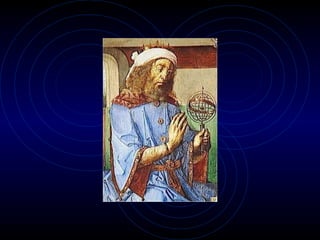
I. History of our position in the universe 2nd Century A.D. – Ptolemy – Earth is the  center of the universe ( geocentric  model)  and orbits of objects  (moon, sun,  planets) are perfect circles.
 
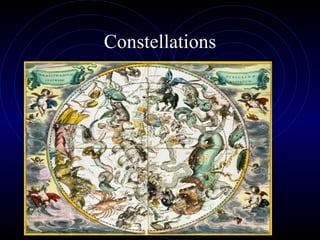
B . Other early observations: Star positions in the sky changed through the night relative to the earth;  but stars did not move  relative to one another. Ex: constellations.
Constellations
2. “ Wanderers ” moved about the stars – other  planets  in their orbits
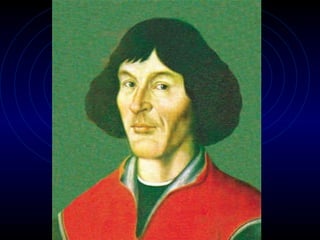
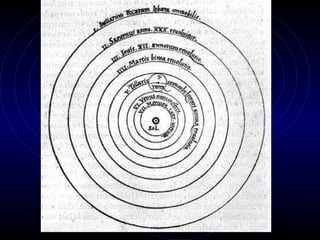
C. Early 1500’s – Nicolaus  Copernicus  –  Earth and other planets orbit the sun ( heliocentric model ) in the same  direction and each planet takes a  different amount of time to orbit the sun.
 
 
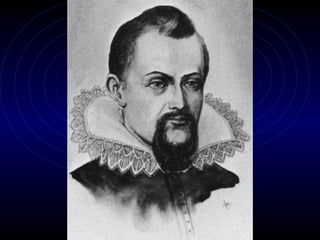
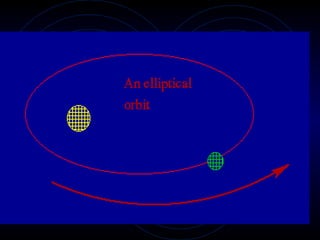
D. 1700’s – Johannes Kepler – Orbits are not perfect circles but  an ellipse  (egg shaped) and  run  counter-clockwise
 
2. Developed  three  laws to help understand planetary orbits around the sun: The path of each planet about the sun is an ellipse with the sun at one focus. b. Each planet moves so that an imaginary line drawn from the sun to the planet sweeps out equal areas in equal periods of time.
 
c. The ratio of the  period of   rotation squared   “ T” of any two planets revolving about the sun is equal to the ratio of the cubes of their  mean distance “R” from the sun.
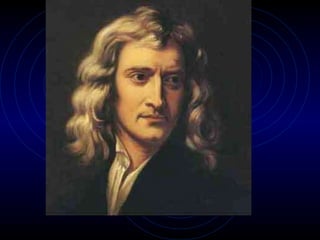
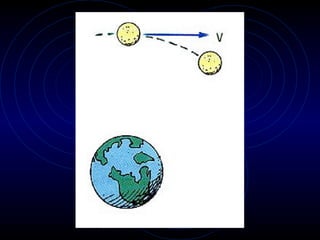
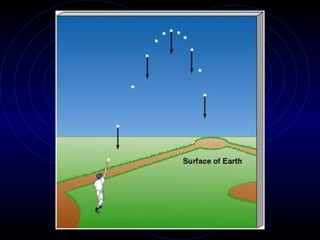
E. Late 1700’s – Issac  Newton  – Developed Law of Inertia (an object’s motion will not change unless the object is acted upon by an outside force). Also, orbits are a result of a planet’s tendency to move in a straight line ( direction ), and the  gravity  of the sun and other celestial bodies (ex: moon).


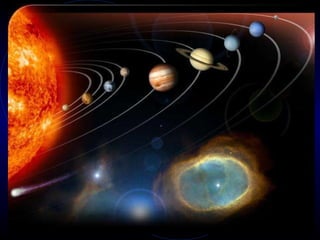
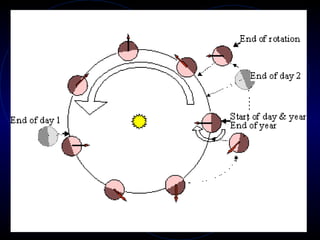
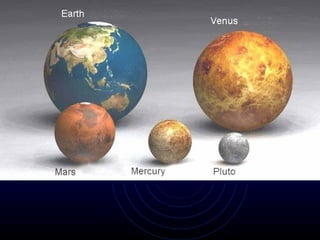
II. Movement of Celestial Bodies A. Period of  Revolution  – making  1 complete orbit  around the sun or planet (for moons) = 1 year; Ex. earth=365.26 days; Mercury=88 days; Pluto=248 earth years. Planets revolve in a counterclockwise direction around the sun.
 
B. Period of  Rotation  – movement of planet  around its axis  = 1 day (day and night cycle); Ex. earth=24 hours; Mercury=59 earth days; Pluto=6 earth days.
 
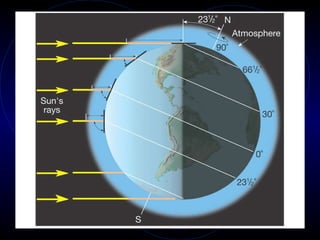
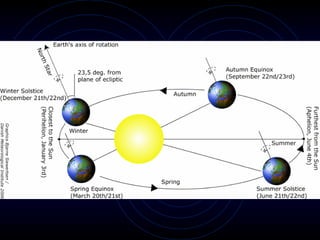
C. Earth is tilted  23.5   degrees  on its axis. The  tilt  is the reason day and night are not  12 hours  each and why we have  seasons . a. The side of the planet tilted  towards  the sun receives  more direct  sunlight and has longer days during the  summer.
C. Earth is tilted  23.5  degrees on its axis. The  tilt  is the reason day and night are not 12 hours each and why we have seasons. 2. The side of the planet tilted  toward  the sun, is receiving  more direct  sunlight and longer days ( summer ).
 
b. The side of the planet tilted  away  from the sun, is receiving  less direct  sunlight and shorter days (winter). c. During the period of revolution where the earth is not tilted   towards or away from sun are autumn and spring.
 
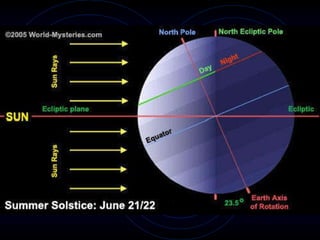
d. Any planet that is tilted on its axis will have  seasons . e. These changes of the seasons are marked by specific dates: i.  Summer  solstice (June 20/21) – the sun appears at its highest point in the sky.  Longest  day of the year ii.  Winter  solstice (December 21/22) – the N. Hemisphere is at full tilt away from sun.  Shortest  day of the year.
iii.  Autumnal equinox  – (day and night equal) September 22/23 iv.  Vernal equinox  – (day and night equal) March 20/21
 
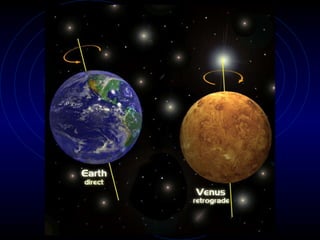
2.  Retrograde rotation  occurs when planets rotate from east to west; normal rotation direction is west to east. Ex.  Venus .
 
Review Questions 1. How is the earth positioned relative to the sun during the summer in the Northern Hemisphere? (you can draw this) The earth is tilted toward the sun.
2. Why is it necessary that we have an  extra day every four years? (hint: think about the period of revolution for the earth) Because is takes 365.26 days for the earth to orbit the sun.
3. Describe how living conditions on earth might change if the earth’s axis were straight up and down instead of tilted. There would not be a change of seasons.
4. What two factors dictate the elliptical orbit pattern of all the planets? What would happen to the orbit of the planets if the sun were to shrink? Inertia and gravity The force of gravity would be less therefore the orbit would increase.
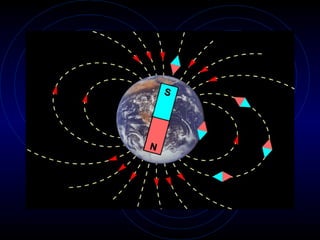
III. The magnetic field of the earth Magnetic field is created from invisible  lines of force connecting the 2 magnetic poles ( not geographic poles ) of the earth. B. Created from the  movement  of materials in the  inner core  of the earth, primarily iron and nickel
 
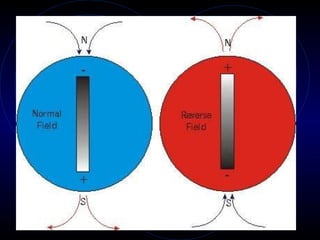
C. Slowly changes over time and  completely  reverses  the field after a period of time. D. Importance of the magnetic field: a. Is important for  navigation  around  the planet. b. Shields earth from  cosmic radiation
 
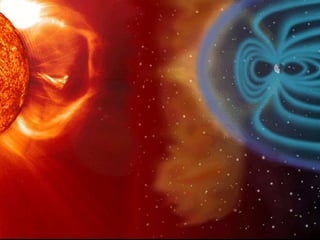
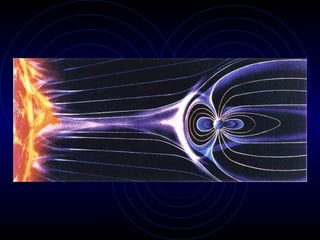
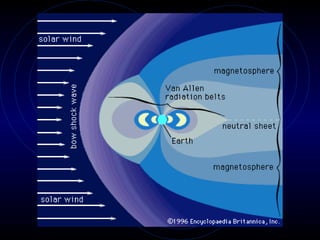
E. Field creates the  magnetosphere  – area of space that is affected by the magnetic field. Begins 1000km in earth’s atmosphere and extends 64,000km into space on side facing sun and millions of kilometers into space on side of earth facing away from the sun (due to  solar wind , blowing the sphere out into space)
 
 
F.  Van Allen  Radiation Belts  1. The inner part of the magnetosphere where charged particles of  solar winds  are trapped.
 
Inner belt has  positive  particles, such as protons. 2. Outer belt has  negative  particles, such as electrons
 
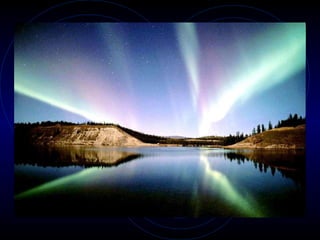
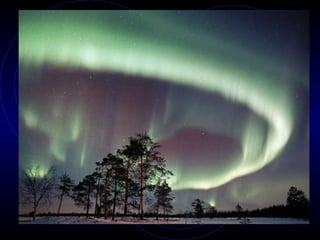
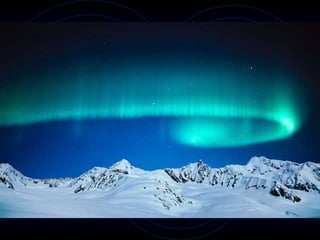
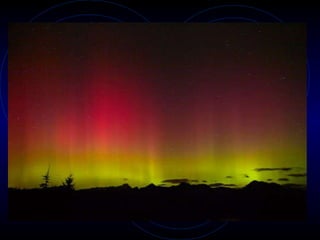
3. When these particles interact with the upper atmosphere layer it creates  aurora   (giving off light). Ex.  northern lights


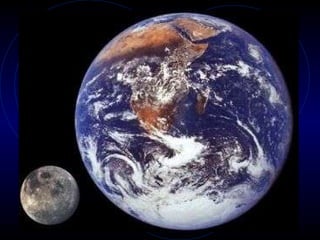
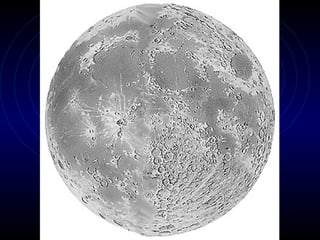
IV. The  Moon , our most important satellite A.  ¼  the size of earth,  1/6  less  gravit y.
 
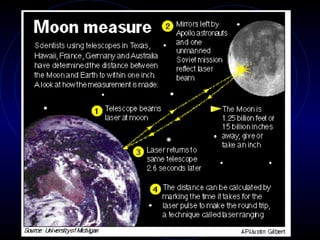
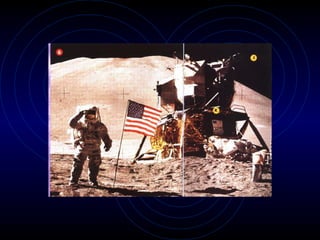
B. 384,403km away from earth. This was determined when astronauts placed a small  mirror  on the moon and a laser was bounced off the mirror from earth. The time to travel to the moon was timed and used to determine the distance, based on the  speed of light .
 
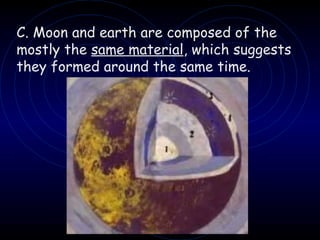
C. Moon and earth are composed of the mostly the  same material , which suggests they formed around the same time.
D. Temperature range of the moon is  100  degrees Celsius during the day and  –175  degrees Celsius at night.
 
 
E. Topography of the moon consists of  craters  (made by meter strikes),  highlands  (extinct volcanoes),  rills  (cracks, either from lava flow or cracks  created from moonquakes)
F. Rotation around axis is around  27   days  and revolution around earth is around  27 days . The  same side  of the moon is ALWAYS facing earth because its rate of  rotation  is equal to its  revolution .
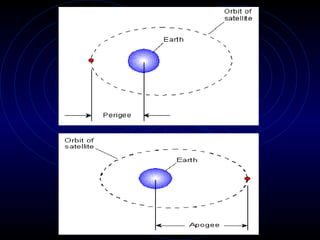
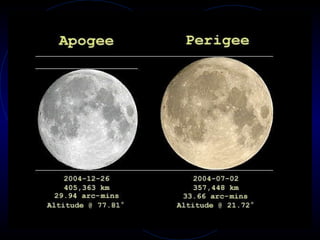
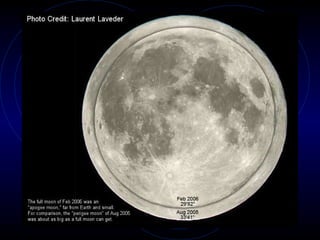
Perigee  is when the orbit of the moon brings it  closest  to the earth 2.  Apogee  is when the orbit of the moon is  farthest  from the earth


G. The Moon appears to move west across the sky (because of the rotation of the earth) but actually moves  eastward   (retrograde rotation).  You can observe the moon relative to stars and you will observe the eastward motion of the earth.
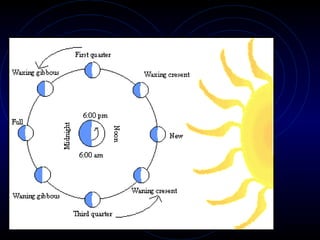
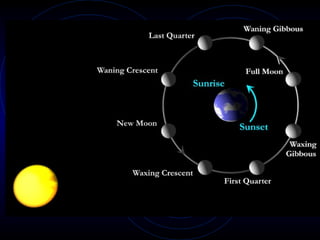
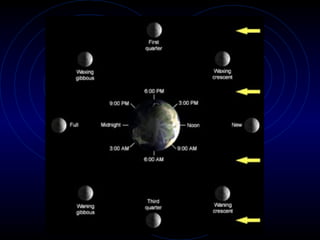
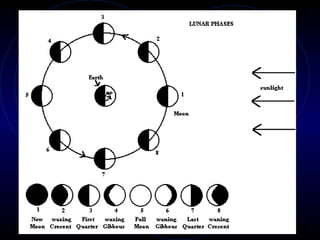
V. Outcome of movements of earth, moon and sun A.  Phases  of the moon - The phases are the result of what  sunlight  is reflected by the moon.


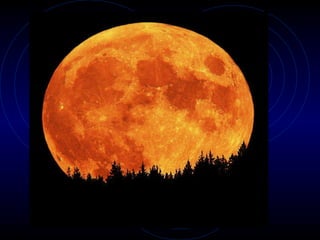
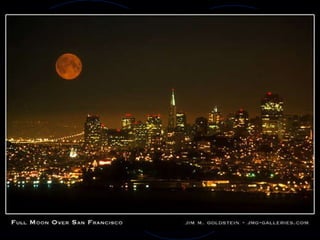
When the moon is  full  the  earth  is  between the sun and the moon, we see  the full side of the moon.
 
 
2. When the moon is  new , the  moon  is  between the earth and the sun, no light is  reflected.


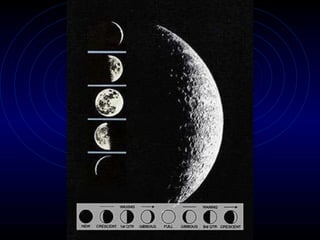
3. A  waxing  moon is the phase where  more  of the moon is gradually seen over two weeks.
 
4. A  waning moon  is the phase where  less of the moon gradually disappears over two weeks.
 
B.  Eclipses  – As the moon and earth revolve together around the sun, sometimes one of the celestial objects  block the suns rays . There are two types.
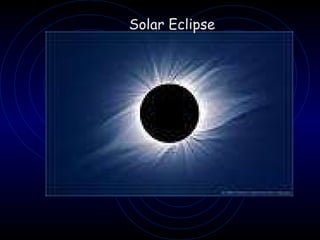
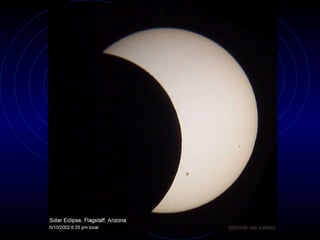
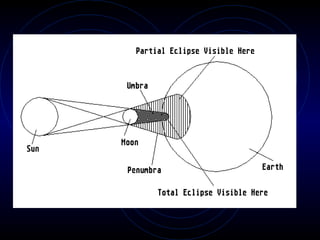
Solar  Eclipse – The  new moon  is between the sun and earth. These do not occur once a month due to the plane of orbit of the moon around the earth. Label the bodies below: sun, moon, earth
Solar Eclipse
 
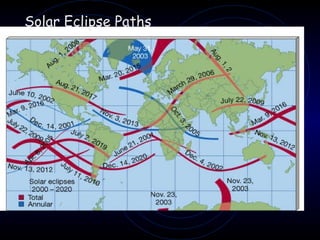
Solar Eclipse Paths
 
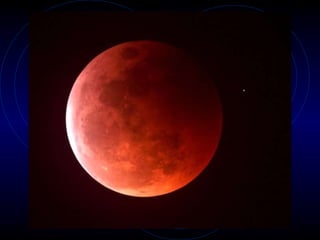
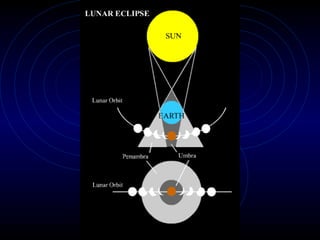
2.  Lunar Eclipse  – When the earth is between the  sun and the full moon , causing the earth’s shadow to fall on the moon (looks dark and coppery color, due to the bending of light waves). Label the bodies below: sun, moon, earth
 
 
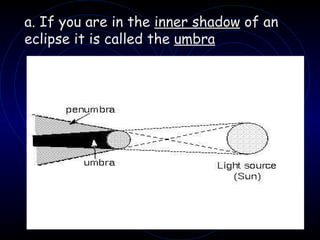
a. If you are in the  inner shadow  of an eclipse it is called the  umbra
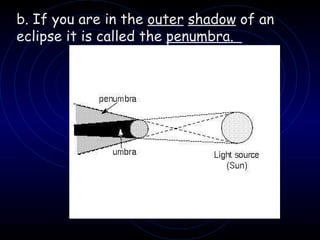
b. If you are in the  outer   shadow  of an eclipse it is called the  penumbra.
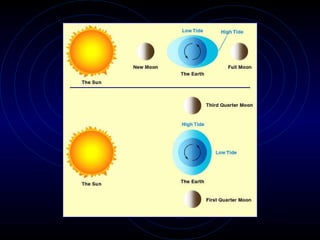
3. Tides – Caused by the  gravitational  pull between the  earth  and the  moon . a. Moon pulls on earth through the orbit, causing the rise and fall of the oceans.
b. Tides go between high and low every  6 hours . There is a 50 minutes delay each day due to the moon  rising  50 minutes later each day.
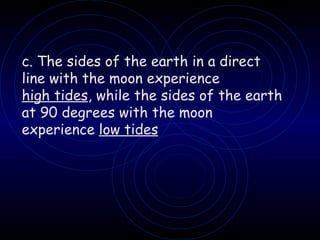
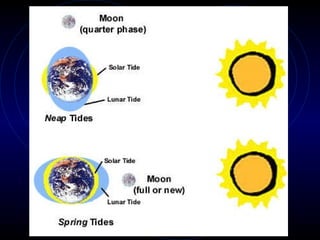
c. The sides of the earth in a direct  line with the moon experience high tides , while the sides of the earth at 90 degrees with the moon experience  low tides
 
d. Full moon and new moons result in higher tides ( spring tides ) because the moon and sun are in  direct line  with the earth,  increasing   the gravitational pull . First quarter and last quarter of the moon phases are the high tides that are  lower  than usual (neap tides) because the moon and sun are at 90o with the earth, there is  less gravitational pull
 
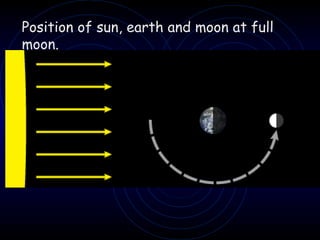
Review Questions 1. Draw the position of the sun, moon and earth of a new moon and a full moon. Remember that the moon revolves around the earth in a counterclockwise direction.
Position of sun, earth and moon at full moon.
2. Why does the lunar eclipse occur either two weeks before or after the total solar eclipse?
What did you Learn? Copy and answer the questions What is a planet? What is an orbit?  How is it shaped? Name two physical forces that affect a planet’s orbit. What do you know about the Earth’s rotation, revolution, and tilt? What do you know about seasonal changes? How does the magnetic field protect the Earth? How does the moon affect the ocean tides? How often do they change? What do you know of the phases of the moon? What is a solar eclipse?  A lunar eclipse? What did you learn about planetary motion that is not listed above?

Chapter 20 planetary motion

  • 1.
    Chapter 20 –Planetary Motion What would happen if the Earth’s orbit changed?
  • 2.
    I. History ofour position in the universe 2nd Century A.D. – Ptolemy – Earth is the center of the universe ( geocentric model) and orbits of objects (moon, sun, planets) are perfect circles.
  • 3.
  • 4.
    B . Otherearly observations: Star positions in the sky changed through the night relative to the earth; but stars did not move relative to one another. Ex: constellations.
  • 5.
  • 6.
    2. “ Wanderers” moved about the stars – other planets in their orbits
  • 7.
    C. Early 1500’s– Nicolaus Copernicus – Earth and other planets orbit the sun ( heliocentric model ) in the same direction and each planet takes a different amount of time to orbit the sun.
  • 8.
  • 9.
  • 10.
    D. 1700’s –Johannes Kepler – Orbits are not perfect circles but an ellipse (egg shaped) and run counter-clockwise
  • 11.
  • 12.
    2. Developed three laws to help understand planetary orbits around the sun: The path of each planet about the sun is an ellipse with the sun at one focus. b. Each planet moves so that an imaginary line drawn from the sun to the planet sweeps out equal areas in equal periods of time.
  • 13.
  • 14.
    c. The ratioof the period of rotation squared “ T” of any two planets revolving about the sun is equal to the ratio of the cubes of their mean distance “R” from the sun.
  • 15.
    E. Late 1700’s– Issac Newton – Developed Law of Inertia (an object’s motion will not change unless the object is acted upon by an outside force). Also, orbits are a result of a planet’s tendency to move in a straight line ( direction ), and the gravity of the sun and other celestial bodies (ex: moon).
  • 16.
  • 17.
  • 18.
  • 19.
    II. Movement ofCelestial Bodies A. Period of Revolution – making 1 complete orbit around the sun or planet (for moons) = 1 year; Ex. earth=365.26 days; Mercury=88 days; Pluto=248 earth years. Planets revolve in a counterclockwise direction around the sun.
  • 20.
  • 21.
    B. Period of Rotation – movement of planet around its axis = 1 day (day and night cycle); Ex. earth=24 hours; Mercury=59 earth days; Pluto=6 earth days.
  • 22.
  • 23.
    C. Earth istilted 23.5 degrees on its axis. The tilt is the reason day and night are not 12 hours each and why we have seasons . a. The side of the planet tilted towards the sun receives more direct sunlight and has longer days during the summer.
  • 24.
    C. Earth istilted 23.5 degrees on its axis. The tilt is the reason day and night are not 12 hours each and why we have seasons. 2. The side of the planet tilted toward the sun, is receiving more direct sunlight and longer days ( summer ).
  • 25.
  • 26.
    b. The sideof the planet tilted away from the sun, is receiving less direct sunlight and shorter days (winter). c. During the period of revolution where the earth is not tilted towards or away from sun are autumn and spring.
  • 27.
  • 28.
    d. Any planetthat is tilted on its axis will have seasons . e. These changes of the seasons are marked by specific dates: i. Summer solstice (June 20/21) – the sun appears at its highest point in the sky. Longest day of the year ii. Winter solstice (December 21/22) – the N. Hemisphere is at full tilt away from sun. Shortest day of the year.
  • 29.
    iii. Autumnalequinox – (day and night equal) September 22/23 iv. Vernal equinox – (day and night equal) March 20/21
  • 30.
  • 31.
    2. Retrograderotation occurs when planets rotate from east to west; normal rotation direction is west to east. Ex. Venus .
  • 32.
  • 33.
    Review Questions 1.How is the earth positioned relative to the sun during the summer in the Northern Hemisphere? (you can draw this) The earth is tilted toward the sun.
  • 34.
    2. Why isit necessary that we have an extra day every four years? (hint: think about the period of revolution for the earth) Because is takes 365.26 days for the earth to orbit the sun.
  • 35.
    3. Describe howliving conditions on earth might change if the earth’s axis were straight up and down instead of tilted. There would not be a change of seasons.
  • 36.
    4. What twofactors dictate the elliptical orbit pattern of all the planets? What would happen to the orbit of the planets if the sun were to shrink? Inertia and gravity The force of gravity would be less therefore the orbit would increase.
  • 37.
    III. The magneticfield of the earth Magnetic field is created from invisible lines of force connecting the 2 magnetic poles ( not geographic poles ) of the earth. B. Created from the movement of materials in the inner core of the earth, primarily iron and nickel
  • 38.
  • 39.
    C. Slowly changesover time and completely reverses the field after a period of time. D. Importance of the magnetic field: a. Is important for navigation around the planet. b. Shields earth from cosmic radiation
  • 40.
  • 41.
    E. Field createsthe magnetosphere – area of space that is affected by the magnetic field. Begins 1000km in earth’s atmosphere and extends 64,000km into space on side facing sun and millions of kilometers into space on side of earth facing away from the sun (due to solar wind , blowing the sphere out into space)
  • 42.
  • 43.
  • 44.
    F. VanAllen Radiation Belts 1. The inner part of the magnetosphere where charged particles of solar winds are trapped.
  • 45.
  • 46.
    Inner belt has positive particles, such as protons. 2. Outer belt has negative particles, such as electrons
  • 47.
  • 48.
    3. When theseparticles interact with the upper atmosphere layer it creates aurora (giving off light). Ex. northern lights
  • 49.
  • 50.
  • 51.
  • 52.
    IV. The Moon , our most important satellite A. ¼ the size of earth, 1/6 less gravit y.
  • 53.
  • 54.
    B. 384,403km awayfrom earth. This was determined when astronauts placed a small mirror on the moon and a laser was bounced off the mirror from earth. The time to travel to the moon was timed and used to determine the distance, based on the speed of light .
  • 55.
  • 56.
    C. Moon andearth are composed of the mostly the same material , which suggests they formed around the same time.
  • 57.
    D. Temperature rangeof the moon is 100 degrees Celsius during the day and –175 degrees Celsius at night.
  • 58.
  • 59.
  • 60.
    E. Topography ofthe moon consists of craters (made by meter strikes), highlands (extinct volcanoes), rills (cracks, either from lava flow or cracks created from moonquakes)
  • 61.
    F. Rotation aroundaxis is around 27 days and revolution around earth is around 27 days . The same side of the moon is ALWAYS facing earth because its rate of rotation is equal to its revolution .
  • 62.
    Perigee iswhen the orbit of the moon brings it closest to the earth 2. Apogee is when the orbit of the moon is farthest from the earth
  • 63.
  • 64.
  • 65.
  • 66.
  • 67.
    G. The Moonappears to move west across the sky (because of the rotation of the earth) but actually moves eastward (retrograde rotation). You can observe the moon relative to stars and you will observe the eastward motion of the earth.
  • 68.
    V. Outcome ofmovements of earth, moon and sun A. Phases of the moon - The phases are the result of what sunlight is reflected by the moon.
  • 69.
  • 70.
  • 71.
  • 72.
    When the moonis full the earth is between the sun and the moon, we see the full side of the moon.
  • 73.
  • 74.
  • 75.
    2. When themoon is new , the moon is between the earth and the sun, no light is reflected.
  • 76.
  • 77.
  • 78.
  • 79.
    3. A waxing moon is the phase where more of the moon is gradually seen over two weeks.
  • 80.
  • 81.
    4. A waning moon is the phase where less of the moon gradually disappears over two weeks.
  • 82.
  • 83.
    B. Eclipses – As the moon and earth revolve together around the sun, sometimes one of the celestial objects block the suns rays . There are two types.
  • 84.
    Solar Eclipse– The new moon is between the sun and earth. These do not occur once a month due to the plane of orbit of the moon around the earth. Label the bodies below: sun, moon, earth
  • 85.
  • 86.
  • 87.
  • 88.
  • 89.
    2. LunarEclipse – When the earth is between the sun and the full moon , causing the earth’s shadow to fall on the moon (looks dark and coppery color, due to the bending of light waves). Label the bodies below: sun, moon, earth
  • 90.
  • 91.
  • 92.
    a. If youare in the inner shadow of an eclipse it is called the umbra
  • 93.
    b. If youare in the outer shadow of an eclipse it is called the penumbra.
  • 94.
    3. Tides –Caused by the gravitational pull between the earth and the moon . a. Moon pulls on earth through the orbit, causing the rise and fall of the oceans.
  • 95.
    b. Tides gobetween high and low every 6 hours . There is a 50 minutes delay each day due to the moon rising 50 minutes later each day.
  • 96.
    c. The sidesof the earth in a direct line with the moon experience high tides , while the sides of the earth at 90 degrees with the moon experience low tides
  • 97.
  • 98.
    d. Full moonand new moons result in higher tides ( spring tides ) because the moon and sun are in direct line with the earth, increasing the gravitational pull . First quarter and last quarter of the moon phases are the high tides that are lower than usual (neap tides) because the moon and sun are at 90o with the earth, there is less gravitational pull
  • 99.
  • 100.
    Review Questions 1.Draw the position of the sun, moon and earth of a new moon and a full moon. Remember that the moon revolves around the earth in a counterclockwise direction.
  • 101.
    Position of sun,earth and moon at full moon.
  • 102.
    2. Why doesthe lunar eclipse occur either two weeks before or after the total solar eclipse?
  • 103.
    What did youLearn? Copy and answer the questions What is a planet? What is an orbit? How is it shaped? Name two physical forces that affect a planet’s orbit. What do you know about the Earth’s rotation, revolution, and tilt? What do you know about seasonal changes? How does the magnetic field protect the Earth? How does the moon affect the ocean tides? How often do they change? What do you know of the phases of the moon? What is a solar eclipse? A lunar eclipse? What did you learn about planetary motion that is not listed above?