First Law –
Law of the Ellipses
Second Law –
Law of Equal Areas
Third Law –
Law of Harmonics
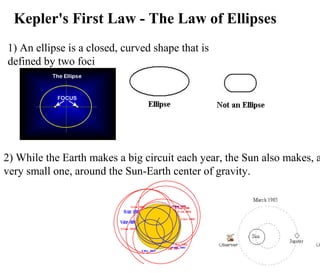
Kepler's First Law - The Law of Ellipses
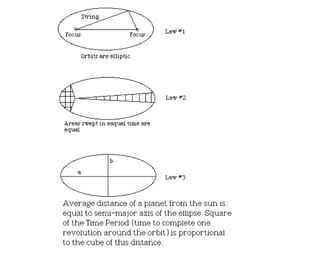
1) An ellipse is a closed, curved shape that is
defined by two foci
2) While the Earth makes a big circuit each year, the Sun also makes, a
very small one, around the Sun-Earth center of gravity.
3) The long one is called the major axis, and the short
one is called the minor axis
4) The shape of an ellipse is measured by its
eccentricity – Whether it is like a circle or oval
5) Eccentricity can be from 0 ( a circle) to .95
(almost a line)
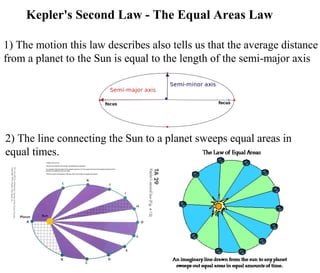
Kepler's Second Law - The Equal Areas Law
1) The motion this law describes also tells us that the average distance
from a planet to the Sun is equal to the length of the semi-major axis
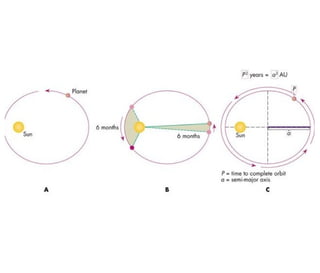
2) The line connecting the Sun to a planet sweeps equal areas in
equal times.
3) Although the orbit is symmetric, the motion is not. A planet speeds
up as it approaches the Sun, gets its greatest velocity when passing
closest, then slows down again.
What would happen if the Earth’s orbit was a Circle?
Kepler's Third Law: The Harmonic Law
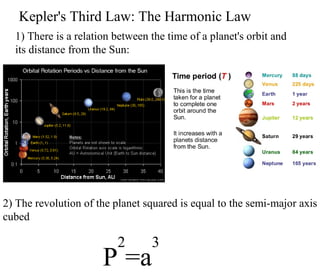
1) There is a relation between the time of a planet's orbit and
its distance from the Sun:
2) The revolution of the planet squared is equal to the semi-major axis
cubed
P
2
=a
3
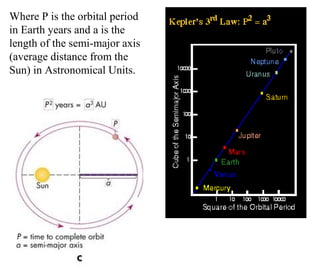
Where P is the orbital period
in Earth years and a is the
length of the semi-major axis
(average distance from the
Sun) in Astronomical Units.
Kepler laws Notes
Kepler laws Notes

Kepler laws Notes

  • 2.
    First Law – Lawof the Ellipses Second Law – Law of Equal Areas Third Law – Law of Harmonics
  • 3.
    Kepler's First Law- The Law of Ellipses 1) An ellipse is a closed, curved shape that is defined by two foci 2) While the Earth makes a big circuit each year, the Sun also makes, a very small one, around the Sun-Earth center of gravity.
  • 4.
    3) The longone is called the major axis, and the short one is called the minor axis 4) The shape of an ellipse is measured by its eccentricity – Whether it is like a circle or oval 5) Eccentricity can be from 0 ( a circle) to .95 (almost a line)
  • 5.
    Kepler's Second Law- The Equal Areas Law 1) The motion this law describes also tells us that the average distance from a planet to the Sun is equal to the length of the semi-major axis 2) The line connecting the Sun to a planet sweeps equal areas in equal times.
  • 6.
    3) Although theorbit is symmetric, the motion is not. A planet speeds up as it approaches the Sun, gets its greatest velocity when passing closest, then slows down again. What would happen if the Earth’s orbit was a Circle?
  • 7.
    Kepler's Third Law:The Harmonic Law 1) There is a relation between the time of a planet's orbit and its distance from the Sun: 2) The revolution of the planet squared is equal to the semi-major axis cubed P 2 =a 3
  • 8.
    Where P isthe orbital period in Earth years and a is the length of the semi-major axis (average distance from the Sun) in Astronomical Units.