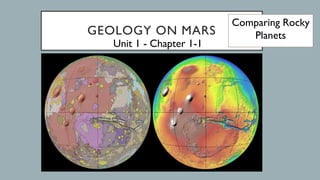
GEOLOGY ON MARS
Unit 1 - Chapter 1-1
Comparing Rocky
Planets
Earth and space science is the study of processes on Earth and in
other locations within our solar system and galaxy.
Your goal is to see the world like an Earth Scientist.Use what you to explain new ideas and to solve problems.Earth Scientists question if there is life beyond planet Earth.
Scientists use advanced tools to see if other planets could
support life.
In this unit, you will learn how Earth scientists use what they know about Earth
to help them in the search for possible life.
Your role - student planetary geologists.A geologist is a type of Earth scientist.
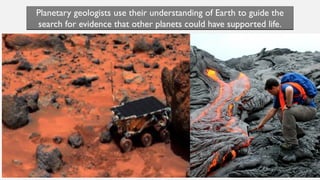
Planetary geologists use their understanding of Earth to guide the
search for evidence that other planets could have supported life.
Universal Space Agency
Universal Space Agency – Fictional – Not Real
Based on real organizations that explore space.
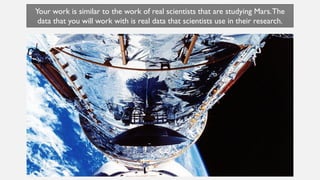
Your work is similar to the work of real scientists that are studying Mars.The
data that you will work with is real data that scientists use in their research.
WHAT DOES A PLANET NEED TO SUPPORT LIFE?
• You will help the Universal Space Agency search
for evidence that other planets could support
life.
• Talk to a partner about what you think a planet
would need to support life.
• Be ready to share!
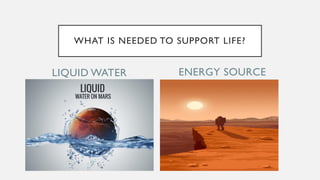
LIQUID WATER ENERGY SOURCE
WHAT IS NEEDED TO SUPPORT LIFE?
Habitable: having the conditions necessary to support life
When a place has the conditions necessary to support life,
we say that place is habitable.
WHERE TO VIEW AND ACCESS
VOCABULARY
•You will be provided a copy of vocabulary for your
folder.
•You can also access vocabulary online…
• On Quizlet (Go to class website)
• On Amplify in digital resources
The Unit Question refers to evidence
that planets were once habitable.
Scientists are interested in evidence that a
planet that is not habitable now could have
been habitable in the past.
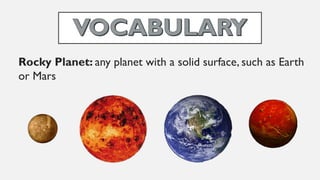
Rocky Planet: any planet with a solid surface, such as Earth
or Mars
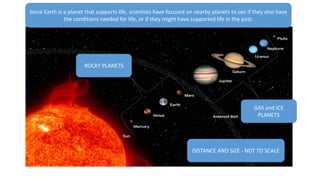
ROCKY PLANETS
GAS and ICE
PLANETS
DISTANCE AND SIZE - NOT TO SCALE
MILKY WAY GALAXYOUR UNIVERSESince Earth is a planet that supports life, scientists have focused on nearby planets to see if they also have
the conditions needed for life, or if they might have supported life in the past.
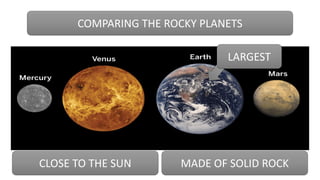
COMPARING THE ROCKY PLANETS
MADE OF SOLID ROCKCLOSE TO THE SUN
LARGEST
How does our understanding of Earth help us learn
about other rocky planets?
Planetary Geologists use their knowledge of Earth to learn about other
rocky planets because of the similarities they have.
You will learn about this process over the next few days.
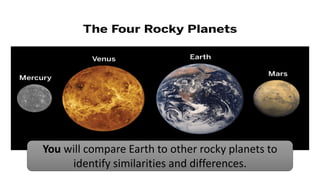
You will compare Earth to other rocky planets to
identify similarities and differences.
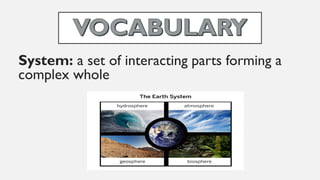
System: a set of interacting parts forming a
complex whole
When scientists think of Earth as a whole, they think
of it as a system.
A system is a set of interacting parts forming a
complex whole.
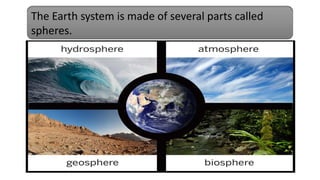
The Earth system is made of several parts called
spheres.
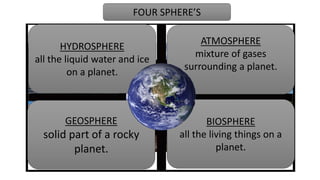
ATMOSPHERE
mixture of gases
surrounding a planet.
FOUR SPHERE’S
HYDROSPHERE
all the liquid water and ice
on a planet.
GEOSPHERE
solid part of a rocky
planet.
BIOSPHERE
all the living things on a
planet.
These spheres are constantly interacting, creating
changes on Earth.
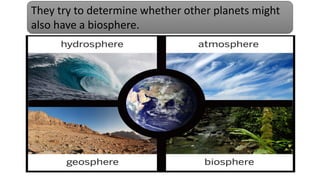
Scientists examine other planets’ atmospheres, hydrospheres, and
geospheres and compare them to those on Earth.
They try to determine whether other planets might
also have a biosphere.
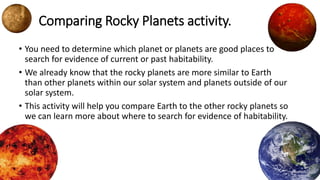
Comparing Rocky Planets activity.
• You need to determine which planet or planets are good places to
search for evidence of current or past habitability.
• We already know that the rocky planets are more similar to Earth
than other planets within our solar system and planets outside of our
solar system.
• This activity will help you compare Earth to the other rocky planets so
we can learn more about where to search for evidence of habitability.
Comparing Rocky Planets activity.
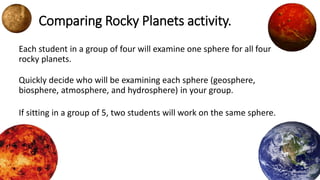
Each student in a group of four will examine one sphere for all four
rocky planets.
Quickly decide who will be examining each sphere (geosphere,
biosphere, atmosphere, and hydrosphere) in your group.
If sitting in a group of 5, two students will work on the same sphere.
Comparing Rocky Planets activity.
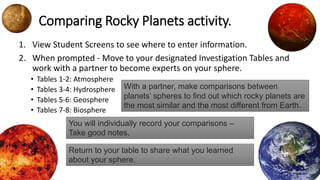
1. View Student Screens to see where to enter information.
2. When prompted - Move to your designated Investigation Tables and
work with a partner to become experts on your sphere.
• Tables 1-2: Atmosphere
• Tables 3-4: Hydrosphere
• Tables 5-6: Geosphere
• Tables 7-8: Biosphere
With a partner, make comparisons between
planets’ spheres to find out which rocky planets are
the most similar and the most different from Earth.
You will individually record your comparisons –
Take good notes.
Return to your table to share what you learned
about your sphere.
OBTAIN YOUR CARDS FROM CENTER OF TABLE
BEGIN COMPARING ROCKY PLANETS
1. Read Card from Earth
2. Read other planet cards to make comparisons
3. Take thorough notes on your screen
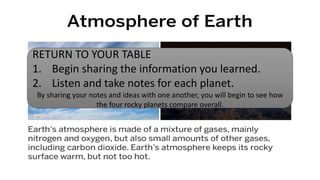
RETURN TO YOUR TABLE
1. Begin sharing the information you learned.
2. Listen and take notes for each planet.
By sharing your notes and ideas with one another, you will begin to see how
the four rocky planets compare overall.
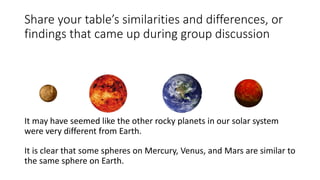
Share your table’s similarities and differences, or
findings that came up during group discussion
It may have seemed like the other rocky planets in our solar system
were very different from Earth.
It is clear that some spheres on Mercury, Venus, and Mars are similar to
the same sphere on Earth.
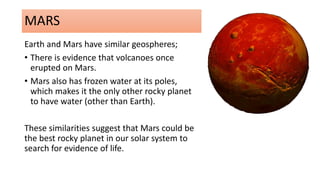
MARS
Earth and Mars have similar geospheres;
• There is evidence that volcanoes once
erupted on Mars.
• Mars also has frozen water at its poles,
which makes it the only other rocky planet
to have water (other than Earth).
These similarities suggest that Mars could be
the best rocky planet in our solar system to
search for evidence of life.
Clip your cards back together.
MEET A
PLANETARY GEOLOGIST
• You already have some idea of what planetary geologists do.
• You will hear from a real planetary geologist who is using what she knows about Earth
to learn about Mars.
• This will help you better understand your role as student planetary geologists and
how what you are doing in this unit is similar to what real scientists do.
DR. LAUREN EDGAR –
PLANETARY GEOLOGIST
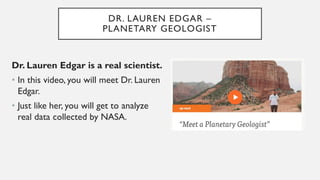
Dr. Lauren Edgar is a real scientist.
• In this video, you will meet Dr. Lauren
Edgar.
• Just like her, you will get to analyze
real data collected by NASA.
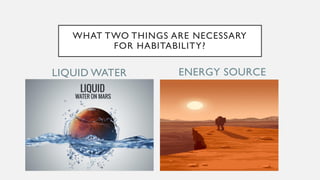
LIQUID WATER ENERGY SOURCE
WHAT TWO THINGS ARE NECESSARY
FOR HABITABILITY?
A PLANETS SYSTEM IS CONSTANTLY
CHANGING
Scientists are looking for evidence of past habitability.
Scientists have looked and have not found bodies of liquid water, it’s not likely that Mars
is habitable right now.
Just because Mars doesn’t have bodies of liquid water now, doesn’t mean it didn’t in the
past.
A planet’s system is constantly changing.
DR. LAUREN EDGAR –
PLANETARY GEOLOGIST
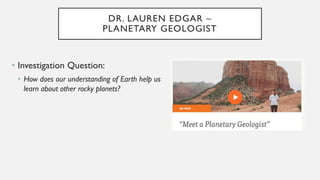
• Investigation Question:
• How does our understanding of Earth help us
learn about other rocky planets?
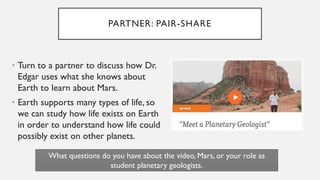
PARTNER: PAIR-SHARE
• Turn to a partner to discuss how Dr.
Edgar uses what she knows about
Earth to learn about Mars.
• Earth supports many types of life, so
we can study how life exists on Earth
in order to understand how life could
possibly exist on other planets.
What questions do you have about the video, Mars, or your role as
student planetary geologists.
TRACKING NEW IDEAS ON THE
CLASSROOM WALL
This is where we will keep track of our questions, ideas, and vocabulary
during this unit.
You can refer to this area to remember some of the new things we are
learning.
DISCUSS THE UNIT QUESTION
You might already have some ideas about the Unit Question.
Share how comparing Earth with other rocky planets helped you learn about how
scientists search for evidence that other planets were once habitable.
Remember your comparisons of the rocky planets and the similarities between Earth and
Mars.
We were able to narrow our focus to Mars as a good place to search for evidence of past
habitability.
Unit Question - This is the question you will try to answer throughout
the unit.
How can we search for evidence that other planets were once
habitable?
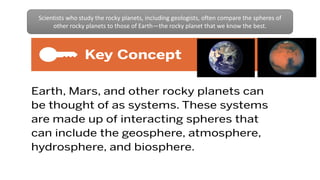
Comparing Rocky Planets activity enforced this key concept
Scientists who study the rocky planets, including geologists, often compare the spheres of
other rocky planets to those of Earth—the rocky planet that we know the best.
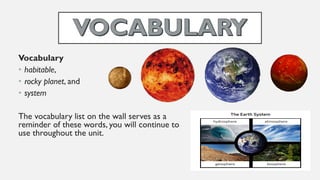
Vocabulary
• habitable,
• rocky planet, and
• system
The vocabulary list on the wall serves as a
reminder of these words, you will continue to
use throughout the unit.
1.1.5: (Activity 5).
Record your ideas about what signs of habitability to look for on
Mars.
You will also read an article about scale in the solar system.

Geology on Mars - Comparing Rocky Planets

  • 1.
    GEOLOGY ON MARS Unit1 - Chapter 1-1 Comparing Rocky Planets
  • 3.
    Earth and spacescience is the study of processes on Earth and in other locations within our solar system and galaxy. Your goal is to see the world like an Earth Scientist.Use what you to explain new ideas and to solve problems.Earth Scientists question if there is life beyond planet Earth. Scientists use advanced tools to see if other planets could support life. In this unit, you will learn how Earth scientists use what they know about Earth to help them in the search for possible life.
  • 4.
    Your role -student planetary geologists.A geologist is a type of Earth scientist. Planetary geologists use their understanding of Earth to guide the search for evidence that other planets could have supported life.
  • 5.
    Universal Space Agency UniversalSpace Agency – Fictional – Not Real Based on real organizations that explore space. Your work is similar to the work of real scientists that are studying Mars.The data that you will work with is real data that scientists use in their research.
  • 6.
    WHAT DOES APLANET NEED TO SUPPORT LIFE? • You will help the Universal Space Agency search for evidence that other planets could support life. • Talk to a partner about what you think a planet would need to support life. • Be ready to share!
  • 7.
    LIQUID WATER ENERGYSOURCE WHAT IS NEEDED TO SUPPORT LIFE?
  • 8.
    Habitable: having theconditions necessary to support life When a place has the conditions necessary to support life, we say that place is habitable.
  • 9.
    WHERE TO VIEWAND ACCESS VOCABULARY •You will be provided a copy of vocabulary for your folder. •You can also access vocabulary online… • On Quizlet (Go to class website) • On Amplify in digital resources
  • 10.
    The Unit Questionrefers to evidence that planets were once habitable. Scientists are interested in evidence that a planet that is not habitable now could have been habitable in the past.
  • 11.
    Rocky Planet: anyplanet with a solid surface, such as Earth or Mars
  • 12.
    ROCKY PLANETS GAS andICE PLANETS DISTANCE AND SIZE - NOT TO SCALE MILKY WAY GALAXYOUR UNIVERSESince Earth is a planet that supports life, scientists have focused on nearby planets to see if they also have the conditions needed for life, or if they might have supported life in the past.
  • 13.
    COMPARING THE ROCKYPLANETS MADE OF SOLID ROCKCLOSE TO THE SUN LARGEST
  • 14.
    How does ourunderstanding of Earth help us learn about other rocky planets? Planetary Geologists use their knowledge of Earth to learn about other rocky planets because of the similarities they have. You will learn about this process over the next few days.
  • 15.
    You will compareEarth to other rocky planets to identify similarities and differences.
  • 16.
    System: a setof interacting parts forming a complex whole
  • 17.
    When scientists thinkof Earth as a whole, they think of it as a system. A system is a set of interacting parts forming a complex whole. The Earth system is made of several parts called spheres.
  • 18.
    ATMOSPHERE mixture of gases surroundinga planet. FOUR SPHERE’S HYDROSPHERE all the liquid water and ice on a planet. GEOSPHERE solid part of a rocky planet. BIOSPHERE all the living things on a planet.
  • 19.
    These spheres areconstantly interacting, creating changes on Earth. Scientists examine other planets’ atmospheres, hydrospheres, and geospheres and compare them to those on Earth. They try to determine whether other planets might also have a biosphere.
  • 20.
    Comparing Rocky Planetsactivity. • You need to determine which planet or planets are good places to search for evidence of current or past habitability. • We already know that the rocky planets are more similar to Earth than other planets within our solar system and planets outside of our solar system. • This activity will help you compare Earth to the other rocky planets so we can learn more about where to search for evidence of habitability.
  • 21.
    Comparing Rocky Planetsactivity. Each student in a group of four will examine one sphere for all four rocky planets. Quickly decide who will be examining each sphere (geosphere, biosphere, atmosphere, and hydrosphere) in your group. If sitting in a group of 5, two students will work on the same sphere.
  • 22.
    Comparing Rocky Planetsactivity. 1. View Student Screens to see where to enter information. 2. When prompted - Move to your designated Investigation Tables and work with a partner to become experts on your sphere. • Tables 1-2: Atmosphere • Tables 3-4: Hydrosphere • Tables 5-6: Geosphere • Tables 7-8: Biosphere With a partner, make comparisons between planets’ spheres to find out which rocky planets are the most similar and the most different from Earth. You will individually record your comparisons – Take good notes. Return to your table to share what you learned about your sphere.
  • 23.
    OBTAIN YOUR CARDSFROM CENTER OF TABLE BEGIN COMPARING ROCKY PLANETS 1. Read Card from Earth 2. Read other planet cards to make comparisons 3. Take thorough notes on your screen RETURN TO YOUR TABLE 1. Begin sharing the information you learned. 2. Listen and take notes for each planet. By sharing your notes and ideas with one another, you will begin to see how the four rocky planets compare overall.
  • 24.
    Share your table’ssimilarities and differences, or findings that came up during group discussion It may have seemed like the other rocky planets in our solar system were very different from Earth. It is clear that some spheres on Mercury, Venus, and Mars are similar to the same sphere on Earth.
  • 25.
    MARS Earth and Marshave similar geospheres; • There is evidence that volcanoes once erupted on Mars. • Mars also has frozen water at its poles, which makes it the only other rocky planet to have water (other than Earth). These similarities suggest that Mars could be the best rocky planet in our solar system to search for evidence of life.
  • 26.
    Clip your cardsback together.
  • 27.
    MEET A PLANETARY GEOLOGIST •You already have some idea of what planetary geologists do. • You will hear from a real planetary geologist who is using what she knows about Earth to learn about Mars. • This will help you better understand your role as student planetary geologists and how what you are doing in this unit is similar to what real scientists do.
  • 28.
    DR. LAUREN EDGAR– PLANETARY GEOLOGIST Dr. Lauren Edgar is a real scientist. • In this video, you will meet Dr. Lauren Edgar. • Just like her, you will get to analyze real data collected by NASA.
  • 29.
    LIQUID WATER ENERGYSOURCE WHAT TWO THINGS ARE NECESSARY FOR HABITABILITY?
  • 30.
    A PLANETS SYSTEMIS CONSTANTLY CHANGING Scientists are looking for evidence of past habitability. Scientists have looked and have not found bodies of liquid water, it’s not likely that Mars is habitable right now. Just because Mars doesn’t have bodies of liquid water now, doesn’t mean it didn’t in the past. A planet’s system is constantly changing.
  • 31.
    DR. LAUREN EDGAR– PLANETARY GEOLOGIST • Investigation Question: • How does our understanding of Earth help us learn about other rocky planets?
  • 32.
    PARTNER: PAIR-SHARE • Turnto a partner to discuss how Dr. Edgar uses what she knows about Earth to learn about Mars. • Earth supports many types of life, so we can study how life exists on Earth in order to understand how life could possibly exist on other planets. What questions do you have about the video, Mars, or your role as student planetary geologists.
  • 33.
    TRACKING NEW IDEASON THE CLASSROOM WALL This is where we will keep track of our questions, ideas, and vocabulary during this unit. You can refer to this area to remember some of the new things we are learning.
  • 34.
    DISCUSS THE UNITQUESTION You might already have some ideas about the Unit Question. Share how comparing Earth with other rocky planets helped you learn about how scientists search for evidence that other planets were once habitable. Remember your comparisons of the rocky planets and the similarities between Earth and Mars. We were able to narrow our focus to Mars as a good place to search for evidence of past habitability. Unit Question - This is the question you will try to answer throughout the unit. How can we search for evidence that other planets were once habitable?
  • 35.
    Comparing Rocky Planetsactivity enforced this key concept Scientists who study the rocky planets, including geologists, often compare the spheres of other rocky planets to those of Earth—the rocky planet that we know the best.
  • 36.
    Vocabulary • habitable, • rockyplanet, and • system The vocabulary list on the wall serves as a reminder of these words, you will continue to use throughout the unit.
  • 37.
    1.1.5: (Activity 5). Recordyour ideas about what signs of habitability to look for on Mars. You will also read an article about scale in the solar system.