Earth and Life
Science
Quarter 1: Module 1-4
1
11
2
DEVELOPMENT TEAM OF THE MODULE
WRITERS: MARIA SHEILA M. PELIGRINO, Master Teacher I
MICHELLE ANN V. VILLACORTA, Teacher III
TERESITA K. DELA CRUZ, Teacher III
CONSOLIDATOR: MICHELLE ANN V. VILLACORTA, Teacher III
LANGUAGE EDITOR: CATHERINE P. DE LOS REYES, Teacher I
CONTENT JULIE ANDREA P. AÑANO, Master Teacher I
VALIDATORS: AYRA PATRICIA S. ALVERO, Teacher III
CHRISTIAN MARU S. GARCIA, Teacher III
JOSELITO P. GRANDE JR. , Teacher II
COVER PAGE AIRA MARI CON M. AUSTERO
ILLUSTRATOR:
TEAM LEADER: DR. RAQUEL M. AUSTERO
Education Program Supervisor
Module 1 Earth as a Unique Planet
Most Essential Learning Competencies
● Recognize the uniqueness of the Earth, being the only planet in the solar
system with properties necessary to support life. (S11/12ES-Ia-e3)
● Explain that the Earth consists of four subsystems, across whose
boundaries matter and energy flow. (S11/12ES-Ia-e4)
What’s In
Characteristics of Earth as a Planet
The Earth is a unique planet among the other planets because of the life
exists on it. Here are the characteristics that make Earth a unique planet:
 There are few stars around the Sun making it safe from gravitational pulls,
gamma rays and collapsing; it makes our planet in a safe region in our solar
system. Unlike other young stars that burst and explode, our Sun is a stable
star making it a long-lasting star.
 Our planet’s orbit is called as the Goldilocks’ Zone because the water exists in a
liquid state on its surface due to the right amount of energy the Earth is
receiving from the Sun.
 The Earth’s core produces its own magnetic field thus protecting our planet
from solar flares coming from the Sun.
 The Earth was tilted towards the Sun making it shakes while it goes around
the Sun. It can shift the climate from hot to cold at around 40,000 years that
may vary because of the Moon’s gravitational pull.
 It has a high altitude ozone layer protecting us from unsafe UV rays.
Astronomical Data Venus Earth Mars
Mean distance from Sun (108
kilometers) 1.082 1.496 2.2794
3
Comparative solar distances 0.723 1 1.524
Orbital period 0.615 1 1.881
Rotational period (hours) 5832.24 23.9345 24.6229
Equatorial radius (kilometers) 6052 6378 3397
Relative Radius 0.95 1 0.53
Earth as a System
System is a set of things working together as parts of a mechanism or an
interconnecting network. Earth acts as a system that are related to each other,
the system of Earth is consisted by the different subsystems:
1. Biosphere includes all living things on Earth. Even in deep vents that light
cannot penetrate serve as a habitat to the exotic-life forms and in the hot
springs for the bacteria.
2. Atmosphere is a blanket of gas that surrounds our planet up to the edge of
space. The very important roles of this part is to provide us the air that we
breath and protect us from the ultraviolet radiation that comes from the Sun.
Layers of the Atmosphere:
 Troposphere is the bottom layer wherein the weather occurs.
 Tropopause is the outer boundary.
4
Source: https://www.pinterest.com.au/pin/221591244137179141/
Table. Comparison of the Three Planets in Terms of Gases Present
Source: https://www.researchgate.net/figure/Basic-data-about-Venus-with-Earth-and-Mars-for-comparison_tbl1_322668645
 Stratosphere is the layer where the ozone layer is located; the ozone
absorbs the ultraviolet radiation from the Sun. The outer layer in the
stratopause.
 Mesosphere is the third layer which is the coldest layer; research
balloons cannot reach this layer.
 Thermosphere is fourth layer wherein a little fraction of atmosphere is
present.
 Exosphere the outermost layer; and the thinnest layer of atmosphere
because the atmosphere gases fade until reaching vacuum of space.
3. Geosphere is the solid part of portion of the Earth. It is the largest among the
rest of the Earth’s subsystems.
Layers of the Earth
A. Crust is the thin rocky outer layer of the Earth.
Two types: continental (granitic rocks) and oceanic (basaltic rocks); rocks
of the oceanic crust are younger than the rocks at the continental crust.
B. Mantle is the thickest layer that consists the 82% of the Earth’s volume.
Two parts: upper mantle is divided into two, the lithosphere (sphere of
rock) and the asthenosphere (weak sphere: solid but mobile and the
lower mantle is solid due to the increasing pressure and it has very hot
rocks that are capable of having a gradual flow.
C. Core is thought to be an iron-nickel alloy with minor oxygen, silicon and
sulfur.
Two regions: outer core is a liquid layer that is responsible in producing
the magnetic field of the Earth; inner core is solid because of the extreme
pressure in the center of the Earth.
4. Hydrosphere is all the waters on or near the Earth surface that continuously
moving, evaporating and back to precipitating to the land and back to the
ocean. The main role of this part is to provide fresh water to the organisms
and is important to produce different landforms.
5
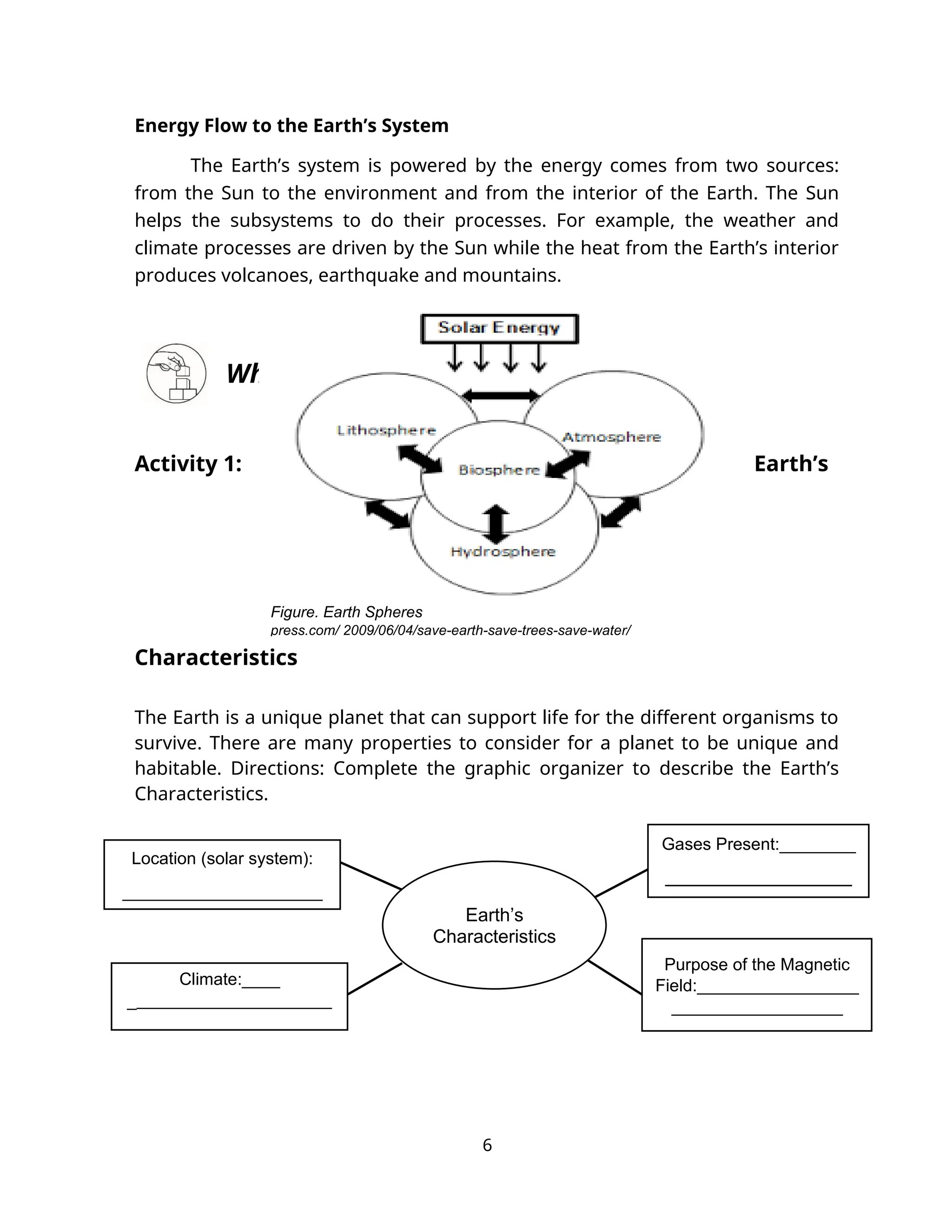
Energy Flow to the Earth’s System
The Earth’s system is powered by the energy comes from two sources:
from the Sun to the environment and from the interior of the Earth. The Sun
helps the subsystems to do their processes. For example, the weather and
climate processes are driven by the Sun while the heat from the Earth’s interior
produces volcanoes, earthquake and mountains.
What’s More
Activity 1: Earth’s
Characteristics
The Earth is a unique planet that can support life for the different organisms to
survive. There are many properties to consider for a planet to be unique and
habitable. Directions: Complete the graphic organizer to describe the Earth’s
Characteristics.
6
Figure. Earth Spheres
press.com/ 2009/06/04/save-earth-save-trees-save-water/
Earth’s
Characteristics
Purpose of the Magnetic
Field:_________________
__________________
Climate:____
________________________
____________
Location (solar system):
_____________________
Gases Present:________
______________________
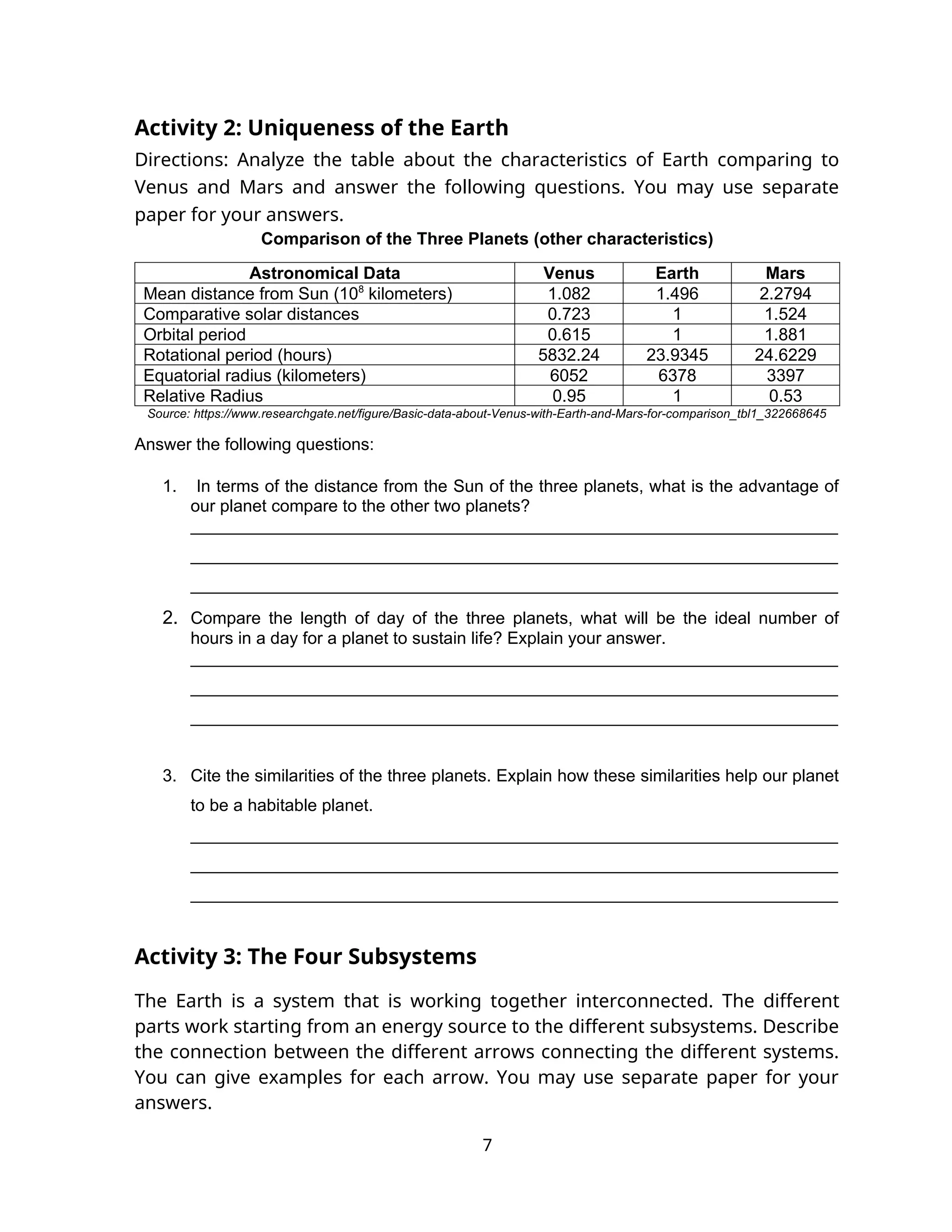
Activity 2: Uniqueness of the Earth
Directions: Analyze the table about the characteristics of Earth comparing to
Venus and Mars and answer the following questions. You may use separate
paper for your answers.
Comparison of the Three Planets (other characteristics)
Astronomical Data Venus Earth Mars
Mean distance from Sun (108
kilometers) 1.082 1.496 2.2794
Comparative solar distances 0.723 1 1.524
Orbital period 0.615 1 1.881
Rotational period (hours) 5832.24 23.9345 24.6229
Equatorial radius (kilometers) 6052 6378 3397
Relative Radius 0.95 1 0.53
Source: https://www.researchgate.net/figure/Basic-data-about-Venus-with-Earth-and-Mars-for-comparison_tbl1_322668645
Answer the following questions:
1. In terms of the distance from the Sun of the three planets, what is the advantage of
our planet compare to the other two planets?
____________________________________________________________________
____________________________________________________________________
____________________________________________________________________
2. Compare the length of day of the three planets, what will be the ideal number of
hours in a day for a planet to sustain life? Explain your answer.
____________________________________________________________________
____________________________________________________________________
____________________________________________________________________
3. Cite the similarities of the three planets. Explain how these similarities help our planet
to be a habitable planet.
____________________________________________________________________
____________________________________________________________________
____________________________________________________________________
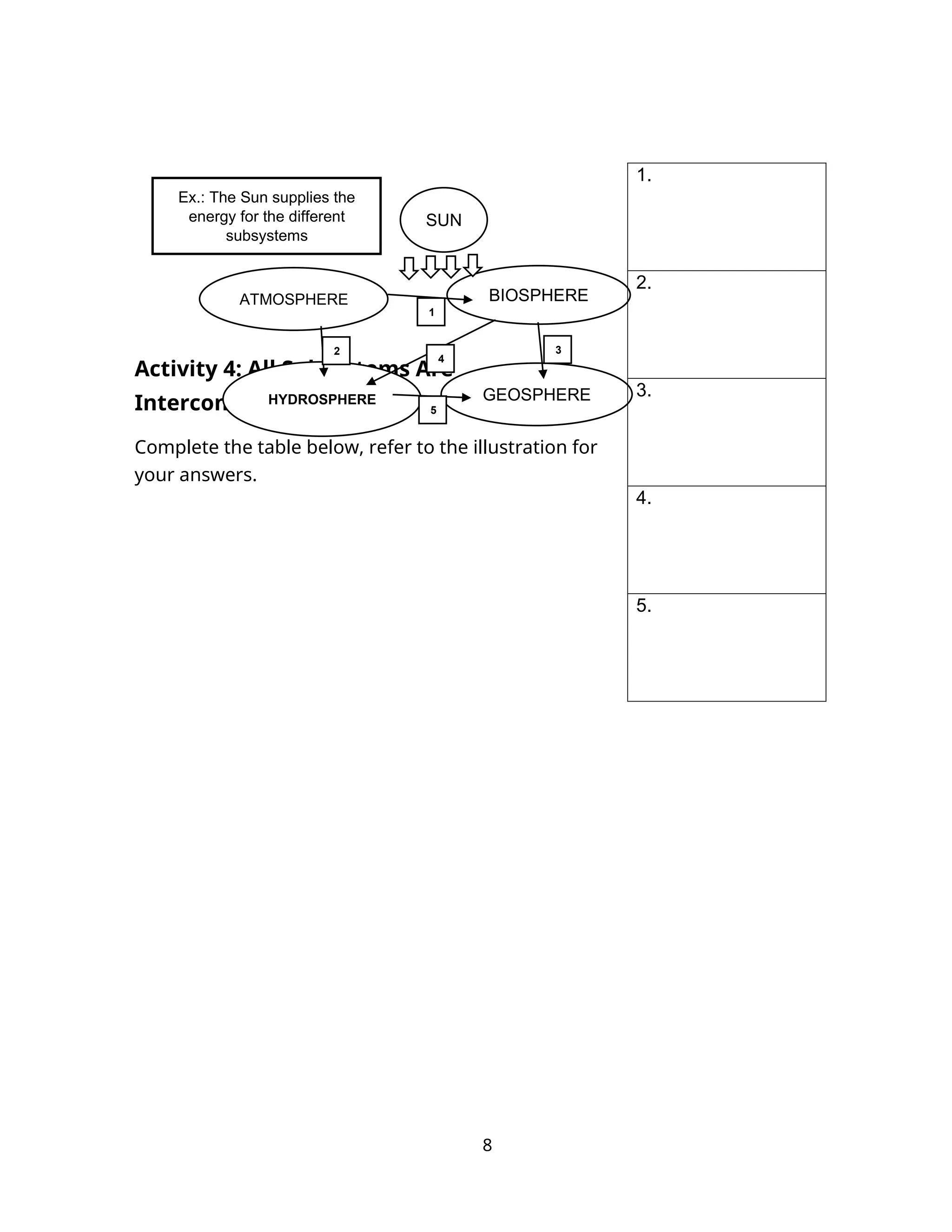
Activity 3: The Four Subsystems
The Earth is a system that is working together interconnected. The different
parts work starting from an energy source to the different subsystems. Describe
the connection between the different arrows connecting the different systems.
You can give examples for each arrow. You may use separate paper for your
answers.
7
Activity 4: All Subsystems Are
Interconnected
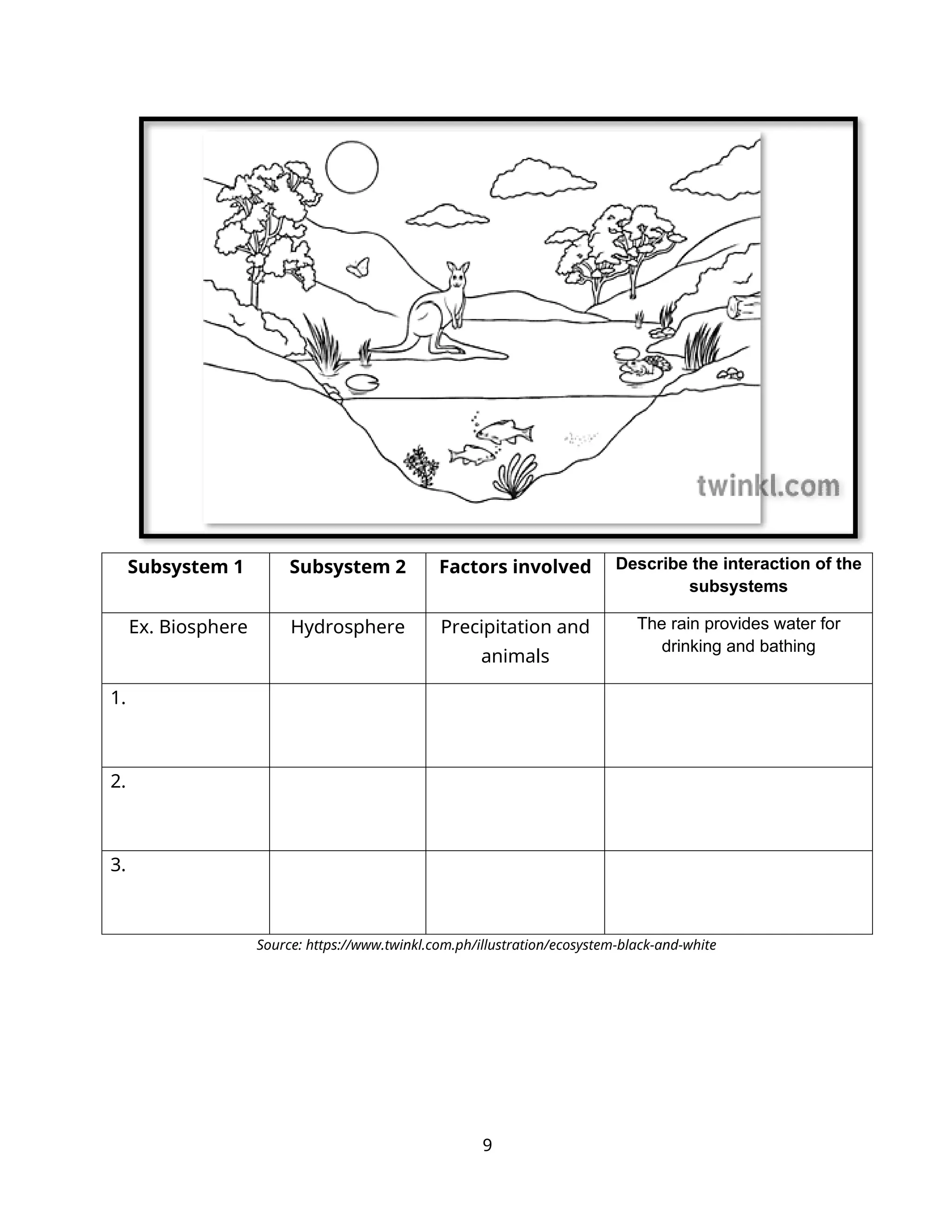
Complete the table below, refer to the illustration for
your answers.
8
SUN
GEOSPHERE
BIOSPHERE
ATMOSPHERE
HYDROSPHERE
Ex.: The Sun supplies the
energy for the different
subsystems
1
2 3
4
5
1.
2.
3.
4.
5.
Subsystem 1 Subsystem 2 Factors involved Describe the interaction of the
subsystems
Ex. Biosphere Hydrosphere Precipitation and
animals
The rain provides water for
drinking and bathing
1.
2.
3.
Source: https://www.twinkl.com.ph/illustration/ecosystem-black-and-white
9
What I Have Learned
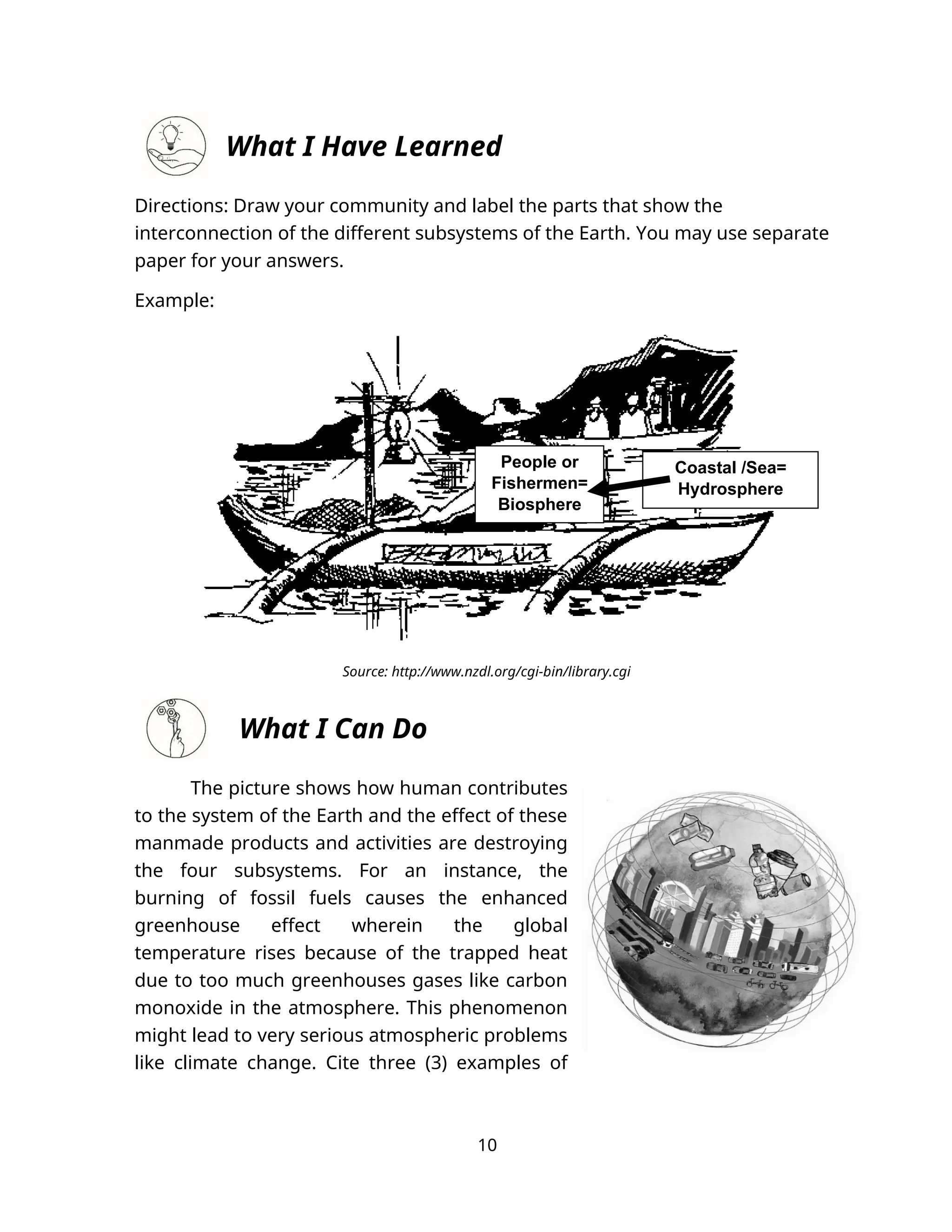
Directions: Draw your community and label the parts that show the
interconnection of the different subsystems of the Earth. You may use separate
paper for your answers.
Example:
Source: http://www.nzdl.org/cgi-bin/library.cgi
What I Can Do
The picture shows how human contributes
to the system of the Earth and the effect of these
manmade products and activities are destroying
the four subsystems. For an instance, the
burning of fossil fuels causes the enhanced
greenhouse effect wherein the global
temperature rises because of the trapped heat
due to too much greenhouses gases like carbon
monoxide in the atmosphere. This phenomenon
might lead to very serious atmospheric problems
like climate change. Cite three (3) examples of
10
Coastal /Sea=
Hydrosphere
People or
Fishermen=
Biosphere
human products and activities and explain your answers. You may use a
separate paper for your answers.
Module 2 ROCKS AND MINERALS
Most Essential Learning Competencies
 Identify common rock-forming minerals using their physical and chemical
properties. (S11/12ES-1a-9)
 Classify rocks into igneous, sedimentary, and metamorphic. (S11/12ES-Ib-10)
 Explain how the products of weathering are carried away by erosion and
deposited elsewhere. (S11/12ES-1b-12)
 Compare and contrast the formation of the different types of igneous rocks.
(S11/12ES-1c-18)
What’s In
In the last module, you have learned that the earth consists of four
major subsystems. Do you still remember those major subsystems of the
earth? How do the four systems interact to each other? Which subsystem
contains all living things of the earth? The Earth system is divided into four
major subsystems, it includes land, air, water, and living things. They are
also known as spheres, geosphere/lithosphere (land), atmosphere (air),
hydrosphere (water), and biosphere (living things). One of the unique
spheres is lithosphere, a rocky outer part and gives an environmental
shape of the earth. What is underneath the ground of the lithosphere? Let
explore it!
11
The National Geographic Society defined rocks in geological aspect as a
natural substance composed of solid crystals of different minerals that have
been fused together into a solid lump; while minerals are typically formed
when molten rock or magma, cools, or by separating out of mineral-rich water,
such as that in underground caverns. In general, mineral particles are small,
having formed within confined areas such as lava flows or between grains of
sediments. Rocks themselves are made of clusters or mixtures of minerals, and
minerals and rocks affect landform development and form natural resources
such as gold, tin, iron, marble, and granite.
Properties of Minerals
1. Luster – it is the quality and intensity of reflected light exhibited by the
mineral.
 Metallic – generally opaque and exhibit a resplendent shine similar to
a polished metal.
 Non-metallic – vitreous (glassy), adamantine (brilliant/diamond-like),
resinous, silky, pearly, dull (earthy), greasy, etc.
2. Hardness – it is a measure of the resistance of a mineral (not specifically
surface) to abrasion.
3. Color and streak –maybe a unique identifying property of certain
minerals (e.g.
malachite – green, azurite – blue).
4. Streak on the other hand is the color of a mineral in powdered form.
5. Crystal Form/Habit – the external shape of a crystal or groups of crystals
is
displayed /observed as these crystals grow in open spaces.
6. Cleavage – it is the property of some minerals to break along parallel
repetitive
planes of weakness to form smooth, flat surfaces.
7. Fracture – some minerals may not have cleavages but exhibit broken
surfaces that are irregular and non-planar.
8. Specific Gravity – it is the ratio of the weight of a mineral to the weight of
an equal volume of water.
9. Others – there are certain unique properties of minerals that actually
help in their identification (e.g. magnetism, odor, taste, tenacity, reaction
to acid, etc.). Magnetite is strongly magnetic; sulfur has distinctive smell;
halite is salty; calcite fizzes with acid as with dolomite but in powdered
form.
12
Classification of Minerals
1. Silicates – minerals containing two of the most abundant elements in the
earth’s
crust, namely, silicon and oxygen.
Ex. quartz, beryl (emerald), and feldspar.
2. Oxides – minerals containing oxygen anion (O2 -) combined with one or
more metal ions.
Ex. Hematite, spinel, sapphire.
3. Sulfates – minerals containing sulfur and oxygen anion (SO4) - combined
with other ions.
Ex. Baryte, gypsum, and anhydrite.
4. Sulfides – minerals containing sulfur anion (S2) - combined with one or
more ions.
Ex. pyrite, galena, and sphalerite.
5. Carbonates – minerals containing the carbonate anion (CO3) 2- combined
with
other elements.
Ex. Calcite, magnesite, and dolomite.
6. Native Elements – minerals that form as individual elements.
a. Metals and Inter-metals – minerals with high thermal and electrical
conductivity, typically with metallic luster, low hardness (gold, silver).
b. Semi-metals – minerals that are more fragile than metals and have
lower conductivity (arsenic, bismuth).
c. Nonmetals – nonconductive (sulfur, diamond).
7. Halides – minerals containing halogen elements combined with one or
more
elements. Ex. fluoride, halite, and chloride.
Types of Rocks
A. Igneous rocks are formed by solidification of molten rocks called magma.
Characteristics are these rocks are formed when magma solidifies, as the
magma cools, mineral crystals will begin to grow, these crystals will grow and
interlock to form a hard crystalline rock, and basalt is usually formed when
magma solidifies on the surface and granite hardens within the earth’s crust.
Types
1. Plutonic (Intrusive) igneous rocks formed from magma that cools and
crystalline beneath the earth.
13
Ex. Diorite, gabbro, granite, pegmatite, and peridotite.
2. Volcanic (Extrusive) igneous rocks formed from magma which has spilled
out onto the surface of a volcano.
Ex. Basalt, andesite, dacite, pumice, rhyolite, scoria, and tuff.
B. Sedimentary rocks are formed with the accumulation, compaction, and
cementation of sediments. Sediments that have settled at the bottom of a
lake, sea or ocean, and have been compressed over millions of years.
Characteristics are the rocks are formed due to the build-up of sediments
over time, the weathered and eroded material is built up in layers, as more
material is added on top – this will push any air and/or water out and will
compact the material together into a hard rock, and often contain fossils of
plants and animals.
Types
1. Clastic sedimentary rocks are formed from mechanical weathering debris.
Ex. breccia, conglomerate, sandstone, siltstone, and shale.
2. Chemical sedimentary rocks are formed when dissolved materials
precipitate
from solution.
Ex. rock salt, iron ore, chert, flint, some dolomites, and some limestones.
3. Organic sedimentary rocks are formed from the accumulation of plant or
animal debris.
Ex. coal, some dolomites, and some limestones.
C. Metamorphic rocks are formed by heat and pressure; changing one type of
rock into another type of rock. Characteristics are these are formed when
either igneous or sedimentary rocks are changed, heat and/or pressure will
cause the elements in the original rock to react and re-form, metamorphic
rocks are highly resistant to erosion and are often used in building materials.
Types
1.Foliated metamorphic rocks have a layered or banded appearance that is
produced by exposure to heat and directed pressure.
Ex. gneiss, phyllite, schist, and slate.
2. Non-foliated metamorphic rocks are novaculite do not have a layered or
banded appearance.
Ex. hornfels, marble, quartzite
14
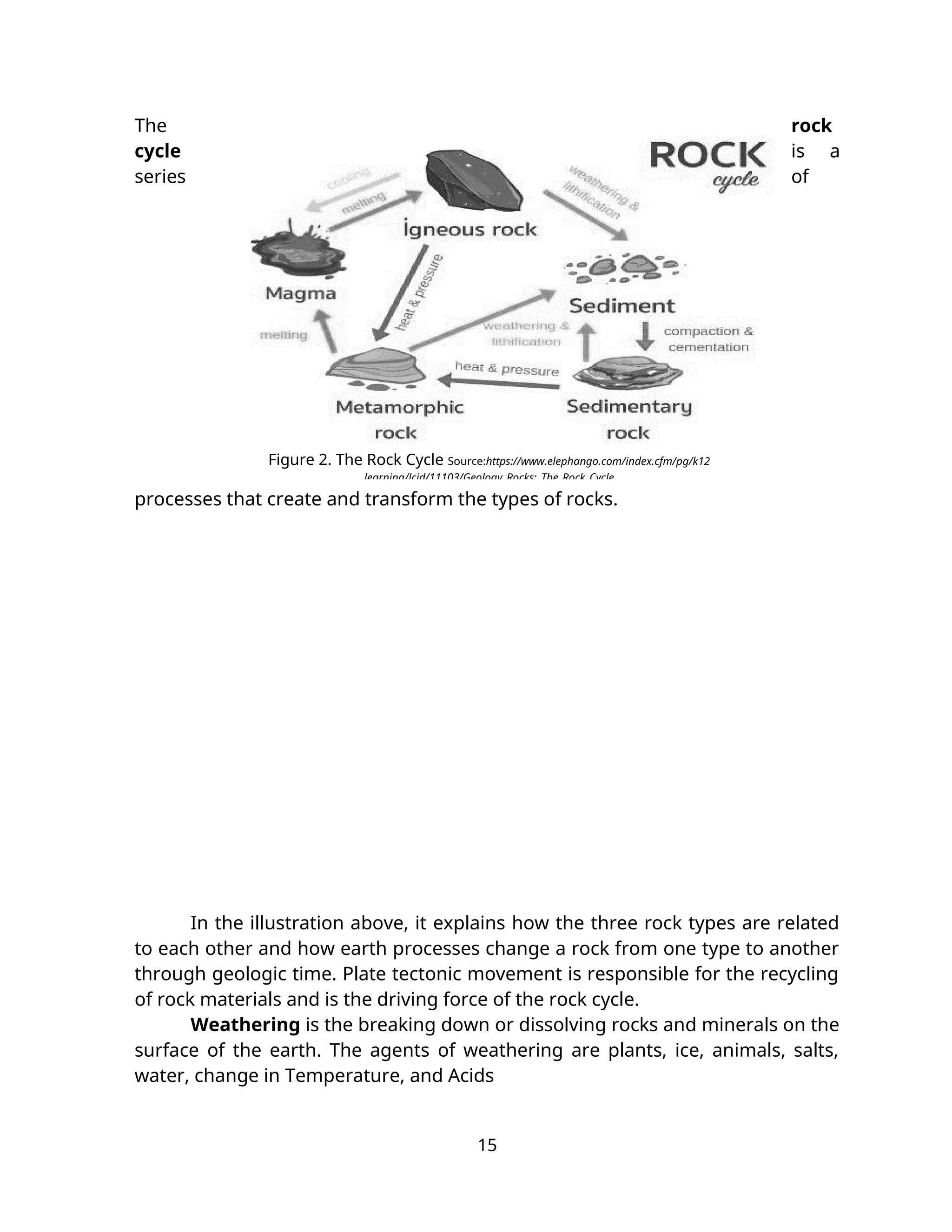
The rock
cycle is a
series of
processes that create and transform the types of rocks.
In the illustration above, it explains how the three rock types are related
to each other and how earth processes change a rock from one type to another
through geologic time. Plate tectonic movement is responsible for the recycling
of rock materials and is the driving force of the rock cycle.
Weathering is the breaking down or dissolving rocks and minerals on the
surface of the earth. The agents of weathering are plants, ice, animals, salts,
water, change in Temperature, and Acids
15
Figure 2. The Rock Cycle Source:https://www.elephango.com/index.cfm/pg/k12
learning/lcid/11103/Geology_Rocks:_The_Rock_Cycle
Types of Weathering
1. Physical (Mechanical) Weathering is the breaking down of rocks into
smaller
pieces with no change in composition. It has the following types:
1. Abrasion–occurs when wearing and grinding by small sedimentary
particles carried by wind, water, or ice.
2. Frost Wedging (Ice Wedging)-occurs when water freezes in rock fractures.
3. Thermal Expansion–occurs when heating and contraction of cooling
weakens rocks.
4. Exfoliation-occurs when rocks breaking loose along parallel fractures like
onion layers.
2. Chemical Weathering – is the breakdown of rocks by chemical agents.
1. Dissolution-occurs when rocks or minerals are dissolved by water.
Ex. Halite and Calcite
2. Oxidation-occurs when minerals react in oxygen gas. Ex. Iron Oxide
3. Hydrolysis-occurs when water reacts with other minerals. Ex. Feldspar
4. Acid Precipitation-occurs rain contains high concentration of acids. Ex.
Acid Rain
3. Biological Weathering – Involved both physical and chemical process. An
action
by plants and animals.
Erosion – is the removal of weathered particles by moving water, wind, ice or
gravity.
What’s More
Activity 1: Uses of Minerals and Rocks
Directions: Complete the table by identifying whether the examples are Minerals
or Rocks. Place a check mark (/) on the space that corresponds to your answer.
Write the uses of the given minerals and rocks on the space provided or use a
separate sheet of paper.
Example Minerals Rocks Uses
1. Limestone
16
2. Marble
3. Halite
(Sodium
Chloride salt)
4. Gold
5. Quartz
6. Diamond
7. Sandstone
8. Ruby
9. Shale
(Mudstone
10. Granite
Answer the following questions:
1. What are the differences between rocks and minerals?
_________________________________________________________________________________
_______________________________________________________________2. Lists down
some minerals and rocks that you have seen in your house, school, and
community. Give the uses or application to your daily lives?
_________________________________________________________________________________
_________________________________________________________________________________
______________________________________________________
17
Activity 2: True Identity
Directions: Identify the properties of rocks and minerals. Write R if the
statement is pertaining to rocks and M if the statement belongs to minerals.
Write the correct letter on the space provided before each number.
_____ 1. It is formed from tremendous heat and pressure.
_____ 2. Formed by solidifying of magma below the earth surface.
_____ 3. A solid, inorganic substance found on earth.
_____ 4. Luster is the quality and intensity of reflected light exhibited by it.
_____ 5. Most of these materials are deposit from the surface of the land to the
bottoms of lakes, rivers and oceans.
_____ 6. It is highly resistant to erosion and are often used in building materials.
_____ 7. Color is one of the best ways to identify this substance.
_____ 8. Often contain fossils of plants and animals.
_____ 9. Formed with the accumulation, compaction, and cementation of
sediments.
_____ 10. Basalt is usually formed when magma solidifies on the surface.
Activity 3: Multiple Choice
Directions: Choose the letter of the best answer. Write the letter of your answer
on a separate sheet of paper.
1. Which is a sedimentary rock?
A. diorite B. granite C. shale D. slate
2. These are the processes of rock cycle, except?
A. cooling B. metamorphism C. sedimentation D. weathering
3. Which of the following does not belong to the group?
A. carbonates : magnetite C. phosphates : hematite
B. hydroxides : brucite D. sulfates : gypsum
4. The physical and chemical breaking down of rocks into smaller particles is
called _________.
A. Deposition B. Erosion C. Exfoliation D.
Weathering
5. What does the mineral property of luster measure or describe?
18
A. measures the density of the mineral
B. the color of the mineral in powdered form
C. describes how a mineral break into pieces
D. describes how well a mineral reflects light
Activity 4: Say Something
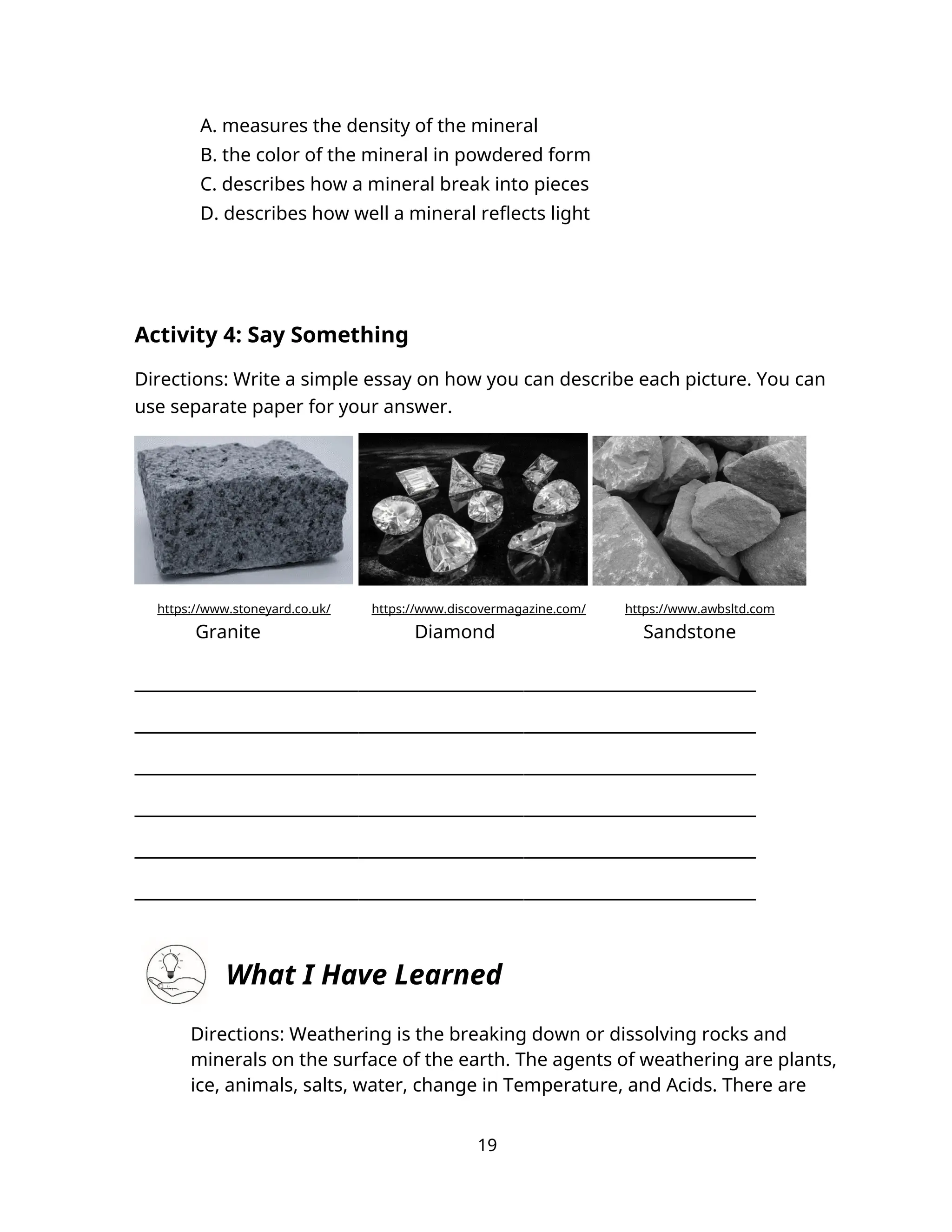
Directions: Write a simple essay on how you can describe each picture. You can
use separate paper for your answer.
https://www.stoneyard.co.uk/ https://www.discovermagazine.com/ https://www.awbsltd.com
Granite Diamond Sandstone
___________________________________________________________________________
___________________________________________________________________________
___________________________________________________________________________
___________________________________________________________________________
___________________________________________________________________________
___________________________________________________________________________
What I Have Learned
Directions: Weathering is the breaking down or dissolving rocks and
minerals on the surface of the earth. The agents of weathering are plants,
ice, animals, salts, water, change in Temperature, and Acids. There are
19
three types of weathering, these are Physical, Chemical and Biological
Weathering. Look for a sample pictures of this three (3) types of
weathering and place it in the box below.
Physical Weathering Chemical Weathering Biological Weathering
What I Can Do
According to nps.gov, rocks and minerals are all around us! They help us to
develop new technologies and are used in our everyday lives. Our use of rocks
and minerals includes as building material, cosmetics, cars, roads, and
appliances. To maintain a healthy lifestyle and strengthen the body, humans
need to consume minerals daily.
As a concerned citizen:
Why are rocks and minerals important?
___________________________________________________________________________
___________________________________________________________________________
___________________________________________________________________________
___________________________________________________________________________
___________________________________________________________________________
___________________________________________________________________________
___________________________________________________________________________
20
How can you conserve and preserve rocks and minerals?
___________________________________________________________________________
___________________________________________________________________________
___________________________________________________________________________
___________________________________________________________________________
___________________________________________________________________________
___________________________________________________________________________
Module 3 Earth's Internal Heat
Most Essential Learning Competencies
Describe where the Earth’s internal heat comes from. (S11/12ES-lb-14)
What’s In
This module was designed and written to help you understand the
different sources of earth's internal heat. Scientists have varied scientific
explanation of how Earth's internal heat were generated. Many geologic
processes and features, such as tectonic plate motion, volcanic activity, and
geysers, are related to the Earth's internal heat. The produced heat from deep
within the interior of the earth is known as the internal heat or the
geothermal energy, and the external heat or solar energy that is generated
from the sun. Most of Earth’s internal heat is left over from when our planet
formed, about 4.5 billion years ago.
Where does Earth’s internal heat come from?
21
Three main sources of earth's internal heat
1. Heat of accretion- Heat is generated when the planet formed and accreted
from planetesimals. Colliding planetesimals convert gravitational potential
energy to kinetic energy and then thermal energy. It takes long for the heat to
move out of the earth during its development. This occurs through both
"convective" transport of heat within the earth's liquid outer core and solid
mantle and slower "conductive" transport of heat through non convecting
boundary layers, such as the earth's plates at the surface. As a result, much of
the planet's primordial heat, has been retained when earth was formed.
2. Frictional heating- is caused by denser core material sinking to the center of
the planet. Earth's interior is the site of great amounts of heat. Most of this heat
is produced by the decay of radioactive elements. Overall, the flow of Earth's
internal heat is outward toward Earth's surface. Many geologic processes and
features, such as tectonic plate motion, volcanism, and metamorphism, are also
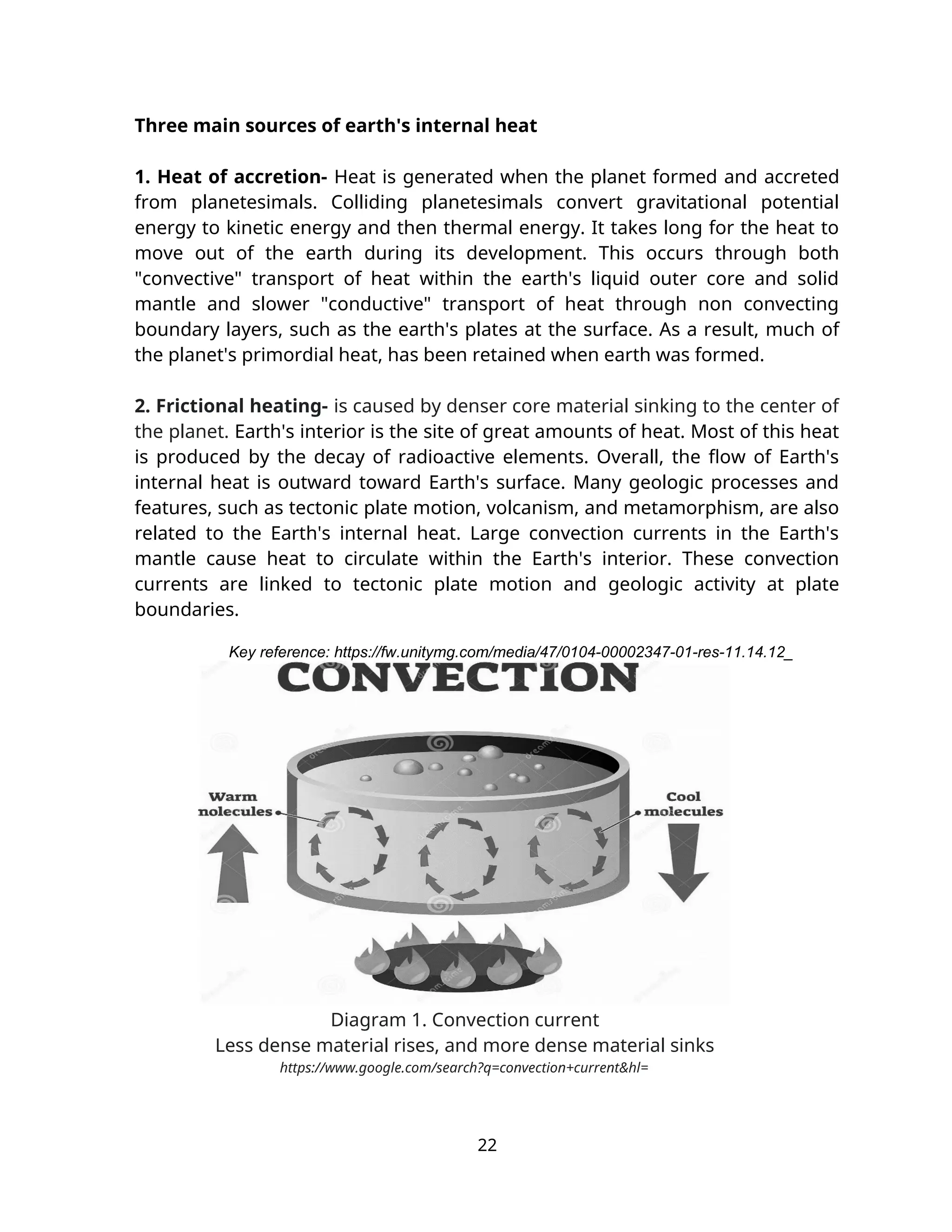
related to the Earth's internal heat. Large convection currents in the Earth's
mantle cause heat to circulate within the Earth's interior. These convection
currents are linked to tectonic plate motion and geologic activity at plate
boundaries.
Key reference: https://fw.unitymg.com/media/47/0104-00002347-01-res-11.14.12_
Diagram 1. Convection current
Less dense material rises, and more dense material sinks
https://www.google.com/search?q=convection+current&hl=
22
What is radioactive decay inside Earth?
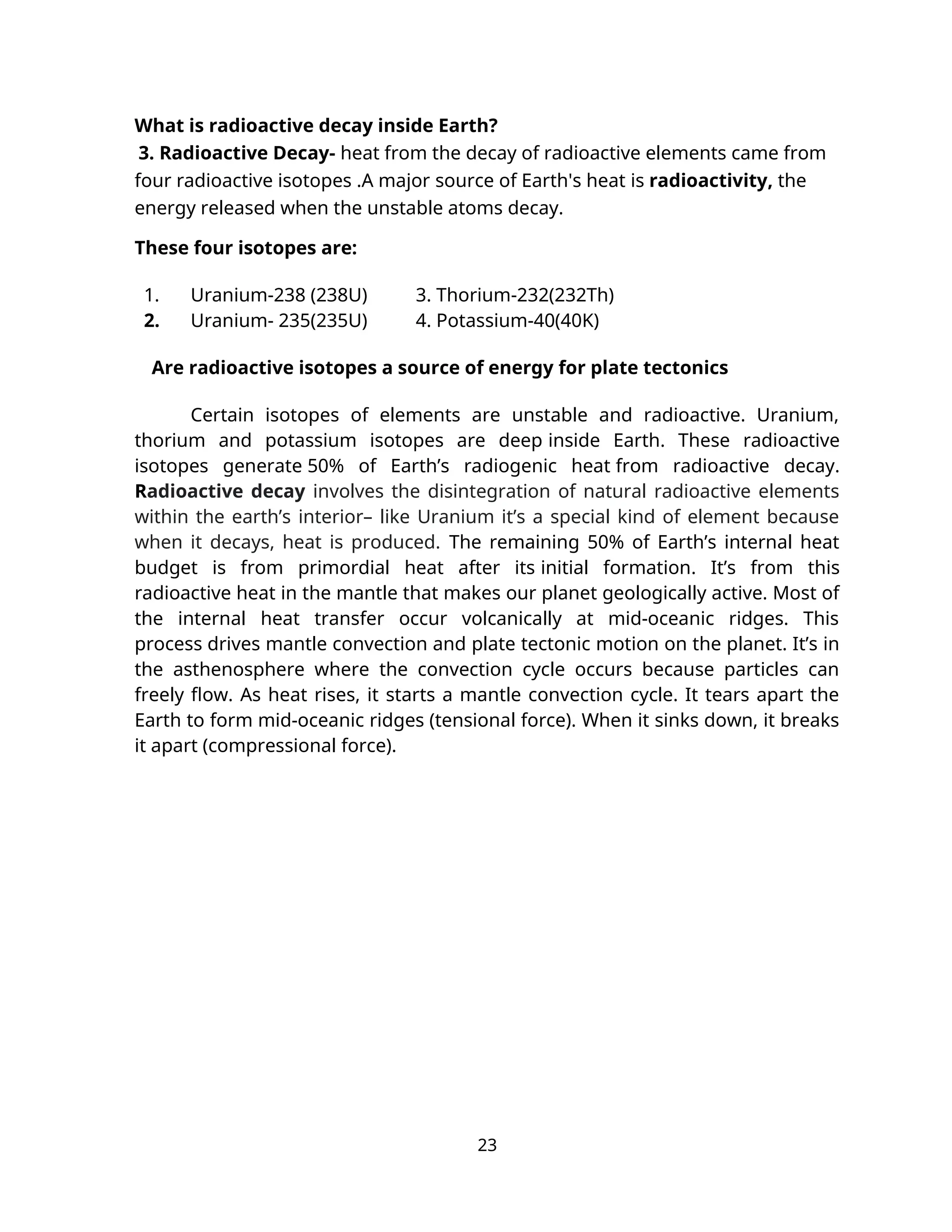
3. Radioactive Decay- heat from the decay of radioactive elements came from
four radioactive isotopes .A major source of Earth's heat is radioactivity, the
energy released when the unstable atoms decay.
These four isotopes are:
1. Uranium-238 (238U) 3. Thorium-232(232Th)
2. Uranium- 235(235U) 4. Potassium-40(40K)
Are radioactive isotopes a source of energy for plate tectonics
Certain isotopes of elements are unstable and radioactive. Uranium,
thorium and potassium isotopes are deep inside Earth. These radioactive
isotopes generate 50% of Earth’s radiogenic heat from radioactive decay.
Radioactive decay involves the disintegration of natural radioactive elements
within the earth’s interior– like Uranium it’s a special kind of element because
when it decays, heat is produced. The remaining 50% of Earth’s internal heat
budget is from primordial heat after its initial formation. It’s from this
radioactive heat in the mantle that makes our planet geologically active. Most of
the internal heat transfer occur volcanically at mid-oceanic ridges. This
process drives mantle convection and plate tectonic motion on the planet. It’s in
the asthenosphere where the convection cycle occurs because particles can
freely flow. As heat rises, it starts a mantle convection cycle. It tears apart the
Earth to form mid-oceanic ridges (tensional force). When it sinks down, it breaks
it apart (compressional force).
23
Diagram 2 .Radioactive Decay
https://www.google.com/search?q=radioactive+decay+of+element+underneath+the+earth
What’s More
Activity1 : Matching Type!
Direction: Match column A with. Column B. Write the letter of the correct
answer before the number.
A B
______1. Major source of earth’s internal heat.
______2. A special kind of element which produced
heat when decayed
______3. Results of differential heating
______4. Involves disintegration of radioactive
element.
______5. Heat source from deep within the earth.
A. geotherma
l energy
B. radioactivit
y
C. radioactive
decay
D. convection
current
E. Uranium
24
F. Aluminum
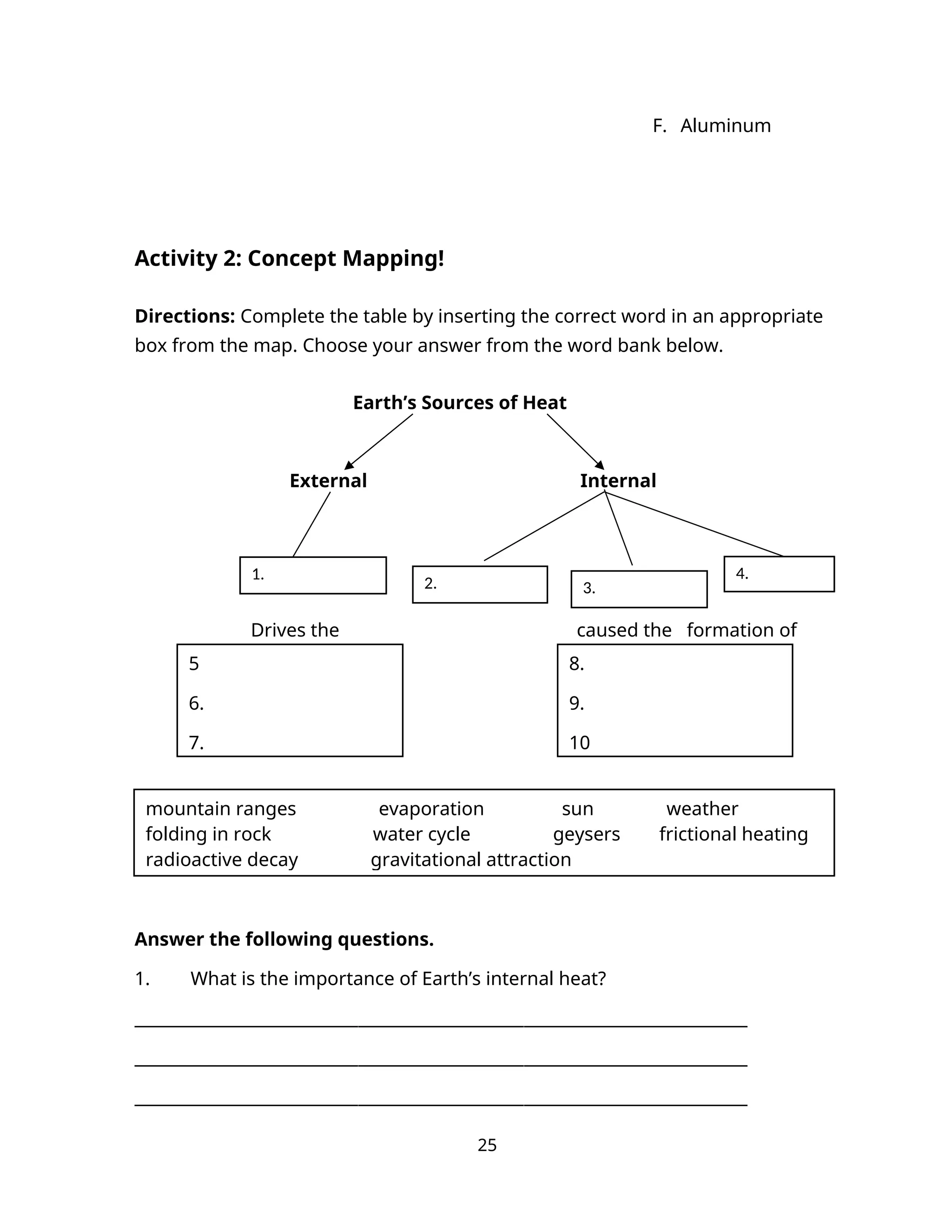
Activity 2: Concept Mapping!
Directions: Complete the table by inserting the correct word in an appropriate
box from the map. Choose your answer from the word bank below.
Earth’s Sources of Heat
External Internal
Drives the caused the formation of
Answer the following questions.
1. What is the importance of Earth’s internal heat?
__________________________________________________________________________
__________________________________________________________________________
__________________________________________________________________________
25
1. 4.
2. 3.
5
6.
7.
8.
9.
10
mountain ranges evaporation sun weather
folding in rock water cycle geysers frictional heating
radioactive decay gravitational attraction
2. How do the elements isotopes generate earth’s internal heat?
___________________________________________________________________
___________________________________________________________________
__________________________________________________________________________
What I Have Learned
Directions: Using the concept of Earth’s Internal Heat, create a poem with three
stanzas.
________________________________________________________
Title
_____________________________________________________________
_____________________________________________________________
_____________________________________________________________
_____________________________________________________________
_____________________________________________________________
_____________________________________________________________
_____________________________________________________________
_____________________________________________________________
_____________________________________________________________
_____________________________________________________________
_____________________________________________________________
26
_____________________________________________________________
What I Can Do
Exploration!
Directions: In a separate sheet; long bond paper, illustrate how earth’s interior
generates heat, and identify, and answer the following questions.
1. What is the significance of earth’s internal heat?
__________________________________________________________________________________
__________________________________________________________________________________
__________________________________________________________________________________
__________________________________________________________________________________
__________________________________________________________________________________
2. How does the formation of the planets generate earth’s internal heat?
__________________________________________________________________________________
__________________________________________________________________________________
__________________________________________________________________________________
__________________________________________________________________________________
__________________________________________________________________________________
27
3. Why does convection cycle occur in the asthenosphere?
__________________________________________________________________________________
__________________________________________________________________________________
__________________________________________________________________________________
__________________________________________________________________________________
__________________________________________________________________________________
Module 4 Metamorphism
Most Essential Learning Competencies
 Differentiate foliated and non-foliated metamorphic rock and
(S11/12ES-Ic-18)
 Describe the changes in mineral components and texture of rocks due
to changes in pressure and temperature {metamorphism]((S11/12ES-
Ic--18)
What’s In
Rocks are formed on Earth as igneous, sedimentary, or metamorphic
rocks. Metamorphic rocks formed from heat and pressure changing the original
or parent rock into a completely new rock. Sedimentary, igneous, or even
another metamorphic rock could be a parent rock of a newly formed
metamorphic rock. For instance, limestone transforms into a marble, sandstone
into quartzite, and granite into gneiss.
The word "metamorphic “comes from the Greek which means "To Change
Form". Metamorphism-is a change in the structure or constitution of a rock due
to heat and pressure.
There are three ways or origins that metamorphic rocks can form:
28
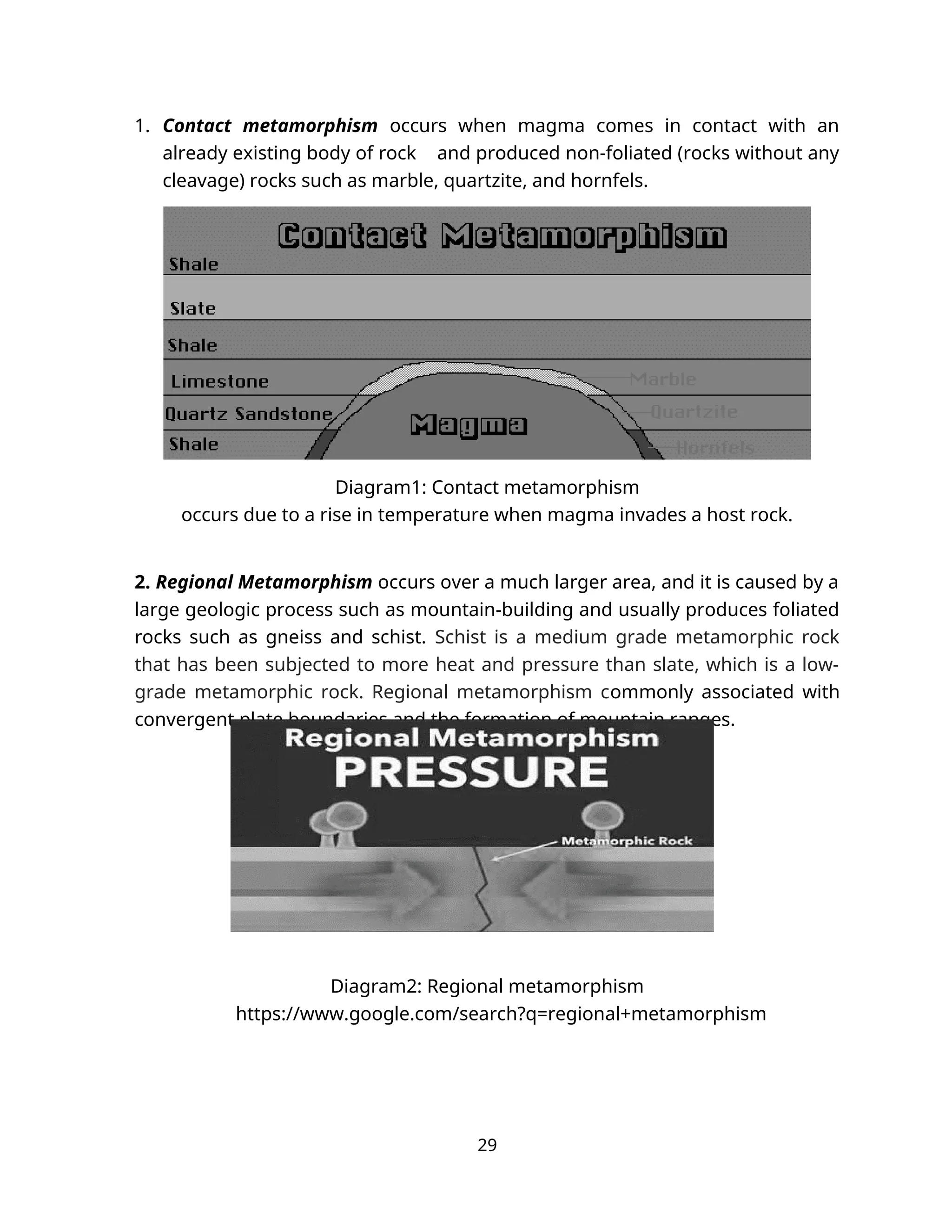
1. Contact metamorphism occurs when magma comes in contact with an
already existing body of rock and produced non-foliated (rocks without any
cleavage) rocks such as marble, quartzite, and hornfels.
Diagram1: Contact metamorphism
occurs due to a rise in temperature when magma invades a host rock.
2. Regional Metamorphism occurs over a much larger area, and it is caused by a
large geologic process such as mountain-building and usually produces foliated
rocks such as gneiss and schist. Schist is a medium grade metamorphic rock
that has been subjected to more heat and pressure than slate, which is a low-
grade metamorphic rock. Regional metamorphism commonly associated with
convergent plate boundaries and the formation of mountain ranges.
Diagram2: Regional metamorphism
https://www.google.com/search?q=regional+metamorphism
29
3. Dynamic Metamorphism also occurs because of mountain-building. These
huge forces of heat and pressure cause the rocks to be bent, folded, crushed,
flattened, and sheared.
Metamorphic rocks are divided into two categories:
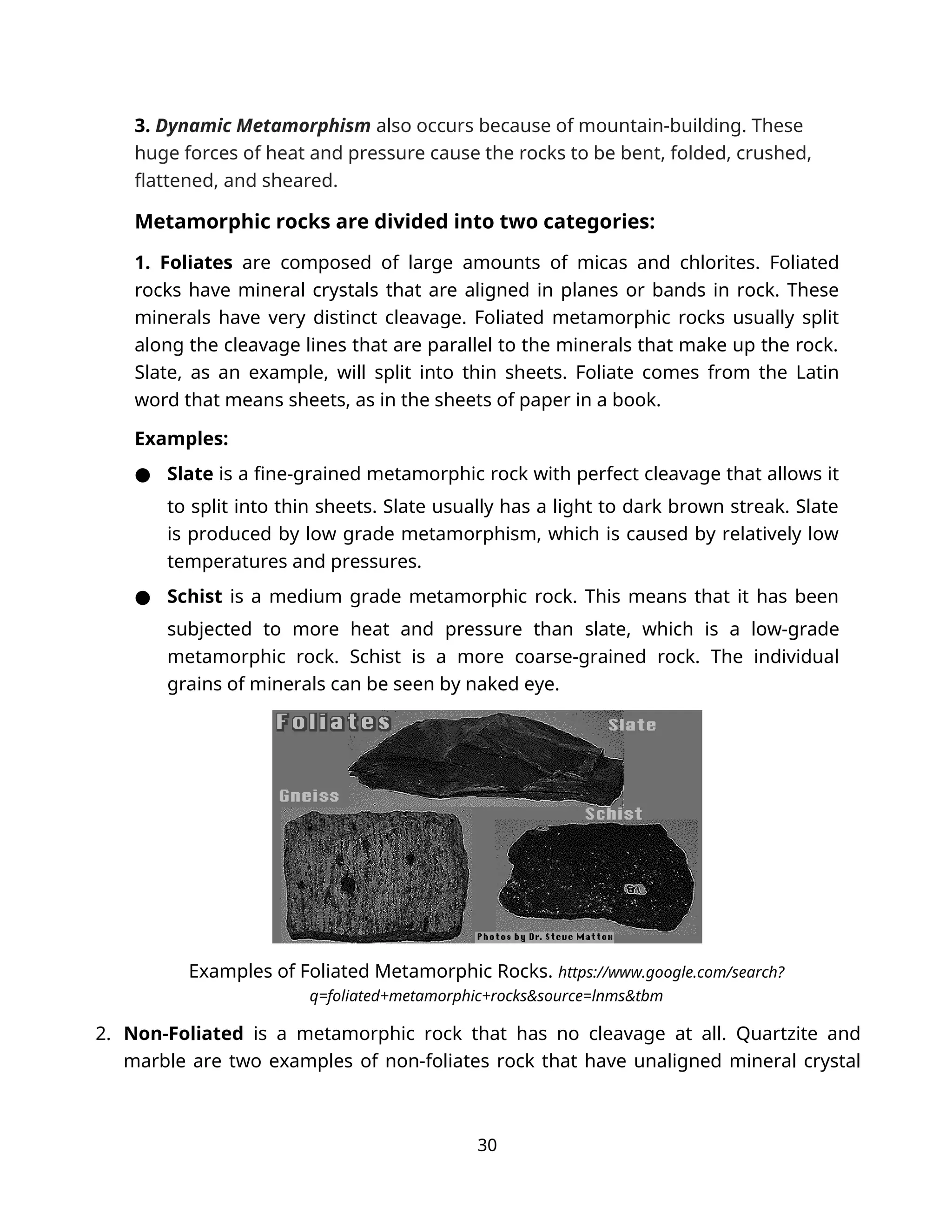
1. Foliates are composed of large amounts of micas and chlorites. Foliated
rocks have mineral crystals that are aligned in planes or bands in rock. These
minerals have very distinct cleavage. Foliated metamorphic rocks usually split
along the cleavage lines that are parallel to the minerals that make up the rock.
Slate, as an example, will split into thin sheets. Foliate comes from the Latin
word that means sheets, as in the sheets of paper in a book.
Examples:
● Slate is a fine-grained metamorphic rock with perfect cleavage that allows it
to split into thin sheets. Slate usually has a light to dark brown streak. Slate
is produced by low grade metamorphism, which is caused by relatively low
temperatures and pressures.
● Schist is a medium grade metamorphic rock. This means that it has been
subjected to more heat and pressure than slate, which is a low-grade
metamorphic rock. Schist is a more coarse-grained rock. The individual
grains of minerals can be seen by naked eye.
Examples of Foliated Metamorphic Rocks. https://www.google.com/search?
q=foliated+metamorphic+rocks&source=lnms&tbm
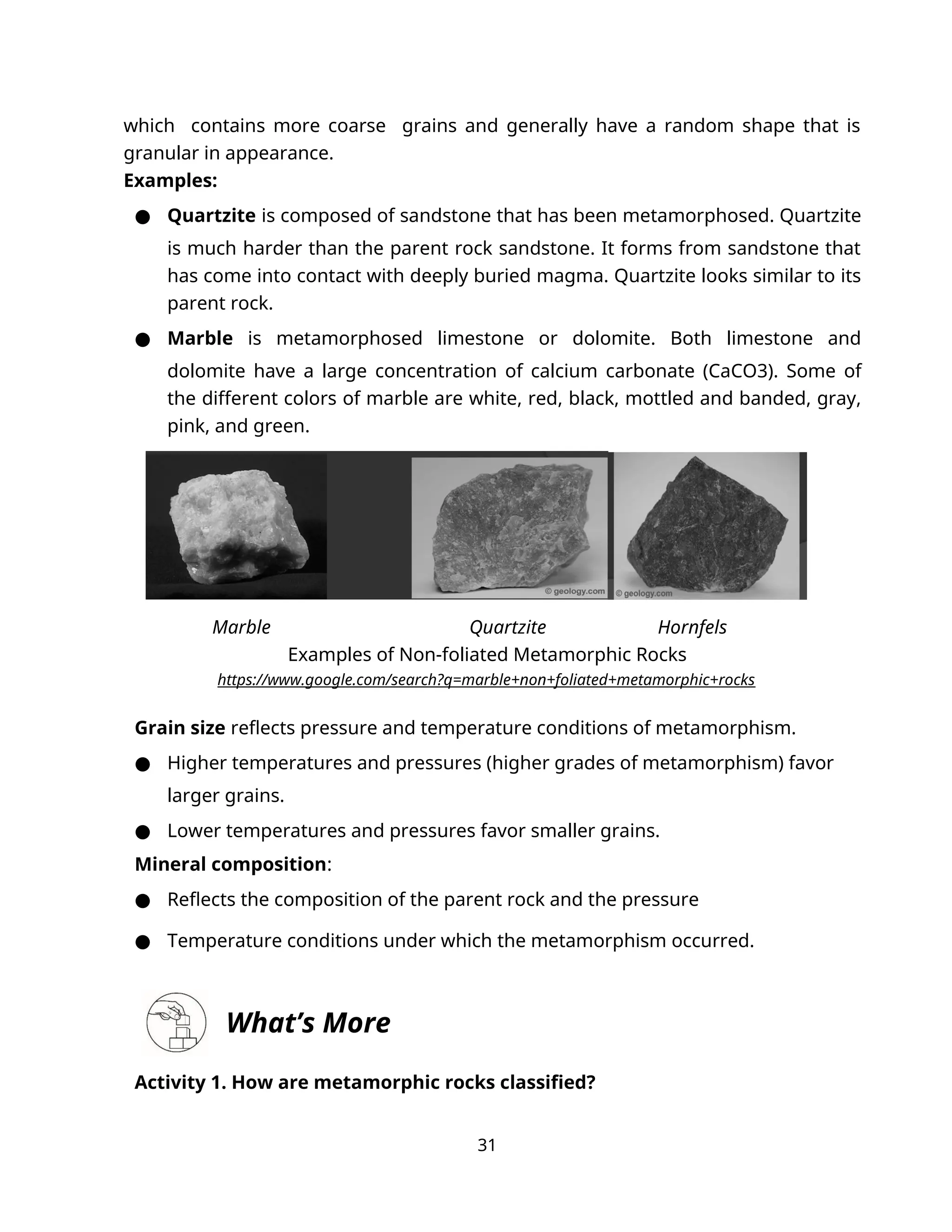
2. Non-Foliated is a metamorphic rock that has no cleavage at all. Quartzite and
marble are two examples of non-foliates rock that have unaligned mineral crystal
30
which contains more coarse grains and generally have a random shape that is
granular in appearance.
Examples:
● Quartzite is composed of sandstone that has been metamorphosed. Quartzite
is much harder than the parent rock sandstone. It forms from sandstone that
has come into contact with deeply buried magma. Quartzite looks similar to its
parent rock.
● Marble is metamorphosed limestone or dolomite. Both limestone and
dolomite have a large concentration of calcium carbonate (CaCO3). Some of
the different colors of marble are white, red, black, mottled and banded, gray,
pink, and green.
Marble Quartzite Hornfels
Examples of Non-foliated Metamorphic Rocks
https://www.google.com/search?q=marble+non+foliated+metamorphic+rocks
Grain size reflects pressure and temperature conditions of metamorphism.
● Higher temperatures and pressures (higher grades of metamorphism) favor
larger grains.
● Lower temperatures and pressures favor smaller grains.
Mineral composition:
● Reflects the composition of the parent rock and the pressure
● Temperature conditions under which the metamorphism occurred.
What’s More
Activity 1. How are metamorphic rocks classified?
31
Directions: Write True if the statement is correct. If the statement is False,
change the underlined word to make the statement correct.
________1. Metamorphic rocks are classified according to their size.
________2. A foliated metamorphic rock has mineral crystal arranged in planes.
________3. Contact metamorphism occurs in tectonic plates which produced non-
foliated rock like marble.
________4. Foliated metamorphic rock usually breaks along the cleavage.
________5. Quartzite is a non-foliated metamorphic rock contained mostly of
quartz.
Activity 2. Classify the following rock listed below as Foliated or Non-Foliated.
Write your answer in the space provided for.
_____________1. marble _____________4. gneiss
_____________2. schist _____________5. quartzite
_____________3. Slate
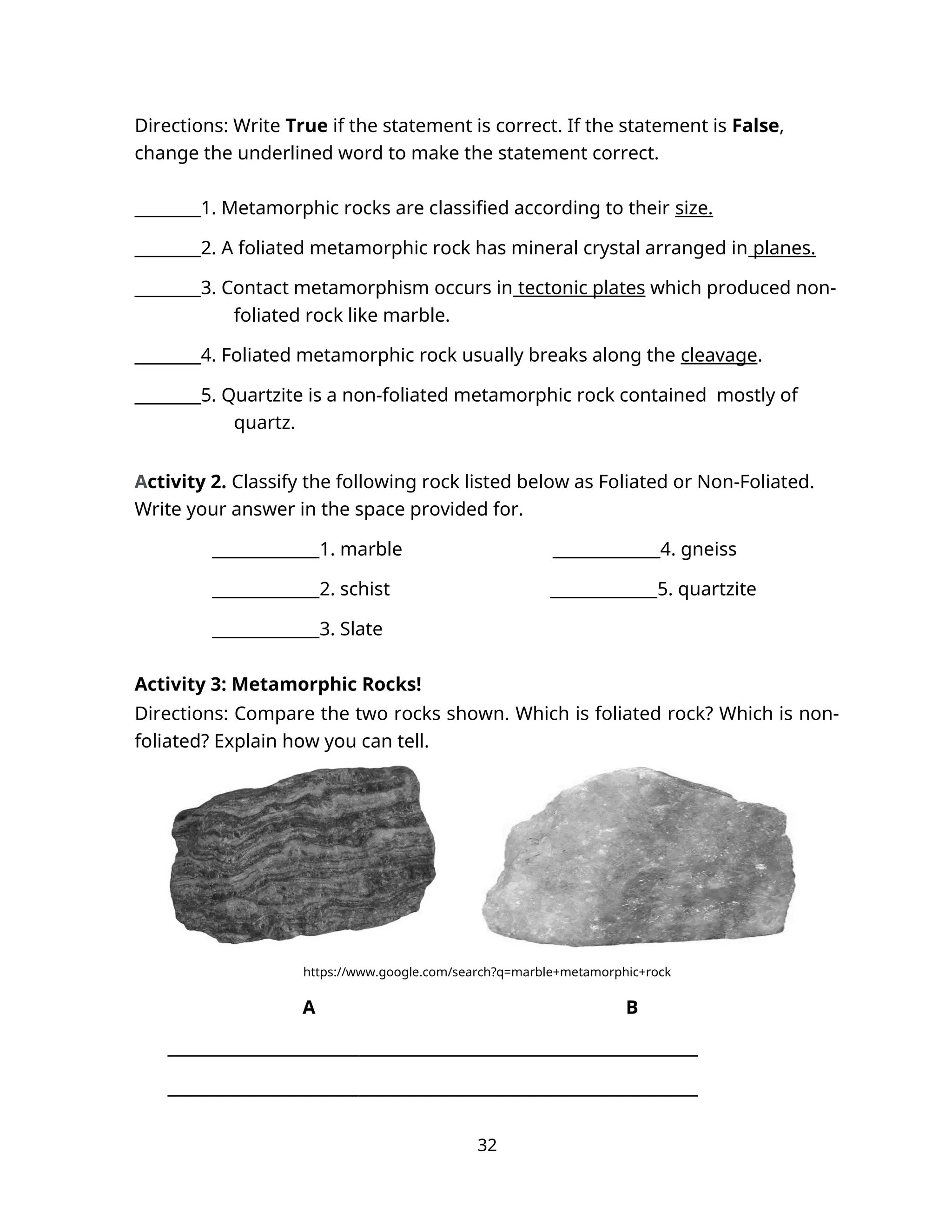
Activity 3: Metamorphic Rocks!
Directions: Compare the two rocks shown. Which is foliated rock? Which is non-
foliated? Explain how you can tell.
https://www.google.com/search?q=marble+metamorphic+rock
A B
________________________________________________________________
________________________________________________________________
32
Activity 4. Identifying and Naming!
Directions: Unscramble the letter to identify the rock in each number.
1. STALE-______________________
2. SNGIES-_____________________
3. LEHFSORN-__________________
4. RMBELA-____________________
5. UATRQIZET-__________________
Answer the following questions:
1. What is the importance of metamorphic rocks?
________________________________________________________________
________________________________________________________________
________________________________________________________________
2. How are metamorphic rocks formed?
________________________________________________________________
________________________________________________________________
________________________________________________________________
3. How is foliated rock different from non-foliated rock?
________________________________________________________________
________________________________________________________________
________________________________________________________________
33
What I Have Learned
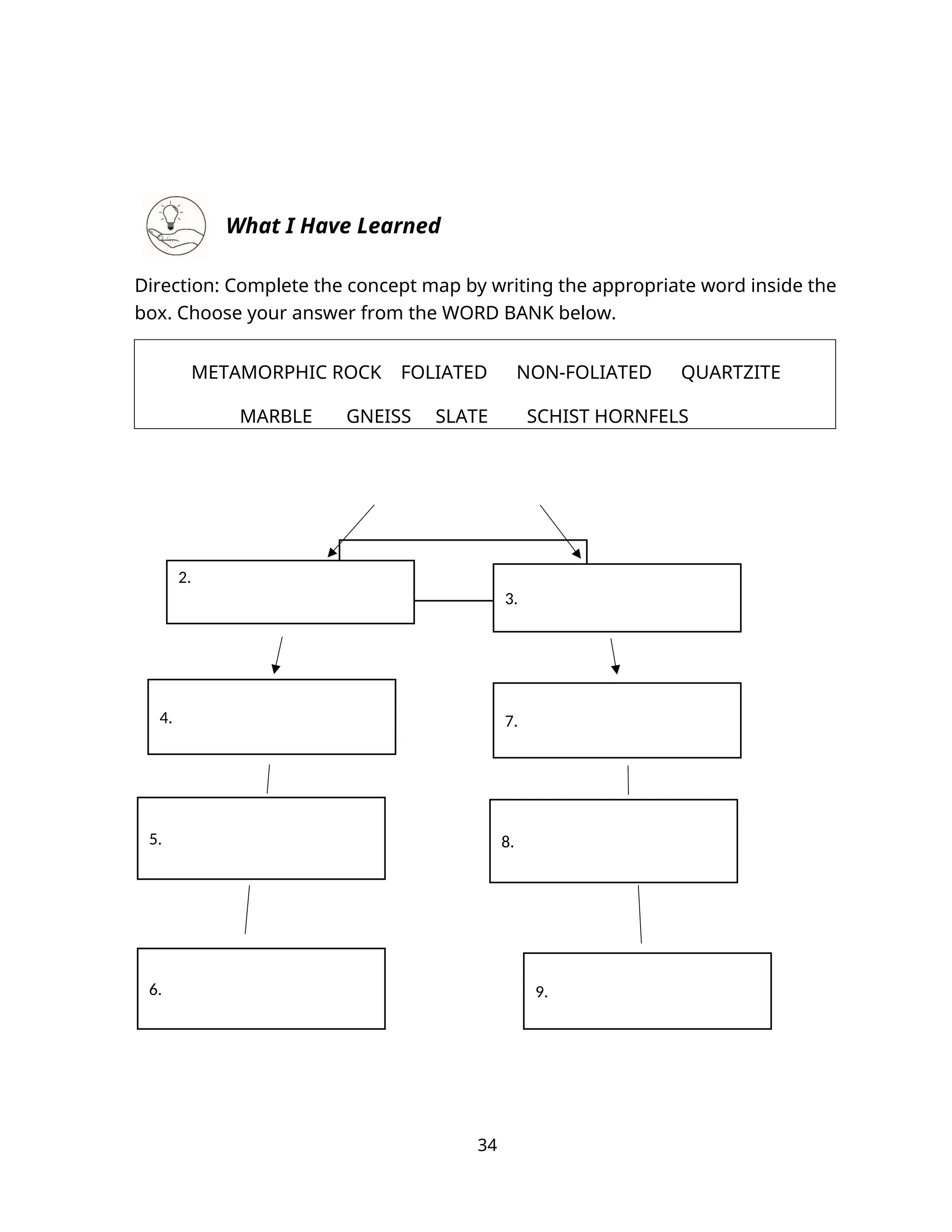
Direction: Complete the concept map by writing the appropriate word inside the
box. Choose your answer from the WORD BANK below.
METAMORPHIC ROCK FOLIATED NON-FOLIATED QUARTZITE
MARBLE GNEISS SLATE SCHIST HORNFELS
34
1.
2.
3.
4. 7.
5.
6.
8.
9.
What I Can Do
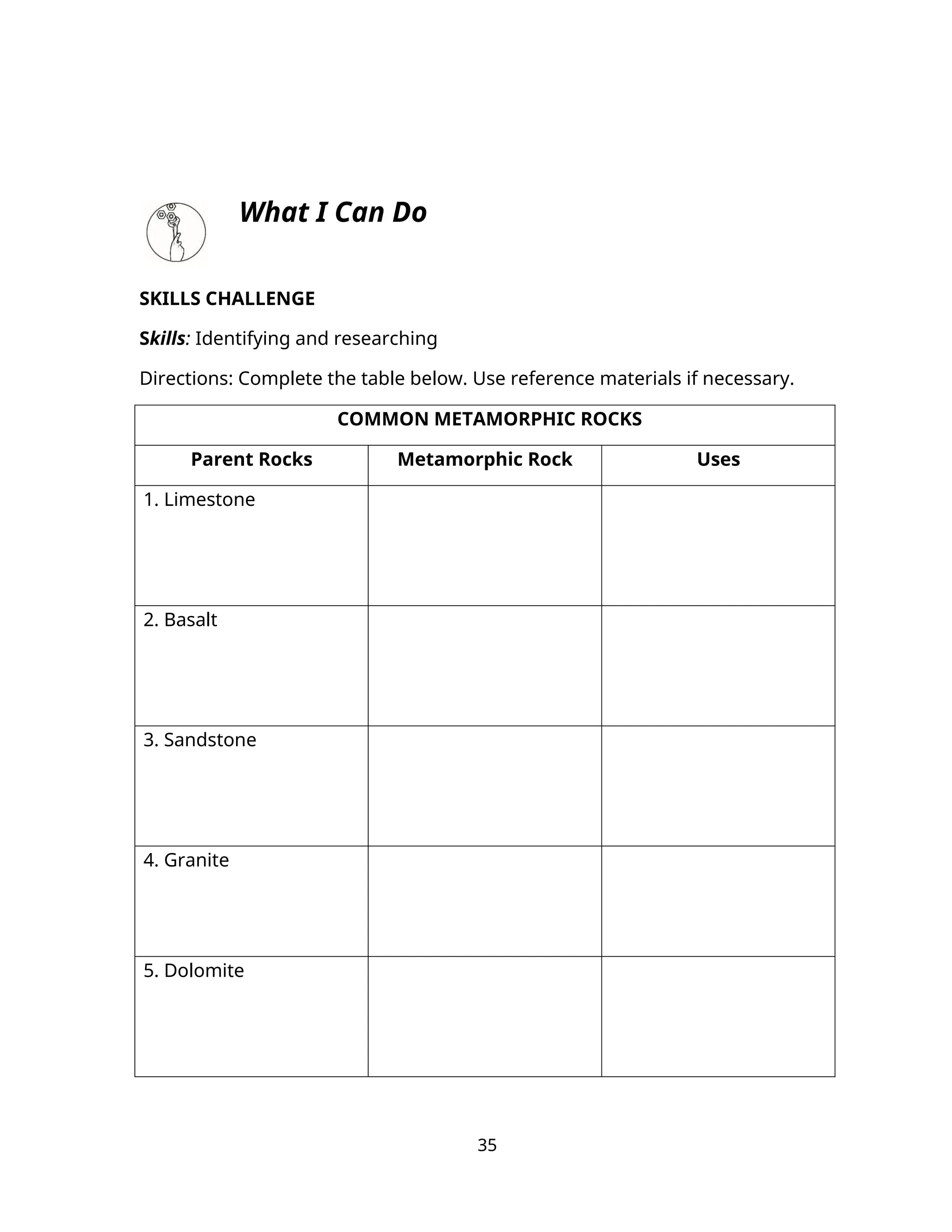
SKILLS CHALLENGE
Skills: Identifying and researching
Directions: Complete the table below. Use reference materials if necessary.
COMMON METAMORPHIC ROCKS
Parent Rocks Metamorphic Rock Uses
1. Limestone
2. Basalt
3. Sandstone
4. Granite
5. Dolomite
35
36
37
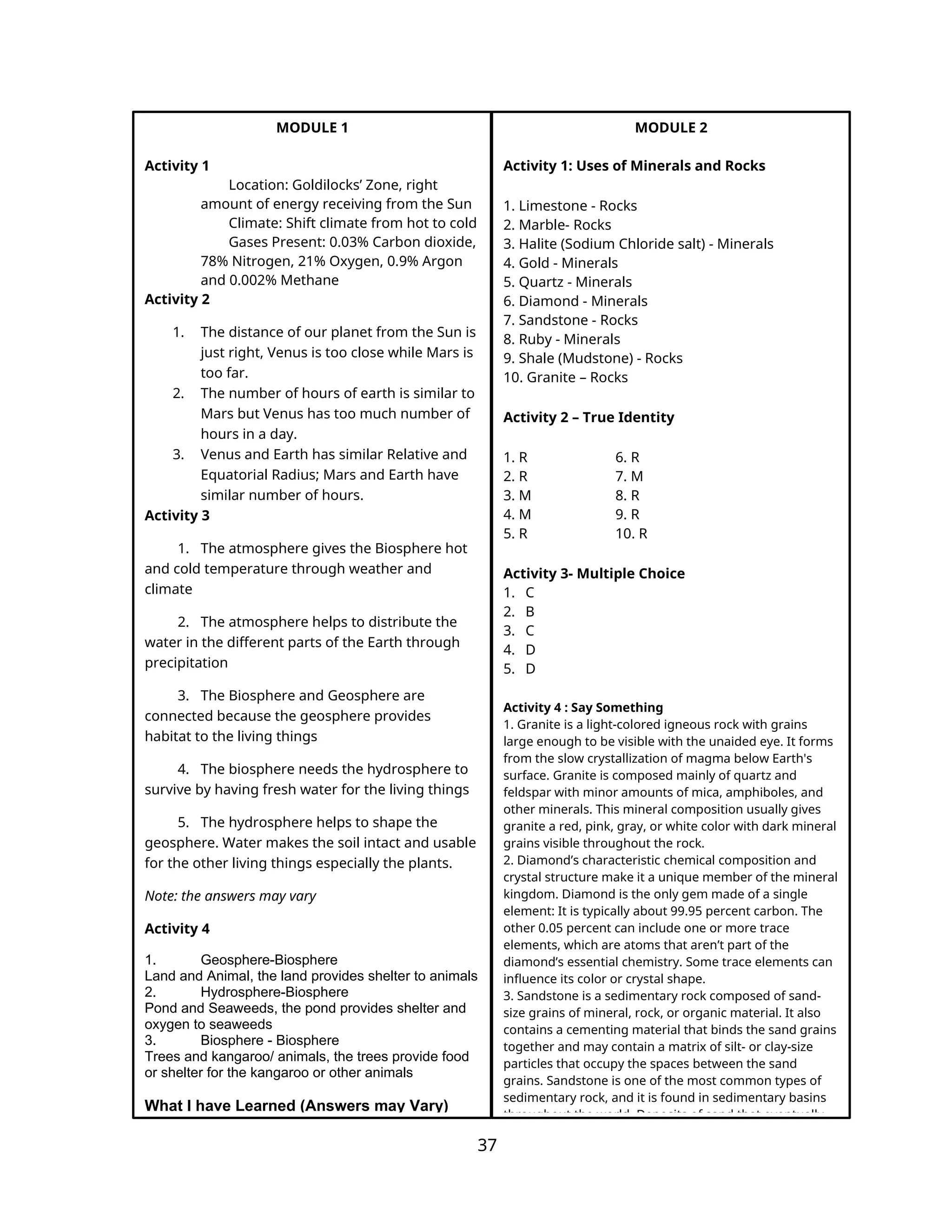
MODULE 2
Activity 1: Uses of Minerals and Rocks
1. Limestone - Rocks
2. Marble- Rocks
3. Halite (Sodium Chloride salt) - Minerals
4. Gold - Minerals
5. Quartz - Minerals
6. Diamond - Minerals
7. Sandstone - Rocks
8. Ruby - Minerals
9. Shale (Mudstone) - Rocks
10. Granite – Rocks
Activity 2 – True Identity
1. R 6. R
2. R 7. M
3. M 8. R
4. M 9. R
5. R 10. R
Activity 3- Multiple Choice
1. C
2. B
3. C
4. D
5. D
Activity 4 : Say Something
1. Granite is a light-colored igneous rock with grains
large enough to be visible with the unaided eye. It forms
from the slow crystallization of magma below Earth's
surface. Granite is composed mainly of quartz and
feldspar with minor amounts of mica, amphiboles, and
other minerals. This mineral composition usually gives
granite a red, pink, gray, or white color with dark mineral
grains visible throughout the rock.
2. Diamond’s characteristic chemical composition and
crystal structure make it a unique member of the mineral
kingdom. Diamond is the only gem made of a single
element: It is typically about 99.95 percent carbon. The
other 0.05 percent can include one or more trace
elements, which are atoms that aren’t part of the
diamond’s essential chemistry. Some trace elements can
influence its color or crystal shape.
3. Sandstone is a sedimentary rock composed of sand-
size grains of mineral, rock, or organic material. It also
contains a cementing material that binds the sand grains
together and may contain a matrix of silt- or clay-size
particles that occupy the spaces between the sand
grains. Sandstone is one of the most common types of
sedimentary rock, and it is found in sedimentary basins
throughout the world. Deposits of sand that eventually
MODULE 1
Activity 1
Location: Goldilocks’ Zone, right
amount of energy receiving from the Sun
Climate: Shift climate from hot to cold
Gases Present: 0.03% Carbon dioxide,
78% Nitrogen, 21% Oxygen, 0.9% Argon
and 0.002% Methane
Activity 2
1. The distance of our planet from the Sun is
just right, Venus is too close while Mars is
too far.
2. The number of hours of earth is similar to
Mars but Venus has too much number of
hours in a day.
3. Venus and Earth has similar Relative and
Equatorial Radius; Mars and Earth have
similar number of hours.
Activity 3
1. The atmosphere gives the Biosphere hot
and cold temperature through weather and
climate
2. The atmosphere helps to distribute the
water in the different parts of the Earth through
precipitation
3. The Biosphere and Geosphere are
connected because the geosphere provides
habitat to the living things
4. The biosphere needs the hydrosphere to
survive by having fresh water for the living things
5. The hydrosphere helps to shape the
geosphere. Water makes the soil intact and usable
for the other living things especially the plants.
Note: the answers may vary
Activity 4
1. Geosphere-Biosphere
Land and Animal, the land provides shelter to animals
2. Hydrosphere-Biosphere
Pond and Seaweeds, the pond provides shelter and
oxygen to seaweeds
3. Biosphere - Biosphere
Trees and kangaroo/ animals, the trees provide food
or shelter for the kangaroo or other animals
What I have Learned (Answers may Vary)
38
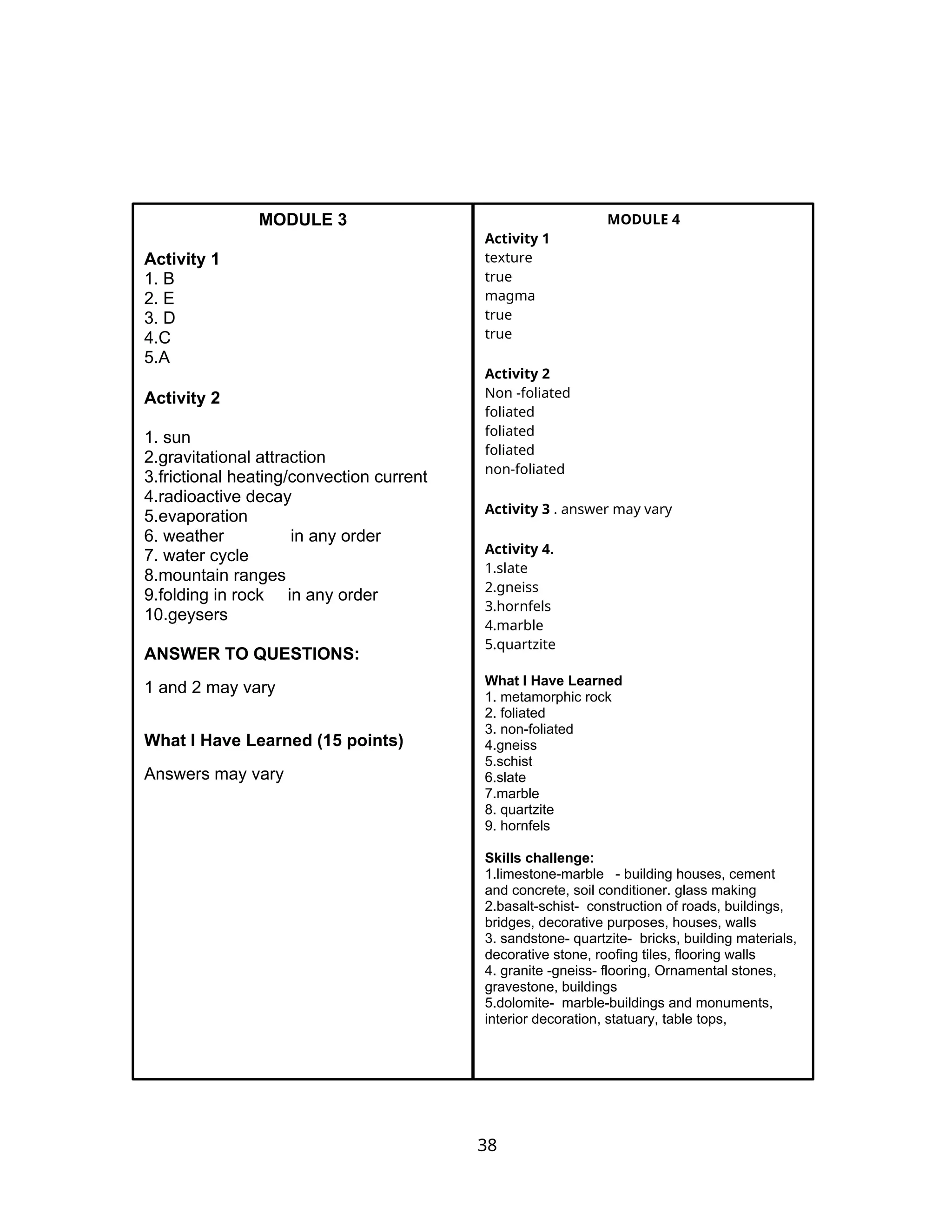
MODULE 4
Activity 1
texture
true
magma
true
true
Activity 2
Non -foliated
foliated
foliated
foliated
non-foliated
Activity 3 . answer may vary
Activity 4.
1.slate
2.gneiss
3.hornfels
4.marble
5.quartzite
What I Have Learned
1. metamorphic rock
2. foliated
3. non-foliated
4.gneiss
5.schist
6.slate
7.marble
8. quartzite
9. hornfels
Skills challenge:
1.limestone-marble - building houses, cement
and concrete, soil conditioner. glass making
2.basalt-schist- construction of roads, buildings,
bridges, decorative purposes, houses, walls
3. sandstone- quartzite- bricks, building materials,
decorative stone, roofing tiles, flooring walls
4. granite -gneiss- flooring, Ornamental stones,
gravestone, buildings
5.dolomite- marble-buildings and monuments,
interior decoration, statuary, table tops,
MODULE 3
Activity 1
1. B
2. E
3. D
4.C
5.A
Activity 2
1. sun
2.gravitational attraction
3.frictional heating/convection current
4.radioactive decay
5.evaporation
6. weather in any order
7. water cycle
8.mountain ranges
9.folding in rock in any order
10.geysers
ANSWER TO QUESTIONS:
1 and 2 may vary
What I Have Learned (15 points)
Answers may vary

RTP EARTH _ LIFE SCI ADM Q1W1-4 Validated and Revised.docx

  • 1.
  • 2.
    2 DEVELOPMENT TEAM OFTHE MODULE WRITERS: MARIA SHEILA M. PELIGRINO, Master Teacher I MICHELLE ANN V. VILLACORTA, Teacher III TERESITA K. DELA CRUZ, Teacher III CONSOLIDATOR: MICHELLE ANN V. VILLACORTA, Teacher III LANGUAGE EDITOR: CATHERINE P. DE LOS REYES, Teacher I CONTENT JULIE ANDREA P. AÑANO, Master Teacher I VALIDATORS: AYRA PATRICIA S. ALVERO, Teacher III CHRISTIAN MARU S. GARCIA, Teacher III JOSELITO P. GRANDE JR. , Teacher II COVER PAGE AIRA MARI CON M. AUSTERO ILLUSTRATOR: TEAM LEADER: DR. RAQUEL M. AUSTERO Education Program Supervisor
  • 3.
    Module 1 Earthas a Unique Planet Most Essential Learning Competencies ● Recognize the uniqueness of the Earth, being the only planet in the solar system with properties necessary to support life. (S11/12ES-Ia-e3) ● Explain that the Earth consists of four subsystems, across whose boundaries matter and energy flow. (S11/12ES-Ia-e4) What’s In Characteristics of Earth as a Planet The Earth is a unique planet among the other planets because of the life exists on it. Here are the characteristics that make Earth a unique planet:  There are few stars around the Sun making it safe from gravitational pulls, gamma rays and collapsing; it makes our planet in a safe region in our solar system. Unlike other young stars that burst and explode, our Sun is a stable star making it a long-lasting star.  Our planet’s orbit is called as the Goldilocks’ Zone because the water exists in a liquid state on its surface due to the right amount of energy the Earth is receiving from the Sun.  The Earth’s core produces its own magnetic field thus protecting our planet from solar flares coming from the Sun.  The Earth was tilted towards the Sun making it shakes while it goes around the Sun. It can shift the climate from hot to cold at around 40,000 years that may vary because of the Moon’s gravitational pull.  It has a high altitude ozone layer protecting us from unsafe UV rays. Astronomical Data Venus Earth Mars Mean distance from Sun (108 kilometers) 1.082 1.496 2.2794 3
  • 4.
    Comparative solar distances0.723 1 1.524 Orbital period 0.615 1 1.881 Rotational period (hours) 5832.24 23.9345 24.6229 Equatorial radius (kilometers) 6052 6378 3397 Relative Radius 0.95 1 0.53 Earth as a System System is a set of things working together as parts of a mechanism or an interconnecting network. Earth acts as a system that are related to each other, the system of Earth is consisted by the different subsystems: 1. Biosphere includes all living things on Earth. Even in deep vents that light cannot penetrate serve as a habitat to the exotic-life forms and in the hot springs for the bacteria. 2. Atmosphere is a blanket of gas that surrounds our planet up to the edge of space. The very important roles of this part is to provide us the air that we breath and protect us from the ultraviolet radiation that comes from the Sun. Layers of the Atmosphere:  Troposphere is the bottom layer wherein the weather occurs.  Tropopause is the outer boundary. 4 Source: https://www.pinterest.com.au/pin/221591244137179141/ Table. Comparison of the Three Planets in Terms of Gases Present Source: https://www.researchgate.net/figure/Basic-data-about-Venus-with-Earth-and-Mars-for-comparison_tbl1_322668645
  • 5.
     Stratosphere isthe layer where the ozone layer is located; the ozone absorbs the ultraviolet radiation from the Sun. The outer layer in the stratopause.  Mesosphere is the third layer which is the coldest layer; research balloons cannot reach this layer.  Thermosphere is fourth layer wherein a little fraction of atmosphere is present.  Exosphere the outermost layer; and the thinnest layer of atmosphere because the atmosphere gases fade until reaching vacuum of space. 3. Geosphere is the solid part of portion of the Earth. It is the largest among the rest of the Earth’s subsystems. Layers of the Earth A. Crust is the thin rocky outer layer of the Earth. Two types: continental (granitic rocks) and oceanic (basaltic rocks); rocks of the oceanic crust are younger than the rocks at the continental crust. B. Mantle is the thickest layer that consists the 82% of the Earth’s volume. Two parts: upper mantle is divided into two, the lithosphere (sphere of rock) and the asthenosphere (weak sphere: solid but mobile and the lower mantle is solid due to the increasing pressure and it has very hot rocks that are capable of having a gradual flow. C. Core is thought to be an iron-nickel alloy with minor oxygen, silicon and sulfur. Two regions: outer core is a liquid layer that is responsible in producing the magnetic field of the Earth; inner core is solid because of the extreme pressure in the center of the Earth. 4. Hydrosphere is all the waters on or near the Earth surface that continuously moving, evaporating and back to precipitating to the land and back to the ocean. The main role of this part is to provide fresh water to the organisms and is important to produce different landforms. 5
  • 6.
    Energy Flow tothe Earth’s System The Earth’s system is powered by the energy comes from two sources: from the Sun to the environment and from the interior of the Earth. The Sun helps the subsystems to do their processes. For example, the weather and climate processes are driven by the Sun while the heat from the Earth’s interior produces volcanoes, earthquake and mountains. What’s More Activity 1: Earth’s Characteristics The Earth is a unique planet that can support life for the different organisms to survive. There are many properties to consider for a planet to be unique and habitable. Directions: Complete the graphic organizer to describe the Earth’s Characteristics. 6 Figure. Earth Spheres press.com/ 2009/06/04/save-earth-save-trees-save-water/ Earth’s Characteristics Purpose of the Magnetic Field:_________________ __________________ Climate:____ ________________________ ____________ Location (solar system): _____________________ Gases Present:________ ______________________
  • 7.
    Activity 2: Uniquenessof the Earth Directions: Analyze the table about the characteristics of Earth comparing to Venus and Mars and answer the following questions. You may use separate paper for your answers. Comparison of the Three Planets (other characteristics) Astronomical Data Venus Earth Mars Mean distance from Sun (108 kilometers) 1.082 1.496 2.2794 Comparative solar distances 0.723 1 1.524 Orbital period 0.615 1 1.881 Rotational period (hours) 5832.24 23.9345 24.6229 Equatorial radius (kilometers) 6052 6378 3397 Relative Radius 0.95 1 0.53 Source: https://www.researchgate.net/figure/Basic-data-about-Venus-with-Earth-and-Mars-for-comparison_tbl1_322668645 Answer the following questions: 1. In terms of the distance from the Sun of the three planets, what is the advantage of our planet compare to the other two planets? ____________________________________________________________________ ____________________________________________________________________ ____________________________________________________________________ 2. Compare the length of day of the three planets, what will be the ideal number of hours in a day for a planet to sustain life? Explain your answer. ____________________________________________________________________ ____________________________________________________________________ ____________________________________________________________________ 3. Cite the similarities of the three planets. Explain how these similarities help our planet to be a habitable planet. ____________________________________________________________________ ____________________________________________________________________ ____________________________________________________________________ Activity 3: The Four Subsystems The Earth is a system that is working together interconnected. The different parts work starting from an energy source to the different subsystems. Describe the connection between the different arrows connecting the different systems. You can give examples for each arrow. You may use separate paper for your answers. 7
  • 8.
    Activity 4: AllSubsystems Are Interconnected Complete the table below, refer to the illustration for your answers. 8 SUN GEOSPHERE BIOSPHERE ATMOSPHERE HYDROSPHERE Ex.: The Sun supplies the energy for the different subsystems 1 2 3 4 5 1. 2. 3. 4. 5.
  • 9.
    Subsystem 1 Subsystem2 Factors involved Describe the interaction of the subsystems Ex. Biosphere Hydrosphere Precipitation and animals The rain provides water for drinking and bathing 1. 2. 3. Source: https://www.twinkl.com.ph/illustration/ecosystem-black-and-white 9
  • 10.
    What I HaveLearned Directions: Draw your community and label the parts that show the interconnection of the different subsystems of the Earth. You may use separate paper for your answers. Example: Source: http://www.nzdl.org/cgi-bin/library.cgi What I Can Do The picture shows how human contributes to the system of the Earth and the effect of these manmade products and activities are destroying the four subsystems. For an instance, the burning of fossil fuels causes the enhanced greenhouse effect wherein the global temperature rises because of the trapped heat due to too much greenhouses gases like carbon monoxide in the atmosphere. This phenomenon might lead to very serious atmospheric problems like climate change. Cite three (3) examples of 10 Coastal /Sea= Hydrosphere People or Fishermen= Biosphere
  • 11.
    human products andactivities and explain your answers. You may use a separate paper for your answers. Module 2 ROCKS AND MINERALS Most Essential Learning Competencies  Identify common rock-forming minerals using their physical and chemical properties. (S11/12ES-1a-9)  Classify rocks into igneous, sedimentary, and metamorphic. (S11/12ES-Ib-10)  Explain how the products of weathering are carried away by erosion and deposited elsewhere. (S11/12ES-1b-12)  Compare and contrast the formation of the different types of igneous rocks. (S11/12ES-1c-18) What’s In In the last module, you have learned that the earth consists of four major subsystems. Do you still remember those major subsystems of the earth? How do the four systems interact to each other? Which subsystem contains all living things of the earth? The Earth system is divided into four major subsystems, it includes land, air, water, and living things. They are also known as spheres, geosphere/lithosphere (land), atmosphere (air), hydrosphere (water), and biosphere (living things). One of the unique spheres is lithosphere, a rocky outer part and gives an environmental shape of the earth. What is underneath the ground of the lithosphere? Let explore it! 11
  • 12.
    The National GeographicSociety defined rocks in geological aspect as a natural substance composed of solid crystals of different minerals that have been fused together into a solid lump; while minerals are typically formed when molten rock or magma, cools, or by separating out of mineral-rich water, such as that in underground caverns. In general, mineral particles are small, having formed within confined areas such as lava flows or between grains of sediments. Rocks themselves are made of clusters or mixtures of minerals, and minerals and rocks affect landform development and form natural resources such as gold, tin, iron, marble, and granite. Properties of Minerals 1. Luster – it is the quality and intensity of reflected light exhibited by the mineral.  Metallic – generally opaque and exhibit a resplendent shine similar to a polished metal.  Non-metallic – vitreous (glassy), adamantine (brilliant/diamond-like), resinous, silky, pearly, dull (earthy), greasy, etc. 2. Hardness – it is a measure of the resistance of a mineral (not specifically surface) to abrasion. 3. Color and streak –maybe a unique identifying property of certain minerals (e.g. malachite – green, azurite – blue). 4. Streak on the other hand is the color of a mineral in powdered form. 5. Crystal Form/Habit – the external shape of a crystal or groups of crystals is displayed /observed as these crystals grow in open spaces. 6. Cleavage – it is the property of some minerals to break along parallel repetitive planes of weakness to form smooth, flat surfaces. 7. Fracture – some minerals may not have cleavages but exhibit broken surfaces that are irregular and non-planar. 8. Specific Gravity – it is the ratio of the weight of a mineral to the weight of an equal volume of water. 9. Others – there are certain unique properties of minerals that actually help in their identification (e.g. magnetism, odor, taste, tenacity, reaction to acid, etc.). Magnetite is strongly magnetic; sulfur has distinctive smell; halite is salty; calcite fizzes with acid as with dolomite but in powdered form. 12
  • 13.
    Classification of Minerals 1.Silicates – minerals containing two of the most abundant elements in the earth’s crust, namely, silicon and oxygen. Ex. quartz, beryl (emerald), and feldspar. 2. Oxides – minerals containing oxygen anion (O2 -) combined with one or more metal ions. Ex. Hematite, spinel, sapphire. 3. Sulfates – minerals containing sulfur and oxygen anion (SO4) - combined with other ions. Ex. Baryte, gypsum, and anhydrite. 4. Sulfides – minerals containing sulfur anion (S2) - combined with one or more ions. Ex. pyrite, galena, and sphalerite. 5. Carbonates – minerals containing the carbonate anion (CO3) 2- combined with other elements. Ex. Calcite, magnesite, and dolomite. 6. Native Elements – minerals that form as individual elements. a. Metals and Inter-metals – minerals with high thermal and electrical conductivity, typically with metallic luster, low hardness (gold, silver). b. Semi-metals – minerals that are more fragile than metals and have lower conductivity (arsenic, bismuth). c. Nonmetals – nonconductive (sulfur, diamond). 7. Halides – minerals containing halogen elements combined with one or more elements. Ex. fluoride, halite, and chloride. Types of Rocks A. Igneous rocks are formed by solidification of molten rocks called magma. Characteristics are these rocks are formed when magma solidifies, as the magma cools, mineral crystals will begin to grow, these crystals will grow and interlock to form a hard crystalline rock, and basalt is usually formed when magma solidifies on the surface and granite hardens within the earth’s crust. Types 1. Plutonic (Intrusive) igneous rocks formed from magma that cools and crystalline beneath the earth. 13
  • 14.
    Ex. Diorite, gabbro,granite, pegmatite, and peridotite. 2. Volcanic (Extrusive) igneous rocks formed from magma which has spilled out onto the surface of a volcano. Ex. Basalt, andesite, dacite, pumice, rhyolite, scoria, and tuff. B. Sedimentary rocks are formed with the accumulation, compaction, and cementation of sediments. Sediments that have settled at the bottom of a lake, sea or ocean, and have been compressed over millions of years. Characteristics are the rocks are formed due to the build-up of sediments over time, the weathered and eroded material is built up in layers, as more material is added on top – this will push any air and/or water out and will compact the material together into a hard rock, and often contain fossils of plants and animals. Types 1. Clastic sedimentary rocks are formed from mechanical weathering debris. Ex. breccia, conglomerate, sandstone, siltstone, and shale. 2. Chemical sedimentary rocks are formed when dissolved materials precipitate from solution. Ex. rock salt, iron ore, chert, flint, some dolomites, and some limestones. 3. Organic sedimentary rocks are formed from the accumulation of plant or animal debris. Ex. coal, some dolomites, and some limestones. C. Metamorphic rocks are formed by heat and pressure; changing one type of rock into another type of rock. Characteristics are these are formed when either igneous or sedimentary rocks are changed, heat and/or pressure will cause the elements in the original rock to react and re-form, metamorphic rocks are highly resistant to erosion and are often used in building materials. Types 1.Foliated metamorphic rocks have a layered or banded appearance that is produced by exposure to heat and directed pressure. Ex. gneiss, phyllite, schist, and slate. 2. Non-foliated metamorphic rocks are novaculite do not have a layered or banded appearance. Ex. hornfels, marble, quartzite 14
  • 15.
    The rock cycle isa series of processes that create and transform the types of rocks. In the illustration above, it explains how the three rock types are related to each other and how earth processes change a rock from one type to another through geologic time. Plate tectonic movement is responsible for the recycling of rock materials and is the driving force of the rock cycle. Weathering is the breaking down or dissolving rocks and minerals on the surface of the earth. The agents of weathering are plants, ice, animals, salts, water, change in Temperature, and Acids 15 Figure 2. The Rock Cycle Source:https://www.elephango.com/index.cfm/pg/k12 learning/lcid/11103/Geology_Rocks:_The_Rock_Cycle
  • 16.
    Types of Weathering 1.Physical (Mechanical) Weathering is the breaking down of rocks into smaller pieces with no change in composition. It has the following types: 1. Abrasion–occurs when wearing and grinding by small sedimentary particles carried by wind, water, or ice. 2. Frost Wedging (Ice Wedging)-occurs when water freezes in rock fractures. 3. Thermal Expansion–occurs when heating and contraction of cooling weakens rocks. 4. Exfoliation-occurs when rocks breaking loose along parallel fractures like onion layers. 2. Chemical Weathering – is the breakdown of rocks by chemical agents. 1. Dissolution-occurs when rocks or minerals are dissolved by water. Ex. Halite and Calcite 2. Oxidation-occurs when minerals react in oxygen gas. Ex. Iron Oxide 3. Hydrolysis-occurs when water reacts with other minerals. Ex. Feldspar 4. Acid Precipitation-occurs rain contains high concentration of acids. Ex. Acid Rain 3. Biological Weathering – Involved both physical and chemical process. An action by plants and animals. Erosion – is the removal of weathered particles by moving water, wind, ice or gravity. What’s More Activity 1: Uses of Minerals and Rocks Directions: Complete the table by identifying whether the examples are Minerals or Rocks. Place a check mark (/) on the space that corresponds to your answer. Write the uses of the given minerals and rocks on the space provided or use a separate sheet of paper. Example Minerals Rocks Uses 1. Limestone 16
  • 17.
    2. Marble 3. Halite (Sodium Chloridesalt) 4. Gold 5. Quartz 6. Diamond 7. Sandstone 8. Ruby 9. Shale (Mudstone 10. Granite Answer the following questions: 1. What are the differences between rocks and minerals? _________________________________________________________________________________ _______________________________________________________________2. Lists down some minerals and rocks that you have seen in your house, school, and community. Give the uses or application to your daily lives? _________________________________________________________________________________ _________________________________________________________________________________ ______________________________________________________ 17
  • 18.
    Activity 2: TrueIdentity Directions: Identify the properties of rocks and minerals. Write R if the statement is pertaining to rocks and M if the statement belongs to minerals. Write the correct letter on the space provided before each number. _____ 1. It is formed from tremendous heat and pressure. _____ 2. Formed by solidifying of magma below the earth surface. _____ 3. A solid, inorganic substance found on earth. _____ 4. Luster is the quality and intensity of reflected light exhibited by it. _____ 5. Most of these materials are deposit from the surface of the land to the bottoms of lakes, rivers and oceans. _____ 6. It is highly resistant to erosion and are often used in building materials. _____ 7. Color is one of the best ways to identify this substance. _____ 8. Often contain fossils of plants and animals. _____ 9. Formed with the accumulation, compaction, and cementation of sediments. _____ 10. Basalt is usually formed when magma solidifies on the surface. Activity 3: Multiple Choice Directions: Choose the letter of the best answer. Write the letter of your answer on a separate sheet of paper. 1. Which is a sedimentary rock? A. diorite B. granite C. shale D. slate 2. These are the processes of rock cycle, except? A. cooling B. metamorphism C. sedimentation D. weathering 3. Which of the following does not belong to the group? A. carbonates : magnetite C. phosphates : hematite B. hydroxides : brucite D. sulfates : gypsum 4. The physical and chemical breaking down of rocks into smaller particles is called _________. A. Deposition B. Erosion C. Exfoliation D. Weathering 5. What does the mineral property of luster measure or describe? 18
  • 19.
    A. measures thedensity of the mineral B. the color of the mineral in powdered form C. describes how a mineral break into pieces D. describes how well a mineral reflects light Activity 4: Say Something Directions: Write a simple essay on how you can describe each picture. You can use separate paper for your answer. https://www.stoneyard.co.uk/ https://www.discovermagazine.com/ https://www.awbsltd.com Granite Diamond Sandstone ___________________________________________________________________________ ___________________________________________________________________________ ___________________________________________________________________________ ___________________________________________________________________________ ___________________________________________________________________________ ___________________________________________________________________________ What I Have Learned Directions: Weathering is the breaking down or dissolving rocks and minerals on the surface of the earth. The agents of weathering are plants, ice, animals, salts, water, change in Temperature, and Acids. There are 19
  • 20.
    three types ofweathering, these are Physical, Chemical and Biological Weathering. Look for a sample pictures of this three (3) types of weathering and place it in the box below. Physical Weathering Chemical Weathering Biological Weathering What I Can Do According to nps.gov, rocks and minerals are all around us! They help us to develop new technologies and are used in our everyday lives. Our use of rocks and minerals includes as building material, cosmetics, cars, roads, and appliances. To maintain a healthy lifestyle and strengthen the body, humans need to consume minerals daily. As a concerned citizen: Why are rocks and minerals important? ___________________________________________________________________________ ___________________________________________________________________________ ___________________________________________________________________________ ___________________________________________________________________________ ___________________________________________________________________________ ___________________________________________________________________________ ___________________________________________________________________________ 20
  • 21.
    How can youconserve and preserve rocks and minerals? ___________________________________________________________________________ ___________________________________________________________________________ ___________________________________________________________________________ ___________________________________________________________________________ ___________________________________________________________________________ ___________________________________________________________________________ Module 3 Earth's Internal Heat Most Essential Learning Competencies Describe where the Earth’s internal heat comes from. (S11/12ES-lb-14) What’s In This module was designed and written to help you understand the different sources of earth's internal heat. Scientists have varied scientific explanation of how Earth's internal heat were generated. Many geologic processes and features, such as tectonic plate motion, volcanic activity, and geysers, are related to the Earth's internal heat. The produced heat from deep within the interior of the earth is known as the internal heat or the geothermal energy, and the external heat or solar energy that is generated from the sun. Most of Earth’s internal heat is left over from when our planet formed, about 4.5 billion years ago. Where does Earth’s internal heat come from? 21
  • 22.
    Three main sourcesof earth's internal heat 1. Heat of accretion- Heat is generated when the planet formed and accreted from planetesimals. Colliding planetesimals convert gravitational potential energy to kinetic energy and then thermal energy. It takes long for the heat to move out of the earth during its development. This occurs through both "convective" transport of heat within the earth's liquid outer core and solid mantle and slower "conductive" transport of heat through non convecting boundary layers, such as the earth's plates at the surface. As a result, much of the planet's primordial heat, has been retained when earth was formed. 2. Frictional heating- is caused by denser core material sinking to the center of the planet. Earth's interior is the site of great amounts of heat. Most of this heat is produced by the decay of radioactive elements. Overall, the flow of Earth's internal heat is outward toward Earth's surface. Many geologic processes and features, such as tectonic plate motion, volcanism, and metamorphism, are also related to the Earth's internal heat. Large convection currents in the Earth's mantle cause heat to circulate within the Earth's interior. These convection currents are linked to tectonic plate motion and geologic activity at plate boundaries. Key reference: https://fw.unitymg.com/media/47/0104-00002347-01-res-11.14.12_ Diagram 1. Convection current Less dense material rises, and more dense material sinks https://www.google.com/search?q=convection+current&hl= 22
  • 23.
    What is radioactivedecay inside Earth? 3. Radioactive Decay- heat from the decay of radioactive elements came from four radioactive isotopes .A major source of Earth's heat is radioactivity, the energy released when the unstable atoms decay. These four isotopes are: 1. Uranium-238 (238U) 3. Thorium-232(232Th) 2. Uranium- 235(235U) 4. Potassium-40(40K) Are radioactive isotopes a source of energy for plate tectonics Certain isotopes of elements are unstable and radioactive. Uranium, thorium and potassium isotopes are deep inside Earth. These radioactive isotopes generate 50% of Earth’s radiogenic heat from radioactive decay. Radioactive decay involves the disintegration of natural radioactive elements within the earth’s interior– like Uranium it’s a special kind of element because when it decays, heat is produced. The remaining 50% of Earth’s internal heat budget is from primordial heat after its initial formation. It’s from this radioactive heat in the mantle that makes our planet geologically active. Most of the internal heat transfer occur volcanically at mid-oceanic ridges. This process drives mantle convection and plate tectonic motion on the planet. It’s in the asthenosphere where the convection cycle occurs because particles can freely flow. As heat rises, it starts a mantle convection cycle. It tears apart the Earth to form mid-oceanic ridges (tensional force). When it sinks down, it breaks it apart (compressional force). 23
  • 24.
    Diagram 2 .RadioactiveDecay https://www.google.com/search?q=radioactive+decay+of+element+underneath+the+earth What’s More Activity1 : Matching Type! Direction: Match column A with. Column B. Write the letter of the correct answer before the number. A B ______1. Major source of earth’s internal heat. ______2. A special kind of element which produced heat when decayed ______3. Results of differential heating ______4. Involves disintegration of radioactive element. ______5. Heat source from deep within the earth. A. geotherma l energy B. radioactivit y C. radioactive decay D. convection current E. Uranium 24
  • 25.
    F. Aluminum Activity 2:Concept Mapping! Directions: Complete the table by inserting the correct word in an appropriate box from the map. Choose your answer from the word bank below. Earth’s Sources of Heat External Internal Drives the caused the formation of Answer the following questions. 1. What is the importance of Earth’s internal heat? __________________________________________________________________________ __________________________________________________________________________ __________________________________________________________________________ 25 1. 4. 2. 3. 5 6. 7. 8. 9. 10 mountain ranges evaporation sun weather folding in rock water cycle geysers frictional heating radioactive decay gravitational attraction
  • 26.
    2. How dothe elements isotopes generate earth’s internal heat? ___________________________________________________________________ ___________________________________________________________________ __________________________________________________________________________ What I Have Learned Directions: Using the concept of Earth’s Internal Heat, create a poem with three stanzas. ________________________________________________________ Title _____________________________________________________________ _____________________________________________________________ _____________________________________________________________ _____________________________________________________________ _____________________________________________________________ _____________________________________________________________ _____________________________________________________________ _____________________________________________________________ _____________________________________________________________ _____________________________________________________________ _____________________________________________________________ 26
  • 27.
    _____________________________________________________________ What I CanDo Exploration! Directions: In a separate sheet; long bond paper, illustrate how earth’s interior generates heat, and identify, and answer the following questions. 1. What is the significance of earth’s internal heat? __________________________________________________________________________________ __________________________________________________________________________________ __________________________________________________________________________________ __________________________________________________________________________________ __________________________________________________________________________________ 2. How does the formation of the planets generate earth’s internal heat? __________________________________________________________________________________ __________________________________________________________________________________ __________________________________________________________________________________ __________________________________________________________________________________ __________________________________________________________________________________ 27
  • 28.
    3. Why doesconvection cycle occur in the asthenosphere? __________________________________________________________________________________ __________________________________________________________________________________ __________________________________________________________________________________ __________________________________________________________________________________ __________________________________________________________________________________ Module 4 Metamorphism Most Essential Learning Competencies  Differentiate foliated and non-foliated metamorphic rock and (S11/12ES-Ic-18)  Describe the changes in mineral components and texture of rocks due to changes in pressure and temperature {metamorphism]((S11/12ES- Ic--18) What’s In Rocks are formed on Earth as igneous, sedimentary, or metamorphic rocks. Metamorphic rocks formed from heat and pressure changing the original or parent rock into a completely new rock. Sedimentary, igneous, or even another metamorphic rock could be a parent rock of a newly formed metamorphic rock. For instance, limestone transforms into a marble, sandstone into quartzite, and granite into gneiss. The word "metamorphic “comes from the Greek which means "To Change Form". Metamorphism-is a change in the structure or constitution of a rock due to heat and pressure. There are three ways or origins that metamorphic rocks can form: 28
  • 29.
    1. Contact metamorphismoccurs when magma comes in contact with an already existing body of rock and produced non-foliated (rocks without any cleavage) rocks such as marble, quartzite, and hornfels. Diagram1: Contact metamorphism occurs due to a rise in temperature when magma invades a host rock. 2. Regional Metamorphism occurs over a much larger area, and it is caused by a large geologic process such as mountain-building and usually produces foliated rocks such as gneiss and schist. Schist is a medium grade metamorphic rock that has been subjected to more heat and pressure than slate, which is a low- grade metamorphic rock. Regional metamorphism commonly associated with convergent plate boundaries and the formation of mountain ranges. Diagram2: Regional metamorphism https://www.google.com/search?q=regional+metamorphism 29
  • 30.
    3. Dynamic Metamorphismalso occurs because of mountain-building. These huge forces of heat and pressure cause the rocks to be bent, folded, crushed, flattened, and sheared. Metamorphic rocks are divided into two categories: 1. Foliates are composed of large amounts of micas and chlorites. Foliated rocks have mineral crystals that are aligned in planes or bands in rock. These minerals have very distinct cleavage. Foliated metamorphic rocks usually split along the cleavage lines that are parallel to the minerals that make up the rock. Slate, as an example, will split into thin sheets. Foliate comes from the Latin word that means sheets, as in the sheets of paper in a book. Examples: ● Slate is a fine-grained metamorphic rock with perfect cleavage that allows it to split into thin sheets. Slate usually has a light to dark brown streak. Slate is produced by low grade metamorphism, which is caused by relatively low temperatures and pressures. ● Schist is a medium grade metamorphic rock. This means that it has been subjected to more heat and pressure than slate, which is a low-grade metamorphic rock. Schist is a more coarse-grained rock. The individual grains of minerals can be seen by naked eye. Examples of Foliated Metamorphic Rocks. https://www.google.com/search? q=foliated+metamorphic+rocks&source=lnms&tbm 2. Non-Foliated is a metamorphic rock that has no cleavage at all. Quartzite and marble are two examples of non-foliates rock that have unaligned mineral crystal 30
  • 31.
    which contains morecoarse grains and generally have a random shape that is granular in appearance. Examples: ● Quartzite is composed of sandstone that has been metamorphosed. Quartzite is much harder than the parent rock sandstone. It forms from sandstone that has come into contact with deeply buried magma. Quartzite looks similar to its parent rock. ● Marble is metamorphosed limestone or dolomite. Both limestone and dolomite have a large concentration of calcium carbonate (CaCO3). Some of the different colors of marble are white, red, black, mottled and banded, gray, pink, and green. Marble Quartzite Hornfels Examples of Non-foliated Metamorphic Rocks https://www.google.com/search?q=marble+non+foliated+metamorphic+rocks Grain size reflects pressure and temperature conditions of metamorphism. ● Higher temperatures and pressures (higher grades of metamorphism) favor larger grains. ● Lower temperatures and pressures favor smaller grains. Mineral composition: ● Reflects the composition of the parent rock and the pressure ● Temperature conditions under which the metamorphism occurred. What’s More Activity 1. How are metamorphic rocks classified? 31
  • 32.
    Directions: Write Trueif the statement is correct. If the statement is False, change the underlined word to make the statement correct. ________1. Metamorphic rocks are classified according to their size. ________2. A foliated metamorphic rock has mineral crystal arranged in planes. ________3. Contact metamorphism occurs in tectonic plates which produced non- foliated rock like marble. ________4. Foliated metamorphic rock usually breaks along the cleavage. ________5. Quartzite is a non-foliated metamorphic rock contained mostly of quartz. Activity 2. Classify the following rock listed below as Foliated or Non-Foliated. Write your answer in the space provided for. _____________1. marble _____________4. gneiss _____________2. schist _____________5. quartzite _____________3. Slate Activity 3: Metamorphic Rocks! Directions: Compare the two rocks shown. Which is foliated rock? Which is non- foliated? Explain how you can tell. https://www.google.com/search?q=marble+metamorphic+rock A B ________________________________________________________________ ________________________________________________________________ 32
  • 33.
    Activity 4. Identifyingand Naming! Directions: Unscramble the letter to identify the rock in each number. 1. STALE-______________________ 2. SNGIES-_____________________ 3. LEHFSORN-__________________ 4. RMBELA-____________________ 5. UATRQIZET-__________________ Answer the following questions: 1. What is the importance of metamorphic rocks? ________________________________________________________________ ________________________________________________________________ ________________________________________________________________ 2. How are metamorphic rocks formed? ________________________________________________________________ ________________________________________________________________ ________________________________________________________________ 3. How is foliated rock different from non-foliated rock? ________________________________________________________________ ________________________________________________________________ ________________________________________________________________ 33
  • 34.
    What I HaveLearned Direction: Complete the concept map by writing the appropriate word inside the box. Choose your answer from the WORD BANK below. METAMORPHIC ROCK FOLIATED NON-FOLIATED QUARTZITE MARBLE GNEISS SLATE SCHIST HORNFELS 34 1. 2. 3. 4. 7. 5. 6. 8. 9.
  • 35.
    What I CanDo SKILLS CHALLENGE Skills: Identifying and researching Directions: Complete the table below. Use reference materials if necessary. COMMON METAMORPHIC ROCKS Parent Rocks Metamorphic Rock Uses 1. Limestone 2. Basalt 3. Sandstone 4. Granite 5. Dolomite 35
  • 36.
  • 37.
    37 MODULE 2 Activity 1:Uses of Minerals and Rocks 1. Limestone - Rocks 2. Marble- Rocks 3. Halite (Sodium Chloride salt) - Minerals 4. Gold - Minerals 5. Quartz - Minerals 6. Diamond - Minerals 7. Sandstone - Rocks 8. Ruby - Minerals 9. Shale (Mudstone) - Rocks 10. Granite – Rocks Activity 2 – True Identity 1. R 6. R 2. R 7. M 3. M 8. R 4. M 9. R 5. R 10. R Activity 3- Multiple Choice 1. C 2. B 3. C 4. D 5. D Activity 4 : Say Something 1. Granite is a light-colored igneous rock with grains large enough to be visible with the unaided eye. It forms from the slow crystallization of magma below Earth's surface. Granite is composed mainly of quartz and feldspar with minor amounts of mica, amphiboles, and other minerals. This mineral composition usually gives granite a red, pink, gray, or white color with dark mineral grains visible throughout the rock. 2. Diamond’s characteristic chemical composition and crystal structure make it a unique member of the mineral kingdom. Diamond is the only gem made of a single element: It is typically about 99.95 percent carbon. The other 0.05 percent can include one or more trace elements, which are atoms that aren’t part of the diamond’s essential chemistry. Some trace elements can influence its color or crystal shape. 3. Sandstone is a sedimentary rock composed of sand- size grains of mineral, rock, or organic material. It also contains a cementing material that binds the sand grains together and may contain a matrix of silt- or clay-size particles that occupy the spaces between the sand grains. Sandstone is one of the most common types of sedimentary rock, and it is found in sedimentary basins throughout the world. Deposits of sand that eventually MODULE 1 Activity 1 Location: Goldilocks’ Zone, right amount of energy receiving from the Sun Climate: Shift climate from hot to cold Gases Present: 0.03% Carbon dioxide, 78% Nitrogen, 21% Oxygen, 0.9% Argon and 0.002% Methane Activity 2 1. The distance of our planet from the Sun is just right, Venus is too close while Mars is too far. 2. The number of hours of earth is similar to Mars but Venus has too much number of hours in a day. 3. Venus and Earth has similar Relative and Equatorial Radius; Mars and Earth have similar number of hours. Activity 3 1. The atmosphere gives the Biosphere hot and cold temperature through weather and climate 2. The atmosphere helps to distribute the water in the different parts of the Earth through precipitation 3. The Biosphere and Geosphere are connected because the geosphere provides habitat to the living things 4. The biosphere needs the hydrosphere to survive by having fresh water for the living things 5. The hydrosphere helps to shape the geosphere. Water makes the soil intact and usable for the other living things especially the plants. Note: the answers may vary Activity 4 1. Geosphere-Biosphere Land and Animal, the land provides shelter to animals 2. Hydrosphere-Biosphere Pond and Seaweeds, the pond provides shelter and oxygen to seaweeds 3. Biosphere - Biosphere Trees and kangaroo/ animals, the trees provide food or shelter for the kangaroo or other animals What I have Learned (Answers may Vary)
  • 38.
    38 MODULE 4 Activity 1 texture true magma true true Activity2 Non -foliated foliated foliated foliated non-foliated Activity 3 . answer may vary Activity 4. 1.slate 2.gneiss 3.hornfels 4.marble 5.quartzite What I Have Learned 1. metamorphic rock 2. foliated 3. non-foliated 4.gneiss 5.schist 6.slate 7.marble 8. quartzite 9. hornfels Skills challenge: 1.limestone-marble - building houses, cement and concrete, soil conditioner. glass making 2.basalt-schist- construction of roads, buildings, bridges, decorative purposes, houses, walls 3. sandstone- quartzite- bricks, building materials, decorative stone, roofing tiles, flooring walls 4. granite -gneiss- flooring, Ornamental stones, gravestone, buildings 5.dolomite- marble-buildings and monuments, interior decoration, statuary, table tops, MODULE 3 Activity 1 1. B 2. E 3. D 4.C 5.A Activity 2 1. sun 2.gravitational attraction 3.frictional heating/convection current 4.radioactive decay 5.evaporation 6. weather in any order 7. water cycle 8.mountain ranges 9.folding in rock in any order 10.geysers ANSWER TO QUESTIONS: 1 and 2 may vary What I Have Learned (15 points) Answers may vary