Tips on using my ppt.
1. You can freely download, edit, modify and put your
name etc.
2. Don’t be concerned about number of slides. Half the
slides are blanks except for the title.
3. First show the blank slides (eg. Aetiology ) > Ask
students what they already know about ethology of
today's topic. > Then show next slide which enumerates
aetiologies.
4. At the end rerun the show – show blank> ask questions >
show next slide.
5. This will be an ACTIVE LEARNING SESSION x
three revisions.
6. Good for self study also.
7. See notes for bibliography.
Inflammatory bowel disease (IBD)
• Inflammatory bowel disease (IBD) is an idiopathic
disease caused by a dysregulated immune
response to host intestinal microflora.
• The two major types of inflammatory bowel
disease are ulcerative colitis (UC), which is
limited to the colonic mucosa, and Crohn disease
(CD), which can affect any segment of the
gastrointestinal tract from the mouth to the anus,
involves "skip lesions," and is transmural.
• There is a genetic predisposition for IBD, and
patients with this condition are more prone to the
development of malignancy.
Inflammatory bowel disease
(IBD)
• Crohn disease
• Ulcerative colitis
• Inflammatory bowel disease (IBD) of
undetermined type.
Introduction & History.
• Ulcerative colitis (UC) is idiopatic
inflammatory disease potentially affecting
the entire large bowel (colon and rectum).
• The inflammation is confined to mucosa.
• UC can go into remission and recur.
• Extraintestinal manifestations.
Aetiology
Aetiology
• Idiopathic
• Congenital/ Genetic
• Nutritional Deficiency/excess
• Traumatic
• Infections /Infestation
• Autoimmune
• Neoplastic (Benign/Malignant)
• Degenerative
• Iatrogenic
• Psychosomatic
Aetiology
• Certain types of food composition
• Oral contraceptives
• Protective effect of tobacco seen in
ulcerative colitis
• Disturbed intestinal flora.
Pathology
Pathology
• Ulcerative colitis characteristically involves the
large bowel.
• Starts in rectum and proceeds proximally upto
terminal ileum (backwater ileitis).
• No skip lesions.
• Ulcerative colitis is a lifelong illness.
• Mucosal disease.
Pathology
• Rectum 95%
• Terminal ileum 10%
• Extraintestinal manifestations.
Gross
•
Microscopic Pathology
• Acute and chronic inflammatory infiltrate of
the lamina propria, crypt branching, and
villous atrophy are present in ulcerative
colitis.
• Inflammation of the crypts of lieberkühn
and abscesses.
• Granulomas are also seen in tuberculosis,
yersiniosis, and can even be seen in
ulcerative colitis
Microscopic Pathology
• The ulcerated areas are soon covered by
granulation tissue
• Inflammatory polyps or pseudopolyps.
• Excessive fibrosis is not a feature of the
disease
Grading
Grading
• Mild: Bleeding per rectum, fewer than four
bowel motions per day
• Moderate: Bleeding per rectum, more than
four bowel motions per day
• Severe: Bleeding per rectum, more than
four bowel motions per day, and a systemic
illness with hypoalbuminemia (< 30 g/L)
Clinical Features
Clinical Features
• Demography
• Symptoms
• Signs
• Prognosis
• Complications
Demography
Demography
• The annual incidence is 10.4-12 cases per
100,000 people, and the prevalence rate is
35-100 cases per 100,000 people.
• Three times more common than Crohn
disease
• White individuals living in Western
industrialized nations
• 2-4 times higher in Ashkenazi Jews.
Demography
• Bimodal pattern, with a peak at 15-25 years
and a smaller one at 55-65 years, although
the disease can occur in people of any age.
• Slightly more common in women than in
men.
Demography:Geographical
distribution
• Ulcerative colitis is more common in the
Western and Northern hemispheres; the
incidence is low in Asia and the Far East.
• As new regions assume Western cultural
practices, an increased prevalence of
ulcerative colitis is usually found
approximately 1 decade before the observed
increase in Crohn disease.
Symptoms
Symptoms
• Rectal bleeding
• Frequent stools
• Mucous discharge from the rectum
• Tenesmus (occasionally)
• Lower abdominal pain and severe
dehydration from purulent rectal discharge
(in severe cases, especially in the elderly).
Symptoms
In some cases, UC has a fulminant course
marked by the following:
• Severe diarrhea and cramps
• Fever
• Leukocytosis
• Abdominal distention
Symptoms
• Colonic Crohn disease may be clinically
indistinguishable from ulcerative colitis,
with symptoms of bloody mucopurulent
diarrhea, cramping abdominal pain, and
urgency to defecate.
Symptoms:ExtraGI manifestations
• Uveitis
• Pyoderma gangrenosum
• Pleuritis
• Erythema nodosum
• Ankylosing spondylitis
• Spondyloarthropathies
• Primary sclerosing cholangitis (PSC)
• Recurrent subcutaneous abscesses unrelated to
pyoderma gangrenosum
• Multiple sclerosis
• Immunobullous disease of the skin
Signs
Signs
• Normal in mild disease
• Mild tenderness in the lower left abdominal
quadrant
Severe cases-
• Fever
• Tachycardia
• Significant abdominal tenderness
• Weight loss
Prognosis: IBD
Prognosis: IBD
• Both are lifelong diseases.
• For both conditions, the overall mortality
has decreased steadily, and currently is less
than 5%.
• Both follow a more severe course in
children and adolescents
• Both are at increased risk for the later
development of cancer.
• The excess risk is limited to colorectal
cancer
Prognosis
• Most patients with these diseases are able to
maintain normal occupations and enjoy
reasonably stable social and economic
situations.
• Ulcerative colitis is curable with
proctocolectomy and ileostomy.
Complications
Complications
• Colonic perforation.
• Carcinoma.
• Benign strictures.
Investigations
Investigations
• Laboratory Studies
– Routine
– Special
• Imaging Studies
• Tissue diagnosis
– Cytology
• FNAC
– Histology
Diagnostic Studies
Diagnostic Studies
Imaging Studies
• X-Ray
• USG
• CT
• Angiography
• MRI
• Endoscopy
• Nuclear scan
Investigations
Investigations
• Serologic markers (eg, antineutrophil
cytoplasmic antibodies [ANCA], anti–
Saccharomyces cerevisiae antibodies
[ASCA])
• Complete blood cell (CBC) count
• Comprehensive metabolic panel
• Inflammation markers (eg, erythrocyte
sedimentation rate [ESR], C-reactive
protein [CRP])
• Stool assays
•
Imaging Studies
1. Endoscopy and biopsy-Abnormal
erythematous mucosa, with or without
ulceration, extending from the rectum to a
part or all of the colon
2. Uniform inflammation, without intervening
areas of normal mucosa (skip lesions tend
to characterize Crohn disease)
3. Contact bleeding may also be observed,
with mucus identified in the lumen of the
bowel
Colonscopy
Mucosa hyperemic loss of the normal vascular pattern
Normal colon Ulcerative Colitis
Imaging Studies
• Plain abdominal radiography
• Double-contrast barium enema examination
• Cross-sectional imaging studies (eg,
ultrasonography, magnetic resonance
imaging, computed tomography scanning)
• Radionuclide studies
• Angiography
UC: Barium enema
strictures in the transverse and
descending colon Mucosal ulcers
Radiography
Radiography
• Pseudopolyposis
• Deep ulcers
• The colon may appear shortened
• Loss of colonic haustra
• Toxic megacolon -massive colonic dilatation
associated with an abnormal mucosal contour.
• Colonic perforation
• Thumbprinting
• Long stricture/spasm of the ascending
colon/cecum
• Increased postrectal space
Barium enema findings
• Colon may appear narrow , short and loose.
• Granular mucosa.
• Pseudopolyposis
• Mucosal ulcers
– Collar-button ulcers
– Double-tracking ulcers
• Burnt-out ulcerative colitis
• Similar radiographic signs may be seen in cases of
infective diarrhea, crohn disease, ischemic colitis,
drug-induced colitis, and amebic colitis
Computed Tomography
Computed Tomography
• Difuse , circumferential, symmetrical wall
thickening with fold enlargement.
• Submucosal fat deposition
• Target sign
• The halo sign typically occurs in ulcerative
colitis.
Differential Diagnosis
• Crohn's Disease
• Cathartic colon.
• Collagenous colitis
• Lymphocytic colitis
• Infectious colitis
• Ischemic colitis
Summary
Summary
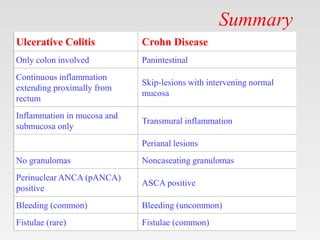
Ulcerative Colitis Crohn Disease
Only colon involved Panintestinal
Continuous inflammation
extending proximally from
rectum
Skip-lesions with intervening normal
mucosa
Inflammation in mucosa and
submucosa only
Transmural inflammation
Perianal lesions
No granulomas Noncaseating granulomas
Perinuclear ANCA (pANCA)
positive
ASCA positive
Bleeding (common) Bleeding (uncommon)
Fistulae (rare) Fistulae (common)
Non Operative Therapy
• Mild disease confined to the rectum: Topical
mesalazine via suppository (preferred) or
budesonide rectal foam
• Left-side colonic disease: Mesalazine suppository
and oral aminosalicylate (oral mesalazine is
preferred to oral sulfasalazine)
• Systemic steroids, when disease does not quickly
respond to aminosalicylates
• Oral budesonide
• After remission, long-term maintenance therapy
(eg, once-daily mesalazine)
Non Operative Therapy
• Medical treatment of acute, severe UC
• Hospitalization
• Intravenous high-dose corticosteroids
• Alternative induction medications:
Cyclosporine, Tofacitinib
• tacrolimus, infliximab, adalimumab,
golimumab
Operative Therapy
Operative Therapy
• Indications for urgent surgery include the
following:
1. Toxic megacolon refractory to medical
management
2. Fulminant attack refractory to medical
management
3. Uncontrolled colonic bleeding
Operative Therapy
• Indications for elective surgery -
1. Long-term steroid dependence
2. Dysplasia or adenocarcinoma found on
screening biopsy
3. Disease being present for 7-10 years
Operative Therapy
Surgical options -
• Total colectomy (panproctocolectomy) and
ileostomy
• Total colectomy Ileoanal pouch
reconstruction or ileorectal anastomosis
• In an emergency, subtotal colectomy with
end-ileostomy
Operative Therapy
• UC is generally limited to the colon, apart
from minimal distal "back-wash" ileitis;
• ulcerative colitis usually involves only the
mucosal layer of the bowel, and, in some
cases, superficial submucosa, unless there is
fulminant colitis
• may also manifest cecal or appendiceal
patches of involvement that can simulate
the "skip" lesions of CD
•
Prevention
Prevention
Take Home Messages
Take Home Messages
• UC is generally limited to the colon, apart
from minimal distal "back-wash" ileitis;
• ulcerative colitis usually involves only the
mucosal layer of the bowel, and, in some
cases, superficial submucosa, unless there is
fulminant colitis
• may also manifest cecal or appendiceal
patches of involvement that can simulate
the "skip" lesions of CD
•
Take Home Messages
• risk of neoplastic transformation, the risk
is higher
• continuous process, worse distally, with
increased span of involvement distal to
proximal, as the disease progresses
• Surgical intervention is better tolerated in
UC
Get this ppt in mobile
1. Download Microsoft
PowerPoint from play
store.
2. Open Google assistant
3. Open Google lens.
4. Scan qr code from
next slide.
Get this ppt in mobile
1. Download Microsoft
PowerPoint from play
store.
2. Open Google assistant
3. Open Google lens.
4. Scan qr code from
next slide.
Get this ppt in mobile
Get my ppt collection
• https://www.slideshare.net/drpradeeppande/
edit_my_uploads
• https://www.dropbox.com/sh/x600md3cvj8
5woy/AACVMHuQtvHvl_K8ehc3ltkEa?dl
=0
• https://www.facebook.com/doctorpradeeppa
nde/?ref=pages_you_manage

Ulcerative colitis.pptx

  • 1.
    Tips on usingmy ppt. 1. You can freely download, edit, modify and put your name etc. 2. Don’t be concerned about number of slides. Half the slides are blanks except for the title. 3. First show the blank slides (eg. Aetiology ) > Ask students what they already know about ethology of today's topic. > Then show next slide which enumerates aetiologies. 4. At the end rerun the show – show blank> ask questions > show next slide. 5. This will be an ACTIVE LEARNING SESSION x three revisions. 6. Good for self study also. 7. See notes for bibliography.
  • 2.
  • 3.
    Inflammatory bowel disease(IBD) • Inflammatory bowel disease (IBD) is an idiopathic disease caused by a dysregulated immune response to host intestinal microflora. • The two major types of inflammatory bowel disease are ulcerative colitis (UC), which is limited to the colonic mucosa, and Crohn disease (CD), which can affect any segment of the gastrointestinal tract from the mouth to the anus, involves "skip lesions," and is transmural. • There is a genetic predisposition for IBD, and patients with this condition are more prone to the development of malignancy.
  • 4.
    Inflammatory bowel disease (IBD) •Crohn disease • Ulcerative colitis • Inflammatory bowel disease (IBD) of undetermined type.
  • 5.
  • 6.
    Introduction & History. •Ulcerative colitis (UC) is idiopatic inflammatory disease potentially affecting the entire large bowel (colon and rectum). • The inflammation is confined to mucosa. • UC can go into remission and recur. • Extraintestinal manifestations.
  • 7.
  • 8.
    Aetiology • Idiopathic • Congenital/Genetic • Nutritional Deficiency/excess • Traumatic • Infections /Infestation • Autoimmune • Neoplastic (Benign/Malignant) • Degenerative • Iatrogenic • Psychosomatic
  • 9.
    Aetiology • Certain typesof food composition • Oral contraceptives • Protective effect of tobacco seen in ulcerative colitis • Disturbed intestinal flora.
  • 10.
  • 11.
    Pathology • Ulcerative colitischaracteristically involves the large bowel. • Starts in rectum and proceeds proximally upto terminal ileum (backwater ileitis). • No skip lesions. • Ulcerative colitis is a lifelong illness. • Mucosal disease.
  • 12.
    Pathology • Rectum 95% •Terminal ileum 10% • Extraintestinal manifestations.
  • 13.
  • 14.
  • 15.
    Microscopic Pathology • Acuteand chronic inflammatory infiltrate of the lamina propria, crypt branching, and villous atrophy are present in ulcerative colitis. • Inflammation of the crypts of lieberkühn and abscesses. • Granulomas are also seen in tuberculosis, yersiniosis, and can even be seen in ulcerative colitis
  • 16.
    Microscopic Pathology • Theulcerated areas are soon covered by granulation tissue • Inflammatory polyps or pseudopolyps. • Excessive fibrosis is not a feature of the disease
  • 17.
  • 18.
    Grading • Mild: Bleedingper rectum, fewer than four bowel motions per day • Moderate: Bleeding per rectum, more than four bowel motions per day • Severe: Bleeding per rectum, more than four bowel motions per day, and a systemic illness with hypoalbuminemia (< 30 g/L)
  • 19.
  • 20.
    Clinical Features • Demography •Symptoms • Signs • Prognosis • Complications
  • 21.
  • 22.
    Demography • The annualincidence is 10.4-12 cases per 100,000 people, and the prevalence rate is 35-100 cases per 100,000 people. • Three times more common than Crohn disease • White individuals living in Western industrialized nations • 2-4 times higher in Ashkenazi Jews.
  • 23.
    Demography • Bimodal pattern,with a peak at 15-25 years and a smaller one at 55-65 years, although the disease can occur in people of any age. • Slightly more common in women than in men.
  • 24.
    Demography:Geographical distribution • Ulcerative colitisis more common in the Western and Northern hemispheres; the incidence is low in Asia and the Far East. • As new regions assume Western cultural practices, an increased prevalence of ulcerative colitis is usually found approximately 1 decade before the observed increase in Crohn disease.
  • 25.
  • 26.
    Symptoms • Rectal bleeding •Frequent stools • Mucous discharge from the rectum • Tenesmus (occasionally) • Lower abdominal pain and severe dehydration from purulent rectal discharge (in severe cases, especially in the elderly).
  • 27.
    Symptoms In some cases,UC has a fulminant course marked by the following: • Severe diarrhea and cramps • Fever • Leukocytosis • Abdominal distention
  • 28.
    Symptoms • Colonic Crohndisease may be clinically indistinguishable from ulcerative colitis, with symptoms of bloody mucopurulent diarrhea, cramping abdominal pain, and urgency to defecate.
  • 29.
    Symptoms:ExtraGI manifestations • Uveitis •Pyoderma gangrenosum • Pleuritis • Erythema nodosum • Ankylosing spondylitis • Spondyloarthropathies • Primary sclerosing cholangitis (PSC) • Recurrent subcutaneous abscesses unrelated to pyoderma gangrenosum • Multiple sclerosis • Immunobullous disease of the skin
  • 30.
  • 31.
    Signs • Normal inmild disease • Mild tenderness in the lower left abdominal quadrant Severe cases- • Fever • Tachycardia • Significant abdominal tenderness • Weight loss
  • 32.
  • 33.
    Prognosis: IBD • Bothare lifelong diseases. • For both conditions, the overall mortality has decreased steadily, and currently is less than 5%. • Both follow a more severe course in children and adolescents • Both are at increased risk for the later development of cancer. • The excess risk is limited to colorectal cancer
  • 34.
    Prognosis • Most patientswith these diseases are able to maintain normal occupations and enjoy reasonably stable social and economic situations. • Ulcerative colitis is curable with proctocolectomy and ileostomy.
  • 35.
  • 36.
    Complications • Colonic perforation. •Carcinoma. • Benign strictures.
  • 37.
  • 38.
    Investigations • Laboratory Studies –Routine – Special • Imaging Studies • Tissue diagnosis – Cytology • FNAC – Histology
  • 39.
  • 40.
    Diagnostic Studies Imaging Studies •X-Ray • USG • CT • Angiography • MRI • Endoscopy • Nuclear scan
  • 41.
  • 42.
    Investigations • Serologic markers(eg, antineutrophil cytoplasmic antibodies [ANCA], anti– Saccharomyces cerevisiae antibodies [ASCA]) • Complete blood cell (CBC) count • Comprehensive metabolic panel • Inflammation markers (eg, erythrocyte sedimentation rate [ESR], C-reactive protein [CRP]) • Stool assays •
  • 43.
    Imaging Studies 1. Endoscopyand biopsy-Abnormal erythematous mucosa, with or without ulceration, extending from the rectum to a part or all of the colon 2. Uniform inflammation, without intervening areas of normal mucosa (skip lesions tend to characterize Crohn disease) 3. Contact bleeding may also be observed, with mucus identified in the lumen of the bowel
  • 44.
    Colonscopy Mucosa hyperemic lossof the normal vascular pattern Normal colon Ulcerative Colitis
  • 45.
    Imaging Studies • Plainabdominal radiography • Double-contrast barium enema examination • Cross-sectional imaging studies (eg, ultrasonography, magnetic resonance imaging, computed tomography scanning) • Radionuclide studies • Angiography
  • 46.
    UC: Barium enema stricturesin the transverse and descending colon Mucosal ulcers
  • 47.
  • 48.
    Radiography • Pseudopolyposis • Deepulcers • The colon may appear shortened • Loss of colonic haustra • Toxic megacolon -massive colonic dilatation associated with an abnormal mucosal contour. • Colonic perforation • Thumbprinting • Long stricture/spasm of the ascending colon/cecum • Increased postrectal space
  • 49.
  • 50.
    Barium enema findings •Colon may appear narrow , short and loose. • Granular mucosa. • Pseudopolyposis • Mucosal ulcers – Collar-button ulcers – Double-tracking ulcers • Burnt-out ulcerative colitis • Similar radiographic signs may be seen in cases of infective diarrhea, crohn disease, ischemic colitis, drug-induced colitis, and amebic colitis
  • 51.
  • 52.
    Computed Tomography • Difuse, circumferential, symmetrical wall thickening with fold enlargement. • Submucosal fat deposition • Target sign • The halo sign typically occurs in ulcerative colitis.
  • 53.
  • 54.
    Differential Diagnosis • Crohn'sDisease • Cathartic colon. • Collagenous colitis • Lymphocytic colitis • Infectious colitis • Ischemic colitis
  • 55.
  • 56.
    Summary Ulcerative Colitis CrohnDisease Only colon involved Panintestinal Continuous inflammation extending proximally from rectum Skip-lesions with intervening normal mucosa Inflammation in mucosa and submucosa only Transmural inflammation Perianal lesions No granulomas Noncaseating granulomas Perinuclear ANCA (pANCA) positive ASCA positive Bleeding (common) Bleeding (uncommon) Fistulae (rare) Fistulae (common)
  • 57.
  • 58.
    Non Operative Therapy •Mild disease confined to the rectum: Topical mesalazine via suppository (preferred) or budesonide rectal foam • Left-side colonic disease: Mesalazine suppository and oral aminosalicylate (oral mesalazine is preferred to oral sulfasalazine) • Systemic steroids, when disease does not quickly respond to aminosalicylates • Oral budesonide • After remission, long-term maintenance therapy (eg, once-daily mesalazine)
  • 59.
    Non Operative Therapy •Medical treatment of acute, severe UC • Hospitalization • Intravenous high-dose corticosteroids • Alternative induction medications: Cyclosporine, Tofacitinib • tacrolimus, infliximab, adalimumab, golimumab
  • 60.
  • 61.
    Operative Therapy • Indicationsfor urgent surgery include the following: 1. Toxic megacolon refractory to medical management 2. Fulminant attack refractory to medical management 3. Uncontrolled colonic bleeding
  • 62.
    Operative Therapy • Indicationsfor elective surgery - 1. Long-term steroid dependence 2. Dysplasia or adenocarcinoma found on screening biopsy 3. Disease being present for 7-10 years
  • 63.
    Operative Therapy Surgical options- • Total colectomy (panproctocolectomy) and ileostomy • Total colectomy Ileoanal pouch reconstruction or ileorectal anastomosis • In an emergency, subtotal colectomy with end-ileostomy
  • 64.
    Operative Therapy • UCis generally limited to the colon, apart from minimal distal "back-wash" ileitis; • ulcerative colitis usually involves only the mucosal layer of the bowel, and, in some cases, superficial submucosa, unless there is fulminant colitis • may also manifest cecal or appendiceal patches of involvement that can simulate the "skip" lesions of CD •
  • 65.
  • 66.
  • 67.
  • 68.
    Take Home Messages •UC is generally limited to the colon, apart from minimal distal "back-wash" ileitis; • ulcerative colitis usually involves only the mucosal layer of the bowel, and, in some cases, superficial submucosa, unless there is fulminant colitis • may also manifest cecal or appendiceal patches of involvement that can simulate the "skip" lesions of CD •
  • 69.
    Take Home Messages •risk of neoplastic transformation, the risk is higher • continuous process, worse distally, with increased span of involvement distal to proximal, as the disease progresses • Surgical intervention is better tolerated in UC
  • 70.
    Get this pptin mobile 1. Download Microsoft PowerPoint from play store. 2. Open Google assistant 3. Open Google lens. 4. Scan qr code from next slide.
  • 72.
    Get this pptin mobile 1. Download Microsoft PowerPoint from play store. 2. Open Google assistant 3. Open Google lens. 4. Scan qr code from next slide.
  • 73.
    Get this pptin mobile
  • 74.
    Get my pptcollection • https://www.slideshare.net/drpradeeppande/ edit_my_uploads • https://www.dropbox.com/sh/x600md3cvj8 5woy/AACVMHuQtvHvl_K8ehc3ltkEa?dl =0 • https://www.facebook.com/doctorpradeeppa nde/?ref=pages_you_manage

Editor's Notes

  • #2 drpradeeppande@gmail.com 7697305442