Forensic Odontology   Done by: Khalid Abo Al Shamat 0352209 Supervised by: Prof. Hisham Othman
Forensic Medicine: A branch of medicine that applies the principles and knowledge of the medical and related sciences to problems that concern the general public and issues of the law.  Forensic science (forensic Odontology):   is the area of dentistry concerned with the correct management, examination, evaluation, and presentation of dental evidence in criminal or civil legal proceedings in the interest of justice.
Forensic dentists are responsible for four main areas of practice: Identification of found human remains, and in mass fatalities and making Dental profiling. Age estimation Assessment of bite mark  Assessment of cases of abuse (child, spousal, elder)
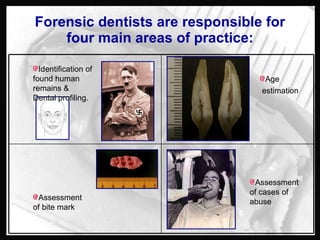
Forensic dentists are responsible for four main areas of practice: Identification of found human remains & Dental profiling. Age estimation Assessment of bite mark  Assessment of cases of abuse
Identification of human remains   if only a few teeth are available  if there is no teeth The American Board of Forensic Odontology conclusions: Positive identification   Possible identification   Insufficient evidence   Exclusion
Dental profiling   The forensic dentist can often produce a "picture" of the general features of the individual.   This process is known as post-mortem dental profiling.  Sex and race  skull appearance  Additional characteristics  The age of children  socio-economic  erosion and abrasion source of DNA
Age estimation  Some of the Methods: HAAVIKKO LILIEQUIST  LUNDBERG  DEMIRJAIAN  Based on:  on the comparison of tooth development, as seen in radiographs, with standard charts compiled from a large number of individuals in a specific geographic region. Results: Other methods:
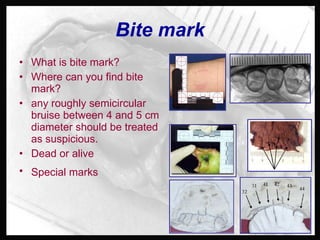
Bite mark What is bite mark? Where can you find bite mark? any roughly semicircular bruise between 4 and 5 cm diameter should be treated as suspicious. Dead or alive Special marks
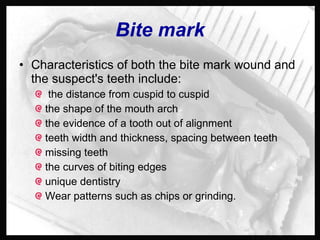
Bite mark Characteristics of both the bite mark wound and the suspect's teeth include: the distance from cuspid to cuspid  the shape of the mouth arch  the evidence of a tooth out of alignment  teeth width and thickness, spacing between teeth  missing teeth  the curves of biting edges  unique dentistry  Wear patterns such as chips or grinding. 
 
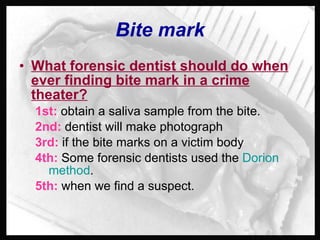
Bite mark What forensic dentist should do when ever finding bite mark in a crime theater? 1st:  obtain a saliva sample from the bite. 2nd:  dentist will make photograph  3rd:  if the bite marks on a victim body  4th:  Some forensic dentists used the  Dorion  method . 5th:  when we find a suspect.
 
 
References:   1.  VERA STAAF, HAKAN MORN ST AND ULF  WELANDER Age estimation based on tooth development: A  test of reliability and validity Scand J Dent Res 1991; 99: 281-6. 2.  Dr. Tom O'Connor Faculty of North Carolina, lecture notes for  forensic law, forensic odontology. http://faculty.ncwc.edu/TOConnor/425/425lect16.htm 3.  The Police Site for the State of New South Wales  Australia, Forensic science, Forensic  Odontology http://www.policensw.com/info/forensic/forensic5.html
Thank you for your time

Forensic Odontology Dentistry

  • 1.
    Forensic Odontology Done by: Khalid Abo Al Shamat 0352209 Supervised by: Prof. Hisham Othman
  • 2.
    Forensic Medicine: Abranch of medicine that applies the principles and knowledge of the medical and related sciences to problems that concern the general public and issues of the law. Forensic science (forensic Odontology): is the area of dentistry concerned with the correct management, examination, evaluation, and presentation of dental evidence in criminal or civil legal proceedings in the interest of justice.
  • 3.
    Forensic dentists areresponsible for four main areas of practice: Identification of found human remains, and in mass fatalities and making Dental profiling. Age estimation Assessment of bite mark Assessment of cases of abuse (child, spousal, elder)
  • 4.
    Forensic dentists areresponsible for four main areas of practice: Identification of found human remains & Dental profiling. Age estimation Assessment of bite mark Assessment of cases of abuse
  • 5.
    Identification of humanremains if only a few teeth are available if there is no teeth The American Board of Forensic Odontology conclusions: Positive identification Possible identification Insufficient evidence Exclusion
  • 6.
    Dental profiling The forensic dentist can often produce a "picture" of the general features of the individual.  This process is known as post-mortem dental profiling. Sex and race skull appearance Additional characteristics The age of children socio-economic erosion and abrasion source of DNA
  • 7.
    Age estimation Some of the Methods: HAAVIKKO LILIEQUIST LUNDBERG DEMIRJAIAN Based on: on the comparison of tooth development, as seen in radiographs, with standard charts compiled from a large number of individuals in a specific geographic region. Results: Other methods:
  • 8.
    Bite mark Whatis bite mark? Where can you find bite mark? any roughly semicircular bruise between 4 and 5 cm diameter should be treated as suspicious. Dead or alive Special marks
  • 9.
    Bite mark Characteristicsof both the bite mark wound and the suspect's teeth include: the distance from cuspid to cuspid the shape of the mouth arch the evidence of a tooth out of alignment teeth width and thickness, spacing between teeth missing teeth the curves of biting edges unique dentistry Wear patterns such as chips or grinding. 
  • 10.
  • 11.
    Bite mark Whatforensic dentist should do when ever finding bite mark in a crime theater? 1st: obtain a saliva sample from the bite. 2nd: dentist will make photograph 3rd: if the bite marks on a victim body 4th: Some forensic dentists used the Dorion method . 5th: when we find a suspect.
  • 12.
  • 13.
  • 14.
    References: 1. VERA STAAF, HAKAN MORN ST AND ULF WELANDER Age estimation based on tooth development: A test of reliability and validity Scand J Dent Res 1991; 99: 281-6. 2. Dr. Tom O'Connor Faculty of North Carolina, lecture notes for forensic law, forensic odontology. http://faculty.ncwc.edu/TOConnor/425/425lect16.htm 3. The Police Site for the State of New South Wales Australia, Forensic science, Forensic Odontology http://www.policensw.com/info/forensic/forensic5.html
  • 15.
    Thank you foryour time