HEAT EXCHANGERHEAT EXCHANGER
Presentation onPresentation on
Heat Exchanger is a device to transfer of
heat from one medium to other medium.
Two fluids of different temperatures, one flows through
the tubes and other flows out side tubes but inside the
shell.
Heat is transferred through the tube walls.
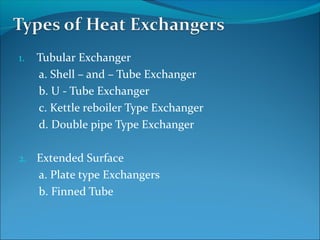
1. Tubular Exchanger
a. Shell – and – Tube Exchanger
b. U - Tube Exchanger
c. Kettle reboiler Type Exchanger
d. Double pipe Type Exchanger
2. Extended Surface
a. Plate type Exchangers
b. Finned Tube
1. Shell
2. Front End Head
3. Rear End Head
4. Inlet / Outlet Nozzles
5. Tube sheets
6. Tubes
7. Baffles
8. Tie Rods
9. Stiffener Plate
10. Impingement plate
U- Tube
bundle
U- Tube
bundle
Kettle
re -boiler Type
Kettle
re -boiler Type
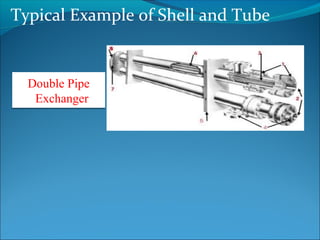
Double Pipe
Exchanger
Double Pipe
Exchanger
Typical Example of Shell and Tube
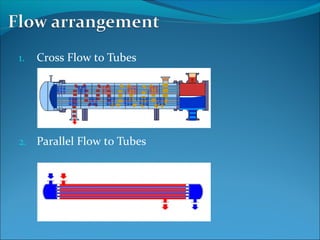
1. Cross Flow to Tubes
2. Parallel Flow to Tubes
TEMA –Tubular Exchangers Manufacturer's
Association
ASME Codes Sec-VIII-Div I and II
ASME Sec –II A , B ,C ,D- Materials , Welding
consumables, properties
ASME Sec –IX – Welder qualification
ASME Sec –V - NDT
ANSI standards
NACE standards/ recommended practices
API standards 660
Process Licensor's guidelines
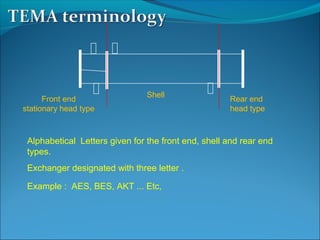
Shell
Front end
stationary head type
Rear end
head type
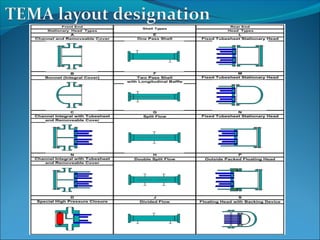
Alphabetical Letters given for the front end, shell and rear end
types.
Exchanger designated with three letter .
Example : AES, BES, AKT ... Etc,
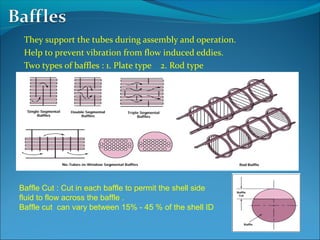
They support the tubes during assembly and operation.
Help to prevent vibration from flow induced eddies.
Two types of baffles : 1. Plate type 2. Rod type
Baffle Cut : Cut in each baffle to permit the shell side
fluid to flow across the baffle .
Baffle cut can vary between 15% - 45 % of the shell ID
A triangular or rotated triangular
pattern will accommodate more tubes
than a square or rotated square pattern.
A triangular pattern produce a high
heat-transfer coefficient.
Typical tube pitch of 1.25 times the tube
OD.
Mechanical cleaning of triangular tubes
pattern is very difficult.
Square pattern must be used where
mechanical cleaning is required.
TUBE PITCH : It is defined as the shortest distance
between two adjacent tubes. Minimum tube pitch is
1.25 times of tube OD.
To join tubes and tubesheet and keep the tubes
structurally stable and support the skeleton assembly
under design conditions.
To prevent intermixing of shell and tube sheet fluids.
To take care of Longitudinal, Compressive,
Mechanical and Thermal axial loads coming on tubes.
Expansion
•Tubes are attached to the tube sheet by
Pneumatic or hydraulic pressure or by roller
expansion.
Strength weld is one in which the design strength of
the weld is greater than or equal to the maximum
allowable axial tube strength.
Seal weld is used to supplement an
expanded tube joint to ensure tube joint
leak tightness.
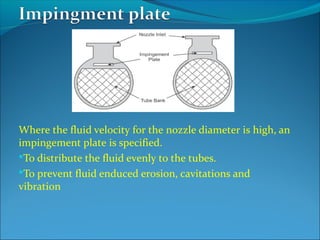
Where the fluid velocity for the nozzle diameter is high, an
impingement plate is specified.
To distribute the fluid evenly to the tubes.
To prevent fluid enduced erosion, cavitations and
vibration
Shell : CS / SS / Non-ferrous types
Tubes : CS / AS / SS / Non-ferrous
Tube Sheet : Forgings / Plates
Nozzle Pipes : CS / AS / SS
Nozzles : CS / AS / SS
Gaskets : CAF, Spiral Wound, IJA,
Ring Joint type
Fasteners : CS / AS / SS
Name Plate : SS
Material Identification (Pressure parts)
Forming
Welding
Review of WPS / PQR / Welder Qualification
NDT
Stage and Final Inspections
Mock-up Assembly
Skeleton Assembly
Tube Bundle
Insertion of Tube Bundle into Shell
Testing (Hydro testing / Pneumatic testing)
Painting
Documentation
Packing / Protection / Dispatch
Provided to seal the joints against leak
Spiral wound with asbestos fill or graphite fill
Metal jacketed
Ring joint type
Camprofile type
CAF – only for less critical services
Material
SS 304, SS 316
Identify leak type and location: hydrotesting
Attend leak :
gasket leak- re-tighten or replace
retubing or plugging leaky tubes
re-expansion of tube sheet joint/ re-welding
Cleaning of tube side /shell side as per
requirements
Install new bundles/ shell as per requirement
Offer statutory tests as per schedule (IBR Etc.)
Timely modifications in shell side/ tube side as per
CTS/CES/FDC/Licensor requirements
Civil jobs : foundation / pedestal/ structures
Inspection as received condition- check for
N2 purging of shell & tube sides
Physical installation : Leveling
Site Checks: ITP format fill up
Alignment to upstream downstream tube
side / shell side piping
Insulation wherever necessary
Heat Exchanger

Heat Exchanger

  • 1.
  • 2.
    Heat Exchanger isa device to transfer of heat from one medium to other medium. Two fluids of different temperatures, one flows through the tubes and other flows out side tubes but inside the shell. Heat is transferred through the tube walls.
  • 3.
    1. Tubular Exchanger a.Shell – and – Tube Exchanger b. U - Tube Exchanger c. Kettle reboiler Type Exchanger d. Double pipe Type Exchanger 2. Extended Surface a. Plate type Exchangers b. Finned Tube
  • 4.
    1. Shell 2. FrontEnd Head 3. Rear End Head 4. Inlet / Outlet Nozzles 5. Tube sheets 6. Tubes 7. Baffles 8. Tie Rods 9. Stiffener Plate 10. Impingement plate
  • 6.
    U- Tube bundle U- Tube bundle Kettle re-boiler Type Kettle re -boiler Type
  • 7.
  • 8.
    1. Cross Flowto Tubes 2. Parallel Flow to Tubes
  • 9.
    TEMA –Tubular ExchangersManufacturer's Association ASME Codes Sec-VIII-Div I and II ASME Sec –II A , B ,C ,D- Materials , Welding consumables, properties ASME Sec –IX – Welder qualification ASME Sec –V - NDT ANSI standards NACE standards/ recommended practices API standards 660 Process Licensor's guidelines
  • 10.
    Shell Front end stationary headtype Rear end head type Alphabetical Letters given for the front end, shell and rear end types. Exchanger designated with three letter . Example : AES, BES, AKT ... Etc,
  • 13.
    They support thetubes during assembly and operation. Help to prevent vibration from flow induced eddies. Two types of baffles : 1. Plate type 2. Rod type Baffle Cut : Cut in each baffle to permit the shell side fluid to flow across the baffle . Baffle cut can vary between 15% - 45 % of the shell ID
  • 14.
    A triangular orrotated triangular pattern will accommodate more tubes than a square or rotated square pattern. A triangular pattern produce a high heat-transfer coefficient. Typical tube pitch of 1.25 times the tube OD. Mechanical cleaning of triangular tubes pattern is very difficult. Square pattern must be used where mechanical cleaning is required. TUBE PITCH : It is defined as the shortest distance between two adjacent tubes. Minimum tube pitch is 1.25 times of tube OD.
  • 15.
    To join tubesand tubesheet and keep the tubes structurally stable and support the skeleton assembly under design conditions. To prevent intermixing of shell and tube sheet fluids. To take care of Longitudinal, Compressive, Mechanical and Thermal axial loads coming on tubes. Expansion •Tubes are attached to the tube sheet by Pneumatic or hydraulic pressure or by roller expansion.
  • 16.
    Strength weld isone in which the design strength of the weld is greater than or equal to the maximum allowable axial tube strength. Seal weld is used to supplement an expanded tube joint to ensure tube joint leak tightness.
  • 17.
    Where the fluidvelocity for the nozzle diameter is high, an impingement plate is specified. To distribute the fluid evenly to the tubes. To prevent fluid enduced erosion, cavitations and vibration
  • 18.
    Shell : CS/ SS / Non-ferrous types Tubes : CS / AS / SS / Non-ferrous Tube Sheet : Forgings / Plates Nozzle Pipes : CS / AS / SS Nozzles : CS / AS / SS Gaskets : CAF, Spiral Wound, IJA, Ring Joint type Fasteners : CS / AS / SS Name Plate : SS
  • 19.
    Material Identification (Pressureparts) Forming Welding Review of WPS / PQR / Welder Qualification NDT Stage and Final Inspections Mock-up Assembly Skeleton Assembly Tube Bundle Insertion of Tube Bundle into Shell Testing (Hydro testing / Pneumatic testing) Painting Documentation Packing / Protection / Dispatch
  • 20.
    Provided to sealthe joints against leak Spiral wound with asbestos fill or graphite fill Metal jacketed Ring joint type Camprofile type CAF – only for less critical services Material SS 304, SS 316
  • 21.
    Identify leak typeand location: hydrotesting Attend leak : gasket leak- re-tighten or replace retubing or plugging leaky tubes re-expansion of tube sheet joint/ re-welding Cleaning of tube side /shell side as per requirements Install new bundles/ shell as per requirement Offer statutory tests as per schedule (IBR Etc.) Timely modifications in shell side/ tube side as per CTS/CES/FDC/Licensor requirements
  • 22.
    Civil jobs :foundation / pedestal/ structures Inspection as received condition- check for N2 purging of shell & tube sides Physical installation : Leveling Site Checks: ITP format fill up Alignment to upstream downstream tube side / shell side piping Insulation wherever necessary