Shell & tube Heat exchanger
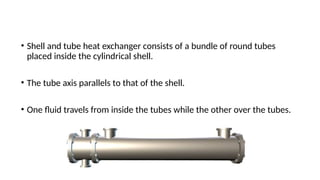
• Shell and tube heat exchanger consists of a bundle of round tubes
placed inside the cylindrical shell.
• The tube axis parallels to that of the shell.
• One fluid travels from inside the tubes while the other over the tubes.
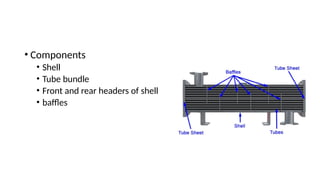
• Components
• Shell
• Tube bundle
• Front and rear headers of shell
• baffles
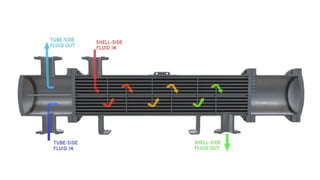
• A shell and tube heat exchanger consists of a series of tubes housed
within a cylindrical container known as a ‘shell’
• Each tube passes through a series of baffles and tube sheets
• One of the tube sheets is fixed and one is free to move, this allows for
thermal expansion as the heat exchanger is heated.
• The flowing medium within the tubes is known as the ‘tube side’
medium. The flowing medium outside of the tubes is known as the
‘shell side’ medium.
• Advantages
• Cheap compared to plate heat exchangers.
• Relatively simple design and easy to maintain.
• Suitable for higher pressures and temperatures compared to plate heat
exchangers.
• Easy to find and isolate leaking tubes.
• Tubes can be 'double walled' to reduce the likelihood of the shell side fluid
leaking into the tube side fluid (or vice versa).
• Do not foul as easily as plate heat exchangers.
• Disadvantages
• Less efficient than plate heat exchangers.
• Require more space to open and remove tubes.
• Cooling capacity can not be increased, but a plate heat exchanger's
can be.

Shell & tube heat exchanger - Construction & working

  • 1.
    Shell & tubeHeat exchanger
  • 2.
    • Shell andtube heat exchanger consists of a bundle of round tubes placed inside the cylindrical shell. • The tube axis parallels to that of the shell. • One fluid travels from inside the tubes while the other over the tubes.
  • 3.
    • Components • Shell •Tube bundle • Front and rear headers of shell • baffles
  • 4.
    • A shelland tube heat exchanger consists of a series of tubes housed within a cylindrical container known as a ‘shell’ • Each tube passes through a series of baffles and tube sheets • One of the tube sheets is fixed and one is free to move, this allows for thermal expansion as the heat exchanger is heated. • The flowing medium within the tubes is known as the ‘tube side’ medium. The flowing medium outside of the tubes is known as the ‘shell side’ medium.
  • 6.
    • Advantages • Cheapcompared to plate heat exchangers. • Relatively simple design and easy to maintain. • Suitable for higher pressures and temperatures compared to plate heat exchangers. • Easy to find and isolate leaking tubes. • Tubes can be 'double walled' to reduce the likelihood of the shell side fluid leaking into the tube side fluid (or vice versa). • Do not foul as easily as plate heat exchangers.
  • 7.
    • Disadvantages • Lessefficient than plate heat exchangers. • Require more space to open and remove tubes. • Cooling capacity can not be increased, but a plate heat exchanger's can be.