Dotsha J. Raheem
Department of Chemistry
College of Science
University of Salahaddin
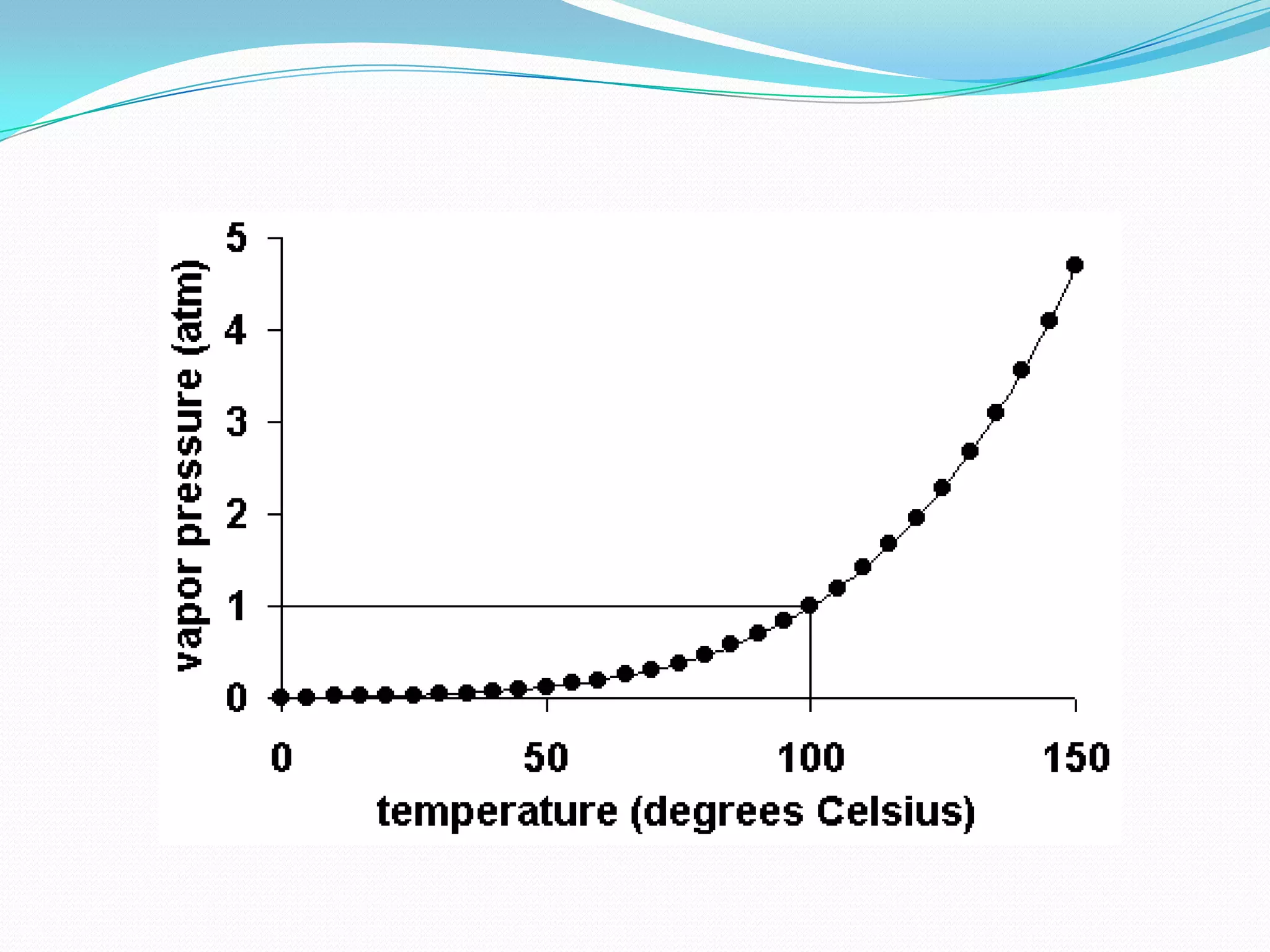
The boiling point of a liquid
is the temperature at which its
vapor pressure is equal to the
pressure of the gas above it
Definition of b.p.
 In terms of intermolecular interactions the b.p.
represents the energy required to overcome the various
intermolecular attractions binding the molecules as a
liquid (e.g. dipole-dipole attraction and hydrogen
bonding) and therefore undergo a phase change into
the gaseous phase . Therefore the boiling point of a
liquid is also an indicator of the strength of the
attractive forces between the liquid’s molecules.
 The normal boiling point of a liquid is the temperature
at which its vapor pressure is equal to 1 atm
Importance of b.p.
B.p. is a physical constant used for:
1. Identification of unknown liquid compound
2. Purification
factors affecting b.p.
 Pressure
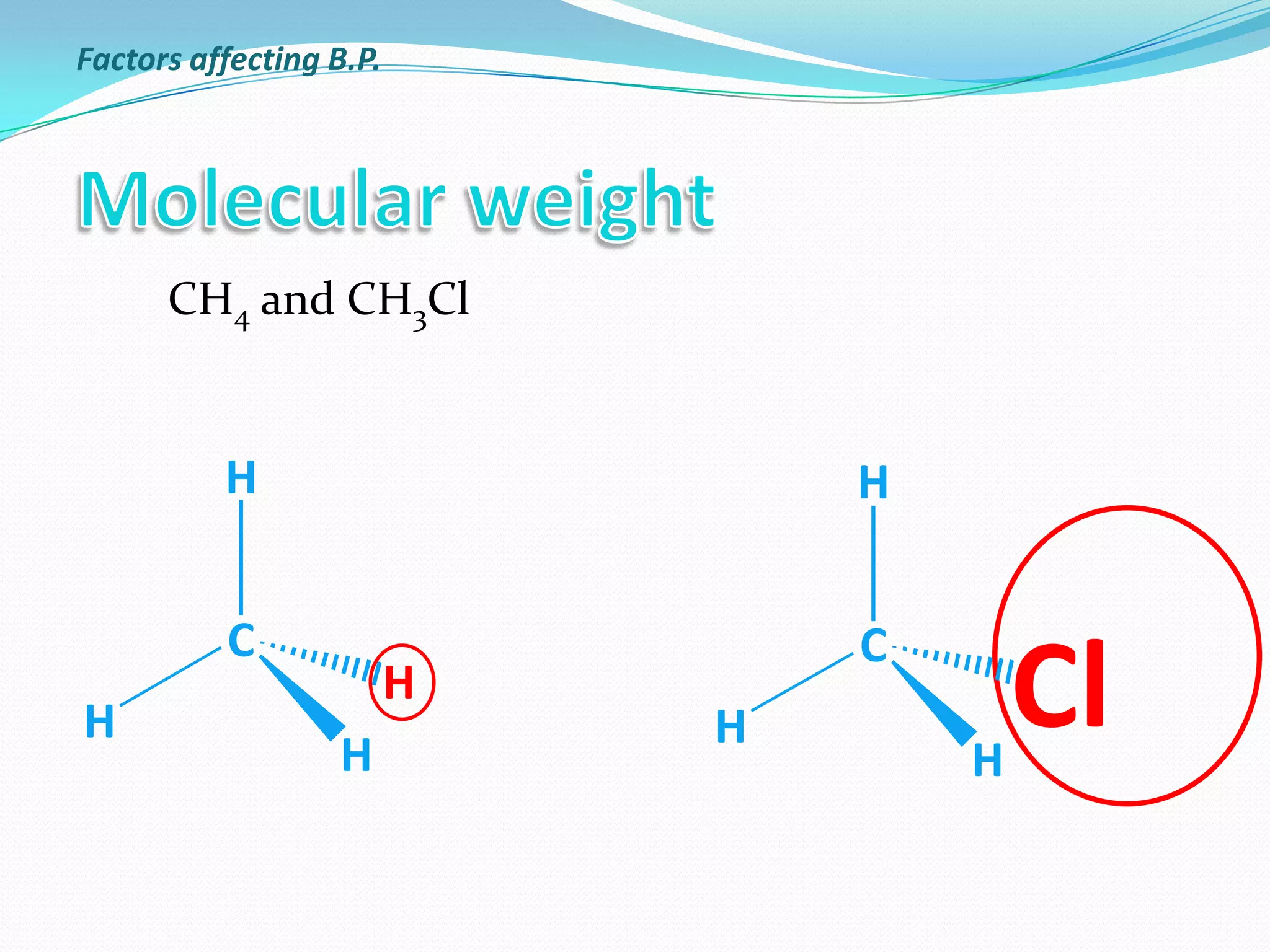
 Molecular weight
 Structure of the molecule & intermolecular
interactions
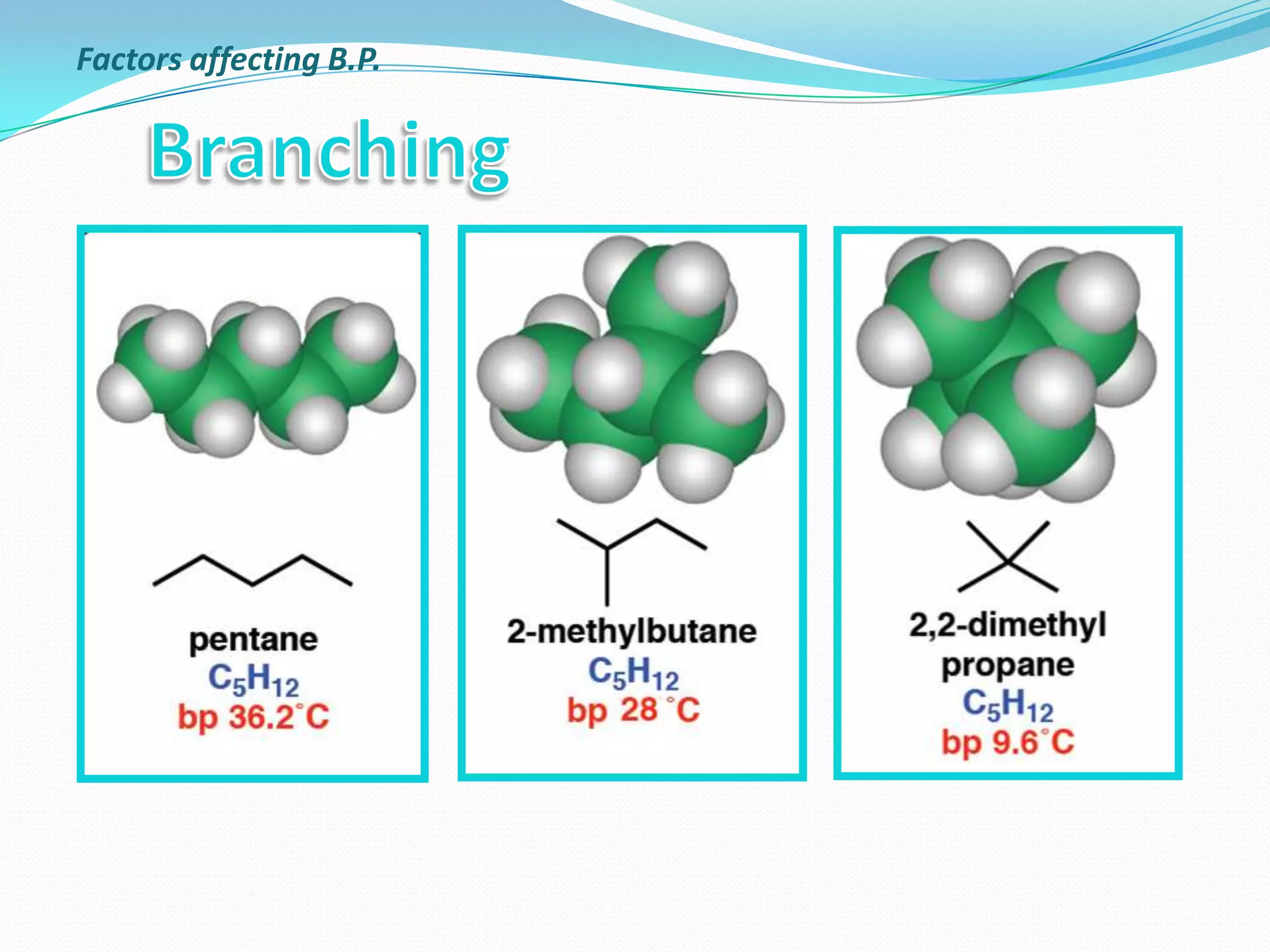
 Branching
 Polarity
 Van der Waals interactions
 H-bonding
 Impurities
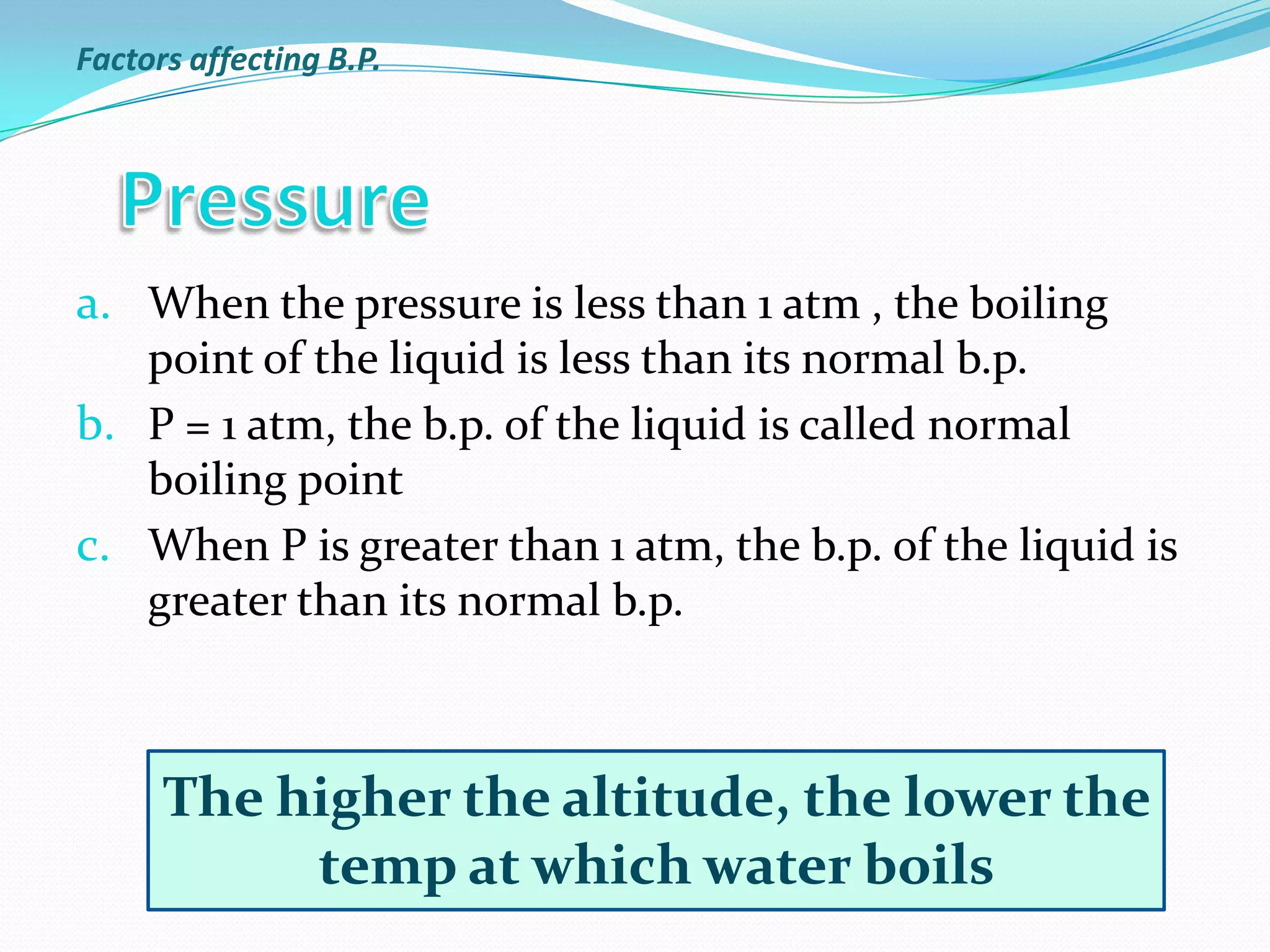
a. When the pressure is less than 1 atm , the boiling
point of the liquid is less than its normal b.p.
b. P = 1 atm, the b.p. of the liquid is called normal
boiling point
c. When P is greater than 1 atm, the b.p. of the liquid is
greater than its normal b.p.
The higher the altitude, the lower the
temp at which water boils
Factors affecting B.P.
CH4 and CH3Cl
Factors affecting B.P.
H
C
H
H
H
H
C
H
H
Cl
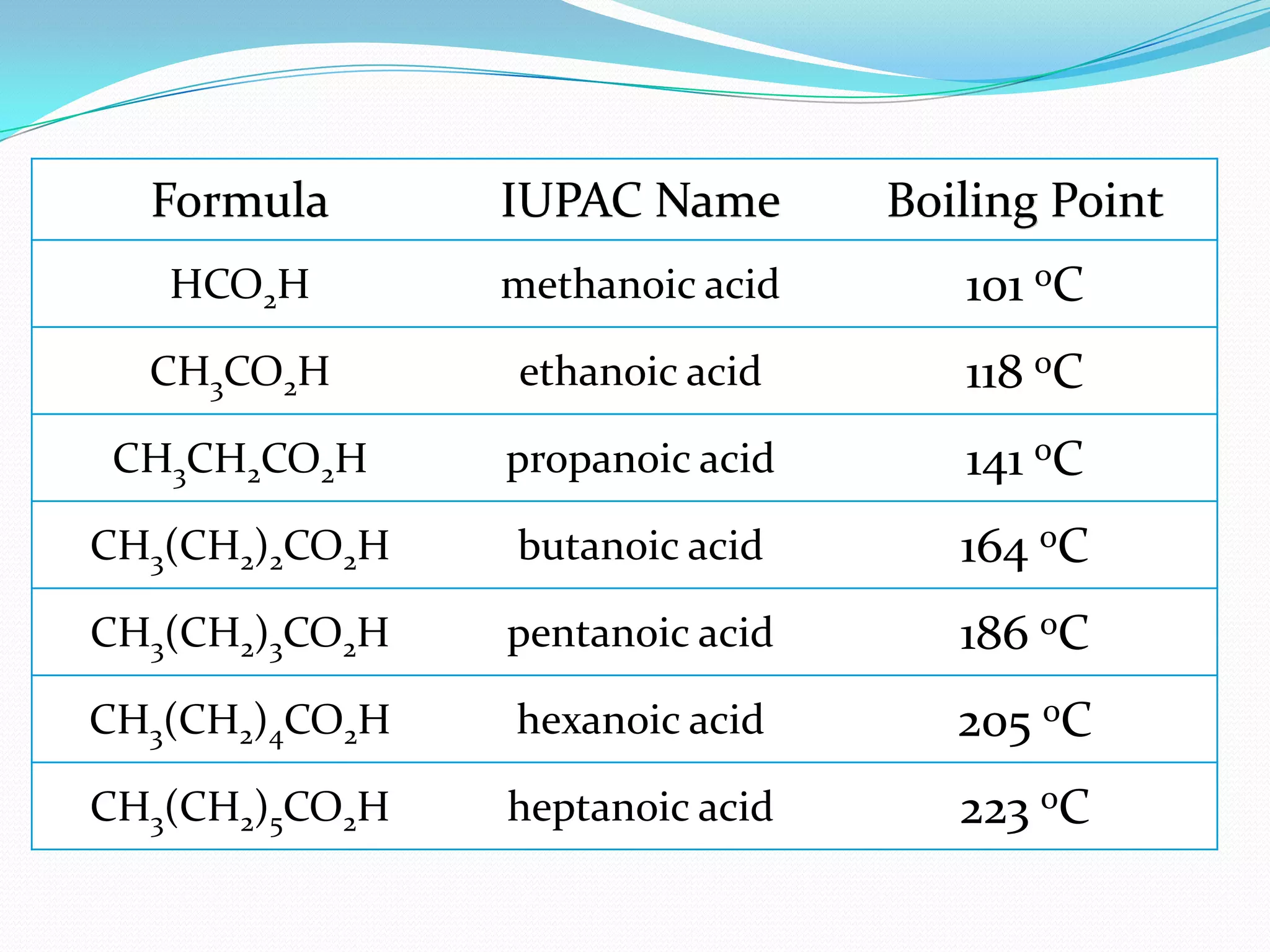
Formula IUPAC Name Boiling Point
HCO2H methanoic acid 101 oC
CH3CO2H ethanoic acid 118 oC
CH3CH2CO2H propanoic acid 141 oC
CH3(CH2)2CO2H butanoic acid 164 oC
CH3(CH2)3CO2H pentanoic acid 186 oC
CH3(CH2)4CO2H hexanoic acid 205 oC
CH3(CH2)5CO2H heptanoic acid 223 oC
Factors affecting B.P.
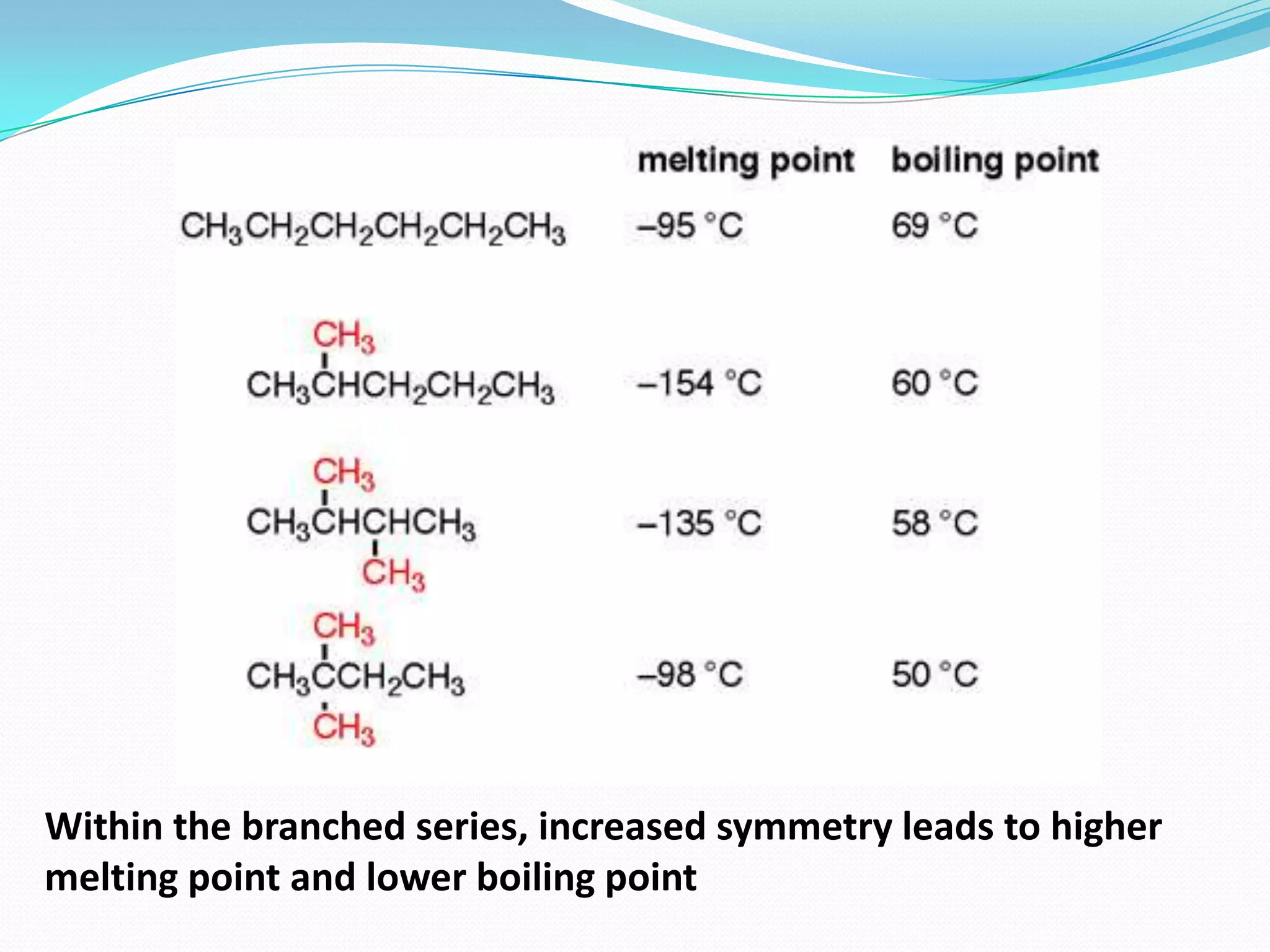
Within the branched series, increased symmetry leads to higher
melting point and lower boiling point
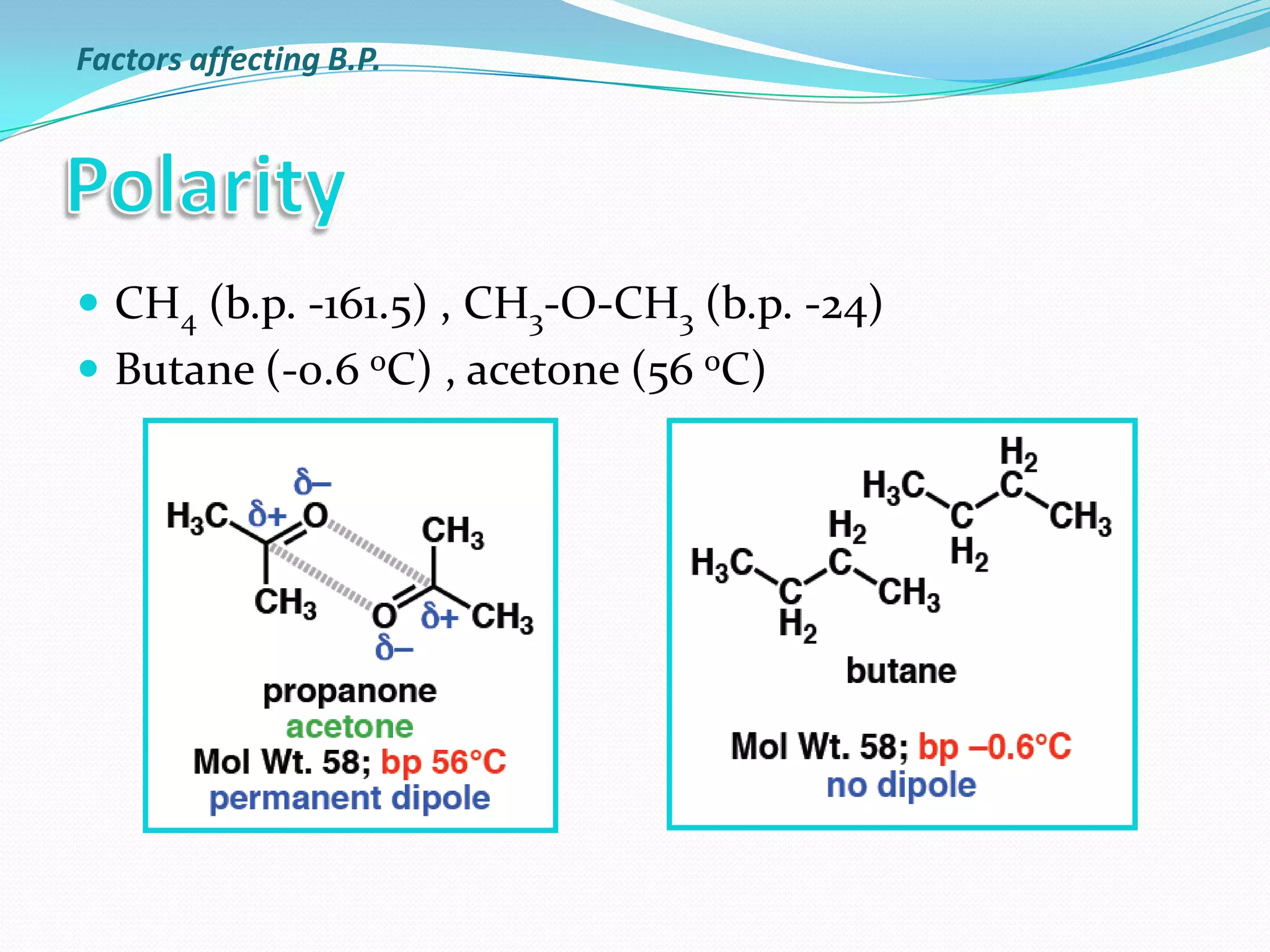
 CH4 (b.p. -161.5) , CH3-O-CH3 (b.p. -24)
 Butane (-0.6 oC) , acetone (56 oC)
Factors affecting B.P.
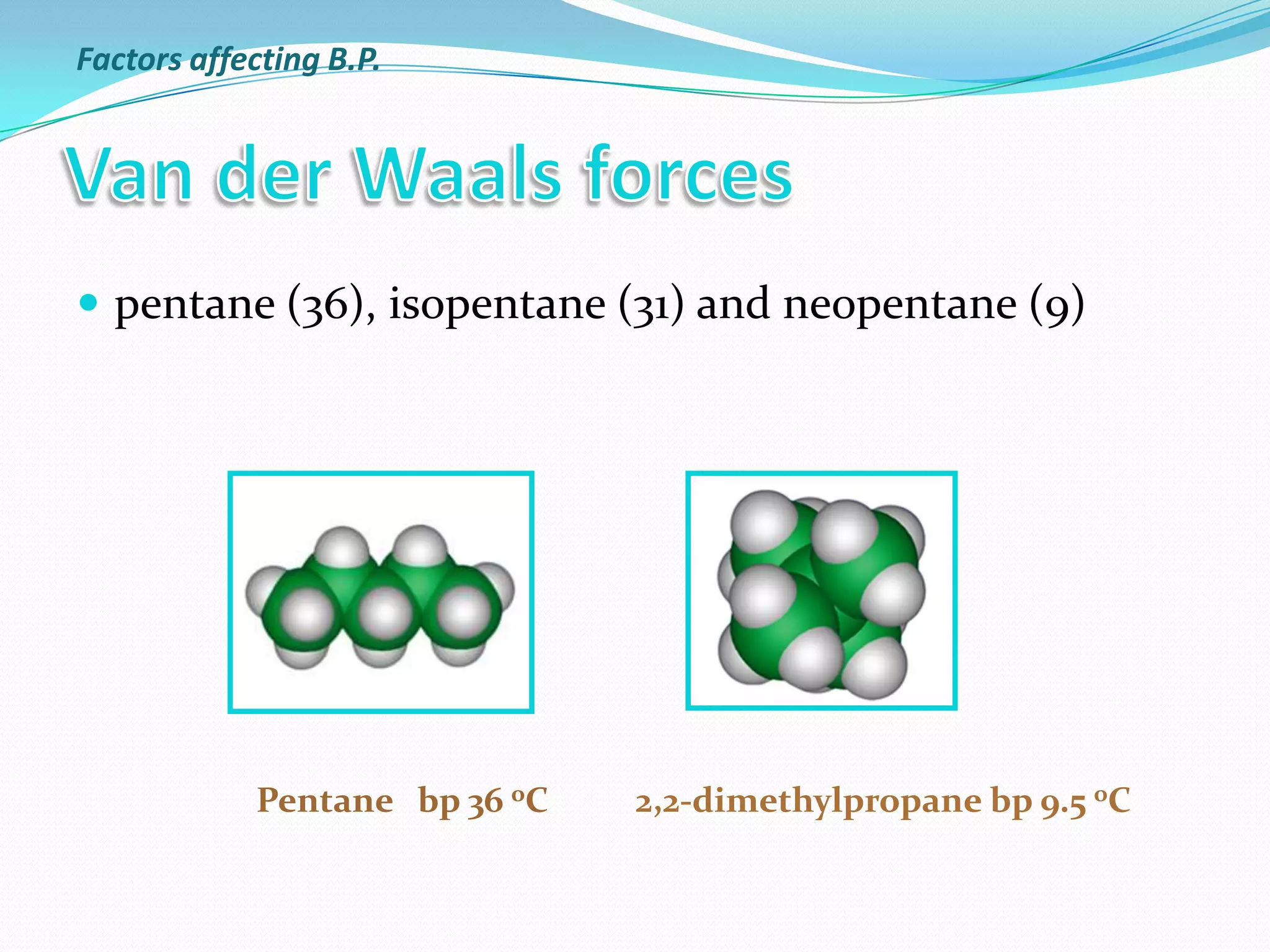
 pentane (36), isopentane (31) and neopentane (9)
Pentane bp 36 oC 2,2-dimethylpropane bp 9.5 oC
Factors affecting B.P.
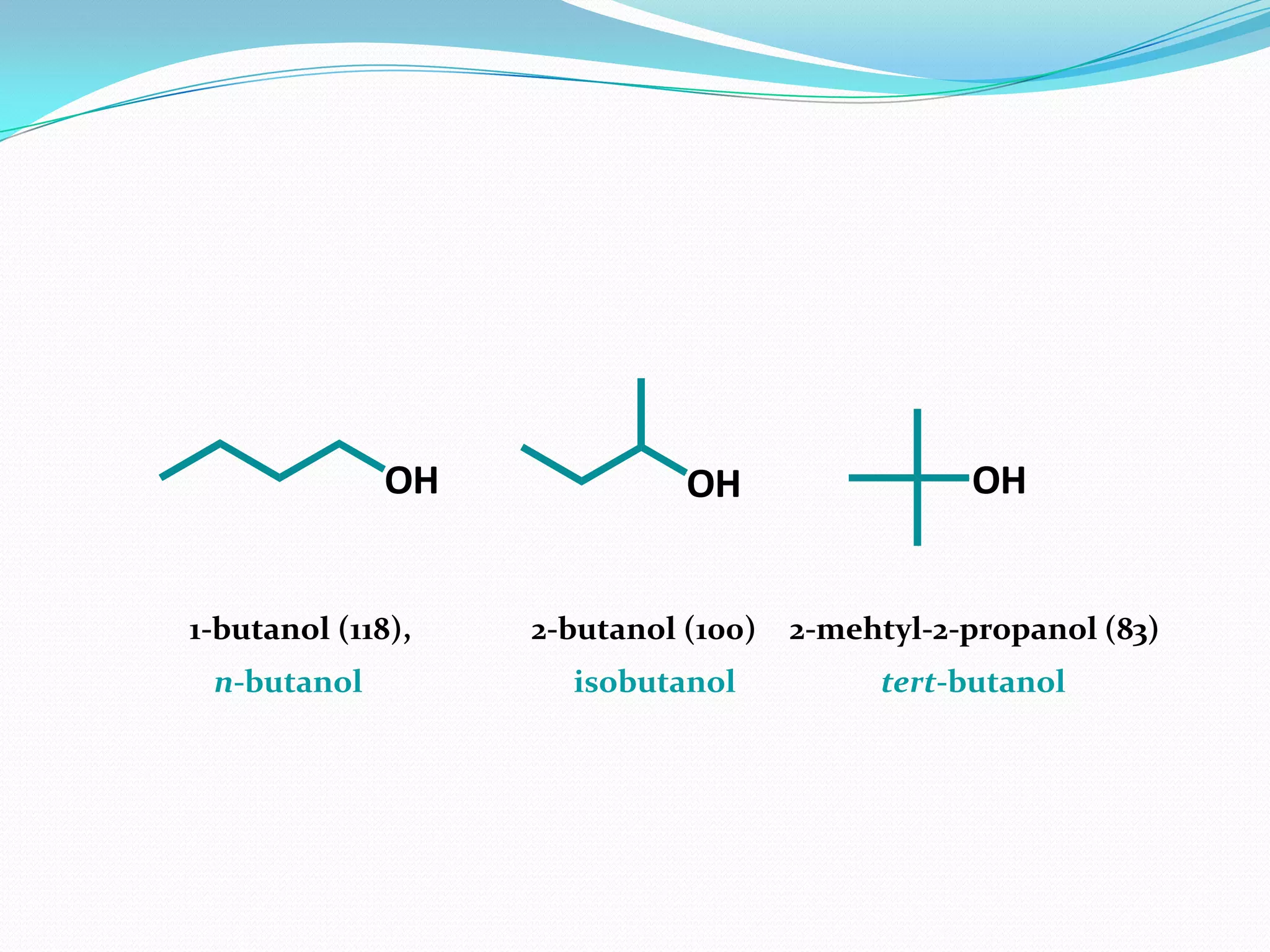
OH OH OH
1-butanol (118), 2-butanol (100) 2-mehtyl-2-propanol (83)
isobutanol tert-butanoln-butanol
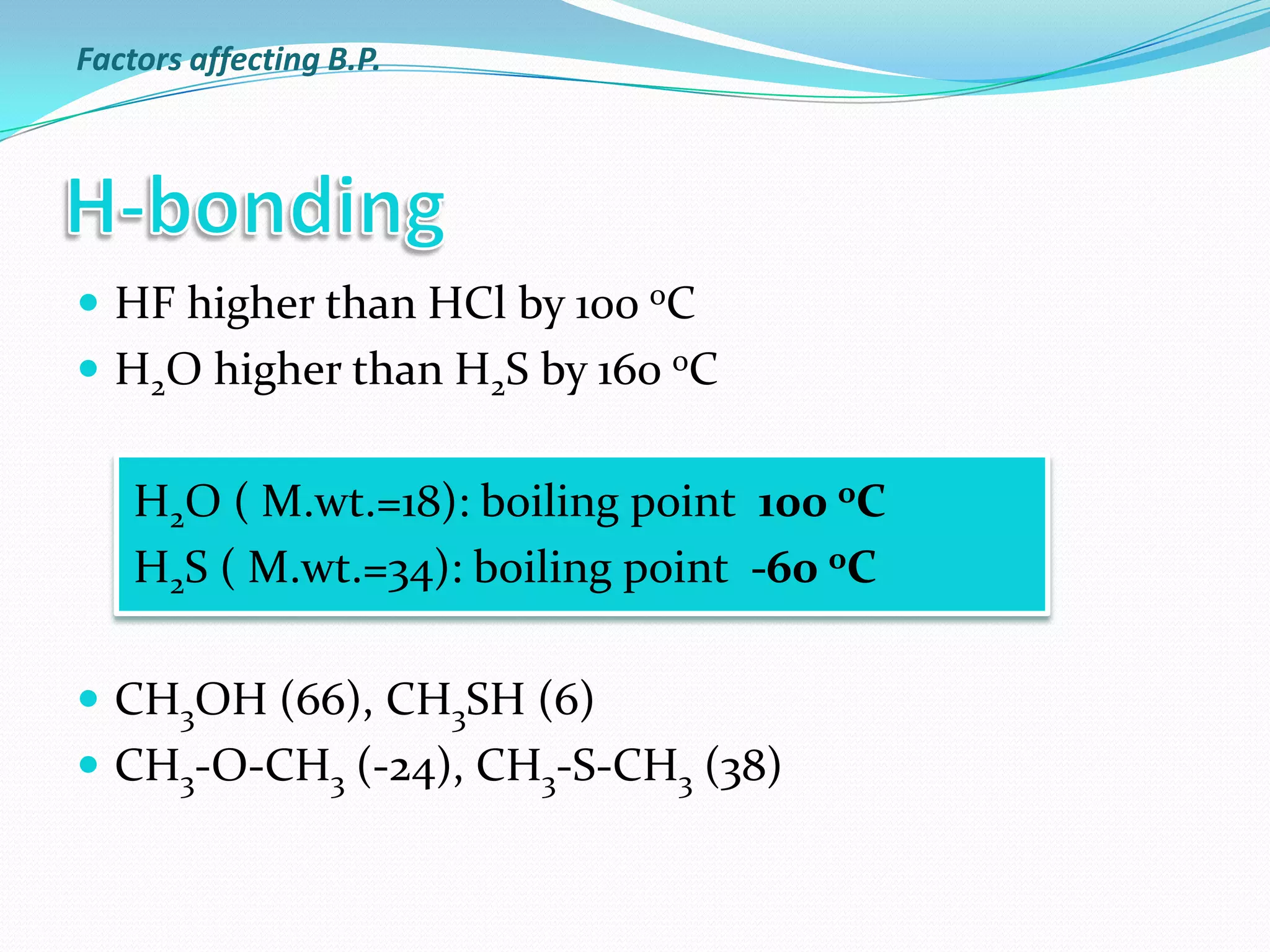
 HF higher than HCl by 100 oC
 H2O higher than H2S by 160 oC
H2O ( M.wt.=18): boiling point 100 oC
H2S ( M.wt.=34): boiling point -60 oC
 CH3OH (66), CH3SH (6)
 CH3-O-CH3 (-24), CH3-S-CH3 (38)
Factors affecting B.P.
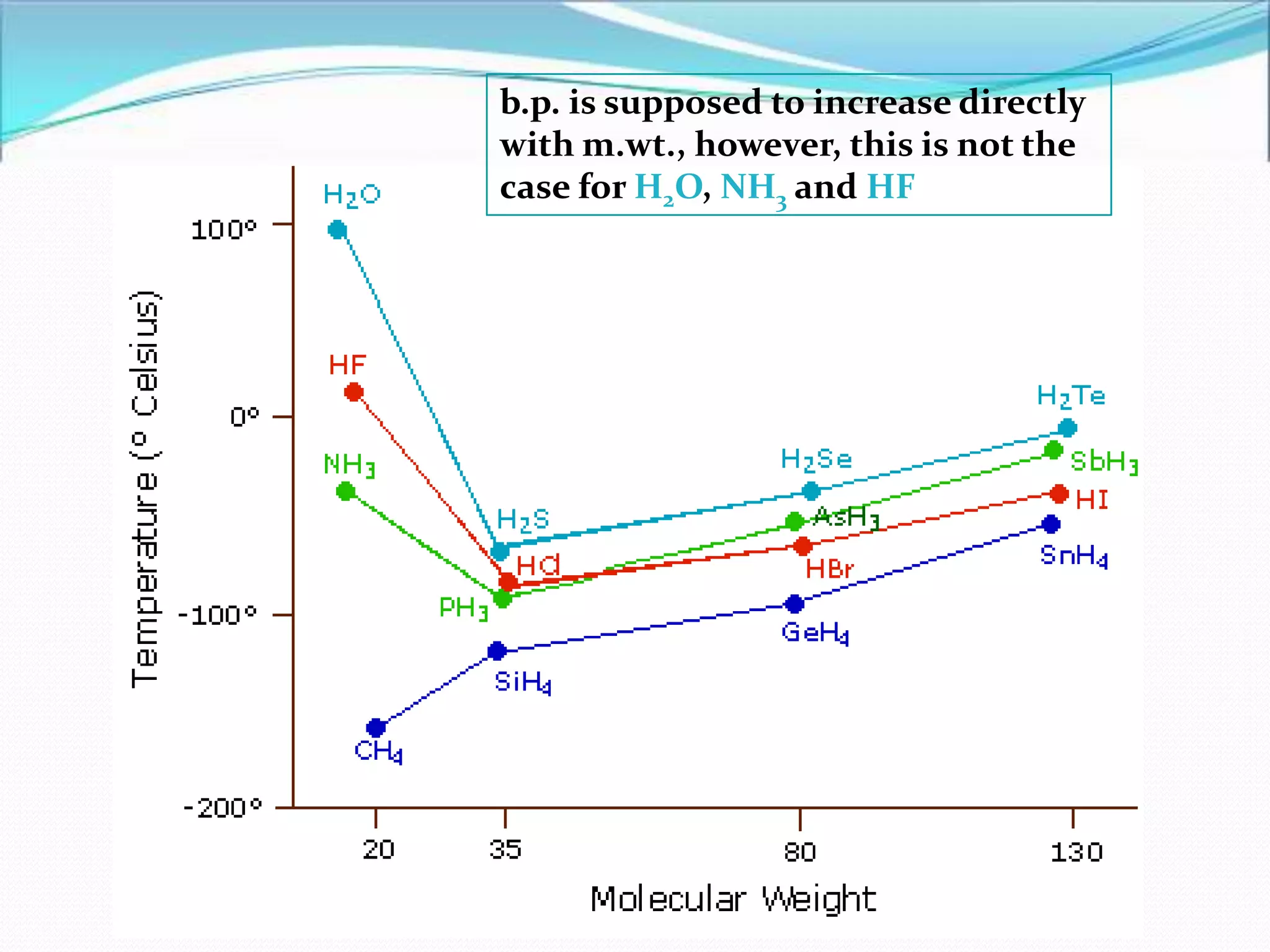
b.p. is supposed to increase directly
with m.wt., however, this is not the
case for H2O, NH3 and HF
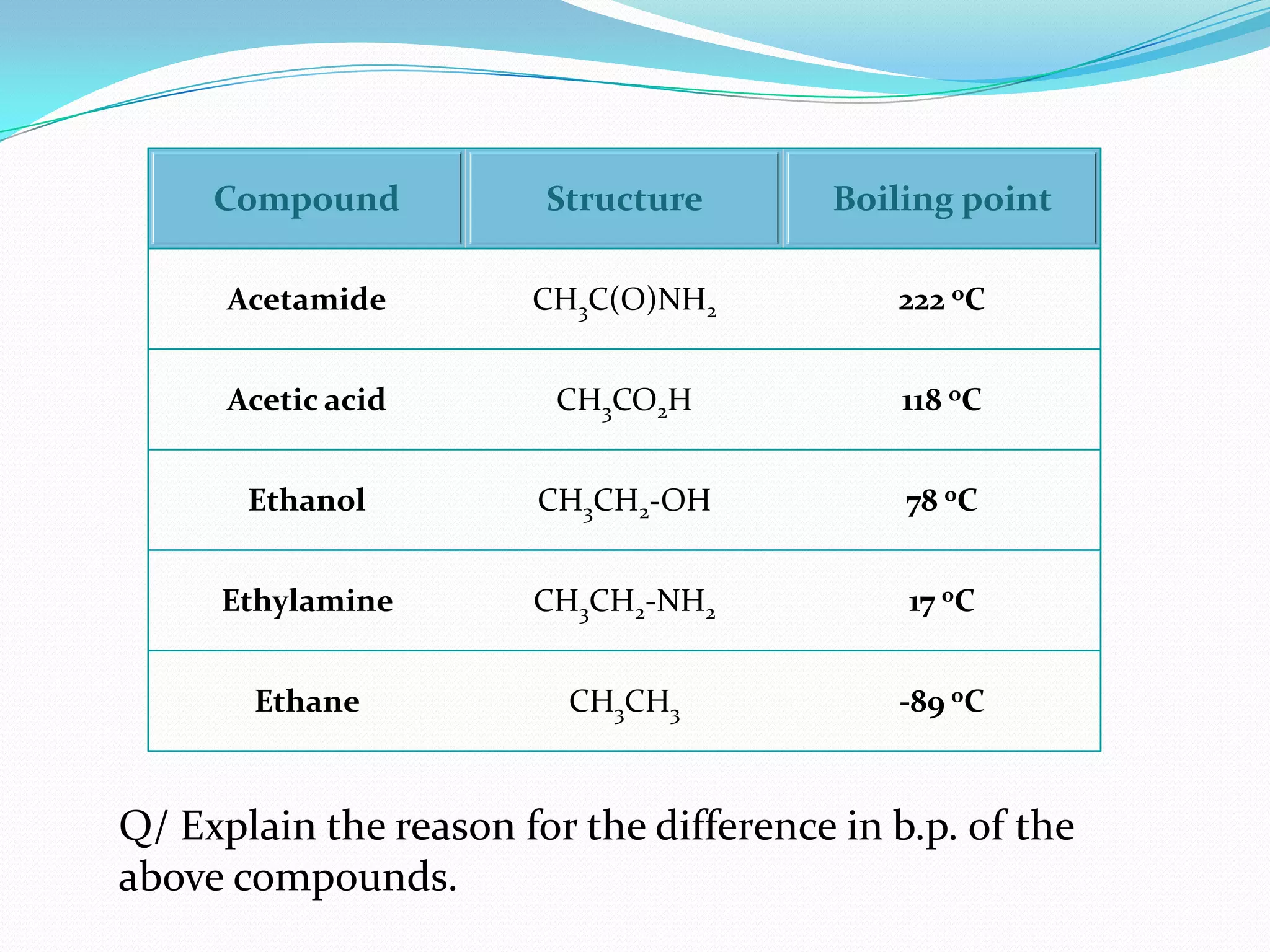
Compound Structure Boiling point
Acetamide CH3C(O)NH2 222 oC
Acetic acid CH3CO2H 118 oC
Ethanol CH3CH2-OH 78 oC
Ethylamine CH3CH2-NH2 17 oC
Ethane CH3CH3 -89 oC
Q/ Explain the reason for the difference in b.p. of the
above compounds.
 A solution has a higher boiling point than a pure
solvent .
 The b.p. of pure H2O is 100 oC, but that b.p. can be
elevated by adding a solute such as a salt.
Δ Tb = Kb Cm
where Kb is called the boiling-point elevation constant
Factors affecting B.P.
The reason for elevating b.p. is:
 the number of solvent molecules at the surface of the
solution is less than for pure solvent. The surface
molecules can be considered “diluted” by the less
volatile particles of the solute
 The rate of exchange between solvent in the solution
and the air above it is lower (vapor pressure of the
solvent is reduced)
 A lower pressure means that a higher temperature is
necessary to boil the water in the solution , hence
boiling point elevation
 Conversely, adding common salt to water will lower its
freezing point.
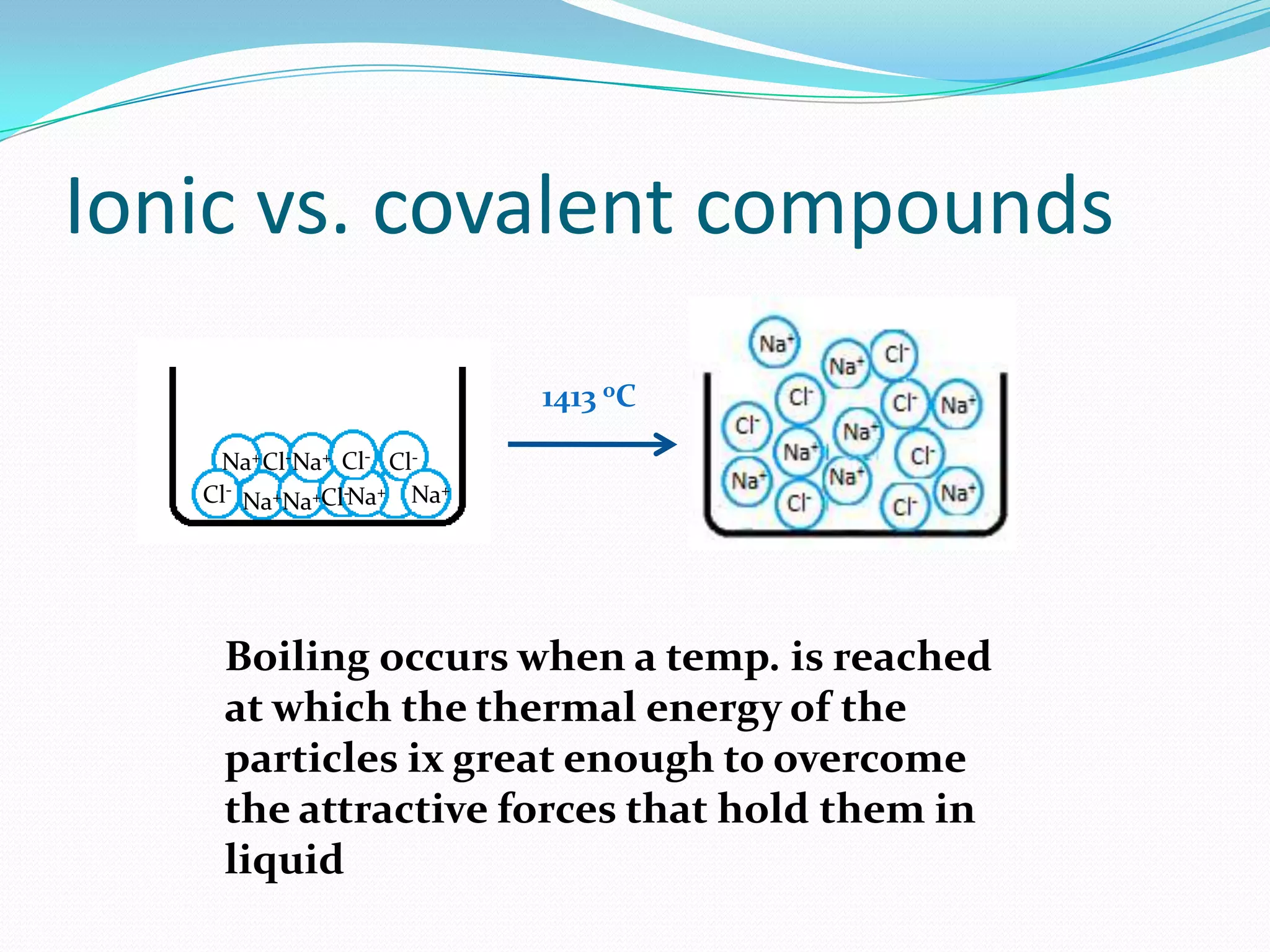
Ionic vs. covalent compounds
Na+
Na+
Na+
Na+
Na+
Na+
Cl-
Cl-
Cl- Cl-
Cl-
1413 oC
Boiling occurs when a temp. is reached
at which the thermal energy of the
particles ix great enough to overcome
the attractive forces that hold them in
liquid
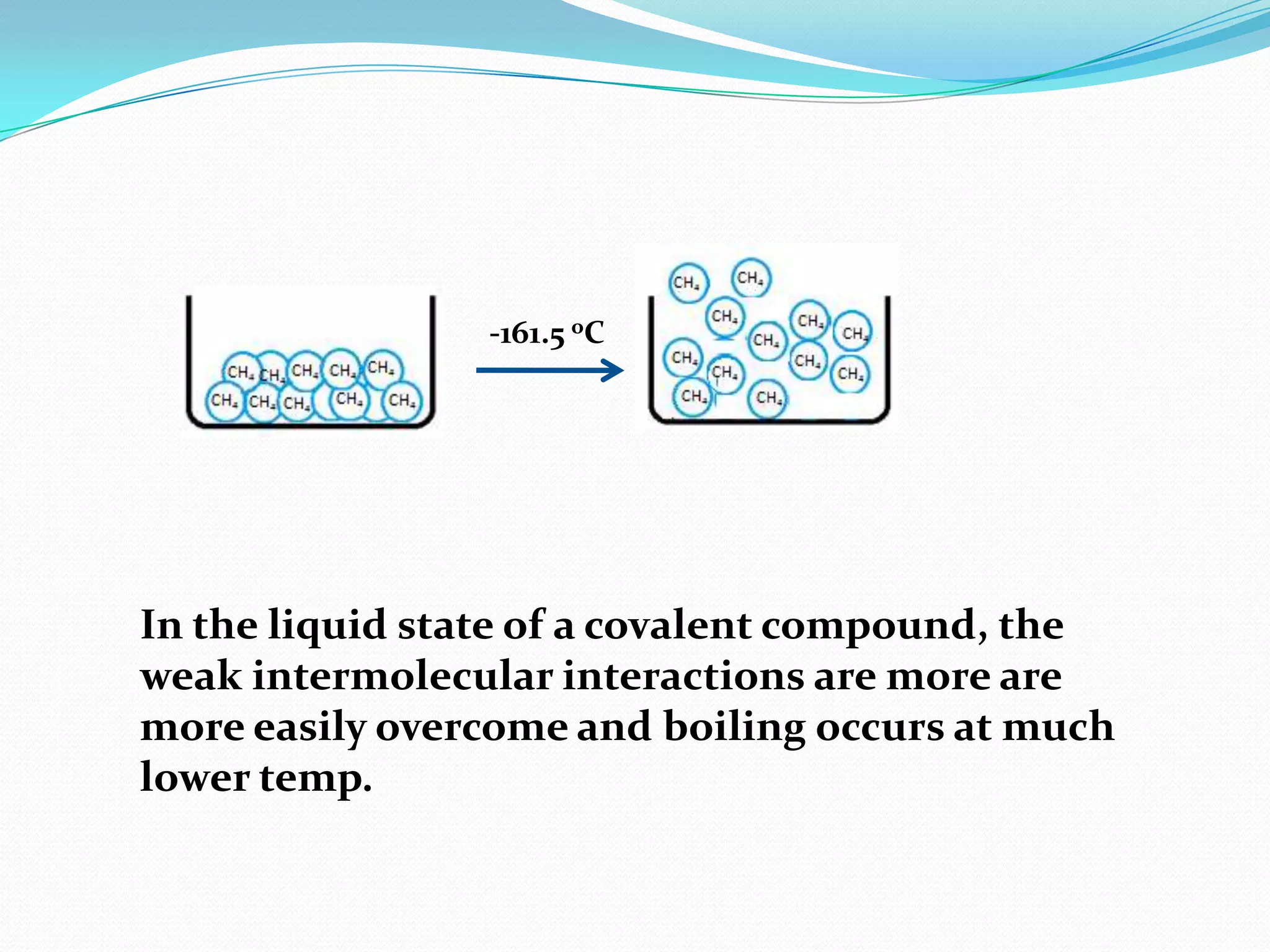
In the liquid state of a covalent compound, the
weak intermolecular interactions are more are
more easily overcome and boiling occurs at much
lower temp.
-161.5 oC
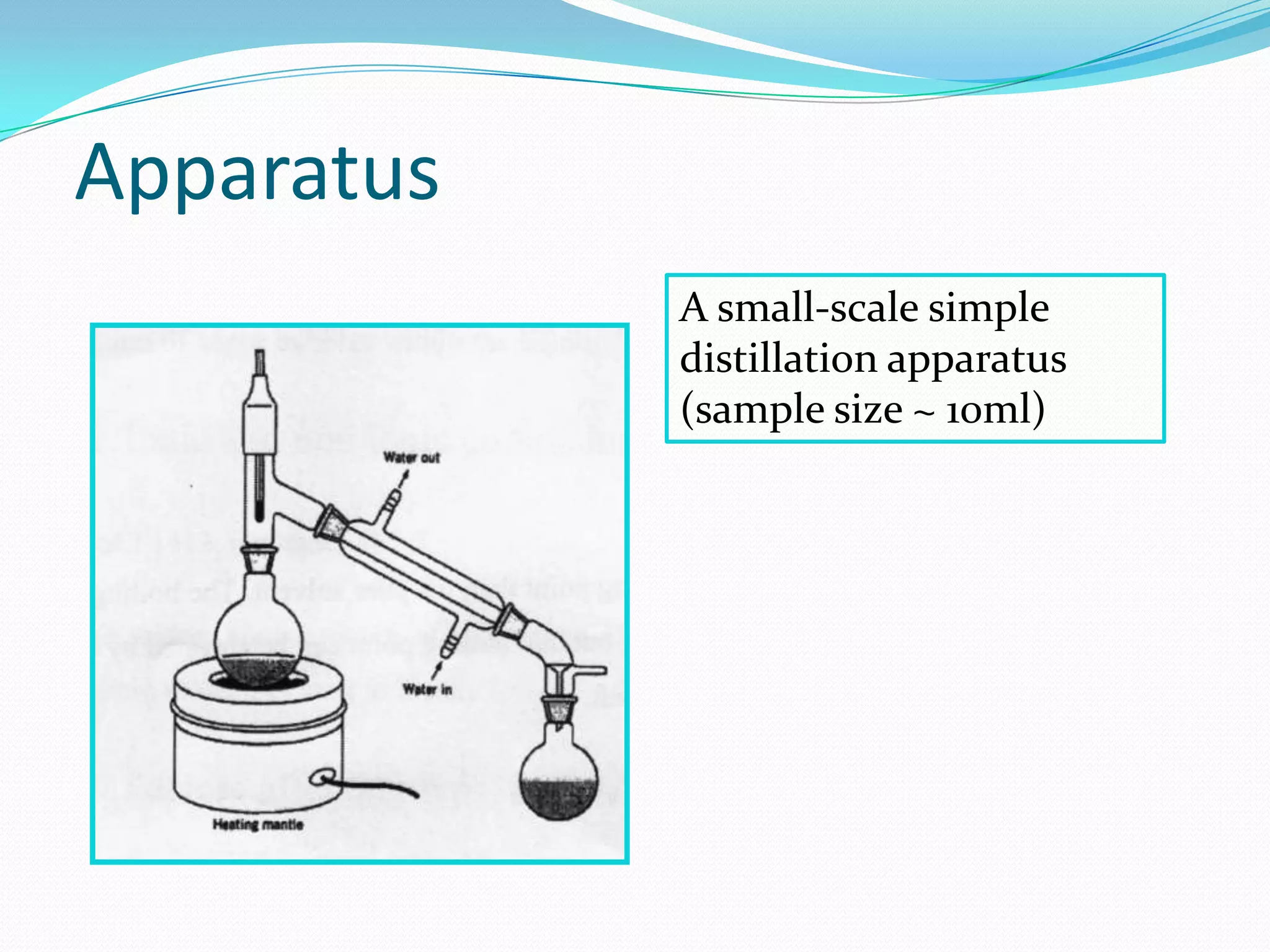
Apparatus
A small-scale simple
distillation apparatus
(sample size ~ 10ml)
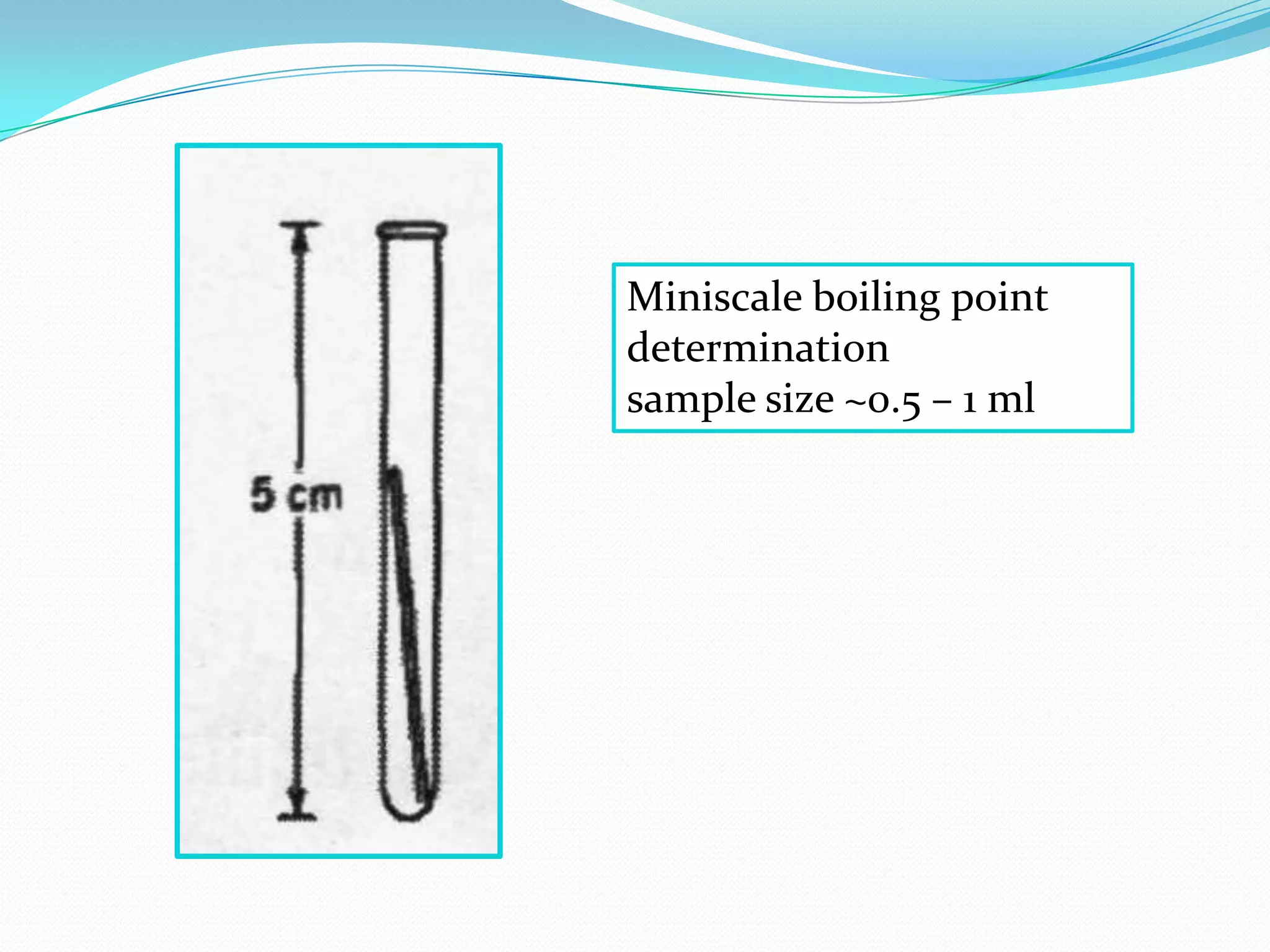
Miniscale boiling point
determination
sample size ~0.5 – 1 ml
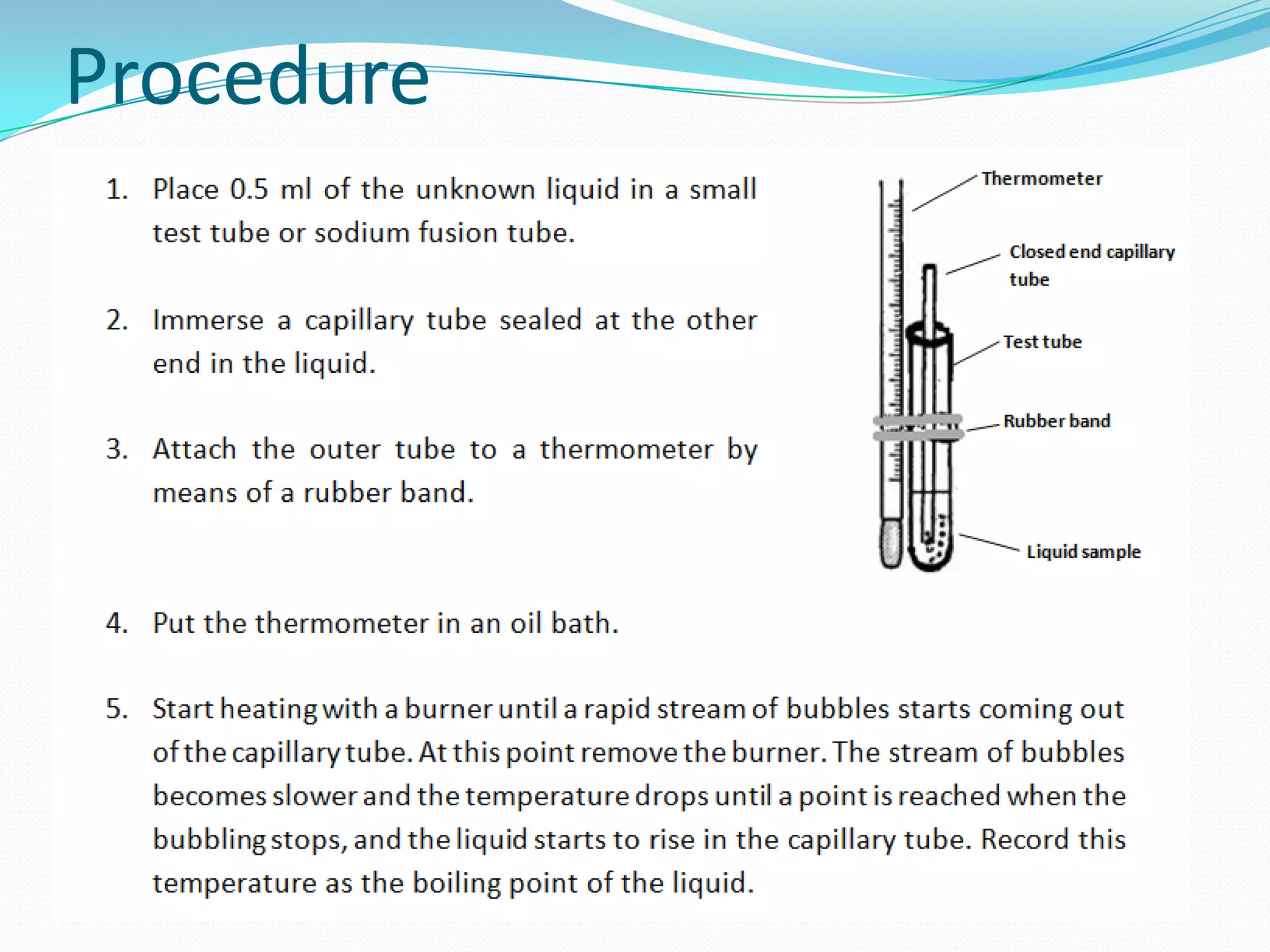
Procedure

Determination of boiling point of organic compounds

  • 2.
    Dotsha J. Raheem Departmentof Chemistry College of Science University of Salahaddin
  • 4.
    The boiling pointof a liquid is the temperature at which its vapor pressure is equal to the pressure of the gas above it Definition of b.p.
  • 5.
     In termsof intermolecular interactions the b.p. represents the energy required to overcome the various intermolecular attractions binding the molecules as a liquid (e.g. dipole-dipole attraction and hydrogen bonding) and therefore undergo a phase change into the gaseous phase . Therefore the boiling point of a liquid is also an indicator of the strength of the attractive forces between the liquid’s molecules.
  • 6.
     The normalboiling point of a liquid is the temperature at which its vapor pressure is equal to 1 atm
  • 7.
    Importance of b.p. B.p.is a physical constant used for: 1. Identification of unknown liquid compound 2. Purification
  • 8.
    factors affecting b.p. Pressure  Molecular weight  Structure of the molecule & intermolecular interactions  Branching  Polarity  Van der Waals interactions  H-bonding  Impurities
  • 9.
    a. When thepressure is less than 1 atm , the boiling point of the liquid is less than its normal b.p. b. P = 1 atm, the b.p. of the liquid is called normal boiling point c. When P is greater than 1 atm, the b.p. of the liquid is greater than its normal b.p. The higher the altitude, the lower the temp at which water boils Factors affecting B.P.
  • 11.
    CH4 and CH3Cl Factorsaffecting B.P. H C H H H H C H H Cl
  • 12.
    Formula IUPAC NameBoiling Point HCO2H methanoic acid 101 oC CH3CO2H ethanoic acid 118 oC CH3CH2CO2H propanoic acid 141 oC CH3(CH2)2CO2H butanoic acid 164 oC CH3(CH2)3CO2H pentanoic acid 186 oC CH3(CH2)4CO2H hexanoic acid 205 oC CH3(CH2)5CO2H heptanoic acid 223 oC
  • 13.
  • 14.
    Within the branchedseries, increased symmetry leads to higher melting point and lower boiling point
  • 15.
     CH4 (b.p.-161.5) , CH3-O-CH3 (b.p. -24)  Butane (-0.6 oC) , acetone (56 oC) Factors affecting B.P.
  • 16.
     pentane (36),isopentane (31) and neopentane (9) Pentane bp 36 oC 2,2-dimethylpropane bp 9.5 oC Factors affecting B.P.
  • 17.
    OH OH OH 1-butanol(118), 2-butanol (100) 2-mehtyl-2-propanol (83) isobutanol tert-butanoln-butanol
  • 18.
     HF higherthan HCl by 100 oC  H2O higher than H2S by 160 oC H2O ( M.wt.=18): boiling point 100 oC H2S ( M.wt.=34): boiling point -60 oC  CH3OH (66), CH3SH (6)  CH3-O-CH3 (-24), CH3-S-CH3 (38) Factors affecting B.P.
  • 19.
    b.p. is supposedto increase directly with m.wt., however, this is not the case for H2O, NH3 and HF
  • 20.
    Compound Structure Boilingpoint Acetamide CH3C(O)NH2 222 oC Acetic acid CH3CO2H 118 oC Ethanol CH3CH2-OH 78 oC Ethylamine CH3CH2-NH2 17 oC Ethane CH3CH3 -89 oC Q/ Explain the reason for the difference in b.p. of the above compounds.
  • 21.
     A solutionhas a higher boiling point than a pure solvent .  The b.p. of pure H2O is 100 oC, but that b.p. can be elevated by adding a solute such as a salt. Δ Tb = Kb Cm where Kb is called the boiling-point elevation constant Factors affecting B.P.
  • 22.
    The reason forelevating b.p. is:  the number of solvent molecules at the surface of the solution is less than for pure solvent. The surface molecules can be considered “diluted” by the less volatile particles of the solute  The rate of exchange between solvent in the solution and the air above it is lower (vapor pressure of the solvent is reduced)
  • 23.
     A lowerpressure means that a higher temperature is necessary to boil the water in the solution , hence boiling point elevation  Conversely, adding common salt to water will lower its freezing point.
  • 24.
    Ionic vs. covalentcompounds Na+ Na+ Na+ Na+ Na+ Na+ Cl- Cl- Cl- Cl- Cl- 1413 oC Boiling occurs when a temp. is reached at which the thermal energy of the particles ix great enough to overcome the attractive forces that hold them in liquid
  • 25.
    In the liquidstate of a covalent compound, the weak intermolecular interactions are more are more easily overcome and boiling occurs at much lower temp. -161.5 oC
  • 26.
    Apparatus A small-scale simple distillationapparatus (sample size ~ 10ml)
  • 27.
  • 28.