Obesity
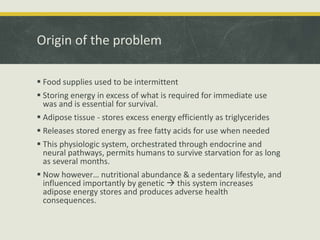
Origin of the problem
 Food supplies used to be intermittent
 Storing energy in excess of what is required for immediate use
was and is essential for survival.
 Adipose tissue - stores excess energy efficiently as triglycerides
 Releases stored energy as free fatty acids for use when needed
 This physiologic system, orchestrated through endocrine and
neural pathways, permits humans to survive starvation for as long
as several months.
 Now however… nutritional abundance & a sedentary lifestyle, and
influenced importantly by genetic  this system increases
adipose energy stores and produces adverse health
consequences.
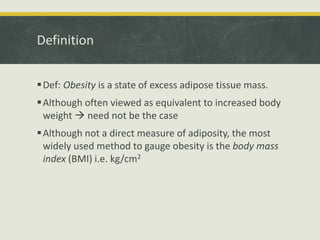
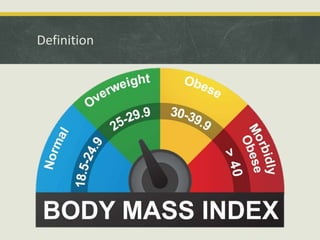
Definition
Def: Obesity is a state of excess adipose tissue mass.
Although often viewed as equivalent to increased body
weight  need not be the case
Although not a direct measure of adiposity, the most
widely used method to gauge obesity is the body mass
index (BMI) i.e. kg/cm2
Definition
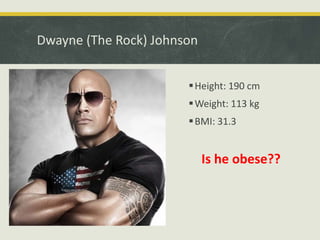
Dwayne (The Rock) Johnson
Height: 190 cm
Weight: 113 kg
BMI: 31.3
Is he obese??
Introduction
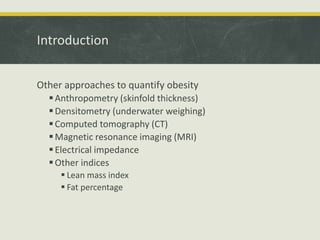
Other approaches to quantify obesity
Anthropometry (skinfold thickness)
Densitometry (underwater weighing)
Computed tomography (CT)
Magnetic resonance imaging (MRI)
Electrical impedance
Other indices
 Lean mass index
 Fat percentage
Introduction
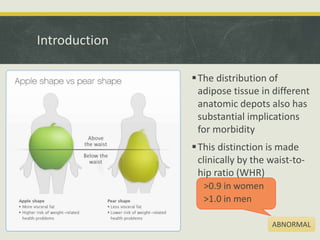
The distribution of
adipose tissue in different
anatomic depots also has
substantial implications
for morbidity
This distinction is made
clinically by the waist-to-
hip ratio (WHR)
>0.9 in women
>1.0 in men
ABNORMAL
Prevalence
Estimated that over 12% of the world’s adult
population is obese
Estimations in India reveal that 5-12% are
obese
⅓ of the adult population of the US  Obese
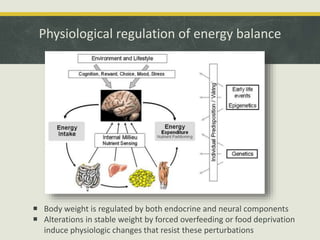
Physiological regulation of energy balance
 Body weight is regulated by both endocrine and neural components
 Alterations in stable weight by forced overfeeding or food deprivation
induce physiologic changes that resist these perturbations
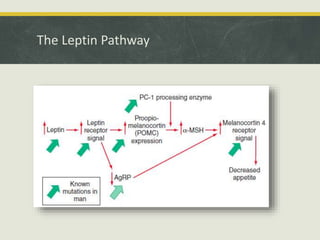
The Leptin Pathway
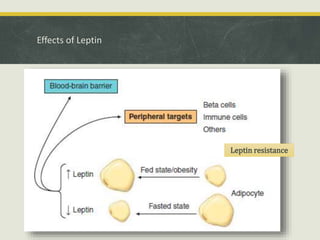
Effects of Leptin
Leptin resistance
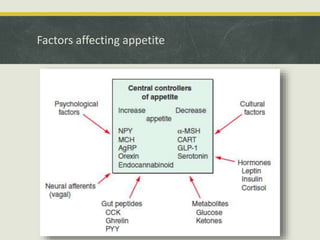
Factors affecting appetite
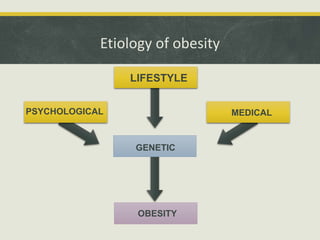
Etiology of obesity
LIFESTYLE
PSYCHOLOGICAL MEDICAL
GENETIC
OBESITY
Environmental/Psychosocial
 Increased caloric
intake
▪ Availability, price
▪ Extra 50 cal/day (1 tsp
sugar) = 2.25 kg/year
= 25 kg over 10 years
 More sedentary
▪ Television/Computer
▪ Emphasis on
academics
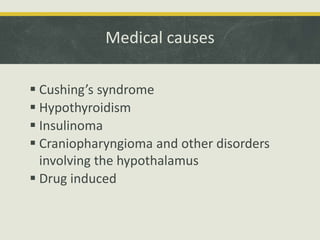
Medical causes
 Cushing’s syndrome
 Hypothyroidism
 Insulinoma
 Craniopharyngioma and other disorders
involving the hypothalamus
 Drug induced
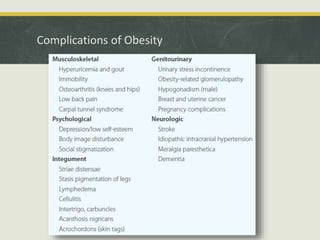
Complications of Obesity
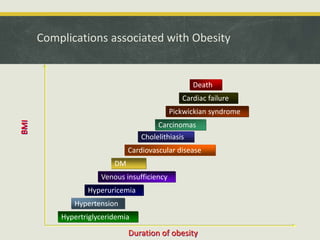
Complications associated with Obesity
Hypertriglyceridemia
Hypertension
Hyperuricemia
Venous insufficiency
DM
Cardiovascular disease
Cholelithiasis
Carcinomas
Pickwickian syndrome
Cardiac failure
Death
Duration of obesity
Management of
Obesity
Work up
Physical exam – Focus on possible complications
Investigations:
 Blood sugar, lipid profile, liver function tests
Other tests based on clinical features
 TSH, Sleep studies
 Dexamethasone suppression test for Cushing’s syndrome*
Treatment
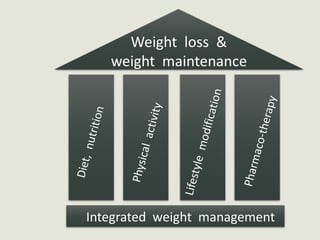
Prevention
Diet
Increased physical activity
Behavior modification
Medicines
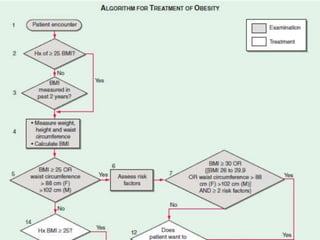
Guide to treatment options
Weight loss &
weight maintenance
Integrated weight management
Behaviour modification
Self monitoring of weight
Stress management
Social support
Diet
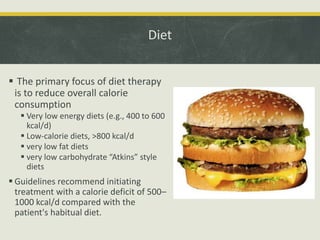
 The primary focus of diet therapy
is to reduce overall calorie
consumption
 Very low energy diets (e.g., 400 to 600
kcal/d)
 Low-calorie diets, >800 kcal/d
 very low fat diets
 very low carbohydrate “Atkins” style
diets
 Guidelines recommend initiating
treatment with a calorie deficit of 500–
1000 kcal/d compared with the
patient's habitual diet.
Diet
The revised Dietary Reference Intakes for
Macronutrients released by the Institute of Medicine
recommends
45–65% of calories from carbohydrates,
 20–35% from fat, and 10–35% from protein.
daily fiber intake of 38 g (men) and 25 g (women) for
persons over 50 years of age and
30 g (men) and 21 g (women)for those under age 50.
Diet
Low-carbohydrate, high-protein diets appear to be
more effective in lowering BMI;
improving coronary heart disease risk factors, including
an increase in HDL cholesterol and a decrease in
triglyceride levels;
controlling satiety in the short term compared with
low-fat diets
Diet
Occasionally, very low calorie diets (VLCDs) are
prescribed as a form of aggressive dietary therapy.
The primary purpose of a VLCD is to promote a rapid
and significant (13–23 kg) short-term weight loss over a
3- to 6-month period.
These propriety formulas typically supply 800 kcal, 50–
80 g protein, and 100% of the recommended daily
intake for vitamins and minerals.
Exercise
 Increased energy expenditure is the
most obvious mechanism for an
effect of exercise
 Exercise appears to be a valuable
means to sustain diet therapy
 Valuable in the obese individual for its
effects on cardiovascular tone and
blood pressure
Pharmacotherapy
Recommended if BMI >/= 27 with
comorbidities or BMI >/= 30
Facts:
Drugs alone cause modest weight loss
Diet with drugs improves efficacy
Effects maintained for duration of treatment
only
Long term safety data not available
Pharmacotherapy
Medications for obesity have traditionally
fallen into two major categories:
1. Appetite suppressants (anorexiants)
2. Gastrointestinal fat blockers
Pharmacotherapy
Centrally Acting Anorexiant Medication
Anorexiants increases satiety and decreases hunger,
these agents help patients reduce caloric intake without
a sense of deprivation.
Targets the ventromedial and lateral hypothalamus
Eg PHEN/TPM (Phenteramine and Topiramate)  9.3%
and 8.6% weight lost in 2 large trials
Pharmacotherapy
Centrally Acting Anorexiant Medication
Lorcaserin is a selective 5-HT2C receptor agonist
thought to decrease food intake through the pro-
opiomelanocortin system of neurons.
Pharmacotherapy
Peripherally Acting Medications
(Gastrointestinal fat blockers)
 Orlistat is a synthetic hydrogenated derivative of a
naturally occurring lipase inhibitor, lipostatin
 Potent, slowly reversible inhibitor of pancreatic, gastric,
and carboxylester lipases and phospholipase A2 
required for the hydrolysis of dietary fat into fatty acids.
 Acts in the lumen of the stomach and small intestine
 Blocks the digestion and absorption of ~30% of dietary
fat
 Weight loss of ~9–10%
Pharmacotherapy
In development
Bupropion and naltrexone
Liraglutide
Surgery
Indications
BMI > 35 with an associated comorbidity or a BMI > 40
(irrespective)
Repeated failures of other therapeutic approaches
Capability of tolerating surgery
Surgery
 Weight loss surgeries have traditionally been classified into 3
categories on the basis of anatomic changes:
 Restrictive
 Restrictive-malabsorptive
 Malabsorptive
 Clinical benefits of bariatric surgery in achieving weight loss and
alleviating metabolic comorbidities have been attributed largely to
changes in the physiologic responses of gut hormones and in
adipose tissue metabolism.
Surgery
 Restrictive surgeries limit the
amount of food the stomach can
hold and slow the rate of gastric
emptying.
 Malabsorptive surgeries reduce the
amount of absorption
A. Laparoscopic gastric band (LAGB)
B. The Roux-en-Y gastric bypass.
C. Biliopancreatic diversion with duodenal
switch.
D. Biliopancreatic diversion.vertical-banded
gastroplasty
E. Biliopancreatic diversion
Surgery
 These procedures generally produce a 30–35% average total body weight
loss that is maintained in nearly 60% of patients at 5 years.
 Significant improvement in multiple obesity-related comorbid conditions,
including type 2 diabetes, hypertension, dyslipidemia, obstructive sleep
apnea, quality of life and long-term cardiovascular events.
 The most common surgical complications include stomal stenosis or
marginal ulcers
 The restrictive-malabsorptive procedures carry an increased risk for
micronutrient deficiencies of vitamin B12, iron, folate, calcium, and
vitamin D.
 Patients with restrictive-malabsorptive procedures require lifelong
supplementation with these micronutrients.
Obesity - Pathophysiology, Etiology and management

Obesity - Pathophysiology, Etiology and management

  • 1.
  • 2.
    Origin of theproblem  Food supplies used to be intermittent  Storing energy in excess of what is required for immediate use was and is essential for survival.  Adipose tissue - stores excess energy efficiently as triglycerides  Releases stored energy as free fatty acids for use when needed  This physiologic system, orchestrated through endocrine and neural pathways, permits humans to survive starvation for as long as several months.  Now however… nutritional abundance & a sedentary lifestyle, and influenced importantly by genetic  this system increases adipose energy stores and produces adverse health consequences.
  • 3.
    Definition Def: Obesity isa state of excess adipose tissue mass. Although often viewed as equivalent to increased body weight  need not be the case Although not a direct measure of adiposity, the most widely used method to gauge obesity is the body mass index (BMI) i.e. kg/cm2
  • 4.
  • 5.
    Dwayne (The Rock)Johnson Height: 190 cm Weight: 113 kg BMI: 31.3 Is he obese??
  • 6.
    Introduction Other approaches toquantify obesity Anthropometry (skinfold thickness) Densitometry (underwater weighing) Computed tomography (CT) Magnetic resonance imaging (MRI) Electrical impedance Other indices  Lean mass index  Fat percentage
  • 7.
    Introduction The distribution of adiposetissue in different anatomic depots also has substantial implications for morbidity This distinction is made clinically by the waist-to- hip ratio (WHR) >0.9 in women >1.0 in men ABNORMAL
  • 8.
    Prevalence Estimated that over12% of the world’s adult population is obese Estimations in India reveal that 5-12% are obese ⅓ of the adult population of the US  Obese
  • 9.
    Physiological regulation ofenergy balance  Body weight is regulated by both endocrine and neural components  Alterations in stable weight by forced overfeeding or food deprivation induce physiologic changes that resist these perturbations
  • 10.
  • 11.
  • 12.
  • 13.
  • 14.
    Environmental/Psychosocial  Increased caloric intake ▪Availability, price ▪ Extra 50 cal/day (1 tsp sugar) = 2.25 kg/year = 25 kg over 10 years  More sedentary ▪ Television/Computer ▪ Emphasis on academics
  • 15.
    Medical causes  Cushing’ssyndrome  Hypothyroidism  Insulinoma  Craniopharyngioma and other disorders involving the hypothalamus  Drug induced
  • 18.
  • 19.
  • 20.
    Complications associated withObesity Hypertriglyceridemia Hypertension Hyperuricemia Venous insufficiency DM Cardiovascular disease Cholelithiasis Carcinomas Pickwickian syndrome Cardiac failure Death Duration of obesity
  • 21.
  • 22.
    Work up Physical exam– Focus on possible complications Investigations:  Blood sugar, lipid profile, liver function tests Other tests based on clinical features  TSH, Sleep studies  Dexamethasone suppression test for Cushing’s syndrome*
  • 23.
  • 24.
  • 25.
    Weight loss & weightmaintenance Integrated weight management
  • 26.
    Behaviour modification Self monitoringof weight Stress management Social support
  • 27.
    Diet  The primaryfocus of diet therapy is to reduce overall calorie consumption  Very low energy diets (e.g., 400 to 600 kcal/d)  Low-calorie diets, >800 kcal/d  very low fat diets  very low carbohydrate “Atkins” style diets  Guidelines recommend initiating treatment with a calorie deficit of 500– 1000 kcal/d compared with the patient's habitual diet.
  • 28.
    Diet The revised DietaryReference Intakes for Macronutrients released by the Institute of Medicine recommends 45–65% of calories from carbohydrates,  20–35% from fat, and 10–35% from protein. daily fiber intake of 38 g (men) and 25 g (women) for persons over 50 years of age and 30 g (men) and 21 g (women)for those under age 50.
  • 29.
    Diet Low-carbohydrate, high-protein dietsappear to be more effective in lowering BMI; improving coronary heart disease risk factors, including an increase in HDL cholesterol and a decrease in triglyceride levels; controlling satiety in the short term compared with low-fat diets
  • 30.
    Diet Occasionally, very lowcalorie diets (VLCDs) are prescribed as a form of aggressive dietary therapy. The primary purpose of a VLCD is to promote a rapid and significant (13–23 kg) short-term weight loss over a 3- to 6-month period. These propriety formulas typically supply 800 kcal, 50– 80 g protein, and 100% of the recommended daily intake for vitamins and minerals.
  • 31.
    Exercise  Increased energyexpenditure is the most obvious mechanism for an effect of exercise  Exercise appears to be a valuable means to sustain diet therapy  Valuable in the obese individual for its effects on cardiovascular tone and blood pressure
  • 32.
    Pharmacotherapy Recommended if BMI>/= 27 with comorbidities or BMI >/= 30 Facts: Drugs alone cause modest weight loss Diet with drugs improves efficacy Effects maintained for duration of treatment only Long term safety data not available
  • 33.
    Pharmacotherapy Medications for obesityhave traditionally fallen into two major categories: 1. Appetite suppressants (anorexiants) 2. Gastrointestinal fat blockers
  • 34.
    Pharmacotherapy Centrally Acting AnorexiantMedication Anorexiants increases satiety and decreases hunger, these agents help patients reduce caloric intake without a sense of deprivation. Targets the ventromedial and lateral hypothalamus Eg PHEN/TPM (Phenteramine and Topiramate)  9.3% and 8.6% weight lost in 2 large trials
  • 35.
    Pharmacotherapy Centrally Acting AnorexiantMedication Lorcaserin is a selective 5-HT2C receptor agonist thought to decrease food intake through the pro- opiomelanocortin system of neurons.
  • 36.
    Pharmacotherapy Peripherally Acting Medications (Gastrointestinalfat blockers)  Orlistat is a synthetic hydrogenated derivative of a naturally occurring lipase inhibitor, lipostatin  Potent, slowly reversible inhibitor of pancreatic, gastric, and carboxylester lipases and phospholipase A2  required for the hydrolysis of dietary fat into fatty acids.  Acts in the lumen of the stomach and small intestine  Blocks the digestion and absorption of ~30% of dietary fat  Weight loss of ~9–10%
  • 37.
  • 38.
    Surgery Indications BMI > 35with an associated comorbidity or a BMI > 40 (irrespective) Repeated failures of other therapeutic approaches Capability of tolerating surgery
  • 39.
    Surgery  Weight losssurgeries have traditionally been classified into 3 categories on the basis of anatomic changes:  Restrictive  Restrictive-malabsorptive  Malabsorptive  Clinical benefits of bariatric surgery in achieving weight loss and alleviating metabolic comorbidities have been attributed largely to changes in the physiologic responses of gut hormones and in adipose tissue metabolism.
  • 40.
    Surgery  Restrictive surgerieslimit the amount of food the stomach can hold and slow the rate of gastric emptying.  Malabsorptive surgeries reduce the amount of absorption A. Laparoscopic gastric band (LAGB) B. The Roux-en-Y gastric bypass. C. Biliopancreatic diversion with duodenal switch. D. Biliopancreatic diversion.vertical-banded gastroplasty E. Biliopancreatic diversion
  • 41.
    Surgery  These proceduresgenerally produce a 30–35% average total body weight loss that is maintained in nearly 60% of patients at 5 years.  Significant improvement in multiple obesity-related comorbid conditions, including type 2 diabetes, hypertension, dyslipidemia, obstructive sleep apnea, quality of life and long-term cardiovascular events.  The most common surgical complications include stomal stenosis or marginal ulcers  The restrictive-malabsorptive procedures carry an increased risk for micronutrient deficiencies of vitamin B12, iron, folate, calcium, and vitamin D.  Patients with restrictive-malabsorptive procedures require lifelong supplementation with these micronutrients.