SACRAL FRACTURESSACRAL FRACTURES
Dr. D. N. BidDr. D. N. Bid
Sarvajanik College of Physiotherapy,Sarvajanik College of Physiotherapy,
Rampura, SuratRampura, Surat
1-3-20161-3-2016
 A blow from behind, or a fall onto theA blow from behind, or a fall onto the
‘tail’ may fracture the sacrum or coccyx,‘tail’ may fracture the sacrum or coccyx,
or sprain the joint between them.or sprain the joint between them.
 Women seem to be affected moreWomen seem to be affected more
commonly than men.commonly than men.
 Bruising is considerable and tenderness isBruising is considerable and tenderness is
elicited when the sacrum or coccyx iselicited when the sacrum or coccyx is
palpated from behind or per rectum.palpated from behind or per rectum.
 Sensation may be lost over the distributionSensation may be lost over the distribution
of sacral nerves.of sacral nerves.
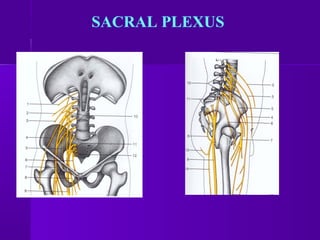
SACRAL PLEXUS
SACRUM FRACTURES – NERVE ROOTS
SACRUM FRACTURES – DENIS CLASSIFICATIONSACRUM FRACTURES – DENIS CLASSIFICATION
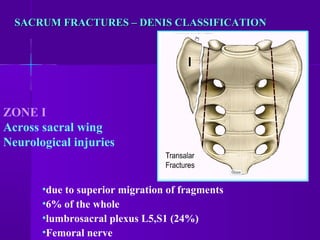
ZONE I
Across sacral wing
Neurological injuries
•due to superior migration of fragments
•6% of the whole
•lumbrosacral plexus L5,S1 (24%)
•Femoral nerve
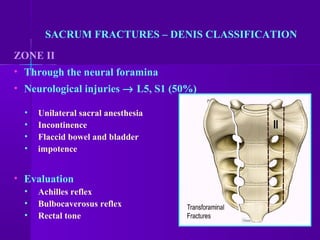
ZONE II
• Through the neural foramina
• Neurological injuries → L5, S1 (50%)
• Unilateral sacral anesthesia
• Incontinence
• Flaccid bowel and bladder
• impotence
• Evaluation
• Achilles reflex
• Bulbocaverosus reflex
• Rectal tone
SACRUM FRACTURES – DENIS CLASSIFICATION
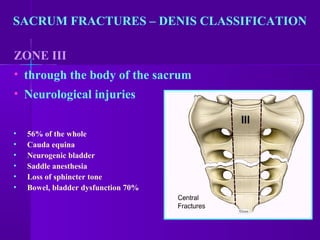
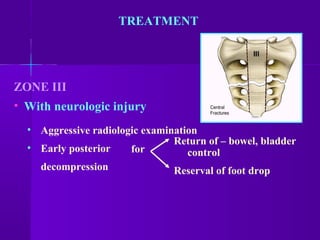
ZONE III
• through the body of the sacrum
• Neurological injuries
• 56% of the whole
• Cauda equina
• Neurogenic bladder
• Saddle anesthesia
• Loss of sphincter tone
• Bowel, bladder dysfunction 70%
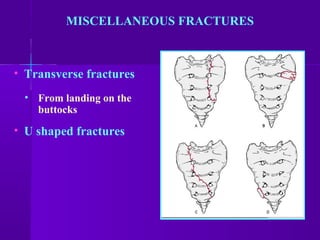
MISCELLANEOUS FRACTURES
• Transverse fractures
• From landing on the
buttocks
• U shaped fractures
• One hand is placed on the iliac crest
• The other hand applies traction to the leg
→ Displacement in vertical plane
PHYSICAL EXAMINATION
X-rayX-ray
 X-raysX-rays may show:may show:
(1)(1) a transverse fracture of the sacrum, in rarea transverse fracture of the sacrum, in rare
cases with the lower fragment pushedcases with the lower fragment pushed
forwards;forwards;
(2) a fractured coccyx, sometimes with the(2) a fractured coccyx, sometimes with the
lower fragment angulated forwards; orlower fragment angulated forwards; or
(3) a normal appearance if the injury was(3) a normal appearance if the injury was
merely a sprained sacrococcygeal joint.merely a sprained sacrococcygeal joint.
RADIOGRAPHIC INVESTIGATION
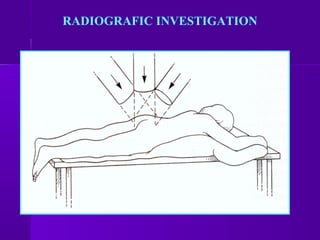
• AP radiographs, inlet and outlet views
• Difficult – complex shape (50% are missed)
• Findings – low lumbar transverse process fractures
- asymmetrical sacral foramen
- irregular trabeculation of the lateral masses
• Sacral arcuate lines → asymmetry: uncomplicated
sacral fractures
→ disorganized: comminuted
sacral fractures.
RADIOGRAFIC INVESTIGATION
• The most accurateThe most accurate
• Especially for transverse fracturesEspecially for transverse fractures
• Useful for detecting large defects as tarlov cystsUseful for detecting large defects as tarlov cysts
• Diagnosis of coexisting malignant lesionsDiagnosis of coexisting malignant lesions
CT SCAN
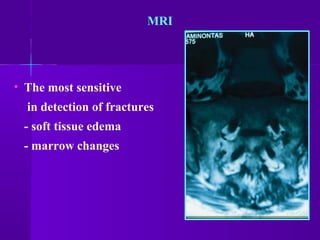
• The most sensitive
in detection of fractures
- soft tissue edema
- marrow changes
MRI
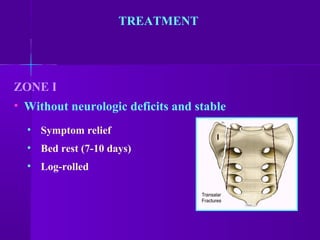
TREATMENT
ZONE I
• Without neurologic deficits and stable
• Symptom relief
• Bed rest (7-10 days)
• Log-rolled
TREATMENT
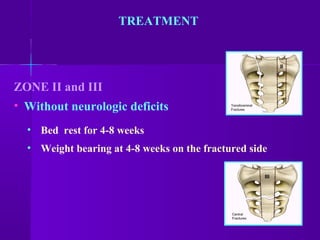
ZONE II and III
• Without neurologic deficits
• Bed rest for 4-8 weeks
• Weight bearing at 4-8 weeks on the fractured side
TREATMENT
ZONE III
• Without neurologic deficits
• Observation: neuropraxia that will resolve
• Symptoms beyond 6-8 weeks: foraminal decompression
TREATMENT
ZONE III
• With neurologic injury
• Aggressive radiologic examination
• Early posterior
decompression
for
Return of – bowel, bladder
control
Reserval of foot drop
COMPLICATIONS OF CONSERVATIVE
TREATMENT
• chronic pain
• sacroiliac joint arthritis
• changes in the alignment on the sacrum
• bowel, bladder disability
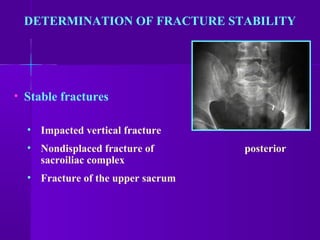
DETERMINATION OF FRACTURE STABILITY
• Stable fractures
• Impacted vertical fracture
• Nondisplaced fracture of posterior
sacroiliac complex
• Fracture of the upper sacrum
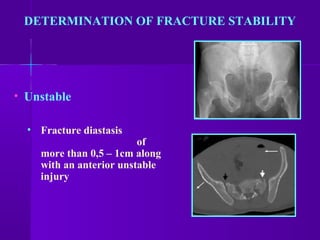
DETERMINATION OF FRACTURE STABILITY
• Unstable
• Fracture diastasis
of
more than 0,5 – 1cm along
with an anterior unstable
injury
SURGICAL INDICATION
• posterior or vertical displacement or both
(>1cm)
• Rotationally unstable pelvic ring injuries
• Sacral fractures with unstable pelvic ring
that requires mobilization
• Neurological injury
PROCEDURE
PRONE POSITION
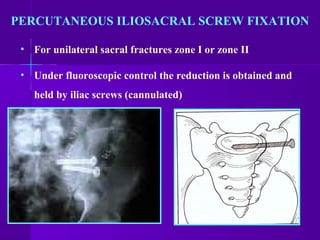
PERCUTANEOUS ILIOSACRAL SCREW FIXATION
• For unilateral sacral fractures zone I or zone II
• Under fluoroscopic control the reduction is obtained and
held by iliac screws (cannulated)
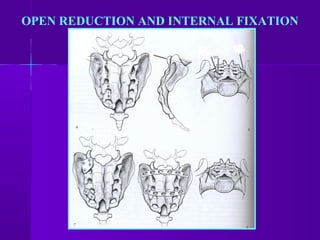
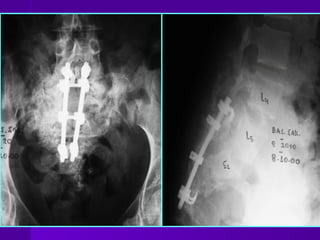
OPEN REDUCTION AND INTERNAL FIXATION
TreatmentTreatment
 If the fracture is displaced, reduction is worthIf the fracture is displaced, reduction is worth
attempting.attempting.
 The lower fragment may be pushed backwards by aThe lower fragment may be pushed backwards by a
finger in the rectum. The reduction is stable, which isfinger in the rectum. The reduction is stable, which is
fortunate.fortunate.
 The patient is allowed to resume normal activity, but isThe patient is allowed to resume normal activity, but is
advised to use a rubber ring cushion when sitting.advised to use a rubber ring cushion when sitting.
 Occasionally, sacral fractures are associated with urinaryOccasionally, sacral fractures are associated with urinary
problems, necessitating sacral laminectomy.problems, necessitating sacral laminectomy.

 Persistent pain, especially on sitting, isPersistent pain, especially on sitting, is
common after coccygeal injuries.common after coccygeal injuries.
 If the pain is not relieved by the use of aIf the pain is not relieved by the use of a
cushion or by the injection of localcushion or by the injection of local
anaesthetic into the tender area, excisionanaesthetic into the tender area, excision
of the coccyx may be considered.of the coccyx may be considered.
CONCLUSION
• Stable Fractures : conservative treatment
• Unstable Fractures : operative treatment
• Neurologic injury :posterior decompression
Fractures of the coccyxFractures of the coccyx
 Fractures of the coccyx result from a direct blowFractures of the coccyx result from a direct blow
to the bottom from a fall onto the coccyx. Theyto the bottom from a fall onto the coccyx. They
are exceedingly painful.are exceedingly painful.
 TreatmentTreatment
No specific treatment is required apart fromNo specific treatment is required apart from
analgesics and a soft cushion. The pain may beanalgesics and a soft cushion. The pain may be
very slow to resolve and can lead to lastingvery slow to resolve and can lead to lasting
disability.disability.

Sacral fractures

  • 1.
    SACRAL FRACTURESSACRAL FRACTURES Dr.D. N. BidDr. D. N. Bid Sarvajanik College of Physiotherapy,Sarvajanik College of Physiotherapy, Rampura, SuratRampura, Surat 1-3-20161-3-2016
  • 2.
     A blowfrom behind, or a fall onto theA blow from behind, or a fall onto the ‘tail’ may fracture the sacrum or coccyx,‘tail’ may fracture the sacrum or coccyx, or sprain the joint between them.or sprain the joint between them.  Women seem to be affected moreWomen seem to be affected more commonly than men.commonly than men.
  • 3.
     Bruising isconsiderable and tenderness isBruising is considerable and tenderness is elicited when the sacrum or coccyx iselicited when the sacrum or coccyx is palpated from behind or per rectum.palpated from behind or per rectum.  Sensation may be lost over the distributionSensation may be lost over the distribution of sacral nerves.of sacral nerves.
  • 4.
  • 5.
  • 6.
    SACRUM FRACTURES –DENIS CLASSIFICATIONSACRUM FRACTURES – DENIS CLASSIFICATION ZONE I Across sacral wing Neurological injuries •due to superior migration of fragments •6% of the whole •lumbrosacral plexus L5,S1 (24%) •Femoral nerve
  • 7.
    ZONE II • Throughthe neural foramina • Neurological injuries → L5, S1 (50%) • Unilateral sacral anesthesia • Incontinence • Flaccid bowel and bladder • impotence • Evaluation • Achilles reflex • Bulbocaverosus reflex • Rectal tone SACRUM FRACTURES – DENIS CLASSIFICATION
  • 8.
    SACRUM FRACTURES –DENIS CLASSIFICATION ZONE III • through the body of the sacrum • Neurological injuries • 56% of the whole • Cauda equina • Neurogenic bladder • Saddle anesthesia • Loss of sphincter tone • Bowel, bladder dysfunction 70%
  • 9.
    MISCELLANEOUS FRACTURES • Transversefractures • From landing on the buttocks • U shaped fractures
  • 10.
    • One handis placed on the iliac crest • The other hand applies traction to the leg → Displacement in vertical plane PHYSICAL EXAMINATION
  • 11.
    X-rayX-ray  X-raysX-rays mayshow:may show: (1)(1) a transverse fracture of the sacrum, in rarea transverse fracture of the sacrum, in rare cases with the lower fragment pushedcases with the lower fragment pushed forwards;forwards; (2) a fractured coccyx, sometimes with the(2) a fractured coccyx, sometimes with the lower fragment angulated forwards; orlower fragment angulated forwards; or (3) a normal appearance if the injury was(3) a normal appearance if the injury was merely a sprained sacrococcygeal joint.merely a sprained sacrococcygeal joint.
  • 12.
    RADIOGRAPHIC INVESTIGATION • APradiographs, inlet and outlet views • Difficult – complex shape (50% are missed) • Findings – low lumbar transverse process fractures - asymmetrical sacral foramen - irregular trabeculation of the lateral masses • Sacral arcuate lines → asymmetry: uncomplicated sacral fractures → disorganized: comminuted sacral fractures.
  • 14.
  • 15.
    • The mostaccurateThe most accurate • Especially for transverse fracturesEspecially for transverse fractures • Useful for detecting large defects as tarlov cystsUseful for detecting large defects as tarlov cysts • Diagnosis of coexisting malignant lesionsDiagnosis of coexisting malignant lesions CT SCAN
  • 16.
    • The mostsensitive in detection of fractures - soft tissue edema - marrow changes MRI
  • 17.
    TREATMENT ZONE I • Withoutneurologic deficits and stable • Symptom relief • Bed rest (7-10 days) • Log-rolled
  • 18.
    TREATMENT ZONE II andIII • Without neurologic deficits • Bed rest for 4-8 weeks • Weight bearing at 4-8 weeks on the fractured side
  • 19.
    TREATMENT ZONE III • Withoutneurologic deficits • Observation: neuropraxia that will resolve • Symptoms beyond 6-8 weeks: foraminal decompression
  • 20.
    TREATMENT ZONE III • Withneurologic injury • Aggressive radiologic examination • Early posterior decompression for Return of – bowel, bladder control Reserval of foot drop
  • 21.
    COMPLICATIONS OF CONSERVATIVE TREATMENT •chronic pain • sacroiliac joint arthritis • changes in the alignment on the sacrum • bowel, bladder disability
  • 22.
    DETERMINATION OF FRACTURESTABILITY • Stable fractures • Impacted vertical fracture • Nondisplaced fracture of posterior sacroiliac complex • Fracture of the upper sacrum
  • 23.
    DETERMINATION OF FRACTURESTABILITY • Unstable • Fracture diastasis of more than 0,5 – 1cm along with an anterior unstable injury
  • 24.
    SURGICAL INDICATION • posterioror vertical displacement or both (>1cm) • Rotationally unstable pelvic ring injuries • Sacral fractures with unstable pelvic ring that requires mobilization • Neurological injury
  • 25.
  • 26.
    PERCUTANEOUS ILIOSACRAL SCREWFIXATION • For unilateral sacral fractures zone I or zone II • Under fluoroscopic control the reduction is obtained and held by iliac screws (cannulated)
  • 27.
    OPEN REDUCTION ANDINTERNAL FIXATION
  • 29.
    TreatmentTreatment  If thefracture is displaced, reduction is worthIf the fracture is displaced, reduction is worth attempting.attempting.  The lower fragment may be pushed backwards by aThe lower fragment may be pushed backwards by a finger in the rectum. The reduction is stable, which isfinger in the rectum. The reduction is stable, which is fortunate.fortunate.  The patient is allowed to resume normal activity, but isThe patient is allowed to resume normal activity, but is advised to use a rubber ring cushion when sitting.advised to use a rubber ring cushion when sitting.  Occasionally, sacral fractures are associated with urinaryOccasionally, sacral fractures are associated with urinary problems, necessitating sacral laminectomy.problems, necessitating sacral laminectomy. 
  • 30.
     Persistent pain,especially on sitting, isPersistent pain, especially on sitting, is common after coccygeal injuries.common after coccygeal injuries.  If the pain is not relieved by the use of aIf the pain is not relieved by the use of a cushion or by the injection of localcushion or by the injection of local anaesthetic into the tender area, excisionanaesthetic into the tender area, excision of the coccyx may be considered.of the coccyx may be considered.
  • 31.
    CONCLUSION • Stable Fractures: conservative treatment • Unstable Fractures : operative treatment • Neurologic injury :posterior decompression
  • 32.
    Fractures of thecoccyxFractures of the coccyx  Fractures of the coccyx result from a direct blowFractures of the coccyx result from a direct blow to the bottom from a fall onto the coccyx. Theyto the bottom from a fall onto the coccyx. They are exceedingly painful.are exceedingly painful.  TreatmentTreatment No specific treatment is required apart fromNo specific treatment is required apart from analgesics and a soft cushion. The pain may beanalgesics and a soft cushion. The pain may be very slow to resolve and can lead to lastingvery slow to resolve and can lead to lasting disability.disability.