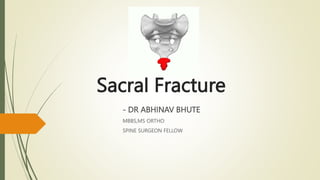
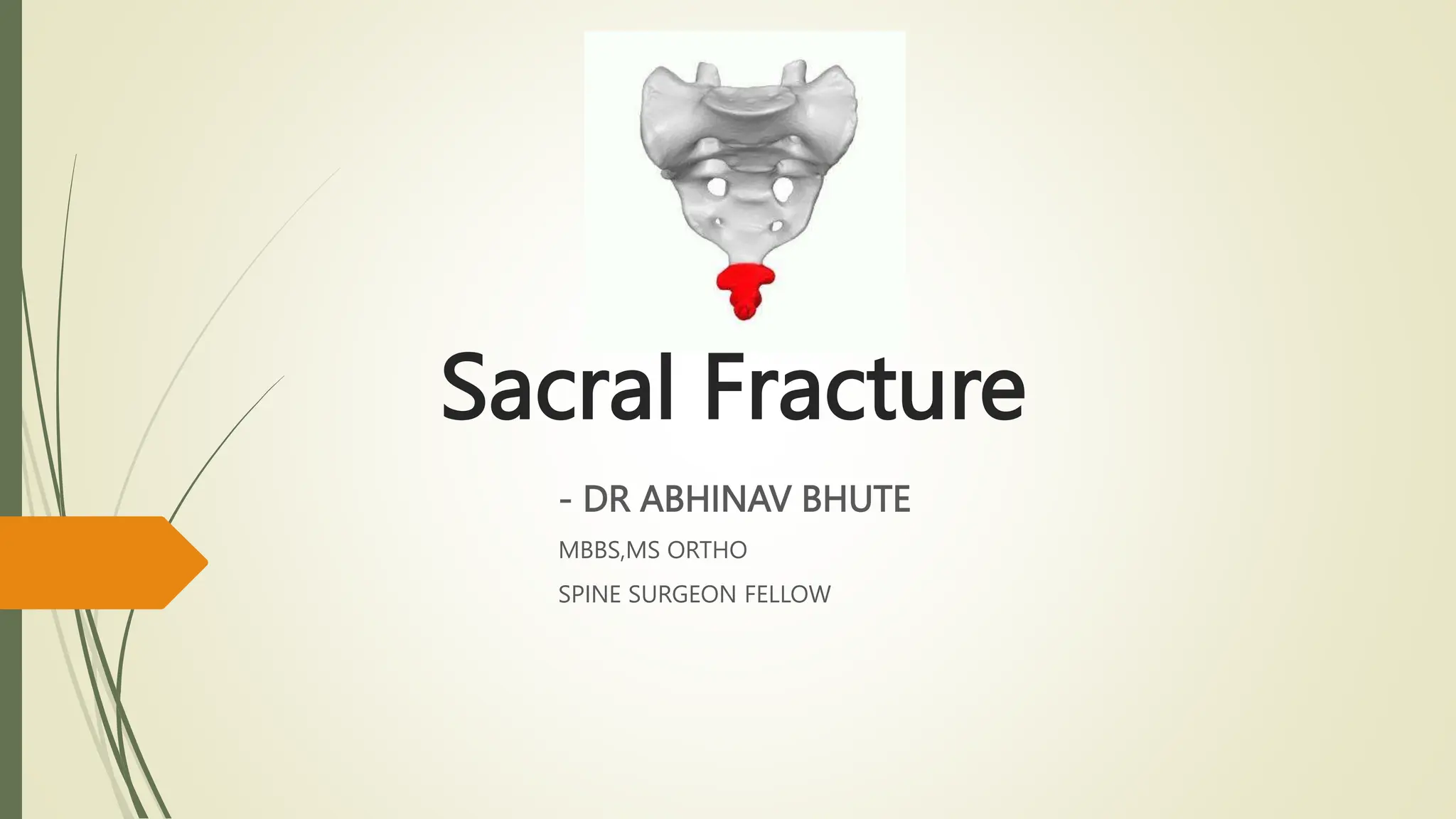
Sacral Fracture
- DR ABHINAV BHUTE
MBBS,MS ORTHO
SPINE SURGEON FELLOW
INTRODUCTION
๏‚ด Sacral fractures involve a break in one or more sacral bones (S1-S5)
๏‚ด Estimated incidence is about 1-3% of all spine fractures
EPIDEMIOLOGY
๏‚ท Incidence: common in pelvic ring injuries
(30-45%)
๏‚ท Bimodal distribution
๏‚ท Young adults: high energy trauma
๏‚ท Elderly: low energy falls
๏‚ท Associate injuries
๏‚ท 25% have neurologic injury
๏‚ท 75% in neurologically intact patients
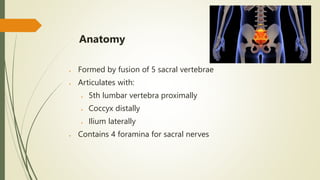
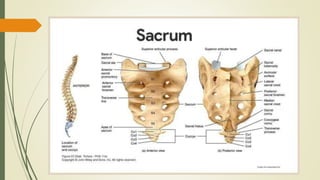
Anatomy
๏‚ท Formed by fusion of 5 sacral vertebrae
๏‚ท Articulates with:
๏‚ท 5th lumbar vertebra proximally
๏‚ท Coccyx distally
๏‚ท Ilium laterally
๏‚ท Contains 4 foramina for sacral nerves
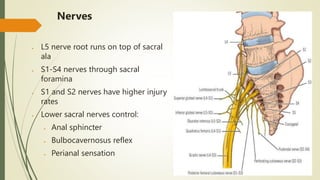
Nerves
๏‚ท L5 nerve root runs on top of sacral
ala
๏‚ท S1-S4 nerves through sacral
foramina
๏‚ท S1 and S2 nerves have higher injury
rates
๏‚ท Lower sacral nerves control:
๏‚ท Anal sphincter
๏‚ท Bulbocavernosus reflex
๏‚ท Perianal sensation
Presentation
๏‚ด - History: Trauma, falls in elderly
๏‚ท Symptoms: Peripelvic pain
๏‚ท Exam findings:
๏‚ท Palpate stability, swelling, open injuries
๏‚ท Neurological exam of lower extremities
๏‚ท Vascular exam of distal pulses
Classification Systems
๏‚ด Denis fracture
๏‚ด AO classification system
๏‚ด Isler classification
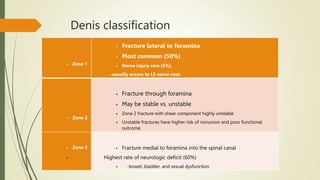
Denis classification
๏‚ง Zone 1
๏‚ง Fracture lateral to foramina
๏‚ง Most common (50%)
๏‚ง Nerve injury rare (5%).
-usually occurs to L5 nerve root
๏‚ง Zone 2
๏‚ง Fracture through foramina
๏‚ง May be stable vs. unstable
๏‚ง Zone 2 fracture with shear component highly unstable
๏‚ง Unstable fractures have higher risk of nonunion and poor functional
outcome
๏‚ง Zone 3
๏‚ง
๏‚ง Fracture medial to foramina into the spinal canal
Highest rate of neurologic deficit (60%)
๏‚ง -bowel, bladder, and sexual dysfunction
Denis classification
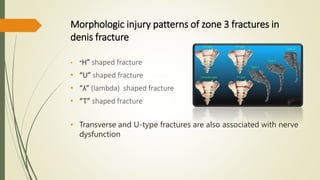
Morphologic injury patterns of zone 3 fractures in
denis fracture
โ€ข โ€œHโ€ shaped fracture
โ€ข โ€œUโ€ shaped fracture
โ€ข โ€œสŽโ€ (lambda) shaped fracture
โ€ข โ€œTโ€ shaped fracture
โ€ข Transverse and U-type fractures are also associated with nerve
dysfunction
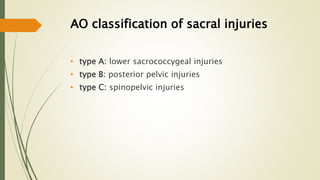
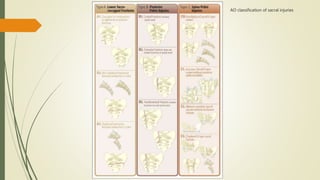
AO classification of sacral injuries
โ€ข type A: lower sacrococcygeal injuries
โ€ข type B: posterior pelvic injuries
โ€ข type C: spinopelvic injuries
AO classification of sacral injuries
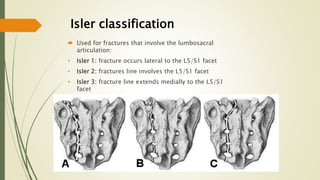
Isler classification
๏‚ด Used for fractures that involve the lumbosacral
articulation:
โ€ข Isler 1: fracture occurs lateral to the L5/S1 facet
โ€ข Isler 2: fractures line involves the L5/S1 facet
โ€ข Isler 3: fracture line extends medially to the L5/S1
facet
Imaging
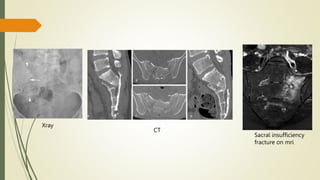
๏‚ท Radiographs show only 30% of fractures
๏‚ท CT is diagnostic study of choice
๏‚ท MRI for suspected neural compromise
Xray
CT
Sacral insufficiency
fracture on mri
Treatment
๏‚ท Nonoperative: <1 cm displacement, no deficit
๏‚ท Operative: Displaced >1 cm, soft tissue injury, persistent pain
Non-operative
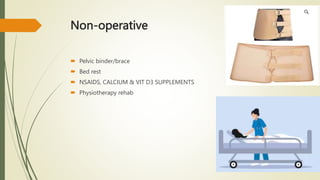
๏‚ด Pelvic binder/brace
๏‚ด Bed rest
๏‚ด NSAIDS, CALCIUM & VIT D3 SUPPLEMENTS
๏‚ด Physiotherapy rehab
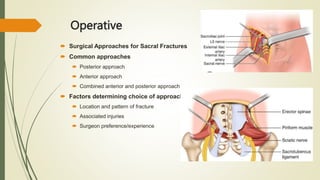
๏‚ด Surgical Approaches for Sacral Fractures
๏‚ด Common approaches
๏‚ด Posterior approach
๏‚ด Anterior approach
๏‚ด Combined anterior and posterior approach
๏‚ด Factors determining choice of approach
๏‚ด Location and pattern of fracture
๏‚ด Associated injuries
๏‚ด Surgeon preference/experience
Operative
๏‚ด Fixation Options
๏‚ด Posterior fixation
๏‚ด Percutaneous iliosacral screws
๏‚ด Spinopelvic fixation
๏‚ด Sacroiliac plating
๏‚ด Anterior fixation
๏‚ด Sacral plating
๏‚ด Iliosacral screws
๏‚ด Lumbopelvic fixation
๏‚ด Decompression for neurologic injury
Goal is to achieve stabilization and allow bone healing
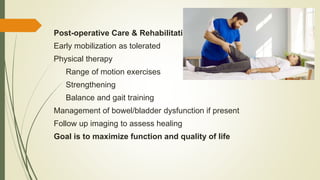
Post-operative Care & Rehabilitation
Early mobilization as tolerated
Physical therapy
Range of motion exercises
Strengthening
Balance and gait training
Management of bowel/bladder dysfunction if present
Follow up imaging to assess healing
Goal is to maximize function and quality of life
Complications
๏‚ท Venous thromboembolism
๏‚ท Nerve injury
๏‚ท Malreduction
Prognosis
๏‚ด Prognosis
๏‚ท Neurologic deficit predicts outcomes
๏‚ท Displacement increases risk
SUMMARY
o Sacral fractures are common pelvic ring injuries that are under-diagnosed and
often associated with neurologic compromise.
o Diagnosis can made with pelvis radiographs but frequently require pelvic CT
scan for full characterization.
o Treatment may be nonoperative or operative depending on fracture
displacement, associated pelvic ring instability and patient activity demands.

SACRAL FRACTURE or SACRAL TRAUMA POWERPOINT

  • 1.
    Sacral Fracture - DRABHINAV BHUTE MBBS,MS ORTHO SPINE SURGEON FELLOW
  • 2.
    INTRODUCTION ๏‚ด Sacral fracturesinvolve a break in one or more sacral bones (S1-S5) ๏‚ด Estimated incidence is about 1-3% of all spine fractures
  • 3.
    EPIDEMIOLOGY ๏‚ท Incidence: commonin pelvic ring injuries (30-45%) ๏‚ท Bimodal distribution ๏‚ท Young adults: high energy trauma ๏‚ท Elderly: low energy falls ๏‚ท Associate injuries ๏‚ท 25% have neurologic injury ๏‚ท 75% in neurologically intact patients
  • 4.
    Anatomy ๏‚ท Formed byfusion of 5 sacral vertebrae ๏‚ท Articulates with: ๏‚ท 5th lumbar vertebra proximally ๏‚ท Coccyx distally ๏‚ท Ilium laterally ๏‚ท Contains 4 foramina for sacral nerves
  • 6.
    Nerves ๏‚ท L5 nerveroot runs on top of sacral ala ๏‚ท S1-S4 nerves through sacral foramina ๏‚ท S1 and S2 nerves have higher injury rates ๏‚ท Lower sacral nerves control: ๏‚ท Anal sphincter ๏‚ท Bulbocavernosus reflex ๏‚ท Perianal sensation
  • 7.
    Presentation ๏‚ด - History:Trauma, falls in elderly ๏‚ท Symptoms: Peripelvic pain ๏‚ท Exam findings: ๏‚ท Palpate stability, swelling, open injuries ๏‚ท Neurological exam of lower extremities ๏‚ท Vascular exam of distal pulses
  • 8.
    Classification Systems ๏‚ด Denisfracture ๏‚ด AO classification system ๏‚ด Isler classification
  • 9.
    Denis classification ๏‚ง Zone1 ๏‚ง Fracture lateral to foramina ๏‚ง Most common (50%) ๏‚ง Nerve injury rare (5%). -usually occurs to L5 nerve root ๏‚ง Zone 2 ๏‚ง Fracture through foramina ๏‚ง May be stable vs. unstable ๏‚ง Zone 2 fracture with shear component highly unstable ๏‚ง Unstable fractures have higher risk of nonunion and poor functional outcome ๏‚ง Zone 3 ๏‚ง ๏‚ง Fracture medial to foramina into the spinal canal Highest rate of neurologic deficit (60%) ๏‚ง -bowel, bladder, and sexual dysfunction
  • 10.
  • 11.
    Morphologic injury patternsof zone 3 fractures in denis fracture โ€ข โ€œHโ€ shaped fracture โ€ข โ€œUโ€ shaped fracture โ€ข โ€œสŽโ€ (lambda) shaped fracture โ€ข โ€œTโ€ shaped fracture โ€ข Transverse and U-type fractures are also associated with nerve dysfunction
  • 12.
    AO classification ofsacral injuries โ€ข type A: lower sacrococcygeal injuries โ€ข type B: posterior pelvic injuries โ€ข type C: spinopelvic injuries
  • 13.
    AO classification ofsacral injuries
  • 14.
    Isler classification ๏‚ด Usedfor fractures that involve the lumbosacral articulation: โ€ข Isler 1: fracture occurs lateral to the L5/S1 facet โ€ข Isler 2: fractures line involves the L5/S1 facet โ€ข Isler 3: fracture line extends medially to the L5/S1 facet
  • 15.
    Imaging ๏‚ท Radiographs showonly 30% of fractures ๏‚ท CT is diagnostic study of choice ๏‚ท MRI for suspected neural compromise
  • 16.
  • 17.
    Treatment ๏‚ท Nonoperative: <1cm displacement, no deficit ๏‚ท Operative: Displaced >1 cm, soft tissue injury, persistent pain
  • 18.
    Non-operative ๏‚ด Pelvic binder/brace ๏‚ดBed rest ๏‚ด NSAIDS, CALCIUM & VIT D3 SUPPLEMENTS ๏‚ด Physiotherapy rehab
  • 19.
    ๏‚ด Surgical Approachesfor Sacral Fractures ๏‚ด Common approaches ๏‚ด Posterior approach ๏‚ด Anterior approach ๏‚ด Combined anterior and posterior approach ๏‚ด Factors determining choice of approach ๏‚ด Location and pattern of fracture ๏‚ด Associated injuries ๏‚ด Surgeon preference/experience Operative
  • 20.
    ๏‚ด Fixation Options ๏‚ดPosterior fixation ๏‚ด Percutaneous iliosacral screws ๏‚ด Spinopelvic fixation ๏‚ด Sacroiliac plating ๏‚ด Anterior fixation ๏‚ด Sacral plating ๏‚ด Iliosacral screws ๏‚ด Lumbopelvic fixation ๏‚ด Decompression for neurologic injury Goal is to achieve stabilization and allow bone healing
  • 21.
    Post-operative Care &Rehabilitation Early mobilization as tolerated Physical therapy Range of motion exercises Strengthening Balance and gait training Management of bowel/bladder dysfunction if present Follow up imaging to assess healing Goal is to maximize function and quality of life
  • 22.
  • 23.
    Prognosis ๏‚ด Prognosis ๏‚ท Neurologicdeficit predicts outcomes ๏‚ท Displacement increases risk
  • 24.
    SUMMARY o Sacral fracturesare common pelvic ring injuries that are under-diagnosed and often associated with neurologic compromise. o Diagnosis can made with pelvis radiographs but frequently require pelvic CT scan for full characterization. o Treatment may be nonoperative or operative depending on fracture displacement, associated pelvic ring instability and patient activity demands.