WHOLE NETWORK
DESCRIPTIVES
Molly Copeland
PhD Candidate
Duke Sociology
Social Networks & Health, 2018
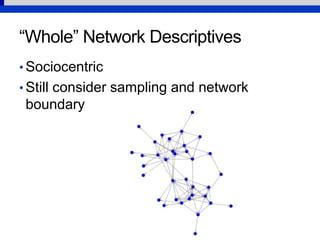
“Whole” Network Descriptives
• Sociocentric
• Still consider sampling and network
boundary
Overview
• Centrality
• Connectivity & Cohesion
• Roles
Overview
• Centrality
• Individual nodes
• Centralization: Whole Networks
• Structural Holes
• Connectivity & Cohesion
• Roles
Centrality: Individual Nodes
How can we distinguish “important” actors?
• Centrality:
• Who is at the ‘center’ of the network?
…but what is meant by ‘center’ gets complicated
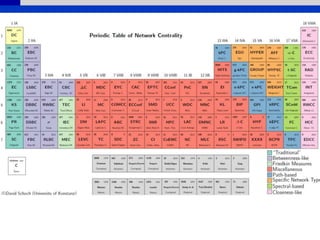
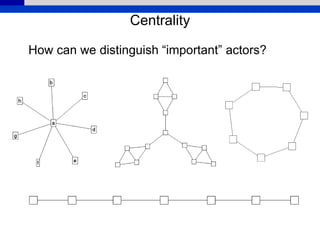
How can we distinguish “important” actors?
Centrality
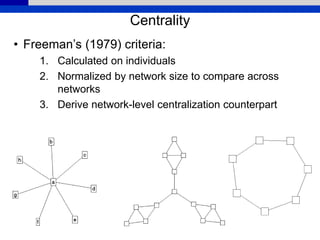
Centrality
• Freeman’s (1979) criteria:
1. Calculated on individuals
2. Normalized by network size to compare across
networks
3. Derive network-level centralization counterpart
Centrality
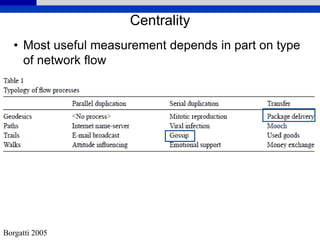
• Most useful measurement depends in part on type
of network flow
Borgatti 2005
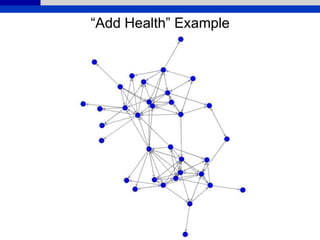
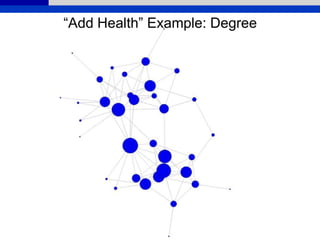
“Add Health” Example
Centrality
How can we distinguish “important” actors?
• Centrality measurement approaches:
• Degrees
• Closeness
• Betweenness
• Information & Power
Centrality
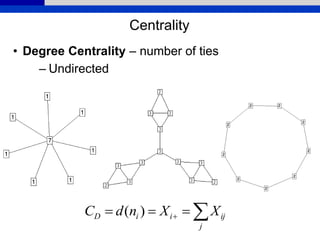
• Degree Centrality – number of ties
– Undirected
 
j
ijiiD XXndC )(
“Add Health” Example: Degree
Centrality
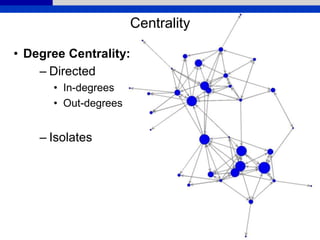
• Degree Centrality:
– Directed
• In-degrees
• Out-degrees
– Isolates
Centrality
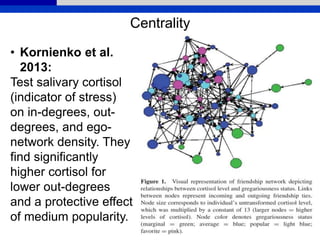
• Kornienko et al.
2013:
Test salivary cortisol
(indicator of stress)
on in-degrees, out-
degrees, and ego-
network density. They
find significantly
higher cortisol for
lower out-degrees
and a protective effect
of medium popularity.
Centrality
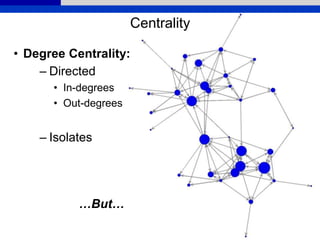
• Degree Centrality:
– Directed
• In-degrees
• Out-degrees
– Isolates
…But…
Centrality
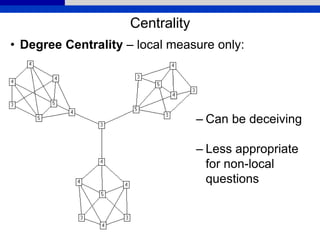
• Degree Centrality – local measure only:
– Can be deceiving
– Less appropriate
for non-local
questions
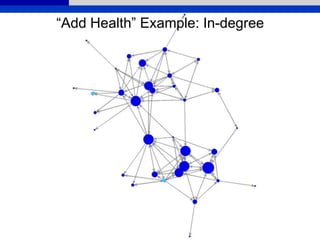
“Add Health” Example: In-degree
Centrality
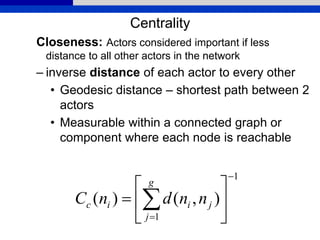
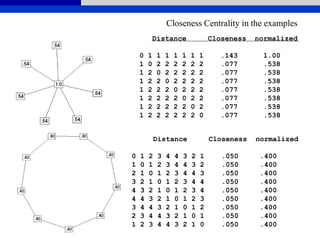
Closeness: Actors considered important if less
distance to all other actors in the network
– inverse distance of each actor to every other
• Geodesic distance – shortest path between 2
actors
• Measurable within a connected graph or
component where each node is reachable
1
1
),()(








 
g
j
jiic nndnC
Centrality
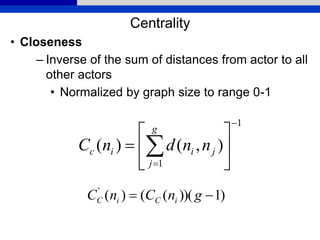
• Closeness
– Inverse of the sum of distances from actor to all
other actors
• Normalized by graph size to range 0-1
1
1
),()(








 
g
j
jiic nndnC
)1))((()('
 gnCnC iCiC
Distance Closeness normalized
0 1 1 1 1 1 1 1 .143 1.00
1 0 2 2 2 2 2 2 .077 .538
1 2 0 2 2 2 2 2 .077 .538
1 2 2 0 2 2 2 2 .077 .538
1 2 2 2 0 2 2 2 .077 .538
1 2 2 2 2 0 2 2 .077 .538
1 2 2 2 2 2 0 2 .077 .538
1 2 2 2 2 2 2 0 .077 .538
Closeness Centrality in the examples
Distance Closeness normalized
0 1 2 3 4 4 3 2 1 .050 .400
1 0 1 2 3 4 4 3 2 .050 .400
2 1 0 1 2 3 4 4 3 .050 .400
3 2 1 0 1 2 3 4 4 .050 .400
4 3 2 1 0 1 2 3 4 .050 .400
4 4 3 2 1 0 1 2 3 .050 .400
3 4 4 3 2 1 0 1 2 .050 .400
2 3 4 4 3 2 1 0 1 .050 .400
1 2 3 4 4 3 2 1 0 .050 .400
Centrality
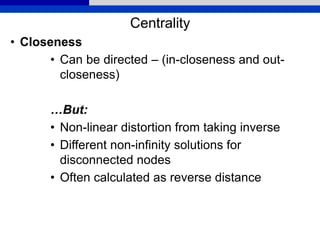
• Closeness
• Can be directed – (in-closeness and out-
closeness)
…But:
• Non-linear distortion from taking inverse
• Different non-infinity solutions for
disconnected nodes
• Often calculated as reverse distance
Centrality
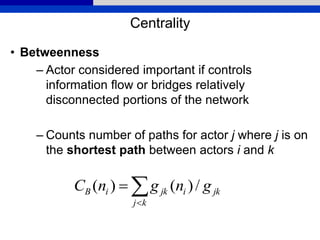
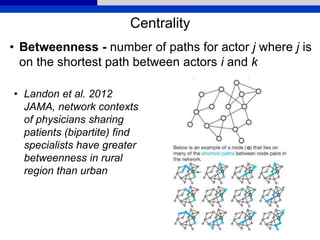
• Betweenness
– Actor considered important if controls
information flow or bridges relatively
disconnected portions of the network
– Counts number of paths for actor j where j is on
the shortest path between actors i and k


kj
jkijkiB gngnC /)()(
Centrality
• Betweenness - number of paths for actor j where j is
on the shortest path between actors i and k
• Landon et al. 2012
JAMA, network contexts
of physicians sharing
patients (bipartite) find
specialists have greater
betweenness in rural
region than urban
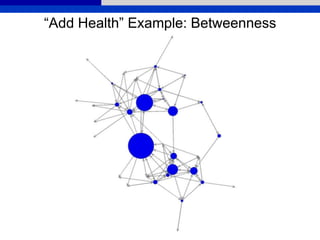
“Add Health” Example: Betweenness
Centrality
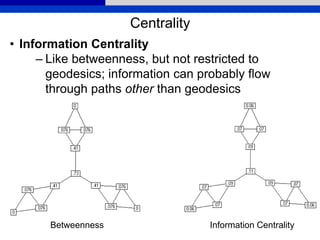
• Information Centrality
– Like betweenness, but not restricted to
geodesics; information can probably flow
through paths other than geodesics
Betweenness Information Centrality
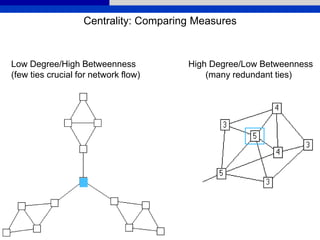
Low Degree/High Betweenness High Degree/Low Betweenness
(few ties crucial for network flow) (many redundant ties)
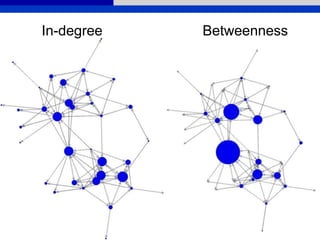
Centrality: Comparing Measures
In-degree Betweenness
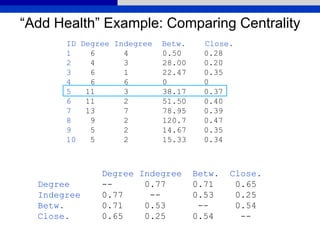
“Add Health” Example: Comparing Centrality
ID Degree Indegree Betw. Close.
1 6 4 0.50 0.28
2 4 3 28.00 0.20
3 6 1 22.47 0.35
4 6 6 0 0
5 11 3 38.17 0.37
6 11 2 51.50 0.40
7 13 7 78.95 0.39
8 9 2 120.7 0.47
9 5 2 14.67 0.35
10 5 2 15.33 0.34
Degree Indegree Betw. Close.
Degree -- 0.77 0.71 0.65
Indegree 0.77 -- 0.53 0.25
Betw. 0.71 0.53 -- 0.54
Close. 0.65 0.25 0.54 --
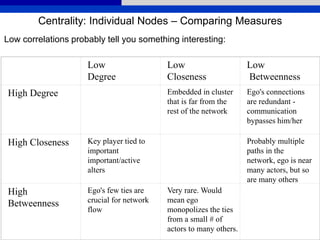
Low correlations probably tell you something interesting:
Low
Degree
Low
Closeness
Low
Betweenness
High Degree Embedded in cluster
that is far from the
rest of the network
Ego's connections
are redundant -
communication
bypasses him/her
High Closeness Key player tied to
important
important/active
alters
Probably multiple
paths in the
network, ego is near
many actors, but so
are many others
High
Betweenness
Ego's few ties are
crucial for network
flow
Very rare. Would
mean ego
monopolizes the ties
from a small # of
actors to many others.
Centrality: Individual Nodes – Comparing Measures
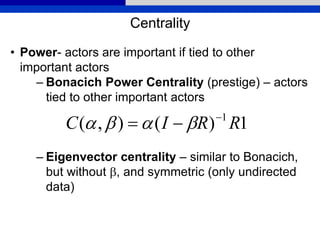
Centrality
• Power- actors are important if tied to other
important actors
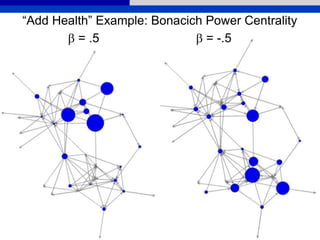
– Bonacich Power Centrality (prestige) – actors
tied to other important actors
– Eigenvector centrality – similar to Bonacich,
but without b, and symmetric (only undirected
data)
1)(),( 1
RRIC 
 bb
“Add Health” Example: Bonacich Power Centrality
b = .5 b = -.5
Many More Measures
• Peer Influence based measures (Friedkin and others). Based
on the assumed network autocorrelation model of peer
influence; variant of the eigenvector centrality measures
• Fragmentation centrality – Borgatti’s Key Player - nodes are
central if they can easily break up a network
• Removal Centrality – effect on the rest of the (graph for any
given statistic) with the removal of a given node; system-
contribution of a particular actor
Many More Measures
• Peer Influence based measures
• Fragmentation centrality
• Removal Centrality
• Multiple measures in analysis
• Ennett et al. 2006: higher betweenness, indegree, reach, Bonacich
Power significantly associated with higher alcohol use for 15 year olds
But…Multicollinearity (don’t forget theory!)
• Rather than considering important individual actors,
describing characteristics of the overall network
– To what extent are the links or is the ‘power’ of a
network concentrated in a few nodes, versus spread
throughout the network?
– Degree Distributions
– Centralization
– Density
Centrality in the Network
Whole Network Centrality
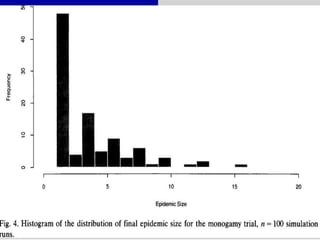
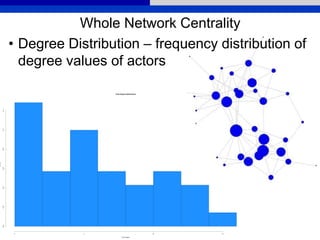
• Degree Distribution – frequency distribution of
degree values of actors
– A simple random graph will have a Poisson
degree distribution, so variation from that
suggest non-random processes
• Degree Distribution – frequency distribution of
degree values of actors
Whole Network Centrality
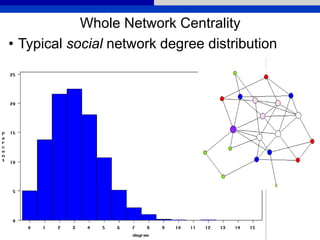
• Typical social network degree distribution
Whole Network Centrality
• Centralization – extent to which centrality is
concentrated in one/few actors; dispersion of
centrality in graph as a whole (Freeman
centralization)
 
)]2)(1[(
)()(1
*




gg
nCnC
C
g
i iDD
D
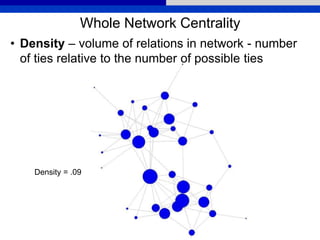
• Density – volume of relations in network - number
of ties relative to the number of possible ties
Whole Network Centrality
Density = .09
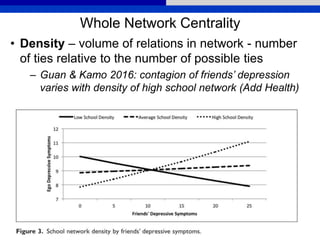
• Density – volume of relations in network - number
of ties relative to the number of possible ties
– Guan & Kamo 2016: contagion of friends’ depression
varies with density of high school network (Add Health)
Whole Network Centrality
Describing Networks
• Beyond centrality, consider structural arrangements
in combination with attributes:
• Similarity of attributes: typically Homophily –
tendency for actors with similar attributes to be more
likely to be connected
– Assortativity - assortative/disassortative
mixing
• Individual attributes: gender, same firm
• Structural attributes: same degree
– Descriptive, not distinguishing
selection/influence
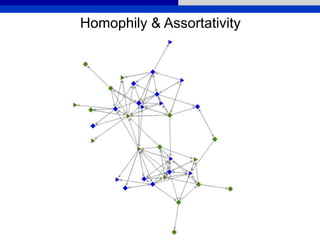
Homophily & Assortativity
Connecting Measures to Mechanisms: Structural Holes
• Structural holes: absence of ties between alters
• Bridging structural holes: connecting people who
otherwise would not be connected; social capital,
access to resources
• Redundancy (ties that connect ego to alters already
connected to) introduces constraint
• Power, brokerage by controlling info or resource by bridging
structural holes (Simmel’s tertius gaudens)
(Burt 1992)
Connecting Measures to Mechanisms: Structural Holes
• Bridging structural holes
• Redundancy & constraint
• Power & brokerage
• Cornwell 2009: Spanning structural holes significantly
positive associated with physical and mental health for
older adults (ego-network data, NSHAP)
Connecting Measures to Mechanisms: Structural Holes
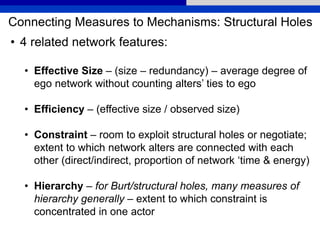
• 4 related network features:
• Effective Size – (size – redundancy) – average degree of
ego network without counting alters’ ties to ego
• Efficiency – (effective size / observed size)
• Constraint – room to exploit structural holes or negotiate;
extent to which network alters are connected with each
other (direct/indirect, proportion of network ‘time & energy)
• Hierarchy – for Burt/structural holes, many measures of
hierarchy generally – extent to which constraint is
concentrated in one actor
Describing Networks
What are the structural arrangements or
characteristics of networks underlying actors’ power,
influence, or centrality?
Overview
• Centrality
• Connectivity & Cohesion
• Triads & Transitivity
• Clustering
• Structural Cohesion
• Roles
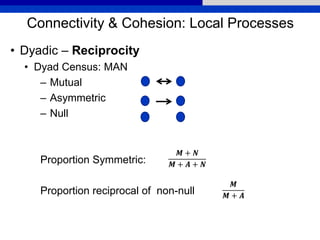
Connectivity & Cohesion: Local Processes
• Dyadic – Reciprocity
• Dyad Census: MAN
– Mutual
– Asymmetric
– Null
Proportion Symmetric:
Proportion reciprocal of non-null
𝑴 + 𝑵
𝑴 + 𝑨 + 𝑵
𝑴
𝑴 + 𝑨
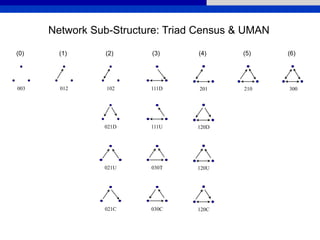
Network Sub-Structure: Triad Census & UMAN
003
(0)
012
(1)
102
021D
021U
021C
(2)
111D
111U
030T
030C
(3)
201
120D
120U
120C
(4)
210
(5)
300
(6)
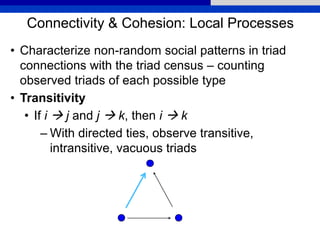
Connectivity & Cohesion: Local Processes
• Characterize non-random social patterns in triad
connections with the triad census – counting
observed triads of each possible type
• Transitivity
• If i  j and j  k, then i  k
– With directed ties, observe transitive,
intransitive, vacuous triads
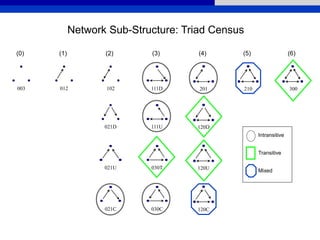
Network Sub-Structure: Triad Census
003
(0)
012
(1)
102
021D
021U
021C
(2)
111D
111U
030T
030C
(3)
201
120D
120U
120C
(4)
210
(5)
300
(6)
Intransitive
Transitive
Mixed
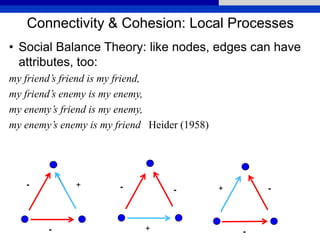
Connectivity & Cohesion: Local Processes
• Social Balance Theory: like nodes, edges can have
attributes, too:
my friend’s friend is my friend,
my friend’s enemy is my enemy,
my enemy’s friend is my enemy,
my enemy’s enemy is my friend Heider (1958)
+
+
+ - -
-
- -
-
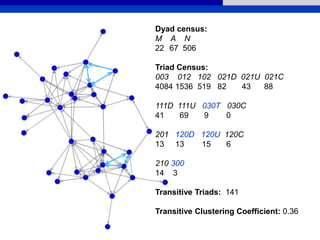
Dyad census:
M A N
22 67 506
Triad Census:
003 012 102 021D 021U 021C
4084 1536 519 82 43 88
111D 111U 030T 030C
41 69 9 0
201 120D 120U 120C
13 13 15 6
210 300
14 3
Transitive Triads: 141
Transitive Clustering Coefficient: 0.36
Connectivity & Cohesion: Clustering
Getting less local:
How can we describe the connective or cohesive
nature of a network overall?
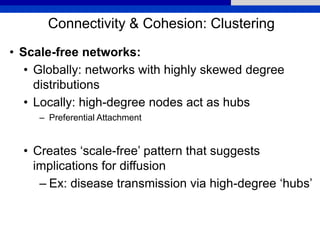
Connectivity & Cohesion: Clustering
• Scale-free networks:
• Globally: networks with highly skewed degree
distributions
• Locally: high-degree nodes act as hubs
– Preferential Attachment
• Creates ‘scale-free’ pattern that suggests
implications for diffusion
– Ex: disease transmission via high-degree ‘hubs’
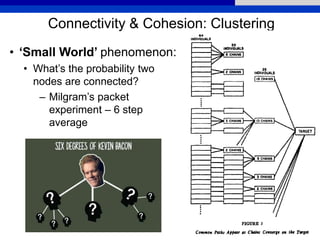
Connectivity & Cohesion: Clustering
• ‘Small World’ phenomenon:
• What’s the probability two
nodes are connected?
– Milgram’s packet
experiment – 6 step
average
Connectivity & Cohesion: Clustering
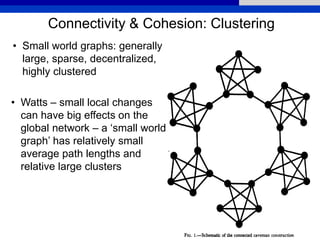
• Small world graphs: generally
large, sparse, decentralized,
highly clustered
• Watts – small local changes
can have big effects on the
global network – a ‘small world
graph’ has relatively small
average path lengths and
relative large clusters
Connectivity & Cohesion: Clustering
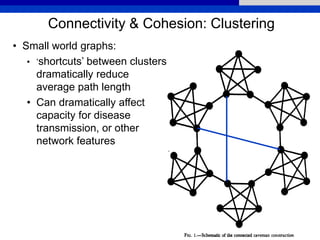
• Small world graphs:
• ‘shortcuts’ between clusters
dramatically reduce
average path length
• Can dramatically affect
capacity for disease
transmission, or other
network features
Connectivity & Cohesion: Clustering
• How else can we measure the ‘small wordliness’ or
other cohesive characteristics of a network?
• Clustering coefficient:
• Average local density (ego-network density/n)
• Transitivity ratio - # closed triads/total # triads
– Verdery et al. 2017 – comparing two RDS networks of persons
who inject drugs in Philippines, see higher clustering associated
with higher and faster spread of HIV/AIDS
Connectivity & Cohesion: Structural Cohesion
• Structural Cohesion – extent to which networks or
sub-groups within networks are ‘sticky’,
interconnected, or resistant to disruption
• Challenging to measure
• Connectedness maintained through one or a few
actors
– More paths linking network that don’t rely on
one actor = more cohesive
Connectivity & Cohesion: Structural Cohesion
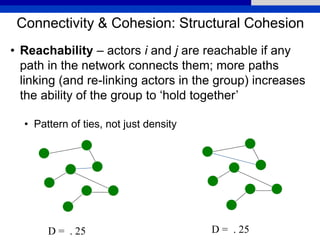
• Reachability – actors i and j are reachable if any
path in the network connects them; more paths
linking (and re-linking actors in the group) increases
the ability of the group to ‘hold together’
• Pattern of ties, not just density
D = . 25 D = . 25
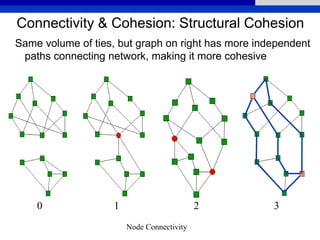
Node Connectivity
0 1 2 3
Same volume of ties, but graph on right has more independent
paths connecting network, making it more cohesive
Connectivity & Cohesion: Structural Cohesion
Connectivity & Cohesion: Components
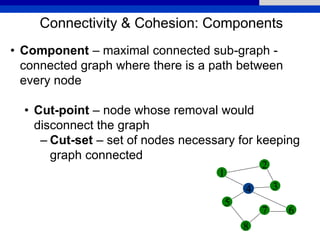
• Component – maximal connected sub-graph -
connected graph where there is a path between
every node
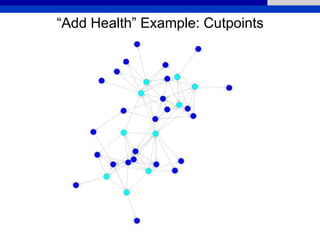
• Cut-point – node whose removal would
disconnect the graph
– Cut-set – set of nodes necessary for keeping
graph connected
1
2
5
4 3
6
8
7
Connectivity & Cohesion: Components
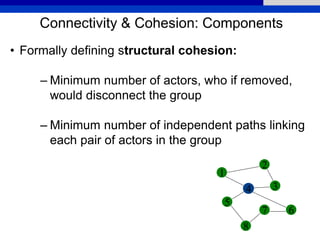
• Formally defining structural cohesion:
– Minimum number of actors, who if removed,
would disconnect the group
– Minimum number of independent paths linking
each pair of actors in the group
1
2
5
4 3
6
8
7
“Add Health” Example: Cutpoints
Connectivity & Cohesion: Components
• Features of components:
• k-components – maximal subset of actors linked
by at least k node-independent paths
– Every member must have at least k ties (but having k
ties doesn’t necessarily make a component)
– 2 k-components can only overlap by k-1 members (or
would be same component)
– Can be nested
• Can also consider components for ego-networks
Connectivity & Cohesion: Components
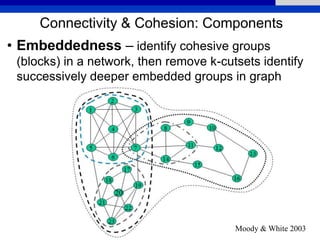
• Embeddedness – identify cohesive groups
(blocks) in a network, then remove k-cutsets identify
successively deeper embedded groups in graph
Moody & White 2003
Connectivity & Cohesion: Groups
• Different types of sub-structures in networks:
• Cliques – all members connected to all other
members
– n-clique – where n is number of steps greater than
direct tie, so can consider 2-clique, defined by 2-step
(friend of a friend) ties
– k-plex – every member to connected to at least n-k
others in the graph (relaxed from connected to all but
self, n-1, of the clique)
– Mostly intractable in large networks
Connectivity & Cohesion: Groups
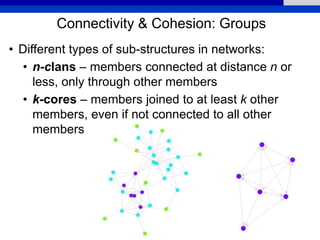
• Different types of sub-structures in networks:
• n-clans – members connected at distance n or
less, only through other members
• k-cores – members joined to at least k other
members, even if not connected to all other
members
Overview
• Centrality
• Connectivity & Cohesion
• Roles
• Structural Equivalence
• Regular Equivalence
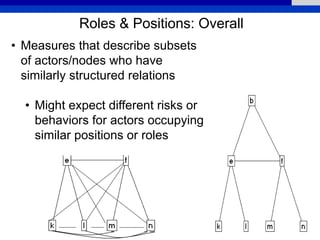
Roles & Positions: Overall
• Measures that describe subsets
of actors/nodes who have
similarly structured relations
• Might expect different risks or
behaviors for actors occupying
similar positions or roles
Roles & Positions: Structural Equivalence
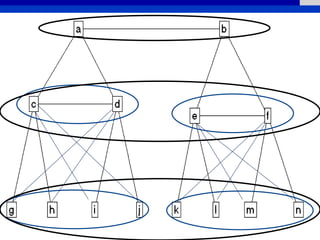
• Structural Equivalence:
• Actors are equivalent if they have the same ties to
the exact same people in the network
– Rare, maybe more restrictive than you want for
thinking about roles and positions in a network,
so can relax to:
• Regular Equivalence:
• Actors are equivalent if have ties to same types
(but not necessarily the exact same) of alters
Roles & Positions: Structural Equivalence & Blockmodeling
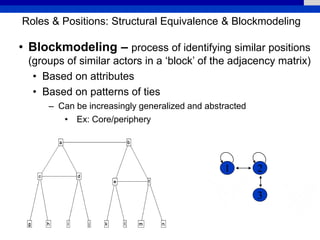
• Blockmodeling – process of identifying similar positions
(groups of similar actors in a ‘block’ of the adjacency matrix)
• Based on attributes
• Based on patterns of ties
– Can be increasingly generalized and abstracted
• Ex: Core/periphery
1 2
3
Roles & Positions: Structural Equivalence
• Structural (Regular) Equivalence: Actors are
equivalent if have ties to same types (but not
necessarily the exact same) of alters
– Fujimoto & Valente 2012: Exposure to substance use
through structural equivalence is a better predictor of
drinking and smoking, (being connected to the same
types of peers with the same types of behaviors matters
more than traditional measures of cohesion)
Describing Networks: Summary
• Many ways of describing networks or characterizing
nodes of interest within them
• Here: individual node properties, entire network
counterparts, then structures and sub-groups:
• Centrality
• Connectivity & Cohesion
• Roles
• Frame as micro/meso/macro
• Micro: individual nodes
• Meso: sub-groups, sub-graph structures, roles
• Macro: features of entire networks
Describing Networks: Summary
• Not considered here:
• Dynamics – churn or stability over time, effects of
changes, etc.
• 2-mode networks
• Many more challenging concepts and additions in
describing networks:
• Centrality or structural measures specific to
certain topics or processes
• Groups & Community Detection
Thank you!
Questions?
molly.copeland@duke.edu
Resources
Cornwell, B. (2009). Good health and the bridging of structural holes. Social Networks, 31(1): 92-103.
Ennett, S. T., Bauman, K. E., Hussong, A., Faris, R., Foshee, V. A., Cai, L., & DuRant, R. (2006). The Peer Context of Adolescent Substance
Use: Findings from Social Network Analysis. Journal of Research on Adolescence, 16(2), 159–186.
Fujimoto, K., & Valente, T. W. (2012). Social network influences on adolescent substance use: Disentangling structural equivalence from
cohesion. Social Science and Medicine, 74(12), 1952–1960.
Guan, W., & Kamo, Y. (2016). Contextualizing Depressive Contagion: A Multilevel Network Approach. Society and Mental Health, 6(2), 129–
145. http://doi.org/10.1177/2156869315619657
Hawe P, Webster C, Shiell A. A glossary of terms for navigating the field of social network analysis. Journal of Epidemiology & Community
Health 2004;58:971-975.
Kornienko, O., Clemans, K. H., Out, D., & Granger, D. A. (2013). Friendship network position and salivary cortisol levels. Social Neuroscience,
8(4), 385–96.
Jasny, L. Descriptive Measures for Social Network Analysis, Advanced Networks II seminar slides, ICPSR 2016.
Landon, B. E., Keating, N. L., Barnett, M. L., Onnela, J.-P., Paul, S., O’Malley, A. J., … Christakis, N. A. (2012). Variation in Patient-Sharing
Networks of Physicians Across the United States. JAMA: The Journal of the American Medical Association, 308(3), 265.
Luke, D. A. & J. K. Harris. Network Analysis in Public Health: History, Methods, and Applications. 2007. Annual Review of Public Health. 28:69-
93.
Moody, J. Slides from Social Networks Seminar, Duke, Spring 2015.
Moody, J., & White, D., (2003). Structural Cohesion and Embeddedness: A Hierarchical Concept of Social Groups. American Sociological
Review, 68: 103-127.
Morris, M., & Kretzschmar, M. (1995). Concurrent partnerships and transmission dynamics in networks. Social Networks, 17(3–4), 299–318
O’Malley, A. J. & P. V. Marsden Health Serv Outcomes Res Methodol. 2008 Dec 1; 8(4): 222–269.
Scott, J. Social Network Analysis. 2012. SAGE.
Scott, J. & P. J. Carrington. The SAGE Handbook of Social Network Analysis. 2011.
Valente, T. Social Networks and Health. 2010. Oxford University Press
Verdery, A. M., Siripong, N., & Pence, B. W. (2017). Social network clustering and the spread of hiv/aids among persons who inject drugs in 2
cities in the philippines. JAIDS Journal of Acquired Immune Deficiency Syndromes, 76(1), 26-32.
Wasserman, S. & K. Faust. Social Network Analysis: Methods and Applications,. 1994 Cambridge.

05 Whole Network Descriptive Stats

  • 1.
    WHOLE NETWORK DESCRIPTIVES Molly Copeland PhDCandidate Duke Sociology Social Networks & Health, 2018
  • 2.
    “Whole” Network Descriptives •Sociocentric • Still consider sampling and network boundary
  • 3.
  • 4.
    Overview • Centrality • Individualnodes • Centralization: Whole Networks • Structural Holes • Connectivity & Cohesion • Roles
  • 5.
    Centrality: Individual Nodes Howcan we distinguish “important” actors? • Centrality: • Who is at the ‘center’ of the network? …but what is meant by ‘center’ gets complicated
  • 7.
    How can wedistinguish “important” actors? Centrality
  • 8.
    Centrality • Freeman’s (1979)criteria: 1. Calculated on individuals 2. Normalized by network size to compare across networks 3. Derive network-level centralization counterpart
  • 9.
    Centrality • Most usefulmeasurement depends in part on type of network flow Borgatti 2005
  • 10.
  • 11.
    Centrality How can wedistinguish “important” actors? • Centrality measurement approaches: • Degrees • Closeness • Betweenness • Information & Power
  • 12.
    Centrality • Degree Centrality– number of ties – Undirected   j ijiiD XXndC )(
  • 13.
  • 14.
    Centrality • Degree Centrality: –Directed • In-degrees • Out-degrees – Isolates
  • 15.
    Centrality • Kornienko etal. 2013: Test salivary cortisol (indicator of stress) on in-degrees, out- degrees, and ego- network density. They find significantly higher cortisol for lower out-degrees and a protective effect of medium popularity.
  • 16.
    Centrality • Degree Centrality: –Directed • In-degrees • Out-degrees – Isolates …But…
  • 17.
    Centrality • Degree Centrality– local measure only: – Can be deceiving – Less appropriate for non-local questions
  • 18.
  • 19.
    Centrality Closeness: Actors consideredimportant if less distance to all other actors in the network – inverse distance of each actor to every other • Geodesic distance – shortest path between 2 actors • Measurable within a connected graph or component where each node is reachable 1 1 ),()(           g j jiic nndnC
  • 20.
    Centrality • Closeness – Inverseof the sum of distances from actor to all other actors • Normalized by graph size to range 0-1 1 1 ),()(           g j jiic nndnC )1))((()('  gnCnC iCiC
  • 21.
    Distance Closeness normalized 01 1 1 1 1 1 1 .143 1.00 1 0 2 2 2 2 2 2 .077 .538 1 2 0 2 2 2 2 2 .077 .538 1 2 2 0 2 2 2 2 .077 .538 1 2 2 2 0 2 2 2 .077 .538 1 2 2 2 2 0 2 2 .077 .538 1 2 2 2 2 2 0 2 .077 .538 1 2 2 2 2 2 2 0 .077 .538 Closeness Centrality in the examples Distance Closeness normalized 0 1 2 3 4 4 3 2 1 .050 .400 1 0 1 2 3 4 4 3 2 .050 .400 2 1 0 1 2 3 4 4 3 .050 .400 3 2 1 0 1 2 3 4 4 .050 .400 4 3 2 1 0 1 2 3 4 .050 .400 4 4 3 2 1 0 1 2 3 .050 .400 3 4 4 3 2 1 0 1 2 .050 .400 2 3 4 4 3 2 1 0 1 .050 .400 1 2 3 4 4 3 2 1 0 .050 .400
  • 23.
    Centrality • Closeness • Canbe directed – (in-closeness and out- closeness) …But: • Non-linear distortion from taking inverse • Different non-infinity solutions for disconnected nodes • Often calculated as reverse distance
  • 24.
    Centrality • Betweenness – Actorconsidered important if controls information flow or bridges relatively disconnected portions of the network – Counts number of paths for actor j where j is on the shortest path between actors i and k   kj jkijkiB gngnC /)()(
  • 25.
    Centrality • Betweenness -number of paths for actor j where j is on the shortest path between actors i and k • Landon et al. 2012 JAMA, network contexts of physicians sharing patients (bipartite) find specialists have greater betweenness in rural region than urban
  • 26.
  • 27.
    Centrality • Information Centrality –Like betweenness, but not restricted to geodesics; information can probably flow through paths other than geodesics Betweenness Information Centrality
  • 28.
    Low Degree/High BetweennessHigh Degree/Low Betweenness (few ties crucial for network flow) (many redundant ties) Centrality: Comparing Measures
  • 29.
  • 30.
    “Add Health” Example:Comparing Centrality ID Degree Indegree Betw. Close. 1 6 4 0.50 0.28 2 4 3 28.00 0.20 3 6 1 22.47 0.35 4 6 6 0 0 5 11 3 38.17 0.37 6 11 2 51.50 0.40 7 13 7 78.95 0.39 8 9 2 120.7 0.47 9 5 2 14.67 0.35 10 5 2 15.33 0.34 Degree Indegree Betw. Close. Degree -- 0.77 0.71 0.65 Indegree 0.77 -- 0.53 0.25 Betw. 0.71 0.53 -- 0.54 Close. 0.65 0.25 0.54 --
  • 31.
    Low correlations probablytell you something interesting: Low Degree Low Closeness Low Betweenness High Degree Embedded in cluster that is far from the rest of the network Ego's connections are redundant - communication bypasses him/her High Closeness Key player tied to important important/active alters Probably multiple paths in the network, ego is near many actors, but so are many others High Betweenness Ego's few ties are crucial for network flow Very rare. Would mean ego monopolizes the ties from a small # of actors to many others. Centrality: Individual Nodes – Comparing Measures
  • 32.
    Centrality • Power- actorsare important if tied to other important actors – Bonacich Power Centrality (prestige) – actors tied to other important actors – Eigenvector centrality – similar to Bonacich, but without b, and symmetric (only undirected data) 1)(),( 1 RRIC   bb
  • 33.
    “Add Health” Example:Bonacich Power Centrality b = .5 b = -.5
  • 34.
    Many More Measures •Peer Influence based measures (Friedkin and others). Based on the assumed network autocorrelation model of peer influence; variant of the eigenvector centrality measures • Fragmentation centrality – Borgatti’s Key Player - nodes are central if they can easily break up a network • Removal Centrality – effect on the rest of the (graph for any given statistic) with the removal of a given node; system- contribution of a particular actor
  • 35.
    Many More Measures •Peer Influence based measures • Fragmentation centrality • Removal Centrality • Multiple measures in analysis • Ennett et al. 2006: higher betweenness, indegree, reach, Bonacich Power significantly associated with higher alcohol use for 15 year olds But…Multicollinearity (don’t forget theory!)
  • 36.
    • Rather thanconsidering important individual actors, describing characteristics of the overall network – To what extent are the links or is the ‘power’ of a network concentrated in a few nodes, versus spread throughout the network? – Degree Distributions – Centralization – Density Centrality in the Network
  • 37.
    Whole Network Centrality •Degree Distribution – frequency distribution of degree values of actors – A simple random graph will have a Poisson degree distribution, so variation from that suggest non-random processes
  • 38.
    • Degree Distribution– frequency distribution of degree values of actors Whole Network Centrality
  • 39.
    Whole Network Centrality •Typical social network degree distribution
  • 41.
    Whole Network Centrality •Centralization – extent to which centrality is concentrated in one/few actors; dispersion of centrality in graph as a whole (Freeman centralization)   )]2)(1[( )()(1 *     gg nCnC C g i iDD D
  • 42.
    • Density –volume of relations in network - number of ties relative to the number of possible ties Whole Network Centrality Density = .09
  • 43.
    • Density –volume of relations in network - number of ties relative to the number of possible ties – Guan & Kamo 2016: contagion of friends’ depression varies with density of high school network (Add Health) Whole Network Centrality
  • 44.
    Describing Networks • Beyondcentrality, consider structural arrangements in combination with attributes: • Similarity of attributes: typically Homophily – tendency for actors with similar attributes to be more likely to be connected – Assortativity - assortative/disassortative mixing • Individual attributes: gender, same firm • Structural attributes: same degree – Descriptive, not distinguishing selection/influence
  • 45.
  • 46.
    Connecting Measures toMechanisms: Structural Holes • Structural holes: absence of ties between alters • Bridging structural holes: connecting people who otherwise would not be connected; social capital, access to resources • Redundancy (ties that connect ego to alters already connected to) introduces constraint • Power, brokerage by controlling info or resource by bridging structural holes (Simmel’s tertius gaudens) (Burt 1992)
  • 47.
    Connecting Measures toMechanisms: Structural Holes • Bridging structural holes • Redundancy & constraint • Power & brokerage • Cornwell 2009: Spanning structural holes significantly positive associated with physical and mental health for older adults (ego-network data, NSHAP)
  • 48.
    Connecting Measures toMechanisms: Structural Holes • 4 related network features: • Effective Size – (size – redundancy) – average degree of ego network without counting alters’ ties to ego • Efficiency – (effective size / observed size) • Constraint – room to exploit structural holes or negotiate; extent to which network alters are connected with each other (direct/indirect, proportion of network ‘time & energy) • Hierarchy – for Burt/structural holes, many measures of hierarchy generally – extent to which constraint is concentrated in one actor
  • 49.
    Describing Networks What arethe structural arrangements or characteristics of networks underlying actors’ power, influence, or centrality?
  • 50.
    Overview • Centrality • Connectivity& Cohesion • Triads & Transitivity • Clustering • Structural Cohesion • Roles
  • 51.
    Connectivity & Cohesion:Local Processes • Dyadic – Reciprocity • Dyad Census: MAN – Mutual – Asymmetric – Null Proportion Symmetric: Proportion reciprocal of non-null 𝑴 + 𝑵 𝑴 + 𝑨 + 𝑵 𝑴 𝑴 + 𝑨
  • 52.
    Network Sub-Structure: TriadCensus & UMAN 003 (0) 012 (1) 102 021D 021U 021C (2) 111D 111U 030T 030C (3) 201 120D 120U 120C (4) 210 (5) 300 (6)
  • 53.
    Connectivity & Cohesion:Local Processes • Characterize non-random social patterns in triad connections with the triad census – counting observed triads of each possible type • Transitivity • If i  j and j  k, then i  k – With directed ties, observe transitive, intransitive, vacuous triads
  • 54.
    Network Sub-Structure: TriadCensus 003 (0) 012 (1) 102 021D 021U 021C (2) 111D 111U 030T 030C (3) 201 120D 120U 120C (4) 210 (5) 300 (6) Intransitive Transitive Mixed
  • 55.
    Connectivity & Cohesion:Local Processes • Social Balance Theory: like nodes, edges can have attributes, too: my friend’s friend is my friend, my friend’s enemy is my enemy, my enemy’s friend is my enemy, my enemy’s enemy is my friend Heider (1958) + + + - - - - - -
  • 56.
    Dyad census: M AN 22 67 506 Triad Census: 003 012 102 021D 021U 021C 4084 1536 519 82 43 88 111D 111U 030T 030C 41 69 9 0 201 120D 120U 120C 13 13 15 6 210 300 14 3 Transitive Triads: 141 Transitive Clustering Coefficient: 0.36
  • 57.
    Connectivity & Cohesion:Clustering Getting less local: How can we describe the connective or cohesive nature of a network overall?
  • 58.
    Connectivity & Cohesion:Clustering • Scale-free networks: • Globally: networks with highly skewed degree distributions • Locally: high-degree nodes act as hubs – Preferential Attachment • Creates ‘scale-free’ pattern that suggests implications for diffusion – Ex: disease transmission via high-degree ‘hubs’
  • 59.
    Connectivity & Cohesion:Clustering • ‘Small World’ phenomenon: • What’s the probability two nodes are connected? – Milgram’s packet experiment – 6 step average
  • 60.
    Connectivity & Cohesion:Clustering • Small world graphs: generally large, sparse, decentralized, highly clustered • Watts – small local changes can have big effects on the global network – a ‘small world graph’ has relatively small average path lengths and relative large clusters
  • 61.
    Connectivity & Cohesion:Clustering • Small world graphs: • ‘shortcuts’ between clusters dramatically reduce average path length • Can dramatically affect capacity for disease transmission, or other network features
  • 62.
    Connectivity & Cohesion:Clustering • How else can we measure the ‘small wordliness’ or other cohesive characteristics of a network? • Clustering coefficient: • Average local density (ego-network density/n) • Transitivity ratio - # closed triads/total # triads – Verdery et al. 2017 – comparing two RDS networks of persons who inject drugs in Philippines, see higher clustering associated with higher and faster spread of HIV/AIDS
  • 63.
    Connectivity & Cohesion:Structural Cohesion • Structural Cohesion – extent to which networks or sub-groups within networks are ‘sticky’, interconnected, or resistant to disruption • Challenging to measure • Connectedness maintained through one or a few actors – More paths linking network that don’t rely on one actor = more cohesive
  • 64.
    Connectivity & Cohesion:Structural Cohesion • Reachability – actors i and j are reachable if any path in the network connects them; more paths linking (and re-linking actors in the group) increases the ability of the group to ‘hold together’ • Pattern of ties, not just density D = . 25 D = . 25
  • 65.
    Node Connectivity 0 12 3 Same volume of ties, but graph on right has more independent paths connecting network, making it more cohesive Connectivity & Cohesion: Structural Cohesion
  • 66.
    Connectivity & Cohesion:Components • Component – maximal connected sub-graph - connected graph where there is a path between every node • Cut-point – node whose removal would disconnect the graph – Cut-set – set of nodes necessary for keeping graph connected 1 2 5 4 3 6 8 7
  • 67.
    Connectivity & Cohesion:Components • Formally defining structural cohesion: – Minimum number of actors, who if removed, would disconnect the group – Minimum number of independent paths linking each pair of actors in the group 1 2 5 4 3 6 8 7
  • 68.
  • 69.
    Connectivity & Cohesion:Components • Features of components: • k-components – maximal subset of actors linked by at least k node-independent paths – Every member must have at least k ties (but having k ties doesn’t necessarily make a component) – 2 k-components can only overlap by k-1 members (or would be same component) – Can be nested • Can also consider components for ego-networks
  • 70.
    Connectivity & Cohesion:Components • Embeddedness – identify cohesive groups (blocks) in a network, then remove k-cutsets identify successively deeper embedded groups in graph Moody & White 2003
  • 71.
    Connectivity & Cohesion:Groups • Different types of sub-structures in networks: • Cliques – all members connected to all other members – n-clique – where n is number of steps greater than direct tie, so can consider 2-clique, defined by 2-step (friend of a friend) ties – k-plex – every member to connected to at least n-k others in the graph (relaxed from connected to all but self, n-1, of the clique) – Mostly intractable in large networks
  • 72.
    Connectivity & Cohesion:Groups • Different types of sub-structures in networks: • n-clans – members connected at distance n or less, only through other members • k-cores – members joined to at least k other members, even if not connected to all other members
  • 73.
    Overview • Centrality • Connectivity& Cohesion • Roles • Structural Equivalence • Regular Equivalence
  • 74.
    Roles & Positions:Overall • Measures that describe subsets of actors/nodes who have similarly structured relations • Might expect different risks or behaviors for actors occupying similar positions or roles
  • 75.
    Roles & Positions:Structural Equivalence • Structural Equivalence: • Actors are equivalent if they have the same ties to the exact same people in the network – Rare, maybe more restrictive than you want for thinking about roles and positions in a network, so can relax to: • Regular Equivalence: • Actors are equivalent if have ties to same types (but not necessarily the exact same) of alters
  • 77.
    Roles & Positions:Structural Equivalence & Blockmodeling • Blockmodeling – process of identifying similar positions (groups of similar actors in a ‘block’ of the adjacency matrix) • Based on attributes • Based on patterns of ties – Can be increasingly generalized and abstracted • Ex: Core/periphery 1 2 3
  • 78.
    Roles & Positions:Structural Equivalence • Structural (Regular) Equivalence: Actors are equivalent if have ties to same types (but not necessarily the exact same) of alters – Fujimoto & Valente 2012: Exposure to substance use through structural equivalence is a better predictor of drinking and smoking, (being connected to the same types of peers with the same types of behaviors matters more than traditional measures of cohesion)
  • 79.
    Describing Networks: Summary •Many ways of describing networks or characterizing nodes of interest within them • Here: individual node properties, entire network counterparts, then structures and sub-groups: • Centrality • Connectivity & Cohesion • Roles • Frame as micro/meso/macro • Micro: individual nodes • Meso: sub-groups, sub-graph structures, roles • Macro: features of entire networks
  • 80.
    Describing Networks: Summary •Not considered here: • Dynamics – churn or stability over time, effects of changes, etc. • 2-mode networks • Many more challenging concepts and additions in describing networks: • Centrality or structural measures specific to certain topics or processes • Groups & Community Detection
  • 81.
  • 82.
    Resources Cornwell, B. (2009).Good health and the bridging of structural holes. Social Networks, 31(1): 92-103. Ennett, S. T., Bauman, K. E., Hussong, A., Faris, R., Foshee, V. A., Cai, L., & DuRant, R. (2006). The Peer Context of Adolescent Substance Use: Findings from Social Network Analysis. Journal of Research on Adolescence, 16(2), 159–186. Fujimoto, K., & Valente, T. W. (2012). Social network influences on adolescent substance use: Disentangling structural equivalence from cohesion. Social Science and Medicine, 74(12), 1952–1960. Guan, W., & Kamo, Y. (2016). Contextualizing Depressive Contagion: A Multilevel Network Approach. Society and Mental Health, 6(2), 129– 145. http://doi.org/10.1177/2156869315619657 Hawe P, Webster C, Shiell A. A glossary of terms for navigating the field of social network analysis. Journal of Epidemiology & Community Health 2004;58:971-975. Kornienko, O., Clemans, K. H., Out, D., & Granger, D. A. (2013). Friendship network position and salivary cortisol levels. Social Neuroscience, 8(4), 385–96. Jasny, L. Descriptive Measures for Social Network Analysis, Advanced Networks II seminar slides, ICPSR 2016. Landon, B. E., Keating, N. L., Barnett, M. L., Onnela, J.-P., Paul, S., O’Malley, A. J., … Christakis, N. A. (2012). Variation in Patient-Sharing Networks of Physicians Across the United States. JAMA: The Journal of the American Medical Association, 308(3), 265. Luke, D. A. & J. K. Harris. Network Analysis in Public Health: History, Methods, and Applications. 2007. Annual Review of Public Health. 28:69- 93. Moody, J. Slides from Social Networks Seminar, Duke, Spring 2015. Moody, J., & White, D., (2003). Structural Cohesion and Embeddedness: A Hierarchical Concept of Social Groups. American Sociological Review, 68: 103-127. Morris, M., & Kretzschmar, M. (1995). Concurrent partnerships and transmission dynamics in networks. Social Networks, 17(3–4), 299–318 O’Malley, A. J. & P. V. Marsden Health Serv Outcomes Res Methodol. 2008 Dec 1; 8(4): 222–269. Scott, J. Social Network Analysis. 2012. SAGE. Scott, J. & P. J. Carrington. The SAGE Handbook of Social Network Analysis. 2011. Valente, T. Social Networks and Health. 2010. Oxford University Press Verdery, A. M., Siripong, N., & Pence, B. W. (2017). Social network clustering and the spread of hiv/aids among persons who inject drugs in 2 cities in the philippines. JAIDS Journal of Acquired Immune Deficiency Syndromes, 76(1), 26-32. Wasserman, S. & K. Faust. Social Network Analysis: Methods and Applications,. 1994 Cambridge.