Electro
magnetic theory

Plane waves reflection refraction and
polarization

joint effort by
Dinesh raj
Rohit
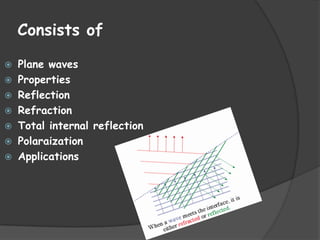
Consists of
Plane waves
 Properties
 Reflection
 Refraction
 Total internal reflection
 Polaraization
 Applications

Plane waves
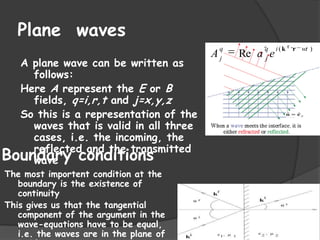
A plane wave can be written as
follows:
Here A represent the E or B
fields, q=i,r,t and j=x,y,z
So this is a representation of the
waves that is valid in all three
cases, i.e. the incoming, the
reflected and the transmitted
Boundary conditions
wave
The most importent condition at the
boundary is the existence of
continuity
This gives us that the tangential
component of the argument in the
wave-equations have to be equal,
i.e. the waves are in the plane of

A

q
j

q
j

Re a e

i(k

q

r wt )
Electromagnetic Waves










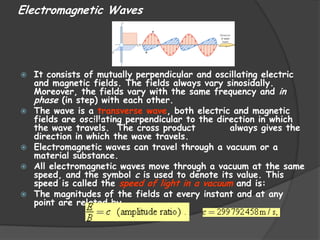
It consists of mutually perpendicular and oscillating electric
and magnetic fields. The fields always vary sinosidally.
Moreover, the fields vary with the same frequency and in
phase (in step) with each other.
The wave is  transverse wave, both electric and magnetic
a 
fields are oscillating perpendicular to the direction in which
E B
the wave travels. The cross product
always gives the
direction in which the wave travels.
Electromagnetic waves can travel through a vacuum or a
material substance.
All electromagnetic waves move through a vacuum at the same
speed, and the symbol c is used to denote its value. This
speed is called the speed of light in a vacuum and is:
The magnitudes of the fields at every instant and at any
point are related by
Properties of the Wave








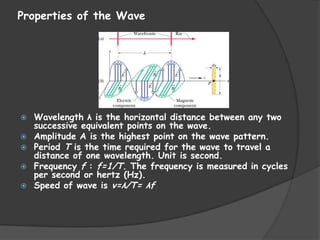
Wavelength λ is the horizontal distance between any two
successive equivalent points on the wave.
Amplitude A is the highest point on the wave pattern.
Period T is the time required for the wave to travel a
distance of one wavelength. Unit is second.
Frequency f : f=1/T. The frequency is measured in cycles
per second or hertz (Hz).
Speed of wave is v=λ/T= λf
The Speed of Light






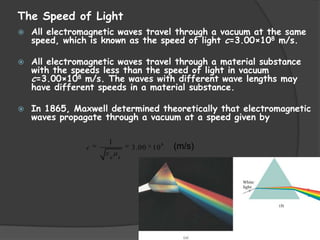
All electromagnetic waves travel through a vacuum at the same
speed, which is known as the speed of light c=3.00×10⁸ m/s.
All electromagnetic waves travel through a material substance
with the speeds less than the speed of light in vacuum
c=3.00×10⁸ m/s. The waves with different wave lengths may
have different speeds in a material substance.
In 1865, Maxwell determined theoretically that electromagnetic
waves propagate through a vacuum at a speed given by
c

1
0

3.00 10
0

8

(m/s)
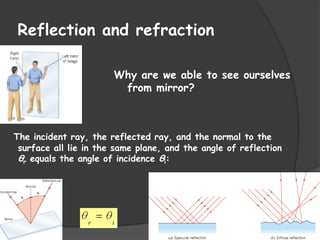
Reflection and refraction
Why are we able to see ourselves
from mirror?

The incident ray, the reflected ray, and the normal to the
surface all lie in the same plane, and the angle of reflection
θr equals the angle of incidence θi:

r

i
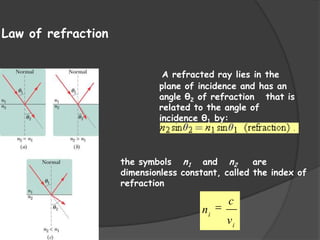
Law of refraction
A refracted ray lies in the
plane of incidence and has an
angle θ2 of refraction that is
related to the angle of
incidence θ1 by:

the symbols n1 and n2
are
dimensionless constant, called the index of
refraction

ni

c
vi
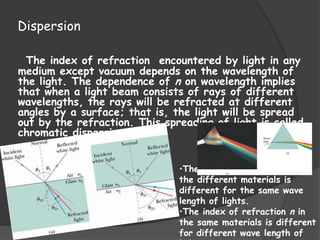
Dispersion
The index of refraction encountered by light in any
medium except vacuum depends on the wavelength of
the light. The dependence of n on wavelength implies
that when a light beam consists of rays of different
wavelengths, the rays will be refracted at different
angles by a surface; that is, the light will be spread
out by the refraction. This spreading of light is called
chromatic dispersion,
•The index of refraction n in
the different materials is
different for the same wave
length of lights.
•The index of refraction n in
the same materials is different
for different wave length of
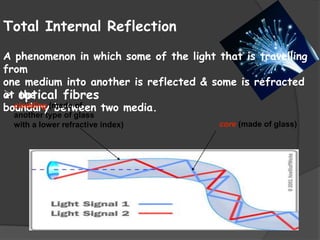
Total Internal Reflection
A phenomenon in which some of the light that is travelling
from
one medium into another is reflected & some is refracted
at the
 optical fibres
cladding between two media.
boundary(made of
another type of glass
with a lower refractive index)

core (made of glass)
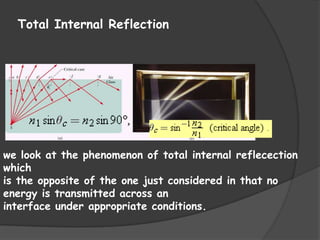
Total Internal Reflection

we look at the phenomenon of total internal reflecection
which
is the opposite of the one just considered in that no
energy is transmitted across an
interface under appropriate conditions.
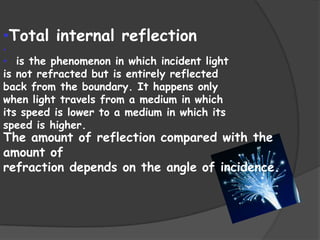
•Total internal reflection
•

• is the phenomenon in which incident light
is not refracted but is entirely reflected
back from the boundary. It happens only
when light travels from a medium in which
its speed is lower to a medium in which its
speed is higher.

The amount of reflection compared with the
amount of
refraction depends on the angle of incidence.
Polarization





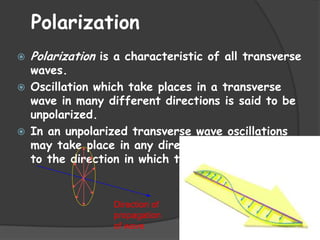
Polarization is a characteristic of all transverse
waves.
Oscillation which take places in a transverse
wave in many different directions is said to be
unpolarized.
In an unpolarized transverse wave oscillations
may take place in any direction at right angles
to the direction in which the wave travels.

Direction of
propagation
of wave
Polarization of Electromagnetic
Waves




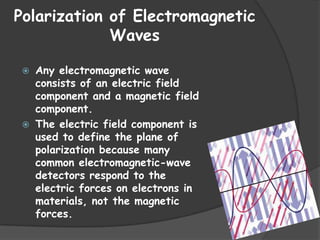
Any electromagnetic wave
consists of an electric field
component and a magnetic field
component.
The electric field component is
used to define the plane of
polarization because many
common electromagnetic-wave
detectors respond to the
electric forces on electrons in
materials, not the magnetic
forces.
Polaroid




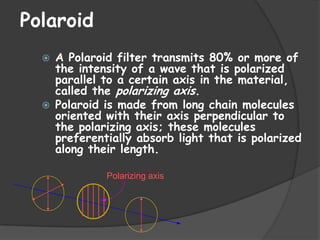
A Polaroid filter transmits 80% or more of
the intensity of a wave that is polarized
parallel to a certain axis in the material,
called the polarizing axis.
Polaroid is made from long chain molecules
oriented with their axis perpendicular to
the polarizing axis; these molecules
preferentially absorb light that is polarized
along their length.
Polarizing axis
Polarization by Reflection
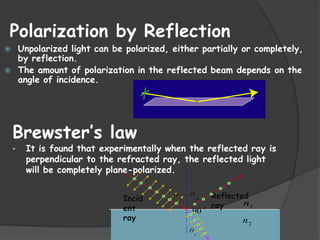
Unpolarized light can be polarized, either partially or completely,
by reflection.
The amount of polarization in the reflected beam depends on the
angle of incidence.




Brewster’s law


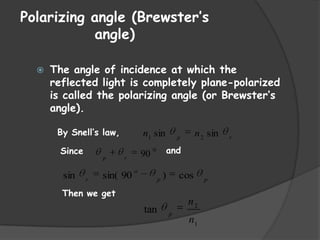
It is found that experimentally when the reflected ray is
perpendicular to the refracted ray, the reflected light
will be completely plane-polarized.
Incid
ent
ray

p

p

90

o

Reflected
n1
ray

n2
r
Polarizing angle (Brewster’s
angle)


The angle of incidence at which the
reflected light is completely plane-polarized
is called the polarizing angle (or Brewster’s
angle).
By Snell’s law,
Since

sin

p

r

n1 sin

sin( 90

and

90

r

o
p

)

cos

Then we get

tan

n 2 sin

p

n2
p

n1

p

r
Polarization by Scattering (1)


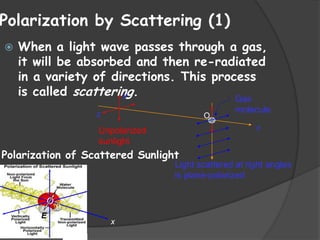
When a light wave passes through a gas,
it will be absorbed and then re-radiated
in a variety of directions. This process
is called scattering.
y
z

O

x

Unpolarized
sunlight

Polarization of Scattered Sunlight

z

Light scattered at right angles
is plane-polarized

y

O
E

Gas
molecule

x
Polarization by
Refraction


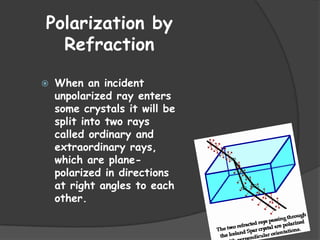
When an incident
unpolarized ray enters
some crystals it will be
split into two rays
called ordinary and
extraordinary rays,
which are planepolarized in directions
at right angles to each
other.
Double
Refraction


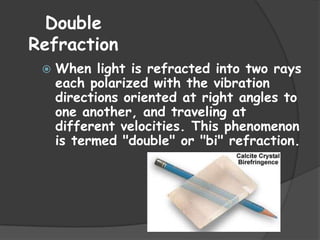
When light is refracted into two rays
each polarized with the vibration
directions oriented at right angles to
one another, and traveling at
different velocities. This phenomenon
is termed "double" or "bi" refraction.


Applications…..

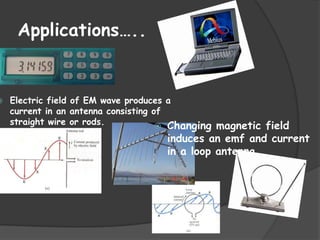
Electric field of EM wave produces a
current in an antenna consisting of
straight wire or rods.
 Changing magnetic field

induces an emf and current
in a loop antenna.
THANK YOU !!
FOR YOUR
PATIENCE ..
Please follow d slides as follows
 Dinesh raj 1-6
 Kanishth
7-9
 Rohit
10-12
 Prashatnth 13-17
 Awadesh
18-21


Plane waves reflection refraction and polarization by dinesh.V.raj

  • 1.
    Electro magnetic theory Plane wavesreflection refraction and polarization joint effort by Dinesh raj Rohit
  • 2.
    Consists of Plane waves Properties  Reflection  Refraction  Total internal reflection  Polaraization  Applications 
  • 3.
    Plane waves A planewave can be written as follows: Here A represent the E or B fields, q=i,r,t and j=x,y,z So this is a representation of the waves that is valid in all three cases, i.e. the incoming, the reflected and the transmitted Boundary conditions wave The most importent condition at the boundary is the existence of continuity This gives us that the tangential component of the argument in the wave-equations have to be equal, i.e. the waves are in the plane of A q j q j Re a e i(k q r wt )
  • 4.
    Electromagnetic Waves      It consistsof mutually perpendicular and oscillating electric and magnetic fields. The fields always vary sinosidally. Moreover, the fields vary with the same frequency and in phase (in step) with each other. The wave is  transverse wave, both electric and magnetic a  fields are oscillating perpendicular to the direction in which E B the wave travels. The cross product always gives the direction in which the wave travels. Electromagnetic waves can travel through a vacuum or a material substance. All electromagnetic waves move through a vacuum at the same speed, and the symbol c is used to denote its value. This speed is called the speed of light in a vacuum and is: The magnitudes of the fields at every instant and at any point are related by
  • 5.
    Properties of theWave      Wavelength λ is the horizontal distance between any two successive equivalent points on the wave. Amplitude A is the highest point on the wave pattern. Period T is the time required for the wave to travel a distance of one wavelength. Unit is second. Frequency f : f=1/T. The frequency is measured in cycles per second or hertz (Hz). Speed of wave is v=λ/T= λf
  • 6.
    The Speed ofLight    All electromagnetic waves travel through a vacuum at the same speed, which is known as the speed of light c=3.00×10⁸ m/s. All electromagnetic waves travel through a material substance with the speeds less than the speed of light in vacuum c=3.00×10⁸ m/s. The waves with different wave lengths may have different speeds in a material substance. In 1865, Maxwell determined theoretically that electromagnetic waves propagate through a vacuum at a speed given by c 1 0 3.00 10 0 8 (m/s)
  • 7.
    Reflection and refraction Whyare we able to see ourselves from mirror? The incident ray, the reflected ray, and the normal to the surface all lie in the same plane, and the angle of reflection θr equals the angle of incidence θi: r i
  • 8.
    Law of refraction Arefracted ray lies in the plane of incidence and has an angle θ2 of refraction that is related to the angle of incidence θ1 by: the symbols n1 and n2 are dimensionless constant, called the index of refraction ni c vi
  • 9.
    Dispersion The index ofrefraction encountered by light in any medium except vacuum depends on the wavelength of the light. The dependence of n on wavelength implies that when a light beam consists of rays of different wavelengths, the rays will be refracted at different angles by a surface; that is, the light will be spread out by the refraction. This spreading of light is called chromatic dispersion, •The index of refraction n in the different materials is different for the same wave length of lights. •The index of refraction n in the same materials is different for different wave length of
  • 10.
    Total Internal Reflection Aphenomenon in which some of the light that is travelling from one medium into another is reflected & some is refracted at the  optical fibres cladding between two media. boundary(made of another type of glass with a lower refractive index) core (made of glass)
  • 11.
    Total Internal Reflection welook at the phenomenon of total internal reflecection which is the opposite of the one just considered in that no energy is transmitted across an interface under appropriate conditions.
  • 12.
    •Total internal reflection • •is the phenomenon in which incident light is not refracted but is entirely reflected back from the boundary. It happens only when light travels from a medium in which its speed is lower to a medium in which its speed is higher. The amount of reflection compared with the amount of refraction depends on the angle of incidence.
  • 13.
    Polarization    Polarization is acharacteristic of all transverse waves. Oscillation which take places in a transverse wave in many different directions is said to be unpolarized. In an unpolarized transverse wave oscillations may take place in any direction at right angles to the direction in which the wave travels. Direction of propagation of wave
  • 14.
    Polarization of Electromagnetic Waves   Anyelectromagnetic wave consists of an electric field component and a magnetic field component. The electric field component is used to define the plane of polarization because many common electromagnetic-wave detectors respond to the electric forces on electrons in materials, not the magnetic forces.
  • 15.
    Polaroid   A Polaroid filtertransmits 80% or more of the intensity of a wave that is polarized parallel to a certain axis in the material, called the polarizing axis. Polaroid is made from long chain molecules oriented with their axis perpendicular to the polarizing axis; these molecules preferentially absorb light that is polarized along their length. Polarizing axis
  • 16.
    Polarization by Reflection Unpolarizedlight can be polarized, either partially or completely, by reflection. The amount of polarization in the reflected beam depends on the angle of incidence.   Brewster’s law  It is found that experimentally when the reflected ray is perpendicular to the refracted ray, the reflected light will be completely plane-polarized. Incid ent ray p p 90 o Reflected n1 ray n2 r
  • 17.
    Polarizing angle (Brewster’s angle)  Theangle of incidence at which the reflected light is completely plane-polarized is called the polarizing angle (or Brewster’s angle). By Snell’s law, Since sin p r n1 sin sin( 90 and 90 r o p ) cos Then we get tan n 2 sin p n2 p n1 p r
  • 18.
    Polarization by Scattering(1)  When a light wave passes through a gas, it will be absorbed and then re-radiated in a variety of directions. This process is called scattering. y z O x Unpolarized sunlight Polarization of Scattered Sunlight z Light scattered at right angles is plane-polarized y O E Gas molecule x
  • 19.
    Polarization by Refraction  When anincident unpolarized ray enters some crystals it will be split into two rays called ordinary and extraordinary rays, which are planepolarized in directions at right angles to each other.
  • 20.
    Double Refraction  When light isrefracted into two rays each polarized with the vibration directions oriented at right angles to one another, and traveling at different velocities. This phenomenon is termed "double" or "bi" refraction.
  • 21.
     Applications….. Electric field ofEM wave produces a current in an antenna consisting of straight wire or rods.  Changing magnetic field induces an emf and current in a loop antenna.
  • 22.
    THANK YOU !! FORYOUR PATIENCE ..
  • 23.
    Please follow dslides as follows  Dinesh raj 1-6  Kanishth 7-9  Rohit 10-12  Prashatnth 13-17  Awadesh 18-21 