TRANSFER
PRICING
Department of Accounting
FACULTY OF MANAGEMENT AND
FINANCE
University of Colombo
Content
1.Introduction
2.Objectives of Transfer Pricing
3.Methods of Transfer Pricing
• Cost Based Transfer Pricing
• Market Based Transfer Pricing
• Negotiated Transfer Pricing
4. Advantages and Disadvantages
5.Conclusion
INTRODUCTION
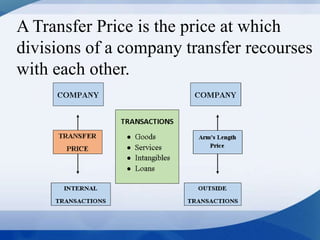
A Transfer Price is the price at which
divisions of a company transfer recourses
with each other.
Types of Internal Transactions
A transfer pricing arrangement can be
between,
• Between Inter-Company Departments
• Parent Company and Subsidiary
• Between two Subsidiaries of the Parent
Company
Internal Transaction can happen,
• Local context
• Global context
Methods of Transfer
Pricing
1. Cost Based Transfer Pricing
2. Market Based Transfer Pricing
3. Negotiated Transfer Pricing
OBJECTIVES
OF
TRANSFER
PRICING
• Minimizing tax liability
• Helps to maintain divisional autonomy
• As a method of performance
measurement & reward.
• To provide information for decision
making.
• To optimise allocation of financial
resources.
• To Enhancing a company’s competitive
position and improve its relations with
foreign governments.
COST BASED
TRANSFER
PRICING
Different forms of cost based transfer
pricing,
• Variable cost
• Actual full cost
• full cost plus profit margin
• Standard full cost
MARKET
BASED
TRANSFER
PRICING
What is Market Based Transfer
Pricing
When the outside market for the good
is well defined, competitive and stable,
firms often use the market price as an
upper bound for the transfer price.
Advantages of Market Based
Transfer Pricing Method
• Managers motivation increases because they
have more control over assets
• Top managers are not distracted by routine
• Forces selling division to be competitive with
market conditions
• Decisions are better and timelier because of
the manager’s proximity to local conditions
NEGOTIATE
TRANSFER
PRICING
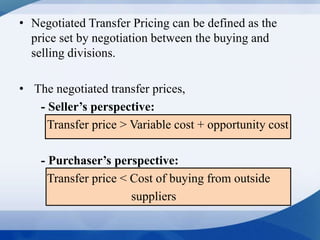
• Negotiated Transfer Pricing can be defined as the
price set by negotiation between the buying and
selling divisions.
• The negotiated transfer prices,
- Seller’s perspective:
Transfer price > Variable cost + opportunity cost
- Purchaser’s perspective:
Transfer price < Cost of buying from outside
suppliers
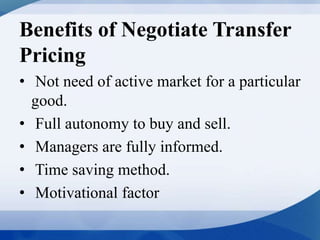
Benefits of Negotiate Transfer
Pricing
• Not need of active market for a particular
good.
• Full autonomy to buy and sell.
• Managers are fully informed.
• Time saving method.
• Motivational factor
Drawbacks of Negotiate
Transfer Pricing
• The parties does not have equal
bargaining power
• Risk for disharmony with
opportunity costs.
• Conflicts on transfer prices between
divisions
ADVANTAGES
&
DISADVANTAGES
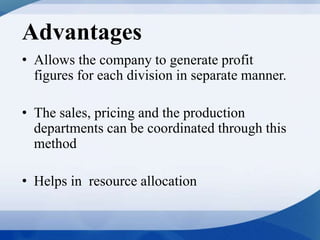
Advantages
• Allows the company to generate profit
figures for each division in separate manner.
• The sales, pricing and the production
departments can be coordinated through this
method
• Helps in resource allocation
• Performance evaluation of each department
becomes easy
• Decisions become better and more timely
• Managers’ motivation increases
• Reducing income taxes
Disadvantages
• Disagreement among organizational divisional
managers
• Additional costs, time and manpower will be
required
• Transfer prices do not work equally
• Cause dysfunctional behavior
• Highly complicated
• Difficult to estimate the right amount of
pricing policy
CONCLUSION
How it relates.....
QUESTIONS
THE END
THANK YOU

Transfer Pricing

  • 1.
    TRANSFER PRICING Department of Accounting FACULTYOF MANAGEMENT AND FINANCE University of Colombo
  • 2.
    Content 1.Introduction 2.Objectives of TransferPricing 3.Methods of Transfer Pricing • Cost Based Transfer Pricing • Market Based Transfer Pricing • Negotiated Transfer Pricing 4. Advantages and Disadvantages 5.Conclusion
  • 3.
  • 4.
    A Transfer Priceis the price at which divisions of a company transfer recourses with each other.
  • 5.
    Types of InternalTransactions A transfer pricing arrangement can be between, • Between Inter-Company Departments • Parent Company and Subsidiary • Between two Subsidiaries of the Parent Company
  • 6.
    Internal Transaction canhappen, • Local context • Global context
  • 7.
    Methods of Transfer Pricing 1.Cost Based Transfer Pricing 2. Market Based Transfer Pricing 3. Negotiated Transfer Pricing
  • 8.
  • 9.
    • Minimizing taxliability • Helps to maintain divisional autonomy • As a method of performance measurement & reward.
  • 10.
    • To provideinformation for decision making. • To optimise allocation of financial resources. • To Enhancing a company’s competitive position and improve its relations with foreign governments.
  • 11.
  • 12.
    Different forms ofcost based transfer pricing, • Variable cost • Actual full cost • full cost plus profit margin • Standard full cost
  • 13.
  • 14.
    What is MarketBased Transfer Pricing When the outside market for the good is well defined, competitive and stable, firms often use the market price as an upper bound for the transfer price.
  • 15.
    Advantages of MarketBased Transfer Pricing Method • Managers motivation increases because they have more control over assets • Top managers are not distracted by routine • Forces selling division to be competitive with market conditions • Decisions are better and timelier because of the manager’s proximity to local conditions
  • 16.
  • 17.
    • Negotiated TransferPricing can be defined as the price set by negotiation between the buying and selling divisions. • The negotiated transfer prices, - Seller’s perspective: Transfer price > Variable cost + opportunity cost - Purchaser’s perspective: Transfer price < Cost of buying from outside suppliers
  • 18.
    Benefits of NegotiateTransfer Pricing • Not need of active market for a particular good. • Full autonomy to buy and sell. • Managers are fully informed. • Time saving method. • Motivational factor
  • 19.
    Drawbacks of Negotiate TransferPricing • The parties does not have equal bargaining power • Risk for disharmony with opportunity costs. • Conflicts on transfer prices between divisions
  • 20.
  • 21.
    Advantages • Allows thecompany to generate profit figures for each division in separate manner. • The sales, pricing and the production departments can be coordinated through this method • Helps in resource allocation
  • 22.
    • Performance evaluationof each department becomes easy • Decisions become better and more timely • Managers’ motivation increases • Reducing income taxes
  • 23.
    Disadvantages • Disagreement amongorganizational divisional managers • Additional costs, time and manpower will be required • Transfer prices do not work equally • Cause dysfunctional behavior • Highly complicated • Difficult to estimate the right amount of pricing policy
  • 24.
  • 25.
  • 26.
  • 27.