Done by:
P.Dhanush,
1670228,
A3.
Introduction
 Laser beam is defined as light beams propagating
dominantly in one direction.
 A laser is a device that generates light by a process
called STIMULATED EMISSION
 The name LASER is an acronym for Light
Amplification by the Stimulated Emission of
Radiation.
 In 1917, Albert einstein first theorized about the
process which makes lasers possible called
"Stimulated Emission."
 Laser beams often have a small optical bandwidth.
 Some lasers emit continuously, but a laser beam can
also consist of a fast sequence of pulses, with many
millions or even billions of pulses per second.
 A laser beam of visible light with sufficiently high
power may be visible when propagating in air, a much
brighter spot is seen on that screen, since most of the
optical power is scattered at this point.
 Laser beams exhibit good focusability and the
potential.
 It is a powerful light in a straight direction and could
be reflected from certain items like glass.
When a single beam laser cuts with
acceptable speed it generates too much heat
damage on the wafer.
To improve the quality of the cut, less laser
power has to be applied.
This reduces the cutting speed too much.
Multiple beam cutting limits the local heat
load sufficiently while achieving a high
material removal rate.
Thus combining a high dicing quality with high
speed ..
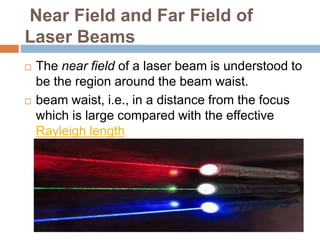
Near Field and Far Field of
Laser Beams
 The near field of a laser beam is understood to
be the region around the beam waist.
 beam waist, i.e., in a distance from the focus
which is large compared with the effective
Rayleigh length
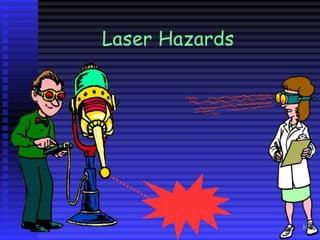
Laser hazards
 Acute exposure of the eye to lasers of certain
wave lengths and power can cause corneal or
retinal burns. Chronic exposure to excessive
levels may cause corneal or leniticular
opacities or retinal injuries.
 Acute exposure to high levels of optical
radiation may cause skin burns.
 Some lasers require hazardous or toxic
subsstances to operate
 Most kasers utilize high voltages that can be
lethal.
Laser and eyes
 What are the effect of laser energy on eye?
1) Laser light in visible to near infrared
spectrum which can cause damage to the
retina resulting in Scotoma.
2) Laser light in the ultravoilent or fae
infrared spectrum can cause damage to the
camera and to
the lens.
 Visual disorientation due to retinal damage
may not be apparent to the operator until
considerable thermal damage has occurred.
Control measures
ENGINEERING CONTROLS
 interlocks
 Enclosed beam
ADMINISTRATIVE CONTROLS
 Standard operating procedures(SOPs)
 Training
PERSONNEL PROTECTIVE
EQUIPMENT(PPE)
 Eye protection
Laser fundamentals
 The light emitted from a laser is
monochromatic, that is it is of one color/wave
length.
 Laser emit light that is highly directional, that is
, laser light is emmited as a relatively narrow
beam in a specific direction. Ordinary bulb
 The light from a laser is said to be coherent.
These properties of laser makes them
hazardous than ordinary light.
Conclusion.
 Laser communication in space has long been a
goal for NASA because it would enable data
transmission rates that are 10 to 1000 times
higher than traditional radio waves.While lasers
and radio transmission both teavel at light
speed, laser can pack more data. It’s similar to
moving from a dial-up internet connection to
broadband. Astronomers could use lasers like
very accurate rulers to measure the movement
of planets with unpreceeding precision.
 Website references:
1) www.slideshare.net/donpraju/laser-ppt
2)www.alsiinternational.com/technology/
multibeam_process/multi_laser_beam_te
chnology

Laser beam technology

  • 1.
  • 2.
    Introduction  Laser beamis defined as light beams propagating dominantly in one direction.  A laser is a device that generates light by a process called STIMULATED EMISSION  The name LASER is an acronym for Light Amplification by the Stimulated Emission of Radiation.  In 1917, Albert einstein first theorized about the process which makes lasers possible called "Stimulated Emission."  Laser beams often have a small optical bandwidth.
  • 3.
     Some lasersemit continuously, but a laser beam can also consist of a fast sequence of pulses, with many millions or even billions of pulses per second.  A laser beam of visible light with sufficiently high power may be visible when propagating in air, a much brighter spot is seen on that screen, since most of the optical power is scattered at this point.  Laser beams exhibit good focusability and the potential.  It is a powerful light in a straight direction and could be reflected from certain items like glass.
  • 4.
    When a singlebeam laser cuts with acceptable speed it generates too much heat damage on the wafer. To improve the quality of the cut, less laser power has to be applied. This reduces the cutting speed too much. Multiple beam cutting limits the local heat load sufficiently while achieving a high material removal rate. Thus combining a high dicing quality with high speed ..
  • 5.
    Near Field andFar Field of Laser Beams  The near field of a laser beam is understood to be the region around the beam waist.  beam waist, i.e., in a distance from the focus which is large compared with the effective Rayleigh length
  • 7.
    Laser hazards  Acuteexposure of the eye to lasers of certain wave lengths and power can cause corneal or retinal burns. Chronic exposure to excessive levels may cause corneal or leniticular opacities or retinal injuries.  Acute exposure to high levels of optical radiation may cause skin burns.  Some lasers require hazardous or toxic subsstances to operate  Most kasers utilize high voltages that can be lethal.
  • 8.
    Laser and eyes What are the effect of laser energy on eye? 1) Laser light in visible to near infrared spectrum which can cause damage to the retina resulting in Scotoma. 2) Laser light in the ultravoilent or fae infrared spectrum can cause damage to the camera and to the lens.  Visual disorientation due to retinal damage may not be apparent to the operator until considerable thermal damage has occurred.
  • 9.
    Control measures ENGINEERING CONTROLS interlocks  Enclosed beam ADMINISTRATIVE CONTROLS  Standard operating procedures(SOPs)  Training PERSONNEL PROTECTIVE EQUIPMENT(PPE)  Eye protection
  • 10.
    Laser fundamentals  Thelight emitted from a laser is monochromatic, that is it is of one color/wave length.  Laser emit light that is highly directional, that is , laser light is emmited as a relatively narrow beam in a specific direction. Ordinary bulb  The light from a laser is said to be coherent. These properties of laser makes them hazardous than ordinary light.
  • 11.
    Conclusion.  Laser communicationin space has long been a goal for NASA because it would enable data transmission rates that are 10 to 1000 times higher than traditional radio waves.While lasers and radio transmission both teavel at light speed, laser can pack more data. It’s similar to moving from a dial-up internet connection to broadband. Astronomers could use lasers like very accurate rulers to measure the movement of planets with unpreceeding precision.
  • 12.
     Website references: 1)www.slideshare.net/donpraju/laser-ppt 2)www.alsiinternational.com/technology/ multibeam_process/multi_laser_beam_te chnology