





Internal & Formative
Assessment
Devender
M.A.M.C.
“Assessment in Medical Education addresses
complex competencies and requires
quantitative and qualitative information
from different sources as well as professional
judgment.”
Pitfalls of Summative exam
• Luck or by chance
– 6 to 15 marks between the same examiners marking
the script twice
• Bluff – make you believe that student knows but
not
• Does not identify regular and irregular students
• Practical skills ??
• Attitude, communication ethics and inter-
personal skills are difficult to assess
Purpose of Assessment is……
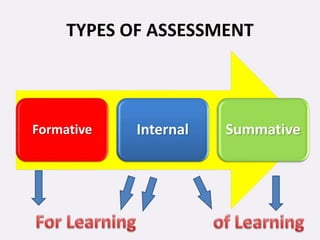
TYPES OF ASSESSMENT
Formative Internal Summative
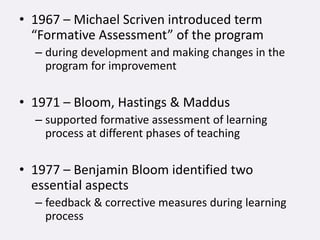
• 1967 – Michael Scriven introduced term
“Formative Assessment” of the program
– during development and making changes in the
program for improvement
• 1971 – Bloom, Hastings & Maddus
– supported formative assessment of learning
process at different phases of teaching
• 1977 – Benjamin Bloom identified two
essential aspects
– feedback & corrective measures during learning
process
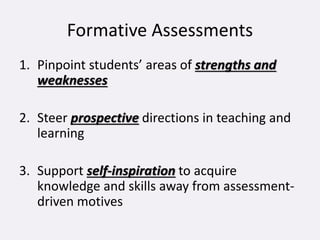
Formative Assessments
1. Pinpoint students’ areas of strengths and
weaknesses
2. Steer prospective directions in teaching and
learning
3. Support self-inspiration to acquire
knowledge and skills away from assessment-
driven motives
Blueprint
• Rational
– Links assessment to learning objectives
• Balance
– All aspects of the curriculum and educational domains are
covered
• Reduces the two major threats of Validity
– Construct Under-representation (CU)
– Construct Irrelevance Variance (CIV)
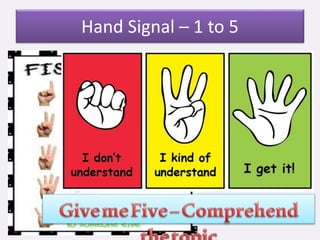
Hand Signal – 1 to 5
Brainstorming
• Great tool to assess prior knowledge of class
on the topic
Exit Summary
• What did you learn today?
• Write your reflection (in few lines)
• Best to assess for overall achievement of
lesson’s objectives
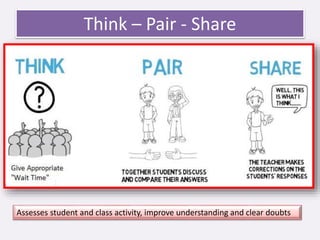
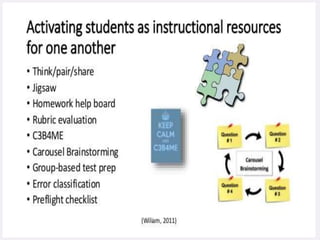
Think – Pair - Share
Assesses student and class activity, improve understanding and clear doubts
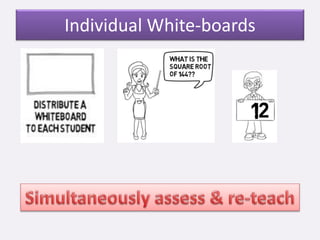
Individual White-boards
Formative Assessments
1. Explore a subject in a more thoughtful fashion
2. Have time to critically appraise preconceived
concepts
3. Link new information to already pre-existing
knowledge
4. Promote effective utilization of higher-order skills
(critical thinking, problem solving, etc.) to generate
comprehensive understanding of course content
Formative Assessment
• ‘Best’ when not computably graded at all
Reason:
Chance to promote evolution of the learning process
from merely scoring grades into a process of vivid,
productive and dynamic educational experience
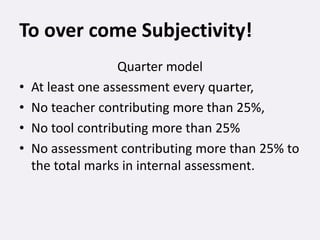
To over come Subjectivity!
Quarter model
• At least one assessment every quarter,
• No teacher contributing more than 25%,
• No tool contributing more than 25%
• No assessment contributing more than 25% to
the total marks in internal assessment.
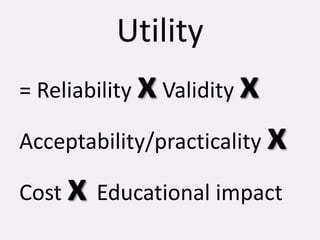
Utility
= Reliability xValidity x
Acceptability/practicality x
Cost x Educational impact
FUNCTIONS OF ASSESSMENT
• Selection
• Certification
• Programme evaluation
• Motivation
• Research
• Feedback
Advantage
• Multiple observations
• Multiple examiners
• Marking scheme is transparent
• Ample opportunities to learner to
improve his performance
If we want to have impact
—to bring about transformation in
medical education
—we need to be learners as well as
teachers
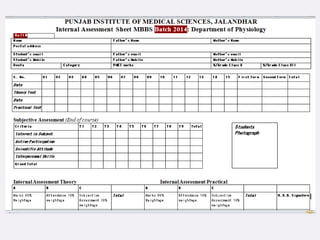
Why Internal Assessment (IA)?
• A system which emphasizes continuous
internal assessment and reduces dependence
on external examinations
• Concentrate on
–“How the learner learnt?”
• Undergraduate students must pass in their IA
to be eligible to appear in the final university
examinations (GME - 2012).
• Assessments are not valid or invalid
• Rather the scores or outcomes of assessment
have more or less evidence to support a
specific interpretation
Take home message…
• Day to day observation of students
– Focus on how student acquired knowledge
• Assesses Affective and Psychomotor domain
• Constructive Feedback and timely
intervention
• Confidence of student increases

Formative assessment

  • 1.
  • 2.
    “Assessment in MedicalEducation addresses complex competencies and requires quantitative and qualitative information from different sources as well as professional judgment.”
  • 3.
    Pitfalls of Summativeexam • Luck or by chance – 6 to 15 marks between the same examiners marking the script twice • Bluff – make you believe that student knows but not • Does not identify regular and irregular students • Practical skills ?? • Attitude, communication ethics and inter- personal skills are difficult to assess
  • 4.
  • 5.
  • 7.
    • 1967 –Michael Scriven introduced term “Formative Assessment” of the program – during development and making changes in the program for improvement • 1971 – Bloom, Hastings & Maddus – supported formative assessment of learning process at different phases of teaching • 1977 – Benjamin Bloom identified two essential aspects – feedback & corrective measures during learning process
  • 8.
    Formative Assessments 1. Pinpointstudents’ areas of strengths and weaknesses 2. Steer prospective directions in teaching and learning 3. Support self-inspiration to acquire knowledge and skills away from assessment- driven motives
  • 12.
    Blueprint • Rational – Linksassessment to learning objectives • Balance – All aspects of the curriculum and educational domains are covered • Reduces the two major threats of Validity – Construct Under-representation (CU) – Construct Irrelevance Variance (CIV)
  • 14.
  • 15.
    Brainstorming • Great toolto assess prior knowledge of class on the topic
  • 16.
    Exit Summary • Whatdid you learn today? • Write your reflection (in few lines) • Best to assess for overall achievement of lesson’s objectives
  • 17.
    Think – Pair- Share Assesses student and class activity, improve understanding and clear doubts
  • 18.
  • 21.
    Formative Assessments 1. Explorea subject in a more thoughtful fashion 2. Have time to critically appraise preconceived concepts 3. Link new information to already pre-existing knowledge 4. Promote effective utilization of higher-order skills (critical thinking, problem solving, etc.) to generate comprehensive understanding of course content
  • 22.
    Formative Assessment • ‘Best’when not computably graded at all Reason: Chance to promote evolution of the learning process from merely scoring grades into a process of vivid, productive and dynamic educational experience
  • 23.
    To over comeSubjectivity! Quarter model • At least one assessment every quarter, • No teacher contributing more than 25%, • No tool contributing more than 25% • No assessment contributing more than 25% to the total marks in internal assessment.
  • 24.
    Utility = Reliability xValidityx Acceptability/practicality x Cost x Educational impact
  • 25.
    FUNCTIONS OF ASSESSMENT •Selection • Certification • Programme evaluation • Motivation • Research • Feedback
  • 26.
    Advantage • Multiple observations •Multiple examiners • Marking scheme is transparent • Ample opportunities to learner to improve his performance
  • 27.
    If we wantto have impact —to bring about transformation in medical education —we need to be learners as well as teachers
  • 28.
    Why Internal Assessment(IA)? • A system which emphasizes continuous internal assessment and reduces dependence on external examinations • Concentrate on –“How the learner learnt?” • Undergraduate students must pass in their IA to be eligible to appear in the final university examinations (GME - 2012).
  • 29.
    • Assessments arenot valid or invalid • Rather the scores or outcomes of assessment have more or less evidence to support a specific interpretation
  • 30.
    Take home message… •Day to day observation of students – Focus on how student acquired knowledge • Assesses Affective and Psychomotor domain • Constructive Feedback and timely intervention • Confidence of student increases