AETCOM Introduction
Dr Devender
MAMC
IMG – Core Competencies
Professional Life Long Learner
Clinician
LeaderCommunicator
Alignment of Skill to Values
Knowledge Skill
Attitude
Values
Indian Medical Graduate
Curriculum Gap
Intended Curriculum
What we student to acquire
Taught Curriculum
Engage student with intended
curriculum
Experienced Curriculum
Differs from student to student
Assessed Curriculum
Assessing what we want them to
learn
Achieved Curriculum
Competencies students acquired
after undergoing course
 Formal – what we say
 Hidden – what we do
Curriculum
Classical Approach
• Role modelling
• Mentorship
• Professional apprenticeship
Direct Approach to Teach
• Domains of attitude and communication
• Emphasis on Ethics
• Stage appropriate opportunity for experiential
learning and reflection
ATCOM Module
 Case based module
 Case scenarios with discussion points
 Structured program
 Distributed over all years
 ? Assessment
AETCOM Module
• 5 Sections
• 2 Annexures
Section I
• Enumerates the roles of the IMG
– Clinician
– Leader and member of the core health care
system
– Communicator
– Life long learner
– Professional
SECTION II
Learning modules
for
Professional year I
• Number of modules 5
• Number of hours 34
• Sessions are interdependent
• Self guided learning
• Interactive discussions
• Closure session with reflection
• Assessment
Learning modules
for
Professional year -2
• Number of modules 7
• Number of hours 35
The foundation of communication – 2
The foundation of bioethics
1. Health care as a right
2. Working in a health care team
3. Bioethics contd - The cover up. Case study on
patient autonomy and decision making
4. Bioethics contd – Life machine.
5. Bioethics contd – Who is the doctor?
6. What does it mean to be family member of
the sick patient
Learning module
for
professional year 3
• Number of modules 5
• Number of hours 25
Foundation of communication 3
1. Case studies in bioethics – Disclosure of
medical errors
2. Seeking immunity
3. The foundation of communication -4
4. Case study in bioethics - Confidentiality
5. Case study in bioethics – Fiduciary duty
Learning modules
for
professional year -4
• Number of modules
• Number of hours 45
• The foundation of communication 4
1. Case study in medical –legal and ethical
situations – Child’s child
2. Case study in medical –legal and ethical
situations - The angry brick kiln owner
3. Case studies in ethics empathy and the doctor
patient relationship
4. Case studies in ethics and the doctor – industry
relationship
5. Case studies in ethics and the doctor – The offer
6. Case studies in ethics and patient autonomy –
The cruel parents
7. Dealing with death
Section III
• Additional list of desirable competencies in
attitudes and communications
• Non core
Section IV
• Competency Acquisition Log
• Suggested log book pattern
SECTION V
Appendix I
• List of competencies in AT COM
• 1 – 39 Core competencies
• 40 -53 non core (Desirable) competencies
Appendix 2
• Communication skills rating scale from
Kalamazoo consensus statement
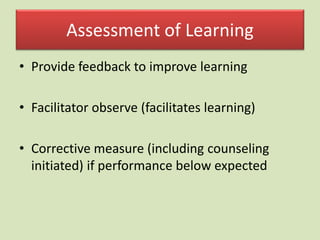
Assessment of Learning
• Provide feedback to improve learning
• Facilitator observe (facilitates learning)
• Corrective measure (including counseling
initiated) if performance below expected
Revitalizing professionalism
 Cognitive base
 Experiential learning
 Continuity
 Role Modeling
 Mentorship
Sometimes you put
walls up, not to keep
people out
But to see who cares
enough to break them
down
Socrates
Definition of Profession
• An occupation
– that regulates itself through systematics, required
training and collegial discipline
• That has a base in technical, specialized
knowledge & skills
• That has a service rather than a profit
orientation
• Enshrined in its code of ethics
FORMAL CURRICULUM
 Empathy
 Compassion
 Altruism
} What we
Say or desire
Hidden curriculum (Today)
 Weariness
 Strong distrust of emotions
 Failure of communication
Walking through AETCom
Teaching AETCom:
• Who
• What
• When and
• How
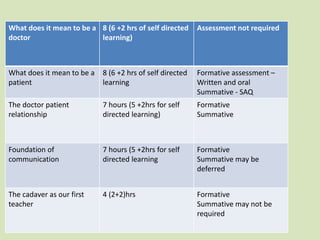
What does it mean to be a
doctor
8 (6 +2 hrs of self directed
learning)
Assessment not required
What does it mean to be a
patient
8 (6 +2 hrs of self directed
learning
Formative assessment –
Written and oral
Summative - SAQ
The doctor patient
relationship
7 hours (5 +2hrs for self
directed learning)
Formative
Summative
Foundation of
communication
7 hours (5 +2hrs for self
directed learning
Formative
Summative may be
deferred
The cadaver as our first
teacher
4 (2+2)hrs Formative
Summative may not be
required
Desirable competencies of AETCOM
• These may be included in whole or in part of
the formative assessment of the student
List the competencies required for the
above roles
• Clinician
• Leader and member of
the core health care
system
• Communicator
• Life long learner
• Professional
• 15 core competencies
• 6 core competencies
• 3 core competencies
• 5 core competencies

AETCOM

  • 1.
  • 2.
    IMG – CoreCompetencies Professional Life Long Learner Clinician LeaderCommunicator
  • 3.
    Alignment of Skillto Values Knowledge Skill Attitude Values Indian Medical Graduate
  • 4.
    Curriculum Gap Intended Curriculum Whatwe student to acquire Taught Curriculum Engage student with intended curriculum Experienced Curriculum Differs from student to student Assessed Curriculum Assessing what we want them to learn Achieved Curriculum Competencies students acquired after undergoing course
  • 5.
     Formal –what we say  Hidden – what we do Curriculum
  • 6.
    Classical Approach • Rolemodelling • Mentorship • Professional apprenticeship
  • 7.
    Direct Approach toTeach • Domains of attitude and communication • Emphasis on Ethics • Stage appropriate opportunity for experiential learning and reflection
  • 8.
    ATCOM Module  Casebased module  Case scenarios with discussion points  Structured program  Distributed over all years  ? Assessment
  • 9.
    AETCOM Module • 5Sections • 2 Annexures
  • 10.
    Section I • Enumeratesthe roles of the IMG – Clinician – Leader and member of the core health care system – Communicator – Life long learner – Professional
  • 11.
  • 12.
    Learning modules for Professional yearI • Number of modules 5 • Number of hours 34 • Sessions are interdependent • Self guided learning • Interactive discussions • Closure session with reflection • Assessment
  • 13.
    Learning modules for Professional year-2 • Number of modules 7 • Number of hours 35
  • 14.
    The foundation ofcommunication – 2 The foundation of bioethics 1. Health care as a right 2. Working in a health care team 3. Bioethics contd - The cover up. Case study on patient autonomy and decision making 4. Bioethics contd – Life machine. 5. Bioethics contd – Who is the doctor? 6. What does it mean to be family member of the sick patient
  • 15.
    Learning module for professional year3 • Number of modules 5 • Number of hours 25
  • 16.
    Foundation of communication3 1. Case studies in bioethics – Disclosure of medical errors 2. Seeking immunity 3. The foundation of communication -4 4. Case study in bioethics - Confidentiality 5. Case study in bioethics – Fiduciary duty
  • 17.
    Learning modules for professional year-4 • Number of modules • Number of hours 45 • The foundation of communication 4
  • 18.
    1. Case studyin medical –legal and ethical situations – Child’s child 2. Case study in medical –legal and ethical situations - The angry brick kiln owner 3. Case studies in ethics empathy and the doctor patient relationship 4. Case studies in ethics and the doctor – industry relationship 5. Case studies in ethics and the doctor – The offer 6. Case studies in ethics and patient autonomy – The cruel parents 7. Dealing with death
  • 19.
    Section III • Additionallist of desirable competencies in attitudes and communications • Non core
  • 20.
    Section IV • CompetencyAcquisition Log • Suggested log book pattern
  • 21.
  • 22.
    Appendix I • Listof competencies in AT COM • 1 – 39 Core competencies • 40 -53 non core (Desirable) competencies
  • 23.
    Appendix 2 • Communicationskills rating scale from Kalamazoo consensus statement
  • 24.
    Assessment of Learning •Provide feedback to improve learning • Facilitator observe (facilitates learning) • Corrective measure (including counseling initiated) if performance below expected
  • 25.
    Revitalizing professionalism  Cognitivebase  Experiential learning  Continuity  Role Modeling  Mentorship
  • 26.
    Sometimes you put wallsup, not to keep people out But to see who cares enough to break them down Socrates
  • 27.
    Definition of Profession •An occupation – that regulates itself through systematics, required training and collegial discipline • That has a base in technical, specialized knowledge & skills • That has a service rather than a profit orientation • Enshrined in its code of ethics
  • 28.
    FORMAL CURRICULUM  Empathy Compassion  Altruism } What we Say or desire
  • 29.
    Hidden curriculum (Today) Weariness  Strong distrust of emotions  Failure of communication
  • 30.
    Walking through AETCom TeachingAETCom: • Who • What • When and • How
  • 31.
    What does itmean to be a doctor 8 (6 +2 hrs of self directed learning) Assessment not required What does it mean to be a patient 8 (6 +2 hrs of self directed learning Formative assessment – Written and oral Summative - SAQ The doctor patient relationship 7 hours (5 +2hrs for self directed learning) Formative Summative Foundation of communication 7 hours (5 +2hrs for self directed learning Formative Summative may be deferred The cadaver as our first teacher 4 (2+2)hrs Formative Summative may not be required
  • 32.
    Desirable competencies ofAETCOM • These may be included in whole or in part of the formative assessment of the student
  • 33.
    List the competenciesrequired for the above roles • Clinician • Leader and member of the core health care system • Communicator • Life long learner • Professional • 15 core competencies • 6 core competencies • 3 core competencies • 5 core competencies • 5 core competencies