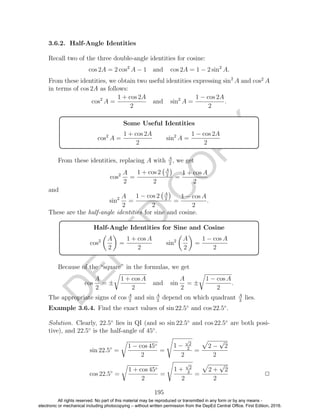
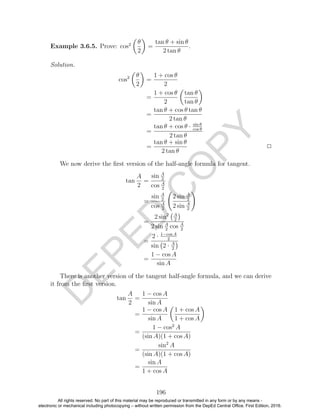
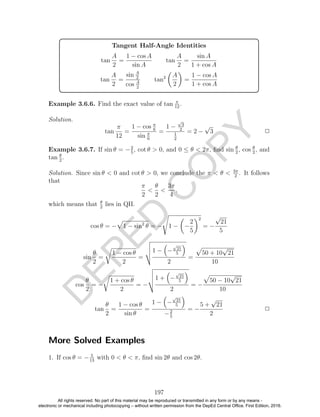
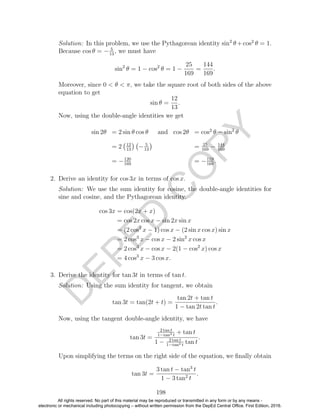
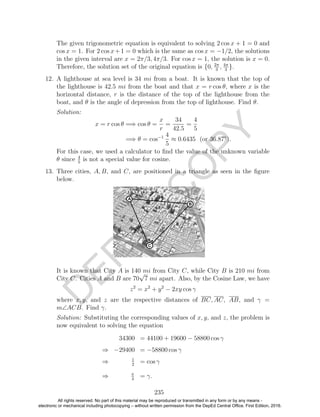
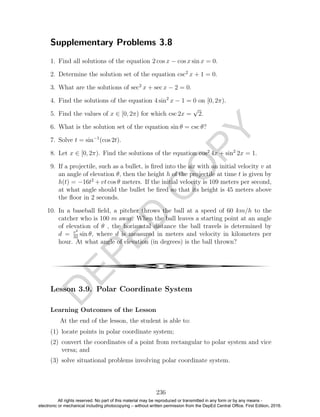
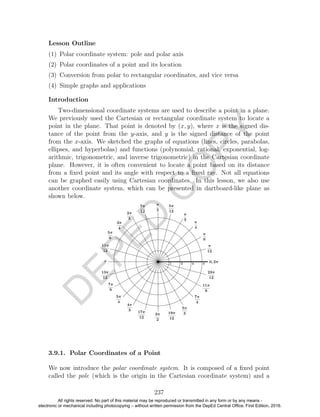
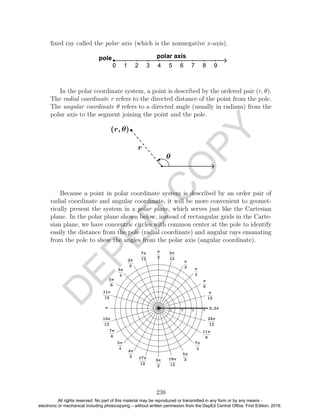
D
EPED
C
O
PY
Precalculus
Learner’s Material
Department of Education
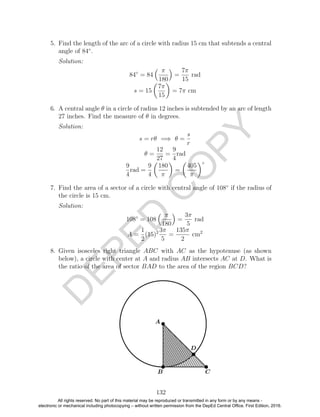
Republic of the Philippines
This learning resource was collaboratively developed and
reviewed by educators from public and private schools, colleges, and/or
universities. We encourage teachers and other education stakeholders
to email their feedback, comments and recommendations to the
Department of Education at action@deped.gov.ph.
We value your feedback and recommendations.
All rights reserved. No part of this material may be reproduced or transmitted in any form or by any means -
electronic or mechanical including photocopying – without written permission from the DepEd Central Office. First Edition, 2016.
D
EPED
C
O
PY
Precalculus
Learner’s Material
First Edition 2016
Republic Act 8293. Section 176 states that: No copyright shall subsist in any work
of the Government of the Philippines. However, prior approval of the government agency or
office wherein the work is created shall be necessary for exploitation of such work for profit.
Such agency or office may, among other things, impose as a condition the payment of
royalties.
Borrowed materials (i.e., songs, stories, poems, pictures, photos, brand names,
trademarks, etc.) included in this learning resource are owned by their respective copyright
holders. DepEd is represented by the Filipinas Copyright Licensing Society (FILCOLS), Inc.
in seeking permission to use these materials from their respective copyright owners. All
means have been exhausted in seeking permission to use these materials. The publisher
and authors do not represent nor claim ownership over them.
Only institutions and companies which have entered an agreement with FILCOLS
and only within the agreed framework may copy from this Manual. Those who have not
entered in an agreement with FILCOLS must, if they wish to copy, contact the publishers
and authors directly.
Undersecretary: Dina S. Ocampo, PhD
Printed in the Philippines by Sunshine Interlinks Publishing House, Inc.
3F Maine City Tower, 236 Tomas Morato Avenue,
Brgy. South Triangle, Quezon City
Department of Education-Bureau of Learning Resources (DepEd-BLR)
Office Address: Ground Floor Bonifacio Building, DepEd Complex
Meralco Avenue, Pasig City, Philippines 1600
Telefax: (02) 634-1054, 634-1072, 631-4985
E-mail Address: blr.lrqad@deped.gov.ph / blr.lrpd@deped.gov.ph
Dr. Flordeliza F. Francisco Mark Anthony J. Vidallo
Carly Mae Casteloy Angela Dianne Agustin
(02) 435-5258, respectively.
Published by the Department of Education
Secretary: Br. Armin A. Luistro FSC
Authors and publishers may email or contact FILCOLS at filcols@gmail.com or
Cover Art Illustrator: Quincy D. Gonzales
Team Leader: Ian June L. Garces, Ph.D.
Management Team of the Precalculus Learner’s Material
Bureau of Curriculum Development
Bureau of Learning Resources
Development Team of the Precalculus Learner’s Material
Joy P. Ascano Jesus Lemuel L. Martin Jr.
Jerico B. Bacani, Ph.D Richard B. Eden, Ph.D
Arnel D. Olofernes Mark Anthony C. Tolentino, Ph.D
Reviewers:
All rights reserved. No part of this material may be reproduced or transmitted in any form or by any means -
electronic or mechanical including photocopying – without written permission from the DepEd Central Office. First Edition, 2016.
D
EPED
C
O
PY
Table of Contents
To the Precalculus Learners 1
DepEd Curriculum Guide for Precalculus 2
Unit 1: Analytic Geometry 6
Lesson 1.1: Introduction to Conic Sections and Circles . . . . . . . . 7
1.1.1: An Overview of Conic Sections . . . . . . . . . . . . . . . . . . . . . . . . . . . 7
1.1.2: Definition and Equation of a Circle. . . . . . . . . . . . . . . . . . . . . . . 8
1.1.3: More Properties of Circles. . . . . . . . . . . . . . . . . . . . . . . . . . . . . . . . 10
1.1.4: Situational Problems Involving Circles. . . . . . . . . . . . . . . . . . . . 12
Lesson 1.2: Parabolas. . . . . . . . . . . . . . . . . . . . . . . . . . . . . . . . . . . . . . . . . 19
1.2.1: Definition and Equation of a Parabola. . . . . . . . . . . . . . . . . . . . 19
1.2.2: More Properties of Parabolas. . . . . . . . . . . . . . . . . . . . . . . . . . . . . 23
1.2.3: Situational Problems Involving Parabolas . . . . . . . . . . . . . . . . 26
Lesson 1.3: Ellipses . . . . . . . . . . . . . . . . . . . . . . . . . . . . . . . . . . . . . . . . . . . 33
1.3.1: Definition and Equation of an Ellipse. . . . . . . . . . . . . . . . . . . . . 33
1.3.2: More Properties of Ellipses . . . . . . . . . . . . . . . . . . . . . . . . . . . . . . . 36
1.3.3: Situational Problems Involving Ellipses. . . . . . . . . . . . . . . . . . . 40
Lesson 1.4: Hyperbolas . . . . . . . . . . . . . . . . . . . . . . . . . . . . . . . . . . . . . . . 46
1.4.1: Definition and Equation of a Hyperbola . . . . . . . . . . . . . . . . . . 46
1.4.2: More Properties of Hyperbolas . . . . . . . . . . . . . . . . . . . . . . . . . . . 50
1.4.3: Situational Problems Involving Hyperbolas . . . . . . . . . . . . . . . 54
Lesson 1.5: More Problems on Conic Sections . . . . . . . . . . . . . . . . 60
1.5.1: Identifying the Conic Section by Inspection. . . . . . . . . . . . . . . 60
1.5.2: Problems Involving Different Conic Sections . . . . . . . . . . . . . . 62
iii
All rights reserved. No part of this material may be reproduced or transmitted in any form or by any means -
electronic or mechanical including photocopying – without written permission from the DepEd Central Office. First Edition, 2016.
D
EPED
C
O
PY
Lesson 1.6: Systems of Nonlinear Equations . . . . . . . . . . . . . . . . . . 67
1.6.1: Review of Techniques in Solving Systems of Linear
Equations . . . . . . . . . . . . . . . . . . . . . . . . . . . . . . . . . . . . . . . . . . . . . . . . 68
1.6.2: Solving Systems of Equations Using Substitution . . . . . . . . . 69
1.6.3: Solving Systems of Equations Using Elimination. . . . . . . . . . 70
1.6.4: Applications of Systems of Nonlinear Equations . . . . . . . . . . 73
Unit 2: Mathematical Induction 80
Lesson 2.1: Review of Sequences and Series . . . . . . . . . . . . . . . . . . . 81
Lesson 2.2: Sigma Notation. . . . . . . . . . . . . . . . . . . . . . . . . . . . . . . . . . . 86
2.2.1: Writing and Evaluating Sums in Sigma Notation . . . . . . . . . 87
2.2.2: Properties of Sigma Notation. . . . . . . . . . . . . . . . . . . . . . . . . . . . . 89
Lesson 2.3: Principle of Mathematical Induction . . . . . . . . . . . . . . 96
2.3.1: Proving Summation Identities . . . . . . . . . . . . . . . . . . . . . . . . . . . . 97
2.3.2: Proving Divisibility Statements. . . . . . . . . . . . . . . . . . . . . . . . . . .101
2.3.3: Proving Inequalities . . . . . . . . . . . . . . . . . . . . . . . . . . . . . . . . . . . . . . 102
Lesson 2.4: The Binomial Theorem . . . . . . . . . . . . . . . . . . . . . . . . . . . 108
2.4.1: Pascal’s Triangle and the Concept of Combination. . . . . . . . 109
2.4.2: The Binomial Theorem. . . . . . . . . . . . . . . . . . . . . . . . . . . . . . . . . . . 111
2.4.3: Terms of a Binomial Expansion . . . . . . . . . . . . . . . . . . . . . . . . . . 114
2.4.4: Approximation and Combination Identities . . . . . . . . . . . . . . . 116
Unit 3: Trigonometry 123
Lesson 3.1: Angles in a Unit Circle . . . . . . . . . . . . . . . . . . . . . . . . . . . 124
3.1.1: Angle Measure . . . . . . . . . . . . . . . . . . . . . . . . . . . . . . . . . . . . . . . . . . . 124
3.1.2: Coterminal Angles . . . . . . . . . . . . . . . . . . . . . . . . . . . . . . . . . . . . . . . 128
3.1.3: Arc Length and Area of a Sector . . . . . . . . . . . . . . . . . . . . . . . . . 129
Lesson 3.2: Circular Functions . . . . . . . . . . . . . . . . . . . . . . . . . . . . . . . . 135
3.2.1: Circular Functions on Real Numbers . . . . . . . . . . . . . . . . . . . . . 136
3.2.2: Reference Angle. . . . . . . . . . . . . . . . . . . . . . . . . . . . . . . . . . . . . . . . . . 139
All rights reserved. No part of this material may be reproduced or transmitted in any form or by any means -
electronic or mechanical including photocopying – without written permission from the DepEd Central Office. First Edition, 2016.
D
EPED
C
O
PY
Lesson 3.3: Graphs of Circular Functions and Situational
Problems . . . . . . . . . . . . . . . . . . . . . . . . . . . . . . . . . . . . . . . . . 144
3.3.1: Graphs of y = sin x and y = cos x . . . . . . . . . . . . . . . . . . . . . . . . 145
3.3.2: Graphs of y = a sin bx and y = a cos bx . . . . . . . . . . . . . . . . . . . 147
3.3.3: Graphs of y = a sin b(x − c) + d and
y = a cos b(x − c) + d. . . . . . . . . . . . . . . . . . . . . . . . . . . . . . . . . . . . . 151
3.3.4: Graphs of Cosecant and Secant Functions . . . . . . . . . . . . . . . . 154
3.3.5: Graphs of Tangent and Cotangent Functions . . . . . . . . . . . . . 158
3.3.6: Simple Harmonic Motion. . . . . . . . . . . . . . . . . . . . . . . . . . . . . . . . . 160
Lesson 3.4: Fundamental Trigonometric Identities. . . . . . . . . . . . .171
3.4.1: Domain of an Expression or Equation . . . . . . . . . . . . . . . . . . . . 171
3.4.2: Identity and Conditional Equation . . . . . . . . . . . . . . . . . . . . . . . 173
3.4.3: The Fundamental Trigonometric Identities . . . . . . . . . . . . . . . 174
3.4.4: Proving Trigonometric Identities . . . . . . . . . . . . . . . . . . . . . . . . . 176
Lesson 3.5: Sum and Difference Identities. . . . . . . . . . . . . . . . . . . . .181
3.5.1: The Cosine Difference and Sum Identities . . . . . . . . . . . . . . . . 181
3.5.2: The Cofunction Identities and the Sine Sum and
Difference Identities . . . . . . . . . . . . . . . . . . . . . . . . . . . . . . . . . . . . . . 183
3.5.3: The Tangent Sum and Difference Identities . . . . . . . . . . . . . . . 186
Lesson 3.6: Double-Angle and Half-Angle Identities. . . . . . . . . . .192
3.6.1: Double-Angle Identities . . . . . . . . . . . . . . . . . . . . . . . . . . . . . . . . . . 192
3.6.2: Half-Angle Identities . . . . . . . . . . . . . . . . . . . . . . . . . . . . . . . . . . . . . 195
Lesson 3.7: Inverse Trigonometric Functions . . . . . . . . . . . . . . . . . . 201
3.7.1: Inverse Sine Function . . . . . . . . . . . . . . . . . . . . . . . . . . . . . . . . . . . . 202
3.7.2: Inverse Cosine Function . . . . . . . . . . . . . . . . . . . . . . . . . . . . . . . . . . 205
3.7.3: Inverse Tangent Function and the Remaining Inverse
Trigonometric Functions . . . . . . . . . . . . . . . . . . . . . . . . . . . . . . . . . 208
Lesson 3.8: Trigonometric Equations. . . . . . . . . . . . . . . . . . . . . . . . . .220
3.8.1: Solutions of a Trigonometric Equation. . . . . . . . . . . . . . . . . . . . 221
3.8.2: Equations with One Term . . . . . . . . . . . . . . . . . . . . . . . . . . . . . . . . 224
3.8.3: Equations with Two or More Terms . . . . . . . . . . . . . . . . . . . . . . 227
All rights reserved. No part of this material may be reproduced or transmitted in any form or by any means -
electronic or mechanical including photocopying – without written permission from the DepEd Central Office. First Edition, 2016.
D
EPED
C
O
PY
Lesson 3.9: Polar Coordinate System . . . . . . . . . . . . . . . . . . . . . . . . . 236
3.9.1: Polar Coordinates of a Point . . . . . . . . . . . . . . . . . . . . . . . . . . . . . 237
3.9.2: From Polar to Rectangular, and Vice Versa. . . . . . . . . . . . . . . 241
3.9.3: Basic Polar Graphs and Applications . . . . . . . . . . . . . . . . . . . . . 244
Answers to Odd-Numbered Exercises in Supplementary Problems
and All Exercises in Topic Tests 255
References 290
All rights reserved. No part of this material may be reproduced or transmitted in any form or by any means -
electronic or mechanical including photocopying – without written permission from the DepEd Central Office. First Edition, 2016.
D
EPED
C
O
PY
To the Precalculus Learners
The Precalculus course bridges basic mathematics and calculus. This course
completes your foundational knowledge on algebra, geometry, and trigonometry.
It provides you with conceptual understanding and computational skills that are
prerequisites for Basic Calculus and future STEM courses.
Based on the Curriculum Guide for Precalculus of the Department of Edu-
cation (see pages 2-5), the primary aim of this Learning Manual is to give you
an adequate stand-alone material that can be used for the Grade 11 Precalculus
course.
The Manual is divided into three units: analytic geometry, summation no-
tation and mathematical induction, and trigonometry. Each unit is composed
of lessons that bring together related learning competencies in the unit. Each
lesson is further divided into sub-lessons that focus on one or two competencies
for effective learning.
At the end of each lesson, more examples are given in Solved Examples to
reinforce the ideas and skills being developed in the lesson. You have the oppor-
tunity to check your understanding of the lesson by solving the Supplementary
Problems. Finally, two sets of Topic Test are included to prepare you for the
exam.
Answers, solutions, or hints to odd-numbered items in the Supplementary
Problems and all items in the Topic Tests are provided at the end of the Manual
to guide you while solving them. We hope that you will use this feature of the
Manual responsibly.
Some items are marked with a star. A starred sub-lesson means the discussion
and accomplishment of the sub-lesson are optional. This will be decided by your
teacher. On the other hand, a starred example or exercise means the use of
calculator is required.
We hope that you will find this Learning Manual helpful and convenient to
use. We encourage you to carefully study this Manual and solve the exercises
yourselves with the guidance of your teacher. Although great effort has been
put into this Manual for technical correctness and precision, any mistake found
and reported to the Team is a gain for other students. Thank you for your
cooperation.
The Precalculus LM Team
All rights reserved. No part of this material may be reproduced or transmitted in any form or by any means -
electronic or mechanical including photocopying – without written permission from the DepEd Central Office. First Edition, 2016.
D
EPED
C
O
PY
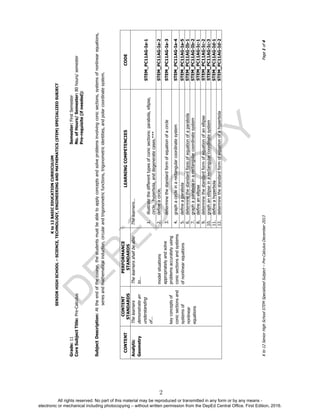
Kto12BASICEDUCATIONCURRICULUM
SENIORHIGHSCHOOL–SCIENCE,TECHNOLOGY,ENGINEERINGANDMATHEMATICS(STEM)SPECIALIZEDSUBJECT
Kto12SeniorHighSchoolSTEMSpecializedSubject–Pre-CalculusDecember2013Page1of4
Grade:11Semester:FirstSemester
CoreSubjectTitle:Pre-CalculusNo.ofHours/Semester:80hours/semester
Pre-requisite(ifneeded):
SubjectDescription:Attheendofthecourse,thestudentsmustbeabletoapplyconceptsandsolveproblemsinvolvingconicsections,systemsofnonlinearequations,
seriesandmathematicalinduction,circularandtrigonometricfunctions,trigonometricidentities,andpolarcoordinatesystem.
CONTENT
CONTENT
STANDARDS
PERFORMANCE
STANDARDS
LEARNINGCOMPETENCIESCODE
Analytic
Geometry
Thelearners
demonstratean
understanding
of...
keyconceptsof
conicsectionsand
systemsof
nonlinear
equations
Thelearnersshallbeable
to...
modelsituations
appropriatelyandsolve
problemsaccuratelyusing
conicsectionsandsystems
ofnonlinearequations
Thelearners...
1.illustratethedifferenttypesofconicsections:parabola,ellipse,
circle,hyperbola,anddegeneratecases.***
STEM_PC11AG-Ia-1
2.defineacircle.STEM_PC11AG-Ia-2
3.determinethestandardformofequationofacircleSTEM_PC11AG-Ia-3
4.graphacircleinarectangularcoordinatesystemSTEM_PC11AG-Ia-4
5.defineaparabolaSTEM_PC11AG-Ia-5
6.determinethestandardformofequationofaparabolaSTEM_PC11AG-Ib-1
7.graphaparabolainarectangularcoordinatesystemSTEM_PC11AG-Ib-2
8.defineanellipseSTEM_PC11AG-Ic-1
9.determinethestandardformofequationofanellipseSTEM_PC11AG-Ic-2
10.graphanellipseinarectangularcoordinatesystemSTEM_PC11AG-Ic-3
11.defineahyperbolaSTEM_PC11AG-Id-1
12.determinethestandardformofequationofahyperbolaSTEM_PC11AG-Id-2
2
All rights reserved. No part of this material may be reproduced or transmitted in any form or by any means -
electronic or mechanical including photocopying – without written permission from the DepEd Central Office. First Edition, 2016.
D
EPED
C
O
PY
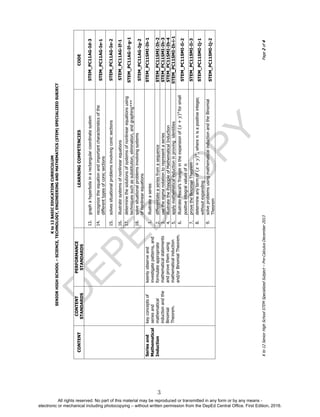
Kto12BASICEDUCATIONCURRICULUM
SENIORHIGHSCHOOL–SCIENCE,TECHNOLOGY,ENGINEERINGANDMATHEMATICS(STEM)SPECIALIZEDSUBJECT
Kto12SeniorHighSchoolSTEMSpecializedSubject–Pre-CalculusDecember2013Page2of4
CONTENT
CONTENT
STANDARDS
PERFORMANCE
STANDARDS
LEARNINGCOMPETENCIESCODE
13.graphahyperbolainarectangularcoordinatesystemSTEM_PC11AG-Id-3
14.recognizetheequationandimportantcharacteristicsofthe
differenttypesofconicsections
STEM_PC11AG-Ie-1
15.solvessituationalproblemsinvolvingconicsectionsSTEM_PC11AG-Ie-2
16.illustratesystemsofnonlinearequationsSTEM_PC11AG-If-1
17.determinethesolutionsofsystemsofnonlinearequationsusing
techniquessuchassubstitution,elimination,andgraphing***
STEM_PC11AG-If-g-1
18.solvesituationalproblemsinvolvingsystems
ofnonlinearequations
STEM_PC11AG-Ig-2
Seriesand
Mathematical
Induction
keyconceptsof
seriesand
mathematical
inductionandthe
Binomial
Theorem.
keenlyobserveand
investigatepatterns,and
formulateappropriate
mathematicalstatements
andprovethemusing
mathematicalinduction
and/orBinomialTheorem.
1.illustrateaseries
STEM_PC11SMI-Ih-1
2.differentiateaseriesfromasequenceSTEM_PC11SMI-Ih-2
3.usethesigmanotationtorepresentaseriesSTEM_PC11SMI-Ih-3
4.illustratethePrincipleofMathematicalInductionSTEM_PC11SMI-Ih-4
5.applymathematicalinductioninprovingidentitiesSTEM_PC11SMI-Ih-i-1
6.illustratePascal’sTriangleintheexpansionof𝑥+𝑦𝑛
forsmall
positiveintegralvaluesof𝑛
STEM_PC11SMI-Ii-2
7.provetheBinomialTheoremSTEM_PC11SMI-Ii-3
8.determineanytermof𝑥+𝑦𝑛
,where𝑛isapositiveinteger,
withoutexpanding
STEM_PC11SMI-Ij-1
9.solveproblemsusingmathematicalinductionandtheBinomial
Theorem
STEM_PC11SMI-Ij-2
3
All rights reserved. No part of this material may be reproduced or transmitted in any form or by any means -
electronic or mechanical including photocopying – without written permission from the DepEd Central Office. First Edition, 2016.
D
EPED
C
O
PY
Kto12BASICEDUCATIONCURRICULUM
SENIORHIGHSCHOOL–SCIENCE,TECHNOLOGY,ENGINEERINGANDMATHEMATICS(STEM)SPECIALIZEDSUBJECT
Kto12SeniorHighSchoolSTEMSpecializedSubject–Pre-CalculusDecember2013Page3of4
CONTENT
CONTENT
STANDARDS
PERFORMANCE
STANDARDS
LEARNINGCOMPETENCIESCODE
Trigonometrykeyconceptsof
circularfunctions,
trigonometric
identities,inverse
trigonometric
functions,and
thepolar
coordinate
system
1.formulateandsolve
accuratelysituational
problemsinvolving
circularfunctions
1.illustratetheunitcircleandtherelationshipbetweenthelinear
andangularmeasuresofacentralangleinaunitcircleSTEM_PC11T-IIa-1
2.convertdegreemeasuretoradianmeasureandviceversaSTEM_PC11T-IIa-2
3.illustrateanglesinstandardpositionandcoterminalanglesSTEM_PC11T-IIa-3
4.illustratethedifferentcircularfunctionsSTEM_PC11T-IIb-1
5.usesreferenceanglestofindexactvaluesofcircularfunctionsSTEM_PC11T-IIb-2
6.determinethedomainandrangeofthedifferentcircularfunctionsSTEM_PC11T-IIc-1
7.graphthesixcircularfunctions(a)amplitude,(b)period,and(c)
phaseshift
STEM_PC11T-IIc-d-1
8.solveproblemsinvolvingcircularfunctionsSTEM_PC11T-IId-2
2.applyappropriate
trigonometricidentitiesin
solvingsituational
problems
9.determinewhetheranequationisanidentityoraconditional
equation
STEM_PC11T-IIe-1
10.derivethefundamentaltrigonometricidentitiesSTEM_PC11T-IIe-2
11.derivetrigonometricidentitiesinvolvingsumanddifferenceof
angles
STEM_PC11T-IIe-3
12.derivethedoubleandhalf-angleformulasSTEM_PC11T-IIf-1
13.simplifytrigonometricexpressionsSTEM_PC11T-IIf-2
14.proveothertrigonometricidentitiesSTEM_PC11T-IIf-g-1
15.solvesituationalproblemsinvolvingtrigonometricidentitiesSTEM_PC11T-IIg-2
3.formulateandsolve
accuratelysituational
problemsinvolving
appropriatetrigonometric
functions
16.illustratethedomainandrangeoftheinversetrigonometric
functions.
STEM_PC11T-IIh-1
17.evaluateaninversetrigonometricexpression.STEM_PC11T-IIh-2
18.solvetrigonometricequations.STEM_PC11T-IIh-i-1
19.solvesituationalproblemsinvolvinginversetrigonometric
functionsandtrigonometricequations
STEM_PC11T-IIi-2
4.formulateandsolve
accuratelysituational
problemsinvolvingthe
polarcoordinatesystem
20.locatepointsinpolarcoordinatesystemSTEM_PC11T-IIj-1
21.convertthecoordinatesofapointfromrectangulartopolar
systemsandviceversa
STEM_PC11T-IIj-2
22.solvesituationalproblemsinvolvingpolarcoordinatesystemSTEM_PC11T-IIj-3
***SuggestionforICT-enhancedlessonwhenavailableandwhereappropriate
4
All rights reserved. No part of this material may be reproduced or transmitted in any form or by any means -
electronic or mechanical including photocopying – without written permission from the DepEd Central Office. First Edition, 2016.
D
EPED
C
O
PY
Kto12BASICEDUCATIONCURRICULUM
SENIORHIGHSCHOOL–SCIENCE,TECHNOLOGY,ENGINEERINGANDMATHEMATICS(STEM)SPECIALIZEDSUBJECT
Kto12SeniorHighSchoolSTEMSpecializedSubject–Pre-CalculusDecember2013Page4of4
CodeBookLegend
Sample:STEM_PC11AG-Ia-1
DOMAIN/COMPONENTCODE
AnalyticGeometryAG
SeriesandMathematicalInductionSMI
TrigonometryT
LEGENDSAMPLE
FirstEntry
LearningAreaand
Strand/Subjector
Specialization
Science,Technology,
EngineeringandMathematics
Pre-Calculus
STEM_PC11AGGradeLevelGrade11
Uppercase
Letter/s
Domain/Content/
Component/Topic
AnalyticGeometry
-
RomanNumeral
*Zeroifnospecific
quarter
QuarterFirstQuarterI
Lowercase
Letter/s
*Putahyphen(-)in
betweenlettersto
indicatemorethana
specificweek
WeekWeekonea
-
ArabicNumberCompetency
illustratethedifferenttypes
ofconicsections:parabola,
ellipse,circle,hyperbola,
anddegeneratecases
1
5
All rights reserved. No part of this material may be reproduced or transmitted in any form or by any means -
electronic or mechanical including photocopying – without written permission from the DepEd Central Office. First Edition, 2016.
D
EPED
C
O
PY
Unit 1
Analytic Geometry
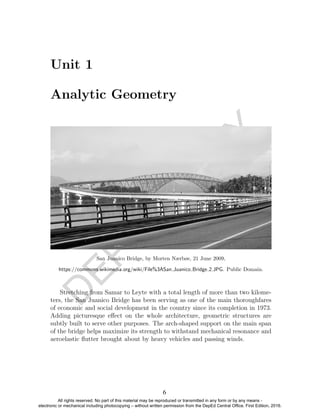
San Juanico Bridge, by Morten Nærbøe, 21 June 2009,
https://commons.wikimedia.org/wiki/File%3ASan Juanico Bridge 2.JPG. Public Domain.
Stretching from Samar to Leyte with a total length of more than two kilome-
ters, the San Juanico Bridge has been serving as one of the main thoroughfares
of economic and social development in the country since its completion in 1973.
Adding picturesque effect on the whole architecture, geometric structures are
subtly built to serve other purposes. The arch-shaped support on the main span
of the bridge helps maximize its strength to withstand mechanical resonance and
aeroelastic flutter brought about by heavy vehicles and passing winds.
6
All rights reserved. No part of this material may be reproduced or transmitted in any form or by any means -
electronic or mechanical including photocopying – without written permission from the DepEd Central Office. First Edition, 2016.
D
EPED
C
O
PY
Lesson 1.1. Introduction to Conic Sections and Circles
Learning Outcomes of the Lesson
At the end of the lesson, the student is able to:
(1) illustrate the different types of conic sections: parabola, ellipse, circle, hyper-
bola, and degenerate cases;
(2) define a circle;
(3) determine the standard form of equation of a circle;
(4) graph a circle in a rectangular coordinate system; and
(5) solve situational problems involving conic sections (circles).
Lesson Outline
(1) Introduction of the four conic sections, along with the degenerate conics
(2) Definition of a circle
(3) Derivation of the standard equation of a circle
(4) Graphing circles
(5) Solving situational problems involving circles
Introduction
We present the conic sections, a particular class of curves which sometimes
appear in nature and which have applications in other fields. In this lesson, we
first illustrate how each of these curves is obtained from the intersection of a
plane and a cone, and then discuss the first of their kind, circles. The other conic
sections will be covered in the next lessons.
1.1.1. An Overview of Conic Sections
We introduce the conic sections (or conics), a particular class of curves which
oftentimes appear in nature and which have applications in other fields. One
of the first shapes we learned, a circle, is a conic. When you throw a ball, the
trajectory it takes is a parabola. The orbit taken by each planet around the sun
is an ellipse. Properties of hyperbolas have been used in the design of certain
telescopes and navigation systems. We will discuss circles in this lesson, leaving
parabolas, ellipses, and hyperbolas for subsequent lessons.
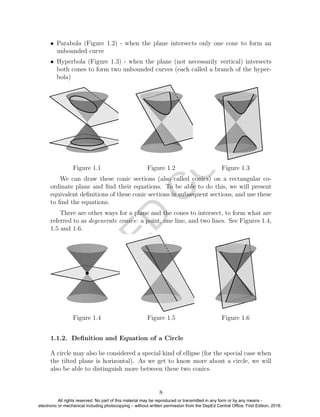
• Circle (Figure 1.1) - when the plane is horizontal
• Ellipse (Figure 1.1) - when the (tilted) plane intersects only one cone to form
a bounded curve
7
All rights reserved. No part of this material may be reproduced or transmitted in any form or by any means -
electronic or mechanical including photocopying – without written permission from the DepEd Central Office. First Edition, 2016.
D
EPED
C
O
PY
• Parabola (Figure 1.2) - when the plane intersects only one cone to form an
unbounded curve
• Hyperbola (Figure 1.3) - when the plane (not necessarily vertical) intersects
both cones to form two unbounded curves (each called a branch of the hyper-
bola)
Figure 1.1 Figure 1.2 Figure 1.3
We can draw these conic sections (also called conics) on a rectangular co-
ordinate plane and find their equations. To be able to do this, we will present
equivalent definitions of these conic sections in subsequent sections, and use these
to find the equations.
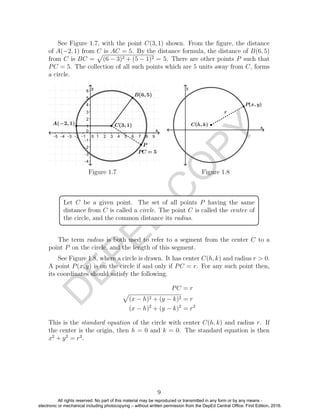
There are other ways for a plane and the cones to intersect, to form what are
referred to as degenerate conics: a point, one line, and two lines. See Figures 1.4,
1.5 and 1.6.
Figure 1.4 Figure 1.5 Figure 1.6
1.1.2. Definition and Equation of a Circle
A circle may also be considered a special kind of ellipse (for the special case when
the tilted plane is horizontal). As we get to know more about a circle, we will
also be able to distinguish more between these two conics.
8
All rights reserved. No part of this material may be reproduced or transmitted in any form or by any means -
electronic or mechanical including photocopying – without written permission from the DepEd Central Office. First Edition, 2016.
D
EPED
C
O
PY
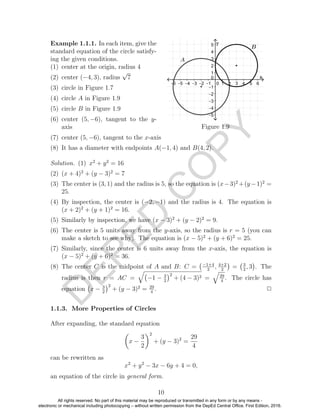
See Figure 1.7, with the point C(3, 1) shown. From the figure, the distance
of A(−2, 1) from C is AC = 5. By the distance formula, the distance of B(6, 5)
from C is BC = (6 − 3)2 + (5 − 1)2 = 5. There are other points P such that
PC = 5. The collection of all such points which are 5 units away from C, forms
a circle.
Figure 1.7 Figure 1.8
Let C be a given point. The set of all points P having the same
distance from C is called a circle. The point C is called the center of
the circle, and the common distance its radius.
The term radius is both used to refer to a segment from the center C to a
point P on the circle, and the length of this segment.
See Figure 1.8, where a circle is drawn. It has center C(h, k) and radius r > 0.
A point P(x, y) is on the circle if and only if PC = r. For any such point then,
its coordinates should satisfy the following.
PC = r
(x − h)2 + (y − k)2 = r
(x − h)2
+ (y − k)2
= r2
This is the standard equation of the circle with center C(h, k) and radius r. If
the center is the origin, then h = 0 and k = 0. The standard equation is then
x2
+ y2
= r2
.
9
All rights reserved. No part of this material may be reproduced or transmitted in any form or by any means -
electronic or mechanical including photocopying – without written permission from the DepEd Central Office. First Edition, 2016.
D
EPED
C
O
PY
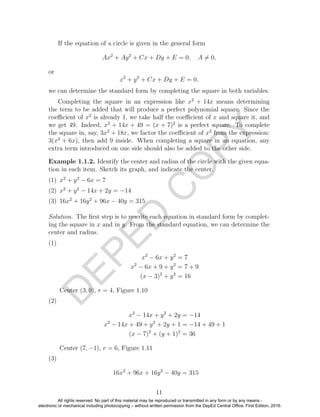
Example 1.1.1. In each item, give the
standard equation of the circle satisfy-
ing the given conditions.
(1) center at the origin, radius 4
(2) center (−4, 3), radius
√
7
(3) circle in Figure 1.7
(4) circle A in Figure 1.9
(5) circle B in Figure 1.9
(6) center (5, −6), tangent to the y-
axis Figure 1.9
(7) center (5, −6), tangent to the x-axis
(8) It has a diameter with endpoints A(−1, 4) and B(4, 2).
Solution. (1) x2
+ y2
= 16
(2) (x + 4)2
+ (y − 3)2
= 7
(3) The center is (3, 1) and the radius is 5, so the equation is (x−3)2
+(y−1)2
=
25.
(4) By inspection, the center is (−2, −1) and the radius is 4. The equation is
(x + 2)2
+ (y + 1)2
= 16.
(5) Similarly by inspection, we have (x − 3)2
+ (y − 2)2
= 9.
(6) The center is 5 units away from the y-axis, so the radius is r = 5 (you can
make a sketch to see why). The equation is (x − 5)2
+ (y + 6)2
= 25.
(7) Similarly, since the center is 6 units away from the x-axis, the equation is
(x − 5)2
+ (y + 6)2
= 36.
(8) The center C is the midpoint of A and B: C = −1+4
2
, 4+2
2
= 3
2
, 3 . The
radius is then r = AC = −1 − 3
2
2
+ (4 − 3)2 = 29
4
. The circle has
equation x − 3
2
2
+ (y − 3)2
= 29
4
. 2
1.1.3. More Properties of Circles
After expanding, the standard equation
x −
3
2
2
+ (y − 3)2
=
29
4
can be rewritten as
x2
+ y2
− 3x − 6y + 4 = 0,
an equation of the circle in general form.
10
All rights reserved. No part of this material may be reproduced or transmitted in any form or by any means -
electronic or mechanical including photocopying – without written permission from the DepEd Central Office. First Edition, 2016.
D
EPED
C
O
PY
If the equation of a circle is given in the general form
Ax2
+ Ay2
+ Cx + Dy + E = 0, A = 0,
or
x2
+ y2
+ Cx + Dy + E = 0,
we can determine the standard form by completing the square in both variables.
Completing the square in an expression like x2
+ 14x means determining
the term to be added that will produce a perfect polynomial square. Since the
coefficient of x2
is already 1, we take half the coefficient of x and square it, and
we get 49. Indeed, x2
+ 14x + 49 = (x + 7)2
is a perfect square. To complete
the square in, say, 3x2
+ 18x, we factor the coefficient of x2
from the expression:
3(x2
+ 6x), then add 9 inside. When completing a square in an equation, any
extra term introduced on one side should also be added to the other side.
Example 1.1.2. Identify the center and radius of the circle with the given equa-
tion in each item. Sketch its graph, and indicate the center.
(1) x2
+ y2
− 6x = 7
(2) x2
+ y2
− 14x + 2y = −14
(3) 16x2
+ 16y2
+ 96x − 40y = 315
Solution. The first step is to rewrite each equation in standard form by complet-
ing the square in x and in y. From the standard equation, we can determine the
center and radius.
(1)
x2
− 6x + y2
= 7
x2
− 6x + 9 + y2
= 7 + 9
(x − 3)2
+ y2
= 16
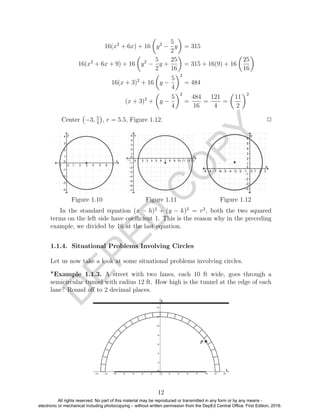
Center (3, 0), r = 4, Figure 1.10
(2)
x2
− 14x + y2
+ 2y = −14
x2
− 14x + 49 + y2
+ 2y + 1 = −14 + 49 + 1
(x − 7)2
+ (y + 1)2
= 36
Center (7, −1), r = 6, Figure 1.11
(3)
16x2
+ 96x + 16y2
− 40y = 315
11
All rights reserved. No part of this material may be reproduced or transmitted in any form or by any means -
electronic or mechanical including photocopying – without written permission from the DepEd Central Office. First Edition, 2016.
D
EPED
C
O
PY
16(x2
+ 6x) + 16 y2
−
5
2
y = 315
16(x2
+ 6x + 9) + 16 y2
−
5
2
y +
25
16
= 315 + 16(9) + 16
25
16
16(x + 3)2
+ 16 y −
5
4
2
= 484
(x + 3)2
+ y −
5
4
2
=
484
16
=
121
4
=
11
2
2
Center −3, 5
4
, r = 5.5, Figure 1.12. 2
Figure 1.10 Figure 1.11 Figure 1.12
In the standard equation (x − h)2
+ (y − k)2
= r2
, both the two squared
terms on the left side have coefficient 1. This is the reason why in the preceding
example, we divided by 16 at the last equation.
1.1.4. Situational Problems Involving Circles
Let us now take a look at some situational problems involving circles.
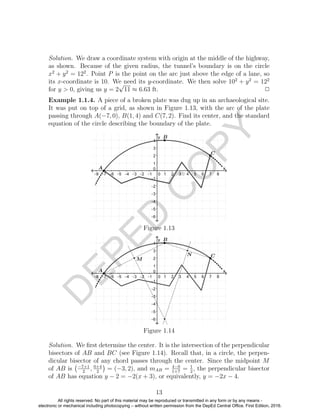
Example 1.1.3. A street with two lanes, each 10 ft wide, goes through a
semicircular tunnel with radius 12 ft. How high is the tunnel at the edge of each
lane? Round off to 2 decimal places.
12
All rights reserved. No part of this material may be reproduced or transmitted in any form or by any means -
electronic or mechanical including photocopying – without written permission from the DepEd Central Office. First Edition, 2016.
D
EPED
C
O
PY
Solution. We draw a coordinate system with origin at the middle of the highway,
as shown. Because of the given radius, the tunnel’s boundary is on the circle
x2
+ y2
= 122
. Point P is the point on the arc just above the edge of a lane, so
its x-coordinate is 10. We need its y-coordinate. We then solve 102
+ y2
= 122
for y > 0, giving us y = 2
√
11 ≈ 6.63 ft. 2
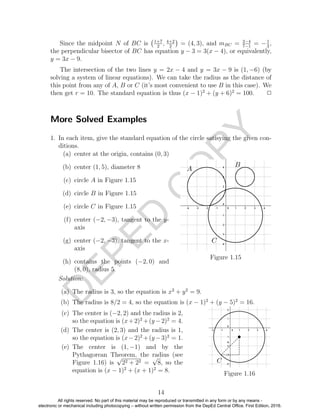
Example 1.1.4. A piece of a broken plate was dug up in an archaeological site.
It was put on top of a grid, as shown in Figure 1.13, with the arc of the plate
passing through A(−7, 0), B(1, 4) and C(7, 2). Find its center, and the standard
equation of the circle describing the boundary of the plate.
Figure 1.13
Figure 1.14
Solution. We first determine the center. It is the intersection of the perpendicular
bisectors of AB and BC (see Figure 1.14). Recall that, in a circle, the perpen-
dicular bisector of any chord passes through the center. Since the midpoint M
of AB is −7+1
2
, 0+4
2
= (−3, 2), and mAB = 4−0
1+7
= 1
2
, the perpendicular bisector
of AB has equation y − 2 = −2(x + 3), or equivalently, y = −2x − 4.
13
All rights reserved. No part of this material may be reproduced or transmitted in any form or by any means -
electronic or mechanical including photocopying – without written permission from the DepEd Central Office. First Edition, 2016.
D
EPED
C
O
PY
Since the midpoint N of BC is 1+7
2
, 4+2
2
= (4, 3), and mBC = 2−4
7−1
= −1
3
,
the perpendicular bisector of BC has equation y − 3 = 3(x − 4), or equivalently,
y = 3x − 9.
The intersection of the two lines y = 2x − 4 and y = 3x − 9 is (1, −6) (by
solving a system of linear equations). We can take the radius as the distance of
this point from any of A, B or C (it’s most convenient to use B in this case). We
then get r = 10. The standard equation is thus (x − 1)2
+ (y + 6)2
= 100. 2
More Solved Examples
1. In each item, give the standard equation of the circle satisying the given con-
ditions.
(a) center at the origin, contains (0, 3)
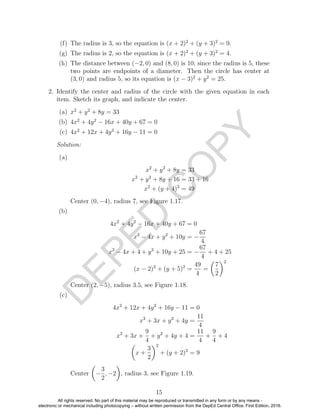
(b) center (1, 5), diameter 8
(c) circle A in Figure 1.15
(d) circle B in Figure 1.15
(e) circle C in Figure 1.15
(f) center (−2, −3), tangent to the y-
axis
(g) center (−2, −3), tangent to the x-
axis
(h) contains the points (−2, 0) and
(8, 0), radius 5
Figure 1.15
Solution:
(a) The radius is 3, so the equation is x2
+ y2
= 9.
(b) The radius is 8/2 = 4, so the equation is (x − 1)2
+ (y − 5)2
= 16.
(c) The center is (−2, 2) and the radius is 2,
so the equation is (x+2)2
+(y −2)2
= 4.
(d) The center is (2, 3) and the radius is 1,
so the equation is (x−2)2
+(y −3)2
= 1.
(e) The center is (1, −1) and by the
Pythagorean Theorem, the radius (see
Figure 1.16) is
√
22 + 22 =
√
8, so the
equation is (x − 1)2
+ (x + 1)2
= 8.
Figure 1.16
14
All rights reserved. No part of this material may be reproduced or transmitted in any form or by any means -
electronic or mechanical including photocopying – without written permission from the DepEd Central Office. First Edition, 2016.
D
EPED
C
O
PY
(f) The radius is 3, so the equation is (x + 2)2
+ (y + 3)2
= 9.
(g) The radius is 2, so the equation is (x + 2)2
+ (y + 3)2
= 4.
(h) The distance between (−2, 0) and (8, 0) is 10; since the radius is 5, these
two points are endpoints of a diameter. Then the circle has center at
(3, 0) and radius 5, so its equation is (x − 3)2
+ y2
= 25.
2. Identify the center and radius of the circle with the given equation in each
item. Sketch its graph, and indicate the center.
(a) x2
+ y2
+ 8y = 33
(b) 4x2
+ 4y2
− 16x + 40y + 67 = 0
(c) 4x2
+ 12x + 4y2
+ 16y − 11 = 0
Solution:
(a)
x2
+ y2
+ 8y = 33
x2
+ y2
+ 8y + 16 = 33 + 16
x2
+ (y + 4)2
= 49
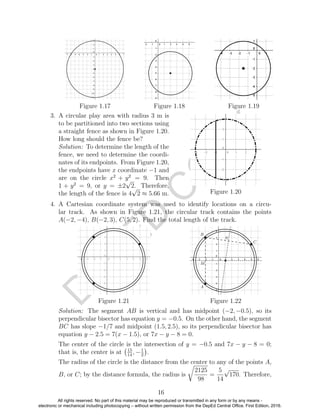
Center (0, −4), radius 7, see Figure 1.17.
(b)
4x2
+ 4y2
− 16x + 40y + 67 = 0
x2
− 4x + y2
+ 10y = −
67
4
x2
− 4x + 4 + y2
+ 10y + 25 = −
67
4
+ 4 + 25
(x − 2)2
+ (y + 5)2
=
49
4
=
7
2
2
Center (2, −5), radius 3.5, see Figure 1.18.
(c)
4x2
+ 12x + 4y2
+ 16y − 11 = 0
x2
+ 3x + y2
+ 4y =
11
4
x2
+ 3x +
9
4
+ y2
+ 4y + 4 =
11
4
+
9
4
+ 4
x +
3
2
2
+ (y + 2)2
= 9
Center −
3
2
, −2 , radius 3, see Figure 1.19.
15
All rights reserved. No part of this material may be reproduced or transmitted in any form or by any means -
electronic or mechanical including photocopying – without written permission from the DepEd Central Office. First Edition, 2016.
D
EPED
C
O
PY
Figure 1.17 Figure 1.18 Figure 1.19
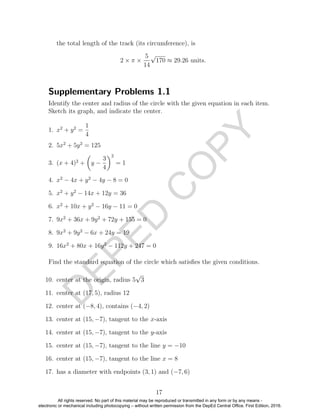
3. A circular play area with radius 3 m is
to be partitioned into two sections using
a straight fence as shown in Figure 1.20.
How long should the fence be?
Solution: To determine the length of the
fence, we need to determine the coordi-
nates of its endpoints. From Figure 1.20,
the endpoints have x coordinate −1 and
are on the circle x2
+ y2
= 9. Then
1 + y2
= 9, or y = ±2
√
2. Therefore,
the length of the fence is 4
√
2 ≈ 5.66 m. Figure 1.20
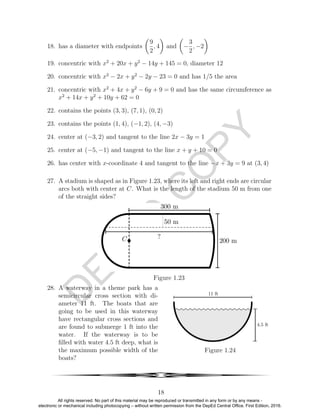
4. A Cartesian coordinate system was used to identify locations on a circu-
lar track. As shown in Figure 1.21, the circular track contains the points
A(−2, −4), B(−2, 3), C(5, 2). Find the total length of the track.
Figure 1.21 Figure 1.22
Solution: The segment AB is vertical and has midpoint (−2, −0.5), so its
perpendicular bisector has equation y = −0.5. On the other hand, the segment
BC has slope −1/7 and midpoint (1.5, 2.5), so its perpendicular bisector has
equation y − 2.5 = 7(x − 1.5), or 7x − y − 8 = 0.
The center of the circle is the intersection of y = −0.5 and 7x − y − 8 = 0;
that is, the center is at 15
14
, −1
2
.
The radius of the circle is the distance from the center to any of the points A,
B, or C; by the distance formula, the radius is
2125
98
=
5
14
√
170. Therefore,
16
All rights reserved. No part of this material may be reproduced or transmitted in any form or by any means -
electronic or mechanical including photocopying – without written permission from the DepEd Central Office. First Edition, 2016.
D
EPED
C
O
PY
the total length of the track (its circumference), is
2 × π ×
5
14
√
170 ≈ 29.26 units.
Supplementary Problems 1.1
Identify the center and radius of the circle with the given equation in each item.
Sketch its graph, and indicate the center.
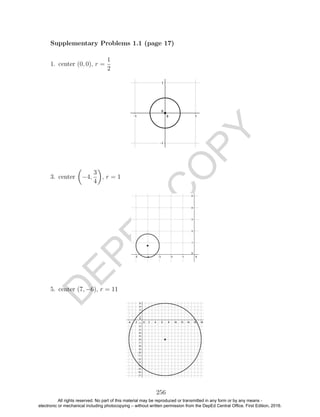
1. x2
+ y2
=
1
4
2. 5x2
+ 5y2
= 125
3. (x + 4)2
+ y −
3
4
2
= 1
4. x2
− 4x + y2
− 4y − 8 = 0
5. x2
+ y2
− 14x + 12y = 36
6. x2
+ 10x + y2
− 16y − 11 = 0
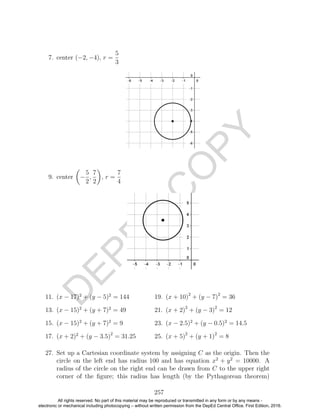
7. 9x2
+ 36x + 9y2
+ 72y + 155 = 0
8. 9x2
+ 9y2
− 6x + 24y = 19
9. 16x2
+ 80x + 16y2
− 112y + 247 = 0
Find the standard equation of the circle which satisfies the given conditions.
10. center at the origin, radius 5
√
3
11. center at (17, 5), radius 12
12. center at (−8, 4), contains (−4, 2)
13. center at (15, −7), tangent to the x-axis
14. center at (15, −7), tangent to the y-axis
15. center at (15, −7), tangent to the line y = −10
16. center at (15, −7), tangent to the line x = 8
17. has a diameter with endpoints (3, 1) and (−7, 6)
17
All rights reserved. No part of this material may be reproduced or transmitted in any form or by any means -
electronic or mechanical including photocopying – without written permission from the DepEd Central Office. First Edition, 2016.
D
EPED
C
O
PY
18. has a diameter with endpoints
9
2
, 4 and −
3
2
, −2
19. concentric with x2
+ 20x + y2
− 14y + 145 = 0, diameter 12
20. concentric with x2
− 2x + y2
− 2y − 23 = 0 and has 1/5 the area
21. concentric with x2
+ 4x + y2
− 6y + 9 = 0 and has the same circumference as
x2
+ 14x + y2
+ 10y + 62 = 0
22. contains the points (3, 3), (7, 1), (0, 2)
23. contains the points (1, 4), (−1, 2), (4, −3)
24. center at (−3, 2) and tangent to the line 2x − 3y = 1
25. center at (−5, −1) and tangent to the line x + y + 10 = 0
26. has center with x-coordinate 4 and tangent to the line −x + 3y = 9 at (3, 4)
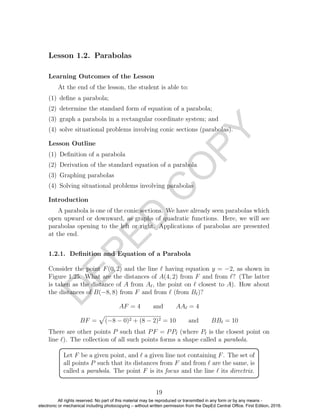
27. A stadium is shaped as in Figure 1.23, where its left and right ends are circular
arcs both with center at C. What is the length of the stadium 50 m from one
of the straight sides?
Figure 1.23
28. A waterway in a theme park has a
semicircular cross section with di-
ameter 11 ft. The boats that are
going to be used in this waterway
have rectangular cross sections and
are found to submerge 1 ft into the
water. If the waterway is to be
filled with water 4.5 ft deep, what is
the maximum possible width of the
boats?
Figure 1.24
4
18
All rights reserved. No part of this material may be reproduced or transmitted in any form or by any means -
electronic or mechanical including photocopying – without written permission from the DepEd Central Office. First Edition, 2016.
D
EPED
C
O
PY
Lesson 1.2. Parabolas
Learning Outcomes of the Lesson
At the end of the lesson, the student is able to:
(1) define a parabola;
(2) determine the standard form of equation of a parabola;
(3) graph a parabola in a rectangular coordinate system; and
(4) solve situational problems involving conic sections (parabolas).
Lesson Outline
(1) Definition of a parabola
(2) Derivation of the standard equation of a parabola
(3) Graphing parabolas
(4) Solving situational problems involving parabolas
Introduction
A parabola is one of the conic sections. We have already seen parabolas which
open upward or downward, as graphs of quadratic functions. Here, we will see
parabolas opening to the left or right. Applications of parabolas are presented
at the end.
1.2.1. Definition and Equation of a Parabola
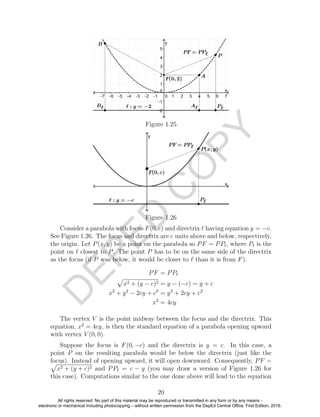
Consider the point F(0, 2) and the line having equation y = −2, as shown in
Figure 1.25. What are the distances of A(4, 2) from F and from ? (The latter
is taken as the distance of A from A , the point on closest to A). How about
the distances of B(−8, 8) from F and from (from B )?
AF = 4 and AA = 4
BF = (−8 − 0)2 + (8 − 2)2 = 10 and BB = 10
There are other points P such that PF = PP (where P is the closest point on
line ). The collection of all such points forms a shape called a parabola.
Let F be a given point, and a given line not containing F. The set of
all points P such that its distances from F and from are the same, is
called a parabola. The point F is its focus and the line its directrix.
19
All rights reserved. No part of this material may be reproduced or transmitted in any form or by any means -
electronic or mechanical including photocopying – without written permission from the DepEd Central Office. First Edition, 2016.
D
EPED
C
O
PY
Figure 1.25
Figure 1.26
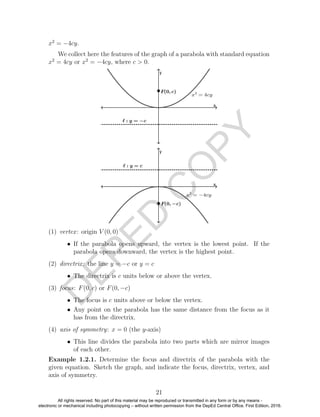
Consider a parabola with focus F(0, c) and directrix having equation y = −c.
See Figure 1.26. The focus and directrix are c units above and below, respectively,
the origin. Let P(x, y) be a point on the parabola so PF = PP , where P is the
point on closest to P. The point P has to be on the same side of the directrix
as the focus (if P was below, it would be closer to than it is from F).
PF = PP
x2 + (y − c)2 = y − (−c) = y + c
x2
+ y2
− 2cy + c2
= y2
+ 2cy + c2
x2
= 4cy
The vertex V is the point midway between the focus and the directrix. This
equation, x2
= 4cy, is then the standard equation of a parabola opening upward
with vertex V (0, 0).
Suppose the focus is F(0, −c) and the directrix is y = c. In this case, a
point P on the resulting parabola would be below the directrix (just like the
focus). Instead of opening upward, it will open downward. Consequently, PF =
x2 + (y + c)2 and PP = c − y (you may draw a version of Figure 1.26 for
this case). Computations similar to the one done above will lead to the equation
20
All rights reserved. No part of this material may be reproduced or transmitted in any form or by any means -
electronic or mechanical including photocopying – without written permission from the DepEd Central Office. First Edition, 2016.
D
EPED
C
O
PY
x2
= −4cy.
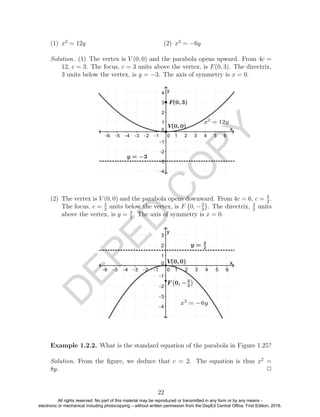
We collect here the features of the graph of a parabola with standard equation
x2
= 4cy or x2
= −4cy, where c > 0.
(1) vertex: origin V (0, 0)
• If the parabola opens upward, the vertex is the lowest point. If the
parabola opens downward, the vertex is the highest point.
(2) directrix: the line y = −c or y = c
• The directrix is c units below or above the vertex.
(3) focus: F(0, c) or F(0, −c)
• The focus is c units above or below the vertex.
• Any point on the parabola has the same distance from the focus as it
has from the directrix.
(4) axis of symmetry: x = 0 (the y-axis)
• This line divides the parabola into two parts which are mirror images
of each other.
Example 1.2.1. Determine the focus and directrix of the parabola with the
given equation. Sketch the graph, and indicate the focus, directrix, vertex, and
axis of symmetry.
21
All rights reserved. No part of this material may be reproduced or transmitted in any form or by any means -
electronic or mechanical including photocopying – without written permission from the DepEd Central Office. First Edition, 2016.
D
EPED
C
O
PY
(1) x2
= 12y (2) x2
= −6y
Solution. (1) The vertex is V (0, 0) and the parabola opens upward. From 4c =
12, c = 3. The focus, c = 3 units above the vertex, is F(0, 3). The directrix,
3 units below the vertex, is y = −3. The axis of symmetry is x = 0.
(2) The vertex is V (0, 0) and the parabola opens downward. From 4c = 6, c = 3
2
.
The focus, c = 3
2
units below the vertex, is F 0, −3
2
. The directrix, 3
2
units
above the vertex, is y = 3
2
. The axis of symmetry is x = 0.
Example 1.2.2. What is the standard equation of the parabola in Figure 1.25?
Solution. From the figure, we deduce that c = 2. The equation is thus x2
=
8y. 2
22
All rights reserved. No part of this material may be reproduced or transmitted in any form or by any means -
electronic or mechanical including photocopying – without written permission from the DepEd Central Office. First Edition, 2016.
D
EPED
C
O
PY
1.2.2. More Properties of Parabolas
The parabolas we considered so far are “vertical” and have their vertices at the
origin. Some parabolas open instead horizontally (to the left or right), and some
have vertices not at the origin. Their standard equations and properties are given
in the box. The corresponding computations are more involved, but are similar
to the one above, and so are not shown anymore.
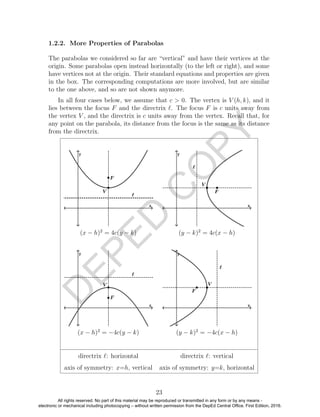
In all four cases below, we assume that c > 0. The vertex is V (h, k), and it
lies between the focus F and the directrix . The focus F is c units away from
the vertex V , and the directrix is c units away from the vertex. Recall that, for
any point on the parabola, its distance from the focus is the same as its distance
from the directrix.
(x − h)2
= 4c(y − k) (y − k)2
= 4c(x − h)
(x − h)2
= −4c(y − k) (y − k)2
= −4c(x − h)
directrix : horizontal directrix : vertical
axis of symmetry: x=h, vertical axis of symmetry: y=k, horizontal
23
All rights reserved. No part of this material may be reproduced or transmitted in any form or by any means -
electronic or mechanical including photocopying – without written permission from the DepEd Central Office. First Edition, 2016.
D
EPED
C
O
PY
Note the following observations:
• The equations are in terms of x − h and y − k: the vertex coordinates are
subtracted from the corresponding variable. Thus, replacing both h and k
with 0 would yield the case where the vertex is the origin. For instance, this
replacement applied to (x−h)2
= 4c(y −k) (parabola opening upward) would
yield x2
= 4cy, the first standard equation we encountered (parabola opening
upward, vertex at the origin).
• If the x-part is squared, the parabola is “vertical”; if the y-part is squared,
the parabola is “horizontal.” In a horizontal parabola, the focus is on the left
or right of the vertex, and the directrix is vertical.
• If the coefficient of the linear (non-squared) part is positive, the parabola
opens upward or to the right; if negative, downward or to the left.
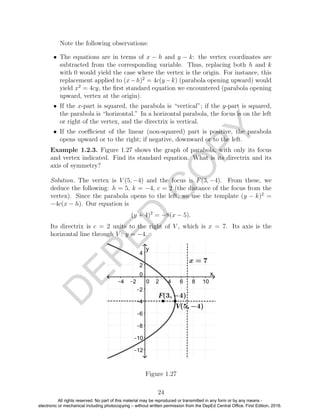
Example 1.2.3. Figure 1.27 shows the graph of parabola, with only its focus
and vertex indicated. Find its standard equation. What is its directrix and its
axis of symmetry?
Solution. The vertex is V (5, −4) and the focus is F(3, −4). From these, we
deduce the following: h = 5, k = −4, c = 2 (the distance of the focus from the
vertex). Since the parabola opens to the left, we use the template (y − k)2
=
−4c(x − h). Our equation is
(y + 4)2
= −8(x − 5).
Its directrix is c = 2 units to the right of V , which is x = 7. Its axis is the
horizontal line through V : y = −4.
Figure 1.27
24
All rights reserved. No part of this material may be reproduced or transmitted in any form or by any means -
electronic or mechanical including photocopying – without written permission from the DepEd Central Office. First Edition, 2016.
D
EPED
C
O
PY
The standard equation (y + 4)2
= −8(x − 5) from the preceding example can
be rewritten as y2
+ 8x + 8y − 24 = 0, an equation of the parabola in general
form.
If the equation is given in the general form Ax2
+Cx+Dy +E = 0 (A and C
are nonzero) or By2
+Cx+Dy+E = 0 (B and C are nonzero), we can determine
the standard form by completing the square in both variables.
Example 1.2.4. Determine the vertex, focus, directrix, and axis of symmetry
of the parabola with the given equation. Sketch the parabola, and include these
points and lines.
(1) y2
− 5x + 12y = −16
(2) 5x2
+ 30x + 24y = 51
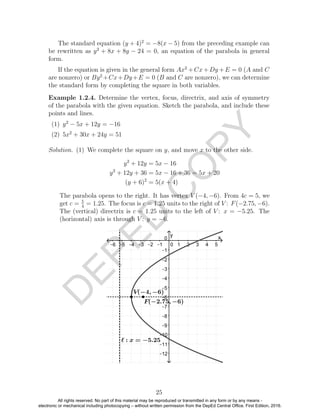
Solution. (1) We complete the square on y, and move x to the other side.
y2
+ 12y = 5x − 16
y2
+ 12y + 36 = 5x − 16 + 36 = 5x + 20
(y + 6)2
= 5(x + 4)
The parabola opens to the right. It has vertex V (−4, −6). From 4c = 5, we
get c = 5
4
= 1.25. The focus is c = 1.25 units to the right of V : F(−2.75, −6).
The (vertical) directrix is c = 1.25 units to the left of V : x = −5.25. The
(horizontal) axis is through V : y = −6.
25
All rights reserved. No part of this material may be reproduced or transmitted in any form or by any means -
electronic or mechanical including photocopying – without written permission from the DepEd Central Office. First Edition, 2016.
D
EPED
C
O
PY
(2) We complete the square on x, and move y to the other side.
5x2
+ 30x = −24y + 51
5(x2
+ 6x + 9) = −24y + 51 + 5(9)
5(x + 3)2
= −24y + 96 = −24(y − 4)
(x + 3)2
= −
24
5
(y − 4)
In the last line, we divided by 5 for the squared part not to have any coeffi-
cient. The parabola opens downward. It has vertex V (−3, 4).
From 4c = 24
5
, we get c = 6
5
= 1.2. The focus is c = 1.2 units below V :
F(−3, 2.8). The (horizontal) directrix is c = 1.2 units above V : y = 5.2. The
(vertical) axis is through V : x = −3.
Example 1.2.5. A parabola has focus F(7, 9) and directrix y = 3. Find its
standard equation.
Solution. The directrix is horizontal, and the focus is above it. The parabola
then opens upward and its standard equation has the form (x − h)2
= 4c(y − k).
Since the distance from the focus to the directrix is 2c = 9 − 3 = 6, then c = 3.
Thus, the vertex is V (7, 6), the point 3 units below F. The standard equation is
then (x − 7)2
= 12(y − 6). 2
1.2.3. Situational Problems Involving Parabolas
Let us now solve some situational problems involving parabolas.
Example 1.2.6. A satellite dish has a shape called a paraboloid, where each
cross-section is a parabola. Since radio signals (parallel to the axis) will bounce
26
All rights reserved. No part of this material may be reproduced or transmitted in any form or by any means -
electronic or mechanical including photocopying – without written permission from the DepEd Central Office. First Edition, 2016.
D
EPED
C
O
PY
off the surface of the dish to the focus, the receiver should be placed at the focus.
How far should the receiver be from the vertex, if the dish is 12 ft across, and 4.5
ft deep at the vertex?
Solution. The second figure above shows a cross-section of the satellite dish drawn
on a rectangular coordinate system, with the vertex at the origin. From the
problem, we deduce that (6, 4.5) is a point on the parabola. We need the distance
of the focus from the vertex, i.e., the value of c in x2
= 4cy.
x2
= 4cy
62
= 4c(4.5)
c =
62
4 · 4.5
= 2
Thus, the receiver should be 2 ft away from the vertex. 2
Example 1.2.7. The cable of a suspension bridge hangs in the shape of a
parabola. The towers supporting the cable are 400 ft apart and 150 ft high.
If the cable, at its lowest, is 30 ft above the bridge at its midpoint, how high is
the cable 50 ft away (horizontally) from either tower?
27
All rights reserved. No part of this material may be reproduced or transmitted in any form or by any means -
electronic or mechanical including photocopying – without written permission from the DepEd Central Office. First Edition, 2016.
D
EPED
C
O
PY
Solution. Refer to the figure above, where the parabolic cable is drawn with
its vertex on the y-axis 30 ft above the origin. We may write its equation as
(x − 0)2
= a(y − 30); since we don’t need the focal distance, we use the simpler
variable a in place of 4c. Since the towers are 150 ft high and 400 ft apart, we
deduce from the figure that (200, 150) is a point on the parabola.
x2
= a(y − 30)
2002
= a(150 − 30)
a =
2002
120
=
1000
3
The parabola has equation x2
= 1000
3
(y − 30), or equivalently,
y = 0.003x2
+ 30. For the two points on the parabola 50 ft away from the
towers, x = 150 or x = −150. If x = 150, then
y = 0.003(1502
) + 30 = 97.5.
Thus, the cable is 97.5 ft high 50 ft away from either tower. (As expected, we
get the same answer from x = −150.) 2
More Solved Examples
For Examples 1 and 2, determine the focus and directrix of the parabola with the
given equation. Sketch the graph, and indicate the focus, directrix, and vertex.
1. y2
= 20x
Solution:
Vertex: V (0, 0), opens to the right
4c = 20 ⇒ c = 5
Focus: F(5, 0), Directrix: x = −5
See Figure 1.28.
2. 3x2
= −12y
Solution: 3x2
= −12y ⇔ x2
= −4y
Vertex: V (0, 0), opens downward
4c = 4 ⇒ c = 1
Focus: F(0, −1), Directrix: y = 1
See Figure 1.29.
Figure 1.28 Figure 1.29
28
All rights reserved. No part of this material may be reproduced or transmitted in any form or by any means -
electronic or mechanical including photocopying – without written permission from the DepEd Central Office. First Edition, 2016.
D
EPED
C
O
PY
3. Determine the standard equation of the
parabola in Figure 1.30 given only its
vertex and focus. Then determine its di-
rectix and axis of symmetry.
Solution:
V −
3
2
, 4 , F(−4, 4)
c =
5
2
⇒ 4c = 10
Parabola opens to the left
Equation: (y − 4)2
= −10 x +
3
2
Directrix: x = 1, Axis: y = 4 Figure 1.30
4. Determine the standard equation of the
parabola in Figure 1.31 given only its
vertex and diretrix. Then determine its
focus and axis of symmetry.
Solution:
V 5,
13
2
, directrix: y =
15
2
c = 1 ⇒ 4c = 4
Parabola opens downward
Equation: y −
13
2
2
= −4 (x − 5)
Focus: 5,
11
2
, Axis: x = 5
Figure 1.31
For Examples 5 and 6, determine the vertex, focus, directrix, and axis of sym-
metry of the parabola with the given equation. Sketch the parabola, and include
these points and lines.
5. x2
− 6x − 2y + 9 = 0
Solution:
x2
− 6x = 2y − 9
x2
− 6x + 9 = 2y
(x − 3)2
= 2y
V (3, 0), parabola opens upward
4c = 2 ⇒ c =
1
2
, F 3,
1
2
,
directrix: y = −
1
2
, axis: x = 3
See Figure 1.32.
Figure 1.32
29
All rights reserved. No part of this material may be reproduced or transmitted in any form or by any means -
electronic or mechanical including photocopying – without written permission from the DepEd Central Office. First Edition, 2016.
D
EPED
C
O
PY
6. 3y2
+ 8x + 24y + 40 = 0
Solution:
3y2
+ 24y = −8x − 40
3(y2
+ 8y) = −8x − 40
3(y2
+ 8y + 16) = −8x − 40 + 48
3(y + 4)2
= −8x + 8
(y + 4)2
= −
8
3
(x − 1)
V (1, −4), parabola opens to the left
4c =
8
3
⇒ c =
2
3
, F
1
3
, −4 ,
directrix: x =
5
3
, axis: y = −4
See Figure 1.33.
Figure 1.33
7. A parabola has focus F(−11, 8) and directrix x = −17. Find its standard
equation.
Solution: Since the focus is 6 units to the right of the directrix, the parabola
opens to the right with 2c = 6. Then c = 3 and V (−14, 8). Hence, the
equation is (y − 8)2
= 12(x + 14).
8. A flashlight is shaped like a
paraboloid and the light source
is placed at the focus so that
the light bounces off parallel to
the axis of symmetry; this is
done to maximize illumination.
A particular flashlight has its
light source located 1 cm from
the base and is 6 cm deep; see
Figure 1.34. What is the width
of the flashlight’s opening?
Figure 1.34
Solution: Let the base (the vertex) of the flashlight be the point V (0, 0).
Then the light source (the focus) is at F(0, 1); so c = 1. Hence, the parabola’s
equation is x2
= 4y. To get the width of the opening, we need the x coordinates
of the points on the parabola with y coordinate 6.
x2
= 4(6) ⇒ x = ±2
√
6
Therefore, the width of the opening is 2 × 2
√
6 = 4
√
6 ≈ 9.8 cm.
30
All rights reserved. No part of this material may be reproduced or transmitted in any form or by any means -
electronic or mechanical including photocopying – without written permission from the DepEd Central Office. First Edition, 2016.
D
EPED
C
O
PY
9. An object thrown from a height of 2
m above the ground follows a parabolic
path until the object falls to the ground;
see Figure 1.35. If the object reaches
a maximum height (measured from the
ground) of 7 m after travelling a hor-
izontal distance of 4 m, determine the
horizontal distance between the object’s
initial and final positions.
Figure 1.35
Solution: Let V (0, 7) be the parabola’s vertex, which corresponds to the high-
est point reached by the object. Then the parabola’s equation is of the form
x2
= −4c(y − 7) and the object’s starting point is at (−4, 2). Then
(−4)2
= −4c(2 − 7) ⇒ c =
16
20
=
4
5
.
Hence, the equation of the parabola is x2
= −
16
5
(y −7). When the object hits
the ground, the y coordinate is 0 and
x2
= −
16
5
(0 − 7) =
112
5
⇒ x = ±4
7
5
.
Since this point is to the right of the vertex, we choose x = +4
7
5
. Therefore,
the total distance travelled is 4
7
5
− (−4) ≈ 8.73 m.
Supplementary Problems 1.2
Determine the vertex, focus, directrix, and axis of symmetry of the parabola with
the given equation. Sketch the graph, and include these points and lines.
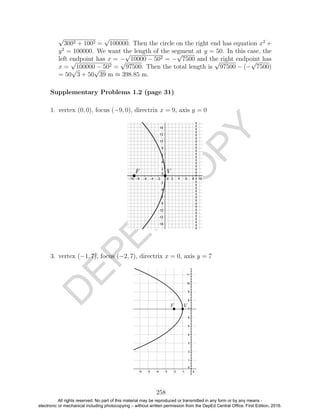
1. y2
= −36x
2. 5x2
= 100y
3. y2
+ 4x − 14y = −53
4. y2
− 2x + 2y − 1 = 0
5. 2x2
− 12x + 28y = 38
6. (3x − 2)2
= 84y − 112
31
All rights reserved. No part of this material may be reproduced or transmitted in any form or by any means -
electronic or mechanical including photocopying – without written permission from the DepEd Central Office. First Edition, 2016.
D
EPED
C
O
PY
Find the standard equation of the parabola which satisfies the given conditions.
7. vertex (7, 11), focus (16, 11)
8. vertex (−10, −5), directrix y = −1
9. focus −10,
23
2
, directrix y = −
11
2
10. focus −
3
2
, 3 , directrix x = −
37
2
11. axis of symmetry y = 9, directrix x = 24, vertex on the line 3y − 5x = 7
12. vertex (0, 7), vertical axis of symmetry, through the point P(4, 5)
13. vertex (−3, 8), horizontal axis of symmetry, through the point P(−5, 12)
14. A satellite dish shaped like a paraboloid has its receiver located at the focus.
How far is the receiver from the vertex if the dish is 10 ft across and 3 ft deep
at the center?
15. A flashlight shaped like a paraboloid has its light source at the focus located
1.5 cm from the base and is 10 cm wide at its opening. How deep is the
flashlight at its center?
16. The ends of a rope are held in place at the top of two posts, 9 m apart and
each one 8 m high. If the rope assumes a parabolic shape and touches the
ground midway between the two posts, how high is the rope 2 m from one of
the posts?
17. Radiation is focused to an unhealthy area in a patient’s body using a parabolic
reflector, positioned in such a way that the target area is at the focus. If the
reflector is 30 cm wide and 15 cm deep at the center, how far should the base
of the reflector be from the target area?
18. A rectangular object 25 m wide is to pass under a parabolic arch that has a
width of 32 m at the base and a height of 24 m at the center. If the vertex
of the parabola is at the top of the arch, what maximum height should the
rectangular object have?
4
32
All rights reserved. No part of this material may be reproduced or transmitted in any form or by any means -
electronic or mechanical including photocopying – without written permission from the DepEd Central Office. First Edition, 2016.
D
EPED
C
O
PY
Lesson 1.3. Ellipses
Learning Outcomes of the Lesson
At the end of the lesson, the student is able to:
(1) define an ellipse;
(2) determine the standard form of equation of an ellipse;
(3) graph an ellipse in a rectangular coordinate system; and
(4) solve situational problems involving conic sections (ellipses).
Lesson Outline
(1) Definition of an ellipse
(2) Derivation of the standard equation of an ellipse
(3) Graphing ellipses
(4) Solving situational problems involving ellipses
Introduction
Unlike circle and parabola, an ellipse is one of the conic sections that most stu-
dents have not encountered formally before. Its shape is a bounded curve which
looks like a flattened circle. The orbits of the planets in our solar system around
the sun happen to be elliptical in shape. Also, just like parabolas, ellipses have
reflective properties that have been used in the construction of certain structures.
These applications and more will be encountered in this lesson.
1.3.1. Definition and Equation of an Ellipse
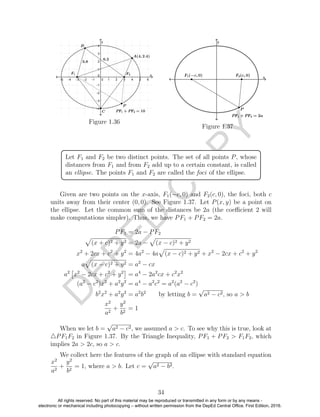
Consider the points F1(−3, 0) and F2(3, 0), as shown in Figure 1.36. What is the
sum of the distances of A(4, 2.4) from F1 and from F2? How about the sum of
the distances of B (and C(0, −4)) from F1 and from F2?
AF1 + AF2 = 7.4 + 2.6 = 10
BF1 + BF2 = 3.8 + 6.2 = 10
CF1 + CF2 = 5 + 5 = 10
There are other points P such that PF1 + PF2 = 10. The collection of all such
points forms a shape called an ellipse.
33
All rights reserved. No part of this material may be reproduced or transmitted in any form or by any means -
electronic or mechanical including photocopying – without written permission from the DepEd Central Office. First Edition, 2016.
D
EPED
C
O
PY
Figure 1.36
Figure 1.37
Let F1 and F2 be two distinct points. The set of all points P, whose
distances from F1 and from F2 add up to a certain constant, is called
an ellipse. The points F1 and F2 are called the foci of the ellipse.
Given are two points on the x-axis, F1(−c, 0) and F2(c, 0), the foci, both c
units away from their center (0, 0). See Figure 1.37. Let P(x, y) be a point on
the ellipse. Let the common sum of the distances be 2a (the coefficient 2 will
make computations simpler). Thus, we have PF1 + PF2 = 2a.
PF1 = 2a − PF2
(x + c)2 + y2 = 2a − (x − c)2 + y2
x2
+ 2cx + c2
+ y2
= 4a2
− 4a (x − c)2 + y2 + x2
− 2cx + c2
+ y2
a (x − c)2 + y2 = a2
− cx
a2
x2
− 2cx + c2
+ y2
= a4
− 2a2
cx + c2
x2
(a2
− c2
)x2
+ a2
y2
= a4
− a2
c2
= a2
(a2
− c2
)
b2
x2
+ a2
y2
= a2
b2
by letting b =
√
a2 − c2, so a > b
x2
a2
+
y2
b2
= 1
When we let b =
√
a2 − c2, we assumed a > c. To see why this is true, look at
PF1F2 in Figure 1.37. By the Triangle Inequality, PF1 + PF2 > F1F2, which
implies 2a > 2c, so a > c.
We collect here the features of the graph of an ellipse with standard equation
x2
a2
+
y2
b2
= 1, where a > b. Let c =
√
a2 − b2.
34
All rights reserved. No part of this material may be reproduced or transmitted in any form or by any means -
electronic or mechanical including photocopying – without written permission from the DepEd Central Office. First Edition, 2016.
D
EPED
C
O
PY
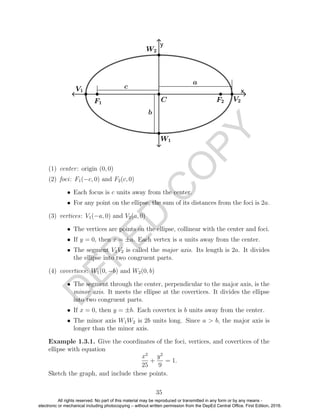
(1) center: origin (0, 0)
(2) foci: F1(−c, 0) and F2(c, 0)
• Each focus is c units away from the center.
• For any point on the ellipse, the sum of its distances from the foci is 2a.
(3) vertices: V1(−a, 0) and V2(a, 0)
• The vertices are points on the ellipse, collinear with the center and foci.
• If y = 0, then x = ±a. Each vertex is a units away from the center.
• The segment V1V2 is called the major axis. Its length is 2a. It divides
the ellipse into two congruent parts.
(4) covertices: W1(0, −b) and W2(0, b)
• The segment through the center, perpendicular to the major axis, is the
minor axis. It meets the ellipse at the covertices. It divides the ellipse
into two congruent parts.
• If x = 0, then y = ±b. Each covertex is b units away from the center.
• The minor axis W1W2 is 2b units long. Since a > b, the major axis is
longer than the minor axis.
Example 1.3.1. Give the coordinates of the foci, vertices, and covertices of the
ellipse with equation
x2
25
+
y2
9
= 1.
Sketch the graph, and include these points.
35
All rights reserved. No part of this material may be reproduced or transmitted in any form or by any means -
electronic or mechanical including photocopying – without written permission from the DepEd Central Office. First Edition, 2016.
D
EPED
C
O
PY
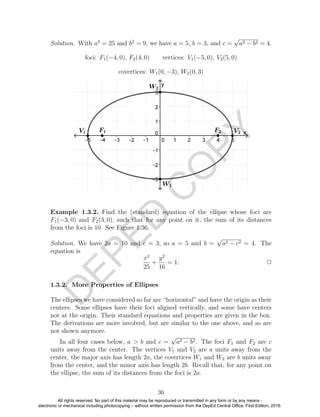
Solution. With a2
= 25 and b2
= 9, we have a = 5, b = 3, and c =
√
a2 − b2 = 4.
foci: F1(−4, 0), F2(4, 0) vertices: V1(−5, 0), V2(5, 0)
covertices: W1(0, −3), W2(0, 3)
Example 1.3.2. Find the (standard) equation of the ellipse whose foci are
F1(−3, 0) and F2(3, 0), such that for any point on it, the sum of its distances
from the foci is 10. See Figure 1.36.
Solution. We have 2a = 10 and c = 3, so a = 5 and b =
√
a2 − c2 = 4. The
equation is
x2
25
+
y2
16
= 1. 2
1.3.2. More Properties of Ellipses
The ellipses we have considered so far are “horizontal” and have the origin as their
centers. Some ellipses have their foci aligned vertically, and some have centers
not at the origin. Their standard equations and properties are given in the box.
The derivations are more involved, but are similar to the one above, and so are
not shown anymore.
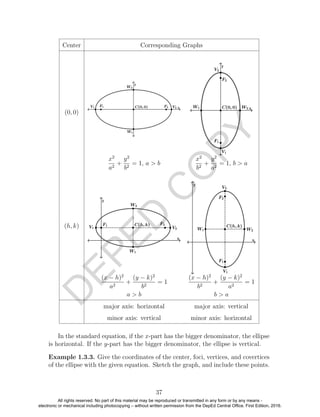
In all four cases below, a > b and c =
√
a2 − b2. The foci F1 and F2 are c
units away from the center. The vertices V1 and V2 are a units away from the
center, the major axis has length 2a, the covertices W1 and W2 are b units away
from the center, and the minor axis has length 2b. Recall that, for any point on
the ellipse, the sum of its distances from the foci is 2a.
36
All rights reserved. No part of this material may be reproduced or transmitted in any form or by any means -
electronic or mechanical including photocopying – without written permission from the DepEd Central Office. First Edition, 2016.
D
EPED
C
O
PY
Center Corresponding Graphs
(0, 0)
x2
a2
+
y2
b2
= 1, a > b
x2
b2
+
y2
a2
= 1, b > a
(h, k)
(x − h)2
a2
+
(y − k)2
b2
= 1
(x − h)2
b2
+
(y − k)2
a2
= 1
a > b b > a
major axis: horizontal major axis: vertical
minor axis: vertical minor axis: horizontal
In the standard equation, if the x-part has the bigger denominator, the ellipse
is horizontal. If the y-part has the bigger denominator, the ellipse is vertical.
Example 1.3.3. Give the coordinates of the center, foci, vertices, and covertices
of the ellipse with the given equation. Sketch the graph, and include these points.
37
All rights reserved. No part of this material may be reproduced or transmitted in any form or by any means -
electronic or mechanical including photocopying – without written permission from the DepEd Central Office. First Edition, 2016.
D
EPED
C
O
PY
(1)
(x + 3)2
24
+
(y − 5)2
49
= 1
(2) 9x2
+ 16y2
− 126x + 64y = 71
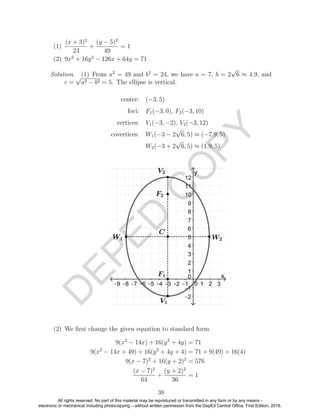
Solution. (1) From a2
= 49 and b2
= 24, we have a = 7, b = 2
√
6 ≈ 4.9, and
c =
√
a2 − b2 = 5. The ellipse is vertical.
center: (−3, 5)
foci: F1(−3, 0), F2(−3, 10)
vertices: V1(−3, −2), V2(−3, 12)
covertices: W1(−3 − 2
√
6, 5) ≈ (−7.9, 5)
W2(−3 + 2
√
6, 5) ≈ (1.9, 5)
(2) We first change the given equation to standard form.
9(x2
− 14x) + 16(y2
+ 4y) = 71
9(x2
− 14x + 49) + 16(y2
+ 4y + 4) = 71 + 9(49) + 16(4)
9(x − 7)2
+ 16(y + 2)2
= 576
(x − 7)2
64
+
(y + 2)2
36
= 1
38
All rights reserved. No part of this material may be reproduced or transmitted in any form or by any means -
electronic or mechanical including photocopying – without written permission from the DepEd Central Office. First Edition, 2016.
D
EPED
C
O
PY
We have a = 8 and b = 6. Thus, c =
√
a2 − b2 = 2
√
7 ≈ 5.3. The ellipse is
horizontal.
center: (7, −2)
foci: F1(7 − 2
√
7, −2) ≈ (1.7, −2)
F2(7 + 2
√
7, −2) ≈ (12.3, −2)
vertices: V1(−1, −2), V2(15, −2)
covertices: W1(7, −8), W2(7, 4)
Example 1.3.4. The foci of an ellipse are (−3, −6) and (−3, 2). For any point
on the ellipse, the sum of its distances from the foci is 14. Find the standard
equation of the ellipse.
Solution. The midpoint (−3, −2) of the foci is the center of the ellipse. The
ellipse is vertical (because the foci are vertically aligned) and c = 4. From the
given sum, 2a = 14 so a = 7. Also, b =
√
a2 − c2 =
√
33. The equation is
(x + 3)2
33
+
(y + 2)2
49
= 1. 2
Example 1.3.5. An ellipse has vertices (2 −
√
61, −5) and (2 +
√
61, −5), and
its minor axis is 12 units long. Find its standard equation and its foci.
39
All rights reserved. No part of this material may be reproduced or transmitted in any form or by any means -
electronic or mechanical including photocopying – without written permission from the DepEd Central Office. First Edition, 2016.
D
EPED
C
O
PY
Solution. The midpoint (2, −5) of the vertices is the center of the ellipse, which is
horizontal. Each vertex is a =
√
61 units away from the center. From the length of
the minor axis, 2b = 12 so b = 6. The standard equation is
(x − 2)2
61
+
(y + 5)2
36
=
1. Each focus is c =
√
a2 − b2 = 5 units away from (2, −5), so their coordinates
are (−3, −5) and (7, −5). 2
1.3.3. Situational Problems Involving Ellipses
Let us now apply the concept of ellipse to some situational problems.
Example 1.3.6. A tunnel has the shape of a semiellipse that is 15 ft high at
the center, and 36 ft across at the base. At most how high should a passing truck
be, if it is 12 ft wide, for it to be able to fit through the tunnel? Round off your
answer to two decimal places.
Solution. Refer to the figure above. If we draw the semiellipse on a rectangular
coordinate system, with its center at the origin, an equation of the ellipse which
contains it, is
x2
182
+
y2
152
= 1.
To maximize its height, the corners of the truck, as shown in the figure, would
have to just touch the ellipse. Since the truck is 12 ft wide, let the point (6, n)
be the corner of the truck in the first quadrant, where n > 0, is the (maximum)
height of the truck. Since this point is on the ellipse, it should fit the equation.
Thus, we have
62
182
+
n2
152
= 1
n = 10
√
2 ≈ 14.14 ft 2
40
All rights reserved. No part of this material may be reproduced or transmitted in any form or by any means -
electronic or mechanical including photocopying – without written permission from the DepEd Central Office. First Edition, 2016.
D
EPED
C
O
PY
Example 1.3.7. The orbit of a planet has the shape of an ellipse, and on one
of the foci is the star around which it revolves. The planet is closest to the star
when it is at one vertex. It is farthest from the star when it is at the other vertex.
Suppose the closest and farthest distances of the planet from this star, are 420
million kilometers and 580 million kilometers, respectively. Find the equation of
the ellipse, in standard form, with center at the origin and the star at the x-axis.
Assume all units are in millions of kilometers.
Solution. In the figure above, the orbit is drawn as a horizontal ellipse with
center at the origin. From the planet’s distances from the star, at its closest
and farthest points, it follows that the major axis is 2a = 420 + 580 = 1000
(million kilometers), so a = 500. If we place the star at the positive x-axis,
then it is c = 500 − 420 = 80 units away from the center. Therefore, we get
b2
= a2
− c2
= 5002
− 802
= 243600. The equation then is
x2
250000
+
y2
243600
= 1.
The star could have been placed on the negative x-axis, and the answer would
still be the same. 2
41
All rights reserved. No part of this material may be reproduced or transmitted in any form or by any means -
electronic or mechanical including photocopying – without written permission from the DepEd Central Office. First Edition, 2016.
D
EPED
C
O
PY
More Solved Examples
1. Give the coordinates of the foci, vertices,
and covertices of the ellipse with equa-
tion
x2
169
+
y2
144
= 1. Then sketch the
graph and include these points.
Solution: The ellipse is horizontal.
a2
= 169 ⇒ a = 13, b2
= 144 ⇒ b = 12,
c =
√
169 − 144 = 5
Foci: F1(−5, 0), F2(5, 0)
Vertices: V1(−13, 0), V2(13, 0)
Covertices: W1(0, −12), W2(0, 12)
See Figure 1.38. Figure 1.38
2. Find the standard equation of the ellipse whose foci are F1(0, −8) and F2(0, 8),
such that for any point on it, the sum of its distances from the foci is 34.
Solution: The ellipse is vertical and has center at (0, 0).
2a = 34 ⇒ a = 17
c = 8 ⇒ b =
√
172 − 82 = 15
The equation is
x2
225
+
y2
289
= 1.
For Examples 3 and 4, give the coordinates of the center, foci, vertices, and
covertices of the ellipse with the given equation. Sketch the graph, and include
these points.
3.
(x − 7)2
64
+
(y + 2)2
25
= 1
Solution: The ellipse is horizontal.
a2
= 64 ⇒ a = 8, b2
= 25 ⇒ b = 5
c =
√
64 − 25 =
√
39 ≈ 6.24
center: (7, −2)
foci: F1(7 −
√
39, −2) ≈ (0.76, −2)
F2(7 +
√
39, −2) ≈ (13.24, −2)
vertices: V1(−1, −2), V2(15, −2)
covertices: W1(7, −7), W2(7, 3)
See Figure 1.39.
Figure 1.39
42
All rights reserved. No part of this material may be reproduced or transmitted in any form or by any means -
electronic or mechanical including photocopying – without written permission from the DepEd Central Office. First Edition, 2016.
D
EPED
C
O
PY
4. 16x2
+ 96x + 7y2
+ 14y + 39 = 0
Solution:
16x2
+ 96x + 7y2
+ 14y = −39
16(x2
+ 6x + 9) + 7(y2
+ 2y + 1) = −39 + 151
16(x + 3)2
+ 7(y + 1)2
= 112
(x + 3)2
7
+
(y + 1)2
16
= 1
The ellipse is vertical.
a2
= 16 ⇒ a = 4, b2
= 7 ⇒ b =
√
7 ≈
2.65
c =
√
16 − 7 = 3
center: (−3, −1)
foci: F1(−3, −4), F2(−3, 2)
vertices: V1(−3, −5), V2(−3, 3)
covertices: W1(−3 −
√
7, −1) ≈ (−5.65, −1)
W2(−3 +
√
7, −1) ≈ (−0.35, −1)
See Figure 1.40.
Figure 1.40
5. The covertices of an ellipse are (5, 6) and (5, 8). For any point on the ellipse,
the sum of its distances from the foci is 12. Find the standard equation of the
ellipse.
Solution: The ellipse is horizontal with center at the midpoint (5, 7) of the
covertices. Also, 2a = 12 so a = 6 while b = 1. The equation is
(x − 5)2
36
+
(y − 7)2
1
= 1.
6. An ellipse has foci (−4 −
√
15, 3) and (−4 +
√
15, 3), and its major axis is 10
units long. Find its standard equation and its vertices.
Solution: The ellipse is horizontal with center at the midpoint (−4, 3) of the
foci; also c =
√
15. Since the length of the major axis is 10, 2a = 10 and
a = 5. Thus b =
√
52 − 15 =
√
10. Therefore, the equation of the ellipse is
(x + 4)2
25
+
(y − 3)2
10
= 1 and its vertices are (−9, 3) and (1, 3).
7. A whispering gallery is an enclosure or room where whispers can be clearly
heard in some parts of the gallery. Such a gallery can be constructed by
making its ceiling in the shape of a semi-ellipse; in this case, a whisper from
one focus can be clearly heard at the other focus. If an elliptical whispering
43
All rights reserved. No part of this material may be reproduced or transmitted in any form or by any means -
electronic or mechanical including photocopying – without written permission from the DepEd Central Office. First Edition, 2016.
D
EPED
C
O
PY
gallery is 90 feet long and the foci are 50 feet apart, how high is the gallery at
its center?
Solution: We set up a Cartesian coordinate system by assigning the center of
the semiellipse as the origin. The point on the ceiling right above the center is a
covertex of the ellipse. Since 2a = 90 and 2c = 50; then b2
= 452
−252
= 1400.
The height is given by b =
√
1400 ≈ 37.4 ft.
8. A spheroid (or oblate spheroid) is the surface obtained by rotating an ellipse
around its minor axis. The bowl in Figure 1.41 is in the shape of the lower half
of a spheroid; that is, its horizontal cross sections are circles while its vertical
cross sections that pass through the center are semiellipses. If this bowl is 10
in wide at the opening and
√
10 in deep at the center, how deep does a circular
cover with diameter 9 in go into the bowl?
Figure 1.41
Solution: We set up a Cartesian coordinate system by assigning the center
of the semiellipse as the origin. Then a = 5, b =
√
10, and the equation of
the ellipse is x2
25
+ y2
10
= 1. We want the y-coordinate of the points on the
ellipse that has x = ±4.5. This coordinate is y = − 10 1 − x2
25
≈ −1.38.
Therefore, the cover will go 1.38 inches into the bowl.
44
All rights reserved. No part of this material may be reproduced or transmitted in any form or by any means -
electronic or mechanical including photocopying – without written permission from the DepEd Central Office. First Edition, 2016.
D
EPED
C
O
PY
Supplementary Problems 1.3
Give the coordinates of the center, foci, vertices, and covertices of the ellipse with
the given equation. Sketch the graph, and include these points.
1.
x2
8
+
y2
4
= 1
2.
x2
16
+
(y − 2)2
25
= 1
3. (x − 1)2
+ (2y − 2)2
= 4
4.
(x + 5)2
49
+
(y − 2)2
121
= 1
5. 16x2
− 224x + 25y2
+ 250y − 191 = 0
6. 25x2
− 200x + 16y2
− 160y = 800
Find the standard equation of the ellipse which satisfies the given conditions.
7. foci (2 −
√
33, 8) and (2 +
√
33, 8), the sum of the distances of any point from
the foci is 14
8. center (−3, −7), vertical major axis of length 20, minor axis of length 12
9. foci (−21, 10) and (3, 10), contains the point (−9, 15)
10. a vertex at (−3, −18) and a covertex at (−12, −7), major axis is either hori-
zontal or vertical
11. a focus at (−9, 15) and a covertex at (1, 10), with vertical major axis
12. A 40-ft wide tunnel has the shape of a semiellipse that is 5 ft high a distance
of 2 ft from either end. How high is the tunnel at its center?
13. The moon’s orbit is an ellipse with Earth as one focus. If the maximum
distance from the moon to Earth is 405 500 km and the minimum distance is
363 300 km, find the equation of the ellipse in a Cartesian coordinate system
where Earth is at the origin. Assume that the ellipse has horizontal major
axis and that the minimum distance is achieved when the moon is to the right
of Earth. Use 100 km as one unit.
14. Two friends visit a whispering gallery (in the shape of a semiellipsoid) where
they stand 100 m apart to be at the foci. If one of them is 6 m from the
nearest wall, how high is the gallery at its center?
45
All rights reserved. No part of this material may be reproduced or transmitted in any form or by any means -
electronic or mechanical including photocopying – without written permission from the DepEd Central Office. First Edition, 2016.
D
EPED
C
O
PY
15. A jogging path is in the shape of an ellipse. If it is 120 ft long and 40 ft wide,
what is the width of the track 15 ft from either vertex?
16. Radiation is focused to an unhealthy area in a patient’s body using a semiel-
liptic reflector, positioned in such a way that the target area is at one focus
while the source of radiation is at the other. If the reflector is 100 cm wide
and 30 cm high at the center, how far should the radiation source and the
target area be from the ends of the reflector?
4
Lesson 1.4. Hyperbolas
Learning Outcomes of the Lesson
At the end of the lesson, the student is able to:
(1) define a hyperbola;
(2) determine the standard form of equation of a hyperbola;
(3) graph a hyperbola in a rectangular coordinate system; and
(4) solve situational problems involving conic sections (hyperbolas).
Lesson Outline
(1) Definition of a hyperbola
(2) Derivation of the standard equation of a hyperbola
(3) Graphing hyperbolas
(4) Solving situational problems involving hyperbolas
Introduction
Just like ellipse, a hyperbola is one of the conic sections that most students
have not encountered formally before. Its graph consists of two unbounded
branches which extend in opposite directions. It is a misconception that each
branch is a parabola. This is not true, as parabolas and hyperbolas have very
different features. An application of hyperbolas in basic location and navigation
schemes are presented in an example and some exercises.
1.4.1. Definition and Equation of a Hyperbola
Consider the points F1(−5, 0) and F2(5, 0) as shown in Figure 1.42. What is the
absolute value of the difference of the distances of A(3.75, −3) from F1 and from
46
All rights reserved. No part of this material may be reproduced or transmitted in any form or by any means -
electronic or mechanical including photocopying – without written permission from the DepEd Central Office. First Edition, 2016.
D
EPED
C
O
PY
F2? How about the absolute value of the difference of the distances of B −5, 16
3
from F1 and from F2?
|AF1 − AF2| = |9.25 − 3.25| = 6
|BF1 − BF2| =
16
3
−
34
3
= 6
There are other points P such that |PF1 − PF2| = 6. The collection of all such
points forms a shape called a hyperbola, which consists of two disjoint branches.
For points P on the left branch, PF2 − PF1 = 6; for those on the right branch,
PF1 − PF2 = 6.
Figure 1.42
Figure 1.43
47
All rights reserved. No part of this material may be reproduced or transmitted in any form or by any means -
electronic or mechanical including photocopying – without written permission from the DepEd Central Office. First Edition, 2016.
D
EPED
C
O
PY
Let F1 and F2 be two distinct points. The set of all points P, whose
distances from F1 and from F2 differ by a certain constant, is called a
hyperbola. The points F1 and F2 are called the foci of the hyperbola.
In Figure 1.43, given are two points on the x-axis, F1(−c, 0) and F2(c, 0), the
foci, both c units away from their midpoint (0, 0). This midpoint is the center
of the hyperbola. Let P(x, y) be a point on the hyperbola, and let the absolute
value of the difference of the distances of P from F1 and F2, be 2a (the coefficient
2 will make computations simpler). Thus, |PF1 − PF2| = 2a, and so
(x + c)2 + y2 − (x − c)2 + y2 = 2a.
Algebraic manipulations allow us to rewrite this into the much simpler
x2
a2
−
y2
b2
= 1, where b =
√
c2 − a2.
When we let b =
√
c2 − a2, we assumed c > a. To see why this is true, suppose
that P is closer to F2, so PF1 − PF2 = 2a. Refer to Figure 1.43. Suppose also
that P is not on the x-axis, so PF1F2 is formed. From the triangle inequality,
F1F2 + PF2 > PF1. Thus, 2c > PF1 − PF2 = 2a, so c > a.
Now we present a derivation. For now, assume P is closer to F2 so PF1 > PF2,
and PF1 − PF2 = 2a.
PF1 = 2a + PF2
(x + c)2 + y2 = 2a + (x − c)2 + y2
(x + c)2 + y2
2
= 2a + (x − c)2 + y2
2
cx − a2
= a (x − c)2 + y2
(cx − a2
)2
= a (x − c)2 + y2
2
(c2
− a2
)x2
− a2
y2
= a2
(c2
− a2
)
b2
x2
− a2
y2
= a2
b2
by letting b =
√
c2 − a2 > 0
x2
a2
−
y2
b2
= 1
We collect here the features of the graph of a hyperbola with standard equa-
tion
x2
a2
−
y2
b2
= 1.
Let c =
√
a2 + b2.
48
All rights reserved. No part of this material may be reproduced or transmitted in any form or by any means -
electronic or mechanical including photocopying – without written permission from the DepEd Central Office. First Edition, 2016.
D
EPED
C
O
PY
Figure 1.44 Figure 1.45
(1) center: origin (0, 0)
(2) foci: F1(−c, 0) and F2(c, 0)
• Each focus is c units away from the center.
• For any point on the hyperbola, the absolute value of the difference of
its distances from the foci is 2a.
(3) vertices: V1(−a, 0) and V2(a, 0)
• The vertices are points on the hyperbola, collinear with the center and
foci.
• If y = 0, then x = ±a. Each vertex is a units away from the center.
• The segment V1V2 is called the transverse axis. Its length is 2a.
(4) asymptotes: y = b
a
x and y = −b
a
x, the lines 1 and 2 in Figure 1.45
• The asymptotes of the hyperbola are two lines passing through the cen-
ter which serve as a guide in graphing the hyperbola: each branch of
the hyperbola gets closer and closer to the asymptotes, in the direction
towards which the branch extends. (We need the concept of limits from
calculus to explain this.)
• An aid in determining the equations of the asymptotes: in the standard
equation, replace 1 by 0, and in the resulting equation x2
a2 − y2
b2 = 0, solve
for y.
• To help us sketch the asymptotes, we point out that the asymptotes
1 and 2 are the extended diagonals of the auxiliary rectangle drawn
in Figure 1.45. This rectangle has sides 2a and 2b with its diagonals
intersecting at the center C. Two sides are congruent and parallel to
the transverse axis V1V2. The other two sides are congruent and parallel
49
All rights reserved. No part of this material may be reproduced or transmitted in any form or by any means -
electronic or mechanical including photocopying – without written permission from the DepEd Central Office. First Edition, 2016.
D
EPED
C
O
PY
to the conjugate axis, the segment shown which is perpendicular to the
transverse axis at the center, and has length 2b.
Example 1.4.1. Determine the foci, vertices, and asymptotes of the hyperbola
with equation
x2
9
−
y2
7
= 1.
Sketch the graph, and include these points and lines, the transverse and conjugate
axes, and the auxiliary rectangle.
Solution. With a2
= 9 and b2
= 7, we have
a = 3, b =
√
7, and c =
√
a2 + b2 = 4.
foci: F1(−4, 0) and F2(4, 0)
vertices: V1(−3, 0) and V2(3, 0)
asymptotes: y =
√
7
3
x and y = −
√
7
3
x
The graph is shown at the right. The conju-
gate axis drawn has its endpoints b =
√
7 ≈
2.7 units above and below the center. 2
Example 1.4.2. Find the (standard) equation of the hyperbola whose foci are
F1(−5, 0) and F2(5, 0), such that for any point on it, the absolute value of the
difference of its distances from the foci is 6. See Figure 1.42.
Solution. We have 2a = 6 and c = 5, so a = 3 and b =
√
c2 − a2 = 4. The
hyperbola then has equation
x2
9
−
y2
16
= 1. 2
1.4.2. More Properties of Hyperbolas
The hyperbolas we considered so far are “horizontal” and have the origin as their
centers. Some hyperbolas have their foci aligned vertically, and some have centers
not at the origin. Their standard equations and properties are given in the box.
The derivations are more involved, but are similar to the one above, and so are
not shown anymore.
In all four cases below, we let c =
√
a2 + b2. The foci F1 and F2 are c units
away from the center C. The vertices V1 and V2 are a units away from the center.
The transverse axis V1V2 has length 2a. The conjugate axis has length 2b and is
perpendicular to the transverse axis. The transverse and conjugate axes bisect
each other at their intersection point, C. Each branch of a hyperbola gets closer
and closer to the asymptotes, in the direction towards which the branch extends.
The equations of the asymptotes can be determined by replacing 1 in the standard
equation by 0. The asymptotes can be drawn as the extended diagonals of the
auxiliary rectangle determined by the transverse and conjugate axes. Recall that,
50
All rights reserved. No part of this material may be reproduced or transmitted in any form or by any means -
electronic or mechanical including photocopying – without written permission from the DepEd Central Office. First Edition, 2016.
D
EPED
C
O
PY
for any point on the hyperbola, the absolute value of the difference of its distances
from the foci is 2a.
Center Corresponding Hyperbola
(0, 0)
x2
a2
−
y2
b2
= 1
y2
a2
−
x2
b2
= 1
(h, k)
(x − h)2
a2
−
(y − k)2
b2
= 1
(y − k)2
a2
−
(x − h)2
b2
= 1
transverse axis: horizontal transverse axis: vertical
conjugate axis: vertical conjugate axis: horizontal
In the standard equation, aside from being positive, there are no other re-
strictions on a and b. In fact, a and b can even be equal. The orientation of the
hyperbola is determined by the variable appearing in the first term (the positive
term): the corresponding axis is where the two branches will open. For example,
if the variable in the first term is x, the hyperbola is “horizontal”: the transverse
51
All rights reserved. No part of this material may be reproduced or transmitted in any form or by any means -
electronic or mechanical including photocopying – without written permission from the DepEd Central Office. First Edition, 2016.
D
EPED
C
O
PY
axis is horizontal, and the branches open to the left and right in the direction of
the x-axis.
Example 1.4.3. Give the coordinates of the center, foci, vertices, and asymp-
totes of the hyperbola with the given equation. Sketch the graph, and include
these points and lines, the transverse and conjugate axes, and the auxiliary rect-
angle.
(1)
(y + 2)2
25
−
(x − 7)2
9
= 1
(2) 4x2
− 5y2
+ 32x + 30y = 1
Solution. (1) From a2
= 25 and b2
= 9, we have a = 5, b = 3, and c =√
a2 + b2 =
√
34 ≈ 5.8. The hyperbola is vertical. To determine the asymp-
totes, we write (y+2)2
25
− (x−7)2
9
= 0, which is equivalent to y + 2 = ±5
3
(x − 7).
We can then solve this for y.
center: C(7, −2)
foci: F1(7, −2 −
√
34) ≈ (7, −7.8) and F2(7, −2 +
√
34) ≈ (7, 3.8)
vertices: V1(7, −7) and V2(7, 3)
asymptotes: y = 5
3
x − 41
3
and y = −5
3
x + 29
3
The conjugate axis drawn has its endpoints b = 3 units to the left and right
of the center.
52
All rights reserved. No part of this material may be reproduced or transmitted in any form or by any means -
electronic or mechanical including photocopying – without written permission from the DepEd Central Office. First Edition, 2016.
D
EPED
C
O
PY
(2) We first change the given equation to standard form.
4(x2
+ 8x) − 5(y2
− 6y) = 1
4(x2
+ 8x + 16) − 5(y2
− 6y + 9) = 1 + 4(16) − 5(9)
4(x + 4)2
− 5(y − 3)2
= 20
(x + 4)2
5
−
(y − 3)2
4
= 1
We have a =
√
5 ≈ 2.2 and b = 2. Thus, c =
√
a2 + b2 = 3. The hyperbola
is horizontal. To determine the asymptotes, we write (x+4)2
5
− (y−3)2
4
= 0
which is equivalent to y − 3 = ± 2√
5
(x + 4), and solve for y.
center: C(−4, 3)
foci: F1(−7, 3) and F2(−1, 3)
vertices: V1(−4 −
√
5, 3) ≈ (−6.2, 3) and V2(−4 +
√
5, 3) ≈ (−1.8, 3)
asymptotes: y = 2√
5
x + 8√
5
+ 3 and y = − 2√
5
x − 8√
5
+ 3
The conjugate axis drawn has its endpoints b = 2 units above and below
the center.
Example 1.4.4. The foci of a hyperbola are (−5, −3) and (9, −3). For any point
on the hyperbola, the absolute value of the difference of its of its distances from
the foci is 10. Find the standard equation of the hyperbola.
53
All rights reserved. No part of this material may be reproduced or transmitted in any form or by any means -
electronic or mechanical including photocopying – without written permission from the DepEd Central Office. First Edition, 2016.
D
EPED
C
O
PY
Solution. The midpoint (2, −3) of the foci is the center of the hyperbola. Each
focus is c = 7 units away from the center. From the given difference, 2a = 10 so
a = 5. Also, b2
= c2
− a2
= 24. The hyperbola is horizontal (because the foci are
horizontally aligned), so the equation is
(x − 2)2
25
−
(y + 3)2
24
= 1. 2
Example 1.4.5. A hyperbola has vertices (−4, −5) and (−4, 9), and one of its
foci is (−4, 2 −
√
65). Find its standard equation.
Solution. The midpoint (−4, 2) of the vertices is the center of the hyperbola,
which is vertical (because the vertices are vertically aligned). Each vertex is
a = 7 units away from the center. The given focus is c =
√
65 units away from
the center. Thus, b2
= c2
− a2
= 16, and the standard equation is
(y − 2)2
49
−
(x + 4)2
16
= 1. 2
1.4.3. Situational Problems Involving Hyperbolas
Let us now give an example on an application of hyperbolas.
Example 1.4.6. An explosion was heard by two stations 1200 m apart, located
at F1(−600, 0) and F2(600, 0). If the explosion was heard in F1 two seconds before
it was heard in F2, identify the possible locations of the explosion. Use 340 m/s
as the speed of sound.
Solution. Using the given speed of sound, we can deduce that the sound traveled
340(2) = 680 m farther in reaching F2 than in reaching F1. This is then the
difference of the distances of the explosion from the two stations. Thus, the
explosion is on a hyperbola with foci are F1 and F2, on the branch closer to F1.
54
All rights reserved. No part of this material may be reproduced or transmitted in any form or by any means -
electronic or mechanical including photocopying – without written permission from the DepEd Central Office. First Edition, 2016.
D
EPED
C
O
PY
We have c = 600 and 2a = 680, so a = 340 and b2
= c2
− a2
= 244400.
The explosion could therefore be anywhere on the left branch of the hyperbola
x2
115600
− y2
244400
= 1. 2
More Solved Examples
1. Determine the foci, vertices, and asymptotes of the hyperbola with equation
x2
16
−
y2
33
= 1. Sketch the graph, and include these points and lines, the
transverse and conjugate axes, and the auxiliary rectangle.
Solution: The hyperbola is horizontal.
a2
= 16 ⇒ a = 4,
b2
= 33 ⇒ b =
√
33,
c =
√
16 + 33 = 7
center: (0, 0)
foci: F1(−7, 0), F2(7, 0)
vertices: V1(−4, 0), V2(4, 0)
asymptotes: y =
√
33
4
x, y = −
√
33
4
x
The conjugate axis has endpoints
(0, −
√
33) and (0,
√
33). See Figure
1.46.
Figure 1.46
2. Find the standard equation of the hyperbola whose foci are F1(0, −10) and
F2(0, 10), such that for any point on it, the absolute value of the difference of
its distances from the foci is 12.
Solution: The hyperbola is vertical and has center at (0, 0). We have 2a = 12,
so a = 6; also, c = 10. Then b =
√
102 − 62 = 8. The equation is
y2
36
−
x2
64
= 1.
For Examples 3 and 4, give the coordinates of the center, foci, vertices, and
asymptotes of the hyperbola with the given equation. Sketch the graph, and in-
clude these points and lines, the transverse and conjugate axes, and the auxiliary
rectangle.
3.
(y + 6)2
25
−
(x − 4)2
39
= 1
Solution: The hyperbola is vertical.
a2
= 25 ⇒ a = 5, b2
= 39 ⇒ b =
√
39, c =
√
25 + 39 = 8
55
All rights reserved. No part of this material may be reproduced or transmitted in any form or by any means -
electronic or mechanical including photocopying – without written permission from the DepEd Central Office. First Edition, 2016.
D
EPED
C
O
PY
center: (4, −6)
foci: F1(4, −14), F2(4, 2)
vertices: V1(4, −11), V2(4, −1)
asymptotes:
(y + 6)2
25
−
(x − 4)2
39
= 0
⇔ y + 6 = ±
5
√
39
(x − 4)
The conjugate axis has endpoints b =
√
39 units to the left and to the right of
the center. See Figure 1.47.
Figure 1.47
4. 9x2
+ 126x − 16y2
− 96y + 153 = 0
Solution:
9x2
+ 126x − 16y2
− 96y = −153
9(x2
+ 14x + 49) − 16(y2
+ 6y + 9) = −153 + 9(49) − 16(9)
9(x + 7)2
− 16(y + 3)2
= 144
(x + 7)2
16
−
(y + 3)2
9
= 1
The hyperbola is horizontal.
a2
= 16 ⇒ a = 4, b2
= 9 ⇒ b = 3, c =
√
16 + 9 = 5
56
All rights reserved. No part of this material may be reproduced or transmitted in any form or by any means -
electronic or mechanical including photocopying – without written permission from the DepEd Central Office. First Edition, 2016.
D
EPED
C
O
PY
center: (−7, −3)
foci: F1(−12, −3), F2(−2, −3)
vertices: V1(−11, −3), V2(−3, −3)
asymptotes:
(x + 7)2
16
−
(y + 3)2
9
= 0 ⇔ y + 3 = ±
3
4
(x + 7)
The conjugate axis have endpoints (−7, −6) and (−7, 0). See Figure 1.48.
Figure 1.48
5. The foci of a hyperbola are (−17, −3) and (3, −3). For any point on the
hyperbola, the absolute value of the difference of its distances from the foci is
14. Find the standard equation of the hyperbola.
Solution: The hyperbola is horizontal with center at the midpoint (−7, −3) of
the foci. Also, 2a = 14 so a = 7 while c = 10. Then b2
= 102
− 72
= 51. The
equation is
(x + 7)2
49
−
(y + 3)2
51
= 1.
6. The auxiliary rectangle of a hyperbola has vertices (−24, −15), (−24, 9), (10, 9),
and (10, −15). Find the equation of the hyperbola if its conjugate axis is hor-
izontal.
Solution: The hyperbola is vertical. Using the auxiliary rectangle’s dimen-
sions, we see that the length of the transverse axis is 2a = 24 while the
length of the conjugate axis is 2b = 34. Thus, a = 12 and b = 17. The
hyperbola’s vertices are the midpoints (−7, −15) and (−7, 9) of the bottom
57
All rights reserved. No part of this material may be reproduced or transmitted in any form or by any means -
electronic or mechanical including photocopying – without written permission from the DepEd Central Office. First Edition, 2016.
D
EPED
C
O
PY
and top sides, respectively, of the auxiliary rectangle. Then the hyperbola’s
center is (−7, −3), which is the midpoint of the vertices. The equation is
(y + 3)2
144
−
(x + 7)2
289
= 1.
7. Two LORAN (long range navigation) stations A and B are situated along a
straight shore, where A is 200 miles west of B. These stations transmit radio
signals at a speed 186 miles per millisecond. The captain of a ship travelling
on the open sea intends to enter a harbor that is located 40 miles east of
station A.
Due to the its location, the harbor experiences a time difference in receiving
the signals from both stations. The captain navigates the ship into the harbor
by following a path where the ship experiences the same time difference as the
harbor.
(a) What time difference between station signals should the captain be look-
ing for in order the ship to make a successful entry into the harbor?
(b) If the desired time difference is achieved, determine the location of the
ship if it is 75 miles offshore.
Solution:
(a) Let H represent the harbor on the shoreline. Note that BH−AH = 160−
40 = 120. The time difference on the harbor is given by 120÷186 ≈ 0.645
milliseconds. This is the time difference needed to be maintained in order
to for the ship to enter the harbor.
(b) Situate the stations A and B on the Cartesian plane so that A (−100, 0)
and B (100, 0). Let P represent the ship on the sea, which has coordinates
(h, 75). Since PB − PA = 120, then it should follow that h < 0. More-
over, P should lie on the left branch of the hyperbola whose equation is
given by
x2
a2
−
y2
b2
= 1
where 2a = 120 ⇒ a = 60, and b =
√
c2 − a2 =
√
1002 − 602 = 80.
Therefore,
h2
602
−
752
802
= 1
h = − 1 +
752
802
602 ≈ −82.24
This means that the ship is around 17.76 miles to the east of station A.
58
All rights reserved. No part of this material may be reproduced or transmitted in any form or by any means -
electronic or mechanical including photocopying – without written permission from the DepEd Central Office. First Edition, 2016.
D
EPED
C
O
PY
Supplementary Problems 1.4
Give the center, foci, vertices, and asymptotes of the hyperbola with the given
equation. Sketch the graph and the auxiliary rectangle, then include these points
and lines.
1.
x2
100
−
y2
81
= 1
2. y − x =
1
y + x
3. 4x2
− 15(y − 5)2
= 60
4.
(y − 6)2
64
−
(x − 8)2
36
= 1
5. 9y2
+ 54y − 6x2
− 36x − 27 = 0
6. 16x2
+ 64x − 105y2
+ 840y − 3296 = 0
Find the standard equation of the hyperbola which satisfies the given conditions.
7. foci (−7, −17) and (−7, 17), the absolute value of the difference of the distances
of any point from the foci is 24
8. foci (−3, −2) and (15, −2), a vertex at (9, −2)
9. center (−10, −4), one corner of auxiliary rectangle at (−1, 12), with horizontal
transverse axis
10. asymptotes y = 71
3
− 4
3
x and y = 4
3
x − 17
3
and a vertex at (17, 9)
11. asymptotes y = − 5
12
x + 19
3
and y = 5
12
x + 29
3
and a focus at (−4, −5)
12. horizontal conjugate axis, one corner of auxiliary rectangle at (3, 8), and an
asymptote 4x + 3y = 12
13. two corners of auxiliary rectangle at (2, 3) and (16, −1), and horizontal trans-
verse axis
14. Two radio stations are located 150 miles apart, where station A is west of sta-
tion B. Radio signals are being transmitted simultaneously by both stations,
travelling at a rate of 0.2 miles/µsec. A plane travelling at 60 miles above
ground level has just passed by station B and is headed towards the other
station. If the signal from B arrives at the plane 480 µsec before the signal
sent from A, determine the location of the plane.
4
59
All rights reserved. No part of this material may be reproduced or transmitted in any form or by any means -
electronic or mechanical including photocopying – without written permission from the DepEd Central Office. First Edition, 2016.
D
EPED
C
O
PY
Lesson 1.5. More Problems on Conic Sections
Learning Outcomes of the Lesson
At the end of the lesson, the student is able to:
(1) recognize the equation and important characteristics of the different types of
conic sections; and
(2) solve situational problems involving conic sections.
Lesson Outline
(1) Conic sections with associated equations in general form
(2) Problems involving characteristics of various conic sections
(3) Solving situational problems involving conic sections
Introduction
In this lesson, we will identify the conic section from a given equation. We
will analyze the properties of the identified conic section. We will also look at
problems that use the properties of the different conic sections. This will allow
us to synthesize what has been covered so far.
1.5.1. Identifying the Conic Section by Inspection
The equation of a circle may be written in standard form
Ax2
+ Ay2
+ Cx + Dy + E = 0,
that is, the coefficients of x2
and y2
are the same. However, it does not follow
that if the coefficients of x2
and y2
are the same, the graph is a circle.
General Equation Standard Equation graph
(A) 2x2
+ 2y2
− 2x + 6y + 5 = 0 x − 1
2
2
+ y + 3
2
2
= 0 point
(B) x2
+ y2
− 6x − 8y + 50 = 0 (x − 3)2
+ (y − 4)2
= −25 empty set
For a circle with equation (x − h)2
+ (y − k)2
= r2
, we have r2
> 0. This is
not the case for the standard equations of (A) and (B).
In (A), because the sum of two squares can only be 0 if and only if each square
is 0, it follows that x − 1
2
= 0 and y + 3
2
= 0. The graph is thus the single point
1
2
, −3
2
.
60
All rights reserved. No part of this material may be reproduced or transmitted in any form or by any means -
electronic or mechanical including photocopying – without written permission from the DepEd Central Office. First Edition, 2016.
D
EPED
C
O
PY
In (B), no real values of x and y can make the nonnegative left side equal to
the negative right side. The graph is then the empty set.
Let us recall the general form of the equations of the other conic sections. We
may write the equations of conic sections we discussed in the general form
Ax2
+ By2
+ Cx + Dy + E = 0.
Some terms may vanish, depending on the kind of conic section.
(1) Circle: both x2
and y2
appear, and their coefficients are the same
Ax2
+ Ay2
+ Cx + Dy + E = 0
Example: 18x2
+ 18y2
− 24x + 48y − 5 = 0
Degenerate cases: a point, and the empty set
(2) Parabola: exactly one of x2
or y2
appears
Ax2
+ Cx + Dy + E = 0 (D = 0, opens upward or downward)
By2
+ Cx + Dy + E = 0 (C = 0, opens to the right or left)
Examples: 3x2
− 12x + 2y + 26 = 0 (opens downward)
− 2y2
+ 3x + 12y − 15 = 0 (opens to the right)
(3) Ellipse: both x2
and y2
appear, and their coefficients A and B have the same
sign and are unequal
Examples: 2x2
+ 5y2
+ 8x − 10y − 7 = 0 (horizontal major axis)
4x2
+ y2
− 16x − 6y + 21 = 0 (vertical major axis)
If A = B, we will classify the conic as a circle, instead of an ellipse.
Degenerate cases: a point, and the empty set
(4) Hyperbola: both x2
and y2
appear, and their coefficients A and B have dif-
ferent signs
Examples: 5x2
− 3y2
− 20x − 18y − 22 = 0 (horizontal transverse axis)
− 4x2
+ y2
+ 24x + 4y − 36 = 0 (vertical transverse axis)
Degenerate case: two intersecting lines
The following examples will show the possible degenerate conic (a point, two
intersecting lines, or the empty set) as the graph of an equation following a similar
pattern as the non-degenerate cases.
(1) 4x2
+ 9y2
− 16x + 18y + 25 = 0 =⇒
(x − 2)2
32
+
(y + 1)2
22
= 0
=⇒ one point: (2, −1)
61
All rights reserved. No part of this material may be reproduced or transmitted in any form or by any means -
electronic or mechanical including photocopying – without written permission from the DepEd Central Office. First Edition, 2016.
D
EPED
C
O
PY
(2) 4x2
+ 9y2
− 16x + 18y + 61 = 0 =⇒
(x − 2)2
32
+
(y + 1)2
22
= −1
=⇒ empty set
(3) 4x2
− 9y2
− 16x − 18y + 7 = 0 =⇒
(x − 2)2
32
−
(y + 1)2
22
= 0
=⇒ two lines: y + 1 = ±
2
3
(x − 2)
A Note on Identifying a Conic Section
by Its General Equation
It is only after transforming a given general equation to standard
form that we can identify its graph either as one of the degenerate
conic sections (a point, two intersecting lines, or the empty set) or as
one of the non-degenerate conic sections (circle, parabola, ellipse, or
hyperbola).
1.5.2. Problems Involving Different Conic Sections
The following examples require us to use the properties of different conic sections
at the same time.
Example 1.5.1. A circle has center at the focus of the parabola y2
+16x+4y =
44, and is tangent to the directrix of this parabola. Find its standard equation.
Solution. The standard equation of the parabola is (y + 2)2
= −16(x − 3). Its
vertex is V (3, −2). Since 4c = 16 or c = 4, its focus is F(−1, −2) and its directrix
is x = 7. The circle has center at (−1, −2) and radius 8, which is the distance
from F to the directrix. Thus, the equation of the circle is
(x + 1)2
+ (y + 2)2
= 64. 2
Example 1.5.2. The vertices and foci of 5x2
− 4y2
+ 50x + 16y + 29 = 0 are,
respectively, the foci and vertices of an ellipse. Find the standard equation of
this ellipse.
Solution. We first write the equation of the hyperbola in standard form:
(x + 5)2
16
−
(y − 2)2
20
= 1.
For this hyperbola, using the notations ah, bh, and ch to refer to a, b, and c of
the standard equation of the hyperbola, respectively, we have ah = 4, bh = 2
√
5,
ch = a2
h + b2
h = 6, so we have the following points:
62
All rights reserved. No part of this material may be reproduced or transmitted in any form or by any means -
electronic or mechanical including photocopying – without written permission from the DepEd Central Office. First Edition, 2016.
D
EPED
C
O
PY
center: (−5, 2)
vertices: (−9, 2) and (−1, 2)
foci: (−11, 2) and (1, 2).
It means that, for the ellipse, we have these points:
center: (−5, 2)
vertices: (−11, 2) and (1, 2)
foci: (−9, 2) and (−1, 2).
In this case, ce = 4 and ae = 6, so that be = a2
e − c2
e =
√
20. The standard
equation of the ellipse is
(x + 5)2
36
+
(y − 2)2
20
= 1. 2
More Solved Examples
1. Identify the graph of each of the following equations.
(a) 4x2
− 8x − 49y2
+ 196y − 388 = 0
(b) x2
+ 5x + y2
− y + 7 = 0
(c) y2
− 48x + 6y = −729
(d) 49x2
+ 196x + 100y2
+ 1400y +
196 = 0
(e) 36x2
+360x+64y2
−512y+1924 =
0
(f) x2
+ y2
− 18y − 19 = 0
(g) −5x2
+ 60x + 7y2
+ 84y + 72 = 0
(h) x2
− 16x + 20y = 136
Solution:
(a) Since the coefficients of x2
and y2
have opposite signs, the graph is a
hyperbola or a pair of intersecting lines. Completing the squares, we get
4x2
− 8x − 49y2
+ 196y − 388 = 0
4(x2
− 2x) − 49(y2
− 4y) = 388
4(x2
− 2x + 1) − 49(y2
− 4y + 4) = 388 + 4(1) − 49(4)
(x − 1)2
49
−
(y − 2)2
4
= 1.
Thus, the graph is a hyperbola.
(b) Since x2
and y2
have equal coefficients, the graph is a circle, a point, or
the empty set. Completing the squares, we get
x2
+ 5x + y2
− y + 7 = 0
63
All rights reserved. No part of this material may be reproduced or transmitted in any form or by any means -
electronic or mechanical including photocopying – without written permission from the DepEd Central Office. First Edition, 2016.
D
EPED
C
O
PY
x2
+ 5x +
25
4
+ y2
− y +
1
4
= −7 +
25
4
+
1
4
x +
5
2
2
+ y −
1
2
2
= −
1
2
.
Since the right hand side is negative, the graph is the empty set.
(c) By inspection, the graph is a parabola.
(d) Since the coefficients of x2
and y2
are not equal but have the same sign,
the graph is an ellipse, a point, or the empty set. Completing the squares,
we get
49x2
+ 196x + 100y2
+ 1400y + 196 = 0
49(x2
+ 4x) + 100(y2
+ 14y) = −196
49(x2
+ 4x + 4) + 100(y2
+ 14y + 49) = −196 + 49(4) + 100(49)
(x + 2)2
100
+
(y + 7)2
49
= 1.
Thus, the graph is an ellipse.
(e) Since the coefficients of x2
and y2
are not equal but have the same sign,
the graph is an ellipse, a point, or the empty set. Completing the squares,
we get
36x2
+ 360x + 64y2
− 512y + 1924 = 0
36(x2
+ 10x) + 64(y2
− 8y) = −1924
36(x2
+ 10x + 25) + 64(y2
− 8y + 16) = −1924 + 36(25) + 64(16)
(x + 5)2
64
+
(y − 4)2
36
= 0.
Since the right-hand side is 0, the graph is a single point (the point is
(−5, 4)).
(f) Since x2
and y2
have equal coefficients, the graph is a circle, a point, or
the empty set. Completing the squares, we get
x2
+ y2
− 18y − 19 = 0
x2
+ y2
− 18y + 81 = 19 + 81
x2
+ (y − 9)2
= 100.
Thus, the graph is a circle.
(g) Since the coefficients of x2
and y2
have opposite signs, the graph is a
hyperbola or a pair of intersecting lines. Completing the squares, we get
−5x2
+ 60x + 7y2
+ 84y + 72 = 0
64
All rights reserved. No part of this material may be reproduced or transmitted in any form or by any means -
electronic or mechanical including photocopying – without written permission from the DepEd Central Office. First Edition, 2016.
D
EPED
C
O
PY
−5(x2
− 12x) + 7(y2
+ 12y) = −72
−5(x2
− 12x + 36) + 7(y2
+ 12y + 36) = −72 − 5(36) + 7(36)
(x − 6)2
7
−
(y + 6)2
5
= 0.
Since the right hand side is 0, the graph is a pair of intersecting lines;
these are y + 6 = ±
5
7
(x − 6).
(h) By inspection, the graph is a parabola.
2. The center of a circle is the vertex of the parabola y2
+ 24x − 12y + 132 = 0.
If the circle intersects the parabola’s directrix at a point where y = 11, find
the equation of the circle.
Solution:
y2
− 12y = −24x − 132
y2
− 12y + 36 = −24x − 132 + 36
(y − 6)2
= −24x − 96
(y − 6)2
= −24(x + 4)
The vertex of the parabola is (−4, 6) and its directrix is x = 2. Thus, the
circle has center (−4, 6) and contains the point (2, 11). Then its radius is
(−4 − 2)2 + (6 − 11)2 =
√
61. Therefore, the equation of the circle is (x +
4)2
+ (y − 6)2
= 61.
3. The vertices of the hyperbola with equation 9x2
−72x−16y2
−128y −256 = 0
are the foci of an ellipse that contains the point (8, −10). Find the standard
equation of the ellipse.
Solution:
9x2
− 72x − 16y2
− 128y − 256 = 0
9(x2
− 8x) − 16(y2
+ 8y) = 256
9(x2
− 8x + 16) − 16(y2
+ 8y + 16) = 256 + 9(16) − 16(16)
(x − 4)2
16
−
(y + 4)2
9
= 1
The vertices of the hyperbola are (0, −4) and (8, −4). Since these are the foci
of the ellipse, the ellipse is horizontal with center C(4, −4); also, the focal
distance of the ellipse is c = 4. The sum of the distances of the point (8, −10)
from the foci is
(8 − 0)2 + (−10 − (−4))2 + (8 − 8)2 + (−10 − (−4))2 = 16.
65
All rights reserved. No part of this material may be reproduced or transmitted in any form or by any means -
electronic or mechanical including photocopying – without written permission from the DepEd Central Office. First Edition, 2016.
D
EPED
C
O
PY
This sum is constant for any point on the ellipse; so 2a = 16 and a = 8. Then
b2
= 82
− 42
= 48. Therefore, the equation of the ellipse is
(x − 4)2
64
+
(y + 4)2
48
= 1.
Supplementary Problems 1.5
For items 1 to 8, identify the graph of each of the following equations.
1. 9x2
+ 72x − 64y2
+ 128y + 80 = 0
2. 49x2
− 490x + 36y2
+ 504y + 1225 = 0
3. y2
+ 56x − 18y + 417 = 0
4. x2
+ 20x + y2
− 20y + 200 = 0
5. x2
− 10x − 48y + 265 = 0
6. −144x2
− 1152x + 25y2
− 150y − 5679 = 0
7. x2
+ 4x + 16y2
− 128y + 292 = 0
8. x2
− 6x + y2
+ 14y + 38 = 0
9. An ellipse has equation 100x2
− 1000x + 36y2
− 144y − 956 = 0. Find the
standard equations of all circles whose center is a focus of the ellipse and
which contains at least one of the ellipse’s vertices.
10. Find all parabolas whose focus is a focus of the hyperbola x2
−2x−3y2
−2 = 0
and whose directrix contains the top side of the hyperbola’s auxiliary rectangle.
11. Find the equation of the circle that contains all corners of the auxiliary rect-
angle of the hyperbola −x2
− 18x + y2
+ 10y − 81 = 0.
12. Find the equations of all horizontal parabolas whose focus is the center of the
ellipse 9x2
+ 17y2
− 170y + 272 = 0 and whose directrix is tangent to the same
ellipse.
13. Find all values of r = 1 so that the graph of
(r − 1)x2
+ 14(r − 1)x + (r − 1)y2
− 6(r − 1)y = 60 − 57r
is
(a) a circle,
66
All rights reserved. No part of this material may be reproduced or transmitted in any form or by any means -
electronic or mechanical including photocopying – without written permission from the DepEd Central Office. First Edition, 2016.
D
EPED
C
O
PY
(b) a point,
(c) the empty set.
14. Find all values of m = −7, 0 so that the graph of
2mx2
− 16mx + my2
+ 7y2
= 2m2
− 18m
is
(a) a circle.
(b) a horizontal ellipse.
(c) a vertical ellipse.
(d) a hyperbola.
(e) the empty set.
4
Lesson 1.6. Systems of Nonlinear Equations
Learning Outcomes of the Lesson
At the end of the lesson, the student is able to:
(1) illustrate systems of nonlinear equations;
(2) determine the solutions of systems of nonlinear equations using techniques
such as substitution, elimination, and graphing; and
(3) solve situational problems involving systems of nonlinear equations.
Lesson Outline
(1) Review systems of linear equations
(2) Solving a system involving one linear and one quadratic equation
(3) Solving a system involving two quadratic equations
(4) Applications of systems of nonlinear equations
Introduction
After recalling the techniques used in solving systems of linear equations in
Grade 8, we extend these methods to solving a system of equations to systems
in which the equations are not necessarily linear. In this lesson, the equations
are restricted to linear and quadratic types, although it is possible to adapt the
67
All rights reserved. No part of this material may be reproduced or transmitted in any form or by any means -
electronic or mechanical including photocopying – without written permission from the DepEd Central Office. First Edition, 2016.
D
EPED
C
O
PY
methodology to systems with other types of equations. We focus on quadratic
equations for two reasons: to include a graphical representation of the solution
and to ensure that either a solution is obtained or it is determined that there is
no solution. The latter is possible because of the quadratic formula.
1.6.1. Review of Techniques in Solving Systems of Linear
Equations
Recall the methods we used to solve systems of linear equations.There were three
methods used: substitution, elimination, and graphical.
Example 1.6.1. Use the substitution method to solve the system, and sketch
the graphs in one Cartesian plane showing the point of intersection.



4x + y = 6
5x + 3y = 4
Solution. Isolate the variable y in the first equation, and then substitute into the
second equation.
4x + y = 6
=⇒ y = 6 − 4x
5x + 3y = 4
5x + 3(6 − 4x) = 4
−7x + 18 = 4
x = 2
y = 6 − 4(2) = −2
Example 1.6.2. Use the elimination method to solve the system, and sketch the
graphs in one Cartesian plane showing the point of intersection.



2x + 7 = 3y
4x + 7y = 12
Solution. We eliminate first the variable x. Rewrite the first equation wherein
only the constant term is on the right-hand side of the equation, then multiply
it by −2, and then add the resulting equation to the second equation.
68
All rights reserved. No part of this material may be reproduced or transmitted in any form or by any means -
electronic or mechanical including photocopying – without written permission from the DepEd Central Office. First Edition, 2016.
D
EPED
C
O
PY
2x − 3y = −7
(−2)(2x − 3y) = (−2)(−7)
−4x + 6y = 14
−4x + 6y = 14
4x + 7y = 12
13y = 26
y = 2
x = −
1
2
1.6.2. Solving Systems of Equations Using Substitution
We begin our extension with a system involving one linear equation and one
quadratic equation. In this case, it is always possible to use substitution by
solving the linear equation for one of the variables.
Example 1.6.3. Solve the following system, and sketch the graphs in one Carte-
sian plane. 


x − y + 2 = 0
y − 1 = x2
Solution. We solve for y in terms of x in the first equation, and substitute this
expression to the second equation.
x − y + 2 = 0 =⇒ y = x + 2
y − 1 = x2
(x + 2) − 1 = x2
x2
− x − 1 = 0
x =
1 ±
√
5
2
x =
1 +
√
5
2
=⇒ y =
1 +
√
5
2
+ 2 =
5 +
√
5
2
x =
1 −
√
5
2
=⇒ y =
1 −
√
5
2
+ 2 =
5 −
√
5
2
Solutions:
1 +
√
5
2
,
5 +
√
5
2
and
1 −
√
5
2
,
5 −
√
5
2
69
All rights reserved. No part of this material may be reproduced or transmitted in any form or by any means -
electronic or mechanical including photocopying – without written permission from the DepEd Central Office. First Edition, 2016.
D
EPED
C
O
PY
The first equation represents a line with x-intercept −2 and y-intercept 2,
while the second equation represents a parabola with vertex at (0, 1) and which
opens upward.
1.6.3. Solving Systems of Equations Using Elimination
Elimination method is also useful in systems of nonlinear equations. Sometimes,
some systems need both techniques (substitution and elimination) to solve them.
Example 1.6.4. Solve the following system:



y2
− 4x − 6y = 11
4(3 − x) = (y − 3)2
.
Solution 1. We expand the second equation, and eliminate the variable x by
adding the equations.
4(3 − x) = (y − 3)2
=⇒ 12 − 4x = y2
− 6y + 9 =⇒ y2
+ 4x − 6y = 3



y2
− 4x − 6y = 11
y2
+ 4x − 6y = 3
Adding these equations, we get
2y2
−12y = 14 =⇒ y2
−6y−7 = 0 =⇒ (y−7)(y+1) = 0 =⇒ y = 7 or y = −1.
Solving for x in the second equation, we have
x = 3 −
(y − 3)2
4
.
70
All rights reserved. No part of this material may be reproduced or transmitted in any form or by any means -
electronic or mechanical including photocopying – without written permission from the DepEd Central Office. First Edition, 2016.
D
EPED
C
O
PY
y = 7 =⇒ x = −1 and y = −1 =⇒ x = −1
Solutions: (−1, 7) and (−1, −1) 2
The graphs of the equations in the preceding example with the points of
intersection are shown below.
Usually, the general form is more convenient to use in solving systems of
equations. However, sometimes the solution can be simplified by writing the
equations in standard form. Moreover, the standard form is best for graphing.
Let us again solve the previous example in a different way.
Solution 2. By completing the square, we can change the first equation into stan-
dard form:
y2
− 4x − 6y = 11 =⇒ 4(x + 5) = (y − 3)2
.



4(x + 5) = (y − 3)2
4(3 − x) = (y − 3)2
Using substitution or the transitive property of equality, we get
4(x + 5) = 4(3 − x) =⇒ x = −1.
Substituting this value of x into the second equation, we have
4[3 − (−1)] = (y − 3)2
=⇒ 16 = (y − 3)2
=⇒ y = 7 or y = −1.
The solutions are (−1, 7) and (−1, −1), same as Solution 1. 2
71
All rights reserved. No part of this material may be reproduced or transmitted in any form or by any means -
electronic or mechanical including photocopying – without written permission from the DepEd Central Office. First Edition, 2016.
D
EPED
C
O
PY
Example 1.6.5. Solve the system and graph the curves:



(x − 3)2
+ (y − 5)2
= 10
x2
+ (y + 1)2
= 25.
Solution. Expanding both equations, we obtain



x2
+ y2
− 6x − 10y + 24 = 0
x2
+ y2
+ 2y − 24 = 0.
Subtracting these two equations, we get
−6x − 12y + 48 = 0 =⇒ x + 2y − 8 = 0
x = 8 − 2y.
We can substitute x = 8 − 2y to either the first equation or the second equation.
For convenience, we choose the second equation.
x2
+ y2
+ 2y − 24 = 0
(8 − 2y)2
+ y2
+ 2y − 24 = 0
y2
− 6y + 8 = 0
y = 2 or y = 4
y = 2 =⇒ x = 8 − 2(2) = 4 and y = 4 =⇒ x = 8 − 2(4) = 0
The solutions are (4, 2) and (0, 4).
The graphs of both equations are circles. One has center (3, 5) and radius√
10, while the other has center (0, −1) and radius 5. The graphs with the points
of intersection are show below.
72
All rights reserved. No part of this material may be reproduced or transmitted in any form or by any means -
electronic or mechanical including photocopying – without written permission from the DepEd Central Office. First Edition, 2016.
D
EPED
C
O
PY
1.6.4. Applications of Systems of Nonlinear Equations
Let us apply systems of equations to a problem involving modern-day television
sets.
Example 1.6.6. The screen size of television sets is given in inches. This
indicates the length of the diagonal. Screens of the same size can come in different
shapes. Wide-screen TV’s usually have screens with aspect ratio 16 : 9, indicating
the ratio of the width to the height. Older TV models often have aspect ratio
4 : 3. A 40-inch LED TV has screen aspect ratio 16 : 9. Find the length and the
width of the screen.
Solution. Let w represent the width and h the height of the screen. Then, by
Pythagorean Theorem, we have the system



w2
+ h2
= 402
=⇒ w2
+ h2
= 1600
w
h
=
16
9
=⇒ h =
9w
16
w2
+ h2
= 1600 =⇒ w2
+
9w
16
2
= 1600
337w2
256
= 1600
w =
409 600
337
≈ 34.86
h =
19x
16
≈
19(34.86)
16
= 19.61
Therefore, a 40-inch TV with aspect ratio 16 : 9 is about 35.86 inches wide and
19.61 inches high. 2
More Solved Examples
Solve the system and graph the curves.
1.



x2
− y2
= 21
x + y = 7
Solution: We can write y in terms of x using the second equation as y = 7−x.
73
All rights reserved. No part of this material may be reproduced or transmitted in any form or by any means -
electronic or mechanical including photocopying – without written permission from the DepEd Central Office. First Edition, 2016.
D
EPED
C
O
PY
Substituting this into the first equation, we have
x2
− (7 − x)2
= 21
14x − 70 = 0
x = 5.
Thus, the point of intersection is (5, 2).
2.



x2
+ y2
− x + 6y + 5 = 0
x + y + 1 = 0
Solution: We can write y in terms of x using the second equation as y =
−(x + 1).
Substituting this into the first equation, we have
x2
+ (−(x + 1))2
− x + 6(−(x + 1)) + 5 = 0
2x2
− 5x = 0
x(2x − 5) = 0,
which yields x = 0 and x =
5
2
. Thus, the points of intersection are (0, −1)
and
5
2
, −
7
2
.
74
All rights reserved. No part of this material may be reproduced or transmitted in any form or by any means -
electronic or mechanical including photocopying – without written permission from the DepEd Central Office. First Edition, 2016.
D
EPED
C
O
PY
3.



(y − 2)2
= 4(x − 4)
(y − 4)2
= x − 5
Solution: We can rewrite the first equation as
x − 4 =
(y − 2)2
4
,
which can be substituted into the second equation by rewriting it as
(y − 4)2
= (x − 4) − 1 =
(y − 2)2
4
− 1
which upon expansion yields
3y2
− 28y + 64 = 0.
This equation has roots y = 16/3 and y = 4, giving us the points (5, 4) and
61
9
,
16
3
.
75
All rights reserved. No part of this material may be reproduced or transmitted in any form or by any means -
electronic or mechanical including photocopying – without written permission from the DepEd Central Office. First Edition, 2016.
D
EPED
C
O
PY
4.



x =
1
2
(y + 5)2
− 2
y2
+ 10y + (x − 2)2
= −9
Solution: We can rewrite the first equation as
(y + 5)2
= 2x + 4,
which can be substituted into the second equation by completing the square
to get
(y2
+ 10y + 25) + (x − 2)2
= −9 + 25
(y + 5)2
+ (x − 2)2
= 16
(2x + 4) + (x − 2)2
= 16
x2
− 2x − 8 = 0,
This equation has roots x = −2 and x = 4, giving us the points (−2, −5),
(4, −5 −
√
12), and 4, −5 +
√
12 .
Find the system of equations that represents the given problem and solve.
5. The difference of two numbers is 12, and the sum of their squares is 144. Find
the numbers.
Solution: If x and y are the two numbers, then we have the resulting system
x − y = 12
x2
+ y2
= 144,
where the first equation yields x = y + 12. Combining this with the second
equation yields (y + 12)2
+ y2
= 144 or equivalently 2y(y + 12) = 0, giving us
the ordered pairs (12, 0) and (0, −12).
76
All rights reserved. No part of this material may be reproduced or transmitted in any form or by any means -
electronic or mechanical including photocopying – without written permission from the DepEd Central Office. First Edition, 2016.
D
EPED
C
O
PY
Supplementary Problems 1.6
1. Solve the system and graph the curves:
(a)



x2
+ 3x − y + 2 = 0
y − 5x = 1
(b)



(y − 2)2
= 9(x + 2)
9x2
+ 4y2
+ 18x − 16y = 0
(c)



(x + 1)2
+ 2(y − 4)2
= 12
y2
− 8y = 4x − 16
(d)



x2
− 2x − 4y2
+ 8y − 2 = 0
5x2
− 10x + 12y2
+ 24y − 58 = 0
(e)



x2
+ y2
= 2
x − y = 4
2. Ram is speeding along a highway when he sees a police motorbike parked on
the side of the road right next to him. He immediately starts slowing down,
but the police motorbike accelerates to catch up with him. It is assumed that
the two vehicles are going in the same direction in parallel paths.
The distance that Ram has traveled in meters t seconds after he starts to
slow down is given by d (t) = 150 + 75t − 1.2t2
. The distance that the police
motorbike travels can be modeled by the equation d (t) = 4t2
. How long will
it take for the police motorbike to catch up to Ram?
3. The square of a certain number exceeds twice the square of another number
by
1
8
. Also, the sum of their squares is
5
16
. Find possible pairs of numbers
that satisfy these conditions.
4. Solve the system of equations



x2
+ y2
= 41
xy = 20
5. Determine the value(s) of k such that the circle x2
+ (y − 6)2
= 36 and the
parabola x2
= 4ky will intersect only at the origin.
4
77
All rights reserved. No part of this material may be reproduced or transmitted in any form or by any means -
electronic or mechanical including photocopying – without written permission from the DepEd Central Office. First Edition, 2016.
D
EPED
C
O
PY
Topic Test 1 for Unit 1
1. Identify the graph of each of the following equations.
(a) x2
− x + y2
+ 3y − 3
2
= 0
(b) x2
+ 4x − 14y = 52
(c) 3x2
− 42x − 4y2
− 24y + 99 = 0
(d) 7x2
− 112x + 2y2
+ 448 = 0
2. Determine and sketch the conic with the given equation. Identify the impor-
tant parts of the conic and include them in the graph.
(a) 25x2
+ 7y2
− 175 = 0
(b) −64x2
+ 128x + 36y2
+ 288y − 1792 = 0
3. Find the equation of the conic with the given properties.
(a) parabola; vertex at (−1, 3); directrix x = −7
(b) hyperbola; asymptotes y = 12
5
x − 1
5
and y = −12
5
x − 49
5
; one vertex at
(3, −5)
4. Solve the following system of equations:



(x − 1)2
+ (y + 1)2
= 5
y = 2(x − 1)2
− 8
5. A doorway is in the shape of a rectangle capped by a semi-ellipse. If the
rectangle is 1 m wide and 2 m high while the ellipse is 0.3 m high at the
center, can a cabinet that is 2.26 m high, 0.5 m wide, and 2 m long be pushed
through the doorway? Assume that the cabinet cannot be laid down on its
side.
6. A point moves so that its distance from the point (0, −1) is twice its distance
from the line x = 3. Derive the equation (in standard form) of the curve that
is traced by the point, and identify the curve.
78
All rights reserved. No part of this material may be reproduced or transmitted in any form or by any means -
electronic or mechanical including photocopying – without written permission from the DepEd Central Office. First Edition, 2016.
D
EPED
C
O
PY
Topic Test 2 for Unit 1
1. Identify the graph of each of the following equations.
(a) y2
+ 8x − 10y = 15
(b) x2
+ 10x + y2
+ 18y + 110 = 0
(c) 9x2
+ 36x + 4y2
− 8y + 4 = 0
(d) −11x2
+ 132x + 17y2
− 136y − 124 = 0
2. Determine and sketch the conic with the given equation. Identify the impor-
tant parts of the conic and include them in the graph.
(a) x2
− y2
= 64 (b) 4x2
+ 24x + 49y2
− 196y + 36
3. Find the equation of the conic with the given properties.
(a) parabola; directrix y = −2; focus at (7, −12)
(b) ellipse; vertical or horizontal major axis; one vertex at (−5, 12); one
covertex at (−1, 3)
4. Solve the following system of equations:



9x2
− 4y2
+ 54x + 45 = 0
(x + 3)2
= 4y + 4
5. Nikko goes to his garden to water his plants. He holds the water hose 3 feet
above the ground, with the hoses opening as the vertex and the water flow
following a parabolic path. The water strikes the ground a horizontal distance
of 2 feet from where the opening is located. If he were to stand on a 1.5 feet
stool, how much further would the water strike the ground?
6. A point moves so that its distance from the point (2, 0) is two-thirds its dis-
tance from the line y = 5. Derive the equation (in standard form) of the curve
that is traced by the point, and identify the curve.
79
All rights reserved. No part of this material may be reproduced or transmitted in any form or by any means -
electronic or mechanical including photocopying – without written permission from the DepEd Central Office. First Edition, 2016.
D
EPED
C
O
PY
Unit 2
Mathematical Induction
Batad Rice Terraces in Ifugao, by Ericmontalban, 30 September 2012,
https://commons.wikimedia.org/wiki/File%3ABatad rice terraces in Ifugao.jpg. Public Domain.
Listed as one of the United Nations Educational, Scientific and Cultural
Organization (UNESCO) World Heritage sites since 1995, the two-millennium-
old Rice Terraces of the Philippine Cordilleras by the Ifugaos is a living testimony
of mankind’s creative engineering to adapt to physically-challenging environment
in nature. One of the five clusters of terraces inscribed in the UNESCO list is
the majestic Batad terrace cluster (shown above), which is characterized by its
amphitheater-like, semicircular terraces with a village at its base.
81
All rights reserved. No part of this material may be reproduced or transmitted in any form or by any means -
electronic or mechanical including photocopying – without written permission from the DepEd Central Office. First Edition, 2016.
D
EPED
C
O
PY
Lesson 2.1. Review of Sequences and Series
Learning Outcomes of the Lesson
At the end of the lesson, the student is able to:
(1) illustrate a series; and
(2) differentiate a series from a sequence.
Lesson Outline
(1) Sequences and series
(2) Different types of sequences and series (Fibonacci sequence, arithmetic and
geometric sequence and series, and harmonic series)
(3) Difference between sequence and series
Introduction
In this lesson, we will review the definitions and different types of sequences
and series.
Lesson Proper
Recall the following definitions:
A sequence is a function whose domain is the set of positive integers
or the set {1, 2, 3, . . . , n}.
A series represents the sum of the terms of a sequence.
If a sequence is finite, we will refer to the sum of the terms of the
sequence as the series associated with the sequence. If the sequence has
infinitely many terms, the sum is defined more precisely in calculus.
A sequence is a list of numbers (separated by commas), while a series is a
sum of numbers (separated by “+” or “−” sign). As an illustration, 1, −1
2
, 1
3
, −1
4
is a sequence, and 1 − 1
2
+ 1
3
− 1
4
= 7
12
is its associated series.
The sequence with nth term an is usually denoted by {an}, and the associated
series is given by
S = a1 + a2 + a3 + · · · + an.
81
All rights reserved. No part of this material may be reproduced or transmitted in any form or by any means -
electronic or mechanical including photocopying – without written permission from the DepEd Central Office. First Edition, 2016.
D
EPED
C
O
PY
Example 2.1.1. Determine the first five terms of each defined sequence, and
give their associated series.
(1) {2 − n}
(2) {1 + 2n + 3n2
}
(3) {(−1)n
}
(4) {1 + 2 + 3 + · · · + n}
Solution. We denote the nth term of a sequence by an, and S = a1 + a2 + a3 +
a4 + a5.
(1) an = 2 − n
First five terms: a1 = 2 − 1 = 1, a2 = 2 − 2 = 0, a3 = −1, a4 = −2, a5 = −3
Associated series: S = a1 + a2 + a3 + a4 + a5 = 1 + 0 − 1 − 2 − 3 = −5
(2) an = 1 + 2n + 3n2
First five terms: a1 = 1 + 2 · 1 + 3 · 12
= 6, a2 = 17, a3 = 34, a4 = 57, a5 = 86
Associated series: S = 6 + 17 + 34 + 57 + 86 = 200
(3) an = (−1)n
First five terms: a1 = (−1)1
= −1, a2 = (−1)2
= 1, a3 = −1, a4 = 1,
a5 = −1
Associated series: S = −1 + 1 − 1 + 1 − 1 = −1
(4) an = 1 + 2 + 3 + · · · + n
First five terms: a1 = 1, a2 = 1+2 = 3, a3 = 1+2+3 = 6, a4 = 1+2+3+4 =
10, a5 = 1 + 2 + 3 + 4 + 5 = 15
Associated series: S = 1 + 3 + 6 + 10 + 15 = 35 2
The sequence {an} defined by an = an−1 + an−2 for n ≥ 3, where a1 =
a2 = 1, is called a Fibonacci sequence. It terms are 1, 1, 2, 3, 5, 8, 13, . . ..
An arithmetic sequence is a sequence in which each term after the first
is obtained by adding a constant (called the common difference) to the
preceding term.
If the nth term of an arithmetic sequence is an and the common difference is
d, then
an = a1 + (n − 1)d.
The associated arithmetic series with n terms is given by
Sn =
n(a1 + an)
2
=
n[2a1 + (n − 1)d]
2
.
82
All rights reserved. No part of this material may be reproduced or transmitted in any form or by any means -
electronic or mechanical including photocopying – without written permission from the DepEd Central Office. First Edition, 2016.
D
EPED
C
O
PY
A geometric sequence is a sequence in which each term after the first
is obtained by multiplying the preceding term by a constant (called
the common ratio).
If the nth term of a geometric sequence is an and the common ratio is r, then
an = a1rn−1
.
The associated geometric series with n terms is given by
Sn =



na1 if r = 1
a1(1 − rn
)
(1 − r)
if r = 1.
The proof of this sum formula is an example in Lesson 2.3.
When −1 < r < 1, the infinite geometric series
a1 + a1r + a1r2
+ · · · + a1rn−1
+ · · ·
has a sum, and is given by
S =
a1
1 − r
.
If {an} is an arithmetic sequence, then the sequence with nth term
bn = 1
an
is a harmonic sequence.
More Solved Examples
1. How many terms are there in an arithmetic sequence with first term 5, common
difference −3, and last term −76?
Solution: a1 = 5, d = −3, an = −76. Find n.
an = 5 + (n − 1)(−3) = −76
n − 1 =
−76 − 5
−3
= 27, ⇒ n = 28
2. List the first three terms of the arithmetic sequence if the 25th term is 35 and
the 30th term is 5.
Solution: a24 = a1 + 24d = 35 and a30 = a1 + 29d = 5
Eliminating a1 by subtraction, 5d = −30, or d = −6
This implies that a1 = 179, and the first three terms are 179, 173, 167.
83
All rights reserved. No part of this material may be reproduced or transmitted in any form or by any means -
electronic or mechanical including photocopying – without written permission from the DepEd Central Office. First Edition, 2016.
D
EPED
C
O
PY
3. Find the sum of all positive three-digit odd integers.
Solution: Find sn if a1 = 101 = 1 + 50(2), an = 999 = 1 + 499(2).
There are 450 terms from a1 to an, hence n = 450.
sn =
450(101 + 999)
2
= 247 500
4. The seventh term of a geometric sequence is −6 and the tenth term is 162.
Find the fifth term.
Solution: a7 = a1r6
= −6 and a10 = a1r9
= 162.
Eliminating a1 by division:
a10
a7
= r3
=
162
−6
= −27. Thus r = −3
Since a5r2
= a7, a5 =
−6
9
= −
2
3
.
5. Insert three numbers (called geometric means) between 6 and 32/27, so that
the five numbers form a geometric sequence.
Solution: If a1 = 6 and there are three terms between a1 and 32/27, then
a5 = 32/27.
a5 = 6(r)4
=
32
27
⇒ r4
=
16
81
⇒ r = ±
2
3
One possible set of three numbers is 4, 8/3, 16/9, the other is −4, 8/3, −16/9.
6. A ball dropped from the top of a building 180 m high always rebounds three-
fourths the distance it has fallen. How far (up and down) will the ball have
traveled when it hits the ground for the 6th time?
Solution: a1 = 180, r = 3/4, n = 6
s6 =
180 1 − 3
4
6
1 − 3
4
The ball traveled 2s6 − 180 ≈ 1003.71 meters.
7. The Cantor set is formed as follows. Divide a segment of one unit into three
equal parts. Remove the middle one-third of the segment. From each of the
two remaining segments, remove the middle third. From each of the remaining
segments, remove the middle third. This process is continued indefinitely. Find
the total length of the segments removed.
Solution: Let an represent the total length removed in the nth iteration. Hence
a1 = 1/3, a2 = 2/9, a3 = 4/27, and so on.
This means r =
2
3
. The sum to infinity is s =
1
3
1 − 2
3
= 1.
The total length of the segments removed is 1 unit.
84
All rights reserved. No part of this material may be reproduced or transmitted in any form or by any means -
electronic or mechanical including photocopying – without written permission from the DepEd Central Office. First Edition, 2016.
D
EPED
C
O
PY
8. The 7th term of an arithmetic sequence is 25. Its first, third, and 21st term
form a geometric sequence. Find the first term and the common difference of
the sequence.
Solution: a7 = a1 + 6d = 25 ⇒ a1 = 25 − 6d
a3
a1
=
a21
a3
, or a1a21 = a2
3.
(25 − 6d) (25 − 6d + 20d) = (25 − 6d + 2d)2
d = 0 and an = 25 for all n, or d = 4 and a1 = 1.
9. Let {an} be an arithmetic sequence and {bn} an arithmetic sequence of positive
integers. Prove that the sequence with nth
term abn is arithmetic.
Solution: Let the common difference of {an} be d and of {bn} be c.
abn+1 − abn = [a1 + (bn+1 − 1) d] − [a1 + (bn − 1) d] = bn+1 − bn = c
This proves that the difference between any two consecutive terms of {abn } is
a constant independent of n.
10. Let {an} be a geometric sequence. Prove that {a3
n} is a geometric sequence.
Solution: Let r be the common ratio of {an}.
a3
n = (a1rn−1
)
3
= a3
1 (r3
)
n−1
.
Thus {a3
n} is a geometric sequence with first term a3
1 and common ratio r3
.
11. If {an} is a sequence such that its first three terms form both an arithmetic
and a geometric sequence, what can be concluded about {an}?
Solution: There is a real number r such that a2 = a1r and a3 = a1r2
.
Since a1, a2 and a3 form an arithmetic sequence, then a2 − a1 = a3 − a2, or
a3 − 2a2 + a1 = 0.
a3 − 2a2 + a1 = a1r2
− 2a1r + a1 = a1
(r − 1)2
= 0 ⇒ a1 = 0 or r = 1.
If a1 = 0, then a1 = a2 = a3 = 0. If r = 1, then a1 = a2 = a3.
In all cases, a1 = a2 = a3.
Supplementary Problems 2.1
1. Find the 5th term of the arithmetic sequence whose 3rd term is 35 and whose
10th term is 77.
2. Suppose that the fourth term of a geometric sequence is 2
9
and the sixth term
is 8
81
. Find the first term and the common ratio.
85
All rights reserved. No part of this material may be reproduced or transmitted in any form or by any means -
electronic or mechanical including photocopying – without written permission from the DepEd Central Office. First Edition, 2016.
D
EPED
C
O
PY
3. The partial sum in the arithmetic series with first term 17 and a common
difference 3 is 30705. How many terms are in the series?
4. An arithmetic sequence a1, a2, . . . , a100 has a sum of 15,000. Find the first
term and the common difference if the sum of the terms in the sequence
a3, a6, a9, . . . , a99 is 5016.
5. The sum of an infinite geometric series is 108, while the sum of the first 3
terms is 112. Determine the first term of this series.
6. Evaluate the infinite series
32
− 20
51
+
33
− 21
52
+ · · · +
3k+1
− 2k−1
5k
+ · · · .
7. Let n = 0.123 = 0.123123 . . . be a nonterminating repeating decimal. Find
a rational number that is equal to n by expressing n as an infinite geometric
series. Simplify your answer.
8. An arithmetic sequence whose first term is 2 has the property that its sec-
ond, third, and seventh terms are consecutive terms of a geometric sequence.
Determine all possible second terms of the arithmetic sequence.
9. Eighty loaves of bread are to be divided among 4 people so that the amounts
they receive form an arithmetic progression. The first two together receive
one-third of what the last two receive. How many loaves does each person
receive?
10. Given a and b, suppose that three numbers are inserted between them so
that the five numbers form a geometric sequence. If the product of the three
inserted numbers between a and b is 27, show that ab = 9.
11. For what values of n will the infinite series (2n − 1) + (2n − 1)2
+ . . . +
(2n − 1)i
+ . . . have a finite value?
4
Lesson 2.2. Sigma Notation
Learning Outcomes of the Lesson
At the end of the lesson, the student is able to use the sigma notation to
represent a series.
Lesson Outline
(1) Definition of and writing in sigma notation
86
All rights reserved. No part of this material may be reproduced or transmitted in any form or by any means -
electronic or mechanical including photocopying – without written permission from the DepEd Central Office. First Edition, 2016.
D
EPED
C
O
PY
(2) Evaluate sums written in sigma notation
(3) Properties of sigma notation
(4) Calculating sums using the properties of sigma notation
Introduction
The sigma notation is a shorthand for writing sums. In this lesson, we will
see the power of this notation in computing sums of numbers as well as algebraic
expressions.
2.2.1. Writing and Evaluating Sums in Sigma Notation
Mathematicians use the sigma notation to denote a sum. The uppercase Greek
letter Σ (sigma) is used to indicate a “sum.” The notation consists of several
components or parts.
Let f(i) be an expression involving an integer i. The expression
f(m) + f(m + 1) + f(m + 2) + · · · + f(n)
can be compactly written in sigma notation, and we write it as
n
i=m
f(i),
which is read “the summation of f(i) from i = m to n.” Here, m
and n are integers with m ≤ n, f(i) is a term (or summand) of the
summation, and the letter i is the index, m the lower bound, and n
the upper bound.
Example 2.2.1. Expand each summation, and simplify if possible.
(1)
4
i=2
(2i + 3)
(2)
5
i=0
2i
(3)
n
i=1
ai
(4)
6
n=1
√
n
n + 1
Solution. We apply the definition of sigma notation.
(1)
4
i=2
(2i + 3) = [2(2) + 3] + [2(3) + 3] + [2(4) + 3] = 27
87
All rights reserved. No part of this material may be reproduced or transmitted in any form or by any means -
electronic or mechanical including photocopying – without written permission from the DepEd Central Office. First Edition, 2016.
D
EPED
C
O
PY
(2)
5
i=0
2i
= 20
+ 21
+ 22
+ 23
+ 24
+ 25
= 63
(3)
n
i=1
ai = a1 + a2 + a3 + · · · + an
(4)
6
n=1
√
n
n + 1
=
1
2
+
√
2
3
+
√
3
4
+
2
5
+
√
5
6
+
√
6
7
2
Example 2.2.2. Write each expression in sigma notation.
(1) 1 +
1
2
+
1
3
+
1
4
+ · · · +
1
100
(2) −1 + 2 − 3 + 4 − 5 + 6 − 7 + 8 − 9 + · · · − 25
(3) a2 + a4 + a6 + a8 + · · · + a20
(4) 1 +
1
2
+
1
4
+
1
8
+
1
16
+
1
32
+
1
64
+
1
128
Solution. (1) 1 +
1
2
+
1
3
+
1
4
+ · · · +
1
100
=
100
n=1
1
n
(2) −1 + 2 − 3 + 4 − 5 + · · · − 25
= (−1)1
1 + (−1)2
2 + (−1)3
3 + (−1)4
4
+ (−1)5
5 + · · · + (−1)25
25
=
25
j=1
(−1)j
j
(3) a2 + a4 + a6 + a8 + · · · + a20
= a2(1) + a2(2) + a2(3) + a2(4) + · · · + a2(10)
=
10
i=1
a2i
(4) 1 +
1
2
+
1
4
+
1
8
+
1
16
+
1
32
+
1
64
+
1
128
=
7
k=0
1
2k
2
The sigma notation of a sum expression is not necessarily unique. For ex-
ample, the last item in the preceding example can also be expressed in sigma
notation as follows:
1 +
1
2
+
1
4
+
1
8
+
1
16
+
1
32
+
1
64
+
1
128
=
8
k=1
1
2k−1
.
However, this last sigma notation is equivalent to the one given in the example.
88
All rights reserved. No part of this material may be reproduced or transmitted in any form or by any means -
electronic or mechanical including photocopying – without written permission from the DepEd Central Office. First Edition, 2016.
D
EPED
C
O
PY
2.2.2. Properties of Sigma Notation
We start with finding a formula for the sum of
n
i=1
i = 1 + 2 + 3 + · · · + n
in terms of n.
The sum can be evaluated in different ways. One informal but simple approach
is pictorial.
n
i=1
i = 1 + 2 + 3 + · · · + n =
n(n + 1)
2
Another way is to use the formula for an arithmetic series with a1 = 1 and
an = n:
S =
n(a1 + an)
2
=
n(n + 1)
2
.
We now derive some useful summation facts. They are based on the axioms
of arithmetic addition and multiplication.
n
i=m
cf(i) = c
n
i=m
f(i), c any real number.
Proof.
n
i=m
cf(i) = cf(m) + cf(m + 1) + cf(m + 2) + · · · + cf(n)
89
All rights reserved. No part of this material may be reproduced or transmitted in any form or by any means -
electronic or mechanical including photocopying – without written permission from the DepEd Central Office. First Edition, 2016.
D
EPED
C
O
PY
= c[f(m) + f(m + 1) + · · · + f(n)]
= c
n
i=m
f(i) 2
n
i=m
[f(i) + g(i)] =
n
i=m
f(i) +
n
i=m
g(i)
Proof.
n
i=m
[f(i) + g(i)]
= [f(m) + g(m)] + · · · + [f(n) + g(n)]
= [f(m) + · · · + f(n)] + [g(m) + · · · + g(n)]
=
n
i=m
f(i) +
n
i=m
g(i) 2
n
i=m
c = c(n − m + 1)
Proof.
n
i=m
c = c + c + c + · · · + c
n−m+1 terms
= c(n − m + 1) 2
A special case of the above result which you might encounter more often is
the following:
n
i=1
c = cn.
Telescoping Sum
n
i=m
[f(i + 1) − f(i)] = f(n + 1) − f(m)
90
All rights reserved. No part of this material may be reproduced or transmitted in any form or by any means -
electronic or mechanical including photocopying – without written permission from the DepEd Central Office. First Edition, 2016.
D
EPED
C
O
PY
Proof.
n
i=m
f(i + 1) − f(i)
= [f(m + 1) − f(m)] + [f(m + 2) − f(m + 1)]
+ [f(m + 3) − f(m + 2)] + · · · + [f(n + 1) − f(n)]
Note that the terms, f(m+1), f(m+2), . . . , f(n), all cancel out. Hence, we have
n
i=m
[f(i + 1) − f(i)] = f(n + 1) − f(m). 2
Example 2.2.3. Evaluate:
30
i=1
(4i − 5).
Solution.
30
i=1
(4i − 5) =
30
i=1
4i −
30
i=1
5
= 4
30
i=1
i −
30
i=1
5
= 4
(30)(31)
2
− 5(30)
= 1710 2
Example 2.2.4. Evaluate:
1
1 · 2
+
1
2 · 3
+
1
3 · 4
+ · · · +
1
99 · 100
.
Solution.
1
1 · 2
+
1
2 · 3
+
1
3 · 4
+ · · · +
1
99 · 100
=
99
i=1
1
i(i + 1)
=
99
i=1
i + 1 − i
i(i + 1)
=
99
i=1
i + 1
i(i + 1)
−
i
i(i + 1)
91
All rights reserved. No part of this material may be reproduced or transmitted in any form or by any means -
electronic or mechanical including photocopying – without written permission from the DepEd Central Office. First Edition, 2016.
D
EPED
C
O
PY
=
99
i=1
1
i
−
1
i + 1
= −
99
i=1
1
i + 1
−
1
i
Using f(i) =
1
i
and the telescoping-sum property, we get
99
i=1
1
i(i + 1)
= −
1
100
−
1
1
=
99
100
. 2
Example 2.2.5. Derive a formula for
n
i=1
i2
using a telescoping sum with terms
f(i) = i3
.
Solution. The telescoping sum property implies that
n
i=1
i3
− (i − 1)3
= n3
− 03
= n3
.
On the other hand, using expansion and the other properties of summation,
we have
n
i=1
i3
− (i − 1)3
=
n
i=1
(i3
− i3
+ 3i2
− 3i + 1)
= 3
n
i=1
i2
− 3
n
i=1
i +
n
i=1
1
= 3
n
i=1
i2
− 3 ·
n(n + 1)
2
+ n.
Equating the two results above, we obtain
3
n
i=1
i2
−
3n(n + 1)
2
+ n = n3
6
n
i=1
i2
− 3n(n + 1) + 2n = 2n3
6
n
i=1
i2
= 2n3
− 2n + 3n(n + 1)
92
All rights reserved. No part of this material may be reproduced or transmitted in any form or by any means -
electronic or mechanical including photocopying – without written permission from the DepEd Central Office. First Edition, 2016.
D
EPED
C
O
PY
= 2n(n2
− 1) + 3n(n + 1)
= 2n(n − 1)(n + 1) + 3n(n + 1)
= n(n + 1)[2(n − 1) + 3]
= n(n + 1)(2n + 1).
Finally, after dividing both sides of the equation by 6, we obtain the desired
formula n
i=1
i2
=
n(n + 1)(2n + 1)
6
. 2
More Solved Examples
1. Expand the following sums and simplify if possible:
(a)
5
i=1
(i2
− i + 1)
(b)
6
i=3
i2 i + 1
2
2
(c)
5
i=0
x3i
y15−3i
(d)
9
i=1
x2i+1
(i + 1)2
(e)
∞
i=1
3−i+2
2i+1
Solution:
(a)
5
i=1
(i2
− i + 1) = (12
− 1 + 1) + (22
− 2 + 1) + . . . + (52
− 5 + 1) = 45 or
5(5 + 1)(2(5) + 1)
6
−
5(5 + 1)
2
+ 5 = 45
(b)
6
i=3
i2 i + 1
2
2
= 32 4
2
2
+ . . . + 62 7
2
2
= 802
(c)
5
i=0
x3i
y15−3i
= x3(0)
y15−3(0)
+ . . . + x3(5)
y15−3(5)
= xy15
+ x3
y12
+ x6
y9
+
x9
y6
+ x12
y3
+ x15
y
93
All rights reserved. No part of this material may be reproduced or transmitted in any form or by any means -
electronic or mechanical including photocopying – without written permission from the DepEd Central Office. First Edition, 2016.
D
EPED
C
O
PY
(d)
9
i=1
x2i+1
(i + 1)2
=
x3
(1 + 1)2
+
x5
(2 + 1)2
+ . . . +
x19
(9 + 1)2
= 4x3
+ 9x5
+ 16x7
+
. . . + 100x19
(e)
∞
i=1
3−i+2
2i+1
= 27
∞
i=1
2
3
i+1
, which is an infinite geometric series with
|r| =
2
3
< 1 and a1 =
4
9
, giving us
∞
i=1
3−i+2
2i+1
= 27
4/9
1 − (2/3)
= 36.
2. Evaluate
20
i=1
[2(i − 1) + 2].
Solution:
20
i=1
(2(i − 1) + 2) =
20
i=1
2i = 4
(20)(21)
2
= 840.
3. Find a formula for
1
1(3)
+
1
2(4)
+
1
3(5)
+ · · · +
1
n(n + 2)
given any positive
integer n.
Solution: We have
1
1(3)
+
1
2(4)
+
1
3(5)
+· · ·+
1
n(n + 2)
=
n
i=1
1
i(i + 2)
. Rewriting
yields
1
i(i + 2)
=
(2 − 1) + (i − i)
i(i + 2)
=
1
i
−
1
i + 2
−
1
i(i + 2)
or equivalently
1
i + 2
=
1
2
1
i
−
1
i + 2
.
Expanding the sum term by term,
n
i=1
1
i(i + 2)
=
n
i=1
1
2
1
i
−
1
i + 2
= 1 −
1
3
+
1
2
−
1
4
+
1
3
−
1
5
· · ·
+
1
n − 2
−
1
n
+
1
n − 1
−
1
n + 1
+
1
n
−
1
n + 2
= 1 +
1
2
−
1
n + 1
−
1
n + 2
=
n(3n + 2)
2(n + 1)(n + 2)
.
94
All rights reserved. No part of this material may be reproduced or transmitted in any form or by any means -
electronic or mechanical including photocopying – without written permission from the DepEd Central Office. First Edition, 2016.
D
EPED
C
O
PY
4. Determine the value of N such that
N
i=0
1
i2 + 3i + 2
=
97
98
.
Solution: Rewrite the sum as
N
i=1
1
i2 + 3i + 2
=
N
i=1
1
(i + 1)(i + 2)
=
N
i=1
1
i + 1
−
1
i + 2
Set f(i) =
1
i + 1
and use telescoping sums to get
N
i=1
1
i2 + 3i + 2
= −
N
i=1
1
i + 2
−
1
i + 1
= −
1
N + 2
−
1
1
=
N + 1
N + 2
.
Since we want the sum to be equal to
97
98
, N = 96.
Supplementary Problems 2.2
1. Expand the following sums:
(a)
10
i=3
√
3 ·
i
2
(b)
5
i=1
x2i
2i
(c)
5
i=2
(−1)i
xi−1
2. Write the following in sigma notation.
95
All rights reserved. No part of this material may be reproduced or transmitted in any form or by any means -
electronic or mechanical including photocopying – without written permission from the DepEd Central Office. First Edition, 2016.
D
EPED
C
O
PY
(a) (x + 5) − (x + 3)2
+ (x + 1)3
− (x − 1)4
(b)
1
33
+
22
43
+
32
53
+ . . . +
102
113
(c) a3 + a6 + a9 + . . . + a81
3. Evaluate the following sums
(a)
150
i=1
(4i + 2)
(b)
120
i=3
i(i − 5)
(c)
50
i=1
(2i − 1)(2i + 1)
4. If
50
i=1
f(i) = 20 and
50
i=1
g(i) = 30, what is the value of
50
i=1
g(i) + 3f(i)
√
2
?
5. If s =
200
i=1
(i − 1)2
− i2
, express
200
i=1
i in terms of s.
6. If s =
n
i=1
ai and t =
n
i=1
bi, does it follow that
n
i=1
ai
bi
=
s
t
?
4
Lesson 2.3. Principle of Mathematical Induction
Learning Outcomes of the Lesson
At the end of the lesson, the student is able to:
(1) illustrate the Principle of Mathematical Induction; and
(2) apply mathematical induction in proving identities.
Lesson Outline
(1) State the Principle of Mathematical Induction
(2) Prove summation identities using mathematical induction
(3) Prove divisibility statements using mathematical induction
(4) Prove inequalities using mathematical induction
96
All rights reserved. No part of this material may be reproduced or transmitted in any form or by any means -
electronic or mechanical including photocopying – without written permission from the DepEd Central Office. First Edition, 2016.
D
EPED
C
O
PY
Introduction
We have derived and used formulas for the terms of arithmetic and geometric
sequences and series. These formulas and many other theorems involving positive
integers can be proven with the use of a technique called mathematical induction.
2.3.1. Proving Summation Identities
The Principle of Mathematical Induction
Let P(n) be a property or statement about an integer n. Suppose
that the following conditions can be proven:
(1) P(n0) is true (that is, the statement is true when n = n0).
(2) If P(k) is true for some integer k ≥ n0, then P(k + 1) is true
(that is, if the statement is true for n = k, then it is also true for
n = k + 1).
Then the statement P(n) is true for all integers n ≥ n0.
The Principle of Mathematical Induction is often compared to climbing an
infinite staircase. First, you need to be able to climb up to the first step. Second,
if you are on any step (n = k), you must be able to climb up to the next step
(n = k + 1). If you can do these two things, then you will be able to climb up
the infinite staircase.
Part 1 Part 2
Another analogy of the Principle of Mathematical Induction that is used is
toppling an infinite line of standing dominoes. You need to give the first domino
a push so that it falls down. Also, the dominoes must be arranged so that if the
kth domino falls down, the next domino will also fall down. These two conditions
will ensure that the entire line of dominoes will fall down.
97
All rights reserved. No part of this material may be reproduced or transmitted in any form or by any means -
electronic or mechanical including photocopying – without written permission from the DepEd Central Office. First Edition, 2016.
D
EPED
C
O
PY
Standing Domino Tiles, by Nara Cute, 16 October 2015,
https://commons.wikimedia.org/wiki/File:Wallpaper kartu domino.png. Public Domain.
There are many mathematical results that can be proven using mathematical
induction. In this lesson, we will focus on three main categories: summation
identities, divisibility statements, and inequalities.
Let us now take a look at some examples on the use of mathematical induction
in proving summation identities.
Example 2.3.1. Using mathematical induction, prove that
1 + 2 + 3 + · · · + n =
n(n + 1)
2
for all positive integers n.
Solution. We need to establish the two conditions stated in the Principle of Math-
ematical Induction.
Part 1.
Prove that the identity is true for n = 1.
The left-hand side of the equation consists of one term equal to 1. The right-
hand side becomes
1(1 + 1)
2
=
2
2
= 1.
Hence, the formula is true for n = 1.
98
All rights reserved. No part of this material may be reproduced or transmitted in any form or by any means -
electronic or mechanical including photocopying – without written permission from the DepEd Central Office. First Edition, 2016.
D
EPED
C
O
PY
Part 2. Assume that the formula is true for n = k ≥ 1:
1 + 2 + 3 + · · · + k =
k(k + 1)
2
.
We want to show that the formula is true for n = k + 1; that is,
1 + 2 + 3 + · · · + k + (k + 1) =
(k + 1)(k + 1 + 1)
2
.
Using the formula for n = k and adding k + 1 to both sides of the equation,
we get
1 + 2 + 3 + · · · + k + (k + 1) =
k(k + 1)
2
+ (k + 1)
=
k(k + 1) + 2(k + 1)
2
=
(k + 1)(k + 2)
2
=
(k + 1) [(k + 1) + 1]
2
We have proven the two conditions required by the Principle of Mathematical
Induction. Therefore, the formula is true for all positive integers n. 2
Example 2.3.2. Use mathematical induction to prove the formula for the sum
of a geometric series with n terms:
Sn =
a1 (1 − rn
)
1 − r
, r = 1.
Solution. Let an be the nth term of a geometric series. From Lesson 2.1, we know
that an = a1rn−1
.
Part 1.
Prove that the formula is true for n = 1.
a1(1 − r1
)
1 − r
= a1 = S1
The formula is true for n = 1.
Part 2. Assume that the formula is true for n = k ≥ 1: Sk =
a1(1 − rk
)
1 − r
. We
want to prove that it is also true for n = k + 1; that is,
Sk+1 =
a1(1 − rk+1
)
1 − r
.
99
All rights reserved. No part of this material may be reproduced or transmitted in any form or by any means -
electronic or mechanical including photocopying – without written permission from the DepEd Central Office. First Edition, 2016.
D
EPED
C
O
PY
We know that
Sk+1 = a1 + a2 + · · · + ak
Sk
+ak+1
= Sk + ak+1
=
a1 1 − rk
1 − r
+ a1rk
=
a1 1 − rk
+ a1rk
(1 − r)
1 − r
=
a1 1 − rk
+ rk
− rk+1
1 − r
=
a1 1 − rk+1
1 − r
By the Principle of Mathematical Induction, we have proven that
Sn =
a1(1 − rn
)
1 − r
for all positive integers n. 2
Example 2.3.3. Using mathematical induction, prove that
12
+ 22
+ 32
+ · · · + n2
=
n(n + 1)(2n + 1)
6
for all positive integers n.
Solution. We again establish the two conditions stated in the Principle of Math-
ematical Induction.
Part 1
1(1 + 1)(2 · 1 + 1)
6
=
1 · 2 · 3
6
= 1 = 12
The formula is true for n = 1.
Part 2
Assume: 12
+ 22
+ 32
+ · · · + k2
=
k(k + 1)(2k + 1)
6
.
Prove: 12
+ 22
+ 32
+ · · · + k2
+ (k + 1)2
=
(k + 1)(k + 2) [2(k + 1) + 1]
6
=
(k + 1)(k + 2)(2k + 3)
6
.
100
All rights reserved. No part of this material may be reproduced or transmitted in any form or by any means -
electronic or mechanical including photocopying – without written permission from the DepEd Central Office. First Edition, 2016.
D
EPED
C
O
PY
12
+ 22
+ 32
+ · · · + k2
+ (k + 1)2
=
k(k + 1)(2k + 1)
6
+ (k + 1)2
=
k(k + 1)(2k + 1) + 6(k + 1)2
6
=
(k + 1) [k(2k + 1) + 6(k + 1)]
6
=
(k + 1) (2k2
+ 7k + 6)
6
=
(k + 1)(k + 2)(2k + 3)
6
Therefore, by the Principle of Mathematical Induction,
12
+ 22
+ 32
+ · · · + n2
=
n(n + 1)(2n + 1)
6
for all positive integers n. 2
2.3.2. Proving Divisibility Statements
We now prove some divisibility statements using mathematical induction.
Example 2.3.4. Use mathematical induction to prove that, for every positive
integer n, 7n
− 1 is divisible by 6.
Solution. Similar to what we did in the previous session, we establish the two
conditions stated in the Principle of Mathematical Induction.
Part 1
71
− 1 = 6 = 6 · 1
71
− 1 is divisible by 6.
Part 2
Assume: 7k
− 1 is divisible by 6.
To show: 7k+1
− 1 is divisible by 6.
7k+1
− 1 = 7 · 7k
− 1 = 6 · 7k
+ 7k
− 1 = 6 · 7k
+ (7k
− 1)
By definition of divisibility, 6 · 7k
is divisible by 6. Also, by the hypothesis
(assumption), 7k
− 1 is divisible by 6. Hence, their sum (which is equal to
7k+1
− 1) is also divisible by 6.
101
All rights reserved. No part of this material may be reproduced or transmitted in any form or by any means -
electronic or mechanical including photocopying – without written permission from the DepEd Central Office. First Edition, 2016.
D
EPED
C
O
PY
Therefore, by the Principle of Math Induction, 7n
− 1 is divisible by 6 for all
positive integers n. 2
Note that 70
− 1 = 1 − 1 = 0 = 6 · 0 is also divisible by 6. Hence, a stronger
and more precise result in the preceding example is: 7n
− 1 is divisible by 6 for
every nonnegative integer n. It does not make sense to substitute negative values
of n since this will result in non-integer values for 7n
− 1.
Example 2.3.5. Use mathematical induction to prove that, for every nonnega-
tive integer n, n3
− n + 3 is divisible by 3.
Solution. We again establish the two conditions in the Principle of Mathematical
Induction.
Part 1 Note that claim of the statement is that it is true for every nonnegative
integer n. This means that Part 1 should prove that the statement is true for
n = 0.
03
− 0 + 3 = 3 = 3(1)
03
− 0 + 3 is divisible by 3.
Part 2. We assume that k3
− k + 3 is divisible by 3. By definition of divisibility,
we can write k3
− k + 3 = 3a for some integer a.
To show: (k + 1)3
− (k + 1) + 3 is divisible by 3.
(k + 1)3
− (k + 1) + 3 = k3
+ 3k2
+ 2k + 3
= (k3
− k + 3) + 3k2
+ 3k
= 3a + 3k2
+ 3k
= 3(a + k2
+ k)
Since a+k2
+k is also an integer, by definition of divisibility, (k+1)3
−(k+1)+3
is divisible by 3.
Therefore, by the Principle of Math Induction, n3
− n + 3 is divisible by 3 for
all positive integers n. 2
2.3.3. Proving Inequalities
Finally, we now apply the Principle of Mathematical Induction in proving some
inequalities involving integers.
Example 2.3.6. Use mathematical induction to prove that 2n
> 2n for every
integer n ≥ 3.
102
All rights reserved. No part of this material may be reproduced or transmitted in any form or by any means -
electronic or mechanical including photocopying – without written permission from the DepEd Central Office. First Edition, 2016.
D
EPED
C
O
PY
Solution. Just like the previous example, we establish the two conditions in the
Principle of Mathematical Induction.
Part 1
23
= 8 > 6 = 2(3)
This confirms that 23
> 2(3).
Part 2
Assume: 2k
> 2k, where k is an integer with k ≥ 3
To show: 2k+1
> 2(k + 1) = 2k + 2
We compare the components of the assumption and the inequality we need to
prove. On the left-hand side, the expression is doubled. On the right-hand side,
the expression is increased by 2. We choose which operation we want to apply to
both sides of the assumed inequality.
Alternative 1. We double both sides.
Since 2k
> 2k, by the multiplication property of inequality, we have 2 · 2k
>
2 · 2k.
2k+1
> 2(2k) = 2k + 2k > 2k + 2 if k ≥ 3.
Hence, 2k+1
> 2(k + 1).
Alternative 2. We increase both sides by 2.
Since 2k
> 2k, by the addition property of inequality, we have 2k
+2 > 2k+2.
2(k + 1) = 2k + 2 < 2k
+ 2 < 2k
+ 2k
if k ≥ 3.
The right-most expression above, 2k
+ 2k
, is equal to 2 2k
= 2k+1
.
Hence, 2(k + 1) < 2k+1
.
Therefore, by the Principle of Math Induction, 2n
> 2n for every integer
n ≥ 3. 2
We test the above inequality for integers less than 3.
20
= 1 > 0 = 2(0) True
21
= 2 = 2(1) False
22
= 4 = 2(2) False
The inequality is not always true for nonnegative integers less than 3. This
illustrates the necessity of Part 1 of the proof to establish the result. However,
the result above can be modified to: 2n
≥ 2n for all nonnegative integers n.
Before we discuss the next example, we review the factorial notation. Recall
103
All rights reserved. No part of this material may be reproduced or transmitted in any form or by any means -
electronic or mechanical including photocopying – without written permission from the DepEd Central Office. First Edition, 2016.
D
EPED
C
O
PY
that 0! = 1 and, for every positive integer n, n! = 1 · 2 · 3 · · · n. The factorial also
satisfies the property that (n + 1)! = (n + 1) · n!.
Example 2.3.7. Use mathematical induction to prove that 3n
< (n + 2)! for
every positive integer n. Can you refine or improve the result?
Solution. We proceed with the usual two-part proof.
Part 1
31
= 3 < 6 = 3! = (1 + 2)! =⇒ 31
< (1 + 2)!
Thus, the desired inequality is true for n = 1.
Part 2
Assume: 3k
< (k + 2)!
To show: 3k+1
< (k + 3)!
Given that 3k
< (k + 2)!, we multiply both sides of the inequality by 3 and
obtain
3 3k
< 3 [(k + 2)!] .
This implies that
3 3k
< 3 [(k + 2)!] < (k + 3) [(k + 2)!] , since k > 0,
and so
3k+1
< (k + 3)!.
Therefore, by the Principle of Math Induction, we conclude that 3n
< (n+2)!
for every positive integer n.
The left-hand side of the inequality is defined for any integer n. The right-
hand side makes sense only if n + 2 ≥ 0, or n ≥ −2.
When n = −2: 3−2
=
1
9
< 1 = 0! = (−2 + 2)!
When n = −1: 3−1
=
1
3
< 1 = 1! = (−1 + 2)!
When n = 0: 30
= 1 < 2 = 2! = (0 + 2)!
Therefore, 3n
< (n + 2)! for any integer n ≥ −2. 2
104
All rights reserved. No part of this material may be reproduced or transmitted in any form or by any means -
electronic or mechanical including photocopying – without written permission from the DepEd Central Office. First Edition, 2016.
D
EPED
C
O
PY
More Solved Examples
Use mathematical induction to prove the given statements below.
1. 2 · 3 + 2 · 32
+ . . . + 2 · 3n−1
= 3n
− 3 for n ≥ 1
Solution:
Part 1.
2 · 3 = 6 = 32
− 3.
The formula is true for n = 1.
Part 2.
Assume: P = 2 · 3 + 2 · 32
+ . . . + 2 · 3k−1
= 3k
− 3.
To show: 2 · 3 + 2 · 32
+ . . . + 2 · 3k
= 3k+1
− 3.
2 · 3 + 2 · 32
+ . . . + 2 · 3k
= P + 2 · 3k
= 3k
− 3 + 2 · 3k
= 3 · 3k
− 3
= 3k+1
− 3.
2. 1 + 4 + 42
+ . . . + 4n−1
=
1
3
(4n
− 1) for n ≥ 1
Solution:
Part 1.
1 =
1
3
(41
− 1).
The formula is true for n = 1.
Part 2.
Assume: P = 1 + 4 + 42
+ . . . + 4k−1
=
1
3
4k
− 1 .
To show: 1 + 4 + 42
+ . . . + 4k
=
1
3
4k+1
− 1 .
1 + 4 + 42
+ . . . + 4k
= P + 4k
=
1
3
4k
− 1 + 4k
=
4
3
4k
−
1
3
=
1
3
4k+1
− 1 .
105
All rights reserved. No part of this material may be reproduced or transmitted in any form or by any means -
electronic or mechanical including photocopying – without written permission from the DepEd Central Office. First Edition, 2016.
D
EPED
C
O
PY
3. 1 −
1
22
· 1 −
1
32
· · · 1 −
1
(n − 1)2
· 1 −
1
n2
=
n + 1
2n
for n ≥ 2.
Solution:
Part 1.
1 −
1
22
=
3
4
=
2 + 1
2(2)
.
The formula is true for n = 2.
Part 2.
Assume: P = 1 −
1
22
· 1 −
1
32
· · · 1 −
1
(k − 1)2
· 1 −
1
k2
=
k + 1
2k
.
To show: 1 −
1
22
· · · 1 −
1
k2
· 1 −
1
(k + 1)2
=
k + 2
2(k + 1)
.
1 −
1
22
· · · 1 −
1
(k + 1)2
= P · 1 −
1
(k + 1)2
=
k + 1
2k
·
(k2
+ 2k + 1) − 1
(k + 1)2
=
k + 1
2k
·
k(k + 2)
(k + 1)2
=
k + 2
2(k + 1)
.
4. Prove that 4n+1
+ 52n−1
is divisible by 21 for all integers n ≥ 1.
Solution:
Part 1.
41+1
+ 52(1)−1
= 21.
The number is divisible by 21 for n = 1.
Part 2.
Assume: 4k+1
+ 52k−1
is divisible by 21.
Prove: 4k+2
+ 52(k+1)−1
is divisible by 21.
4k+2
+ 52(k+1)−1
= 4 · 4k+1
+ 25 · 52k−1
= 4 4k+1
+ 52k−1
+ 21 · 52k−1
21·52k−1
is divisible by 21 and by the hypothesis (assumption), 4k+1
+52k−1
is
divisible by 21. Hence, their sum which is equal to 4k+2
+ 52(k+1)−1
is divisible
by 21.
106
All rights reserved. No part of this material may be reproduced or transmitted in any form or by any means -
electronic or mechanical including photocopying – without written permission from the DepEd Central Office. First Edition, 2016.
D
EPED
C
O
PY
5. n2
> 2n + 3 for n ≥ 4.
Solution:
Part 1.
24
= 16 > 7 = 2(2) + 3 The inequality is true for n = 4.
Part 2
Assume: k2
> 2k + 3
Prove: (k + 1)2
> 2(k + 1) + 3
We expand (k + 1)2
and use the inequality in the hypothesis to get
(k + 1)2
= k2
+ 2k + 1 > (2k + 3) + 2k + 1 = 4(k + 1) > 2(k + 1) + 3 if k > 0.
Therefore, by the principle of math induction, n2
> 2n + 3 for n ≥ 4.
6. Prove that 2n+3
< (n + 3)! for n ≥ 4.
Solution:
Part 1.
24+3
= 27
< 1 · 2 · 3 · · · 7 = (4 + 3)! The inequality is true for n = 1.
Part 2
Assume: 2k+3
< (k + 3)!
Prove: 2k+4
< (k + 4)!
Given that 2k+3
< (k + 3)!, we multiply both sides of the inequality by 2 and
obtain
2 2k+3
< 2 [(k + 3)!].
This implies that
2k+4
< 2 [(k + 3)!] < (k + 4) [(k + 3)!], if k > 0.
Therefore, by the principle of math induction, 2k+3
< (k+3)! for every positive
integer n.
107
All rights reserved. No part of this material may be reproduced or transmitted in any form or by any means -
electronic or mechanical including photocopying – without written permission from the DepEd Central Office. First Edition, 2016.
D
EPED
C
O
PY
Supplementary Problems 2.3
Prove the following by mathematical induction:
1.
1
2
+
2
22
+
3
23
+ · · · +
n
2n
= 2 −
n + 2
2n
for n ≥ 1
2.
n
i=1
−(i + 1) = −
n(n + 3)
2
3. 1(1!) + 2(2!) + . . . + n(n!) = (n + 1)! − 1.
4. The sum of the first n odd numbers is equal to n2
.
5. 1 −
1
2
1 −
1
3
1 −
1
4
. . . 1 −
1
n
=
1
2n
.
6.
n
i=1
(−1)i
i2
=
(−1)n
n(n + 1)
2
7. 43n+1
+ 23n+1
+ 1 is divisible by 7
8. 11n+2
+ 122n+1
is divisible by 133
9. 52n+1
· 2n+2
+ 3n+2
· 22n+1
is divisible by 19
10. 11n
− 6 is divisible by 5
11.
10n
3
+
5
3
+ 4n+2
is divisible by 3
12. n2
< 2n
for n ≥ 5.
13.
1
13
+
1
23
+
1
33
+ . . . +
1
n3
≤ 2 −
1
n
for n ≥ 1.
14. The sequence an = 2an−1, a1 =
√
2 is increasing; that is, an < an+1.
4
Lesson 2.4. The Binomial Theorem
Learning Outcomes of the Lesson
At the end of the lesson, the student is able to:
(1) illustrate Pascal’s Triangle in the expansion of (x + y)n
for small positive
integral values of n;
108
All rights reserved. No part of this material may be reproduced or transmitted in any form or by any means -
electronic or mechanical including photocopying – without written permission from the DepEd Central Office. First Edition, 2016.
D
EPED
C
O
PY
(2) prove the Binomial Theorem;
(3) determine any term in (x + y)n
, where n is a positive integer, without ex-
panding; and
(4) solve problems using mathematical induction and the Binomial Theorem.
Lesson Outline
(1) Expand (x + y)n
for small values of n using Pascal’s Triangle
(2) Review the definition of and formula for combination
(3) State and prove the Binomial Theorem
(4) Compute all or specified terms of a binomial expansion
(5) Prove some combination identities using the Binomial Theorem
Introduction
In this lesson, we study two ways to expand (a + b)n
, where n is a positive
integer. The first, which uses Pascal’s Triangle, is applicable if n is not too big,
and if we want to determine all the terms in the expansion. The second method
gives a general formula for the expansion of (a + b)n
for any positive integer n.
This formula is useful especially when n is large because it avoids the process of
going through all the coefficients for lower values of n obtained through Pascal’s
Triangle.
2.4.1. Pascal’s Triangle and the Concept of Combination
Consider the following powers of a + b:
(a + b)1
= a + b
(a + b)2
= a2
+ 2ab + b2
(a + b)3
= a3
+ 3a2
b + 3ab2
+ b3
(a + b)4
= a4
+ 4a3
b + 6a2
b2
+ 4ab3
+ b4
(a + b)5
= a5
+ 5a4
b + 10a3
b2
+ 10a2
b3
+ 5ab4
+ b5
We now list down the coefficients of each expansion in a triangular array as
follows:
n = 1 : 1 1
n = 2 : 1 2 1
n = 3 : 1 3 3 1
n = 4 : 1 4 6 4 1
n = 5 : 1 5 10 10 5 1
109
All rights reserved. No part of this material may be reproduced or transmitted in any form or by any means -
electronic or mechanical including photocopying – without written permission from the DepEd Central Office. First Edition, 2016.
D
EPED
C
O
PY
The preceding triangular array of numbers is part of what is called the Pas-
cal’s Triangle, named after the French mathematician, Blaise Pascal (1623-1662).
Some properties of the Triangle are the following:
(1) Each row begins and ends with 1.
(2) Each row has n + 1 numbers.
(3) The second and second to the last number of each row correspond to the
row number.
(4) There is symmetry of the numbers in each row.
(5) The number of entries in a row is one more than the row number (or one
more than the number of entries in the preceding row).
(6) Every middle number after first row is the sum of the two numbers above
it.
It is the last statement which is useful in constructing the succeeding rows of the
triangle.
Example 2.4.1. Use Pascal’s Triangle to expand the expression (2x − 3y)5
.
Solution. We use the coefficients in the fifth row of the Pascal’s Triangle.
(2x − 3y)5
= (2x)5
+ 5(2x)4
(−3y) + 10(2x)3
(−3y)2
+ 10(2x)2
(−3y)3
+ 5(2x)(−3y)4
+ (−3y)5
= 32x5
− 240x4
y + 720x3
y2
− 1080x2
y3
+ 810xy4
− 243y5
2
Example 2.4.2. Use Pascal’s Triangle to expand (a + b)8
.
Solution. We start with the sixth row (or any row of the Pascal’s Triangle that
we remember).
n = 6 : 1 6 15 20 15 6 1
n = 7 : 1 7 21 35 35 21 7 1
n = 8 : 1 8 28 56 70 56 28 8 1
Therefore, we get
(a + b)8
= a8
+ 8a7
b + 28a6
b2
+ 56a5
b3
+ 70a4
b4
+ 56a3
b5
+ 28a2
b6
+ 8ab7
+ b8
2
110
All rights reserved. No part of this material may be reproduced or transmitted in any form or by any means -
electronic or mechanical including photocopying – without written permission from the DepEd Central Office. First Edition, 2016.
D
EPED
C
O
PY
We observe that, for each n, the expansion of (a + b)n
starts with an
and the exponent of a in the succeeding terms decreases by 1, while
the exponent of b increases by 1. This observation will be shown to
be true in general.
Let us review the concept of combination. Recall that C(n, k) or n
k
counts
the number of ways of choosing k objects from a set of n objects. It is also useful
to know some properties of C(n, k):
(1) C(n, 0) = C(n, n) = 1,
(2) C(n, 1) = C(n, n − 1) = n, and
(3) C(n, k) = C(n, n − k).
These properties can explain some of the observations we made on the num-
bers in the Pascal’s Triangle. Also recall the general formula for the number of
combinations of n objects taken k at a time:
C(n, k) =
n
k
=
n!
k!(n − k)!
,
where 0! = 1 and, for every positive integer n, n! = 1 · 2 · 3 · · · n.
Example 2.4.3. Compute
5
3
and
8
5
.
Solution.
5
3
=
5!
(5 − 3)!3!
=
5!
2!3!
= 10
8
5
=
8!
(8 − 5)!5!
=
10!
3!5!
= 56 2
You may observe that the value of 5
3
and the fourth coefficient in the fifth
row of Pascal’s Triangle are the same. In the same manner, 8
5
is equal to the
sixth coefficient in the expansion of (a + b)8
(see Example 2.4.2). These observed
equalities are not coincidental, and they are, in fact, the essence embodied in the
Binomial Theorem, as you will see in the succeeding sessions.
2.4.2. The Binomial Theorem
As the power n gets larger, the more laborious it would be to use Pascal’s Triangle
(and impractical to use long multiplication) to expand (a + b)n
. For example,
using Pascal’s Triangle, we need to compute row by row up to the thirtieth row
111
All rights reserved. No part of this material may be reproduced or transmitted in any form or by any means -
electronic or mechanical including photocopying – without written permission from the DepEd Central Office. First Edition, 2016.
D
EPED
C
O
PY
to know the coefficients of (a + b)30
. It is, therefore, delightful to know that it is
possible to compute the terms of a binomial expansion of degree n without going
through the expansion of all the powers less than n.
We now explain how the concept of combination is used in the expansion of
(a + b)n
.
(a + b)n
= (a + b)(a + b)(a + b) · · · (a + b)
n factors
When the distributive law is applied, the expansion of (a + b)n
consists of
terms of the form am
bi
, where 0 ≤ m, i ≤ n. This term is obtained by choosing
a for m of the factors and b for the rest of the factors. Hence, m + i = n, or
m = n − i. This means that the number of times the term an−i
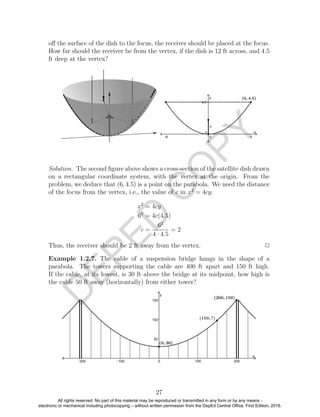
bi
will appear
in the expansion of (a + b)n
equals the number of ways of choosing (n − i) or i
factors from the n factors, which is exactly C(n, i). Therefore, we have
(a + b)n
=
n
i=0
n
i
an−i
bi
.
To explain the reasoning above, consider the case n = 3.
(a + b)3
= (a + b)(a + b)(a + b)
= aaa + aab + aba + abb + baa + bab + bba + bbb
= a3
+ 3a2
b + 3ab2
+ b3
That is, each term in the expansion is obtained by choosing either a or b in each
factor. The term a3
is obtained when a is chosen each time, while a2
b is obtained
when a is selected 2 times, or equivalently, b is selected exactly once.
We will give another proof of this result using mathematical induction. But
first, we need to prove a result about combinations.
Pascal’s Identity
If n and k are positive integers with k ≤ n, then
n + 1
k
=
n
k
+
n
k − 1
.
Proof. The result follows from the combination formula.
n
k
+
n
k − 1
=
n!
k!(n − k)!
+
n!
(k − 1)!(n − k + 1)!
=
n!(n − k + 1) + n!(k)
k!(n − k + 1)!
112
All rights reserved. No part of this material may be reproduced or transmitted in any form or by any means -
electronic or mechanical including photocopying – without written permission from the DepEd Central Office. First Edition, 2016.
D
EPED
C
O
PY
=
n!(n − k + 1 + k)
k!(n + 1 − k)!
=
n!(n + 1)
k!(n + 1 − k)!
=
(n + 1)!
k!(n + 1 − k)!
=
n + 1
k
2
Pascal’s identity explains the method of constructing Pascal’s Triangle, in
which an entry is obtained by adding the two numbers above it. This identity
is also an essential part of the second proof of the Binomial Theorem, which we
now state.
The Binomial Theorem
For any positive integer n,
(a + b)n
=
n
i=0
n
i
an−i
bi
.
Proof. We use mathematical induction.
Part 1
1
i=0
1
i
a1−i
bi
=
1
0
a1
b0
+
1
1
a0
b1
= a + b
Hence, the formula is true for n = 1.
Part 2. Assume that
(a + b)k
=
k
i=0
k
i
ak−i
bi
.
We want to show that
(a + b)k+1
=
k+1
i=0
k + 1
i
ak+1−i
bi
.
(a + b)k+1
= (a + b)(a + b)k
= (a + b)
k
i=0
k
i
ak−i
bi
113
All rights reserved. No part of this material may be reproduced or transmitted in any form or by any means -
electronic or mechanical including photocopying – without written permission from the DepEd Central Office. First Edition, 2016.
D
EPED
C
O
PY
= a
k
i=0
k
i
ak−i
bi
+ b
k
i=0
k
i
ak−i
bi
=
k
i=0
k
i
ak−i+1
bi
+
k
i=0
k
i
ak−i
bi+1
=
k
0
ak+1
b0
+
k
i=1
k
i
ak+1−i
bi
+
k
0
ak
b1
+
k
1
ak−1
b2
+
k
2
ak−2
b3
+ · · · +
k
k − 1
a1
bk
+
k
k
a0
bk+1
= ak+1
+
k
i=1
k
i
ak+1−i
bi
+
k
i=1
k
i − 1
ak+1−i
bi
+ bk+1
=
k + 1
0
ak+1
b0
+
k
i=1
k
i
+
k
i − 1
ak+1−i
bi
+
k + 1
k + 1
a0
bk+1
=
k+1
i=0
k + 1
i
ak+1−i
bi
The last expression above follows from Pascal’s Identity.
Therefore, by the Principle of Mathematical Induction,
(a + b)n
=
n
i=1
n
i
an−i
bi
for any positive integer n. 2
2.4.3. Terms of a Binomial Expansion
We now apply the Binomial Theorem in different examples.
Example 2.4.4. Use the Binomial Theorem to expand (x + y)6
.
114
All rights reserved. No part of this material may be reproduced or transmitted in any form or by any means -
electronic or mechanical including photocopying – without written permission from the DepEd Central Office. First Edition, 2016.
D
EPED
C
O
PY
Solution.
(x + y)6
=
6
k=0
6
k
x6−k
yk
=
6
0
x6
y0
+
6
1
x5
y1
+
6
2
x4
y2
+
6
3
x3
y3
+
6
4
x2
y4
+
6
5
x1
y5
+
6
6
x0
y6
= x6
+ 6x5
y + 15x4
y2
+ 20x3
y3
+ 15x2
y2
+ 6xy5
+ y6
2
Since the expansion of (a + b)n
begins with k = 0 and ends with k = n, the
expansion has n + 1 terms. The first term in the expansion is n
0
an
= an
, the
second term is n
1
an−1
b = nan=1
b, the second to the last term is n
n−1
abn−1
=
nabn−1
, and the last term is n
n
bn
= bn
.
The kth term of the expansion is n
k−1
an−k+1
bk−1
. If n is even, there is a
middle term, which is the n
2
+ 1 th term. If n is odd, there are two middle
terms, the n+1
2
th and n+1
2
+ 1 th terms.
The general term is often represented by n
k
an−k
bk
. Notice that, in any term,
the sum of the exponents of a and b is n. The combination n
k
is the coefficient
of the term involving bk
. This allows us to compute any particular term without
needing to expand (a + b)n
and without listing all the other terms.
Example 2.4.5. Find the fifth term in the expansion of 2x −
√
y
20
.
Solution. The fifth term in the expansion of a fifth power corresponds to k = 4.
20
4
(2x)20−4
(−
√
y)4
= 4845 65536x16
y2
= 317521920x16
y2
2
Example 2.4.6. Find the middle term in the expansion of
x
2
+ 3y
6
.
Solution. Since there are seven terms in the expansion, the middle term is the
fourth term (k = 3), which is
6
3
x
2
3
(3y)3
= 20
x3
8
27y3
=
135x3
y3
2
. 2
115
All rights reserved. No part of this material may be reproduced or transmitted in any form or by any means -
electronic or mechanical including photocopying – without written permission from the DepEd Central Office. First Edition, 2016.
D
EPED
C
O
PY
Example 2.4.7. Find the term involving x (with exponent 1) in the expansion
of x2
−
2y
x
8
.
Solution. The general term in the expansion is
8
k
x2 8−k
−
2y
x
k
=
8
k
x16−2k
·
(−2)k
yk
xk
=
8
k
(−2)k
x16−2k−k
yk
=
8
k
(−2)k
x16−3k
yk
.
The term involves x if the exponent of x is 1, which means 16 − 3k = 1, or
k = 5. Hence, the term is
8
5
(−2)5
xy5
= −1792xy5
. 2
2.4.4. Approximation and Combination Identities
We continue applying the Binomial Theorem.
Example 2.4.8. (1) Approximate (0.8)8
by using the first three terms in the
expansion of (1 − 0.2)8
. Compare your answer with the calculator value.
(2) Use 5 terms in the binomial expansion to approximate (0.8)8
. Is there an
improvement in the approximation?
Solution.
(0.8)8
= (1 − 0.2)8
=
8
k=0
8
k
(1)8−k
(−0.2)k
=
8
k=0
8
k
(−0.2)k
(1)
2
k=0
8
k
(−0.2)k
=
8
0
+
8
1
(−0.2) +
8
2
(−0.2)2
= 1 − 1.6 + 1.12 = 0.52
The calculator value is 0.16777216, so the error is 0.35222784.
116
All rights reserved. No part of this material may be reproduced or transmitted in any form or by any means -
electronic or mechanical including photocopying – without written permission from the DepEd Central Office. First Edition, 2016.
D
EPED
C
O
PY
(2)
4
k=0
8
k
(−0.2)k
=
8
0
+
8
1
(−0.2) +
8
2
(−0.2)2
+
8
3
(−0.2)3
+
8
4
(−0.2)4
= 0.52 − 0.448 + 0.112 = 0.184
The error is 0.01622784, which is an improvement on the previous estimate.
2
Example 2.4.9. Use the Binomial Theorem to prove that, for any positive in-
teger n,
n
k=0
n
k
= 2n
.
Solution. Set a = b = 1 in the expansion of (a + b)n
. Then
2n
= (1 + 1)n
=
n
k=0
n
k
(1)n−k
(1)k
=
n
k=0
n
k
. 2
Example 2.4.10. Use the Binomial Theorem to prove that
100
0
+
100
2
+
100
4
+ · · · +
100
100
=
100
1
+
100
3
+
100
5
+ · · · +
100
99
Solution. Let a = 1 and b = −1 in the expansion of (a + b)100
. Then
1 + (−1)
100
=
100
k=0
100
k
(1)100−k
(−1)k
.
0 =
100
0
+
100
1
(−1) +
100
2
(−1)2
+
100
3
(−1)3
+ · · · +
100
99
(−1)99
+
100
100
(−1)100
If k is even, then (−1)k
= 1. If k is odd, then (−1)k
= −1. Hence, we have
0 =
100
0
−
100
1
+
100
2
−
100
3
+ · · · −
100
99
+
100
100
117
All rights reserved. No part of this material may be reproduced or transmitted in any form or by any means -
electronic or mechanical including photocopying – without written permission from the DepEd Central Office. First Edition, 2016.
D
EPED
C
O
PY
Therefore, after transposing the negative terms to other side of the equation, we
obtain
100
0
+
100
2
+
100
4
+ · · · +
100
100
=
100
1
+
100
3
+
100
5
+ · · · +
100
99
2
More Solved Examples
1. Use the Binomial Theorem to expand (2x4
− 3y2
)
5
.
Solution: 2x4
− 3y2 5
=
5
k=0
2x4 5−k
3y2 k
= 32x20
−240x16
y2
+720x12
y4
−
1080x8
y6
+ 810x4
y8
− 243y10
2. Determine the 20th term in the expansion of (x3
− 3y)
28
.
Solution: We see that k = 19 should yield the 20th term, yielding −319 28
19
x27
y19
.
3. Find the term containing
x2
y2
in the expansion of
x
y
−
y2
2x2
20
.
Solution: Setting a =
x
y
, b = −
y2
2x2
, the (k + 1)th term in the binomial
expansion is (−1)k 20
k
x
y
20−k
y2
2x2
k
=
(−1)k
2k
n
k
x20−3k
y3k−20
. To get
x2
y2
, we get 20 − 3k = 2 ⇒ k = 6, yielding
1
26
20
6
x2
y2
.
4. Determine the term not involving x in the expansion of x3
+
2
x5
16
.
Solution: Setting a = x3
, b =
2
x5
, the (k+1)th term in the binomial expansion
is
16
k
x3 16−k 2
x5
k
= 2k 16
k
x48−8k
. To get the term without x, we get
48 − 8k = 0 ⇒ k = 6, yielding 26 16
6
.
5. Determine the coefficient of x9
in the expansion of (1 + 2x)10
.
118
All rights reserved. No part of this material may be reproduced or transmitted in any form or by any means -
electronic or mechanical including photocopying – without written permission from the DepEd Central Office. First Edition, 2016.
D
EPED
C
O
PY
Solution: Setting a = 1, b = 2x, the (k + 1)th term in the binomial expansion
of the first factor is
10
k
(1)10−k
(2x)k
= 2k 10
k
xk
. To get x9
, we set k = 9,
yielding 29 10
9
x9
.
6. Prove that
n
i=0
(−1)k n
k
3n−k
= 2n
.
Solution: Set a = 3, b = −1.
7. If
√
3 +
√
2
5
is written in the form a
√
3 + b
√
2 where a, b are integers, what
is a + b?
Solution: We have
√
3 +
√
2
5
=
5
k=0
5
k
√
3
5−k √
2
k
. Note that if
5 − k is odd (or equivalently, k is even), the term has a factor of
√
3, while
the rest have a factor of
√
2. Thus, a =
5
0
+
5
2
+
5
4
= 16 and
b =
5
1
+
5
3
+
5
5
= 16 yields a + b = 32.
Supplementary Problems 2.4
1. Use the Binomial Theorem to expand the following:
(a) (2x − 3y)5
(b)
√
x
3
−
2
x2
4
(c) (1 +
√
x)
4
2. Without expanding completely, find the indicated value(s) in the expansion of
the following:
(a) (2 + x)9
, two middle terms
(b)
p
2
+
2
q
10
, 3rd term
(c) (x2
+ y4
)
21
, last 2 terms
(d)
1
√
x
20
, middle term
119
All rights reserved. No part of this material may be reproduced or transmitted in any form or by any means -
electronic or mechanical including photocopying – without written permission from the DepEd Central Office. First Edition, 2016.
D
EPED
C
O
PY
(e)
2y4
x3
+
x5
4y
15
, term not involving y
(f)
1
2x2
− x2
13
, term involving x2
(g) (1 − 2x)6
, coefficient of x3
(h) 2y7/3
−
1
2y5/3
30
, coefficient of
1
y2
(i) (
√
x − 3)
8
, coefficient of x7/2
(j) (
√
x + 2)
6
, coefficient of x3/2
3. Approximate (2.1)10
by using the first 5 terms in the expansion of (2 + 0.1)20
.
Compare your answer with the calculator result.
4. In the expansion of (4x + 3)34
, the kth value and the (k + 1)st terms have
equal coefficients. What is the value of k?
5. Determine the value of
19
0
−
19
1
3 +
19
2
32
−
19
3
33
+ . . . +
19
18
318
−
19
19
319
4
120
All rights reserved. No part of this material may be reproduced or transmitted in any form or by any means -
electronic or mechanical including photocopying – without written permission from the DepEd Central Office. First Edition, 2016.
D
EPED
C
O
PY
Topic Test 1 for Unit 2
1. Determine if the given sequence is arithmetic, geometric, or neither by writing
A, G, or O, respectively.
(a)
1
3
,
1
2
,
3
4
,
9
16
,
27
32
, . . .
(b)
1
2
,
1
7
,
1
12
,
1
17
,
1
21
, . . .
(c) 0, 3, 8, 15, 24, . . .
2. Three numbers form an arithmetic sequence, the common difference being 5.
If the last number is increased by 1, the second by 2, and the first by 4, the
resulting numbers form a geometric sequence. Find the numbers.
3. Evaluate the sum
50
i=1
2i3
+ 9i2
+ 13i + 6
i2 + 3i + 2
.
4. Find the indicated terms in the expansion of the given expression.
(a) x2
−
1
2
8
, term involving x8 (b) (n3
− 3m)
28
, 20th term
5. Prove the statement below for all positive integers n by mathematical induc-
tion.
1
1 · 3
+
1
3 · 5
+ · · · +
1
(2n − 1)(2n + 1)
=
n
2n + 1
6. On his 20th birthday, Ian deposited an amount of 10,000 pesos to a time-
deposit scheme with a yearly interest of 4%. Ian decides not to withdraw any
amount of money or earnings and vows to keep it in the same time-deposit
scheme year after year. Show that the new amounts in Ian’s time-deposit
account in each succeeding birthday represent a geometric sequence, and use
this to determine the value of the money during Ian’s 60th birthday.
121
All rights reserved. No part of this material may be reproduced or transmitted in any form or by any means -
electronic or mechanical including photocopying – without written permission from the DepEd Central Office. First Edition, 2016.
D
EPED
C
O
PY
Topic Test 2 for Unit 2
1. Determine if the given sequence is arithmetic, geometric, or neither by writing
A, G, or O, respectively.
(a)
2
3
,
8
15
,
32
75
,
128
375
,
512
1875
, . . .
(b)
1
2
,
2
3
,
3
4
,
4
5
,
5
6
, . . .
(c) 3,
11
2
, 8,
21
2
, 13, . . .
2. The sum of the first two terms of an arithmetic sequence is 9 and the sum of
the first three terms is also 9. How many terms must be taken to give a sum
of −126?
3. Evaluate the following sums.
(a)
50
i=1
(2i + 1)(i − 3) (b)
30
i=1
i2 − 2i + 1
4
4. Find the term not involving x in the expansion of x3
+
1
x
8
.
5. Prove that the following statements are true for all positive integers n by
mathematical induction.
(a) 1 + 4 + 7 + . . . + (3n − 2) =
n(3n − 1)
2
(b) 3n
+ 7n−1
+ 8 is divisible by 12.
122
All rights reserved. No part of this material may be reproduced or transmitted in any form or by any means -
electronic or mechanical including photocopying – without written permission from the DepEd Central Office. First Edition, 2016.
D
EPED
C
O
PY
Unit 3
Trigonometry
Puerto Princesa Subterranean River National Park, by Giovanni G. Navata, 12 November 2010,
https://commons.wikimedia.org/wiki/File%3AUnderground River.jpg. Public Domain
Named as one of the New Seven Wonders of Nature in 2012 by the New7Wonders
Foundation, the Puerto Princesa Subterranean River National Park is world-
famous for its limestone karst mountain landscape with an underground river.
The Park was also listed as UNESCO World Heritage Site in 1999. The under-
ground river stretches about 8.2 km long, making it one of the world’s longest
rivers of its kind.
123
All rights reserved. No part of this material may be reproduced or transmitted in any form or by any means -
electronic or mechanical including photocopying – without written permission from the DepEd Central Office. First Edition, 2016.
D
EPED
C
O
PY
Lesson 3.1. Angles in a Unit Circle
Learning Outcomes of the Lesson
At the end of the lesson, the student is able to:
(1) illustrate the unit circle and the relationship between the linear and angular
measures of arcs in a unit circle.
(2) convert degree measure to radian measure, and vice versa.
(3) illustrate angles in standard position and coterminal angles.
Lesson Outline
(1) Linear and angular measure of arcs
(2) Conversion of degree to radian, and vice versa
(3) Arc length and area of the sector
(4) Angle in standard position and coterminal angles
Introduction
Angles are being used in several fields like engineering, medical imaging, elec-
tronics, astronomy, geography and many more. Added to that, surveyors, pilots,
landscapers, designers, soldiers, and people in many other professions heavily use
angles and trigonometry to accomplish a variety of practical tasks. In this les-
son, we will deal with the basics of angle measures together with arc length and
sectors.
3.1.1. Angle Measure
An angle is formed by rotating a ray about its endpoint. In the figure shown
below, the initial side of ∠AOB is OA, while its terminal side is OB. An angle
is said to be positive if the ray rotates in a counterclockwise direction, and the
angle is negative if it rotates in a clockwise direction.
124
All rights reserved. No part of this material may be reproduced or transmitted in any form or by any means -
electronic or mechanical including photocopying – without written permission from the DepEd Central Office. First Edition, 2016.
D
EPED
C
O
PY
An angle is in standard position if it is drawn in the xy-plane with its vertex
at the origin and its initial side on the positive x-axis. The angles α, β, and θ in
the following figure are angles in standard position.
To measure angles, we use degrees, minutes, seconds, and radians.
A central angle of a circle measures one degree, written 1◦
, if it inter-
cepts 1
360
of the circumference of the circle. One minute, written 1 , is
1
60
of 1◦
, while one second, written 1 , is 1
60
of 1 .
For example, in degrees, minutes, and seconds,
10◦
30 18 = 10◦
30 +
18
60
= 10◦
30.3
= 10 +
30.3
60
◦
= 10.505◦
and
79.251◦
= 79◦
(0.251 × 60)
= 79◦
15.06
= 79◦
15 (0.06 × 60)
= 79◦
15 3.6 .
Recall that the unit circle is the circle with center at the origin and radius 1
unit.
125
All rights reserved. No part of this material may be reproduced or transmitted in any form or by any means -
electronic or mechanical including photocopying – without written permission from the DepEd Central Office. First Edition, 2016.
D
EPED
C
O
PY
A central angle of the unit circle that intercepts an arc of the circle
with length 1 unit is said to have a measure of one radian, written 1
rad. See Figure 3.1.
Figure 3.1
In trigonometry, as it was studied in Grade 9, the degree measure is often used.
On the other hand, in some fields of mathematics like calculus, radian measure of
angles is preferred. Radian measure allows us to treat the trigonometric functions
as functions with the set of real numbers as domains, rather than angles.
Example 3.1.1. In the following figure, identify the terminal side of an angle in
standard position with given measure.
(1) degree measure: 135◦
, −135◦
, −90◦
, 405◦
(2) radian measure: π
4
rad, −3π
4
rad, 3π
2
rad, −π
2
rad
126
All rights reserved. No part of this material may be reproduced or transmitted in any form or by any means -
electronic or mechanical including photocopying – without written permission from the DepEd Central Office. First Edition, 2016.
D
EPED
C
O
PY
Solution. (1) 135◦
:
−→
OC; −135◦
:
−−→
OD; −90◦
:
−−→
OE; and 405◦
:
−−→
OB
(2) radian measure: π
4
rad:
−−→
OB; −3π
4
rad:
−−→
OD; 3π
2
rad:
−−→
OE; and −π
2
rad:
−−→
OE 2
Since a unit circle has circumference 2π, a central angle that measures 360◦
has measure equivalent to 2π radians. Thus, we obtain the following conversion
rules.
Converting degree to radian, and vice versa
1. To convert a degree measure to radian, multiply it by π
180
.
2. To convert a radian measure to degree, multiply it by 180
π
.
Figure 3.2 shows some special angles in standard position with the indicated
terminal sides. The degree and radian measures are also given.
Figure 3.2
Example 3.1.2. Express 75◦
and 240◦
in radians.
Solution.
75
π
180
=
5π
12
=⇒ 75◦
=
5π
12
rad
240
π
180
=
4π
3
=⇒ 240◦
=
4π
3
rad 2
127
All rights reserved. No part of this material may be reproduced or transmitted in any form or by any means -
electronic or mechanical including photocopying – without written permission from the DepEd Central Office. First Edition, 2016.
D
EPED
C
O
PY
Example 3.1.3. Express π
8
rad and 11π
6
rad in degrees.
Solution.
π
8
180
π
= 22.5 =⇒
π
8
rad = 22.5◦
11π
6
180
π
= 330 =⇒
11π
6
rad = 330◦
2
3.1.2. Coterminal Angles
Two angles in standard position that have a common terminal side are called
coterminal angles. Observe that the degree measures of coterminal angles differ
by multiples of 360◦
.
Two angles are coterminal if and only if their degree measures differ
by 360k, where k ∈ Z.
Similarly, two angles are coterminal if and only if their radian mea-
sures differ by 2πk, where k ∈ Z.
As a quick illustration, to find one coterminal angle with an angle that mea-
sures 410◦
, just subtract 360◦
, resulting in 50◦
. See Figure 3.3.
Figure 3.3
Example 3.1.4. Find the angle coterminal with −380◦
that has measure
(1) between 0◦
and 360◦
, and
128
All rights reserved. No part of this material may be reproduced or transmitted in any form or by any means -
electronic or mechanical including photocopying – without written permission from the DepEd Central Office. First Edition, 2016.
D
EPED
C
O
PY
(2) between −360◦
and 0◦
.
Solution. A negative angle moves in a clockwise direction, and the angle −380◦
lies in Quadrant IV.
(1) −380◦
+ 2 · 360◦
= 340◦
(2) −380◦
+ 360◦
= −20◦
2
3.1.3. Arc Length and Area of a Sector
In a circle, a central angle whose radian measure is θ subtends an arc that is the
fraction θ
2π
of the circumference of the circle. Thus, in a circle of radius r (see
Figure 3.4), the length s of an arc that subtends the angle θ is
s =
θ
2π
× circumference of circle =
θ
2π
(2πr) = rθ.
Figure 3.4
In a circle of radius r, the length s of an arc intercepted by a central
angle with measure θ radians is given by
s = rθ.
Example 3.1.5. Find the length of an arc of a circle with radius 10 m that
subtends a central angle of 30◦
.
Solution. Since the given central angle is in degrees, we have to convert it into
radian measure. Then apply the formula for an arc length.
30
π
180
=
π
6
rad
129
All rights reserved. No part of this material may be reproduced or transmitted in any form or by any means -
electronic or mechanical including photocopying – without written permission from the DepEd Central Office. First Edition, 2016.
D
EPED
C
O
PY
s = 10
π
6
=
5π
3
m 2
Example 3.1.6. A central angle θ in a circle of radius 4 m is subtended by an
arc of length 6 m. Find the measure of θ in radians.
Solution.
θ =
s
r
=
6
4
=
3
2
rad 2
A sector of a circle is the portion of the interior of a circle bounded by the
initial and terminal sides of a central angle and its intercepted arc. It is like a
“slice of pizza.” Note that an angle with measure 2π radians will define a sector
that corresponds to the whole “pizza.” Therefore, if a central angle of a sector
has measure θ radians, then the sector makes up the fraction θ
2π
of a complete
circle. See Figure 3.5. Since the area of a complete circle with radius r is πr2
, we
have
Area of a sector =
θ
2π
(πr2
) =
1
2
θr2
.
Figure 3.5
In a circle of radius r, the area A of a sector with a central angle
measuring θ radians is
A =
1
2
r2
θ.
Example 3.1.7. Find the area of a sector of a circle with central angle 60◦
if
the radius of the circle is 3 m.
Solution. First, we have to convert 60◦
into radians. Then apply the formula for
computing the area of a sector.
60
π
180
=
π
3
rad
130
All rights reserved. No part of this material may be reproduced or transmitted in any form or by any means -
electronic or mechanical including photocopying – without written permission from the DepEd Central Office. First Edition, 2016.
D
EPED
C
O
PY
A =
1
2
(32
)
π
3
=
3π
2
m2
2
Example 3.1.8. A sprinkler on a golf course fairway is set to spray water over
a distance of 70 feet and rotates through an angle of 120◦
. Find the area of the
fairway watered by the sprinkler.
Solution.
120
π
180
=
2π
3
rad
A =
1
2
(702
)
2π
3
=
4900π
3
≈ 5131 ft2
2
More Solved Examples
1. Find the equivalent degree measure of 5
48
radians.
Solution: 5
48
rad = 5
48
180
π
= 75
4π
◦
2. Find the equivalent angle measure in degrees and in radians of an angle tracing
23
5
revolutions.
Solution: One revolution around a circle is equivalent to tracing 360◦
.
2
3
5
rev = 2
3
5
rev
360
1 rev
= 936◦
936◦
= 936
π
180
=
26π
5
rad
3. Find the smallest positive angle coterminal with −2016◦
.
Solution: Add 6 complete revolutions or 6(360◦
) = 2160◦
to the given angle
(or keep on adding 360◦
until you get a positive angle).
−2016◦
+ 2160◦
= 144◦
4. Find the largest negative angle coterminal with 137π
5
.
Solution: Subtract 14 complete revolutions or 14(2π) = 28π to the given angle
(or keep on subtracting 2π until you get a negative angle).
137π
5
− 28π = −
3π
5
rad
131
All rights reserved. No part of this material may be reproduced or transmitted in any form or by any means -
electronic or mechanical including photocopying – without written permission from the DepEd Central Office. First Edition, 2016.
D
EPED
C
O
PY
5. Find the length of the arc of a circle with radius 15 cm that subtends a central
angle of 84◦
.
Solution:
84◦
= 84
π
180
=
7π
15
rad
s = 15
7π
15
= 7π cm
6. A central angle θ in a circle of radius 12 inches is subtended by an arc of length
27 inches. Find the measure of θ in degrees.
Solution:
s = rθ =⇒ θ =
s
r
θ =
12
27
=
9
4
rad
9
4
rad =
9
4
180
π
=
405
π
◦
7. Find the area of a sector of a circle with central angle of 108◦
if the radius of
the circle is 15 cm.
Solution:
108◦
= 108
π
180
=
3π
5
rad
A =
1
2
(15)2 3π
5
=
135π
2
cm2
8. Given isosceles right triangle ABC with AC as the hypotenuse (as shown
below), a circle with center at A and radius AB intersects AC at D. What is
the ratio of the area of sector BAD to the area of the region BCD?
132
All rights reserved. No part of this material may be reproduced or transmitted in any form or by any means -
electronic or mechanical including photocopying – without written permission from the DepEd Central Office. First Edition, 2016.
D
EPED
C
O
PY
Solution: Let r be the radius of the circle; that is, r = AB.
∠A =
π
4
rad =⇒ Area of sector BAD =
1
2
r2 π
4
=
πr2
8
Area of region BCD = Area of ABC − Area of sector BAD =
4r2
− πr2
8
area of sector BAD
area of the region BCD
=
πr2
8
4r2−πr2
8
=
π
4 − π
Supplementary Problems 3.1
1. How many degrees is 11
5
of a complete revolution?
2. How many radians is 11
5
of a complete revolution?
3. What is the length of an arc of a circle with radius 4 cm that subtends a
central angle of 216◦
?
4. Find the length of an arc of a circle with radius 6
π
cm that subtends a central
angle of 99◦
.
5. What is the smallest positive angle coterminal with 2110◦
?
6. Find the largest negative angle coterminal with 107π
6
.
7. Find the area of a sector of a circle with central angle of 7π
6
if the diameter of
the circle is 9 cm.
8. Find the area of a sector of a circle with central angle of 108◦
if the radius of
the circle is 15 cm.
9. What is the radius of a circle in which a central angle of 150◦
determines a
sector of area 15 in2
?
10. Find the radius of a circle in which a central angle of 5π
4
determines a sector
of area 32 in2
.
11. A central angle of a circle of radius 6 inches is subtended by an arc of length 6
inches. What is the central angle in degrees (rounded to two decimal places)?
12. An arc of length π
5
cm subtends a central angle θ of a circle with radius 2
3
cm.
What is θ in degrees?
133
All rights reserved. No part of this material may be reproduced or transmitted in any form or by any means -
electronic or mechanical including photocopying – without written permission from the DepEd Central Office. First Edition, 2016.
D
EPED
C
O
PY
13. Two overlapping circles of radii 1 cm are drawn such that each circle passes
through the center of the other. What is the perimeter of the entire region?
14. The length of arc AB of a circle with center at O is equal to twice the length
of the radius r of the circle. Find the area of sector AOB in terms of r.
15. The angle of a sector in a given circle is 20◦
and the area of the sector is equal
to 800 cm2
. Find the arc length of the sector.
16. In Figure 3.6, AE and BC are arcs of two concentric circles with center at D.
If AD = 2 cm, BD = 8 cm, and ∠ADE = 75◦
, find the area of the region
AECB.
17. In Figure 3.7, AB and DE are diameters. If AB = 12 cm and ∠AOD = 126◦
,
find the area of the shaded region.
Figure 3.6 Figure 3.7 Figure 3.8
18. A point moves outside an equilateral triangle of side 5 cm such that its distance
from the triangle is always 2 cm. See Figure 3.8. What is the length of one
complete path that the point traces?
Figure 3.9
19. The segment of a circle is the region bounded by a chord and the arc subtended
by the chord. See Figure 3.9. Find the area of a segment of a circle with a
central angle of 120◦
and a radius of 64 cm.
134
All rights reserved. No part of this material may be reproduced or transmitted in any form or by any means -
electronic or mechanical including photocopying – without written permission from the DepEd Central Office. First Edition, 2016.
D
EPED
C
O
PY
Figure 3.10
20. In Figure 3.10, diameter AB of circle O measures 12 cm and arc BC measures
120◦
. Find the area of the shaded region.
4
Lesson 3.2. Circular Functions
Learning Outcomes of the Lesson
At the end of the lesson, the student is able to:
(1) illustrate the different circular functions; and
(2) use reference angles to find exact values of circular functions.
Lesson Outline
(1) Circular functions
(2) Reference angles
Introduction
We define the six trigonometric function in such a way that the domain of
each function is the set of angles in standard position. The angles are measured
either in degrees or radians. In this lesson, we will modify these trigonometric
functions so that the domain will be real numbers rather than set of angles.
135
All rights reserved. No part of this material may be reproduced or transmitted in any form or by any means -
electronic or mechanical including photocopying – without written permission from the DepEd Central Office. First Edition, 2016.
D
EPED
C
O
PY
3.2.1. Circular Functions on Real Numbers
Recall that the sine and cosine functions (and four others: tangent, cosecant,
secant, and cotangent) of angles measuring between 0◦
and 90◦
were defined in
the last quarter of Grade 9 as ratios of sides of a right triangle. It can be verified
that these definitions are special cases of the following definition.
Let θ be an angle in standard position and P(θ) = P(x, y) the point
on its terminal side on the unit circle. Define
sin θ = y csc θ =
1
y
, y = 0
cos θ = x sec θ =
1
x
, x = 0
tan θ =
y
x
, x = 0 cot θ =
x
y
, y = 0
Example 3.2.1. Find the values of cos 135◦
, tan 135◦
, sin(−60◦
), and sec(−60◦
).
Solution. Refer to Figure 3.11(a).
(a) (b)
Figure 3.11
From properties of 45◦
-45◦
and 30◦
-60◦
right triangles (with hypotenuse 1
unit), we obtain the lengths of the legs as in Figure 3.11(b). Thus, the coordinates
of A and B are
A = −
√
2
2
,
√
2
2
and B =
1
2
, −
√
3
2
.
136
All rights reserved. No part of this material may be reproduced or transmitted in any form or by any means -
electronic or mechanical including photocopying – without written permission from the DepEd Central Office. First Edition, 2016.
D
EPED
C
O
PY
Therefore, we get
cos 135◦
= −
√
2
2
, tan 135◦
= −1,
sin(−60◦
) = −
√
3
2
, and sec(−60◦
) = 2. 2
From the last example, we may then also say that
cos
π
4
rad =
√
2
2
, sin −
π
3
rad = −
√
3
2
,
and so on.
From the above definitions, we define the same six functions on real numbers.
These functions are called trigonometric functions.
Let s be any real number. Suppose θ is the angle in standard position
with measure s rad. Then we define
sin s = sin θ csc s = csc θ
cos s = cos θ sec s = sec θ
tan s = tan θ cot s = cot θ
From the last example, we then have
cos
π
4
= cos
π
4
rad = cos 45◦
=
√
2
2
and
sin −
π
3
= sin −
π
3
rad = sin(−60◦
) = −
√
3
2
.
In the same way, we have
tan 0 = tan(0 rad) = tan 0◦
= 0.
Example 3.2.2. Find the exact values of sin 3π
2
, cos 3π
2
, and tan 3π
2
.
Solution. Let P 3π
2
be the point on the unit circle and on the terminal side of
the angle in the standard position with measure 3π
2
rad. Then P 3π
2
= (0, −1),
and so
sin
3π
2
= −1, cos
3π
2
= 0,
but tan 3π
2
is undefined. 2
137
All rights reserved. No part of this material may be reproduced or transmitted in any form or by any means -
electronic or mechanical including photocopying – without written permission from the DepEd Central Office. First Edition, 2016.
D
EPED
C
O
PY
Example 3.2.3. Suppose s is a real number such that sin s = −3
4
and cos s > 0.
Find cos s.
Solution. We may consider s as the angle with measure s rad. Let P(s) = (x, y)
be the point on the unit circle and on the terminal side of angle s.
Since P(s) is on the unit circle, we know that x2
+ y2
= 1. Since sin s = y =
−3
4
, we get
x2
= 1 − y2
= 1 − −
3
4
2
=
7
16
=⇒ x = ±
√
7
4
.
Since cos s = x > 0, we have cos s =
√
7
4
. 2
Let P(x1, y1) and Q(x, y) be points on the terminal side of an angle θ in
standard position, where P is on the unit circle and Q on the circle of radius r
(not necessarily 1) with center also at the origin, as shown above. Observe that
we can use similar triangles to obtain
cos θ = x1 =
x1
1
=
x
r
and sin θ = y1 =
y1
1
=
y
r
.
We may then further generalize the definitions of the six circular functions.
138
All rights reserved. No part of this material may be reproduced or transmitted in any form or by any means -
electronic or mechanical including photocopying – without written permission from the DepEd Central Office. First Edition, 2016.
D
EPED
C
O
PY
Let θ be an angle in standard position, Q(x, y) any point on the ter-
minal side of θ, and r = x2 + y2 > 0. Then
sin θ =
y
r
csc θ =
r
y
, y = 0
cos θ =
x
r
sec θ =
r
x
, x = 0
tan θ =
y
x
, x = 0 cot θ =
x
y
, y = 0
We then have a second solution for Example 3.2.3 as follows. With sin s = −3
4
and sin s = y
r
, we may choose y = −3 and r = 4 (which is always positive). In
this case, we can solve for x, which is positive since cos s = x
4
is given to be
positive.
4 = x2 + (−3)2 =⇒ x =
√
7 =⇒ cos s =
√
7
4
3.2.2. Reference Angle
We observe that if θ1 and θ2 are coterminal angles, the values of the six circular
or trigonometric functions at θ1 agree with the values at θ2. Therefore, in finding
the value of a circular function at a number θ, we can always reduce θ to a number
between 0 and 2π. For example, sin 14π
3
= sin 14π
3
− 4π = sin 2π
3
. Also, observe
from Figure 3.12 that sin 2π
3
= sin π
3
.
Figure 3.12
139
All rights reserved. No part of this material may be reproduced or transmitted in any form or by any means -
electronic or mechanical including photocopying – without written permission from the DepEd Central Office. First Edition, 2016.
D
EPED
C
O
PY
In general, if θ1, θ2, θ3, and θ4 are as shown in Figure 3.13 with P(θ1) =
(x1, y1), then each of the x-coordinates of P(θ2), P(θ3), and P(θ4) is ±x1, while
the y-coordinate is ±y1. The correct sign is determined by the location of the
angle. Therefore, together with the correct sign, the value of a particular circular
function at an angle θ can be determined by its value at an angle θ1 with radian
measure between 0 and π
2
. The angle θ1 is called the reference angle of θ.
Figure 3.13
The signs of the coordinates of P(θ) depends on the quadrant or axis where
it terminates. It is important to know the sign of each circular function in each
quadrant. See Figure 3.14. It is not necessary to memorize the table, since the
sign of each function for each quadrant is easily determined from its definition.
We note that the signs of cosecant, secant, and cotangent are the same as sine,
cosine, and tangent, respectively.
Figure 3.14
Using the fact that the unit circle is symmetric with respect to the x-axis, the
y-axis, and the origin, we can identify the coordinates of all the points using the
140
All rights reserved. No part of this material may be reproduced or transmitted in any form or by any means -
electronic or mechanical including photocopying – without written permission from the DepEd Central Office. First Edition, 2016.
D
EPED
C
O
PY
coordinates of corresponding points in the Quadrant I, as shown in Figure 3.15
for the special angles.
Figure 3.15
Example 3.2.4. Use reference angle and appropriate sign to find the exact value
of each expression.
(1) sin 11π
6
and cos 11π
6
(2) cos −7π
6
(3) sin 150◦
(4) tan 8π
3
Solution. (1) The reference angle of 11π
6
is π
6
, and it lies in Quadrant IV wherein
sine and cosine are negative and positive, respectively.
sin
11π
6
= − sin
π
6
= −
1
2
cos
11π
6
= cos
π
6
=
√
3
2
(2) The angle −7π
6
lies in Quadrant II wherein cosine is negative, and its refer-
ence angle is π
6
.
cos −
7π
6
= − cos
π
6
= −
√
3
2
(3) sin 150◦
= sin 30◦
= 1
2
(4) tan 8π
3
= − tan π
3
= −
sin
π
3
cos
π
3
= −
√
3
2
1
2
= −
√
3 2
141
All rights reserved. No part of this material may be reproduced or transmitted in any form or by any means -
electronic or mechanical including photocopying – without written permission from the DepEd Central Office. First Edition, 2016.
D
EPED
C
O
PY
More Solved Examples
1. If P(θ) is a point on the unit circle and θ = 17π
3
, what are the coordinates of
P(θ)?
Solution: 17π
3
is coterminal with 5π
3
which terminates in QIV. The reference
angle is π
3
, therefore P 17π
3
= 1
2
, −
√
3
2
.
2. If P(θ) is a point on the unit circle and θ = −5π
6
, find the values of the six
trigonometric functions of θ.
Solution: The angle −5π
6
terminates in QIII, the reference angle is π
6
, therefore
P −5π
6
= −
√
3
2
, −1
2
.
cos −
5π
6
= −
√
3
2
sec −
5π
6
= −
2
√
3
= −
2
√
3
3
sin −
5π
6
= −
1
2
csc −
5π
6
= −2
tan −
5π
6
=
1
√
3
=
√
3
3
cot −
5π
6
=
√
3
1
=
√
3
3. Find the six trigonometric functions of the angle θ if the terminal side of θ in
standard position passes through the point (5, −12).
Solution: x = 5, y = −12, r = (5)2 + (−12)2 = 13.
cos θ =
x
r
=
5
13
sec θ =
r
x
=
13
5
sin θ =
y
r
= −
12
13
csc θ =
r
y
= −
13
12
tan θ =
y
x
= −
12
5
cot θ =
x
y
= −
5
12
4. Given sec θ = −25
24
and π ≤ θ ≤ 3π
2
, find sin θ + cos θ.
Solution: r = 25, x = −24, y = (25)2 − (−24)2 = ±7.
Since θ is in QIII, y = −7.
sin θ + cos θ =
−7
25
+
−24
25
= −
31
25
.
5. If tan A = 4
5
, determine 2 sin A−cos A
3 cos A
.
142
All rights reserved. No part of this material may be reproduced or transmitted in any form or by any means -
electronic or mechanical including photocopying – without written permission from the DepEd Central Office. First Edition, 2016.
D
EPED
C
O
PY
Solution:
tan A =
4
5
=⇒
sin A
cos A
=
4
5
2 sin A − cos A
3 cos A
=
2
3
sin A
cos A
−
1
3
cos A
cos A
=
2
3
4
5
−
1
3
(1) =
1
5
6. What is the reference angle of −29π
6
? Find the value of tan −29π
6
.
Solution: −29π
6
is coterminal with 7π
6
in QIII, so its reference angle is π
6
.
tan −
29π
6
= tan
π
6
=
√
3
3
7. For what angle θ in the third quadrant is cos θ = sin 5π
3
?
Solution:
sin
5π
3
= cos θ
cos θ = −
√
3
2
and θ in QIII =⇒ θ =
7π
6
Supplementary Problems 3.2
1. In what quadrant is P(θ) located if θ = 33π
4
?
2. In what quadrant is P(θ) located if θ = −17π
6
?
3. In what quadrant is P(θ) located if sec θ > 0 and cot θ < 0?
4. In what quadrant is P(θ) located if tan θ > 0 and cos θ < 0 ?
5. If P(θ) is a point on the unit circle and θ = 5π
6
, what are the coordinates of
P(θ)?
6. If P(θ) is a point on the unit circle and θ = −11π
6
, what are the coordinates
of P(θ)?
7. If cos θ > 0 and tan θ = −2
3
, find sec θ+tan θ
sec θ−tan θ
8. If tan θ = 3
5
and θ is in QIII, what is sec θ?
9. If csc θ = 2 and cos θ < 0, find sec θ.
10. Find the values of the other trigonometric functions of θ if cot θ = −4
3
and
sin θ < 0.
143
All rights reserved. No part of this material may be reproduced or transmitted in any form or by any means -
electronic or mechanical including photocopying – without written permission from the DepEd Central Office. First Edition, 2016.
D
EPED
C
O
PY
11. Find the values of the other trigonometric functions of θ if csc θ = −4 and θ
does not terminate in QIII.
12. The terminal side of an angle θ in standard position contains the point (7, −1).
Find the values of the six trigonometric functions of θ.
13. The terminal side of an angle θ in standard position contains the point (−2, 4).
Find the values of the six trigonometric functions of θ.
14. If the terminal point of an arc of length θ lies on the line joining the origin
and the point (−3, −1), what is cos2
θ − sin2
θ?
15. If the terminal point of an arc of length θ lies on the line joining the origin
and the point (2, −6), what is sec2
θ − csc2
θ?
16. Determine the reference angle of 35π
4
, and find cos 35π
4
.
17. If 3π
2
< θ < 2π, find θ if cos θ = sin 2π
3
.
18. Evaluate the sum of sin 30◦
+ sin 60◦
+ sin 90◦
+ · · · + sin 510◦
+ sin 540◦
.
19. If f(x) = sin 2x + cos 2x + sec 2x + csc 2x + tan 2x + cot 2x, what is f 7π
8
?
20. Evaluate the sum of sec π
6
+ sec 13π
6
+ sec 25π
6
+ · · · + sec 109π
6
.
4
Lesson 3.3. Graphs of Circular Functions and Situational
Problems
Learning Outcomes of the Lesson
At the end of the lesson, the student is able to:
(1) determine the domain and range of the different circular functions;
(2) graph the six circular functions with its amplitude, period, and phase shift;
and
(3) solve situational problems involving circular functions.
Lesson Outline
(1) Domain and range of circular functions
(2) Graphs of circular functions
(3) Amplitude, period, and phase shift
144
All rights reserved. No part of this material may be reproduced or transmitted in any form or by any means -
electronic or mechanical including photocopying – without written permission from the DepEd Central Office. First Edition, 2016.
D
EPED
C
O
PY
Introduction
There are many things that occur periodically. Phenomena like rotation of
the planets and comets, high and low tides, and yearly change of the seasons
follow a periodic pattern. In this lesson, we will graph the six circular functions
and we will see that they are periodic in nature.
3.3.1. Graphs of y = sin x and y = cos x
Recall that, for a real number x, sin x = sin θ for an angle θ with measure x
radians, and that sin θ is the second coordinate of the point P(θ) on the unit
circle. Since each x corresponds to an angle θ, we can conclude that
(1) sin x is defined for any real number x or the domain of the sine function is
R, and
(2) the range of sine is the set of all real numbers between −1 and 1 (inclusive).
From the definition, it also follows that sin(x+2π) = sin x for any real number
x. This means that the values of the sine function repeat every 2π units. In this
case, we say that the sine function is a periodic function with period 2π.
Table 3.16 below shows the values of y = sin x, where x is the equivalent radian
measure of the special angles and their multiples from 0 to 2π. As commented
above, these values determine the behavior of the function on R.
x 0 π
6
π
4
π
3
π
2
2π
3
3π
4
5π
6
π
y 0 1
2
√
2
2
√
3
2
1
√
3
2
√
2
2
1
2
0
0 0.5 0.71 0.87 1 0.87 0.71 0.5 0
x 7π
6
5π
4
4π
3
3π
2
5π
3
7π
4
11π
6
2π
y −1
2
−
√
2
2
−
√
3
2
−1 −
√
3
2
−
√
2
2
−1
2
0
−0.5 −0.71 −0.87 −1 −0.87 −0.71 −0.5 0
Table 3.16
From the table, we can observe that as x increases from 0 to π
2
, sin x also
increases from 0 to 1. Similarly, as x increases from 3π
2
to 2π, sin x also increases
from −1 to 0. On the other hand, notice that as x increases from π
2
to π, sin x
decreases from 1 to 0. Similarly, as x increases from π to 3π
2
, sin x decreases from
0 to −1.
145
All rights reserved. No part of this material may be reproduced or transmitted in any form or by any means -
electronic or mechanical including photocopying – without written permission from the DepEd Central Office. First Edition, 2016.
D
EPED
C
O
PY
To sketch the graph of y = sin x, we plot the points presented in Table 3.16,
and join them with a smooth curve. See Figure 3.17. Since the graph repeats
every 2π units, Figure 3.18 shows periodic graph over a longer interval.
Figure 3.17
Figure 3.18
We can make observations about the cosine function that are similar to the
sine function.
• y = cos x has domain R and range [−1, 1].
• y = cos x is periodic with period 2π. The graph of y = cos x is shown in
Figure 3.19.
Figure 3.19
146
All rights reserved. No part of this material may be reproduced or transmitted in any form or by any means -
electronic or mechanical including photocopying – without written permission from the DepEd Central Office. First Edition, 2016.
D
EPED
C
O
PY
From the graphs of y = sin x and y = cos x in Figures 3.18 and 3.19, re-
spectively, we observe that sin(−x) = − sin x and cos(−x) = cos x for any real
number x. In other words, the graphs of y = cos(−x) and y = cos x are the same,
while the graph of y = sin(−x) is the same as that of y = − sin x.
In general, if a function f satisfies the property that f(−x) = f(x) for all x
in its domain, we say that such function is even. On the other hand, we say that
a function f is odd if f(−x) = −f(x) for all x in its domain. For example, the
functions x2
and cos x are even, while the functions x3
− 3x and sin x are odd.
3.3.2. Graphs of y = a sin bx and y = a cos bx
Using a table of values from 0 to 2π, we can sketch the graph of y = 3 sin x, and
compare it to the graph of y = sin x. See Figure 3.20 wherein the solid curve
belongs to y = 3 sin x, while the dashed curve to y = sin x. For instance, if x = π
2
,
then y = 1 when y = sin x, and y = 3 when y = 3 sin x. The period, x-intercepts,
and domains are the same for both graphs, while they differ in the range. The
range of y = 3 sin x is [−3, 3].
Figure 3.20
In general, the graphs of y = a sin x and y = a cos x with a > 0 have the same
shape as the graphs of y = sin x and y = cos x, respectively. If a < 0, there is a
reflection across the x-axis.
In the graphs of y = a sin x and y = a cos x, the number |a| is called
its amplitude. It dictates the height of the curve. When |a| < 1,
the graphs are shrunk vertically, and when |a| > 1, the graphs are
stretched vertically.
Now, in Table 3.21, we consider the values of y = sin 2x on [0, 2π].
147
All rights reserved. No part of this material may be reproduced or transmitted in any form or by any means -
electronic or mechanical including photocopying – without written permission from the DepEd Central Office. First Edition, 2016.
D
EPED
C
O
PY
x 0 π
6
π
4
π
3
π
2
2π
3
3π
4
5π
6
π
y 0
√
3
2
1
√
3
2
0 −
√
3
2
−1 −
√
3
2
0
0 0.87 1 0.87 0 −0.87 −1 −0.87 0
x 7π
6
5π
4
4π
3
3π
2
5π
3
7π
4
11π
6
2π
y
√
3
2
1
√
3
2
0 −
√
3
2
−1 −
√
3
2
0
0.87 1 0.87 0 −0.87 −1 −0.87 0
Table 3.21
Figure 3.22
Figure 3.22 shows the graphs of y = sin 2x (solid curve) and y = sin x (dashed
curve) over the interval [0, 2π]. Notice that, for sin 2x to generate periodic values
similar to [0, 2π] for y = sin x, we just need values of x from 0 to π. We then
expect the values of sin 2x to repeat every π units thereafter. The period of
y = sin 2x is π.
If b = 0, then both y = sin bx and y = cos bx have period given by
2π
|b|
.
If 0 < |b| < 1, the graphs are stretched horizontally, and if |b| > 1, the
graphs are shrunk horizontally.
To sketch the graphs of y = a sin bx and y = a cos bx, a, b = 0, we may proceed
with the following steps:
(1) Determine the amplitude |a|, and find the period 2π
|b|
. To draw one cycle
of the graph (that is, one complete graph for one period), we just need to
complete the graph from 0 to 2π
|b|
.
148
All rights reserved. No part of this material may be reproduced or transmitted in any form or by any means -
electronic or mechanical including photocopying – without written permission from the DepEd Central Office. First Edition, 2016.
D
EPED
C
O
PY
(2) Divide the interval into four equal parts, and get five division points: x1 = 0,
x2, x3, x4, and x5 = 2π
|b|
, where x3 is the midpoint between x1 and x5 (that
is, 1
2
(x1 + x5) = x3), x2 is the midpoint between x1 and x3, and x4 is the
midpoint between x3 and x5.
(3) Evaluate the function at each of the five x-values identified in Step 2. The
points will correspond to the highest point, lowest point, and x-intercepts
of the graph.
(4) Plot the points found in Step 3, and join them with a smooth curve similar
to the graph of the basic sine curve.
(5) Extend the graph to the right and to the left, as needed.
Example 3.3.1. Sketch the graph of one cycle of y = 2 sin 4x.
Solution. (1) The period is 2π
4
= π
2
, and the amplitude is 2.
(2) Dividing the interval [0, π
2
] into 4 equal parts, we get the following x-
coordinates: 0, π
8
, π
4
, 3π
8
, and π
2
.
(3) When x = 0, π
4
, and π
2
, we get y = 0. On the other hand, when x = π
8
, we
have y = 2 (the amplitude), and y = −2 when x = 3π
8
.
(4) Draw a smooth curve by connecting the points. There is no need to proceed
to Step 5 because the problem only asks for one cycle.
Example 3.3.2. Sketch the graph of y = −3 cos x
2
.
Solution. (1) The amplitude is | − 3| = 3, and the period is
2π
1
2
= 4π.
(2) We divide the interval [0, 4π] into four equal parts, and we get the following
x-values: 0, π, 2π, 3π, and 4π.
149
All rights reserved. No part of this material may be reproduced or transmitted in any form or by any means -
electronic or mechanical including photocopying – without written permission from the DepEd Central Office. First Edition, 2016.
D
EPED
C
O
PY
(3) We have y = 0 when x = π and 3π, y = −3 when x = 0 and 4π, and y = 3
when x = 2π.
(4) We trace the points in Step 3 by a smooth curve.
(5) We extend the pattern in Step 4 to the left and to the right.
Example 3.3.3. Sketch the graph of two cycles of y = 1
2
sin −2x
3
.
Solution. Since the sine function is odd, the graph of y = 1
2
sin −2x
3
is the same
as that of y = −1
2
sin 2x
3
.
(1) The amplitude is 1
2
, and the period is
2π
2
3
= 3π.
(2) Dividing the interval [0, 3π] into four equal parts, we get the x-coordinates
of the five important points:
0 + 3π
2
=
3π
2
,
0 + 3π
2
2
=
3π
4
,
3π
2
+ 3π
2
=
9π
4
.
(3) We get y = 0 when x = 0, 3π
2
, and 3π, y = −1
2
when 3π
4
, and y = 1
2
when
9π
4
.
(4) We trace the points in Step 3 by a smooth curve.
(5) We extend the pattern in Step 4 by one more period to the right.
150
All rights reserved. No part of this material may be reproduced or transmitted in any form or by any means -
electronic or mechanical including photocopying – without written permission from the DepEd Central Office. First Edition, 2016.
D
EPED
C
O
PY
3.3.3. Graphs of y = a sin b(x − c) + d and y = a cos b(x − c) + d
We first compare the graphs of y = sin x and y = sin x − π
3
using a table of
values and the 5-step procedure discussed earlier.
As x runs from π
3
to 7π
3
, the value of the expression x− π
3
runs from 0 to 2π. So
for one cycle of the graph of y = sin x − π
3
, we then expect to have the graph of
y = sin x starting from x = π
3
. This is confirmed by the values in Table 3.23. We
then apply a similar procedure to complete one cycle of the graph; that is, divide
the interval [π
3
, 7π
3
] into four equal parts, and then determine the key values of
x in sketching the graphs as discussed earlier. The one-cycle graph of y = sin x
(dashed curve) and the corresponding one-cycle graph of y = sin x − π
3
(solid
curve) are shown in Figure 3.24.
x π
3
5π
6
4π
3
11π
6
7π
3
x − π
3
0 π
2
π 3π
2
2π
sin x − π
3
0 1 0 −1 0
Table 3.23
Figure 3.24
Observe that the graph of y = sin x − π
3
shifts π
3
units to the right of
y = sin x. Thus, they have the same period, amplitude, domain, and range.
The graphs of
y = a sin b(x − c) and y = a cos b(x − c)
have the same shape as y = a sin bx and y = a cos bx, respectively, but
shifted c units to the right when c > 0 and shifted |c| units to the left
if c < 0. The number c is called the phase shift of the sine or cosine
graph.
151
All rights reserved. No part of this material may be reproduced or transmitted in any form or by any means -
electronic or mechanical including photocopying – without written permission from the DepEd Central Office. First Edition, 2016.
D
EPED
C
O
PY
Example 3.3.4. In the same Cartesian plane, sketch one cycle of the graphs of
y = 3 sin x and y = 3 sin x + π
4
.
Solution. We have sketched the graph of y = 3 sin x earlier at the start of the
lesson. We consider y = 3 sin x + π
4
. We expect that it has the same shape as
that of y = 3 sin x, but shifted some units.
Here, we have a = 3, b = 1, and c = −π
4
. From these constants, we get
the amplitude, the period, and the phase shift, and these are 3, 2π, and −π
4
,
respectively.
One cycle starts at x = −π
4
and ends at x = −π
4
+ 2π = 7π
4
. We now compute
the important values of x.
−π
4
+ 7π
4
2
=
3π
4
,
−π
4
+ 3π
4
2
=
π
4
,
3π
4
+ 7π
4
2
=
5π
4
x −π
4
π
4
3π
4
5π
4
7π
4
y = 3 sin x + π
4
0 3 0 −3 0
While the effect of c in y = a sin b(x − c) and y = a cos b(x − c) is
a horizontal shift of their graphs from the corresponding graphs of
y = a sin bx and y = a cos bx, the effect of d in the equations y =
a sin b(x − c) + d and y = a cos b(x − c) + d is a vertical shift. That is,
the graph of y = a sin b(x−c)+d has the same amplitude, period, and
phase shift as that of y = a sin b(x − c), but shifted d units upward
when d > 0 and |d| units downward when d < 0.
152
All rights reserved. No part of this material may be reproduced or transmitted in any form or by any means -
electronic or mechanical including photocopying – without written permission from the DepEd Central Office. First Edition, 2016.
D
EPED
C
O
PY
Example 3.3.5. Sketch the graph of
y = −2 cos 2 x −
π
6
− 3.
Solution. Here, a = −2, b = 2, c = π
6
, and d = −3. We first sketch one cycle of
the graph of y = −2 cos 2 x − π
6
, and then extend this graph to the left and to
the right, and then move the resulting graph 3 units downward.
The graph of y = −2 cos 2 x − π
6
has amplitude 2, period π, and phase shift
π
6
.
Start of one cycle: π
6
End of the cycle: π
6
+ π = 7π
6
π
6
+ 7π
6
2
=
2π
3
,
π
6
+ 2π
3
2
=
5π
12
,
2π
3
+ 7π
6
2
=
11π
12
x π
6
5π
12
2π
3
11π
12
7π
6
y = −2 cos 2 x − π
6
−2 0 2 0 −2
y = −2 cos 2 x − π
6
− 3 −5 −3 −1 −3 −5
Before we end this sub-lesson, we make the following observation, which will
be used in the discussion on simple harmonic motion (Sub-Lesson 3.3.6).
153
All rights reserved. No part of this material may be reproduced or transmitted in any form or by any means -
electronic or mechanical including photocopying – without written permission from the DepEd Central Office. First Edition, 2016.
D
EPED
C
O
PY
Different Equations, The Same Graph
1. The graphs of y = sin x and y = sin(x + 2πk), k any integer, are
the same.
2. The graphs of y = sin x, y = − sin(x + π), y = cos(x − π
2
), and
y = − cos(x + π
2
) are the same.
3. In general, the graphs of
y = a sin b(x − c) + d,
y = −a sin[b(x − c) + π + 2πk] + d,
y = a cos[b(x − c) − π
2
+ 2πk] + d,
and
y = −a cos[b(x − c) + π
2
+ 2πk] + d,
where k is any integer, are all the same.
Similar observations are true for cosine.
3.3.4. Graphs of Cosecant and Secant Functions
We know that csc x = 1
sin x
if sin x = 0. Using this relationship, we can sketch the
graph of y = csc x.
First, we observe that the domain of the cosecant function is
{x ∈ R : sin x = 0} = {x ∈ R : x = kπ, k ∈ Z}.
Table 3.25 shows the key numbers (that is, numbers where y = sin x crosses the
x-axis, attain its maximum and minimum values) and some neighboring points,
where “und” stands for “undefined,” while Figure 3.26 shows one cycle of the
graphs of y = sin x (dashed curve) and y = csc x (solid curve). Notice the
asymptotes of the graph y = csc x.
x 0 π
6
π
2
5π
6
π 7π
6
3π
2
11π
6
2π
y = sin x 0 1
2
1 1
2
0 −1
2
−1 −1
2
0
y = csc x und 2 1 2 und −2 −1 −2 und
Table 3.25
154
All rights reserved. No part of this material may be reproduced or transmitted in any form or by any means -
electronic or mechanical including photocopying – without written permission from the DepEd Central Office. First Edition, 2016.
D
EPED
C
O
PY
Figure 3.26
We could also sketch the graph of csc x directly from the graph of y = sin x
by observing the following facts:
(1) If sin x = 1 (or −1), then csc x = 1 (or −1).
(2) At each x-intercept of y = sin x, y = csc x is undefined; but a vertical
asymptote is formed because, when sin x is close to 0, the value of csc x will
have a big magnitude with the same sign as sin x.
Refer to Figure 3.27 for the graphs of y = sin x (dashed curve) and y = csc x
(solid curve) over a larger interval.
Figure 3.27
155
All rights reserved. No part of this material may be reproduced or transmitted in any form or by any means -
electronic or mechanical including photocopying – without written permission from the DepEd Central Office. First Edition, 2016.
D
EPED
C
O
PY
Like the sine and cosecant functions, the cosine and secant functions are also
reciprocals of each other. Therefore, y = sec x has domain
{x ∈ R : cos x = 0} = {x ∈ R : x =
kπ
2
, k odd integer}.
Similarly, the graph of y = sec x can be obtained from the graph of y = cos x.
These graphs are shown in Figure 3.28.
Figure 3.28
Example 3.3.6. Sketch the graph of y = 2 csc x
2
.
Solution. First, we sketch the graph of y = 2 sin x
2
, and use the technique dis-
cussed above to sketch the graph of y = 2 csc x
2
.
The vertical asymptotes of y = 2 csc x
2
are the x-intercepts of y = 2 sin x
2
:
x = 0, ±2π, ±4π, . . .. After setting up the asymptotes, we now sketch the graph
of y = 2 csc x
2
as shown below.
156
All rights reserved. No part of this material may be reproduced or transmitted in any form or by any means -
electronic or mechanical including photocopying – without written permission from the DepEd Central Office. First Edition, 2016.
D
EPED
C
O
PY
Example 3.3.7. Sketch the graph of y = 2 − sec 2x.
Solution. Sketch the graph of y = − cos 2x (note that it has period π), then sketch
the graph of y = − sec 2x (as illustrated above), and then move the resulting
graph 2 units upward to obtain the graph of y = 2 − sec 2x.
157
All rights reserved. No part of this material may be reproduced or transmitted in any form or by any means -
electronic or mechanical including photocopying – without written permission from the DepEd Central Office. First Edition, 2016.
D
EPED
C
O
PY
3.3.5. Graphs of Tangent and Cotangent Functions
We know that tan x = sin x
cos x
, where cos x = 0. From this definition of the tangent
function, it follows that its domain is the same as that of the secant function,
which is
{x ∈ R : cos x = 0} = {x ∈ R : x =
kπ
2
, k odd integer}.
We note that tan x = 0 when sin x = 0 (that is, when x = kπ, k any integer), and
that the graph of y = tan x has asymptotes x = kπ
2
, k odd integer. Furthermore,
by recalling the signs of tangent from Quadrant I to Quadrant IV and its values,
we observe that the tangent function is periodic with period π.
To sketch the graph of y = tan x, it will be enough to know its one-cycle
graph on the open interval −π
2
, π
2
. See Table 3.29 and Figure 3.30.
x −π
2
−π
3
−π
4
−π
6
0
y = tan x und −
√
3 −1 −
√
3
3
0
x π
6
π
4
π
3
π
2
y = tan x
√
3
3
1
√
3 und
Table 3.29
Figure 3.30
In the same manner, the domain of y = cot x = cos x
sin x
is
{x ∈ R : sin x = 0} = {x ∈ R : x = kπ, k ∈ Z},
and its period is also π. The graph of y = cot x is shown in Figure 3.31.
158
All rights reserved. No part of this material may be reproduced or transmitted in any form or by any means -
electronic or mechanical including photocopying – without written permission from the DepEd Central Office. First Edition, 2016.
D
EPED
C
O
PY
Figure 3.31
In general, to sketch the graphs of y = a tan bx and y = a cot bx, a = 0 and
b > 0, we may proceed with the following steps:
(1) Determine the period π
b
. Then we draw one cycle of the graph on − π
2b
, π
2b
for y = a tan bx, and on 0, π
b
for y = a cot bx.
(2) Determine the two adjacent vertical asymptotes. For y = a tan bx, these
vertical asymptotes are given by x = ± π
2b
. For y = a cot bx, the vertical
asymptotes are given by x = 0 and x = π
b
.
(3) Divide the interval formed by the vertical asymptotes in Step 2 into four
equal parts, and get three division points exclusively between the asymp-
totes.
(4) Evaluate the function at each of these x-values identified in Step 3. The
points will correspond to the signs and x-intercept of the graph.
(5) Plot the points found in Step 3, and join them with a smooth curve ap-
proaching to the vertical asymptotes. Extend the graph to the right and to
the left, as needed.
Example 3.3.8. Sketch the graph of y = 1
2
tan 2x.
Solution. The period of the function is π
2
, and the adjacent asymptotes are x =
±π
4
, ±3π
4
, . . .. Dividing the interval −π
4
, π
4
into four equal parts, the key x-values
are −π
8
, 0, and π
8
.
x −π
8
0 π
8
y = 1
2
tan 2x −1
2
0 1
2
159
All rights reserved. No part of this material may be reproduced or transmitted in any form or by any means -
electronic or mechanical including photocopying – without written permission from the DepEd Central Office. First Edition, 2016.
D
EPED
C
O
PY
Example 3.3.9. Sketch the graph of y = 2 cot x
3
on the interval (0, 3π).
Solution. The period of the function is 3π, and the adjacent asymptotes are x = 0
and x = 3π. We now divide the interval (0, 3π) into four equal parts, and the
key x-values are 3π
4
, 3π
2
, and 9π
4
.
x 3π
4
3π
2
9π
4
y = 2 cot x
3
2 0 −2
3.3.6. Simple Harmonic Motion
Repetitive or periodic behavior is common in nature. As an example, the time-
telling device known as sundial is a result of the predictable rising and setting
of the sun everyday. It consists of a flat plate and a gnomon. As the sun moves
across the sky, the gnomon casts a shadow on the plate, which is calibrated to
tell the time of the day.
160
All rights reserved. No part of this material may be reproduced or transmitted in any form or by any means -
electronic or mechanical including photocopying – without written permission from the DepEd Central Office. First Edition, 2016.
D
EPED
C
O
PY
Sundial, by liz west, 29 March 2007,
https://commons.wikimedia.org/wiki/File:Sundial 2r.jpg. Public Domain.
Some motions are also periodic. When a weight is suspended on a spring,
pulled down, and released, the weight oscillates up and down. Neglecting resis-
tance, this oscillatory motion of the weight will continue on and on, and its height
is periodic with respect to time.
t = 0 sec t = 2.8 sec
161
All rights reserved. No part of this material may be reproduced or transmitted in any form or by any means -
electronic or mechanical including photocopying – without written permission from the DepEd Central Office. First Edition, 2016.
D
EPED
C
O
PY
t = 6.1 sec t = 9 sec
Periodic motions are usually modeled by either sine or cosine function, and are
called simple harmonic motions. Unimpeded movements of objects like oscilla-
tion, vibration, rotation, and motion due to water waves are real-life occurrences
that behave in simple harmonic motion.
Equations of Simple Harmonic Motion
The displacement y (directed height or length) of an object behaving
in a simple harmonic motion with respect to time t is given by one of
the following equations:
y = a sin b(t − c) + d
or
y = a cos b(t − c) + d.
In both equations, we have the following information:
• amplitude = |a| = 1
2
(M − m) - the maximum displacement above
and below the rest position or central position or equilibrium, where
M is the maximum height and m is the minimum height;
• period = 2π
|b|
- the time required to complete one cycle (from one
highest or lowest point to the next);
• frequency = |b|
2π
- the number of cycles per unit of time;
• c - responsible for the horizontal shift in time; and
• d - responsible for the vertical shift in displacement.
Example 3.3.10. A weight is suspended from a spring and is moving up and
down in a simple harmonic motion. At start, the weight is pulled down 5 cm below
the resting position, and then released. After 8 seconds, the weight reaches its
162
All rights reserved. No part of this material may be reproduced or transmitted in any form or by any means -
electronic or mechanical including photocopying – without written permission from the DepEd Central Office. First Edition, 2016.
D
EPED
C
O
PY
highest location for the first time. Find the equation of the motion.
Solution. We are given that the weight is located at its lowest position at t = 0;
that is, y = −5 when t = 0. Therefore, the equation is y = −5 cos bt.
Because it took the weight 8 seconds from the lowest point to its immediate
highest point, half the period is 8 seconds.
1
2
·
2π
b
= 8 =⇒ b =
π
8
=⇒ y = −5 cos
πt
8
2
Example 3.3.11. Suppose you ride a Ferris wheel. The lowest point of the
wheel is 3 meters off the ground, and its diameter is 20 m. After it started, the
Ferris wheel revolves at a constant speed, and it takes 32 seconds to bring you
back again to the riding point. After riding for 150 seconds, find your approximate
height above the ground.
Solution. We ignore first the fixed value of 3 m off the ground, and assume that
the central position passes through the center of the wheel and is parallel to the
ground.
Let t be the time (in seconds) elapsed that you have been riding the Ferris
wheel, and y is he directed distance of your location with respect to the assumed
central position at time t. Because y = −10 when t = 0, the appropriate model
is y = −10 cos bt for t ≥ 0.
Given that the Ferris wheel takes 32 seconds to move from the lowest point
to the next, the period is 32.
2π
b
= 32 =⇒ b =
π
16
=⇒ y = −10 cos
πt
16
When t = 150, we get y = 10 cos 150π
16
≈ 3.83.
Bringing back the original condition given in the problem that the riding point
is 3 m off the ground, after riding for 150 seconds, you are approximately located
3.83 + 13 = 16.83 m off the ground. 2
In the last example, the central position or equilibrium may be vertically
shifted from the ground or sea level (the role of the constant d). In the same way,
the starting point may also be horizontally shifted (the role of the constant c).
Moreover, as observed in Sub-Lesson 3.3.3 (see page 154), to find the function
that describes a particular simple harmonic motion, we can either choose
y = a sin b(t − c) + d
or
y = a cos b(t − c) + d,
and determine the appropriate values of a, b, c, and d. In fact, we can assume
that a and b are positive numbers, and c is the smallest such nonnegative number.
163
All rights reserved. No part of this material may be reproduced or transmitted in any form or by any means -
electronic or mechanical including photocopying – without written permission from the DepEd Central Office. First Edition, 2016.
D
EPED
C
O
PY
Example 3.3.12. A signal buoy in Laguna Bay bobs up and down with the
height h of its transmitter (in feet) above sea level modeled by h(t) = a sin bt + d
at time t (in seconds). During a small squall, its height varies from 1 ft to 9 ft
above sea level, and it takes 3.5 seconds from one 9-ft height to the next. Find
the values of the constants a, b, and d.
Solution. We solve the constants step by step.
• The minimum and maximum values of h(t) are 1 ft and 9 ft, respectively.
Thus, the amplitude is a = 1
2
(M − m) = 1
2
(9 − 1) = 4.
• Because it takes 3.5 seconds from one 9-ft height to the next, the period is
3.5. Thus, we have 2π
b
= 3.5, which gives b = 4π
7
.
• Because the lowest point is 1 ft above the sea level and the amplitude is 4,
it follows that d = 5. 2
Example 3.3.13. A variable star is a star whose brightness fluctuates as ob-
served from Earth. The magnitude of visual brightness of one variable star ranges
from 2.0 to 10.1, and it takes 332 days to observe one maximum brightness to
the next. Assuming that the visual brightness of the star can be modeled by the
equation y = a sin b(t − c) + d, t in days, and putting t = 0 at a time when the
star is at its maximum brightness, find the constants a, b, c, and d, where a, b > 0
and c the least nonnegative number possible.
Solution.
a =
M − m
2
=
10.1 − 2.0
2
= 4.05
2π
b
= 332 =⇒ b =
π
166
d = a + m = 4.05 + 2.0 = 6.05
For the (ordinary) sine function to start at the highest point at t = 0, the least
possible horizontal movement to the right (positive value) is 3π
2
units.
bc =
3π
2
=⇒ c =
3π
2b
=
3π
2 · π
166
= 249 2
Example 3.3.14. The path of a fast-moving particle traces a circle with equa-
tion
(x + 7)2
+ (y − 5)2
= 36.
It starts at point (−1, 5), moves clockwise, and passes the point (−7, 11) for the
first time after traveling 6 microseconds. Where is the particle after traveling 15
microseconds?
164
All rights reserved. No part of this material may be reproduced or transmitted in any form or by any means -
electronic or mechanical including photocopying – without written permission from the DepEd Central Office. First Edition, 2016.
D
EPED
C
O
PY
Solution. As described above, we may choose sine or cosine function. Here, we
choose the sine function to describe both x and y in terms of time t in microsec-
onds; that is, we let
x = a sin b(t − c) + d and y = e sin f(t − g) + h,
where we appropriately choose the positive values for a, b, e, and f, and the least
nonnegative values for c and g.
The given circle has radius 6 and center (−7, 5). Defining the central position
of the values of x as the line x = −7 and that of the values of y as the line y = 5,
we get a = e = 6, d = −7, and h = 5.
From the point (−1, 5) to the point (−7, 11) (moving clockwise), the particle
has traveled three-fourths of the complete cycle; that is, three-fourths of the
period must be 2.
3
4
·
2π
b
=
3
4
·
2π
f
= 6 =⇒ b = f =
π
4
As the particle starts at (−1, 5) and moves clockwise, the values of x start
at its highest value (x = −1) and move downward toward its central position
(x = −7) and continue to its lowest value (x = −13). Therefore, the graph of
a sin bt + d has to move 3π
2b
= 6 units to the right, and so we get c = 6.
As to the value of g, we observe the values of y start at its central position
(y = 5) and go downward to its lowest value (y = −1). Similar to the argument
used in determining c, the graph of y = e sin ft + h has to move π
b
= 4 units to
the right, implying that g = 4.
Hence, We have the following equations of x and y in terms of t:
x = 6 sin π
4
(t − 6) − 7 and y = 6 sin π
4
(t − 4) + 5.
When t = 15, we get
x = 6 sin π
4
(15 − 6) − 7 = −7 + 3
√
2 ≈ −2.76
and
y = 6 sin π
4
(15 − 4) + 5 = 5 + 3
√
2 ≈ 9.24.
That is, after traveling for 15 microseconds, the particle is located near the point
(−2.76, 9.24). 2
More Solved Examples
1. Find the period of the function y = 4 sin x−π
4
− 3.
Solution: y = 4 sin x−π
4
− 3 =⇒ y = 4 sin 1
3
(x − π) − 3 =⇒ P = 2π
1
3
= 6π
165
All rights reserved. No part of this material may be reproduced or transmitted in any form or by any means -
electronic or mechanical including photocopying – without written permission from the DepEd Central Office. First Edition, 2016.
D
EPED
C
O
PY
2. In the function y = 3 tan(2kx − π), the period is 4π. Find the value of k and
the phase shift of the graph of the function.
Solution: The period of the tangent function is P = π
b
.
y = 3 tan(2kx − π) =⇒ y = 3 tan 2k x −
π
2k
=⇒ P =
π
2k
= 4π.
1
2k
= 4 =⇒ k =
1
8
and Phase shift =
π
2k
=
π
2 1
8
= 4π
3. Sketch the graph of function y = 1
2
sin 1
2
x + π
6
+2 over one period. Determine
the domain and range of the function.
Solution: The graph is a vertical translation of y = 1
2
sin 1
2
x + π
6
by 2 units
upward. The period of the given function is 2π
1
2
= 4π. One complete cycle may
start at x = −π
6
and end at x = −π
6
+ 4π = 23π
6
.
The critical points for the graph are
x = −
π
6
, x = −
5π
6
, x =
11π
6
, x =
17π
6
, and x =
23π
6
.
The domain of the function is R and its range is 5
2
, 3
2
.
4. Sketch the graph of the function y = −2 cos(x− π
2
)+3 over two periods. Find
the domain and range of the function.
Solution: The graph of the given function is a vertical translation of y =
−2 cos(x − π
2
) by 3 units upward. The period of the function is 2π. One
complete cycle may start and end at x = π
2
and x = 5π
2
, respectively. The
next complete cycle starts at x = 5π
2
and ends at x = 9π
2
.
critical points:
π
2
, π,
3π
2
, 2π,
5π
2
, 3π,
7π
2
, 4π,
9π
2
166
All rights reserved. No part of this material may be reproduced or transmitted in any form or by any means -
electronic or mechanical including photocopying – without written permission from the DepEd Central Office. First Edition, 2016.
D
EPED
C
O
PY
The domain of the given cosine function is R, and its range is [1, 5].
5. Sketch the graph of the function y = 1
4
tan x − π
4
over three periods. Find
the domain and range of the function.
Solution: The period of the function is π. One complete cycle may start at
x = π
4
and end at x = 5π
4
.
The domain of the function is {x|x = 3π
4
+ kπ, k ∈ Z}, and its range is R.
6. Sketch the graph of the function y = −3 cot 1
2
x + π
12
+ 2 over three periods.
Find the domain and range of the function.
Solution: y = −3 cot 1
2
x + π
12
+ 2 = −3 cot 1
2
x + π
6
+ 2 =⇒ P = 2π
One complete cycle may start at x = −π
6
and end at x = 11π
6
.
167
All rights reserved. No part of this material may be reproduced or transmitted in any form or by any means -
electronic or mechanical including photocopying – without written permission from the DepEd Central Office. First Edition, 2016.
D
EPED
C
O
PY
The domain of the function is {x|x = −π
6
+ 2kπ, k ∈ Z}, and its range is R.
7. The graph of the function g(x) is the same as that of f(x) = 3 sin x − π
3
but
shifted 2 units downward and π
2
units to the right. What is g(−π)?
Solution: The function f(x) = 3 sin x − π
3
when shifted 2 units downward
and π
2
units to the right is
g(x) = 3 sin x −
π
3
−
π
2
− 2 = 3 sin x −
5π
6
− 2.
g(−π) = 3 sin −π −
5π
6
− 2 = −
1
2
8. The graph of the function h(x) is the same as that of f(x) = 3 sin(2x−3π)+1
but shifted 3 units upward and π
2
units to the left. What is h(5π
6
)?
Solution: h(x) = 3 sin 2 x + π
2
− 3π + 1 + 3 = 3 sin(2x − 2π) + 4
h
5π
6
= 3 sin 2
5π
6
− 2π + 4 =
8 − 3
√
3
2
9. Sketch the graph of y = 2 sec 1
2
x − π
4
over two periods. Find the domain
and range of the function.
Solution: The period of the function is 4π. One complete cycle may start at
x = π
4
and end at x = 17π
4
.
168
All rights reserved. No part of this material may be reproduced or transmitted in any form or by any means -
electronic or mechanical including photocopying – without written permission from the DepEd Central Office. First Edition, 2016.
D
EPED
C
O
PY
The domain of the function is {x|x = 5π
4
+ 2kπ, k ∈ Z}, and its range is
(−∞, −2] ∪ [2, ∞).
10. Sketch the graph of y = − csc x + π
3
+ 2 over two periods. Find the domain
and range of the function.
Solution: The period of the function is 2π. One complete cycle may start and
end at x = −π
3
and x = 5π
3
, respectively.
The domain of the function is {x|x = −π
3
+ kπ, k ∈ Z}, and its range is
(−∞, 1] ∪ [3, ∞).
169
All rights reserved. No part of this material may be reproduced or transmitted in any form or by any means -
electronic or mechanical including photocopying – without written permission from the DepEd Central Office. First Edition, 2016.
D
EPED
C
O
PY
Supplementary Problems 3.3
1. What is the period of the function y = −2 cos 1
4
x − π
2
?
2. The amplitude and period of the function y = 4− a
2
cos bx
3
− π are 3 and 4π,
respectively. Find |a| + b.
3. In the function y = 2π − 3π cot 4π
k
(x − 2), the period is 2. Find the value of k.
4. What are the minimum and maximum values of the function y = 3 sin 3
4
x + 2π
3
−
5?
5. Given the function y = 3 sin 3
4
x + 2π
3
− 5, find the value of y when x = 8π
9
.
6. Given the function y = −2 cot 4
3
x − π
6
+ 3, find the value of y when x = 7π
6
.
7. Find the domain and range of the function y = −2
3
sin 1
3
x − 3π
4
+ 2?
8. Find the range of the function y = 3 sec 2x
3
.
9. Find the equation of the secant function whose graph is the graph of y =
3 sec 2x shifted π units to the right and 3 units downward.
10. Find the equation of the sine function whose graph is the graph of y =
−2 sin 2 x − π
4
+ 1 shifted π
2
units to the left and 3 units upward.
11. Given the tangent function y = 1 − 3 tan 2x−π
4
, find the equations of all its
vertical asymptotes.
12. Given the cosecant function y = csc x
2
− π
3
, find the equations of all its
vertical asymptotes.
13. Sketch the graph over one period, and indicate the period, phase shift, domain,
and range for each.
(a) y = 2 sin 1
4
x + π
4
− 1
(b) y = tan 1
2
2x + π
3
− 2
(c) y = 1
2
csc 3
4
(2x − π) − 1
(d) y = sec 1
2
4x + 2π
3
+ 2
14. A point P in simple harmonic motion has a frequency of 1
2
oscillation per
minute and amplitude of 4 ft. Express the motion of P by means of an
equation in the form d = a sin bt.
15. A mass is attached to a spring, and then pulled and released 8 cm below its
resting position at the start. If the simple harmonic motion is modeled by
y = a cos 1
10
(t − c), where a > 0, c the least nonnegative such number, and t
in seconds, find the location of the mass 10 seconds later.
4
170
All rights reserved. No part of this material may be reproduced or transmitted in any form or by any means -
electronic or mechanical including photocopying – without written permission from the DepEd Central Office. First Edition, 2016.
D
EPED
C
O
PY
Lesson 3.4. Fundamental Trigonometric Identities
Learning Outcomes of the Lesson
At the end of the lesson, the student is able to:
(1) determine whether an equation is an identity or a conditional equation;
(2) derive the fundamental trigonometric identities;
(3) simplify trigonometric expressions using fundamental trigonometric identi-
ties; and
(4) prove other trigonometric identities using fundamental trigonometric identi-
ties.
Lesson Outline
(1) Domain of an equation
(2) Identity and conditional equation
(3) Fundamental trigonometric identities
(4) Proving trigonometric identities
Introduction
In previous lessons, we have defined trigonometric functions using the unit
circle and also investigated the graphs of the six trigonometric functions. This
lesson builds on the understanding of the different trigonometric functions by
discovery, deriving, and working with trigonometric identities.
3.4.1. Domain of an Expression or Equation
Consider the following expressions:
2x + 1,
√
x2 − 1,
x
x2 − 3x − 4
,
x
√
x − 1
.
What are the real values of the variable x that make the expressions defined in
the set of real numbers?
In the first expression, every real value of x when substituted to the expression
makes it defined in the set of real numbers; that is, the value of the expression is
real when x is real.
In the second expression, not every real value of x makes the expression defined
in R. For example, when x = 0, the expression becomes
√
−1, which is not a real
number.
√
x2 − 1 ∈ R ⇐⇒ x2
− 1 ≥ 0 ⇐⇒ x ≤ −1 or x ≥ 1
171
All rights reserved. No part of this material may be reproduced or transmitted in any form or by any means -
electronic or mechanical including photocopying – without written permission from the DepEd Central Office. First Edition, 2016.
D
EPED
C
O
PY
Here, for
√
x2 − 1 to be defined in R, x must be in (−∞, −1] ∪ [1, ∞).
In the third expression, the values of x that make the denominator zero make
the entire expression undefined.
x2
− 3x − 4 = (x − 4)(x + 1) = 0 ⇐⇒ x = 4 or x = −1
Hence, the expression
x
x2 − 3x − 4
is real when x = 4 and x = −1.
In the fourth expression, because the expression
√
x − 1 is in the denominator,
x must be greater than 1. Although the value of the entire expression is 0 when
x = 0, we do not include 0 as allowed value of x because part of the expression
is not real when x = 0.
In the expressions above, the allowed values of the variable x constitute the
domain of the expression.
The domain of an expression (or equation) is the set of all real values of
the variable for which every term (or part) of the expression (equation)
is defined in R.
In the expressions above, the domains of the first, second, third, and fourth
expressions are R, (−∞, −1] ∪ [1, ∞), R  {−1, 4}, and (1, ∞), respectively.
Example 3.4.1. Determine the domain of the expression/equation.
(a)
x2
− 1
x3 + 2x2 − 8x
−
√
x + 1
1 − x
(b) tan θ − sin θ − cos 2θ
(c) x2
−
√
1 + x2 =
2
3
√
x2 − 1
(d) z −
cos2
z
1 + sin z
= 4 sin z − 1
Solution. (a) x3
+ 2x2
− 8x = x(x + 4)(x − 2) = 0 ⇐⇒ x = 0, x =
−4, or x = 2
√
x + 1 ∈ R ⇐⇒ x + 1 ≥ 0 ⇐⇒ x ≥ −1
1 − x = 0 ⇐⇒ x = 1
Domain = [−1, ∞)  {−4, 0, 1, 2}
= [−1, 0) ∪ (0, 1) ∪ (1, 2) ∪ (2, ∞)
172
All rights reserved. No part of this material may be reproduced or transmitted in any form or by any means -
electronic or mechanical including photocopying – without written permission from the DepEd Central Office. First Edition, 2016.
D
EPED
C
O
PY
(b) tan θ − sin θ − cos 2θ = sin θ
cos θ
− sin θ − cos 2θ
cos θ = 0 ⇐⇒ θ = kπ
2
, k odd integer
Domain = R  {kπ
2
| k odd integer}
(c) The expression 1+x2
is always positive, and so
√
1 + x2 is defined in R. On
the other hand, the expression 3
√
x2 − 1 is also defined in R, but it cannot
be zero because it is in the denominator. Therefore, x should not be −1
and 1.
Domain = R  {−1, 1}
(d) 1 + sin z = 0 ⇐⇒ z = 3π
2
+ 2kπ, k ∈ Z
Domain = R  {3π
2
+ 2kπ|k ∈ Z} 2
3.4.2. Identity and Conditional Equation
Consider the following two groups of equations:
Group A Group B
(A1) x2
− 1 = 0 (B1) x2
− 1 = (x − 1)(x + 1)
(A2) (x + 7)2
= x2
+ 49 (B2) (x + 7)2
= x2
+ 14x + 49
(A3)
x2
− 4
x − 2
= 2x − 1 (B3)
x2
− 4
x − 2
= x + 2
In each equation in Group A, some values of the variable that are in the
domain of the equation do not satisfy the equation (that is, do not make the
equation true). On the other hand, in each equation in Group B, every element
in the domain of the equation satisfies the given equation. The equations in
Group A are called conditional equations, while those in Group B are called
identities.
An identity is an equation that is true for all values of the variable
in the domain of the equation. An equation that is not an identity is
called a conditional equation. (In other words, if some values of the
variable in the domain of the equation do not satisfy the equation,
then the equation is a conditional equation.)
Example 3.4.2. Identify whether the given equation is an identity or a condi-
tional equation. For each conditional equation, provide a value of the variable in
the domain that does not satisfy the equation.
(1) x3
− 2 = x − 3
√
2 x2
+ 3
√
2x + 3
√
4
173
All rights reserved. No part of this material may be reproduced or transmitted in any form or by any means -
electronic or mechanical including photocopying – without written permission from the DepEd Central Office. First Edition, 2016.
D
EPED
C
O
PY
(2) sin2
θ = cos2
θ + 1
(3) sin θ = cos θ − 1
(4)
1 −
√
x
1 +
√
x
=
1 − 2
√
x + x
1 − x
Solution. (1) This is an identity because this is simply factoring of difference of
two cubes.
(2) This is a conditional equation. If θ = 0, then the left-hand side of the equation
is 0, while the right-hand side is 2.
(3) This is also a conditional equation. If θ = 0, then both sides of the equation
are equal to 0. But if θ = π, then the left-hand side of the equation is 0,
while the right-hand side is −2.
(4) This is an identity because the right-hand side of the equation is obtained by
rationalizing the denominator of the left-hand side. 2
3.4.3. The Fundamental Trigonometric Identities
Recall that if P(x, y) is the terminal point on the unit circle corresponding to θ,
then we have
sin θ = y csc θ =
1
y
tan θ =
y
x
cos θ = x sec θ =
1
x
cot θ =
x
y
.
From the definitions, the following reciprocal and quotient identities immedi-
ately follow. Note that these identities hold if θ is taken either as a real number
or as an angle.
Reciprocal Identities
csc θ =
1
sin θ
sec θ =
1
cos θ
cot θ =
1
tan θ
Quotient Identities
tan θ =
sin θ
cos θ
cot θ =
cos θ
sin θ
We can use these identities to simplify trigonometric expressions.
174
All rights reserved. No part of this material may be reproduced or transmitted in any form or by any means -
electronic or mechanical including photocopying – without written permission from the DepEd Central Office. First Edition, 2016.
D
EPED
C
O
PY
Example 3.4.3. Simplify:
(1)
tan θ cos θ
sin θ
(2)
cos θ
cot θ
Solution. (1)
tan θ cos θ
sin θ
=
sin θ
cos θ
cos θ
sin θ
= 1
(2)
cos θ
cot θ
=
cos θ
cos θ
sin θ
= sin θ 2
If P(x, y) is the terminal point on the unit circle corresponding to θ, then
x2
+ y2
= 1. Since sin θ = y and cos θ = x, we get
sin2
θ + cos2
θ = 1.
By dividing both sides of this identity by cos2
θ and sin2
θ, respectively, we obtain
tan2
θ + 1 = sec2
θ and 1 + cot2
θ = csc2
θ.
Pythagorean Identities
sin2
θ + cos2
θ = 1
tan2
θ + 1 = sec2
θ 1 + cot2
θ = csc2
θ
Example 3.4.4. Simplify:
(1) cos2
θ + cos2
θ tan2
θ (2)
1 + tan2
θ
1 + cot2
θ
Solution. (1) cos2
θ + cos2
θ tan2
θ = (cos2
θ)(1 + tan2
θ)
= cos2
θ sec2
θ
= 1
(2)
1 + tan2
θ
1 + cot2
θ
=
sec2
θ
csc2 θ
=
1
cos2 θ
1
sin2 θ
=
sin2
θ
cos2 θ
= tan2
θ 2
In addition to the eight identities presented above, we also have the following
identities.
Even-Odd Identities
sin(−θ) = − sin θ cos(−θ) = cos θ
tan(−θ) = − tan θ
175
All rights reserved. No part of this material may be reproduced or transmitted in any form or by any means -
electronic or mechanical including photocopying – without written permission from the DepEd Central Office. First Edition, 2016.
D
EPED
C
O
PY
The first two of the negative identities can be obtained from the graphs of
the sine and cosine functions, respectively. (Please review the discussion on page
147.) The third identity can be derived as follows:
tan(−θ) =
sin(−θ)
cos(−θ)
=
− sin θ
cos θ
= − tan θ.
The reciprocal, quotient, Pythagorean, and even-odd identities constitute
what we call the fundamental trigonometric identities.
We now solve Example 3.2.3 in a different way.
Example 3.4.5. If sin θ = −3
4
and cos θ > 0. Find cos θ.
Solution. Using the identity sin2
θ + cos2
θ = 1 with cos θ > 0, we have
cos θ = 1 − sin2
θ = 1 − −
3
4
2
=
√
7
4
. 2
Example 3.4.6. If sec θ = 5
2
and tan θ < 0, use the identities to find the values
of the remaining trigonometric functions of θ.
Solution. Note that θ lies in QIV.
cos θ =
1
sec θ
=
2
5
sin θ = −
√
1 − cos2 θ = − 1 −
2
5
2
= −
√
21
5
csc θ =
1
sin θ
= −
5
√
21
21
tan θ =
sin θ
cos θ
=
−
√
21
5
2
5
= −
√
21
2
cot θ =
1
tan θ
= −
2
√
21
21
2
3.4.4. Proving Trigonometric Identities
We can use the eleven fundamental trigonometric identities to establish other
identities. For example, suppose we want to establish the identity
csc θ − cot θ =
sin θ
1 + cos θ
.
176
All rights reserved. No part of this material may be reproduced or transmitted in any form or by any means -
electronic or mechanical including photocopying – without written permission from the DepEd Central Office. First Edition, 2016.
D
EPED
C
O
PY
To verify that it is an identity, recall that we need to establish the truth of the
equation for all values of the variable in the domain of the equation. It is not
enough to verify its truth for some selected values of the variable. To prove it, we
use the fundamental trigonometric identities and valid algebraic manipulations
like performing the fundamental operations, factoring, canceling, and multiplying
the numerator and denominator by the same quantity.
Start on the expression on one side of the proposed identity (preferably the
complicated side), use and apply some of the fundamental trigonometric identities
and algebraic manipulations, and arrive at the expression on the other side of the
proposed identity.
Expression Explanation
csc θ − cot θ Start on one side.
=
1
sin θ
−
cos θ
sin θ
Apply some reciprocal and
quotient identities.
=
1 − cos θ
sin θ
Add the quotients.
=
1 − cos θ
sin θ
·
1 + cos θ
1 + cos θ
Multiply the numerator
and denominator by
1 + cos θ.
=
1 − cos2
θ
(sin θ)(1 + cos θ)
Multiply.
=
sin2
θ
(sin θ)(1 + cos θ)
Apply a Pythagorean
identity.
=
sin θ
1 + cos θ
Reduce to lowest terms.
Upon arriving at the expression of the other side, the identity has been estab-
lished. There is no unique technique to prove all identities, but familiarity with
the different techniques may help.
Example 3.4.7. Prove: sec x − cos x = sin x tan x.
Solution.
sec x − cos x =
1
cos x
− cos x
=
1 − cos2
x
cos x
=
sin2
x
cos x
= sin x ·
sin x
cos x
= sin x tan x 2
Example 3.4.8. Prove:
1 + sin θ
1 − sin θ
−
1 − sin θ
1 + sin θ
= 4 sin θ sec2
θ
177
All rights reserved. No part of this material may be reproduced or transmitted in any form or by any means -
electronic or mechanical including photocopying – without written permission from the DepEd Central Office. First Edition, 2016.
D
EPED
C
O
PY
Solution.
1 + sin θ
1 − sin θ
−
1 − sin θ
1 + sin θ
=
(1 + sin θ)2
− (1 − sin θ)2
(1 − sin θ)(1 + sin θ)
=
1 + 2 sin θ + sin2
θ − 1 + 2 sin θ − sin2
θ
1 − sin2
θ
=
4 sin θ
cos2 θ
= 4 sin θ sec2
θ 2
More Solved Examples
1. Express each of the other circular functions of θ in terms of cos θ.
Solution:
• sec θ =
1
cos θ
• sin2
θ + cos2
θ = 1 =⇒ sin2
θ = 1 − cos2
θ =⇒ sin θ = ±
√
1 − cos2 θ
• csc θ =
1
sin θ
=
1
±
√
1 − cos2 θ
• cot θ =
cos θ
sin θ
=
cos θ
±
√
1 − cos2 θ
• tan θ =
sin θ
cos θ
=
±
√
1 − cos2 θ
cos θ
2. If tan θ = a, express cos2
θ in terms of a.
Solution:
a =
sin θ
cos θ
=⇒ a2
=
sin2
θ
cos2 θ
=⇒ a2
=
1 − cos2
θ
cos2 θ
a2
cos2
θ = 1 − cos2
θ
a2
cos2
θ + cos2
θ = 1 =⇒ cos2
θ(a2
+ 1) = 1 =⇒ cos2
θ =
1
a2 + 1
3. Given a = cos x, simplify and express sin4
x − cos4
x in terms of a.
Solution: sin4
x − cos4
x = (sin2
x + cos2
x)(sin2
x − cos2
x)
= sin2
x − cos2
x
= 1 − cos2
x − cos2
x
= 1 − 2 cos2
x = 1 − 2a2
178
All rights reserved. No part of this material may be reproduced or transmitted in any form or by any means -
electronic or mechanical including photocopying – without written permission from the DepEd Central Office. First Edition, 2016.
D
EPED
C
O
PY
4. Simplify (csc x − sec x)2
+ (csc x + sec x)2
.
Solution: (csc x − sec x)2
+ (csc x + sec x)2
= (csc2
x − 2 csc x sec x + sec2
x) + (csc2
x + 2 csc x sec x + sec2
x)
= 2 csc2
x + 2 sec2
x
=
2
sin2
x
+
2
cos2 x
=
2(cos2
x + sin2
x)
sin2
x cos2 x
=
2
sin2
x cos2 x
= 2 csc2
x sec2
x
5. Verify the identity
csc θ
tan θ + cot θ
= cos θ.
Solution:
csc θ
tan θ + cot θ
=
1
sin θ
sin θ
cos θ
+
cos θ
sin θ
=
1
sin θ
sin2
θ + cos2
θ
cos θ sin θ
=
1
sin θ
·
cos θ sin θ
1
= cos θ
6. Establish the identity
csc θ + cot θ − 1
cot θ − csc θ + 1
=
1 + cos θ
sin θ
.
Solution:
csc θ + cot θ − 1
cot θ − csc θ + 1
=
csc θ + cot θ − 1
cot θ − csc θ + 1
·
csc θ + cot θ
csc θ + cot θ
=
(csc θ + cot θ − 1)(csc θ + cot θ)
(cot θ − csc θ)(csc θ + cot θ) + (csc θ + cot θ)
=
(csc θ + cot θ − 1)(csc θ + cot θ)
cot2
θ − csc2 θ + csc θ + cot θ
=
(csc θ + cot θ − 1)(csc θ + cot θ)
−1 + csc θ + cot θ
= csc θ + cot θ =
1
sin θ
+
cos θ
sin θ
=
1 + cos θ
sin θ
Supplementary Problems 3.4
1. Using fundamental identities, simplify the expression
tan x − sin x
sin x
.
2. Using fundamental identities, simplify the expression
1
csc x − cot x
.
3. Simplify sin A +
cos2
A
1 + sin A
.
179
All rights reserved. No part of this material may be reproduced or transmitted in any form or by any means -
electronic or mechanical including photocopying – without written permission from the DepEd Central Office. First Edition, 2016.
D
EPED
C
O
PY
4. Simplify (1 − cos2
A)(1 + cot2
A).
5. Express
csc x + sec x
cot x + tan x
in terms of sine and cosine.
6. Express
tan x − cot x
tan x + cot x
in terms of sine and cosine.
7. Express
tan x + sin x
csc x + cot x
in terms cosine only.
8. Express
1
1 + tan2
x
in terms sine only.
9. If cot θ = a, express sin θ cos θ in terms of a.
10. If sec θ = a > 0 and sin θ > 0, express sin θ cos θ in terms of a.
For numbers 11 - 20, establish the identities.
11.
csc a + 1
csc a − 1
=
1 + sin a
1 − sin a
12.
1 + sin a
1 − sin a
−
1 − sin a
1 + sin a
= 4 tan a sec a
13.
cos a
sec a + tan a
= 1 − sin a
14.
csc a + sec a tan a
csc2 a
= tan a sec a
15.
1
1 − cos a
+
1
1 + cos a
= 2 csc2
a
16.
sin3
α − cos3
α
sin α − cos α
= 1 + sin α cos α
17.
tan α
1 − tan2
α
=
sin α cos α
2 cos2 α − 1
18.
tan2
α + sec α + 1
tan α + cot α
= tan α + sin α
19.
cot α − sin α sec α
sec α csc α
= cos2
α − sin2
α
20. tan2
α sec2
α − sec2
α + 1 = tan4
α
4
180
All rights reserved. No part of this material may be reproduced or transmitted in any form or by any means -
electronic or mechanical including photocopying – without written permission from the DepEd Central Office. First Edition, 2016.
D
EPED
C
O
PY
Lesson 3.5. Sum and Difference Identities
Learning Outcomes of the Lesson
At the end of the lesson, the student is able to:
(1) derive trigonometric identities involving sum and difference of two angles;
(2) simplify trigonometric expressions using fundamental trigonometric identities
and sum and difference identities;
(3) prove other trigonometric identities using fundamental trigonometric identi-
ties and sum and difference identities; and
(4) solve situational problems involving trigonometric identities.
Lesson Outline
(1) The sum and difference identities for cosine, sine, and tangent functions
(2) Cofunction identities
(3) More trigonometric identities
Introduction
In previous lesson, we introduced the concept of trigonometric identity, pre-
sented the fundamental identities, and proved some identities. In this lesson, we
derive the sum and difference identities for cosine, sine, and tangent functions,
establish the cofunction identities, and prove more trigonometric identities.
3.5.1. The Cosine Difference and Sum Identities
Let u and v be any real numbers with 0 < v ≤ u < 2π. Consider the unit circle
with points A = (1, 0), P1, P2, P3, and u and v with corresponding angles as
shown below. Then P1P2 = AP3.
181
All rights reserved. No part of this material may be reproduced or transmitted in any form or by any means -
electronic or mechanical including photocopying – without written permission from the DepEd Central Office. First Edition, 2016.
D
EPED
C
O
PY
Recall that P1 = P(u) = (cos u, sin u), P2 = P(v) = (cos v, sin v), and P3 =
P(u − v) = (cos(u − v), sin(u − v)), so that
P1P2 = (cos u − cos v)2 + (sin u − sin v)2,
while
AP3 = [cos(u − v) − 1]2 + [sin(u − v) − 0]2.
Equating these two expressions and expanding the squares, we get
(cos u − cos v)2
+ (sin u − sin v)2
= [cos(u − v) − 1]2
+ sin2
(u − v)
cos2
u − 2 cos u cos v + cos2
v + sin2
u − 2 sin u sin v + sin2
v
= cos2
(u − v) − 2 cos(u − v) + 1 + sin2
(u − v)
Applying the Pythagorean identity cos2
θ+sin2
θ = 1 and simplifying the resulting
equations, we obtain
(cos2
u + sin2
u) + (cos2
v + sin2
v) − 2 cos u cos v − 2 sin u sin v
= [cos2
(u − v) + sin2
(u − v)] − 2 cos(u − v) + 1
1 + 1 − 2 cos u cos v − 2 sin u sin v = 1 − 2 cos(u − v) + 1
cos(u − v) = cos u cos v + sin u sin v.
We have thus proved another identity.
Although we assumed at the start that 0 < v ≤ u < 2π, but because
cos(−θ) = cos θ (one of the even-odd identities), this new identity is true for
any real numbers u and v. As before, the variables can take any real values or
angle measures.
Cosine Difference Identity
cos(A − B) = cos A cos B + sin A sin B
Replacing B with −B, and applying the even-odd identities, we immediately
get another identity.
Cosine Sum Identity
cos(A + B) = cos A cos B − sin A sin B
Example 3.5.1. Find the exact values of cos 105◦
and cos π
12
.
182
All rights reserved. No part of this material may be reproduced or transmitted in any form or by any means -
electronic or mechanical including photocopying – without written permission from the DepEd Central Office. First Edition, 2016.
D
EPED
C
O
PY
Solution.
cos 105◦
= cos(60◦
+ 45◦
)
= cos 60◦
cos 45◦
− sin 60◦
sin 45◦
=
1
2
·
√
2
2
−
√
3
2
·
√
2
2
=
√
2 −
√
6
4
cos
π
12
= cos
π
4
−
π
6
= cos
π
4
cos
π
6
+ sin
π
4
sin
π
6
=
√
2
2
·
√
3
2
+
√
2
2
·
1
2
=
√
6 +
√
2
4
2
Example 3.5.2. Given cos α = 3
5
and sin β = 12
13
, where α lies in QIV and β in
QI, find cos(α + β).
Solution. We will be needing sin α and cos β.
sin α = −
√
1 − cos2 α = − 1 −
3
5
2
= −
4
5
cos β = 1 − sin2
β = 1 −
12
13
2
=
5
13
cos(α + β) = cos α cos β − sin α sin β
=
3
5
·
5
13
− −
4
5
12
13
=
63
65
2
3.5.2. The Cofunction Identities and the Sine Sum and Difference
Identities
In the Cosine Difference Identity, if we let A = π
2
, we get
cos
π
2
− B = cos
π
2
cos B + sin
π
2
sin B
183
All rights reserved. No part of this material may be reproduced or transmitted in any form or by any means -
electronic or mechanical including photocopying – without written permission from the DepEd Central Office. First Edition, 2016.
D
EPED
C
O
PY
= (0) cos B + (1) sin B
= sin B.
From this identity, if we replace B with π
2
− B, we have
cos
π
2
−
π
2
− B = sin
π
2
− B
cos B = sin
π
2
− B .
As for the tangent function, we have
tan
π
2
− B =
sin π
2
− B
cos π
2
− B
=
cos B
sin B
= cot B.
We have just derived another set of identities.
Cofunction Identities
cos
π
2
− B = sin B sin
π
2
− B = cos B
tan
π
2
− B = cot B
Using the first two cofunction identities, we now derive the identity for sin(A+
B).
sin(A + B) = cos
π
2
− (A + B)
= cos
π
2
− A − B)
= cos
π
2
− A cos B + sin
π
2
− A sin B
= sin A cos B + cos A sin B
Sine Sum Identity
sin(A + B) = sin A cos B + cos A sin B
In the last identity, replacing B with −B and applying the even-odd identities
yield
sin(A − B) = sin[A + (−B)]
184
All rights reserved. No part of this material may be reproduced or transmitted in any form or by any means -
electronic or mechanical including photocopying – without written permission from the DepEd Central Office. First Edition, 2016.
D
EPED
C
O
PY
= sin A cos(−B) + cos A sin(−B)
= sin A cos B − cos A sin B.
Sine Difference Identity
sin(A − B) = sin A cos B − cos A sin B
Example 3.5.3. Find the exact value of sin 5π
12
.
Solution.
sin
5π
12
= sin
π
4
+
π
6
= sin
π
4
cos
π
6
+ cos
π
4
sin
π
6
=
√
2
2
·
√
3
2
+
√
2
2
·
1
2
=
√
6 +
√
2
4
2
Example 3.5.4. If sin α = 3
13
and sin β = 1
2
, where 0 < α < π
2
and π
2
< β < π,
find sin(α + β) and sin(β − α).
Solution. We first compute cos α and cos β.
cos α = 1 − sin2
α = 1 −
3
13
2
=
4
√
10
13
cos β = − 1 − sin2
β = − 1 −
1
2
2
= −
√
3
2
sin(α + β) = sin α cos β + cos α sin β
=
3
13
−
√
3
2
+
4
√
10
13
·
1
2
=
4
√
10 − 3
√
3
26
sin(β − α) = sin β cos α − cos β sin α
=
1
2
·
4
√
10
13
− −
√
3
2
3
13
=
4
√
10 + 3
√
3
26
2
185
All rights reserved. No part of this material may be reproduced or transmitted in any form or by any means -
electronic or mechanical including photocopying – without written permission from the DepEd Central Office. First Edition, 2016.
D
EPED
C
O
PY
Example 3.5.5. Prove:
sin(x + y) = (1 + cot x tan y) sin x cos y.
Solution.
(1 + cot x tan y) sin x cos y = sin x cos y + cot x tan y sin x cos y
= sin x cos y +
cos x
sin x
sin y
cos y
sin x cos y
= sin x cos y + cos x sin y = sin(x + y) 2
3.5.3. The Tangent Sum and Difference Identities
Recall that tan x is the ratio of sin x over cos x. When we replace x with A + B,
we obtain
tan(A + B) =
sin(A + B)
cos(A + B)
.
Using the sum identities for sine and cosine, and then dividing the numerator
and denominator by cos A cos B, we have
tan(A + B) =
sin A cos B + cos A sin B
cos A cos B − sin A sin B
=
sin A cos B
cos A cos B
+ cos A sin B
cos A cos B
cos A cos B
cos A cos B
− sin A sin B
cos A cos B
=
tan A + tan B
1 − tan A tan B
.
We have just established the tangent sum identity.
In the above identity, if we replace B with −B and use the even-odd identity
tan(−θ) = − tan θ, we get
tan(A − B) = tan[A + (−B)] =
tan A + tan(−B)
1 − tan A tan(−B)
=
tan A − tan B
1 + tan A tan B
.
This is the tangent difference identity.
Tangent Sum and Difference Identities
tan(A + B) =
tan A + tan B
1 − tan A tan B
tan(A − B) =
tan A − tan B
1 + tan A tan B
186
All rights reserved. No part of this material may be reproduced or transmitted in any form or by any means -
electronic or mechanical including photocopying – without written permission from the DepEd Central Office. First Edition, 2016.
D
EPED
C
O
PY
More Solved Examples
1. Given cos A = −3
5
, π < A < 3π
2
, and tan B = 7
24
, B in QI, find: (a) sin(A+B),
(b) cos(A + B), and (c) tan(A + B).
Solution: cos A = −
3
5
and A in QIII =⇒ sin A = −
4
5
tan B =
7
24
and B in QIII =⇒ sin B = −
7
25
and cos B = −
24
25
(a) sin(A + B) = sin A cos B + cos A sin B
= −
4
5
−
24
25
+ −
3
5
−
7
25
=
117
125
(b) cos(A + B) = cos A cos B − sin A sin B
= −
3
5
−
24
25
− −
4
5
−
7
25
=
44
125
(c) tan(A + B) =
sin(A + B)
cos(A + B)
=
117
125
44
125
=
117
44
2. Find the exact value of cos
5π
12
.
Solution: cos
5π
12
= cos
2π
3
−
π
4
= cos
2π
3
cos
π
4
+ sin
2π
3
sin
π
4
= −
1
2
√
2
2
+
√
3
2
√
2
2
=
√
6 −
√
2
4
3. If A + B = π
2
+ 2kπ, k ∈ Z, prove that sin A = cos B.
Solution: sin A = sin
π
2
+ 2kπ − B
= sin
π
2
+ 2kπ cos B − cos
π
2
+ 2kπ sin B = cos B
4. Find the value of
(tan 10◦
)(tan 15◦
)(tan 20◦
)(tan 15◦
) · · · (tan 65◦
)(tan 70◦
)(tan 75◦
)(tan 80◦
).
Solution: From the previous item, we know that sin θ = cos(90◦
− θ). We
write each tangent in terms of sine and cosine.
(tan 10◦
)(tan 15◦
)(tan 20◦
)(tan 15◦
) · · · (tan 65◦
)(tan 70◦
)(tan 75◦
)(tan 80◦
)
=
sin 10
cos 10
sin 15
cos 15
sin 20
cos 20
· · ·
sin 70
cos 70
sin 75
cos 75
sin 80
cos 80
= 1
187
All rights reserved. No part of this material may be reproduced or transmitted in any form or by any means -
electronic or mechanical including photocopying – without written permission from the DepEd Central Office. First Edition, 2016.
D
EPED
C
O
PY
5. If A, B and C are the angles of a triangle and
(tan A)(tan B)(tan C) = −
√
3
3
,
find tan A + tan B + tan C.
Solution:
A + B + C = 180◦
=⇒ tan(A + B + C) = tan 180◦
= 0
tan A + tan(B + C)
1 − tan A tan(B + C)
= 0 =⇒ tan A + tan(B + C) = 0
tan A +
tan B + tan C
1 − tan B tan C
= 0
tan A − tan A tan B tan C + tan B + tan C
1 − tan B tan C
= 0
=⇒ tan A − tan A tan B tan C + tan B + tan C = 0
tan A + tan B + tan C = tan A tan B tan C = −
√
3
3
6. Establish the identity
sin(A + B)
cos(A − B)
=
tan A + tan B
1 + tan A tan B
.
Solution:
sin(A + B)
cos(A − B)
=
sin A cos B + cos A sin B
cos A cos B + sin A sin B
=
sin A cos B + cos A sin B
cos A cos B + sin A sin B
·
1
cos A cos B
1
cos A cos B
=
sin A cos B
cos A cos B
+
cos A sin B
cos A cos B
cos A cos B
cos A cos B
+
sin A sin B
cos A cos B
=
tan A + tan B
1 + tan A tan B
Supplementary Problems 3.5
1. If 3π
2
< θ < 2π, find the radian measure of θ if cos θ = sin 2π
3
.
2. For what angle θ in QIV is sin θ = cos 4π
3
?
3. If A + B = π
2
+ kπ, k ∈ Z, prove that tan A = cot B.
188
All rights reserved. No part of this material may be reproduced or transmitted in any form or by any means -
electronic or mechanical including photocopying – without written permission from the DepEd Central Office. First Edition, 2016.
D
EPED
C
O
PY
4. What is the exact value of cot −5π
12
?
5. What is the exact value of sin 105◦
− cos 15◦
?
6. What is the exact value of tan 1875◦
?
7. Let α and β be acute angles such that cot α = 7 and csc β =
√
10. Find
cos(α + β).
8. Given sin α = − 8
17
and sin β = −1
2
, find cos(α+β) if both α and β are in QIV.
9. If 3 sin x = 2, find sin(x − π) + sin(x + π).
10. Simplify: cos x + π
2
+ cos π
2
− x .
11. Given sin A = 4
5
, π
2
≤ A ≤ π, and cos B = 4
5
, B not in QI, find: (a) sin(A−B),
(b) cos(A − B), and (c) tan(A − B). Also, determine the quadrant in which
A − B terminate.
12. Given csc A =
√
3, A in QI, and sec B =
√
2, sin B < 0, find: (a) sin(A − B),
(b) cos(A − B), and (c) tan(A − B). Also, determine the quadrant in which
A − B terminate.
13. Given sin α = 4
5
and cos β = 5
13
, find sin(α + β) + sin(α − β).
14. Given sin α = 2
3
, α in QII, and cos β = 3
4
, find cos(α + β) + cos(α − β).
15. If A and B are acute angles (in degrees) such that csc A =
√
17 and csc B =√
34
3
, what is A + B?
16. If tan(x + y) = 1
3
and tan y = 1
2
, what is tan x?
17. Evaluate:
tan π
9
+ tan 23π
36
1 − tan π
9
tan 23π
36
.
18. Establish the identity:
sin(A + B + C) = sin A cos B cos C + cos A sin B cos C
+ cos A cos B sin C − sin A sin B sin C.
19. Prove: sin 2θ = 2 sin θ cos θ.
20. Prove: cot 2θ =
cot2
θ − 1
2 cot θ
.
4
189
All rights reserved. No part of this material may be reproduced or transmitted in any form or by any means -
electronic or mechanical including photocopying – without written permission from the DepEd Central Office. First Edition, 2016.
D
EPED
C
O
PY
Topic Test 1 for Unit 3
1. A central angle in a circle of radius 6 cm measures 37.5◦
. Find: (a) length of
the intercepted arc and (b) the area of the sector.
2. The point (−1, −2) lies on the terminal side of the angle θ in standard position.
Find sin θ + cos θ + tan θ.
3. Given sin A = 12
13
, where A is not in QI, and csc B = −5
3
, where B is not in
QIII, find: (a) cos(A − B) and (b) tan(A − B).
4. Find the exact value of
tan 57◦
+ tan 78◦
1 − tan 57◦ tan 78◦
.
5. If sin x = a and cos x ≥ 0, express
cos x tan x + sin x
tan x
in terms of a.
6. Prove the identity cos6
x + sin6
x = 3 cos4
x − 3 cos2
x − 1.
7. A regular hexagon of side length 1 unit is inscribed in a unit circle such that
two of its vertices are located on the x-axis. Determine the coordinates of the
hexagon.
8. Determine the amplitude, period and phase shift of the graph of
y = 2 sin
x
2
+
π
3
− 1,
and sketch its graph over one period. Find the range of the function.
190
All rights reserved. No part of this material may be reproduced or transmitted in any form or by any means -
electronic or mechanical including photocopying – without written permission from the DepEd Central Office. First Edition, 2016.
D
EPED
C
O
PY
Topic Test 2 for Unit 3
1. The area of a sector of a circle formed by a central angle of 30◦
is dπ
3
cm2
.
Find the length of the intercepted arc.
2. The point (8, −6) lies on the terminal side of the angle θ in standard position.
Find (sin θ + cos θ)2
.
3. Given sin A = −
8
17
and cos A > 0, evaluate sin
π
2
− A + cos
π
2
− A .
4. Find the exact value of sin 160◦
cos 35◦
− sin 70◦
cos 55◦
.
5. Find the exact value of tan
7π
12
.
6. Given cos A = −3
5
, where A is not in QII, and tan B = 24
7
, where B is not in
QI, find: (a) sin(A + B) and (b) cot(A + B).
7. Establish the identity
tan2
x
tan x + tan3
x
= sin x cos x.
8. If sin x − cos x =
1
3
, find
sin x
sec x
.
9. Determine the period and phase shift of the graph of y = tan
π
18
−
x
3
+ 2,
and sketch its graph over two periods.
191
All rights reserved. No part of this material may be reproduced or transmitted in any form or by any means -
electronic or mechanical including photocopying – without written permission from the DepEd Central Office. First Edition, 2016.
D
EPED
C
O
PY
Lesson 3.6. Double-Angle and Half-Angle Identities
Learning Outcomes of the Lesson
At the end of the lesson, the student is able to:
(1) derive the double-angle and half-angle identities;
(2) simplify trigonometric expressions using known identities;
(3) prove other trigonometric identities using known identities; and
(4) solve situational problems involving trigonometric identities.
Lesson Outline
(1) The double-angle and half-angle identities for cosine, sine, and tangent
(2) More trigonometric identities
Introduction
Trigonometric identities simplify the computations of trigonometric expres-
sions. In this lesson, we continue on establishing more trigonometric identities.
In particular, we derive the formulas for f(2θ) and f 1
2
θ , where f is the sine,
cosine, or tangent function.
3.6.1. Double-Angle Identities
Recall the sum identities for sine and cosine.
sin(A + B) = sin A cos B + cos A sin B
cos(A + B) = cos A cos B − sin A sin B
When A = B, these identities becomes
sin 2A = sin A cos A + cos A sin A = 2 sin A cos A
and
cos 2A = cos A cos A − sin A sin A = cos2
A − sin2
A.
Double-Angle Identities for Sine and Cosine
sin 2A = 2 sin A cos A cos 2A = cos2
A − sin2
A
The double-identity for cosine has other forms. We use the Pythagorean
identity sin2
θ + cos2
θ = 1.
cos 2A = cos2
A − sin2
A
192
All rights reserved. No part of this material may be reproduced or transmitted in any form or by any means -
electronic or mechanical including photocopying – without written permission from the DepEd Central Office. First Edition, 2016.
D
EPED
C
O
PY
= cos2
A − (1 − cos2
A)
= 2 cos2
A − 1
cos 2A = cos2
A − sin2
A
= (1 − sin2
A) − sin2
A
= 1 − 2 sin2
A
Other Double-Angle Identities for Cosine
cos 2A = 2 cos2
A − 1 cos 2A = 1 − 2 sin2
A
Example 3.6.1. Given sin t = 3
5
and π
2
< t < π, find sin 2t and cos 2t.
Solution. We first find cos t using the Pythagorean identity. Since t lies in QII,
we have
cos t = − 1 − sin2
t = − 1 −
3
5
2
= −
4
5
.
sin 2t = 2 sin t cos t
= 2
3
5
−
4
5
= −
24
25
cos 2t = 1 − 2 sin2
t
= 1 − 2
3
5
2
=
7
25
2
In the last example, we may compute cos 2t using one of the other two double-
angle identities for cosine. For the sake of answering the curious minds, we include
the computations here.
cos 2t = cos2
t − sin2
t
= −
4
5
2
−
3
5
2
=
7
25
cos 2t = 2 cos2
t − 1
= 2 −
4
5
2
− 1
=
7
25
In the three cosine double-angle identities, which formula to use depends on
the convenience, what is given, and what is asked.
Example 3.6.2. Derive an identity for sin 3x in terms of sin x.
193
All rights reserved. No part of this material may be reproduced or transmitted in any form or by any means -
electronic or mechanical including photocopying – without written permission from the DepEd Central Office. First Edition, 2016.
D
EPED
C
O
PY
Solution. We use the sum identity for sine, the double-angle identities for sine
and cosine, and the Pythagorean identity.
sin 3x = sin(2x + x)
= sin 2x cos x + cos 2x sin x
= (2 sin x cos x) cos x + (1 − 2 sin2
x) sin x
= 2 sin x cos2
x + sin x − 2 sin3
x
= 2(sin x)(1 − sin2
x) + sin x − 2 sin3
x
= 3 sin x − 4 sin3
x 2
For the double-angle formula for tangent, we recall the tangent sum identity:
tan(A + B) =
tan A + tan B
1 − tan A tan B
.
When A = B, we obtain
tan(A + A) =
tan A + tan A
1 − tan A tan A
=
2 tan A
1 − tan2
A
.
Tangent Double-Angle Identity
tan 2A =
2 tan A
1 − tan2
A
Example 3.6.3. If tan θ = −1
3
and sec θ > 0, find sin 2θ, cos 2θ, and tan 2θ.
Solution. We can compute immediately tan 2θ.
tan 2θ =
2 tan θ
1 − tan2
θ
=
2 −1
3
1 − −1
3
2 = −
3
4
From the given information, we deduce that θ lies in QIV. Using one Pythagorean
identity, we compute cos θ through sec θ. (We may also use the technique dis-
cussed in Lesson 3.2 by solving for x, y, and r.) Then we proceed to find cos 2θ.
sec θ = 1 + tan2
θ = 1 + −
1
3
2
=
√
10
3
cos θ =
1
sec θ
=
1
√
10
3
=
3
√
10
10
cos 2θ = 2 cos2
θ − 1 = 2
3
√
10
10
2
− 1 =
4
5
tan 2θ =
sin 2θ
cos 2θ
=⇒ sin 2θ = tan 2θ cos 2θ = −
3
5
2
194
All rights reserved. No part of this material may be reproduced or transmitted in any form or by any means -
electronic or mechanical including photocopying – without written permission from the DepEd Central Office. First Edition, 2016.
D
EPED
C
O
PY
3.6.2. Half-Angle Identities
Recall two of the three double-angle identities for cosine:
cos 2A = 2 cos2
A − 1 and cos 2A = 1 − 2 sin2
A.
From these identities, we obtain two useful identities expressing sin2
A and cos2
A
in terms of cos 2A as follows:
cos2
A =
1 + cos 2A
2
and sin2
A =
1 − cos 2A
2
.
Some Useful Identities
cos2
A =
1 + cos 2A
2
sin2
A =
1 − cos 2A
2
From these identities, replacing A with A
2
, we get
cos2 A
2
=
1 + cos 2 A
2
2
=
1 + cos A
2
and
sin2 A
2
=
1 − cos 2 A
2
2
=
1 − cos A
2
.
These are the half-angle identities for sine and cosine.
Half-Angle Identities for Sine and Cosine
cos2 A
2
=
1 + cos A
2
sin2 A
2
=
1 − cos A
2
Because of the “square” in the formulas, we get
cos
A
2
= ±
1 + cos A
2
and sin
A
2
= ±
1 − cos A
2
.
The appropriate signs of cos A
2
and sin A
2
depend on which quadrant A
2
lies.
Example 3.6.4. Find the exact values of sin 22.5◦
and cos 22.5◦
.
Solution. Clearly, 22.5◦
lies in QI (and so sin 22.5◦
and cos 22.5◦
are both posi-
tive), and 22.5◦
is the half-angle of 45◦
.
sin 22.5◦
=
1 − cos 45◦
2
=
1 −
√
2
2
2
=
2 −
√
2
2
cos 22.5◦
=
1 + cos 45◦
2
=
1 +
√
2
2
2
=
2 +
√
2
2
2
195
All rights reserved. No part of this material may be reproduced or transmitted in any form or by any means -
electronic or mechanical including photocopying – without written permission from the DepEd Central Office. First Edition, 2016.
D
EPED
C
O
PY
Example 3.6.5. Prove: cos2 θ
2
=
tan θ + sin θ
2 tan θ
.
Solution.
cos2 θ
2
=
1 + cos θ
2
=
1 + cos θ
2
tan θ
tan θ
=
tan θ + cos θ tan θ
2 tan θ
=
tan θ + cos θ · sin θ
cos θ
2 tan θ
=
tan θ + sin θ
2 tan θ
2
We now derive the first version of the half-angle formula for tangent.
tan
A
2
=
sin A
2
cos A
2
=
sin A
2
cos A
2
2 sin A
2
2 sin A
2
=
2 sin2 A
2
2 sin A
2
cos A
2
=
2 · 1−cos A
2
sin 2 · A
2
=
1 − cos A
sin A
There is another version of the tangent half-angle formula, and we can derive
it from the first version.
tan
A
2
=
1 − cos A
sin A
=
1 − cos A
sin A
1 + cos A
1 + cos A
=
1 − cos2
A
(sin A)(1 + cos A)
=
sin2
A
(sin A)(1 + cos A)
=
sin A
1 + cos A
196
All rights reserved. No part of this material may be reproduced or transmitted in any form or by any means -
electronic or mechanical including photocopying – without written permission from the DepEd Central Office. First Edition, 2016.
D
EPED
C
O
PY
Tangent Half-Angle Identities
tan
A
2
=
1 − cos A
sin A
tan
A
2
=
sin A
1 + cos A
tan
A
2
=
sin A
2
cos A
2
tan2 A
2
=
1 − cos A
1 + cos A
Example 3.6.6. Find the exact value of tan π
12
.
Solution.
tan
π
12
=
1 − cos π
6
sin π
6
=
1 −
√
3
2
1
2
= 2 −
√
3 2
Example 3.6.7. If sin θ = −2
5
, cot θ > 0, and 0 ≤ θ < 2π, find sin θ
2
, cos θ
2
, and
tan θ
2
.
Solution. Since sin θ < 0 and cot θ > 0, we conclude the π < θ < 3π
2
. It follows
that
π
2
<
θ
2
<
3π
4
,
which means that θ
2
lies in QII.
cos θ = − 1 − sin2
θ = − 1 − −
2
5
2
= −
√
21
5
sin
θ
2
=
1 − cos θ
2
=
1 − −
√
21
5
2
=
50 + 10
√
21
10
cos
θ
2
= −
1 + cos θ
2
= −
1 + −
√
21
5
2
= −
50 − 10
√
21
10
tan
θ
2
=
1 − cos θ
sin θ
=
1 − −
√
21
5
−2
5
= −
5 +
√
21
2
2
More Solved Examples
1. If cos θ = − 5
13
with 0 < θ < π, find sin 2θ and cos 2θ.
197
All rights reserved. No part of this material may be reproduced or transmitted in any form or by any means -
electronic or mechanical including photocopying – without written permission from the DepEd Central Office. First Edition, 2016.
D
EPED
C
O
PY
Solution: In this problem, we use the Pythagorean identity sin2
θ +cos2
θ = 1.
Because cos θ = − 5
13
, we must have
sin2
θ = 1 − cos2
θ = 1 −
25
169
=
144
169
.
Moreover, since 0 < θ < π, we take the square root of both sides of the above
equation to get
sin θ =
12
13
.
Now, using the double-angle identities we get
sin 2θ = 2 sin θ cos θ and cos 2θ = cos2
θ − sin2
θ
= 2 12
13
− 5
13
= 25
169
− 144
169
= −120
169
= −119
169
.
2. Derive an identity for cos 3x in terms of cos x.
Solution: We use the sum identity for cosine, the double-angle identities for
sine and cosine, and the Pythagorean identity.
cos 3x = cos(2x + x)
= cos 2x cos x − sin 2x sin x
= (2 cos2
x − 1) cos x − (2 sin x cos x) sin x
= 2 cos3
x − cos x − 2 sin2
x cos x
= 2 cos3
x − cos x − 2(1 − cos2
x) cos x
= 4 cos3
x − 3 cos x.
3. Derive the identity for tan 3t in terms of tan t.
Solution: Using the sum identity for tangent, we obtain
tan 3t = tan(2t + t) =
tan 2t + tan t
1 − tan 2t tan t
.
Now, using the tangent double-angle identity, we have
tan 3t =
2 tan t
1−tan2 t
+ tan t
1 − 2 tan t
1−tan2 t
tan t
.
Upon simplifying the terms on the right side of the equation, we finally obtain
tan 3t =
3 tan t − tan3
t
1 − 3 tan2
t
.
198
All rights reserved. No part of this material may be reproduced or transmitted in any form or by any means -
electronic or mechanical including photocopying – without written permission from the DepEd Central Office. First Edition, 2016.
D
EPED
C
O
PY
4. Find the exact value of sin π
12
.
Solution: To find the value of sin π
12
, we use the identity sin2 1
2
y = 1−cos y
2
.
With y = π
6
, we obtain
sin2 π
12
= sin2 1
2
π
6
=
1 − cos π
6
2
=
1 −
√
3
2
2
=
2 −
√
3
4
.
Now, since 0 < π
12
< π, sin π
12
must be positive, and so
sin
π
12
=
2 −
√
3
2
.
5. Prove: sin2 θ
2
=
sec θ − 1
2 sec θ
.
Solution:
sin2 θ
2
=
1 − cos θ
2
=
1 − cos θ
2
sec θ
sec θ
=
sec θ − cos θ sec θ
2 sec θ
=
sec θ − cos θ · 1
cos θ
2 sec θ
=
sec θ − 1
2 sec θ
.
6. Use the half-angle identity to find the exact value of tan 75◦
.
Solution: tan 75◦
= tan 1
2
· 150◦
= 1−cos 150◦
sin 150◦ =
1+
√
3
2
1
2
= 2 +
√
3.
7. A ball is thrown following a projectile motion. It is known that the horizontal
distance (range) the ball can travel is given by
R =
v2
0
g
sin 2θ,
where R is the range (in feet), v0 is the initial speed (in ft/s), θ is the angle
of elevation the ball is thrown, and g = 32 ft/s2
is the acceleration due to
gravity.
(a) Express the new range in terms of the original range when an angle θ
(0 < θ ≤ 45◦
) is doubled?
(b) If a ball travels a horizontal distance of 20 ft when kicked at an angle
of α with initial speed of 20
√
2 ft/s, find the horizontal distance it can
travel when you double α. Hint: Use the result of item (a)
199
All rights reserved. No part of this material may be reproduced or transmitted in any form or by any means -
electronic or mechanical including photocopying – without written permission from the DepEd Central Office. First Edition, 2016.
D
EPED
C
O
PY
Solution:
(a) Let R =
v2
0
g
sin 2θ be the original range. When the angle is doubled, the
new range will become R =
v2
0
g
sin 4θ. Now, we solve sin 4θ in terms of
the original range.
Note that sin 2θ = gR
v2
0
. So, as a consequence of the fundamental identity,
we obtain
cos 2θ = 1 −
g2R2
v4
0
=
v4
0 − g2R2
v2
0
.
Since sin 4θ = 2 sin 2θ cos 2θ, it follows that
R =
v2
0
g
sin 4θ =
v2
0
g
2 ·
gR
v2
0
·
v4
0 − g2R2
v2
0
=
2R v4
0 − g2R2
v2
0
.
(b) Using the result in (a), if α is doubled, then the new range is given by
R =
2R v4
0 − g2R2
v2
0
=
40
√
640000 − 409600
800
= 24.
Therefore, the new horizontal distance is 24 ft.
Supplementary Problems 3.6
1. Let θ be an angle in the first quadrant and sin θ = 1
3
. Find
(a) sin 2θ
(b) cos 2θ
(c) tan 2θ
(d) sec 2θ
(e) csc 2θ
(f) cot 2θ
2. Find the approximate value of csc 46◦
and sec 46◦
, given that sin 23◦
≈ 0.3907.
3. If cos t = 3
4
, what is cos 2t?
4. Derive a formula for sin 4x in terms of sin x and cos x.
5. Let −π
4
< x < 0. Given that tan 2x = −2, solve for tan x.
6. Obtain an identity for tan 4θ in terms of tan θ.
7. Solve for the exact value of cot 4θ if tan θ = 1
2
.
8. Use half-angle identities to find the exact value of (a) sin2
15◦
and (b) cos2
15◦
.
9. Use half-angle identities to find the exact value of (a) sin2 5π
8
and (b) cos2 5π
8
.
200
All rights reserved. No part of this material may be reproduced or transmitted in any form or by any means -
electronic or mechanical including photocopying – without written permission from the DepEd Central Office. First Edition, 2016.
D
EPED
C
O
PY
10. Find the exact value of cos π
8
.
11. Prove that
tan 1
2
y − 1
tan 1
2
y + 1
=
sin y − cos y − 1
sin y + cos y + 1
.
12. Verify that the following equation is an identity: cot 1
2
t = cot t(sec t + 1).
13. Use half-angle identities to find the exact value of (a) cos 105◦
and (b) tan 22.5◦
.
4
Lesson 3.7. Inverse Trigonometric Functions
Learning Outcomes of the Lesson
At the end of the lesson, the student is able to:
(1) graph the six basic inverse trigonometric functions;
(2) illustrate the domain and range of the inverse trigonometric functions;
(3) evaluate inverse trigonometric expressions; and
(4) solve situational problems involving inverse trigonometric functions.
Lesson Outline
(1) Definitions of the six inverse trigonometric functions
(2) Graphs of inverse trigonometric functions
(3) Domain and range of inverse trigonometric functions
(4) Evaluation of inverse trigonometric expressions
Introduction
In the previous lessons on functions (algebraic and trigonometric), we com-
puted for the value of a function at a number in its domain. Now, given a value
in the range of the function, we reverse this process by finding a number in the
domain whose function value is the given one. Observe that, in this process,
the function involved may or may not give a unique number in the domain. For
example, each of the functions f(x) = x2
and g(x) = cos x do not give a unique
number in their respective domains for some values of each function. Given
f(x) = 1, the function gives x = ±1. If g(x) = 1, then x = 2kπ, where k is an
integer. Because of this possibility, in order for the reverse process to produce a
function, we restrict this process to one-to-one functions or at least restrict the
domain of a non-one-to-one function to make it one-to-one so that the process
201
All rights reserved. No part of this material may be reproduced or transmitted in any form or by any means -
electronic or mechanical including photocopying – without written permission from the DepEd Central Office. First Edition, 2016.
D
EPED
C
O
PY
works. Loosely speaking, a function that reverses what a given function f does
is called its inverse function, and is usually denoted by f−1
.
More formally, two functions f and g are inverse functions if
g(f(x)) = x for any x in the domain of f,
and
f(g(x)) = x for any x in the domain of g.
We denote the inverse function of a function f by f−1
. The graphs of a function
and its inverse function are symmetric with respect to the line y = x.
In this lesson, we first restrict the domain of each trigonometric function
because each of them is not one-to-one. We then define each respective inverse
function and evaluate the values of each inverse trigonometric function.
3.7.1. Inverse Sine Function
All the trigonometric functions that we consider are periodic over their entire
domains. This means that all trigonometric functions are not one-to-one if we
consider their whole domains, which implies that they have no inverses over those
sets. But there is a way to make each of the trigonometric functions one-to-one.
This is done by restricting their respective domains. The restrictions will give us
well-defined inverse trigonometric functions.
The domain of the sine function is the set R of real numbers, and its range is
the closed interval [−1, 1]. As observed in the previous lessons, the sine function
is not one-to-one, and the first step is to restrict its domain (by agreeing what the
convention is) with the following conditions: (1) the sine function is one-to-one
in that restricted domain, and (2) the range remains the same.
The inverse of the (restricted) sine function f(x) = sin x, where the
domain is restricted to the closed interval −π
2
, π
2
, is called the inverse
sine function or arcsine function, denoted by f−1
(x) = sin−1
x or
f−1
(x) = arcsin x. Here, the domain of f−1
(x) = arcsin x is [−1, 1],
and its range is −π
2
, π
2
. Thus,
y = sin−1
x or y = arcsin x
if and only if
sin y = x,
where −1 ≤ x ≤ 1 and −π
2
≤ y ≤ π
2
.
Throughout the lesson, we interchangeably use sin−1
x and arcsin x to mean
the inverse sine function.
202
All rights reserved. No part of this material may be reproduced or transmitted in any form or by any means -
electronic or mechanical including photocopying – without written permission from the DepEd Central Office. First Edition, 2016.
D
EPED
C
O
PY
Example 3.7.1. Find the exact value of each expression.
(1) sin−1 1
2
(2) arcsin(−1)
(3) arcsin 0
(4) sin−1
−1
2
Solution. (1) Let θ = sin−1 1
2
. This is equivalent to sin θ = 1
2
. This means that
we are looking for the number θ in the closed interval −π
2
, π
2
whose sine is
1
2
. We get θ = π
6
. Thus, we have sin−1 1
2
= π
6
.
(2) arcsin(−1) = −π
2
because sin −π
2
= −1 and −π
2
∈ −π
2
, π
2
.
(3) arcsin 0 = 0
(4) sin−1
−1
2
= −π
6
2
As emphasized in the last example, as long as −1 ≤ x ≤ 1, sin−1
x is that
number y ∈ −π
2
, π
2
such that sin y = x. If |x| > 1, then sin−1
x is not defined in
R.
We can sometimes find the exact value of sin−1
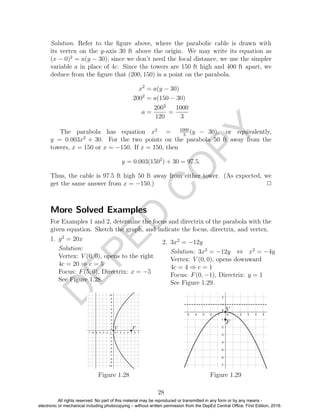
x (that is, we can find a value
in terms of π), but if no such special value exists, then we leave it in the form
sin−1
x. For example, as shown above, sin−1 1
2
is equal to π
6
. However, as studied
in Lesson 3.2, no special number θ satisfies sin θ = 2
3
, so we leave sin−1 2
3
as is.
Example 3.7.2. Find the exact value of each expression.
(1) sin sin−1 1
2
(2) arcsin sin π
3
(3) arcsin(sin π)
(4) sin sin−1
−1
2
Solution. (1) sin sin−1 1
2
= sin π
6
= 1
2
(2) arcsin sin π
3
= arcsin
√
3
2
= π
3
(3) arcsin(sin π) = arcsin 0 = 0
(4) sin sin−1
−1
2
= sin −π
6
= −1
2
2
From the last example, we have the following observations:
1. sin(arcsin x) = x for any x ∈ [−1, 1]; and
2. arcsin(sin θ) = θ if and only if θ ∈ −π
2
, π
2
, and if θ ∈ −π
2
, π
2
, then
arcsin(sin θ) = ϕ, where ϕ ∈ −π
2
, π
2
such that sin ϕ = sin θ.
To sketch the graph of y = sin−1
x, Table 3.32 presents the tables of values
for y = sin x and y = sin−1
x. Recall that the graphs of y = sin x and y = sin−1
x
are symmetric with respect to the line y = x. This means that if a point (a, b) is
on y = sin x, then (b, a) is on y = sin−1
x.
203
All rights reserved. No part of this material may be reproduced or transmitted in any form or by any means -
electronic or mechanical including photocopying – without written permission from the DepEd Central Office. First Edition, 2016.
D
EPED
C
O
PY
y = sin x
x −π
2
−π
3
−π
4
−π
6
0 π
6
π
4
π
3
π
2
y −1 −
√
3
2
−
√
2
2
−1
2
0 1
2
√
2
2
√
3
2
1
y = sin−1
x
x −1 −
√
3
2
−
√
2
2
−1
2
0 1
2
√
2
2
√
3
2
1
y −π
2
−π
3
−π
4
−π
6
0 π
6
π
4
π
3
π
2
Table 3.32
The graph (solid thick curve) of the restricted sine function y = sin x is shown
in Figure 3.33(a), while the graph of inverse sine function y = arcsin x is shown
in Figure 3.33(b).
(a) y = sin x (b) y = sin−1
x
Figure 3.33
Example 3.7.3. Sketch the graph of y = sin−1
(x + 1).
Solution 1. In this solution, we use translation of graphs.
Because y = sin−1
(x + 1) is equivalent to y = sin−1
[x − (−1)], the graph of
y = sin−1
(x + 1) is 1-unit to the left of y = sin−1
x. The graph below shows
y = sin−1
(x + 1) (solid line) and y = sin−1
x (dashed line).
204
All rights reserved. No part of this material may be reproduced or transmitted in any form or by any means -
electronic or mechanical including photocopying – without written permission from the DepEd Central Office. First Edition, 2016.
D
EPED
C
O
PY
Solution 2. In this solution, we graph first the corresponding sine function, and
then use the symmetry with respect to y = x to graph the inverse function.
y = sin−1
(x + 1) ⇐⇒ sin y = x + 1 ⇐⇒ x = sin y − 1
The graph below shows the process of graphing of y = sin−1
(x + 1) from y =
sin x − 1 with −π
2
≤ x ≤ π
2
, and then reflecting it with respect to y = x.
3.7.2. Inverse Cosine Function
The development of the other inverse trigonometric functions is similar to that
of the inverse sine function.
205
All rights reserved. No part of this material may be reproduced or transmitted in any form or by any means -
electronic or mechanical including photocopying – without written permission from the DepEd Central Office. First Edition, 2016.
D
EPED
C
O
PY
y = cos−1
x or y = arccos x
means
cos y = x,
where −1 ≤ x ≤ 1 and 0 ≤ y ≤ π.
The graph (solid thick curve) of the restricted cosine function y = cos x is
shown in Figure 3.34(a), while the graph of inverse cosine function y = arccos x
is shown in Figure 3.34(b).
(a) y = cos x (b) y = cos−1
x
Figure 3.34
Example 3.7.4. Find the exact value of each expression.
(1) cos−1
0
(2) arccos −
√
3
2
(3) cos cos−1
−
√
3
2
(4) cos−1
cos 3π
4
(5) arccos cos 7π
6
(6) sin cos−1
√
2
2
Solution. (1) cos−1
0 = π
2
because cos π
2
= 0 and π
2
∈ [0, π].
(2) arccos −
√
3
2
= 5π
6
(3) cos cos−1
−
√
3
2
= −
√
3
2
because −
√
3
2
∈ [−1, 1]
(4) cos−1
cos 3π
4
= 3π
4
because 3π
4
∈ [0, π].
206
All rights reserved. No part of this material may be reproduced or transmitted in any form or by any means -
electronic or mechanical including photocopying – without written permission from the DepEd Central Office. First Edition, 2016.
D
EPED
C
O
PY
(5) arccos cos 7π
6
= arccos −
√
3
2
= 5π
6
(6) sin cos−1
√
2
2
=
√
2
2
2
Example 3.7.5. Simplify: sin arcsin 2
3
+ arccos 1
2
.
Solution. We know that arccos 1
2
= π
3
. Using the Sine Sum Identity, we have
sin arcsin 2
3
+ arccos 1
2
= sin arcsin 2
3
+ π
3
= sin arcsin 2
3
cos π
3
+ cos arcsin 2
3
sin π
3
= 2
3
· 1
2
+ cos arcsin 2
3
·
√
3
2
= 1
3
+
√
3
2
cos arcsin 2
3
.
We compute cos arcsin 2
3
. Let θ = arcsin 2
3
. By definition, sin θ = 2
3
, where
θ lies in QI. Using the Pythagorean identity, we have
cos arcsin 2
3
= cos θ = 1 − sin2
θ =
√
5
3
.
Going back to the original computations above, we have
sin arcsin 2
3
+ arccos 1
2
= 1
3
+
√
3
2
cos arcsin 2
3
= 1
3
+
√
3
2
·
√
5
3
= 2+
√
15
6
. 2
Example 3.7.6. Simplify: sin 2 cos−1
−4
5
.
Solution. Let θ = cos−1
−4
5
. Then cos θ = −4
5
. Because cos θ < 0 and range
of inverse cosine function is [0, π], we know that θ must be within the interval
π
2
, π . Using the Pythagorean Identity, we get sin θ = 3
5
.
Using the Sine Double-Angle Identity, we have
sin 2 cos−1
−4
5
= sin 2θ
= 2 sin θ cos θ
= 2 · 3
5
−4
5
= −24
25
. 2
Example 3.7.7. Sketch the graph of y = 1
4
cos−1
(2x).
Solution.
y =
1
4
cos−1
(2x) ⇐⇒ 4y = cos−1
(2x) ⇐⇒ x =
1
2
cos(4y)
207
All rights reserved. No part of this material may be reproduced or transmitted in any form or by any means -
electronic or mechanical including photocopying – without written permission from the DepEd Central Office. First Edition, 2016.
D
EPED
C
O
PY
We graph first y = 1
2
cos(4x). The domain of this graph comes from the restriction
of cosine as follows:
0 ≤ 4x ≤ π =⇒ 0 ≤ x ≤
π
4
.
Then reflect this graph with respect to y = x, and we finally obtain the graph of
y = 1
4
cos−1
(2x) (solid line).
In the last example, we may also use the following technique. In graphing
y = 1
4
cos−1
(2x), the horizontal length of cos−1
x is reduced to half, while the
vertical height is reduced to quarter. This comparison technique is shown in
the graph below with the graph of y = cos−1
x in dashed line and the graph of
y = 1
4
cos−1
(2x) in solid line.
3.7.3. Inverse Tangent Function and the Remaining Inverse
Trigonometric Functions
The inverse tangent function is similarly defined as inverse sine and inverse cosine
functions.
208
All rights reserved. No part of this material may be reproduced or transmitted in any form or by any means -
electronic or mechanical including photocopying – without written permission from the DepEd Central Office. First Edition, 2016.
D
EPED
C
O
PY
y = tan−1
x or y = arctan x
means
tan y = x,
where x ∈ R and −π
2
< y < π
2
.
The graph (solid thick curve) of the restricted function y = tan x is shown
in Figure 3.35(a), while the graph of inverse function y = arctan x is shown in
Figure 3.35(b).
(a) y = tan x (b) y = tan−1
x
Figure 3.35
Example 3.7.8. Find the exact value of each expression.
(1) tan−1
1
(2) arctan −
√
3
(3) tan tan−1
−5
2
(4) tan−1
tan −π
6
(5) tan−1
tan 7π
6
(6) arctan tan −19π
6
Solution. Note the range of arctan is the open interval −π
2
, π
2
.
(1) tan−1
1 = π
4
(2) arctan −
√
3 = −π
3
(3) tan tan−1
−5
2
= −5
2
(4) tan−1
tan −π
6
= −π
6
because −π
6
∈ −π
2
, π
2
.
209
All rights reserved. No part of this material may be reproduced or transmitted in any form or by any means -
electronic or mechanical including photocopying – without written permission from the DepEd Central Office. First Edition, 2016.
D
EPED
C
O
PY
(5) Here, note that 7π
6
∈ −π
2
, π
2
. Use the idea of reference angle, we know that
tan 7π
6
= tan π
6
.
tan−1
tan
7π
6
= tan−1
tan
π
6
=
π
6
(6) Here, we cannot use the idea of reference angle, but the idea can help in a
way. The number (or angle) −19π
6
is in QII, wherein tangent is negative, and
its reference angle is π
6
.
arctan tan −
19π
6
= arctan tan −
π
6
= −
π
6
2
Example 3.7.9. Find the exact value of each expression.
(1) sin 2 tan−1
−8
3
(2) tan sin−1 3
5
− tan−1 1
4
Solution. (1) Let θ = tan−1
−8
3
. Then tan θ = −8
3
. Following the notations in
Lesson 3.2 and the definition of inverse tangent function, we know that θ lies
in QIV, and x = 3 and y = −8. We get r = 32 + (−8)2 =
√
73.
Applying the Sine Double-Angle Identity (page 192) gives
sin 2 tan−1
−
8
3
= sin 2θ
= 2 sin θ cos θ
= 2 ·
y
r
·
x
r
= 2 −
8
√
73
3
√
73
= −
48
73
.
(2) Using the Tangent Difference Identity, we obtain
tan sin−1 3
5
− tan−1 1
4
=
tan sin−1 3
5
− tan tan−1 1
4
1 + tan sin−1 3
5
tan tan−1 1
4
=
tan sin−1 3
5
− 1
4
1 + tan sin−1 3
5
· 1
4
.
We are left to compute tan sin−1 3
5
. We proceed as in (1) above. Let
θ = sin−1 3
5
. Then sin θ = 3
5
. From the definition of inverse sine function and
210
All rights reserved. No part of this material may be reproduced or transmitted in any form or by any means -
electronic or mechanical including photocopying – without written permission from the DepEd Central Office. First Edition, 2016.
D
EPED
C
O
PY
the notations used in Lesson 3.2, we know that θ lies in QI, and y = 3 and
r = 5. We get x =
√
52 − 32 = 4, so that tan θ = y
x
= 3
4
.
tan sin−1 3
5
− tan−1 1
4
=
tan sin−1 3
5
− 1
4
1 + tan sin−1 3
5
· 1
4
=
3
4
− 1
4
1 + 3
4
· 1
4
=
8
19
2
Example 3.7.10. A student is
viewing a painting in a museum.
Standing 6 ft from the painting,
the eye level of the student is 5 ft
above the ground. If the paint-
ing is 10 ft tall, and its base is
4 ft above the ground, find the
viewing angle subtended by the
painting at the eyes of the stu-
dent.
Solution. Let θ be the viewing angle, and let θ = α + β as shown below.
We observe that
tan α =
1
6
and tan β =
9
6
.
Using the Tangent Sum Identity, we have
tan θ = tan(α + β) =
tan α + tan β
1 − tan α tan β
=
1
6
+ 9
6
1 − 1
6
· 9
6
=
20
9
.
Using a calculator, the viewing angle is θ = tan−1 20
9
≈ 65.8◦
. 2
We now define the remaining inverse trigonometric functions.
211
All rights reserved. No part of this material may be reproduced or transmitted in any form or by any means -
electronic or mechanical including photocopying – without written permission from the DepEd Central Office. First Edition, 2016.
D
EPED
C
O
PY
Define
cot−1
x =
π
2
− tan−1
x.
It follows that the domain of y = cot−1
x is R and its range is (0, π).
y = sec−1
x or y = arcsec x
means
sec y = x,
where |x| ≥ 1 and y ∈ 0, π
2
∪ π, 3π
2
.
Define
csc−1
x =
π
2
− sec−1
x.
This means that the domain of y = csc−1
x is (−∞, −1] ∪ [1, ∞) and
its range is −π, −π
2
∪ 0, π
2
.
The graphs of these last three inverse trigonometric functions are shown in
Figures 3.36, 3.37, and 3.38, respectively.
(a) y = cot x (b) y = cot−1
x
Figure 3.36
212
All rights reserved. No part of this material may be reproduced or transmitted in any form or by any means -
electronic or mechanical including photocopying – without written permission from the DepEd Central Office. First Edition, 2016.
D
EPED
C
O
PY
(a) y = sec x (b) y = sec−1
x
Figure 3.37
(a) y = csc x (b) y = csc−1
x
Figure 3.38
Observe that the process in getting the value of an inverse function is the
same to all inverse functions. That is, y = f−1
(x) is the same as f(y) = x. We
need to remember the range of each inverse trigonometric function. Table 3.39
summarizes all the information about the six inverse trigonometric functions.
213
All rights reserved. No part of this material may be reproduced or transmitted in any form or by any means -
electronic or mechanical including photocopying – without written permission from the DepEd Central Office. First Edition, 2016.
D
EPED
C
O
PY
Function Domain Range Graph
sin−1
x [−1, 1] −π
2
, π
2
Figure
3.33(b)
cos−1
x [−1, 1] [0, π]
Figure
3.34(b)
tan−1
x R −π
2
, π
2
Figure
3.35(b)
cot−1
x R (0, π)
Figure
3.36(b)
sec−1
x {x : |x| ≥ 1} 0, π
2
∪ π, 3π
2
Figure
3.37(b)
csc−1
x {x : |x| ≥ 1} −π, −π
2
∪ 0, π
2
Figure
3.38(b)
Table 3.39
Example 3.7.11. Find the exact value of each expression.
(1) sec−1
(−2)
(2) csc−1
−2
√
3
3
(3) cot−1
−
√
3
(4) sin sec−1
−3
2
− csc−1
−2
√
3
3
Solution. (1) sec−1
(−2) = 4π
3
because sec 4π
3
= −2 and 4π
3
∈ π, 3π
2
(2) csc−1
−2
√
3
3
= −2π
3
(3) cot−1
−
√
3 = 5π
6
(4) From (2), we know that csc−1
−2
√
3
3
= −2π
3
. Let θ = sec−1
−3
2
. Then
sec θ = −3
2
. From defined range of inverse secant function and the notations
in Lesson 3.2, θ lies in QIII, and r = 3 and x = −2. Solving for y, we get
y = − 32 − (−2)2 = −
√
5. It follows that sin θ = −
√
5
3
and cos θ = −2
3
.
We now use the Sine Sum Identity.
sin sec−1
−
3
2
− csc−1
−
2
√
3
3
= sin θ − −
2π
3
= sin θ +
2π
3
214
All rights reserved. No part of this material may be reproduced or transmitted in any form or by any means -
electronic or mechanical including photocopying – without written permission from the DepEd Central Office. First Edition, 2016.
D
EPED
C
O
PY
= sin θ cos
2π
3
+ cos θ sin
2π
3
= −
√
5
3
−
1
2
+ −
2
3
√
3
2
=
√
5 − 2
√
3
6
2
More Solved Examples
1. Find the exact values of the following, if they exist.
(a) sin−1
√
2
2
(b) arcsin −1
2
(c) sin−1
2
Solution: Note that the range of f(x) = sin−1
x is [−π
2
, π
2
]. Thus, if we let
y = sin−1
x, then we are looking for y ∈ [−π
2
, π
2
] such that sin y = x. Hence,
(a) sin−1
√
2
2
= π
4
,
(b) arcsin −1
2
= −π
6
, and
(c) sin−1
2 is undefined because sin y ≤ 1.
2. Find the exact value of each expression.
(a) sin sin−1
√
2
2
(b) cos arcsin −1
2
(c) sin−1
sin 11π
2
Solution:
(a) sin sin−1
√
2
2
= sin(π
4
) =
√
2
2
(b) cos arcsin −1
2
= cos(−π
6
) =
√
3
2
(c) sin−1
sin 11π
2
= sin−1
(−1) = −π
2
3. Answer the following.
(a) What is the domain of y = sin−1
2x?
(b) What is the range of y = sin−1
2x?
(c) What is the x−intercept of y = sin−1
2x?
Solution:
(a) Consider the function f(θ) = sin−1
θ. The domain of sin−1
θ is [−1, 1].
So, θ = 2x ∈ [−1, 1]. Therefore, the domain of sin−1
2x is [−1/2, 1/2].
215
All rights reserved. No part of this material may be reproduced or transmitted in any form or by any means -
electronic or mechanical including photocopying – without written permission from the DepEd Central Office. First Edition, 2016.
D
EPED
C
O
PY
(b) [−π/2, π/2]
(c) (0, 0)
4. From the concept of projectile motion, if an object is directed at an angle θ
(with θ ∈ [0, π/2]), then the range will be R =
v2
0
g
sin 2θ (in feet) where v0 (in
ft/s) is the initial speed and g = 32 ft/s2
is the acceleration due to gravity.
At what angle shall the object be directed so that the range will be 100 ft,
given that the initial speed is v0 = 80 ft/s?
Solution: From the formula of the range, we get
100 =
802
32
sin 2θ =⇒
1
2
= sin 2θ
Since θ must be from 0 to π
2
(i.e. 0 ≤ 2θ ≤ π), this is equivalent to finding 2θ
such that 2θ = sin−1 1
2
. Hence,
2θ =
π
6
=⇒ θ =
π
12
.
Therefore, the object must be directed at an angle of π
12
rad (or 15◦
), to have
a projectile range of 100 ft.
5. Find the exact values of the following, if they exist.
(a) cos−1
√
2
2
(b) cos cos−1
−1
2
(c) arccos(cos π)
(d) arccos π
Solution:
(a) cos−1
√
2
2
= π
4
(b) cos cos−1
−1
2
= cos 2π
3
= −1
2
(c) arccos(cos π) = arccos(−1) = π
(d) Let y = arccos π. Since cos y ≤ 1, we have y is undefined because π > 3.
6. Simplify: (a) cos cos−1
√
3
2
− cos−1 1
3
Solution: We know that cos−1
√
3
2
= π
6
. Let θ = cos−1 1
3
. Which is equivalent
to cos θ = 1
3
with 0 ≤ θ ≤ π. Using the Cosine Difference Identity, we have
cos cos−1
√
3
2
− cos−1 1
3
= cos
π
6
− θ = cos
π
6
cos θ + sin
π
6
sin θ
=
√
3
2
·
1
3
+
1
2
· sin θ.
216
All rights reserved. No part of this material may be reproduced or transmitted in any form or by any means -
electronic or mechanical including photocopying – without written permission from the DepEd Central Office. First Edition, 2016.
D
EPED
C
O
PY
Now, we solve for sin θ using the Pythagorean Identity which gives
sin2
θ = 1 − (1/3)2
= 1 − (1/9) = 8/9.
Thus, sin θ = 2
√
2
3
because θ ∈ [0, π]. Finally, we obtain
cos cos−1
√
3
2
− cos−1 1
3
=
√
3
2
·
1
3
+
1
2
·
2
√
2
3
=
√
3
6
+
2
√
2
6
=
√
3 + 2
√
2
6
.
7. Simplify: (a) cos 2 cos−1 2
5
; (b) sin cos−1 2
5
Solution: Let θ = cos−1 2
5
. Which is equivalent to cos θ = 2
5
with 0 ≤ θ ≤
π. Using the Double-Angle Identity for Cosine and one of the Fundamental
Idenity, we have
cos 2 cos−1 2
5
= cos(2θ) = 2 cos2
θ − 1 = 2
2
5
2
− 1 =
8
25
− 1 = −
17
25
and
sin cos−1 2
5
= sin θ =
√
1 − cos2 θ = 1 −
4
25
=
√
21
5
.
Here, sin θ ≥ 0 because θ ∈ [0, π].
8. Graph: y = 1 + cos−1
x
Solution: The graph can be obtained by translating the graph of the inverse
cosine function one unit upward.
217
All rights reserved. No part of this material may be reproduced or transmitted in any form or by any means -
electronic or mechanical including photocopying – without written permission from the DepEd Central Office. First Edition, 2016.
D
EPED
C
O
PY
9. Find the exact value of each expression.
(a) arctan(tan 4π
3
) (b) tan(tan−1 4
5
)
Solution:
(a) arctan(tan 4π
3
) = arctan
√
3 = π/3
(b) tan(tan−1 4
5
) = 4
5
10. Find the exact value of tan(tan−1 7
6
+ tan−1 1
2
).
Solution:
tan tan−1 7
6
+ tan−1 1
2
=
tan(tan−1 7
6
) + tan(tan−1 1
2
)
1 − tan(tan−1 7
6
) · tan(tan−1 1
2
)
=
7
6
+ 1
2
1 − 7
6
· 1
2
= 4
11. Find the exact values of the following, if they exist.
(a) sec−1
√
2
(b) csc−1
1
(c) cot−1
√
3
3
(d) arcsec−1
(cot(−π
4
))
(e) cos(arccsc−1
2)
(f) arccot−1
(sin 20π
3
)
Solution:
(a) sec−1
√
2 = π
4
(b) csc−1
1 = π
2
(c) cot−1
√
3
3
= π
3
(d) arcsec(cot(−π
4
)) = arcsec(−1) = −π
(e) cos(arccsc(2)) = cos π
6
=
√
3
2
(f) arccot(sin 20π
3
) = arccot
√
3
2
. Let θ = arccot
√
3
2
. Then,
cot θ =
√
3
2
=⇒ tan θ =
2
√
3
=⇒ θ = tan−1 2
√
3
(≈ 0.8571).
Here, we needed to use a calculator to solve for the approximate value,
since 2√
3
is not a special value for tangent function.
218
All rights reserved. No part of this material may be reproduced or transmitted in any form or by any means -
electronic or mechanical including photocopying – without written permission from the DepEd Central Office. First Edition, 2016.
D
EPED
C
O
PY
Supplementary Problems 3.7
1. Find the exact value of the following.
(a) sin[sin−1
(1/2)]
(b) cos[cos−1
(−
√
2/2)]
(c) tan[tan−1
(−
√
3)]
(d) sin[arctan(
√
3)]
(e) cos[arccos(
√
2)]
(f) tan[arcsin(1/4)]
(g) cos[sin−1
(
√
3/2)]
2. Find the exact value of the following.
(a) sin−1
[sin(25π/6)]
(b) arccos[cos(23π/4)]
(c) tan−1
[tan(−1)]
(d) arcsin[cos(13π/4)]
(e) cos−1
[sec(23π)]
(f) arctan[sin(−π/12)]
3. Solve the exact value of the following.
(a) sin[2 cos−1
(−4/5)]
(b) cos[2 sin−1
(5/13)]
(c) sin(sin−1
(3/5) + cos−1
(−5/13))
(d) cos[sin−1
(1/2) − cos−1
(8/17)]
4. Consider the function f(x) = tan−1
(x + 1). Do the following.
(a) Find the domain of f.
(b) Find the range of f.
(c) Find the x− and y−intercept of f, if there are any.
(d) Graph f.
5. Evaluate and simplify the following, if they exist.
(a) arcsec(−
√
2)
(b) arccsc(−2)
(c) arccot
√
3
(d) [sec−1
(−1)] · [cos−1
(−1)]
(e) 2 cot−1
√
3 + 3 csc−1
2
(f) csc−1
0
6. Evaluate and simplify the following, if they exist.
(a)
cos(sec−1
3 + tan−1
2)
cos(tan−1
2)
(b) tan(2 arcsin(1/6))
(c) cos2 sin−1(1/2)
2
(d) arcsec(sin(100π/3))
219
All rights reserved. No part of this material may be reproduced or transmitted in any form or by any means -
electronic or mechanical including photocopying – without written permission from the DepEd Central Office. First Edition, 2016.
D
EPED
C
O
PY
7. A trough is in the shape of an inverted triangular prism whose cross section
has the shape of an inverted isosceles triangle (see Figure 3.40). If the length
of the base of the cross section is 2
√
3 m. and the length of the trough is
100
√
3 m., find the size of the vertex angle so that the volume is 900 m3
.
Hint: V = bhl/2.
Figure 3.40
4
Lesson 3.8. Trigonometric Equations
Learning Outcomes of the Lesson
At the end of the lesson, the student is able to:
(1) solve trigonometric equations; and
(2) solve situational problems involving trigonometric equations.
Lesson Outline
(1) Definition of a trigonometric equation
(2) Solution to a trigonometric equation
(3) Techniques of solving a trigonometric equation
Introduction
We have studied equations in Lesson 3.4. We differentiated an identity from
a conditional equation. Recall that an identity is an equation that is true for all
220
All rights reserved. No part of this material may be reproduced or transmitted in any form or by any means -
electronic or mechanical including photocopying – without written permission from the DepEd Central Office. First Edition, 2016.
D
EPED
C
O
PY
values of the variable in the domain of the equation, while a conditional equation
is an equation that is not an identity.
In this lesson, we mostly study conditional trigonometric equations. Though
not explicitly, we have started it in the preceding lesson. For example, the equa-
tion sin x = 1
2
has the unique solution x = sin−1 1
2
= π
6
in the closed interval
−π
2
, π
2
. However, if we consider the entire domain (not the restricted domain)
of the sine function, which is the set R of real numbers, there are solutions (other
than π
6
) of the equation sin x = 1
2
. This current lesson explores the techniques of
solving (conditional) trigonometric equations.
We divide the lesson into two groups of equations: the ones using a basic way
of solving, and those using more advanced techniques.
3.8.1. Solutions of a Trigonometric Equation
Any equation that involves trigonometric expressions is called a trigonometric
equation. Recall that a solution or a root of an equation is a number in the domain
of the equation that, when substituted to the variable, makes the equation true.
The set of all solutions of an equation is called the solution set of the equation.
Technically, the basic method to show that a particular number is a solution
of an equation is to substitute the number to the variable and see if the equation
becomes true. However, we may use our knowledge gained from the previous
lessons to do a quicker verification process by not doing the manual substitution
and checking. We use this technique in the example.
Example 3.8.1. Which numbers in the set 0, π
6
, π
4
, π
3
, π
2
, 2π
3
, 3π
4
, 5π
6
, π, 2π are
solutions to the following equations?
(1) sin x = 1
2
(2) tan x = 1
(3) 3 sec x = −2
√
3
(4)
√
3| cot x| = 1
(5) sec2
x − tan2
x = 1
(6) sin x + cos x = 0
(7) cos2
x = cos 2x + sin2
x
(8) sin x + cos 2x = 0
(9) 2 sin x + tan x − 2 cos x = 2
(10) sin2
x + cos2
x = 2
(11) sin 2x = sin x
(12) 2 tan x + 4 sin x = 2 + sec x
Solution. Note that the choices (except 2π) are numbers within the interval [0, π].
To quickly determine which numbers among the choices are solutions to a par-
ticular equation, we use some distinctive properties of the possible solutions.
(1) The sine function is positive on (0, π). From Lesson 3.2, we recall that π
6
is
an obvious solution. We may imagine the graph of y = sin x. We may also
use the idea of reference angle. Thus, among the choices, only π
6
and 5π
6
are
the only solutions of sin x = 1
2
.
221
All rights reserved. No part of this material may be reproduced or transmitted in any form or by any means -
electronic or mechanical including photocopying – without written permission from the DepEd Central Office. First Edition, 2016.
D
EPED
C
O
PY
(2) Since tan x = 1 > 0, any solution of the equation among the choices must
be in the interval 0, π
2
(that is, in QI). Again, among the choices, the only
solution to tan x = 1 is π
4
.
(3) Here, the given equation is equivalent to sec x = −2
√
3
3
. Among the choices,
the only solution of the equation 3 sec x = −2
√
3 is 5π
6
.
(4) Eliminating the absolute value sign, the given equation is equivalent to cot x =√
3
3
or cot x = −
√
3
3
. Among the choices, the only solution of cot x =
√
3
3
is π
3
,
while the other equation has 2π
3
. Thus, the only solutions of
√
3| cot x| = 1
from the given set are π
3
and 2π
3
.
(5) The given equation is one of the Pythagorean Identities (page 175). It means
that all numbers in the domain of the equation are solutions. The domain
of the equation is R  {x : cos x = 0}. Thus, all except π
2
are solutions of
sec2
x − tan2
x = 1.
(6) For the sum of sin x and cos x to be 0, they must have equal absolute values
but different signs. Among the choices, only 3π
4
satisfies these properties, and
it is the only solution of sin x + cos x = 0.
(7) This equations is one of the Double-Angle Identities for Cosine. This means
that all numbers in the domain of the equation are its solutions. Because the
domain of the given equation is R, all numbers in the given set are solutions
of cos2
x = cos 2x + sin2
x.
(8) We substitute each number in the choices to the expression on the left-side
of the equation, and select those numbers that give resulting values equal to
1.
x = 0: sin 0 + cos 2(0) = 0 + 1 = 1
x = π
6
: sin π
6
+ cos 2(π
6
) = 1
2
+ 1
2
= 1
x = π
4
: sin π
4
+ cos 2(π
4
) =
√
2
2
+ 0 =
√
2
2
x = π
3
: sin π
3
+ cos 2(π
3
) =
√
3
2
− 1
2
=
√
3−1
2
x = π
2
: sin π
2
+ cos 2(π
2
) = 1 − 1 = 0
x = 2π
3
: sin 2π
3
+ cos 2(2π
3
) =
√
3
2
− 1
2
=
√
3−1
2
x = 3π
4
: sin 3π
4
+ cos 2(3π
4
) =
√
2
2
+ 0 =
√
2
2
x = 5π
6
: sin 5π
6
+ cos 2(5π
6
) = 1
2
+ 1
2
= 1
x = π: sin π + cos 2π = 0 + 1 = 1
x = 2π: sin 2π + cos 2(2π) = 0 + 1 = 1
222
All rights reserved. No part of this material may be reproduced or transmitted in any form or by any means -
electronic or mechanical including photocopying – without written permission from the DepEd Central Office. First Edition, 2016.
D
EPED
C
O
PY
From these values, the only solution of sin x + cos 2x = 0 among the choices
is π
2
.
(9) We again substitute the numbers in the given set one by one, and see which
resulting values are equal to 1.
x = 0: 2 sin 0 + tan 0 − 2 cos 0 = −2
x = π
6
: 2 sin π
6
+ tan π
6
− 2 cos π
6
= 3−2
√
3
3
x = π
4
: 2 sin π
4
+ tan π
4
− 2 cos π
4
= 1
x = π
3
: 2 sin π
3
+ tan π
3
− 2 cos π
3
= 2
√
3 − 1
x = π
2
: Since tan π
2
is undefined, this value of x cannot be a solution of the
equation.
x = 2π
3
: 2 sin 2π
3
+ tan 2π
3
− 2 cos 2π
3
= 1
x = 3π
4
: 2 sin 3π
4
+ tan 3π
4
− 2 cos 3π
4
= 2
√
2 − 1
x = 5π
6
: 2 sin 5π
6
+ tan 5π
6
− 2 cos 5π
6
= 3+2
√
3
3
x = π: 2 sin π + tan π − 2 cos π = 2
x = 2π: 2 sin 2π + tan 2π − 2 cos 2π = −2
Thus, the only solution of 2 sin x+tan x−2 cos x = 2 from the given set is π.
(10) This equation has no solution because one of the Pythagorean Identities says
sin2
x + cos2
x = 1.
(11) We substitute each number in the given set to the expression of each side of
the equation, and see which resulting values are equal.
x = 0: sin 2(0) = 0; sin 0 = 0
x = π
6
: sin 2(π
6
) =
√
3
2
; sin π
6
= 1
2
x = π
4
: sin 2(π
4
) = 1; sin π
4
=
√
2
2
x = π
3
: sin 2(π
3
) =
√
3
2
; sin π
3
=
√
3
2
x = π
2
: sin 2(π
2
) = 0; sin π
2
= 1
x = 3π
4
: sin 2(3π
4
) = −1; sin 3π
4
=
√
2
2
x = 5π
6
: sin 2(5π
6
) = −
√
3
2
; sin π
3
= 1
2
x = π: sin 2π = 0; sin π = 0
x = 2π: sin 2(2π) = 0; sin 2π = 0
Thus, among the numbers in the given set, the solutions of sin 2x = sin x are
0, π
3
, π, and 2π.
223
All rights reserved. No part of this material may be reproduced or transmitted in any form or by any means -
electronic or mechanical including photocopying – without written permission from the DepEd Central Office. First Edition, 2016.
D
EPED
C
O
PY
(12) We employ the same technique used in the previous item.
x = 0 : 2 tan 0 + 4 sin 0 = 0
2 + sec 0 = 3
x = π
6
: 2 tan π
6
+ 4 sin π
6
= 2
√
3+6
3
2 + sec π
6
= 2
√
3+6
3
x = π
4
: 2 tan π
4
+ 4 sin π
4
= 2
√
2 + 2
2 + sec π
4
=
√
2 + 2
x = π
3
: 2 tan π
3
+ 4 sin π
3
= 4
√
3
2 + sec π
3
= 4
x = π
2
: Both tan π
2
and sec π
2
are undefined.
x = 2π
3
: 2 tan 2π
3
+ 4 sin 2π
3
= 0
2 + sec 2π
3
= 0
x = 3π
4
: 2 tan 3π
4
+ 4 sin 3π
4
= 2
√
2 − 2
2 + sec 3π
4
= 2 −
√
2
x = 5π
6
: 2 tan 5π
6
+ 4 sin 5π
6
= 6−2
√
3
3
2 + sec 5π
6
= 6−2
√
3
3
x = π : 2 tan π + 4 sin π = 0
2 + sec π = 1
x = 2π : 2 tan 2π + 4 sin 2π = 0
2 + sec 2π = 3
After checking the equal values, the solutions of 2 tan x + 4 sin x = 2 + sec x
among the given choices are π
6
, 2π
3
, and 5π
6
. 2
3.8.2. Equations with One Term
From the preceding discussion, you may observe that there may be more solutions
of a given equation outside the given set. We now find all solutions of a given
equation.
We will start with a group of equations having straightforward techniques
in finding their solutions. These simple techniques involve at least one of the
following ideas:
224
All rights reserved. No part of this material may be reproduced or transmitted in any form or by any means -
electronic or mechanical including photocopying – without written permission from the DepEd Central Office. First Edition, 2016.
D
EPED
C
O
PY
(1) equivalent equations (that is, equations that have the same solutions as the
original equation);
(2) periodicity of the trigonometric function involved;
(3) inverse trigonometric function;
(4) values of the trigonometric function involved on the interval [0, π] or [0, 2π]
(depending on the periodicity of the function); and
(5) Zero-Factor Law: ab = 0 if and only if a = 0 or b = 0.
To “solve an equation” means to find all solutions of the equation. Here,
unless stated as angles measured in degrees, we mean solutions of the equation
that are real numbers (or equivalently, angles measured in radians).
Example 3.8.2. Solve the equation 2 cos x − 1 = 0.
Solution. The given equation is equivalent to
cos x =
1
2
.
On the interval [0, 2π], there are only two solutions of the last equation, and these
are x = π
3
(this is in QI) and x = 5π
3
(in QIV).
Because the period of cosine function is 2π, the complete solutions of the
equation are x = π
3
+ k(2π) and x = 5π
3
+ k(2π) for all integers k. 2
In the preceding example, by saying that the “complete solutions are x =
π
3
+ k(2π) and x = 5π
3
+ k(2π) for all integers k,” we mean that any integral
value of k will produce a solution to the given equation. For example, when
k = 3, x = π
3
+ 3(2π) = 19π
3
is a solution of the equation. When k = −2,
x = 5π
3
+ (−2)(2π) = −7π
3
is another solution of 2 cos x − 1 = 0. The family of
solutions x = π
3
+ k(2π) can be equivalently enumerated as x = 19π
3
+ 2kπ, while
the family x = 5π
3
+ k(2π) can also be stated as x = −7π
3
+ 2kπ.
Example 3.8.3. Solve: (1 + cos θ)(tan θ − 1) = 0.
Solution. By the Zero-Factor Law, the given equation is equivalent to
1 + cos θ = 0 or tan θ − 1 = 0
cos θ = −1 tan θ = 1
θ = π + 2kπ, k ∈ Z θ = π
4
+ kπ, k ∈ Z.
Therefore, the solutions of the equation are θ = π + 2kπ and θ = π
4
+ kπ for all
k ∈ Z. 2
225
All rights reserved. No part of this material may be reproduced or transmitted in any form or by any means -
electronic or mechanical including photocopying – without written permission from the DepEd Central Office. First Edition, 2016.
D
EPED
C
O
PY
Example 3.8.4. Find all values of x in the interval [−2π, 2π] that satisfy the
equation (sin x − 1)(sin x + 1) = 0.
Solution.
sin x − 1 = 0 or sin x + 1 = 0
sin x = 1 sin x = −1
x = π
2
or − 3π
2
x = 3π
2
or − π
2
Solutions: π
2
, −3π
2
, 3π
2
, −π
2
2
Example 3.8.5. Solve: cos x = 0.1.
Solution. There is no special number whose cosine is 0.1. However, because
0.1 ∈ [−1, 1], there is a number whose cosine is 0.1. In fact, in any one-period
interval, with cos x = 0.1 > 0, we expect two solutions: one in QI and another in
QIV. We use the inverse cosine function.
From Lesson 3.7, one particular solution of cos x = 0.1 in QI is x = cos−1
0.1.
We can use this solution to get a particular solution in QIV, and this is x =
2π − cos−1
0.1, which is equivalent to x = − cos−1
0.1.
From the above particular solutions, we can produce all solutions of cos x =
0.1, and these are x = cos−1
0.1+2kπ and x = − cos−1
0.1+2kπ for all k ∈ Z. 2
Example 3.8.6. Solve: 3 tan θ + 5 = 0.
Solution.
3 tan θ + 5 = 0 =⇒ tan θ = −5
3
We expect only one solution in any one-period interval.
tan θ = −5
3
=⇒ θ = tan−1
−5
3
+ kπ, k ∈ Z 2
Example 3.8.7. The voltage V (in volts) coming from an electricity distribut-
ing company is fluctuating according to the function V (t) = 200 + 170 sin(120πt)
at time t in seconds.
(1) Determine the first time it takes to reach 300 volts.
(2) For what values of t does the voltage reach its maximum value?
Solution. (1) We solve for the least positive value of t such that V (t) = 300.
200 + 170 sin(120πt) = 300
sin(120πt) =
100
170
226
All rights reserved. No part of this material may be reproduced or transmitted in any form or by any means -
electronic or mechanical including photocopying – without written permission from the DepEd Central Office. First Edition, 2016.
D
EPED
C
O
PY
120πt = sin−1 100
170
t =
sin−1 100
170
120π
≈ 0.00167 seconds
(2) The maximum value of V (t) happens when and only when the maximum
value of sin(120πt) is reached. We know that the maximum value of sin(120πt)
is 1, and it follows that the maximum value of V (t) is 370 volts. Thus, we
need to solve for all values of t such that sin(120πt) = 1.
sin(120πt) = 1
120πt =
π
2
+ 2kπ, k nonnegative integer
t =
π
2
+ 2kπ
120π
t =
1
2
+ 2k
120
≈ 0.00417 + 0.017k
This means that the voltage is maximum when t ≈ 0.00417+0.017k for each
nonnegative integer k. 2
3.8.3. Equations with Two or More Terms
We will now consider a group of equations having multi-step techniques of finding
their solutions. Coupled with the straightforward techniques we learned in the
preceding discussion, these more advanced techniques involve factoring of expres-
sions and trigonometric identities. The primary goal is to reduce a given equation
into equivalent one-term equations.
Example 3.8.8. Solve: 2 cos x tan x = 2 cos x.
Solution.
2 cos x tan x = 2 cos x
2 cos x tan x − 2 cos x = 0
(2 cos x)(tan x − 1) = 0
2 cos x = 0 or tan x − 1 = 0
cos x = 0 tan x = 1
x = π
2
+ 2kπ or
x = 3π
2
+ 2kπ,
k ∈ Z
x = π
4
+ kπ,
k ∈ Z
Solutions: π
2
+ 2kπ, 3π
2
+ 2kπ, π
4
+ kπ, k ∈ Z 2
227
All rights reserved. No part of this material may be reproduced or transmitted in any form or by any means -
electronic or mechanical including photocopying – without written permission from the DepEd Central Office. First Edition, 2016.
D
EPED
C
O
PY
Example 3.8.9. Solve for x ∈ [0, 2π): sin 2x = sin x.
Solution.
sin 2x = sin x
sin 2x − sin x = 0
2 sin x cos x − sin x = 0 Sine Double-Angle Identity
(sin x)(2 cos x − 1) = 0
sin x = 0 or 2 cos x − 1 = 0
x = 0 or x = π cos x = 1
2
x = π
3
or x = 5π
3
Solutions: 0, π, π
3
, 5π
3
2
Tips in Solving Trigonometric Equations
(1) If the equation contains only one trigonometric term, isolate that
term, and solve for the variable.
(2) If the equation is quadratic in form, we may use factoring, finding
square roots, or the quadratic formula.
(3) Rewrite the equation to have 0 on one side, and then factor (if
appropriate) the expression on the other side.
(4) If the equation contains more than one trigonometric function,
try to express everything in terms of one trigonometric function.
Here, identities are useful.
(5) If half or multiple angles are present, express them in terms of a
trigonometric expression of a single angle, except when all angles
involved have the same multiplicity wherein, in this case, retain
the angle. Half-angle and double-angle identities are useful in
simplification.
Example 3.8.10. Solve for x ∈ [0, 2π): 2 cos2
x = 1 + sin x.
Solution.
2 cos2
x = 1 + sin x
2(1 − sin2
x) = 1 + sin x Pythagorean Identity
228
All rights reserved. No part of this material may be reproduced or transmitted in any form or by any means -
electronic or mechanical including photocopying – without written permission from the DepEd Central Office. First Edition, 2016.
D
EPED
C
O
PY
2 sin2
x + sin x − 1 = 0
(2 sin x − 1)(sin x + 1) = 0 Factoring
2 sin x − 1 = 0 or sin x + 1 = 0
sin x = 1
2
sin x = −1
x = π
6
or x = 5π
6
x = 3π
2
Solutions: π
6
, 5π
6
, 3π
2
2
Example 3.8.11. Solve for x ∈ [0, 2π) in the equation 3 cos2
x + 2 sin x = 2.
Solution.
3 cos2
x + 2 sin x = 2
3(1 − sin2
x) + 2 sin x = 2 Pythagorean Identity
(3 sin x + 1)(sin x − 1) = 0 Factoring
3 sin x + 1 = 0 or sin x − 1 = 0
sin x = −1
3
sin x = 1
x = sin−1
(−1
3
) + 2π
or
x = π − sin−1
(−1
3
)
x = π
2
Solutions: 2π − sin−1
(1
3
)+, π + sin−1
(1
3
), π
2
2
One part of the last solution needs further explanation. In the equation
sin x = −1
3
, we expect two solutions in the interval [0, 2π): one in (π, 3π
2
) (which
is QIII), and another in (3π
2
, 2π) (which is QIV). Since no special number satisfies
sin x = −1
3
, we use inverse sine function. Because the range of sin−1
is [−π
2
, π
2
], we
know that −π
2
< sin−1
(−1
3
) < 0. From this value, to get the solution in (3π
2
, 2π),
we simply add 2π to this value, resulting to x = sin−1
(−1
3
) + 2π. On the other
hand, to get the solution in (π, 3π
2
), we simply add − sin−1
(−1
3
) to π, resulting to
x = π − sin−1
(−1
3
).
Example 3.8.12. Solve: sin2
x + 5 cos2 x
2
= 2.
Solution.
sin2
x + 5 cos2 x
2
= 2
sin2
x + 5 1+cos x
2
= 2 Cosine Half-Angle Identity
2 sin2
x + 5 cos x + 1 = 0
229
All rights reserved. No part of this material may be reproduced or transmitted in any form or by any means -
electronic or mechanical including photocopying – without written permission from the DepEd Central Office. First Edition, 2016.
D
EPED
C
O
PY
2(1 − cos2
x) + 5 cos x + 1 = 0 Pythagorean Identity
2 cos2
x − 5 cos x − 3 = 0
(2 cos x + 1)(cos x − 3) = 0
2 cos x + 1 = 0 or cos x − 3 = 0
cos x = −1
2
cos x = 3
x = 2π
3
+ 2kπ or
x = 4π
3
+ 2kπ,
k ∈ Z
no solution
Solutions: 2π
3
+ 2kπ, 4π
3
+ 2kπ, k ∈ Z 2
Example 3.8.13. Solve for x ∈ [0, 2π) in the equation tan 2x − 2 cos x = 0.
Solution.
tan 2x − 2 cos x = 0
sin 2x
cos 2x
− 2 cos x = 0
sin 2x − 2 cos x cos 2x = 0
Apply the Double-Angle Identities for Sine and Cosine, and then factor.
2 sin x cos x − 2(cos x)(1 − 2 sin2
x) = 0
(2 cos x)(2 sin2
x + sin x − 1) = 0
(2 cos x)(2 sin x − 1)(sin x + 1) = 0
2 cos x = 0 or 2 sin x − 1 = 0 or sin x + 1 = 0
cos x = 0 sin x = 1
2
sin x = −1
x = π
2
or
x = 3π
2
x = π
6
or
x = 5π
6
x = 3π
2
These values of x should be checked in the original equation because tan 2x may
not be defined. Upon checking, this is not the case for each value of x obtained.
The solutions are π
2
, 3π
2
, π
6
, 5π
6
, and 3π
2
. 2
Example 3.8.14. A weight is suspended from a spring and vibrating vertically
according to the equation
f(t) = 20 cos 4
5
π t − 5
6
,
where f(t) centimeters is the directed distance of the weight from its central
position at t seconds, and the positive distance means above its central position.
230
All rights reserved. No part of this material may be reproduced or transmitted in any form or by any means -
electronic or mechanical including photocopying – without written permission from the DepEd Central Office. First Edition, 2016.
D
EPED
C
O
PY
(1) At what time is the displacement of the weight 5 cm below its central
position for the first time?
(2) For what values of t does the weight reach its farthest point below its central
position?
Solution. (1) We find the least positive value of t such that f(t) = −5.
20 cos 4
5
π t − 5
6
= −5
cos 4
5
π t − 5
6
= −1
4
There are two families of solutions for this equation.
• 4
5
π t − 5
6
= cos−1
−1
4
+ 2kπ, k ∈ Z
t = 5
6
+
cos−1
(− 1
4 )+2kπ
4
5
π
In this family of solutions, the least positive value of t happens when
k = 0, and this is
t =
5
6
+
cos−1
−1
4
+ 2(0)π
4
5
π
≈ 1.5589.
• 4
5
π t − 5
6
= 2π − cos−1
−1
4
+ 2kπ, k ∈ Z
t = 5
6
+
2π−cos−1
(− 1
4 )+2kπ
4
5
π
Here, the least positive value of t happens when k = −1, and this is
t =
5
6
+
2π − cos−1
−1
4
+ 2(−1)π
4
5
π
≈ 0.1078.
Therefore, the first time that the displacement of the weight is 5 cm below
its central position is at about 0.1078 seconds.
(2) The minimum value of f(t) happens when and only when the minimum
value of cos 4
5
π t − 5
6
is reached. The minimum value of cos 4
5
π t − 5
6
is
−1, which implies that the farthest point the weight can reach below its
central position is 20 cm. Thus, we need to solve for all values of t such that
cos 4
5
π t − 5
6
= −1.
cos 4
5
π t − 5
6
= −1
4
5
π t − 5
6
= cos−1
(−1) + 2kπ, k ≥ 0
4
5
π t − 5
6
= π + 2kπ
t = 5
6
+ π+2kπ
4
5
π
= 25
12
+ 5
2
k
Therefore, the weight reaches its farthest point (which is 20 cm) below its
central position at t = 25
12
+ 5
2
k for every integer k ≥ 0. 2
231
All rights reserved. No part of this material may be reproduced or transmitted in any form or by any means -
electronic or mechanical including photocopying – without written permission from the DepEd Central Office. First Edition, 2016.
D
EPED
C
O
PY
More Solved Examples
1. Give a particular solution of the following equation.
(a) sin2
x − 1 = 0
(b) cot x =
√
3
(c) sec 3x = −1
(d) csc2
x − csc x − 2 = 0
(e) cos2
2x = sin2
x
(f) 2 cos x − 3 = 0
Solution:
(a) x = −π
2
is a solution because sin2
(−π
2
) − 1 = (−1)2
− 1 = 0.
(b) Note that cos π
6
=
√
3
2
and sin π
6
= 1
2
. Thus, cot π
6
=
√
3. So, x = π
6
is a
solution.
(c) Since sec θ = −1 if and only if cos θ = −1, a particular solution of the
equation in 3x is π, that is, 3x = π. Hence, x = π
3
is a solution.
(d) Note that csc 3π
2
= −1. So, csc2 3π
2
= 1. As a consequence, csc2 3π
2
−
csc 3π
2
− 2 = 1 − (−1) − 2 = 0.
(e) x = π
2
is a solution.
(f) Because cos x must not be more than 1, then the equation has no solution.
2. What is the solution set of the following trigonometric equation sin2
x +
cos2
x = 1?
Solution: The equation is the Pythagorean Identity, meaning any element of
the domain of sin x and cos x satisfies the equation. The domain of both sin x
and cos x is R. Therefore, the solution set of this trigonometric equation is R.
One may try the numbers −π
6
, 0, and π
4
for illustration.
(a) x = −π
6
sin2
x + cos2
x = sin2
−
π
6
+ cos2
−
π
6
= sin −
π
6
2
+ cos −
π
6
2
= −
1
2
2
+
√
3
2
2
=
1
4
+
3
4
= 1.
(b) x = 0
sin2
x + cos2
x = sin2
0 + cos2
0 = 02
+ 12
= 0 + 1 = 1.
(c) x = π
4
sin2
x + cos2
x = sin2 π
4
+ cos2 π
4
=
√
2
2
2
+
√
2
2
2
=
1
4
+
1
4
= 1.
232
All rights reserved. No part of this material may be reproduced or transmitted in any form or by any means -
electronic or mechanical including photocopying – without written permission from the DepEd Central Office. First Edition, 2016.
D
EPED
C
O
PY
3. Find the solution set of the trigonometric equation tan2
x + 1 = sec2
x.
Solution: Notice that this is a fundamental identity. Thus, the solution of
this equation is any number common to the domain of the tangent and secant
function. That is, the solution set is
{x ∈ R | cos x = 0} = {x ∈ R | x = ±π
2
, ±3π
2
, ±5π
2
, ...}
= {x ∈ R | x = (2k+1)π
2
, k ∈ Z}.
4. Find all solutions of
√
3 tan x + 1 = 0.
Solution: The equation is equivalent to tan x = − 1√
3
. This is true only if
x = 5π
6
+ kπ where k ∈ Z.
5. What are the solutions of
√
3 tan x + 1 = 0, where x ∈ [0, 2π].
Solution: The solutions are x = 5π
6
and x = 11π
6
.
6. Determine all solutions of 4 cos2
x − 1 = 0.
Solution: Note that the equation is quadratic in form, so we can apply tech-
niques in solving quadratic equations. For this case, we factor the expression
on the left and obtain, (2 cos x − 1)(2 cos x + 1) = 0. Consequently, we have
cos x = 1/2 or cos x = −1/2. The first equation have solutions of the form
(π/3 + 2kπ) or (5π/3 + 2kπ) where k ∈ Z, while the second equation have
solutions of the form (2π/3 + 2kπ) or (4π/3 + 2kπ). Combining the two solu-
tions, one observes that the solution set of the original equation may be given
by
π
3
,
2π
3
,
4π
3
,
5π
3
,
7π
3
, ... .
We can write this in a more compact form as
kπ
3
: k = 3j, where j ∈ Z .
7. Find the solutions of 4 cos2
x − 1 = 0 within the closed interval [0, 2π].
Solution: Similar to Example 6, the solution of the above equation is
kπ
3
: k = 3j, where j ∈ Z .
Since we are to find solutions in [0, 2π], we take k = 1, 2, 4, and 5 to obtain
the solutions π/3, 2π/3, 4π/3, and 5π/3.
233
All rights reserved. No part of this material may be reproduced or transmitted in any form or by any means -
electronic or mechanical including photocopying – without written permission from the DepEd Central Office. First Edition, 2016.
D
EPED
C
O
PY
8. If x ∈ [0, 2π), solve the equation 2 sin2
x =
√
3 sin x.
Solution: First, we write the equation as 2 sin2
x −
√
3 sin x = 0. Then, we
factor out sin x and get
sin x(2 sin x −
√
3) = 0 =⇒ sin x = 0 or sin x =
√
3/2.
The first of these equations has solutions x = 0 and x = π, while the second
has solutions x = π/3 and 2π/3. The solutions of the original equation is the
union of the two, i.e., the solution set is {0, π, π
3
, 2π
3
}.
9. Solve 2 cos2
x + 5 cos x − 3 = 0, where x ∈ [0, 2π).
Solution: By factoring the left hand side of the given equation, we get (2 cos x−
1)(cos x + 3) = 0. This gives us two equations, namely
cos x =
1
2
and cos x = −3.
First, we remark that the second equation does not have a solution because
cos x should be more than or equal to -1. Hence, the solution of the first
equation is the solution of the original equation. Thus, the solution set is
{π
3
, 5π
3
}.
10. Determine the solution set of the equation cos 2x = sin x on [0, 2π).
Solution: Combining the equation cos 2x = sin x with the cosine double-angle
identity cos 2x = 1 − 2 sin2
x, we get
sin x = 1 − 2 sin2
x.
This is equivalent to
2 sin2
x + sin x − 1 = 0 =⇒ (2 sin x − 1)(sin x + 1) = 0
=⇒ sin x = 1/2 and sin x = −1.
The solutions of the first equation is x = π/6 and x = 5π/6. The number
x = 3π/2 is the solution of the second equation. Therefore, the solution set of
the original equation is {π
6
, 5π
6
, 3π
2
}.
11. Solve cos x = cos 2x, for x ∈ [0, 2π).
Solution:
cos x = cos 2x
⇒ cos x = 2 cos2
x − 1
⇒ 0 = 2 cos2
x − cos x − 1
⇒ 0 = (2 cos x + 1)(cos x − 1).
234
All rights reserved. No part of this material may be reproduced or transmitted in any form or by any means -
electronic or mechanical including photocopying – without written permission from the DepEd Central Office. First Edition, 2016.
D
EPED
C
O
PY
The given trigonometric equation is equivalent to solving 2 cos x + 1 = 0 and
cos x = 1. For 2 cos x+1 = 0 which is the same as cos x = −1/2, the solutions
in the given interval are x = 2π/3, 4π/3. For cos x = 1, the solution is x = 0.
Therefore, the solution set of the original equation is {0, 2π
3
, 4π
3
}.
12. A lighthouse at sea level is 34 mi from a boat. It is known that the top of
the lighthouse is 42.5 mi from the boat and that x = r cos θ, where x is the
horizontal distance, r is the distance of the top of the lighthouse from the
boat, and θ is the angle of depression from the top of lighthouse. Find θ.
Solution:
x = r cos θ =⇒ cos θ =
x
r
=
34
42.5
=
4
5
=⇒ θ = cos−1 4
5
≈ 0.6435 (or 36.87◦
).
For this case, we used a calculator to find the value of the unknown variable
θ since 4
5
is not a special value for cosine.
13. Three cities, A, B, and C, are positioned in a triangle as seen in the figure
below.
It is known that City A is 140 mi from City C, while City B is 210 mi from
City C. Cities A and B are 70
√
7 mi apart. Also, by the Cosine Law, we have
z2
= x2
+ y2
− 2xy cos γ
where x, y, and z are the respective distances of BC, AC, AB, and γ =
m∠ACB. Find γ.
Solution: Substituting the corresponding values of x, y, and z, the problem is
now equivalent to solving the equation
34300 = 44100 + 19600 − 58800 cos γ
⇒ −29400 = −58800 cos γ
⇒ 1
2
= cos γ
⇒ π
3
= γ.
235
All rights reserved. No part of this material may be reproduced or transmitted in any form or by any means -
electronic or mechanical including photocopying – without written permission from the DepEd Central Office. First Edition, 2016.
D
EPED
C
O
PY
Supplementary Problems 3.8
1. Find all solutions of the equation 2 cos x − cos x sin x = 0.
2. Determine the solution set of the equation csc2
x + 1 = 0.
3. What are the solutions of sec2
x + sec x − 2 = 0.
4. Find the solutions of the equation 4 sin2
x − 1 = 0 on [0, 2π).
5. Find the values of x ∈ [0, 2π) for which csc 2x =
√
2.
6. What is the solution set of the equation sin θ = csc θ?
7. Solve t = sin−1
(cos 2t).
8. Let x ∈ [0, 2π). Find the solutions of the equation cos2
4x + sin2
2x = 1.
9. If a projectile, such as a bullet, is fired into the air with an initial velocity v at
an angle of elevation θ, then the height h of the projectile at time t is given by
h(t) = −16t2
+ vt cos θ meters. If the initial velocity is 109 meters per second,
at what angle should the bullet be fired so that its height is 45 meters above
the floor in 2 seconds.
10. In a baseball field, a pitcher throws the ball at a speed of 60 km/h to the
catcher who is 100 m away. When the ball leaves a starting point at an angle
of elevation of θ , the horizontal distance the ball travels is determined by
d = v2
32
sin θ, where d is measured in meters and velocity in kilometers per
hour. At what angle of elevation (in degrees) is the ball thrown?
4
Lesson 3.9. Polar Coordinate System
Learning Outcomes of the Lesson
At the end of the lesson, the student is able to:
(1) locate points in polar coordinate system;
(2) convert the coordinates of a point from rectangular to polar system and vice
versa; and
(3) solve situational problems involving polar coordinate system.
236
All rights reserved. No part of this material may be reproduced or transmitted in any form or by any means -
electronic or mechanical including photocopying – without written permission from the DepEd Central Office. First Edition, 2016.
D
EPED
C
O
PY
Lesson Outline
(1) Polar coordinate system: pole and polar axis
(2) Polar coordinates of a point and its location
(3) Conversion from polar to rectangular coordinates, and vice versa
(4) Simple graphs and applications
Introduction
Two-dimensional coordinate systems are used to describe a point in a plane.
We previously used the Cartesian or rectangular coordinate system to locate a
point in the plane. That point is denoted by (x, y), where x is the signed dis-
tance of the point from the y-axis, and y is the signed distance of the point
from the x-axis. We sketched the graphs of equations (lines, circles, parabolas,
ellipses, and hyperbolas) and functions (polynomial, rational, exponential, log-
arithmic, trigonometric, and inverse trigonometric) in the Cartesian coordinate
plane. However, it is often convenient to locate a point based on its distance
from a fixed point and its angle with respect to a fixed ray. Not all equations
can be graphed easily using Cartesian coordinates. In this lesson, we also use
another coordinate system, which can be presented in dartboard-like plane as
shown below.
3.9.1. Polar Coordinates of a Point
We now introduce the polar coordinate system. It is composed of a fixed point
called the pole (which is the origin in the Cartesian coordinate system) and a
237
All rights reserved. No part of this material may be reproduced or transmitted in any form or by any means -
electronic or mechanical including photocopying – without written permission from the DepEd Central Office. First Edition, 2016.
D
EPED
C
O
PY
fixed ray called the polar axis (which is the nonnegative x-axis).
In the polar coordinate system, a point is described by the ordered pair (r, θ).
The radial coordinate r refers to the directed distance of the point from the pole.
The angular coordinate θ refers to a directed angle (usually in radians) from the
polar axis to the segment joining the point and the pole.
Because a point in polar coordinate system is described by an order pair of
radial coordinate and angular coordinate, it will be more convenient to geomet-
rically present the system in a polar plane, which serves just like the Cartesian
plane. In the polar plane shown below, instead of rectangular grids in the Carte-
sian plane, we have concentric circles with common center at the pole to identify
easily the distance from the pole (radial coordinate) and angular rays emanating
from the pole to show the angles from the polar axis (angular coordinate).
238
All rights reserved. No part of this material may be reproduced or transmitted in any form or by any means -
electronic or mechanical including photocopying – without written permission from the DepEd Central Office. First Edition, 2016.
D
EPED
C
O
PY
Example 3.9.1. Plot the following points in one polar plane: A(3, π
3
), B(1, 5π
6
),
C(2, 7π
6
), D(4, 19π
12
), E(3, −π), F(4, −7π
6
), G(2.5, 17π
4
), H(4, 17π
6
), and I(3, −5π
3
).
Solution.
As seen in the last example, unlike in Cartesian plane where a point has a
unique Cartesian coordinate representation, a point in polar plane have infinitely
many polar coordinate representations. For example, the coordinates (3, 4) in
the Cartesian plane refer to exactly one point in the plane, and this particular
point has no rectangular coordinate representations other than (3, 4). However,
the coordinates (3, π
3
) in the polar plane also refer to exactly one point, but
this point has other polar coordinate representations. For example, the polar
coordinates (3, −5π
3
), (3, 7π
3
), (3, 13π
3
), and (3, 19π
3
) all refer to the same point as
that of (3, π
3
).
The polar coordinates (r, θ + 2kπ), where k ∈ Z, represent the same
point as that of (r, θ).
In polar coordinate system, it is possible for the coordinates (r, θ) to have
a negative value of r. In this case, the point is |r| units from the pole in the
opposite direction of the terminal side of θ, as shown in Figure 3.41.
239
All rights reserved. No part of this material may be reproduced or transmitted in any form or by any means -
electronic or mechanical including photocopying – without written permission from the DepEd Central Office. First Edition, 2016.
D
EPED
C
O
PY
Figure 3.41
Example 3.9.2. Plot the following points in one polar plane: A(−3, 4π
3
), B(−4, 11π
6
),
C(−2, −π), and D(−3.5, −7π
4
).
Solution. As described above, a polar point with negative radial coordinate lies
on the opposite ray of the terminal side of θ.
240
All rights reserved. No part of this material may be reproduced or transmitted in any form or by any means -
electronic or mechanical including photocopying – without written permission from the DepEd Central Office. First Edition, 2016.
D
EPED
C
O
PY
Points in Polar Coordinates
1. For any θ, the polar coordinates (0, θ) represent the pole.
2. A point with polar coordinates (r, θ) can also be represented by
(r, θ + 2kπ) or (−r, θ + π + 2kπ) for any integer k.
3.9.2. From Polar to Rectangular, and Vice Versa
We now have two ways to describe points on a plane – whether to use the Carte-
sian coordinates (x, y) or the polar coordinates (r, θ). We now derive the conver-
sion from one of these coordinate systems to the other.
We superimpose the Cartesian and polar planes, as shown in the following
diagram.
Figure 3.42
Suppose a point P is represented by the polar coordinates (r, θ). From Lesson
3.2 (in particular, the boxed definition on page 139), we know that
x = r cos θ and y = r sin θ.
Conversion from Polar to Rectangular Coordinates
(r, θ) −→



x = r cos θ
y = r sin θ
−→ (x, y)
Given one polar coordinate representation (r, θ), there is only one
rectangular coordinate representation (x, y) corresponding to it.
241
All rights reserved. No part of this material may be reproduced or transmitted in any form or by any means -
electronic or mechanical including photocopying – without written permission from the DepEd Central Office. First Edition, 2016.
D
EPED
C
O
PY
Example 3.9.3. Convert the polar coordinates (5, π) and (−3, π
6
) to Cartesian
coordinates.
Solution.
(5, π) −→



x = 5 cos π = −5
y = 5 sin π = 0
−→ (−5, 0)
(−3, π
6
) −→



x = −3 cos π
6
= −3
√
3
2
y = −3 sin π
6
= −3
2
−→ (−3
√
3
2
, −3
2
) 2
As explained on page 239 (right after Example 3.9.1), we expect that there
are infinitely many polar coordinate representations that correspond to just one
given rectangular coordinate representation. Although we can actually determine
all of them, we only need to know one of them and we can choose r ≥ 0.
Suppose a point P is represented by the rectangular coordinates (x, y). Re-
ferring back to Figure 3.42, the equation of the circle is
x2
+ y2
= r2
=⇒ r = x2 + y2.
We now determine θ. If x = y = 0, then r = 0 and the point is the pole. The
pole has coordinates (0, θ), where θ is any real number.
If x = 0 and y = 0, then we may choose θ to be either π
2
or 3π
2
(or their
equivalents) depending on whether y > 0 or y < 0, respectively.
Now, suppose x = 0. From the boxed definition again on page 139, we know
that
tan θ =
y
x
,
where θ is an angle in standard position whose terminal side passes through the
point (x, y).
Conversion from Rectangular to Polar Coordinates
(x, y) = (0, 0) −→ (r, θ) = (0, θ), θ ∈ R
(0, y)
y=0
−→ (r, θ) =



(y, π
2
) if y > 0
(|y|, 3π
2
) if y < 0
(x, 0)
x=0
−→ (r, θ) =



(x, 0) if x > 0
(|x|, π) if x < 0
242
All rights reserved. No part of this material may be reproduced or transmitted in any form or by any means -
electronic or mechanical including photocopying – without written permission from the DepEd Central Office. First Edition, 2016.
D
EPED
C
O
PY
(x, y)
x=0, y=0
−→ (r, θ)
r = x2 + y2
tan θ = y
x
θ same quadrant as (x, y)
Given one rectangular coordinate representation (x, y), there are
many polar coordinate representations (r, θ) corresponding to it. The
above computations just give one of them.
Example 3.9.4. Convert each Cartesian coordinates to polar coordinates (r, θ),
where r ≥ 0.
(1) (−4, 0)
(2) (4, 4)
(3) (−3, −
√
3)
(4) (6, −2)
(5) (−3, 6)
(6) (−12, −8)
Solution. (1) (−4, 0) −→ (4, π)
(2) The point (4, 4) is in QI.
r = x2 + y2 =
√
42 + 42 = 4
√
2
tan θ = y
x
= 4
4
= 1 =⇒ θ = π
4
(4, 4) −→ 4
√
2, π
4
(3) (−3, −
√
3) in QIII
r = (−3)2 + (−
√
3)2 = 2
√
3
tan θ = −
√
3
−3
=
√
3
3
=⇒ θ = 7π
6
(−3, −
√
3) −→ 2
√
3, 7π
6
(4) (6, −2) in QIV
r = 62 + (−2)2 = 2
√
10
tan θ = −2
6
= −1
3
=⇒ θ = tan−1
−1
3
(6, −2) −→ 2
√
10, tan−1
−1
3
(5) (−3, 6) in QII
r = (−3)2 + 62 = 3
√
5
tan θ = 6
−3
= −2 =⇒ θ = π + tan−1
(−2)
(−3, 6) −→ 3
√
5, π + tan−1
(−2)
243
All rights reserved. No part of this material may be reproduced or transmitted in any form or by any means -
electronic or mechanical including photocopying – without written permission from the DepEd Central Office. First Edition, 2016.
D
EPED
C
O
PY
(6) (−12, −8) in QIII
r = (−12)2 + (−8)2 = 4
√
13
tan θ = −8
−12
= 2
3
=⇒ θ = π + tan−1 2
3
(−12, −8) −→ 4
√
13, π + tan−1 2
3
2
3.9.3. Basic Polar Graphs and Applications
From the preceding session, we learned how to convert polar coordinates of a
point to rectangular and vice versa using the following conversion formulas:
r2
= x2
+ y2
, tan θ =
y
x
, x = r cos θ, and y = r sin θ.
Because a graph is composed of points, we can identify the graphs of some equa-
tions in terms of r and θ.
Graph of a Polar Equation
The polar graph of an equation involving r and θ is the set of all
points with polar coordinates (r, θ) that satisfy the equation.
As a quick illustration, the polar graph of the equation r = 2−2 sin θ consists
of all points (r, θ) that satisfy the equation. Some of these points are (2, 0), (1, π
6
),
(0, π
2
), (2, π), and (4, 3π
2
).
Example 3.9.5. Identify the polar graph of r = 2, and sketch its graph in the
polar plane.
Solution. Squaring the equation, we get r2
= 4. Because r2
= x2
+ y2
, we have
x2
+y2
= 4, which is a circle of radius 2 and with center at the origin. Therefore,
the graph of r = 2 is a circle of radius 2 with center at the pole, as shown below.
244
All rights reserved. No part of this material may be reproduced or transmitted in any form or by any means -
electronic or mechanical including photocopying – without written permission from the DepEd Central Office. First Edition, 2016.
D
EPED
C
O
PY
In the previous example, instead of using the conversion formula r2
= x2
+y2
,
we may also identify the graph of r = 2 by observing that its graph consists of
points (2, θ) for all θ. In other words, the graph consists of all points with radial
distance 2 from the pole as θ rotates around the polar plane. Therefore, the
graph of r = 2 is indeed a circle of radius 2 as shown.
Example 3.9.6. Identify and sketch the polar graph of θ = −5π
4
.
Solution. The graph of θ = −5π
4
consists of all points (r, −5π
4
) for r ∈ R. If
r > 0, then points (r, −5π
4
) determine a ray from the pole with angle −5π
4
from
the polar axis. If r = 0, then (0, −5π
4
) is the pole. If r < 0, then the points
(r, −5π
4
) determine a ray in opposite direction to that of r > 0. Therefore, the
graph of θ = −5π
4
is a line passing through the pole and with angle −5π
4
with
respect to the polar axis, as shown below.
Example 3.9.7. Identify (and describe) the graph of the equation r = 4 sin θ.
Solution.
r = 4 sin θ
r2
= 4r sin θ
x2
+ y2
= 4y
x2
+ y2
− 4y = 0
x2
+ (y − 2)2
= 4
Therefore, the graph of r = 4 sin θ is a circle of radius 2 and with center at (2, π
2
).
245
All rights reserved. No part of this material may be reproduced or transmitted in any form or by any means -
electronic or mechanical including photocopying – without written permission from the DepEd Central Office. First Edition, 2016.
D
EPED
C
O
PY
Example 3.9.8. Sketch the graph of r = 2 − 2 sin θ.
Solution. We construct a table of values.
x 0 π
6
π
4
π
3
π
2
2π
3
3π
4
5π
6
π
r 2 1 0.59 0.27 0 0.27 0.59 1 2
x 7π
6
5π
4
4π
3
3π
2
5π
3
7π
4
11π
6
2π
r 3 3.41 3.73 4 3.73 3.41 3 2
This heart-shaped curve is called a cardioid. 2
246
All rights reserved. No part of this material may be reproduced or transmitted in any form or by any means -
electronic or mechanical including photocopying – without written permission from the DepEd Central Office. First Edition, 2016.
D
EPED
C
O
PY
Example 3.9.9. The sound-pickup capability of a certain brand of microphone
is described by the polar equation r = −4 cos θ, where |r| gives the sensitivity of
the microphone to a sound coming from an angle θ (in radians).
(1) Identify and sketch the graph of the polar equation.
(2) Sound coming from what angle θ ∈ [0, π] is the microphone most sensitive
to? Least sensitive?
Solution. (1) r = −4 cos θ
r2
= −4r cos θ
x2
+ y2
= −4x
x2
+ 4x + y2
= 0
(x + 2)2
+ y2
= 4
This is a circle of radius 2 and with center at (2, π).
(2) We construct a table of values.
x 0 π
6
π
4
π
3
π
2
2π
3
3π
4
5π
6
π
r −4 −3.46 −2.83 −2 0 2 2.83 3.46 4
From the table, the microphone is most sensitive to sounds coming from
angles θ = 0 and θ = π, and least sensitive to sound coming from an angle
θ = π
2
. 2
247
All rights reserved. No part of this material may be reproduced or transmitted in any form or by any means -
electronic or mechanical including photocopying – without written permission from the DepEd Central Office. First Edition, 2016.
D
EPED
C
O
PY
More Solved Examples
1. Locate in the polar plane the following polar points: M(1, π/3), A(0, π), T(π, 0),
and H(4, 5π/3).
Solution:
2. Locate in the polar plane the following polar points: W(−1, 7π/4), X(2, −π/6), Y (4, −5π/6)
and Z(−3, −11π/3).
Solution:
248
All rights reserved. No part of this material may be reproduced or transmitted in any form or by any means -
electronic or mechanical including photocopying – without written permission from the DepEd Central Office. First Edition, 2016.
D
EPED
C
O
PY
3. Convert the following polar points to Cartesian coordinates.
(a) (5, 5π/4) to Cartesian coordinates
(b) (−2, 3π/4) to Cartesian coordinates
(c) (π, π)
(d) (0, 10)
Solution: (a) Using the conversion formulas with r = 5 and θ = 5π/4, we get
x = r cos θ = 5 cos(5π/4) = −5
√
2/2
and
y = r sin θ = 5 sin(5π/4) = −5
√
2/2.
Therefore, (5, 5π/4) in Cartesian coordinate is(−5
√
2/2, −5
√
2/2).
(b) Using the conversion formulas with r = −2 and θ = 5 = 3π/4, we get
x = r cos θ = −2 cos(3π/4) = 2
√
2/2
and
y = r sin θ = −2 sin(3π/4) = −2
√
2/2.
Therefore, (−2, 3π/4) in Cartesian coordinate is (2
√
2/2, −2
√
2/2).
(c) Notice here that π is used in two different ways. First is π, with numerical
value approximately equal to −3.14, is used as a radius and second, as an
angle equivalent to 180◦
. That is, the point is in the negative x-axis π units
away from the origin. Hence, the Cartesian coordinate of (π, π) is (−π, 0).
(d) Since the radius is 0, then the polar point (0, 10) is the origin with Cartesian
coordinate (0, 0).
4. Convert the following Cartesian points to polar coordinates.
(a) (5, −5)
(b) (−3,
√
3)
(c) (−5
√
3, −15)
(d) (8, 0)
Solution: (a) The point (x, y) = (5, −5) is in the fourth quadrant. Using the
conversion formulas, we get
r = x2 + y2 = 52 + (−5)2 = 5
√
2
and
θ = tan−1
(y/x) = tan−1
(−1) = −π/4.
Therefore, (5, −5) in polar coordinate is (5
√
2, −π/4).
249
All rights reserved. No part of this material may be reproduced or transmitted in any form or by any means -
electronic or mechanical including photocopying – without written permission from the DepEd Central Office. First Edition, 2016.
D
EPED
C
O
PY
(b) Similarly, we use the conversion formulas to get
r = (−3)2 + (
√
3)2 =
√
12 = 2
√
3
and
θ = tan−1
[
√
3/(−3)] = −π/6.
Note that the point is in the second quadrant so we must use −pi
6
+ π. There-
fore, (−3,
√
3) in polar coordinate is (2
√
3, 5π/6).
(c) The point is in the third quadrant.
r = (−5
√
3)2 + (−15)2 =
√
300 = 10
√
3
and
tan θ = −15/(−5
√
3) ⇒ θ = 4π/3.
Therefore, (−5
√
3, −15) in polar coordinate is (10
√
3, 4π/3).
(d) Using the conversion formula, one can show that the point (8, 0) in polar
coordinate is also (8, 0).
5. Identify (and describe) the graph of the equation r = 4 sin θ. Using a graphing
software, graph the following equations.
(a) r = 2 sin θ
(b) r = −5
(c) θ = 2r
(d) r = 2 − 2 cos θ
Solution: (a) r = 2 sin θ is a circle with radius 1 centered at (1, π
2
).
(b) r = −5 is a standard circle with radius 5.
(c) Notice that as θ increases, the r also increases. The graph of θ = 2r is a
spiral rotating counter-clockwise from the pole.
(d) The graph of r = 2 − 2 cos θ is a cardioid.
(a) (b)
250
All rights reserved. No part of this material may be reproduced or transmitted in any form or by any means -
electronic or mechanical including photocopying – without written permission from the DepEd Central Office. First Edition, 2016.
D
EPED
C
O
PY
(c) (d)
6. A boy is flying a kite with an angle of elevation of 60◦
from where he stands.
What is the direct distance of the kite from him, if the the kite is 6 ft above
the ground?
Solution: The problem can be illustrated as follows:
Here, r (in ft) is the distance of the kite from the boy and θ is the angle of
depression. To solve for r, we apply the formula y = r sin θ. Thus,
r = y/ sin θ = 6/ sin(60◦
) = 6/(
√
3/2) = 12/
√
3 = 4
√
3.
Therefore, the kite is 4
√
3 ft away from the boy.
251
All rights reserved. No part of this material may be reproduced or transmitted in any form or by any means -
electronic or mechanical including photocopying – without written permission from the DepEd Central Office. First Edition, 2016.
D
EPED
C
O
PY
Supplementary Problems 3.9
1. Give two more pairs of coordinates that describe the same point.
(a) (13, π/3) (b) (0, 0) (c) (15, 15π/4)
2. Locate the following points in the polar coordinate plane:
(a) P(3, −π)
(b) Q(−3, 7π/4)
(c) R(5/2, 5π/2)
(d) S(−8, −23π/6)
3. Transform the following to Cartesian coordinates:
(a) (3, −π)
(b) (−3, 7π/4)
(c) (5/2, 5π/2)
(d) (−8, −23π/6)
4. Transform the following to polar coordinates:
(a) (−9, 40)
(b) (15, 20)
(c) (5/2, 5π/2)
(d) (14, −14)
5. Consider the equation in polar form r = 4 cos 2θ.
(a) Complete the table
θ 0 π/6 π/4 π/3 π/2 2π/3 3π/4 5π/6 π 7π/6 5π/4 4π/3 3π/2
r
(b) Plot the points obtained in part (a) in a polar coordinate system.
6. A helicopter is hovering 800 feet above a road. A truck driver observes the
helicopter at a horizontal distance of 600 feet. Find the angle of elevation of
the helicopter from the truck driver.
4
252
All rights reserved. No part of this material may be reproduced or transmitted in any form or by any means -
electronic or mechanical including photocopying – without written permission from the DepEd Central Office. First Edition, 2016.
D
EPED
C
O
PY
Topic Test 3 for Unit 3
1. Let θ be an angle in QIII such that cos θ = −
12
13
. Find the values of the six
trigonometric functions of 2θ.
2. Prove that cot(2x) =
cot2
x − 1
2 cot x
.
3. Using half-angle identities to find the exact values of the following.
(a) tan 15◦
(b) tan 7.5◦
4. Find the exact value of the following.
(a) tan−1
cot
103π
6
(b) cos sin−1 40
41
5. Let y ∈ [0, 2π). Find the solutions of the equation
sin−1
(cos2
y − cos y − 1) = −π/2.
6. Let θ ∈ [0, 2π]. Find all the solutions of the equation
4 cos2
θ sin θ = 3 sin θ.
7. Let r = −2−2 sin θ. Complete the table and plot the points (r, θ) in the same
polar coordinates.
θ 0 π/6 π/4 π/3 π/2 2π/3 3π/4 5π/6 π 7π/6 5π/4 4π/3 3π/2
r
8. Transform the following points from Cartesian to polar coordinates.
(a) (−42, −56)
(b) (100, 100)
(c) (0, 7)
(d) (7, 0)
(e) (2π, 2π)
(f) (5, 12)
9. Transform the following points from polar to Cartesian coordinates.
(a) (3, π/3)
(b) (45, 7π/4)
(c) (−1, −π)
(d) (5, 0)
(e) (2π, 2π)
(f) (9, 17π/6)
253
All rights reserved. No part of this material may be reproduced or transmitted in any form or by any means -
electronic or mechanical including photocopying – without written permission from the DepEd Central Office. First Edition, 2016.
D
EPED
C
O
PY
Topic Test 4 for Unit 3
1. Let θ be an angle in the 2nd quadrant such that cos θ = −
7
25
. Find the
following.
(a) cos(2θ) (b) sin(2θ) (c) tan(2θ)
2. Given that cos 48◦
≈ 0.6691. Find the approximate value of the following.
(a) cos2
24◦
(b) sin2
24◦
(c) tan2
24◦
3. Using half-angle identities to find the exact values of the following.
(a) tan(π/12) (b) tan(π/24)
4. Find the exact value of cos cos−1 1
7
+ cos−1 3
5
.
5. Let x ∈ [0, 2π). Find the solutions of the equation
4 sin2
x + (2
√
3 − 2
√
2) sin x −
√
6 = 0.
6. Let θ ∈ [0, 2π]. Find all the solutions of the equation
2 sin2
(2θ) − sin(2θ) − 1 = 0.
7. Let r = 2 + 2 cos θ. Complete the table and plot the points (r, θ) in the same
polar coordinates.
θ 0 π/6 π/4 π/3 π/2 2π/3 3π/4 5π/6 π 7π/6 5π/4 4π/3 3π/2
r
8. Transform the following points from Cartesian to polar coordinates.
(a) (21, −28)
(b) (−100, −100)
(c) (0, −5)
(d) (−5, 0)
(e) (π, π)
(f) (15, 8)
9. Transform the following points from polar to Cartesian coordinates.
(a) (4, π/6)
(b) (100, 5π/4)
(c) (1, π)
(d) (−5, 0)
(e) (π, π)
(f) (15, 8π/3)
254
All rights reserved. No part of this material may be reproduced or transmitted in any form or by any means -
electronic or mechanical including photocopying – without written permission from the DepEd Central Office. First Edition, 2016.
D
EPED
C
O
PY
4
Answers to
Odd-Numbered Exercises
in Supplementary Problems
and
All Exercises in Topic Tests
4
All rights reserved. No part of this material may be reproduced or transmitted in any form or by any means -
electronic or mechanical including photocopying – without written permission from the DepEd Central Office. First Edition, 2016.
D
EPED
C
O
PY
1. center (0, 0), r =
1
2
3. center −4,
3
4
, r = 1
5. center (7, −6), r = 11
256
Supplementary Problems 1.1 (page 17)
All rights reserved. No part of this material may be reproduced or transmitted in any form or by any means -
electronic or mechanical including photocopying – without written permission from the DepEd Central Office. First Edition, 2016.
D
EPED
C
O
PY
7. center (−2, −4), r =
5
3
9. center −
5
2
,
7
2
, r =
7
4
11. (x − 17)2
+ (y − 5)2
= 144
13. (x − 15)2
+ (y + 7)2
= 49
15. (x − 15)2
+ (y + 7)2
= 9
17. (x + 2)2
+ (y − 3.5)2
= 31.25
19. (x + 10)2
+ (y − 7)2
= 36
21. (x + 2)2
+ (y − 3)2
= 12
23. (x − 2.5)2
+ (y − 0.5)2
= 14.5
25. (x + 5)2
+ (y + 1)2
= 8
27. Set up a Cartesian coordinate system by assigning C as the origin. Then the
circle on the left end has radius 100 and has equation x2
+ y2
= 10000. A
radius of the circle on the right end can be drawn from C to the upper right
corner of the figure; this radius has length (by the Pythagorean theorem)
257
All rights reserved. No part of this material may be reproduced or transmitted in any form or by any means -
electronic or mechanical including photocopying – without written permission from the DepEd Central Office. First Edition, 2016.
D
EPED
C
O
PY
√
3002 + 1002 =
√
100000. Then the circle on the right end has equation x2
+
y2
= 100000. We want the length of the segment at y = 50. In this case, the
left endpoint has x = −
√
10000 − 502 = −
√
7500 and the right endpoint has
x =
√
100000 − 502 =
√
97500. Then the total length is
√
97500 − (−
√
7500)
= 50
√
3 + 50
√
39 m ≈ 398.85 m.
1. vertex (0, 0), focus (−9, 0), directrix x = 9, axis y = 0
3. vertex (−1, 7), focus (−2, 7), directrix x = 0, axis y = 7
258
Supplementary Problems 1.2 (page 31)
All rights reserved. No part of this material may be reproduced or transmitted in any form or by any means -
electronic or mechanical including photocopying – without written permission from the DepEd Central Office. First Edition, 2016.
D
EPED
C
O
PY
5. vertex (3, 2), focus 3, −
3
2
, directrix y =
11
2
, axis x = 3
7. (y − 11)2
= 36(x − 7)
9. (x + 10)2
= 34(y − 3)
11. (y − 9)2
= −80(x − 4)
13. (y − 8)2
= −8(x + 3)
15. ≈ 4.17 cm
17. 3.75 cm
1. center: (0, 0)
foci: F1(−2, 0), F2(2, 0)
vertices: V1(−2
√
2, 0), V2(2
√
2, 0)
covertices: W1(0, −2), W2(0, 2)
3. center: (1, 1)
foci: F1(1 −
√
3, 1),
F2(1 +
√
3, 1)
vertices: V1(−1, 1), V2(3, 1)
covertices: W1(1, 0), W2(1, 2)
259
Supplementary Problems 1.3 (page 45)
All rights reserved. No part of this material may be reproduced or transmitted in any form or by any means -
electronic or mechanical including photocopying – without written permission from the DepEd Central Office. First Edition, 2016.
D
EPED
C
O
PY
5. center: (7, −5)
foci: F1(1, −5), F2(13, −5)
vertices: V1(−3, −5), V2(17, −5)
covertices: W1(7, −13), W2(7, 3)
7.
(x − 2)2
49
+
(y − 8)2
16
= 1
9. The center is (−9, 10) and c = 12. We see that the given point (−9, 15) is
a covertex, so b = 5. Then a =
√
52 + 122 = 13. Therefore, the equation is
(x + 9)2
169
+
(y − 10)2
25
= 1.
11. Since the major axis is vertical, the center has the same x coordinate as the
focus and the same y coordinate as the covertex; that is, the center is (−9, 10).
Then c = 5, b = 10, and a2
= 125. Therefore, the equation is
(x + 9)2
100
+
(y − 10)2
125
= 1.
13. Recall that the unit is 100 km. The vertices of the ellipse are at (3633, 0) and
(−4055, 0). Then the center of the ellipse is at (−211, 0). Then a = 3844
and c = 211. It follows that b2
= 14731815. The equation is
(x + 211)2
14776336
+
y2
14731815
= 1.
15. Set up a coordinate system with the center of the ellipse at the origin. Then
a = 60 and b = 20. We want the length of the segment with endpoints (on the
ellipse) having x = 45 (or −45). The y coordinates are given by 452
602 + y2
202 = 1,
or y = ± 202 1 − 452
602 ≈ ±13.23. Hence, the desired width is 26.46 ft.
260
All rights reserved. No part of this material may be reproduced or transmitted in any form or by any means -
electronic or mechanical including photocopying – without written permission from the DepEd Central Office. First Edition, 2016.
D
EPED
C
O
PY
1. center: (0, 0)
foci: F1(−
√
181, 0), F2(
√
181, 0)
vertices: V1(−10, 0), V2(10, 0)
asymptotes: y = ±
9
10
x
3. center: (0, 5)
foci: F1(−
√
19, 5), F2(
√
19, 5)
vertices: V1(−
√
15, 5), V2(
√
15, 5)
asymptotes: y − 5 = ±
2
√
15
x
5. center: (−3, −3)
foci: F1(−3, −3 −
√
15),
F2(−3, −3 +
√
15)
vertices: V1(−3, −3 −
√
6),
V2(−3, −3 +
√
6)
asymptotes: y + 3 = ±
√
6
3
(x + 3)
261
Supplementary Problems 1.4 (page 59)
All rights reserved. No part of this material may be reproduced or transmitted in any form or by any means -
electronic or mechanical including photocopying – without written permission from the DepEd Central Office. First Edition, 2016.
D
EPED
C
O
PY
7.
y2
144
−
(x + 7)2
145
= 1 9.
(x + 10)2
81
−
(y + 4)2
256
= 1
11. The intersection (−4, 8) of the two asymptotes is the center of the hyperbola.
Then the hyperbola is vertical and c = 13. Since the slopes of the asymptotes
are ± 5
12
, we have a
b
= 5
12
.
Since c = 13, we have a2
+ b2
= 169 and b =
√
169 − a2. It follows that
a
√
169 − a2
=
5
12
=⇒ a = 5 and b = 12 =⇒
(y − 8)2
25
−
(x + 4)2
144
= 1.
13. The midpoint (9, 1) of the two given corners is the center of the hyperbola.
Since the transverse axis is horizontal, a = 7 and b = 2. Therefore, the
equation is
(x − 9)2
49
−
(y − 1)2
4
= 1.
1. pair of intersecting lines
3. parabola
5. parabola
7. empty set
9. The standard equation of the ellipse is
(x − 5)2
36
+
(y − 2)2
100
= 1; so its foci
are (5, 10) and (5, −6) while its vertices are (5, 12) and (5, −8). The equations
of the circles are (x − 5)2
+ (y − 10)2
= 4, (x − 5)2
+ (y − 10)2
= 324,
(x − 5)2
+ (y + 6)2
= 4, and (x − 5)2
+ (y + 6)2
= 324.
11. The standard equation of the hyperbola is
(y + 5)2
25
−
(x + 9)2
25
= 1. Its auxil-
iary rectangle has corners (−14, 0), (−4, 0), (−4, −10), (−14, −10). The equa-
tion of the circle is (x + 9)2
+ (y + 5)2
= 50.
13. The equation simplifies to
(x + 7)2
+ (y − 3)2
=
r + 2
r − 1
.
Its graph
(a) is a circle if
r + 2
r − 1
> 0; that is, when r ∈ (−∞, −2) ∪ (1, +∞).
(b) is a point if
r + 2
r − 1
= 0; that is, when r = −2.
(c) is the empty set if
r + 2
r − 1
< 0; that is, when r ∈ (−2, 1).
262
Supplementary Problems 1.5 (page 66)
All rights reserved. No part of this material may be reproduced or transmitted in any form or by any means -
electronic or mechanical including photocopying – without written permission from the DepEd Central Office. First Edition, 2016.
D
EPED
C
O
PY
1. (a) (1, 6)
(b) −
4
3
, −
9
20
, −
4
3
,
89
20
(c) (1, 6), (1, 2)
263
Supplementary Problems 1.6 (page 77)
All rights reserved. No part of this material may be reproduced or transmitted in any form or by any means -
electronic or mechanical including photocopying – without written permission from the DepEd Central Office. First Edition, 2016.
D
EPED
C
O
PY
(d) 1,
3
2
, (1 −
√
15, −1), (1 +
√
15, −1)
(e) No solution
3. Let (x, y) be the ordered pair that satisfies the conditions. The resulting
system of equations is



x2
= 2y2
+
1
8
x2
+ y2
=
5
16
Solving yields
1
2
,
1
4
, −
1
2
,
1
4
,
1
2
, −
1
4
, and −
1
2
, −
1
4
.
264
All rights reserved. No part of this material may be reproduced or transmitted in any form or by any means -
electronic or mechanical including photocopying – without written permission from the DepEd Central Office. First Edition, 2016.
D
EPED
C
O
PY
5. We have the system 


x2
+ (y − 6)2
= 36
x2
= 4ky,
where the first equation is a circle above the x-axis, tangent to the x-axis at
x = 0, and the second equation is a parabola facing up/down, depending on
k.
Substituting the second equation in the first equation yields y2
+(4k−12)y = 0.
Note that y = 0 is already a root.
We now consider two cases.
If k > 0, the system might have one or two solutions. To ensure that the
solution is unique, we set the discriminant to be nonpositive: 4k − 12 ≤ 0 ⇒
k ≥ 3.
If k ≤ 0, the system will always have a unique solution.
Thus k ∈ (−∞, 0] ∪ (3, +∞).
1. (a) Since the coefficients of x2
and y2
are equal, the graph is a circle, a point,
or the empty set. Completing the squares, we see that the equation is
equivalent to
x −
1
2
2
+ y +
3
2
2
= 4.
Hence, the graph is a circle with center (0.5, −1.5) and radius 2.
(b) By inspection, the graph is a parabola. Completing the squares, we see
that the equation is equivalent to (x + 2)2
= 14(y + 4). Hence, the graph
has vertex at (−2, −4) and is opening upward.
(c) Since the coefficients of x2
and y2
are of opposite signs, the graph is a
hyperbola or a pair of intersecting lines. Completing the squares, we see
that the equation is equivalent to
(x − 7)2
4
−
(y + 3)2
3
= 1.
Hence, the graph is a horizontal hyperbola with center at (7, −3).
(d) Since the coefficients of x2
and y2
have the same sign and are unequal,
the graph is an ellipse, a point, or the empty set. Completing the squares,
we see that the equation is equivalent to
(x − 8)2
2
+
y2
7
= 0.
Hence, the graph is the point (8, 0).
265
Topic Test 1 for Unit 1 (page 78)
All rights reserved. No part of this material may be reproduced or transmitted in any form or by any means -
electronic or mechanical including photocopying – without written permission from the DepEd Central Office. First Edition, 2016.
D
EPED
C
O
PY
2. (a) The equation is equivalent to
x2
7
+
y2
25
= 1. This is a vertical ellipse.
center: (0, 0)
foci: F1(0, −3
√
2), F2(0, 3
√
2)
vertices: V1(0, −5), V2(0, 5)
covertices: W1(−
√
7, 0), W2(
√
7, 0)
(b) The equation is equivalent to
(y + 4)2
64
−
(x − 1)2
36
= 1. This is a vertical
hyperbola.
center: C(1, −4)
foci: F1(1, −14), F2(1, 6)
vertices: F1(1, −12), F2(1, 6)
asymptotes: y + 4 = ±4
3
(x − 1)
3. (a) The parabola opens to the right and has focal distance c = 6. Its equation
is (y − 3)2
= 24(x + 1).
(b) The intersection (−2, −5) of the two asymptotes is the center of the
hyperbola. Then the hyperbola is horizontal and a = 5. Using the slopes
of the asymptotes, we have b
a
= 12
4
. It follows that b = 12 and the
equation is
(x + 2)2
25
−
(y + 5)2
144
= 1.
4. Multiplying the first equation by 2, we get 2(x − 1)2
+ 2(y + 1)2
= 10. By
subtracting the second equation from this new equation, we get the equation
2(y + 1)2
+ 8 = 10 − y. This has solutions y = 0 and y = −5/2.
When y = 0, the corresponding x values are 3 and −1. When y = −5/2,
the corresponding x values are ±
√
11
2
+ 1. Therefore, the solutions are (−1, 0),
(3, 0), ±
√
11
2
+ 1, −5
2
.
266
All rights reserved. No part of this material may be reproduced or transmitted in any form or by any means -
electronic or mechanical including photocopying – without written permission from the DepEd Central Office. First Edition, 2016.
D
EPED
C
O
PY
5. Set up a coordinate system by making the center of the door’s base the origin.
Then the ellipse has center (0, 2) with a = 1/2 and b = 0.3; then its is equation
x2
0.52 + (y−2)2
0.32 = 1.
To determine if the cabinet can be pushed through the doorway, we determine
the height of the doorway when x = 0.25 (or −0.25). We solve for y from the
equation 0.252
0.52 + (y−2)2
0.32 = 1. Solving for the y coordinate, we see that the height
is ≈ 2.2598 m. Hence, the cabinet cannot be pushed through the doorway.
6. Let (x, y) be the coordinates of the point. This point satisfies
x2 + (y + 1)2 = 2|x − 3|.
Manipulating this equation gives us
x2
+ (y + 1)2
= 4(x2
− 6y + 9)
−3(x2
− 8x + 16) + (y + 1)2
= 36 − 48
−3(x − 4)2
+ (y + 1)2
= −12
(x − 4)2
4
−
(y + 1)2
12
= 1.
Therefore, the point traces a horizontal hyperbola with center at (4, −1).
1. (a) By inspection, the graph is a parabola. Completing the squares, we see
that the equation is equivalent to (y −5)2
= −8(x−5). Hence, the graph
has vertex at (5, 5) and is opening to the left.
(b) Since the coefficients of x2
and y2
are equal, the graph is a circle, a point,
or the empty set. Completing the squares, we see that the equation is
equivalent to (x + 5)2
+ (y + 9)2
= −4. Hence, the graph is the empty
set.
(c) Since the coefficients of x2
and y2
have the same sign and are unequal,
the graph is an ellipse, a point, or the empty set. Completing the squares,
we see that the equation is equivalent to
(x + 2)2
4
+
(y − 1)2
9
= 1. Hence,
the graph is a vertical ellipse with center (−2, 1).
(d) Since the coefficients of x2
and y2
are of opposite signs, the graph is a
hyperbola or a pair of intersecting lines. Completing the squares, we
see that the equation is equivalent to
(y − 4)2
11
−
(x − 6)2
17
= 0. Hence,
the graph is a pair of intersecting lines given by the equations y − 4 =
±11
17
(x − 6).
267
Topic Test 2 for Unit 1 (page 79)
All rights reserved. No part of this material may be reproduced or transmitted in any form or by any means -
electronic or mechanical including photocopying – without written permission from the DepEd Central Office. First Edition, 2016.
D
EPED
C
O
PY
2. (a) The equation is equivalent to
x2
64
−
y2
64
= 1. This is a horizontal hyperbola.
center: (0, 0)
foci: F1(−8
√
2, 0),
F2(8
√
2, 0)
vertices: V1(−8, 0), V2(8, 0)
asymptotes: y = ±x
(b) The equation is equivalent to
(x + 3)2
49
+
(y − 2)2
4
= 1. This is a horizontal
ellipse.
center: C(−3, 2)
foci: F1(−3 − 3
√
5, 2), F2(−3 + 3
√
5, 2)
vertices: F1(−10, 2), F2(4, 2)
covertices: W1(−3, 0), W2(−3, 4)
3. (a) The parabola opens downward and has focal distance c = 5. Its equation
is (x − 7)2
= −20(y + 7).
(b) Since the ellipse has vertical or horizontal major axis, the center is at
either (−1, 12) or (−5, 3). Since the major axis is longer than the minor
axis, the center must be at (−5, 3). Then the ellipse is vertical with a = 9
and b = 4. Its equation is
(x + 5)2
16
+
(y − 3)2
81
= 1.
268
All rights reserved. No part of this material may be reproduced or transmitted in any form or by any means -
electronic or mechanical including photocopying – without written permission from the DepEd Central Office. First Edition, 2016.
D
EPED
C
O
PY
4. Completing the squares, we see that the first equation is equivalent to 9(x +
3)2
= 4y2
+ 36. On the other hand, the second equation is equivalent to
9(x + 3)2
= 36y + 36. Subtracting the second equation from the first, we get
4y2
− 36y = 0, which has solutions y = 0 and y = 9.
When y = 0, the corresponding x values are −5 and −1. When y = 9, the
corresponding x values are −3 ± 2
√
10. Therefore, the solutions are (−5, 0),
(−1, 0), −3 ± 2
√
10, 9 .
5. Set up a coordinate system so that the opening of the hose (the parabola’s
vertex) is at (0, 3) and that the water flows towards the positive x-axis. Then
the x-axis (y = 0) corresponds to the ground; it follows the parabola passes
through the point (2, 0). Hence, the equation of the parabola is x2
= −4
3
(y−3).
If Nikko stands on a 1.5-ft stool and the vertex remains at (0, 3), the line
y = −1.5 will correspond to the ground. Hence, the water will strike the
ground when y = −1.5. This gives x = −4
3
(−1.5 − 3) =
√
6. Therefore, the
water will travel
√
6 − 2 ft further before striking the ground.
6. Let (x, y) be the coordinates of the point. This point satisfies
(x − 2)2 + y2 =
2
3
|y − 5|.
Manipulating this equation gives us
(x − 2)2
+ y2
=
4
9
(y2
− 10y + 25)
9(x − 2)2
+ 5(y2
+ 8y) = 100
9(x − 2)2
+ 5(y + 4)2
= 100 + 80
(x − 2)2
20
+
(y + 4)2
36
= 1.
Therefore, the point traces a vertical ellipse with center at (2, −4).
1. a3 = a1 +(3−1)d = 35; a10 = a1 +(10−1)d = 77 ⇒ d = 6, a1 = 23 ⇒ a5 = 47.
3. sn =
n (2(17) + (n − 1)3)
2
= 30705 ⇒ 3n2
+ 31n − 61410 = 0. Using the
quadratic formula and noting that n must be a whole number, we have n =
138.
5. We have s = 108 =
a1
1 − r
and s3 = 112 =
a1 (1 − r3
)
1 − r
= 108 (1 − r3
) ⇒ r =
−
1
27
⇒ a1 = 144.
269
Supplementary Problems 2.1 (page 85)
All rights reserved. No part of this material may be reproduced or transmitted in any form or by any means -
electronic or mechanical including photocopying – without written permission from the DepEd Central Office. First Edition, 2016.
D
EPED
C
O
PY
7. Note that 0.123123 . . . = 0.123 + 0.000123 + 0.000000123 + . . . = 0.123 +
0.123(0.001) + 0.123(0.001)2
+ . . ., which is an infinite geometric series with
r = 0.001. Thus, 0.123 =
0.123
1 − 0.001
=
41
333
.
9. We have s4 =
4 (2a1 + (4 − 1)d)
2
= 80 ⇒ 2a1 + 3d = 40. Since the sum of the
first two numbers are one-third of the sum of the last two numbers, we have
1
3
(a1 + a2) = a3 + a4 ⇒ 4a1 + 14d = 0. Combining yields d = 10, and thus
a1 = 5, a2 = 15, a3 = 25, a4 = 35.
11. Note that this is a geometric series with common ratio 2n − 1. Thus, the sum
will have a finite value if |2n − 1| < 1 ⇒ −1 < 2n − 1 < 1 ⇒ 0 < n < 1.
Thus, n ∈ (0, 1).
1. (a)
10
i=3
√
3 ·
i
2
=
√
3
2
3
2
+ . . . +
10
2
= 26
√
3
(b)
5
i=1
x2i
2i
=
x2
2
+
x4
4
+
x6
8
+
x8
16
+
x10
32
(c)
5
i=2
(−1)i
xi−1
= x − x2
+ x3
− x4
3. (a)
150
i=1
(4i + 2) = 4
150
i=1
i +
150
i=1
2 = 4
150(151)
2
+ 2(150) = 45, 600
(b)
120
i=3
i(i−5) =
120
i=1
(i2
−5i)−1(1−5)−2(2−5) =
120(121)(2(120) + 1)
6
+10 =
583, 230
(c)
130
i=1
(2i−3)(2i+3) =
130
i=1
(4i2
−9) = 4
130
i=1
i2
−
130
i=1
9 =
130(131)(2(130) + 1)
6
+
9(130) = 741, 975
5. s =
200
i=1
(i − 1)2
− i2
=
200
i=1
(1 − 2i) ⇒
200
i=1
i =
200 − s
2
270
Supplementary Problems 2.2 (page 95)
All rights reserved. No part of this material may be reproduced or transmitted in any form or by any means -
electronic or mechanical including photocopying – without written permission from the DepEd Central Office. First Edition, 2016.
D
EPED
C
O
PY
1. Part 1.
1
2
= 2 −
1 + 2
21
The formula is true for n = 1.
Part 2.
Assume:
k
i=1
i
2i
= 2 −
k + 2
2k
.
To show:
k+1
i=1
i
2i
= 2 −
k + 3
2k+1
.
k+1
i=1
i
2i
=
k
i=1
i
2i
+
k + 1
2k+1
= 2 −
k + 2
2k
+
k + 3
2k+1
= 2 −
k + 3
2k+1
.
3. Part 1.
1(1!) = (1 + 1)! − 1
The formula is true for n = 1.
Part 2.
Assume:
k
i=1
i(i!) = (k + 1)! − 1.
To show:
k+1
i=1
i(i!) = (k + 2)! − 1.
k+1
i=1
i(i!) =
k
i=1
i(i!) + (k + 1)[(k + 1)!]
= (k + 1)! − 1 + (k + 1)[(k + 1)!]
= (k + 2)(k + 1)! − 1
= (k + 2)! − 1.
271
Supplementary Problems 2.3 (page 108)
All rights reserved. No part of this material may be reproduced or transmitted in any form or by any means -
electronic or mechanical including photocopying – without written permission from the DepEd Central Office. First Edition, 2016.
D
EPED
C
O
PY
5. Part 1.
1 −
1
2
=
1
2
=
1
2(1)
The formula is true for n = 2.
Part 2.
Assume: P = 1 −
1
2
· 1 −
1
3
· · · 1 −
1
k − 1
· 1 −
1
k
=
1
2k
.
To show: 1 −
1
2
· · · 1 −
1
k
· 1 −
1
k + 1
=
1
2(k + 1)
.
1 −
1
2
· · · 1 −
1
k + 1
= P · 1 −
1
k + 1
=
1
2k
·
k
k + 1
=
1
2(k + 1)
.
7. Part 1.
43(1)+1
+ 23(1)+1
+ 1 = 273 = 7(39)
The number is divisible by 7 for n = 1.
Part 2.
Assume: 43k+1
+ 23k+1
+ 1 is divisible by 21.
Prove: 43(k+1)+1
+ 23(k+1)+1
+ 1 is divisible by 21.
43(k+1)+1
+23(k+1)+1
+1 = 64·43k+1
+8·23k+1
+1 = 56·43k+1
+8 43k+1
+ 23k+1
+ 1 −
7
9. Part 1.
52(1)+1
· 21+2
+ 31+2
· 22(1)+1
= 1216 = 19(64)
The number is divisible by 19 for n = 1.
Part 2.
Assume: 52k+1
· 2k+2
+ 3k+2
· 22k+1
is divisible by 19.
Prove: 52(k+1)+1
· 2(k+1)+2
+ 3(k+1)+2
· 22(k+1)+1
is divisible by 19.
52(k+1)+1
· 2(k+1)+2
+ 3(k+1)+2
· 22(k+1)+1
= 50 · 52k+1
· 2k+2
+ 12 · 3k+2
· 22k+1
=
12 (52n+1
· 2n+2
+ 3n+2
· 22n+1
) + 38 · 52n+1
· 2n+2
272
All rights reserved. No part of this material may be reproduced or transmitted in any form or by any means -
electronic or mechanical including photocopying – without written permission from the DepEd Central Office. First Edition, 2016.
D
EPED
C
O
PY
11. Part 1.
101
3
+
5
3
+ 41+2
= 1029 = 3(343)
The number is divisible by 3 for n = 1.
Part 2.
Assume:
10k
3
+
5
3
+ 4k+2
is divisible by 3.
Prove:
10k+1
3
+
5
3
+ 4k+3
is divisible by 3.
10k+1
3
+
5
3
+4k+3
= 10·
10k
3
+
5
3
+4·4k+2
= 10
10k
3
+
5
3
+ 4k+2
−6·4n+2
−9·
5
3
13. Part 1. 1 ≤ 2 −
1
1
= 1
Part 2
Assume:
k
i=1
1
i3
≤ 2 −
1
k
Prove:
k+1
i=1
1
i3
≤ 2 −
1
k + 1
k+1
i=1
1
i3
≤ 2 −
1
k
+
1
(k + 1)3
= 2 −
(k + 1)3
− k
(k + 1)3
. Note that 0 < (k + 1)2
⇒
(k + 1)2
< (k + 1)3
− k, thus 2 −
(k + 1)3
− k
(k + 1)3
< 2 −
(k + 1)2
(k + 1)3
= 2 −
1
k + 1
.
1. (a) (2x − 3y)5
= 32x5
− 240x4
y + 720x3
y2
− 1080x2
y3
+ 810xy4
− 243y5
(b)
√
x
3
−
2
x2
4
= −
32
3
x−11/2
+ 16x−8
+
8
3
x−3
+
1
81
x2
−
8
27
x−1/2
(c) (1 +
√
x)
4
= 4x3/2
+ x2
+ 6x + 4
√
x + 1
3. Approximating yields (2.1)10
≈
4
k=0
10
k
210−k
(0.1)k
= 1667.904, which has
an approximate error of −0.08.
5. In sigma notation we have
19
k=0
19
k
(−3)k
= (1 − 3)19
= (−2)19
.
273
Supplementary Problems 2.4 (page 119)
All rights reserved. No part of this material may be reproduced or transmitted in any form or by any means -
electronic or mechanical including photocopying – without written permission from the DepEd Central Office. First Edition, 2016.
D
EPED
C
O
PY
1. (a) G, r = 3/2 (b) O (c) O
2. First, a3 = a2 + 5 = a1 + 10. Also,
a3 + 1
a2 + 2
=
a2 + 2
a1 + 4
. Thus, a1 = 5,
a2 = 10, and a3 = 15.
3. We have
50
i=1
2i3
+ 9i2
+ 13i + 6
i2 + 3i + 2
=
(2i + 3)(i + 1)(i + 2)
(i + 1)(i + 2)
= 2i + 3.
Thus,
50
i=1
2i3
+ 9i2
+ 13i + 6
i2 + 3i + 2
=
50
i=1
(2i + 3) = 2700.
4. (a)
8
k
x16−2k
−
1
2
k
=⇒ 16 − 2k = 8 =⇒ k = 4
=⇒
8
4
x8
−
1
2
4
=
35
8
x8
(b) k = 19 =⇒
28
19
(n3
)
28−19
(−3m)19
= −
28
19
319
n27
m19
5. For n = k + 1:
1
1 · 3
+
1
3 · 5
+ · · · +
1
(2(k + 1) − 1)(2(k + 1) + 1)
=
k
2k + 1
+
1
(2k + 1)(2k + 3)
=
2k2
+ 3k + 1
(2k + 1) · (2k + 3)
=
k + 1
2k + 3
6. a1 = 10, 000, r = 1.04, 60 − 20 = 40
s40 = 10, 000 ·
1 − (1.04)40
1 − (1.04)
≈ 499, 675.83 pesos
1. (a) G, r = 4/5 (b) O (c) A, d = 5/2
2. We have a1 + a2 = 2a1 + d = 9 and a1 + a2 + a3 = 3a1 + 2d = 9 yielding
a1 = 9, d = −9. Using sn = −126, we get n = 7.
3. (a)
50
i=1
(2i + 1)(i − 3) =
50
i=1
2i2
− 5i − 3 = 79, 472
(b)
30
i=1
i2 − 2i + 1
4
=
30
i=1
i − 1
2
=
435
2
274
Topic Test 1 for Unit 2 (page 121)
Topic Test 2 for Unit 2 (page 122)
All rights reserved. No part of this material may be reproduced or transmitted in any form or by any means -
electronic or mechanical including photocopying – without written permission from the DepEd Central Office. First Edition, 2016.
D
EPED
C
O
PY
4.
8
k
(x3
)
8−k 1
x
k
=
8
k
x24−4k
=⇒ 24 − 4k = 0 =⇒ k = 6 =⇒
8
6
= 28
5. (a) For n = k + 1:
1 + 4 + 7 + · · · + (3(k + 1) − 2)
=
k(3k − 1)
2
+ (3k + 1) =
3k2
+ 5k + 2
2
=
(k + 1)(3k + 2)
2
(b) For n = k + 1: 3(n+1)
+ 7(n+1)−1
+ 8 = 7 (3n
+ 7n−1
+ 8) − 4 · 3n
− 6 · 8,
where 4 · 3n
is divisible by 12 for n ≥ 1, and 6 · 8 = 48 = 12(4).
1.
6
5
rev =
6
5
rev
360
1 rev
= 432◦
3. 216◦
= 216
π
180
=
6π
5
rad; s = 4
6π
5
=
24π
5
cm
5. 2110◦
− 5(360◦
) = 310◦
7. θ =
7π
6
; r =
9
2
cm; A =
1
2
9
2
2
7π
6
=
189π
16
cm2
9. θ = 150◦
=
5π
6
; A = 15 in2
; r =
2(15)
5π
6
=
6
√
π
=
6
√
π
π
in
11. r = 6 in; s = 6 in; θ =
s
r
=
6
6
= 1 rad; 1 rad = 1
180◦
π
≈ 57.30◦
13.
8π
3
cm
15. θ = 20◦
=
π
9
rad; A = 800 cm2
r =
2(800)
π
9
=
120
√
π
=
120
√
π
π
cm; s =
120
√
π
π
π
9
=
40
√
π
3
cm
17. r = 6 cm; θ = 54◦
=
3π
10
Area of shaded region = 2×area of sector AOE = 2
1
2
(6)2 3π
10
=
54π
5
cm2
19. Asegment = Asector − Atriangle =
1
2
2π
3
(6)2
−
1
2
(3)(6
√
3) = (12π − 9
√
3) cm2
275
Supplementary Problems 3.1 (page 133)
All rights reserved. No part of this material may be reproduced or transmitted in any form or by any means -
electronic or mechanical including photocopying – without written permission from the DepEd Central Office. First Edition, 2016.
D
EPED
C
O
PY
1.
33π
4
is coterminal with
33π
4
− 8π =
π
4
, and
33π
4
terminates in QI.
3. The secant function is positive in QI and QIV. The cotangent function is
negative in QII and QIV. Therefore, the angle θ is in QIV.
5.
5π
6
is in QII. The reference angle is
π
6
, and therefore P
5π
6
= −
√
3
2
,
1
2
.
7. tan θ = −
2
3
, cos θ > 0 =⇒ sec θ =
√
13
3
sec θ + tan θ
sec θ − tan θ
=
√
13
3
−
2
3√
13
3
+
2
3
=
17 − 4
√
13
9
9. csc θ = 2, cos θ < 0; r = 2, y = 1, x = −
√
3; sec θ =
r
x
=
2
−
√
3
= −
2
√
3
3
11. csc θ = −4 and θ not in QIII =⇒ θ in QIV
csc θ =
4
−1
=⇒ r = 4, y = −1
x = (4)2 − (−1)2 = ±
√
15, θ is in Quadrant IV, x =
√
15
cos θ =
x
r
=
√
15
4
sec θ =
r
x
=
4
√
15
15
sin θ =
y
r
= −
1
4
csc θ =
r
y
= −4 tan θ =
y
x
= −
√
15
15
cot θ =
x
y
= −
√
15
13. x = −2, y = 4 =⇒ r = (−2)2 + (4)2 = 2
√
5
cos θ =
x
r
= −
√
5
5
sec θ =
r
x
= −
√
5 sin θ =
y
r
=
2
√
5
5
csc θ =
r
y
=
√
52 tan θ =
y
x
= −2 cot θ =
x
y
= −
1
2
15. x = 2, y = −6, r = (2)2 + (−6)2 = 2
√
10; sec θ =
√
10, csc θ = −
√
10
3
sec2
θ − csc2
θ = 10 −
10
9
=
80
9
17. cos θ = sin 2π
3
=
√
3
2
and 3π
2
< θ < 2π =⇒ θ =
11π
6
276
Supplementary Problems 3.2 (page 143)
All rights reserved. No part of this material may be reproduced or transmitted in any form or by any means -
electronic or mechanical including photocopying – without written permission from the DepEd Central Office. First Edition, 2016.
D
EPED
C
O
PY
19. f(x) = sin 2x + cos 2x + sec 2x + csc 2x + tan 2x + cot 2x
f
7π
8
= −
√
2
2
+
√
2
2
+
√
2 −
√
2 − 1 − 1 = −2
1. P =
2π
1
4
= 8π
3.
π
4π
k
= 2 =⇒ k = 8
5. y = 3 sin 3
4
8π
9
+ 2π
3
− 5 = −13
2
7. domain = R; range = 4
3
, 8
3
9. y = 3 sec 2(x − π) − 3
11. Asymptotes: x = 3π
2
+ 2kπ, k ∈ Z
13. (a) P = 8π, phase shift = −π
4
, domain = R, range = [−3, 1]
(b) P = π, phase shift = −π
6
, domain = x|x = π
3
+ kπ, k ∈ Z , range = R
277
Supplementary Problems 3.3 (page 170)
All rights reserved. No part of this material may be reproduced or transmitted in any form or by any means -
electronic or mechanical including photocopying – without written permission from the DepEd Central Office. First Edition, 2016.
D
EPED
C
O
PY
(c) P = 4π
3
, phase shift = π
2
, domain = x|x = π
2
+ 2kπ
3
, k ∈ Z , range =
−∞, −3
2
∪ −1
2
, ∞
(d) P = π, phase shift = −π
6
, domain = x|x = π
12
+ kπ
2
, k ∈ Z , range =
(−∞, 1] ∪ [3, ∞)
15. y = 8 cos 1
10
(t − 10π); at t = 10, y ≈ −4.32 (that is, the mass is located about
4.32 cm below the resting position)
278
All rights reserved. No part of this material may be reproduced or transmitted in any form or by any means -
electronic or mechanical including photocopying – without written permission from the DepEd Central Office. First Edition, 2016.
D
EPED
C
O
PY
1.
tan x − sin x
sin x
=
sin x
cos x
sin x
−
sin x
sin x
=
sin x
cos x
·
1
sin x
− 1 = sec x − 1
3. sin A +
cos2
A
1 + sin A
=
sin A + sin2
A cos2
A
1 + sin A
=
sin A + 1
1 + sin A
= 1
5.
csc x + sec x
cot x + tan x
=
1
sin x
+
1
cos x
cos x
sin x
+
sin x
cos x
=
cos x + sin x
sin x cos x
cos2
x + sin2
x
sin x cos x
= cos x + sin x
7.
tan x + sin x
csc x + cot x
=
sin x
cos x
− sin x
1
sin x
+
cos x
sin x
=
sin x + sin x cos x
cos x
1 + cos x
sin x
=
sin x(1 + cos x)
cos x
1 + cos x
sin x
=
sin2
x
cos x
=
1 − cos2
x
cos x
9. sin θ cos θ = sin2
θ ·
cos θ
sin θ
=
cot θ
csc2 θ
=
cot θ
1 + cot2
θ
=
a
1 + a2
11.
csc a + 1
csc a − 1
=
1
sin a
+ 1
1
sin a
− 1
=
1 + sin a
sin a
1 − sin a
sin a
=
1 + sin a
1 − sin a
13.
cos a
sec a + tan a
=
cos a
1
cos a
+
sin a
cos a
=
cos2
a
1 + sin a
=
1 − sin2
a
1 + sin a
= 1 − sin a
15.
1
1 − cos a
+
1
1 + cos a
=
1 + cos a + 1 − cos a
(1 − cos a)(1 + cos a)
=
2
1 − cos2 a
=
2
sin2
a
= 2 csc2
a
17.
tan α
1 − tan2
α
=
sin α
cos α
1 −
sin2
α
cos2 α
=
sin α
cos α
cos2
α − sin2
α
sin2
α
=
sin α
cos α
cos2
α
cos2 α − sin2
α
=
sin α cos α
cos2 α − (1 − cos2 α)
=
sin α cos α
2 cos2 α − 1
279
Supplementary Problems 3.4 (page 179)
All rights reserved. No part of this material may be reproduced or transmitted in any form or by any means -
electronic or mechanical including photocopying – without written permission from the DepEd Central Office. First Edition, 2016.
D
EPED
C
O
PY
19.
cot α − sin α sec α
sec α csc α
=
cos α
sin α
−
sin α
cos α
1
cos α
·
1
sin α
=
cos2
α − sin2
α
sin α cos α
· cos α sin α = cos2
α − sin2
α
1. cos θ = sin
2π
3
=
√
3
2
and θ in QIV =⇒ θ =
11π
6
3. tan A = tan
π
2
+ kπ − B =
sin π
2
+ kπ − B
cos π
2
+ kπ − B
=
sin π
2
+ kπ cos B − cos π
2
+ kπ sin B
cos π
2
+ kπ cos B + sin π
2
+ kπ sin B
=
sin π
2
+ kπ cos B
sin π
2
+ kπ sin B
= cot B
5. sin 105◦
− cos 15◦
= sin(90◦
+ 15◦
) − cos 15◦
= cos 15◦
− cos 15◦
= 0
7. cot α = 7, csc β =
√
10, and α and β are acute
=⇒ cos α =
7
√
2
10
, sin α =
√
2
10
, sin β =
√
10
10
, cos β =
3
√
2
10
cos(α + β) = cos α cos β − sin α sin β
=
7
√
2
10
3
√
2
10
−
√
2
10
√
10
10
=
2
√
5
5
9. 3 sin x = 2 =⇒ sin x =
2
3
sin(x − π) + sin(x + π)
= sin x cos π − cos x sin π + sin x cos π + cos x sin π
= 2 sin x cos π = 2
2
3
(−1) = −
4
3
11. sin A =
4
5
and A in QII =⇒ cos A = −
3
5
cos B =
4
5
and B in QIV =⇒ sin B = −
3
5
(a) sin(A − B) =
4
5
4
5
−
−3
5
−3
5
=
7
25
280
Supplementary Problems 3.5 (page 188)
All rights reserved. No part of this material may be reproduced or transmitted in any form or by any means -
electronic or mechanical including photocopying – without written permission from the DepEd Central Office. First Edition, 2016.
D
EPED
C
O
PY
(b) cos(A − B) =
−3
5
4
5
+
4
5
−3
5
= −
24
25
(c) tan(A − B) =
7
25
−
24
25
= −
7
24
cos(A − B) < 0 and sin(A − B) > 0 =⇒ A − B in QII
13. Given: sin α =
4
5
and cos β =
5
13
sin(α + β) + sin(α − β) = sin α cos β + cos α sin β + sin α cos β − cos α sin β
= 2 sin α cos β = 2
4
5
5
13
=
8
13
15. csc A =
√
17, A in QI =⇒ tan A =
1
4
csc B =
√
34
3
, B in QI =⇒ tan B =
3
5
tan(A + B) =
1
4
+
3
5
1 −
1
4
3
5
= 1 =⇒ A + B = 45◦
17.
tan
π
9
+ tan
23π
36
1 − tan
π
9
tan
23π
36
= tan
π
9
+
23π
36
= tan
3π
4
= −1
19. sin 2θ = sin(θ + θ) = sin θ cos θ + cos θ sin θ = 2 sin θ cos θ
1. r = 6 cm, θ = 37.5◦
= 37.5
π
180
=
5π
24
rad
(a) s = 6
5π
24
=
5π
4
cm
(b) A =
1
2
(6)2 5π
24
=
15π
4
cm2
2. x = −1, y = −2, r = (−1)2 + (−2)2 =
√
5
sin θ + cos θ + tan θ =
−2
√
5
5
+
−
√
5
5
+ 2 =
10 − 3
√
5
5
281
Topic Test 1 for Unit 3 (page 190)
All rights reserved. No part of this material may be reproduced or transmitted in any form or by any means -
electronic or mechanical including photocopying – without written permission from the DepEd Central Office. First Edition, 2016.
D
EPED
C
O
PY
3. sin A =
12
13
, A is in QII =⇒ cos A = −
5
13
, tan A = −
12
5
cos B = −
5
3
, B is in QIV =⇒ sin B = −
3
5
, cos B =
4
5
, tan A = −
3
4
(a) cos(A − B) = cos A cos B + sin A sin B
= −
5
13
4
5
+
12
13
−
3
5
= −
56
65
(b) tan(A − B) =
tan A + tan B
1 + tan A tan B
=
−
12
5
+ −
3
4
1 + −
12
5
−
3
4
= −
33
56
4.
tan 57◦
+ tan 78◦
1 − tan 57◦ tan 78◦
= tan(57 + 78)◦
= tan 135◦
= −1
5.
cos x tan x + sin x
tan x
= cos x +
sin x
tan x
= 2 cos x = 2 1 − sin2
x = 2
√
1 − a2
6. cos6
x + sin6
x = (cos2
x)3
+ (sin2
x)3
= (cos2
x + sin2
x)(cos4
x − cos2
x sin2
x + sin4
x)
= cos4
x − cos2
x sin2
x + sin4
x
= cos4
x − cos2
x(1 − cos2
x) + (1 − cos2
x)2
= cos4
x − cos2
x + cos4
x + 1 − 2 cos2
x + cos4
x
= 3 cos4
x − 3 cos2
x − 1
7. Connect the three diagonals of the hexagon. In doing this, the hexagon is
divided into 6 equilateral triangles. Hence, B
1
2
,
√
3
2
. Same coordinates
for C, E and F, except that they will just vary in signs depending on the
quadrant.
8. y = 2 sin
x
2
+
π
3
− 1 =⇒ y = 2 sin
1
2
x +
2π
3
− 1
P = 4π, Phase Shift =
2π
3
, Amplitude = 2, Range = [−3, 1]
282
All rights reserved. No part of this material may be reproduced or transmitted in any form or by any means -
electronic or mechanical including photocopying – without written permission from the DepEd Central Office. First Edition, 2016.
D
EPED
C
O
PY
1. Asector =
π
3
cm2
, θ = 30◦
= 30
π
180
=
π
6
rad
π
3
=
1
2
π
6
r2
=⇒ r = 2 cm =⇒ 2
π
6
=
π
3
cm
2. x = 8, y = −6, r = (8)2 + (−6)2 = 10
(sin θ + cos θ)2
= sin2
θ + 2 sin θ cos θ + cos2
θ
= 1 + 2 sin θ cos θ = 1 + 2
−6
10
8
10
=
1
25
3. sin A = −
8
17
sin
π
2
− A + cos
π
2
− A = cos A + sin A =
15
17
+
−8
17
=
7
17
4. sin 160 cos 35 − sin 70 cos 55
= sin 20 cos 35 − cos 20 sin 35
= sin(20 − 35) = − sin(45 − 30) =
√
2 −
√
6
4
5. tan
7π
12
= tan
π
4
+
π
3
=
tan
π
4
+ tan
π
3
1 − tan
π
4
tan
π
3
=
1 +
√
3
1 −
√
3
= −2 −
√
3
6. cos A = −
3
5
, A is in QIII =⇒ sin A = −
4
5
, tan A =
4
3
tan B =
24
7
, B is in QIII =⇒ sin B = −
24
25
, cos B = −
7
25
,
(a) sin(A + B) = sin A cos B + cos A sin B
= −
4
5
−
7
25
+ −
3
5
−
24
25
=
4
5
(b) cot(A + B) =
1 − tan A tan B
tan A + tan B
=
1 −
4
3
24
7
4
3
+
24
7
= −
3
4
7.
tan2
x
tan x + tan3
x
=
tan2
x
tan x(1 + tan2
x)
=
tan x
sec2 x
= sin x cos x
283
Topic Test 2 for Unit 3 (page 191)
All rights reserved. No part of this material may be reproduced or transmitted in any form or by any means -
electronic or mechanical including photocopying – without written permission from the DepEd Central Office. First Edition, 2016.
D
EPED
C
O
PY
8.
sin x
sec x
= sin x cos x
sin x − cos x =
1
3
(sin x − cos x)2
=
1
3
2
=⇒ sin2
x − 2 sin x cos x + cos2
x =
1
9
=⇒ 1 − 2 sin x cos x =
1
9
=⇒ −2 sin x cos x = −
8
9
=⇒ sin x cos x =
4
9
9. y = tan
π
18
−
x
3
+ 2 = − tan
1
3
x −
π
6
+ 2
P = 3π, phase shift =
π
6
√
2
9
(b) cos 2θ = 7
9
(c) tan 2θ = 4
√
2
7
(d) sec 2θ = 9
7
(e) csc 2θ = 9
√
2
8
(f) cot 2θ = 7
√
2
8
3. cos(2t) = 1
8
5. tan x = 1−
√
5
2
7. cot 4θ = 1/(tan 4θ) = −7/24
9. sin2 5π
8
= 2+
√
2
4
and cos2 5π
8
= 2−
√
2
4
11.
tan 1
2
y − 1
tan 1
2
y + 1
=
1 − cos y
sin y
− 1
sin y
1 + cos y
+ 1
=
1 − cos y − sin y
sin y
sin y + 1 + cos y
1 + cos y
=
1 − cos2
y − sin y − sin y cos y
sin2
y + sin y + sin y cos y
=
sin2
y − sin y − sin y cos y
sin2
y + sin y + sin y cos y
=
sin y − 1 − cos y
sin y + 1 + cos y
.
284
Supplementary Problems 3.6 (page 200)
1. (a) sin 2θ = 4
All rights reserved. No part of this material may be reproduced or transmitted in any form or by any means -
electronic or mechanical including photocopying – without written permission from the DepEd Central Office. First Edition, 2016.
D
EPED
C
O
PY
13. (a) cos 105◦
=
√
2+
√
3
2
(b) tan 22.5◦
=
√
2 − 1
1. (a) sin[sin−1
(1/2)] = 1/2
(b) cos[cos−1
(−
√
2/2)] = −
√
2/2
(c) tan[tan−1
(−
√
3)] = −
√
3
(d) sin[arctan(
√
3)] = −
√
3/2
(e) cos[arccos(
√
2)] does not exist
(f) tan[arcsin(1/4)] =
√
15/15
(g) cos(sin−1
√
3/2) = 1/2
3. (a) sin[2 cos−1
(−4/5)] = −24/25
(b) cos[2 sin−1
(5/13)] = 119/169
(c) sin[sin−1
(3/5) + cos−1
(−5/13)] = 33/65
(d) cos[sin−1
(1/2) − cos−1
(8/17)] = (15 + 8
√
3)/34
5. (a) arcsec(−
√
2) = 3π/4
(b) arccsc(−2) = −π/6
(c) arccot
√
3 = π/6
(d) [sec−1
(−1)] · [cos−1
(−1)] = π · π = π2
(e) 2 cot−1
√
3 + 3 csc−1
2 = 2(π/6) + 3(π/6) = 5π/6
(f) csc−1
0 does not exist
7. Vertex angle θ should be π/3.
1. Solution set: {π/2, 3π/2, 5π/2, 7π/2, ...} = {(2k + 1)π/2 | k ∈ Z}
3. Solution set: {2kπ/3 | k ∈ Z}
5. Solution set: {π/8, 3π/8, 9π/8, 11π/8}
7. Solution set: {−π/2, π/6}
9. The bullet should be fired with an angle of θ = 60◦
.
285
Supplementary Problems 3.7 (page 219)
Supplementary Problems 3.8 (page 236)
All rights reserved. No part of this material may be reproduced or transmitted in any form or by any means -
electronic or mechanical including photocopying – without written permission from the DepEd Central Office. First Edition, 2016.
D
EPED
C
O
PY
1. (a) (13, 7π/3), (13, 13π/3)
(b) (0, 2π), (0, π/4)
(c) (15, 7π/4), (15, 23π/4)
3. (a) (−3, 0)
(b) (−3
√
2/2, 3
√
2/2)
(c) (0, 5/2)
(d) (−4
√
3, −4)
5. (a) r = 4 cos 2θ
θ 0 π/6 π/4 π/3 π/2 2π/3 3π/4 5π/6 π 7π/6 5π/4 4π/3 3π/2
r 4 2 0 −2 −4 −2 0 2 4 2 0 −2 −4
(b)
169
(b) sin(2θ) = −120
169
(c) tan(2θ) = −120
119
(d) sec(2θ) = 169
119
(e) csc(2θ) = −169
120
(f) cot(2θ) = −119
120
2. Hint: Use the double-angle identity for tangent tan(2x) =
2 tan x
1 − tan2
x
.
3. (a) tan 15◦
= 2 −
√
3 (b) tan 7.5◦
=
4 −
√
6 −
√
2
√
6 −
√
2
4. (a) tan−1
cot
103π
6
=
π
3
(b) cos sin−1 40
41
=
9
41
5. Solution Set = 0,
π
2
,
3π
2
286
Supplementary Problems 3.9 (page 252)
Topic Test 3 for Unit 3 (page 253)
1. (a) cos(2θ) = 119
All rights reserved. No part of this material may be reproduced or transmitted in any form or by any means -
electronic or mechanical including photocopying – without written permission from the DepEd Central Office. First Edition, 2016.
D
EPED
C
O
PY
6. Solution Set = 0, π, 2π,
π
6
,
5π
6
,
7π
6
,
11π
6
7. r = −2 − 2 sin θ
θ 0 π/6 π/4 π/3 π/2 2π/3 3π/4
r −2 −3 −2 −
√
2 −2 −
√
3 −4 −2 −
√
3 −2 −
√
2
θ 5π/6 π 7π/6 5π/4 4π/3 3π/2
r −3 −2 −1 −2 +
√
2 −2 +
√
3 0
8. (a) (r, θ) = (−70, tan−1 4
3
)
(b) (r, θ) = (100
√
2, π
4
)
(c) (r, θ) = (7, π
2
)
(d) (r, θ) = (7, 0)
(e) (r, θ) = (2π
√
2, π
4
)
(f) (r, θ) = (13, tan−1 12
5
)
9. (a) (x, y) = (3
2
, 3
√
3
2
)
(b) (x, y) = (45
√
2
2
, −45
√
2
2
)
(c) (x, y) = (1, 0)
(d) (x, y) = (5, 0)
(e) (x, y) = (2π, 0)
(f) (x, y) = (−9
√
3
2
, 9
2
)
287
All rights reserved. No part of this material may be reproduced or transmitted in any form or by any means -
electronic or mechanical including photocopying – without written permission from the DepEd Central Office. First Edition, 2016.
D
EPED
C
O
PY
625
(b) sin(2θ) = −336
625
(c) tan(2θ) = 336
527
2. (a) cos2
24◦
≈ 0.8346 (b) sin2
24◦
≈ 0.1655 (c) tan2
24◦
≈ 0.1983
3. (a) tan(π/12) = 2 −
√
3 (b) tan(π/24) =
4 −
√
6 −
√
2
√
6 −
√
2
4. cos cos−1 1
7
+ cos−1 3
5
=
3 − 16
√
3
35
5. Solution set =
π
4
,
3π
4
,
4π
3
,
5π
3
6. Solution set =
5π
8
,
7π
8
,
13π
8
,
15π
8
,
π
4
,
5π
4
7. r = 2 + 2 cos θ
θ 0 π/6 π/4 π/3 π/2 2π/3 3π/4
r 4 2 +
√
3 2 +
√
2 3 2 1 2 −
√
2
θ 5π/6 π 7π/6 5π/4 4π/3 3π/2
r 2 −
√
3 0 2 −
√
3 2 −
√
2 1 2
288
Topic Test 4 for Unit 3 (page 254)
1. (a) cos(2θ) = −527
All rights reserved. No part of this material may be reproduced or transmitted in any form or by any means -
electronic or mechanical including photocopying – without written permission from the DepEd Central Office. First Edition, 2016.
D
EPED
C
O
PY
8. (a) (r, θ) = (35, tan−1
(−4
3
))
(b) (r, θ) = (100
√
2, 5π
4
)
(c) (r, θ) = (5, −π
2
)
(d) (r, θ) = (5, π)
(e) (r, θ) = (π
√
2, π
4
)
(f) (r, θ) = (17, tan−1
( 8
15
))
9. (a) (x, y) = (2
√
3, 2)
(b) (x, y) = (−50
√
2, −50
√
2)
(c) (x, y) = (−1, 0)
(d) (x, y) = (−5, 0)
(e) (x, y) = (−π, 0)
(f) (x, y) = (−15
2
, 15
√
3
2
)
289
All rights reserved. No part of this material may be reproduced or transmitted in any form or by any means -
electronic or mechanical including photocopying – without written permission from the DepEd Central Office. First Edition, 2016.
D
EPED
C
O
PY
References
[1] R.N. Aufmann, V.C. Barker, and R.D. Nation, College Trigonometry, Houghton
Mifflin Company, 2008.
[2] E.A. Cabral, M.L.A.N. De Las Pe˜nas, E.P. De Lara-Tuprio, F.F. Francisco,
I.J.L. Garces, R.M. Marcelo, and J.F. Sarmiento, Precalculus, Ateneo de
Manila University Press, 2010.
[3] R. Larson, Precalculus with Limits, Brooks/Cole, Cengage Learning, 2014.
[4] L. Leithold, College Algebra and Trigonometry, Addison Wesley Longman
Inc., 1989, reprinted by Pearson Education Asia Pte. Ltd., 2002.
[5] M.L. Lial, J. Hornsby, and D.I. Schneider, College Algebra and Trigonometry
and Precalculus, Addison-Wesley Educational Publisher, Inc., 2001.
[6] J. Stewart, L. Redlin, and S. Watson, Precalculus: Mathematics for Calculus,
Brooks/Cole, Cengage Learning, 2012.
[7] M. Sullivan, Algebra & Trigonometry, Pearson Education, Inc., 2012.
[8] C. Young, Algebra and Trigonometry, John Wiley & Sons, Inc., 2013.
290
All rights reserved. No part of this material may be reproduced or transmitted in any form or by any means -
electronic or mechanical including photocopying – without written permission from the DepEd Central Office. First Edition, 2016.

Pre calculus Grade 11 Learner's Module Senior High School

  • 1.
    D EPED C O PY Precalculus Learner’s Material Department ofEducation Republic of the Philippines This learning resource was collaboratively developed and reviewed by educators from public and private schools, colleges, and/or universities. We encourage teachers and other education stakeholders to email their feedback, comments and recommendations to the Department of Education at action@deped.gov.ph. We value your feedback and recommendations. All rights reserved. No part of this material may be reproduced or transmitted in any form or by any means - electronic or mechanical including photocopying – without written permission from the DepEd Central Office. First Edition, 2016.
  • 2.
    D EPED C O PY Precalculus Learner’s Material First Edition2016 Republic Act 8293. Section 176 states that: No copyright shall subsist in any work of the Government of the Philippines. However, prior approval of the government agency or office wherein the work is created shall be necessary for exploitation of such work for profit. Such agency or office may, among other things, impose as a condition the payment of royalties. Borrowed materials (i.e., songs, stories, poems, pictures, photos, brand names, trademarks, etc.) included in this learning resource are owned by their respective copyright holders. DepEd is represented by the Filipinas Copyright Licensing Society (FILCOLS), Inc. in seeking permission to use these materials from their respective copyright owners. All means have been exhausted in seeking permission to use these materials. The publisher and authors do not represent nor claim ownership over them. Only institutions and companies which have entered an agreement with FILCOLS and only within the agreed framework may copy from this Manual. Those who have not entered in an agreement with FILCOLS must, if they wish to copy, contact the publishers and authors directly. Undersecretary: Dina S. Ocampo, PhD Printed in the Philippines by Sunshine Interlinks Publishing House, Inc. 3F Maine City Tower, 236 Tomas Morato Avenue, Brgy. South Triangle, Quezon City Department of Education-Bureau of Learning Resources (DepEd-BLR) Office Address: Ground Floor Bonifacio Building, DepEd Complex Meralco Avenue, Pasig City, Philippines 1600 Telefax: (02) 634-1054, 634-1072, 631-4985 E-mail Address: blr.lrqad@deped.gov.ph / blr.lrpd@deped.gov.ph Dr. Flordeliza F. Francisco Mark Anthony J. Vidallo Carly Mae Casteloy Angela Dianne Agustin (02) 435-5258, respectively. Published by the Department of Education Secretary: Br. Armin A. Luistro FSC Authors and publishers may email or contact FILCOLS at filcols@gmail.com or Cover Art Illustrator: Quincy D. Gonzales Team Leader: Ian June L. Garces, Ph.D. Management Team of the Precalculus Learner’s Material Bureau of Curriculum Development Bureau of Learning Resources Development Team of the Precalculus Learner’s Material Joy P. Ascano Jesus Lemuel L. Martin Jr. Jerico B. Bacani, Ph.D Richard B. Eden, Ph.D Arnel D. Olofernes Mark Anthony C. Tolentino, Ph.D Reviewers: All rights reserved. No part of this material may be reproduced or transmitted in any form or by any means - electronic or mechanical including photocopying – without written permission from the DepEd Central Office. First Edition, 2016.
  • 3.
    D EPED C O PY Table of Contents Tothe Precalculus Learners 1 DepEd Curriculum Guide for Precalculus 2 Unit 1: Analytic Geometry 6 Lesson 1.1: Introduction to Conic Sections and Circles . . . . . . . . 7 1.1.1: An Overview of Conic Sections . . . . . . . . . . . . . . . . . . . . . . . . . . . 7 1.1.2: Definition and Equation of a Circle. . . . . . . . . . . . . . . . . . . . . . . 8 1.1.3: More Properties of Circles. . . . . . . . . . . . . . . . . . . . . . . . . . . . . . . . 10 1.1.4: Situational Problems Involving Circles. . . . . . . . . . . . . . . . . . . . 12 Lesson 1.2: Parabolas. . . . . . . . . . . . . . . . . . . . . . . . . . . . . . . . . . . . . . . . . 19 1.2.1: Definition and Equation of a Parabola. . . . . . . . . . . . . . . . . . . . 19 1.2.2: More Properties of Parabolas. . . . . . . . . . . . . . . . . . . . . . . . . . . . . 23 1.2.3: Situational Problems Involving Parabolas . . . . . . . . . . . . . . . . 26 Lesson 1.3: Ellipses . . . . . . . . . . . . . . . . . . . . . . . . . . . . . . . . . . . . . . . . . . . 33 1.3.1: Definition and Equation of an Ellipse. . . . . . . . . . . . . . . . . . . . . 33 1.3.2: More Properties of Ellipses . . . . . . . . . . . . . . . . . . . . . . . . . . . . . . . 36 1.3.3: Situational Problems Involving Ellipses. . . . . . . . . . . . . . . . . . . 40 Lesson 1.4: Hyperbolas . . . . . . . . . . . . . . . . . . . . . . . . . . . . . . . . . . . . . . . 46 1.4.1: Definition and Equation of a Hyperbola . . . . . . . . . . . . . . . . . . 46 1.4.2: More Properties of Hyperbolas . . . . . . . . . . . . . . . . . . . . . . . . . . . 50 1.4.3: Situational Problems Involving Hyperbolas . . . . . . . . . . . . . . . 54 Lesson 1.5: More Problems on Conic Sections . . . . . . . . . . . . . . . . 60 1.5.1: Identifying the Conic Section by Inspection. . . . . . . . . . . . . . . 60 1.5.2: Problems Involving Different Conic Sections . . . . . . . . . . . . . . 62 iii All rights reserved. No part of this material may be reproduced or transmitted in any form or by any means - electronic or mechanical including photocopying – without written permission from the DepEd Central Office. First Edition, 2016.
  • 4.
    D EPED C O PY Lesson 1.6: Systemsof Nonlinear Equations . . . . . . . . . . . . . . . . . . 67 1.6.1: Review of Techniques in Solving Systems of Linear Equations . . . . . . . . . . . . . . . . . . . . . . . . . . . . . . . . . . . . . . . . . . . . . . . . 68 1.6.2: Solving Systems of Equations Using Substitution . . . . . . . . . 69 1.6.3: Solving Systems of Equations Using Elimination. . . . . . . . . . 70 1.6.4: Applications of Systems of Nonlinear Equations . . . . . . . . . . 73 Unit 2: Mathematical Induction 80 Lesson 2.1: Review of Sequences and Series . . . . . . . . . . . . . . . . . . . 81 Lesson 2.2: Sigma Notation. . . . . . . . . . . . . . . . . . . . . . . . . . . . . . . . . . . 86 2.2.1: Writing and Evaluating Sums in Sigma Notation . . . . . . . . . 87 2.2.2: Properties of Sigma Notation. . . . . . . . . . . . . . . . . . . . . . . . . . . . . 89 Lesson 2.3: Principle of Mathematical Induction . . . . . . . . . . . . . . 96 2.3.1: Proving Summation Identities . . . . . . . . . . . . . . . . . . . . . . . . . . . . 97 2.3.2: Proving Divisibility Statements. . . . . . . . . . . . . . . . . . . . . . . . . . .101 2.3.3: Proving Inequalities . . . . . . . . . . . . . . . . . . . . . . . . . . . . . . . . . . . . . . 102 Lesson 2.4: The Binomial Theorem . . . . . . . . . . . . . . . . . . . . . . . . . . . 108 2.4.1: Pascal’s Triangle and the Concept of Combination. . . . . . . . 109 2.4.2: The Binomial Theorem. . . . . . . . . . . . . . . . . . . . . . . . . . . . . . . . . . . 111 2.4.3: Terms of a Binomial Expansion . . . . . . . . . . . . . . . . . . . . . . . . . . 114 2.4.4: Approximation and Combination Identities . . . . . . . . . . . . . . . 116 Unit 3: Trigonometry 123 Lesson 3.1: Angles in a Unit Circle . . . . . . . . . . . . . . . . . . . . . . . . . . . 124 3.1.1: Angle Measure . . . . . . . . . . . . . . . . . . . . . . . . . . . . . . . . . . . . . . . . . . . 124 3.1.2: Coterminal Angles . . . . . . . . . . . . . . . . . . . . . . . . . . . . . . . . . . . . . . . 128 3.1.3: Arc Length and Area of a Sector . . . . . . . . . . . . . . . . . . . . . . . . . 129 Lesson 3.2: Circular Functions . . . . . . . . . . . . . . . . . . . . . . . . . . . . . . . . 135 3.2.1: Circular Functions on Real Numbers . . . . . . . . . . . . . . . . . . . . . 136 3.2.2: Reference Angle. . . . . . . . . . . . . . . . . . . . . . . . . . . . . . . . . . . . . . . . . . 139 All rights reserved. No part of this material may be reproduced or transmitted in any form or by any means - electronic or mechanical including photocopying – without written permission from the DepEd Central Office. First Edition, 2016.
  • 5.
    D EPED C O PY Lesson 3.3: Graphsof Circular Functions and Situational Problems . . . . . . . . . . . . . . . . . . . . . . . . . . . . . . . . . . . . . . . . . 144 3.3.1: Graphs of y = sin x and y = cos x . . . . . . . . . . . . . . . . . . . . . . . . 145 3.3.2: Graphs of y = a sin bx and y = a cos bx . . . . . . . . . . . . . . . . . . . 147 3.3.3: Graphs of y = a sin b(x − c) + d and y = a cos b(x − c) + d. . . . . . . . . . . . . . . . . . . . . . . . . . . . . . . . . . . . . 151 3.3.4: Graphs of Cosecant and Secant Functions . . . . . . . . . . . . . . . . 154 3.3.5: Graphs of Tangent and Cotangent Functions . . . . . . . . . . . . . 158 3.3.6: Simple Harmonic Motion. . . . . . . . . . . . . . . . . . . . . . . . . . . . . . . . . 160 Lesson 3.4: Fundamental Trigonometric Identities. . . . . . . . . . . . .171 3.4.1: Domain of an Expression or Equation . . . . . . . . . . . . . . . . . . . . 171 3.4.2: Identity and Conditional Equation . . . . . . . . . . . . . . . . . . . . . . . 173 3.4.3: The Fundamental Trigonometric Identities . . . . . . . . . . . . . . . 174 3.4.4: Proving Trigonometric Identities . . . . . . . . . . . . . . . . . . . . . . . . . 176 Lesson 3.5: Sum and Difference Identities. . . . . . . . . . . . . . . . . . . . .181 3.5.1: The Cosine Difference and Sum Identities . . . . . . . . . . . . . . . . 181 3.5.2: The Cofunction Identities and the Sine Sum and Difference Identities . . . . . . . . . . . . . . . . . . . . . . . . . . . . . . . . . . . . . . 183 3.5.3: The Tangent Sum and Difference Identities . . . . . . . . . . . . . . . 186 Lesson 3.6: Double-Angle and Half-Angle Identities. . . . . . . . . . .192 3.6.1: Double-Angle Identities . . . . . . . . . . . . . . . . . . . . . . . . . . . . . . . . . . 192 3.6.2: Half-Angle Identities . . . . . . . . . . . . . . . . . . . . . . . . . . . . . . . . . . . . . 195 Lesson 3.7: Inverse Trigonometric Functions . . . . . . . . . . . . . . . . . . 201 3.7.1: Inverse Sine Function . . . . . . . . . . . . . . . . . . . . . . . . . . . . . . . . . . . . 202 3.7.2: Inverse Cosine Function . . . . . . . . . . . . . . . . . . . . . . . . . . . . . . . . . . 205 3.7.3: Inverse Tangent Function and the Remaining Inverse Trigonometric Functions . . . . . . . . . . . . . . . . . . . . . . . . . . . . . . . . . 208 Lesson 3.8: Trigonometric Equations. . . . . . . . . . . . . . . . . . . . . . . . . .220 3.8.1: Solutions of a Trigonometric Equation. . . . . . . . . . . . . . . . . . . . 221 3.8.2: Equations with One Term . . . . . . . . . . . . . . . . . . . . . . . . . . . . . . . . 224 3.8.3: Equations with Two or More Terms . . . . . . . . . . . . . . . . . . . . . . 227 All rights reserved. No part of this material may be reproduced or transmitted in any form or by any means - electronic or mechanical including photocopying – without written permission from the DepEd Central Office. First Edition, 2016.
  • 6.
    D EPED C O PY Lesson 3.9: PolarCoordinate System . . . . . . . . . . . . . . . . . . . . . . . . . 236 3.9.1: Polar Coordinates of a Point . . . . . . . . . . . . . . . . . . . . . . . . . . . . . 237 3.9.2: From Polar to Rectangular, and Vice Versa. . . . . . . . . . . . . . . 241 3.9.3: Basic Polar Graphs and Applications . . . . . . . . . . . . . . . . . . . . . 244 Answers to Odd-Numbered Exercises in Supplementary Problems and All Exercises in Topic Tests 255 References 290 All rights reserved. No part of this material may be reproduced or transmitted in any form or by any means - electronic or mechanical including photocopying – without written permission from the DepEd Central Office. First Edition, 2016.
  • 7.
    D EPED C O PY To the PrecalculusLearners The Precalculus course bridges basic mathematics and calculus. This course completes your foundational knowledge on algebra, geometry, and trigonometry. It provides you with conceptual understanding and computational skills that are prerequisites for Basic Calculus and future STEM courses. Based on the Curriculum Guide for Precalculus of the Department of Edu- cation (see pages 2-5), the primary aim of this Learning Manual is to give you an adequate stand-alone material that can be used for the Grade 11 Precalculus course. The Manual is divided into three units: analytic geometry, summation no- tation and mathematical induction, and trigonometry. Each unit is composed of lessons that bring together related learning competencies in the unit. Each lesson is further divided into sub-lessons that focus on one or two competencies for effective learning. At the end of each lesson, more examples are given in Solved Examples to reinforce the ideas and skills being developed in the lesson. You have the oppor- tunity to check your understanding of the lesson by solving the Supplementary Problems. Finally, two sets of Topic Test are included to prepare you for the exam. Answers, solutions, or hints to odd-numbered items in the Supplementary Problems and all items in the Topic Tests are provided at the end of the Manual to guide you while solving them. We hope that you will use this feature of the Manual responsibly. Some items are marked with a star. A starred sub-lesson means the discussion and accomplishment of the sub-lesson are optional. This will be decided by your teacher. On the other hand, a starred example or exercise means the use of calculator is required. We hope that you will find this Learning Manual helpful and convenient to use. We encourage you to carefully study this Manual and solve the exercises yourselves with the guidance of your teacher. Although great effort has been put into this Manual for technical correctness and precision, any mistake found and reported to the Team is a gain for other students. Thank you for your cooperation. The Precalculus LM Team All rights reserved. No part of this material may be reproduced or transmitted in any form or by any means - electronic or mechanical including photocopying – without written permission from the DepEd Central Office. First Edition, 2016.
  • 8.
    D EPED C O PY Kto12BASICEDUCATIONCURRICULUM SENIORHIGHSCHOOL–SCIENCE,TECHNOLOGY,ENGINEERINGANDMATHEMATICS(STEM)SPECIALIZEDSUBJECT Kto12SeniorHighSchoolSTEMSpecializedSubject–Pre-CalculusDecember2013Page1of4 Grade:11Semester:FirstSemester CoreSubjectTitle:Pre-CalculusNo.ofHours/Semester:80hours/semester Pre-requisite(ifneeded): SubjectDescription:Attheendofthecourse,thestudentsmustbeabletoapplyconceptsandsolveproblemsinvolvingconicsections,systemsofnonlinearequations, seriesandmathematicalinduction,circularandtrigonometricfunctions,trigonometricidentities,andpolarcoordinatesystem. CONTENT CONTENT STANDARDS PERFORMANCE STANDARDS LEARNINGCOMPETENCIESCODE Analytic Geometry Thelearners demonstratean understanding of... keyconceptsof conicsectionsand systemsof nonlinear equations Thelearnersshallbeable to... modelsituations appropriatelyandsolve problemsaccuratelyusing conicsectionsandsystems ofnonlinearequations Thelearners... 1.illustratethedifferenttypesofconicsections:parabola,ellipse, circle,hyperbola,anddegeneratecases.*** STEM_PC11AG-Ia-1 2.defineacircle.STEM_PC11AG-Ia-2 3.determinethestandardformofequationofacircleSTEM_PC11AG-Ia-3 4.graphacircleinarectangularcoordinatesystemSTEM_PC11AG-Ia-4 5.defineaparabolaSTEM_PC11AG-Ia-5 6.determinethestandardformofequationofaparabolaSTEM_PC11AG-Ib-1 7.graphaparabolainarectangularcoordinatesystemSTEM_PC11AG-Ib-2 8.defineanellipseSTEM_PC11AG-Ic-1 9.determinethestandardformofequationofanellipseSTEM_PC11AG-Ic-2 10.graphanellipseinarectangularcoordinatesystemSTEM_PC11AG-Ic-3 11.defineahyperbolaSTEM_PC11AG-Id-1 12.determinethestandardformofequationofahyperbolaSTEM_PC11AG-Id-2 2 All rights reserved.No part of this material may be reproduced or transmitted in any form or by any means - electronic or mechanical including photocopying – without written permission from the DepEd Central Office. First Edition, 2016.
  • 9.
    D EPED C O PY Kto12BASICEDUCATIONCURRICULUM SENIORHIGHSCHOOL–SCIENCE,TECHNOLOGY,ENGINEERINGANDMATHEMATICS(STEM)SPECIALIZEDSUBJECT Kto12SeniorHighSchoolSTEMSpecializedSubject–Pre-CalculusDecember2013Page2of4 CONTENT CONTENT STANDARDS PERFORMANCE STANDARDS LEARNINGCOMPETENCIESCODE 13.graphahyperbolainarectangularcoordinatesystemSTEM_PC11AG-Id-3 14.recognizetheequationandimportantcharacteristicsofthe differenttypesofconicsections STEM_PC11AG-Ie-1 15.solvessituationalproblemsinvolvingconicsectionsSTEM_PC11AG-Ie-2 16.illustratesystemsofnonlinearequationsSTEM_PC11AG-If-1 17.determinethesolutionsofsystemsofnonlinearequationsusing techniquessuchassubstitution,elimination,andgraphing*** STEM_PC11AG-If-g-1 18.solvesituationalproblemsinvolvingsystems ofnonlinearequations STEM_PC11AG-Ig-2 Seriesand Mathematical Induction keyconceptsof seriesand mathematical inductionandthe Binomial Theorem. keenlyobserveand investigatepatterns,and formulateappropriate mathematicalstatements andprovethemusing mathematicalinduction and/orBinomialTheorem. 1.illustrateaseries STEM_PC11SMI-Ih-1 2.differentiateaseriesfromasequenceSTEM_PC11SMI-Ih-2 3.usethesigmanotationtorepresentaseriesSTEM_PC11SMI-Ih-3 4.illustratethePrincipleofMathematicalInductionSTEM_PC11SMI-Ih-4 5.applymathematicalinductioninprovingidentitiesSTEM_PC11SMI-Ih-i-1 6.illustratePascal’sTriangleintheexpansionof𝑥+𝑦𝑛 forsmall positiveintegralvaluesof𝑛 STEM_PC11SMI-Ii-2 7.provetheBinomialTheoremSTEM_PC11SMI-Ii-3 8.determineanytermof𝑥+𝑦𝑛 ,where𝑛isapositiveinteger, withoutexpanding STEM_PC11SMI-Ij-1 9.solveproblemsusingmathematicalinductionandtheBinomial Theorem STEM_PC11SMI-Ij-2 3 All rights reserved.No part of this material may be reproduced or transmitted in any form or by any means - electronic or mechanical including photocopying – without written permission from the DepEd Central Office. First Edition, 2016.
  • 10.
    D EPED C O PY Kto12BASICEDUCATIONCURRICULUM SENIORHIGHSCHOOL–SCIENCE,TECHNOLOGY,ENGINEERINGANDMATHEMATICS(STEM)SPECIALIZEDSUBJECT Kto12SeniorHighSchoolSTEMSpecializedSubject–Pre-CalculusDecember2013Page3of4 CONTENT CONTENT STANDARDS PERFORMANCE STANDARDS LEARNINGCOMPETENCIESCODE Trigonometrykeyconceptsof circularfunctions, trigonometric identities,inverse trigonometric functions,and thepolar coordinate system 1.formulateandsolve accuratelysituational problemsinvolving circularfunctions 1.illustratetheunitcircleandtherelationshipbetweenthelinear andangularmeasuresofacentralangleinaunitcircleSTEM_PC11T-IIa-1 2.convertdegreemeasuretoradianmeasureandviceversaSTEM_PC11T-IIa-2 3.illustrateanglesinstandardpositionandcoterminalanglesSTEM_PC11T-IIa-3 4.illustratethedifferentcircularfunctionsSTEM_PC11T-IIb-1 5.usesreferenceanglestofindexactvaluesofcircularfunctionsSTEM_PC11T-IIb-2 6.determinethedomainandrangeofthedifferentcircularfunctionsSTEM_PC11T-IIc-1 7.graphthesixcircularfunctions(a)amplitude,(b)period,and(c) phaseshift STEM_PC11T-IIc-d-1 8.solveproblemsinvolvingcircularfunctionsSTEM_PC11T-IId-2 2.applyappropriate trigonometricidentitiesin solvingsituational problems 9.determinewhetheranequationisanidentityoraconditional equation STEM_PC11T-IIe-1 10.derivethefundamentaltrigonometricidentitiesSTEM_PC11T-IIe-2 11.derivetrigonometricidentitiesinvolvingsumanddifferenceof angles STEM_PC11T-IIe-3 12.derivethedoubleandhalf-angleformulasSTEM_PC11T-IIf-1 13.simplifytrigonometricexpressionsSTEM_PC11T-IIf-2 14.proveothertrigonometricidentitiesSTEM_PC11T-IIf-g-1 15.solvesituationalproblemsinvolvingtrigonometricidentitiesSTEM_PC11T-IIg-2 3.formulateandsolve accuratelysituational problemsinvolving appropriatetrigonometric functions 16.illustratethedomainandrangeoftheinversetrigonometric functions. STEM_PC11T-IIh-1 17.evaluateaninversetrigonometricexpression.STEM_PC11T-IIh-2 18.solvetrigonometricequations.STEM_PC11T-IIh-i-1 19.solvesituationalproblemsinvolvinginversetrigonometric functionsandtrigonometricequations STEM_PC11T-IIi-2 4.formulateandsolve accuratelysituational problemsinvolvingthe polarcoordinatesystem 20.locatepointsinpolarcoordinatesystemSTEM_PC11T-IIj-1 21.convertthecoordinatesofapointfromrectangulartopolar systemsandviceversa STEM_PC11T-IIj-2 22.solvesituationalproblemsinvolvingpolarcoordinatesystemSTEM_PC11T-IIj-3 ***SuggestionforICT-enhancedlessonwhenavailableandwhereappropriate 4 All rights reserved.No part of this material may be reproduced or transmitted in any form or by any means - electronic or mechanical including photocopying – without written permission from the DepEd Central Office. First Edition, 2016.
  • 11.
    D EPED C O PY Kto12BASICEDUCATIONCURRICULUM SENIORHIGHSCHOOL–SCIENCE,TECHNOLOGY,ENGINEERINGANDMATHEMATICS(STEM)SPECIALIZEDSUBJECT Kto12SeniorHighSchoolSTEMSpecializedSubject–Pre-CalculusDecember2013Page4of4 CodeBookLegend Sample:STEM_PC11AG-Ia-1 DOMAIN/COMPONENTCODE AnalyticGeometryAG SeriesandMathematicalInductionSMI TrigonometryT LEGENDSAMPLE FirstEntry LearningAreaand Strand/Subjector Specialization Science,Technology, EngineeringandMathematics Pre-Calculus STEM_PC11AGGradeLevelGrade11 Uppercase Letter/s Domain/Content/ Component/Topic AnalyticGeometry - RomanNumeral *Zeroifnospecific quarter QuarterFirstQuarterI Lowercase Letter/s *Putahyphen(-)in betweenlettersto indicatemorethana specificweek WeekWeekonea - ArabicNumberCompetency illustratethedifferenttypes ofconicsections:parabola, ellipse,circle,hyperbola, anddegeneratecases 1 5 All rights reserved.No part of this material may be reproduced or transmitted in any form or by any means - electronic or mechanical including photocopying – without written permission from the DepEd Central Office. First Edition, 2016.
  • 12.
    D EPED C O PY Unit 1 Analytic Geometry SanJuanico Bridge, by Morten Nærbøe, 21 June 2009, https://commons.wikimedia.org/wiki/File%3ASan Juanico Bridge 2.JPG. Public Domain. Stretching from Samar to Leyte with a total length of more than two kilome- ters, the San Juanico Bridge has been serving as one of the main thoroughfares of economic and social development in the country since its completion in 1973. Adding picturesque effect on the whole architecture, geometric structures are subtly built to serve other purposes. The arch-shaped support on the main span of the bridge helps maximize its strength to withstand mechanical resonance and aeroelastic flutter brought about by heavy vehicles and passing winds. 6 All rights reserved. No part of this material may be reproduced or transmitted in any form or by any means - electronic or mechanical including photocopying – without written permission from the DepEd Central Office. First Edition, 2016.
  • 13.
    D EPED C O PY Lesson 1.1. Introductionto Conic Sections and Circles Learning Outcomes of the Lesson At the end of the lesson, the student is able to: (1) illustrate the different types of conic sections: parabola, ellipse, circle, hyper- bola, and degenerate cases; (2) define a circle; (3) determine the standard form of equation of a circle; (4) graph a circle in a rectangular coordinate system; and (5) solve situational problems involving conic sections (circles). Lesson Outline (1) Introduction of the four conic sections, along with the degenerate conics (2) Definition of a circle (3) Derivation of the standard equation of a circle (4) Graphing circles (5) Solving situational problems involving circles Introduction We present the conic sections, a particular class of curves which sometimes appear in nature and which have applications in other fields. In this lesson, we first illustrate how each of these curves is obtained from the intersection of a plane and a cone, and then discuss the first of their kind, circles. The other conic sections will be covered in the next lessons. 1.1.1. An Overview of Conic Sections We introduce the conic sections (or conics), a particular class of curves which oftentimes appear in nature and which have applications in other fields. One of the first shapes we learned, a circle, is a conic. When you throw a ball, the trajectory it takes is a parabola. The orbit taken by each planet around the sun is an ellipse. Properties of hyperbolas have been used in the design of certain telescopes and navigation systems. We will discuss circles in this lesson, leaving parabolas, ellipses, and hyperbolas for subsequent lessons. • Circle (Figure 1.1) - when the plane is horizontal • Ellipse (Figure 1.1) - when the (tilted) plane intersects only one cone to form a bounded curve 7 All rights reserved. No part of this material may be reproduced or transmitted in any form or by any means - electronic or mechanical including photocopying – without written permission from the DepEd Central Office. First Edition, 2016.
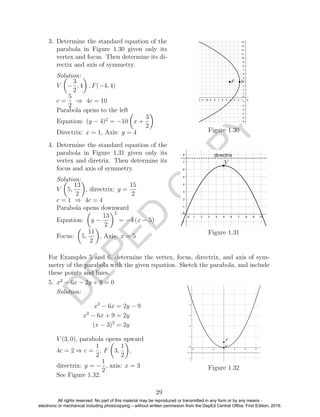
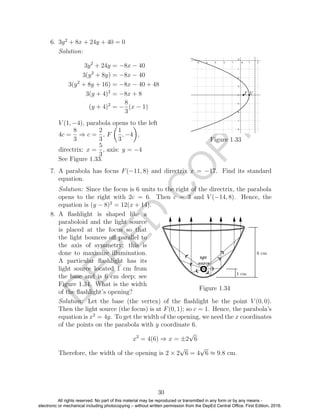
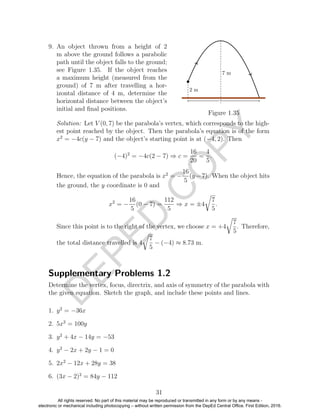
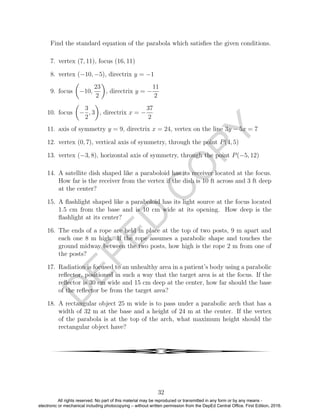
  • 14.
    D EPED C O PY • Parabola (Figure1.2) - when the plane intersects only one cone to form an unbounded curve • Hyperbola (Figure 1.3) - when the plane (not necessarily vertical) intersects both cones to form two unbounded curves (each called a branch of the hyper- bola) Figure 1.1 Figure 1.2 Figure 1.3 We can draw these conic sections (also called conics) on a rectangular co- ordinate plane and find their equations. To be able to do this, we will present equivalent definitions of these conic sections in subsequent sections, and use these to find the equations. There are other ways for a plane and the cones to intersect, to form what are referred to as degenerate conics: a point, one line, and two lines. See Figures 1.4, 1.5 and 1.6. Figure 1.4 Figure 1.5 Figure 1.6 1.1.2. Definition and Equation of a Circle A circle may also be considered a special kind of ellipse (for the special case when the tilted plane is horizontal). As we get to know more about a circle, we will also be able to distinguish more between these two conics. 8 All rights reserved. No part of this material may be reproduced or transmitted in any form or by any means - electronic or mechanical including photocopying – without written permission from the DepEd Central Office. First Edition, 2016.
  • 15.
    D EPED C O PY See Figure 1.7,with the point C(3, 1) shown. From the figure, the distance of A(−2, 1) from C is AC = 5. By the distance formula, the distance of B(6, 5) from C is BC = (6 − 3)2 + (5 − 1)2 = 5. There are other points P such that PC = 5. The collection of all such points which are 5 units away from C, forms a circle. Figure 1.7 Figure 1.8 Let C be a given point. The set of all points P having the same distance from C is called a circle. The point C is called the center of the circle, and the common distance its radius. The term radius is both used to refer to a segment from the center C to a point P on the circle, and the length of this segment. See Figure 1.8, where a circle is drawn. It has center C(h, k) and radius r > 0. A point P(x, y) is on the circle if and only if PC = r. For any such point then, its coordinates should satisfy the following. PC = r (x − h)2 + (y − k)2 = r (x − h)2 + (y − k)2 = r2 This is the standard equation of the circle with center C(h, k) and radius r. If the center is the origin, then h = 0 and k = 0. The standard equation is then x2 + y2 = r2 . 9 All rights reserved. No part of this material may be reproduced or transmitted in any form or by any means - electronic or mechanical including photocopying – without written permission from the DepEd Central Office. First Edition, 2016.
  • 16.
    D EPED C O PY Example 1.1.1. Ineach item, give the standard equation of the circle satisfy- ing the given conditions. (1) center at the origin, radius 4 (2) center (−4, 3), radius √ 7 (3) circle in Figure 1.7 (4) circle A in Figure 1.9 (5) circle B in Figure 1.9 (6) center (5, −6), tangent to the y- axis Figure 1.9 (7) center (5, −6), tangent to the x-axis (8) It has a diameter with endpoints A(−1, 4) and B(4, 2). Solution. (1) x2 + y2 = 16 (2) (x + 4)2 + (y − 3)2 = 7 (3) The center is (3, 1) and the radius is 5, so the equation is (x−3)2 +(y−1)2 = 25. (4) By inspection, the center is (−2, −1) and the radius is 4. The equation is (x + 2)2 + (y + 1)2 = 16. (5) Similarly by inspection, we have (x − 3)2 + (y − 2)2 = 9. (6) The center is 5 units away from the y-axis, so the radius is r = 5 (you can make a sketch to see why). The equation is (x − 5)2 + (y + 6)2 = 25. (7) Similarly, since the center is 6 units away from the x-axis, the equation is (x − 5)2 + (y + 6)2 = 36. (8) The center C is the midpoint of A and B: C = −1+4 2 , 4+2 2 = 3 2 , 3 . The radius is then r = AC = −1 − 3 2 2 + (4 − 3)2 = 29 4 . The circle has equation x − 3 2 2 + (y − 3)2 = 29 4 . 2 1.1.3. More Properties of Circles After expanding, the standard equation x − 3 2 2 + (y − 3)2 = 29 4 can be rewritten as x2 + y2 − 3x − 6y + 4 = 0, an equation of the circle in general form. 10 All rights reserved. No part of this material may be reproduced or transmitted in any form or by any means - electronic or mechanical including photocopying – without written permission from the DepEd Central Office. First Edition, 2016.
  • 17.
    D EPED C O PY If the equationof a circle is given in the general form Ax2 + Ay2 + Cx + Dy + E = 0, A = 0, or x2 + y2 + Cx + Dy + E = 0, we can determine the standard form by completing the square in both variables. Completing the square in an expression like x2 + 14x means determining the term to be added that will produce a perfect polynomial square. Since the coefficient of x2 is already 1, we take half the coefficient of x and square it, and we get 49. Indeed, x2 + 14x + 49 = (x + 7)2 is a perfect square. To complete the square in, say, 3x2 + 18x, we factor the coefficient of x2 from the expression: 3(x2 + 6x), then add 9 inside. When completing a square in an equation, any extra term introduced on one side should also be added to the other side. Example 1.1.2. Identify the center and radius of the circle with the given equa- tion in each item. Sketch its graph, and indicate the center. (1) x2 + y2 − 6x = 7 (2) x2 + y2 − 14x + 2y = −14 (3) 16x2 + 16y2 + 96x − 40y = 315 Solution. The first step is to rewrite each equation in standard form by complet- ing the square in x and in y. From the standard equation, we can determine the center and radius. (1) x2 − 6x + y2 = 7 x2 − 6x + 9 + y2 = 7 + 9 (x − 3)2 + y2 = 16 Center (3, 0), r = 4, Figure 1.10 (2) x2 − 14x + y2 + 2y = −14 x2 − 14x + 49 + y2 + 2y + 1 = −14 + 49 + 1 (x − 7)2 + (y + 1)2 = 36 Center (7, −1), r = 6, Figure 1.11 (3) 16x2 + 96x + 16y2 − 40y = 315 11 All rights reserved. No part of this material may be reproduced or transmitted in any form or by any means - electronic or mechanical including photocopying – without written permission from the DepEd Central Office. First Edition, 2016.
  • 18.
    D EPED C O PY 16(x2 + 6x) +16 y2 − 5 2 y = 315 16(x2 + 6x + 9) + 16 y2 − 5 2 y + 25 16 = 315 + 16(9) + 16 25 16 16(x + 3)2 + 16 y − 5 4 2 = 484 (x + 3)2 + y − 5 4 2 = 484 16 = 121 4 = 11 2 2 Center −3, 5 4 , r = 5.5, Figure 1.12. 2 Figure 1.10 Figure 1.11 Figure 1.12 In the standard equation (x − h)2 + (y − k)2 = r2 , both the two squared terms on the left side have coefficient 1. This is the reason why in the preceding example, we divided by 16 at the last equation. 1.1.4. Situational Problems Involving Circles Let us now take a look at some situational problems involving circles. Example 1.1.3. A street with two lanes, each 10 ft wide, goes through a semicircular tunnel with radius 12 ft. How high is the tunnel at the edge of each lane? Round off to 2 decimal places. 12 All rights reserved. No part of this material may be reproduced or transmitted in any form or by any means - electronic or mechanical including photocopying – without written permission from the DepEd Central Office. First Edition, 2016.
  • 19.
    D EPED C O PY Solution. We drawa coordinate system with origin at the middle of the highway, as shown. Because of the given radius, the tunnel’s boundary is on the circle x2 + y2 = 122 . Point P is the point on the arc just above the edge of a lane, so its x-coordinate is 10. We need its y-coordinate. We then solve 102 + y2 = 122 for y > 0, giving us y = 2 √ 11 ≈ 6.63 ft. 2 Example 1.1.4. A piece of a broken plate was dug up in an archaeological site. It was put on top of a grid, as shown in Figure 1.13, with the arc of the plate passing through A(−7, 0), B(1, 4) and C(7, 2). Find its center, and the standard equation of the circle describing the boundary of the plate. Figure 1.13 Figure 1.14 Solution. We first determine the center. It is the intersection of the perpendicular bisectors of AB and BC (see Figure 1.14). Recall that, in a circle, the perpen- dicular bisector of any chord passes through the center. Since the midpoint M of AB is −7+1 2 , 0+4 2 = (−3, 2), and mAB = 4−0 1+7 = 1 2 , the perpendicular bisector of AB has equation y − 2 = −2(x + 3), or equivalently, y = −2x − 4. 13 All rights reserved. No part of this material may be reproduced or transmitted in any form or by any means - electronic or mechanical including photocopying – without written permission from the DepEd Central Office. First Edition, 2016.
  • 20.
    D EPED C O PY Since the midpointN of BC is 1+7 2 , 4+2 2 = (4, 3), and mBC = 2−4 7−1 = −1 3 , the perpendicular bisector of BC has equation y − 3 = 3(x − 4), or equivalently, y = 3x − 9. The intersection of the two lines y = 2x − 4 and y = 3x − 9 is (1, −6) (by solving a system of linear equations). We can take the radius as the distance of this point from any of A, B or C (it’s most convenient to use B in this case). We then get r = 10. The standard equation is thus (x − 1)2 + (y + 6)2 = 100. 2 More Solved Examples 1. In each item, give the standard equation of the circle satisying the given con- ditions. (a) center at the origin, contains (0, 3) (b) center (1, 5), diameter 8 (c) circle A in Figure 1.15 (d) circle B in Figure 1.15 (e) circle C in Figure 1.15 (f) center (−2, −3), tangent to the y- axis (g) center (−2, −3), tangent to the x- axis (h) contains the points (−2, 0) and (8, 0), radius 5 Figure 1.15 Solution: (a) The radius is 3, so the equation is x2 + y2 = 9. (b) The radius is 8/2 = 4, so the equation is (x − 1)2 + (y − 5)2 = 16. (c) The center is (−2, 2) and the radius is 2, so the equation is (x+2)2 +(y −2)2 = 4. (d) The center is (2, 3) and the radius is 1, so the equation is (x−2)2 +(y −3)2 = 1. (e) The center is (1, −1) and by the Pythagorean Theorem, the radius (see Figure 1.16) is √ 22 + 22 = √ 8, so the equation is (x − 1)2 + (x + 1)2 = 8. Figure 1.16 14 All rights reserved. No part of this material may be reproduced or transmitted in any form or by any means - electronic or mechanical including photocopying – without written permission from the DepEd Central Office. First Edition, 2016.
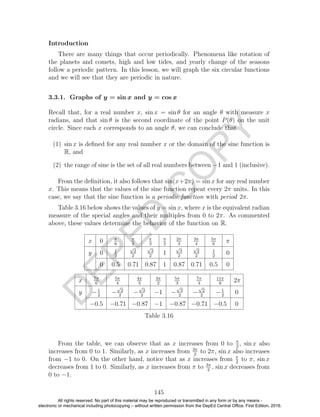
  • 21.
    D EPED C O PY (f) The radiusis 3, so the equation is (x + 2)2 + (y + 3)2 = 9. (g) The radius is 2, so the equation is (x + 2)2 + (y + 3)2 = 4. (h) The distance between (−2, 0) and (8, 0) is 10; since the radius is 5, these two points are endpoints of a diameter. Then the circle has center at (3, 0) and radius 5, so its equation is (x − 3)2 + y2 = 25. 2. Identify the center and radius of the circle with the given equation in each item. Sketch its graph, and indicate the center. (a) x2 + y2 + 8y = 33 (b) 4x2 + 4y2 − 16x + 40y + 67 = 0 (c) 4x2 + 12x + 4y2 + 16y − 11 = 0 Solution: (a) x2 + y2 + 8y = 33 x2 + y2 + 8y + 16 = 33 + 16 x2 + (y + 4)2 = 49 Center (0, −4), radius 7, see Figure 1.17. (b) 4x2 + 4y2 − 16x + 40y + 67 = 0 x2 − 4x + y2 + 10y = − 67 4 x2 − 4x + 4 + y2 + 10y + 25 = − 67 4 + 4 + 25 (x − 2)2 + (y + 5)2 = 49 4 = 7 2 2 Center (2, −5), radius 3.5, see Figure 1.18. (c) 4x2 + 12x + 4y2 + 16y − 11 = 0 x2 + 3x + y2 + 4y = 11 4 x2 + 3x + 9 4 + y2 + 4y + 4 = 11 4 + 9 4 + 4 x + 3 2 2 + (y + 2)2 = 9 Center − 3 2 , −2 , radius 3, see Figure 1.19. 15 All rights reserved. No part of this material may be reproduced or transmitted in any form or by any means - electronic or mechanical including photocopying – without written permission from the DepEd Central Office. First Edition, 2016.
  • 22.
    D EPED C O PY Figure 1.17 Figure1.18 Figure 1.19 3. A circular play area with radius 3 m is to be partitioned into two sections using a straight fence as shown in Figure 1.20. How long should the fence be? Solution: To determine the length of the fence, we need to determine the coordi- nates of its endpoints. From Figure 1.20, the endpoints have x coordinate −1 and are on the circle x2 + y2 = 9. Then 1 + y2 = 9, or y = ±2 √ 2. Therefore, the length of the fence is 4 √ 2 ≈ 5.66 m. Figure 1.20 4. A Cartesian coordinate system was used to identify locations on a circu- lar track. As shown in Figure 1.21, the circular track contains the points A(−2, −4), B(−2, 3), C(5, 2). Find the total length of the track. Figure 1.21 Figure 1.22 Solution: The segment AB is vertical and has midpoint (−2, −0.5), so its perpendicular bisector has equation y = −0.5. On the other hand, the segment BC has slope −1/7 and midpoint (1.5, 2.5), so its perpendicular bisector has equation y − 2.5 = 7(x − 1.5), or 7x − y − 8 = 0. The center of the circle is the intersection of y = −0.5 and 7x − y − 8 = 0; that is, the center is at 15 14 , −1 2 . The radius of the circle is the distance from the center to any of the points A, B, or C; by the distance formula, the radius is 2125 98 = 5 14 √ 170. Therefore, 16 All rights reserved. No part of this material may be reproduced or transmitted in any form or by any means - electronic or mechanical including photocopying – without written permission from the DepEd Central Office. First Edition, 2016.
  • 23.
    D EPED C O PY the total lengthof the track (its circumference), is 2 × π × 5 14 √ 170 ≈ 29.26 units. Supplementary Problems 1.1 Identify the center and radius of the circle with the given equation in each item. Sketch its graph, and indicate the center. 1. x2 + y2 = 1 4 2. 5x2 + 5y2 = 125 3. (x + 4)2 + y − 3 4 2 = 1 4. x2 − 4x + y2 − 4y − 8 = 0 5. x2 + y2 − 14x + 12y = 36 6. x2 + 10x + y2 − 16y − 11 = 0 7. 9x2 + 36x + 9y2 + 72y + 155 = 0 8. 9x2 + 9y2 − 6x + 24y = 19 9. 16x2 + 80x + 16y2 − 112y + 247 = 0 Find the standard equation of the circle which satisfies the given conditions. 10. center at the origin, radius 5 √ 3 11. center at (17, 5), radius 12 12. center at (−8, 4), contains (−4, 2) 13. center at (15, −7), tangent to the x-axis 14. center at (15, −7), tangent to the y-axis 15. center at (15, −7), tangent to the line y = −10 16. center at (15, −7), tangent to the line x = 8 17. has a diameter with endpoints (3, 1) and (−7, 6) 17 All rights reserved. No part of this material may be reproduced or transmitted in any form or by any means - electronic or mechanical including photocopying – without written permission from the DepEd Central Office. First Edition, 2016.
  • 24.
    D EPED C O PY 18. has adiameter with endpoints 9 2 , 4 and − 3 2 , −2 19. concentric with x2 + 20x + y2 − 14y + 145 = 0, diameter 12 20. concentric with x2 − 2x + y2 − 2y − 23 = 0 and has 1/5 the area 21. concentric with x2 + 4x + y2 − 6y + 9 = 0 and has the same circumference as x2 + 14x + y2 + 10y + 62 = 0 22. contains the points (3, 3), (7, 1), (0, 2) 23. contains the points (1, 4), (−1, 2), (4, −3) 24. center at (−3, 2) and tangent to the line 2x − 3y = 1 25. center at (−5, −1) and tangent to the line x + y + 10 = 0 26. has center with x-coordinate 4 and tangent to the line −x + 3y = 9 at (3, 4) 27. A stadium is shaped as in Figure 1.23, where its left and right ends are circular arcs both with center at C. What is the length of the stadium 50 m from one of the straight sides? Figure 1.23 28. A waterway in a theme park has a semicircular cross section with di- ameter 11 ft. The boats that are going to be used in this waterway have rectangular cross sections and are found to submerge 1 ft into the water. If the waterway is to be filled with water 4.5 ft deep, what is the maximum possible width of the boats? Figure 1.24 4 18 All rights reserved. No part of this material may be reproduced or transmitted in any form or by any means - electronic or mechanical including photocopying – without written permission from the DepEd Central Office. First Edition, 2016.
  • 25.
    D EPED C O PY Lesson 1.2. Parabolas LearningOutcomes of the Lesson At the end of the lesson, the student is able to: (1) define a parabola; (2) determine the standard form of equation of a parabola; (3) graph a parabola in a rectangular coordinate system; and (4) solve situational problems involving conic sections (parabolas). Lesson Outline (1) Definition of a parabola (2) Derivation of the standard equation of a parabola (3) Graphing parabolas (4) Solving situational problems involving parabolas Introduction A parabola is one of the conic sections. We have already seen parabolas which open upward or downward, as graphs of quadratic functions. Here, we will see parabolas opening to the left or right. Applications of parabolas are presented at the end. 1.2.1. Definition and Equation of a Parabola Consider the point F(0, 2) and the line having equation y = −2, as shown in Figure 1.25. What are the distances of A(4, 2) from F and from ? (The latter is taken as the distance of A from A , the point on closest to A). How about the distances of B(−8, 8) from F and from (from B )? AF = 4 and AA = 4 BF = (−8 − 0)2 + (8 − 2)2 = 10 and BB = 10 There are other points P such that PF = PP (where P is the closest point on line ). The collection of all such points forms a shape called a parabola. Let F be a given point, and a given line not containing F. The set of all points P such that its distances from F and from are the same, is called a parabola. The point F is its focus and the line its directrix. 19 All rights reserved. No part of this material may be reproduced or transmitted in any form or by any means - electronic or mechanical including photocopying – without written permission from the DepEd Central Office. First Edition, 2016.
  • 26.
    D EPED C O PY Figure 1.25 Figure 1.26 Considera parabola with focus F(0, c) and directrix having equation y = −c. See Figure 1.26. The focus and directrix are c units above and below, respectively, the origin. Let P(x, y) be a point on the parabola so PF = PP , where P is the point on closest to P. The point P has to be on the same side of the directrix as the focus (if P was below, it would be closer to than it is from F). PF = PP x2 + (y − c)2 = y − (−c) = y + c x2 + y2 − 2cy + c2 = y2 + 2cy + c2 x2 = 4cy The vertex V is the point midway between the focus and the directrix. This equation, x2 = 4cy, is then the standard equation of a parabola opening upward with vertex V (0, 0). Suppose the focus is F(0, −c) and the directrix is y = c. In this case, a point P on the resulting parabola would be below the directrix (just like the focus). Instead of opening upward, it will open downward. Consequently, PF = x2 + (y + c)2 and PP = c − y (you may draw a version of Figure 1.26 for this case). Computations similar to the one done above will lead to the equation 20 All rights reserved. No part of this material may be reproduced or transmitted in any form or by any means - electronic or mechanical including photocopying – without written permission from the DepEd Central Office. First Edition, 2016.
  • 27.
    D EPED C O PY x2 = −4cy. We collecthere the features of the graph of a parabola with standard equation x2 = 4cy or x2 = −4cy, where c > 0. (1) vertex: origin V (0, 0) • If the parabola opens upward, the vertex is the lowest point. If the parabola opens downward, the vertex is the highest point. (2) directrix: the line y = −c or y = c • The directrix is c units below or above the vertex. (3) focus: F(0, c) or F(0, −c) • The focus is c units above or below the vertex. • Any point on the parabola has the same distance from the focus as it has from the directrix. (4) axis of symmetry: x = 0 (the y-axis) • This line divides the parabola into two parts which are mirror images of each other. Example 1.2.1. Determine the focus and directrix of the parabola with the given equation. Sketch the graph, and indicate the focus, directrix, vertex, and axis of symmetry. 21 All rights reserved. No part of this material may be reproduced or transmitted in any form or by any means - electronic or mechanical including photocopying – without written permission from the DepEd Central Office. First Edition, 2016.
  • 28.
    D EPED C O PY (1) x2 = 12y(2) x2 = −6y Solution. (1) The vertex is V (0, 0) and the parabola opens upward. From 4c = 12, c = 3. The focus, c = 3 units above the vertex, is F(0, 3). The directrix, 3 units below the vertex, is y = −3. The axis of symmetry is x = 0. (2) The vertex is V (0, 0) and the parabola opens downward. From 4c = 6, c = 3 2 . The focus, c = 3 2 units below the vertex, is F 0, −3 2 . The directrix, 3 2 units above the vertex, is y = 3 2 . The axis of symmetry is x = 0. Example 1.2.2. What is the standard equation of the parabola in Figure 1.25? Solution. From the figure, we deduce that c = 2. The equation is thus x2 = 8y. 2 22 All rights reserved. No part of this material may be reproduced or transmitted in any form or by any means - electronic or mechanical including photocopying – without written permission from the DepEd Central Office. First Edition, 2016.
  • 29.
    D EPED C O PY 1.2.2. More Propertiesof Parabolas The parabolas we considered so far are “vertical” and have their vertices at the origin. Some parabolas open instead horizontally (to the left or right), and some have vertices not at the origin. Their standard equations and properties are given in the box. The corresponding computations are more involved, but are similar to the one above, and so are not shown anymore. In all four cases below, we assume that c > 0. The vertex is V (h, k), and it lies between the focus F and the directrix . The focus F is c units away from the vertex V , and the directrix is c units away from the vertex. Recall that, for any point on the parabola, its distance from the focus is the same as its distance from the directrix. (x − h)2 = 4c(y − k) (y − k)2 = 4c(x − h) (x − h)2 = −4c(y − k) (y − k)2 = −4c(x − h) directrix : horizontal directrix : vertical axis of symmetry: x=h, vertical axis of symmetry: y=k, horizontal 23 All rights reserved. No part of this material may be reproduced or transmitted in any form or by any means - electronic or mechanical including photocopying – without written permission from the DepEd Central Office. First Edition, 2016.
  • 30.
    D EPED C O PY Note the followingobservations: • The equations are in terms of x − h and y − k: the vertex coordinates are subtracted from the corresponding variable. Thus, replacing both h and k with 0 would yield the case where the vertex is the origin. For instance, this replacement applied to (x−h)2 = 4c(y −k) (parabola opening upward) would yield x2 = 4cy, the first standard equation we encountered (parabola opening upward, vertex at the origin). • If the x-part is squared, the parabola is “vertical”; if the y-part is squared, the parabola is “horizontal.” In a horizontal parabola, the focus is on the left or right of the vertex, and the directrix is vertical. • If the coefficient of the linear (non-squared) part is positive, the parabola opens upward or to the right; if negative, downward or to the left. Example 1.2.3. Figure 1.27 shows the graph of parabola, with only its focus and vertex indicated. Find its standard equation. What is its directrix and its axis of symmetry? Solution. The vertex is V (5, −4) and the focus is F(3, −4). From these, we deduce the following: h = 5, k = −4, c = 2 (the distance of the focus from the vertex). Since the parabola opens to the left, we use the template (y − k)2 = −4c(x − h). Our equation is (y + 4)2 = −8(x − 5). Its directrix is c = 2 units to the right of V , which is x = 7. Its axis is the horizontal line through V : y = −4. Figure 1.27 24 All rights reserved. No part of this material may be reproduced or transmitted in any form or by any means - electronic or mechanical including photocopying – without written permission from the DepEd Central Office. First Edition, 2016.
  • 31.
    D EPED C O PY The standard equation(y + 4)2 = −8(x − 5) from the preceding example can be rewritten as y2 + 8x + 8y − 24 = 0, an equation of the parabola in general form. If the equation is given in the general form Ax2 +Cx+Dy +E = 0 (A and C are nonzero) or By2 +Cx+Dy+E = 0 (B and C are nonzero), we can determine the standard form by completing the square in both variables. Example 1.2.4. Determine the vertex, focus, directrix, and axis of symmetry of the parabola with the given equation. Sketch the parabola, and include these points and lines. (1) y2 − 5x + 12y = −16 (2) 5x2 + 30x + 24y = 51 Solution. (1) We complete the square on y, and move x to the other side. y2 + 12y = 5x − 16 y2 + 12y + 36 = 5x − 16 + 36 = 5x + 20 (y + 6)2 = 5(x + 4) The parabola opens to the right. It has vertex V (−4, −6). From 4c = 5, we get c = 5 4 = 1.25. The focus is c = 1.25 units to the right of V : F(−2.75, −6). The (vertical) directrix is c = 1.25 units to the left of V : x = −5.25. The (horizontal) axis is through V : y = −6. 25 All rights reserved. No part of this material may be reproduced or transmitted in any form or by any means - electronic or mechanical including photocopying – without written permission from the DepEd Central Office. First Edition, 2016.
  • 32.
    D EPED C O PY (2) We completethe square on x, and move y to the other side. 5x2 + 30x = −24y + 51 5(x2 + 6x + 9) = −24y + 51 + 5(9) 5(x + 3)2 = −24y + 96 = −24(y − 4) (x + 3)2 = − 24 5 (y − 4) In the last line, we divided by 5 for the squared part not to have any coeffi- cient. The parabola opens downward. It has vertex V (−3, 4). From 4c = 24 5 , we get c = 6 5 = 1.2. The focus is c = 1.2 units below V : F(−3, 2.8). The (horizontal) directrix is c = 1.2 units above V : y = 5.2. The (vertical) axis is through V : x = −3. Example 1.2.5. A parabola has focus F(7, 9) and directrix y = 3. Find its standard equation. Solution. The directrix is horizontal, and the focus is above it. The parabola then opens upward and its standard equation has the form (x − h)2 = 4c(y − k). Since the distance from the focus to the directrix is 2c = 9 − 3 = 6, then c = 3. Thus, the vertex is V (7, 6), the point 3 units below F. The standard equation is then (x − 7)2 = 12(y − 6). 2 1.2.3. Situational Problems Involving Parabolas Let us now solve some situational problems involving parabolas. Example 1.2.6. A satellite dish has a shape called a paraboloid, where each cross-section is a parabola. Since radio signals (parallel to the axis) will bounce 26 All rights reserved. No part of this material may be reproduced or transmitted in any form or by any means - electronic or mechanical including photocopying – without written permission from the DepEd Central Office. First Edition, 2016.
  • 33.
    D EPED C O PY off the surfaceof the dish to the focus, the receiver should be placed at the focus. How far should the receiver be from the vertex, if the dish is 12 ft across, and 4.5 ft deep at the vertex? Solution. The second figure above shows a cross-section of the satellite dish drawn on a rectangular coordinate system, with the vertex at the origin. From the problem, we deduce that (6, 4.5) is a point on the parabola. We need the distance of the focus from the vertex, i.e., the value of c in x2 = 4cy. x2 = 4cy 62 = 4c(4.5) c = 62 4 · 4.5 = 2 Thus, the receiver should be 2 ft away from the vertex. 2 Example 1.2.7. The cable of a suspension bridge hangs in the shape of a parabola. The towers supporting the cable are 400 ft apart and 150 ft high. If the cable, at its lowest, is 30 ft above the bridge at its midpoint, how high is the cable 50 ft away (horizontally) from either tower? 27 All rights reserved. No part of this material may be reproduced or transmitted in any form or by any means - electronic or mechanical including photocopying – without written permission from the DepEd Central Office. First Edition, 2016.
  • 34.
    D EPED C O PY Solution. Refer tothe figure above, where the parabolic cable is drawn with its vertex on the y-axis 30 ft above the origin. We may write its equation as (x − 0)2 = a(y − 30); since we don’t need the focal distance, we use the simpler variable a in place of 4c. Since the towers are 150 ft high and 400 ft apart, we deduce from the figure that (200, 150) is a point on the parabola. x2 = a(y − 30) 2002 = a(150 − 30) a = 2002 120 = 1000 3 The parabola has equation x2 = 1000 3 (y − 30), or equivalently, y = 0.003x2 + 30. For the two points on the parabola 50 ft away from the towers, x = 150 or x = −150. If x = 150, then y = 0.003(1502 ) + 30 = 97.5. Thus, the cable is 97.5 ft high 50 ft away from either tower. (As expected, we get the same answer from x = −150.) 2 More Solved Examples For Examples 1 and 2, determine the focus and directrix of the parabola with the given equation. Sketch the graph, and indicate the focus, directrix, and vertex. 1. y2 = 20x Solution: Vertex: V (0, 0), opens to the right 4c = 20 ⇒ c = 5 Focus: F(5, 0), Directrix: x = −5 See Figure 1.28. 2. 3x2 = −12y Solution: 3x2 = −12y ⇔ x2 = −4y Vertex: V (0, 0), opens downward 4c = 4 ⇒ c = 1 Focus: F(0, −1), Directrix: y = 1 See Figure 1.29. Figure 1.28 Figure 1.29 28 All rights reserved. No part of this material may be reproduced or transmitted in any form or by any means - electronic or mechanical including photocopying – without written permission from the DepEd Central Office. First Edition, 2016.
  • 35.
    D EPED C O PY 3. Determine thestandard equation of the parabola in Figure 1.30 given only its vertex and focus. Then determine its di- rectix and axis of symmetry. Solution: V − 3 2 , 4 , F(−4, 4) c = 5 2 ⇒ 4c = 10 Parabola opens to the left Equation: (y − 4)2 = −10 x + 3 2 Directrix: x = 1, Axis: y = 4 Figure 1.30 4. Determine the standard equation of the parabola in Figure 1.31 given only its vertex and diretrix. Then determine its focus and axis of symmetry. Solution: V 5, 13 2 , directrix: y = 15 2 c = 1 ⇒ 4c = 4 Parabola opens downward Equation: y − 13 2 2 = −4 (x − 5) Focus: 5, 11 2 , Axis: x = 5 Figure 1.31 For Examples 5 and 6, determine the vertex, focus, directrix, and axis of sym- metry of the parabola with the given equation. Sketch the parabola, and include these points and lines. 5. x2 − 6x − 2y + 9 = 0 Solution: x2 − 6x = 2y − 9 x2 − 6x + 9 = 2y (x − 3)2 = 2y V (3, 0), parabola opens upward 4c = 2 ⇒ c = 1 2 , F 3, 1 2 , directrix: y = − 1 2 , axis: x = 3 See Figure 1.32. Figure 1.32 29 All rights reserved. No part of this material may be reproduced or transmitted in any form or by any means - electronic or mechanical including photocopying – without written permission from the DepEd Central Office. First Edition, 2016.
  • 36.
    D EPED C O PY 6. 3y2 + 8x+ 24y + 40 = 0 Solution: 3y2 + 24y = −8x − 40 3(y2 + 8y) = −8x − 40 3(y2 + 8y + 16) = −8x − 40 + 48 3(y + 4)2 = −8x + 8 (y + 4)2 = − 8 3 (x − 1) V (1, −4), parabola opens to the left 4c = 8 3 ⇒ c = 2 3 , F 1 3 , −4 , directrix: x = 5 3 , axis: y = −4 See Figure 1.33. Figure 1.33 7. A parabola has focus F(−11, 8) and directrix x = −17. Find its standard equation. Solution: Since the focus is 6 units to the right of the directrix, the parabola opens to the right with 2c = 6. Then c = 3 and V (−14, 8). Hence, the equation is (y − 8)2 = 12(x + 14). 8. A flashlight is shaped like a paraboloid and the light source is placed at the focus so that the light bounces off parallel to the axis of symmetry; this is done to maximize illumination. A particular flashlight has its light source located 1 cm from the base and is 6 cm deep; see Figure 1.34. What is the width of the flashlight’s opening? Figure 1.34 Solution: Let the base (the vertex) of the flashlight be the point V (0, 0). Then the light source (the focus) is at F(0, 1); so c = 1. Hence, the parabola’s equation is x2 = 4y. To get the width of the opening, we need the x coordinates of the points on the parabola with y coordinate 6. x2 = 4(6) ⇒ x = ±2 √ 6 Therefore, the width of the opening is 2 × 2 √ 6 = 4 √ 6 ≈ 9.8 cm. 30 All rights reserved. No part of this material may be reproduced or transmitted in any form or by any means - electronic or mechanical including photocopying – without written permission from the DepEd Central Office. First Edition, 2016.
  • 37.
    D EPED C O PY 9. An objectthrown from a height of 2 m above the ground follows a parabolic path until the object falls to the ground; see Figure 1.35. If the object reaches a maximum height (measured from the ground) of 7 m after travelling a hor- izontal distance of 4 m, determine the horizontal distance between the object’s initial and final positions. Figure 1.35 Solution: Let V (0, 7) be the parabola’s vertex, which corresponds to the high- est point reached by the object. Then the parabola’s equation is of the form x2 = −4c(y − 7) and the object’s starting point is at (−4, 2). Then (−4)2 = −4c(2 − 7) ⇒ c = 16 20 = 4 5 . Hence, the equation of the parabola is x2 = − 16 5 (y −7). When the object hits the ground, the y coordinate is 0 and x2 = − 16 5 (0 − 7) = 112 5 ⇒ x = ±4 7 5 . Since this point is to the right of the vertex, we choose x = +4 7 5 . Therefore, the total distance travelled is 4 7 5 − (−4) ≈ 8.73 m. Supplementary Problems 1.2 Determine the vertex, focus, directrix, and axis of symmetry of the parabola with the given equation. Sketch the graph, and include these points and lines. 1. y2 = −36x 2. 5x2 = 100y 3. y2 + 4x − 14y = −53 4. y2 − 2x + 2y − 1 = 0 5. 2x2 − 12x + 28y = 38 6. (3x − 2)2 = 84y − 112 31 All rights reserved. No part of this material may be reproduced or transmitted in any form or by any means - electronic or mechanical including photocopying – without written permission from the DepEd Central Office. First Edition, 2016.
  • 38.
    D EPED C O PY Find the standardequation of the parabola which satisfies the given conditions. 7. vertex (7, 11), focus (16, 11) 8. vertex (−10, −5), directrix y = −1 9. focus −10, 23 2 , directrix y = − 11 2 10. focus − 3 2 , 3 , directrix x = − 37 2 11. axis of symmetry y = 9, directrix x = 24, vertex on the line 3y − 5x = 7 12. vertex (0, 7), vertical axis of symmetry, through the point P(4, 5) 13. vertex (−3, 8), horizontal axis of symmetry, through the point P(−5, 12) 14. A satellite dish shaped like a paraboloid has its receiver located at the focus. How far is the receiver from the vertex if the dish is 10 ft across and 3 ft deep at the center? 15. A flashlight shaped like a paraboloid has its light source at the focus located 1.5 cm from the base and is 10 cm wide at its opening. How deep is the flashlight at its center? 16. The ends of a rope are held in place at the top of two posts, 9 m apart and each one 8 m high. If the rope assumes a parabolic shape and touches the ground midway between the two posts, how high is the rope 2 m from one of the posts? 17. Radiation is focused to an unhealthy area in a patient’s body using a parabolic reflector, positioned in such a way that the target area is at the focus. If the reflector is 30 cm wide and 15 cm deep at the center, how far should the base of the reflector be from the target area? 18. A rectangular object 25 m wide is to pass under a parabolic arch that has a width of 32 m at the base and a height of 24 m at the center. If the vertex of the parabola is at the top of the arch, what maximum height should the rectangular object have? 4 32 All rights reserved. No part of this material may be reproduced or transmitted in any form or by any means - electronic or mechanical including photocopying – without written permission from the DepEd Central Office. First Edition, 2016.
  • 39.
    D EPED C O PY Lesson 1.3. Ellipses LearningOutcomes of the Lesson At the end of the lesson, the student is able to: (1) define an ellipse; (2) determine the standard form of equation of an ellipse; (3) graph an ellipse in a rectangular coordinate system; and (4) solve situational problems involving conic sections (ellipses). Lesson Outline (1) Definition of an ellipse (2) Derivation of the standard equation of an ellipse (3) Graphing ellipses (4) Solving situational problems involving ellipses Introduction Unlike circle and parabola, an ellipse is one of the conic sections that most stu- dents have not encountered formally before. Its shape is a bounded curve which looks like a flattened circle. The orbits of the planets in our solar system around the sun happen to be elliptical in shape. Also, just like parabolas, ellipses have reflective properties that have been used in the construction of certain structures. These applications and more will be encountered in this lesson. 1.3.1. Definition and Equation of an Ellipse Consider the points F1(−3, 0) and F2(3, 0), as shown in Figure 1.36. What is the sum of the distances of A(4, 2.4) from F1 and from F2? How about the sum of the distances of B (and C(0, −4)) from F1 and from F2? AF1 + AF2 = 7.4 + 2.6 = 10 BF1 + BF2 = 3.8 + 6.2 = 10 CF1 + CF2 = 5 + 5 = 10 There are other points P such that PF1 + PF2 = 10. The collection of all such points forms a shape called an ellipse. 33 All rights reserved. No part of this material may be reproduced or transmitted in any form or by any means - electronic or mechanical including photocopying – without written permission from the DepEd Central Office. First Edition, 2016.
  • 40.
    D EPED C O PY Figure 1.36 Figure 1.37 LetF1 and F2 be two distinct points. The set of all points P, whose distances from F1 and from F2 add up to a certain constant, is called an ellipse. The points F1 and F2 are called the foci of the ellipse. Given are two points on the x-axis, F1(−c, 0) and F2(c, 0), the foci, both c units away from their center (0, 0). See Figure 1.37. Let P(x, y) be a point on the ellipse. Let the common sum of the distances be 2a (the coefficient 2 will make computations simpler). Thus, we have PF1 + PF2 = 2a. PF1 = 2a − PF2 (x + c)2 + y2 = 2a − (x − c)2 + y2 x2 + 2cx + c2 + y2 = 4a2 − 4a (x − c)2 + y2 + x2 − 2cx + c2 + y2 a (x − c)2 + y2 = a2 − cx a2 x2 − 2cx + c2 + y2 = a4 − 2a2 cx + c2 x2 (a2 − c2 )x2 + a2 y2 = a4 − a2 c2 = a2 (a2 − c2 ) b2 x2 + a2 y2 = a2 b2 by letting b = √ a2 − c2, so a > b x2 a2 + y2 b2 = 1 When we let b = √ a2 − c2, we assumed a > c. To see why this is true, look at PF1F2 in Figure 1.37. By the Triangle Inequality, PF1 + PF2 > F1F2, which implies 2a > 2c, so a > c. We collect here the features of the graph of an ellipse with standard equation x2 a2 + y2 b2 = 1, where a > b. Let c = √ a2 − b2. 34 All rights reserved. No part of this material may be reproduced or transmitted in any form or by any means - electronic or mechanical including photocopying – without written permission from the DepEd Central Office. First Edition, 2016.
  • 41.
    D EPED C O PY (1) center: origin(0, 0) (2) foci: F1(−c, 0) and F2(c, 0) • Each focus is c units away from the center. • For any point on the ellipse, the sum of its distances from the foci is 2a. (3) vertices: V1(−a, 0) and V2(a, 0) • The vertices are points on the ellipse, collinear with the center and foci. • If y = 0, then x = ±a. Each vertex is a units away from the center. • The segment V1V2 is called the major axis. Its length is 2a. It divides the ellipse into two congruent parts. (4) covertices: W1(0, −b) and W2(0, b) • The segment through the center, perpendicular to the major axis, is the minor axis. It meets the ellipse at the covertices. It divides the ellipse into two congruent parts. • If x = 0, then y = ±b. Each covertex is b units away from the center. • The minor axis W1W2 is 2b units long. Since a > b, the major axis is longer than the minor axis. Example 1.3.1. Give the coordinates of the foci, vertices, and covertices of the ellipse with equation x2 25 + y2 9 = 1. Sketch the graph, and include these points. 35 All rights reserved. No part of this material may be reproduced or transmitted in any form or by any means - electronic or mechanical including photocopying – without written permission from the DepEd Central Office. First Edition, 2016.
  • 42.
    D EPED C O PY Solution. With a2 =25 and b2 = 9, we have a = 5, b = 3, and c = √ a2 − b2 = 4. foci: F1(−4, 0), F2(4, 0) vertices: V1(−5, 0), V2(5, 0) covertices: W1(0, −3), W2(0, 3) Example 1.3.2. Find the (standard) equation of the ellipse whose foci are F1(−3, 0) and F2(3, 0), such that for any point on it, the sum of its distances from the foci is 10. See Figure 1.36. Solution. We have 2a = 10 and c = 3, so a = 5 and b = √ a2 − c2 = 4. The equation is x2 25 + y2 16 = 1. 2 1.3.2. More Properties of Ellipses The ellipses we have considered so far are “horizontal” and have the origin as their centers. Some ellipses have their foci aligned vertically, and some have centers not at the origin. Their standard equations and properties are given in the box. The derivations are more involved, but are similar to the one above, and so are not shown anymore. In all four cases below, a > b and c = √ a2 − b2. The foci F1 and F2 are c units away from the center. The vertices V1 and V2 are a units away from the center, the major axis has length 2a, the covertices W1 and W2 are b units away from the center, and the minor axis has length 2b. Recall that, for any point on the ellipse, the sum of its distances from the foci is 2a. 36 All rights reserved. No part of this material may be reproduced or transmitted in any form or by any means - electronic or mechanical including photocopying – without written permission from the DepEd Central Office. First Edition, 2016.
  • 43.
    D EPED C O PY Center Corresponding Graphs (0,0) x2 a2 + y2 b2 = 1, a > b x2 b2 + y2 a2 = 1, b > a (h, k) (x − h)2 a2 + (y − k)2 b2 = 1 (x − h)2 b2 + (y − k)2 a2 = 1 a > b b > a major axis: horizontal major axis: vertical minor axis: vertical minor axis: horizontal In the standard equation, if the x-part has the bigger denominator, the ellipse is horizontal. If the y-part has the bigger denominator, the ellipse is vertical. Example 1.3.3. Give the coordinates of the center, foci, vertices, and covertices of the ellipse with the given equation. Sketch the graph, and include these points. 37 All rights reserved. No part of this material may be reproduced or transmitted in any form or by any means - electronic or mechanical including photocopying – without written permission from the DepEd Central Office. First Edition, 2016.
  • 44.
    D EPED C O PY (1) (x + 3)2 24 + (y− 5)2 49 = 1 (2) 9x2 + 16y2 − 126x + 64y = 71 Solution. (1) From a2 = 49 and b2 = 24, we have a = 7, b = 2 √ 6 ≈ 4.9, and c = √ a2 − b2 = 5. The ellipse is vertical. center: (−3, 5) foci: F1(−3, 0), F2(−3, 10) vertices: V1(−3, −2), V2(−3, 12) covertices: W1(−3 − 2 √ 6, 5) ≈ (−7.9, 5) W2(−3 + 2 √ 6, 5) ≈ (1.9, 5) (2) We first change the given equation to standard form. 9(x2 − 14x) + 16(y2 + 4y) = 71 9(x2 − 14x + 49) + 16(y2 + 4y + 4) = 71 + 9(49) + 16(4) 9(x − 7)2 + 16(y + 2)2 = 576 (x − 7)2 64 + (y + 2)2 36 = 1 38 All rights reserved. No part of this material may be reproduced or transmitted in any form or by any means - electronic or mechanical including photocopying – without written permission from the DepEd Central Office. First Edition, 2016.
  • 45.
    D EPED C O PY We have a= 8 and b = 6. Thus, c = √ a2 − b2 = 2 √ 7 ≈ 5.3. The ellipse is horizontal. center: (7, −2) foci: F1(7 − 2 √ 7, −2) ≈ (1.7, −2) F2(7 + 2 √ 7, −2) ≈ (12.3, −2) vertices: V1(−1, −2), V2(15, −2) covertices: W1(7, −8), W2(7, 4) Example 1.3.4. The foci of an ellipse are (−3, −6) and (−3, 2). For any point on the ellipse, the sum of its distances from the foci is 14. Find the standard equation of the ellipse. Solution. The midpoint (−3, −2) of the foci is the center of the ellipse. The ellipse is vertical (because the foci are vertically aligned) and c = 4. From the given sum, 2a = 14 so a = 7. Also, b = √ a2 − c2 = √ 33. The equation is (x + 3)2 33 + (y + 2)2 49 = 1. 2 Example 1.3.5. An ellipse has vertices (2 − √ 61, −5) and (2 + √ 61, −5), and its minor axis is 12 units long. Find its standard equation and its foci. 39 All rights reserved. No part of this material may be reproduced or transmitted in any form or by any means - electronic or mechanical including photocopying – without written permission from the DepEd Central Office. First Edition, 2016.
  • 46.
    D EPED C O PY Solution. The midpoint(2, −5) of the vertices is the center of the ellipse, which is horizontal. Each vertex is a = √ 61 units away from the center. From the length of the minor axis, 2b = 12 so b = 6. The standard equation is (x − 2)2 61 + (y + 5)2 36 = 1. Each focus is c = √ a2 − b2 = 5 units away from (2, −5), so their coordinates are (−3, −5) and (7, −5). 2 1.3.3. Situational Problems Involving Ellipses Let us now apply the concept of ellipse to some situational problems. Example 1.3.6. A tunnel has the shape of a semiellipse that is 15 ft high at the center, and 36 ft across at the base. At most how high should a passing truck be, if it is 12 ft wide, for it to be able to fit through the tunnel? Round off your answer to two decimal places. Solution. Refer to the figure above. If we draw the semiellipse on a rectangular coordinate system, with its center at the origin, an equation of the ellipse which contains it, is x2 182 + y2 152 = 1. To maximize its height, the corners of the truck, as shown in the figure, would have to just touch the ellipse. Since the truck is 12 ft wide, let the point (6, n) be the corner of the truck in the first quadrant, where n > 0, is the (maximum) height of the truck. Since this point is on the ellipse, it should fit the equation. Thus, we have 62 182 + n2 152 = 1 n = 10 √ 2 ≈ 14.14 ft 2 40 All rights reserved. No part of this material may be reproduced or transmitted in any form or by any means - electronic or mechanical including photocopying – without written permission from the DepEd Central Office. First Edition, 2016.
  • 47.
    D EPED C O PY Example 1.3.7. Theorbit of a planet has the shape of an ellipse, and on one of the foci is the star around which it revolves. The planet is closest to the star when it is at one vertex. It is farthest from the star when it is at the other vertex. Suppose the closest and farthest distances of the planet from this star, are 420 million kilometers and 580 million kilometers, respectively. Find the equation of the ellipse, in standard form, with center at the origin and the star at the x-axis. Assume all units are in millions of kilometers. Solution. In the figure above, the orbit is drawn as a horizontal ellipse with center at the origin. From the planet’s distances from the star, at its closest and farthest points, it follows that the major axis is 2a = 420 + 580 = 1000 (million kilometers), so a = 500. If we place the star at the positive x-axis, then it is c = 500 − 420 = 80 units away from the center. Therefore, we get b2 = a2 − c2 = 5002 − 802 = 243600. The equation then is x2 250000 + y2 243600 = 1. The star could have been placed on the negative x-axis, and the answer would still be the same. 2 41 All rights reserved. No part of this material may be reproduced or transmitted in any form or by any means - electronic or mechanical including photocopying – without written permission from the DepEd Central Office. First Edition, 2016.
  • 48.
    D EPED C O PY More Solved Examples 1.Give the coordinates of the foci, vertices, and covertices of the ellipse with equa- tion x2 169 + y2 144 = 1. Then sketch the graph and include these points. Solution: The ellipse is horizontal. a2 = 169 ⇒ a = 13, b2 = 144 ⇒ b = 12, c = √ 169 − 144 = 5 Foci: F1(−5, 0), F2(5, 0) Vertices: V1(−13, 0), V2(13, 0) Covertices: W1(0, −12), W2(0, 12) See Figure 1.38. Figure 1.38 2. Find the standard equation of the ellipse whose foci are F1(0, −8) and F2(0, 8), such that for any point on it, the sum of its distances from the foci is 34. Solution: The ellipse is vertical and has center at (0, 0). 2a = 34 ⇒ a = 17 c = 8 ⇒ b = √ 172 − 82 = 15 The equation is x2 225 + y2 289 = 1. For Examples 3 and 4, give the coordinates of the center, foci, vertices, and covertices of the ellipse with the given equation. Sketch the graph, and include these points. 3. (x − 7)2 64 + (y + 2)2 25 = 1 Solution: The ellipse is horizontal. a2 = 64 ⇒ a = 8, b2 = 25 ⇒ b = 5 c = √ 64 − 25 = √ 39 ≈ 6.24 center: (7, −2) foci: F1(7 − √ 39, −2) ≈ (0.76, −2) F2(7 + √ 39, −2) ≈ (13.24, −2) vertices: V1(−1, −2), V2(15, −2) covertices: W1(7, −7), W2(7, 3) See Figure 1.39. Figure 1.39 42 All rights reserved. No part of this material may be reproduced or transmitted in any form or by any means - electronic or mechanical including photocopying – without written permission from the DepEd Central Office. First Edition, 2016.
  • 49.
    D EPED C O PY 4. 16x2 + 96x+ 7y2 + 14y + 39 = 0 Solution: 16x2 + 96x + 7y2 + 14y = −39 16(x2 + 6x + 9) + 7(y2 + 2y + 1) = −39 + 151 16(x + 3)2 + 7(y + 1)2 = 112 (x + 3)2 7 + (y + 1)2 16 = 1 The ellipse is vertical. a2 = 16 ⇒ a = 4, b2 = 7 ⇒ b = √ 7 ≈ 2.65 c = √ 16 − 7 = 3 center: (−3, −1) foci: F1(−3, −4), F2(−3, 2) vertices: V1(−3, −5), V2(−3, 3) covertices: W1(−3 − √ 7, −1) ≈ (−5.65, −1) W2(−3 + √ 7, −1) ≈ (−0.35, −1) See Figure 1.40. Figure 1.40 5. The covertices of an ellipse are (5, 6) and (5, 8). For any point on the ellipse, the sum of its distances from the foci is 12. Find the standard equation of the ellipse. Solution: The ellipse is horizontal with center at the midpoint (5, 7) of the covertices. Also, 2a = 12 so a = 6 while b = 1. The equation is (x − 5)2 36 + (y − 7)2 1 = 1. 6. An ellipse has foci (−4 − √ 15, 3) and (−4 + √ 15, 3), and its major axis is 10 units long. Find its standard equation and its vertices. Solution: The ellipse is horizontal with center at the midpoint (−4, 3) of the foci; also c = √ 15. Since the length of the major axis is 10, 2a = 10 and a = 5. Thus b = √ 52 − 15 = √ 10. Therefore, the equation of the ellipse is (x + 4)2 25 + (y − 3)2 10 = 1 and its vertices are (−9, 3) and (1, 3). 7. A whispering gallery is an enclosure or room where whispers can be clearly heard in some parts of the gallery. Such a gallery can be constructed by making its ceiling in the shape of a semi-ellipse; in this case, a whisper from one focus can be clearly heard at the other focus. If an elliptical whispering 43 All rights reserved. No part of this material may be reproduced or transmitted in any form or by any means - electronic or mechanical including photocopying – without written permission from the DepEd Central Office. First Edition, 2016.
  • 50.
    D EPED C O PY gallery is 90feet long and the foci are 50 feet apart, how high is the gallery at its center? Solution: We set up a Cartesian coordinate system by assigning the center of the semiellipse as the origin. The point on the ceiling right above the center is a covertex of the ellipse. Since 2a = 90 and 2c = 50; then b2 = 452 −252 = 1400. The height is given by b = √ 1400 ≈ 37.4 ft. 8. A spheroid (or oblate spheroid) is the surface obtained by rotating an ellipse around its minor axis. The bowl in Figure 1.41 is in the shape of the lower half of a spheroid; that is, its horizontal cross sections are circles while its vertical cross sections that pass through the center are semiellipses. If this bowl is 10 in wide at the opening and √ 10 in deep at the center, how deep does a circular cover with diameter 9 in go into the bowl? Figure 1.41 Solution: We set up a Cartesian coordinate system by assigning the center of the semiellipse as the origin. Then a = 5, b = √ 10, and the equation of the ellipse is x2 25 + y2 10 = 1. We want the y-coordinate of the points on the ellipse that has x = ±4.5. This coordinate is y = − 10 1 − x2 25 ≈ −1.38. Therefore, the cover will go 1.38 inches into the bowl. 44 All rights reserved. No part of this material may be reproduced or transmitted in any form or by any means - electronic or mechanical including photocopying – without written permission from the DepEd Central Office. First Edition, 2016.
  • 51.
    D EPED C O PY Supplementary Problems 1.3 Givethe coordinates of the center, foci, vertices, and covertices of the ellipse with the given equation. Sketch the graph, and include these points. 1. x2 8 + y2 4 = 1 2. x2 16 + (y − 2)2 25 = 1 3. (x − 1)2 + (2y − 2)2 = 4 4. (x + 5)2 49 + (y − 2)2 121 = 1 5. 16x2 − 224x + 25y2 + 250y − 191 = 0 6. 25x2 − 200x + 16y2 − 160y = 800 Find the standard equation of the ellipse which satisfies the given conditions. 7. foci (2 − √ 33, 8) and (2 + √ 33, 8), the sum of the distances of any point from the foci is 14 8. center (−3, −7), vertical major axis of length 20, minor axis of length 12 9. foci (−21, 10) and (3, 10), contains the point (−9, 15) 10. a vertex at (−3, −18) and a covertex at (−12, −7), major axis is either hori- zontal or vertical 11. a focus at (−9, 15) and a covertex at (1, 10), with vertical major axis 12. A 40-ft wide tunnel has the shape of a semiellipse that is 5 ft high a distance of 2 ft from either end. How high is the tunnel at its center? 13. The moon’s orbit is an ellipse with Earth as one focus. If the maximum distance from the moon to Earth is 405 500 km and the minimum distance is 363 300 km, find the equation of the ellipse in a Cartesian coordinate system where Earth is at the origin. Assume that the ellipse has horizontal major axis and that the minimum distance is achieved when the moon is to the right of Earth. Use 100 km as one unit. 14. Two friends visit a whispering gallery (in the shape of a semiellipsoid) where they stand 100 m apart to be at the foci. If one of them is 6 m from the nearest wall, how high is the gallery at its center? 45 All rights reserved. No part of this material may be reproduced or transmitted in any form or by any means - electronic or mechanical including photocopying – without written permission from the DepEd Central Office. First Edition, 2016.
  • 52.
    D EPED C O PY 15. A joggingpath is in the shape of an ellipse. If it is 120 ft long and 40 ft wide, what is the width of the track 15 ft from either vertex? 16. Radiation is focused to an unhealthy area in a patient’s body using a semiel- liptic reflector, positioned in such a way that the target area is at one focus while the source of radiation is at the other. If the reflector is 100 cm wide and 30 cm high at the center, how far should the radiation source and the target area be from the ends of the reflector? 4 Lesson 1.4. Hyperbolas Learning Outcomes of the Lesson At the end of the lesson, the student is able to: (1) define a hyperbola; (2) determine the standard form of equation of a hyperbola; (3) graph a hyperbola in a rectangular coordinate system; and (4) solve situational problems involving conic sections (hyperbolas). Lesson Outline (1) Definition of a hyperbola (2) Derivation of the standard equation of a hyperbola (3) Graphing hyperbolas (4) Solving situational problems involving hyperbolas Introduction Just like ellipse, a hyperbola is one of the conic sections that most students have not encountered formally before. Its graph consists of two unbounded branches which extend in opposite directions. It is a misconception that each branch is a parabola. This is not true, as parabolas and hyperbolas have very different features. An application of hyperbolas in basic location and navigation schemes are presented in an example and some exercises. 1.4.1. Definition and Equation of a Hyperbola Consider the points F1(−5, 0) and F2(5, 0) as shown in Figure 1.42. What is the absolute value of the difference of the distances of A(3.75, −3) from F1 and from 46 All rights reserved. No part of this material may be reproduced or transmitted in any form or by any means - electronic or mechanical including photocopying – without written permission from the DepEd Central Office. First Edition, 2016.
  • 53.
    D EPED C O PY F2? How aboutthe absolute value of the difference of the distances of B −5, 16 3 from F1 and from F2? |AF1 − AF2| = |9.25 − 3.25| = 6 |BF1 − BF2| = 16 3 − 34 3 = 6 There are other points P such that |PF1 − PF2| = 6. The collection of all such points forms a shape called a hyperbola, which consists of two disjoint branches. For points P on the left branch, PF2 − PF1 = 6; for those on the right branch, PF1 − PF2 = 6. Figure 1.42 Figure 1.43 47 All rights reserved. No part of this material may be reproduced or transmitted in any form or by any means - electronic or mechanical including photocopying – without written permission from the DepEd Central Office. First Edition, 2016.
  • 54.
    D EPED C O PY Let F1 andF2 be two distinct points. The set of all points P, whose distances from F1 and from F2 differ by a certain constant, is called a hyperbola. The points F1 and F2 are called the foci of the hyperbola. In Figure 1.43, given are two points on the x-axis, F1(−c, 0) and F2(c, 0), the foci, both c units away from their midpoint (0, 0). This midpoint is the center of the hyperbola. Let P(x, y) be a point on the hyperbola, and let the absolute value of the difference of the distances of P from F1 and F2, be 2a (the coefficient 2 will make computations simpler). Thus, |PF1 − PF2| = 2a, and so (x + c)2 + y2 − (x − c)2 + y2 = 2a. Algebraic manipulations allow us to rewrite this into the much simpler x2 a2 − y2 b2 = 1, where b = √ c2 − a2. When we let b = √ c2 − a2, we assumed c > a. To see why this is true, suppose that P is closer to F2, so PF1 − PF2 = 2a. Refer to Figure 1.43. Suppose also that P is not on the x-axis, so PF1F2 is formed. From the triangle inequality, F1F2 + PF2 > PF1. Thus, 2c > PF1 − PF2 = 2a, so c > a. Now we present a derivation. For now, assume P is closer to F2 so PF1 > PF2, and PF1 − PF2 = 2a. PF1 = 2a + PF2 (x + c)2 + y2 = 2a + (x − c)2 + y2 (x + c)2 + y2 2 = 2a + (x − c)2 + y2 2 cx − a2 = a (x − c)2 + y2 (cx − a2 )2 = a (x − c)2 + y2 2 (c2 − a2 )x2 − a2 y2 = a2 (c2 − a2 ) b2 x2 − a2 y2 = a2 b2 by letting b = √ c2 − a2 > 0 x2 a2 − y2 b2 = 1 We collect here the features of the graph of a hyperbola with standard equa- tion x2 a2 − y2 b2 = 1. Let c = √ a2 + b2. 48 All rights reserved. No part of this material may be reproduced or transmitted in any form or by any means - electronic or mechanical including photocopying – without written permission from the DepEd Central Office. First Edition, 2016.
  • 55.
    D EPED C O PY Figure 1.44 Figure1.45 (1) center: origin (0, 0) (2) foci: F1(−c, 0) and F2(c, 0) • Each focus is c units away from the center. • For any point on the hyperbola, the absolute value of the difference of its distances from the foci is 2a. (3) vertices: V1(−a, 0) and V2(a, 0) • The vertices are points on the hyperbola, collinear with the center and foci. • If y = 0, then x = ±a. Each vertex is a units away from the center. • The segment V1V2 is called the transverse axis. Its length is 2a. (4) asymptotes: y = b a x and y = −b a x, the lines 1 and 2 in Figure 1.45 • The asymptotes of the hyperbola are two lines passing through the cen- ter which serve as a guide in graphing the hyperbola: each branch of the hyperbola gets closer and closer to the asymptotes, in the direction towards which the branch extends. (We need the concept of limits from calculus to explain this.) • An aid in determining the equations of the asymptotes: in the standard equation, replace 1 by 0, and in the resulting equation x2 a2 − y2 b2 = 0, solve for y. • To help us sketch the asymptotes, we point out that the asymptotes 1 and 2 are the extended diagonals of the auxiliary rectangle drawn in Figure 1.45. This rectangle has sides 2a and 2b with its diagonals intersecting at the center C. Two sides are congruent and parallel to the transverse axis V1V2. The other two sides are congruent and parallel 49 All rights reserved. No part of this material may be reproduced or transmitted in any form or by any means - electronic or mechanical including photocopying – without written permission from the DepEd Central Office. First Edition, 2016.
  • 56.
    D EPED C O PY to the conjugateaxis, the segment shown which is perpendicular to the transverse axis at the center, and has length 2b. Example 1.4.1. Determine the foci, vertices, and asymptotes of the hyperbola with equation x2 9 − y2 7 = 1. Sketch the graph, and include these points and lines, the transverse and conjugate axes, and the auxiliary rectangle. Solution. With a2 = 9 and b2 = 7, we have a = 3, b = √ 7, and c = √ a2 + b2 = 4. foci: F1(−4, 0) and F2(4, 0) vertices: V1(−3, 0) and V2(3, 0) asymptotes: y = √ 7 3 x and y = − √ 7 3 x The graph is shown at the right. The conju- gate axis drawn has its endpoints b = √ 7 ≈ 2.7 units above and below the center. 2 Example 1.4.2. Find the (standard) equation of the hyperbola whose foci are F1(−5, 0) and F2(5, 0), such that for any point on it, the absolute value of the difference of its distances from the foci is 6. See Figure 1.42. Solution. We have 2a = 6 and c = 5, so a = 3 and b = √ c2 − a2 = 4. The hyperbola then has equation x2 9 − y2 16 = 1. 2 1.4.2. More Properties of Hyperbolas The hyperbolas we considered so far are “horizontal” and have the origin as their centers. Some hyperbolas have their foci aligned vertically, and some have centers not at the origin. Their standard equations and properties are given in the box. The derivations are more involved, but are similar to the one above, and so are not shown anymore. In all four cases below, we let c = √ a2 + b2. The foci F1 and F2 are c units away from the center C. The vertices V1 and V2 are a units away from the center. The transverse axis V1V2 has length 2a. The conjugate axis has length 2b and is perpendicular to the transverse axis. The transverse and conjugate axes bisect each other at their intersection point, C. Each branch of a hyperbola gets closer and closer to the asymptotes, in the direction towards which the branch extends. The equations of the asymptotes can be determined by replacing 1 in the standard equation by 0. The asymptotes can be drawn as the extended diagonals of the auxiliary rectangle determined by the transverse and conjugate axes. Recall that, 50 All rights reserved. No part of this material may be reproduced or transmitted in any form or by any means - electronic or mechanical including photocopying – without written permission from the DepEd Central Office. First Edition, 2016.
  • 57.
    D EPED C O PY for any pointon the hyperbola, the absolute value of the difference of its distances from the foci is 2a. Center Corresponding Hyperbola (0, 0) x2 a2 − y2 b2 = 1 y2 a2 − x2 b2 = 1 (h, k) (x − h)2 a2 − (y − k)2 b2 = 1 (y − k)2 a2 − (x − h)2 b2 = 1 transverse axis: horizontal transverse axis: vertical conjugate axis: vertical conjugate axis: horizontal In the standard equation, aside from being positive, there are no other re- strictions on a and b. In fact, a and b can even be equal. The orientation of the hyperbola is determined by the variable appearing in the first term (the positive term): the corresponding axis is where the two branches will open. For example, if the variable in the first term is x, the hyperbola is “horizontal”: the transverse 51 All rights reserved. No part of this material may be reproduced or transmitted in any form or by any means - electronic or mechanical including photocopying – without written permission from the DepEd Central Office. First Edition, 2016.
  • 58.
    D EPED C O PY axis is horizontal,and the branches open to the left and right in the direction of the x-axis. Example 1.4.3. Give the coordinates of the center, foci, vertices, and asymp- totes of the hyperbola with the given equation. Sketch the graph, and include these points and lines, the transverse and conjugate axes, and the auxiliary rect- angle. (1) (y + 2)2 25 − (x − 7)2 9 = 1 (2) 4x2 − 5y2 + 32x + 30y = 1 Solution. (1) From a2 = 25 and b2 = 9, we have a = 5, b = 3, and c =√ a2 + b2 = √ 34 ≈ 5.8. The hyperbola is vertical. To determine the asymp- totes, we write (y+2)2 25 − (x−7)2 9 = 0, which is equivalent to y + 2 = ±5 3 (x − 7). We can then solve this for y. center: C(7, −2) foci: F1(7, −2 − √ 34) ≈ (7, −7.8) and F2(7, −2 + √ 34) ≈ (7, 3.8) vertices: V1(7, −7) and V2(7, 3) asymptotes: y = 5 3 x − 41 3 and y = −5 3 x + 29 3 The conjugate axis drawn has its endpoints b = 3 units to the left and right of the center. 52 All rights reserved. No part of this material may be reproduced or transmitted in any form or by any means - electronic or mechanical including photocopying – without written permission from the DepEd Central Office. First Edition, 2016.
  • 59.
    D EPED C O PY (2) We firstchange the given equation to standard form. 4(x2 + 8x) − 5(y2 − 6y) = 1 4(x2 + 8x + 16) − 5(y2 − 6y + 9) = 1 + 4(16) − 5(9) 4(x + 4)2 − 5(y − 3)2 = 20 (x + 4)2 5 − (y − 3)2 4 = 1 We have a = √ 5 ≈ 2.2 and b = 2. Thus, c = √ a2 + b2 = 3. The hyperbola is horizontal. To determine the asymptotes, we write (x+4)2 5 − (y−3)2 4 = 0 which is equivalent to y − 3 = ± 2√ 5 (x + 4), and solve for y. center: C(−4, 3) foci: F1(−7, 3) and F2(−1, 3) vertices: V1(−4 − √ 5, 3) ≈ (−6.2, 3) and V2(−4 + √ 5, 3) ≈ (−1.8, 3) asymptotes: y = 2√ 5 x + 8√ 5 + 3 and y = − 2√ 5 x − 8√ 5 + 3 The conjugate axis drawn has its endpoints b = 2 units above and below the center. Example 1.4.4. The foci of a hyperbola are (−5, −3) and (9, −3). For any point on the hyperbola, the absolute value of the difference of its of its distances from the foci is 10. Find the standard equation of the hyperbola. 53 All rights reserved. No part of this material may be reproduced or transmitted in any form or by any means - electronic or mechanical including photocopying – without written permission from the DepEd Central Office. First Edition, 2016.
  • 60.
    D EPED C O PY Solution. The midpoint(2, −3) of the foci is the center of the hyperbola. Each focus is c = 7 units away from the center. From the given difference, 2a = 10 so a = 5. Also, b2 = c2 − a2 = 24. The hyperbola is horizontal (because the foci are horizontally aligned), so the equation is (x − 2)2 25 − (y + 3)2 24 = 1. 2 Example 1.4.5. A hyperbola has vertices (−4, −5) and (−4, 9), and one of its foci is (−4, 2 − √ 65). Find its standard equation. Solution. The midpoint (−4, 2) of the vertices is the center of the hyperbola, which is vertical (because the vertices are vertically aligned). Each vertex is a = 7 units away from the center. The given focus is c = √ 65 units away from the center. Thus, b2 = c2 − a2 = 16, and the standard equation is (y − 2)2 49 − (x + 4)2 16 = 1. 2 1.4.3. Situational Problems Involving Hyperbolas Let us now give an example on an application of hyperbolas. Example 1.4.6. An explosion was heard by two stations 1200 m apart, located at F1(−600, 0) and F2(600, 0). If the explosion was heard in F1 two seconds before it was heard in F2, identify the possible locations of the explosion. Use 340 m/s as the speed of sound. Solution. Using the given speed of sound, we can deduce that the sound traveled 340(2) = 680 m farther in reaching F2 than in reaching F1. This is then the difference of the distances of the explosion from the two stations. Thus, the explosion is on a hyperbola with foci are F1 and F2, on the branch closer to F1. 54 All rights reserved. No part of this material may be reproduced or transmitted in any form or by any means - electronic or mechanical including photocopying – without written permission from the DepEd Central Office. First Edition, 2016.
  • 61.
    D EPED C O PY We have c= 600 and 2a = 680, so a = 340 and b2 = c2 − a2 = 244400. The explosion could therefore be anywhere on the left branch of the hyperbola x2 115600 − y2 244400 = 1. 2 More Solved Examples 1. Determine the foci, vertices, and asymptotes of the hyperbola with equation x2 16 − y2 33 = 1. Sketch the graph, and include these points and lines, the transverse and conjugate axes, and the auxiliary rectangle. Solution: The hyperbola is horizontal. a2 = 16 ⇒ a = 4, b2 = 33 ⇒ b = √ 33, c = √ 16 + 33 = 7 center: (0, 0) foci: F1(−7, 0), F2(7, 0) vertices: V1(−4, 0), V2(4, 0) asymptotes: y = √ 33 4 x, y = − √ 33 4 x The conjugate axis has endpoints (0, − √ 33) and (0, √ 33). See Figure 1.46. Figure 1.46 2. Find the standard equation of the hyperbola whose foci are F1(0, −10) and F2(0, 10), such that for any point on it, the absolute value of the difference of its distances from the foci is 12. Solution: The hyperbola is vertical and has center at (0, 0). We have 2a = 12, so a = 6; also, c = 10. Then b = √ 102 − 62 = 8. The equation is y2 36 − x2 64 = 1. For Examples 3 and 4, give the coordinates of the center, foci, vertices, and asymptotes of the hyperbola with the given equation. Sketch the graph, and in- clude these points and lines, the transverse and conjugate axes, and the auxiliary rectangle. 3. (y + 6)2 25 − (x − 4)2 39 = 1 Solution: The hyperbola is vertical. a2 = 25 ⇒ a = 5, b2 = 39 ⇒ b = √ 39, c = √ 25 + 39 = 8 55 All rights reserved. No part of this material may be reproduced or transmitted in any form or by any means - electronic or mechanical including photocopying – without written permission from the DepEd Central Office. First Edition, 2016.
  • 62.
    D EPED C O PY center: (4, −6) foci:F1(4, −14), F2(4, 2) vertices: V1(4, −11), V2(4, −1) asymptotes: (y + 6)2 25 − (x − 4)2 39 = 0 ⇔ y + 6 = ± 5 √ 39 (x − 4) The conjugate axis has endpoints b = √ 39 units to the left and to the right of the center. See Figure 1.47. Figure 1.47 4. 9x2 + 126x − 16y2 − 96y + 153 = 0 Solution: 9x2 + 126x − 16y2 − 96y = −153 9(x2 + 14x + 49) − 16(y2 + 6y + 9) = −153 + 9(49) − 16(9) 9(x + 7)2 − 16(y + 3)2 = 144 (x + 7)2 16 − (y + 3)2 9 = 1 The hyperbola is horizontal. a2 = 16 ⇒ a = 4, b2 = 9 ⇒ b = 3, c = √ 16 + 9 = 5 56 All rights reserved. No part of this material may be reproduced or transmitted in any form or by any means - electronic or mechanical including photocopying – without written permission from the DepEd Central Office. First Edition, 2016.
  • 63.
    D EPED C O PY center: (−7, −3) foci:F1(−12, −3), F2(−2, −3) vertices: V1(−11, −3), V2(−3, −3) asymptotes: (x + 7)2 16 − (y + 3)2 9 = 0 ⇔ y + 3 = ± 3 4 (x + 7) The conjugate axis have endpoints (−7, −6) and (−7, 0). See Figure 1.48. Figure 1.48 5. The foci of a hyperbola are (−17, −3) and (3, −3). For any point on the hyperbola, the absolute value of the difference of its distances from the foci is 14. Find the standard equation of the hyperbola. Solution: The hyperbola is horizontal with center at the midpoint (−7, −3) of the foci. Also, 2a = 14 so a = 7 while c = 10. Then b2 = 102 − 72 = 51. The equation is (x + 7)2 49 − (y + 3)2 51 = 1. 6. The auxiliary rectangle of a hyperbola has vertices (−24, −15), (−24, 9), (10, 9), and (10, −15). Find the equation of the hyperbola if its conjugate axis is hor- izontal. Solution: The hyperbola is vertical. Using the auxiliary rectangle’s dimen- sions, we see that the length of the transverse axis is 2a = 24 while the length of the conjugate axis is 2b = 34. Thus, a = 12 and b = 17. The hyperbola’s vertices are the midpoints (−7, −15) and (−7, 9) of the bottom 57 All rights reserved. No part of this material may be reproduced or transmitted in any form or by any means - electronic or mechanical including photocopying – without written permission from the DepEd Central Office. First Edition, 2016.
  • 64.
    D EPED C O PY and top sides,respectively, of the auxiliary rectangle. Then the hyperbola’s center is (−7, −3), which is the midpoint of the vertices. The equation is (y + 3)2 144 − (x + 7)2 289 = 1. 7. Two LORAN (long range navigation) stations A and B are situated along a straight shore, where A is 200 miles west of B. These stations transmit radio signals at a speed 186 miles per millisecond. The captain of a ship travelling on the open sea intends to enter a harbor that is located 40 miles east of station A. Due to the its location, the harbor experiences a time difference in receiving the signals from both stations. The captain navigates the ship into the harbor by following a path where the ship experiences the same time difference as the harbor. (a) What time difference between station signals should the captain be look- ing for in order the ship to make a successful entry into the harbor? (b) If the desired time difference is achieved, determine the location of the ship if it is 75 miles offshore. Solution: (a) Let H represent the harbor on the shoreline. Note that BH−AH = 160− 40 = 120. The time difference on the harbor is given by 120÷186 ≈ 0.645 milliseconds. This is the time difference needed to be maintained in order to for the ship to enter the harbor. (b) Situate the stations A and B on the Cartesian plane so that A (−100, 0) and B (100, 0). Let P represent the ship on the sea, which has coordinates (h, 75). Since PB − PA = 120, then it should follow that h < 0. More- over, P should lie on the left branch of the hyperbola whose equation is given by x2 a2 − y2 b2 = 1 where 2a = 120 ⇒ a = 60, and b = √ c2 − a2 = √ 1002 − 602 = 80. Therefore, h2 602 − 752 802 = 1 h = − 1 + 752 802 602 ≈ −82.24 This means that the ship is around 17.76 miles to the east of station A. 58 All rights reserved. No part of this material may be reproduced or transmitted in any form or by any means - electronic or mechanical including photocopying – without written permission from the DepEd Central Office. First Edition, 2016.
  • 65.
    D EPED C O PY Supplementary Problems 1.4 Givethe center, foci, vertices, and asymptotes of the hyperbola with the given equation. Sketch the graph and the auxiliary rectangle, then include these points and lines. 1. x2 100 − y2 81 = 1 2. y − x = 1 y + x 3. 4x2 − 15(y − 5)2 = 60 4. (y − 6)2 64 − (x − 8)2 36 = 1 5. 9y2 + 54y − 6x2 − 36x − 27 = 0 6. 16x2 + 64x − 105y2 + 840y − 3296 = 0 Find the standard equation of the hyperbola which satisfies the given conditions. 7. foci (−7, −17) and (−7, 17), the absolute value of the difference of the distances of any point from the foci is 24 8. foci (−3, −2) and (15, −2), a vertex at (9, −2) 9. center (−10, −4), one corner of auxiliary rectangle at (−1, 12), with horizontal transverse axis 10. asymptotes y = 71 3 − 4 3 x and y = 4 3 x − 17 3 and a vertex at (17, 9) 11. asymptotes y = − 5 12 x + 19 3 and y = 5 12 x + 29 3 and a focus at (−4, −5) 12. horizontal conjugate axis, one corner of auxiliary rectangle at (3, 8), and an asymptote 4x + 3y = 12 13. two corners of auxiliary rectangle at (2, 3) and (16, −1), and horizontal trans- verse axis 14. Two radio stations are located 150 miles apart, where station A is west of sta- tion B. Radio signals are being transmitted simultaneously by both stations, travelling at a rate of 0.2 miles/µsec. A plane travelling at 60 miles above ground level has just passed by station B and is headed towards the other station. If the signal from B arrives at the plane 480 µsec before the signal sent from A, determine the location of the plane. 4 59 All rights reserved. No part of this material may be reproduced or transmitted in any form or by any means - electronic or mechanical including photocopying – without written permission from the DepEd Central Office. First Edition, 2016.
  • 66.
    D EPED C O PY Lesson 1.5. MoreProblems on Conic Sections Learning Outcomes of the Lesson At the end of the lesson, the student is able to: (1) recognize the equation and important characteristics of the different types of conic sections; and (2) solve situational problems involving conic sections. Lesson Outline (1) Conic sections with associated equations in general form (2) Problems involving characteristics of various conic sections (3) Solving situational problems involving conic sections Introduction In this lesson, we will identify the conic section from a given equation. We will analyze the properties of the identified conic section. We will also look at problems that use the properties of the different conic sections. This will allow us to synthesize what has been covered so far. 1.5.1. Identifying the Conic Section by Inspection The equation of a circle may be written in standard form Ax2 + Ay2 + Cx + Dy + E = 0, that is, the coefficients of x2 and y2 are the same. However, it does not follow that if the coefficients of x2 and y2 are the same, the graph is a circle. General Equation Standard Equation graph (A) 2x2 + 2y2 − 2x + 6y + 5 = 0 x − 1 2 2 + y + 3 2 2 = 0 point (B) x2 + y2 − 6x − 8y + 50 = 0 (x − 3)2 + (y − 4)2 = −25 empty set For a circle with equation (x − h)2 + (y − k)2 = r2 , we have r2 > 0. This is not the case for the standard equations of (A) and (B). In (A), because the sum of two squares can only be 0 if and only if each square is 0, it follows that x − 1 2 = 0 and y + 3 2 = 0. The graph is thus the single point 1 2 , −3 2 . 60 All rights reserved. No part of this material may be reproduced or transmitted in any form or by any means - electronic or mechanical including photocopying – without written permission from the DepEd Central Office. First Edition, 2016.
  • 67.
    D EPED C O PY In (B), noreal values of x and y can make the nonnegative left side equal to the negative right side. The graph is then the empty set. Let us recall the general form of the equations of the other conic sections. We may write the equations of conic sections we discussed in the general form Ax2 + By2 + Cx + Dy + E = 0. Some terms may vanish, depending on the kind of conic section. (1) Circle: both x2 and y2 appear, and their coefficients are the same Ax2 + Ay2 + Cx + Dy + E = 0 Example: 18x2 + 18y2 − 24x + 48y − 5 = 0 Degenerate cases: a point, and the empty set (2) Parabola: exactly one of x2 or y2 appears Ax2 + Cx + Dy + E = 0 (D = 0, opens upward or downward) By2 + Cx + Dy + E = 0 (C = 0, opens to the right or left) Examples: 3x2 − 12x + 2y + 26 = 0 (opens downward) − 2y2 + 3x + 12y − 15 = 0 (opens to the right) (3) Ellipse: both x2 and y2 appear, and their coefficients A and B have the same sign and are unequal Examples: 2x2 + 5y2 + 8x − 10y − 7 = 0 (horizontal major axis) 4x2 + y2 − 16x − 6y + 21 = 0 (vertical major axis) If A = B, we will classify the conic as a circle, instead of an ellipse. Degenerate cases: a point, and the empty set (4) Hyperbola: both x2 and y2 appear, and their coefficients A and B have dif- ferent signs Examples: 5x2 − 3y2 − 20x − 18y − 22 = 0 (horizontal transverse axis) − 4x2 + y2 + 24x + 4y − 36 = 0 (vertical transverse axis) Degenerate case: two intersecting lines The following examples will show the possible degenerate conic (a point, two intersecting lines, or the empty set) as the graph of an equation following a similar pattern as the non-degenerate cases. (1) 4x2 + 9y2 − 16x + 18y + 25 = 0 =⇒ (x − 2)2 32 + (y + 1)2 22 = 0 =⇒ one point: (2, −1) 61 All rights reserved. No part of this material may be reproduced or transmitted in any form or by any means - electronic or mechanical including photocopying – without written permission from the DepEd Central Office. First Edition, 2016.
  • 68.
    D EPED C O PY (2) 4x2 + 9y2 −16x + 18y + 61 = 0 =⇒ (x − 2)2 32 + (y + 1)2 22 = −1 =⇒ empty set (3) 4x2 − 9y2 − 16x − 18y + 7 = 0 =⇒ (x − 2)2 32 − (y + 1)2 22 = 0 =⇒ two lines: y + 1 = ± 2 3 (x − 2) A Note on Identifying a Conic Section by Its General Equation It is only after transforming a given general equation to standard form that we can identify its graph either as one of the degenerate conic sections (a point, two intersecting lines, or the empty set) or as one of the non-degenerate conic sections (circle, parabola, ellipse, or hyperbola). 1.5.2. Problems Involving Different Conic Sections The following examples require us to use the properties of different conic sections at the same time. Example 1.5.1. A circle has center at the focus of the parabola y2 +16x+4y = 44, and is tangent to the directrix of this parabola. Find its standard equation. Solution. The standard equation of the parabola is (y + 2)2 = −16(x − 3). Its vertex is V (3, −2). Since 4c = 16 or c = 4, its focus is F(−1, −2) and its directrix is x = 7. The circle has center at (−1, −2) and radius 8, which is the distance from F to the directrix. Thus, the equation of the circle is (x + 1)2 + (y + 2)2 = 64. 2 Example 1.5.2. The vertices and foci of 5x2 − 4y2 + 50x + 16y + 29 = 0 are, respectively, the foci and vertices of an ellipse. Find the standard equation of this ellipse. Solution. We first write the equation of the hyperbola in standard form: (x + 5)2 16 − (y − 2)2 20 = 1. For this hyperbola, using the notations ah, bh, and ch to refer to a, b, and c of the standard equation of the hyperbola, respectively, we have ah = 4, bh = 2 √ 5, ch = a2 h + b2 h = 6, so we have the following points: 62 All rights reserved. No part of this material may be reproduced or transmitted in any form or by any means - electronic or mechanical including photocopying – without written permission from the DepEd Central Office. First Edition, 2016.
  • 69.
    D EPED C O PY center: (−5, 2) vertices:(−9, 2) and (−1, 2) foci: (−11, 2) and (1, 2). It means that, for the ellipse, we have these points: center: (−5, 2) vertices: (−11, 2) and (1, 2) foci: (−9, 2) and (−1, 2). In this case, ce = 4 and ae = 6, so that be = a2 e − c2 e = √ 20. The standard equation of the ellipse is (x + 5)2 36 + (y − 2)2 20 = 1. 2 More Solved Examples 1. Identify the graph of each of the following equations. (a) 4x2 − 8x − 49y2 + 196y − 388 = 0 (b) x2 + 5x + y2 − y + 7 = 0 (c) y2 − 48x + 6y = −729 (d) 49x2 + 196x + 100y2 + 1400y + 196 = 0 (e) 36x2 +360x+64y2 −512y+1924 = 0 (f) x2 + y2 − 18y − 19 = 0 (g) −5x2 + 60x + 7y2 + 84y + 72 = 0 (h) x2 − 16x + 20y = 136 Solution: (a) Since the coefficients of x2 and y2 have opposite signs, the graph is a hyperbola or a pair of intersecting lines. Completing the squares, we get 4x2 − 8x − 49y2 + 196y − 388 = 0 4(x2 − 2x) − 49(y2 − 4y) = 388 4(x2 − 2x + 1) − 49(y2 − 4y + 4) = 388 + 4(1) − 49(4) (x − 1)2 49 − (y − 2)2 4 = 1. Thus, the graph is a hyperbola. (b) Since x2 and y2 have equal coefficients, the graph is a circle, a point, or the empty set. Completing the squares, we get x2 + 5x + y2 − y + 7 = 0 63 All rights reserved. No part of this material may be reproduced or transmitted in any form or by any means - electronic or mechanical including photocopying – without written permission from the DepEd Central Office. First Edition, 2016.
  • 70.
    D EPED C O PY x2 + 5x + 25 4 +y2 − y + 1 4 = −7 + 25 4 + 1 4 x + 5 2 2 + y − 1 2 2 = − 1 2 . Since the right hand side is negative, the graph is the empty set. (c) By inspection, the graph is a parabola. (d) Since the coefficients of x2 and y2 are not equal but have the same sign, the graph is an ellipse, a point, or the empty set. Completing the squares, we get 49x2 + 196x + 100y2 + 1400y + 196 = 0 49(x2 + 4x) + 100(y2 + 14y) = −196 49(x2 + 4x + 4) + 100(y2 + 14y + 49) = −196 + 49(4) + 100(49) (x + 2)2 100 + (y + 7)2 49 = 1. Thus, the graph is an ellipse. (e) Since the coefficients of x2 and y2 are not equal but have the same sign, the graph is an ellipse, a point, or the empty set. Completing the squares, we get 36x2 + 360x + 64y2 − 512y + 1924 = 0 36(x2 + 10x) + 64(y2 − 8y) = −1924 36(x2 + 10x + 25) + 64(y2 − 8y + 16) = −1924 + 36(25) + 64(16) (x + 5)2 64 + (y − 4)2 36 = 0. Since the right-hand side is 0, the graph is a single point (the point is (−5, 4)). (f) Since x2 and y2 have equal coefficients, the graph is a circle, a point, or the empty set. Completing the squares, we get x2 + y2 − 18y − 19 = 0 x2 + y2 − 18y + 81 = 19 + 81 x2 + (y − 9)2 = 100. Thus, the graph is a circle. (g) Since the coefficients of x2 and y2 have opposite signs, the graph is a hyperbola or a pair of intersecting lines. Completing the squares, we get −5x2 + 60x + 7y2 + 84y + 72 = 0 64 All rights reserved. No part of this material may be reproduced or transmitted in any form or by any means - electronic or mechanical including photocopying – without written permission from the DepEd Central Office. First Edition, 2016.
  • 71.
    D EPED C O PY −5(x2 − 12x) +7(y2 + 12y) = −72 −5(x2 − 12x + 36) + 7(y2 + 12y + 36) = −72 − 5(36) + 7(36) (x − 6)2 7 − (y + 6)2 5 = 0. Since the right hand side is 0, the graph is a pair of intersecting lines; these are y + 6 = ± 5 7 (x − 6). (h) By inspection, the graph is a parabola. 2. The center of a circle is the vertex of the parabola y2 + 24x − 12y + 132 = 0. If the circle intersects the parabola’s directrix at a point where y = 11, find the equation of the circle. Solution: y2 − 12y = −24x − 132 y2 − 12y + 36 = −24x − 132 + 36 (y − 6)2 = −24x − 96 (y − 6)2 = −24(x + 4) The vertex of the parabola is (−4, 6) and its directrix is x = 2. Thus, the circle has center (−4, 6) and contains the point (2, 11). Then its radius is (−4 − 2)2 + (6 − 11)2 = √ 61. Therefore, the equation of the circle is (x + 4)2 + (y − 6)2 = 61. 3. The vertices of the hyperbola with equation 9x2 −72x−16y2 −128y −256 = 0 are the foci of an ellipse that contains the point (8, −10). Find the standard equation of the ellipse. Solution: 9x2 − 72x − 16y2 − 128y − 256 = 0 9(x2 − 8x) − 16(y2 + 8y) = 256 9(x2 − 8x + 16) − 16(y2 + 8y + 16) = 256 + 9(16) − 16(16) (x − 4)2 16 − (y + 4)2 9 = 1 The vertices of the hyperbola are (0, −4) and (8, −4). Since these are the foci of the ellipse, the ellipse is horizontal with center C(4, −4); also, the focal distance of the ellipse is c = 4. The sum of the distances of the point (8, −10) from the foci is (8 − 0)2 + (−10 − (−4))2 + (8 − 8)2 + (−10 − (−4))2 = 16. 65 All rights reserved. No part of this material may be reproduced or transmitted in any form or by any means - electronic or mechanical including photocopying – without written permission from the DepEd Central Office. First Edition, 2016.
  • 72.
    D EPED C O PY This sum isconstant for any point on the ellipse; so 2a = 16 and a = 8. Then b2 = 82 − 42 = 48. Therefore, the equation of the ellipse is (x − 4)2 64 + (y + 4)2 48 = 1. Supplementary Problems 1.5 For items 1 to 8, identify the graph of each of the following equations. 1. 9x2 + 72x − 64y2 + 128y + 80 = 0 2. 49x2 − 490x + 36y2 + 504y + 1225 = 0 3. y2 + 56x − 18y + 417 = 0 4. x2 + 20x + y2 − 20y + 200 = 0 5. x2 − 10x − 48y + 265 = 0 6. −144x2 − 1152x + 25y2 − 150y − 5679 = 0 7. x2 + 4x + 16y2 − 128y + 292 = 0 8. x2 − 6x + y2 + 14y + 38 = 0 9. An ellipse has equation 100x2 − 1000x + 36y2 − 144y − 956 = 0. Find the standard equations of all circles whose center is a focus of the ellipse and which contains at least one of the ellipse’s vertices. 10. Find all parabolas whose focus is a focus of the hyperbola x2 −2x−3y2 −2 = 0 and whose directrix contains the top side of the hyperbola’s auxiliary rectangle. 11. Find the equation of the circle that contains all corners of the auxiliary rect- angle of the hyperbola −x2 − 18x + y2 + 10y − 81 = 0. 12. Find the equations of all horizontal parabolas whose focus is the center of the ellipse 9x2 + 17y2 − 170y + 272 = 0 and whose directrix is tangent to the same ellipse. 13. Find all values of r = 1 so that the graph of (r − 1)x2 + 14(r − 1)x + (r − 1)y2 − 6(r − 1)y = 60 − 57r is (a) a circle, 66 All rights reserved. No part of this material may be reproduced or transmitted in any form or by any means - electronic or mechanical including photocopying – without written permission from the DepEd Central Office. First Edition, 2016.
  • 73.
    D EPED C O PY (b) a point, (c)the empty set. 14. Find all values of m = −7, 0 so that the graph of 2mx2 − 16mx + my2 + 7y2 = 2m2 − 18m is (a) a circle. (b) a horizontal ellipse. (c) a vertical ellipse. (d) a hyperbola. (e) the empty set. 4 Lesson 1.6. Systems of Nonlinear Equations Learning Outcomes of the Lesson At the end of the lesson, the student is able to: (1) illustrate systems of nonlinear equations; (2) determine the solutions of systems of nonlinear equations using techniques such as substitution, elimination, and graphing; and (3) solve situational problems involving systems of nonlinear equations. Lesson Outline (1) Review systems of linear equations (2) Solving a system involving one linear and one quadratic equation (3) Solving a system involving two quadratic equations (4) Applications of systems of nonlinear equations Introduction After recalling the techniques used in solving systems of linear equations in Grade 8, we extend these methods to solving a system of equations to systems in which the equations are not necessarily linear. In this lesson, the equations are restricted to linear and quadratic types, although it is possible to adapt the 67 All rights reserved. No part of this material may be reproduced or transmitted in any form or by any means - electronic or mechanical including photocopying – without written permission from the DepEd Central Office. First Edition, 2016.
  • 74.
    D EPED C O PY methodology to systemswith other types of equations. We focus on quadratic equations for two reasons: to include a graphical representation of the solution and to ensure that either a solution is obtained or it is determined that there is no solution. The latter is possible because of the quadratic formula. 1.6.1. Review of Techniques in Solving Systems of Linear Equations Recall the methods we used to solve systems of linear equations.There were three methods used: substitution, elimination, and graphical. Example 1.6.1. Use the substitution method to solve the system, and sketch the graphs in one Cartesian plane showing the point of intersection.    4x + y = 6 5x + 3y = 4 Solution. Isolate the variable y in the first equation, and then substitute into the second equation. 4x + y = 6 =⇒ y = 6 − 4x 5x + 3y = 4 5x + 3(6 − 4x) = 4 −7x + 18 = 4 x = 2 y = 6 − 4(2) = −2 Example 1.6.2. Use the elimination method to solve the system, and sketch the graphs in one Cartesian plane showing the point of intersection.    2x + 7 = 3y 4x + 7y = 12 Solution. We eliminate first the variable x. Rewrite the first equation wherein only the constant term is on the right-hand side of the equation, then multiply it by −2, and then add the resulting equation to the second equation. 68 All rights reserved. No part of this material may be reproduced or transmitted in any form or by any means - electronic or mechanical including photocopying – without written permission from the DepEd Central Office. First Edition, 2016.
  • 75.
    D EPED C O PY 2x − 3y= −7 (−2)(2x − 3y) = (−2)(−7) −4x + 6y = 14 −4x + 6y = 14 4x + 7y = 12 13y = 26 y = 2 x = − 1 2 1.6.2. Solving Systems of Equations Using Substitution We begin our extension with a system involving one linear equation and one quadratic equation. In this case, it is always possible to use substitution by solving the linear equation for one of the variables. Example 1.6.3. Solve the following system, and sketch the graphs in one Carte- sian plane.    x − y + 2 = 0 y − 1 = x2 Solution. We solve for y in terms of x in the first equation, and substitute this expression to the second equation. x − y + 2 = 0 =⇒ y = x + 2 y − 1 = x2 (x + 2) − 1 = x2 x2 − x − 1 = 0 x = 1 ± √ 5 2 x = 1 + √ 5 2 =⇒ y = 1 + √ 5 2 + 2 = 5 + √ 5 2 x = 1 − √ 5 2 =⇒ y = 1 − √ 5 2 + 2 = 5 − √ 5 2 Solutions: 1 + √ 5 2 , 5 + √ 5 2 and 1 − √ 5 2 , 5 − √ 5 2 69 All rights reserved. No part of this material may be reproduced or transmitted in any form or by any means - electronic or mechanical including photocopying – without written permission from the DepEd Central Office. First Edition, 2016.
  • 76.
    D EPED C O PY The first equationrepresents a line with x-intercept −2 and y-intercept 2, while the second equation represents a parabola with vertex at (0, 1) and which opens upward. 1.6.3. Solving Systems of Equations Using Elimination Elimination method is also useful in systems of nonlinear equations. Sometimes, some systems need both techniques (substitution and elimination) to solve them. Example 1.6.4. Solve the following system:    y2 − 4x − 6y = 11 4(3 − x) = (y − 3)2 . Solution 1. We expand the second equation, and eliminate the variable x by adding the equations. 4(3 − x) = (y − 3)2 =⇒ 12 − 4x = y2 − 6y + 9 =⇒ y2 + 4x − 6y = 3    y2 − 4x − 6y = 11 y2 + 4x − 6y = 3 Adding these equations, we get 2y2 −12y = 14 =⇒ y2 −6y−7 = 0 =⇒ (y−7)(y+1) = 0 =⇒ y = 7 or y = −1. Solving for x in the second equation, we have x = 3 − (y − 3)2 4 . 70 All rights reserved. No part of this material may be reproduced or transmitted in any form or by any means - electronic or mechanical including photocopying – without written permission from the DepEd Central Office. First Edition, 2016.
  • 77.
    D EPED C O PY y = 7=⇒ x = −1 and y = −1 =⇒ x = −1 Solutions: (−1, 7) and (−1, −1) 2 The graphs of the equations in the preceding example with the points of intersection are shown below. Usually, the general form is more convenient to use in solving systems of equations. However, sometimes the solution can be simplified by writing the equations in standard form. Moreover, the standard form is best for graphing. Let us again solve the previous example in a different way. Solution 2. By completing the square, we can change the first equation into stan- dard form: y2 − 4x − 6y = 11 =⇒ 4(x + 5) = (y − 3)2 .    4(x + 5) = (y − 3)2 4(3 − x) = (y − 3)2 Using substitution or the transitive property of equality, we get 4(x + 5) = 4(3 − x) =⇒ x = −1. Substituting this value of x into the second equation, we have 4[3 − (−1)] = (y − 3)2 =⇒ 16 = (y − 3)2 =⇒ y = 7 or y = −1. The solutions are (−1, 7) and (−1, −1), same as Solution 1. 2 71 All rights reserved. No part of this material may be reproduced or transmitted in any form or by any means - electronic or mechanical including photocopying – without written permission from the DepEd Central Office. First Edition, 2016.
  • 78.
    D EPED C O PY Example 1.6.5. Solvethe system and graph the curves:    (x − 3)2 + (y − 5)2 = 10 x2 + (y + 1)2 = 25. Solution. Expanding both equations, we obtain    x2 + y2 − 6x − 10y + 24 = 0 x2 + y2 + 2y − 24 = 0. Subtracting these two equations, we get −6x − 12y + 48 = 0 =⇒ x + 2y − 8 = 0 x = 8 − 2y. We can substitute x = 8 − 2y to either the first equation or the second equation. For convenience, we choose the second equation. x2 + y2 + 2y − 24 = 0 (8 − 2y)2 + y2 + 2y − 24 = 0 y2 − 6y + 8 = 0 y = 2 or y = 4 y = 2 =⇒ x = 8 − 2(2) = 4 and y = 4 =⇒ x = 8 − 2(4) = 0 The solutions are (4, 2) and (0, 4). The graphs of both equations are circles. One has center (3, 5) and radius√ 10, while the other has center (0, −1) and radius 5. The graphs with the points of intersection are show below. 72 All rights reserved. No part of this material may be reproduced or transmitted in any form or by any means - electronic or mechanical including photocopying – without written permission from the DepEd Central Office. First Edition, 2016.
  • 79.
    D EPED C O PY 1.6.4. Applications ofSystems of Nonlinear Equations Let us apply systems of equations to a problem involving modern-day television sets. Example 1.6.6. The screen size of television sets is given in inches. This indicates the length of the diagonal. Screens of the same size can come in different shapes. Wide-screen TV’s usually have screens with aspect ratio 16 : 9, indicating the ratio of the width to the height. Older TV models often have aspect ratio 4 : 3. A 40-inch LED TV has screen aspect ratio 16 : 9. Find the length and the width of the screen. Solution. Let w represent the width and h the height of the screen. Then, by Pythagorean Theorem, we have the system    w2 + h2 = 402 =⇒ w2 + h2 = 1600 w h = 16 9 =⇒ h = 9w 16 w2 + h2 = 1600 =⇒ w2 + 9w 16 2 = 1600 337w2 256 = 1600 w = 409 600 337 ≈ 34.86 h = 19x 16 ≈ 19(34.86) 16 = 19.61 Therefore, a 40-inch TV with aspect ratio 16 : 9 is about 35.86 inches wide and 19.61 inches high. 2 More Solved Examples Solve the system and graph the curves. 1.    x2 − y2 = 21 x + y = 7 Solution: We can write y in terms of x using the second equation as y = 7−x. 73 All rights reserved. No part of this material may be reproduced or transmitted in any form or by any means - electronic or mechanical including photocopying – without written permission from the DepEd Central Office. First Edition, 2016.
  • 80.
    D EPED C O PY Substituting this intothe first equation, we have x2 − (7 − x)2 = 21 14x − 70 = 0 x = 5. Thus, the point of intersection is (5, 2). 2.    x2 + y2 − x + 6y + 5 = 0 x + y + 1 = 0 Solution: We can write y in terms of x using the second equation as y = −(x + 1). Substituting this into the first equation, we have x2 + (−(x + 1))2 − x + 6(−(x + 1)) + 5 = 0 2x2 − 5x = 0 x(2x − 5) = 0, which yields x = 0 and x = 5 2 . Thus, the points of intersection are (0, −1) and 5 2 , − 7 2 . 74 All rights reserved. No part of this material may be reproduced or transmitted in any form or by any means - electronic or mechanical including photocopying – without written permission from the DepEd Central Office. First Edition, 2016.
  • 81.
    D EPED C O PY 3.    (y − 2)2 =4(x − 4) (y − 4)2 = x − 5 Solution: We can rewrite the first equation as x − 4 = (y − 2)2 4 , which can be substituted into the second equation by rewriting it as (y − 4)2 = (x − 4) − 1 = (y − 2)2 4 − 1 which upon expansion yields 3y2 − 28y + 64 = 0. This equation has roots y = 16/3 and y = 4, giving us the points (5, 4) and 61 9 , 16 3 . 75 All rights reserved. No part of this material may be reproduced or transmitted in any form or by any means - electronic or mechanical including photocopying – without written permission from the DepEd Central Office. First Edition, 2016.
  • 82.
    D EPED C O PY 4.    x = 1 2 (y +5)2 − 2 y2 + 10y + (x − 2)2 = −9 Solution: We can rewrite the first equation as (y + 5)2 = 2x + 4, which can be substituted into the second equation by completing the square to get (y2 + 10y + 25) + (x − 2)2 = −9 + 25 (y + 5)2 + (x − 2)2 = 16 (2x + 4) + (x − 2)2 = 16 x2 − 2x − 8 = 0, This equation has roots x = −2 and x = 4, giving us the points (−2, −5), (4, −5 − √ 12), and 4, −5 + √ 12 . Find the system of equations that represents the given problem and solve. 5. The difference of two numbers is 12, and the sum of their squares is 144. Find the numbers. Solution: If x and y are the two numbers, then we have the resulting system x − y = 12 x2 + y2 = 144, where the first equation yields x = y + 12. Combining this with the second equation yields (y + 12)2 + y2 = 144 or equivalently 2y(y + 12) = 0, giving us the ordered pairs (12, 0) and (0, −12). 76 All rights reserved. No part of this material may be reproduced or transmitted in any form or by any means - electronic or mechanical including photocopying – without written permission from the DepEd Central Office. First Edition, 2016.
  • 83.
    D EPED C O PY Supplementary Problems 1.6 1.Solve the system and graph the curves: (a)    x2 + 3x − y + 2 = 0 y − 5x = 1 (b)    (y − 2)2 = 9(x + 2) 9x2 + 4y2 + 18x − 16y = 0 (c)    (x + 1)2 + 2(y − 4)2 = 12 y2 − 8y = 4x − 16 (d)    x2 − 2x − 4y2 + 8y − 2 = 0 5x2 − 10x + 12y2 + 24y − 58 = 0 (e)    x2 + y2 = 2 x − y = 4 2. Ram is speeding along a highway when he sees a police motorbike parked on the side of the road right next to him. He immediately starts slowing down, but the police motorbike accelerates to catch up with him. It is assumed that the two vehicles are going in the same direction in parallel paths. The distance that Ram has traveled in meters t seconds after he starts to slow down is given by d (t) = 150 + 75t − 1.2t2 . The distance that the police motorbike travels can be modeled by the equation d (t) = 4t2 . How long will it take for the police motorbike to catch up to Ram? 3. The square of a certain number exceeds twice the square of another number by 1 8 . Also, the sum of their squares is 5 16 . Find possible pairs of numbers that satisfy these conditions. 4. Solve the system of equations    x2 + y2 = 41 xy = 20 5. Determine the value(s) of k such that the circle x2 + (y − 6)2 = 36 and the parabola x2 = 4ky will intersect only at the origin. 4 77 All rights reserved. No part of this material may be reproduced or transmitted in any form or by any means - electronic or mechanical including photocopying – without written permission from the DepEd Central Office. First Edition, 2016.
  • 84.
    D EPED C O PY Topic Test 1for Unit 1 1. Identify the graph of each of the following equations. (a) x2 − x + y2 + 3y − 3 2 = 0 (b) x2 + 4x − 14y = 52 (c) 3x2 − 42x − 4y2 − 24y + 99 = 0 (d) 7x2 − 112x + 2y2 + 448 = 0 2. Determine and sketch the conic with the given equation. Identify the impor- tant parts of the conic and include them in the graph. (a) 25x2 + 7y2 − 175 = 0 (b) −64x2 + 128x + 36y2 + 288y − 1792 = 0 3. Find the equation of the conic with the given properties. (a) parabola; vertex at (−1, 3); directrix x = −7 (b) hyperbola; asymptotes y = 12 5 x − 1 5 and y = −12 5 x − 49 5 ; one vertex at (3, −5) 4. Solve the following system of equations:    (x − 1)2 + (y + 1)2 = 5 y = 2(x − 1)2 − 8 5. A doorway is in the shape of a rectangle capped by a semi-ellipse. If the rectangle is 1 m wide and 2 m high while the ellipse is 0.3 m high at the center, can a cabinet that is 2.26 m high, 0.5 m wide, and 2 m long be pushed through the doorway? Assume that the cabinet cannot be laid down on its side. 6. A point moves so that its distance from the point (0, −1) is twice its distance from the line x = 3. Derive the equation (in standard form) of the curve that is traced by the point, and identify the curve. 78 All rights reserved. No part of this material may be reproduced or transmitted in any form or by any means - electronic or mechanical including photocopying – without written permission from the DepEd Central Office. First Edition, 2016.
  • 85.
    D EPED C O PY Topic Test 2for Unit 1 1. Identify the graph of each of the following equations. (a) y2 + 8x − 10y = 15 (b) x2 + 10x + y2 + 18y + 110 = 0 (c) 9x2 + 36x + 4y2 − 8y + 4 = 0 (d) −11x2 + 132x + 17y2 − 136y − 124 = 0 2. Determine and sketch the conic with the given equation. Identify the impor- tant parts of the conic and include them in the graph. (a) x2 − y2 = 64 (b) 4x2 + 24x + 49y2 − 196y + 36 3. Find the equation of the conic with the given properties. (a) parabola; directrix y = −2; focus at (7, −12) (b) ellipse; vertical or horizontal major axis; one vertex at (−5, 12); one covertex at (−1, 3) 4. Solve the following system of equations:    9x2 − 4y2 + 54x + 45 = 0 (x + 3)2 = 4y + 4 5. Nikko goes to his garden to water his plants. He holds the water hose 3 feet above the ground, with the hoses opening as the vertex and the water flow following a parabolic path. The water strikes the ground a horizontal distance of 2 feet from where the opening is located. If he were to stand on a 1.5 feet stool, how much further would the water strike the ground? 6. A point moves so that its distance from the point (2, 0) is two-thirds its dis- tance from the line y = 5. Derive the equation (in standard form) of the curve that is traced by the point, and identify the curve. 79 All rights reserved. No part of this material may be reproduced or transmitted in any form or by any means - electronic or mechanical including photocopying – without written permission from the DepEd Central Office. First Edition, 2016.
  • 86.
    D EPED C O PY Unit 2 Mathematical Induction BatadRice Terraces in Ifugao, by Ericmontalban, 30 September 2012, https://commons.wikimedia.org/wiki/File%3ABatad rice terraces in Ifugao.jpg. Public Domain. Listed as one of the United Nations Educational, Scientific and Cultural Organization (UNESCO) World Heritage sites since 1995, the two-millennium- old Rice Terraces of the Philippine Cordilleras by the Ifugaos is a living testimony of mankind’s creative engineering to adapt to physically-challenging environment in nature. One of the five clusters of terraces inscribed in the UNESCO list is the majestic Batad terrace cluster (shown above), which is characterized by its amphitheater-like, semicircular terraces with a village at its base. 81 All rights reserved. No part of this material may be reproduced or transmitted in any form or by any means - electronic or mechanical including photocopying – without written permission from the DepEd Central Office. First Edition, 2016.
  • 87.
    D EPED C O PY Lesson 2.1. Reviewof Sequences and Series Learning Outcomes of the Lesson At the end of the lesson, the student is able to: (1) illustrate a series; and (2) differentiate a series from a sequence. Lesson Outline (1) Sequences and series (2) Different types of sequences and series (Fibonacci sequence, arithmetic and geometric sequence and series, and harmonic series) (3) Difference between sequence and series Introduction In this lesson, we will review the definitions and different types of sequences and series. Lesson Proper Recall the following definitions: A sequence is a function whose domain is the set of positive integers or the set {1, 2, 3, . . . , n}. A series represents the sum of the terms of a sequence. If a sequence is finite, we will refer to the sum of the terms of the sequence as the series associated with the sequence. If the sequence has infinitely many terms, the sum is defined more precisely in calculus. A sequence is a list of numbers (separated by commas), while a series is a sum of numbers (separated by “+” or “−” sign). As an illustration, 1, −1 2 , 1 3 , −1 4 is a sequence, and 1 − 1 2 + 1 3 − 1 4 = 7 12 is its associated series. The sequence with nth term an is usually denoted by {an}, and the associated series is given by S = a1 + a2 + a3 + · · · + an. 81 All rights reserved. No part of this material may be reproduced or transmitted in any form or by any means - electronic or mechanical including photocopying – without written permission from the DepEd Central Office. First Edition, 2016.
  • 88.
    D EPED C O PY Example 2.1.1. Determinethe first five terms of each defined sequence, and give their associated series. (1) {2 − n} (2) {1 + 2n + 3n2 } (3) {(−1)n } (4) {1 + 2 + 3 + · · · + n} Solution. We denote the nth term of a sequence by an, and S = a1 + a2 + a3 + a4 + a5. (1) an = 2 − n First five terms: a1 = 2 − 1 = 1, a2 = 2 − 2 = 0, a3 = −1, a4 = −2, a5 = −3 Associated series: S = a1 + a2 + a3 + a4 + a5 = 1 + 0 − 1 − 2 − 3 = −5 (2) an = 1 + 2n + 3n2 First five terms: a1 = 1 + 2 · 1 + 3 · 12 = 6, a2 = 17, a3 = 34, a4 = 57, a5 = 86 Associated series: S = 6 + 17 + 34 + 57 + 86 = 200 (3) an = (−1)n First five terms: a1 = (−1)1 = −1, a2 = (−1)2 = 1, a3 = −1, a4 = 1, a5 = −1 Associated series: S = −1 + 1 − 1 + 1 − 1 = −1 (4) an = 1 + 2 + 3 + · · · + n First five terms: a1 = 1, a2 = 1+2 = 3, a3 = 1+2+3 = 6, a4 = 1+2+3+4 = 10, a5 = 1 + 2 + 3 + 4 + 5 = 15 Associated series: S = 1 + 3 + 6 + 10 + 15 = 35 2 The sequence {an} defined by an = an−1 + an−2 for n ≥ 3, where a1 = a2 = 1, is called a Fibonacci sequence. It terms are 1, 1, 2, 3, 5, 8, 13, . . .. An arithmetic sequence is a sequence in which each term after the first is obtained by adding a constant (called the common difference) to the preceding term. If the nth term of an arithmetic sequence is an and the common difference is d, then an = a1 + (n − 1)d. The associated arithmetic series with n terms is given by Sn = n(a1 + an) 2 = n[2a1 + (n − 1)d] 2 . 82 All rights reserved. No part of this material may be reproduced or transmitted in any form or by any means - electronic or mechanical including photocopying – without written permission from the DepEd Central Office. First Edition, 2016.
  • 89.
    D EPED C O PY A geometric sequenceis a sequence in which each term after the first is obtained by multiplying the preceding term by a constant (called the common ratio). If the nth term of a geometric sequence is an and the common ratio is r, then an = a1rn−1 . The associated geometric series with n terms is given by Sn =    na1 if r = 1 a1(1 − rn ) (1 − r) if r = 1. The proof of this sum formula is an example in Lesson 2.3. When −1 < r < 1, the infinite geometric series a1 + a1r + a1r2 + · · · + a1rn−1 + · · · has a sum, and is given by S = a1 1 − r . If {an} is an arithmetic sequence, then the sequence with nth term bn = 1 an is a harmonic sequence. More Solved Examples 1. How many terms are there in an arithmetic sequence with first term 5, common difference −3, and last term −76? Solution: a1 = 5, d = −3, an = −76. Find n. an = 5 + (n − 1)(−3) = −76 n − 1 = −76 − 5 −3 = 27, ⇒ n = 28 2. List the first three terms of the arithmetic sequence if the 25th term is 35 and the 30th term is 5. Solution: a24 = a1 + 24d = 35 and a30 = a1 + 29d = 5 Eliminating a1 by subtraction, 5d = −30, or d = −6 This implies that a1 = 179, and the first three terms are 179, 173, 167. 83 All rights reserved. No part of this material may be reproduced or transmitted in any form or by any means - electronic or mechanical including photocopying – without written permission from the DepEd Central Office. First Edition, 2016.
  • 90.
    D EPED C O PY 3. Find thesum of all positive three-digit odd integers. Solution: Find sn if a1 = 101 = 1 + 50(2), an = 999 = 1 + 499(2). There are 450 terms from a1 to an, hence n = 450. sn = 450(101 + 999) 2 = 247 500 4. The seventh term of a geometric sequence is −6 and the tenth term is 162. Find the fifth term. Solution: a7 = a1r6 = −6 and a10 = a1r9 = 162. Eliminating a1 by division: a10 a7 = r3 = 162 −6 = −27. Thus r = −3 Since a5r2 = a7, a5 = −6 9 = − 2 3 . 5. Insert three numbers (called geometric means) between 6 and 32/27, so that the five numbers form a geometric sequence. Solution: If a1 = 6 and there are three terms between a1 and 32/27, then a5 = 32/27. a5 = 6(r)4 = 32 27 ⇒ r4 = 16 81 ⇒ r = ± 2 3 One possible set of three numbers is 4, 8/3, 16/9, the other is −4, 8/3, −16/9. 6. A ball dropped from the top of a building 180 m high always rebounds three- fourths the distance it has fallen. How far (up and down) will the ball have traveled when it hits the ground for the 6th time? Solution: a1 = 180, r = 3/4, n = 6 s6 = 180 1 − 3 4 6 1 − 3 4 The ball traveled 2s6 − 180 ≈ 1003.71 meters. 7. The Cantor set is formed as follows. Divide a segment of one unit into three equal parts. Remove the middle one-third of the segment. From each of the two remaining segments, remove the middle third. From each of the remaining segments, remove the middle third. This process is continued indefinitely. Find the total length of the segments removed. Solution: Let an represent the total length removed in the nth iteration. Hence a1 = 1/3, a2 = 2/9, a3 = 4/27, and so on. This means r = 2 3 . The sum to infinity is s = 1 3 1 − 2 3 = 1. The total length of the segments removed is 1 unit. 84 All rights reserved. No part of this material may be reproduced or transmitted in any form or by any means - electronic or mechanical including photocopying – without written permission from the DepEd Central Office. First Edition, 2016.
  • 91.
    D EPED C O PY 8. The 7thterm of an arithmetic sequence is 25. Its first, third, and 21st term form a geometric sequence. Find the first term and the common difference of the sequence. Solution: a7 = a1 + 6d = 25 ⇒ a1 = 25 − 6d a3 a1 = a21 a3 , or a1a21 = a2 3. (25 − 6d) (25 − 6d + 20d) = (25 − 6d + 2d)2 d = 0 and an = 25 for all n, or d = 4 and a1 = 1. 9. Let {an} be an arithmetic sequence and {bn} an arithmetic sequence of positive integers. Prove that the sequence with nth term abn is arithmetic. Solution: Let the common difference of {an} be d and of {bn} be c. abn+1 − abn = [a1 + (bn+1 − 1) d] − [a1 + (bn − 1) d] = bn+1 − bn = c This proves that the difference between any two consecutive terms of {abn } is a constant independent of n. 10. Let {an} be a geometric sequence. Prove that {a3 n} is a geometric sequence. Solution: Let r be the common ratio of {an}. a3 n = (a1rn−1 ) 3 = a3 1 (r3 ) n−1 . Thus {a3 n} is a geometric sequence with first term a3 1 and common ratio r3 . 11. If {an} is a sequence such that its first three terms form both an arithmetic and a geometric sequence, what can be concluded about {an}? Solution: There is a real number r such that a2 = a1r and a3 = a1r2 . Since a1, a2 and a3 form an arithmetic sequence, then a2 − a1 = a3 − a2, or a3 − 2a2 + a1 = 0. a3 − 2a2 + a1 = a1r2 − 2a1r + a1 = a1 (r − 1)2 = 0 ⇒ a1 = 0 or r = 1. If a1 = 0, then a1 = a2 = a3 = 0. If r = 1, then a1 = a2 = a3. In all cases, a1 = a2 = a3. Supplementary Problems 2.1 1. Find the 5th term of the arithmetic sequence whose 3rd term is 35 and whose 10th term is 77. 2. Suppose that the fourth term of a geometric sequence is 2 9 and the sixth term is 8 81 . Find the first term and the common ratio. 85 All rights reserved. No part of this material may be reproduced or transmitted in any form or by any means - electronic or mechanical including photocopying – without written permission from the DepEd Central Office. First Edition, 2016.
  • 92.
    D EPED C O PY 3. The partialsum in the arithmetic series with first term 17 and a common difference 3 is 30705. How many terms are in the series? 4. An arithmetic sequence a1, a2, . . . , a100 has a sum of 15,000. Find the first term and the common difference if the sum of the terms in the sequence a3, a6, a9, . . . , a99 is 5016. 5. The sum of an infinite geometric series is 108, while the sum of the first 3 terms is 112. Determine the first term of this series. 6. Evaluate the infinite series 32 − 20 51 + 33 − 21 52 + · · · + 3k+1 − 2k−1 5k + · · · . 7. Let n = 0.123 = 0.123123 . . . be a nonterminating repeating decimal. Find a rational number that is equal to n by expressing n as an infinite geometric series. Simplify your answer. 8. An arithmetic sequence whose first term is 2 has the property that its sec- ond, third, and seventh terms are consecutive terms of a geometric sequence. Determine all possible second terms of the arithmetic sequence. 9. Eighty loaves of bread are to be divided among 4 people so that the amounts they receive form an arithmetic progression. The first two together receive one-third of what the last two receive. How many loaves does each person receive? 10. Given a and b, suppose that three numbers are inserted between them so that the five numbers form a geometric sequence. If the product of the three inserted numbers between a and b is 27, show that ab = 9. 11. For what values of n will the infinite series (2n − 1) + (2n − 1)2 + . . . + (2n − 1)i + . . . have a finite value? 4 Lesson 2.2. Sigma Notation Learning Outcomes of the Lesson At the end of the lesson, the student is able to use the sigma notation to represent a series. Lesson Outline (1) Definition of and writing in sigma notation 86 All rights reserved. No part of this material may be reproduced or transmitted in any form or by any means - electronic or mechanical including photocopying – without written permission from the DepEd Central Office. First Edition, 2016.
  • 93.
    D EPED C O PY (2) Evaluate sumswritten in sigma notation (3) Properties of sigma notation (4) Calculating sums using the properties of sigma notation Introduction The sigma notation is a shorthand for writing sums. In this lesson, we will see the power of this notation in computing sums of numbers as well as algebraic expressions. 2.2.1. Writing and Evaluating Sums in Sigma Notation Mathematicians use the sigma notation to denote a sum. The uppercase Greek letter Σ (sigma) is used to indicate a “sum.” The notation consists of several components or parts. Let f(i) be an expression involving an integer i. The expression f(m) + f(m + 1) + f(m + 2) + · · · + f(n) can be compactly written in sigma notation, and we write it as n i=m f(i), which is read “the summation of f(i) from i = m to n.” Here, m and n are integers with m ≤ n, f(i) is a term (or summand) of the summation, and the letter i is the index, m the lower bound, and n the upper bound. Example 2.2.1. Expand each summation, and simplify if possible. (1) 4 i=2 (2i + 3) (2) 5 i=0 2i (3) n i=1 ai (4) 6 n=1 √ n n + 1 Solution. We apply the definition of sigma notation. (1) 4 i=2 (2i + 3) = [2(2) + 3] + [2(3) + 3] + [2(4) + 3] = 27 87 All rights reserved. No part of this material may be reproduced or transmitted in any form or by any means - electronic or mechanical including photocopying – without written permission from the DepEd Central Office. First Edition, 2016.
  • 94.
    D EPED C O PY (2) 5 i=0 2i = 20 + 21 +22 + 23 + 24 + 25 = 63 (3) n i=1 ai = a1 + a2 + a3 + · · · + an (4) 6 n=1 √ n n + 1 = 1 2 + √ 2 3 + √ 3 4 + 2 5 + √ 5 6 + √ 6 7 2 Example 2.2.2. Write each expression in sigma notation. (1) 1 + 1 2 + 1 3 + 1 4 + · · · + 1 100 (2) −1 + 2 − 3 + 4 − 5 + 6 − 7 + 8 − 9 + · · · − 25 (3) a2 + a4 + a6 + a8 + · · · + a20 (4) 1 + 1 2 + 1 4 + 1 8 + 1 16 + 1 32 + 1 64 + 1 128 Solution. (1) 1 + 1 2 + 1 3 + 1 4 + · · · + 1 100 = 100 n=1 1 n (2) −1 + 2 − 3 + 4 − 5 + · · · − 25 = (−1)1 1 + (−1)2 2 + (−1)3 3 + (−1)4 4 + (−1)5 5 + · · · + (−1)25 25 = 25 j=1 (−1)j j (3) a2 + a4 + a6 + a8 + · · · + a20 = a2(1) + a2(2) + a2(3) + a2(4) + · · · + a2(10) = 10 i=1 a2i (4) 1 + 1 2 + 1 4 + 1 8 + 1 16 + 1 32 + 1 64 + 1 128 = 7 k=0 1 2k 2 The sigma notation of a sum expression is not necessarily unique. For ex- ample, the last item in the preceding example can also be expressed in sigma notation as follows: 1 + 1 2 + 1 4 + 1 8 + 1 16 + 1 32 + 1 64 + 1 128 = 8 k=1 1 2k−1 . However, this last sigma notation is equivalent to the one given in the example. 88 All rights reserved. No part of this material may be reproduced or transmitted in any form or by any means - electronic or mechanical including photocopying – without written permission from the DepEd Central Office. First Edition, 2016.
  • 95.
    D EPED C O PY 2.2.2. Properties ofSigma Notation We start with finding a formula for the sum of n i=1 i = 1 + 2 + 3 + · · · + n in terms of n. The sum can be evaluated in different ways. One informal but simple approach is pictorial. n i=1 i = 1 + 2 + 3 + · · · + n = n(n + 1) 2 Another way is to use the formula for an arithmetic series with a1 = 1 and an = n: S = n(a1 + an) 2 = n(n + 1) 2 . We now derive some useful summation facts. They are based on the axioms of arithmetic addition and multiplication. n i=m cf(i) = c n i=m f(i), c any real number. Proof. n i=m cf(i) = cf(m) + cf(m + 1) + cf(m + 2) + · · · + cf(n) 89 All rights reserved. No part of this material may be reproduced or transmitted in any form or by any means - electronic or mechanical including photocopying – without written permission from the DepEd Central Office. First Edition, 2016.
  • 96.
    D EPED C O PY = c[f(m) +f(m + 1) + · · · + f(n)] = c n i=m f(i) 2 n i=m [f(i) + g(i)] = n i=m f(i) + n i=m g(i) Proof. n i=m [f(i) + g(i)] = [f(m) + g(m)] + · · · + [f(n) + g(n)] = [f(m) + · · · + f(n)] + [g(m) + · · · + g(n)] = n i=m f(i) + n i=m g(i) 2 n i=m c = c(n − m + 1) Proof. n i=m c = c + c + c + · · · + c n−m+1 terms = c(n − m + 1) 2 A special case of the above result which you might encounter more often is the following: n i=1 c = cn. Telescoping Sum n i=m [f(i + 1) − f(i)] = f(n + 1) − f(m) 90 All rights reserved. No part of this material may be reproduced or transmitted in any form or by any means - electronic or mechanical including photocopying – without written permission from the DepEd Central Office. First Edition, 2016.
  • 97.
    D EPED C O PY Proof. n i=m f(i + 1)− f(i) = [f(m + 1) − f(m)] + [f(m + 2) − f(m + 1)] + [f(m + 3) − f(m + 2)] + · · · + [f(n + 1) − f(n)] Note that the terms, f(m+1), f(m+2), . . . , f(n), all cancel out. Hence, we have n i=m [f(i + 1) − f(i)] = f(n + 1) − f(m). 2 Example 2.2.3. Evaluate: 30 i=1 (4i − 5). Solution. 30 i=1 (4i − 5) = 30 i=1 4i − 30 i=1 5 = 4 30 i=1 i − 30 i=1 5 = 4 (30)(31) 2 − 5(30) = 1710 2 Example 2.2.4. Evaluate: 1 1 · 2 + 1 2 · 3 + 1 3 · 4 + · · · + 1 99 · 100 . Solution. 1 1 · 2 + 1 2 · 3 + 1 3 · 4 + · · · + 1 99 · 100 = 99 i=1 1 i(i + 1) = 99 i=1 i + 1 − i i(i + 1) = 99 i=1 i + 1 i(i + 1) − i i(i + 1) 91 All rights reserved. No part of this material may be reproduced or transmitted in any form or by any means - electronic or mechanical including photocopying – without written permission from the DepEd Central Office. First Edition, 2016.
  • 98.
    D EPED C O PY = 99 i=1 1 i − 1 i + 1 =− 99 i=1 1 i + 1 − 1 i Using f(i) = 1 i and the telescoping-sum property, we get 99 i=1 1 i(i + 1) = − 1 100 − 1 1 = 99 100 . 2 Example 2.2.5. Derive a formula for n i=1 i2 using a telescoping sum with terms f(i) = i3 . Solution. The telescoping sum property implies that n i=1 i3 − (i − 1)3 = n3 − 03 = n3 . On the other hand, using expansion and the other properties of summation, we have n i=1 i3 − (i − 1)3 = n i=1 (i3 − i3 + 3i2 − 3i + 1) = 3 n i=1 i2 − 3 n i=1 i + n i=1 1 = 3 n i=1 i2 − 3 · n(n + 1) 2 + n. Equating the two results above, we obtain 3 n i=1 i2 − 3n(n + 1) 2 + n = n3 6 n i=1 i2 − 3n(n + 1) + 2n = 2n3 6 n i=1 i2 = 2n3 − 2n + 3n(n + 1) 92 All rights reserved. No part of this material may be reproduced or transmitted in any form or by any means - electronic or mechanical including photocopying – without written permission from the DepEd Central Office. First Edition, 2016.
  • 99.
    D EPED C O PY = 2n(n2 − 1)+ 3n(n + 1) = 2n(n − 1)(n + 1) + 3n(n + 1) = n(n + 1)[2(n − 1) + 3] = n(n + 1)(2n + 1). Finally, after dividing both sides of the equation by 6, we obtain the desired formula n i=1 i2 = n(n + 1)(2n + 1) 6 . 2 More Solved Examples 1. Expand the following sums and simplify if possible: (a) 5 i=1 (i2 − i + 1) (b) 6 i=3 i2 i + 1 2 2 (c) 5 i=0 x3i y15−3i (d) 9 i=1 x2i+1 (i + 1)2 (e) ∞ i=1 3−i+2 2i+1 Solution: (a) 5 i=1 (i2 − i + 1) = (12 − 1 + 1) + (22 − 2 + 1) + . . . + (52 − 5 + 1) = 45 or 5(5 + 1)(2(5) + 1) 6 − 5(5 + 1) 2 + 5 = 45 (b) 6 i=3 i2 i + 1 2 2 = 32 4 2 2 + . . . + 62 7 2 2 = 802 (c) 5 i=0 x3i y15−3i = x3(0) y15−3(0) + . . . + x3(5) y15−3(5) = xy15 + x3 y12 + x6 y9 + x9 y6 + x12 y3 + x15 y 93 All rights reserved. No part of this material may be reproduced or transmitted in any form or by any means - electronic or mechanical including photocopying – without written permission from the DepEd Central Office. First Edition, 2016.
  • 100.
    D EPED C O PY (d) 9 i=1 x2i+1 (i + 1)2 = x3 (1+ 1)2 + x5 (2 + 1)2 + . . . + x19 (9 + 1)2 = 4x3 + 9x5 + 16x7 + . . . + 100x19 (e) ∞ i=1 3−i+2 2i+1 = 27 ∞ i=1 2 3 i+1 , which is an infinite geometric series with |r| = 2 3 < 1 and a1 = 4 9 , giving us ∞ i=1 3−i+2 2i+1 = 27 4/9 1 − (2/3) = 36. 2. Evaluate 20 i=1 [2(i − 1) + 2]. Solution: 20 i=1 (2(i − 1) + 2) = 20 i=1 2i = 4 (20)(21) 2 = 840. 3. Find a formula for 1 1(3) + 1 2(4) + 1 3(5) + · · · + 1 n(n + 2) given any positive integer n. Solution: We have 1 1(3) + 1 2(4) + 1 3(5) +· · ·+ 1 n(n + 2) = n i=1 1 i(i + 2) . Rewriting yields 1 i(i + 2) = (2 − 1) + (i − i) i(i + 2) = 1 i − 1 i + 2 − 1 i(i + 2) or equivalently 1 i + 2 = 1 2 1 i − 1 i + 2 . Expanding the sum term by term, n i=1 1 i(i + 2) = n i=1 1 2 1 i − 1 i + 2 = 1 − 1 3 + 1 2 − 1 4 + 1 3 − 1 5 · · · + 1 n − 2 − 1 n + 1 n − 1 − 1 n + 1 + 1 n − 1 n + 2 = 1 + 1 2 − 1 n + 1 − 1 n + 2 = n(3n + 2) 2(n + 1)(n + 2) . 94 All rights reserved. No part of this material may be reproduced or transmitted in any form or by any means - electronic or mechanical including photocopying – without written permission from the DepEd Central Office. First Edition, 2016.
  • 101.
    D EPED C O PY 4. Determine thevalue of N such that N i=0 1 i2 + 3i + 2 = 97 98 . Solution: Rewrite the sum as N i=1 1 i2 + 3i + 2 = N i=1 1 (i + 1)(i + 2) = N i=1 1 i + 1 − 1 i + 2 Set f(i) = 1 i + 1 and use telescoping sums to get N i=1 1 i2 + 3i + 2 = − N i=1 1 i + 2 − 1 i + 1 = − 1 N + 2 − 1 1 = N + 1 N + 2 . Since we want the sum to be equal to 97 98 , N = 96. Supplementary Problems 2.2 1. Expand the following sums: (a) 10 i=3 √ 3 · i 2 (b) 5 i=1 x2i 2i (c) 5 i=2 (−1)i xi−1 2. Write the following in sigma notation. 95 All rights reserved. No part of this material may be reproduced or transmitted in any form or by any means - electronic or mechanical including photocopying – without written permission from the DepEd Central Office. First Edition, 2016.
  • 102.
    D EPED C O PY (a) (x +5) − (x + 3)2 + (x + 1)3 − (x − 1)4 (b) 1 33 + 22 43 + 32 53 + . . . + 102 113 (c) a3 + a6 + a9 + . . . + a81 3. Evaluate the following sums (a) 150 i=1 (4i + 2) (b) 120 i=3 i(i − 5) (c) 50 i=1 (2i − 1)(2i + 1) 4. If 50 i=1 f(i) = 20 and 50 i=1 g(i) = 30, what is the value of 50 i=1 g(i) + 3f(i) √ 2 ? 5. If s = 200 i=1 (i − 1)2 − i2 , express 200 i=1 i in terms of s. 6. If s = n i=1 ai and t = n i=1 bi, does it follow that n i=1 ai bi = s t ? 4 Lesson 2.3. Principle of Mathematical Induction Learning Outcomes of the Lesson At the end of the lesson, the student is able to: (1) illustrate the Principle of Mathematical Induction; and (2) apply mathematical induction in proving identities. Lesson Outline (1) State the Principle of Mathematical Induction (2) Prove summation identities using mathematical induction (3) Prove divisibility statements using mathematical induction (4) Prove inequalities using mathematical induction 96 All rights reserved. No part of this material may be reproduced or transmitted in any form or by any means - electronic or mechanical including photocopying – without written permission from the DepEd Central Office. First Edition, 2016.
  • 103.
    D EPED C O PY Introduction We have derivedand used formulas for the terms of arithmetic and geometric sequences and series. These formulas and many other theorems involving positive integers can be proven with the use of a technique called mathematical induction. 2.3.1. Proving Summation Identities The Principle of Mathematical Induction Let P(n) be a property or statement about an integer n. Suppose that the following conditions can be proven: (1) P(n0) is true (that is, the statement is true when n = n0). (2) If P(k) is true for some integer k ≥ n0, then P(k + 1) is true (that is, if the statement is true for n = k, then it is also true for n = k + 1). Then the statement P(n) is true for all integers n ≥ n0. The Principle of Mathematical Induction is often compared to climbing an infinite staircase. First, you need to be able to climb up to the first step. Second, if you are on any step (n = k), you must be able to climb up to the next step (n = k + 1). If you can do these two things, then you will be able to climb up the infinite staircase. Part 1 Part 2 Another analogy of the Principle of Mathematical Induction that is used is toppling an infinite line of standing dominoes. You need to give the first domino a push so that it falls down. Also, the dominoes must be arranged so that if the kth domino falls down, the next domino will also fall down. These two conditions will ensure that the entire line of dominoes will fall down. 97 All rights reserved. No part of this material may be reproduced or transmitted in any form or by any means - electronic or mechanical including photocopying – without written permission from the DepEd Central Office. First Edition, 2016.
  • 104.
    D EPED C O PY Standing Domino Tiles,by Nara Cute, 16 October 2015, https://commons.wikimedia.org/wiki/File:Wallpaper kartu domino.png. Public Domain. There are many mathematical results that can be proven using mathematical induction. In this lesson, we will focus on three main categories: summation identities, divisibility statements, and inequalities. Let us now take a look at some examples on the use of mathematical induction in proving summation identities. Example 2.3.1. Using mathematical induction, prove that 1 + 2 + 3 + · · · + n = n(n + 1) 2 for all positive integers n. Solution. We need to establish the two conditions stated in the Principle of Math- ematical Induction. Part 1. Prove that the identity is true for n = 1. The left-hand side of the equation consists of one term equal to 1. The right- hand side becomes 1(1 + 1) 2 = 2 2 = 1. Hence, the formula is true for n = 1. 98 All rights reserved. No part of this material may be reproduced or transmitted in any form or by any means - electronic or mechanical including photocopying – without written permission from the DepEd Central Office. First Edition, 2016.
  • 105.
    D EPED C O PY Part 2. Assumethat the formula is true for n = k ≥ 1: 1 + 2 + 3 + · · · + k = k(k + 1) 2 . We want to show that the formula is true for n = k + 1; that is, 1 + 2 + 3 + · · · + k + (k + 1) = (k + 1)(k + 1 + 1) 2 . Using the formula for n = k and adding k + 1 to both sides of the equation, we get 1 + 2 + 3 + · · · + k + (k + 1) = k(k + 1) 2 + (k + 1) = k(k + 1) + 2(k + 1) 2 = (k + 1)(k + 2) 2 = (k + 1) [(k + 1) + 1] 2 We have proven the two conditions required by the Principle of Mathematical Induction. Therefore, the formula is true for all positive integers n. 2 Example 2.3.2. Use mathematical induction to prove the formula for the sum of a geometric series with n terms: Sn = a1 (1 − rn ) 1 − r , r = 1. Solution. Let an be the nth term of a geometric series. From Lesson 2.1, we know that an = a1rn−1 . Part 1. Prove that the formula is true for n = 1. a1(1 − r1 ) 1 − r = a1 = S1 The formula is true for n = 1. Part 2. Assume that the formula is true for n = k ≥ 1: Sk = a1(1 − rk ) 1 − r . We want to prove that it is also true for n = k + 1; that is, Sk+1 = a1(1 − rk+1 ) 1 − r . 99 All rights reserved. No part of this material may be reproduced or transmitted in any form or by any means - electronic or mechanical including photocopying – without written permission from the DepEd Central Office. First Edition, 2016.
  • 106.
    D EPED C O PY We know that Sk+1= a1 + a2 + · · · + ak Sk +ak+1 = Sk + ak+1 = a1 1 − rk 1 − r + a1rk = a1 1 − rk + a1rk (1 − r) 1 − r = a1 1 − rk + rk − rk+1 1 − r = a1 1 − rk+1 1 − r By the Principle of Mathematical Induction, we have proven that Sn = a1(1 − rn ) 1 − r for all positive integers n. 2 Example 2.3.3. Using mathematical induction, prove that 12 + 22 + 32 + · · · + n2 = n(n + 1)(2n + 1) 6 for all positive integers n. Solution. We again establish the two conditions stated in the Principle of Math- ematical Induction. Part 1 1(1 + 1)(2 · 1 + 1) 6 = 1 · 2 · 3 6 = 1 = 12 The formula is true for n = 1. Part 2 Assume: 12 + 22 + 32 + · · · + k2 = k(k + 1)(2k + 1) 6 . Prove: 12 + 22 + 32 + · · · + k2 + (k + 1)2 = (k + 1)(k + 2) [2(k + 1) + 1] 6 = (k + 1)(k + 2)(2k + 3) 6 . 100 All rights reserved. No part of this material may be reproduced or transmitted in any form or by any means - electronic or mechanical including photocopying – without written permission from the DepEd Central Office. First Edition, 2016.
  • 107.
    D EPED C O PY 12 + 22 + 32 +· · · + k2 + (k + 1)2 = k(k + 1)(2k + 1) 6 + (k + 1)2 = k(k + 1)(2k + 1) + 6(k + 1)2 6 = (k + 1) [k(2k + 1) + 6(k + 1)] 6 = (k + 1) (2k2 + 7k + 6) 6 = (k + 1)(k + 2)(2k + 3) 6 Therefore, by the Principle of Mathematical Induction, 12 + 22 + 32 + · · · + n2 = n(n + 1)(2n + 1) 6 for all positive integers n. 2 2.3.2. Proving Divisibility Statements We now prove some divisibility statements using mathematical induction. Example 2.3.4. Use mathematical induction to prove that, for every positive integer n, 7n − 1 is divisible by 6. Solution. Similar to what we did in the previous session, we establish the two conditions stated in the Principle of Mathematical Induction. Part 1 71 − 1 = 6 = 6 · 1 71 − 1 is divisible by 6. Part 2 Assume: 7k − 1 is divisible by 6. To show: 7k+1 − 1 is divisible by 6. 7k+1 − 1 = 7 · 7k − 1 = 6 · 7k + 7k − 1 = 6 · 7k + (7k − 1) By definition of divisibility, 6 · 7k is divisible by 6. Also, by the hypothesis (assumption), 7k − 1 is divisible by 6. Hence, their sum (which is equal to 7k+1 − 1) is also divisible by 6. 101 All rights reserved. No part of this material may be reproduced or transmitted in any form or by any means - electronic or mechanical including photocopying – without written permission from the DepEd Central Office. First Edition, 2016.
  • 108.
    D EPED C O PY Therefore, by thePrinciple of Math Induction, 7n − 1 is divisible by 6 for all positive integers n. 2 Note that 70 − 1 = 1 − 1 = 0 = 6 · 0 is also divisible by 6. Hence, a stronger and more precise result in the preceding example is: 7n − 1 is divisible by 6 for every nonnegative integer n. It does not make sense to substitute negative values of n since this will result in non-integer values for 7n − 1. Example 2.3.5. Use mathematical induction to prove that, for every nonnega- tive integer n, n3 − n + 3 is divisible by 3. Solution. We again establish the two conditions in the Principle of Mathematical Induction. Part 1 Note that claim of the statement is that it is true for every nonnegative integer n. This means that Part 1 should prove that the statement is true for n = 0. 03 − 0 + 3 = 3 = 3(1) 03 − 0 + 3 is divisible by 3. Part 2. We assume that k3 − k + 3 is divisible by 3. By definition of divisibility, we can write k3 − k + 3 = 3a for some integer a. To show: (k + 1)3 − (k + 1) + 3 is divisible by 3. (k + 1)3 − (k + 1) + 3 = k3 + 3k2 + 2k + 3 = (k3 − k + 3) + 3k2 + 3k = 3a + 3k2 + 3k = 3(a + k2 + k) Since a+k2 +k is also an integer, by definition of divisibility, (k+1)3 −(k+1)+3 is divisible by 3. Therefore, by the Principle of Math Induction, n3 − n + 3 is divisible by 3 for all positive integers n. 2 2.3.3. Proving Inequalities Finally, we now apply the Principle of Mathematical Induction in proving some inequalities involving integers. Example 2.3.6. Use mathematical induction to prove that 2n > 2n for every integer n ≥ 3. 102 All rights reserved. No part of this material may be reproduced or transmitted in any form or by any means - electronic or mechanical including photocopying – without written permission from the DepEd Central Office. First Edition, 2016.
  • 109.
    D EPED C O PY Solution. Just likethe previous example, we establish the two conditions in the Principle of Mathematical Induction. Part 1 23 = 8 > 6 = 2(3) This confirms that 23 > 2(3). Part 2 Assume: 2k > 2k, where k is an integer with k ≥ 3 To show: 2k+1 > 2(k + 1) = 2k + 2 We compare the components of the assumption and the inequality we need to prove. On the left-hand side, the expression is doubled. On the right-hand side, the expression is increased by 2. We choose which operation we want to apply to both sides of the assumed inequality. Alternative 1. We double both sides. Since 2k > 2k, by the multiplication property of inequality, we have 2 · 2k > 2 · 2k. 2k+1 > 2(2k) = 2k + 2k > 2k + 2 if k ≥ 3. Hence, 2k+1 > 2(k + 1). Alternative 2. We increase both sides by 2. Since 2k > 2k, by the addition property of inequality, we have 2k +2 > 2k+2. 2(k + 1) = 2k + 2 < 2k + 2 < 2k + 2k if k ≥ 3. The right-most expression above, 2k + 2k , is equal to 2 2k = 2k+1 . Hence, 2(k + 1) < 2k+1 . Therefore, by the Principle of Math Induction, 2n > 2n for every integer n ≥ 3. 2 We test the above inequality for integers less than 3. 20 = 1 > 0 = 2(0) True 21 = 2 = 2(1) False 22 = 4 = 2(2) False The inequality is not always true for nonnegative integers less than 3. This illustrates the necessity of Part 1 of the proof to establish the result. However, the result above can be modified to: 2n ≥ 2n for all nonnegative integers n. Before we discuss the next example, we review the factorial notation. Recall 103 All rights reserved. No part of this material may be reproduced or transmitted in any form or by any means - electronic or mechanical including photocopying – without written permission from the DepEd Central Office. First Edition, 2016.
  • 110.
    D EPED C O PY that 0! =1 and, for every positive integer n, n! = 1 · 2 · 3 · · · n. The factorial also satisfies the property that (n + 1)! = (n + 1) · n!. Example 2.3.7. Use mathematical induction to prove that 3n < (n + 2)! for every positive integer n. Can you refine or improve the result? Solution. We proceed with the usual two-part proof. Part 1 31 = 3 < 6 = 3! = (1 + 2)! =⇒ 31 < (1 + 2)! Thus, the desired inequality is true for n = 1. Part 2 Assume: 3k < (k + 2)! To show: 3k+1 < (k + 3)! Given that 3k < (k + 2)!, we multiply both sides of the inequality by 3 and obtain 3 3k < 3 [(k + 2)!] . This implies that 3 3k < 3 [(k + 2)!] < (k + 3) [(k + 2)!] , since k > 0, and so 3k+1 < (k + 3)!. Therefore, by the Principle of Math Induction, we conclude that 3n < (n+2)! for every positive integer n. The left-hand side of the inequality is defined for any integer n. The right- hand side makes sense only if n + 2 ≥ 0, or n ≥ −2. When n = −2: 3−2 = 1 9 < 1 = 0! = (−2 + 2)! When n = −1: 3−1 = 1 3 < 1 = 1! = (−1 + 2)! When n = 0: 30 = 1 < 2 = 2! = (0 + 2)! Therefore, 3n < (n + 2)! for any integer n ≥ −2. 2 104 All rights reserved. No part of this material may be reproduced or transmitted in any form or by any means - electronic or mechanical including photocopying – without written permission from the DepEd Central Office. First Edition, 2016.
  • 111.
    D EPED C O PY More Solved Examples Usemathematical induction to prove the given statements below. 1. 2 · 3 + 2 · 32 + . . . + 2 · 3n−1 = 3n − 3 for n ≥ 1 Solution: Part 1. 2 · 3 = 6 = 32 − 3. The formula is true for n = 1. Part 2. Assume: P = 2 · 3 + 2 · 32 + . . . + 2 · 3k−1 = 3k − 3. To show: 2 · 3 + 2 · 32 + . . . + 2 · 3k = 3k+1 − 3. 2 · 3 + 2 · 32 + . . . + 2 · 3k = P + 2 · 3k = 3k − 3 + 2 · 3k = 3 · 3k − 3 = 3k+1 − 3. 2. 1 + 4 + 42 + . . . + 4n−1 = 1 3 (4n − 1) for n ≥ 1 Solution: Part 1. 1 = 1 3 (41 − 1). The formula is true for n = 1. Part 2. Assume: P = 1 + 4 + 42 + . . . + 4k−1 = 1 3 4k − 1 . To show: 1 + 4 + 42 + . . . + 4k = 1 3 4k+1 − 1 . 1 + 4 + 42 + . . . + 4k = P + 4k = 1 3 4k − 1 + 4k = 4 3 4k − 1 3 = 1 3 4k+1 − 1 . 105 All rights reserved. No part of this material may be reproduced or transmitted in any form or by any means - electronic or mechanical including photocopying – without written permission from the DepEd Central Office. First Edition, 2016.
  • 112.
    D EPED C O PY 3. 1 − 1 22 ·1 − 1 32 · · · 1 − 1 (n − 1)2 · 1 − 1 n2 = n + 1 2n for n ≥ 2. Solution: Part 1. 1 − 1 22 = 3 4 = 2 + 1 2(2) . The formula is true for n = 2. Part 2. Assume: P = 1 − 1 22 · 1 − 1 32 · · · 1 − 1 (k − 1)2 · 1 − 1 k2 = k + 1 2k . To show: 1 − 1 22 · · · 1 − 1 k2 · 1 − 1 (k + 1)2 = k + 2 2(k + 1) . 1 − 1 22 · · · 1 − 1 (k + 1)2 = P · 1 − 1 (k + 1)2 = k + 1 2k · (k2 + 2k + 1) − 1 (k + 1)2 = k + 1 2k · k(k + 2) (k + 1)2 = k + 2 2(k + 1) . 4. Prove that 4n+1 + 52n−1 is divisible by 21 for all integers n ≥ 1. Solution: Part 1. 41+1 + 52(1)−1 = 21. The number is divisible by 21 for n = 1. Part 2. Assume: 4k+1 + 52k−1 is divisible by 21. Prove: 4k+2 + 52(k+1)−1 is divisible by 21. 4k+2 + 52(k+1)−1 = 4 · 4k+1 + 25 · 52k−1 = 4 4k+1 + 52k−1 + 21 · 52k−1 21·52k−1 is divisible by 21 and by the hypothesis (assumption), 4k+1 +52k−1 is divisible by 21. Hence, their sum which is equal to 4k+2 + 52(k+1)−1 is divisible by 21. 106 All rights reserved. No part of this material may be reproduced or transmitted in any form or by any means - electronic or mechanical including photocopying – without written permission from the DepEd Central Office. First Edition, 2016.
  • 113.
    D EPED C O PY 5. n2 > 2n+ 3 for n ≥ 4. Solution: Part 1. 24 = 16 > 7 = 2(2) + 3 The inequality is true for n = 4. Part 2 Assume: k2 > 2k + 3 Prove: (k + 1)2 > 2(k + 1) + 3 We expand (k + 1)2 and use the inequality in the hypothesis to get (k + 1)2 = k2 + 2k + 1 > (2k + 3) + 2k + 1 = 4(k + 1) > 2(k + 1) + 3 if k > 0. Therefore, by the principle of math induction, n2 > 2n + 3 for n ≥ 4. 6. Prove that 2n+3 < (n + 3)! for n ≥ 4. Solution: Part 1. 24+3 = 27 < 1 · 2 · 3 · · · 7 = (4 + 3)! The inequality is true for n = 1. Part 2 Assume: 2k+3 < (k + 3)! Prove: 2k+4 < (k + 4)! Given that 2k+3 < (k + 3)!, we multiply both sides of the inequality by 2 and obtain 2 2k+3 < 2 [(k + 3)!]. This implies that 2k+4 < 2 [(k + 3)!] < (k + 4) [(k + 3)!], if k > 0. Therefore, by the principle of math induction, 2k+3 < (k+3)! for every positive integer n. 107 All rights reserved. No part of this material may be reproduced or transmitted in any form or by any means - electronic or mechanical including photocopying – without written permission from the DepEd Central Office. First Edition, 2016.
  • 114.
    D EPED C O PY Supplementary Problems 2.3 Provethe following by mathematical induction: 1. 1 2 + 2 22 + 3 23 + · · · + n 2n = 2 − n + 2 2n for n ≥ 1 2. n i=1 −(i + 1) = − n(n + 3) 2 3. 1(1!) + 2(2!) + . . . + n(n!) = (n + 1)! − 1. 4. The sum of the first n odd numbers is equal to n2 . 5. 1 − 1 2 1 − 1 3 1 − 1 4 . . . 1 − 1 n = 1 2n . 6. n i=1 (−1)i i2 = (−1)n n(n + 1) 2 7. 43n+1 + 23n+1 + 1 is divisible by 7 8. 11n+2 + 122n+1 is divisible by 133 9. 52n+1 · 2n+2 + 3n+2 · 22n+1 is divisible by 19 10. 11n − 6 is divisible by 5 11. 10n 3 + 5 3 + 4n+2 is divisible by 3 12. n2 < 2n for n ≥ 5. 13. 1 13 + 1 23 + 1 33 + . . . + 1 n3 ≤ 2 − 1 n for n ≥ 1. 14. The sequence an = 2an−1, a1 = √ 2 is increasing; that is, an < an+1. 4 Lesson 2.4. The Binomial Theorem Learning Outcomes of the Lesson At the end of the lesson, the student is able to: (1) illustrate Pascal’s Triangle in the expansion of (x + y)n for small positive integral values of n; 108 All rights reserved. No part of this material may be reproduced or transmitted in any form or by any means - electronic or mechanical including photocopying – without written permission from the DepEd Central Office. First Edition, 2016.
  • 115.
    D EPED C O PY (2) prove theBinomial Theorem; (3) determine any term in (x + y)n , where n is a positive integer, without ex- panding; and (4) solve problems using mathematical induction and the Binomial Theorem. Lesson Outline (1) Expand (x + y)n for small values of n using Pascal’s Triangle (2) Review the definition of and formula for combination (3) State and prove the Binomial Theorem (4) Compute all or specified terms of a binomial expansion (5) Prove some combination identities using the Binomial Theorem Introduction In this lesson, we study two ways to expand (a + b)n , where n is a positive integer. The first, which uses Pascal’s Triangle, is applicable if n is not too big, and if we want to determine all the terms in the expansion. The second method gives a general formula for the expansion of (a + b)n for any positive integer n. This formula is useful especially when n is large because it avoids the process of going through all the coefficients for lower values of n obtained through Pascal’s Triangle. 2.4.1. Pascal’s Triangle and the Concept of Combination Consider the following powers of a + b: (a + b)1 = a + b (a + b)2 = a2 + 2ab + b2 (a + b)3 = a3 + 3a2 b + 3ab2 + b3 (a + b)4 = a4 + 4a3 b + 6a2 b2 + 4ab3 + b4 (a + b)5 = a5 + 5a4 b + 10a3 b2 + 10a2 b3 + 5ab4 + b5 We now list down the coefficients of each expansion in a triangular array as follows: n = 1 : 1 1 n = 2 : 1 2 1 n = 3 : 1 3 3 1 n = 4 : 1 4 6 4 1 n = 5 : 1 5 10 10 5 1 109 All rights reserved. No part of this material may be reproduced or transmitted in any form or by any means - electronic or mechanical including photocopying – without written permission from the DepEd Central Office. First Edition, 2016.
  • 116.
    D EPED C O PY The preceding triangulararray of numbers is part of what is called the Pas- cal’s Triangle, named after the French mathematician, Blaise Pascal (1623-1662). Some properties of the Triangle are the following: (1) Each row begins and ends with 1. (2) Each row has n + 1 numbers. (3) The second and second to the last number of each row correspond to the row number. (4) There is symmetry of the numbers in each row. (5) The number of entries in a row is one more than the row number (or one more than the number of entries in the preceding row). (6) Every middle number after first row is the sum of the two numbers above it. It is the last statement which is useful in constructing the succeeding rows of the triangle. Example 2.4.1. Use Pascal’s Triangle to expand the expression (2x − 3y)5 . Solution. We use the coefficients in the fifth row of the Pascal’s Triangle. (2x − 3y)5 = (2x)5 + 5(2x)4 (−3y) + 10(2x)3 (−3y)2 + 10(2x)2 (−3y)3 + 5(2x)(−3y)4 + (−3y)5 = 32x5 − 240x4 y + 720x3 y2 − 1080x2 y3 + 810xy4 − 243y5 2 Example 2.4.2. Use Pascal’s Triangle to expand (a + b)8 . Solution. We start with the sixth row (or any row of the Pascal’s Triangle that we remember). n = 6 : 1 6 15 20 15 6 1 n = 7 : 1 7 21 35 35 21 7 1 n = 8 : 1 8 28 56 70 56 28 8 1 Therefore, we get (a + b)8 = a8 + 8a7 b + 28a6 b2 + 56a5 b3 + 70a4 b4 + 56a3 b5 + 28a2 b6 + 8ab7 + b8 2 110 All rights reserved. No part of this material may be reproduced or transmitted in any form or by any means - electronic or mechanical including photocopying – without written permission from the DepEd Central Office. First Edition, 2016.
  • 117.
    D EPED C O PY We observe that,for each n, the expansion of (a + b)n starts with an and the exponent of a in the succeeding terms decreases by 1, while the exponent of b increases by 1. This observation will be shown to be true in general. Let us review the concept of combination. Recall that C(n, k) or n k counts the number of ways of choosing k objects from a set of n objects. It is also useful to know some properties of C(n, k): (1) C(n, 0) = C(n, n) = 1, (2) C(n, 1) = C(n, n − 1) = n, and (3) C(n, k) = C(n, n − k). These properties can explain some of the observations we made on the num- bers in the Pascal’s Triangle. Also recall the general formula for the number of combinations of n objects taken k at a time: C(n, k) = n k = n! k!(n − k)! , where 0! = 1 and, for every positive integer n, n! = 1 · 2 · 3 · · · n. Example 2.4.3. Compute 5 3 and 8 5 . Solution. 5 3 = 5! (5 − 3)!3! = 5! 2!3! = 10 8 5 = 8! (8 − 5)!5! = 10! 3!5! = 56 2 You may observe that the value of 5 3 and the fourth coefficient in the fifth row of Pascal’s Triangle are the same. In the same manner, 8 5 is equal to the sixth coefficient in the expansion of (a + b)8 (see Example 2.4.2). These observed equalities are not coincidental, and they are, in fact, the essence embodied in the Binomial Theorem, as you will see in the succeeding sessions. 2.4.2. The Binomial Theorem As the power n gets larger, the more laborious it would be to use Pascal’s Triangle (and impractical to use long multiplication) to expand (a + b)n . For example, using Pascal’s Triangle, we need to compute row by row up to the thirtieth row 111 All rights reserved. No part of this material may be reproduced or transmitted in any form or by any means - electronic or mechanical including photocopying – without written permission from the DepEd Central Office. First Edition, 2016.
  • 118.
    D EPED C O PY to know thecoefficients of (a + b)30 . It is, therefore, delightful to know that it is possible to compute the terms of a binomial expansion of degree n without going through the expansion of all the powers less than n. We now explain how the concept of combination is used in the expansion of (a + b)n . (a + b)n = (a + b)(a + b)(a + b) · · · (a + b) n factors When the distributive law is applied, the expansion of (a + b)n consists of terms of the form am bi , where 0 ≤ m, i ≤ n. This term is obtained by choosing a for m of the factors and b for the rest of the factors. Hence, m + i = n, or m = n − i. This means that the number of times the term an−i bi will appear in the expansion of (a + b)n equals the number of ways of choosing (n − i) or i factors from the n factors, which is exactly C(n, i). Therefore, we have (a + b)n = n i=0 n i an−i bi . To explain the reasoning above, consider the case n = 3. (a + b)3 = (a + b)(a + b)(a + b) = aaa + aab + aba + abb + baa + bab + bba + bbb = a3 + 3a2 b + 3ab2 + b3 That is, each term in the expansion is obtained by choosing either a or b in each factor. The term a3 is obtained when a is chosen each time, while a2 b is obtained when a is selected 2 times, or equivalently, b is selected exactly once. We will give another proof of this result using mathematical induction. But first, we need to prove a result about combinations. Pascal’s Identity If n and k are positive integers with k ≤ n, then n + 1 k = n k + n k − 1 . Proof. The result follows from the combination formula. n k + n k − 1 = n! k!(n − k)! + n! (k − 1)!(n − k + 1)! = n!(n − k + 1) + n!(k) k!(n − k + 1)! 112 All rights reserved. No part of this material may be reproduced or transmitted in any form or by any means - electronic or mechanical including photocopying – without written permission from the DepEd Central Office. First Edition, 2016.
  • 119.
    D EPED C O PY = n!(n − k+ 1 + k) k!(n + 1 − k)! = n!(n + 1) k!(n + 1 − k)! = (n + 1)! k!(n + 1 − k)! = n + 1 k 2 Pascal’s identity explains the method of constructing Pascal’s Triangle, in which an entry is obtained by adding the two numbers above it. This identity is also an essential part of the second proof of the Binomial Theorem, which we now state. The Binomial Theorem For any positive integer n, (a + b)n = n i=0 n i an−i bi . Proof. We use mathematical induction. Part 1 1 i=0 1 i a1−i bi = 1 0 a1 b0 + 1 1 a0 b1 = a + b Hence, the formula is true for n = 1. Part 2. Assume that (a + b)k = k i=0 k i ak−i bi . We want to show that (a + b)k+1 = k+1 i=0 k + 1 i ak+1−i bi . (a + b)k+1 = (a + b)(a + b)k = (a + b) k i=0 k i ak−i bi 113 All rights reserved. No part of this material may be reproduced or transmitted in any form or by any means - electronic or mechanical including photocopying – without written permission from the DepEd Central Office. First Edition, 2016.
  • 120.
    D EPED C O PY = a k i=0 k i ak−i bi + b k i=0 k i ak−i bi = k i=0 k i ak−i+1 bi + k i=0 k i ak−i bi+1 = k 0 ak+1 b0 + k i=1 k i ak+1−i bi + k 0 ak b1 + k 1 ak−1 b2 + k 2 ak−2 b3 +· · · + k k − 1 a1 bk + k k a0 bk+1 = ak+1 + k i=1 k i ak+1−i bi + k i=1 k i − 1 ak+1−i bi + bk+1 = k + 1 0 ak+1 b0 + k i=1 k i + k i − 1 ak+1−i bi + k + 1 k + 1 a0 bk+1 = k+1 i=0 k + 1 i ak+1−i bi The last expression above follows from Pascal’s Identity. Therefore, by the Principle of Mathematical Induction, (a + b)n = n i=1 n i an−i bi for any positive integer n. 2 2.4.3. Terms of a Binomial Expansion We now apply the Binomial Theorem in different examples. Example 2.4.4. Use the Binomial Theorem to expand (x + y)6 . 114 All rights reserved. No part of this material may be reproduced or transmitted in any form or by any means - electronic or mechanical including photocopying – without written permission from the DepEd Central Office. First Edition, 2016.
  • 121.
    D EPED C O PY Solution. (x + y)6 = 6 k=0 6 k x6−k yk = 6 0 x6 y0 + 6 1 x5 y1 + 6 2 x4 y2 + 6 3 x3 y3 + 6 4 x2 y4 + 6 5 x1 y5 + 6 6 x0 y6 =x6 + 6x5 y + 15x4 y2 + 20x3 y3 + 15x2 y2 + 6xy5 + y6 2 Since the expansion of (a + b)n begins with k = 0 and ends with k = n, the expansion has n + 1 terms. The first term in the expansion is n 0 an = an , the second term is n 1 an−1 b = nan=1 b, the second to the last term is n n−1 abn−1 = nabn−1 , and the last term is n n bn = bn . The kth term of the expansion is n k−1 an−k+1 bk−1 . If n is even, there is a middle term, which is the n 2 + 1 th term. If n is odd, there are two middle terms, the n+1 2 th and n+1 2 + 1 th terms. The general term is often represented by n k an−k bk . Notice that, in any term, the sum of the exponents of a and b is n. The combination n k is the coefficient of the term involving bk . This allows us to compute any particular term without needing to expand (a + b)n and without listing all the other terms. Example 2.4.5. Find the fifth term in the expansion of 2x − √ y 20 . Solution. The fifth term in the expansion of a fifth power corresponds to k = 4. 20 4 (2x)20−4 (− √ y)4 = 4845 65536x16 y2 = 317521920x16 y2 2 Example 2.4.6. Find the middle term in the expansion of x 2 + 3y 6 . Solution. Since there are seven terms in the expansion, the middle term is the fourth term (k = 3), which is 6 3 x 2 3 (3y)3 = 20 x3 8 27y3 = 135x3 y3 2 . 2 115 All rights reserved. No part of this material may be reproduced or transmitted in any form or by any means - electronic or mechanical including photocopying – without written permission from the DepEd Central Office. First Edition, 2016.
  • 122.
    D EPED C O PY Example 2.4.7. Findthe term involving x (with exponent 1) in the expansion of x2 − 2y x 8 . Solution. The general term in the expansion is 8 k x2 8−k − 2y x k = 8 k x16−2k · (−2)k yk xk = 8 k (−2)k x16−2k−k yk = 8 k (−2)k x16−3k yk . The term involves x if the exponent of x is 1, which means 16 − 3k = 1, or k = 5. Hence, the term is 8 5 (−2)5 xy5 = −1792xy5 . 2 2.4.4. Approximation and Combination Identities We continue applying the Binomial Theorem. Example 2.4.8. (1) Approximate (0.8)8 by using the first three terms in the expansion of (1 − 0.2)8 . Compare your answer with the calculator value. (2) Use 5 terms in the binomial expansion to approximate (0.8)8 . Is there an improvement in the approximation? Solution. (0.8)8 = (1 − 0.2)8 = 8 k=0 8 k (1)8−k (−0.2)k = 8 k=0 8 k (−0.2)k (1) 2 k=0 8 k (−0.2)k = 8 0 + 8 1 (−0.2) + 8 2 (−0.2)2 = 1 − 1.6 + 1.12 = 0.52 The calculator value is 0.16777216, so the error is 0.35222784. 116 All rights reserved. No part of this material may be reproduced or transmitted in any form or by any means - electronic or mechanical including photocopying – without written permission from the DepEd Central Office. First Edition, 2016.
  • 123.
    D EPED C O PY (2) 4 k=0 8 k (−0.2)k = 8 0 + 8 1 (−0.2) + 8 2 (−0.2)2 + 8 3 (−0.2)3 + 8 4 (−0.2)4 = 0.52− 0.448 + 0.112 = 0.184 The error is 0.01622784, which is an improvement on the previous estimate. 2 Example 2.4.9. Use the Binomial Theorem to prove that, for any positive in- teger n, n k=0 n k = 2n . Solution. Set a = b = 1 in the expansion of (a + b)n . Then 2n = (1 + 1)n = n k=0 n k (1)n−k (1)k = n k=0 n k . 2 Example 2.4.10. Use the Binomial Theorem to prove that 100 0 + 100 2 + 100 4 + · · · + 100 100 = 100 1 + 100 3 + 100 5 + · · · + 100 99 Solution. Let a = 1 and b = −1 in the expansion of (a + b)100 . Then 1 + (−1) 100 = 100 k=0 100 k (1)100−k (−1)k . 0 = 100 0 + 100 1 (−1) + 100 2 (−1)2 + 100 3 (−1)3 + · · · + 100 99 (−1)99 + 100 100 (−1)100 If k is even, then (−1)k = 1. If k is odd, then (−1)k = −1. Hence, we have 0 = 100 0 − 100 1 + 100 2 − 100 3 + · · · − 100 99 + 100 100 117 All rights reserved. No part of this material may be reproduced or transmitted in any form or by any means - electronic or mechanical including photocopying – without written permission from the DepEd Central Office. First Edition, 2016.
  • 124.
    D EPED C O PY Therefore, after transposingthe negative terms to other side of the equation, we obtain 100 0 + 100 2 + 100 4 + · · · + 100 100 = 100 1 + 100 3 + 100 5 + · · · + 100 99 2 More Solved Examples 1. Use the Binomial Theorem to expand (2x4 − 3y2 ) 5 . Solution: 2x4 − 3y2 5 = 5 k=0 2x4 5−k 3y2 k = 32x20 −240x16 y2 +720x12 y4 − 1080x8 y6 + 810x4 y8 − 243y10 2. Determine the 20th term in the expansion of (x3 − 3y) 28 . Solution: We see that k = 19 should yield the 20th term, yielding −319 28 19 x27 y19 . 3. Find the term containing x2 y2 in the expansion of x y − y2 2x2 20 . Solution: Setting a = x y , b = − y2 2x2 , the (k + 1)th term in the binomial expansion is (−1)k 20 k x y 20−k y2 2x2 k = (−1)k 2k n k x20−3k y3k−20 . To get x2 y2 , we get 20 − 3k = 2 ⇒ k = 6, yielding 1 26 20 6 x2 y2 . 4. Determine the term not involving x in the expansion of x3 + 2 x5 16 . Solution: Setting a = x3 , b = 2 x5 , the (k+1)th term in the binomial expansion is 16 k x3 16−k 2 x5 k = 2k 16 k x48−8k . To get the term without x, we get 48 − 8k = 0 ⇒ k = 6, yielding 26 16 6 . 5. Determine the coefficient of x9 in the expansion of (1 + 2x)10 . 118 All rights reserved. No part of this material may be reproduced or transmitted in any form or by any means - electronic or mechanical including photocopying – without written permission from the DepEd Central Office. First Edition, 2016.
  • 125.
    D EPED C O PY Solution: Setting a= 1, b = 2x, the (k + 1)th term in the binomial expansion of the first factor is 10 k (1)10−k (2x)k = 2k 10 k xk . To get x9 , we set k = 9, yielding 29 10 9 x9 . 6. Prove that n i=0 (−1)k n k 3n−k = 2n . Solution: Set a = 3, b = −1. 7. If √ 3 + √ 2 5 is written in the form a √ 3 + b √ 2 where a, b are integers, what is a + b? Solution: We have √ 3 + √ 2 5 = 5 k=0 5 k √ 3 5−k √ 2 k . Note that if 5 − k is odd (or equivalently, k is even), the term has a factor of √ 3, while the rest have a factor of √ 2. Thus, a = 5 0 + 5 2 + 5 4 = 16 and b = 5 1 + 5 3 + 5 5 = 16 yields a + b = 32. Supplementary Problems 2.4 1. Use the Binomial Theorem to expand the following: (a) (2x − 3y)5 (b) √ x 3 − 2 x2 4 (c) (1 + √ x) 4 2. Without expanding completely, find the indicated value(s) in the expansion of the following: (a) (2 + x)9 , two middle terms (b) p 2 + 2 q 10 , 3rd term (c) (x2 + y4 ) 21 , last 2 terms (d) 1 √ x 20 , middle term 119 All rights reserved. No part of this material may be reproduced or transmitted in any form or by any means - electronic or mechanical including photocopying – without written permission from the DepEd Central Office. First Edition, 2016.
  • 126.
    D EPED C O PY (e) 2y4 x3 + x5 4y 15 , term notinvolving y (f) 1 2x2 − x2 13 , term involving x2 (g) (1 − 2x)6 , coefficient of x3 (h) 2y7/3 − 1 2y5/3 30 , coefficient of 1 y2 (i) ( √ x − 3) 8 , coefficient of x7/2 (j) ( √ x + 2) 6 , coefficient of x3/2 3. Approximate (2.1)10 by using the first 5 terms in the expansion of (2 + 0.1)20 . Compare your answer with the calculator result. 4. In the expansion of (4x + 3)34 , the kth value and the (k + 1)st terms have equal coefficients. What is the value of k? 5. Determine the value of 19 0 − 19 1 3 + 19 2 32 − 19 3 33 + . . . + 19 18 318 − 19 19 319 4 120 All rights reserved. No part of this material may be reproduced or transmitted in any form or by any means - electronic or mechanical including photocopying – without written permission from the DepEd Central Office. First Edition, 2016.
  • 127.
    D EPED C O PY Topic Test 1for Unit 2 1. Determine if the given sequence is arithmetic, geometric, or neither by writing A, G, or O, respectively. (a) 1 3 , 1 2 , 3 4 , 9 16 , 27 32 , . . . (b) 1 2 , 1 7 , 1 12 , 1 17 , 1 21 , . . . (c) 0, 3, 8, 15, 24, . . . 2. Three numbers form an arithmetic sequence, the common difference being 5. If the last number is increased by 1, the second by 2, and the first by 4, the resulting numbers form a geometric sequence. Find the numbers. 3. Evaluate the sum 50 i=1 2i3 + 9i2 + 13i + 6 i2 + 3i + 2 . 4. Find the indicated terms in the expansion of the given expression. (a) x2 − 1 2 8 , term involving x8 (b) (n3 − 3m) 28 , 20th term 5. Prove the statement below for all positive integers n by mathematical induc- tion. 1 1 · 3 + 1 3 · 5 + · · · + 1 (2n − 1)(2n + 1) = n 2n + 1 6. On his 20th birthday, Ian deposited an amount of 10,000 pesos to a time- deposit scheme with a yearly interest of 4%. Ian decides not to withdraw any amount of money or earnings and vows to keep it in the same time-deposit scheme year after year. Show that the new amounts in Ian’s time-deposit account in each succeeding birthday represent a geometric sequence, and use this to determine the value of the money during Ian’s 60th birthday. 121 All rights reserved. No part of this material may be reproduced or transmitted in any form or by any means - electronic or mechanical including photocopying – without written permission from the DepEd Central Office. First Edition, 2016.
  • 128.
    D EPED C O PY Topic Test 2for Unit 2 1. Determine if the given sequence is arithmetic, geometric, or neither by writing A, G, or O, respectively. (a) 2 3 , 8 15 , 32 75 , 128 375 , 512 1875 , . . . (b) 1 2 , 2 3 , 3 4 , 4 5 , 5 6 , . . . (c) 3, 11 2 , 8, 21 2 , 13, . . . 2. The sum of the first two terms of an arithmetic sequence is 9 and the sum of the first three terms is also 9. How many terms must be taken to give a sum of −126? 3. Evaluate the following sums. (a) 50 i=1 (2i + 1)(i − 3) (b) 30 i=1 i2 − 2i + 1 4 4. Find the term not involving x in the expansion of x3 + 1 x 8 . 5. Prove that the following statements are true for all positive integers n by mathematical induction. (a) 1 + 4 + 7 + . . . + (3n − 2) = n(3n − 1) 2 (b) 3n + 7n−1 + 8 is divisible by 12. 122 All rights reserved. No part of this material may be reproduced or transmitted in any form or by any means - electronic or mechanical including photocopying – without written permission from the DepEd Central Office. First Edition, 2016.
  • 129.
    D EPED C O PY Unit 3 Trigonometry Puerto PrincesaSubterranean River National Park, by Giovanni G. Navata, 12 November 2010, https://commons.wikimedia.org/wiki/File%3AUnderground River.jpg. Public Domain Named as one of the New Seven Wonders of Nature in 2012 by the New7Wonders Foundation, the Puerto Princesa Subterranean River National Park is world- famous for its limestone karst mountain landscape with an underground river. The Park was also listed as UNESCO World Heritage Site in 1999. The under- ground river stretches about 8.2 km long, making it one of the world’s longest rivers of its kind. 123 All rights reserved. No part of this material may be reproduced or transmitted in any form or by any means - electronic or mechanical including photocopying – without written permission from the DepEd Central Office. First Edition, 2016.
  • 130.
    D EPED C O PY Lesson 3.1. Anglesin a Unit Circle Learning Outcomes of the Lesson At the end of the lesson, the student is able to: (1) illustrate the unit circle and the relationship between the linear and angular measures of arcs in a unit circle. (2) convert degree measure to radian measure, and vice versa. (3) illustrate angles in standard position and coterminal angles. Lesson Outline (1) Linear and angular measure of arcs (2) Conversion of degree to radian, and vice versa (3) Arc length and area of the sector (4) Angle in standard position and coterminal angles Introduction Angles are being used in several fields like engineering, medical imaging, elec- tronics, astronomy, geography and many more. Added to that, surveyors, pilots, landscapers, designers, soldiers, and people in many other professions heavily use angles and trigonometry to accomplish a variety of practical tasks. In this les- son, we will deal with the basics of angle measures together with arc length and sectors. 3.1.1. Angle Measure An angle is formed by rotating a ray about its endpoint. In the figure shown below, the initial side of ∠AOB is OA, while its terminal side is OB. An angle is said to be positive if the ray rotates in a counterclockwise direction, and the angle is negative if it rotates in a clockwise direction. 124 All rights reserved. No part of this material may be reproduced or transmitted in any form or by any means - electronic or mechanical including photocopying – without written permission from the DepEd Central Office. First Edition, 2016.
  • 131.
    D EPED C O PY An angle isin standard position if it is drawn in the xy-plane with its vertex at the origin and its initial side on the positive x-axis. The angles α, β, and θ in the following figure are angles in standard position. To measure angles, we use degrees, minutes, seconds, and radians. A central angle of a circle measures one degree, written 1◦ , if it inter- cepts 1 360 of the circumference of the circle. One minute, written 1 , is 1 60 of 1◦ , while one second, written 1 , is 1 60 of 1 . For example, in degrees, minutes, and seconds, 10◦ 30 18 = 10◦ 30 + 18 60 = 10◦ 30.3 = 10 + 30.3 60 ◦ = 10.505◦ and 79.251◦ = 79◦ (0.251 × 60) = 79◦ 15.06 = 79◦ 15 (0.06 × 60) = 79◦ 15 3.6 . Recall that the unit circle is the circle with center at the origin and radius 1 unit. 125 All rights reserved. No part of this material may be reproduced or transmitted in any form or by any means - electronic or mechanical including photocopying – without written permission from the DepEd Central Office. First Edition, 2016.
  • 132.
    D EPED C O PY A central angleof the unit circle that intercepts an arc of the circle with length 1 unit is said to have a measure of one radian, written 1 rad. See Figure 3.1. Figure 3.1 In trigonometry, as it was studied in Grade 9, the degree measure is often used. On the other hand, in some fields of mathematics like calculus, radian measure of angles is preferred. Radian measure allows us to treat the trigonometric functions as functions with the set of real numbers as domains, rather than angles. Example 3.1.1. In the following figure, identify the terminal side of an angle in standard position with given measure. (1) degree measure: 135◦ , −135◦ , −90◦ , 405◦ (2) radian measure: π 4 rad, −3π 4 rad, 3π 2 rad, −π 2 rad 126 All rights reserved. No part of this material may be reproduced or transmitted in any form or by any means - electronic or mechanical including photocopying – without written permission from the DepEd Central Office. First Edition, 2016.
  • 133.
    D EPED C O PY Solution. (1) 135◦ : −→ OC;−135◦ : −−→ OD; −90◦ : −−→ OE; and 405◦ : −−→ OB (2) radian measure: π 4 rad: −−→ OB; −3π 4 rad: −−→ OD; 3π 2 rad: −−→ OE; and −π 2 rad: −−→ OE 2 Since a unit circle has circumference 2π, a central angle that measures 360◦ has measure equivalent to 2π radians. Thus, we obtain the following conversion rules. Converting degree to radian, and vice versa 1. To convert a degree measure to radian, multiply it by π 180 . 2. To convert a radian measure to degree, multiply it by 180 π . Figure 3.2 shows some special angles in standard position with the indicated terminal sides. The degree and radian measures are also given. Figure 3.2 Example 3.1.2. Express 75◦ and 240◦ in radians. Solution. 75 π 180 = 5π 12 =⇒ 75◦ = 5π 12 rad 240 π 180 = 4π 3 =⇒ 240◦ = 4π 3 rad 2 127 All rights reserved. No part of this material may be reproduced or transmitted in any form or by any means - electronic or mechanical including photocopying – without written permission from the DepEd Central Office. First Edition, 2016.
  • 134.
    D EPED C O PY Example 3.1.3. Expressπ 8 rad and 11π 6 rad in degrees. Solution. π 8 180 π = 22.5 =⇒ π 8 rad = 22.5◦ 11π 6 180 π = 330 =⇒ 11π 6 rad = 330◦ 2 3.1.2. Coterminal Angles Two angles in standard position that have a common terminal side are called coterminal angles. Observe that the degree measures of coterminal angles differ by multiples of 360◦ . Two angles are coterminal if and only if their degree measures differ by 360k, where k ∈ Z. Similarly, two angles are coterminal if and only if their radian mea- sures differ by 2πk, where k ∈ Z. As a quick illustration, to find one coterminal angle with an angle that mea- sures 410◦ , just subtract 360◦ , resulting in 50◦ . See Figure 3.3. Figure 3.3 Example 3.1.4. Find the angle coterminal with −380◦ that has measure (1) between 0◦ and 360◦ , and 128 All rights reserved. No part of this material may be reproduced or transmitted in any form or by any means - electronic or mechanical including photocopying – without written permission from the DepEd Central Office. First Edition, 2016.
  • 135.
    D EPED C O PY (2) between −360◦ and0◦ . Solution. A negative angle moves in a clockwise direction, and the angle −380◦ lies in Quadrant IV. (1) −380◦ + 2 · 360◦ = 340◦ (2) −380◦ + 360◦ = −20◦ 2 3.1.3. Arc Length and Area of a Sector In a circle, a central angle whose radian measure is θ subtends an arc that is the fraction θ 2π of the circumference of the circle. Thus, in a circle of radius r (see Figure 3.4), the length s of an arc that subtends the angle θ is s = θ 2π × circumference of circle = θ 2π (2πr) = rθ. Figure 3.4 In a circle of radius r, the length s of an arc intercepted by a central angle with measure θ radians is given by s = rθ. Example 3.1.5. Find the length of an arc of a circle with radius 10 m that subtends a central angle of 30◦ . Solution. Since the given central angle is in degrees, we have to convert it into radian measure. Then apply the formula for an arc length. 30 π 180 = π 6 rad 129 All rights reserved. No part of this material may be reproduced or transmitted in any form or by any means - electronic or mechanical including photocopying – without written permission from the DepEd Central Office. First Edition, 2016.
  • 136.
    D EPED C O PY s = 10 π 6 = 5π 3 m2 Example 3.1.6. A central angle θ in a circle of radius 4 m is subtended by an arc of length 6 m. Find the measure of θ in radians. Solution. θ = s r = 6 4 = 3 2 rad 2 A sector of a circle is the portion of the interior of a circle bounded by the initial and terminal sides of a central angle and its intercepted arc. It is like a “slice of pizza.” Note that an angle with measure 2π radians will define a sector that corresponds to the whole “pizza.” Therefore, if a central angle of a sector has measure θ radians, then the sector makes up the fraction θ 2π of a complete circle. See Figure 3.5. Since the area of a complete circle with radius r is πr2 , we have Area of a sector = θ 2π (πr2 ) = 1 2 θr2 . Figure 3.5 In a circle of radius r, the area A of a sector with a central angle measuring θ radians is A = 1 2 r2 θ. Example 3.1.7. Find the area of a sector of a circle with central angle 60◦ if the radius of the circle is 3 m. Solution. First, we have to convert 60◦ into radians. Then apply the formula for computing the area of a sector. 60 π 180 = π 3 rad 130 All rights reserved. No part of this material may be reproduced or transmitted in any form or by any means - electronic or mechanical including photocopying – without written permission from the DepEd Central Office. First Edition, 2016.
  • 137.
    D EPED C O PY A = 1 2 (32 ) π 3 = 3π 2 m2 2 Example 3.1.8.A sprinkler on a golf course fairway is set to spray water over a distance of 70 feet and rotates through an angle of 120◦ . Find the area of the fairway watered by the sprinkler. Solution. 120 π 180 = 2π 3 rad A = 1 2 (702 ) 2π 3 = 4900π 3 ≈ 5131 ft2 2 More Solved Examples 1. Find the equivalent degree measure of 5 48 radians. Solution: 5 48 rad = 5 48 180 π = 75 4π ◦ 2. Find the equivalent angle measure in degrees and in radians of an angle tracing 23 5 revolutions. Solution: One revolution around a circle is equivalent to tracing 360◦ . 2 3 5 rev = 2 3 5 rev 360 1 rev = 936◦ 936◦ = 936 π 180 = 26π 5 rad 3. Find the smallest positive angle coterminal with −2016◦ . Solution: Add 6 complete revolutions or 6(360◦ ) = 2160◦ to the given angle (or keep on adding 360◦ until you get a positive angle). −2016◦ + 2160◦ = 144◦ 4. Find the largest negative angle coterminal with 137π 5 . Solution: Subtract 14 complete revolutions or 14(2π) = 28π to the given angle (or keep on subtracting 2π until you get a negative angle). 137π 5 − 28π = − 3π 5 rad 131 All rights reserved. No part of this material may be reproduced or transmitted in any form or by any means - electronic or mechanical including photocopying – without written permission from the DepEd Central Office. First Edition, 2016.
  • 138.
    D EPED C O PY 5. Find thelength of the arc of a circle with radius 15 cm that subtends a central angle of 84◦ . Solution: 84◦ = 84 π 180 = 7π 15 rad s = 15 7π 15 = 7π cm 6. A central angle θ in a circle of radius 12 inches is subtended by an arc of length 27 inches. Find the measure of θ in degrees. Solution: s = rθ =⇒ θ = s r θ = 12 27 = 9 4 rad 9 4 rad = 9 4 180 π = 405 π ◦ 7. Find the area of a sector of a circle with central angle of 108◦ if the radius of the circle is 15 cm. Solution: 108◦ = 108 π 180 = 3π 5 rad A = 1 2 (15)2 3π 5 = 135π 2 cm2 8. Given isosceles right triangle ABC with AC as the hypotenuse (as shown below), a circle with center at A and radius AB intersects AC at D. What is the ratio of the area of sector BAD to the area of the region BCD? 132 All rights reserved. No part of this material may be reproduced or transmitted in any form or by any means - electronic or mechanical including photocopying – without written permission from the DepEd Central Office. First Edition, 2016.
  • 139.
    D EPED C O PY Solution: Let rbe the radius of the circle; that is, r = AB. ∠A = π 4 rad =⇒ Area of sector BAD = 1 2 r2 π 4 = πr2 8 Area of region BCD = Area of ABC − Area of sector BAD = 4r2 − πr2 8 area of sector BAD area of the region BCD = πr2 8 4r2−πr2 8 = π 4 − π Supplementary Problems 3.1 1. How many degrees is 11 5 of a complete revolution? 2. How many radians is 11 5 of a complete revolution? 3. What is the length of an arc of a circle with radius 4 cm that subtends a central angle of 216◦ ? 4. Find the length of an arc of a circle with radius 6 π cm that subtends a central angle of 99◦ . 5. What is the smallest positive angle coterminal with 2110◦ ? 6. Find the largest negative angle coterminal with 107π 6 . 7. Find the area of a sector of a circle with central angle of 7π 6 if the diameter of the circle is 9 cm. 8. Find the area of a sector of a circle with central angle of 108◦ if the radius of the circle is 15 cm. 9. What is the radius of a circle in which a central angle of 150◦ determines a sector of area 15 in2 ? 10. Find the radius of a circle in which a central angle of 5π 4 determines a sector of area 32 in2 . 11. A central angle of a circle of radius 6 inches is subtended by an arc of length 6 inches. What is the central angle in degrees (rounded to two decimal places)? 12. An arc of length π 5 cm subtends a central angle θ of a circle with radius 2 3 cm. What is θ in degrees? 133 All rights reserved. No part of this material may be reproduced or transmitted in any form or by any means - electronic or mechanical including photocopying – without written permission from the DepEd Central Office. First Edition, 2016.
  • 140.
    D EPED C O PY 13. Two overlappingcircles of radii 1 cm are drawn such that each circle passes through the center of the other. What is the perimeter of the entire region? 14. The length of arc AB of a circle with center at O is equal to twice the length of the radius r of the circle. Find the area of sector AOB in terms of r. 15. The angle of a sector in a given circle is 20◦ and the area of the sector is equal to 800 cm2 . Find the arc length of the sector. 16. In Figure 3.6, AE and BC are arcs of two concentric circles with center at D. If AD = 2 cm, BD = 8 cm, and ∠ADE = 75◦ , find the area of the region AECB. 17. In Figure 3.7, AB and DE are diameters. If AB = 12 cm and ∠AOD = 126◦ , find the area of the shaded region. Figure 3.6 Figure 3.7 Figure 3.8 18. A point moves outside an equilateral triangle of side 5 cm such that its distance from the triangle is always 2 cm. See Figure 3.8. What is the length of one complete path that the point traces? Figure 3.9 19. The segment of a circle is the region bounded by a chord and the arc subtended by the chord. See Figure 3.9. Find the area of a segment of a circle with a central angle of 120◦ and a radius of 64 cm. 134 All rights reserved. No part of this material may be reproduced or transmitted in any form or by any means - electronic or mechanical including photocopying – without written permission from the DepEd Central Office. First Edition, 2016.
  • 141.
    D EPED C O PY Figure 3.10 20. InFigure 3.10, diameter AB of circle O measures 12 cm and arc BC measures 120◦ . Find the area of the shaded region. 4 Lesson 3.2. Circular Functions Learning Outcomes of the Lesson At the end of the lesson, the student is able to: (1) illustrate the different circular functions; and (2) use reference angles to find exact values of circular functions. Lesson Outline (1) Circular functions (2) Reference angles Introduction We define the six trigonometric function in such a way that the domain of each function is the set of angles in standard position. The angles are measured either in degrees or radians. In this lesson, we will modify these trigonometric functions so that the domain will be real numbers rather than set of angles. 135 All rights reserved. No part of this material may be reproduced or transmitted in any form or by any means - electronic or mechanical including photocopying – without written permission from the DepEd Central Office. First Edition, 2016.
  • 142.
    D EPED C O PY 3.2.1. Circular Functionson Real Numbers Recall that the sine and cosine functions (and four others: tangent, cosecant, secant, and cotangent) of angles measuring between 0◦ and 90◦ were defined in the last quarter of Grade 9 as ratios of sides of a right triangle. It can be verified that these definitions are special cases of the following definition. Let θ be an angle in standard position and P(θ) = P(x, y) the point on its terminal side on the unit circle. Define sin θ = y csc θ = 1 y , y = 0 cos θ = x sec θ = 1 x , x = 0 tan θ = y x , x = 0 cot θ = x y , y = 0 Example 3.2.1. Find the values of cos 135◦ , tan 135◦ , sin(−60◦ ), and sec(−60◦ ). Solution. Refer to Figure 3.11(a). (a) (b) Figure 3.11 From properties of 45◦ -45◦ and 30◦ -60◦ right triangles (with hypotenuse 1 unit), we obtain the lengths of the legs as in Figure 3.11(b). Thus, the coordinates of A and B are A = − √ 2 2 , √ 2 2 and B = 1 2 , − √ 3 2 . 136 All rights reserved. No part of this material may be reproduced or transmitted in any form or by any means - electronic or mechanical including photocopying – without written permission from the DepEd Central Office. First Edition, 2016.
  • 143.
    D EPED C O PY Therefore, we get cos135◦ = − √ 2 2 , tan 135◦ = −1, sin(−60◦ ) = − √ 3 2 , and sec(−60◦ ) = 2. 2 From the last example, we may then also say that cos π 4 rad = √ 2 2 , sin − π 3 rad = − √ 3 2 , and so on. From the above definitions, we define the same six functions on real numbers. These functions are called trigonometric functions. Let s be any real number. Suppose θ is the angle in standard position with measure s rad. Then we define sin s = sin θ csc s = csc θ cos s = cos θ sec s = sec θ tan s = tan θ cot s = cot θ From the last example, we then have cos π 4 = cos π 4 rad = cos 45◦ = √ 2 2 and sin − π 3 = sin − π 3 rad = sin(−60◦ ) = − √ 3 2 . In the same way, we have tan 0 = tan(0 rad) = tan 0◦ = 0. Example 3.2.2. Find the exact values of sin 3π 2 , cos 3π 2 , and tan 3π 2 . Solution. Let P 3π 2 be the point on the unit circle and on the terminal side of the angle in the standard position with measure 3π 2 rad. Then P 3π 2 = (0, −1), and so sin 3π 2 = −1, cos 3π 2 = 0, but tan 3π 2 is undefined. 2 137 All rights reserved. No part of this material may be reproduced or transmitted in any form or by any means - electronic or mechanical including photocopying – without written permission from the DepEd Central Office. First Edition, 2016.
  • 144.
    D EPED C O PY Example 3.2.3. Supposes is a real number such that sin s = −3 4 and cos s > 0. Find cos s. Solution. We may consider s as the angle with measure s rad. Let P(s) = (x, y) be the point on the unit circle and on the terminal side of angle s. Since P(s) is on the unit circle, we know that x2 + y2 = 1. Since sin s = y = −3 4 , we get x2 = 1 − y2 = 1 − − 3 4 2 = 7 16 =⇒ x = ± √ 7 4 . Since cos s = x > 0, we have cos s = √ 7 4 . 2 Let P(x1, y1) and Q(x, y) be points on the terminal side of an angle θ in standard position, where P is on the unit circle and Q on the circle of radius r (not necessarily 1) with center also at the origin, as shown above. Observe that we can use similar triangles to obtain cos θ = x1 = x1 1 = x r and sin θ = y1 = y1 1 = y r . We may then further generalize the definitions of the six circular functions. 138 All rights reserved. No part of this material may be reproduced or transmitted in any form or by any means - electronic or mechanical including photocopying – without written permission from the DepEd Central Office. First Edition, 2016.
  • 145.
    D EPED C O PY Let θ bean angle in standard position, Q(x, y) any point on the ter- minal side of θ, and r = x2 + y2 > 0. Then sin θ = y r csc θ = r y , y = 0 cos θ = x r sec θ = r x , x = 0 tan θ = y x , x = 0 cot θ = x y , y = 0 We then have a second solution for Example 3.2.3 as follows. With sin s = −3 4 and sin s = y r , we may choose y = −3 and r = 4 (which is always positive). In this case, we can solve for x, which is positive since cos s = x 4 is given to be positive. 4 = x2 + (−3)2 =⇒ x = √ 7 =⇒ cos s = √ 7 4 3.2.2. Reference Angle We observe that if θ1 and θ2 are coterminal angles, the values of the six circular or trigonometric functions at θ1 agree with the values at θ2. Therefore, in finding the value of a circular function at a number θ, we can always reduce θ to a number between 0 and 2π. For example, sin 14π 3 = sin 14π 3 − 4π = sin 2π 3 . Also, observe from Figure 3.12 that sin 2π 3 = sin π 3 . Figure 3.12 139 All rights reserved. No part of this material may be reproduced or transmitted in any form or by any means - electronic or mechanical including photocopying – without written permission from the DepEd Central Office. First Edition, 2016.
  • 146.
    D EPED C O PY In general, ifθ1, θ2, θ3, and θ4 are as shown in Figure 3.13 with P(θ1) = (x1, y1), then each of the x-coordinates of P(θ2), P(θ3), and P(θ4) is ±x1, while the y-coordinate is ±y1. The correct sign is determined by the location of the angle. Therefore, together with the correct sign, the value of a particular circular function at an angle θ can be determined by its value at an angle θ1 with radian measure between 0 and π 2 . The angle θ1 is called the reference angle of θ. Figure 3.13 The signs of the coordinates of P(θ) depends on the quadrant or axis where it terminates. It is important to know the sign of each circular function in each quadrant. See Figure 3.14. It is not necessary to memorize the table, since the sign of each function for each quadrant is easily determined from its definition. We note that the signs of cosecant, secant, and cotangent are the same as sine, cosine, and tangent, respectively. Figure 3.14 Using the fact that the unit circle is symmetric with respect to the x-axis, the y-axis, and the origin, we can identify the coordinates of all the points using the 140 All rights reserved. No part of this material may be reproduced or transmitted in any form or by any means - electronic or mechanical including photocopying – without written permission from the DepEd Central Office. First Edition, 2016.
  • 147.
    D EPED C O PY coordinates of correspondingpoints in the Quadrant I, as shown in Figure 3.15 for the special angles. Figure 3.15 Example 3.2.4. Use reference angle and appropriate sign to find the exact value of each expression. (1) sin 11π 6 and cos 11π 6 (2) cos −7π 6 (3) sin 150◦ (4) tan 8π 3 Solution. (1) The reference angle of 11π 6 is π 6 , and it lies in Quadrant IV wherein sine and cosine are negative and positive, respectively. sin 11π 6 = − sin π 6 = − 1 2 cos 11π 6 = cos π 6 = √ 3 2 (2) The angle −7π 6 lies in Quadrant II wherein cosine is negative, and its refer- ence angle is π 6 . cos − 7π 6 = − cos π 6 = − √ 3 2 (3) sin 150◦ = sin 30◦ = 1 2 (4) tan 8π 3 = − tan π 3 = − sin π 3 cos π 3 = − √ 3 2 1 2 = − √ 3 2 141 All rights reserved. No part of this material may be reproduced or transmitted in any form or by any means - electronic or mechanical including photocopying – without written permission from the DepEd Central Office. First Edition, 2016.
  • 148.
    D EPED C O PY More Solved Examples 1.If P(θ) is a point on the unit circle and θ = 17π 3 , what are the coordinates of P(θ)? Solution: 17π 3 is coterminal with 5π 3 which terminates in QIV. The reference angle is π 3 , therefore P 17π 3 = 1 2 , − √ 3 2 . 2. If P(θ) is a point on the unit circle and θ = −5π 6 , find the values of the six trigonometric functions of θ. Solution: The angle −5π 6 terminates in QIII, the reference angle is π 6 , therefore P −5π 6 = − √ 3 2 , −1 2 . cos − 5π 6 = − √ 3 2 sec − 5π 6 = − 2 √ 3 = − 2 √ 3 3 sin − 5π 6 = − 1 2 csc − 5π 6 = −2 tan − 5π 6 = 1 √ 3 = √ 3 3 cot − 5π 6 = √ 3 1 = √ 3 3. Find the six trigonometric functions of the angle θ if the terminal side of θ in standard position passes through the point (5, −12). Solution: x = 5, y = −12, r = (5)2 + (−12)2 = 13. cos θ = x r = 5 13 sec θ = r x = 13 5 sin θ = y r = − 12 13 csc θ = r y = − 13 12 tan θ = y x = − 12 5 cot θ = x y = − 5 12 4. Given sec θ = −25 24 and π ≤ θ ≤ 3π 2 , find sin θ + cos θ. Solution: r = 25, x = −24, y = (25)2 − (−24)2 = ±7. Since θ is in QIII, y = −7. sin θ + cos θ = −7 25 + −24 25 = − 31 25 . 5. If tan A = 4 5 , determine 2 sin A−cos A 3 cos A . 142 All rights reserved. No part of this material may be reproduced or transmitted in any form or by any means - electronic or mechanical including photocopying – without written permission from the DepEd Central Office. First Edition, 2016.
  • 149.
    D EPED C O PY Solution: tan A = 4 5 =⇒ sinA cos A = 4 5 2 sin A − cos A 3 cos A = 2 3 sin A cos A − 1 3 cos A cos A = 2 3 4 5 − 1 3 (1) = 1 5 6. What is the reference angle of −29π 6 ? Find the value of tan −29π 6 . Solution: −29π 6 is coterminal with 7π 6 in QIII, so its reference angle is π 6 . tan − 29π 6 = tan π 6 = √ 3 3 7. For what angle θ in the third quadrant is cos θ = sin 5π 3 ? Solution: sin 5π 3 = cos θ cos θ = − √ 3 2 and θ in QIII =⇒ θ = 7π 6 Supplementary Problems 3.2 1. In what quadrant is P(θ) located if θ = 33π 4 ? 2. In what quadrant is P(θ) located if θ = −17π 6 ? 3. In what quadrant is P(θ) located if sec θ > 0 and cot θ < 0? 4. In what quadrant is P(θ) located if tan θ > 0 and cos θ < 0 ? 5. If P(θ) is a point on the unit circle and θ = 5π 6 , what are the coordinates of P(θ)? 6. If P(θ) is a point on the unit circle and θ = −11π 6 , what are the coordinates of P(θ)? 7. If cos θ > 0 and tan θ = −2 3 , find sec θ+tan θ sec θ−tan θ 8. If tan θ = 3 5 and θ is in QIII, what is sec θ? 9. If csc θ = 2 and cos θ < 0, find sec θ. 10. Find the values of the other trigonometric functions of θ if cot θ = −4 3 and sin θ < 0. 143 All rights reserved. No part of this material may be reproduced or transmitted in any form or by any means - electronic or mechanical including photocopying – without written permission from the DepEd Central Office. First Edition, 2016.
  • 150.
    D EPED C O PY 11. Find thevalues of the other trigonometric functions of θ if csc θ = −4 and θ does not terminate in QIII. 12. The terminal side of an angle θ in standard position contains the point (7, −1). Find the values of the six trigonometric functions of θ. 13. The terminal side of an angle θ in standard position contains the point (−2, 4). Find the values of the six trigonometric functions of θ. 14. If the terminal point of an arc of length θ lies on the line joining the origin and the point (−3, −1), what is cos2 θ − sin2 θ? 15. If the terminal point of an arc of length θ lies on the line joining the origin and the point (2, −6), what is sec2 θ − csc2 θ? 16. Determine the reference angle of 35π 4 , and find cos 35π 4 . 17. If 3π 2 < θ < 2π, find θ if cos θ = sin 2π 3 . 18. Evaluate the sum of sin 30◦ + sin 60◦ + sin 90◦ + · · · + sin 510◦ + sin 540◦ . 19. If f(x) = sin 2x + cos 2x + sec 2x + csc 2x + tan 2x + cot 2x, what is f 7π 8 ? 20. Evaluate the sum of sec π 6 + sec 13π 6 + sec 25π 6 + · · · + sec 109π 6 . 4 Lesson 3.3. Graphs of Circular Functions and Situational Problems Learning Outcomes of the Lesson At the end of the lesson, the student is able to: (1) determine the domain and range of the different circular functions; (2) graph the six circular functions with its amplitude, period, and phase shift; and (3) solve situational problems involving circular functions. Lesson Outline (1) Domain and range of circular functions (2) Graphs of circular functions (3) Amplitude, period, and phase shift 144 All rights reserved. No part of this material may be reproduced or transmitted in any form or by any means - electronic or mechanical including photocopying – without written permission from the DepEd Central Office. First Edition, 2016.
  • 151.
    D EPED C O PY Introduction There are manythings that occur periodically. Phenomena like rotation of the planets and comets, high and low tides, and yearly change of the seasons follow a periodic pattern. In this lesson, we will graph the six circular functions and we will see that they are periodic in nature. 3.3.1. Graphs of y = sin x and y = cos x Recall that, for a real number x, sin x = sin θ for an angle θ with measure x radians, and that sin θ is the second coordinate of the point P(θ) on the unit circle. Since each x corresponds to an angle θ, we can conclude that (1) sin x is defined for any real number x or the domain of the sine function is R, and (2) the range of sine is the set of all real numbers between −1 and 1 (inclusive). From the definition, it also follows that sin(x+2π) = sin x for any real number x. This means that the values of the sine function repeat every 2π units. In this case, we say that the sine function is a periodic function with period 2π. Table 3.16 below shows the values of y = sin x, where x is the equivalent radian measure of the special angles and their multiples from 0 to 2π. As commented above, these values determine the behavior of the function on R. x 0 π 6 π 4 π 3 π 2 2π 3 3π 4 5π 6 π y 0 1 2 √ 2 2 √ 3 2 1 √ 3 2 √ 2 2 1 2 0 0 0.5 0.71 0.87 1 0.87 0.71 0.5 0 x 7π 6 5π 4 4π 3 3π 2 5π 3 7π 4 11π 6 2π y −1 2 − √ 2 2 − √ 3 2 −1 − √ 3 2 − √ 2 2 −1 2 0 −0.5 −0.71 −0.87 −1 −0.87 −0.71 −0.5 0 Table 3.16 From the table, we can observe that as x increases from 0 to π 2 , sin x also increases from 0 to 1. Similarly, as x increases from 3π 2 to 2π, sin x also increases from −1 to 0. On the other hand, notice that as x increases from π 2 to π, sin x decreases from 1 to 0. Similarly, as x increases from π to 3π 2 , sin x decreases from 0 to −1. 145 All rights reserved. No part of this material may be reproduced or transmitted in any form or by any means - electronic or mechanical including photocopying – without written permission from the DepEd Central Office. First Edition, 2016.
  • 152.
    D EPED C O PY To sketch thegraph of y = sin x, we plot the points presented in Table 3.16, and join them with a smooth curve. See Figure 3.17. Since the graph repeats every 2π units, Figure 3.18 shows periodic graph over a longer interval. Figure 3.17 Figure 3.18 We can make observations about the cosine function that are similar to the sine function. • y = cos x has domain R and range [−1, 1]. • y = cos x is periodic with period 2π. The graph of y = cos x is shown in Figure 3.19. Figure 3.19 146 All rights reserved. No part of this material may be reproduced or transmitted in any form or by any means - electronic or mechanical including photocopying – without written permission from the DepEd Central Office. First Edition, 2016.
  • 153.
    D EPED C O PY From the graphsof y = sin x and y = cos x in Figures 3.18 and 3.19, re- spectively, we observe that sin(−x) = − sin x and cos(−x) = cos x for any real number x. In other words, the graphs of y = cos(−x) and y = cos x are the same, while the graph of y = sin(−x) is the same as that of y = − sin x. In general, if a function f satisfies the property that f(−x) = f(x) for all x in its domain, we say that such function is even. On the other hand, we say that a function f is odd if f(−x) = −f(x) for all x in its domain. For example, the functions x2 and cos x are even, while the functions x3 − 3x and sin x are odd. 3.3.2. Graphs of y = a sin bx and y = a cos bx Using a table of values from 0 to 2π, we can sketch the graph of y = 3 sin x, and compare it to the graph of y = sin x. See Figure 3.20 wherein the solid curve belongs to y = 3 sin x, while the dashed curve to y = sin x. For instance, if x = π 2 , then y = 1 when y = sin x, and y = 3 when y = 3 sin x. The period, x-intercepts, and domains are the same for both graphs, while they differ in the range. The range of y = 3 sin x is [−3, 3]. Figure 3.20 In general, the graphs of y = a sin x and y = a cos x with a > 0 have the same shape as the graphs of y = sin x and y = cos x, respectively. If a < 0, there is a reflection across the x-axis. In the graphs of y = a sin x and y = a cos x, the number |a| is called its amplitude. It dictates the height of the curve. When |a| < 1, the graphs are shrunk vertically, and when |a| > 1, the graphs are stretched vertically. Now, in Table 3.21, we consider the values of y = sin 2x on [0, 2π]. 147 All rights reserved. No part of this material may be reproduced or transmitted in any form or by any means - electronic or mechanical including photocopying – without written permission from the DepEd Central Office. First Edition, 2016.
  • 154.
    D EPED C O PY x 0 π 6 π 4 π 3 π 2 2π 3 3π 4 5π 6 π y0 √ 3 2 1 √ 3 2 0 − √ 3 2 −1 − √ 3 2 0 0 0.87 1 0.87 0 −0.87 −1 −0.87 0 x 7π 6 5π 4 4π 3 3π 2 5π 3 7π 4 11π 6 2π y √ 3 2 1 √ 3 2 0 − √ 3 2 −1 − √ 3 2 0 0.87 1 0.87 0 −0.87 −1 −0.87 0 Table 3.21 Figure 3.22 Figure 3.22 shows the graphs of y = sin 2x (solid curve) and y = sin x (dashed curve) over the interval [0, 2π]. Notice that, for sin 2x to generate periodic values similar to [0, 2π] for y = sin x, we just need values of x from 0 to π. We then expect the values of sin 2x to repeat every π units thereafter. The period of y = sin 2x is π. If b = 0, then both y = sin bx and y = cos bx have period given by 2π |b| . If 0 < |b| < 1, the graphs are stretched horizontally, and if |b| > 1, the graphs are shrunk horizontally. To sketch the graphs of y = a sin bx and y = a cos bx, a, b = 0, we may proceed with the following steps: (1) Determine the amplitude |a|, and find the period 2π |b| . To draw one cycle of the graph (that is, one complete graph for one period), we just need to complete the graph from 0 to 2π |b| . 148 All rights reserved. No part of this material may be reproduced or transmitted in any form or by any means - electronic or mechanical including photocopying – without written permission from the DepEd Central Office. First Edition, 2016.
  • 155.
    D EPED C O PY (2) Divide theinterval into four equal parts, and get five division points: x1 = 0, x2, x3, x4, and x5 = 2π |b| , where x3 is the midpoint between x1 and x5 (that is, 1 2 (x1 + x5) = x3), x2 is the midpoint between x1 and x3, and x4 is the midpoint between x3 and x5. (3) Evaluate the function at each of the five x-values identified in Step 2. The points will correspond to the highest point, lowest point, and x-intercepts of the graph. (4) Plot the points found in Step 3, and join them with a smooth curve similar to the graph of the basic sine curve. (5) Extend the graph to the right and to the left, as needed. Example 3.3.1. Sketch the graph of one cycle of y = 2 sin 4x. Solution. (1) The period is 2π 4 = π 2 , and the amplitude is 2. (2) Dividing the interval [0, π 2 ] into 4 equal parts, we get the following x- coordinates: 0, π 8 , π 4 , 3π 8 , and π 2 . (3) When x = 0, π 4 , and π 2 , we get y = 0. On the other hand, when x = π 8 , we have y = 2 (the amplitude), and y = −2 when x = 3π 8 . (4) Draw a smooth curve by connecting the points. There is no need to proceed to Step 5 because the problem only asks for one cycle. Example 3.3.2. Sketch the graph of y = −3 cos x 2 . Solution. (1) The amplitude is | − 3| = 3, and the period is 2π 1 2 = 4π. (2) We divide the interval [0, 4π] into four equal parts, and we get the following x-values: 0, π, 2π, 3π, and 4π. 149 All rights reserved. No part of this material may be reproduced or transmitted in any form or by any means - electronic or mechanical including photocopying – without written permission from the DepEd Central Office. First Edition, 2016.
  • 156.
    D EPED C O PY (3) We havey = 0 when x = π and 3π, y = −3 when x = 0 and 4π, and y = 3 when x = 2π. (4) We trace the points in Step 3 by a smooth curve. (5) We extend the pattern in Step 4 to the left and to the right. Example 3.3.3. Sketch the graph of two cycles of y = 1 2 sin −2x 3 . Solution. Since the sine function is odd, the graph of y = 1 2 sin −2x 3 is the same as that of y = −1 2 sin 2x 3 . (1) The amplitude is 1 2 , and the period is 2π 2 3 = 3π. (2) Dividing the interval [0, 3π] into four equal parts, we get the x-coordinates of the five important points: 0 + 3π 2 = 3π 2 , 0 + 3π 2 2 = 3π 4 , 3π 2 + 3π 2 = 9π 4 . (3) We get y = 0 when x = 0, 3π 2 , and 3π, y = −1 2 when 3π 4 , and y = 1 2 when 9π 4 . (4) We trace the points in Step 3 by a smooth curve. (5) We extend the pattern in Step 4 by one more period to the right. 150 All rights reserved. No part of this material may be reproduced or transmitted in any form or by any means - electronic or mechanical including photocopying – without written permission from the DepEd Central Office. First Edition, 2016.
  • 157.
    D EPED C O PY 3.3.3. Graphs ofy = a sin b(x − c) + d and y = a cos b(x − c) + d We first compare the graphs of y = sin x and y = sin x − π 3 using a table of values and the 5-step procedure discussed earlier. As x runs from π 3 to 7π 3 , the value of the expression x− π 3 runs from 0 to 2π. So for one cycle of the graph of y = sin x − π 3 , we then expect to have the graph of y = sin x starting from x = π 3 . This is confirmed by the values in Table 3.23. We then apply a similar procedure to complete one cycle of the graph; that is, divide the interval [π 3 , 7π 3 ] into four equal parts, and then determine the key values of x in sketching the graphs as discussed earlier. The one-cycle graph of y = sin x (dashed curve) and the corresponding one-cycle graph of y = sin x − π 3 (solid curve) are shown in Figure 3.24. x π 3 5π 6 4π 3 11π 6 7π 3 x − π 3 0 π 2 π 3π 2 2π sin x − π 3 0 1 0 −1 0 Table 3.23 Figure 3.24 Observe that the graph of y = sin x − π 3 shifts π 3 units to the right of y = sin x. Thus, they have the same period, amplitude, domain, and range. The graphs of y = a sin b(x − c) and y = a cos b(x − c) have the same shape as y = a sin bx and y = a cos bx, respectively, but shifted c units to the right when c > 0 and shifted |c| units to the left if c < 0. The number c is called the phase shift of the sine or cosine graph. 151 All rights reserved. No part of this material may be reproduced or transmitted in any form or by any means - electronic or mechanical including photocopying – without written permission from the DepEd Central Office. First Edition, 2016.
  • 158.
    D EPED C O PY Example 3.3.4. Inthe same Cartesian plane, sketch one cycle of the graphs of y = 3 sin x and y = 3 sin x + π 4 . Solution. We have sketched the graph of y = 3 sin x earlier at the start of the lesson. We consider y = 3 sin x + π 4 . We expect that it has the same shape as that of y = 3 sin x, but shifted some units. Here, we have a = 3, b = 1, and c = −π 4 . From these constants, we get the amplitude, the period, and the phase shift, and these are 3, 2π, and −π 4 , respectively. One cycle starts at x = −π 4 and ends at x = −π 4 + 2π = 7π 4 . We now compute the important values of x. −π 4 + 7π 4 2 = 3π 4 , −π 4 + 3π 4 2 = π 4 , 3π 4 + 7π 4 2 = 5π 4 x −π 4 π 4 3π 4 5π 4 7π 4 y = 3 sin x + π 4 0 3 0 −3 0 While the effect of c in y = a sin b(x − c) and y = a cos b(x − c) is a horizontal shift of their graphs from the corresponding graphs of y = a sin bx and y = a cos bx, the effect of d in the equations y = a sin b(x − c) + d and y = a cos b(x − c) + d is a vertical shift. That is, the graph of y = a sin b(x−c)+d has the same amplitude, period, and phase shift as that of y = a sin b(x − c), but shifted d units upward when d > 0 and |d| units downward when d < 0. 152 All rights reserved. No part of this material may be reproduced or transmitted in any form or by any means - electronic or mechanical including photocopying – without written permission from the DepEd Central Office. First Edition, 2016.
  • 159.
    D EPED C O PY Example 3.3.5. Sketchthe graph of y = −2 cos 2 x − π 6 − 3. Solution. Here, a = −2, b = 2, c = π 6 , and d = −3. We first sketch one cycle of the graph of y = −2 cos 2 x − π 6 , and then extend this graph to the left and to the right, and then move the resulting graph 3 units downward. The graph of y = −2 cos 2 x − π 6 has amplitude 2, period π, and phase shift π 6 . Start of one cycle: π 6 End of the cycle: π 6 + π = 7π 6 π 6 + 7π 6 2 = 2π 3 , π 6 + 2π 3 2 = 5π 12 , 2π 3 + 7π 6 2 = 11π 12 x π 6 5π 12 2π 3 11π 12 7π 6 y = −2 cos 2 x − π 6 −2 0 2 0 −2 y = −2 cos 2 x − π 6 − 3 −5 −3 −1 −3 −5 Before we end this sub-lesson, we make the following observation, which will be used in the discussion on simple harmonic motion (Sub-Lesson 3.3.6). 153 All rights reserved. No part of this material may be reproduced or transmitted in any form or by any means - electronic or mechanical including photocopying – without written permission from the DepEd Central Office. First Edition, 2016.
  • 160.
    D EPED C O PY Different Equations, TheSame Graph 1. The graphs of y = sin x and y = sin(x + 2πk), k any integer, are the same. 2. The graphs of y = sin x, y = − sin(x + π), y = cos(x − π 2 ), and y = − cos(x + π 2 ) are the same. 3. In general, the graphs of y = a sin b(x − c) + d, y = −a sin[b(x − c) + π + 2πk] + d, y = a cos[b(x − c) − π 2 + 2πk] + d, and y = −a cos[b(x − c) + π 2 + 2πk] + d, where k is any integer, are all the same. Similar observations are true for cosine. 3.3.4. Graphs of Cosecant and Secant Functions We know that csc x = 1 sin x if sin x = 0. Using this relationship, we can sketch the graph of y = csc x. First, we observe that the domain of the cosecant function is {x ∈ R : sin x = 0} = {x ∈ R : x = kπ, k ∈ Z}. Table 3.25 shows the key numbers (that is, numbers where y = sin x crosses the x-axis, attain its maximum and minimum values) and some neighboring points, where “und” stands for “undefined,” while Figure 3.26 shows one cycle of the graphs of y = sin x (dashed curve) and y = csc x (solid curve). Notice the asymptotes of the graph y = csc x. x 0 π 6 π 2 5π 6 π 7π 6 3π 2 11π 6 2π y = sin x 0 1 2 1 1 2 0 −1 2 −1 −1 2 0 y = csc x und 2 1 2 und −2 −1 −2 und Table 3.25 154 All rights reserved. No part of this material may be reproduced or transmitted in any form or by any means - electronic or mechanical including photocopying – without written permission from the DepEd Central Office. First Edition, 2016.
  • 161.
    D EPED C O PY Figure 3.26 We couldalso sketch the graph of csc x directly from the graph of y = sin x by observing the following facts: (1) If sin x = 1 (or −1), then csc x = 1 (or −1). (2) At each x-intercept of y = sin x, y = csc x is undefined; but a vertical asymptote is formed because, when sin x is close to 0, the value of csc x will have a big magnitude with the same sign as sin x. Refer to Figure 3.27 for the graphs of y = sin x (dashed curve) and y = csc x (solid curve) over a larger interval. Figure 3.27 155 All rights reserved. No part of this material may be reproduced or transmitted in any form or by any means - electronic or mechanical including photocopying – without written permission from the DepEd Central Office. First Edition, 2016.
  • 162.
    D EPED C O PY Like the sineand cosecant functions, the cosine and secant functions are also reciprocals of each other. Therefore, y = sec x has domain {x ∈ R : cos x = 0} = {x ∈ R : x = kπ 2 , k odd integer}. Similarly, the graph of y = sec x can be obtained from the graph of y = cos x. These graphs are shown in Figure 3.28. Figure 3.28 Example 3.3.6. Sketch the graph of y = 2 csc x 2 . Solution. First, we sketch the graph of y = 2 sin x 2 , and use the technique dis- cussed above to sketch the graph of y = 2 csc x 2 . The vertical asymptotes of y = 2 csc x 2 are the x-intercepts of y = 2 sin x 2 : x = 0, ±2π, ±4π, . . .. After setting up the asymptotes, we now sketch the graph of y = 2 csc x 2 as shown below. 156 All rights reserved. No part of this material may be reproduced or transmitted in any form or by any means - electronic or mechanical including photocopying – without written permission from the DepEd Central Office. First Edition, 2016.
  • 163.
    D EPED C O PY Example 3.3.7. Sketchthe graph of y = 2 − sec 2x. Solution. Sketch the graph of y = − cos 2x (note that it has period π), then sketch the graph of y = − sec 2x (as illustrated above), and then move the resulting graph 2 units upward to obtain the graph of y = 2 − sec 2x. 157 All rights reserved. No part of this material may be reproduced or transmitted in any form or by any means - electronic or mechanical including photocopying – without written permission from the DepEd Central Office. First Edition, 2016.
  • 164.
    D EPED C O PY 3.3.5. Graphs ofTangent and Cotangent Functions We know that tan x = sin x cos x , where cos x = 0. From this definition of the tangent function, it follows that its domain is the same as that of the secant function, which is {x ∈ R : cos x = 0} = {x ∈ R : x = kπ 2 , k odd integer}. We note that tan x = 0 when sin x = 0 (that is, when x = kπ, k any integer), and that the graph of y = tan x has asymptotes x = kπ 2 , k odd integer. Furthermore, by recalling the signs of tangent from Quadrant I to Quadrant IV and its values, we observe that the tangent function is periodic with period π. To sketch the graph of y = tan x, it will be enough to know its one-cycle graph on the open interval −π 2 , π 2 . See Table 3.29 and Figure 3.30. x −π 2 −π 3 −π 4 −π 6 0 y = tan x und − √ 3 −1 − √ 3 3 0 x π 6 π 4 π 3 π 2 y = tan x √ 3 3 1 √ 3 und Table 3.29 Figure 3.30 In the same manner, the domain of y = cot x = cos x sin x is {x ∈ R : sin x = 0} = {x ∈ R : x = kπ, k ∈ Z}, and its period is also π. The graph of y = cot x is shown in Figure 3.31. 158 All rights reserved. No part of this material may be reproduced or transmitted in any form or by any means - electronic or mechanical including photocopying – without written permission from the DepEd Central Office. First Edition, 2016.
  • 165.
    D EPED C O PY Figure 3.31 In general,to sketch the graphs of y = a tan bx and y = a cot bx, a = 0 and b > 0, we may proceed with the following steps: (1) Determine the period π b . Then we draw one cycle of the graph on − π 2b , π 2b for y = a tan bx, and on 0, π b for y = a cot bx. (2) Determine the two adjacent vertical asymptotes. For y = a tan bx, these vertical asymptotes are given by x = ± π 2b . For y = a cot bx, the vertical asymptotes are given by x = 0 and x = π b . (3) Divide the interval formed by the vertical asymptotes in Step 2 into four equal parts, and get three division points exclusively between the asymp- totes. (4) Evaluate the function at each of these x-values identified in Step 3. The points will correspond to the signs and x-intercept of the graph. (5) Plot the points found in Step 3, and join them with a smooth curve ap- proaching to the vertical asymptotes. Extend the graph to the right and to the left, as needed. Example 3.3.8. Sketch the graph of y = 1 2 tan 2x. Solution. The period of the function is π 2 , and the adjacent asymptotes are x = ±π 4 , ±3π 4 , . . .. Dividing the interval −π 4 , π 4 into four equal parts, the key x-values are −π 8 , 0, and π 8 . x −π 8 0 π 8 y = 1 2 tan 2x −1 2 0 1 2 159 All rights reserved. No part of this material may be reproduced or transmitted in any form or by any means - electronic or mechanical including photocopying – without written permission from the DepEd Central Office. First Edition, 2016.
  • 166.
    D EPED C O PY Example 3.3.9. Sketchthe graph of y = 2 cot x 3 on the interval (0, 3π). Solution. The period of the function is 3π, and the adjacent asymptotes are x = 0 and x = 3π. We now divide the interval (0, 3π) into four equal parts, and the key x-values are 3π 4 , 3π 2 , and 9π 4 . x 3π 4 3π 2 9π 4 y = 2 cot x 3 2 0 −2 3.3.6. Simple Harmonic Motion Repetitive or periodic behavior is common in nature. As an example, the time- telling device known as sundial is a result of the predictable rising and setting of the sun everyday. It consists of a flat plate and a gnomon. As the sun moves across the sky, the gnomon casts a shadow on the plate, which is calibrated to tell the time of the day. 160 All rights reserved. No part of this material may be reproduced or transmitted in any form or by any means - electronic or mechanical including photocopying – without written permission from the DepEd Central Office. First Edition, 2016.
  • 167.
    D EPED C O PY Sundial, by lizwest, 29 March 2007, https://commons.wikimedia.org/wiki/File:Sundial 2r.jpg. Public Domain. Some motions are also periodic. When a weight is suspended on a spring, pulled down, and released, the weight oscillates up and down. Neglecting resis- tance, this oscillatory motion of the weight will continue on and on, and its height is periodic with respect to time. t = 0 sec t = 2.8 sec 161 All rights reserved. No part of this material may be reproduced or transmitted in any form or by any means - electronic or mechanical including photocopying – without written permission from the DepEd Central Office. First Edition, 2016.
  • 168.
    D EPED C O PY t = 6.1sec t = 9 sec Periodic motions are usually modeled by either sine or cosine function, and are called simple harmonic motions. Unimpeded movements of objects like oscilla- tion, vibration, rotation, and motion due to water waves are real-life occurrences that behave in simple harmonic motion. Equations of Simple Harmonic Motion The displacement y (directed height or length) of an object behaving in a simple harmonic motion with respect to time t is given by one of the following equations: y = a sin b(t − c) + d or y = a cos b(t − c) + d. In both equations, we have the following information: • amplitude = |a| = 1 2 (M − m) - the maximum displacement above and below the rest position or central position or equilibrium, where M is the maximum height and m is the minimum height; • period = 2π |b| - the time required to complete one cycle (from one highest or lowest point to the next); • frequency = |b| 2π - the number of cycles per unit of time; • c - responsible for the horizontal shift in time; and • d - responsible for the vertical shift in displacement. Example 3.3.10. A weight is suspended from a spring and is moving up and down in a simple harmonic motion. At start, the weight is pulled down 5 cm below the resting position, and then released. After 8 seconds, the weight reaches its 162 All rights reserved. No part of this material may be reproduced or transmitted in any form or by any means - electronic or mechanical including photocopying – without written permission from the DepEd Central Office. First Edition, 2016.
  • 169.
    D EPED C O PY highest location forthe first time. Find the equation of the motion. Solution. We are given that the weight is located at its lowest position at t = 0; that is, y = −5 when t = 0. Therefore, the equation is y = −5 cos bt. Because it took the weight 8 seconds from the lowest point to its immediate highest point, half the period is 8 seconds. 1 2 · 2π b = 8 =⇒ b = π 8 =⇒ y = −5 cos πt 8 2 Example 3.3.11. Suppose you ride a Ferris wheel. The lowest point of the wheel is 3 meters off the ground, and its diameter is 20 m. After it started, the Ferris wheel revolves at a constant speed, and it takes 32 seconds to bring you back again to the riding point. After riding for 150 seconds, find your approximate height above the ground. Solution. We ignore first the fixed value of 3 m off the ground, and assume that the central position passes through the center of the wheel and is parallel to the ground. Let t be the time (in seconds) elapsed that you have been riding the Ferris wheel, and y is he directed distance of your location with respect to the assumed central position at time t. Because y = −10 when t = 0, the appropriate model is y = −10 cos bt for t ≥ 0. Given that the Ferris wheel takes 32 seconds to move from the lowest point to the next, the period is 32. 2π b = 32 =⇒ b = π 16 =⇒ y = −10 cos πt 16 When t = 150, we get y = 10 cos 150π 16 ≈ 3.83. Bringing back the original condition given in the problem that the riding point is 3 m off the ground, after riding for 150 seconds, you are approximately located 3.83 + 13 = 16.83 m off the ground. 2 In the last example, the central position or equilibrium may be vertically shifted from the ground or sea level (the role of the constant d). In the same way, the starting point may also be horizontally shifted (the role of the constant c). Moreover, as observed in Sub-Lesson 3.3.3 (see page 154), to find the function that describes a particular simple harmonic motion, we can either choose y = a sin b(t − c) + d or y = a cos b(t − c) + d, and determine the appropriate values of a, b, c, and d. In fact, we can assume that a and b are positive numbers, and c is the smallest such nonnegative number. 163 All rights reserved. No part of this material may be reproduced or transmitted in any form or by any means - electronic or mechanical including photocopying – without written permission from the DepEd Central Office. First Edition, 2016.
  • 170.
    D EPED C O PY Example 3.3.12. Asignal buoy in Laguna Bay bobs up and down with the height h of its transmitter (in feet) above sea level modeled by h(t) = a sin bt + d at time t (in seconds). During a small squall, its height varies from 1 ft to 9 ft above sea level, and it takes 3.5 seconds from one 9-ft height to the next. Find the values of the constants a, b, and d. Solution. We solve the constants step by step. • The minimum and maximum values of h(t) are 1 ft and 9 ft, respectively. Thus, the amplitude is a = 1 2 (M − m) = 1 2 (9 − 1) = 4. • Because it takes 3.5 seconds from one 9-ft height to the next, the period is 3.5. Thus, we have 2π b = 3.5, which gives b = 4π 7 . • Because the lowest point is 1 ft above the sea level and the amplitude is 4, it follows that d = 5. 2 Example 3.3.13. A variable star is a star whose brightness fluctuates as ob- served from Earth. The magnitude of visual brightness of one variable star ranges from 2.0 to 10.1, and it takes 332 days to observe one maximum brightness to the next. Assuming that the visual brightness of the star can be modeled by the equation y = a sin b(t − c) + d, t in days, and putting t = 0 at a time when the star is at its maximum brightness, find the constants a, b, c, and d, where a, b > 0 and c the least nonnegative number possible. Solution. a = M − m 2 = 10.1 − 2.0 2 = 4.05 2π b = 332 =⇒ b = π 166 d = a + m = 4.05 + 2.0 = 6.05 For the (ordinary) sine function to start at the highest point at t = 0, the least possible horizontal movement to the right (positive value) is 3π 2 units. bc = 3π 2 =⇒ c = 3π 2b = 3π 2 · π 166 = 249 2 Example 3.3.14. The path of a fast-moving particle traces a circle with equa- tion (x + 7)2 + (y − 5)2 = 36. It starts at point (−1, 5), moves clockwise, and passes the point (−7, 11) for the first time after traveling 6 microseconds. Where is the particle after traveling 15 microseconds? 164 All rights reserved. No part of this material may be reproduced or transmitted in any form or by any means - electronic or mechanical including photocopying – without written permission from the DepEd Central Office. First Edition, 2016.
  • 171.
    D EPED C O PY Solution. As describedabove, we may choose sine or cosine function. Here, we choose the sine function to describe both x and y in terms of time t in microsec- onds; that is, we let x = a sin b(t − c) + d and y = e sin f(t − g) + h, where we appropriately choose the positive values for a, b, e, and f, and the least nonnegative values for c and g. The given circle has radius 6 and center (−7, 5). Defining the central position of the values of x as the line x = −7 and that of the values of y as the line y = 5, we get a = e = 6, d = −7, and h = 5. From the point (−1, 5) to the point (−7, 11) (moving clockwise), the particle has traveled three-fourths of the complete cycle; that is, three-fourths of the period must be 2. 3 4 · 2π b = 3 4 · 2π f = 6 =⇒ b = f = π 4 As the particle starts at (−1, 5) and moves clockwise, the values of x start at its highest value (x = −1) and move downward toward its central position (x = −7) and continue to its lowest value (x = −13). Therefore, the graph of a sin bt + d has to move 3π 2b = 6 units to the right, and so we get c = 6. As to the value of g, we observe the values of y start at its central position (y = 5) and go downward to its lowest value (y = −1). Similar to the argument used in determining c, the graph of y = e sin ft + h has to move π b = 4 units to the right, implying that g = 4. Hence, We have the following equations of x and y in terms of t: x = 6 sin π 4 (t − 6) − 7 and y = 6 sin π 4 (t − 4) + 5. When t = 15, we get x = 6 sin π 4 (15 − 6) − 7 = −7 + 3 √ 2 ≈ −2.76 and y = 6 sin π 4 (15 − 4) + 5 = 5 + 3 √ 2 ≈ 9.24. That is, after traveling for 15 microseconds, the particle is located near the point (−2.76, 9.24). 2 More Solved Examples 1. Find the period of the function y = 4 sin x−π 4 − 3. Solution: y = 4 sin x−π 4 − 3 =⇒ y = 4 sin 1 3 (x − π) − 3 =⇒ P = 2π 1 3 = 6π 165 All rights reserved. No part of this material may be reproduced or transmitted in any form or by any means - electronic or mechanical including photocopying – without written permission from the DepEd Central Office. First Edition, 2016.
  • 172.
    D EPED C O PY 2. In thefunction y = 3 tan(2kx − π), the period is 4π. Find the value of k and the phase shift of the graph of the function. Solution: The period of the tangent function is P = π b . y = 3 tan(2kx − π) =⇒ y = 3 tan 2k x − π 2k =⇒ P = π 2k = 4π. 1 2k = 4 =⇒ k = 1 8 and Phase shift = π 2k = π 2 1 8 = 4π 3. Sketch the graph of function y = 1 2 sin 1 2 x + π 6 +2 over one period. Determine the domain and range of the function. Solution: The graph is a vertical translation of y = 1 2 sin 1 2 x + π 6 by 2 units upward. The period of the given function is 2π 1 2 = 4π. One complete cycle may start at x = −π 6 and end at x = −π 6 + 4π = 23π 6 . The critical points for the graph are x = − π 6 , x = − 5π 6 , x = 11π 6 , x = 17π 6 , and x = 23π 6 . The domain of the function is R and its range is 5 2 , 3 2 . 4. Sketch the graph of the function y = −2 cos(x− π 2 )+3 over two periods. Find the domain and range of the function. Solution: The graph of the given function is a vertical translation of y = −2 cos(x − π 2 ) by 3 units upward. The period of the function is 2π. One complete cycle may start and end at x = π 2 and x = 5π 2 , respectively. The next complete cycle starts at x = 5π 2 and ends at x = 9π 2 . critical points: π 2 , π, 3π 2 , 2π, 5π 2 , 3π, 7π 2 , 4π, 9π 2 166 All rights reserved. No part of this material may be reproduced or transmitted in any form or by any means - electronic or mechanical including photocopying – without written permission from the DepEd Central Office. First Edition, 2016.
  • 173.
    D EPED C O PY The domain ofthe given cosine function is R, and its range is [1, 5]. 5. Sketch the graph of the function y = 1 4 tan x − π 4 over three periods. Find the domain and range of the function. Solution: The period of the function is π. One complete cycle may start at x = π 4 and end at x = 5π 4 . The domain of the function is {x|x = 3π 4 + kπ, k ∈ Z}, and its range is R. 6. Sketch the graph of the function y = −3 cot 1 2 x + π 12 + 2 over three periods. Find the domain and range of the function. Solution: y = −3 cot 1 2 x + π 12 + 2 = −3 cot 1 2 x + π 6 + 2 =⇒ P = 2π One complete cycle may start at x = −π 6 and end at x = 11π 6 . 167 All rights reserved. No part of this material may be reproduced or transmitted in any form or by any means - electronic or mechanical including photocopying – without written permission from the DepEd Central Office. First Edition, 2016.
  • 174.
    D EPED C O PY The domain ofthe function is {x|x = −π 6 + 2kπ, k ∈ Z}, and its range is R. 7. The graph of the function g(x) is the same as that of f(x) = 3 sin x − π 3 but shifted 2 units downward and π 2 units to the right. What is g(−π)? Solution: The function f(x) = 3 sin x − π 3 when shifted 2 units downward and π 2 units to the right is g(x) = 3 sin x − π 3 − π 2 − 2 = 3 sin x − 5π 6 − 2. g(−π) = 3 sin −π − 5π 6 − 2 = − 1 2 8. The graph of the function h(x) is the same as that of f(x) = 3 sin(2x−3π)+1 but shifted 3 units upward and π 2 units to the left. What is h(5π 6 )? Solution: h(x) = 3 sin 2 x + π 2 − 3π + 1 + 3 = 3 sin(2x − 2π) + 4 h 5π 6 = 3 sin 2 5π 6 − 2π + 4 = 8 − 3 √ 3 2 9. Sketch the graph of y = 2 sec 1 2 x − π 4 over two periods. Find the domain and range of the function. Solution: The period of the function is 4π. One complete cycle may start at x = π 4 and end at x = 17π 4 . 168 All rights reserved. No part of this material may be reproduced or transmitted in any form or by any means - electronic or mechanical including photocopying – without written permission from the DepEd Central Office. First Edition, 2016.
  • 175.
    D EPED C O PY The domain ofthe function is {x|x = 5π 4 + 2kπ, k ∈ Z}, and its range is (−∞, −2] ∪ [2, ∞). 10. Sketch the graph of y = − csc x + π 3 + 2 over two periods. Find the domain and range of the function. Solution: The period of the function is 2π. One complete cycle may start and end at x = −π 3 and x = 5π 3 , respectively. The domain of the function is {x|x = −π 3 + kπ, k ∈ Z}, and its range is (−∞, 1] ∪ [3, ∞). 169 All rights reserved. No part of this material may be reproduced or transmitted in any form or by any means - electronic or mechanical including photocopying – without written permission from the DepEd Central Office. First Edition, 2016.
  • 176.
    D EPED C O PY Supplementary Problems 3.3 1.What is the period of the function y = −2 cos 1 4 x − π 2 ? 2. The amplitude and period of the function y = 4− a 2 cos bx 3 − π are 3 and 4π, respectively. Find |a| + b. 3. In the function y = 2π − 3π cot 4π k (x − 2), the period is 2. Find the value of k. 4. What are the minimum and maximum values of the function y = 3 sin 3 4 x + 2π 3 − 5? 5. Given the function y = 3 sin 3 4 x + 2π 3 − 5, find the value of y when x = 8π 9 . 6. Given the function y = −2 cot 4 3 x − π 6 + 3, find the value of y when x = 7π 6 . 7. Find the domain and range of the function y = −2 3 sin 1 3 x − 3π 4 + 2? 8. Find the range of the function y = 3 sec 2x 3 . 9. Find the equation of the secant function whose graph is the graph of y = 3 sec 2x shifted π units to the right and 3 units downward. 10. Find the equation of the sine function whose graph is the graph of y = −2 sin 2 x − π 4 + 1 shifted π 2 units to the left and 3 units upward. 11. Given the tangent function y = 1 − 3 tan 2x−π 4 , find the equations of all its vertical asymptotes. 12. Given the cosecant function y = csc x 2 − π 3 , find the equations of all its vertical asymptotes. 13. Sketch the graph over one period, and indicate the period, phase shift, domain, and range for each. (a) y = 2 sin 1 4 x + π 4 − 1 (b) y = tan 1 2 2x + π 3 − 2 (c) y = 1 2 csc 3 4 (2x − π) − 1 (d) y = sec 1 2 4x + 2π 3 + 2 14. A point P in simple harmonic motion has a frequency of 1 2 oscillation per minute and amplitude of 4 ft. Express the motion of P by means of an equation in the form d = a sin bt. 15. A mass is attached to a spring, and then pulled and released 8 cm below its resting position at the start. If the simple harmonic motion is modeled by y = a cos 1 10 (t − c), where a > 0, c the least nonnegative such number, and t in seconds, find the location of the mass 10 seconds later. 4 170 All rights reserved. No part of this material may be reproduced or transmitted in any form or by any means - electronic or mechanical including photocopying – without written permission from the DepEd Central Office. First Edition, 2016.
  • 177.
    D EPED C O PY Lesson 3.4. FundamentalTrigonometric Identities Learning Outcomes of the Lesson At the end of the lesson, the student is able to: (1) determine whether an equation is an identity or a conditional equation; (2) derive the fundamental trigonometric identities; (3) simplify trigonometric expressions using fundamental trigonometric identi- ties; and (4) prove other trigonometric identities using fundamental trigonometric identi- ties. Lesson Outline (1) Domain of an equation (2) Identity and conditional equation (3) Fundamental trigonometric identities (4) Proving trigonometric identities Introduction In previous lessons, we have defined trigonometric functions using the unit circle and also investigated the graphs of the six trigonometric functions. This lesson builds on the understanding of the different trigonometric functions by discovery, deriving, and working with trigonometric identities. 3.4.1. Domain of an Expression or Equation Consider the following expressions: 2x + 1, √ x2 − 1, x x2 − 3x − 4 , x √ x − 1 . What are the real values of the variable x that make the expressions defined in the set of real numbers? In the first expression, every real value of x when substituted to the expression makes it defined in the set of real numbers; that is, the value of the expression is real when x is real. In the second expression, not every real value of x makes the expression defined in R. For example, when x = 0, the expression becomes √ −1, which is not a real number. √ x2 − 1 ∈ R ⇐⇒ x2 − 1 ≥ 0 ⇐⇒ x ≤ −1 or x ≥ 1 171 All rights reserved. No part of this material may be reproduced or transmitted in any form or by any means - electronic or mechanical including photocopying – without written permission from the DepEd Central Office. First Edition, 2016.
  • 178.
    D EPED C O PY Here, for √ x2 −1 to be defined in R, x must be in (−∞, −1] ∪ [1, ∞). In the third expression, the values of x that make the denominator zero make the entire expression undefined. x2 − 3x − 4 = (x − 4)(x + 1) = 0 ⇐⇒ x = 4 or x = −1 Hence, the expression x x2 − 3x − 4 is real when x = 4 and x = −1. In the fourth expression, because the expression √ x − 1 is in the denominator, x must be greater than 1. Although the value of the entire expression is 0 when x = 0, we do not include 0 as allowed value of x because part of the expression is not real when x = 0. In the expressions above, the allowed values of the variable x constitute the domain of the expression. The domain of an expression (or equation) is the set of all real values of the variable for which every term (or part) of the expression (equation) is defined in R. In the expressions above, the domains of the first, second, third, and fourth expressions are R, (−∞, −1] ∪ [1, ∞), R {−1, 4}, and (1, ∞), respectively. Example 3.4.1. Determine the domain of the expression/equation. (a) x2 − 1 x3 + 2x2 − 8x − √ x + 1 1 − x (b) tan θ − sin θ − cos 2θ (c) x2 − √ 1 + x2 = 2 3 √ x2 − 1 (d) z − cos2 z 1 + sin z = 4 sin z − 1 Solution. (a) x3 + 2x2 − 8x = x(x + 4)(x − 2) = 0 ⇐⇒ x = 0, x = −4, or x = 2 √ x + 1 ∈ R ⇐⇒ x + 1 ≥ 0 ⇐⇒ x ≥ −1 1 − x = 0 ⇐⇒ x = 1 Domain = [−1, ∞) {−4, 0, 1, 2} = [−1, 0) ∪ (0, 1) ∪ (1, 2) ∪ (2, ∞) 172 All rights reserved. No part of this material may be reproduced or transmitted in any form or by any means - electronic or mechanical including photocopying – without written permission from the DepEd Central Office. First Edition, 2016.
  • 179.
    D EPED C O PY (b) tan θ− sin θ − cos 2θ = sin θ cos θ − sin θ − cos 2θ cos θ = 0 ⇐⇒ θ = kπ 2 , k odd integer Domain = R {kπ 2 | k odd integer} (c) The expression 1+x2 is always positive, and so √ 1 + x2 is defined in R. On the other hand, the expression 3 √ x2 − 1 is also defined in R, but it cannot be zero because it is in the denominator. Therefore, x should not be −1 and 1. Domain = R {−1, 1} (d) 1 + sin z = 0 ⇐⇒ z = 3π 2 + 2kπ, k ∈ Z Domain = R {3π 2 + 2kπ|k ∈ Z} 2 3.4.2. Identity and Conditional Equation Consider the following two groups of equations: Group A Group B (A1) x2 − 1 = 0 (B1) x2 − 1 = (x − 1)(x + 1) (A2) (x + 7)2 = x2 + 49 (B2) (x + 7)2 = x2 + 14x + 49 (A3) x2 − 4 x − 2 = 2x − 1 (B3) x2 − 4 x − 2 = x + 2 In each equation in Group A, some values of the variable that are in the domain of the equation do not satisfy the equation (that is, do not make the equation true). On the other hand, in each equation in Group B, every element in the domain of the equation satisfies the given equation. The equations in Group A are called conditional equations, while those in Group B are called identities. An identity is an equation that is true for all values of the variable in the domain of the equation. An equation that is not an identity is called a conditional equation. (In other words, if some values of the variable in the domain of the equation do not satisfy the equation, then the equation is a conditional equation.) Example 3.4.2. Identify whether the given equation is an identity or a condi- tional equation. For each conditional equation, provide a value of the variable in the domain that does not satisfy the equation. (1) x3 − 2 = x − 3 √ 2 x2 + 3 √ 2x + 3 √ 4 173 All rights reserved. No part of this material may be reproduced or transmitted in any form or by any means - electronic or mechanical including photocopying – without written permission from the DepEd Central Office. First Edition, 2016.
  • 180.
    D EPED C O PY (2) sin2 θ =cos2 θ + 1 (3) sin θ = cos θ − 1 (4) 1 − √ x 1 + √ x = 1 − 2 √ x + x 1 − x Solution. (1) This is an identity because this is simply factoring of difference of two cubes. (2) This is a conditional equation. If θ = 0, then the left-hand side of the equation is 0, while the right-hand side is 2. (3) This is also a conditional equation. If θ = 0, then both sides of the equation are equal to 0. But if θ = π, then the left-hand side of the equation is 0, while the right-hand side is −2. (4) This is an identity because the right-hand side of the equation is obtained by rationalizing the denominator of the left-hand side. 2 3.4.3. The Fundamental Trigonometric Identities Recall that if P(x, y) is the terminal point on the unit circle corresponding to θ, then we have sin θ = y csc θ = 1 y tan θ = y x cos θ = x sec θ = 1 x cot θ = x y . From the definitions, the following reciprocal and quotient identities immedi- ately follow. Note that these identities hold if θ is taken either as a real number or as an angle. Reciprocal Identities csc θ = 1 sin θ sec θ = 1 cos θ cot θ = 1 tan θ Quotient Identities tan θ = sin θ cos θ cot θ = cos θ sin θ We can use these identities to simplify trigonometric expressions. 174 All rights reserved. No part of this material may be reproduced or transmitted in any form or by any means - electronic or mechanical including photocopying – without written permission from the DepEd Central Office. First Edition, 2016.
  • 181.
    D EPED C O PY Example 3.4.3. Simplify: (1) tanθ cos θ sin θ (2) cos θ cot θ Solution. (1) tan θ cos θ sin θ = sin θ cos θ cos θ sin θ = 1 (2) cos θ cot θ = cos θ cos θ sin θ = sin θ 2 If P(x, y) is the terminal point on the unit circle corresponding to θ, then x2 + y2 = 1. Since sin θ = y and cos θ = x, we get sin2 θ + cos2 θ = 1. By dividing both sides of this identity by cos2 θ and sin2 θ, respectively, we obtain tan2 θ + 1 = sec2 θ and 1 + cot2 θ = csc2 θ. Pythagorean Identities sin2 θ + cos2 θ = 1 tan2 θ + 1 = sec2 θ 1 + cot2 θ = csc2 θ Example 3.4.4. Simplify: (1) cos2 θ + cos2 θ tan2 θ (2) 1 + tan2 θ 1 + cot2 θ Solution. (1) cos2 θ + cos2 θ tan2 θ = (cos2 θ)(1 + tan2 θ) = cos2 θ sec2 θ = 1 (2) 1 + tan2 θ 1 + cot2 θ = sec2 θ csc2 θ = 1 cos2 θ 1 sin2 θ = sin2 θ cos2 θ = tan2 θ 2 In addition to the eight identities presented above, we also have the following identities. Even-Odd Identities sin(−θ) = − sin θ cos(−θ) = cos θ tan(−θ) = − tan θ 175 All rights reserved. No part of this material may be reproduced or transmitted in any form or by any means - electronic or mechanical including photocopying – without written permission from the DepEd Central Office. First Edition, 2016.
  • 182.
    D EPED C O PY The first twoof the negative identities can be obtained from the graphs of the sine and cosine functions, respectively. (Please review the discussion on page 147.) The third identity can be derived as follows: tan(−θ) = sin(−θ) cos(−θ) = − sin θ cos θ = − tan θ. The reciprocal, quotient, Pythagorean, and even-odd identities constitute what we call the fundamental trigonometric identities. We now solve Example 3.2.3 in a different way. Example 3.4.5. If sin θ = −3 4 and cos θ > 0. Find cos θ. Solution. Using the identity sin2 θ + cos2 θ = 1 with cos θ > 0, we have cos θ = 1 − sin2 θ = 1 − − 3 4 2 = √ 7 4 . 2 Example 3.4.6. If sec θ = 5 2 and tan θ < 0, use the identities to find the values of the remaining trigonometric functions of θ. Solution. Note that θ lies in QIV. cos θ = 1 sec θ = 2 5 sin θ = − √ 1 − cos2 θ = − 1 − 2 5 2 = − √ 21 5 csc θ = 1 sin θ = − 5 √ 21 21 tan θ = sin θ cos θ = − √ 21 5 2 5 = − √ 21 2 cot θ = 1 tan θ = − 2 √ 21 21 2 3.4.4. Proving Trigonometric Identities We can use the eleven fundamental trigonometric identities to establish other identities. For example, suppose we want to establish the identity csc θ − cot θ = sin θ 1 + cos θ . 176 All rights reserved. No part of this material may be reproduced or transmitted in any form or by any means - electronic or mechanical including photocopying – without written permission from the DepEd Central Office. First Edition, 2016.
  • 183.
    D EPED C O PY To verify thatit is an identity, recall that we need to establish the truth of the equation for all values of the variable in the domain of the equation. It is not enough to verify its truth for some selected values of the variable. To prove it, we use the fundamental trigonometric identities and valid algebraic manipulations like performing the fundamental operations, factoring, canceling, and multiplying the numerator and denominator by the same quantity. Start on the expression on one side of the proposed identity (preferably the complicated side), use and apply some of the fundamental trigonometric identities and algebraic manipulations, and arrive at the expression on the other side of the proposed identity. Expression Explanation csc θ − cot θ Start on one side. = 1 sin θ − cos θ sin θ Apply some reciprocal and quotient identities. = 1 − cos θ sin θ Add the quotients. = 1 − cos θ sin θ · 1 + cos θ 1 + cos θ Multiply the numerator and denominator by 1 + cos θ. = 1 − cos2 θ (sin θ)(1 + cos θ) Multiply. = sin2 θ (sin θ)(1 + cos θ) Apply a Pythagorean identity. = sin θ 1 + cos θ Reduce to lowest terms. Upon arriving at the expression of the other side, the identity has been estab- lished. There is no unique technique to prove all identities, but familiarity with the different techniques may help. Example 3.4.7. Prove: sec x − cos x = sin x tan x. Solution. sec x − cos x = 1 cos x − cos x = 1 − cos2 x cos x = sin2 x cos x = sin x · sin x cos x = sin x tan x 2 Example 3.4.8. Prove: 1 + sin θ 1 − sin θ − 1 − sin θ 1 + sin θ = 4 sin θ sec2 θ 177 All rights reserved. No part of this material may be reproduced or transmitted in any form or by any means - electronic or mechanical including photocopying – without written permission from the DepEd Central Office. First Edition, 2016.
  • 184.
    D EPED C O PY Solution. 1 + sinθ 1 − sin θ − 1 − sin θ 1 + sin θ = (1 + sin θ)2 − (1 − sin θ)2 (1 − sin θ)(1 + sin θ) = 1 + 2 sin θ + sin2 θ − 1 + 2 sin θ − sin2 θ 1 − sin2 θ = 4 sin θ cos2 θ = 4 sin θ sec2 θ 2 More Solved Examples 1. Express each of the other circular functions of θ in terms of cos θ. Solution: • sec θ = 1 cos θ • sin2 θ + cos2 θ = 1 =⇒ sin2 θ = 1 − cos2 θ =⇒ sin θ = ± √ 1 − cos2 θ • csc θ = 1 sin θ = 1 ± √ 1 − cos2 θ • cot θ = cos θ sin θ = cos θ ± √ 1 − cos2 θ • tan θ = sin θ cos θ = ± √ 1 − cos2 θ cos θ 2. If tan θ = a, express cos2 θ in terms of a. Solution: a = sin θ cos θ =⇒ a2 = sin2 θ cos2 θ =⇒ a2 = 1 − cos2 θ cos2 θ a2 cos2 θ = 1 − cos2 θ a2 cos2 θ + cos2 θ = 1 =⇒ cos2 θ(a2 + 1) = 1 =⇒ cos2 θ = 1 a2 + 1 3. Given a = cos x, simplify and express sin4 x − cos4 x in terms of a. Solution: sin4 x − cos4 x = (sin2 x + cos2 x)(sin2 x − cos2 x) = sin2 x − cos2 x = 1 − cos2 x − cos2 x = 1 − 2 cos2 x = 1 − 2a2 178 All rights reserved. No part of this material may be reproduced or transmitted in any form or by any means - electronic or mechanical including photocopying – without written permission from the DepEd Central Office. First Edition, 2016.
  • 185.
    D EPED C O PY 4. Simplify (cscx − sec x)2 + (csc x + sec x)2 . Solution: (csc x − sec x)2 + (csc x + sec x)2 = (csc2 x − 2 csc x sec x + sec2 x) + (csc2 x + 2 csc x sec x + sec2 x) = 2 csc2 x + 2 sec2 x = 2 sin2 x + 2 cos2 x = 2(cos2 x + sin2 x) sin2 x cos2 x = 2 sin2 x cos2 x = 2 csc2 x sec2 x 5. Verify the identity csc θ tan θ + cot θ = cos θ. Solution: csc θ tan θ + cot θ = 1 sin θ sin θ cos θ + cos θ sin θ = 1 sin θ sin2 θ + cos2 θ cos θ sin θ = 1 sin θ · cos θ sin θ 1 = cos θ 6. Establish the identity csc θ + cot θ − 1 cot θ − csc θ + 1 = 1 + cos θ sin θ . Solution: csc θ + cot θ − 1 cot θ − csc θ + 1 = csc θ + cot θ − 1 cot θ − csc θ + 1 · csc θ + cot θ csc θ + cot θ = (csc θ + cot θ − 1)(csc θ + cot θ) (cot θ − csc θ)(csc θ + cot θ) + (csc θ + cot θ) = (csc θ + cot θ − 1)(csc θ + cot θ) cot2 θ − csc2 θ + csc θ + cot θ = (csc θ + cot θ − 1)(csc θ + cot θ) −1 + csc θ + cot θ = csc θ + cot θ = 1 sin θ + cos θ sin θ = 1 + cos θ sin θ Supplementary Problems 3.4 1. Using fundamental identities, simplify the expression tan x − sin x sin x . 2. Using fundamental identities, simplify the expression 1 csc x − cot x . 3. Simplify sin A + cos2 A 1 + sin A . 179 All rights reserved. No part of this material may be reproduced or transmitted in any form or by any means - electronic or mechanical including photocopying – without written permission from the DepEd Central Office. First Edition, 2016.
  • 186.
    D EPED C O PY 4. Simplify (1− cos2 A)(1 + cot2 A). 5. Express csc x + sec x cot x + tan x in terms of sine and cosine. 6. Express tan x − cot x tan x + cot x in terms of sine and cosine. 7. Express tan x + sin x csc x + cot x in terms cosine only. 8. Express 1 1 + tan2 x in terms sine only. 9. If cot θ = a, express sin θ cos θ in terms of a. 10. If sec θ = a > 0 and sin θ > 0, express sin θ cos θ in terms of a. For numbers 11 - 20, establish the identities. 11. csc a + 1 csc a − 1 = 1 + sin a 1 − sin a 12. 1 + sin a 1 − sin a − 1 − sin a 1 + sin a = 4 tan a sec a 13. cos a sec a + tan a = 1 − sin a 14. csc a + sec a tan a csc2 a = tan a sec a 15. 1 1 − cos a + 1 1 + cos a = 2 csc2 a 16. sin3 α − cos3 α sin α − cos α = 1 + sin α cos α 17. tan α 1 − tan2 α = sin α cos α 2 cos2 α − 1 18. tan2 α + sec α + 1 tan α + cot α = tan α + sin α 19. cot α − sin α sec α sec α csc α = cos2 α − sin2 α 20. tan2 α sec2 α − sec2 α + 1 = tan4 α 4 180 All rights reserved. No part of this material may be reproduced or transmitted in any form or by any means - electronic or mechanical including photocopying – without written permission from the DepEd Central Office. First Edition, 2016.
  • 187.
    D EPED C O PY Lesson 3.5. Sumand Difference Identities Learning Outcomes of the Lesson At the end of the lesson, the student is able to: (1) derive trigonometric identities involving sum and difference of two angles; (2) simplify trigonometric expressions using fundamental trigonometric identities and sum and difference identities; (3) prove other trigonometric identities using fundamental trigonometric identi- ties and sum and difference identities; and (4) solve situational problems involving trigonometric identities. Lesson Outline (1) The sum and difference identities for cosine, sine, and tangent functions (2) Cofunction identities (3) More trigonometric identities Introduction In previous lesson, we introduced the concept of trigonometric identity, pre- sented the fundamental identities, and proved some identities. In this lesson, we derive the sum and difference identities for cosine, sine, and tangent functions, establish the cofunction identities, and prove more trigonometric identities. 3.5.1. The Cosine Difference and Sum Identities Let u and v be any real numbers with 0 < v ≤ u < 2π. Consider the unit circle with points A = (1, 0), P1, P2, P3, and u and v with corresponding angles as shown below. Then P1P2 = AP3. 181 All rights reserved. No part of this material may be reproduced or transmitted in any form or by any means - electronic or mechanical including photocopying – without written permission from the DepEd Central Office. First Edition, 2016.
  • 188.
    D EPED C O PY Recall that P1= P(u) = (cos u, sin u), P2 = P(v) = (cos v, sin v), and P3 = P(u − v) = (cos(u − v), sin(u − v)), so that P1P2 = (cos u − cos v)2 + (sin u − sin v)2, while AP3 = [cos(u − v) − 1]2 + [sin(u − v) − 0]2. Equating these two expressions and expanding the squares, we get (cos u − cos v)2 + (sin u − sin v)2 = [cos(u − v) − 1]2 + sin2 (u − v) cos2 u − 2 cos u cos v + cos2 v + sin2 u − 2 sin u sin v + sin2 v = cos2 (u − v) − 2 cos(u − v) + 1 + sin2 (u − v) Applying the Pythagorean identity cos2 θ+sin2 θ = 1 and simplifying the resulting equations, we obtain (cos2 u + sin2 u) + (cos2 v + sin2 v) − 2 cos u cos v − 2 sin u sin v = [cos2 (u − v) + sin2 (u − v)] − 2 cos(u − v) + 1 1 + 1 − 2 cos u cos v − 2 sin u sin v = 1 − 2 cos(u − v) + 1 cos(u − v) = cos u cos v + sin u sin v. We have thus proved another identity. Although we assumed at the start that 0 < v ≤ u < 2π, but because cos(−θ) = cos θ (one of the even-odd identities), this new identity is true for any real numbers u and v. As before, the variables can take any real values or angle measures. Cosine Difference Identity cos(A − B) = cos A cos B + sin A sin B Replacing B with −B, and applying the even-odd identities, we immediately get another identity. Cosine Sum Identity cos(A + B) = cos A cos B − sin A sin B Example 3.5.1. Find the exact values of cos 105◦ and cos π 12 . 182 All rights reserved. No part of this material may be reproduced or transmitted in any form or by any means - electronic or mechanical including photocopying – without written permission from the DepEd Central Office. First Edition, 2016.
  • 189.
    D EPED C O PY Solution. cos 105◦ = cos(60◦ +45◦ ) = cos 60◦ cos 45◦ − sin 60◦ sin 45◦ = 1 2 · √ 2 2 − √ 3 2 · √ 2 2 = √ 2 − √ 6 4 cos π 12 = cos π 4 − π 6 = cos π 4 cos π 6 + sin π 4 sin π 6 = √ 2 2 · √ 3 2 + √ 2 2 · 1 2 = √ 6 + √ 2 4 2 Example 3.5.2. Given cos α = 3 5 and sin β = 12 13 , where α lies in QIV and β in QI, find cos(α + β). Solution. We will be needing sin α and cos β. sin α = − √ 1 − cos2 α = − 1 − 3 5 2 = − 4 5 cos β = 1 − sin2 β = 1 − 12 13 2 = 5 13 cos(α + β) = cos α cos β − sin α sin β = 3 5 · 5 13 − − 4 5 12 13 = 63 65 2 3.5.2. The Cofunction Identities and the Sine Sum and Difference Identities In the Cosine Difference Identity, if we let A = π 2 , we get cos π 2 − B = cos π 2 cos B + sin π 2 sin B 183 All rights reserved. No part of this material may be reproduced or transmitted in any form or by any means - electronic or mechanical including photocopying – without written permission from the DepEd Central Office. First Edition, 2016.
  • 190.
    D EPED C O PY = (0) cosB + (1) sin B = sin B. From this identity, if we replace B with π 2 − B, we have cos π 2 − π 2 − B = sin π 2 − B cos B = sin π 2 − B . As for the tangent function, we have tan π 2 − B = sin π 2 − B cos π 2 − B = cos B sin B = cot B. We have just derived another set of identities. Cofunction Identities cos π 2 − B = sin B sin π 2 − B = cos B tan π 2 − B = cot B Using the first two cofunction identities, we now derive the identity for sin(A+ B). sin(A + B) = cos π 2 − (A + B) = cos π 2 − A − B) = cos π 2 − A cos B + sin π 2 − A sin B = sin A cos B + cos A sin B Sine Sum Identity sin(A + B) = sin A cos B + cos A sin B In the last identity, replacing B with −B and applying the even-odd identities yield sin(A − B) = sin[A + (−B)] 184 All rights reserved. No part of this material may be reproduced or transmitted in any form or by any means - electronic or mechanical including photocopying – without written permission from the DepEd Central Office. First Edition, 2016.
  • 191.
    D EPED C O PY = sin Acos(−B) + cos A sin(−B) = sin A cos B − cos A sin B. Sine Difference Identity sin(A − B) = sin A cos B − cos A sin B Example 3.5.3. Find the exact value of sin 5π 12 . Solution. sin 5π 12 = sin π 4 + π 6 = sin π 4 cos π 6 + cos π 4 sin π 6 = √ 2 2 · √ 3 2 + √ 2 2 · 1 2 = √ 6 + √ 2 4 2 Example 3.5.4. If sin α = 3 13 and sin β = 1 2 , where 0 < α < π 2 and π 2 < β < π, find sin(α + β) and sin(β − α). Solution. We first compute cos α and cos β. cos α = 1 − sin2 α = 1 − 3 13 2 = 4 √ 10 13 cos β = − 1 − sin2 β = − 1 − 1 2 2 = − √ 3 2 sin(α + β) = sin α cos β + cos α sin β = 3 13 − √ 3 2 + 4 √ 10 13 · 1 2 = 4 √ 10 − 3 √ 3 26 sin(β − α) = sin β cos α − cos β sin α = 1 2 · 4 √ 10 13 − − √ 3 2 3 13 = 4 √ 10 + 3 √ 3 26 2 185 All rights reserved. No part of this material may be reproduced or transmitted in any form or by any means - electronic or mechanical including photocopying – without written permission from the DepEd Central Office. First Edition, 2016.
  • 192.
    D EPED C O PY Example 3.5.5. Prove: sin(x+ y) = (1 + cot x tan y) sin x cos y. Solution. (1 + cot x tan y) sin x cos y = sin x cos y + cot x tan y sin x cos y = sin x cos y + cos x sin x sin y cos y sin x cos y = sin x cos y + cos x sin y = sin(x + y) 2 3.5.3. The Tangent Sum and Difference Identities Recall that tan x is the ratio of sin x over cos x. When we replace x with A + B, we obtain tan(A + B) = sin(A + B) cos(A + B) . Using the sum identities for sine and cosine, and then dividing the numerator and denominator by cos A cos B, we have tan(A + B) = sin A cos B + cos A sin B cos A cos B − sin A sin B = sin A cos B cos A cos B + cos A sin B cos A cos B cos A cos B cos A cos B − sin A sin B cos A cos B = tan A + tan B 1 − tan A tan B . We have just established the tangent sum identity. In the above identity, if we replace B with −B and use the even-odd identity tan(−θ) = − tan θ, we get tan(A − B) = tan[A + (−B)] = tan A + tan(−B) 1 − tan A tan(−B) = tan A − tan B 1 + tan A tan B . This is the tangent difference identity. Tangent Sum and Difference Identities tan(A + B) = tan A + tan B 1 − tan A tan B tan(A − B) = tan A − tan B 1 + tan A tan B 186 All rights reserved. No part of this material may be reproduced or transmitted in any form or by any means - electronic or mechanical including photocopying – without written permission from the DepEd Central Office. First Edition, 2016.
  • 193.
    D EPED C O PY More Solved Examples 1.Given cos A = −3 5 , π < A < 3π 2 , and tan B = 7 24 , B in QI, find: (a) sin(A+B), (b) cos(A + B), and (c) tan(A + B). Solution: cos A = − 3 5 and A in QIII =⇒ sin A = − 4 5 tan B = 7 24 and B in QIII =⇒ sin B = − 7 25 and cos B = − 24 25 (a) sin(A + B) = sin A cos B + cos A sin B = − 4 5 − 24 25 + − 3 5 − 7 25 = 117 125 (b) cos(A + B) = cos A cos B − sin A sin B = − 3 5 − 24 25 − − 4 5 − 7 25 = 44 125 (c) tan(A + B) = sin(A + B) cos(A + B) = 117 125 44 125 = 117 44 2. Find the exact value of cos 5π 12 . Solution: cos 5π 12 = cos 2π 3 − π 4 = cos 2π 3 cos π 4 + sin 2π 3 sin π 4 = − 1 2 √ 2 2 + √ 3 2 √ 2 2 = √ 6 − √ 2 4 3. If A + B = π 2 + 2kπ, k ∈ Z, prove that sin A = cos B. Solution: sin A = sin π 2 + 2kπ − B = sin π 2 + 2kπ cos B − cos π 2 + 2kπ sin B = cos B 4. Find the value of (tan 10◦ )(tan 15◦ )(tan 20◦ )(tan 15◦ ) · · · (tan 65◦ )(tan 70◦ )(tan 75◦ )(tan 80◦ ). Solution: From the previous item, we know that sin θ = cos(90◦ − θ). We write each tangent in terms of sine and cosine. (tan 10◦ )(tan 15◦ )(tan 20◦ )(tan 15◦ ) · · · (tan 65◦ )(tan 70◦ )(tan 75◦ )(tan 80◦ ) = sin 10 cos 10 sin 15 cos 15 sin 20 cos 20 · · · sin 70 cos 70 sin 75 cos 75 sin 80 cos 80 = 1 187 All rights reserved. No part of this material may be reproduced or transmitted in any form or by any means - electronic or mechanical including photocopying – without written permission from the DepEd Central Office. First Edition, 2016.
  • 194.
    D EPED C O PY 5. If A,B and C are the angles of a triangle and (tan A)(tan B)(tan C) = − √ 3 3 , find tan A + tan B + tan C. Solution: A + B + C = 180◦ =⇒ tan(A + B + C) = tan 180◦ = 0 tan A + tan(B + C) 1 − tan A tan(B + C) = 0 =⇒ tan A + tan(B + C) = 0 tan A + tan B + tan C 1 − tan B tan C = 0 tan A − tan A tan B tan C + tan B + tan C 1 − tan B tan C = 0 =⇒ tan A − tan A tan B tan C + tan B + tan C = 0 tan A + tan B + tan C = tan A tan B tan C = − √ 3 3 6. Establish the identity sin(A + B) cos(A − B) = tan A + tan B 1 + tan A tan B . Solution: sin(A + B) cos(A − B) = sin A cos B + cos A sin B cos A cos B + sin A sin B = sin A cos B + cos A sin B cos A cos B + sin A sin B · 1 cos A cos B 1 cos A cos B = sin A cos B cos A cos B + cos A sin B cos A cos B cos A cos B cos A cos B + sin A sin B cos A cos B = tan A + tan B 1 + tan A tan B Supplementary Problems 3.5 1. If 3π 2 < θ < 2π, find the radian measure of θ if cos θ = sin 2π 3 . 2. For what angle θ in QIV is sin θ = cos 4π 3 ? 3. If A + B = π 2 + kπ, k ∈ Z, prove that tan A = cot B. 188 All rights reserved. No part of this material may be reproduced or transmitted in any form or by any means - electronic or mechanical including photocopying – without written permission from the DepEd Central Office. First Edition, 2016.
  • 195.
    D EPED C O PY 4. What isthe exact value of cot −5π 12 ? 5. What is the exact value of sin 105◦ − cos 15◦ ? 6. What is the exact value of tan 1875◦ ? 7. Let α and β be acute angles such that cot α = 7 and csc β = √ 10. Find cos(α + β). 8. Given sin α = − 8 17 and sin β = −1 2 , find cos(α+β) if both α and β are in QIV. 9. If 3 sin x = 2, find sin(x − π) + sin(x + π). 10. Simplify: cos x + π 2 + cos π 2 − x . 11. Given sin A = 4 5 , π 2 ≤ A ≤ π, and cos B = 4 5 , B not in QI, find: (a) sin(A−B), (b) cos(A − B), and (c) tan(A − B). Also, determine the quadrant in which A − B terminate. 12. Given csc A = √ 3, A in QI, and sec B = √ 2, sin B < 0, find: (a) sin(A − B), (b) cos(A − B), and (c) tan(A − B). Also, determine the quadrant in which A − B terminate. 13. Given sin α = 4 5 and cos β = 5 13 , find sin(α + β) + sin(α − β). 14. Given sin α = 2 3 , α in QII, and cos β = 3 4 , find cos(α + β) + cos(α − β). 15. If A and B are acute angles (in degrees) such that csc A = √ 17 and csc B =√ 34 3 , what is A + B? 16. If tan(x + y) = 1 3 and tan y = 1 2 , what is tan x? 17. Evaluate: tan π 9 + tan 23π 36 1 − tan π 9 tan 23π 36 . 18. Establish the identity: sin(A + B + C) = sin A cos B cos C + cos A sin B cos C + cos A cos B sin C − sin A sin B sin C. 19. Prove: sin 2θ = 2 sin θ cos θ. 20. Prove: cot 2θ = cot2 θ − 1 2 cot θ . 4 189 All rights reserved. No part of this material may be reproduced or transmitted in any form or by any means - electronic or mechanical including photocopying – without written permission from the DepEd Central Office. First Edition, 2016.
  • 196.
    D EPED C O PY Topic Test 1for Unit 3 1. A central angle in a circle of radius 6 cm measures 37.5◦ . Find: (a) length of the intercepted arc and (b) the area of the sector. 2. The point (−1, −2) lies on the terminal side of the angle θ in standard position. Find sin θ + cos θ + tan θ. 3. Given sin A = 12 13 , where A is not in QI, and csc B = −5 3 , where B is not in QIII, find: (a) cos(A − B) and (b) tan(A − B). 4. Find the exact value of tan 57◦ + tan 78◦ 1 − tan 57◦ tan 78◦ . 5. If sin x = a and cos x ≥ 0, express cos x tan x + sin x tan x in terms of a. 6. Prove the identity cos6 x + sin6 x = 3 cos4 x − 3 cos2 x − 1. 7. A regular hexagon of side length 1 unit is inscribed in a unit circle such that two of its vertices are located on the x-axis. Determine the coordinates of the hexagon. 8. Determine the amplitude, period and phase shift of the graph of y = 2 sin x 2 + π 3 − 1, and sketch its graph over one period. Find the range of the function. 190 All rights reserved. No part of this material may be reproduced or transmitted in any form or by any means - electronic or mechanical including photocopying – without written permission from the DepEd Central Office. First Edition, 2016.
  • 197.
    D EPED C O PY Topic Test 2for Unit 3 1. The area of a sector of a circle formed by a central angle of 30◦ is dπ 3 cm2 . Find the length of the intercepted arc. 2. The point (8, −6) lies on the terminal side of the angle θ in standard position. Find (sin θ + cos θ)2 . 3. Given sin A = − 8 17 and cos A > 0, evaluate sin π 2 − A + cos π 2 − A . 4. Find the exact value of sin 160◦ cos 35◦ − sin 70◦ cos 55◦ . 5. Find the exact value of tan 7π 12 . 6. Given cos A = −3 5 , where A is not in QII, and tan B = 24 7 , where B is not in QI, find: (a) sin(A + B) and (b) cot(A + B). 7. Establish the identity tan2 x tan x + tan3 x = sin x cos x. 8. If sin x − cos x = 1 3 , find sin x sec x . 9. Determine the period and phase shift of the graph of y = tan π 18 − x 3 + 2, and sketch its graph over two periods. 191 All rights reserved. No part of this material may be reproduced or transmitted in any form or by any means - electronic or mechanical including photocopying – without written permission from the DepEd Central Office. First Edition, 2016.
  • 198.
    D EPED C O PY Lesson 3.6. Double-Angleand Half-Angle Identities Learning Outcomes of the Lesson At the end of the lesson, the student is able to: (1) derive the double-angle and half-angle identities; (2) simplify trigonometric expressions using known identities; (3) prove other trigonometric identities using known identities; and (4) solve situational problems involving trigonometric identities. Lesson Outline (1) The double-angle and half-angle identities for cosine, sine, and tangent (2) More trigonometric identities Introduction Trigonometric identities simplify the computations of trigonometric expres- sions. In this lesson, we continue on establishing more trigonometric identities. In particular, we derive the formulas for f(2θ) and f 1 2 θ , where f is the sine, cosine, or tangent function. 3.6.1. Double-Angle Identities Recall the sum identities for sine and cosine. sin(A + B) = sin A cos B + cos A sin B cos(A + B) = cos A cos B − sin A sin B When A = B, these identities becomes sin 2A = sin A cos A + cos A sin A = 2 sin A cos A and cos 2A = cos A cos A − sin A sin A = cos2 A − sin2 A. Double-Angle Identities for Sine and Cosine sin 2A = 2 sin A cos A cos 2A = cos2 A − sin2 A The double-identity for cosine has other forms. We use the Pythagorean identity sin2 θ + cos2 θ = 1. cos 2A = cos2 A − sin2 A 192 All rights reserved. No part of this material may be reproduced or transmitted in any form or by any means - electronic or mechanical including photocopying – without written permission from the DepEd Central Office. First Edition, 2016.
  • 199.
    D EPED C O PY = cos2 A −(1 − cos2 A) = 2 cos2 A − 1 cos 2A = cos2 A − sin2 A = (1 − sin2 A) − sin2 A = 1 − 2 sin2 A Other Double-Angle Identities for Cosine cos 2A = 2 cos2 A − 1 cos 2A = 1 − 2 sin2 A Example 3.6.1. Given sin t = 3 5 and π 2 < t < π, find sin 2t and cos 2t. Solution. We first find cos t using the Pythagorean identity. Since t lies in QII, we have cos t = − 1 − sin2 t = − 1 − 3 5 2 = − 4 5 . sin 2t = 2 sin t cos t = 2 3 5 − 4 5 = − 24 25 cos 2t = 1 − 2 sin2 t = 1 − 2 3 5 2 = 7 25 2 In the last example, we may compute cos 2t using one of the other two double- angle identities for cosine. For the sake of answering the curious minds, we include the computations here. cos 2t = cos2 t − sin2 t = − 4 5 2 − 3 5 2 = 7 25 cos 2t = 2 cos2 t − 1 = 2 − 4 5 2 − 1 = 7 25 In the three cosine double-angle identities, which formula to use depends on the convenience, what is given, and what is asked. Example 3.6.2. Derive an identity for sin 3x in terms of sin x. 193 All rights reserved. No part of this material may be reproduced or transmitted in any form or by any means - electronic or mechanical including photocopying – without written permission from the DepEd Central Office. First Edition, 2016.
  • 200.
    D EPED C O PY Solution. We usethe sum identity for sine, the double-angle identities for sine and cosine, and the Pythagorean identity. sin 3x = sin(2x + x) = sin 2x cos x + cos 2x sin x = (2 sin x cos x) cos x + (1 − 2 sin2 x) sin x = 2 sin x cos2 x + sin x − 2 sin3 x = 2(sin x)(1 − sin2 x) + sin x − 2 sin3 x = 3 sin x − 4 sin3 x 2 For the double-angle formula for tangent, we recall the tangent sum identity: tan(A + B) = tan A + tan B 1 − tan A tan B . When A = B, we obtain tan(A + A) = tan A + tan A 1 − tan A tan A = 2 tan A 1 − tan2 A . Tangent Double-Angle Identity tan 2A = 2 tan A 1 − tan2 A Example 3.6.3. If tan θ = −1 3 and sec θ > 0, find sin 2θ, cos 2θ, and tan 2θ. Solution. We can compute immediately tan 2θ. tan 2θ = 2 tan θ 1 − tan2 θ = 2 −1 3 1 − −1 3 2 = − 3 4 From the given information, we deduce that θ lies in QIV. Using one Pythagorean identity, we compute cos θ through sec θ. (We may also use the technique dis- cussed in Lesson 3.2 by solving for x, y, and r.) Then we proceed to find cos 2θ. sec θ = 1 + tan2 θ = 1 + − 1 3 2 = √ 10 3 cos θ = 1 sec θ = 1 √ 10 3 = 3 √ 10 10 cos 2θ = 2 cos2 θ − 1 = 2 3 √ 10 10 2 − 1 = 4 5 tan 2θ = sin 2θ cos 2θ =⇒ sin 2θ = tan 2θ cos 2θ = − 3 5 2 194 All rights reserved. No part of this material may be reproduced or transmitted in any form or by any means - electronic or mechanical including photocopying – without written permission from the DepEd Central Office. First Edition, 2016.
  • 201.
    D EPED C O PY 3.6.2. Half-Angle Identities Recalltwo of the three double-angle identities for cosine: cos 2A = 2 cos2 A − 1 and cos 2A = 1 − 2 sin2 A. From these identities, we obtain two useful identities expressing sin2 A and cos2 A in terms of cos 2A as follows: cos2 A = 1 + cos 2A 2 and sin2 A = 1 − cos 2A 2 . Some Useful Identities cos2 A = 1 + cos 2A 2 sin2 A = 1 − cos 2A 2 From these identities, replacing A with A 2 , we get cos2 A 2 = 1 + cos 2 A 2 2 = 1 + cos A 2 and sin2 A 2 = 1 − cos 2 A 2 2 = 1 − cos A 2 . These are the half-angle identities for sine and cosine. Half-Angle Identities for Sine and Cosine cos2 A 2 = 1 + cos A 2 sin2 A 2 = 1 − cos A 2 Because of the “square” in the formulas, we get cos A 2 = ± 1 + cos A 2 and sin A 2 = ± 1 − cos A 2 . The appropriate signs of cos A 2 and sin A 2 depend on which quadrant A 2 lies. Example 3.6.4. Find the exact values of sin 22.5◦ and cos 22.5◦ . Solution. Clearly, 22.5◦ lies in QI (and so sin 22.5◦ and cos 22.5◦ are both posi- tive), and 22.5◦ is the half-angle of 45◦ . sin 22.5◦ = 1 − cos 45◦ 2 = 1 − √ 2 2 2 = 2 − √ 2 2 cos 22.5◦ = 1 + cos 45◦ 2 = 1 + √ 2 2 2 = 2 + √ 2 2 2 195 All rights reserved. No part of this material may be reproduced or transmitted in any form or by any means - electronic or mechanical including photocopying – without written permission from the DepEd Central Office. First Edition, 2016.
  • 202.
    D EPED C O PY Example 3.6.5. Prove:cos2 θ 2 = tan θ + sin θ 2 tan θ . Solution. cos2 θ 2 = 1 + cos θ 2 = 1 + cos θ 2 tan θ tan θ = tan θ + cos θ tan θ 2 tan θ = tan θ + cos θ · sin θ cos θ 2 tan θ = tan θ + sin θ 2 tan θ 2 We now derive the first version of the half-angle formula for tangent. tan A 2 = sin A 2 cos A 2 = sin A 2 cos A 2 2 sin A 2 2 sin A 2 = 2 sin2 A 2 2 sin A 2 cos A 2 = 2 · 1−cos A 2 sin 2 · A 2 = 1 − cos A sin A There is another version of the tangent half-angle formula, and we can derive it from the first version. tan A 2 = 1 − cos A sin A = 1 − cos A sin A 1 + cos A 1 + cos A = 1 − cos2 A (sin A)(1 + cos A) = sin2 A (sin A)(1 + cos A) = sin A 1 + cos A 196 All rights reserved. No part of this material may be reproduced or transmitted in any form or by any means - electronic or mechanical including photocopying – without written permission from the DepEd Central Office. First Edition, 2016.
  • 203.
    D EPED C O PY Tangent Half-Angle Identities tan A 2 = 1− cos A sin A tan A 2 = sin A 1 + cos A tan A 2 = sin A 2 cos A 2 tan2 A 2 = 1 − cos A 1 + cos A Example 3.6.6. Find the exact value of tan π 12 . Solution. tan π 12 = 1 − cos π 6 sin π 6 = 1 − √ 3 2 1 2 = 2 − √ 3 2 Example 3.6.7. If sin θ = −2 5 , cot θ > 0, and 0 ≤ θ < 2π, find sin θ 2 , cos θ 2 , and tan θ 2 . Solution. Since sin θ < 0 and cot θ > 0, we conclude the π < θ < 3π 2 . It follows that π 2 < θ 2 < 3π 4 , which means that θ 2 lies in QII. cos θ = − 1 − sin2 θ = − 1 − − 2 5 2 = − √ 21 5 sin θ 2 = 1 − cos θ 2 = 1 − − √ 21 5 2 = 50 + 10 √ 21 10 cos θ 2 = − 1 + cos θ 2 = − 1 + − √ 21 5 2 = − 50 − 10 √ 21 10 tan θ 2 = 1 − cos θ sin θ = 1 − − √ 21 5 −2 5 = − 5 + √ 21 2 2 More Solved Examples 1. If cos θ = − 5 13 with 0 < θ < π, find sin 2θ and cos 2θ. 197 All rights reserved. No part of this material may be reproduced or transmitted in any form or by any means - electronic or mechanical including photocopying – without written permission from the DepEd Central Office. First Edition, 2016.
  • 204.
    D EPED C O PY Solution: In thisproblem, we use the Pythagorean identity sin2 θ +cos2 θ = 1. Because cos θ = − 5 13 , we must have sin2 θ = 1 − cos2 θ = 1 − 25 169 = 144 169 . Moreover, since 0 < θ < π, we take the square root of both sides of the above equation to get sin θ = 12 13 . Now, using the double-angle identities we get sin 2θ = 2 sin θ cos θ and cos 2θ = cos2 θ − sin2 θ = 2 12 13 − 5 13 = 25 169 − 144 169 = −120 169 = −119 169 . 2. Derive an identity for cos 3x in terms of cos x. Solution: We use the sum identity for cosine, the double-angle identities for sine and cosine, and the Pythagorean identity. cos 3x = cos(2x + x) = cos 2x cos x − sin 2x sin x = (2 cos2 x − 1) cos x − (2 sin x cos x) sin x = 2 cos3 x − cos x − 2 sin2 x cos x = 2 cos3 x − cos x − 2(1 − cos2 x) cos x = 4 cos3 x − 3 cos x. 3. Derive the identity for tan 3t in terms of tan t. Solution: Using the sum identity for tangent, we obtain tan 3t = tan(2t + t) = tan 2t + tan t 1 − tan 2t tan t . Now, using the tangent double-angle identity, we have tan 3t = 2 tan t 1−tan2 t + tan t 1 − 2 tan t 1−tan2 t tan t . Upon simplifying the terms on the right side of the equation, we finally obtain tan 3t = 3 tan t − tan3 t 1 − 3 tan2 t . 198 All rights reserved. No part of this material may be reproduced or transmitted in any form or by any means - electronic or mechanical including photocopying – without written permission from the DepEd Central Office. First Edition, 2016.
  • 205.
    D EPED C O PY 4. Find theexact value of sin π 12 . Solution: To find the value of sin π 12 , we use the identity sin2 1 2 y = 1−cos y 2 . With y = π 6 , we obtain sin2 π 12 = sin2 1 2 π 6 = 1 − cos π 6 2 = 1 − √ 3 2 2 = 2 − √ 3 4 . Now, since 0 < π 12 < π, sin π 12 must be positive, and so sin π 12 = 2 − √ 3 2 . 5. Prove: sin2 θ 2 = sec θ − 1 2 sec θ . Solution: sin2 θ 2 = 1 − cos θ 2 = 1 − cos θ 2 sec θ sec θ = sec θ − cos θ sec θ 2 sec θ = sec θ − cos θ · 1 cos θ 2 sec θ = sec θ − 1 2 sec θ . 6. Use the half-angle identity to find the exact value of tan 75◦ . Solution: tan 75◦ = tan 1 2 · 150◦ = 1−cos 150◦ sin 150◦ = 1+ √ 3 2 1 2 = 2 + √ 3. 7. A ball is thrown following a projectile motion. It is known that the horizontal distance (range) the ball can travel is given by R = v2 0 g sin 2θ, where R is the range (in feet), v0 is the initial speed (in ft/s), θ is the angle of elevation the ball is thrown, and g = 32 ft/s2 is the acceleration due to gravity. (a) Express the new range in terms of the original range when an angle θ (0 < θ ≤ 45◦ ) is doubled? (b) If a ball travels a horizontal distance of 20 ft when kicked at an angle of α with initial speed of 20 √ 2 ft/s, find the horizontal distance it can travel when you double α. Hint: Use the result of item (a) 199 All rights reserved. No part of this material may be reproduced or transmitted in any form or by any means - electronic or mechanical including photocopying – without written permission from the DepEd Central Office. First Edition, 2016.
  • 206.
    D EPED C O PY Solution: (a) Let R= v2 0 g sin 2θ be the original range. When the angle is doubled, the new range will become R = v2 0 g sin 4θ. Now, we solve sin 4θ in terms of the original range. Note that sin 2θ = gR v2 0 . So, as a consequence of the fundamental identity, we obtain cos 2θ = 1 − g2R2 v4 0 = v4 0 − g2R2 v2 0 . Since sin 4θ = 2 sin 2θ cos 2θ, it follows that R = v2 0 g sin 4θ = v2 0 g 2 · gR v2 0 · v4 0 − g2R2 v2 0 = 2R v4 0 − g2R2 v2 0 . (b) Using the result in (a), if α is doubled, then the new range is given by R = 2R v4 0 − g2R2 v2 0 = 40 √ 640000 − 409600 800 = 24. Therefore, the new horizontal distance is 24 ft. Supplementary Problems 3.6 1. Let θ be an angle in the first quadrant and sin θ = 1 3 . Find (a) sin 2θ (b) cos 2θ (c) tan 2θ (d) sec 2θ (e) csc 2θ (f) cot 2θ 2. Find the approximate value of csc 46◦ and sec 46◦ , given that sin 23◦ ≈ 0.3907. 3. If cos t = 3 4 , what is cos 2t? 4. Derive a formula for sin 4x in terms of sin x and cos x. 5. Let −π 4 < x < 0. Given that tan 2x = −2, solve for tan x. 6. Obtain an identity for tan 4θ in terms of tan θ. 7. Solve for the exact value of cot 4θ if tan θ = 1 2 . 8. Use half-angle identities to find the exact value of (a) sin2 15◦ and (b) cos2 15◦ . 9. Use half-angle identities to find the exact value of (a) sin2 5π 8 and (b) cos2 5π 8 . 200 All rights reserved. No part of this material may be reproduced or transmitted in any form or by any means - electronic or mechanical including photocopying – without written permission from the DepEd Central Office. First Edition, 2016.
  • 207.
    D EPED C O PY 10. Find theexact value of cos π 8 . 11. Prove that tan 1 2 y − 1 tan 1 2 y + 1 = sin y − cos y − 1 sin y + cos y + 1 . 12. Verify that the following equation is an identity: cot 1 2 t = cot t(sec t + 1). 13. Use half-angle identities to find the exact value of (a) cos 105◦ and (b) tan 22.5◦ . 4 Lesson 3.7. Inverse Trigonometric Functions Learning Outcomes of the Lesson At the end of the lesson, the student is able to: (1) graph the six basic inverse trigonometric functions; (2) illustrate the domain and range of the inverse trigonometric functions; (3) evaluate inverse trigonometric expressions; and (4) solve situational problems involving inverse trigonometric functions. Lesson Outline (1) Definitions of the six inverse trigonometric functions (2) Graphs of inverse trigonometric functions (3) Domain and range of inverse trigonometric functions (4) Evaluation of inverse trigonometric expressions Introduction In the previous lessons on functions (algebraic and trigonometric), we com- puted for the value of a function at a number in its domain. Now, given a value in the range of the function, we reverse this process by finding a number in the domain whose function value is the given one. Observe that, in this process, the function involved may or may not give a unique number in the domain. For example, each of the functions f(x) = x2 and g(x) = cos x do not give a unique number in their respective domains for some values of each function. Given f(x) = 1, the function gives x = ±1. If g(x) = 1, then x = 2kπ, where k is an integer. Because of this possibility, in order for the reverse process to produce a function, we restrict this process to one-to-one functions or at least restrict the domain of a non-one-to-one function to make it one-to-one so that the process 201 All rights reserved. No part of this material may be reproduced or transmitted in any form or by any means - electronic or mechanical including photocopying – without written permission from the DepEd Central Office. First Edition, 2016.
  • 208.
    D EPED C O PY works. Loosely speaking,a function that reverses what a given function f does is called its inverse function, and is usually denoted by f−1 . More formally, two functions f and g are inverse functions if g(f(x)) = x for any x in the domain of f, and f(g(x)) = x for any x in the domain of g. We denote the inverse function of a function f by f−1 . The graphs of a function and its inverse function are symmetric with respect to the line y = x. In this lesson, we first restrict the domain of each trigonometric function because each of them is not one-to-one. We then define each respective inverse function and evaluate the values of each inverse trigonometric function. 3.7.1. Inverse Sine Function All the trigonometric functions that we consider are periodic over their entire domains. This means that all trigonometric functions are not one-to-one if we consider their whole domains, which implies that they have no inverses over those sets. But there is a way to make each of the trigonometric functions one-to-one. This is done by restricting their respective domains. The restrictions will give us well-defined inverse trigonometric functions. The domain of the sine function is the set R of real numbers, and its range is the closed interval [−1, 1]. As observed in the previous lessons, the sine function is not one-to-one, and the first step is to restrict its domain (by agreeing what the convention is) with the following conditions: (1) the sine function is one-to-one in that restricted domain, and (2) the range remains the same. The inverse of the (restricted) sine function f(x) = sin x, where the domain is restricted to the closed interval −π 2 , π 2 , is called the inverse sine function or arcsine function, denoted by f−1 (x) = sin−1 x or f−1 (x) = arcsin x. Here, the domain of f−1 (x) = arcsin x is [−1, 1], and its range is −π 2 , π 2 . Thus, y = sin−1 x or y = arcsin x if and only if sin y = x, where −1 ≤ x ≤ 1 and −π 2 ≤ y ≤ π 2 . Throughout the lesson, we interchangeably use sin−1 x and arcsin x to mean the inverse sine function. 202 All rights reserved. No part of this material may be reproduced or transmitted in any form or by any means - electronic or mechanical including photocopying – without written permission from the DepEd Central Office. First Edition, 2016.
  • 209.
    D EPED C O PY Example 3.7.1. Findthe exact value of each expression. (1) sin−1 1 2 (2) arcsin(−1) (3) arcsin 0 (4) sin−1 −1 2 Solution. (1) Let θ = sin−1 1 2 . This is equivalent to sin θ = 1 2 . This means that we are looking for the number θ in the closed interval −π 2 , π 2 whose sine is 1 2 . We get θ = π 6 . Thus, we have sin−1 1 2 = π 6 . (2) arcsin(−1) = −π 2 because sin −π 2 = −1 and −π 2 ∈ −π 2 , π 2 . (3) arcsin 0 = 0 (4) sin−1 −1 2 = −π 6 2 As emphasized in the last example, as long as −1 ≤ x ≤ 1, sin−1 x is that number y ∈ −π 2 , π 2 such that sin y = x. If |x| > 1, then sin−1 x is not defined in R. We can sometimes find the exact value of sin−1 x (that is, we can find a value in terms of π), but if no such special value exists, then we leave it in the form sin−1 x. For example, as shown above, sin−1 1 2 is equal to π 6 . However, as studied in Lesson 3.2, no special number θ satisfies sin θ = 2 3 , so we leave sin−1 2 3 as is. Example 3.7.2. Find the exact value of each expression. (1) sin sin−1 1 2 (2) arcsin sin π 3 (3) arcsin(sin π) (4) sin sin−1 −1 2 Solution. (1) sin sin−1 1 2 = sin π 6 = 1 2 (2) arcsin sin π 3 = arcsin √ 3 2 = π 3 (3) arcsin(sin π) = arcsin 0 = 0 (4) sin sin−1 −1 2 = sin −π 6 = −1 2 2 From the last example, we have the following observations: 1. sin(arcsin x) = x for any x ∈ [−1, 1]; and 2. arcsin(sin θ) = θ if and only if θ ∈ −π 2 , π 2 , and if θ ∈ −π 2 , π 2 , then arcsin(sin θ) = ϕ, where ϕ ∈ −π 2 , π 2 such that sin ϕ = sin θ. To sketch the graph of y = sin−1 x, Table 3.32 presents the tables of values for y = sin x and y = sin−1 x. Recall that the graphs of y = sin x and y = sin−1 x are symmetric with respect to the line y = x. This means that if a point (a, b) is on y = sin x, then (b, a) is on y = sin−1 x. 203 All rights reserved. No part of this material may be reproduced or transmitted in any form or by any means - electronic or mechanical including photocopying – without written permission from the DepEd Central Office. First Edition, 2016.
  • 210.
    D EPED C O PY y = sinx x −π 2 −π 3 −π 4 −π 6 0 π 6 π 4 π 3 π 2 y −1 − √ 3 2 − √ 2 2 −1 2 0 1 2 √ 2 2 √ 3 2 1 y = sin−1 x x −1 − √ 3 2 − √ 2 2 −1 2 0 1 2 √ 2 2 √ 3 2 1 y −π 2 −π 3 −π 4 −π 6 0 π 6 π 4 π 3 π 2 Table 3.32 The graph (solid thick curve) of the restricted sine function y = sin x is shown in Figure 3.33(a), while the graph of inverse sine function y = arcsin x is shown in Figure 3.33(b). (a) y = sin x (b) y = sin−1 x Figure 3.33 Example 3.7.3. Sketch the graph of y = sin−1 (x + 1). Solution 1. In this solution, we use translation of graphs. Because y = sin−1 (x + 1) is equivalent to y = sin−1 [x − (−1)], the graph of y = sin−1 (x + 1) is 1-unit to the left of y = sin−1 x. The graph below shows y = sin−1 (x + 1) (solid line) and y = sin−1 x (dashed line). 204 All rights reserved. No part of this material may be reproduced or transmitted in any form or by any means - electronic or mechanical including photocopying – without written permission from the DepEd Central Office. First Edition, 2016.
  • 211.
    D EPED C O PY Solution 2. Inthis solution, we graph first the corresponding sine function, and then use the symmetry with respect to y = x to graph the inverse function. y = sin−1 (x + 1) ⇐⇒ sin y = x + 1 ⇐⇒ x = sin y − 1 The graph below shows the process of graphing of y = sin−1 (x + 1) from y = sin x − 1 with −π 2 ≤ x ≤ π 2 , and then reflecting it with respect to y = x. 3.7.2. Inverse Cosine Function The development of the other inverse trigonometric functions is similar to that of the inverse sine function. 205 All rights reserved. No part of this material may be reproduced or transmitted in any form or by any means - electronic or mechanical including photocopying – without written permission from the DepEd Central Office. First Edition, 2016.
  • 212.
    D EPED C O PY y = cos−1 xor y = arccos x means cos y = x, where −1 ≤ x ≤ 1 and 0 ≤ y ≤ π. The graph (solid thick curve) of the restricted cosine function y = cos x is shown in Figure 3.34(a), while the graph of inverse cosine function y = arccos x is shown in Figure 3.34(b). (a) y = cos x (b) y = cos−1 x Figure 3.34 Example 3.7.4. Find the exact value of each expression. (1) cos−1 0 (2) arccos − √ 3 2 (3) cos cos−1 − √ 3 2 (4) cos−1 cos 3π 4 (5) arccos cos 7π 6 (6) sin cos−1 √ 2 2 Solution. (1) cos−1 0 = π 2 because cos π 2 = 0 and π 2 ∈ [0, π]. (2) arccos − √ 3 2 = 5π 6 (3) cos cos−1 − √ 3 2 = − √ 3 2 because − √ 3 2 ∈ [−1, 1] (4) cos−1 cos 3π 4 = 3π 4 because 3π 4 ∈ [0, π]. 206 All rights reserved. No part of this material may be reproduced or transmitted in any form or by any means - electronic or mechanical including photocopying – without written permission from the DepEd Central Office. First Edition, 2016.
  • 213.
    D EPED C O PY (5) arccos cos7π 6 = arccos − √ 3 2 = 5π 6 (6) sin cos−1 √ 2 2 = √ 2 2 2 Example 3.7.5. Simplify: sin arcsin 2 3 + arccos 1 2 . Solution. We know that arccos 1 2 = π 3 . Using the Sine Sum Identity, we have sin arcsin 2 3 + arccos 1 2 = sin arcsin 2 3 + π 3 = sin arcsin 2 3 cos π 3 + cos arcsin 2 3 sin π 3 = 2 3 · 1 2 + cos arcsin 2 3 · √ 3 2 = 1 3 + √ 3 2 cos arcsin 2 3 . We compute cos arcsin 2 3 . Let θ = arcsin 2 3 . By definition, sin θ = 2 3 , where θ lies in QI. Using the Pythagorean identity, we have cos arcsin 2 3 = cos θ = 1 − sin2 θ = √ 5 3 . Going back to the original computations above, we have sin arcsin 2 3 + arccos 1 2 = 1 3 + √ 3 2 cos arcsin 2 3 = 1 3 + √ 3 2 · √ 5 3 = 2+ √ 15 6 . 2 Example 3.7.6. Simplify: sin 2 cos−1 −4 5 . Solution. Let θ = cos−1 −4 5 . Then cos θ = −4 5 . Because cos θ < 0 and range of inverse cosine function is [0, π], we know that θ must be within the interval π 2 , π . Using the Pythagorean Identity, we get sin θ = 3 5 . Using the Sine Double-Angle Identity, we have sin 2 cos−1 −4 5 = sin 2θ = 2 sin θ cos θ = 2 · 3 5 −4 5 = −24 25 . 2 Example 3.7.7. Sketch the graph of y = 1 4 cos−1 (2x). Solution. y = 1 4 cos−1 (2x) ⇐⇒ 4y = cos−1 (2x) ⇐⇒ x = 1 2 cos(4y) 207 All rights reserved. No part of this material may be reproduced or transmitted in any form or by any means - electronic or mechanical including photocopying – without written permission from the DepEd Central Office. First Edition, 2016.
  • 214.
    D EPED C O PY We graph firsty = 1 2 cos(4x). The domain of this graph comes from the restriction of cosine as follows: 0 ≤ 4x ≤ π =⇒ 0 ≤ x ≤ π 4 . Then reflect this graph with respect to y = x, and we finally obtain the graph of y = 1 4 cos−1 (2x) (solid line). In the last example, we may also use the following technique. In graphing y = 1 4 cos−1 (2x), the horizontal length of cos−1 x is reduced to half, while the vertical height is reduced to quarter. This comparison technique is shown in the graph below with the graph of y = cos−1 x in dashed line and the graph of y = 1 4 cos−1 (2x) in solid line. 3.7.3. Inverse Tangent Function and the Remaining Inverse Trigonometric Functions The inverse tangent function is similarly defined as inverse sine and inverse cosine functions. 208 All rights reserved. No part of this material may be reproduced or transmitted in any form or by any means - electronic or mechanical including photocopying – without written permission from the DepEd Central Office. First Edition, 2016.
  • 215.
    D EPED C O PY y = tan−1 xor y = arctan x means tan y = x, where x ∈ R and −π 2 < y < π 2 . The graph (solid thick curve) of the restricted function y = tan x is shown in Figure 3.35(a), while the graph of inverse function y = arctan x is shown in Figure 3.35(b). (a) y = tan x (b) y = tan−1 x Figure 3.35 Example 3.7.8. Find the exact value of each expression. (1) tan−1 1 (2) arctan − √ 3 (3) tan tan−1 −5 2 (4) tan−1 tan −π 6 (5) tan−1 tan 7π 6 (6) arctan tan −19π 6 Solution. Note the range of arctan is the open interval −π 2 , π 2 . (1) tan−1 1 = π 4 (2) arctan − √ 3 = −π 3 (3) tan tan−1 −5 2 = −5 2 (4) tan−1 tan −π 6 = −π 6 because −π 6 ∈ −π 2 , π 2 . 209 All rights reserved. No part of this material may be reproduced or transmitted in any form or by any means - electronic or mechanical including photocopying – without written permission from the DepEd Central Office. First Edition, 2016.
  • 216.
    D EPED C O PY (5) Here, notethat 7π 6 ∈ −π 2 , π 2 . Use the idea of reference angle, we know that tan 7π 6 = tan π 6 . tan−1 tan 7π 6 = tan−1 tan π 6 = π 6 (6) Here, we cannot use the idea of reference angle, but the idea can help in a way. The number (or angle) −19π 6 is in QII, wherein tangent is negative, and its reference angle is π 6 . arctan tan − 19π 6 = arctan tan − π 6 = − π 6 2 Example 3.7.9. Find the exact value of each expression. (1) sin 2 tan−1 −8 3 (2) tan sin−1 3 5 − tan−1 1 4 Solution. (1) Let θ = tan−1 −8 3 . Then tan θ = −8 3 . Following the notations in Lesson 3.2 and the definition of inverse tangent function, we know that θ lies in QIV, and x = 3 and y = −8. We get r = 32 + (−8)2 = √ 73. Applying the Sine Double-Angle Identity (page 192) gives sin 2 tan−1 − 8 3 = sin 2θ = 2 sin θ cos θ = 2 · y r · x r = 2 − 8 √ 73 3 √ 73 = − 48 73 . (2) Using the Tangent Difference Identity, we obtain tan sin−1 3 5 − tan−1 1 4 = tan sin−1 3 5 − tan tan−1 1 4 1 + tan sin−1 3 5 tan tan−1 1 4 = tan sin−1 3 5 − 1 4 1 + tan sin−1 3 5 · 1 4 . We are left to compute tan sin−1 3 5 . We proceed as in (1) above. Let θ = sin−1 3 5 . Then sin θ = 3 5 . From the definition of inverse sine function and 210 All rights reserved. No part of this material may be reproduced or transmitted in any form or by any means - electronic or mechanical including photocopying – without written permission from the DepEd Central Office. First Edition, 2016.
  • 217.
    D EPED C O PY the notations usedin Lesson 3.2, we know that θ lies in QI, and y = 3 and r = 5. We get x = √ 52 − 32 = 4, so that tan θ = y x = 3 4 . tan sin−1 3 5 − tan−1 1 4 = tan sin−1 3 5 − 1 4 1 + tan sin−1 3 5 · 1 4 = 3 4 − 1 4 1 + 3 4 · 1 4 = 8 19 2 Example 3.7.10. A student is viewing a painting in a museum. Standing 6 ft from the painting, the eye level of the student is 5 ft above the ground. If the paint- ing is 10 ft tall, and its base is 4 ft above the ground, find the viewing angle subtended by the painting at the eyes of the stu- dent. Solution. Let θ be the viewing angle, and let θ = α + β as shown below. We observe that tan α = 1 6 and tan β = 9 6 . Using the Tangent Sum Identity, we have tan θ = tan(α + β) = tan α + tan β 1 − tan α tan β = 1 6 + 9 6 1 − 1 6 · 9 6 = 20 9 . Using a calculator, the viewing angle is θ = tan−1 20 9 ≈ 65.8◦ . 2 We now define the remaining inverse trigonometric functions. 211 All rights reserved. No part of this material may be reproduced or transmitted in any form or by any means - electronic or mechanical including photocopying – without written permission from the DepEd Central Office. First Edition, 2016.
  • 218.
    D EPED C O PY Define cot−1 x = π 2 − tan−1 x. Itfollows that the domain of y = cot−1 x is R and its range is (0, π). y = sec−1 x or y = arcsec x means sec y = x, where |x| ≥ 1 and y ∈ 0, π 2 ∪ π, 3π 2 . Define csc−1 x = π 2 − sec−1 x. This means that the domain of y = csc−1 x is (−∞, −1] ∪ [1, ∞) and its range is −π, −π 2 ∪ 0, π 2 . The graphs of these last three inverse trigonometric functions are shown in Figures 3.36, 3.37, and 3.38, respectively. (a) y = cot x (b) y = cot−1 x Figure 3.36 212 All rights reserved. No part of this material may be reproduced or transmitted in any form or by any means - electronic or mechanical including photocopying – without written permission from the DepEd Central Office. First Edition, 2016.
  • 219.
    D EPED C O PY (a) y =sec x (b) y = sec−1 x Figure 3.37 (a) y = csc x (b) y = csc−1 x Figure 3.38 Observe that the process in getting the value of an inverse function is the same to all inverse functions. That is, y = f−1 (x) is the same as f(y) = x. We need to remember the range of each inverse trigonometric function. Table 3.39 summarizes all the information about the six inverse trigonometric functions. 213 All rights reserved. No part of this material may be reproduced or transmitted in any form or by any means - electronic or mechanical including photocopying – without written permission from the DepEd Central Office. First Edition, 2016.
  • 220.
    D EPED C O PY Function Domain RangeGraph sin−1 x [−1, 1] −π 2 , π 2 Figure 3.33(b) cos−1 x [−1, 1] [0, π] Figure 3.34(b) tan−1 x R −π 2 , π 2 Figure 3.35(b) cot−1 x R (0, π) Figure 3.36(b) sec−1 x {x : |x| ≥ 1} 0, π 2 ∪ π, 3π 2 Figure 3.37(b) csc−1 x {x : |x| ≥ 1} −π, −π 2 ∪ 0, π 2 Figure 3.38(b) Table 3.39 Example 3.7.11. Find the exact value of each expression. (1) sec−1 (−2) (2) csc−1 −2 √ 3 3 (3) cot−1 − √ 3 (4) sin sec−1 −3 2 − csc−1 −2 √ 3 3 Solution. (1) sec−1 (−2) = 4π 3 because sec 4π 3 = −2 and 4π 3 ∈ π, 3π 2 (2) csc−1 −2 √ 3 3 = −2π 3 (3) cot−1 − √ 3 = 5π 6 (4) From (2), we know that csc−1 −2 √ 3 3 = −2π 3 . Let θ = sec−1 −3 2 . Then sec θ = −3 2 . From defined range of inverse secant function and the notations in Lesson 3.2, θ lies in QIII, and r = 3 and x = −2. Solving for y, we get y = − 32 − (−2)2 = − √ 5. It follows that sin θ = − √ 5 3 and cos θ = −2 3 . We now use the Sine Sum Identity. sin sec−1 − 3 2 − csc−1 − 2 √ 3 3 = sin θ − − 2π 3 = sin θ + 2π 3 214 All rights reserved. No part of this material may be reproduced or transmitted in any form or by any means - electronic or mechanical including photocopying – without written permission from the DepEd Central Office. First Edition, 2016.
  • 221.
    D EPED C O PY = sin θcos 2π 3 + cos θ sin 2π 3 = − √ 5 3 − 1 2 + − 2 3 √ 3 2 = √ 5 − 2 √ 3 6 2 More Solved Examples 1. Find the exact values of the following, if they exist. (a) sin−1 √ 2 2 (b) arcsin −1 2 (c) sin−1 2 Solution: Note that the range of f(x) = sin−1 x is [−π 2 , π 2 ]. Thus, if we let y = sin−1 x, then we are looking for y ∈ [−π 2 , π 2 ] such that sin y = x. Hence, (a) sin−1 √ 2 2 = π 4 , (b) arcsin −1 2 = −π 6 , and (c) sin−1 2 is undefined because sin y ≤ 1. 2. Find the exact value of each expression. (a) sin sin−1 √ 2 2 (b) cos arcsin −1 2 (c) sin−1 sin 11π 2 Solution: (a) sin sin−1 √ 2 2 = sin(π 4 ) = √ 2 2 (b) cos arcsin −1 2 = cos(−π 6 ) = √ 3 2 (c) sin−1 sin 11π 2 = sin−1 (−1) = −π 2 3. Answer the following. (a) What is the domain of y = sin−1 2x? (b) What is the range of y = sin−1 2x? (c) What is the x−intercept of y = sin−1 2x? Solution: (a) Consider the function f(θ) = sin−1 θ. The domain of sin−1 θ is [−1, 1]. So, θ = 2x ∈ [−1, 1]. Therefore, the domain of sin−1 2x is [−1/2, 1/2]. 215 All rights reserved. No part of this material may be reproduced or transmitted in any form or by any means - electronic or mechanical including photocopying – without written permission from the DepEd Central Office. First Edition, 2016.
  • 222.
    D EPED C O PY (b) [−π/2, π/2] (c)(0, 0) 4. From the concept of projectile motion, if an object is directed at an angle θ (with θ ∈ [0, π/2]), then the range will be R = v2 0 g sin 2θ (in feet) where v0 (in ft/s) is the initial speed and g = 32 ft/s2 is the acceleration due to gravity. At what angle shall the object be directed so that the range will be 100 ft, given that the initial speed is v0 = 80 ft/s? Solution: From the formula of the range, we get 100 = 802 32 sin 2θ =⇒ 1 2 = sin 2θ Since θ must be from 0 to π 2 (i.e. 0 ≤ 2θ ≤ π), this is equivalent to finding 2θ such that 2θ = sin−1 1 2 . Hence, 2θ = π 6 =⇒ θ = π 12 . Therefore, the object must be directed at an angle of π 12 rad (or 15◦ ), to have a projectile range of 100 ft. 5. Find the exact values of the following, if they exist. (a) cos−1 √ 2 2 (b) cos cos−1 −1 2 (c) arccos(cos π) (d) arccos π Solution: (a) cos−1 √ 2 2 = π 4 (b) cos cos−1 −1 2 = cos 2π 3 = −1 2 (c) arccos(cos π) = arccos(−1) = π (d) Let y = arccos π. Since cos y ≤ 1, we have y is undefined because π > 3. 6. Simplify: (a) cos cos−1 √ 3 2 − cos−1 1 3 Solution: We know that cos−1 √ 3 2 = π 6 . Let θ = cos−1 1 3 . Which is equivalent to cos θ = 1 3 with 0 ≤ θ ≤ π. Using the Cosine Difference Identity, we have cos cos−1 √ 3 2 − cos−1 1 3 = cos π 6 − θ = cos π 6 cos θ + sin π 6 sin θ = √ 3 2 · 1 3 + 1 2 · sin θ. 216 All rights reserved. No part of this material may be reproduced or transmitted in any form or by any means - electronic or mechanical including photocopying – without written permission from the DepEd Central Office. First Edition, 2016.
  • 223.
    D EPED C O PY Now, we solvefor sin θ using the Pythagorean Identity which gives sin2 θ = 1 − (1/3)2 = 1 − (1/9) = 8/9. Thus, sin θ = 2 √ 2 3 because θ ∈ [0, π]. Finally, we obtain cos cos−1 √ 3 2 − cos−1 1 3 = √ 3 2 · 1 3 + 1 2 · 2 √ 2 3 = √ 3 6 + 2 √ 2 6 = √ 3 + 2 √ 2 6 . 7. Simplify: (a) cos 2 cos−1 2 5 ; (b) sin cos−1 2 5 Solution: Let θ = cos−1 2 5 . Which is equivalent to cos θ = 2 5 with 0 ≤ θ ≤ π. Using the Double-Angle Identity for Cosine and one of the Fundamental Idenity, we have cos 2 cos−1 2 5 = cos(2θ) = 2 cos2 θ − 1 = 2 2 5 2 − 1 = 8 25 − 1 = − 17 25 and sin cos−1 2 5 = sin θ = √ 1 − cos2 θ = 1 − 4 25 = √ 21 5 . Here, sin θ ≥ 0 because θ ∈ [0, π]. 8. Graph: y = 1 + cos−1 x Solution: The graph can be obtained by translating the graph of the inverse cosine function one unit upward. 217 All rights reserved. No part of this material may be reproduced or transmitted in any form or by any means - electronic or mechanical including photocopying – without written permission from the DepEd Central Office. First Edition, 2016.
  • 224.
    D EPED C O PY 9. Find theexact value of each expression. (a) arctan(tan 4π 3 ) (b) tan(tan−1 4 5 ) Solution: (a) arctan(tan 4π 3 ) = arctan √ 3 = π/3 (b) tan(tan−1 4 5 ) = 4 5 10. Find the exact value of tan(tan−1 7 6 + tan−1 1 2 ). Solution: tan tan−1 7 6 + tan−1 1 2 = tan(tan−1 7 6 ) + tan(tan−1 1 2 ) 1 − tan(tan−1 7 6 ) · tan(tan−1 1 2 ) = 7 6 + 1 2 1 − 7 6 · 1 2 = 4 11. Find the exact values of the following, if they exist. (a) sec−1 √ 2 (b) csc−1 1 (c) cot−1 √ 3 3 (d) arcsec−1 (cot(−π 4 )) (e) cos(arccsc−1 2) (f) arccot−1 (sin 20π 3 ) Solution: (a) sec−1 √ 2 = π 4 (b) csc−1 1 = π 2 (c) cot−1 √ 3 3 = π 3 (d) arcsec(cot(−π 4 )) = arcsec(−1) = −π (e) cos(arccsc(2)) = cos π 6 = √ 3 2 (f) arccot(sin 20π 3 ) = arccot √ 3 2 . Let θ = arccot √ 3 2 . Then, cot θ = √ 3 2 =⇒ tan θ = 2 √ 3 =⇒ θ = tan−1 2 √ 3 (≈ 0.8571). Here, we needed to use a calculator to solve for the approximate value, since 2√ 3 is not a special value for tangent function. 218 All rights reserved. No part of this material may be reproduced or transmitted in any form or by any means - electronic or mechanical including photocopying – without written permission from the DepEd Central Office. First Edition, 2016.
  • 225.
    D EPED C O PY Supplementary Problems 3.7 1.Find the exact value of the following. (a) sin[sin−1 (1/2)] (b) cos[cos−1 (− √ 2/2)] (c) tan[tan−1 (− √ 3)] (d) sin[arctan( √ 3)] (e) cos[arccos( √ 2)] (f) tan[arcsin(1/4)] (g) cos[sin−1 ( √ 3/2)] 2. Find the exact value of the following. (a) sin−1 [sin(25π/6)] (b) arccos[cos(23π/4)] (c) tan−1 [tan(−1)] (d) arcsin[cos(13π/4)] (e) cos−1 [sec(23π)] (f) arctan[sin(−π/12)] 3. Solve the exact value of the following. (a) sin[2 cos−1 (−4/5)] (b) cos[2 sin−1 (5/13)] (c) sin(sin−1 (3/5) + cos−1 (−5/13)) (d) cos[sin−1 (1/2) − cos−1 (8/17)] 4. Consider the function f(x) = tan−1 (x + 1). Do the following. (a) Find the domain of f. (b) Find the range of f. (c) Find the x− and y−intercept of f, if there are any. (d) Graph f. 5. Evaluate and simplify the following, if they exist. (a) arcsec(− √ 2) (b) arccsc(−2) (c) arccot √ 3 (d) [sec−1 (−1)] · [cos−1 (−1)] (e) 2 cot−1 √ 3 + 3 csc−1 2 (f) csc−1 0 6. Evaluate and simplify the following, if they exist. (a) cos(sec−1 3 + tan−1 2) cos(tan−1 2) (b) tan(2 arcsin(1/6)) (c) cos2 sin−1(1/2) 2 (d) arcsec(sin(100π/3)) 219 All rights reserved. No part of this material may be reproduced or transmitted in any form or by any means - electronic or mechanical including photocopying – without written permission from the DepEd Central Office. First Edition, 2016.
  • 226.
    D EPED C O PY 7. A troughis in the shape of an inverted triangular prism whose cross section has the shape of an inverted isosceles triangle (see Figure 3.40). If the length of the base of the cross section is 2 √ 3 m. and the length of the trough is 100 √ 3 m., find the size of the vertex angle so that the volume is 900 m3 . Hint: V = bhl/2. Figure 3.40 4 Lesson 3.8. Trigonometric Equations Learning Outcomes of the Lesson At the end of the lesson, the student is able to: (1) solve trigonometric equations; and (2) solve situational problems involving trigonometric equations. Lesson Outline (1) Definition of a trigonometric equation (2) Solution to a trigonometric equation (3) Techniques of solving a trigonometric equation Introduction We have studied equations in Lesson 3.4. We differentiated an identity from a conditional equation. Recall that an identity is an equation that is true for all 220 All rights reserved. No part of this material may be reproduced or transmitted in any form or by any means - electronic or mechanical including photocopying – without written permission from the DepEd Central Office. First Edition, 2016.
  • 227.
    D EPED C O PY values of thevariable in the domain of the equation, while a conditional equation is an equation that is not an identity. In this lesson, we mostly study conditional trigonometric equations. Though not explicitly, we have started it in the preceding lesson. For example, the equa- tion sin x = 1 2 has the unique solution x = sin−1 1 2 = π 6 in the closed interval −π 2 , π 2 . However, if we consider the entire domain (not the restricted domain) of the sine function, which is the set R of real numbers, there are solutions (other than π 6 ) of the equation sin x = 1 2 . This current lesson explores the techniques of solving (conditional) trigonometric equations. We divide the lesson into two groups of equations: the ones using a basic way of solving, and those using more advanced techniques. 3.8.1. Solutions of a Trigonometric Equation Any equation that involves trigonometric expressions is called a trigonometric equation. Recall that a solution or a root of an equation is a number in the domain of the equation that, when substituted to the variable, makes the equation true. The set of all solutions of an equation is called the solution set of the equation. Technically, the basic method to show that a particular number is a solution of an equation is to substitute the number to the variable and see if the equation becomes true. However, we may use our knowledge gained from the previous lessons to do a quicker verification process by not doing the manual substitution and checking. We use this technique in the example. Example 3.8.1. Which numbers in the set 0, π 6 , π 4 , π 3 , π 2 , 2π 3 , 3π 4 , 5π 6 , π, 2π are solutions to the following equations? (1) sin x = 1 2 (2) tan x = 1 (3) 3 sec x = −2 √ 3 (4) √ 3| cot x| = 1 (5) sec2 x − tan2 x = 1 (6) sin x + cos x = 0 (7) cos2 x = cos 2x + sin2 x (8) sin x + cos 2x = 0 (9) 2 sin x + tan x − 2 cos x = 2 (10) sin2 x + cos2 x = 2 (11) sin 2x = sin x (12) 2 tan x + 4 sin x = 2 + sec x Solution. Note that the choices (except 2π) are numbers within the interval [0, π]. To quickly determine which numbers among the choices are solutions to a par- ticular equation, we use some distinctive properties of the possible solutions. (1) The sine function is positive on (0, π). From Lesson 3.2, we recall that π 6 is an obvious solution. We may imagine the graph of y = sin x. We may also use the idea of reference angle. Thus, among the choices, only π 6 and 5π 6 are the only solutions of sin x = 1 2 . 221 All rights reserved. No part of this material may be reproduced or transmitted in any form or by any means - electronic or mechanical including photocopying – without written permission from the DepEd Central Office. First Edition, 2016.
  • 228.
    D EPED C O PY (2) Since tanx = 1 > 0, any solution of the equation among the choices must be in the interval 0, π 2 (that is, in QI). Again, among the choices, the only solution to tan x = 1 is π 4 . (3) Here, the given equation is equivalent to sec x = −2 √ 3 3 . Among the choices, the only solution of the equation 3 sec x = −2 √ 3 is 5π 6 . (4) Eliminating the absolute value sign, the given equation is equivalent to cot x =√ 3 3 or cot x = − √ 3 3 . Among the choices, the only solution of cot x = √ 3 3 is π 3 , while the other equation has 2π 3 . Thus, the only solutions of √ 3| cot x| = 1 from the given set are π 3 and 2π 3 . (5) The given equation is one of the Pythagorean Identities (page 175). It means that all numbers in the domain of the equation are solutions. The domain of the equation is R {x : cos x = 0}. Thus, all except π 2 are solutions of sec2 x − tan2 x = 1. (6) For the sum of sin x and cos x to be 0, they must have equal absolute values but different signs. Among the choices, only 3π 4 satisfies these properties, and it is the only solution of sin x + cos x = 0. (7) This equations is one of the Double-Angle Identities for Cosine. This means that all numbers in the domain of the equation are its solutions. Because the domain of the given equation is R, all numbers in the given set are solutions of cos2 x = cos 2x + sin2 x. (8) We substitute each number in the choices to the expression on the left-side of the equation, and select those numbers that give resulting values equal to 1. x = 0: sin 0 + cos 2(0) = 0 + 1 = 1 x = π 6 : sin π 6 + cos 2(π 6 ) = 1 2 + 1 2 = 1 x = π 4 : sin π 4 + cos 2(π 4 ) = √ 2 2 + 0 = √ 2 2 x = π 3 : sin π 3 + cos 2(π 3 ) = √ 3 2 − 1 2 = √ 3−1 2 x = π 2 : sin π 2 + cos 2(π 2 ) = 1 − 1 = 0 x = 2π 3 : sin 2π 3 + cos 2(2π 3 ) = √ 3 2 − 1 2 = √ 3−1 2 x = 3π 4 : sin 3π 4 + cos 2(3π 4 ) = √ 2 2 + 0 = √ 2 2 x = 5π 6 : sin 5π 6 + cos 2(5π 6 ) = 1 2 + 1 2 = 1 x = π: sin π + cos 2π = 0 + 1 = 1 x = 2π: sin 2π + cos 2(2π) = 0 + 1 = 1 222 All rights reserved. No part of this material may be reproduced or transmitted in any form or by any means - electronic or mechanical including photocopying – without written permission from the DepEd Central Office. First Edition, 2016.
  • 229.
    D EPED C O PY From these values,the only solution of sin x + cos 2x = 0 among the choices is π 2 . (9) We again substitute the numbers in the given set one by one, and see which resulting values are equal to 1. x = 0: 2 sin 0 + tan 0 − 2 cos 0 = −2 x = π 6 : 2 sin π 6 + tan π 6 − 2 cos π 6 = 3−2 √ 3 3 x = π 4 : 2 sin π 4 + tan π 4 − 2 cos π 4 = 1 x = π 3 : 2 sin π 3 + tan π 3 − 2 cos π 3 = 2 √ 3 − 1 x = π 2 : Since tan π 2 is undefined, this value of x cannot be a solution of the equation. x = 2π 3 : 2 sin 2π 3 + tan 2π 3 − 2 cos 2π 3 = 1 x = 3π 4 : 2 sin 3π 4 + tan 3π 4 − 2 cos 3π 4 = 2 √ 2 − 1 x = 5π 6 : 2 sin 5π 6 + tan 5π 6 − 2 cos 5π 6 = 3+2 √ 3 3 x = π: 2 sin π + tan π − 2 cos π = 2 x = 2π: 2 sin 2π + tan 2π − 2 cos 2π = −2 Thus, the only solution of 2 sin x+tan x−2 cos x = 2 from the given set is π. (10) This equation has no solution because one of the Pythagorean Identities says sin2 x + cos2 x = 1. (11) We substitute each number in the given set to the expression of each side of the equation, and see which resulting values are equal. x = 0: sin 2(0) = 0; sin 0 = 0 x = π 6 : sin 2(π 6 ) = √ 3 2 ; sin π 6 = 1 2 x = π 4 : sin 2(π 4 ) = 1; sin π 4 = √ 2 2 x = π 3 : sin 2(π 3 ) = √ 3 2 ; sin π 3 = √ 3 2 x = π 2 : sin 2(π 2 ) = 0; sin π 2 = 1 x = 3π 4 : sin 2(3π 4 ) = −1; sin 3π 4 = √ 2 2 x = 5π 6 : sin 2(5π 6 ) = − √ 3 2 ; sin π 3 = 1 2 x = π: sin 2π = 0; sin π = 0 x = 2π: sin 2(2π) = 0; sin 2π = 0 Thus, among the numbers in the given set, the solutions of sin 2x = sin x are 0, π 3 , π, and 2π. 223 All rights reserved. No part of this material may be reproduced or transmitted in any form or by any means - electronic or mechanical including photocopying – without written permission from the DepEd Central Office. First Edition, 2016.
  • 230.
    D EPED C O PY (12) We employthe same technique used in the previous item. x = 0 : 2 tan 0 + 4 sin 0 = 0 2 + sec 0 = 3 x = π 6 : 2 tan π 6 + 4 sin π 6 = 2 √ 3+6 3 2 + sec π 6 = 2 √ 3+6 3 x = π 4 : 2 tan π 4 + 4 sin π 4 = 2 √ 2 + 2 2 + sec π 4 = √ 2 + 2 x = π 3 : 2 tan π 3 + 4 sin π 3 = 4 √ 3 2 + sec π 3 = 4 x = π 2 : Both tan π 2 and sec π 2 are undefined. x = 2π 3 : 2 tan 2π 3 + 4 sin 2π 3 = 0 2 + sec 2π 3 = 0 x = 3π 4 : 2 tan 3π 4 + 4 sin 3π 4 = 2 √ 2 − 2 2 + sec 3π 4 = 2 − √ 2 x = 5π 6 : 2 tan 5π 6 + 4 sin 5π 6 = 6−2 √ 3 3 2 + sec 5π 6 = 6−2 √ 3 3 x = π : 2 tan π + 4 sin π = 0 2 + sec π = 1 x = 2π : 2 tan 2π + 4 sin 2π = 0 2 + sec 2π = 3 After checking the equal values, the solutions of 2 tan x + 4 sin x = 2 + sec x among the given choices are π 6 , 2π 3 , and 5π 6 . 2 3.8.2. Equations with One Term From the preceding discussion, you may observe that there may be more solutions of a given equation outside the given set. We now find all solutions of a given equation. We will start with a group of equations having straightforward techniques in finding their solutions. These simple techniques involve at least one of the following ideas: 224 All rights reserved. No part of this material may be reproduced or transmitted in any form or by any means - electronic or mechanical including photocopying – without written permission from the DepEd Central Office. First Edition, 2016.
  • 231.
    D EPED C O PY (1) equivalent equations(that is, equations that have the same solutions as the original equation); (2) periodicity of the trigonometric function involved; (3) inverse trigonometric function; (4) values of the trigonometric function involved on the interval [0, π] or [0, 2π] (depending on the periodicity of the function); and (5) Zero-Factor Law: ab = 0 if and only if a = 0 or b = 0. To “solve an equation” means to find all solutions of the equation. Here, unless stated as angles measured in degrees, we mean solutions of the equation that are real numbers (or equivalently, angles measured in radians). Example 3.8.2. Solve the equation 2 cos x − 1 = 0. Solution. The given equation is equivalent to cos x = 1 2 . On the interval [0, 2π], there are only two solutions of the last equation, and these are x = π 3 (this is in QI) and x = 5π 3 (in QIV). Because the period of cosine function is 2π, the complete solutions of the equation are x = π 3 + k(2π) and x = 5π 3 + k(2π) for all integers k. 2 In the preceding example, by saying that the “complete solutions are x = π 3 + k(2π) and x = 5π 3 + k(2π) for all integers k,” we mean that any integral value of k will produce a solution to the given equation. For example, when k = 3, x = π 3 + 3(2π) = 19π 3 is a solution of the equation. When k = −2, x = 5π 3 + (−2)(2π) = −7π 3 is another solution of 2 cos x − 1 = 0. The family of solutions x = π 3 + k(2π) can be equivalently enumerated as x = 19π 3 + 2kπ, while the family x = 5π 3 + k(2π) can also be stated as x = −7π 3 + 2kπ. Example 3.8.3. Solve: (1 + cos θ)(tan θ − 1) = 0. Solution. By the Zero-Factor Law, the given equation is equivalent to 1 + cos θ = 0 or tan θ − 1 = 0 cos θ = −1 tan θ = 1 θ = π + 2kπ, k ∈ Z θ = π 4 + kπ, k ∈ Z. Therefore, the solutions of the equation are θ = π + 2kπ and θ = π 4 + kπ for all k ∈ Z. 2 225 All rights reserved. No part of this material may be reproduced or transmitted in any form or by any means - electronic or mechanical including photocopying – without written permission from the DepEd Central Office. First Edition, 2016.
  • 232.
    D EPED C O PY Example 3.8.4. Findall values of x in the interval [−2π, 2π] that satisfy the equation (sin x − 1)(sin x + 1) = 0. Solution. sin x − 1 = 0 or sin x + 1 = 0 sin x = 1 sin x = −1 x = π 2 or − 3π 2 x = 3π 2 or − π 2 Solutions: π 2 , −3π 2 , 3π 2 , −π 2 2 Example 3.8.5. Solve: cos x = 0.1. Solution. There is no special number whose cosine is 0.1. However, because 0.1 ∈ [−1, 1], there is a number whose cosine is 0.1. In fact, in any one-period interval, with cos x = 0.1 > 0, we expect two solutions: one in QI and another in QIV. We use the inverse cosine function. From Lesson 3.7, one particular solution of cos x = 0.1 in QI is x = cos−1 0.1. We can use this solution to get a particular solution in QIV, and this is x = 2π − cos−1 0.1, which is equivalent to x = − cos−1 0.1. From the above particular solutions, we can produce all solutions of cos x = 0.1, and these are x = cos−1 0.1+2kπ and x = − cos−1 0.1+2kπ for all k ∈ Z. 2 Example 3.8.6. Solve: 3 tan θ + 5 = 0. Solution. 3 tan θ + 5 = 0 =⇒ tan θ = −5 3 We expect only one solution in any one-period interval. tan θ = −5 3 =⇒ θ = tan−1 −5 3 + kπ, k ∈ Z 2 Example 3.8.7. The voltage V (in volts) coming from an electricity distribut- ing company is fluctuating according to the function V (t) = 200 + 170 sin(120πt) at time t in seconds. (1) Determine the first time it takes to reach 300 volts. (2) For what values of t does the voltage reach its maximum value? Solution. (1) We solve for the least positive value of t such that V (t) = 300. 200 + 170 sin(120πt) = 300 sin(120πt) = 100 170 226 All rights reserved. No part of this material may be reproduced or transmitted in any form or by any means - electronic or mechanical including photocopying – without written permission from the DepEd Central Office. First Edition, 2016.
  • 233.
    D EPED C O PY 120πt = sin−1100 170 t = sin−1 100 170 120π ≈ 0.00167 seconds (2) The maximum value of V (t) happens when and only when the maximum value of sin(120πt) is reached. We know that the maximum value of sin(120πt) is 1, and it follows that the maximum value of V (t) is 370 volts. Thus, we need to solve for all values of t such that sin(120πt) = 1. sin(120πt) = 1 120πt = π 2 + 2kπ, k nonnegative integer t = π 2 + 2kπ 120π t = 1 2 + 2k 120 ≈ 0.00417 + 0.017k This means that the voltage is maximum when t ≈ 0.00417+0.017k for each nonnegative integer k. 2 3.8.3. Equations with Two or More Terms We will now consider a group of equations having multi-step techniques of finding their solutions. Coupled with the straightforward techniques we learned in the preceding discussion, these more advanced techniques involve factoring of expres- sions and trigonometric identities. The primary goal is to reduce a given equation into equivalent one-term equations. Example 3.8.8. Solve: 2 cos x tan x = 2 cos x. Solution. 2 cos x tan x = 2 cos x 2 cos x tan x − 2 cos x = 0 (2 cos x)(tan x − 1) = 0 2 cos x = 0 or tan x − 1 = 0 cos x = 0 tan x = 1 x = π 2 + 2kπ or x = 3π 2 + 2kπ, k ∈ Z x = π 4 + kπ, k ∈ Z Solutions: π 2 + 2kπ, 3π 2 + 2kπ, π 4 + kπ, k ∈ Z 2 227 All rights reserved. No part of this material may be reproduced or transmitted in any form or by any means - electronic or mechanical including photocopying – without written permission from the DepEd Central Office. First Edition, 2016.
  • 234.
    D EPED C O PY Example 3.8.9. Solvefor x ∈ [0, 2π): sin 2x = sin x. Solution. sin 2x = sin x sin 2x − sin x = 0 2 sin x cos x − sin x = 0 Sine Double-Angle Identity (sin x)(2 cos x − 1) = 0 sin x = 0 or 2 cos x − 1 = 0 x = 0 or x = π cos x = 1 2 x = π 3 or x = 5π 3 Solutions: 0, π, π 3 , 5π 3 2 Tips in Solving Trigonometric Equations (1) If the equation contains only one trigonometric term, isolate that term, and solve for the variable. (2) If the equation is quadratic in form, we may use factoring, finding square roots, or the quadratic formula. (3) Rewrite the equation to have 0 on one side, and then factor (if appropriate) the expression on the other side. (4) If the equation contains more than one trigonometric function, try to express everything in terms of one trigonometric function. Here, identities are useful. (5) If half or multiple angles are present, express them in terms of a trigonometric expression of a single angle, except when all angles involved have the same multiplicity wherein, in this case, retain the angle. Half-angle and double-angle identities are useful in simplification. Example 3.8.10. Solve for x ∈ [0, 2π): 2 cos2 x = 1 + sin x. Solution. 2 cos2 x = 1 + sin x 2(1 − sin2 x) = 1 + sin x Pythagorean Identity 228 All rights reserved. No part of this material may be reproduced or transmitted in any form or by any means - electronic or mechanical including photocopying – without written permission from the DepEd Central Office. First Edition, 2016.
  • 235.
    D EPED C O PY 2 sin2 x +sin x − 1 = 0 (2 sin x − 1)(sin x + 1) = 0 Factoring 2 sin x − 1 = 0 or sin x + 1 = 0 sin x = 1 2 sin x = −1 x = π 6 or x = 5π 6 x = 3π 2 Solutions: π 6 , 5π 6 , 3π 2 2 Example 3.8.11. Solve for x ∈ [0, 2π) in the equation 3 cos2 x + 2 sin x = 2. Solution. 3 cos2 x + 2 sin x = 2 3(1 − sin2 x) + 2 sin x = 2 Pythagorean Identity (3 sin x + 1)(sin x − 1) = 0 Factoring 3 sin x + 1 = 0 or sin x − 1 = 0 sin x = −1 3 sin x = 1 x = sin−1 (−1 3 ) + 2π or x = π − sin−1 (−1 3 ) x = π 2 Solutions: 2π − sin−1 (1 3 )+, π + sin−1 (1 3 ), π 2 2 One part of the last solution needs further explanation. In the equation sin x = −1 3 , we expect two solutions in the interval [0, 2π): one in (π, 3π 2 ) (which is QIII), and another in (3π 2 , 2π) (which is QIV). Since no special number satisfies sin x = −1 3 , we use inverse sine function. Because the range of sin−1 is [−π 2 , π 2 ], we know that −π 2 < sin−1 (−1 3 ) < 0. From this value, to get the solution in (3π 2 , 2π), we simply add 2π to this value, resulting to x = sin−1 (−1 3 ) + 2π. On the other hand, to get the solution in (π, 3π 2 ), we simply add − sin−1 (−1 3 ) to π, resulting to x = π − sin−1 (−1 3 ). Example 3.8.12. Solve: sin2 x + 5 cos2 x 2 = 2. Solution. sin2 x + 5 cos2 x 2 = 2 sin2 x + 5 1+cos x 2 = 2 Cosine Half-Angle Identity 2 sin2 x + 5 cos x + 1 = 0 229 All rights reserved. No part of this material may be reproduced or transmitted in any form or by any means - electronic or mechanical including photocopying – without written permission from the DepEd Central Office. First Edition, 2016.
  • 236.
    D EPED C O PY 2(1 − cos2 x)+ 5 cos x + 1 = 0 Pythagorean Identity 2 cos2 x − 5 cos x − 3 = 0 (2 cos x + 1)(cos x − 3) = 0 2 cos x + 1 = 0 or cos x − 3 = 0 cos x = −1 2 cos x = 3 x = 2π 3 + 2kπ or x = 4π 3 + 2kπ, k ∈ Z no solution Solutions: 2π 3 + 2kπ, 4π 3 + 2kπ, k ∈ Z 2 Example 3.8.13. Solve for x ∈ [0, 2π) in the equation tan 2x − 2 cos x = 0. Solution. tan 2x − 2 cos x = 0 sin 2x cos 2x − 2 cos x = 0 sin 2x − 2 cos x cos 2x = 0 Apply the Double-Angle Identities for Sine and Cosine, and then factor. 2 sin x cos x − 2(cos x)(1 − 2 sin2 x) = 0 (2 cos x)(2 sin2 x + sin x − 1) = 0 (2 cos x)(2 sin x − 1)(sin x + 1) = 0 2 cos x = 0 or 2 sin x − 1 = 0 or sin x + 1 = 0 cos x = 0 sin x = 1 2 sin x = −1 x = π 2 or x = 3π 2 x = π 6 or x = 5π 6 x = 3π 2 These values of x should be checked in the original equation because tan 2x may not be defined. Upon checking, this is not the case for each value of x obtained. The solutions are π 2 , 3π 2 , π 6 , 5π 6 , and 3π 2 . 2 Example 3.8.14. A weight is suspended from a spring and vibrating vertically according to the equation f(t) = 20 cos 4 5 π t − 5 6 , where f(t) centimeters is the directed distance of the weight from its central position at t seconds, and the positive distance means above its central position. 230 All rights reserved. No part of this material may be reproduced or transmitted in any form or by any means - electronic or mechanical including photocopying – without written permission from the DepEd Central Office. First Edition, 2016.
  • 237.
    D EPED C O PY (1) At whattime is the displacement of the weight 5 cm below its central position for the first time? (2) For what values of t does the weight reach its farthest point below its central position? Solution. (1) We find the least positive value of t such that f(t) = −5. 20 cos 4 5 π t − 5 6 = −5 cos 4 5 π t − 5 6 = −1 4 There are two families of solutions for this equation. • 4 5 π t − 5 6 = cos−1 −1 4 + 2kπ, k ∈ Z t = 5 6 + cos−1 (− 1 4 )+2kπ 4 5 π In this family of solutions, the least positive value of t happens when k = 0, and this is t = 5 6 + cos−1 −1 4 + 2(0)π 4 5 π ≈ 1.5589. • 4 5 π t − 5 6 = 2π − cos−1 −1 4 + 2kπ, k ∈ Z t = 5 6 + 2π−cos−1 (− 1 4 )+2kπ 4 5 π Here, the least positive value of t happens when k = −1, and this is t = 5 6 + 2π − cos−1 −1 4 + 2(−1)π 4 5 π ≈ 0.1078. Therefore, the first time that the displacement of the weight is 5 cm below its central position is at about 0.1078 seconds. (2) The minimum value of f(t) happens when and only when the minimum value of cos 4 5 π t − 5 6 is reached. The minimum value of cos 4 5 π t − 5 6 is −1, which implies that the farthest point the weight can reach below its central position is 20 cm. Thus, we need to solve for all values of t such that cos 4 5 π t − 5 6 = −1. cos 4 5 π t − 5 6 = −1 4 5 π t − 5 6 = cos−1 (−1) + 2kπ, k ≥ 0 4 5 π t − 5 6 = π + 2kπ t = 5 6 + π+2kπ 4 5 π = 25 12 + 5 2 k Therefore, the weight reaches its farthest point (which is 20 cm) below its central position at t = 25 12 + 5 2 k for every integer k ≥ 0. 2 231 All rights reserved. No part of this material may be reproduced or transmitted in any form or by any means - electronic or mechanical including photocopying – without written permission from the DepEd Central Office. First Edition, 2016.
  • 238.
    D EPED C O PY More Solved Examples 1.Give a particular solution of the following equation. (a) sin2 x − 1 = 0 (b) cot x = √ 3 (c) sec 3x = −1 (d) csc2 x − csc x − 2 = 0 (e) cos2 2x = sin2 x (f) 2 cos x − 3 = 0 Solution: (a) x = −π 2 is a solution because sin2 (−π 2 ) − 1 = (−1)2 − 1 = 0. (b) Note that cos π 6 = √ 3 2 and sin π 6 = 1 2 . Thus, cot π 6 = √ 3. So, x = π 6 is a solution. (c) Since sec θ = −1 if and only if cos θ = −1, a particular solution of the equation in 3x is π, that is, 3x = π. Hence, x = π 3 is a solution. (d) Note that csc 3π 2 = −1. So, csc2 3π 2 = 1. As a consequence, csc2 3π 2 − csc 3π 2 − 2 = 1 − (−1) − 2 = 0. (e) x = π 2 is a solution. (f) Because cos x must not be more than 1, then the equation has no solution. 2. What is the solution set of the following trigonometric equation sin2 x + cos2 x = 1? Solution: The equation is the Pythagorean Identity, meaning any element of the domain of sin x and cos x satisfies the equation. The domain of both sin x and cos x is R. Therefore, the solution set of this trigonometric equation is R. One may try the numbers −π 6 , 0, and π 4 for illustration. (a) x = −π 6 sin2 x + cos2 x = sin2 − π 6 + cos2 − π 6 = sin − π 6 2 + cos − π 6 2 = − 1 2 2 + √ 3 2 2 = 1 4 + 3 4 = 1. (b) x = 0 sin2 x + cos2 x = sin2 0 + cos2 0 = 02 + 12 = 0 + 1 = 1. (c) x = π 4 sin2 x + cos2 x = sin2 π 4 + cos2 π 4 = √ 2 2 2 + √ 2 2 2 = 1 4 + 1 4 = 1. 232 All rights reserved. No part of this material may be reproduced or transmitted in any form or by any means - electronic or mechanical including photocopying – without written permission from the DepEd Central Office. First Edition, 2016.
  • 239.
    D EPED C O PY 3. Find thesolution set of the trigonometric equation tan2 x + 1 = sec2 x. Solution: Notice that this is a fundamental identity. Thus, the solution of this equation is any number common to the domain of the tangent and secant function. That is, the solution set is {x ∈ R | cos x = 0} = {x ∈ R | x = ±π 2 , ±3π 2 , ±5π 2 , ...} = {x ∈ R | x = (2k+1)π 2 , k ∈ Z}. 4. Find all solutions of √ 3 tan x + 1 = 0. Solution: The equation is equivalent to tan x = − 1√ 3 . This is true only if x = 5π 6 + kπ where k ∈ Z. 5. What are the solutions of √ 3 tan x + 1 = 0, where x ∈ [0, 2π]. Solution: The solutions are x = 5π 6 and x = 11π 6 . 6. Determine all solutions of 4 cos2 x − 1 = 0. Solution: Note that the equation is quadratic in form, so we can apply tech- niques in solving quadratic equations. For this case, we factor the expression on the left and obtain, (2 cos x − 1)(2 cos x + 1) = 0. Consequently, we have cos x = 1/2 or cos x = −1/2. The first equation have solutions of the form (π/3 + 2kπ) or (5π/3 + 2kπ) where k ∈ Z, while the second equation have solutions of the form (2π/3 + 2kπ) or (4π/3 + 2kπ). Combining the two solu- tions, one observes that the solution set of the original equation may be given by π 3 , 2π 3 , 4π 3 , 5π 3 , 7π 3 , ... . We can write this in a more compact form as kπ 3 : k = 3j, where j ∈ Z . 7. Find the solutions of 4 cos2 x − 1 = 0 within the closed interval [0, 2π]. Solution: Similar to Example 6, the solution of the above equation is kπ 3 : k = 3j, where j ∈ Z . Since we are to find solutions in [0, 2π], we take k = 1, 2, 4, and 5 to obtain the solutions π/3, 2π/3, 4π/3, and 5π/3. 233 All rights reserved. No part of this material may be reproduced or transmitted in any form or by any means - electronic or mechanical including photocopying – without written permission from the DepEd Central Office. First Edition, 2016.
  • 240.
    D EPED C O PY 8. If x∈ [0, 2π), solve the equation 2 sin2 x = √ 3 sin x. Solution: First, we write the equation as 2 sin2 x − √ 3 sin x = 0. Then, we factor out sin x and get sin x(2 sin x − √ 3) = 0 =⇒ sin x = 0 or sin x = √ 3/2. The first of these equations has solutions x = 0 and x = π, while the second has solutions x = π/3 and 2π/3. The solutions of the original equation is the union of the two, i.e., the solution set is {0, π, π 3 , 2π 3 }. 9. Solve 2 cos2 x + 5 cos x − 3 = 0, where x ∈ [0, 2π). Solution: By factoring the left hand side of the given equation, we get (2 cos x− 1)(cos x + 3) = 0. This gives us two equations, namely cos x = 1 2 and cos x = −3. First, we remark that the second equation does not have a solution because cos x should be more than or equal to -1. Hence, the solution of the first equation is the solution of the original equation. Thus, the solution set is {π 3 , 5π 3 }. 10. Determine the solution set of the equation cos 2x = sin x on [0, 2π). Solution: Combining the equation cos 2x = sin x with the cosine double-angle identity cos 2x = 1 − 2 sin2 x, we get sin x = 1 − 2 sin2 x. This is equivalent to 2 sin2 x + sin x − 1 = 0 =⇒ (2 sin x − 1)(sin x + 1) = 0 =⇒ sin x = 1/2 and sin x = −1. The solutions of the first equation is x = π/6 and x = 5π/6. The number x = 3π/2 is the solution of the second equation. Therefore, the solution set of the original equation is {π 6 , 5π 6 , 3π 2 }. 11. Solve cos x = cos 2x, for x ∈ [0, 2π). Solution: cos x = cos 2x ⇒ cos x = 2 cos2 x − 1 ⇒ 0 = 2 cos2 x − cos x − 1 ⇒ 0 = (2 cos x + 1)(cos x − 1). 234 All rights reserved. No part of this material may be reproduced or transmitted in any form or by any means - electronic or mechanical including photocopying – without written permission from the DepEd Central Office. First Edition, 2016.
  • 241.
    D EPED C O PY The given trigonometricequation is equivalent to solving 2 cos x + 1 = 0 and cos x = 1. For 2 cos x+1 = 0 which is the same as cos x = −1/2, the solutions in the given interval are x = 2π/3, 4π/3. For cos x = 1, the solution is x = 0. Therefore, the solution set of the original equation is {0, 2π 3 , 4π 3 }. 12. A lighthouse at sea level is 34 mi from a boat. It is known that the top of the lighthouse is 42.5 mi from the boat and that x = r cos θ, where x is the horizontal distance, r is the distance of the top of the lighthouse from the boat, and θ is the angle of depression from the top of lighthouse. Find θ. Solution: x = r cos θ =⇒ cos θ = x r = 34 42.5 = 4 5 =⇒ θ = cos−1 4 5 ≈ 0.6435 (or 36.87◦ ). For this case, we used a calculator to find the value of the unknown variable θ since 4 5 is not a special value for cosine. 13. Three cities, A, B, and C, are positioned in a triangle as seen in the figure below. It is known that City A is 140 mi from City C, while City B is 210 mi from City C. Cities A and B are 70 √ 7 mi apart. Also, by the Cosine Law, we have z2 = x2 + y2 − 2xy cos γ where x, y, and z are the respective distances of BC, AC, AB, and γ = m∠ACB. Find γ. Solution: Substituting the corresponding values of x, y, and z, the problem is now equivalent to solving the equation 34300 = 44100 + 19600 − 58800 cos γ ⇒ −29400 = −58800 cos γ ⇒ 1 2 = cos γ ⇒ π 3 = γ. 235 All rights reserved. No part of this material may be reproduced or transmitted in any form or by any means - electronic or mechanical including photocopying – without written permission from the DepEd Central Office. First Edition, 2016.
  • 242.
    D EPED C O PY Supplementary Problems 3.8 1.Find all solutions of the equation 2 cos x − cos x sin x = 0. 2. Determine the solution set of the equation csc2 x + 1 = 0. 3. What are the solutions of sec2 x + sec x − 2 = 0. 4. Find the solutions of the equation 4 sin2 x − 1 = 0 on [0, 2π). 5. Find the values of x ∈ [0, 2π) for which csc 2x = √ 2. 6. What is the solution set of the equation sin θ = csc θ? 7. Solve t = sin−1 (cos 2t). 8. Let x ∈ [0, 2π). Find the solutions of the equation cos2 4x + sin2 2x = 1. 9. If a projectile, such as a bullet, is fired into the air with an initial velocity v at an angle of elevation θ, then the height h of the projectile at time t is given by h(t) = −16t2 + vt cos θ meters. If the initial velocity is 109 meters per second, at what angle should the bullet be fired so that its height is 45 meters above the floor in 2 seconds. 10. In a baseball field, a pitcher throws the ball at a speed of 60 km/h to the catcher who is 100 m away. When the ball leaves a starting point at an angle of elevation of θ , the horizontal distance the ball travels is determined by d = v2 32 sin θ, where d is measured in meters and velocity in kilometers per hour. At what angle of elevation (in degrees) is the ball thrown? 4 Lesson 3.9. Polar Coordinate System Learning Outcomes of the Lesson At the end of the lesson, the student is able to: (1) locate points in polar coordinate system; (2) convert the coordinates of a point from rectangular to polar system and vice versa; and (3) solve situational problems involving polar coordinate system. 236 All rights reserved. No part of this material may be reproduced or transmitted in any form or by any means - electronic or mechanical including photocopying – without written permission from the DepEd Central Office. First Edition, 2016.
  • 243.
    D EPED C O PY Lesson Outline (1) Polarcoordinate system: pole and polar axis (2) Polar coordinates of a point and its location (3) Conversion from polar to rectangular coordinates, and vice versa (4) Simple graphs and applications Introduction Two-dimensional coordinate systems are used to describe a point in a plane. We previously used the Cartesian or rectangular coordinate system to locate a point in the plane. That point is denoted by (x, y), where x is the signed dis- tance of the point from the y-axis, and y is the signed distance of the point from the x-axis. We sketched the graphs of equations (lines, circles, parabolas, ellipses, and hyperbolas) and functions (polynomial, rational, exponential, log- arithmic, trigonometric, and inverse trigonometric) in the Cartesian coordinate plane. However, it is often convenient to locate a point based on its distance from a fixed point and its angle with respect to a fixed ray. Not all equations can be graphed easily using Cartesian coordinates. In this lesson, we also use another coordinate system, which can be presented in dartboard-like plane as shown below. 3.9.1. Polar Coordinates of a Point We now introduce the polar coordinate system. It is composed of a fixed point called the pole (which is the origin in the Cartesian coordinate system) and a 237 All rights reserved. No part of this material may be reproduced or transmitted in any form or by any means - electronic or mechanical including photocopying – without written permission from the DepEd Central Office. First Edition, 2016.
  • 244.
    D EPED C O PY fixed ray calledthe polar axis (which is the nonnegative x-axis). In the polar coordinate system, a point is described by the ordered pair (r, θ). The radial coordinate r refers to the directed distance of the point from the pole. The angular coordinate θ refers to a directed angle (usually in radians) from the polar axis to the segment joining the point and the pole. Because a point in polar coordinate system is described by an order pair of radial coordinate and angular coordinate, it will be more convenient to geomet- rically present the system in a polar plane, which serves just like the Cartesian plane. In the polar plane shown below, instead of rectangular grids in the Carte- sian plane, we have concentric circles with common center at the pole to identify easily the distance from the pole (radial coordinate) and angular rays emanating from the pole to show the angles from the polar axis (angular coordinate). 238 All rights reserved. No part of this material may be reproduced or transmitted in any form or by any means - electronic or mechanical including photocopying – without written permission from the DepEd Central Office. First Edition, 2016.
  • 245.
    D EPED C O PY Example 3.9.1. Plotthe following points in one polar plane: A(3, π 3 ), B(1, 5π 6 ), C(2, 7π 6 ), D(4, 19π 12 ), E(3, −π), F(4, −7π 6 ), G(2.5, 17π 4 ), H(4, 17π 6 ), and I(3, −5π 3 ). Solution. As seen in the last example, unlike in Cartesian plane where a point has a unique Cartesian coordinate representation, a point in polar plane have infinitely many polar coordinate representations. For example, the coordinates (3, 4) in the Cartesian plane refer to exactly one point in the plane, and this particular point has no rectangular coordinate representations other than (3, 4). However, the coordinates (3, π 3 ) in the polar plane also refer to exactly one point, but this point has other polar coordinate representations. For example, the polar coordinates (3, −5π 3 ), (3, 7π 3 ), (3, 13π 3 ), and (3, 19π 3 ) all refer to the same point as that of (3, π 3 ). The polar coordinates (r, θ + 2kπ), where k ∈ Z, represent the same point as that of (r, θ). In polar coordinate system, it is possible for the coordinates (r, θ) to have a negative value of r. In this case, the point is |r| units from the pole in the opposite direction of the terminal side of θ, as shown in Figure 3.41. 239 All rights reserved. No part of this material may be reproduced or transmitted in any form or by any means - electronic or mechanical including photocopying – without written permission from the DepEd Central Office. First Edition, 2016.
  • 246.
    D EPED C O PY Figure 3.41 Example 3.9.2.Plot the following points in one polar plane: A(−3, 4π 3 ), B(−4, 11π 6 ), C(−2, −π), and D(−3.5, −7π 4 ). Solution. As described above, a polar point with negative radial coordinate lies on the opposite ray of the terminal side of θ. 240 All rights reserved. No part of this material may be reproduced or transmitted in any form or by any means - electronic or mechanical including photocopying – without written permission from the DepEd Central Office. First Edition, 2016.
  • 247.
    D EPED C O PY Points in PolarCoordinates 1. For any θ, the polar coordinates (0, θ) represent the pole. 2. A point with polar coordinates (r, θ) can also be represented by (r, θ + 2kπ) or (−r, θ + π + 2kπ) for any integer k. 3.9.2. From Polar to Rectangular, and Vice Versa We now have two ways to describe points on a plane – whether to use the Carte- sian coordinates (x, y) or the polar coordinates (r, θ). We now derive the conver- sion from one of these coordinate systems to the other. We superimpose the Cartesian and polar planes, as shown in the following diagram. Figure 3.42 Suppose a point P is represented by the polar coordinates (r, θ). From Lesson 3.2 (in particular, the boxed definition on page 139), we know that x = r cos θ and y = r sin θ. Conversion from Polar to Rectangular Coordinates (r, θ) −→    x = r cos θ y = r sin θ −→ (x, y) Given one polar coordinate representation (r, θ), there is only one rectangular coordinate representation (x, y) corresponding to it. 241 All rights reserved. No part of this material may be reproduced or transmitted in any form or by any means - electronic or mechanical including photocopying – without written permission from the DepEd Central Office. First Edition, 2016.
  • 248.
    D EPED C O PY Example 3.9.3. Convertthe polar coordinates (5, π) and (−3, π 6 ) to Cartesian coordinates. Solution. (5, π) −→    x = 5 cos π = −5 y = 5 sin π = 0 −→ (−5, 0) (−3, π 6 ) −→    x = −3 cos π 6 = −3 √ 3 2 y = −3 sin π 6 = −3 2 −→ (−3 √ 3 2 , −3 2 ) 2 As explained on page 239 (right after Example 3.9.1), we expect that there are infinitely many polar coordinate representations that correspond to just one given rectangular coordinate representation. Although we can actually determine all of them, we only need to know one of them and we can choose r ≥ 0. Suppose a point P is represented by the rectangular coordinates (x, y). Re- ferring back to Figure 3.42, the equation of the circle is x2 + y2 = r2 =⇒ r = x2 + y2. We now determine θ. If x = y = 0, then r = 0 and the point is the pole. The pole has coordinates (0, θ), where θ is any real number. If x = 0 and y = 0, then we may choose θ to be either π 2 or 3π 2 (or their equivalents) depending on whether y > 0 or y < 0, respectively. Now, suppose x = 0. From the boxed definition again on page 139, we know that tan θ = y x , where θ is an angle in standard position whose terminal side passes through the point (x, y). Conversion from Rectangular to Polar Coordinates (x, y) = (0, 0) −→ (r, θ) = (0, θ), θ ∈ R (0, y) y=0 −→ (r, θ) =    (y, π 2 ) if y > 0 (|y|, 3π 2 ) if y < 0 (x, 0) x=0 −→ (r, θ) =    (x, 0) if x > 0 (|x|, π) if x < 0 242 All rights reserved. No part of this material may be reproduced or transmitted in any form or by any means - electronic or mechanical including photocopying – without written permission from the DepEd Central Office. First Edition, 2016.
  • 249.
    D EPED C O PY (x, y) x=0, y=0 −→(r, θ) r = x2 + y2 tan θ = y x θ same quadrant as (x, y) Given one rectangular coordinate representation (x, y), there are many polar coordinate representations (r, θ) corresponding to it. The above computations just give one of them. Example 3.9.4. Convert each Cartesian coordinates to polar coordinates (r, θ), where r ≥ 0. (1) (−4, 0) (2) (4, 4) (3) (−3, − √ 3) (4) (6, −2) (5) (−3, 6) (6) (−12, −8) Solution. (1) (−4, 0) −→ (4, π) (2) The point (4, 4) is in QI. r = x2 + y2 = √ 42 + 42 = 4 √ 2 tan θ = y x = 4 4 = 1 =⇒ θ = π 4 (4, 4) −→ 4 √ 2, π 4 (3) (−3, − √ 3) in QIII r = (−3)2 + (− √ 3)2 = 2 √ 3 tan θ = − √ 3 −3 = √ 3 3 =⇒ θ = 7π 6 (−3, − √ 3) −→ 2 √ 3, 7π 6 (4) (6, −2) in QIV r = 62 + (−2)2 = 2 √ 10 tan θ = −2 6 = −1 3 =⇒ θ = tan−1 −1 3 (6, −2) −→ 2 √ 10, tan−1 −1 3 (5) (−3, 6) in QII r = (−3)2 + 62 = 3 √ 5 tan θ = 6 −3 = −2 =⇒ θ = π + tan−1 (−2) (−3, 6) −→ 3 √ 5, π + tan−1 (−2) 243 All rights reserved. No part of this material may be reproduced or transmitted in any form or by any means - electronic or mechanical including photocopying – without written permission from the DepEd Central Office. First Edition, 2016.
  • 250.
    D EPED C O PY (6) (−12, −8)in QIII r = (−12)2 + (−8)2 = 4 √ 13 tan θ = −8 −12 = 2 3 =⇒ θ = π + tan−1 2 3 (−12, −8) −→ 4 √ 13, π + tan−1 2 3 2 3.9.3. Basic Polar Graphs and Applications From the preceding session, we learned how to convert polar coordinates of a point to rectangular and vice versa using the following conversion formulas: r2 = x2 + y2 , tan θ = y x , x = r cos θ, and y = r sin θ. Because a graph is composed of points, we can identify the graphs of some equa- tions in terms of r and θ. Graph of a Polar Equation The polar graph of an equation involving r and θ is the set of all points with polar coordinates (r, θ) that satisfy the equation. As a quick illustration, the polar graph of the equation r = 2−2 sin θ consists of all points (r, θ) that satisfy the equation. Some of these points are (2, 0), (1, π 6 ), (0, π 2 ), (2, π), and (4, 3π 2 ). Example 3.9.5. Identify the polar graph of r = 2, and sketch its graph in the polar plane. Solution. Squaring the equation, we get r2 = 4. Because r2 = x2 + y2 , we have x2 +y2 = 4, which is a circle of radius 2 and with center at the origin. Therefore, the graph of r = 2 is a circle of radius 2 with center at the pole, as shown below. 244 All rights reserved. No part of this material may be reproduced or transmitted in any form or by any means - electronic or mechanical including photocopying – without written permission from the DepEd Central Office. First Edition, 2016.
  • 251.
    D EPED C O PY In the previousexample, instead of using the conversion formula r2 = x2 +y2 , we may also identify the graph of r = 2 by observing that its graph consists of points (2, θ) for all θ. In other words, the graph consists of all points with radial distance 2 from the pole as θ rotates around the polar plane. Therefore, the graph of r = 2 is indeed a circle of radius 2 as shown. Example 3.9.6. Identify and sketch the polar graph of θ = −5π 4 . Solution. The graph of θ = −5π 4 consists of all points (r, −5π 4 ) for r ∈ R. If r > 0, then points (r, −5π 4 ) determine a ray from the pole with angle −5π 4 from the polar axis. If r = 0, then (0, −5π 4 ) is the pole. If r < 0, then the points (r, −5π 4 ) determine a ray in opposite direction to that of r > 0. Therefore, the graph of θ = −5π 4 is a line passing through the pole and with angle −5π 4 with respect to the polar axis, as shown below. Example 3.9.7. Identify (and describe) the graph of the equation r = 4 sin θ. Solution. r = 4 sin θ r2 = 4r sin θ x2 + y2 = 4y x2 + y2 − 4y = 0 x2 + (y − 2)2 = 4 Therefore, the graph of r = 4 sin θ is a circle of radius 2 and with center at (2, π 2 ). 245 All rights reserved. No part of this material may be reproduced or transmitted in any form or by any means - electronic or mechanical including photocopying – without written permission from the DepEd Central Office. First Edition, 2016.
  • 252.
    D EPED C O PY Example 3.9.8. Sketchthe graph of r = 2 − 2 sin θ. Solution. We construct a table of values. x 0 π 6 π 4 π 3 π 2 2π 3 3π 4 5π 6 π r 2 1 0.59 0.27 0 0.27 0.59 1 2 x 7π 6 5π 4 4π 3 3π 2 5π 3 7π 4 11π 6 2π r 3 3.41 3.73 4 3.73 3.41 3 2 This heart-shaped curve is called a cardioid. 2 246 All rights reserved. No part of this material may be reproduced or transmitted in any form or by any means - electronic or mechanical including photocopying – without written permission from the DepEd Central Office. First Edition, 2016.
  • 253.
    D EPED C O PY Example 3.9.9. Thesound-pickup capability of a certain brand of microphone is described by the polar equation r = −4 cos θ, where |r| gives the sensitivity of the microphone to a sound coming from an angle θ (in radians). (1) Identify and sketch the graph of the polar equation. (2) Sound coming from what angle θ ∈ [0, π] is the microphone most sensitive to? Least sensitive? Solution. (1) r = −4 cos θ r2 = −4r cos θ x2 + y2 = −4x x2 + 4x + y2 = 0 (x + 2)2 + y2 = 4 This is a circle of radius 2 and with center at (2, π). (2) We construct a table of values. x 0 π 6 π 4 π 3 π 2 2π 3 3π 4 5π 6 π r −4 −3.46 −2.83 −2 0 2 2.83 3.46 4 From the table, the microphone is most sensitive to sounds coming from angles θ = 0 and θ = π, and least sensitive to sound coming from an angle θ = π 2 . 2 247 All rights reserved. No part of this material may be reproduced or transmitted in any form or by any means - electronic or mechanical including photocopying – without written permission from the DepEd Central Office. First Edition, 2016.
  • 254.
    D EPED C O PY More Solved Examples 1.Locate in the polar plane the following polar points: M(1, π/3), A(0, π), T(π, 0), and H(4, 5π/3). Solution: 2. Locate in the polar plane the following polar points: W(−1, 7π/4), X(2, −π/6), Y (4, −5π/6) and Z(−3, −11π/3). Solution: 248 All rights reserved. No part of this material may be reproduced or transmitted in any form or by any means - electronic or mechanical including photocopying – without written permission from the DepEd Central Office. First Edition, 2016.
  • 255.
    D EPED C O PY 3. Convert thefollowing polar points to Cartesian coordinates. (a) (5, 5π/4) to Cartesian coordinates (b) (−2, 3π/4) to Cartesian coordinates (c) (π, π) (d) (0, 10) Solution: (a) Using the conversion formulas with r = 5 and θ = 5π/4, we get x = r cos θ = 5 cos(5π/4) = −5 √ 2/2 and y = r sin θ = 5 sin(5π/4) = −5 √ 2/2. Therefore, (5, 5π/4) in Cartesian coordinate is(−5 √ 2/2, −5 √ 2/2). (b) Using the conversion formulas with r = −2 and θ = 5 = 3π/4, we get x = r cos θ = −2 cos(3π/4) = 2 √ 2/2 and y = r sin θ = −2 sin(3π/4) = −2 √ 2/2. Therefore, (−2, 3π/4) in Cartesian coordinate is (2 √ 2/2, −2 √ 2/2). (c) Notice here that π is used in two different ways. First is π, with numerical value approximately equal to −3.14, is used as a radius and second, as an angle equivalent to 180◦ . That is, the point is in the negative x-axis π units away from the origin. Hence, the Cartesian coordinate of (π, π) is (−π, 0). (d) Since the radius is 0, then the polar point (0, 10) is the origin with Cartesian coordinate (0, 0). 4. Convert the following Cartesian points to polar coordinates. (a) (5, −5) (b) (−3, √ 3) (c) (−5 √ 3, −15) (d) (8, 0) Solution: (a) The point (x, y) = (5, −5) is in the fourth quadrant. Using the conversion formulas, we get r = x2 + y2 = 52 + (−5)2 = 5 √ 2 and θ = tan−1 (y/x) = tan−1 (−1) = −π/4. Therefore, (5, −5) in polar coordinate is (5 √ 2, −π/4). 249 All rights reserved. No part of this material may be reproduced or transmitted in any form or by any means - electronic or mechanical including photocopying – without written permission from the DepEd Central Office. First Edition, 2016.
  • 256.
    D EPED C O PY (b) Similarly, weuse the conversion formulas to get r = (−3)2 + ( √ 3)2 = √ 12 = 2 √ 3 and θ = tan−1 [ √ 3/(−3)] = −π/6. Note that the point is in the second quadrant so we must use −pi 6 + π. There- fore, (−3, √ 3) in polar coordinate is (2 √ 3, 5π/6). (c) The point is in the third quadrant. r = (−5 √ 3)2 + (−15)2 = √ 300 = 10 √ 3 and tan θ = −15/(−5 √ 3) ⇒ θ = 4π/3. Therefore, (−5 √ 3, −15) in polar coordinate is (10 √ 3, 4π/3). (d) Using the conversion formula, one can show that the point (8, 0) in polar coordinate is also (8, 0). 5. Identify (and describe) the graph of the equation r = 4 sin θ. Using a graphing software, graph the following equations. (a) r = 2 sin θ (b) r = −5 (c) θ = 2r (d) r = 2 − 2 cos θ Solution: (a) r = 2 sin θ is a circle with radius 1 centered at (1, π 2 ). (b) r = −5 is a standard circle with radius 5. (c) Notice that as θ increases, the r also increases. The graph of θ = 2r is a spiral rotating counter-clockwise from the pole. (d) The graph of r = 2 − 2 cos θ is a cardioid. (a) (b) 250 All rights reserved. No part of this material may be reproduced or transmitted in any form or by any means - electronic or mechanical including photocopying – without written permission from the DepEd Central Office. First Edition, 2016.
  • 257.
    D EPED C O PY (c) (d) 6. Aboy is flying a kite with an angle of elevation of 60◦ from where he stands. What is the direct distance of the kite from him, if the the kite is 6 ft above the ground? Solution: The problem can be illustrated as follows: Here, r (in ft) is the distance of the kite from the boy and θ is the angle of depression. To solve for r, we apply the formula y = r sin θ. Thus, r = y/ sin θ = 6/ sin(60◦ ) = 6/( √ 3/2) = 12/ √ 3 = 4 √ 3. Therefore, the kite is 4 √ 3 ft away from the boy. 251 All rights reserved. No part of this material may be reproduced or transmitted in any form or by any means - electronic or mechanical including photocopying – without written permission from the DepEd Central Office. First Edition, 2016.
  • 258.
    D EPED C O PY Supplementary Problems 3.9 1.Give two more pairs of coordinates that describe the same point. (a) (13, π/3) (b) (0, 0) (c) (15, 15π/4) 2. Locate the following points in the polar coordinate plane: (a) P(3, −π) (b) Q(−3, 7π/4) (c) R(5/2, 5π/2) (d) S(−8, −23π/6) 3. Transform the following to Cartesian coordinates: (a) (3, −π) (b) (−3, 7π/4) (c) (5/2, 5π/2) (d) (−8, −23π/6) 4. Transform the following to polar coordinates: (a) (−9, 40) (b) (15, 20) (c) (5/2, 5π/2) (d) (14, −14) 5. Consider the equation in polar form r = 4 cos 2θ. (a) Complete the table θ 0 π/6 π/4 π/3 π/2 2π/3 3π/4 5π/6 π 7π/6 5π/4 4π/3 3π/2 r (b) Plot the points obtained in part (a) in a polar coordinate system. 6. A helicopter is hovering 800 feet above a road. A truck driver observes the helicopter at a horizontal distance of 600 feet. Find the angle of elevation of the helicopter from the truck driver. 4 252 All rights reserved. No part of this material may be reproduced or transmitted in any form or by any means - electronic or mechanical including photocopying – without written permission from the DepEd Central Office. First Edition, 2016.
  • 259.
    D EPED C O PY Topic Test 3for Unit 3 1. Let θ be an angle in QIII such that cos θ = − 12 13 . Find the values of the six trigonometric functions of 2θ. 2. Prove that cot(2x) = cot2 x − 1 2 cot x . 3. Using half-angle identities to find the exact values of the following. (a) tan 15◦ (b) tan 7.5◦ 4. Find the exact value of the following. (a) tan−1 cot 103π 6 (b) cos sin−1 40 41 5. Let y ∈ [0, 2π). Find the solutions of the equation sin−1 (cos2 y − cos y − 1) = −π/2. 6. Let θ ∈ [0, 2π]. Find all the solutions of the equation 4 cos2 θ sin θ = 3 sin θ. 7. Let r = −2−2 sin θ. Complete the table and plot the points (r, θ) in the same polar coordinates. θ 0 π/6 π/4 π/3 π/2 2π/3 3π/4 5π/6 π 7π/6 5π/4 4π/3 3π/2 r 8. Transform the following points from Cartesian to polar coordinates. (a) (−42, −56) (b) (100, 100) (c) (0, 7) (d) (7, 0) (e) (2π, 2π) (f) (5, 12) 9. Transform the following points from polar to Cartesian coordinates. (a) (3, π/3) (b) (45, 7π/4) (c) (−1, −π) (d) (5, 0) (e) (2π, 2π) (f) (9, 17π/6) 253 All rights reserved. No part of this material may be reproduced or transmitted in any form or by any means - electronic or mechanical including photocopying – without written permission from the DepEd Central Office. First Edition, 2016.
  • 260.
    D EPED C O PY Topic Test 4for Unit 3 1. Let θ be an angle in the 2nd quadrant such that cos θ = − 7 25 . Find the following. (a) cos(2θ) (b) sin(2θ) (c) tan(2θ) 2. Given that cos 48◦ ≈ 0.6691. Find the approximate value of the following. (a) cos2 24◦ (b) sin2 24◦ (c) tan2 24◦ 3. Using half-angle identities to find the exact values of the following. (a) tan(π/12) (b) tan(π/24) 4. Find the exact value of cos cos−1 1 7 + cos−1 3 5 . 5. Let x ∈ [0, 2π). Find the solutions of the equation 4 sin2 x + (2 √ 3 − 2 √ 2) sin x − √ 6 = 0. 6. Let θ ∈ [0, 2π]. Find all the solutions of the equation 2 sin2 (2θ) − sin(2θ) − 1 = 0. 7. Let r = 2 + 2 cos θ. Complete the table and plot the points (r, θ) in the same polar coordinates. θ 0 π/6 π/4 π/3 π/2 2π/3 3π/4 5π/6 π 7π/6 5π/4 4π/3 3π/2 r 8. Transform the following points from Cartesian to polar coordinates. (a) (21, −28) (b) (−100, −100) (c) (0, −5) (d) (−5, 0) (e) (π, π) (f) (15, 8) 9. Transform the following points from polar to Cartesian coordinates. (a) (4, π/6) (b) (100, 5π/4) (c) (1, π) (d) (−5, 0) (e) (π, π) (f) (15, 8π/3) 254 All rights reserved. No part of this material may be reproduced or transmitted in any form or by any means - electronic or mechanical including photocopying – without written permission from the DepEd Central Office. First Edition, 2016.
  • 261.
    D EPED C O PY 4 Answers to Odd-Numbered Exercises inSupplementary Problems and All Exercises in Topic Tests 4 All rights reserved. No part of this material may be reproduced or transmitted in any form or by any means - electronic or mechanical including photocopying – without written permission from the DepEd Central Office. First Edition, 2016.
  • 262.
    D EPED C O PY 1. center (0,0), r = 1 2 3. center −4, 3 4 , r = 1 5. center (7, −6), r = 11 256 Supplementary Problems 1.1 (page 17) All rights reserved. No part of this material may be reproduced or transmitted in any form or by any means - electronic or mechanical including photocopying – without written permission from the DepEd Central Office. First Edition, 2016.
  • 263.
    D EPED C O PY 7. center (−2,−4), r = 5 3 9. center − 5 2 , 7 2 , r = 7 4 11. (x − 17)2 + (y − 5)2 = 144 13. (x − 15)2 + (y + 7)2 = 49 15. (x − 15)2 + (y + 7)2 = 9 17. (x + 2)2 + (y − 3.5)2 = 31.25 19. (x + 10)2 + (y − 7)2 = 36 21. (x + 2)2 + (y − 3)2 = 12 23. (x − 2.5)2 + (y − 0.5)2 = 14.5 25. (x + 5)2 + (y + 1)2 = 8 27. Set up a Cartesian coordinate system by assigning C as the origin. Then the circle on the left end has radius 100 and has equation x2 + y2 = 10000. A radius of the circle on the right end can be drawn from C to the upper right corner of the figure; this radius has length (by the Pythagorean theorem) 257 All rights reserved. No part of this material may be reproduced or transmitted in any form or by any means - electronic or mechanical including photocopying – without written permission from the DepEd Central Office. First Edition, 2016.
  • 264.
    D EPED C O PY √ 3002 + 1002= √ 100000. Then the circle on the right end has equation x2 + y2 = 100000. We want the length of the segment at y = 50. In this case, the left endpoint has x = − √ 10000 − 502 = − √ 7500 and the right endpoint has x = √ 100000 − 502 = √ 97500. Then the total length is √ 97500 − (− √ 7500) = 50 √ 3 + 50 √ 39 m ≈ 398.85 m. 1. vertex (0, 0), focus (−9, 0), directrix x = 9, axis y = 0 3. vertex (−1, 7), focus (−2, 7), directrix x = 0, axis y = 7 258 Supplementary Problems 1.2 (page 31) All rights reserved. No part of this material may be reproduced or transmitted in any form or by any means - electronic or mechanical including photocopying – without written permission from the DepEd Central Office. First Edition, 2016.
  • 265.
    D EPED C O PY 5. vertex (3,2), focus 3, − 3 2 , directrix y = 11 2 , axis x = 3 7. (y − 11)2 = 36(x − 7) 9. (x + 10)2 = 34(y − 3) 11. (y − 9)2 = −80(x − 4) 13. (y − 8)2 = −8(x + 3) 15. ≈ 4.17 cm 17. 3.75 cm 1. center: (0, 0) foci: F1(−2, 0), F2(2, 0) vertices: V1(−2 √ 2, 0), V2(2 √ 2, 0) covertices: W1(0, −2), W2(0, 2) 3. center: (1, 1) foci: F1(1 − √ 3, 1), F2(1 + √ 3, 1) vertices: V1(−1, 1), V2(3, 1) covertices: W1(1, 0), W2(1, 2) 259 Supplementary Problems 1.3 (page 45) All rights reserved. No part of this material may be reproduced or transmitted in any form or by any means - electronic or mechanical including photocopying – without written permission from the DepEd Central Office. First Edition, 2016.
  • 266.
    D EPED C O PY 5. center: (7,−5) foci: F1(1, −5), F2(13, −5) vertices: V1(−3, −5), V2(17, −5) covertices: W1(7, −13), W2(7, 3) 7. (x − 2)2 49 + (y − 8)2 16 = 1 9. The center is (−9, 10) and c = 12. We see that the given point (−9, 15) is a covertex, so b = 5. Then a = √ 52 + 122 = 13. Therefore, the equation is (x + 9)2 169 + (y − 10)2 25 = 1. 11. Since the major axis is vertical, the center has the same x coordinate as the focus and the same y coordinate as the covertex; that is, the center is (−9, 10). Then c = 5, b = 10, and a2 = 125. Therefore, the equation is (x + 9)2 100 + (y − 10)2 125 = 1. 13. Recall that the unit is 100 km. The vertices of the ellipse are at (3633, 0) and (−4055, 0). Then the center of the ellipse is at (−211, 0). Then a = 3844 and c = 211. It follows that b2 = 14731815. The equation is (x + 211)2 14776336 + y2 14731815 = 1. 15. Set up a coordinate system with the center of the ellipse at the origin. Then a = 60 and b = 20. We want the length of the segment with endpoints (on the ellipse) having x = 45 (or −45). The y coordinates are given by 452 602 + y2 202 = 1, or y = ± 202 1 − 452 602 ≈ ±13.23. Hence, the desired width is 26.46 ft. 260 All rights reserved. No part of this material may be reproduced or transmitted in any form or by any means - electronic or mechanical including photocopying – without written permission from the DepEd Central Office. First Edition, 2016.
  • 267.
    D EPED C O PY 1. center: (0,0) foci: F1(− √ 181, 0), F2( √ 181, 0) vertices: V1(−10, 0), V2(10, 0) asymptotes: y = ± 9 10 x 3. center: (0, 5) foci: F1(− √ 19, 5), F2( √ 19, 5) vertices: V1(− √ 15, 5), V2( √ 15, 5) asymptotes: y − 5 = ± 2 √ 15 x 5. center: (−3, −3) foci: F1(−3, −3 − √ 15), F2(−3, −3 + √ 15) vertices: V1(−3, −3 − √ 6), V2(−3, −3 + √ 6) asymptotes: y + 3 = ± √ 6 3 (x + 3) 261 Supplementary Problems 1.4 (page 59) All rights reserved. No part of this material may be reproduced or transmitted in any form or by any means - electronic or mechanical including photocopying – without written permission from the DepEd Central Office. First Edition, 2016.
  • 268.
    D EPED C O PY 7. y2 144 − (x + 7)2 145 =1 9. (x + 10)2 81 − (y + 4)2 256 = 1 11. The intersection (−4, 8) of the two asymptotes is the center of the hyperbola. Then the hyperbola is vertical and c = 13. Since the slopes of the asymptotes are ± 5 12 , we have a b = 5 12 . Since c = 13, we have a2 + b2 = 169 and b = √ 169 − a2. It follows that a √ 169 − a2 = 5 12 =⇒ a = 5 and b = 12 =⇒ (y − 8)2 25 − (x + 4)2 144 = 1. 13. The midpoint (9, 1) of the two given corners is the center of the hyperbola. Since the transverse axis is horizontal, a = 7 and b = 2. Therefore, the equation is (x − 9)2 49 − (y − 1)2 4 = 1. 1. pair of intersecting lines 3. parabola 5. parabola 7. empty set 9. The standard equation of the ellipse is (x − 5)2 36 + (y − 2)2 100 = 1; so its foci are (5, 10) and (5, −6) while its vertices are (5, 12) and (5, −8). The equations of the circles are (x − 5)2 + (y − 10)2 = 4, (x − 5)2 + (y − 10)2 = 324, (x − 5)2 + (y + 6)2 = 4, and (x − 5)2 + (y + 6)2 = 324. 11. The standard equation of the hyperbola is (y + 5)2 25 − (x + 9)2 25 = 1. Its auxil- iary rectangle has corners (−14, 0), (−4, 0), (−4, −10), (−14, −10). The equa- tion of the circle is (x + 9)2 + (y + 5)2 = 50. 13. The equation simplifies to (x + 7)2 + (y − 3)2 = r + 2 r − 1 . Its graph (a) is a circle if r + 2 r − 1 > 0; that is, when r ∈ (−∞, −2) ∪ (1, +∞). (b) is a point if r + 2 r − 1 = 0; that is, when r = −2. (c) is the empty set if r + 2 r − 1 < 0; that is, when r ∈ (−2, 1). 262 Supplementary Problems 1.5 (page 66) All rights reserved. No part of this material may be reproduced or transmitted in any form or by any means - electronic or mechanical including photocopying – without written permission from the DepEd Central Office. First Edition, 2016.
  • 269.
    D EPED C O PY 1. (a) (1,6) (b) − 4 3 , − 9 20 , − 4 3 , 89 20 (c) (1, 6), (1, 2) 263 Supplementary Problems 1.6 (page 77) All rights reserved. No part of this material may be reproduced or transmitted in any form or by any means - electronic or mechanical including photocopying – without written permission from the DepEd Central Office. First Edition, 2016.
  • 270.
    D EPED C O PY (d) 1, 3 2 , (1− √ 15, −1), (1 + √ 15, −1) (e) No solution 3. Let (x, y) be the ordered pair that satisfies the conditions. The resulting system of equations is    x2 = 2y2 + 1 8 x2 + y2 = 5 16 Solving yields 1 2 , 1 4 , − 1 2 , 1 4 , 1 2 , − 1 4 , and − 1 2 , − 1 4 . 264 All rights reserved. No part of this material may be reproduced or transmitted in any form or by any means - electronic or mechanical including photocopying – without written permission from the DepEd Central Office. First Edition, 2016.
  • 271.
    D EPED C O PY 5. We havethe system    x2 + (y − 6)2 = 36 x2 = 4ky, where the first equation is a circle above the x-axis, tangent to the x-axis at x = 0, and the second equation is a parabola facing up/down, depending on k. Substituting the second equation in the first equation yields y2 +(4k−12)y = 0. Note that y = 0 is already a root. We now consider two cases. If k > 0, the system might have one or two solutions. To ensure that the solution is unique, we set the discriminant to be nonpositive: 4k − 12 ≤ 0 ⇒ k ≥ 3. If k ≤ 0, the system will always have a unique solution. Thus k ∈ (−∞, 0] ∪ (3, +∞). 1. (a) Since the coefficients of x2 and y2 are equal, the graph is a circle, a point, or the empty set. Completing the squares, we see that the equation is equivalent to x − 1 2 2 + y + 3 2 2 = 4. Hence, the graph is a circle with center (0.5, −1.5) and radius 2. (b) By inspection, the graph is a parabola. Completing the squares, we see that the equation is equivalent to (x + 2)2 = 14(y + 4). Hence, the graph has vertex at (−2, −4) and is opening upward. (c) Since the coefficients of x2 and y2 are of opposite signs, the graph is a hyperbola or a pair of intersecting lines. Completing the squares, we see that the equation is equivalent to (x − 7)2 4 − (y + 3)2 3 = 1. Hence, the graph is a horizontal hyperbola with center at (7, −3). (d) Since the coefficients of x2 and y2 have the same sign and are unequal, the graph is an ellipse, a point, or the empty set. Completing the squares, we see that the equation is equivalent to (x − 8)2 2 + y2 7 = 0. Hence, the graph is the point (8, 0). 265 Topic Test 1 for Unit 1 (page 78) All rights reserved. No part of this material may be reproduced or transmitted in any form or by any means - electronic or mechanical including photocopying – without written permission from the DepEd Central Office. First Edition, 2016.
  • 272.
    D EPED C O PY 2. (a) Theequation is equivalent to x2 7 + y2 25 = 1. This is a vertical ellipse. center: (0, 0) foci: F1(0, −3 √ 2), F2(0, 3 √ 2) vertices: V1(0, −5), V2(0, 5) covertices: W1(− √ 7, 0), W2( √ 7, 0) (b) The equation is equivalent to (y + 4)2 64 − (x − 1)2 36 = 1. This is a vertical hyperbola. center: C(1, −4) foci: F1(1, −14), F2(1, 6) vertices: F1(1, −12), F2(1, 6) asymptotes: y + 4 = ±4 3 (x − 1) 3. (a) The parabola opens to the right and has focal distance c = 6. Its equation is (y − 3)2 = 24(x + 1). (b) The intersection (−2, −5) of the two asymptotes is the center of the hyperbola. Then the hyperbola is horizontal and a = 5. Using the slopes of the asymptotes, we have b a = 12 4 . It follows that b = 12 and the equation is (x + 2)2 25 − (y + 5)2 144 = 1. 4. Multiplying the first equation by 2, we get 2(x − 1)2 + 2(y + 1)2 = 10. By subtracting the second equation from this new equation, we get the equation 2(y + 1)2 + 8 = 10 − y. This has solutions y = 0 and y = −5/2. When y = 0, the corresponding x values are 3 and −1. When y = −5/2, the corresponding x values are ± √ 11 2 + 1. Therefore, the solutions are (−1, 0), (3, 0), ± √ 11 2 + 1, −5 2 . 266 All rights reserved. No part of this material may be reproduced or transmitted in any form or by any means - electronic or mechanical including photocopying – without written permission from the DepEd Central Office. First Edition, 2016.
  • 273.
    D EPED C O PY 5. Set upa coordinate system by making the center of the door’s base the origin. Then the ellipse has center (0, 2) with a = 1/2 and b = 0.3; then its is equation x2 0.52 + (y−2)2 0.32 = 1. To determine if the cabinet can be pushed through the doorway, we determine the height of the doorway when x = 0.25 (or −0.25). We solve for y from the equation 0.252 0.52 + (y−2)2 0.32 = 1. Solving for the y coordinate, we see that the height is ≈ 2.2598 m. Hence, the cabinet cannot be pushed through the doorway. 6. Let (x, y) be the coordinates of the point. This point satisfies x2 + (y + 1)2 = 2|x − 3|. Manipulating this equation gives us x2 + (y + 1)2 = 4(x2 − 6y + 9) −3(x2 − 8x + 16) + (y + 1)2 = 36 − 48 −3(x − 4)2 + (y + 1)2 = −12 (x − 4)2 4 − (y + 1)2 12 = 1. Therefore, the point traces a horizontal hyperbola with center at (4, −1). 1. (a) By inspection, the graph is a parabola. Completing the squares, we see that the equation is equivalent to (y −5)2 = −8(x−5). Hence, the graph has vertex at (5, 5) and is opening to the left. (b) Since the coefficients of x2 and y2 are equal, the graph is a circle, a point, or the empty set. Completing the squares, we see that the equation is equivalent to (x + 5)2 + (y + 9)2 = −4. Hence, the graph is the empty set. (c) Since the coefficients of x2 and y2 have the same sign and are unequal, the graph is an ellipse, a point, or the empty set. Completing the squares, we see that the equation is equivalent to (x + 2)2 4 + (y − 1)2 9 = 1. Hence, the graph is a vertical ellipse with center (−2, 1). (d) Since the coefficients of x2 and y2 are of opposite signs, the graph is a hyperbola or a pair of intersecting lines. Completing the squares, we see that the equation is equivalent to (y − 4)2 11 − (x − 6)2 17 = 0. Hence, the graph is a pair of intersecting lines given by the equations y − 4 = ±11 17 (x − 6). 267 Topic Test 2 for Unit 1 (page 79) All rights reserved. No part of this material may be reproduced or transmitted in any form or by any means - electronic or mechanical including photocopying – without written permission from the DepEd Central Office. First Edition, 2016.
  • 274.
    D EPED C O PY 2. (a) Theequation is equivalent to x2 64 − y2 64 = 1. This is a horizontal hyperbola. center: (0, 0) foci: F1(−8 √ 2, 0), F2(8 √ 2, 0) vertices: V1(−8, 0), V2(8, 0) asymptotes: y = ±x (b) The equation is equivalent to (x + 3)2 49 + (y − 2)2 4 = 1. This is a horizontal ellipse. center: C(−3, 2) foci: F1(−3 − 3 √ 5, 2), F2(−3 + 3 √ 5, 2) vertices: F1(−10, 2), F2(4, 2) covertices: W1(−3, 0), W2(−3, 4) 3. (a) The parabola opens downward and has focal distance c = 5. Its equation is (x − 7)2 = −20(y + 7). (b) Since the ellipse has vertical or horizontal major axis, the center is at either (−1, 12) or (−5, 3). Since the major axis is longer than the minor axis, the center must be at (−5, 3). Then the ellipse is vertical with a = 9 and b = 4. Its equation is (x + 5)2 16 + (y − 3)2 81 = 1. 268 All rights reserved. No part of this material may be reproduced or transmitted in any form or by any means - electronic or mechanical including photocopying – without written permission from the DepEd Central Office. First Edition, 2016.
  • 275.
    D EPED C O PY 4. Completing thesquares, we see that the first equation is equivalent to 9(x + 3)2 = 4y2 + 36. On the other hand, the second equation is equivalent to 9(x + 3)2 = 36y + 36. Subtracting the second equation from the first, we get 4y2 − 36y = 0, which has solutions y = 0 and y = 9. When y = 0, the corresponding x values are −5 and −1. When y = 9, the corresponding x values are −3 ± 2 √ 10. Therefore, the solutions are (−5, 0), (−1, 0), −3 ± 2 √ 10, 9 . 5. Set up a coordinate system so that the opening of the hose (the parabola’s vertex) is at (0, 3) and that the water flows towards the positive x-axis. Then the x-axis (y = 0) corresponds to the ground; it follows the parabola passes through the point (2, 0). Hence, the equation of the parabola is x2 = −4 3 (y−3). If Nikko stands on a 1.5-ft stool and the vertex remains at (0, 3), the line y = −1.5 will correspond to the ground. Hence, the water will strike the ground when y = −1.5. This gives x = −4 3 (−1.5 − 3) = √ 6. Therefore, the water will travel √ 6 − 2 ft further before striking the ground. 6. Let (x, y) be the coordinates of the point. This point satisfies (x − 2)2 + y2 = 2 3 |y − 5|. Manipulating this equation gives us (x − 2)2 + y2 = 4 9 (y2 − 10y + 25) 9(x − 2)2 + 5(y2 + 8y) = 100 9(x − 2)2 + 5(y + 4)2 = 100 + 80 (x − 2)2 20 + (y + 4)2 36 = 1. Therefore, the point traces a vertical ellipse with center at (2, −4). 1. a3 = a1 +(3−1)d = 35; a10 = a1 +(10−1)d = 77 ⇒ d = 6, a1 = 23 ⇒ a5 = 47. 3. sn = n (2(17) + (n − 1)3) 2 = 30705 ⇒ 3n2 + 31n − 61410 = 0. Using the quadratic formula and noting that n must be a whole number, we have n = 138. 5. We have s = 108 = a1 1 − r and s3 = 112 = a1 (1 − r3 ) 1 − r = 108 (1 − r3 ) ⇒ r = − 1 27 ⇒ a1 = 144. 269 Supplementary Problems 2.1 (page 85) All rights reserved. No part of this material may be reproduced or transmitted in any form or by any means - electronic or mechanical including photocopying – without written permission from the DepEd Central Office. First Edition, 2016.
  • 276.
    D EPED C O PY 7. Note that0.123123 . . . = 0.123 + 0.000123 + 0.000000123 + . . . = 0.123 + 0.123(0.001) + 0.123(0.001)2 + . . ., which is an infinite geometric series with r = 0.001. Thus, 0.123 = 0.123 1 − 0.001 = 41 333 . 9. We have s4 = 4 (2a1 + (4 − 1)d) 2 = 80 ⇒ 2a1 + 3d = 40. Since the sum of the first two numbers are one-third of the sum of the last two numbers, we have 1 3 (a1 + a2) = a3 + a4 ⇒ 4a1 + 14d = 0. Combining yields d = 10, and thus a1 = 5, a2 = 15, a3 = 25, a4 = 35. 11. Note that this is a geometric series with common ratio 2n − 1. Thus, the sum will have a finite value if |2n − 1| < 1 ⇒ −1 < 2n − 1 < 1 ⇒ 0 < n < 1. Thus, n ∈ (0, 1). 1. (a) 10 i=3 √ 3 · i 2 = √ 3 2 3 2 + . . . + 10 2 = 26 √ 3 (b) 5 i=1 x2i 2i = x2 2 + x4 4 + x6 8 + x8 16 + x10 32 (c) 5 i=2 (−1)i xi−1 = x − x2 + x3 − x4 3. (a) 150 i=1 (4i + 2) = 4 150 i=1 i + 150 i=1 2 = 4 150(151) 2 + 2(150) = 45, 600 (b) 120 i=3 i(i−5) = 120 i=1 (i2 −5i)−1(1−5)−2(2−5) = 120(121)(2(120) + 1) 6 +10 = 583, 230 (c) 130 i=1 (2i−3)(2i+3) = 130 i=1 (4i2 −9) = 4 130 i=1 i2 − 130 i=1 9 = 130(131)(2(130) + 1) 6 + 9(130) = 741, 975 5. s = 200 i=1 (i − 1)2 − i2 = 200 i=1 (1 − 2i) ⇒ 200 i=1 i = 200 − s 2 270 Supplementary Problems 2.2 (page 95) All rights reserved. No part of this material may be reproduced or transmitted in any form or by any means - electronic or mechanical including photocopying – without written permission from the DepEd Central Office. First Edition, 2016.
  • 277.
    D EPED C O PY 1. Part 1. 1 2 =2 − 1 + 2 21 The formula is true for n = 1. Part 2. Assume: k i=1 i 2i = 2 − k + 2 2k . To show: k+1 i=1 i 2i = 2 − k + 3 2k+1 . k+1 i=1 i 2i = k i=1 i 2i + k + 1 2k+1 = 2 − k + 2 2k + k + 3 2k+1 = 2 − k + 3 2k+1 . 3. Part 1. 1(1!) = (1 + 1)! − 1 The formula is true for n = 1. Part 2. Assume: k i=1 i(i!) = (k + 1)! − 1. To show: k+1 i=1 i(i!) = (k + 2)! − 1. k+1 i=1 i(i!) = k i=1 i(i!) + (k + 1)[(k + 1)!] = (k + 1)! − 1 + (k + 1)[(k + 1)!] = (k + 2)(k + 1)! − 1 = (k + 2)! − 1. 271 Supplementary Problems 2.3 (page 108) All rights reserved. No part of this material may be reproduced or transmitted in any form or by any means - electronic or mechanical including photocopying – without written permission from the DepEd Central Office. First Edition, 2016.
  • 278.
    D EPED C O PY 5. Part 1. 1− 1 2 = 1 2 = 1 2(1) The formula is true for n = 2. Part 2. Assume: P = 1 − 1 2 · 1 − 1 3 · · · 1 − 1 k − 1 · 1 − 1 k = 1 2k . To show: 1 − 1 2 · · · 1 − 1 k · 1 − 1 k + 1 = 1 2(k + 1) . 1 − 1 2 · · · 1 − 1 k + 1 = P · 1 − 1 k + 1 = 1 2k · k k + 1 = 1 2(k + 1) . 7. Part 1. 43(1)+1 + 23(1)+1 + 1 = 273 = 7(39) The number is divisible by 7 for n = 1. Part 2. Assume: 43k+1 + 23k+1 + 1 is divisible by 21. Prove: 43(k+1)+1 + 23(k+1)+1 + 1 is divisible by 21. 43(k+1)+1 +23(k+1)+1 +1 = 64·43k+1 +8·23k+1 +1 = 56·43k+1 +8 43k+1 + 23k+1 + 1 − 7 9. Part 1. 52(1)+1 · 21+2 + 31+2 · 22(1)+1 = 1216 = 19(64) The number is divisible by 19 for n = 1. Part 2. Assume: 52k+1 · 2k+2 + 3k+2 · 22k+1 is divisible by 19. Prove: 52(k+1)+1 · 2(k+1)+2 + 3(k+1)+2 · 22(k+1)+1 is divisible by 19. 52(k+1)+1 · 2(k+1)+2 + 3(k+1)+2 · 22(k+1)+1 = 50 · 52k+1 · 2k+2 + 12 · 3k+2 · 22k+1 = 12 (52n+1 · 2n+2 + 3n+2 · 22n+1 ) + 38 · 52n+1 · 2n+2 272 All rights reserved. No part of this material may be reproduced or transmitted in any form or by any means - electronic or mechanical including photocopying – without written permission from the DepEd Central Office. First Edition, 2016.
  • 279.
    D EPED C O PY 11. Part 1. 101 3 + 5 3 +41+2 = 1029 = 3(343) The number is divisible by 3 for n = 1. Part 2. Assume: 10k 3 + 5 3 + 4k+2 is divisible by 3. Prove: 10k+1 3 + 5 3 + 4k+3 is divisible by 3. 10k+1 3 + 5 3 +4k+3 = 10· 10k 3 + 5 3 +4·4k+2 = 10 10k 3 + 5 3 + 4k+2 −6·4n+2 −9· 5 3 13. Part 1. 1 ≤ 2 − 1 1 = 1 Part 2 Assume: k i=1 1 i3 ≤ 2 − 1 k Prove: k+1 i=1 1 i3 ≤ 2 − 1 k + 1 k+1 i=1 1 i3 ≤ 2 − 1 k + 1 (k + 1)3 = 2 − (k + 1)3 − k (k + 1)3 . Note that 0 < (k + 1)2 ⇒ (k + 1)2 < (k + 1)3 − k, thus 2 − (k + 1)3 − k (k + 1)3 < 2 − (k + 1)2 (k + 1)3 = 2 − 1 k + 1 . 1. (a) (2x − 3y)5 = 32x5 − 240x4 y + 720x3 y2 − 1080x2 y3 + 810xy4 − 243y5 (b) √ x 3 − 2 x2 4 = − 32 3 x−11/2 + 16x−8 + 8 3 x−3 + 1 81 x2 − 8 27 x−1/2 (c) (1 + √ x) 4 = 4x3/2 + x2 + 6x + 4 √ x + 1 3. Approximating yields (2.1)10 ≈ 4 k=0 10 k 210−k (0.1)k = 1667.904, which has an approximate error of −0.08. 5. In sigma notation we have 19 k=0 19 k (−3)k = (1 − 3)19 = (−2)19 . 273 Supplementary Problems 2.4 (page 119) All rights reserved. No part of this material may be reproduced or transmitted in any form or by any means - electronic or mechanical including photocopying – without written permission from the DepEd Central Office. First Edition, 2016.
  • 280.
    D EPED C O PY 1. (a) G,r = 3/2 (b) O (c) O 2. First, a3 = a2 + 5 = a1 + 10. Also, a3 + 1 a2 + 2 = a2 + 2 a1 + 4 . Thus, a1 = 5, a2 = 10, and a3 = 15. 3. We have 50 i=1 2i3 + 9i2 + 13i + 6 i2 + 3i + 2 = (2i + 3)(i + 1)(i + 2) (i + 1)(i + 2) = 2i + 3. Thus, 50 i=1 2i3 + 9i2 + 13i + 6 i2 + 3i + 2 = 50 i=1 (2i + 3) = 2700. 4. (a) 8 k x16−2k − 1 2 k =⇒ 16 − 2k = 8 =⇒ k = 4 =⇒ 8 4 x8 − 1 2 4 = 35 8 x8 (b) k = 19 =⇒ 28 19 (n3 ) 28−19 (−3m)19 = − 28 19 319 n27 m19 5. For n = k + 1: 1 1 · 3 + 1 3 · 5 + · · · + 1 (2(k + 1) − 1)(2(k + 1) + 1) = k 2k + 1 + 1 (2k + 1)(2k + 3) = 2k2 + 3k + 1 (2k + 1) · (2k + 3) = k + 1 2k + 3 6. a1 = 10, 000, r = 1.04, 60 − 20 = 40 s40 = 10, 000 · 1 − (1.04)40 1 − (1.04) ≈ 499, 675.83 pesos 1. (a) G, r = 4/5 (b) O (c) A, d = 5/2 2. We have a1 + a2 = 2a1 + d = 9 and a1 + a2 + a3 = 3a1 + 2d = 9 yielding a1 = 9, d = −9. Using sn = −126, we get n = 7. 3. (a) 50 i=1 (2i + 1)(i − 3) = 50 i=1 2i2 − 5i − 3 = 79, 472 (b) 30 i=1 i2 − 2i + 1 4 = 30 i=1 i − 1 2 = 435 2 274 Topic Test 1 for Unit 2 (page 121) Topic Test 2 for Unit 2 (page 122) All rights reserved. No part of this material may be reproduced or transmitted in any form or by any means - electronic or mechanical including photocopying – without written permission from the DepEd Central Office. First Edition, 2016.
  • 281.
    D EPED C O PY 4. 8 k (x3 ) 8−k 1 x k = 8 k x24−4k =⇒ 24− 4k = 0 =⇒ k = 6 =⇒ 8 6 = 28 5. (a) For n = k + 1: 1 + 4 + 7 + · · · + (3(k + 1) − 2) = k(3k − 1) 2 + (3k + 1) = 3k2 + 5k + 2 2 = (k + 1)(3k + 2) 2 (b) For n = k + 1: 3(n+1) + 7(n+1)−1 + 8 = 7 (3n + 7n−1 + 8) − 4 · 3n − 6 · 8, where 4 · 3n is divisible by 12 for n ≥ 1, and 6 · 8 = 48 = 12(4). 1. 6 5 rev = 6 5 rev 360 1 rev = 432◦ 3. 216◦ = 216 π 180 = 6π 5 rad; s = 4 6π 5 = 24π 5 cm 5. 2110◦ − 5(360◦ ) = 310◦ 7. θ = 7π 6 ; r = 9 2 cm; A = 1 2 9 2 2 7π 6 = 189π 16 cm2 9. θ = 150◦ = 5π 6 ; A = 15 in2 ; r = 2(15) 5π 6 = 6 √ π = 6 √ π π in 11. r = 6 in; s = 6 in; θ = s r = 6 6 = 1 rad; 1 rad = 1 180◦ π ≈ 57.30◦ 13. 8π 3 cm 15. θ = 20◦ = π 9 rad; A = 800 cm2 r = 2(800) π 9 = 120 √ π = 120 √ π π cm; s = 120 √ π π π 9 = 40 √ π 3 cm 17. r = 6 cm; θ = 54◦ = 3π 10 Area of shaded region = 2×area of sector AOE = 2 1 2 (6)2 3π 10 = 54π 5 cm2 19. Asegment = Asector − Atriangle = 1 2 2π 3 (6)2 − 1 2 (3)(6 √ 3) = (12π − 9 √ 3) cm2 275 Supplementary Problems 3.1 (page 133) All rights reserved. No part of this material may be reproduced or transmitted in any form or by any means - electronic or mechanical including photocopying – without written permission from the DepEd Central Office. First Edition, 2016.
  • 282.
    D EPED C O PY 1. 33π 4 is coterminal with 33π 4 −8π = π 4 , and 33π 4 terminates in QI. 3. The secant function is positive in QI and QIV. The cotangent function is negative in QII and QIV. Therefore, the angle θ is in QIV. 5. 5π 6 is in QII. The reference angle is π 6 , and therefore P 5π 6 = − √ 3 2 , 1 2 . 7. tan θ = − 2 3 , cos θ > 0 =⇒ sec θ = √ 13 3 sec θ + tan θ sec θ − tan θ = √ 13 3 − 2 3√ 13 3 + 2 3 = 17 − 4 √ 13 9 9. csc θ = 2, cos θ < 0; r = 2, y = 1, x = − √ 3; sec θ = r x = 2 − √ 3 = − 2 √ 3 3 11. csc θ = −4 and θ not in QIII =⇒ θ in QIV csc θ = 4 −1 =⇒ r = 4, y = −1 x = (4)2 − (−1)2 = ± √ 15, θ is in Quadrant IV, x = √ 15 cos θ = x r = √ 15 4 sec θ = r x = 4 √ 15 15 sin θ = y r = − 1 4 csc θ = r y = −4 tan θ = y x = − √ 15 15 cot θ = x y = − √ 15 13. x = −2, y = 4 =⇒ r = (−2)2 + (4)2 = 2 √ 5 cos θ = x r = − √ 5 5 sec θ = r x = − √ 5 sin θ = y r = 2 √ 5 5 csc θ = r y = √ 52 tan θ = y x = −2 cot θ = x y = − 1 2 15. x = 2, y = −6, r = (2)2 + (−6)2 = 2 √ 10; sec θ = √ 10, csc θ = − √ 10 3 sec2 θ − csc2 θ = 10 − 10 9 = 80 9 17. cos θ = sin 2π 3 = √ 3 2 and 3π 2 < θ < 2π =⇒ θ = 11π 6 276 Supplementary Problems 3.2 (page 143) All rights reserved. No part of this material may be reproduced or transmitted in any form or by any means - electronic or mechanical including photocopying – without written permission from the DepEd Central Office. First Edition, 2016.
  • 283.
    D EPED C O PY 19. f(x) =sin 2x + cos 2x + sec 2x + csc 2x + tan 2x + cot 2x f 7π 8 = − √ 2 2 + √ 2 2 + √ 2 − √ 2 − 1 − 1 = −2 1. P = 2π 1 4 = 8π 3. π 4π k = 2 =⇒ k = 8 5. y = 3 sin 3 4 8π 9 + 2π 3 − 5 = −13 2 7. domain = R; range = 4 3 , 8 3 9. y = 3 sec 2(x − π) − 3 11. Asymptotes: x = 3π 2 + 2kπ, k ∈ Z 13. (a) P = 8π, phase shift = −π 4 , domain = R, range = [−3, 1] (b) P = π, phase shift = −π 6 , domain = x|x = π 3 + kπ, k ∈ Z , range = R 277 Supplementary Problems 3.3 (page 170) All rights reserved. No part of this material may be reproduced or transmitted in any form or by any means - electronic or mechanical including photocopying – without written permission from the DepEd Central Office. First Edition, 2016.
  • 284.
    D EPED C O PY (c) P =4π 3 , phase shift = π 2 , domain = x|x = π 2 + 2kπ 3 , k ∈ Z , range = −∞, −3 2 ∪ −1 2 , ∞ (d) P = π, phase shift = −π 6 , domain = x|x = π 12 + kπ 2 , k ∈ Z , range = (−∞, 1] ∪ [3, ∞) 15. y = 8 cos 1 10 (t − 10π); at t = 10, y ≈ −4.32 (that is, the mass is located about 4.32 cm below the resting position) 278 All rights reserved. No part of this material may be reproduced or transmitted in any form or by any means - electronic or mechanical including photocopying – without written permission from the DepEd Central Office. First Edition, 2016.
  • 285.
    D EPED C O PY 1. tan x −sin x sin x = sin x cos x sin x − sin x sin x = sin x cos x · 1 sin x − 1 = sec x − 1 3. sin A + cos2 A 1 + sin A = sin A + sin2 A cos2 A 1 + sin A = sin A + 1 1 + sin A = 1 5. csc x + sec x cot x + tan x = 1 sin x + 1 cos x cos x sin x + sin x cos x = cos x + sin x sin x cos x cos2 x + sin2 x sin x cos x = cos x + sin x 7. tan x + sin x csc x + cot x = sin x cos x − sin x 1 sin x + cos x sin x = sin x + sin x cos x cos x 1 + cos x sin x = sin x(1 + cos x) cos x 1 + cos x sin x = sin2 x cos x = 1 − cos2 x cos x 9. sin θ cos θ = sin2 θ · cos θ sin θ = cot θ csc2 θ = cot θ 1 + cot2 θ = a 1 + a2 11. csc a + 1 csc a − 1 = 1 sin a + 1 1 sin a − 1 = 1 + sin a sin a 1 − sin a sin a = 1 + sin a 1 − sin a 13. cos a sec a + tan a = cos a 1 cos a + sin a cos a = cos2 a 1 + sin a = 1 − sin2 a 1 + sin a = 1 − sin a 15. 1 1 − cos a + 1 1 + cos a = 1 + cos a + 1 − cos a (1 − cos a)(1 + cos a) = 2 1 − cos2 a = 2 sin2 a = 2 csc2 a 17. tan α 1 − tan2 α = sin α cos α 1 − sin2 α cos2 α = sin α cos α cos2 α − sin2 α sin2 α = sin α cos α cos2 α cos2 α − sin2 α = sin α cos α cos2 α − (1 − cos2 α) = sin α cos α 2 cos2 α − 1 279 Supplementary Problems 3.4 (page 179) All rights reserved. No part of this material may be reproduced or transmitted in any form or by any means - electronic or mechanical including photocopying – without written permission from the DepEd Central Office. First Edition, 2016.
  • 286.
    D EPED C O PY 19. cot α −sin α sec α sec α csc α = cos α sin α − sin α cos α 1 cos α · 1 sin α = cos2 α − sin2 α sin α cos α · cos α sin α = cos2 α − sin2 α 1. cos θ = sin 2π 3 = √ 3 2 and θ in QIV =⇒ θ = 11π 6 3. tan A = tan π 2 + kπ − B = sin π 2 + kπ − B cos π 2 + kπ − B = sin π 2 + kπ cos B − cos π 2 + kπ sin B cos π 2 + kπ cos B + sin π 2 + kπ sin B = sin π 2 + kπ cos B sin π 2 + kπ sin B = cot B 5. sin 105◦ − cos 15◦ = sin(90◦ + 15◦ ) − cos 15◦ = cos 15◦ − cos 15◦ = 0 7. cot α = 7, csc β = √ 10, and α and β are acute =⇒ cos α = 7 √ 2 10 , sin α = √ 2 10 , sin β = √ 10 10 , cos β = 3 √ 2 10 cos(α + β) = cos α cos β − sin α sin β = 7 √ 2 10 3 √ 2 10 − √ 2 10 √ 10 10 = 2 √ 5 5 9. 3 sin x = 2 =⇒ sin x = 2 3 sin(x − π) + sin(x + π) = sin x cos π − cos x sin π + sin x cos π + cos x sin π = 2 sin x cos π = 2 2 3 (−1) = − 4 3 11. sin A = 4 5 and A in QII =⇒ cos A = − 3 5 cos B = 4 5 and B in QIV =⇒ sin B = − 3 5 (a) sin(A − B) = 4 5 4 5 − −3 5 −3 5 = 7 25 280 Supplementary Problems 3.5 (page 188) All rights reserved. No part of this material may be reproduced or transmitted in any form or by any means - electronic or mechanical including photocopying – without written permission from the DepEd Central Office. First Edition, 2016.
  • 287.
    D EPED C O PY (b) cos(A −B) = −3 5 4 5 + 4 5 −3 5 = − 24 25 (c) tan(A − B) = 7 25 − 24 25 = − 7 24 cos(A − B) < 0 and sin(A − B) > 0 =⇒ A − B in QII 13. Given: sin α = 4 5 and cos β = 5 13 sin(α + β) + sin(α − β) = sin α cos β + cos α sin β + sin α cos β − cos α sin β = 2 sin α cos β = 2 4 5 5 13 = 8 13 15. csc A = √ 17, A in QI =⇒ tan A = 1 4 csc B = √ 34 3 , B in QI =⇒ tan B = 3 5 tan(A + B) = 1 4 + 3 5 1 − 1 4 3 5 = 1 =⇒ A + B = 45◦ 17. tan π 9 + tan 23π 36 1 − tan π 9 tan 23π 36 = tan π 9 + 23π 36 = tan 3π 4 = −1 19. sin 2θ = sin(θ + θ) = sin θ cos θ + cos θ sin θ = 2 sin θ cos θ 1. r = 6 cm, θ = 37.5◦ = 37.5 π 180 = 5π 24 rad (a) s = 6 5π 24 = 5π 4 cm (b) A = 1 2 (6)2 5π 24 = 15π 4 cm2 2. x = −1, y = −2, r = (−1)2 + (−2)2 = √ 5 sin θ + cos θ + tan θ = −2 √ 5 5 + − √ 5 5 + 2 = 10 − 3 √ 5 5 281 Topic Test 1 for Unit 3 (page 190) All rights reserved. No part of this material may be reproduced or transmitted in any form or by any means - electronic or mechanical including photocopying – without written permission from the DepEd Central Office. First Edition, 2016.
  • 288.
    D EPED C O PY 3. sin A= 12 13 , A is in QII =⇒ cos A = − 5 13 , tan A = − 12 5 cos B = − 5 3 , B is in QIV =⇒ sin B = − 3 5 , cos B = 4 5 , tan A = − 3 4 (a) cos(A − B) = cos A cos B + sin A sin B = − 5 13 4 5 + 12 13 − 3 5 = − 56 65 (b) tan(A − B) = tan A + tan B 1 + tan A tan B = − 12 5 + − 3 4 1 + − 12 5 − 3 4 = − 33 56 4. tan 57◦ + tan 78◦ 1 − tan 57◦ tan 78◦ = tan(57 + 78)◦ = tan 135◦ = −1 5. cos x tan x + sin x tan x = cos x + sin x tan x = 2 cos x = 2 1 − sin2 x = 2 √ 1 − a2 6. cos6 x + sin6 x = (cos2 x)3 + (sin2 x)3 = (cos2 x + sin2 x)(cos4 x − cos2 x sin2 x + sin4 x) = cos4 x − cos2 x sin2 x + sin4 x = cos4 x − cos2 x(1 − cos2 x) + (1 − cos2 x)2 = cos4 x − cos2 x + cos4 x + 1 − 2 cos2 x + cos4 x = 3 cos4 x − 3 cos2 x − 1 7. Connect the three diagonals of the hexagon. In doing this, the hexagon is divided into 6 equilateral triangles. Hence, B 1 2 , √ 3 2 . Same coordinates for C, E and F, except that they will just vary in signs depending on the quadrant. 8. y = 2 sin x 2 + π 3 − 1 =⇒ y = 2 sin 1 2 x + 2π 3 − 1 P = 4π, Phase Shift = 2π 3 , Amplitude = 2, Range = [−3, 1] 282 All rights reserved. No part of this material may be reproduced or transmitted in any form or by any means - electronic or mechanical including photocopying – without written permission from the DepEd Central Office. First Edition, 2016.
  • 289.
    D EPED C O PY 1. Asector = π 3 cm2 ,θ = 30◦ = 30 π 180 = π 6 rad π 3 = 1 2 π 6 r2 =⇒ r = 2 cm =⇒ 2 π 6 = π 3 cm 2. x = 8, y = −6, r = (8)2 + (−6)2 = 10 (sin θ + cos θ)2 = sin2 θ + 2 sin θ cos θ + cos2 θ = 1 + 2 sin θ cos θ = 1 + 2 −6 10 8 10 = 1 25 3. sin A = − 8 17 sin π 2 − A + cos π 2 − A = cos A + sin A = 15 17 + −8 17 = 7 17 4. sin 160 cos 35 − sin 70 cos 55 = sin 20 cos 35 − cos 20 sin 35 = sin(20 − 35) = − sin(45 − 30) = √ 2 − √ 6 4 5. tan 7π 12 = tan π 4 + π 3 = tan π 4 + tan π 3 1 − tan π 4 tan π 3 = 1 + √ 3 1 − √ 3 = −2 − √ 3 6. cos A = − 3 5 , A is in QIII =⇒ sin A = − 4 5 , tan A = 4 3 tan B = 24 7 , B is in QIII =⇒ sin B = − 24 25 , cos B = − 7 25 , (a) sin(A + B) = sin A cos B + cos A sin B = − 4 5 − 7 25 + − 3 5 − 24 25 = 4 5 (b) cot(A + B) = 1 − tan A tan B tan A + tan B = 1 − 4 3 24 7 4 3 + 24 7 = − 3 4 7. tan2 x tan x + tan3 x = tan2 x tan x(1 + tan2 x) = tan x sec2 x = sin x cos x 283 Topic Test 2 for Unit 3 (page 191) All rights reserved. No part of this material may be reproduced or transmitted in any form or by any means - electronic or mechanical including photocopying – without written permission from the DepEd Central Office. First Edition, 2016.
  • 290.
    D EPED C O PY 8. sin x sec x =sin x cos x sin x − cos x = 1 3 (sin x − cos x)2 = 1 3 2 =⇒ sin2 x − 2 sin x cos x + cos2 x = 1 9 =⇒ 1 − 2 sin x cos x = 1 9 =⇒ −2 sin x cos x = − 8 9 =⇒ sin x cos x = 4 9 9. y = tan π 18 − x 3 + 2 = − tan 1 3 x − π 6 + 2 P = 3π, phase shift = π 6 √ 2 9 (b) cos 2θ = 7 9 (c) tan 2θ = 4 √ 2 7 (d) sec 2θ = 9 7 (e) csc 2θ = 9 √ 2 8 (f) cot 2θ = 7 √ 2 8 3. cos(2t) = 1 8 5. tan x = 1− √ 5 2 7. cot 4θ = 1/(tan 4θ) = −7/24 9. sin2 5π 8 = 2+ √ 2 4 and cos2 5π 8 = 2− √ 2 4 11. tan 1 2 y − 1 tan 1 2 y + 1 = 1 − cos y sin y − 1 sin y 1 + cos y + 1 = 1 − cos y − sin y sin y sin y + 1 + cos y 1 + cos y = 1 − cos2 y − sin y − sin y cos y sin2 y + sin y + sin y cos y = sin2 y − sin y − sin y cos y sin2 y + sin y + sin y cos y = sin y − 1 − cos y sin y + 1 + cos y . 284 Supplementary Problems 3.6 (page 200) 1. (a) sin 2θ = 4 All rights reserved. No part of this material may be reproduced or transmitted in any form or by any means - electronic or mechanical including photocopying – without written permission from the DepEd Central Office. First Edition, 2016.
  • 291.
    D EPED C O PY 13. (a) cos105◦ = √ 2+ √ 3 2 (b) tan 22.5◦ = √ 2 − 1 1. (a) sin[sin−1 (1/2)] = 1/2 (b) cos[cos−1 (− √ 2/2)] = − √ 2/2 (c) tan[tan−1 (− √ 3)] = − √ 3 (d) sin[arctan( √ 3)] = − √ 3/2 (e) cos[arccos( √ 2)] does not exist (f) tan[arcsin(1/4)] = √ 15/15 (g) cos(sin−1 √ 3/2) = 1/2 3. (a) sin[2 cos−1 (−4/5)] = −24/25 (b) cos[2 sin−1 (5/13)] = 119/169 (c) sin[sin−1 (3/5) + cos−1 (−5/13)] = 33/65 (d) cos[sin−1 (1/2) − cos−1 (8/17)] = (15 + 8 √ 3)/34 5. (a) arcsec(− √ 2) = 3π/4 (b) arccsc(−2) = −π/6 (c) arccot √ 3 = π/6 (d) [sec−1 (−1)] · [cos−1 (−1)] = π · π = π2 (e) 2 cot−1 √ 3 + 3 csc−1 2 = 2(π/6) + 3(π/6) = 5π/6 (f) csc−1 0 does not exist 7. Vertex angle θ should be π/3. 1. Solution set: {π/2, 3π/2, 5π/2, 7π/2, ...} = {(2k + 1)π/2 | k ∈ Z} 3. Solution set: {2kπ/3 | k ∈ Z} 5. Solution set: {π/8, 3π/8, 9π/8, 11π/8} 7. Solution set: {−π/2, π/6} 9. The bullet should be fired with an angle of θ = 60◦ . 285 Supplementary Problems 3.7 (page 219) Supplementary Problems 3.8 (page 236) All rights reserved. No part of this material may be reproduced or transmitted in any form or by any means - electronic or mechanical including photocopying – without written permission from the DepEd Central Office. First Edition, 2016.
  • 292.
    D EPED C O PY 1. (a) (13,7π/3), (13, 13π/3) (b) (0, 2π), (0, π/4) (c) (15, 7π/4), (15, 23π/4) 3. (a) (−3, 0) (b) (−3 √ 2/2, 3 √ 2/2) (c) (0, 5/2) (d) (−4 √ 3, −4) 5. (a) r = 4 cos 2θ θ 0 π/6 π/4 π/3 π/2 2π/3 3π/4 5π/6 π 7π/6 5π/4 4π/3 3π/2 r 4 2 0 −2 −4 −2 0 2 4 2 0 −2 −4 (b) 169 (b) sin(2θ) = −120 169 (c) tan(2θ) = −120 119 (d) sec(2θ) = 169 119 (e) csc(2θ) = −169 120 (f) cot(2θ) = −119 120 2. Hint: Use the double-angle identity for tangent tan(2x) = 2 tan x 1 − tan2 x . 3. (a) tan 15◦ = 2 − √ 3 (b) tan 7.5◦ = 4 − √ 6 − √ 2 √ 6 − √ 2 4. (a) tan−1 cot 103π 6 = π 3 (b) cos sin−1 40 41 = 9 41 5. Solution Set = 0, π 2 , 3π 2 286 Supplementary Problems 3.9 (page 252) Topic Test 3 for Unit 3 (page 253) 1. (a) cos(2θ) = 119 All rights reserved. No part of this material may be reproduced or transmitted in any form or by any means - electronic or mechanical including photocopying – without written permission from the DepEd Central Office. First Edition, 2016.
  • 293.
    D EPED C O PY 6. Solution Set= 0, π, 2π, π 6 , 5π 6 , 7π 6 , 11π 6 7. r = −2 − 2 sin θ θ 0 π/6 π/4 π/3 π/2 2π/3 3π/4 r −2 −3 −2 − √ 2 −2 − √ 3 −4 −2 − √ 3 −2 − √ 2 θ 5π/6 π 7π/6 5π/4 4π/3 3π/2 r −3 −2 −1 −2 + √ 2 −2 + √ 3 0 8. (a) (r, θ) = (−70, tan−1 4 3 ) (b) (r, θ) = (100 √ 2, π 4 ) (c) (r, θ) = (7, π 2 ) (d) (r, θ) = (7, 0) (e) (r, θ) = (2π √ 2, π 4 ) (f) (r, θ) = (13, tan−1 12 5 ) 9. (a) (x, y) = (3 2 , 3 √ 3 2 ) (b) (x, y) = (45 √ 2 2 , −45 √ 2 2 ) (c) (x, y) = (1, 0) (d) (x, y) = (5, 0) (e) (x, y) = (2π, 0) (f) (x, y) = (−9 √ 3 2 , 9 2 ) 287 All rights reserved. No part of this material may be reproduced or transmitted in any form or by any means - electronic or mechanical including photocopying – without written permission from the DepEd Central Office. First Edition, 2016.
  • 294.
    D EPED C O PY 625 (b) sin(2θ) =−336 625 (c) tan(2θ) = 336 527 2. (a) cos2 24◦ ≈ 0.8346 (b) sin2 24◦ ≈ 0.1655 (c) tan2 24◦ ≈ 0.1983 3. (a) tan(π/12) = 2 − √ 3 (b) tan(π/24) = 4 − √ 6 − √ 2 √ 6 − √ 2 4. cos cos−1 1 7 + cos−1 3 5 = 3 − 16 √ 3 35 5. Solution set = π 4 , 3π 4 , 4π 3 , 5π 3 6. Solution set = 5π 8 , 7π 8 , 13π 8 , 15π 8 , π 4 , 5π 4 7. r = 2 + 2 cos θ θ 0 π/6 π/4 π/3 π/2 2π/3 3π/4 r 4 2 + √ 3 2 + √ 2 3 2 1 2 − √ 2 θ 5π/6 π 7π/6 5π/4 4π/3 3π/2 r 2 − √ 3 0 2 − √ 3 2 − √ 2 1 2 288 Topic Test 4 for Unit 3 (page 254) 1. (a) cos(2θ) = −527 All rights reserved. No part of this material may be reproduced or transmitted in any form or by any means - electronic or mechanical including photocopying – without written permission from the DepEd Central Office. First Edition, 2016.
  • 295.
    D EPED C O PY 8. (a) (r,θ) = (35, tan−1 (−4 3 )) (b) (r, θ) = (100 √ 2, 5π 4 ) (c) (r, θ) = (5, −π 2 ) (d) (r, θ) = (5, π) (e) (r, θ) = (π √ 2, π 4 ) (f) (r, θ) = (17, tan−1 ( 8 15 )) 9. (a) (x, y) = (2 √ 3, 2) (b) (x, y) = (−50 √ 2, −50 √ 2) (c) (x, y) = (−1, 0) (d) (x, y) = (−5, 0) (e) (x, y) = (−π, 0) (f) (x, y) = (−15 2 , 15 √ 3 2 ) 289 All rights reserved. No part of this material may be reproduced or transmitted in any form or by any means - electronic or mechanical including photocopying – without written permission from the DepEd Central Office. First Edition, 2016.
  • 296.
    D EPED C O PY References [1] R.N. Aufmann,V.C. Barker, and R.D. Nation, College Trigonometry, Houghton Mifflin Company, 2008. [2] E.A. Cabral, M.L.A.N. De Las Pe˜nas, E.P. De Lara-Tuprio, F.F. Francisco, I.J.L. Garces, R.M. Marcelo, and J.F. Sarmiento, Precalculus, Ateneo de Manila University Press, 2010. [3] R. Larson, Precalculus with Limits, Brooks/Cole, Cengage Learning, 2014. [4] L. Leithold, College Algebra and Trigonometry, Addison Wesley Longman Inc., 1989, reprinted by Pearson Education Asia Pte. Ltd., 2002. [5] M.L. Lial, J. Hornsby, and D.I. Schneider, College Algebra and Trigonometry and Precalculus, Addison-Wesley Educational Publisher, Inc., 2001. [6] J. Stewart, L. Redlin, and S. Watson, Precalculus: Mathematics for Calculus, Brooks/Cole, Cengage Learning, 2012. [7] M. Sullivan, Algebra & Trigonometry, Pearson Education, Inc., 2012. [8] C. Young, Algebra and Trigonometry, John Wiley & Sons, Inc., 2013. 290 All rights reserved. No part of this material may be reproduced or transmitted in any form or by any means - electronic or mechanical including photocopying – without written permission from the DepEd Central Office. First Edition, 2016.