UNIVERSITY OF HYDERABAD 
SCHOOL OF ENGINEERING SCIENCES AND TECHNOLOGY 
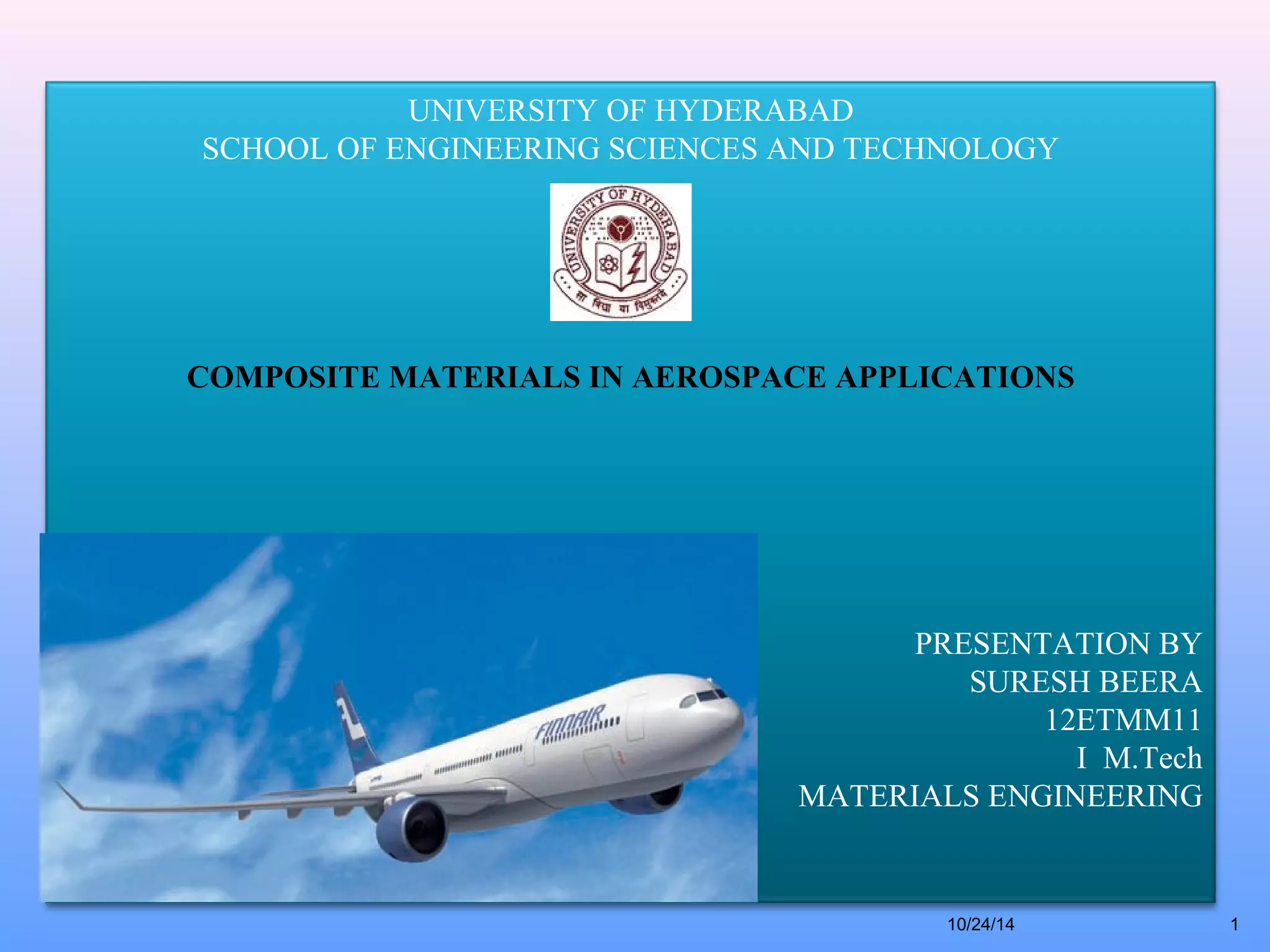
COMPOSITE MATERIALS IN AEROSPACE APPLICATIONS 
PRESENTATION BY 
SURESH BEERA 
12ETMM11 
I M.Tech 
MATERIALS ENGINEERING 
10/24/14 1
 Introduction to Composite Materials 
 Classification of composite 
 Application of composites in aerospace 
 Advantages & Disadvantages of composites 
 Conclusions 
 References 
10/24/14 2
3 
What are composite materials (definition) ? 
 Composite material is a material composed of two or 
more distinct phases(matrix phase and dispersed phase) 
which are chemically & physically different 
 Composites are used because overall properties of 
the composites are superior to those of the individual 
components 
10/24/14
4 
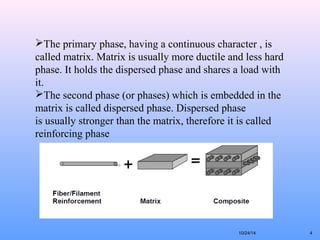
The primary phase, having a continuous character , is 
called matrix. Matrix is usually more ductile and less hard 
phase. It holds the dispersed phase and shares a load with 
it. 
The second phase (or phases) which is embedded in the 
matrix is called dispersed phase. Dispersed phase 
is usually stronger than the matrix, therefore it is called 
reinforcing phase 
10/24/14
5 
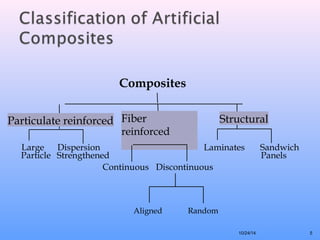
Composites 
Particulate reinforced Fiber 
reinforced 
Structural 
Laminates Sandwich 
Continuous Discontinuous 
Panels 
Large 
Particle 
Dispersion 
Strengthened 
Aligned Random 
10/24/14
6 
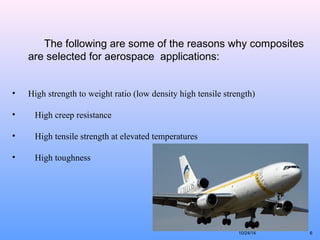
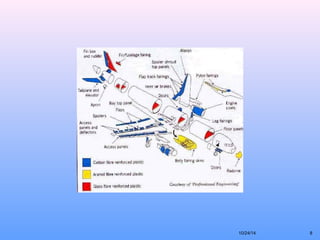
The following are some of the reasons why composites 
are selected for aerospace applications: 
• High strength to weight ratio (low density high tensile strength) 
• High creep resistance 
• High tensile strength at elevated temperatures 
• High toughness 
10/24/14
10/24/14 7
10/24/14 8
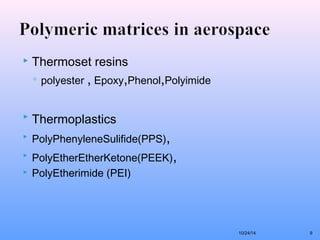
 Thermoset resins 
◦ polyester , Epoxy,Phenol,Polyimide 
 Thermoplastics 
 PolyPhenyleneSulifide(PPS), 
 PolyEtherEtherKetone(PEEK), 
 PolyEtherimide (PEI) 
10/24/14 9
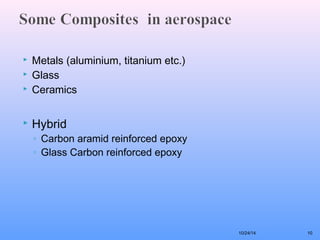
 Metals (aluminium, titanium etc.) 
 Glass 
 Ceramics 
 Hybrid 
◦ Carbon aramid reinforced epoxy 
◦ Glass Carbon reinforced epoxy 
10/24/14 10
10/24/14 11 
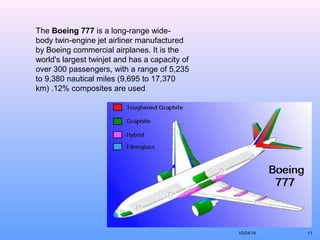
The Boeing 777 is a long-range wide-body 
twin-engine jet airliner manufactured 
by Boeing commercial airplanes. It is the 
world's largest twinjet and has a capacity of 
over 300 passengers, with a range of 5,235 
to 9,380 nautical miles (9,695 to 17,370 
km) .12% composites are used
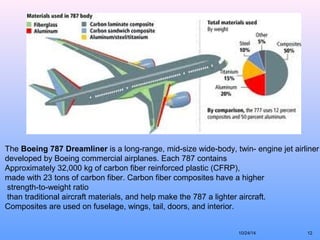
The Boeing 787 Dreamliner is a long-range, mid-size wide-body, twin- engine jet airliner 
developed by Boeing commercial airplanes. Each 787 contains 
Approximately 32,000 kg of carbon fiber reinforced plastic (CFRP), 
made with 23 tons of carbon fiber. Carbon fiber composites have a higher 
strength-to-weight ratio 
than traditional aircraft materials, and help make the 787 a lighter aircraft. 
Composites are used on fuselage, wings, tail, doors, and interior. 
10/24/14 12
10/24/14 13
10/24/14 14
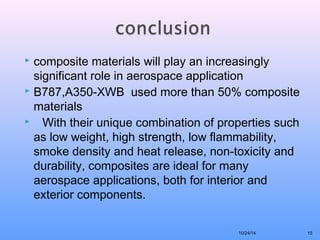
 composite materials will play an increasingly 
significant role in aerospace application 
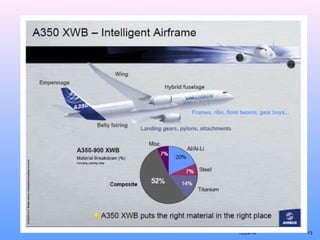
 B787,A350-XWB used more than 50% composite 
materials 
 With their unique combination of properties such 
as low weight, high strength, low flammability, 
smoke density and heat release, non-toxicity and 
durability, composites are ideal for many 
aerospace applications, both for interior and 
exterior components. 
10/24/14 15
 Mainly from Reference 1: “Low-cost composite 
materials and structures for aircraft applications”, 
Doe R.B., Starnes, J.H., Holzwarth, R.C.,May 
2001. 
 Callister’s Materials science andengineering,wiley 
india publication 
 Composite materials for aerospace 
applications.P D MANGALGIRI Aeronautical 
Development Agency, Vimanapura PO, Bangalore 
560017, India 
10/24/14 16
10/24/14 17

composite materials in aerospace application seminar

  • 1.
    UNIVERSITY OF HYDERABAD SCHOOL OF ENGINEERING SCIENCES AND TECHNOLOGY COMPOSITE MATERIALS IN AEROSPACE APPLICATIONS PRESENTATION BY SURESH BEERA 12ETMM11 I M.Tech MATERIALS ENGINEERING 10/24/14 1
  • 2.
     Introduction toComposite Materials  Classification of composite  Application of composites in aerospace  Advantages & Disadvantages of composites  Conclusions  References 10/24/14 2
  • 3.
    3 What arecomposite materials (definition) ?  Composite material is a material composed of two or more distinct phases(matrix phase and dispersed phase) which are chemically & physically different  Composites are used because overall properties of the composites are superior to those of the individual components 10/24/14
  • 4.
    4 The primaryphase, having a continuous character , is called matrix. Matrix is usually more ductile and less hard phase. It holds the dispersed phase and shares a load with it. The second phase (or phases) which is embedded in the matrix is called dispersed phase. Dispersed phase is usually stronger than the matrix, therefore it is called reinforcing phase 10/24/14
  • 5.
    5 Composites Particulatereinforced Fiber reinforced Structural Laminates Sandwich Continuous Discontinuous Panels Large Particle Dispersion Strengthened Aligned Random 10/24/14
  • 6.
    6 The followingare some of the reasons why composites are selected for aerospace applications: • High strength to weight ratio (low density high tensile strength) • High creep resistance • High tensile strength at elevated temperatures • High toughness 10/24/14
  • 7.
  • 8.
  • 9.
     Thermoset resins ◦ polyester , Epoxy,Phenol,Polyimide  Thermoplastics  PolyPhenyleneSulifide(PPS),  PolyEtherEtherKetone(PEEK),  PolyEtherimide (PEI) 10/24/14 9
  • 10.
     Metals (aluminium,titanium etc.)  Glass  Ceramics  Hybrid ◦ Carbon aramid reinforced epoxy ◦ Glass Carbon reinforced epoxy 10/24/14 10
  • 11.
    10/24/14 11 TheBoeing 777 is a long-range wide-body twin-engine jet airliner manufactured by Boeing commercial airplanes. It is the world's largest twinjet and has a capacity of over 300 passengers, with a range of 5,235 to 9,380 nautical miles (9,695 to 17,370 km) .12% composites are used
  • 12.
    The Boeing 787Dreamliner is a long-range, mid-size wide-body, twin- engine jet airliner developed by Boeing commercial airplanes. Each 787 contains Approximately 32,000 kg of carbon fiber reinforced plastic (CFRP), made with 23 tons of carbon fiber. Carbon fiber composites have a higher strength-to-weight ratio than traditional aircraft materials, and help make the 787 a lighter aircraft. Composites are used on fuselage, wings, tail, doors, and interior. 10/24/14 12
  • 13.
  • 14.
  • 15.
     composite materialswill play an increasingly significant role in aerospace application  B787,A350-XWB used more than 50% composite materials  With their unique combination of properties such as low weight, high strength, low flammability, smoke density and heat release, non-toxicity and durability, composites are ideal for many aerospace applications, both for interior and exterior components. 10/24/14 15
  • 16.
     Mainly fromReference 1: “Low-cost composite materials and structures for aircraft applications”, Doe R.B., Starnes, J.H., Holzwarth, R.C.,May 2001.  Callister’s Materials science andengineering,wiley india publication  Composite materials for aerospace applications.P D MANGALGIRI Aeronautical Development Agency, Vimanapura PO, Bangalore 560017, India 10/24/14 16
  • 17.