Prepregnancy Care & 
Ensuring Success For 
Contraception 
O&G Update 2014 
Hospital Sarikei, Sarawak 
yongsoonleong@yahoo.com
Contraception is a stepping 
stone for effective 
prepregnancy care 
especially for high risk 
women
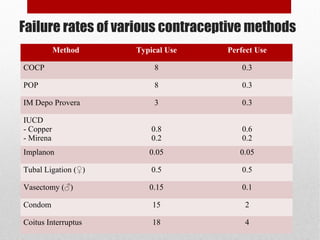
Failure rates of various contraceptive methods 
Method Typical Use Perfect Use 
COCP 8 0.3 
POP 8 0.3 
IM Depo Provera 3 0.3 
IUCD 
- Copper 
0.8 
0.6 
- Mirena 
0.2 
0.2 
Implanon 0.05 0.05 
Tubal Ligation (♀) 0.5 0.5 
Vasectomy (♂) 0.15 0.1 
Condom 15 2 
Coitus Interruptus 18 4
Types of contraception 
● Hormonal 
 Oral (COCP, POP) 
 Injectable (Depo Provera, NET) 
 Implant (Implanon) 
 Vaginal (NuvaRing) 
● Intrauterine contraceptive devices 
● Barrier method 
● Permanent sterilisation (BTL, Vasectomy)
Combined Oral Contraceptives 
Pills (COCP) 
● Contains 2 types of hormones 
-> estrogen & progesterone
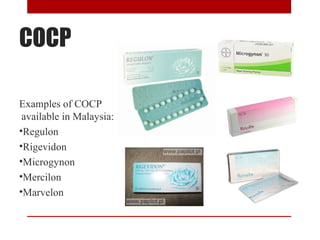
COCP 
Examples of COCP 
available in Malaysia: 
•Regulon 
•Rigevidon 
•Microgynon 
•Mercilon 
•Marvelon
When to start COCP? 
● Day 1 – 5 of menses 
● At any other time if patient is sure NOT pregnant, but with 
additional protection for the first 7 days ie. condom
When to start COCP? 
Postpartum 
1. Fully breastfeeding 
-> 6 months postpartum 
2. Not breastfeeding 
-> 3weeks postpartum
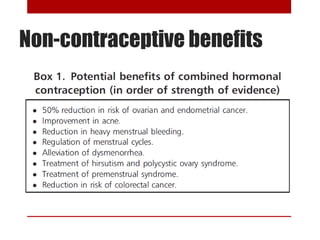
Non-contraceptive benefits
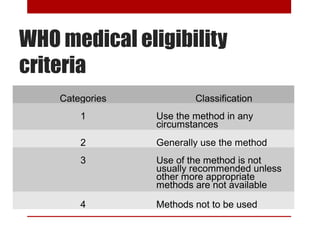
WHO medical eligibility 
criteria 
Categories Classification 
1 Use the method in any 
circumstances 
2 Generally use the method 
3 Use of the method is not 
usually recommended unless 
other more appropriate 
methods are not available 
4 Methods not to be used
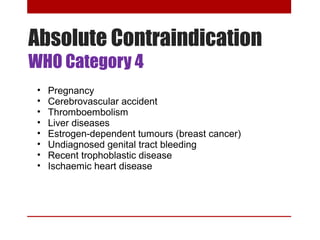
Absolute Contraindication 
WHO Category 4 
• Pregnancy 
• Cerebrovascular accident 
• Thromboembolism 
• Liver diseases 
• Estrogen-dependent tumours (breast cancer) 
• Undiagnosed genital tract bleeding 
• Recent trophoblastic disease 
• Ischaemic heart disease
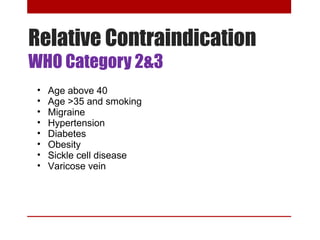
Relative Contraindication 
WHO Category 2&3 
• Age above 40 
• Age >35 and smoking 
• Migraine 
• Hypertension 
• Diabetes 
• Obesity 
• Sickle cell disease 
• Varicose vein
Missed pills (COCP) 
1st question to ask patient: 
Which type ooff CCOOCCPP tthhaann yyoouu aarree ttaakkiinngg?? 
30 mcg or 20 mcg of ethinyloestradiol
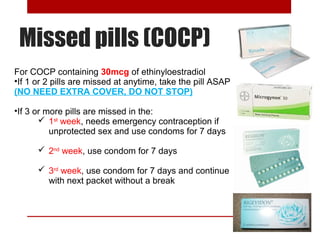
Missed pills (COCP) 
For COCP containing 30mcg of ethinyloestradiol 
•If 1 or 2 pills are missed at anytime, take the pill ASAP 
(NO NEED EXTRA COVER, DO NOT STOP) 
•If 3 or more pills are missed in the: 
 1st week, needs emergency contraception if 
unprotected sex and use condoms for 7 days 
 2nd week, use condom for 7 days 
 3rd week, use condom for 7 days and continue 
with next packet without a break
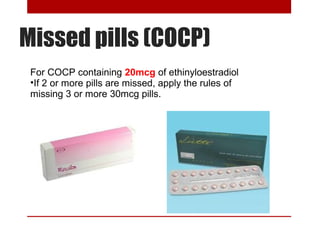
Missed pills (COCP) 
For COCP containing 20mcg of ethinyloestradiol 
•If 2 or more pills are missed, apply the rules of 
missing 3 or more 30mcg pills.
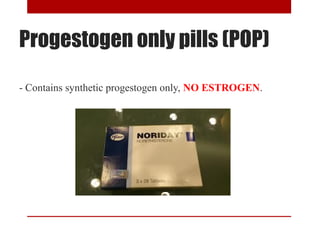
Progestogen only pills (POP) 
- Contains synthetic progestogen only, NO ESTROGEN.

When to start POP? 
• Day 1 till up to day 5 of menses 
• At any time when patient is sure not pregnant, but with 
additional protection for the next 48 hours i.e. condom
When to start POP? 
• Postpartum 
 Up to day 21 postpartum with no additional 
contraception 
 After day 21 postpartum, need additional 
contraception (ie condom) or avoid sexual intercourse 
for the next 48 hours.
Side effects of POP 
• Amenorrhoea 
• Irregular bleeding or spotting 
• Weight gain or loss (change in apetite) 
• Breast tenderness 
• Headaches, acnes 
• Increased risk of benign functional ovarian cysts
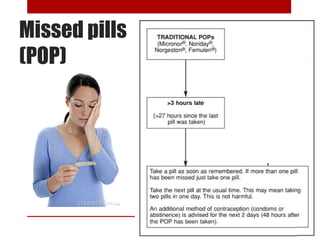
Missed pills 
(POP)
Missed pills 
(POP) 
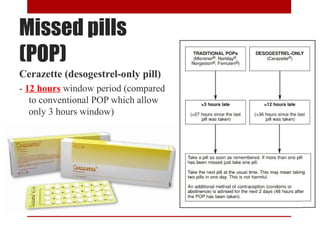
Cerazette (desogestrel-only pill) 
- 12 hours window period (compared 
to conventional POP which allow 
only 3 hours window)
Vomit (POP) 
• If vomit within 2 hours of taking a POP, she should be 
advised to take another pill.
Injectable Progestogen 
• Depo Provera (DMPA) 
 150mg depot medroxyprogesterone acetate every 12 weeks 
• Noristerat (NET-EN) 
 200mg norethisterone enanthate every 8 weeks
When to start Injectable 
Progestogen? 
• Day 1 to 5 of menses 
 no backup contraceptive method is necessary 
• Anytime during the menstrual cycle when patient is sure not 
pregnant 
 additional contraceptive method should be used for the next 7 
days, ie condom
When to start Injectable 
Progestogen? 
• Postpartum 
 Maybe initiated up to day 21 postpartum with immediate 
contraception cover 
 If initiated after day 21, then condom or avoid sexual 
intercourse for the next 7 days.
Disadvantages 
• Changes in menstrual cycle 
 20% amenorrhoeic 
 40% menses regularly 
 40% erractic bleeding 
• Delay in return of fertility 
 average of 9-10 months from the date of last injection 
• Weight gain (evidence is not strong) 
• Headache & dizziness
Disadvantages 
• Nausea 
• Mood changes (depression) 
• Hirsutism 
• Hyperpigmentation over injection site 
• Loss of libido
Missed injection?? 
Come early/late for 
injection?? 
IM Depo Provera / IM NET-EN 
can be given 2 weeks earlier or late
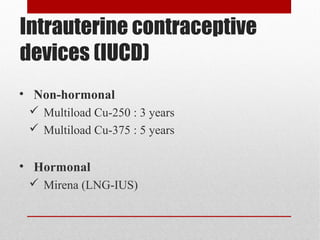
Intrauterine contraceptive 
devices (IUCD) 
• Non-hormonal 
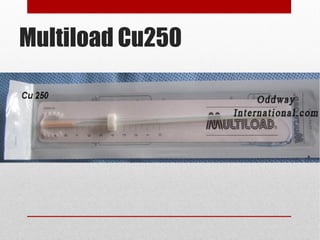
 Multiload Cu-250 : 3 years 
 Multiload Cu-375 : 5 years 
• Hormonal 
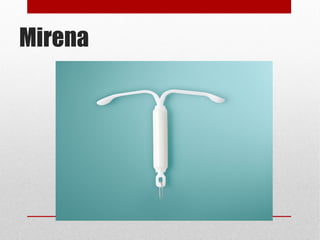
 Mirena (LNG-IUS)
Multiload Cu250
Mirena
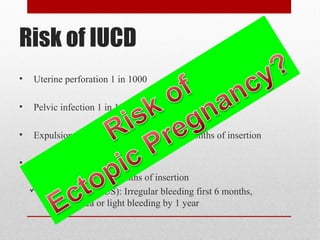
Risk of IUCD 
• Uterine perforation 1 in 1000 
• Pelvic infection 1 in 100 
• Expulsion 1 in 20 particularly within 3 months of insertion 
• Abnormal bleeding 
 Cu-IUD: first 3-6 months of insertion 
 Mirena (LNG-IUS): Irregular bleeding first 6 months, 
amenorrhoea or light bleeding by 1 year
Contraindication 
• Current PID or in the last 3 months 
• STD 
• Distorted uterine cavity 
• Pregnancy 
• Unexplained abnormal PV bleed
Timing of insertion 
● Anytime during the menstrual cycle when you can be sure 
that the client is not pregnant 
● Postpartum 
 Immediately after expulsion of placenta or after 4 
weeks postpartum 
● Post-miscarriage 
 Within 48 hours or delay until 4 weeks later
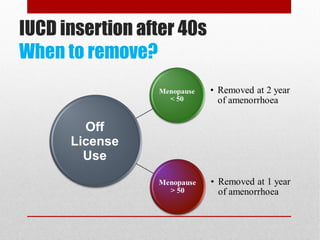
IUCD insertion after 40s 
When to remove? 
Off 
License 
Use
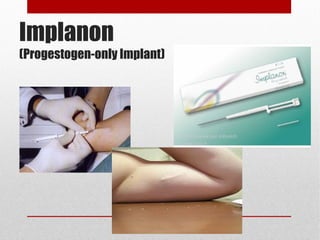
Implanon 
(Progestogen-only Implant)
Choice of contraception should be tailored to her 
health condition & the couple wish. 
Counseling to her involving the spouse will ensure 
success for contraception & prepregnancy care.
Thank you

Family planning

  • 1.
    Prepregnancy Care & Ensuring Success For Contraception O&G Update 2014 Hospital Sarikei, Sarawak yongsoonleong@yahoo.com
  • 2.
    Contraception is astepping stone for effective prepregnancy care especially for high risk women
  • 3.
    Failure rates ofvarious contraceptive methods Method Typical Use Perfect Use COCP 8 0.3 POP 8 0.3 IM Depo Provera 3 0.3 IUCD - Copper 0.8 0.6 - Mirena 0.2 0.2 Implanon 0.05 0.05 Tubal Ligation (♀) 0.5 0.5 Vasectomy (♂) 0.15 0.1 Condom 15 2 Coitus Interruptus 18 4
  • 4.
    Types of contraception ● Hormonal  Oral (COCP, POP)  Injectable (Depo Provera, NET)  Implant (Implanon)  Vaginal (NuvaRing) ● Intrauterine contraceptive devices ● Barrier method ● Permanent sterilisation (BTL, Vasectomy)
  • 5.
    Combined Oral Contraceptives Pills (COCP) ● Contains 2 types of hormones -> estrogen & progesterone
  • 6.
    COCP Examples ofCOCP available in Malaysia: •Regulon •Rigevidon •Microgynon •Mercilon •Marvelon
  • 7.
    When to startCOCP? ● Day 1 – 5 of menses ● At any other time if patient is sure NOT pregnant, but with additional protection for the first 7 days ie. condom
  • 8.
    When to startCOCP? Postpartum 1. Fully breastfeeding -> 6 months postpartum 2. Not breastfeeding -> 3weeks postpartum
  • 9.
  • 10.
    WHO medical eligibility criteria Categories Classification 1 Use the method in any circumstances 2 Generally use the method 3 Use of the method is not usually recommended unless other more appropriate methods are not available 4 Methods not to be used
  • 11.
    Absolute Contraindication WHOCategory 4 • Pregnancy • Cerebrovascular accident • Thromboembolism • Liver diseases • Estrogen-dependent tumours (breast cancer) • Undiagnosed genital tract bleeding • Recent trophoblastic disease • Ischaemic heart disease
  • 12.
    Relative Contraindication WHOCategory 2&3 • Age above 40 • Age >35 and smoking • Migraine • Hypertension • Diabetes • Obesity • Sickle cell disease • Varicose vein
  • 13.
    Missed pills (COCP) 1st question to ask patient: Which type ooff CCOOCCPP tthhaann yyoouu aarree ttaakkiinngg?? 30 mcg or 20 mcg of ethinyloestradiol
  • 14.
    Missed pills (COCP) For COCP containing 30mcg of ethinyloestradiol •If 1 or 2 pills are missed at anytime, take the pill ASAP (NO NEED EXTRA COVER, DO NOT STOP) •If 3 or more pills are missed in the:  1st week, needs emergency contraception if unprotected sex and use condoms for 7 days  2nd week, use condom for 7 days  3rd week, use condom for 7 days and continue with next packet without a break
  • 15.
    Missed pills (COCP) For COCP containing 20mcg of ethinyloestradiol •If 2 or more pills are missed, apply the rules of missing 3 or more 30mcg pills.
  • 16.
    Progestogen only pills(POP) - Contains synthetic progestogen only, NO ESTROGEN.
  • 17.
    When to startPOP? • Day 1 till up to day 5 of menses • At any time when patient is sure not pregnant, but with additional protection for the next 48 hours i.e. condom
  • 18.
    When to startPOP? • Postpartum  Up to day 21 postpartum with no additional contraception  After day 21 postpartum, need additional contraception (ie condom) or avoid sexual intercourse for the next 48 hours.
  • 19.
    Side effects ofPOP • Amenorrhoea • Irregular bleeding or spotting • Weight gain or loss (change in apetite) • Breast tenderness • Headaches, acnes • Increased risk of benign functional ovarian cysts
  • 20.
  • 21.
    Missed pills (POP) Cerazette (desogestrel-only pill) - 12 hours window period (compared to conventional POP which allow only 3 hours window)
  • 22.
    Vomit (POP) •If vomit within 2 hours of taking a POP, she should be advised to take another pill.
  • 23.
    Injectable Progestogen •Depo Provera (DMPA)  150mg depot medroxyprogesterone acetate every 12 weeks • Noristerat (NET-EN)  200mg norethisterone enanthate every 8 weeks
  • 24.
    When to startInjectable Progestogen? • Day 1 to 5 of menses  no backup contraceptive method is necessary • Anytime during the menstrual cycle when patient is sure not pregnant  additional contraceptive method should be used for the next 7 days, ie condom
  • 25.
    When to startInjectable Progestogen? • Postpartum  Maybe initiated up to day 21 postpartum with immediate contraception cover  If initiated after day 21, then condom or avoid sexual intercourse for the next 7 days.
  • 26.
    Disadvantages • Changesin menstrual cycle  20% amenorrhoeic  40% menses regularly  40% erractic bleeding • Delay in return of fertility  average of 9-10 months from the date of last injection • Weight gain (evidence is not strong) • Headache & dizziness
  • 27.
    Disadvantages • Nausea • Mood changes (depression) • Hirsutism • Hyperpigmentation over injection site • Loss of libido
  • 28.
    Missed injection?? Comeearly/late for injection?? IM Depo Provera / IM NET-EN can be given 2 weeks earlier or late
  • 29.
    Intrauterine contraceptive devices(IUCD) • Non-hormonal  Multiload Cu-250 : 3 years  Multiload Cu-375 : 5 years • Hormonal  Mirena (LNG-IUS)
  • 30.
  • 31.
  • 32.
    Risk of IUCD • Uterine perforation 1 in 1000 • Pelvic infection 1 in 100 • Expulsion 1 in 20 particularly within 3 months of insertion • Abnormal bleeding  Cu-IUD: first 3-6 months of insertion  Mirena (LNG-IUS): Irregular bleeding first 6 months, amenorrhoea or light bleeding by 1 year
  • 33.
    Contraindication • CurrentPID or in the last 3 months • STD • Distorted uterine cavity • Pregnancy • Unexplained abnormal PV bleed
  • 34.
    Timing of insertion ● Anytime during the menstrual cycle when you can be sure that the client is not pregnant ● Postpartum  Immediately after expulsion of placenta or after 4 weeks postpartum ● Post-miscarriage  Within 48 hours or delay until 4 weeks later
  • 35.
    IUCD insertion after40s When to remove? Off License Use
  • 36.
  • 37.
    Choice of contraceptionshould be tailored to her health condition & the couple wish. Counseling to her involving the spouse will ensure success for contraception & prepregnancy care.
  • 38.