
Employee Development
SlideShare Presentation by Stella Sim
Employee Development
Why Develop Your Employees?
• They are one of the Company’s most
critical assets. Employees drive
organization performance and
success.
• Feedback & coaching in development
discussions help employees improve
their competencies and performance.
• Employees are more motivated and
engaged.
• Build and retain a pipeline of the next
generation of leaders.
Employee Development
AN EFFECTIVE EMPLOYEE
DEVELOPMENT PLAN CAN BE THE
COMPASS TO A SUCCESSFUL CAREER
FOR YOUR TEAM MEMBERS.
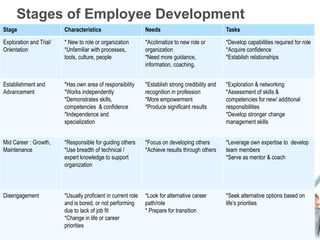
Stages of Employee Development
Question
• ??
Stage Characteristics Needs Tasks
Exploration and Trial/
Orientation
* New to role or organization
*Unfamiliar with processes,
tools, culture, people
*Acclimatize to new role or
organization
*Need more guidance,
information, coaching.
*Develop capabilities required for role
*Acquire confidence
*Establish relationships
Establishment and
Advancement
*Has own area of responsibility
*Works independently
*Demonstrates skills,
competencies & confidence
*Independence and
specialization
*Establish strong credibility and
recognition in profession
*More empowerment
*Produce significant results
*Exploration & networking
*Assessment of skills &
competencies for new/ additional
responsibilities
*Develop stronger change
management skills
Mid Career : Growth,
Maintenance
*Responsible for guiding others
*Use breadth of technical /
expert knowledge to support
organization
*Focus on developing others
*Achieve results through others
*Leverage own expertise to develop
team members
*Serve as mentor & coach
Disengagement *Usually proficient in current role
and is bored, or not performing
due to lack of job fit
*Change in life or career
priorities
*Look for alternative career
path/role
* Prepare for transition
*Seek alternative options based on
life’s priorities
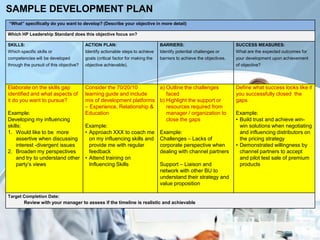
SAMPLE DEVELOPMENT PLAN
“What” specifically do you want to develop? (Describe your objective in more detail)
Which HP Leadership Standard does this objective focus on?
SKILLS:
Which specific skills or
competencies will be developed
through the pursuit of this objective?
ACTION PLAN:
Identify actionable steps to achieve
goals (critical factor for making the
objective achievable).
BARRIERS:
Identify potential challenges or
barriers to achieve the objectives.
SUCCESS MEASURES:
What are the expected outcomes for
your development upon achievement
of objective?
Elaborate on the skills gap
identified and what aspects of
it do you want to pursue?
Example:
Developing my influencing
skills:
1. Would like to be more
assertive when discussing
interest -divergent issues
2. Broaden my perspectives
and try to understand other
party’s views
Consider the 70/20/10
learning guide and include
mix of development platforms
– Experience, Relationship &
Education
Example:
• Approach XXX to coach me
on my influencing skills and
provide me with regular
feedback
• Attend training on
Influencing Skills
a) Outline the challenges
faced
b) Highlight the support or
resources required from
manager / organization to
close the gaps
Example:
Challenges – Lacks of
corporate perspective when
dealing with channel partners
Support – Liaison and
network with other BU to
understand their strategy and
value proposition
Define what success looks like if
you successfully closed the
gaps
Example:
• Build trust and achieve win-
win solutions when negotiating
and influencing distributors on
the pricing strategy
• Demonstrated willingness by
channel partners to accept
and pilot test sale of premium
products
Target Completion Date:
Review with your manager to assess if the timeline is realistic and achievable
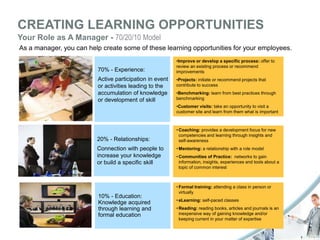
CREATING LEARNING OPPORTUNITIES
10% - Education:
Knowledge acquired
through learning and
formal education
• Formal training: attending a class in person or
virtually
• eLearning: self-paced classes
• Reading: reading books, articles and journals is an
inexpensive way of gaining knowledge and/or
keeping current in your matter of expertise
70% - Experience:
Active participation in event
or activities leading to the
accumulation of knowledge
or development of skill
•Improve or develop a specific process: offer to
review an existing process or recommend
improvements
•Projects: initiate or recommend projects that
contribute to success
•Benchmarking: learn from best practices through
benchmarking
•Customer visits: take an opportunity to visit a
customer site and learn from them what is important
20% - Relationships:
Connection with people to
increase your knowledge
or build a specific skill
• Coaching: provides a development focus for new
competencies and learning through insights and
self-awareness
• Mentoring: a relationship with a role model
• Communities of Practice: networks to gain
information, insights, experiences and tools about a
topic of common interest
As a manager, you can help create some of these learning opportunities for your employees.
Your Role as A Manager - 70/20/10 Model
Thank You!

Employee Development

  • 1.
  • 2.
    Employee Development Why DevelopYour Employees? • They are one of the Company’s most critical assets. Employees drive organization performance and success. • Feedback & coaching in development discussions help employees improve their competencies and performance. • Employees are more motivated and engaged. • Build and retain a pipeline of the next generation of leaders.
  • 3.
    Employee Development AN EFFECTIVEEMPLOYEE DEVELOPMENT PLAN CAN BE THE COMPASS TO A SUCCESSFUL CAREER FOR YOUR TEAM MEMBERS.
  • 4.
    Stages of EmployeeDevelopment Question • ?? Stage Characteristics Needs Tasks Exploration and Trial/ Orientation * New to role or organization *Unfamiliar with processes, tools, culture, people *Acclimatize to new role or organization *Need more guidance, information, coaching. *Develop capabilities required for role *Acquire confidence *Establish relationships Establishment and Advancement *Has own area of responsibility *Works independently *Demonstrates skills, competencies & confidence *Independence and specialization *Establish strong credibility and recognition in profession *More empowerment *Produce significant results *Exploration & networking *Assessment of skills & competencies for new/ additional responsibilities *Develop stronger change management skills Mid Career : Growth, Maintenance *Responsible for guiding others *Use breadth of technical / expert knowledge to support organization *Focus on developing others *Achieve results through others *Leverage own expertise to develop team members *Serve as mentor & coach Disengagement *Usually proficient in current role and is bored, or not performing due to lack of job fit *Change in life or career priorities *Look for alternative career path/role * Prepare for transition *Seek alternative options based on life’s priorities
  • 5.
    SAMPLE DEVELOPMENT PLAN “What”specifically do you want to develop? (Describe your objective in more detail) Which HP Leadership Standard does this objective focus on? SKILLS: Which specific skills or competencies will be developed through the pursuit of this objective? ACTION PLAN: Identify actionable steps to achieve goals (critical factor for making the objective achievable). BARRIERS: Identify potential challenges or barriers to achieve the objectives. SUCCESS MEASURES: What are the expected outcomes for your development upon achievement of objective? Elaborate on the skills gap identified and what aspects of it do you want to pursue? Example: Developing my influencing skills: 1. Would like to be more assertive when discussing interest -divergent issues 2. Broaden my perspectives and try to understand other party’s views Consider the 70/20/10 learning guide and include mix of development platforms – Experience, Relationship & Education Example: • Approach XXX to coach me on my influencing skills and provide me with regular feedback • Attend training on Influencing Skills a) Outline the challenges faced b) Highlight the support or resources required from manager / organization to close the gaps Example: Challenges – Lacks of corporate perspective when dealing with channel partners Support – Liaison and network with other BU to understand their strategy and value proposition Define what success looks like if you successfully closed the gaps Example: • Build trust and achieve win- win solutions when negotiating and influencing distributors on the pricing strategy • Demonstrated willingness by channel partners to accept and pilot test sale of premium products Target Completion Date: Review with your manager to assess if the timeline is realistic and achievable
  • 6.
    CREATING LEARNING OPPORTUNITIES 10%- Education: Knowledge acquired through learning and formal education • Formal training: attending a class in person or virtually • eLearning: self-paced classes • Reading: reading books, articles and journals is an inexpensive way of gaining knowledge and/or keeping current in your matter of expertise 70% - Experience: Active participation in event or activities leading to the accumulation of knowledge or development of skill •Improve or develop a specific process: offer to review an existing process or recommend improvements •Projects: initiate or recommend projects that contribute to success •Benchmarking: learn from best practices through benchmarking •Customer visits: take an opportunity to visit a customer site and learn from them what is important 20% - Relationships: Connection with people to increase your knowledge or build a specific skill • Coaching: provides a development focus for new competencies and learning through insights and self-awareness • Mentoring: a relationship with a role model • Communities of Practice: networks to gain information, insights, experiences and tools about a topic of common interest As a manager, you can help create some of these learning opportunities for your employees. Your Role as A Manager - 70/20/10 Model
  • 7.