How do I Develop
my staff?
A STEP-BY-STEP PLAN FOR STATEGIC EMPLOYEE
DEVELOPMET
Dear director, manager of supervisor
In the dynamic world of business, developing personnel is a challenging game. We feel the constant
pressure to keep up and avoid being outcompeted in the market. At the same time, we recognize that
our staff is an essential part of our company's growth.
Especially in a young and dynamic team, the challenges are particularly intense. Our new and
ambitious employees want to prove themselves and make rapid progress. Finding the right balance
between nurturing their potential and ensuring stability requires skill. It is a continuous dance between
challenging and supporting, providing room for growth while keeping our business goals in mind.
As an entrepreneur, I fully understand the importance of nurturing talent. Investing in personnel
development is not a luxury but an absolute necessity to stay relevant and competitive. This means
investing in training and education, creating a culture of continuous learning, and encouraging
personal growth.
This step-by-step plan has been developed to assist managers, entrepreneurs, and directors in taking
their personnel and company to a higher level. Our strategic approach is designed to achieve
successful growth while supporting our staff. We hope that this helps you!
GROW&Co.
Step 1 ANALYZE THE CURRENT
SITUATION
1.1 EVALUATE THE CURRENT SKILLS,
KNOWLEDGE, AND COMPETENCIES OF
YOUR PERSONNEL [JOB ARCHITECTURE]
• What are the main tasks, responsibilities, and competencies of
the positions within the company?
• What are the expectations regarding the attitude of my staff?
• How should they behave? What skills are associated with it?
1.2 RESEARCH THE CURRENT SKILLS,
KNOWLEDGE, AND CAPABILITIES OF YOUR
STAFF
• What competencies does my staff currently possess?
• What skills do they have?
• What are the strengths and areas of expertise of each individual?
• How do they behave?
HOW?
Consider carefully what is important in each role within the
company. Each role requires different competencies. For
example, an administrative assistant needs accuracy,
efficiency, and good written skills, while a team leader should
prioritize assertiveness, leadership skills, and strong
communication abilities.
HOW?
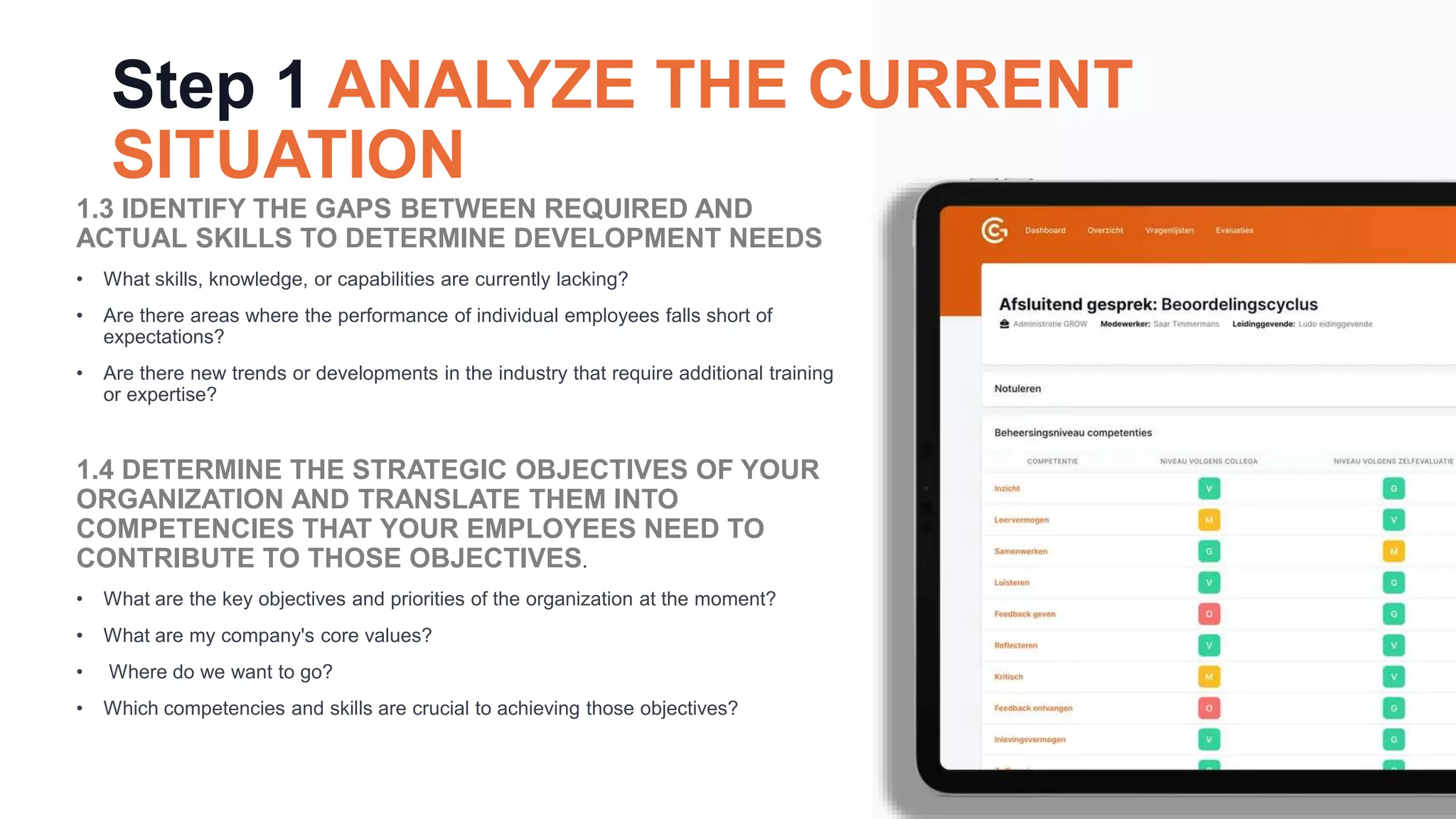
Use a research tool to measure the status of your
employees.
Step 1 ANALYZE THE CURRENT
SITUATION
1.3 IDENTIFY THE GAPS BETWEEN REQUIRED AND
ACTUAL SKILLS TO DETERMINE DEVELOPMENT NEEDS
• What skills, knowledge, or capabilities are currently lacking?
• Are there areas where the performance of individual employees falls short of
expectations?
• Are there new trends or developments in the industry that require additional training
or expertise?
1.4 DETERMINE THE STRATEGIC OBJECTIVES OF YOUR
ORGANIZATION AND TRANSLATE THEM INTO
COMPETENCIES THAT YOUR EMPLOYEES NEED TO
CONTRIBUTE TO THOSE OBJECTIVES.
• What are the key objectives and priorities of the organization at the moment?
• What are my company's core values?
• Where do we want to go?
• Which competencies and skills are crucial to achieving those objectives?
Example:
John, 27 years old, has been working as a
Marketing Advisor for two years. After going
through step 1, you realize that Gijs struggles to
adapt to the dynamic market. He often falls back
into old patterns. New regulations, ideas from
management, and customer inquiries are rarely
implemented promptly. As a manager, you
recognize that adaptability is crucial in his role and
in the industry. You decide to develop this skill in
Gijs.
Step 2 SET DEVELOPMENT GOALS
• Define specific and measurable development goals for each
individual based on identified gaps and strategic needs.
• Ensure that the goals are challenging yet achievable and
aligned with the career goals of your employees. Encourage
the employees to contribute their own thoughts and ideas
when setting these goals.
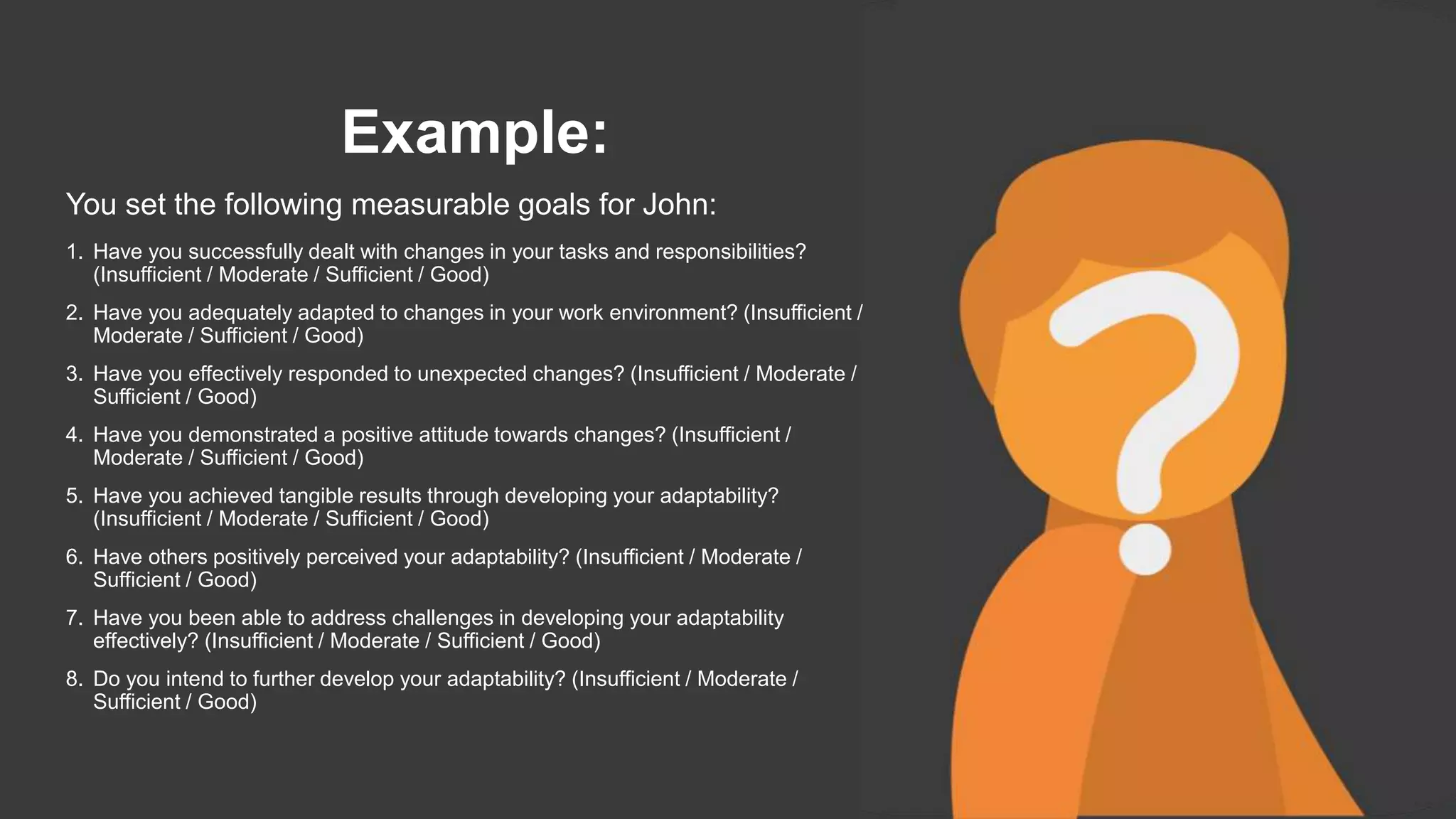
Example:
You set the following measurable goals for John:
1. Have you successfully dealt with changes in your tasks and responsibilities?
(Insufficient / Moderate / Sufficient / Good)
2. Have you adequately adapted to changes in your work environment? (Insufficient /
Moderate / Sufficient / Good)
3. Have you effectively responded to unexpected changes? (Insufficient / Moderate /
Sufficient / Good)
4. Have you demonstrated a positive attitude towards changes? (Insufficient /
Moderate / Sufficient / Good)
5. Have you achieved tangible results through developing your adaptability?
(Insufficient / Moderate / Sufficient / Good)
6. Have others positively perceived your adaptability? (Insufficient / Moderate /
Sufficient / Good)
7. Have you been able to address challenges in developing your adaptability
effectively? (Insufficient / Moderate / Sufficient / Good)
8. Do you intend to further develop your adaptability? (Insufficient / Moderate /
Sufficient / Good)
Stap 3 Develop a plan
• Based on the analysis from step 1 and the strategic goals from
step 2, you will create a development plan. This plan will include
actions and initiatives that support the development of your
employees, such as training programs, education, coaching,
and mentoring. Ensure that the development plan aligns with
the needs of both the employees and the organization.
• A good plan relies on the objectives you want to achieve. A
crucial part of every plan is having conversations with the
employees. For example, schedule four development
discussions per employee within a year. In these discussions,
you will address the development goals set in step 2.
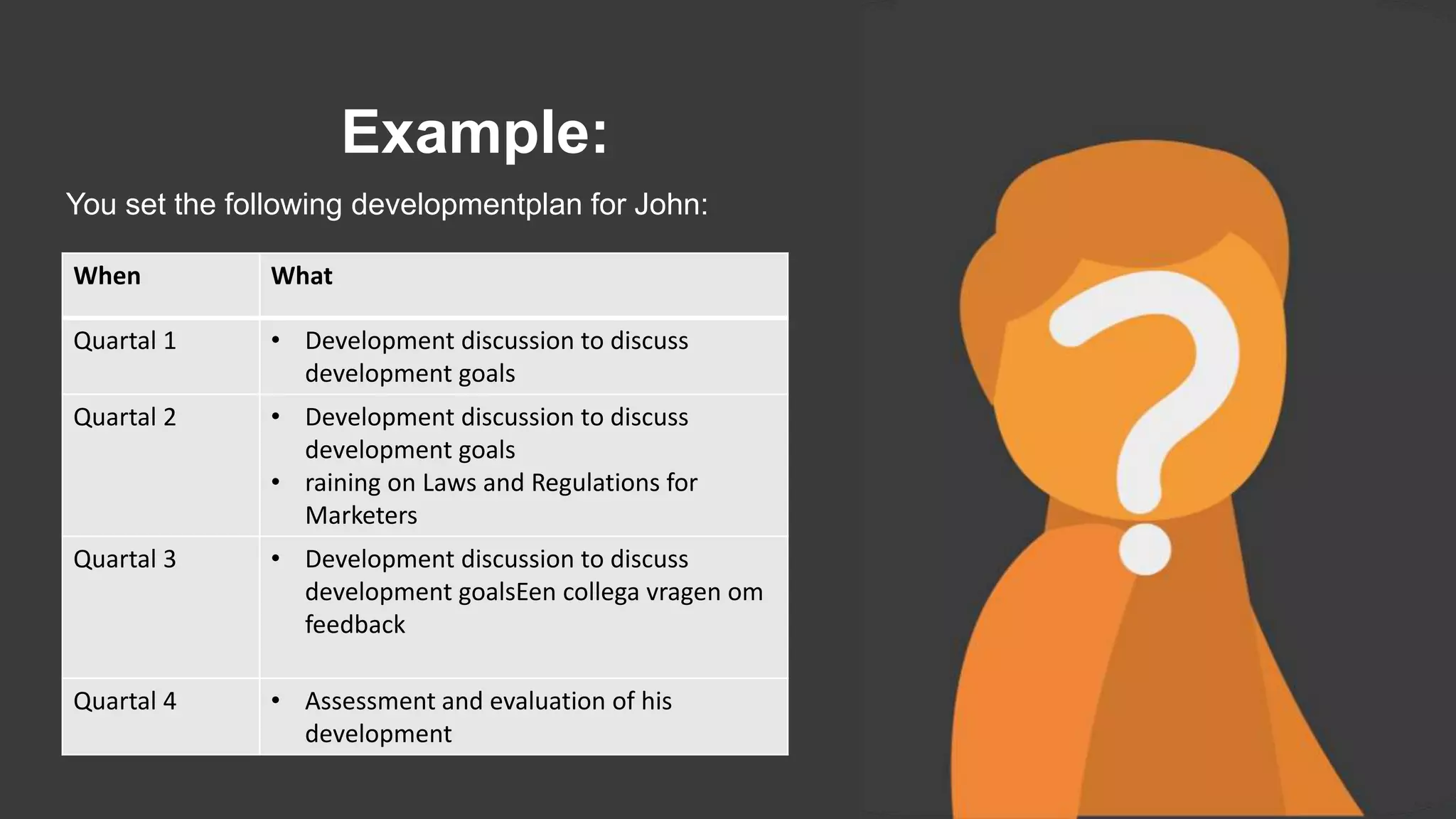
Example:
You set the following developmentplan for John:
When What
Quartal 1 • Development discussion to discuss
development goals
Quartal 2 • Development discussion to discuss
development goals
• raining on Laws and Regulations for
Marketers
Quartal 3 • Development discussion to discuss
development goalsEen collega vragen om
feedback
Quartal 4 • Assessment and evaluation of his
development
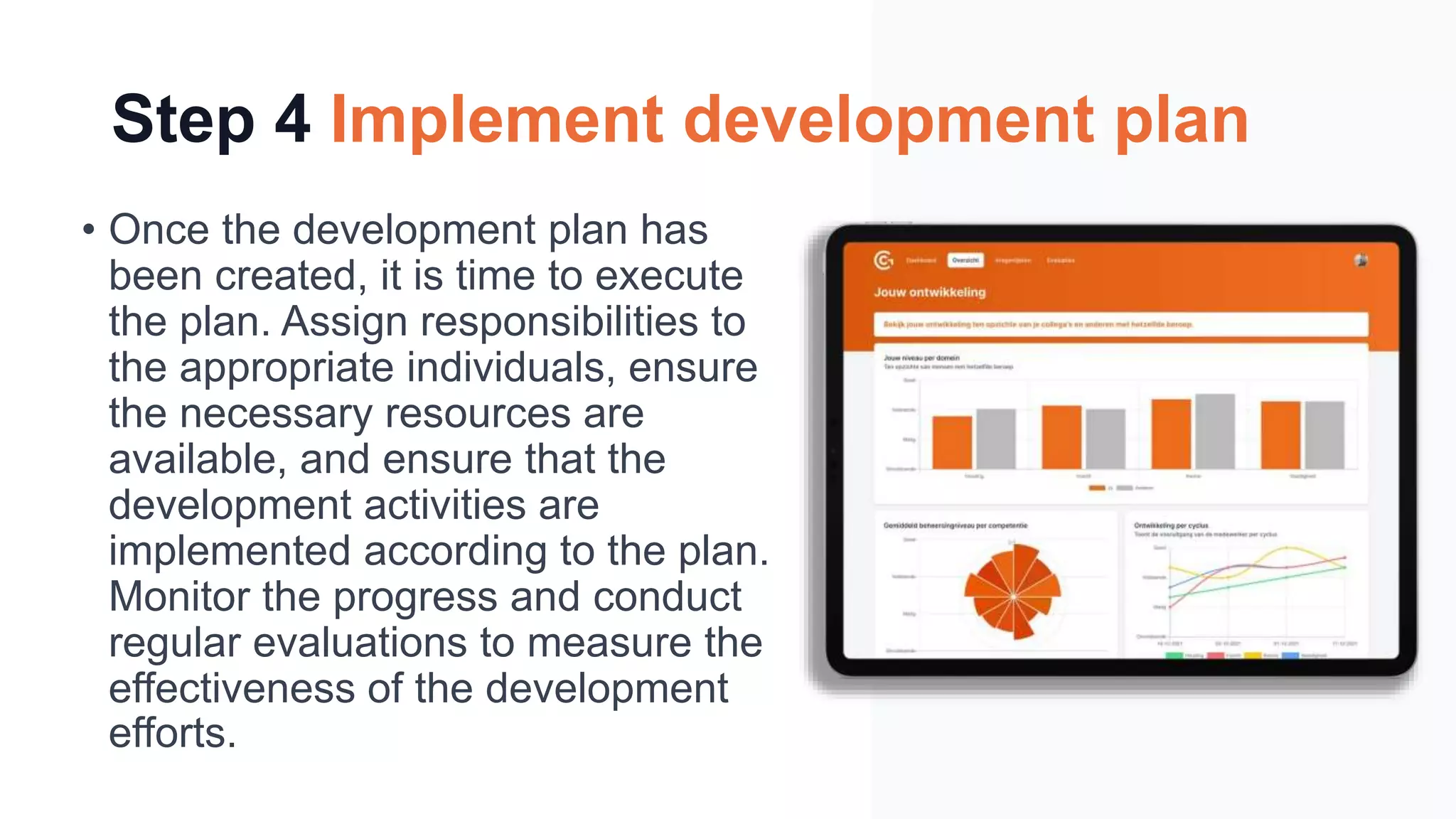
Step 4 Implement development plan
• Once the development plan has
been created, it is time to execute
the plan. Assign responsibilities to
the appropriate individuals, ensure
the necessary resources are
available, and ensure that the
development activities are
implemented according to the plan.
Monitor the progress and conduct
regular evaluations to measure the
effectiveness of the development
efforts.
Step 5 Evaluate and revise
• Continue to monitor the development of
your personnel and regularly evaluate
the results. Measure the impact of the
development activities on both individual
employees and the organization as a
whole. Adjust the development plan if
necessary based on the gathered
feedback and strive for continuous
improvement.
• Keep track of your staff's progress and
regularly assess the outcomes. Assess
how the development activities have
influenced both individual employees
and the overall organization. Modify the
development plan as needed, based on
the feedback received, and maintain a
commitment to ongoing enhancement.
TIPS
1.Make the development points come alive. The more specific
goals are mentioned in meetings or job descriptions, the more
they become real and actionable.
2.Encourage employees to come up with their own ideas.
Many employees have a good understanding of how to
achieve certain goals. This applies to both personal and
collective objectives.
3.Be willing to change yourself. Imposing change is not the
right way to foster development. Ask others for feedback on
how you can improve your performance in your role.
4.Seek help. Some situations require additional hands and
eyes. Seek assistance from experts to elevate your company
to a higher level.
VITAL EMPLOYEES & INSIGHT INTO YOUR
EMPLOYEES
HR Support
Employee Development
En Organisation Developmen
Thank you for reading!
Hopefully it helpeld…
Need extra help or support?
www.growenco.nl
013 20 32 64 1

How Do I Develop My Staff?

  • 1.
    How do IDevelop my staff? A STEP-BY-STEP PLAN FOR STATEGIC EMPLOYEE DEVELOPMET
  • 2.
    Dear director, managerof supervisor In the dynamic world of business, developing personnel is a challenging game. We feel the constant pressure to keep up and avoid being outcompeted in the market. At the same time, we recognize that our staff is an essential part of our company's growth. Especially in a young and dynamic team, the challenges are particularly intense. Our new and ambitious employees want to prove themselves and make rapid progress. Finding the right balance between nurturing their potential and ensuring stability requires skill. It is a continuous dance between challenging and supporting, providing room for growth while keeping our business goals in mind. As an entrepreneur, I fully understand the importance of nurturing talent. Investing in personnel development is not a luxury but an absolute necessity to stay relevant and competitive. This means investing in training and education, creating a culture of continuous learning, and encouraging personal growth. This step-by-step plan has been developed to assist managers, entrepreneurs, and directors in taking their personnel and company to a higher level. Our strategic approach is designed to achieve successful growth while supporting our staff. We hope that this helps you! GROW&Co.
  • 3.
    Step 1 ANALYZETHE CURRENT SITUATION 1.1 EVALUATE THE CURRENT SKILLS, KNOWLEDGE, AND COMPETENCIES OF YOUR PERSONNEL [JOB ARCHITECTURE] • What are the main tasks, responsibilities, and competencies of the positions within the company? • What are the expectations regarding the attitude of my staff? • How should they behave? What skills are associated with it? 1.2 RESEARCH THE CURRENT SKILLS, KNOWLEDGE, AND CAPABILITIES OF YOUR STAFF • What competencies does my staff currently possess? • What skills do they have? • What are the strengths and areas of expertise of each individual? • How do they behave? HOW? Consider carefully what is important in each role within the company. Each role requires different competencies. For example, an administrative assistant needs accuracy, efficiency, and good written skills, while a team leader should prioritize assertiveness, leadership skills, and strong communication abilities. HOW? Use a research tool to measure the status of your employees.
  • 4.
    Step 1 ANALYZETHE CURRENT SITUATION 1.3 IDENTIFY THE GAPS BETWEEN REQUIRED AND ACTUAL SKILLS TO DETERMINE DEVELOPMENT NEEDS • What skills, knowledge, or capabilities are currently lacking? • Are there areas where the performance of individual employees falls short of expectations? • Are there new trends or developments in the industry that require additional training or expertise? 1.4 DETERMINE THE STRATEGIC OBJECTIVES OF YOUR ORGANIZATION AND TRANSLATE THEM INTO COMPETENCIES THAT YOUR EMPLOYEES NEED TO CONTRIBUTE TO THOSE OBJECTIVES. • What are the key objectives and priorities of the organization at the moment? • What are my company's core values? • Where do we want to go? • Which competencies and skills are crucial to achieving those objectives?
  • 5.
    Example: John, 27 yearsold, has been working as a Marketing Advisor for two years. After going through step 1, you realize that Gijs struggles to adapt to the dynamic market. He often falls back into old patterns. New regulations, ideas from management, and customer inquiries are rarely implemented promptly. As a manager, you recognize that adaptability is crucial in his role and in the industry. You decide to develop this skill in Gijs.
  • 6.
    Step 2 SETDEVELOPMENT GOALS • Define specific and measurable development goals for each individual based on identified gaps and strategic needs. • Ensure that the goals are challenging yet achievable and aligned with the career goals of your employees. Encourage the employees to contribute their own thoughts and ideas when setting these goals.
  • 7.
    Example: You set thefollowing measurable goals for John: 1. Have you successfully dealt with changes in your tasks and responsibilities? (Insufficient / Moderate / Sufficient / Good) 2. Have you adequately adapted to changes in your work environment? (Insufficient / Moderate / Sufficient / Good) 3. Have you effectively responded to unexpected changes? (Insufficient / Moderate / Sufficient / Good) 4. Have you demonstrated a positive attitude towards changes? (Insufficient / Moderate / Sufficient / Good) 5. Have you achieved tangible results through developing your adaptability? (Insufficient / Moderate / Sufficient / Good) 6. Have others positively perceived your adaptability? (Insufficient / Moderate / Sufficient / Good) 7. Have you been able to address challenges in developing your adaptability effectively? (Insufficient / Moderate / Sufficient / Good) 8. Do you intend to further develop your adaptability? (Insufficient / Moderate / Sufficient / Good)
  • 8.
    Stap 3 Developa plan • Based on the analysis from step 1 and the strategic goals from step 2, you will create a development plan. This plan will include actions and initiatives that support the development of your employees, such as training programs, education, coaching, and mentoring. Ensure that the development plan aligns with the needs of both the employees and the organization. • A good plan relies on the objectives you want to achieve. A crucial part of every plan is having conversations with the employees. For example, schedule four development discussions per employee within a year. In these discussions, you will address the development goals set in step 2.
  • 9.
    Example: You set thefollowing developmentplan for John: When What Quartal 1 • Development discussion to discuss development goals Quartal 2 • Development discussion to discuss development goals • raining on Laws and Regulations for Marketers Quartal 3 • Development discussion to discuss development goalsEen collega vragen om feedback Quartal 4 • Assessment and evaluation of his development
  • 10.
    Step 4 Implementdevelopment plan • Once the development plan has been created, it is time to execute the plan. Assign responsibilities to the appropriate individuals, ensure the necessary resources are available, and ensure that the development activities are implemented according to the plan. Monitor the progress and conduct regular evaluations to measure the effectiveness of the development efforts.
  • 11.
    Step 5 Evaluateand revise • Continue to monitor the development of your personnel and regularly evaluate the results. Measure the impact of the development activities on both individual employees and the organization as a whole. Adjust the development plan if necessary based on the gathered feedback and strive for continuous improvement. • Keep track of your staff's progress and regularly assess the outcomes. Assess how the development activities have influenced both individual employees and the overall organization. Modify the development plan as needed, based on the feedback received, and maintain a commitment to ongoing enhancement. TIPS 1.Make the development points come alive. The more specific goals are mentioned in meetings or job descriptions, the more they become real and actionable. 2.Encourage employees to come up with their own ideas. Many employees have a good understanding of how to achieve certain goals. This applies to both personal and collective objectives. 3.Be willing to change yourself. Imposing change is not the right way to foster development. Ask others for feedback on how you can improve your performance in your role. 4.Seek help. Some situations require additional hands and eyes. Seek assistance from experts to elevate your company to a higher level.
  • 12.
    VITAL EMPLOYEES &INSIGHT INTO YOUR EMPLOYEES HR Support Employee Development En Organisation Developmen Thank you for reading! Hopefully it helpeld… Need extra help or support? www.growenco.nl 013 20 32 64 1