CHAPTER 7
The Nominating Process
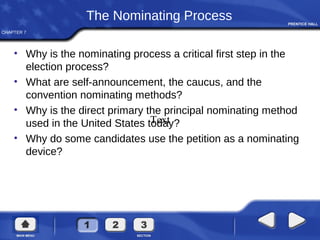
• Why is the nominating process a critical first step in the
election process?
• What are self-announcement, the caucus, and the
convention nominating methods?
• Why is the direct primary the principal nominating method
used in the United States today?
• Why do some candidates use the petition as a nominating
device?
Text
CHAPTER 7
A Critical First Step
1. Nomination, in which the field of candidates is narrowed
2. General election, the regularly scheduled election where voters make
the final choice of officeholder
In the United States, the election process occurs in two
steps:
CHAPTER 7
Nominating and Electing a Candidate
CHAPTER 7
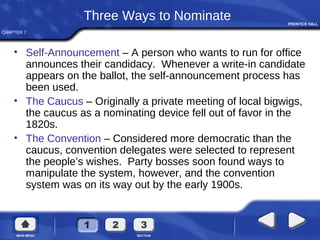
Three Ways to Nominate
• Self-Announcement – A person who wants to run for office
announces their candidacy. Whenever a write-in candidate
appears on the ballot, the self-announcement process has
been used.
• The Caucus – Originally a private meeting of local bigwigs,
the caucus as a nominating device fell out of favor in the
1820s.
• The Convention – Considered more democratic than the
caucus, convention delegates were selected to represent
the people’s wishes. Party bosses soon found ways to
manipulate the system, however, and the convention
system was on its way out by the early 1900s.
CHAPTER 7
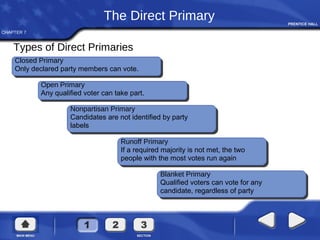
The Direct Primary
Closed Primary
Only declared party members can vote.
Open Primary
Any qualified voter can take part.
Nonpartisan Primary
Candidates are not identified by party
labels
Runoff Primary
If a required majority is not met, the two
people with the most votes run again
Blanket Primary
Qualified voters can vote for any
candidate, regardless of party
Types of Direct Primaries
CHAPTER 7
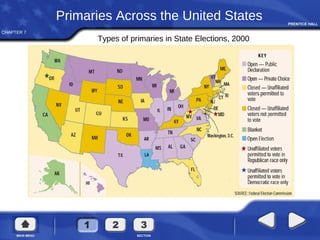
Primaries Across the United States
Types of primaries in State Elections, 2000
CHAPTER 7
Petition
• Candidates must gather a required number of voters’
signatures to get on the ballot by means of petition.
• Minor party and independent candidates are usually
required by State law to be nominated by petition.
• Petition is often used at the local level to nominate for
school posts and municipal offices.
CHAPTER 7
Want to connect to the Magruder’s link for this chapter? Click Here!
Section 1 Assessment
1. The most commonly used method of nomination today is
(a) the caucus.
(b) the direct primary.
(c) self-announcement.
(d) the convention.
2. A runoff primary is held in some States when
(a) no one wins a majority of votes.
(b) there is only one candidate.
(c) not enough voters turn out on election day.
(d) a candidate asks for a recount.
CHAPTER 7
Want to connect to the Magruder’s link for this chapter? Click Here!
Section 1 Assessment
1. The most commonly used method of nomination today is
(a) the caucus.
(b) the direct primary.
(c) self-announcement.
(d) the convention.
2. A runoff primary is held in some States when
(a) no one wins a majority of votes.
(b) there is only one candidate.
(c) not enough voters turn out on election day.
(d) a candidate asks for a recount.
CHAPTER 7
Elections
• How does the administration of elections in the United
States make democracy work?
• What role do precincts and polling places play in the
election process?
• In what ways can voters cast their ballots?
• What role do voting machines and other innovations play in
the election process?
CHAPTER 7
Elections are primarily regulated by State law, but there are some
overreaching federal regulations.
The Administration of Elections
Congress
• Congress has the power to set the time, place, and manner of congressional and
presidential elections.
• Congress has chosen the first Tuesday after the first Monday in November of every even-
numbered year for congressional elections, with the presidential election being held the
same day every fourth year.
States
• States determine the details of the election of thousands of State and local officials.
• Most States provide for absentee voting, for voters who are unable to get to their regular
polling places on election day. Some States within the last few years have started to
allow voting a few days before election day to increase voter participation.
CHAPTER 7
Precincts and Polling Places
Precincts
• A precinct is a voting district.
• Precincts are the smallest geographic units used to carry out elections.
• A precinct election board supervises the voting process in each precinct.
Polling Places
• A polling place is where the voters who live in a precinct go to vote.
• It is located in or near each precinct. Polling places are supposed to be located
conveniently for voters.
CHAPTER 7
Casting the Ballot
History of the Ballot
• Voting was initially done orally. It was considered “manly” to speak out your
vote without fear of reprisal.
• Paper ballots began to be used in the mid-1800s. At first, people provided their
own ballots. Then, political machines began to take advantage of the flexibility
of the process to intimidate, buy, or manufacture votes.
• In the late 1800s, ballot reforms cleaned up ballot fraud by supplying
standardized, accurate ballots and mandating that voting be secret.
CHAPTER 7
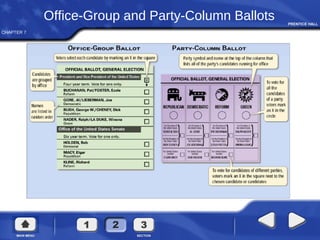
Office-Group and Party-Column Ballots
CHAPTER 7
Voting Machines and Innovations
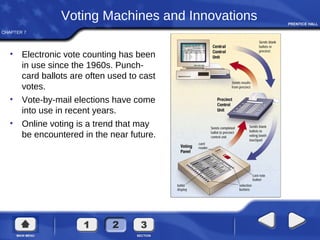
• Electronic vote counting has been
in use since the 1960s. Punch-
card ballots are often used to cast
votes.
• Vote-by-mail elections have come
into use in recent years.
• Online voting is a trend that may
be encountered in the near future.
CHAPTER 7
Want to connect to the Magruder’s link for this chapter? Click Here!
Section 2 Assessment
1. Elections are held on
(a) the first Wednesday after Halloween.
(b) the first Tuesday after the first Monday in November.
(c) the second Thursday after the first Monday in March.
(d) the first Monday in December.
2. The Office-Group Ballot encourages
(a) voter fraud.
(b) split-ticket voting.
(c) voter dissatisfaction.
(d) the Democratic Party.
CHAPTER 7
Want to connect to the Magruder’s link for this chapter? Click Here!
Section 2 Assessment
1. Elections are held on
(a) the first Wednesday after Halloween.
(b) the first Tuesday after the first Monday in November.
(c) the second Thursday after the first Monday in March.
(d) the first Monday in December.
2. The Office-Group Ballot encourages
(a) voter fraud.
(b) split-ticket voting.
(c) voter dissatisfaction.
(d) the Democratic Party.
CHAPTER 7
Money and Elections
• What are the issues raised by campaign spending?
• What are the various sources of campaign funding?
• How do federal laws regulate campaign finance?
• What role does the Federal Election Commission have in
enforcing campaign finance laws?
• What loopholes exist in today’s campaign finance laws?
CHAPTER 7
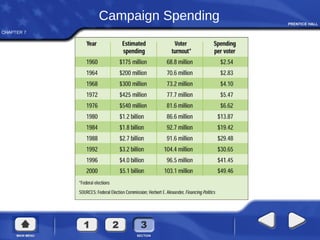
Campaign Spending
CHAPTER 7
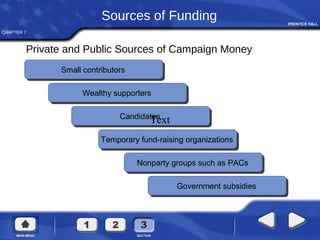
Private and Public Sources of Campaign Money
Candidates
Wealthy supporters
Small contributors
Temporary fund-raising organizations
Nonparty groups such as PACs
Government subsidies
Sources of Funding
Text
CHAPTER 7
Regulating Campaign Financing
• Early campaign regulations were created in 1907, but feebly enforced.
• The Federal Election Campaign Act (FECA) of 1971 was passed to replaced
the former, ineffective legislation.
• The FECA Amendments of 1974 were passed in response to the Watergate
scandal.
• Buckley v. Valeo invalidated some of the measures in the FECA Amendments
of 1974. Most significantly, it also stipulated that several of the limits that the
1974 amendments placed on spending only apply to candidates who accept
campaign money from the government, not those who raise money
independently.
• The FECA Amendments of 1976 were passed in response to Buckley v. Valeo.
CHAPTER 7
The Federal Election Commission
The Federal Election Commission (FEC) enforces:
• the timely disclosure of campaign finance information
• limits on campaign contributions
• limits on campaign expenditures
• provisions for public funding of presidential campaigns
CHAPTER 7
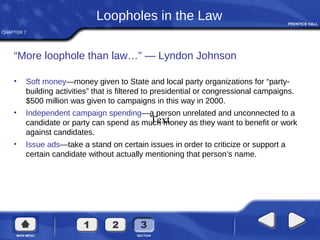
Loopholes in the Law
“More loophole than law…” — Lyndon Johnson
• Soft money—money given to State and local party organizations for “party-
building activities” that is filtered to presidential or congressional campaigns.
$500 million was given to campaigns in this way in 2000.
• Independent campaign spending—a person unrelated and unconnected to a
candidate or party can spend as much money as they want to benefit or work
against candidates.
• Issue ads—take a stand on certain issues in order to criticize or support a
certain candidate without actually mentioning that person’s name.
Text
CHAPTER 7
Want to connect to the Magruder’s link for this chapter? Click Here!
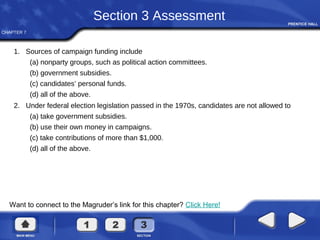
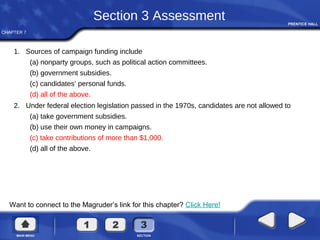
Section 3 Assessment
1. Sources of campaign funding include
(a) nonparty groups, such as political action committees.
(b) government subsidies.
(c) candidates’ personal funds.
(d) all of the above.
2. Under federal election legislation passed in the 1970s, candidates are not allowed to
(a) take government subsidies.
(b) use their own money in campaigns.
(c) take contributions of more than $1,000.
(d) all of the above.
CHAPTER 7
Want to connect to the Magruder’s link for this chapter? Click Here!
Section 3 Assessment
1. Sources of campaign funding include
(a) nonparty groups, such as political action committees.
(b) government subsidies.
(c) candidates’ personal funds.
(d) all of the above.
2. Under federal election legislation passed in the 1970s, candidates are not allowed to
(a) take government subsidies.
(b) use their own money in campaigns.
(c) take contributions of more than $1,000.
(d) all of the above.

The Electoral Process

  • 1.
    CHAPTER 7 The NominatingProcess • Why is the nominating process a critical first step in the election process? • What are self-announcement, the caucus, and the convention nominating methods? • Why is the direct primary the principal nominating method used in the United States today? • Why do some candidates use the petition as a nominating device? Text
  • 2.
    CHAPTER 7 A CriticalFirst Step 1. Nomination, in which the field of candidates is narrowed 2. General election, the regularly scheduled election where voters make the final choice of officeholder In the United States, the election process occurs in two steps:
  • 3.
    CHAPTER 7 Nominating andElecting a Candidate
  • 4.
    CHAPTER 7 Three Waysto Nominate • Self-Announcement – A person who wants to run for office announces their candidacy. Whenever a write-in candidate appears on the ballot, the self-announcement process has been used. • The Caucus – Originally a private meeting of local bigwigs, the caucus as a nominating device fell out of favor in the 1820s. • The Convention – Considered more democratic than the caucus, convention delegates were selected to represent the people’s wishes. Party bosses soon found ways to manipulate the system, however, and the convention system was on its way out by the early 1900s.
  • 5.
    CHAPTER 7 The DirectPrimary Closed Primary Only declared party members can vote. Open Primary Any qualified voter can take part. Nonpartisan Primary Candidates are not identified by party labels Runoff Primary If a required majority is not met, the two people with the most votes run again Blanket Primary Qualified voters can vote for any candidate, regardless of party Types of Direct Primaries
  • 6.
    CHAPTER 7 Primaries Acrossthe United States Types of primaries in State Elections, 2000
  • 7.
    CHAPTER 7 Petition • Candidatesmust gather a required number of voters’ signatures to get on the ballot by means of petition. • Minor party and independent candidates are usually required by State law to be nominated by petition. • Petition is often used at the local level to nominate for school posts and municipal offices.
  • 8.
    CHAPTER 7 Want toconnect to the Magruder’s link for this chapter? Click Here! Section 1 Assessment 1. The most commonly used method of nomination today is (a) the caucus. (b) the direct primary. (c) self-announcement. (d) the convention. 2. A runoff primary is held in some States when (a) no one wins a majority of votes. (b) there is only one candidate. (c) not enough voters turn out on election day. (d) a candidate asks for a recount.
  • 9.
    CHAPTER 7 Want toconnect to the Magruder’s link for this chapter? Click Here! Section 1 Assessment 1. The most commonly used method of nomination today is (a) the caucus. (b) the direct primary. (c) self-announcement. (d) the convention. 2. A runoff primary is held in some States when (a) no one wins a majority of votes. (b) there is only one candidate. (c) not enough voters turn out on election day. (d) a candidate asks for a recount.
  • 10.
    CHAPTER 7 Elections • Howdoes the administration of elections in the United States make democracy work? • What role do precincts and polling places play in the election process? • In what ways can voters cast their ballots? • What role do voting machines and other innovations play in the election process?
  • 11.
    CHAPTER 7 Elections areprimarily regulated by State law, but there are some overreaching federal regulations. The Administration of Elections Congress • Congress has the power to set the time, place, and manner of congressional and presidential elections. • Congress has chosen the first Tuesday after the first Monday in November of every even- numbered year for congressional elections, with the presidential election being held the same day every fourth year. States • States determine the details of the election of thousands of State and local officials. • Most States provide for absentee voting, for voters who are unable to get to their regular polling places on election day. Some States within the last few years have started to allow voting a few days before election day to increase voter participation.
  • 12.
    CHAPTER 7 Precincts andPolling Places Precincts • A precinct is a voting district. • Precincts are the smallest geographic units used to carry out elections. • A precinct election board supervises the voting process in each precinct. Polling Places • A polling place is where the voters who live in a precinct go to vote. • It is located in or near each precinct. Polling places are supposed to be located conveniently for voters.
  • 13.
    CHAPTER 7 Casting theBallot History of the Ballot • Voting was initially done orally. It was considered “manly” to speak out your vote without fear of reprisal. • Paper ballots began to be used in the mid-1800s. At first, people provided their own ballots. Then, political machines began to take advantage of the flexibility of the process to intimidate, buy, or manufacture votes. • In the late 1800s, ballot reforms cleaned up ballot fraud by supplying standardized, accurate ballots and mandating that voting be secret.
  • 14.
    CHAPTER 7 Office-Group andParty-Column Ballots
  • 15.
    CHAPTER 7 Voting Machinesand Innovations • Electronic vote counting has been in use since the 1960s. Punch- card ballots are often used to cast votes. • Vote-by-mail elections have come into use in recent years. • Online voting is a trend that may be encountered in the near future.
  • 16.
    CHAPTER 7 Want toconnect to the Magruder’s link for this chapter? Click Here! Section 2 Assessment 1. Elections are held on (a) the first Wednesday after Halloween. (b) the first Tuesday after the first Monday in November. (c) the second Thursday after the first Monday in March. (d) the first Monday in December. 2. The Office-Group Ballot encourages (a) voter fraud. (b) split-ticket voting. (c) voter dissatisfaction. (d) the Democratic Party.
  • 17.
    CHAPTER 7 Want toconnect to the Magruder’s link for this chapter? Click Here! Section 2 Assessment 1. Elections are held on (a) the first Wednesday after Halloween. (b) the first Tuesday after the first Monday in November. (c) the second Thursday after the first Monday in March. (d) the first Monday in December. 2. The Office-Group Ballot encourages (a) voter fraud. (b) split-ticket voting. (c) voter dissatisfaction. (d) the Democratic Party.
  • 18.
    CHAPTER 7 Money andElections • What are the issues raised by campaign spending? • What are the various sources of campaign funding? • How do federal laws regulate campaign finance? • What role does the Federal Election Commission have in enforcing campaign finance laws? • What loopholes exist in today’s campaign finance laws?
  • 19.
  • 20.
    CHAPTER 7 Private andPublic Sources of Campaign Money Candidates Wealthy supporters Small contributors Temporary fund-raising organizations Nonparty groups such as PACs Government subsidies Sources of Funding Text
  • 21.
    CHAPTER 7 Regulating CampaignFinancing • Early campaign regulations were created in 1907, but feebly enforced. • The Federal Election Campaign Act (FECA) of 1971 was passed to replaced the former, ineffective legislation. • The FECA Amendments of 1974 were passed in response to the Watergate scandal. • Buckley v. Valeo invalidated some of the measures in the FECA Amendments of 1974. Most significantly, it also stipulated that several of the limits that the 1974 amendments placed on spending only apply to candidates who accept campaign money from the government, not those who raise money independently. • The FECA Amendments of 1976 were passed in response to Buckley v. Valeo.
  • 22.
    CHAPTER 7 The FederalElection Commission The Federal Election Commission (FEC) enforces: • the timely disclosure of campaign finance information • limits on campaign contributions • limits on campaign expenditures • provisions for public funding of presidential campaigns
  • 23.
    CHAPTER 7 Loopholes inthe Law “More loophole than law…” — Lyndon Johnson • Soft money—money given to State and local party organizations for “party- building activities” that is filtered to presidential or congressional campaigns. $500 million was given to campaigns in this way in 2000. • Independent campaign spending—a person unrelated and unconnected to a candidate or party can spend as much money as they want to benefit or work against candidates. • Issue ads—take a stand on certain issues in order to criticize or support a certain candidate without actually mentioning that person’s name. Text
  • 24.
    CHAPTER 7 Want toconnect to the Magruder’s link for this chapter? Click Here! Section 3 Assessment 1. Sources of campaign funding include (a) nonparty groups, such as political action committees. (b) government subsidies. (c) candidates’ personal funds. (d) all of the above. 2. Under federal election legislation passed in the 1970s, candidates are not allowed to (a) take government subsidies. (b) use their own money in campaigns. (c) take contributions of more than $1,000. (d) all of the above.
  • 25.
    CHAPTER 7 Want toconnect to the Magruder’s link for this chapter? Click Here! Section 3 Assessment 1. Sources of campaign funding include (a) nonparty groups, such as political action committees. (b) government subsidies. (c) candidates’ personal funds. (d) all of the above. 2. Under federal election legislation passed in the 1970s, candidates are not allowed to (a) take government subsidies. (b) use their own money in campaigns. (c) take contributions of more than $1,000. (d) all of the above.