Chapter 13Chapter 13
CongressCongress
Copyright © 2011 CengageCopyright © 2011 Cengage
 WHO GOVERNS?WHO GOVERNS?
1.1. Are members of CongressAre members of Congress
representative of the American people?representative of the American people?
2.2. Does Congress normally do what mostDoes Congress normally do what most
citizens want it to do?citizens want it to do?
 TO WHAT ENDS?TO WHAT ENDS?
1.1. Should Congress run under strongShould Congress run under strong
leadership?leadership?
2.2. Should Congress act more quickly?Should Congress act more quickly?
Congress versus ParliamentCongress versus Parliament
 CongressCongress
• Independent representatives of theirIndependent representatives of their
districts or statesdistricts or states
• Principle work is representation andPrinciple work is representation and
actionaction
 ParliamentParliament
• Loyal to national party leadershipLoyal to national party leadership
• Principle work is debatePrinciple work is debate
Copyright © 2011 CengageCopyright © 2011 Cengage
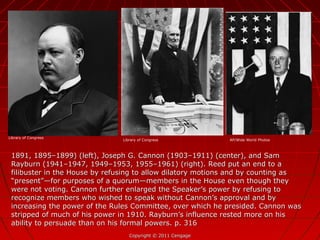
1891, 1895–1899) (left), Joseph G. Cannon (1903–1911) (center), and Sam1891, 1895–1899) (left), Joseph G. Cannon (1903–1911) (center), and Sam
Rayburn (1941–1947, 1949–1953, 1955–1961) (right). Reed put an end to aRayburn (1941–1947, 1949–1953, 1955–1961) (right). Reed put an end to a
filibuster in the House by refusing to allow dilatory motions and by counting asfilibuster in the House by refusing to allow dilatory motions and by counting as
“present”—for purposes of a quorum—members in the House even though they“present”—for purposes of a quorum—members in the House even though they
were not voting. Cannon further enlarged the Speaker’s power by refusing towere not voting. Cannon further enlarged the Speaker’s power by refusing to
recognize members who wished to speak without Cannon’s approval and byrecognize members who wished to speak without Cannon’s approval and by
increasing the power of the Rules Committee, over which he presided. Cannon wasincreasing the power of the Rules Committee, over which he presided. Cannon was
stripped of much of his power in 1910. Rayburn’s influence rested more on hisstripped of much of his power in 1910. Rayburn’s influence rested more on his
ability to persuade than on his formal powers. p. 316ability to persuade than on his formal powers. p. 316
Copyright © 2011 CengageCopyright © 2011 Cengage
Library of Congress
Library of Congress AP/Wide World Photos
The Evolution of CongressThe Evolution of Congress
 Bicameral (twoBicameral (two
chamber) legislaturechamber) legislature
 House ofHouse of
RepresentativesRepresentatives
 SenateSenate
 Centralization vs.Centralization vs.
decentralizationdecentralization
Copyright © 2011 CengageCopyright © 2011 Cengage
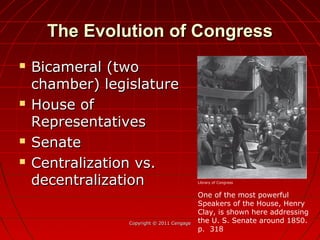
One of the most powerful
Speakers of the House, Henry
Clay, is shown here addressing
the U. S. Senate around 1850.
p. 318
Library of Congress
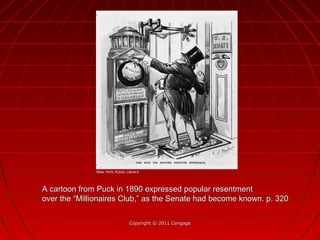
A cartoon from Puck in 1890 expressed popular resentmentA cartoon from Puck in 1890 expressed popular resentment
over the “Millionaires Club,” as the Senate had become known. p. 320over the “Millionaires Club,” as the Senate had become known. p. 320
Copyright © 2011 CengageCopyright © 2011 Cengage
New York Public Library
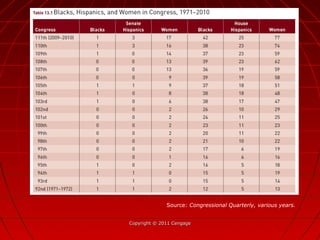
Who is in Congress?Who is in Congress?
 Sex and RaceSex and Race
 IncumbencyIncumbency
• Marginal districtsMarginal districts
• Safe districtsSafe districts
 PartyParty
Copyright © 2011 CengageCopyright © 2011 Cengage
Source: Congressional Quarterly, various years.
Copyright © 2011 CengageCopyright © 2011 Cengage
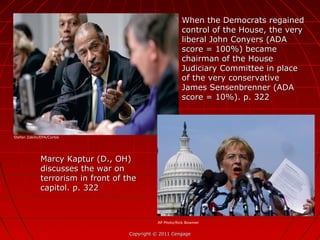
When the Democrats regainedWhen the Democrats regained
control of the House, the verycontrol of the House, the very
liberal John Conyers (ADAliberal John Conyers (ADA
score = 100%) becamescore = 100%) became
chairman of the Housechairman of the House
Judiciary Committee in placeJudiciary Committee in place
of the very conservativeof the very conservative
James Sensenbrenner (ADAJames Sensenbrenner (ADA
score = 10%). p. 322score = 10%). p. 322
Marcy Kaptur (D., OH)Marcy Kaptur (D., OH)
discusses the war ondiscusses the war on
terrorism in front of theterrorism in front of the
capitol. p. 322capitol. p. 322
Stefan Zaklin/EPA/Corbis
AP Photo/Rick Bowmer
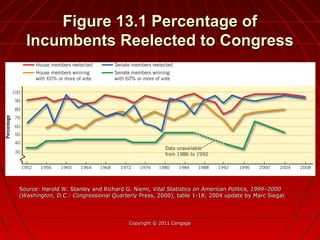
Figure 13.1 Percentage ofFigure 13.1 Percentage of
Incumbents Reelected to CongressIncumbents Reelected to Congress
Copyright © 2011 CengageCopyright © 2011 Cengage
Source: Harold W. Stanley and Richard G. Niemi,Source: Harold W. Stanley and Richard G. Niemi, Vital Statistics on American Politics, 1999–2000Vital Statistics on American Politics, 1999–2000
(Washington, D.C.: Congressional Quarterly(Washington, D.C.: Congressional Quarterly Press, 2000), table 1-18; 2004 update by Marc Siegal.Press, 2000), table 1-18; 2004 update by Marc Siegal.
Do Members Represent TheirDo Members Represent Their
Voters?Voters?
 Representational view–Representational view–
members vote to pleasemembers vote to please
their constituentstheir constituents
 Organizational View–Organizational View–
members vote to pleasemembers vote to please
fellow members of Congressfellow members of Congress
 Attitudinal View–Attitudinal View–membersmembers
vote on the basis of theirvote on the basis of their
own beliefsown beliefs
Copyright © 2011 CengageCopyright © 2011 Cengage
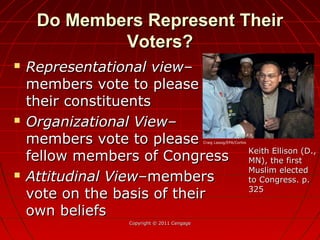
Keith Ellison (D.,Keith Ellison (D.,
MN), the firstMN), the first
Muslim electedMuslim elected
to Congress. p.to Congress. p.
325325
Craig Lassig/EPA/Corbis
A Polarized CongressA Polarized Congress
 A more ideological perspective hasA more ideological perspective has
been brought to Congress.been brought to Congress.
 Congress’ most liberal members areCongress’ most liberal members are
Democrats.Democrats.
 Congress’ most conservativeCongress’ most conservative
members are Republicans.members are Republicans.
 Voters are closer to the center ofVoters are closer to the center of
political spectrum.political spectrum.
Copyright © 2011 CengageCopyright © 2011 Cengage
The Organization of Congress:The Organization of Congress:
Parties and CaucusesParties and Caucuses
 Party Organization ofParty Organization of
the Senatethe Senate
 Party Structure in theParty Structure in the
HouseHouse
 The Strength of PartyThe Strength of Party
StructuresStructures
 Party UnityParty Unity
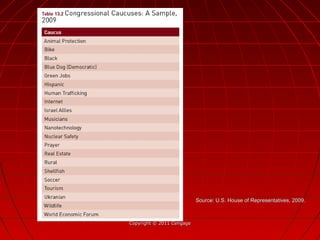
 CaucusesCaucuses
Copyright © 2011 CengageCopyright © 2011 Cengage
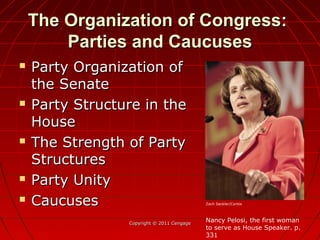
Nancy Pelosi, the first woman
to serve as House Speaker. p.
331
Zach Seckler/Corbis
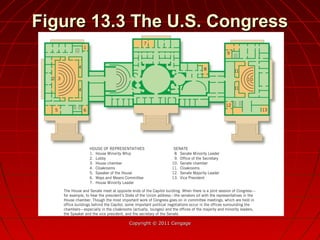
Figure 13.3 The U.S. CongressFigure 13.3 The U.S. Congress
Copyright © 2011 CengageCopyright © 2011 Cengage
Source: U.S. House of Representatives, 2009.Source: U.S. House of Representatives, 2009.
Copyright © 2011 CengageCopyright © 2011 Cengage
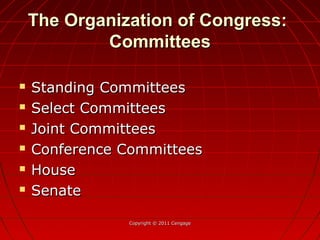
The Organization of Congress:The Organization of Congress:
CommitteesCommittees
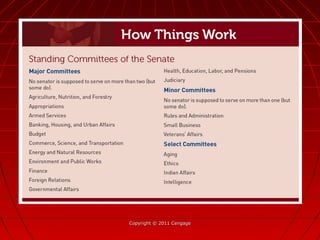
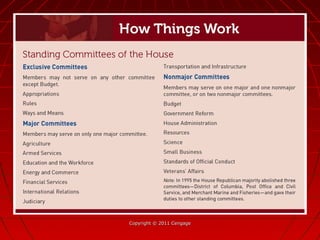
 Standing CommitteesStanding Committees
 Select CommitteesSelect Committees
 Joint CommitteesJoint Committees
 Conference CommitteesConference Committees
 HouseHouse
 SenateSenate
Copyright © 2011 CengageCopyright © 2011 Cengage
The Organization of Congress:The Organization of Congress:
Staff and Specialized OfficesStaff and Specialized Offices
 Tasks of Staff MembersTasks of Staff Members
 Staff AgenciesStaff Agencies
• Congressional Research Service (CRS)Congressional Research Service (CRS)
• General Accounting Office (GAO)General Accounting Office (GAO)
• Office of Technology Assessment (OTA)Office of Technology Assessment (OTA)
• Congressional Budget Office (CBO)Congressional Budget Office (CBO)
Copyright © 2011 CengageCopyright © 2011 Cengage
How a Bill Becomes a LawHow a Bill Becomes a Law
 Introducing a BillIntroducing a Bill
 Legislative ProductivityLegislative Productivity
 Study by CommitteeStudy by Committee
 Floor Debate – The HouseFloor Debate – The House
 Floor Debate – The SenateFloor Debate – The Senate
 Methods of VotingMethods of Voting
Copyright © 2011 CengageCopyright © 2011 Cengage
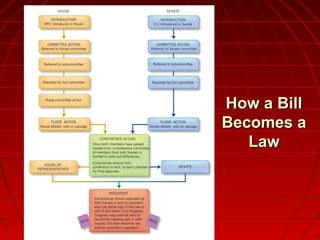
How a BillHow a Bill
Becomes aBecomes a
LawLaw
Copyright © 2011 CengageCopyright © 2011 Cengage
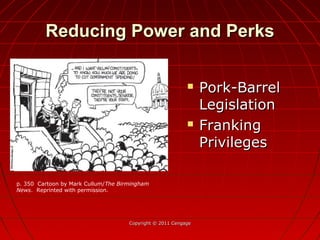
Reducing Power and PerksReducing Power and Perks
 Pork-BarrelPork-Barrel
LegislationLegislation
 FrankingFranking
PrivilegesPrivileges
Copyright © 2011 CengageCopyright © 2011 Cengage
p. 350 Cartoon by Mark Cullum/The Birmingham
News. Reprinted with permission.
Copyright © 2011 CengageCopyright © 2011 Cengage
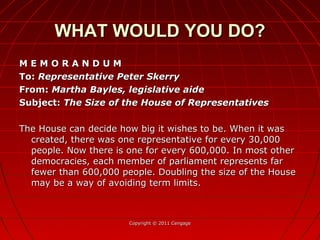
M E M O R A N D U MM E M O R A N D U M
To:To: Representative Peter SkerryRepresentative Peter Skerry
From:From: Martha Bayles, legislative aideMartha Bayles, legislative aide
Subject:Subject: The Size of the House of RepresentativesThe Size of the House of Representatives
The House can decide how big it wishes to be. When it wasThe House can decide how big it wishes to be. When it was
created, there was one representative for every 30,000created, there was one representative for every 30,000
people. Now there is one for every 600,000. In most otherpeople. Now there is one for every 600,000. In most other
democracies, each member of parliament represents fardemocracies, each member of parliament represents far
fewer than 600,000 people. Doubling the size of the Housefewer than 600,000 people. Doubling the size of the House
may be a way of avoiding term limits.may be a way of avoiding term limits.
Copyright © 2011 CengageCopyright © 2011 Cengage
WHAT WOULD YOU DO?WHAT WOULD YOU DO?
Arguments for:Arguments for:
1. Doubling the size of the House would reduce the huge1. Doubling the size of the House would reduce the huge
demand for constituent services each member now faces.demand for constituent services each member now faces.
2. A bigger House would represent more shades of opinion2. A bigger House would represent more shades of opinion
more fairly.more fairly.
3. Each member could raise less campaign money because his3. Each member could raise less campaign money because his
or her campaign would be smaller.or her campaign would be smaller.
Copyright © 2011 CengageCopyright © 2011 Cengage
WHAT WOULD YOU DO?WHAT WOULD YOU DO?
Arguments against:Arguments against:
1. A bigger House would be twice as hard to manage, and it1. A bigger House would be twice as hard to manage, and it
would take even longer to pass legislation.would take even longer to pass legislation.
2. Campaigns in districts of 300,000 people would cost as2. Campaigns in districts of 300,000 people would cost as
much as ones in districts with 600,000 people.much as ones in districts with 600,000 people.
3. Interest groups do a better job of representing public3. Interest groups do a better job of representing public
opinion than would a House with more members.opinion than would a House with more members.
Copyright © 2011 CengageCopyright © 2011 Cengage
WHAT WOULD YOU DO?WHAT WOULD YOU DO?
Your decision:Your decision:
Increase size of House?Increase size of House?
Do not increase size of House?Do not increase size of House?
Copyright © 2011 CengageCopyright © 2011 Cengage
WHAT WOULD YOU DO?WHAT WOULD YOU DO?

Congress

  • 1.
  • 2.
    Copyright © 2011CengageCopyright © 2011 Cengage  WHO GOVERNS?WHO GOVERNS? 1.1. Are members of CongressAre members of Congress representative of the American people?representative of the American people? 2.2. Does Congress normally do what mostDoes Congress normally do what most citizens want it to do?citizens want it to do?  TO WHAT ENDS?TO WHAT ENDS? 1.1. Should Congress run under strongShould Congress run under strong leadership?leadership? 2.2. Should Congress act more quickly?Should Congress act more quickly?
  • 3.
    Congress versus ParliamentCongressversus Parliament  CongressCongress • Independent representatives of theirIndependent representatives of their districts or statesdistricts or states • Principle work is representation andPrinciple work is representation and actionaction  ParliamentParliament • Loyal to national party leadershipLoyal to national party leadership • Principle work is debatePrinciple work is debate Copyright © 2011 CengageCopyright © 2011 Cengage
  • 4.
    Copyright © 2011CengageCopyright © 2011 Cengage
  • 5.
    1891, 1895–1899) (left),Joseph G. Cannon (1903–1911) (center), and Sam1891, 1895–1899) (left), Joseph G. Cannon (1903–1911) (center), and Sam Rayburn (1941–1947, 1949–1953, 1955–1961) (right). Reed put an end to aRayburn (1941–1947, 1949–1953, 1955–1961) (right). Reed put an end to a filibuster in the House by refusing to allow dilatory motions and by counting asfilibuster in the House by refusing to allow dilatory motions and by counting as “present”—for purposes of a quorum—members in the House even though they“present”—for purposes of a quorum—members in the House even though they were not voting. Cannon further enlarged the Speaker’s power by refusing towere not voting. Cannon further enlarged the Speaker’s power by refusing to recognize members who wished to speak without Cannon’s approval and byrecognize members who wished to speak without Cannon’s approval and by increasing the power of the Rules Committee, over which he presided. Cannon wasincreasing the power of the Rules Committee, over which he presided. Cannon was stripped of much of his power in 1910. Rayburn’s influence rested more on hisstripped of much of his power in 1910. Rayburn’s influence rested more on his ability to persuade than on his formal powers. p. 316ability to persuade than on his formal powers. p. 316 Copyright © 2011 CengageCopyright © 2011 Cengage Library of Congress Library of Congress AP/Wide World Photos
  • 6.
    The Evolution ofCongressThe Evolution of Congress  Bicameral (twoBicameral (two chamber) legislaturechamber) legislature  House ofHouse of RepresentativesRepresentatives  SenateSenate  Centralization vs.Centralization vs. decentralizationdecentralization Copyright © 2011 CengageCopyright © 2011 Cengage One of the most powerful Speakers of the House, Henry Clay, is shown here addressing the U. S. Senate around 1850. p. 318 Library of Congress
  • 7.
    A cartoon fromPuck in 1890 expressed popular resentmentA cartoon from Puck in 1890 expressed popular resentment over the “Millionaires Club,” as the Senate had become known. p. 320over the “Millionaires Club,” as the Senate had become known. p. 320 Copyright © 2011 CengageCopyright © 2011 Cengage New York Public Library
  • 8.
    Who is inCongress?Who is in Congress?  Sex and RaceSex and Race  IncumbencyIncumbency • Marginal districtsMarginal districts • Safe districtsSafe districts  PartyParty Copyright © 2011 CengageCopyright © 2011 Cengage
  • 9.
    Copyright © 2011CengageCopyright © 2011 Cengage Source: Congressional Quarterly, various years.
  • 10.
    Copyright © 2011CengageCopyright © 2011 Cengage When the Democrats regainedWhen the Democrats regained control of the House, the verycontrol of the House, the very liberal John Conyers (ADAliberal John Conyers (ADA score = 100%) becamescore = 100%) became chairman of the Housechairman of the House Judiciary Committee in placeJudiciary Committee in place of the very conservativeof the very conservative James Sensenbrenner (ADAJames Sensenbrenner (ADA score = 10%). p. 322score = 10%). p. 322 Marcy Kaptur (D., OH)Marcy Kaptur (D., OH) discusses the war ondiscusses the war on terrorism in front of theterrorism in front of the capitol. p. 322capitol. p. 322 Stefan Zaklin/EPA/Corbis AP Photo/Rick Bowmer
  • 11.
    Figure 13.1 PercentageofFigure 13.1 Percentage of Incumbents Reelected to CongressIncumbents Reelected to Congress Copyright © 2011 CengageCopyright © 2011 Cengage Source: Harold W. Stanley and Richard G. Niemi,Source: Harold W. Stanley and Richard G. Niemi, Vital Statistics on American Politics, 1999–2000Vital Statistics on American Politics, 1999–2000 (Washington, D.C.: Congressional Quarterly(Washington, D.C.: Congressional Quarterly Press, 2000), table 1-18; 2004 update by Marc Siegal.Press, 2000), table 1-18; 2004 update by Marc Siegal.
  • 12.
    Do Members RepresentTheirDo Members Represent Their Voters?Voters?  Representational view–Representational view– members vote to pleasemembers vote to please their constituentstheir constituents  Organizational View–Organizational View– members vote to pleasemembers vote to please fellow members of Congressfellow members of Congress  Attitudinal View–Attitudinal View–membersmembers vote on the basis of theirvote on the basis of their own beliefsown beliefs Copyright © 2011 CengageCopyright © 2011 Cengage Keith Ellison (D.,Keith Ellison (D., MN), the firstMN), the first Muslim electedMuslim elected to Congress. p.to Congress. p. 325325 Craig Lassig/EPA/Corbis
  • 13.
    A Polarized CongressAPolarized Congress  A more ideological perspective hasA more ideological perspective has been brought to Congress.been brought to Congress.  Congress’ most liberal members areCongress’ most liberal members are Democrats.Democrats.  Congress’ most conservativeCongress’ most conservative members are Republicans.members are Republicans.  Voters are closer to the center ofVoters are closer to the center of political spectrum.political spectrum. Copyright © 2011 CengageCopyright © 2011 Cengage
  • 14.
    The Organization ofCongress:The Organization of Congress: Parties and CaucusesParties and Caucuses  Party Organization ofParty Organization of the Senatethe Senate  Party Structure in theParty Structure in the HouseHouse  The Strength of PartyThe Strength of Party StructuresStructures  Party UnityParty Unity  CaucusesCaucuses Copyright © 2011 CengageCopyright © 2011 Cengage Nancy Pelosi, the first woman to serve as House Speaker. p. 331 Zach Seckler/Corbis
  • 15.
    Figure 13.3 TheU.S. CongressFigure 13.3 The U.S. Congress Copyright © 2011 CengageCopyright © 2011 Cengage
  • 16.
    Copyright © 2011CengageCopyright © 2011 Cengage
  • 17.
    Source: U.S. Houseof Representatives, 2009.Source: U.S. House of Representatives, 2009. Copyright © 2011 CengageCopyright © 2011 Cengage
  • 18.
    The Organization ofCongress:The Organization of Congress: CommitteesCommittees  Standing CommitteesStanding Committees  Select CommitteesSelect Committees  Joint CommitteesJoint Committees  Conference CommitteesConference Committees  HouseHouse  SenateSenate Copyright © 2011 CengageCopyright © 2011 Cengage
  • 19.
    Copyright © 2011CengageCopyright © 2011 Cengage
  • 20.
    Copyright © 2011CengageCopyright © 2011 Cengage
  • 21.
    The Organization ofCongress:The Organization of Congress: Staff and Specialized OfficesStaff and Specialized Offices  Tasks of Staff MembersTasks of Staff Members  Staff AgenciesStaff Agencies • Congressional Research Service (CRS)Congressional Research Service (CRS) • General Accounting Office (GAO)General Accounting Office (GAO) • Office of Technology Assessment (OTA)Office of Technology Assessment (OTA) • Congressional Budget Office (CBO)Congressional Budget Office (CBO) Copyright © 2011 CengageCopyright © 2011 Cengage
  • 22.
    How a BillBecomes a LawHow a Bill Becomes a Law  Introducing a BillIntroducing a Bill  Legislative ProductivityLegislative Productivity  Study by CommitteeStudy by Committee  Floor Debate – The HouseFloor Debate – The House  Floor Debate – The SenateFloor Debate – The Senate  Methods of VotingMethods of Voting Copyright © 2011 CengageCopyright © 2011 Cengage
  • 23.
    How a BillHowa Bill Becomes aBecomes a LawLaw Copyright © 2011 CengageCopyright © 2011 Cengage
  • 24.
    Copyright © 2011CengageCopyright © 2011 Cengage
  • 25.
    Copyright © 2011CengageCopyright © 2011 Cengage
  • 26.
    Reducing Power andPerksReducing Power and Perks  Pork-BarrelPork-Barrel LegislationLegislation  FrankingFranking PrivilegesPrivileges Copyright © 2011 CengageCopyright © 2011 Cengage p. 350 Cartoon by Mark Cullum/The Birmingham News. Reprinted with permission.
  • 27.
    Copyright © 2011CengageCopyright © 2011 Cengage
  • 28.
    Copyright © 2011CengageCopyright © 2011 Cengage
  • 29.
    M E MO R A N D U MM E M O R A N D U M To:To: Representative Peter SkerryRepresentative Peter Skerry From:From: Martha Bayles, legislative aideMartha Bayles, legislative aide Subject:Subject: The Size of the House of RepresentativesThe Size of the House of Representatives The House can decide how big it wishes to be. When it wasThe House can decide how big it wishes to be. When it was created, there was one representative for every 30,000created, there was one representative for every 30,000 people. Now there is one for every 600,000. In most otherpeople. Now there is one for every 600,000. In most other democracies, each member of parliament represents fardemocracies, each member of parliament represents far fewer than 600,000 people. Doubling the size of the Housefewer than 600,000 people. Doubling the size of the House may be a way of avoiding term limits.may be a way of avoiding term limits. Copyright © 2011 CengageCopyright © 2011 Cengage WHAT WOULD YOU DO?WHAT WOULD YOU DO?
  • 30.
    Arguments for:Arguments for: 1.Doubling the size of the House would reduce the huge1. Doubling the size of the House would reduce the huge demand for constituent services each member now faces.demand for constituent services each member now faces. 2. A bigger House would represent more shades of opinion2. A bigger House would represent more shades of opinion more fairly.more fairly. 3. Each member could raise less campaign money because his3. Each member could raise less campaign money because his or her campaign would be smaller.or her campaign would be smaller. Copyright © 2011 CengageCopyright © 2011 Cengage WHAT WOULD YOU DO?WHAT WOULD YOU DO?
  • 31.
    Arguments against:Arguments against: 1.A bigger House would be twice as hard to manage, and it1. A bigger House would be twice as hard to manage, and it would take even longer to pass legislation.would take even longer to pass legislation. 2. Campaigns in districts of 300,000 people would cost as2. Campaigns in districts of 300,000 people would cost as much as ones in districts with 600,000 people.much as ones in districts with 600,000 people. 3. Interest groups do a better job of representing public3. Interest groups do a better job of representing public opinion than would a House with more members.opinion than would a House with more members. Copyright © 2011 CengageCopyright © 2011 Cengage WHAT WOULD YOU DO?WHAT WOULD YOU DO?
  • 32.
    Your decision:Your decision: Increasesize of House?Increase size of House? Do not increase size of House?Do not increase size of House? Copyright © 2011 CengageCopyright © 2011 Cengage WHAT WOULD YOU DO?WHAT WOULD YOU DO?

Editor's Notes

  • #10 Replace with jpeg, p. 321
  • #24 Replace with jpeg, p. 343