Pragmatic approach to research
Muhammad Ayoob Babar
Reg. No. 140-FSS/PHDEDU/F17
Department Of Education
International Islamic University, Islamabad
Contents
• Definition
• Philosophy
• Characteristics
• Mixed method definition
• Positivism, Interpretivism and Pragmatism
• Strengths
• Limitations
• Implication of concept in Pakistan
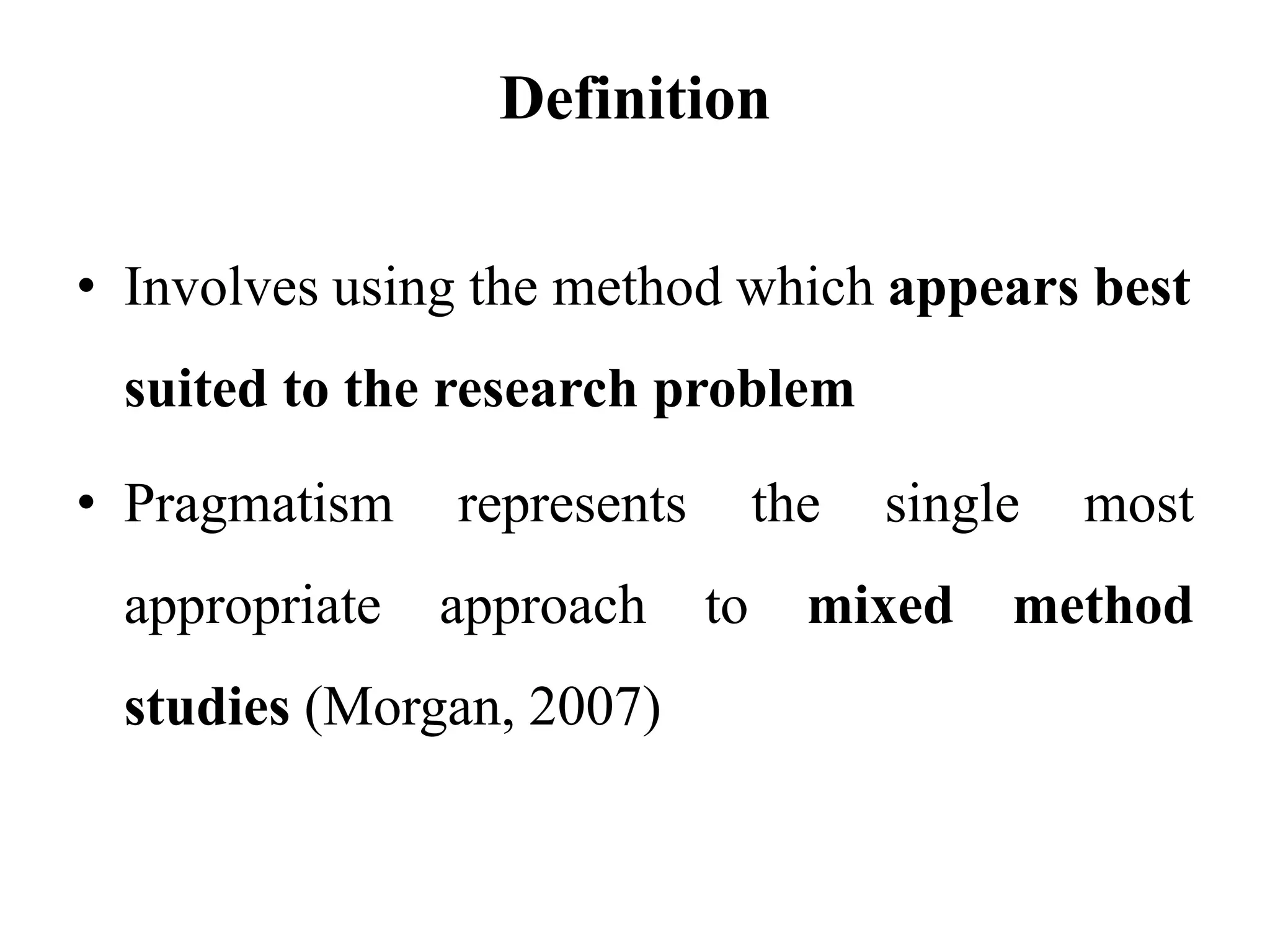
Definition
• Involves using the method which appears best
suited to the research problem
• Pragmatism represents the single most
appropriate approach to mixed method
studies (Morgan, 2007)
Cont..
• Pragmatism suggests that researchers adopt
a needs-based or possibility approach to
selecting methods and approaches (Johnson
& On wueg, 2004).
Philosophy
Ontology, Epistemology, Methodology
• Ontology
 Reality is the practical effects of ideas.
View point regarding existence of man,
society and the world, and relationship
among them (Gray, 2013)
• Epistemology
• Any way of thinking/doing that leads to
pragmatic solutions is useful.
 The process through which a researcher
may establish or determine reality
(Creswell, 2003)
• Methodology
 Mixed Methods, design-based research,
action research
 The generic (not specific) approach used by
the researchers, which include the methods of
data collection to data analysis to conduct
their research (Silverman, 2016)
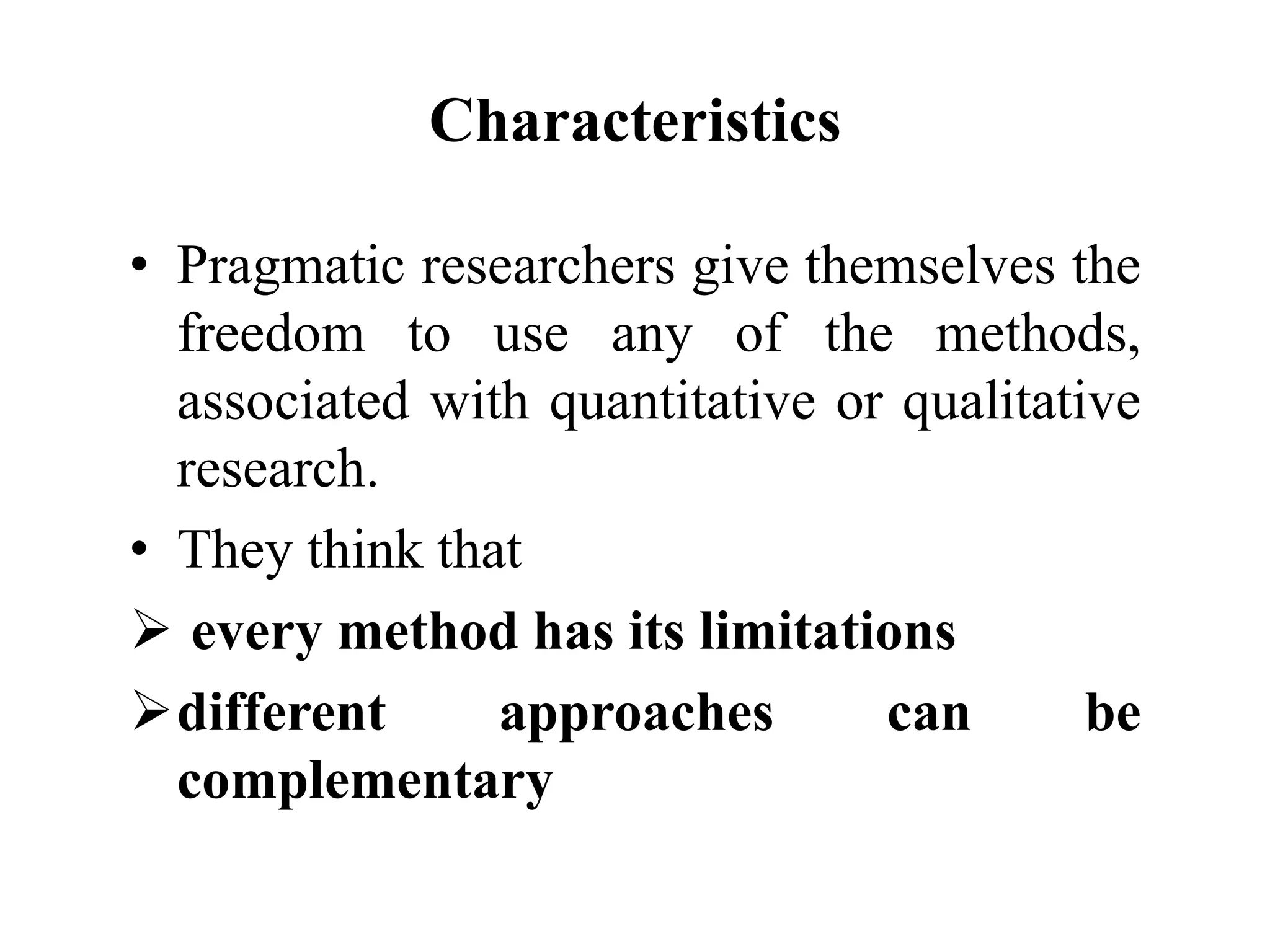
Characteristics
• Pragmatic researchers give themselves the
freedom to use any of the methods,
associated with quantitative or qualitative
research.
• They think that
 every method has its limitations
different approaches can be
complementary
Mixed methods definition
• Research that involves collecting, analyzing
and interrelating
Quantitative (experiments, surveys) and
Qualitative (focus groups, Interviews)
research ( Creswell ,2011)
Cont..
• This approach to research is used when this
combination provides a better
understanding of the research problem
than either each alone
Positivism, interpretivism and Pragmatism
Positivism
• There are no differences in the logic of inquiry across
sciences
• The research should aim to explain and predict
• Research should be empirically observable via human
senses.
• Inductive reasoning should be used to develop statements
(hypotheses) to be tested
• Interpretivism
• The Principle of Contextualization
• The Principle of Interaction between the
Researchers and the Subjects
• The Principle of Abstraction (deal with
ideas) and Generalization
Cont..
• The Principle of Dialogical Reasoning
(Dialogue)
• The Principle of Multiple Interpretations
• The Principle of Suspicion (doubtful, unsure)
Klein and Myers (1999)
• Pragmatism
• Pragmatism research philosophy accepts concepts
to be relevant only if they support action.
• Pragmatics recognize that there are many different
ways of interpreting the world and undertaking
research, that no single point of view can ever give
the entire picture and that there may be multiple
realities
Positivism, interpretivism and Pragmatism
Types of
research
Research
approach
Ontology Axiology Research
strategies
Positivism Deductive Objective Value-free Quantitative
Interpretivism Inductive Subjective Biased Qualitative
Pragmatism Deductive/
inductive
Objective or
subjective
Value-
free/Biased
Qualitative and/
or quantitative
Strengths
• Can be easy to describe and report
• Can be useful when unexpected results arise
from a prior study
• Can help to generalize data
• Helpful in designing and validating an
instrument
Limitations
• Time required
• Discrepancies between different types of
data
• Can be difficult to decide when to proceed
in sequential designs (study different groups over
a long period of time)
Conclusion
• Despite the variations between qualitative and
quantitative approaches have in terms of
ontological and epistemological assumptions, the
combination of both in one study is not only
possible, but it also provides a proper
understanding of the phenomena (Creswell &
Plano Clark, 2007).
Cont..
• However, a mixed methods research may
be designed only if there is a need to
understand and confirm the social
phenomenon at the same time.
References
• Bednarz, D. (1985). Quality and quantity in evaluation research: A divergent view.
Evaluation and Program Planning, 8, 289-306.
• Beiser, F. (Ed). (1993). The Cambridge companion to Hegel. Cambridge, England:
Cambridge University Press.
• Cohen, J. (1960). A coefficient of agreement for nominal scales. Educational and
Psychological Measurement, 20, pp. 37- 46. Cook, T. D. &
• Campbell, D. T. (1979). Quasi-experimentation: Design and analysis issues for field
settings. Chicago: Rand McNally.
• Datta, L. (1994). Paradigm wars: A basis for peaceful coexistence and beyond. New
Directions for Evaluation, 61, 53-70.
• Datta, L. (1997). A pragmatic basis for mixed method designs. New Directions for
Evaluation, 74, 33-46.
• Greene, J. C., & McClintock, C. (1985). Triangulation in evaluation: design and analysis
issues. Evaluation Review, 9(5), 523-545.
• Guba, E. G., & Lincoln, Y. S. (1981). Effective evaluation. San Francisco: Jossey-Bass.
• Hammersley, M. (1992). What’s wrong with ethnography? Methodological exploration.
London: Routledge.
Cont..
• Howell, D. C. (2002). Statistical methods for psychology (5th ed.). Pacific Grove,
CA: Duxbury Thompson Learning.
• Hughes, J. R., Gulliver, S. B., & Fenwick, J. W. (1992). Smoking cessation among
self-quitters. Health Psychology, 11, 331-334.
• Hunt, W. A., & Bespalec, D. A. (1974). An evaluation of current methods of
modifying smoking behavior. Journal of Clinical Psychology, 30, 431-438.
• Kirkhart, K. E. (2000). Reconceptualizing evaluation use: An integrated theory of
influence. New Directions for Evaluation, (88), 5-23.
• Krueger, R. A. (1998). Moderating focus groups. Thousand Oaks, CA: SAGE
Publications.
• Morgan, D. L. (2007). Paradigms lost and pragmatism regained: Methodological
implications of combining qualitative and quantitative methods. Journal of Mixed
Methods Research. 1(1), 48-76.
• Velicer, W. F., & Prochaska, J. O. (2004). A comparison of four self-report smoking
cessation outcome measures. Addictive Behaviors, 29(1), 51-60.
Thanks

Pragmatic approach to research

  • 1.
    Pragmatic approach toresearch Muhammad Ayoob Babar Reg. No. 140-FSS/PHDEDU/F17 Department Of Education International Islamic University, Islamabad
  • 2.
    Contents • Definition • Philosophy •Characteristics • Mixed method definition • Positivism, Interpretivism and Pragmatism • Strengths • Limitations • Implication of concept in Pakistan
  • 3.
    Definition • Involves usingthe method which appears best suited to the research problem • Pragmatism represents the single most appropriate approach to mixed method studies (Morgan, 2007)
  • 4.
    Cont.. • Pragmatism suggeststhat researchers adopt a needs-based or possibility approach to selecting methods and approaches (Johnson & On wueg, 2004).
  • 5.
    Philosophy Ontology, Epistemology, Methodology •Ontology  Reality is the practical effects of ideas. View point regarding existence of man, society and the world, and relationship among them (Gray, 2013)
  • 6.
    • Epistemology • Anyway of thinking/doing that leads to pragmatic solutions is useful.  The process through which a researcher may establish or determine reality (Creswell, 2003)
  • 7.
    • Methodology  MixedMethods, design-based research, action research  The generic (not specific) approach used by the researchers, which include the methods of data collection to data analysis to conduct their research (Silverman, 2016)
  • 8.
    Characteristics • Pragmatic researchersgive themselves the freedom to use any of the methods, associated with quantitative or qualitative research. • They think that  every method has its limitations different approaches can be complementary
  • 9.
    Mixed methods definition •Research that involves collecting, analyzing and interrelating Quantitative (experiments, surveys) and Qualitative (focus groups, Interviews) research ( Creswell ,2011)
  • 10.
    Cont.. • This approachto research is used when this combination provides a better understanding of the research problem than either each alone
  • 11.
    Positivism, interpretivism andPragmatism Positivism • There are no differences in the logic of inquiry across sciences • The research should aim to explain and predict • Research should be empirically observable via human senses. • Inductive reasoning should be used to develop statements (hypotheses) to be tested
  • 12.
    • Interpretivism • ThePrinciple of Contextualization • The Principle of Interaction between the Researchers and the Subjects • The Principle of Abstraction (deal with ideas) and Generalization
  • 13.
    Cont.. • The Principleof Dialogical Reasoning (Dialogue) • The Principle of Multiple Interpretations • The Principle of Suspicion (doubtful, unsure) Klein and Myers (1999)
  • 14.
    • Pragmatism • Pragmatismresearch philosophy accepts concepts to be relevant only if they support action. • Pragmatics recognize that there are many different ways of interpreting the world and undertaking research, that no single point of view can ever give the entire picture and that there may be multiple realities
  • 15.
    Positivism, interpretivism andPragmatism Types of research Research approach Ontology Axiology Research strategies Positivism Deductive Objective Value-free Quantitative Interpretivism Inductive Subjective Biased Qualitative Pragmatism Deductive/ inductive Objective or subjective Value- free/Biased Qualitative and/ or quantitative
  • 16.
    Strengths • Can beeasy to describe and report • Can be useful when unexpected results arise from a prior study • Can help to generalize data • Helpful in designing and validating an instrument
  • 17.
    Limitations • Time required •Discrepancies between different types of data • Can be difficult to decide when to proceed in sequential designs (study different groups over a long period of time)
  • 18.
    Conclusion • Despite thevariations between qualitative and quantitative approaches have in terms of ontological and epistemological assumptions, the combination of both in one study is not only possible, but it also provides a proper understanding of the phenomena (Creswell & Plano Clark, 2007).
  • 19.
    Cont.. • However, amixed methods research may be designed only if there is a need to understand and confirm the social phenomenon at the same time.
  • 20.
    References • Bednarz, D.(1985). Quality and quantity in evaluation research: A divergent view. Evaluation and Program Planning, 8, 289-306. • Beiser, F. (Ed). (1993). The Cambridge companion to Hegel. Cambridge, England: Cambridge University Press. • Cohen, J. (1960). A coefficient of agreement for nominal scales. Educational and Psychological Measurement, 20, pp. 37- 46. Cook, T. D. & • Campbell, D. T. (1979). Quasi-experimentation: Design and analysis issues for field settings. Chicago: Rand McNally. • Datta, L. (1994). Paradigm wars: A basis for peaceful coexistence and beyond. New Directions for Evaluation, 61, 53-70. • Datta, L. (1997). A pragmatic basis for mixed method designs. New Directions for Evaluation, 74, 33-46. • Greene, J. C., & McClintock, C. (1985). Triangulation in evaluation: design and analysis issues. Evaluation Review, 9(5), 523-545. • Guba, E. G., & Lincoln, Y. S. (1981). Effective evaluation. San Francisco: Jossey-Bass. • Hammersley, M. (1992). What’s wrong with ethnography? Methodological exploration. London: Routledge.
  • 21.
    Cont.. • Howell, D.C. (2002). Statistical methods for psychology (5th ed.). Pacific Grove, CA: Duxbury Thompson Learning. • Hughes, J. R., Gulliver, S. B., & Fenwick, J. W. (1992). Smoking cessation among self-quitters. Health Psychology, 11, 331-334. • Hunt, W. A., & Bespalec, D. A. (1974). An evaluation of current methods of modifying smoking behavior. Journal of Clinical Psychology, 30, 431-438. • Kirkhart, K. E. (2000). Reconceptualizing evaluation use: An integrated theory of influence. New Directions for Evaluation, (88), 5-23. • Krueger, R. A. (1998). Moderating focus groups. Thousand Oaks, CA: SAGE Publications. • Morgan, D. L. (2007). Paradigms lost and pragmatism regained: Methodological implications of combining qualitative and quantitative methods. Journal of Mixed Methods Research. 1(1), 48-76. • Velicer, W. F., & Prochaska, J. O. (2004). A comparison of four self-report smoking cessation outcome measures. Addictive Behaviors, 29(1), 51-60.
  • 22.