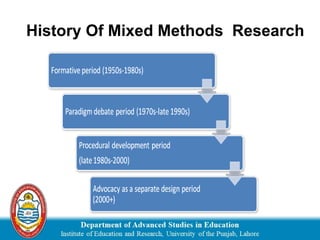
Introduction to Mixed Method Research in Education
Introduction to Mixed Method Research
Stances on mixing paradigms .
Historical & philosophical roots of MMR.
Purpose and Significance
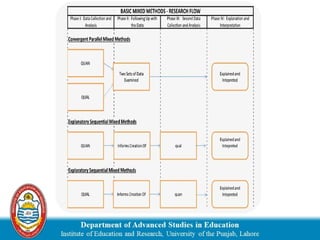
Designs of mixed method research
Challenges in Using a Mixed-Methods Design
References
Introduction to Mixed Method Research in Education
1.
Mixed Method Research
By
MuhammadMunsif Siyal
Dr./E-2024-F-10
munsifsail@gmail.com
To
Sir Dr. Muhammad Shahid Farooq
03/29/2025
03:30 PM
2.
AGENDA
2
03/29/2025
03:30 PM
• Introductionto Mixed Method Research
• Stances on mixing paradigms .
• Historical & philosophical roots of MMR.
• Purpose and Significance
• Designs of mixed method research
• Challenges in Using a Mixed-Methods Design
• References
3.
Mixed Method ResearchMMR
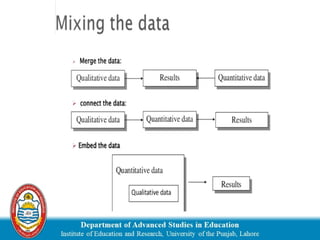
Mixed method involves both a qualitative and
quantitative approach to research. Two forms
of data are integrated in the design procedure,
data collection and analysis through merging
the data, connecting the data or embedding
the data. These procedures are incorporated
into a distinct MM design that also includes the
timing of the data collection, (concurrent or
sequential) as well as the emphasis (equal or
unequal) for each database (Creswell, 2014,
pp 217).
3
03/29/2025
03:30 PM
4.
Mixed Method ResearchMMR
Mixed methods research is a research design with
philosophical assumptions as well as methods of
inquiry. As a methodology, it involves philosophical
assumptions that guide the direction of the
collection and analysis of data and the mixture of
qualitative and quantitative data in a single study or
series of studies. Its central premise is that the use
of quantitative and qualitative approaches in
combination provides a better understanding of
research problems than either approach alone.
(Creswell, 2014)
4
03/29/2025
03:30 PM
5.
Pragmatism
Pragmatism is aphilosophical tradition
that began in the United States around 1870.Its
origins are often attributed to the
philosophers William James, John Dewey,
and Charles Sanders Peirce. Peirce later
described it in his pragmatic maxim: "Consider
the practical effects of the objects of your
conception. Then, your conception of those
effects is the whole of your conception of the
object.
5
03/29/2025
03:30 PM
6.
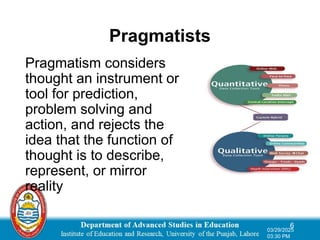
Pragmatists
Pragmatism considers
thought aninstrument or
tool for prediction,
problem solving and
action, and rejects the
idea that the function of
thought is to describe,
represent, or mirror
reality
6
03/29/2025
03:30 PM
7.
Pragmatic Paradigm
• Ontology:Reality is the practical effects of ideas.
• Epistemology: Any way of thinking/doing that leads to
pragmatic solutions is useful.
• Methodology: Mixed Methods, design-based
research, action research
7
03/29/2025
03:30 PM
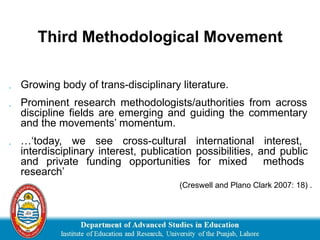
Third Methodological Movement
Growing body of trans-disciplinary literature.
Prominent research methodologists/authorities from across
discipline fields are emerging and guiding the commentary
and the movements’ momentum.
…‘today, we see cross-cultural international interest,
interdisciplinary interest, publication possibilities, and public
and private funding opportunities for mixed methods
research’
(Creswell and Plano Clark 2007: 18) .
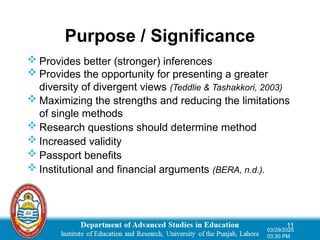
Purpose / Significance
Provides better (stronger) inferences
Provides the opportunity for presenting a greater
diversity of divergent views (Teddlie & Tashakkori, 2003)
Maximizing the strengths and reducing the limitations
of single methods
Research questions should determine method
Increased validity
Passport benefits
Institutional and financial arguments (BERA, n.d.).
11
03/29/2025
03:30 PM
12.
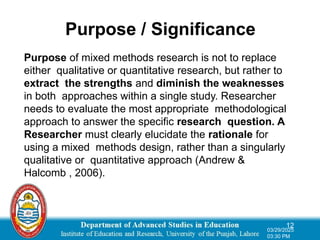
Purpose / Significance
Purposeof mixed methods research is not to replace
either qualitative or quantitative research, but rather to
extract the strengths and diminish the weaknesses
in both approaches within a single study. Researcher
needs to evaluate the most appropriate methodological
approach to answer the specific research question. A
Researcher must clearly elucidate the rationale for
using a mixed methods design, rather than a singularly
qualitative or quantitative approach (Andrew &
Halcomb , 2006).
12
03/29/2025
03:30 PM
13.
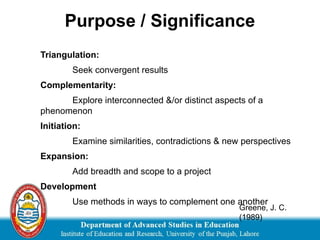
Triangulation:
Seek convergent results
Complementarity:
Exploreinterconnected &/or distinct aspects of a
phenomenon
Initiation:
Examine similarities, contradictions & new perspectives
Expansion:
Add breadth and scope to a project
Development
Use methods in ways to complement one another
Greene, J. C.
(1989)
Purpose / Significance
14.
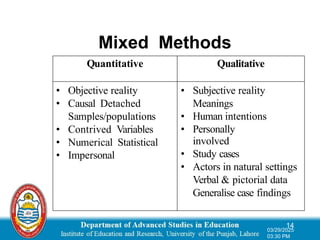
Quantitative Qualitative
• Objectivereality
• Causal Detached
Samples/populations
• Contrived Variables
• Numerical Statistical
• Impersonal
• Subjective reality
Meanings
• Human intentions
• Personally
involved
• Study cases
• Actors in natural settings
Verbal & pictorial data
Generalise case findings
14
03/29/2025
03:30 PM
Mixed Methods
15.
03/29/2025 03:30 PM15
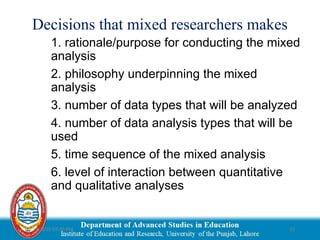
Decisions that mixed researchers makes
1. rationale/purpose for conducting the mixed
analysis
2. philosophy underpinning the mixed
analysis
3. number of data types that will be analyzed
4. number of data analysis types that will be
used
5. time sequence of the mixed analysis
6. level of interaction between quantitative
and qualitative analyses
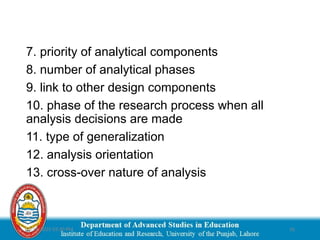
16.
03/29/2025 03:30 PM16
7. priority of analytical components
8. number of analytical phases
9. link to other design components
10. phase of the research process when all
analysis decisions are made
11. type of generalization
12. analysis orientation
13. cross-over nature of analysis
17.
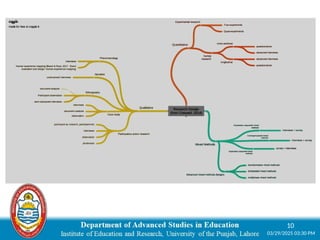
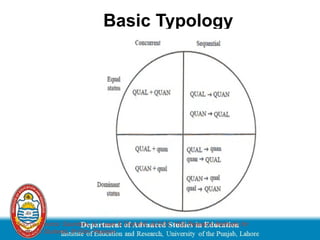
Basic Typology
Source: Source:Saunders, N, Lewis & Thornhill, A(2012: 165) Research Methods for
Business Students, 6th Edn, Pearson
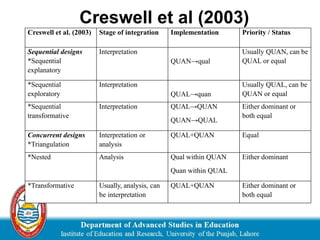
Creswell et al(2003)
Creswell et al. (2003) Stage of integration Implementation Priority / Status
Sequential designs
*Sequential
explanatory
Interpretation
QUAN→qual
Usually QUAN, can be
QUAL or equal
*Sequential
exploratory
Interpretation
QUAL→quan
Usually QUAL, can be
QUAN or equal
*Sequential
transformative
Interpretation QUAL→QUAN
QUAN→QUAL
Either dominant or
both equal
Concurrent designs
*Triangulation
Interpretation or
analysis
QUAL+QUAN Equal
*Nested Analysis Qual within QUAN
Quan within QUAL
Either dominant
*Transformative Usually, analysis, can
be interpretation
QUAL+QUAN Either dominant or
both equal
21.
03/29/2025 03:30 PM21
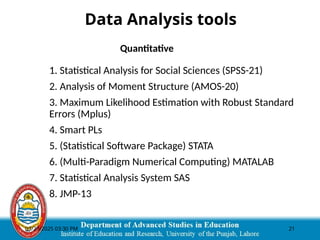
Data Analysis tools
Quantitative
1. Statistical Analysis for Social Sciences (SPSS-21)
2. Analysis of Moment Structure (AMOS-20)
3. Maximum Likelihood Estimation with Robust Standard
Errors (Mplus)
4. Smart PLs
5. (Statistical Software Package) STATA
6. (Multi-Paradigm Numerical Computing) MATALAB
7. Statistical Analysis System SAS
8. JMP-13
22.
03/29/2025 03:30 PM22
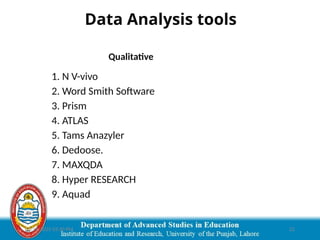
Qualitative
1. N V-vivo
2. Word Smith Software
3. Prism
4. ATLAS
5. Tams Anazyler
6. Dedoose.
7. MAXQDA
8. Hyper RESEARCH
9. Aquad
Data Analysis tools
23.
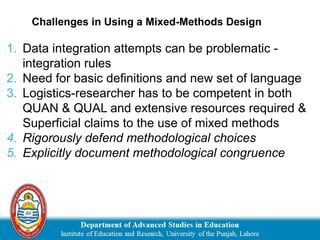
1. Data integrationattempts can be problematic -
integration rules
2. Need for basic definitions and new set of language
3. Logistics-researcher has to be competent in both
QUAN & QUAL and extensive resources required &
Superficial claims to the use of mixed methods
4. Rigorously defend methodological choices
5. Explicitly document methodological congruence
Challenges in Using a Mixed-Methods Design
24.
References
• Creswell, J.W. (2015). A concise Introduction to Mixed Methods Research. Sage
Publications Ltd.
• Fetters, M. D. (2016). Haven’t we always been doing mixed methods research? Lessons
learned from the development of the horseless carriage. Journal of Mixed Methods
Research, 10(1), 3–11. https://doi.org/10.1177/1558689815620883
• Maxwell, J. A. (2016). Expanding the history and range of mixed methods research.
Journal of Mixed Methods Research, 10(1), 12–27.
https://doi.org/10.1177/1558689815571132
• Munce, S. E. P., Guetterman, T. C. & Jaglal, S. B. (2021). Using the exploratory sequential
design for complex intervention development: Example of the development of a self-
management program for spinal cord injury. Journal of Mixed Methods Research. 15(1)
37–60. https://doi.org/10.1177/1558689820901936
• Saville, N. (2012). Applying a Model for Investigating the Impact of Language Assessment
within Educational Contexts: The Cambridge ESOL Approach. Cambridge ESOL: Research
Notes 50.
• Timans, R., Wouters, P., & Heilbron, J. (2019). Mixed methods research: what it is and
what it could be. Theory Soc, 48, 193–216. https://doi.org/10.1007/s11186-019-09345-5
• Wisdom, J., Creswell, J. W. (2013, March). Mixed Methods: Integrating Quantitative and
Qualitative Data Collection and Analysis While Studying Patient-Centered Medical Home
Models. AHRQ and PCHM.