PRINCIPLES OF ARTHROTOMY &
ARTHROCENTESIS
Bassey, A E M.B., B.S.
Dep’t of Orthopaedic & Trauma Surgery
UATH, Abuja
OUTLINE - ARTHROTOMY
• INTRODUCTION
• DEFINITION
• STATEMENT OF IMPORTANCE
• INDICATIONS
• DIAGNOSTIC
• THERAPEUTIC
• PRE-OPERATIVE CONSIDERATIONS
• INTRA-OPERATIVE CONSIDERATIONS
• POST-OPERATIVE CARE/REHABILITATION
• COMPLICATIONS
• EARLY
• LATE
• CURRENT TRENDS
INTRODUCTION
• This is an incision into a joint to expose its interior
• Although many of its roles have been usurped by
minimally-invasive techniques, arthrotomy still
remains a very useful tool in the management of
joint diseases, moreso, in resource-constrained
settings. Every orthopaedic surgeon of worth
should therefore be well-grounded in its
principles.
INDICATIONS
• DIAGNOSTIC
• Assessment of joint trauma
• Biopsy
• THERAPEUTIC
• Incision & drainage
• Debridement/removal of loose bodies
• Ligament reconstruction
• Fracture fixation
• Disarticulation
• Joint replacement
• Tumour excision
PRE-OPERATIVE CONSIDERATIONS
• Indication is first met
• Consent – written, informed consent
INTRA-OPERATIVE CONSIDERATIONS
• Anaesthesia – depends on site
• Prophylactic antibiotics
• Tourniquet (where feasible)
• Approach
– Shoulder
– Anterior (deltopectoral) approach
– Posterior approach
– Elbow
– Posterolateral approach
– Posteromedial approach
– Wrist
– Dorsal approach
– Hip
– Anterior approach (children)
– Lateral approach (adults)
– Knee
– Medial parapatellar approach
– Lateral parapatellar approach
– Ankle
– Anteromedial approach
– Anterolateral approach
TECHNIQUE – KNEE ARTHROTOMY
• Anaesthesia – GA, SAB, epidural, femoral
block
• Position – supine with sandbag underneath
the hip
• Tourniquet
• Skin preparation
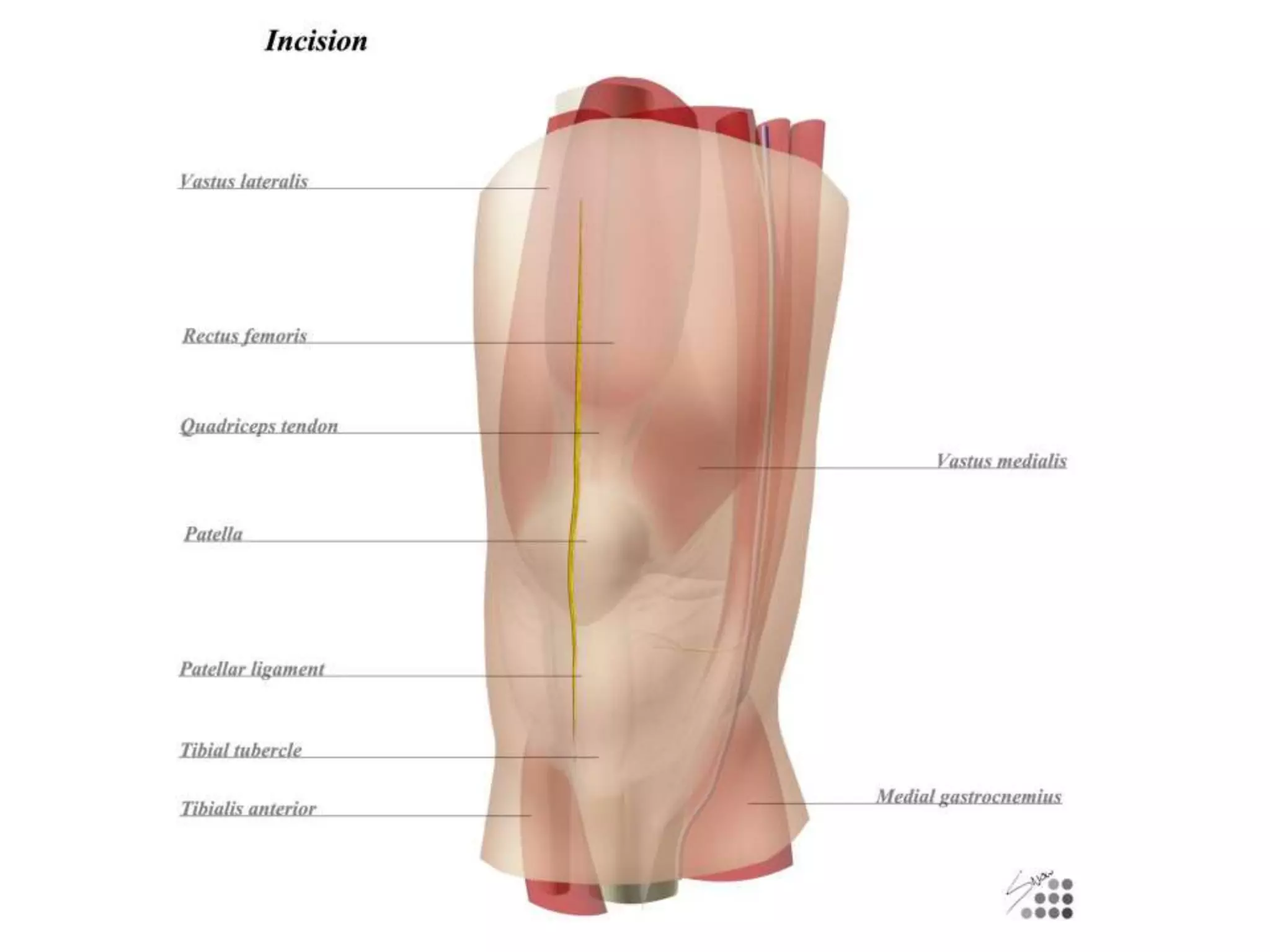
• Incision – midline longitudinal incision
extending from 5cm above superior pole of
patella to the tibial tuberosity
TECHNIQUE – KNEE ARTHROTOMY
• Procedure –
• deepen incision thru subcut and deep fasciae
• Develop medial flap to expose quadriceps tendon,
medial border patella and medial border ligamentum
patellae
• Incise medial aspect of knee joint capsule longitudinally
and adjacent to patella
• Retract patella laterally for better view
• Closure is done in layers
TECHNIQUE – SHOULDER
ARTHROTOMY
• Anaesthesia – GA
• Position – Supine
• Skin preparation
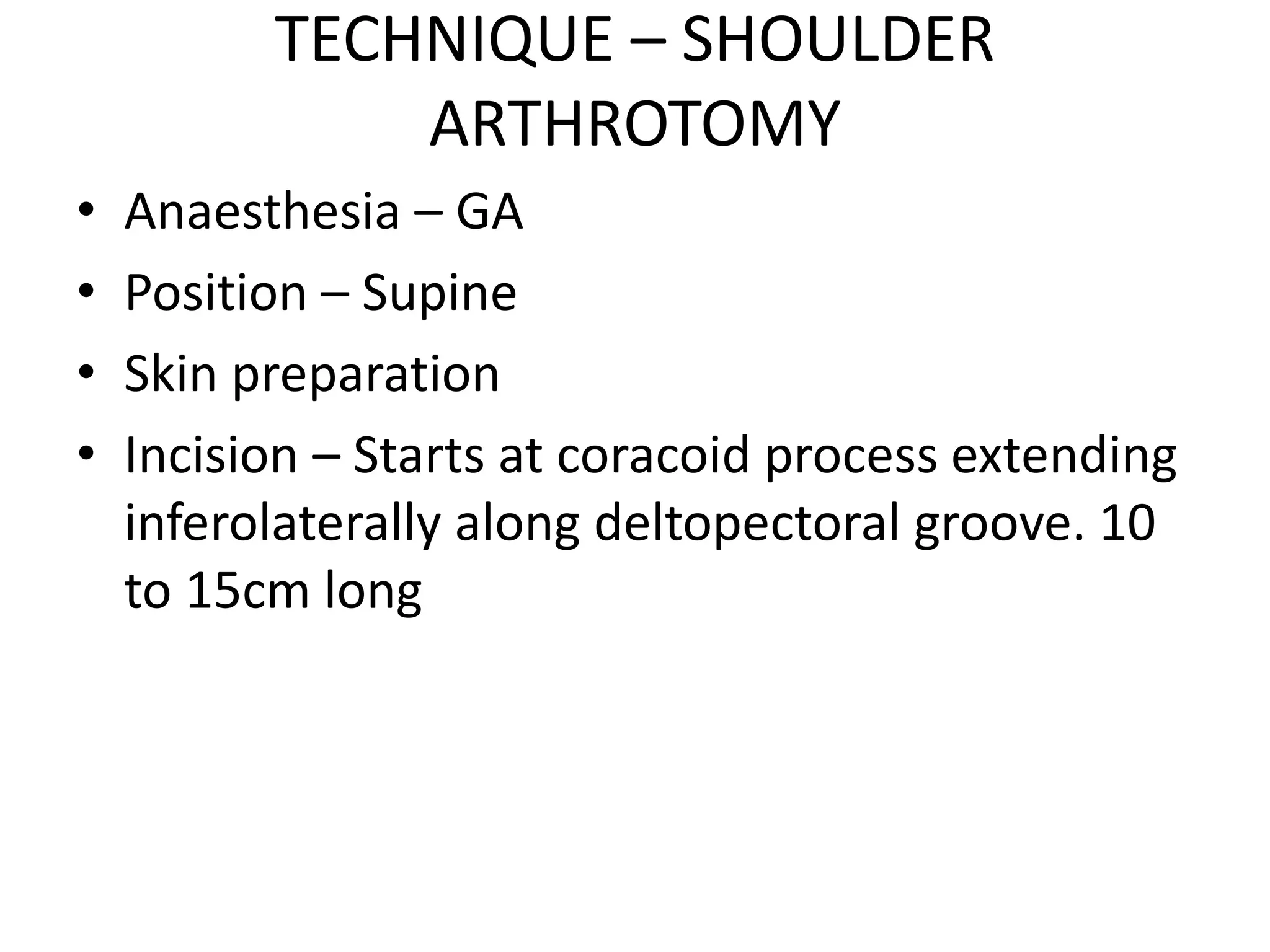
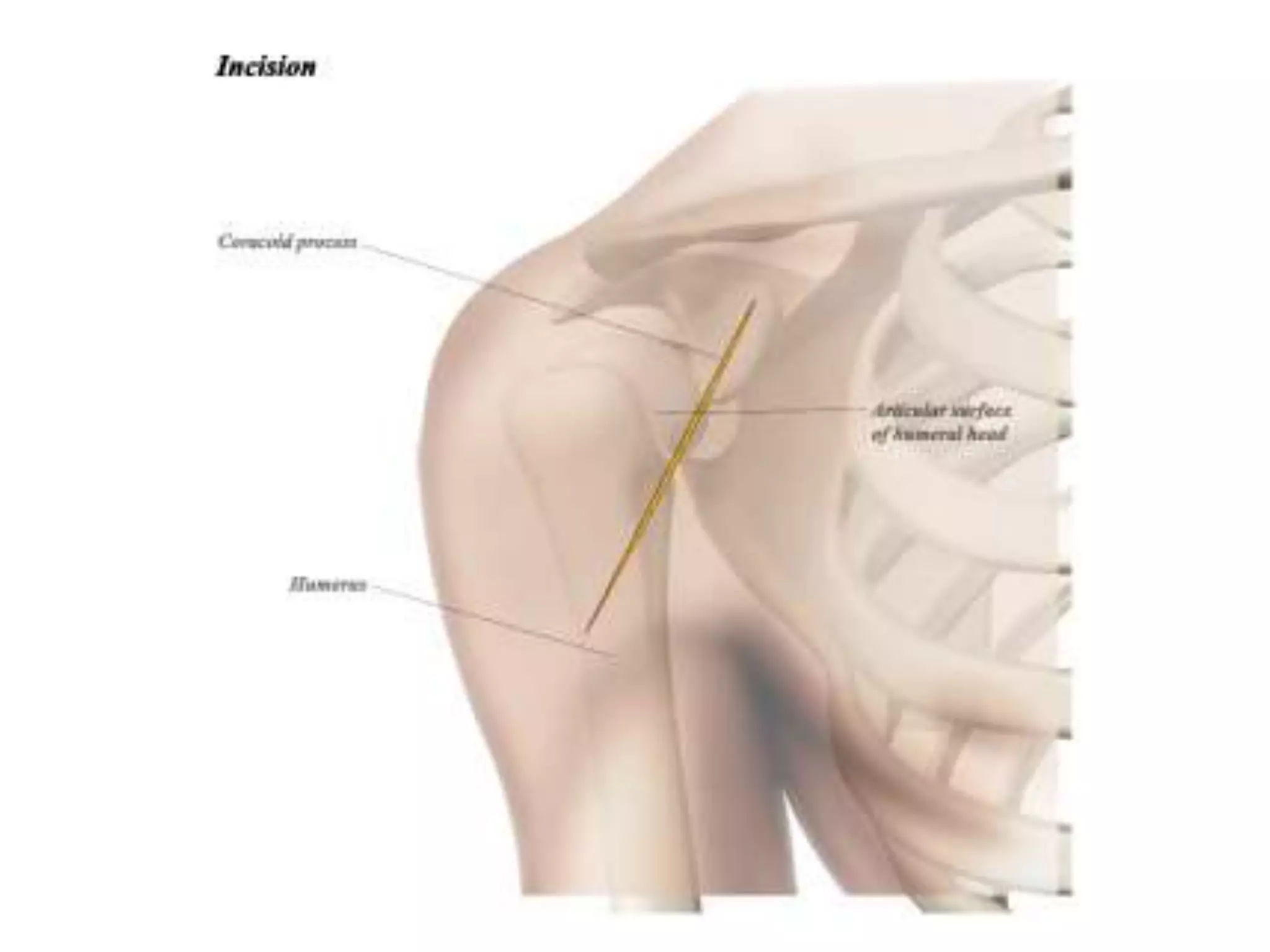
• Incision – Starts at coracoid process extending
inferolaterally along deltopectoral groove. 10
to 15cm long
TECHNIQUE - SHOULDER
ARTHROTOMY
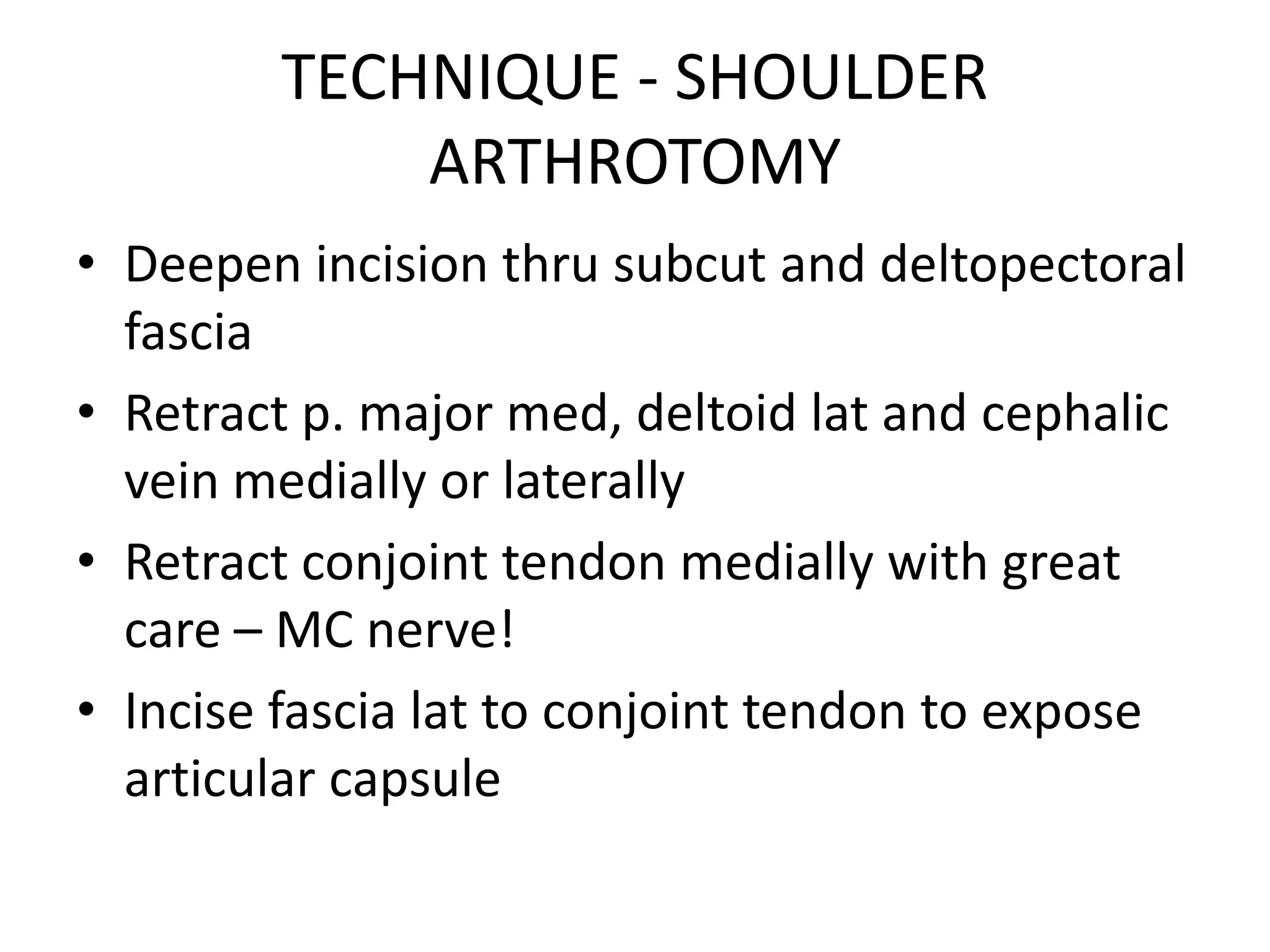
• Deepen incision thru subcut and deltopectoral
fascia
• Retract p. major med, deltoid lat and cephalic
vein medially or laterally
• Retract conjoint tendon medially with great
care – MC nerve!
• Incise fascia lat to conjoint tendon to expose
articular capsule
POST-OP CARE/REHABILITATION
• Wound care
• Splintage and elevation of limb
• Analgesia
• Antibiotics?
• Physical therapy
• Muscle strengthening
• ROM exercises
COMPLICATIONS
• Early
• Haemorrhage/haemarthrosis
• Septic arthritis
• Nerve damage
• Late
• Stiffness
• Chronic joint pain
• Fibrous adhesions
• Scars/contractures
CURRENT TRENDS
• Use of arthroscopy offers folllowing benefits
– Decreased metabolic response to trauma
– Decreased complication rate
– Decreased hospital stay
– Earlier return to work
– Improved ability to perform some surgical
procedures e.g. partial meniscectomy
OUTLINE - ARTHROCENTESIS
• INTRODUCTION
• DEFINITION
• STATEMENT OF IMPORTANCE
• INDICATIONS
• DIAGNOSTIC
• THERAPEUTIC
• CONTRAINDICATIONS
• PREPROCEDURAL CONSIDERATIONS
• TECHNIQUE
• POSTPROCEDURAL CARE
• SYNOVIAL FLUID ANALYSIS
• MACROSCOPIC EXAMINATION
• MICROSCOPIC EXAMINATION
• CHEMISTRY
• CYTOLOGY
• COMPLICATIONS
• CONCLUSION
INTRODUCTION
• It is the sterile, surgical puncture of a joint
with aspiration of fluid for diagnostic and/or
therapeutic purposes
• It is an indispensable component of the
management of joint diseases. In fact, the
diagnosis of diseases such as septic arthritis
and crystal arthropathy can only be made
when arthrocentesis has been carried out
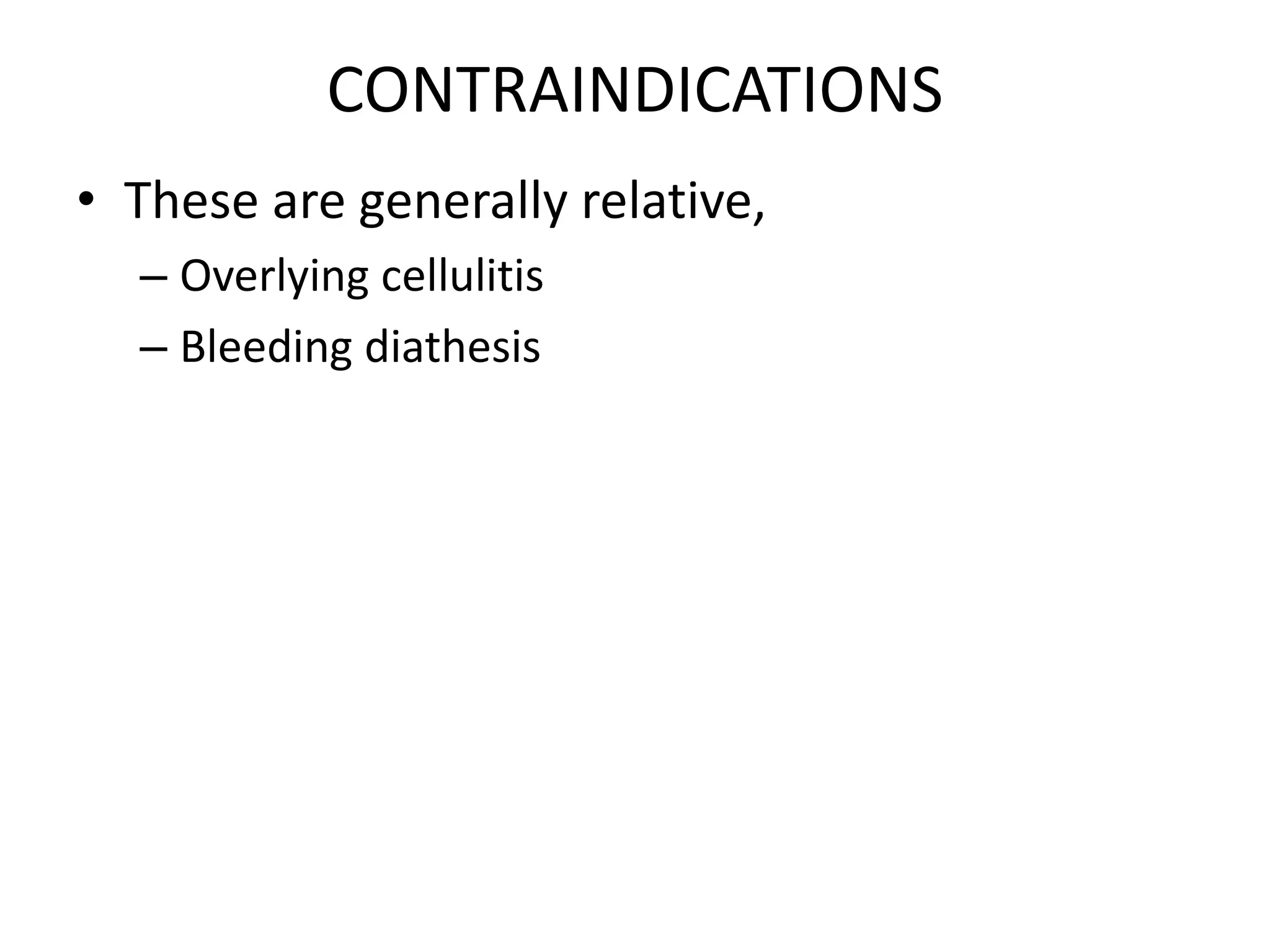
INDICATIONS
• Diagnostic
• Septic arthritis
• Tuberculous arthritis
• Cyrstal arthropathy – gout, pseudogout
• Therapeutic
• Septic arthritis (repeated aspiration)
• Haemathrosis
• Done prior to corticosteroid injection
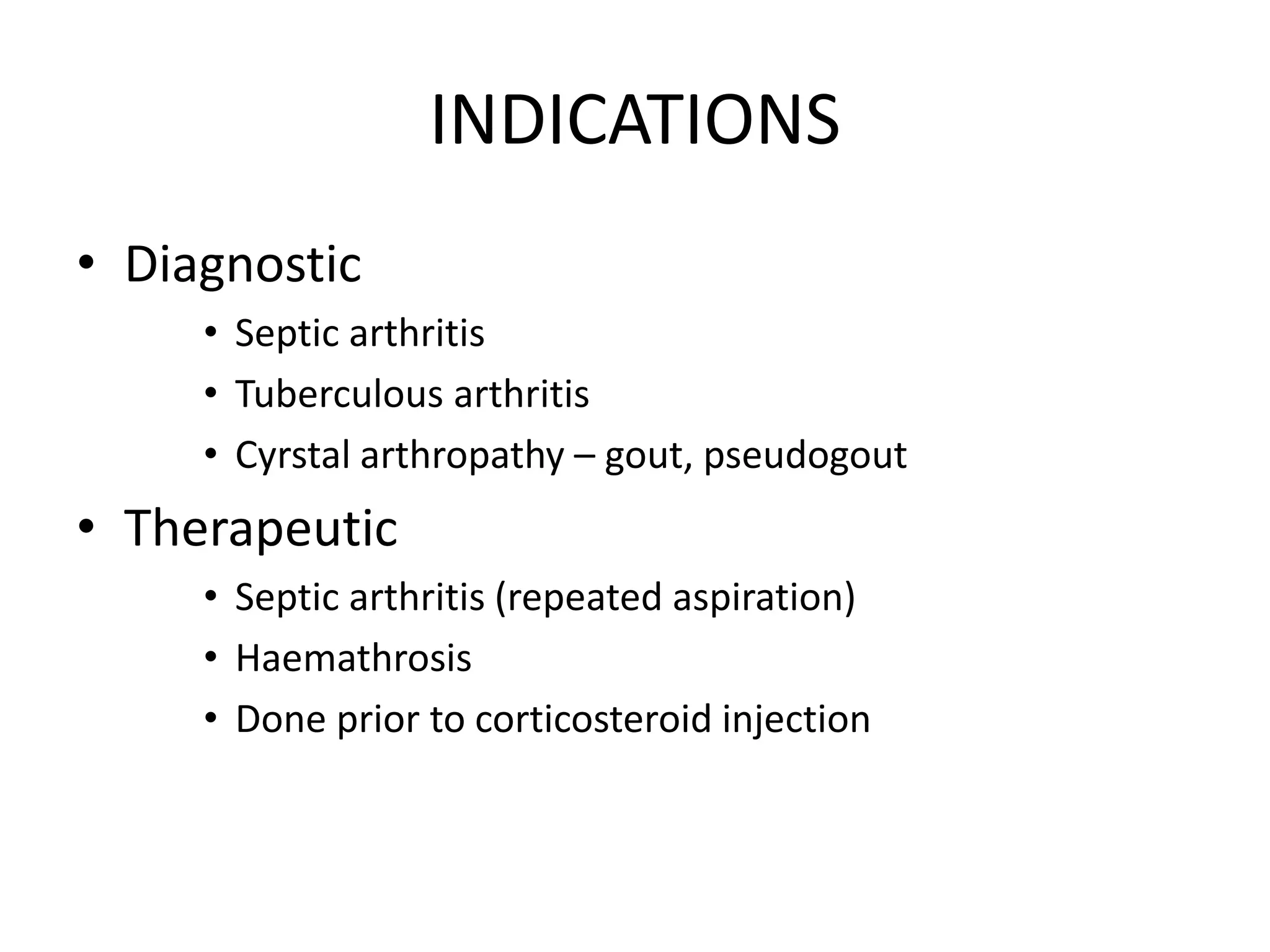
CONTRAINDICATIONS
• These are generally relative,
– Overlying cellulitis
– Bleeding diathesis
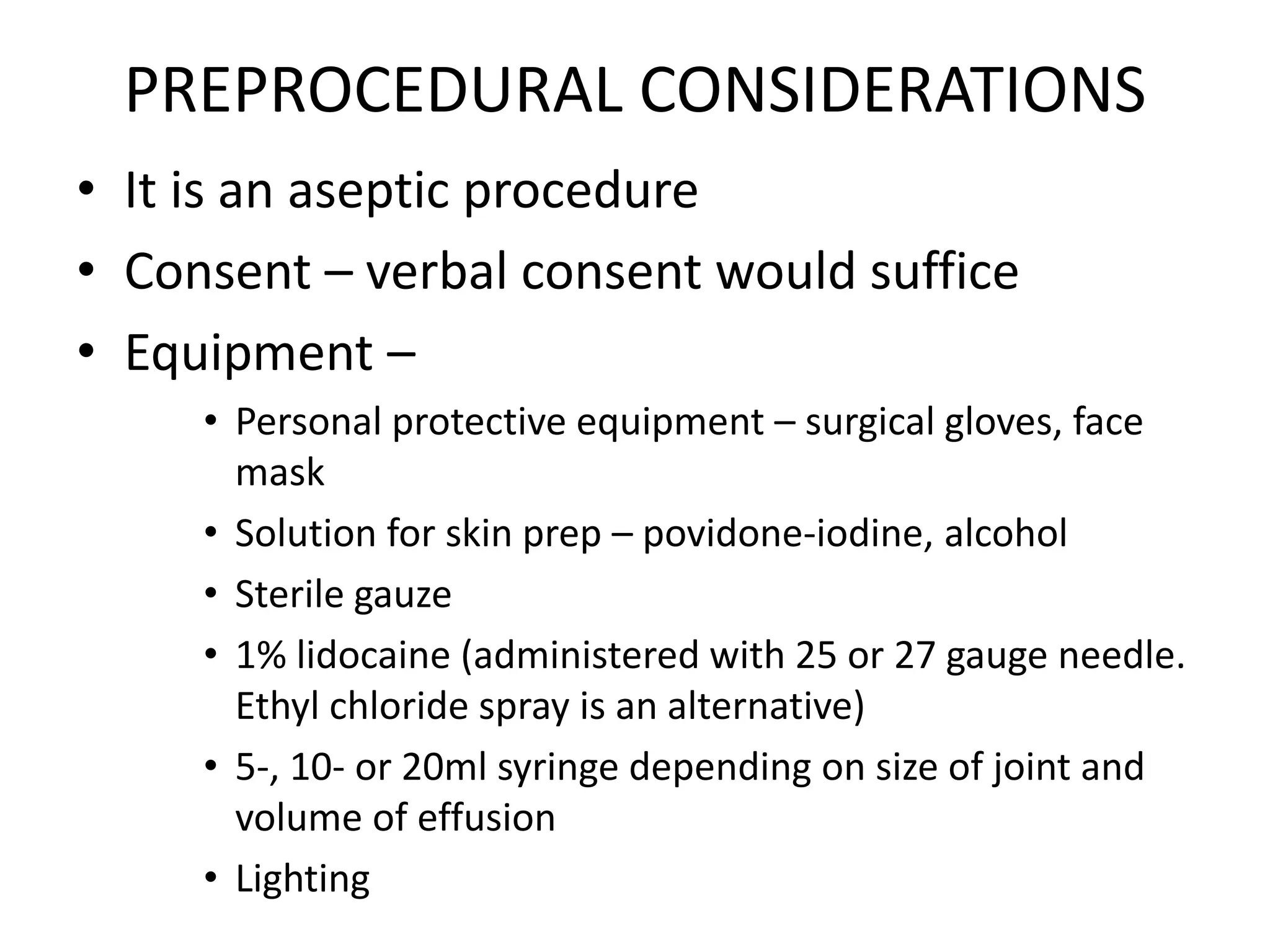
PREPROCEDURAL CONSIDERATIONS
• It is an aseptic procedure
• Consent – verbal consent would suffice
• Equipment –
• Personal protective equipment – surgical gloves, face
mask
• Solution for skin prep – povidone-iodine, alcohol
• Sterile gauze
• 1% lidocaine (administered with 25 or 27 gauge needle.
Ethyl chloride spray is an alternative)
• 5-, 10- or 20ml syringe depending on size of joint and
volume of effusion
• Lighting
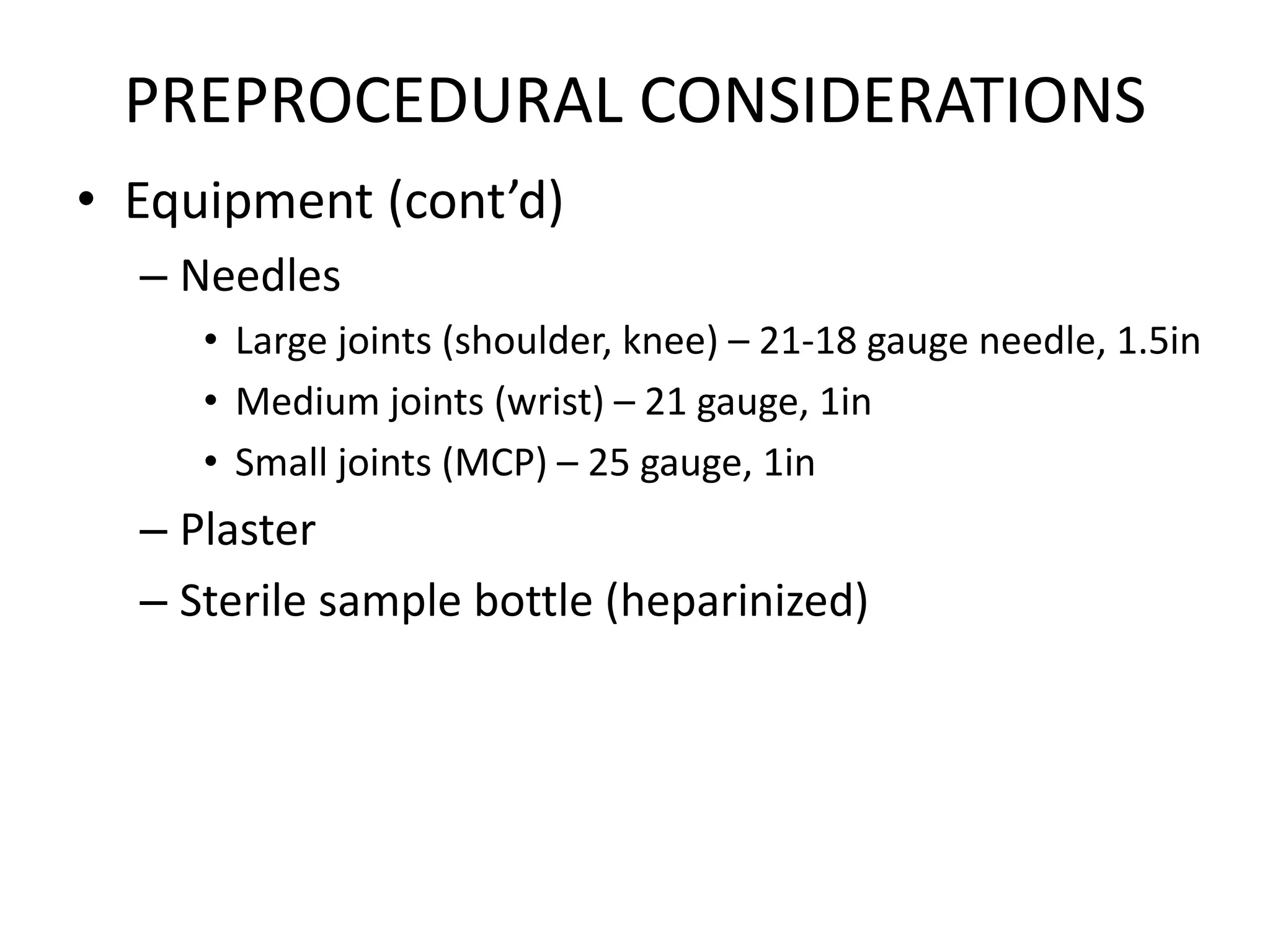
PREPROCEDURAL CONSIDERATIONS
• Equipment (cont’d)
– Needles
• Large joints (shoulder, knee) – 21-18 gauge needle, 1.5in
• Medium joints (wrist) – 21 gauge, 1in
• Small joints (MCP) – 25 gauge, 1in
– Plaster
– Sterile sample bottle (heparinized)
TECHNIQUE
• Prior to skin prep identify landmarks and mark
needle insertion point
• Anaesthesia – 1ml 1% lidocaine
• Positioning – joint to be aspirated should rest
on a stable, immobile surface
• Skin prep – ensure solution dries before start
• Blind vs. image-guided aspiration
APPROACH
• Considerations:
• These are designed such that the articular capsule
bulges toward the inserted needle
• If on aspiration the tap is dry it may be that the needle
isn’t in the joint space or the fluid is too viscous or the
needle is blocked by debris. This is ameliorated by
withdrawal and repositioning of the needle or changing
it.
• Specific approaches
• Shoulder
– Anterior:
» Patient is seated
» Arm adducted and externally rotated
APPROACH
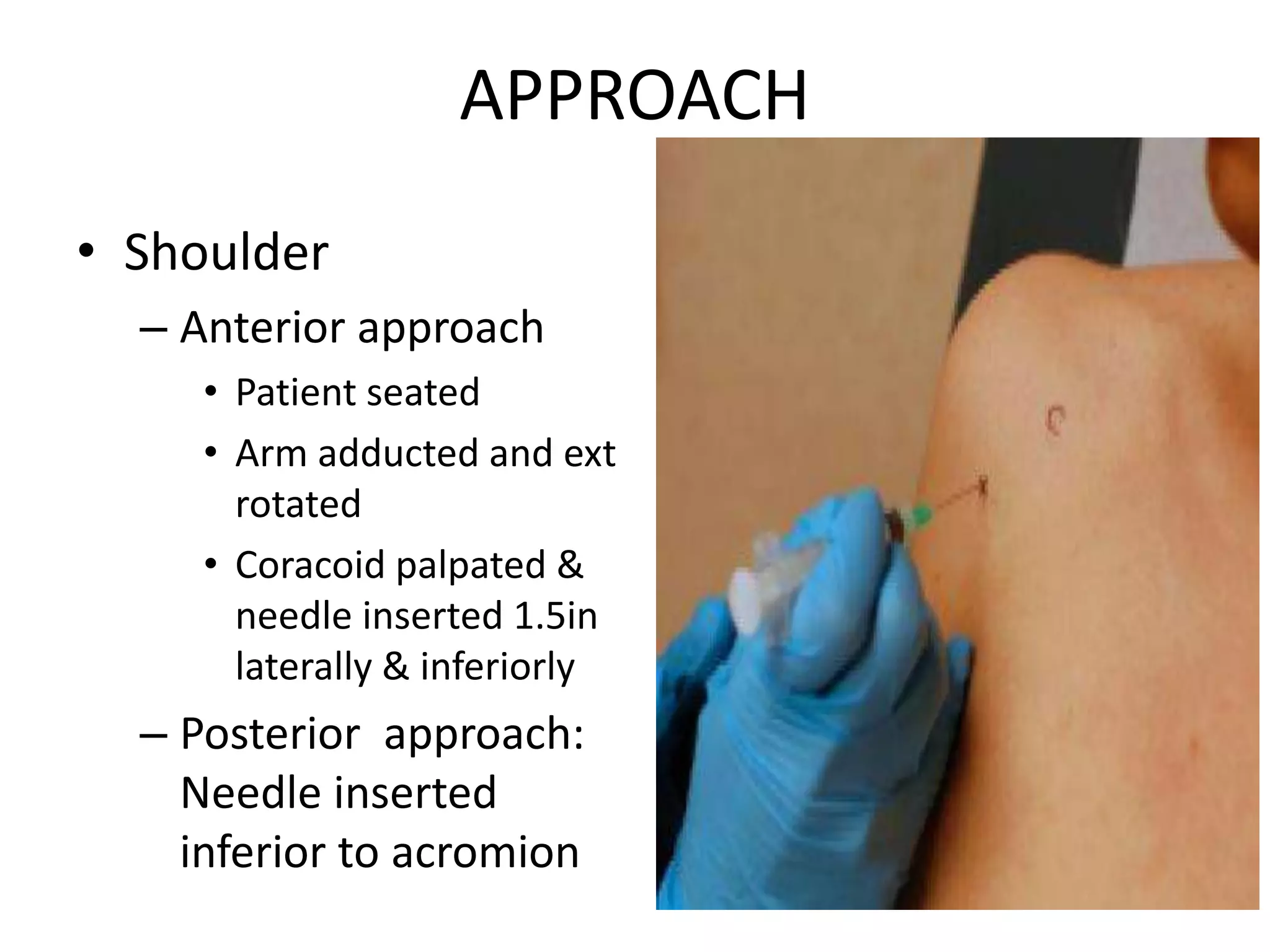
• Shoulder
– Anterior approach
• Patient seated
• Arm adducted and ext
rotated
• Coracoid palpated &
needle inserted 1.5in
laterally & inferiorly
– Posterior approach:
Needle inserted
inferior to acromion
APPROACH
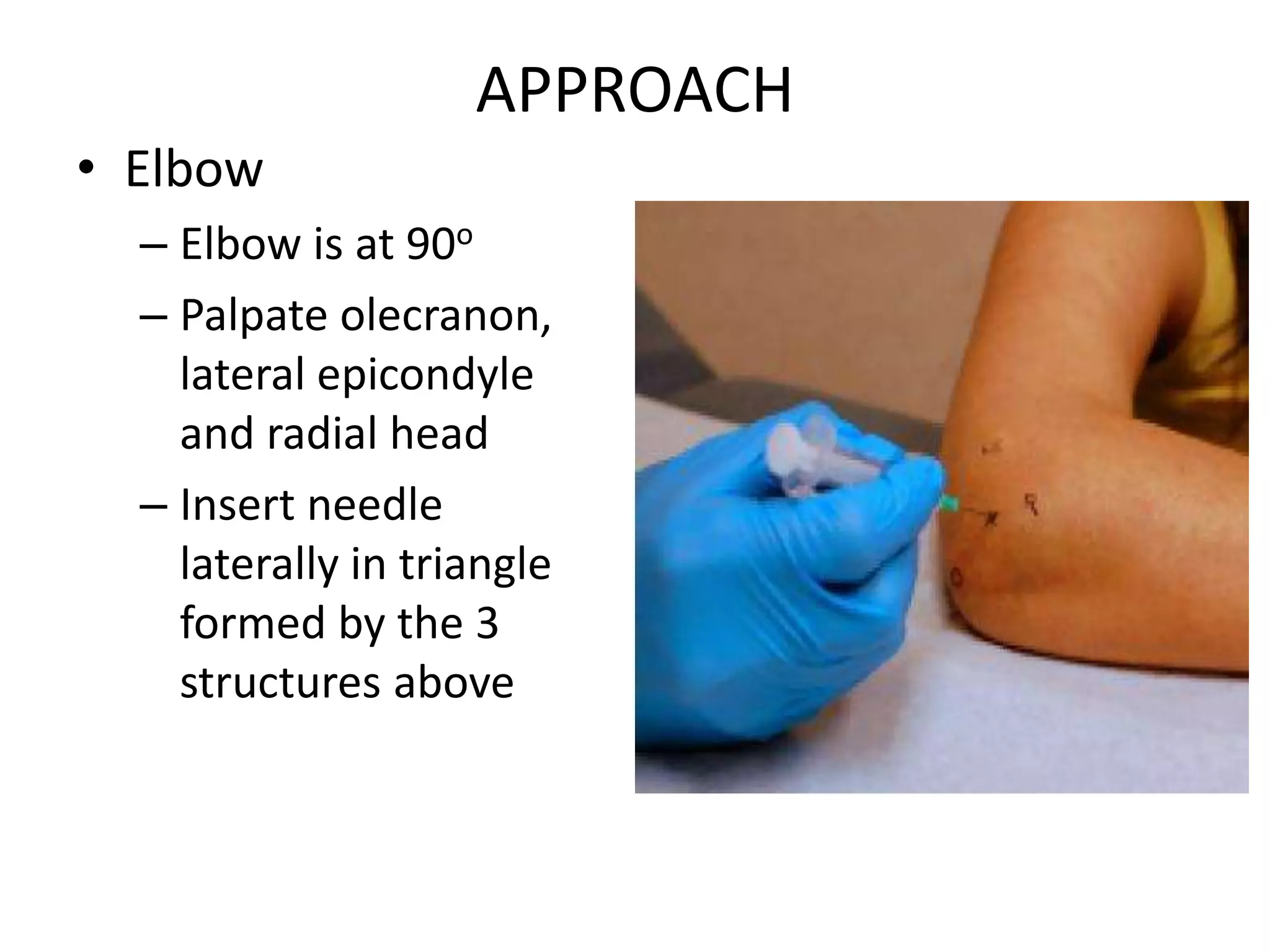
• Elbow
– Elbow is at 90o
– Palpate olecranon,
lateral epicondyle
and radial head
– Insert needle
laterally in triangle
formed by the 3
structures above
APPROACH
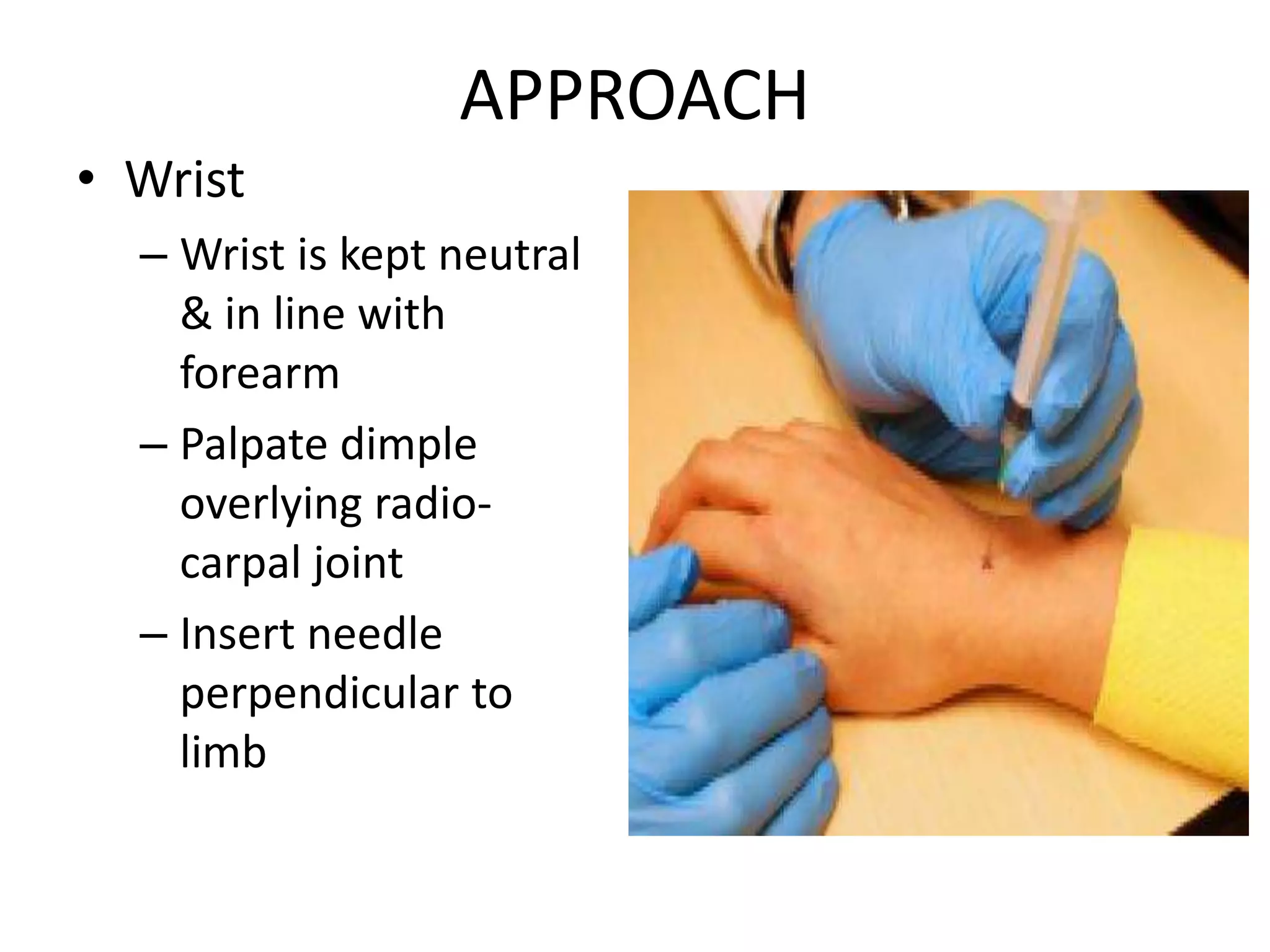
• Wrist
– Wrist is kept neutral
& in line with
forearm
– Palpate dimple
overlying radio-
carpal joint
– Insert needle
perpendicular to
limb
APPROACH
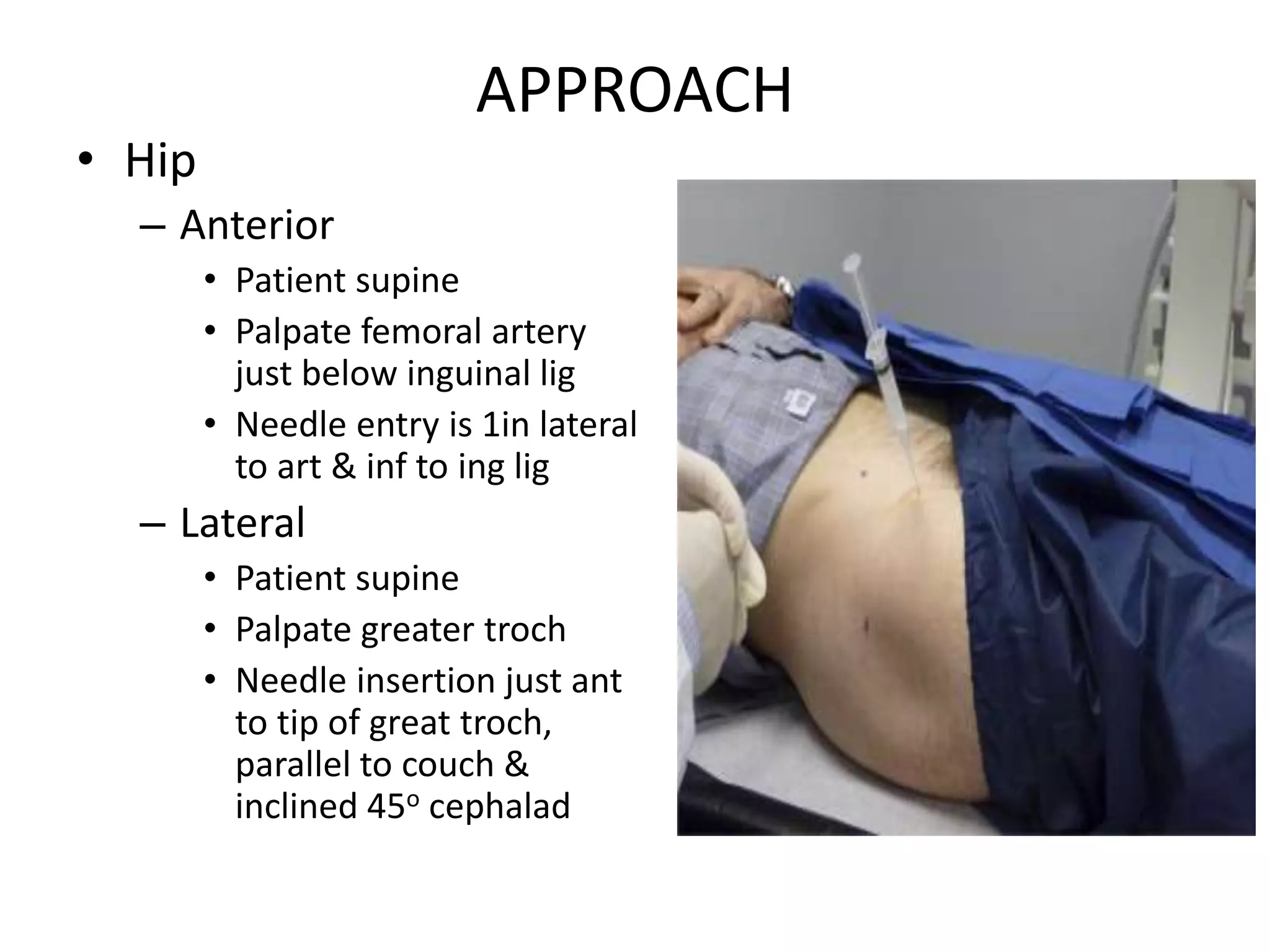
• Hip
– Anterior
• Patient supine
• Palpate femoral artery
just below inguinal lig
• Needle entry is 1in lateral
to art & inf to ing lig
– Lateral
• Patient supine
• Palpate greater troch
• Needle insertion just ant
to tip of great troch,
parallel to couch &
inclined 45o cephalad
APPROACH
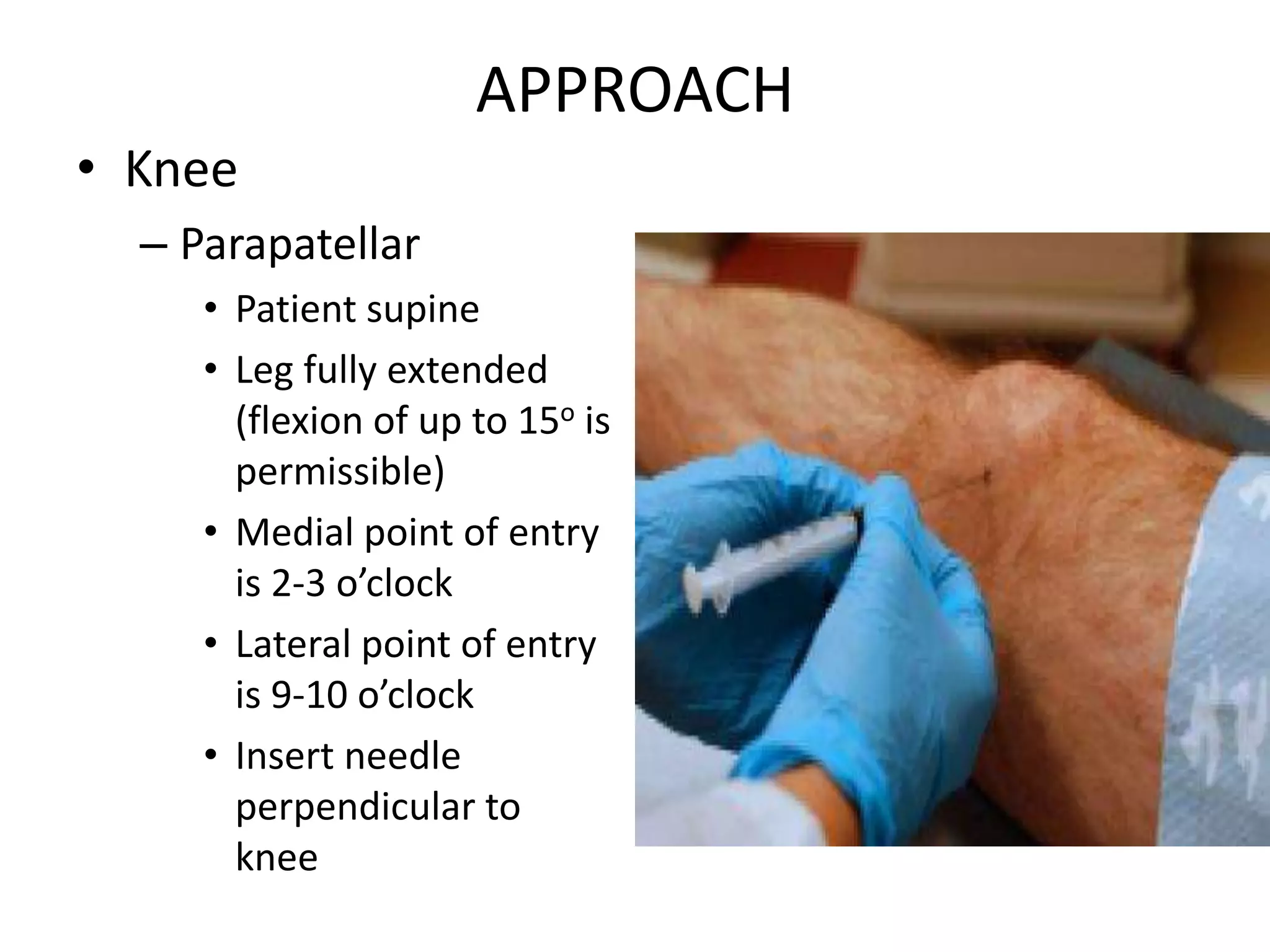
• Knee
– Parapatellar
• Patient supine
• Leg fully extended
(flexion of up to 15o is
permissible)
• Medial point of entry
is 2-3 o’clock
• Lateral point of entry
is 9-10 o’clock
• Insert needle
perpendicular to
knee
APPROACH
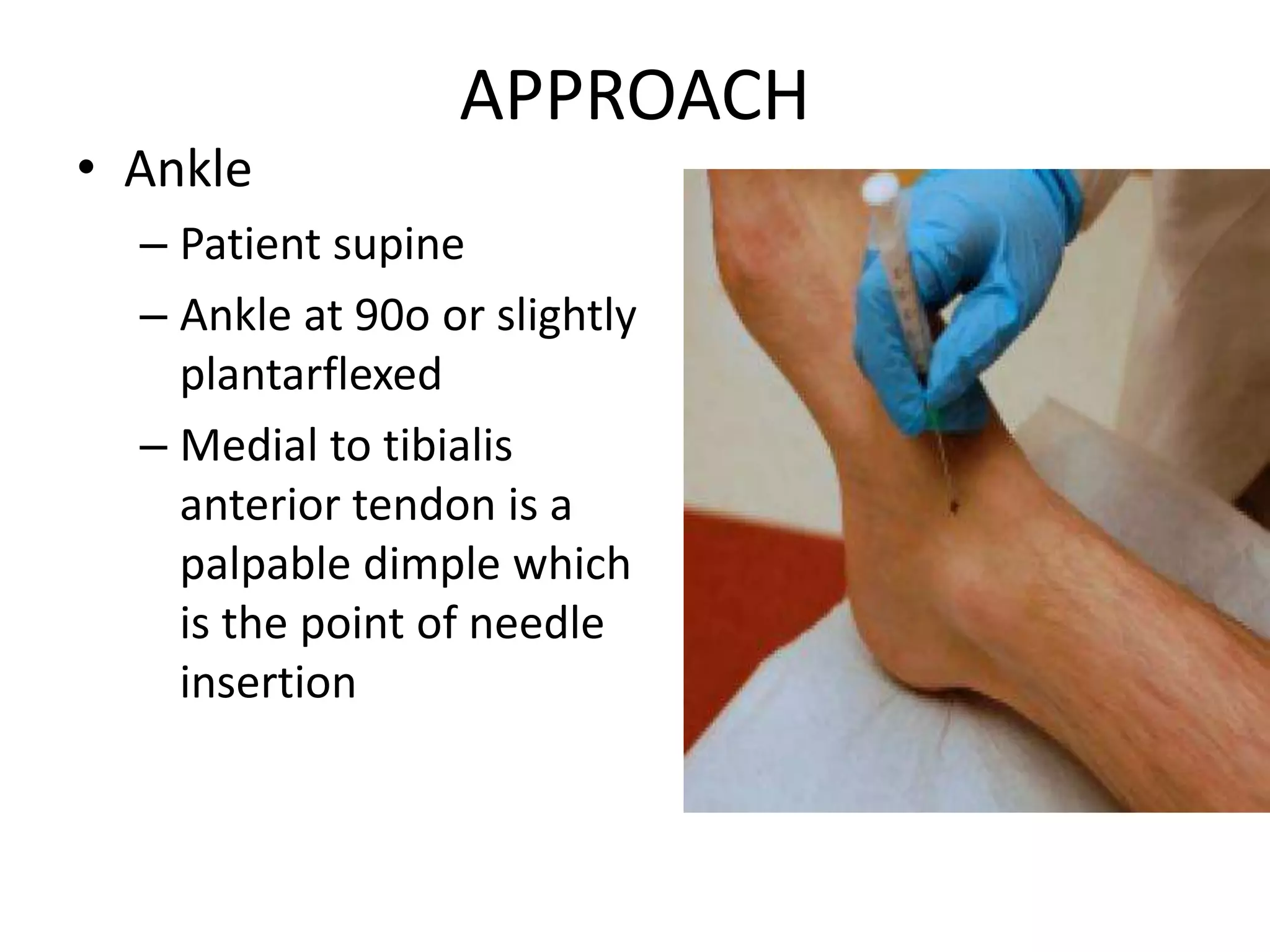
• Ankle
– Patient supine
– Ankle at 90o or slightly
plantarflexed
– Medial to tibialis
anterior tendon is a
palpable dimple which
is the point of needle
insertion
APPROACH
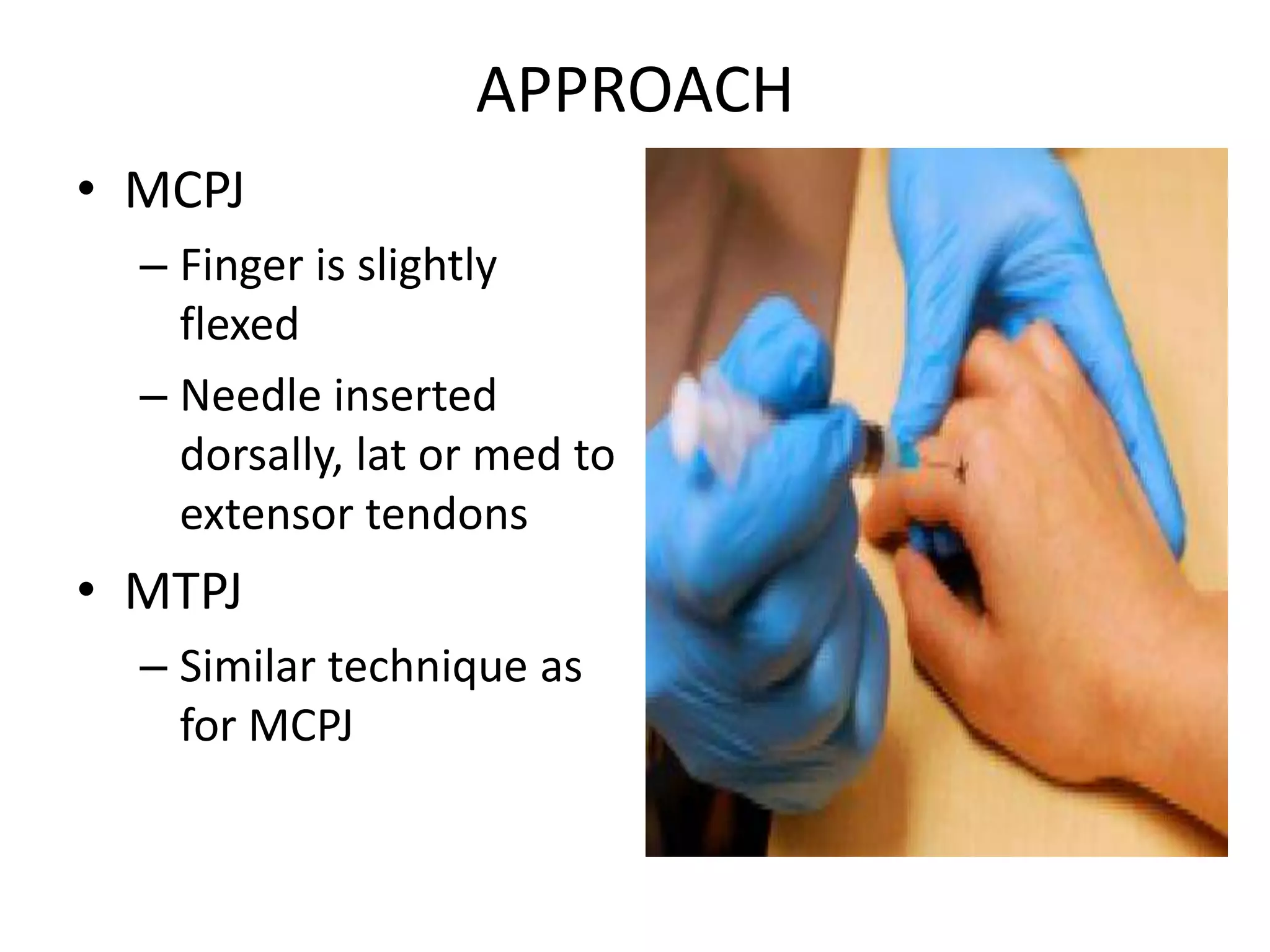
• MCPJ
– Finger is slightly
flexed
– Needle inserted
dorsally, lat or med to
extensor tendons
• MTPJ
– Similar technique as
for MCPJ
POST PROCEDURAL CARE
• Apply gauze over puncture site
• Rest the drained joint for 48hrs
SYNOVIAL FLUID ANALYSIS
• Macroscopic examination
– Colour : straw-coloured, bloody, purulent
– Turbidity: clear, turbid
• Microscopic examination
– Microscopy: gram stain, AFB
– Culture/sensitivity
• Chemistry
– Crystal analysis: monosodium urate (gout), calcium
pyrophosphate dihydrate (pseudogout)
– Glucose, protein, lactate dehydrogenase
• Cytology
– malignancy
COMPLICATIONS
• Early
– Haemarthrosis
– Infection
– Cartilage damage
• Late
– Adhesion
– Recurrence of effusion
CONCLUSION
• Arthrocentesis and arthrotomy are frequently
performed procedures, often being carried
out in tandem in the management of joint
pathology.
• Despite the emergence of advanced
technologies in current orthopaedic practice,
the principles guiding the use of these
techniques are still very valid today.
THANK YOU
REFERENCES
• Apley’s System of Orthopaedics & Fractures, 9th Ed, pg
323
• Chapman’s Orthopaedic Surgery, 3rd Ed, pp 3568-3569
• Essential Orthopaedics & Trauma, Dandy D, Edwards D,
5th Ed, pg 83
• http://www.orthobullets.com/approaches/12028/knee
-medial-parapatellar-approach
• http://www.rileywilliamsmd.com/elbow/arthrotomy
• http://www.wisegeek.com/what-are-the-different-
reasons-to-perform-a-arthrotomy.htm
• http://emedicine.medscape.com/article/2094114-
overview
• http://www.anwresidency.com/simulation/guide/arthr
o.html
• http://www.wheelessonline.com/ortho/aspiration_of_
the_hip_joint

Principles of arthrotomy & arthrocentesis

  • 1.
    PRINCIPLES OF ARTHROTOMY& ARTHROCENTESIS Bassey, A E M.B., B.S. Dep’t of Orthopaedic & Trauma Surgery UATH, Abuja
  • 2.
    OUTLINE - ARTHROTOMY •INTRODUCTION • DEFINITION • STATEMENT OF IMPORTANCE • INDICATIONS • DIAGNOSTIC • THERAPEUTIC • PRE-OPERATIVE CONSIDERATIONS • INTRA-OPERATIVE CONSIDERATIONS • POST-OPERATIVE CARE/REHABILITATION • COMPLICATIONS • EARLY • LATE • CURRENT TRENDS
  • 3.
    INTRODUCTION • This isan incision into a joint to expose its interior • Although many of its roles have been usurped by minimally-invasive techniques, arthrotomy still remains a very useful tool in the management of joint diseases, moreso, in resource-constrained settings. Every orthopaedic surgeon of worth should therefore be well-grounded in its principles.
  • 4.
    INDICATIONS • DIAGNOSTIC • Assessmentof joint trauma • Biopsy • THERAPEUTIC • Incision & drainage • Debridement/removal of loose bodies • Ligament reconstruction • Fracture fixation • Disarticulation • Joint replacement • Tumour excision
  • 5.
    PRE-OPERATIVE CONSIDERATIONS • Indicationis first met • Consent – written, informed consent
  • 6.
    INTRA-OPERATIVE CONSIDERATIONS • Anaesthesia– depends on site • Prophylactic antibiotics • Tourniquet (where feasible) • Approach – Shoulder – Anterior (deltopectoral) approach – Posterior approach – Elbow – Posterolateral approach – Posteromedial approach – Wrist – Dorsal approach – Hip – Anterior approach (children) – Lateral approach (adults) – Knee – Medial parapatellar approach – Lateral parapatellar approach – Ankle – Anteromedial approach – Anterolateral approach
  • 7.
    TECHNIQUE – KNEEARTHROTOMY • Anaesthesia – GA, SAB, epidural, femoral block • Position – supine with sandbag underneath the hip • Tourniquet • Skin preparation • Incision – midline longitudinal incision extending from 5cm above superior pole of patella to the tibial tuberosity
  • 9.
    TECHNIQUE – KNEEARTHROTOMY • Procedure – • deepen incision thru subcut and deep fasciae • Develop medial flap to expose quadriceps tendon, medial border patella and medial border ligamentum patellae • Incise medial aspect of knee joint capsule longitudinally and adjacent to patella • Retract patella laterally for better view • Closure is done in layers
  • 10.
    TECHNIQUE – SHOULDER ARTHROTOMY •Anaesthesia – GA • Position – Supine • Skin preparation • Incision – Starts at coracoid process extending inferolaterally along deltopectoral groove. 10 to 15cm long
  • 12.
    TECHNIQUE - SHOULDER ARTHROTOMY •Deepen incision thru subcut and deltopectoral fascia • Retract p. major med, deltoid lat and cephalic vein medially or laterally • Retract conjoint tendon medially with great care – MC nerve! • Incise fascia lat to conjoint tendon to expose articular capsule
  • 13.
    POST-OP CARE/REHABILITATION • Woundcare • Splintage and elevation of limb • Analgesia • Antibiotics? • Physical therapy • Muscle strengthening • ROM exercises
  • 14.
    COMPLICATIONS • Early • Haemorrhage/haemarthrosis •Septic arthritis • Nerve damage • Late • Stiffness • Chronic joint pain • Fibrous adhesions • Scars/contractures
  • 15.
    CURRENT TRENDS • Useof arthroscopy offers folllowing benefits – Decreased metabolic response to trauma – Decreased complication rate – Decreased hospital stay – Earlier return to work – Improved ability to perform some surgical procedures e.g. partial meniscectomy
  • 16.
    OUTLINE - ARTHROCENTESIS •INTRODUCTION • DEFINITION • STATEMENT OF IMPORTANCE • INDICATIONS • DIAGNOSTIC • THERAPEUTIC • CONTRAINDICATIONS • PREPROCEDURAL CONSIDERATIONS • TECHNIQUE • POSTPROCEDURAL CARE • SYNOVIAL FLUID ANALYSIS • MACROSCOPIC EXAMINATION • MICROSCOPIC EXAMINATION • CHEMISTRY • CYTOLOGY • COMPLICATIONS • CONCLUSION
  • 17.
    INTRODUCTION • It isthe sterile, surgical puncture of a joint with aspiration of fluid for diagnostic and/or therapeutic purposes • It is an indispensable component of the management of joint diseases. In fact, the diagnosis of diseases such as septic arthritis and crystal arthropathy can only be made when arthrocentesis has been carried out
  • 18.
    INDICATIONS • Diagnostic • Septicarthritis • Tuberculous arthritis • Cyrstal arthropathy – gout, pseudogout • Therapeutic • Septic arthritis (repeated aspiration) • Haemathrosis • Done prior to corticosteroid injection
  • 19.
    CONTRAINDICATIONS • These aregenerally relative, – Overlying cellulitis – Bleeding diathesis
  • 20.
    PREPROCEDURAL CONSIDERATIONS • Itis an aseptic procedure • Consent – verbal consent would suffice • Equipment – • Personal protective equipment – surgical gloves, face mask • Solution for skin prep – povidone-iodine, alcohol • Sterile gauze • 1% lidocaine (administered with 25 or 27 gauge needle. Ethyl chloride spray is an alternative) • 5-, 10- or 20ml syringe depending on size of joint and volume of effusion • Lighting
  • 21.
    PREPROCEDURAL CONSIDERATIONS • Equipment(cont’d) – Needles • Large joints (shoulder, knee) – 21-18 gauge needle, 1.5in • Medium joints (wrist) – 21 gauge, 1in • Small joints (MCP) – 25 gauge, 1in – Plaster – Sterile sample bottle (heparinized)
  • 22.
    TECHNIQUE • Prior toskin prep identify landmarks and mark needle insertion point • Anaesthesia – 1ml 1% lidocaine • Positioning – joint to be aspirated should rest on a stable, immobile surface • Skin prep – ensure solution dries before start • Blind vs. image-guided aspiration
  • 23.
    APPROACH • Considerations: • Theseare designed such that the articular capsule bulges toward the inserted needle • If on aspiration the tap is dry it may be that the needle isn’t in the joint space or the fluid is too viscous or the needle is blocked by debris. This is ameliorated by withdrawal and repositioning of the needle or changing it. • Specific approaches • Shoulder – Anterior: » Patient is seated » Arm adducted and externally rotated
  • 24.
    APPROACH • Shoulder – Anteriorapproach • Patient seated • Arm adducted and ext rotated • Coracoid palpated & needle inserted 1.5in laterally & inferiorly – Posterior approach: Needle inserted inferior to acromion
  • 25.
    APPROACH • Elbow – Elbowis at 90o – Palpate olecranon, lateral epicondyle and radial head – Insert needle laterally in triangle formed by the 3 structures above
  • 26.
    APPROACH • Wrist – Wristis kept neutral & in line with forearm – Palpate dimple overlying radio- carpal joint – Insert needle perpendicular to limb
  • 27.
    APPROACH • Hip – Anterior •Patient supine • Palpate femoral artery just below inguinal lig • Needle entry is 1in lateral to art & inf to ing lig – Lateral • Patient supine • Palpate greater troch • Needle insertion just ant to tip of great troch, parallel to couch & inclined 45o cephalad
  • 28.
    APPROACH • Knee – Parapatellar •Patient supine • Leg fully extended (flexion of up to 15o is permissible) • Medial point of entry is 2-3 o’clock • Lateral point of entry is 9-10 o’clock • Insert needle perpendicular to knee
  • 29.
    APPROACH • Ankle – Patientsupine – Ankle at 90o or slightly plantarflexed – Medial to tibialis anterior tendon is a palpable dimple which is the point of needle insertion
  • 30.
    APPROACH • MCPJ – Fingeris slightly flexed – Needle inserted dorsally, lat or med to extensor tendons • MTPJ – Similar technique as for MCPJ
  • 31.
    POST PROCEDURAL CARE •Apply gauze over puncture site • Rest the drained joint for 48hrs
  • 32.
    SYNOVIAL FLUID ANALYSIS •Macroscopic examination – Colour : straw-coloured, bloody, purulent – Turbidity: clear, turbid • Microscopic examination – Microscopy: gram stain, AFB – Culture/sensitivity • Chemistry – Crystal analysis: monosodium urate (gout), calcium pyrophosphate dihydrate (pseudogout) – Glucose, protein, lactate dehydrogenase • Cytology – malignancy
  • 33.
    COMPLICATIONS • Early – Haemarthrosis –Infection – Cartilage damage • Late – Adhesion – Recurrence of effusion
  • 34.
    CONCLUSION • Arthrocentesis andarthrotomy are frequently performed procedures, often being carried out in tandem in the management of joint pathology. • Despite the emergence of advanced technologies in current orthopaedic practice, the principles guiding the use of these techniques are still very valid today.
  • 35.
  • 36.
    REFERENCES • Apley’s Systemof Orthopaedics & Fractures, 9th Ed, pg 323 • Chapman’s Orthopaedic Surgery, 3rd Ed, pp 3568-3569 • Essential Orthopaedics & Trauma, Dandy D, Edwards D, 5th Ed, pg 83 • http://www.orthobullets.com/approaches/12028/knee -medial-parapatellar-approach • http://www.rileywilliamsmd.com/elbow/arthrotomy • http://www.wisegeek.com/what-are-the-different- reasons-to-perform-a-arthrotomy.htm • http://emedicine.medscape.com/article/2094114- overview • http://www.anwresidency.com/simulation/guide/arthr o.html • http://www.wheelessonline.com/ortho/aspiration_of_ the_hip_joint