Principles of Knee arthroscopy
Presenter
Dr Kaushal Raj Kafle
Resident
History
• Early Endoscopic attempts on knee
1912 by Severin Nordentoft from Denmark
1919 by Kenji Takaji in Japan
• Eugene Bircher : Pioneer and parent of knee
arthroscopy(1920-30)
• Masaki Watanabe and Richard Connor: Parent
of interventional arthroscopy (1970-80)
Arthroscope
• an optical instrument.
• Three basic optical systems
– the classic thin lens system,
– the rod-lens system designed by Professor
Hopkins of Reading, England,
– graded index (GRIN) lens system.
Optical Characteristics
• Diameter
• Inclination
– Angle between the axis of arthoscope and perpendicular to
surface of lens
– 25o-30 o: Most common
– 70o-90o: Corners
• Field of Vision
– the viewing angle encompassed by the lens
– 1.9-mm : 65o
– 2.7-mm : 90o
– 4.0-mm : 115o
Television Camera
• Advantages
– More comfortable operating position for the surgeon,
– Avoidance of contamination of the operative field
– Involvement of the rest of the surgical team in the
procedure.
– can be connected directly to the arthroscope
• reductions in size
• better high-definition digital resolution.
• Cableless arthroscopic systems
– Miniature light source
Basic Instrument Kit
• Arthoscopes (30- and 70-degree)
• Probe
• Scissors
• Basket forceps
• grasping forceps
• arthroscopic knives
• motorized meniscus cutter and
shaver
• electrosurgical, laser, and
radiofrequency instruments
• Miscellaneous equipment
• Procedure Specific Instruments
Irrigation System
• Irrigation and Joint Distension
• Lactated Ringer solution
:physiological and minimal
synovial and articular surface
changes.
• Arthroscopic pumps
• Height 3 -4 feet : 66 -
88 mm Hg
• distention pressure
:approximately 30 mm Hg
below the systolic blood
pressure.
Tourniquet
• knee, ankle, elbow, and other distal joints
• C/I: thrombophlebitis and significant peripheral vascular
disease
• Advantage :
– increased visibility
– no significantly increased postoperative morbidity <90 to
120 minutes
• Disadvantage
– blanching of the synovium, differentiation and diagnosis
of various synovial disorders difficult,
– ischemic damage to muscle and nervous tissue with
prolonged tourniquet time
• addition of epinephrine (1 mg /liter of saline) significantly
increased visibility and reduced the need for tourniquet
inflation by 50%
Positioning
• Patient supine with ability to flex the knee
• Leg holder or post
Leg Holders
– knee is flexed 90
– medial fulcrum for both varus
and valgus stresses
– open the posteromedial
compartment for better viewing,
– manipulation of the meniscus,
– posterior horn meniscal surgery,
especially in tight knees
– Limited number of Positions
Lateral post
– lateral aspect of the distal thigh
can be levered against
– handwidth proximal to the base
of the patella
– opening of the posteromedial
compartment.
– unlimited number of positions,
including flexion and the figure-
four position,
Anesthesia
• General anesthesia and spinal anesthesia
• Local anaesthesia – may be added
• At portal sites
• Into the joint at the end of surgery
Common Therapeutic Indications
• Meniscectomies
• Meniscal suture
• ACL reconstructions,
• cartilage debridement
• less frequently
– PCL or multiligament reconstructions,
– patellar subluxations and cartilage repairs
Diagnostic Indication
• Historically Diagnostic Arthroscopy
• MRI : Routine non invasive diagnostic
modality
Contraindications
• Risk of Joint Sepsis from local skin condition
• Complete and partial Ankylosis
• Major collateral ligamentous and capsular
disruptions : excessive extravasation of fluids
into the soft tissues
• Minimally damaged joints responding to
conservative therapy
Advantages
• Reduced Post Operative Morbidity
• Smaller Incisions
• Less Intense Inflammatory Response
• Improved Visualization
• Absence of secondary effects
• Reduced Hospital Stay
• Reduced complication rates
• Improved follow up evaluation
Disadvantage
• Requires working through small portal and fragile
instruments
• Maneuvering through tight intraarticular spaces
may produce scuffing and scoring of the articular
surfaces,
• Extensive and Expensive Specialised equipment
• Proficiency in arthroscopic techniques requires a
great deal of patience and persistence.
Triangulation Technique
• use of one or more instruments that are
inserted through separate portals and brought
into the optical field of the arthroscope,
• the tips of the instrument and the arthroscope
forming the apex of a triangle.
• sufficient for handling the vast majority of
meniscal lesions suitable for arthroscopic
meniscal surgery.
Surface Anatomy
Portals
• Standard portals
Anterolateral 1 cm above joint line and 1 cm lateral to edge
of patellar tendon
Anteromedial 1cm above medial joint line and 1 cm medial to
edge of patellar tendon
Posteromedial Triangular soft spot between posteromedial
edge of femoral condyle and posteromedial
edge of tibia
Superolateral Lateral to quadriceps tendon and 2.5cm
superior to superolateral corner of patella
Portals
• Optional portals:
1. Posterolateral portal
2. Proximal midpatellar medial and lateral portals
3. Accessory far medial and lateral portals
4. Accessory Transpatellar tendon portal(Gillquist)
Scope insertion
• Make anterolateral incision over soft spot of knee
– vertical incisions
• have advantage of increased superior-inferior mobility of
instruments
– horizontal incisions
• have advantage of increased medial-lateral mobility of instruments
• Insert trochar into capsule
– advance blade into capsule then follow with trochar
– do with knee flexed
• Advance trochar into suprapatellar pouch
– with knee straightened
Diagnostic Arthroscopy
• Systematic and step wise Visualization of
1. Suprapatellar pouch and patellofemoral joint
2. Medial gutter
3. Medial compartment
4. Intercondylar notch
5. Posteromedial compartment
6. Lateral compartment
7. Lateral gutter and posterolateral compartment
• Diagnose intraarticular disorders meniscus,
synovium, ligament and articular cartilage
Steps
•Should systematically check the following locations and structures:
1.with knee fully extended start in suprapatellar pouch
•loose bodies
2.patellofemoral joint
•patellofemoral cartilage
•patellofemoral tracking
3.trochlear groove
4.lateral gutter
•insertion of popliteus
5.lateral compartment
•anterior horn of lateral meniscus
Steps
6. medial gutter
7. with knee flexed to 90 move to medial compartment
– medial meniscus
– medial femoral condyle cartilage
– medial tibial plateau cartilage
8. intercondylar notch
– ACL
– PCL
– posteromedial corner - best seen with 70 degree scope placed through
notch (Modified Gillquist view)
9. with knee in figure-four position finish in lateral compartment
– lateral meniscus
– popliteal hiatus
– lateral femoral condyle cartilage
– lateral tibial plateau cartilage
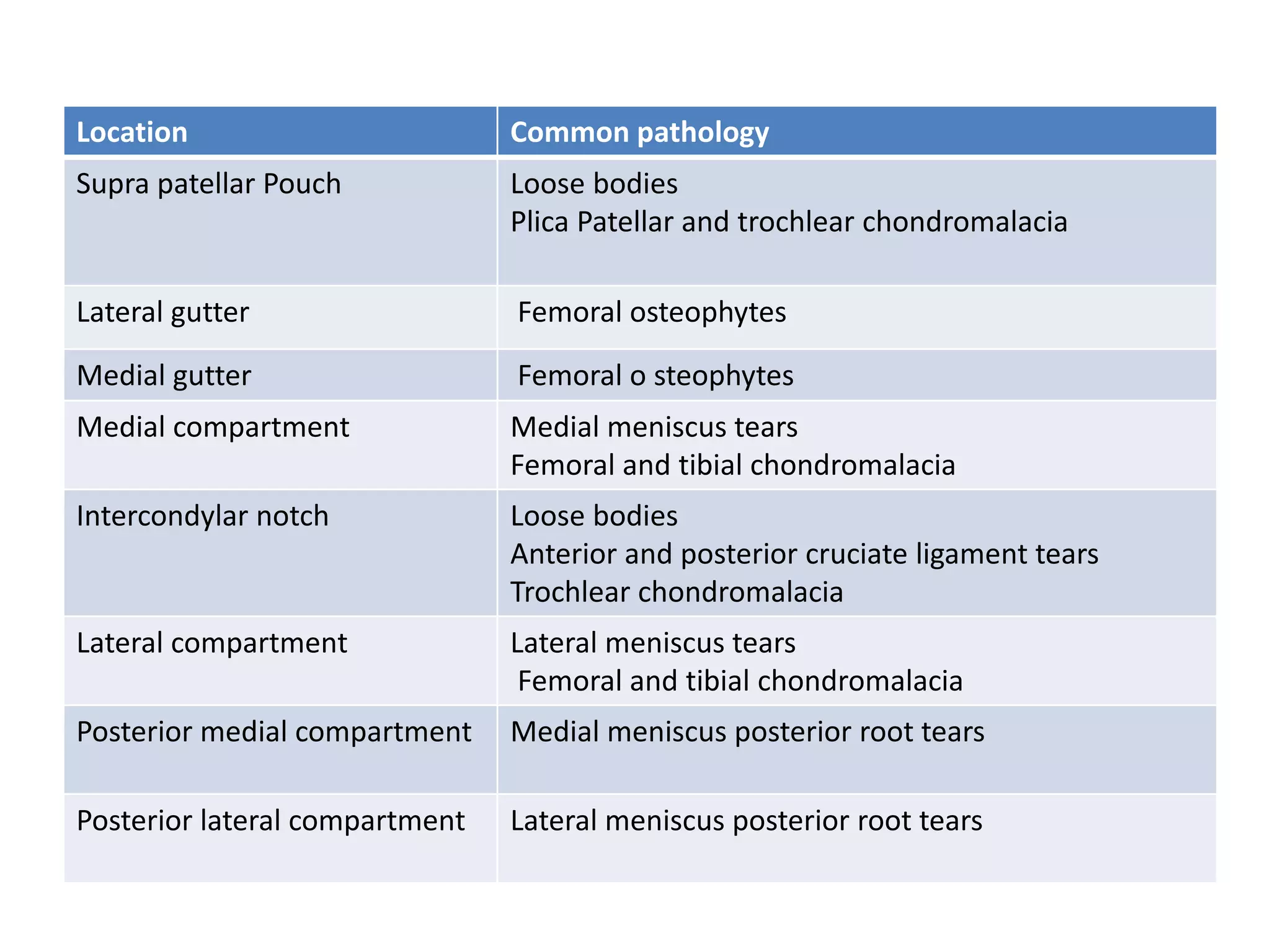
Location Common pathology
Supra patellar Pouch Loose bodies
Plica Patellar and trochlear chondromalacia
Lateral gutter Femoral osteophytes
Medial gutter Femoral o steophytes
Medial compartment Medial meniscus tears
Femoral and tibial chondromalacia
Intercondylar notch Loose bodies
Anterior and posterior cruciate ligament tears
Trochlear chondromalacia
Lateral compartment Lateral meniscus tears
Femoral and tibial chondromalacia
Posterior medial compartment Medial meniscus posterior root tears
Posterior lateral compartment Lateral meniscus posterior root tears
• Probing of the
medial meniscus
on it’s tibial and
femoral surfaces
• inspection of the
posterior horn and
insertion point of
the medial
meniscus
medial gutter seen
through the
anteromedial portal.
Arthroscopic views of
the patellofemoral
joint
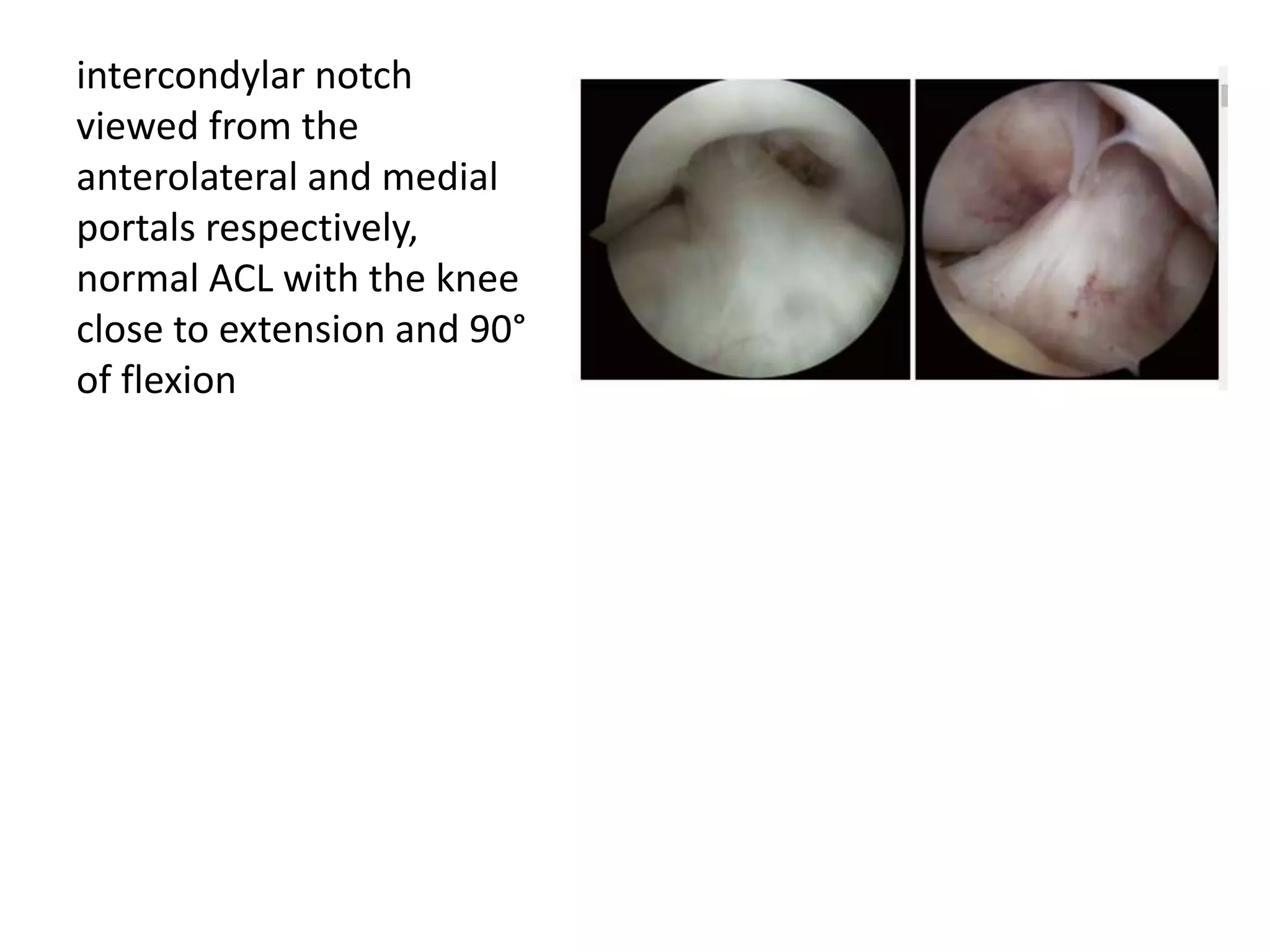
intercondylar notch
viewed from the
anterolateral and medial
portals respectively,
normal ACL with the knee
close to extension and 90°
of flexion
Complications
• Damage to intraarticular structure
– Scuffing of intraarticular cartilage > Chondromalatic
changes and degenerative arthritis
• Damage to Menisci and Fat
• Damage to Cruciate ligament
• Damage to Ligaments and tendon
– MCL : accesory medial portal , excessive valgus stress
to open up medial compartment
• Damage to extra articular structures
–Blood vessels
• Popliteal artery : Menisectomy while cutting
intercondylar attachment
• Posteriorly placed sutures In meniscus repair
• Extensive articular synovectomy : Genicular
arteries
–Nerves
• Traction/Overdistraction
• Direct trauma
• Mechanical compression from extravasation
• Prolonged tourniquet use
• Inferior branches of saphenous nerve and
Sartorial branch of femoral nerve are
commonly injured
• Compartment Syndromes
– Lower pump pressure/gravity inflow with
adequate outflow
– Stopping inflow, Releasing torniquet, leveling limb
to heart, use of Esmarch wrap from distal to
proximal
• Hemoarthosis
– Most common post op complication
– Lateral retinacular release : superior lateral
geniculate vessel
– Lateral meniscetomy and Synovectomies : inferior
lateral geniculate vessel
• Thrombophebitis
– DVT
– Most dangerous post op complication
• 9.9% DVT and 2.1% proximal DVT after arthroscopy
• Pulmonary emboli <1 %
• With LMWH , DVT 1.8%
• age >70 years increases thromboembolic risk 10 times;
• BMI >29, smoking, and oral contraception increase the
risk three timesdiabetes and hypertension increase the
risk two times
• Infection
– <0.2% , very rare
– Limited incision, young Healthy patients, Short OT
time, irrigation and dilution effect
– Prophylactic Antibiotic : Controversial
– Beneficial for High risk patient: DM, immuno
compromsied and Skin disorder
– Post op use of steriod > Increased risk of infection
• early arthroscopic irrigation and debridement
and intravenous antibiotics
• Synovial Herniation and Fistula
– Larger ports
– Large cystic fluid filled herniation
– Fistula : Suture reaction, stitch abscess
• Instrument Breakage
– Stop outflow, keep joint distended, keep in visual field
– Gravitate to medial and lateral gutter, beneath
mensici, posterior or most dependent
– Radiographic location
– Suction, Magnet, grasping instrument
• Implant Complication
– Suture anchor, sutures and knots
– Chondral damage, synovitis, osteolysis, chondrolysis
References
• Campbells Textbook of Orthopedics
• Atlas of Knee Arthroscopy

Principles of knee arthoscopy

  • 1.
    Principles of Kneearthroscopy Presenter Dr Kaushal Raj Kafle Resident
  • 2.
    History • Early Endoscopicattempts on knee 1912 by Severin Nordentoft from Denmark 1919 by Kenji Takaji in Japan • Eugene Bircher : Pioneer and parent of knee arthroscopy(1920-30) • Masaki Watanabe and Richard Connor: Parent of interventional arthroscopy (1970-80)
  • 3.
    Arthroscope • an opticalinstrument. • Three basic optical systems – the classic thin lens system, – the rod-lens system designed by Professor Hopkins of Reading, England, – graded index (GRIN) lens system.
  • 4.
    Optical Characteristics • Diameter •Inclination – Angle between the axis of arthoscope and perpendicular to surface of lens – 25o-30 o: Most common – 70o-90o: Corners • Field of Vision – the viewing angle encompassed by the lens – 1.9-mm : 65o – 2.7-mm : 90o – 4.0-mm : 115o
  • 7.
    Television Camera • Advantages –More comfortable operating position for the surgeon, – Avoidance of contamination of the operative field – Involvement of the rest of the surgical team in the procedure. – can be connected directly to the arthroscope • reductions in size • better high-definition digital resolution. • Cableless arthroscopic systems – Miniature light source
  • 8.
    Basic Instrument Kit •Arthoscopes (30- and 70-degree) • Probe • Scissors • Basket forceps • grasping forceps • arthroscopic knives • motorized meniscus cutter and shaver • electrosurgical, laser, and radiofrequency instruments • Miscellaneous equipment • Procedure Specific Instruments
  • 9.
    Irrigation System • Irrigationand Joint Distension • Lactated Ringer solution :physiological and minimal synovial and articular surface changes. • Arthroscopic pumps • Height 3 -4 feet : 66 - 88 mm Hg • distention pressure :approximately 30 mm Hg below the systolic blood pressure.
  • 10.
    Tourniquet • knee, ankle,elbow, and other distal joints • C/I: thrombophlebitis and significant peripheral vascular disease • Advantage : – increased visibility – no significantly increased postoperative morbidity <90 to 120 minutes
  • 11.
    • Disadvantage – blanchingof the synovium, differentiation and diagnosis of various synovial disorders difficult, – ischemic damage to muscle and nervous tissue with prolonged tourniquet time • addition of epinephrine (1 mg /liter of saline) significantly increased visibility and reduced the need for tourniquet inflation by 50%
  • 12.
    Positioning • Patient supinewith ability to flex the knee • Leg holder or post
  • 13.
    Leg Holders – kneeis flexed 90 – medial fulcrum for both varus and valgus stresses – open the posteromedial compartment for better viewing, – manipulation of the meniscus, – posterior horn meniscal surgery, especially in tight knees – Limited number of Positions
  • 14.
    Lateral post – lateralaspect of the distal thigh can be levered against – handwidth proximal to the base of the patella – opening of the posteromedial compartment. – unlimited number of positions, including flexion and the figure- four position,
  • 15.
    Anesthesia • General anesthesiaand spinal anesthesia • Local anaesthesia – may be added • At portal sites • Into the joint at the end of surgery
  • 16.
    Common Therapeutic Indications •Meniscectomies • Meniscal suture • ACL reconstructions, • cartilage debridement • less frequently – PCL or multiligament reconstructions, – patellar subluxations and cartilage repairs
  • 17.
    Diagnostic Indication • HistoricallyDiagnostic Arthroscopy • MRI : Routine non invasive diagnostic modality
  • 18.
    Contraindications • Risk ofJoint Sepsis from local skin condition • Complete and partial Ankylosis • Major collateral ligamentous and capsular disruptions : excessive extravasation of fluids into the soft tissues • Minimally damaged joints responding to conservative therapy
  • 19.
    Advantages • Reduced PostOperative Morbidity • Smaller Incisions • Less Intense Inflammatory Response • Improved Visualization • Absence of secondary effects • Reduced Hospital Stay • Reduced complication rates • Improved follow up evaluation
  • 20.
    Disadvantage • Requires workingthrough small portal and fragile instruments • Maneuvering through tight intraarticular spaces may produce scuffing and scoring of the articular surfaces, • Extensive and Expensive Specialised equipment • Proficiency in arthroscopic techniques requires a great deal of patience and persistence.
  • 21.
    Triangulation Technique • useof one or more instruments that are inserted through separate portals and brought into the optical field of the arthroscope, • the tips of the instrument and the arthroscope forming the apex of a triangle. • sufficient for handling the vast majority of meniscal lesions suitable for arthroscopic meniscal surgery.
  • 22.
  • 23.
    Portals • Standard portals Anterolateral1 cm above joint line and 1 cm lateral to edge of patellar tendon Anteromedial 1cm above medial joint line and 1 cm medial to edge of patellar tendon Posteromedial Triangular soft spot between posteromedial edge of femoral condyle and posteromedial edge of tibia Superolateral Lateral to quadriceps tendon and 2.5cm superior to superolateral corner of patella
  • 24.
    Portals • Optional portals: 1.Posterolateral portal 2. Proximal midpatellar medial and lateral portals 3. Accessory far medial and lateral portals 4. Accessory Transpatellar tendon portal(Gillquist)
  • 26.
    Scope insertion • Makeanterolateral incision over soft spot of knee – vertical incisions • have advantage of increased superior-inferior mobility of instruments – horizontal incisions • have advantage of increased medial-lateral mobility of instruments • Insert trochar into capsule – advance blade into capsule then follow with trochar – do with knee flexed • Advance trochar into suprapatellar pouch – with knee straightened
  • 27.
    Diagnostic Arthroscopy • Systematicand step wise Visualization of 1. Suprapatellar pouch and patellofemoral joint 2. Medial gutter 3. Medial compartment 4. Intercondylar notch 5. Posteromedial compartment 6. Lateral compartment 7. Lateral gutter and posterolateral compartment • Diagnose intraarticular disorders meniscus, synovium, ligament and articular cartilage
  • 28.
    Steps •Should systematically checkthe following locations and structures: 1.with knee fully extended start in suprapatellar pouch •loose bodies 2.patellofemoral joint •patellofemoral cartilage •patellofemoral tracking 3.trochlear groove 4.lateral gutter •insertion of popliteus 5.lateral compartment •anterior horn of lateral meniscus
  • 29.
    Steps 6. medial gutter 7.with knee flexed to 90 move to medial compartment – medial meniscus – medial femoral condyle cartilage – medial tibial plateau cartilage 8. intercondylar notch – ACL – PCL – posteromedial corner - best seen with 70 degree scope placed through notch (Modified Gillquist view) 9. with knee in figure-four position finish in lateral compartment – lateral meniscus – popliteal hiatus – lateral femoral condyle cartilage – lateral tibial plateau cartilage
  • 30.
    Location Common pathology Suprapatellar Pouch Loose bodies Plica Patellar and trochlear chondromalacia Lateral gutter Femoral osteophytes Medial gutter Femoral o steophytes Medial compartment Medial meniscus tears Femoral and tibial chondromalacia Intercondylar notch Loose bodies Anterior and posterior cruciate ligament tears Trochlear chondromalacia Lateral compartment Lateral meniscus tears Femoral and tibial chondromalacia Posterior medial compartment Medial meniscus posterior root tears Posterior lateral compartment Lateral meniscus posterior root tears
  • 31.
    • Probing ofthe medial meniscus on it’s tibial and femoral surfaces • inspection of the posterior horn and insertion point of the medial meniscus medial gutter seen through the anteromedial portal. Arthroscopic views of the patellofemoral joint
  • 32.
    intercondylar notch viewed fromthe anterolateral and medial portals respectively, normal ACL with the knee close to extension and 90° of flexion
  • 33.
    Complications • Damage tointraarticular structure – Scuffing of intraarticular cartilage > Chondromalatic changes and degenerative arthritis • Damage to Menisci and Fat • Damage to Cruciate ligament • Damage to Ligaments and tendon – MCL : accesory medial portal , excessive valgus stress to open up medial compartment
  • 34.
    • Damage toextra articular structures –Blood vessels • Popliteal artery : Menisectomy while cutting intercondylar attachment • Posteriorly placed sutures In meniscus repair • Extensive articular synovectomy : Genicular arteries
  • 35.
    –Nerves • Traction/Overdistraction • Directtrauma • Mechanical compression from extravasation • Prolonged tourniquet use • Inferior branches of saphenous nerve and Sartorial branch of femoral nerve are commonly injured
  • 36.
    • Compartment Syndromes –Lower pump pressure/gravity inflow with adequate outflow – Stopping inflow, Releasing torniquet, leveling limb to heart, use of Esmarch wrap from distal to proximal
  • 37.
    • Hemoarthosis – Mostcommon post op complication – Lateral retinacular release : superior lateral geniculate vessel – Lateral meniscetomy and Synovectomies : inferior lateral geniculate vessel
  • 38.
    • Thrombophebitis – DVT –Most dangerous post op complication • 9.9% DVT and 2.1% proximal DVT after arthroscopy • Pulmonary emboli <1 % • With LMWH , DVT 1.8% • age >70 years increases thromboembolic risk 10 times; • BMI >29, smoking, and oral contraception increase the risk three timesdiabetes and hypertension increase the risk two times
  • 39.
    • Infection – <0.2%, very rare – Limited incision, young Healthy patients, Short OT time, irrigation and dilution effect – Prophylactic Antibiotic : Controversial – Beneficial for High risk patient: DM, immuno compromsied and Skin disorder – Post op use of steriod > Increased risk of infection • early arthroscopic irrigation and debridement and intravenous antibiotics
  • 40.
    • Synovial Herniationand Fistula – Larger ports – Large cystic fluid filled herniation – Fistula : Suture reaction, stitch abscess • Instrument Breakage – Stop outflow, keep joint distended, keep in visual field – Gravitate to medial and lateral gutter, beneath mensici, posterior or most dependent – Radiographic location – Suction, Magnet, grasping instrument • Implant Complication – Suture anchor, sutures and knots – Chondral damage, synovitis, osteolysis, chondrolysis
  • 41.
    References • Campbells Textbookof Orthopedics • Atlas of Knee Arthroscopy

Editor's Notes

  • #5  angle of inclination, which is the angle between the axis of the arthroscope and a line perpendicular to the surface of the lens, varies from 0 to 120 degrees. The 25- and 30-degree arthroscopes are most commonly used. The 70- and 90-degree arthroscopes are useful for seeing around corners, such as the posterior compartments of the knee through the intercondylar notch, but have the disadvantage of making orientation by the observer more difficult.
  • #23 that were impossible to visualize trough classic arthrotomy. The posterior horn of the medial meniscus is a classic example.
  • #34 Loose bodies can be found in any location
  • #43 prophylactic antibiotics may be cost beneficial, considering the unpredictability of this complication and its serious consequences. However, Bert et al. reviewed 3231 arthroscopic knee surgeries and found infection rates of 0.15% in patients who received antibiotics and 0.16% in those who did not. These authors concluded that there was no value in administering antibiotics before routine arthroscopic knee surgery.
  • #44  but the inflow should be left open to keep the joint distended. Stopping the outflow reduces turbulence, and holding the joint still helps to prevent the fragment from falling out of sight into another part of the joint. If the broken instrument is located in the visual field, it is essential to focus total attention on keeping it within view and removing it. Broken instruments tend to gravitate into the medial or lateral gutters of the knee, to hide beneath the menisci, or to drop by gravity into the posterior or most dependent part of the joint. If the fragment cannot be located by thorough examination and probing of the joint, a radiograph of the joint should be made. If the broken piece is located, a suction apparatus or magnet may be introduced through an accessory portal to stabilize and remove the small broken fragment, or an additional grasping instrument can be inserted through a third portal to secure and extract the piece.  Suture anchors, sutures, and knots can cause chondral damage, synovitis, osteolysis, and chondrolysis. Persistence of mechanical symptoms, reproducible knot impingement, and persistence of synovitis should be evaluated by MRI and by aspiration if indicated. Arthroscopic examination is indicated for painful mechanical catching or impingement for which another cause cannot be found.