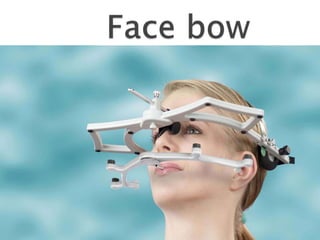
 The face bow is a caliper – like device that is
used to record the relationship of the jaws to
the opening axis of the jaw and to orient the
cast in this same relationship to the opening
axis of the articulator .
 U-shaped frame
 Condylar rods
 Bite fork
 Locking device
 Orbital pointer with clamp
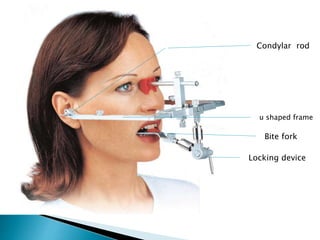
u shaped frame
Bite fork
Locking device
Condylar rod
 U-shaped frame
It is a u shaped metallic bar that forms the main frame of
the face-bow . All other component are attached to the frame with
the help of clamps . It record the plane of cranium.
Condylar rods
These are two small metallic rods on either side of the free end of the
u-shaped frame that contacts the skin over the TMJ . They help to
locate the hinge axis or opening axis of TMJ . Face bow that have
condylar rod ,to record true hinge axis are called as kinematic
facebow and those having earpiece are called arbitrary face bow .
Bite fork
It is a U-shaped plate ,which is attached to the occlusal
rims while recording the orientation relation . The bite fork should be
inserted about 3mm below the occlusal surface within the occlusal
rim .
locking device
This part of the face-bow helps to attach the bite
fork to the U-shaped frame . It also support the face bow ,occlusal
rim and cast during articulation .
Orbital pointer
It is designed to mark the anterior reference point
(infraorbital notch) and can be locked in position with a clamp . It is
present only in arbitrary face bow
 A) Arbitrary face-bow
facia type
Earpiece type
Hanau face-bow (spring bow )
Slidematic ( denar )
Twirl bow
Whipmix
B) Kinematic or hinge bow
Arbitrary face bow
The hinge axis is approximately located in this type of face bow.
It is commonly used for complete denture construction.
This is type of face bows generally locate the true Hinge axis within a range of 5
mm.
a)facia type
Here , the hinge axis or the posterior reference point is 13mm anterior to the external
auditory meatus and anterior reference point is orbitale (midpoint of the lower
border of orbit) . The face bow has pointer that can be positioned to the posterior
reference point .
Ear piece type
The posterior reference point is the external auditory meatus and
the anterior reference point is orbitale . The earpiece engage in
posterior reference point .
hanau face-bow
It is most commonly used face bow
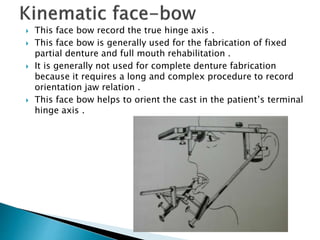
 This face bow record the true hinge axis .
 This face bow is generally used for the fabrication of fixed
partial denture and full mouth rehabilitation .
 It is generally not used for complete denture fabrication
because it requires a long and complex procedure to record
orientation jaw relation .
 This face bow helps to orient the cast in the patient’s terminal
hinge axis .
Recording orientation jaw relation using an
arbitrary face-bow (using a hanau face-bow)
 The patient is seated in comfortable position with the head upright
and supported by the head rest .
 A point is marked 13mm anterior to auditory meatus on a line
running from the outer canthous to the superior order of the tragus
 Guideline for anterior teeth placement is marked on bite fork
 The U shaped frame of face-bow along with the condylar rods is
positioned on the posterior reference point marked 13mm in front of
external auditory meatus .
 The stem of bite fork is locked to transverse rod of the face-bow .
 The stem of bite fork is locked to the transverse rod of face bow .
 The infraorbital notch is palpated and marked . The orbital pointer is
made to touch the infraorbital notch and locked in position to the U
frame with an orbital clamp .
 The entire face-bow assembly along with the occlusal rim is removed
from the mouth and positioned in the articulator .
 The bite fork along with stem is placed in patient’s mouth .
 The face bow is attached to the stem of bite fork and the
condylar rods are located at a point 13mm in front of
auditory meatus on the canthotragus line .
 The mandible should be guided to produce opening and
closing movements , which are purely rotational . The patient
should be asked to make eccentric movement
 The condylar rods will move during mandibular movement
,the point at which the condylar rods show pure rotation
indicates the hinge axis .
 The condylar rods are locked in this position and the face-
bow is removed .
 And the orientation jaw relation is translated to articulator .

Face bow

  • 2.
     The facebow is a caliper – like device that is used to record the relationship of the jaws to the opening axis of the jaw and to orient the cast in this same relationship to the opening axis of the articulator .
  • 3.
     U-shaped frame Condylar rods  Bite fork  Locking device  Orbital pointer with clamp
  • 4.
    u shaped frame Bitefork Locking device Condylar rod
  • 5.
     U-shaped frame Itis a u shaped metallic bar that forms the main frame of the face-bow . All other component are attached to the frame with the help of clamps . It record the plane of cranium. Condylar rods These are two small metallic rods on either side of the free end of the u-shaped frame that contacts the skin over the TMJ . They help to locate the hinge axis or opening axis of TMJ . Face bow that have condylar rod ,to record true hinge axis are called as kinematic facebow and those having earpiece are called arbitrary face bow .
  • 6.
    Bite fork It isa U-shaped plate ,which is attached to the occlusal rims while recording the orientation relation . The bite fork should be inserted about 3mm below the occlusal surface within the occlusal rim . locking device This part of the face-bow helps to attach the bite fork to the U-shaped frame . It also support the face bow ,occlusal rim and cast during articulation . Orbital pointer It is designed to mark the anterior reference point (infraorbital notch) and can be locked in position with a clamp . It is present only in arbitrary face bow
  • 7.
     A) Arbitraryface-bow facia type Earpiece type Hanau face-bow (spring bow ) Slidematic ( denar ) Twirl bow Whipmix B) Kinematic or hinge bow
  • 8.
    Arbitrary face bow Thehinge axis is approximately located in this type of face bow. It is commonly used for complete denture construction. This is type of face bows generally locate the true Hinge axis within a range of 5 mm. a)facia type Here , the hinge axis or the posterior reference point is 13mm anterior to the external auditory meatus and anterior reference point is orbitale (midpoint of the lower border of orbit) . The face bow has pointer that can be positioned to the posterior reference point .
  • 9.
    Ear piece type Theposterior reference point is the external auditory meatus and the anterior reference point is orbitale . The earpiece engage in posterior reference point . hanau face-bow It is most commonly used face bow
  • 10.
     This facebow record the true hinge axis .  This face bow is generally used for the fabrication of fixed partial denture and full mouth rehabilitation .  It is generally not used for complete denture fabrication because it requires a long and complex procedure to record orientation jaw relation .  This face bow helps to orient the cast in the patient’s terminal hinge axis .
  • 11.
    Recording orientation jawrelation using an arbitrary face-bow (using a hanau face-bow)  The patient is seated in comfortable position with the head upright and supported by the head rest .  A point is marked 13mm anterior to auditory meatus on a line running from the outer canthous to the superior order of the tragus  Guideline for anterior teeth placement is marked on bite fork  The U shaped frame of face-bow along with the condylar rods is positioned on the posterior reference point marked 13mm in front of external auditory meatus .  The stem of bite fork is locked to transverse rod of the face-bow .  The stem of bite fork is locked to the transverse rod of face bow .  The infraorbital notch is palpated and marked . The orbital pointer is made to touch the infraorbital notch and locked in position to the U frame with an orbital clamp .  The entire face-bow assembly along with the occlusal rim is removed from the mouth and positioned in the articulator .
  • 12.
     The bitefork along with stem is placed in patient’s mouth .  The face bow is attached to the stem of bite fork and the condylar rods are located at a point 13mm in front of auditory meatus on the canthotragus line .  The mandible should be guided to produce opening and closing movements , which are purely rotational . The patient should be asked to make eccentric movement  The condylar rods will move during mandibular movement ,the point at which the condylar rods show pure rotation indicates the hinge axis .  The condylar rods are locked in this position and the face- bow is removed .  And the orientation jaw relation is translated to articulator .