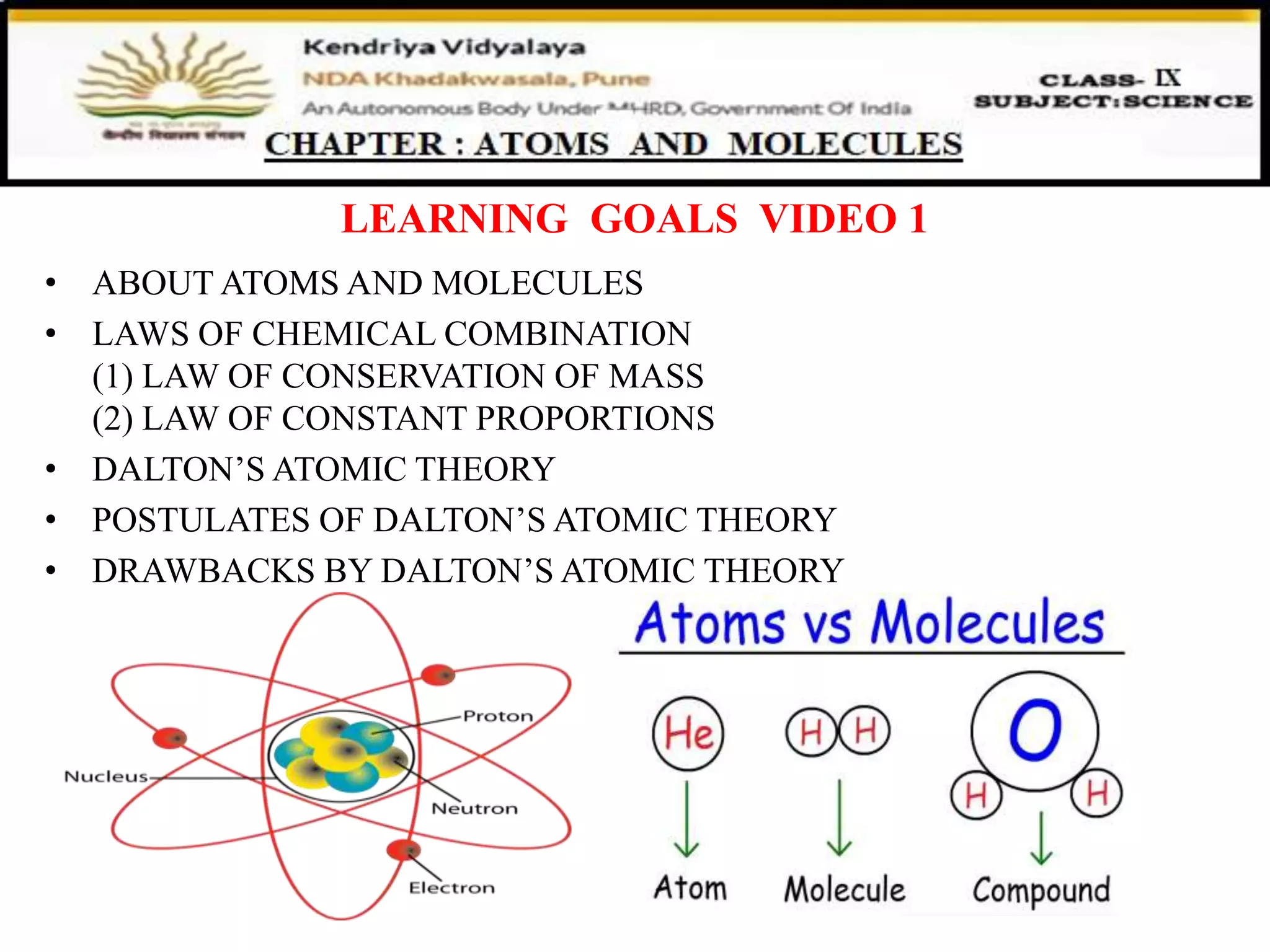
LEARNING GOALS VIDEO 1
• ABOUT ATOMS AND MOLECULES
• LAWS OF CHEMICAL COMBINATION
(1) LAW OF CONSERVATION OF MASS
(2) LAW OF CONSTANT PROPORTIONS
• DALTON’S ATOMIC THEORY
• POSTULATES OF DALTON’S ATOMIC THEORY
• DRAWBACKS BY DALTON’S ATOMIC THEORY
ABOUT ATOMS AND MOLECULES
• In 500BC Indian philosopher Maharishi
Kanad had postulated that matter is
divisible i.e. when we go on breaking the
matter we will get smaller and smaller
particle . The particle obtained is so small
that they cannot be divided further . These
particles were named as Parmanu .
• In almost same year ancient greek
philosopher Democritus and Leucippus also
put forward same idea . They called
smallest indivisible particle as atom.
• During same era an Indian Philosopher ,
Pakhuda Katyayama said that atom may not
exist in free state but may exist in combine
state called Compounds .
LAW OF CHEMICAL COMBINATION
• Whenever reactants react together to form
product or elements combine together to
form compound . They do so according to
certain laws . These laws are called Laws
of Chemical Combination .
(1) Law of Conservation of Mass
(2) Law of constant proportion
LAW OF CONSERVATION OF MASS
• This law was given by Antoine Lavoisier in 1774 .
• Law states that Mass can neither be created nor destroyed in a chemical
reaction. In simple words , in any chemical reaction , the total mass of the
reactants is equal to total mass of product .
• Example : Calcium Carbonate (CaCO3) on heating decomposes to form
calcium oxide (CaO) and Carbon Dioxide (CO2) . It is found that if 100g of
calcium carbonate is heated , it gives 56g of calcium oxide and 44g of carbon
dioxide . Thus for reaction ,
CaCO3  CaO + CO2
Mass of reactant (CaCO3) = 100g
Total mass of product : 56 + 44 = 100g
Total mass of product = Total mass of reactant
This proves the law .
Problem
When 0.0976g of magnesium was heated in air, 0.1618g of magnesium oxide (MgO) was
produced. What is the mass of oxygen needed to produce 0.1618g MgO?
Solution:
According to law of conservation of mass,
Total mass reactants = Total mass products
mass of Mg + mass O = mass of MgO
0.0976g Mg + mass O = 0.1618g MgO
mass O = 0.1618g – 0.0976 = 0.0642g O
Problem :
Silicon dioxide, made up of elements silicon and oxygen, contains 46.7% by mass of
silicon. With what mass of oxygen will 10 g of silicon combine?
Solution:
100g of silicon dioxide contains 46.7 g of silicon, or 100 – 46.7 ( i.e. 53.3 g) of oxygen.
It means, 10g of silicon will contain (10/100) × 53.3 = 5.33 g of oxygen.
Problem : 2
In a chemical reaction 150 g Baking soda mixture containing sodium bicarbonate and vinegar on
heating gives 87 g of carbon dioxide gas. What mass of solid residue will left in food?
Solution:
According to law of conservation of mass,
Total mass of reactants = Total mass of products.
Here, baking soda mixture (reactant) on heating gives solid residue and carbon dioxide (
products).Here baking soda mixture (reactant) on heating gives solid residue and carbon
dioxide ( products).
MBaking soda = MSolid residue + MCarbon dioxide
Hence, the mass of solid residue is 150g – 87g = 63g.
Problem :
Silicon dioxide, made up of elements silicon and oxygen, contains 46.7% by mass of
silicon. With what mass of oxygen will 10 g of silicon combine?
Solution:
100g of silicon dioxide contains 46.7 g of silicon, or 100 – 46.7 ( i.e. 53.3 g) of oxygen.
It means, 10g of silicon will contain (10/100) × 53.3 = 5.33 g of oxygen.
Problem : 2
In a chemical reaction 150 g Baking soda mixture containing sodium bicarbonate and vinegar on
heating gives 87 g of carbon dioxide gas. What mass of solid residue will left in food?
Solution:
According to law of conservation of mass,
Total mass of reactants = Total mass of products.
Here, baking soda mixture (reactant) on heating gives solid residue and carbon dioxide (
products).Here baking soda mixture (reactant) on heating gives solid residue and carbon
dioxide ( products).
MBaking soda = MSolid residue + MCarbon dioxide
Hence, the mass of solid residue is 150g – 87g = 63g.
LAW OF DEFINITE PROPORTIONS OR CONSTANT COMPOSITION
• This was put forward by J.L.Proust in 1799
• It states that Chemical compound is always made up of same elements
combined together in same fixed proportion by mass .
• Example : Carbon dioxide can be prepared by any one method :
1. By burning charcoal in air : (C+O2  CO2)
2. By heating limestone : (CaCO3  CaO + CO2)
3. BY adding dilute hydrochloric acid on any carbonate :
(NaCO3 + 2HCl  2NaCl + H2O + CO2)
4. By heating sodium bicarbonate : (2NaHCO3  NaCO3 + H2O + CO2)
• Carbon dioxide is made by same elements in same fixed ratio
LAW OF DEFINITE PROPORTIONS OR CONSTANT COMPOSITION
• As law of constant proportion is true , it helps to calculate % of any
element in given compound by :
% of element in compound = Mass of Element X 100
Mass of compound
DALTON’S ATOMIC THEORY
• POSTULATES OF DALTON’S ATOMIC
THEORY
(i) All matter is made of very tiny
particles called atoms, which
participate in chemical reactions.
(ii) Atoms are indivisible particles, which
cannot be created or destroyed in a
chemical reaction.
(iii)Atoms of a given element are identical
in mass and chemical properties.
(iv) Atoms of different elements have
different masses and chemical
properties.
(v) Atoms combine in the ratio of small
whole numbers to form compounds.
(vi) The relative number and kinds of
atoms are constant in a given
compound.
SUMMARY
• ABOUT ATOMS AND MOLECULES
• LAWS OF CHEMICAL COMBINATION
(1) LAW OF CONSERVATION OF MASS
(2) LAW OF CONSTANT PROPORTIONS
• DALTON’S ATOMIC THEORY
• POSTULATES OF DALTON’S ATOMIC THEORY
• DRAWBACKS BY DALTON’S ATOMIC THEORY

Class 9 ppt 1 atoms n molecules

  • 1.
    LEARNING GOALS VIDEO1 • ABOUT ATOMS AND MOLECULES • LAWS OF CHEMICAL COMBINATION (1) LAW OF CONSERVATION OF MASS (2) LAW OF CONSTANT PROPORTIONS • DALTON’S ATOMIC THEORY • POSTULATES OF DALTON’S ATOMIC THEORY • DRAWBACKS BY DALTON’S ATOMIC THEORY
  • 2.
    ABOUT ATOMS ANDMOLECULES • In 500BC Indian philosopher Maharishi Kanad had postulated that matter is divisible i.e. when we go on breaking the matter we will get smaller and smaller particle . The particle obtained is so small that they cannot be divided further . These particles were named as Parmanu . • In almost same year ancient greek philosopher Democritus and Leucippus also put forward same idea . They called smallest indivisible particle as atom. • During same era an Indian Philosopher , Pakhuda Katyayama said that atom may not exist in free state but may exist in combine state called Compounds .
  • 3.
    LAW OF CHEMICALCOMBINATION • Whenever reactants react together to form product or elements combine together to form compound . They do so according to certain laws . These laws are called Laws of Chemical Combination . (1) Law of Conservation of Mass (2) Law of constant proportion
  • 4.
    LAW OF CONSERVATIONOF MASS • This law was given by Antoine Lavoisier in 1774 . • Law states that Mass can neither be created nor destroyed in a chemical reaction. In simple words , in any chemical reaction , the total mass of the reactants is equal to total mass of product . • Example : Calcium Carbonate (CaCO3) on heating decomposes to form calcium oxide (CaO) and Carbon Dioxide (CO2) . It is found that if 100g of calcium carbonate is heated , it gives 56g of calcium oxide and 44g of carbon dioxide . Thus for reaction , CaCO3  CaO + CO2 Mass of reactant (CaCO3) = 100g Total mass of product : 56 + 44 = 100g Total mass of product = Total mass of reactant This proves the law .
  • 6.
    Problem When 0.0976g ofmagnesium was heated in air, 0.1618g of magnesium oxide (MgO) was produced. What is the mass of oxygen needed to produce 0.1618g MgO? Solution: According to law of conservation of mass, Total mass reactants = Total mass products mass of Mg + mass O = mass of MgO 0.0976g Mg + mass O = 0.1618g MgO mass O = 0.1618g – 0.0976 = 0.0642g O
  • 7.
    Problem : Silicon dioxide,made up of elements silicon and oxygen, contains 46.7% by mass of silicon. With what mass of oxygen will 10 g of silicon combine? Solution: 100g of silicon dioxide contains 46.7 g of silicon, or 100 – 46.7 ( i.e. 53.3 g) of oxygen. It means, 10g of silicon will contain (10/100) × 53.3 = 5.33 g of oxygen. Problem : 2 In a chemical reaction 150 g Baking soda mixture containing sodium bicarbonate and vinegar on heating gives 87 g of carbon dioxide gas. What mass of solid residue will left in food? Solution: According to law of conservation of mass, Total mass of reactants = Total mass of products. Here, baking soda mixture (reactant) on heating gives solid residue and carbon dioxide ( products).Here baking soda mixture (reactant) on heating gives solid residue and carbon dioxide ( products). MBaking soda = MSolid residue + MCarbon dioxide Hence, the mass of solid residue is 150g – 87g = 63g.
  • 8.
    Problem : Silicon dioxide,made up of elements silicon and oxygen, contains 46.7% by mass of silicon. With what mass of oxygen will 10 g of silicon combine? Solution: 100g of silicon dioxide contains 46.7 g of silicon, or 100 – 46.7 ( i.e. 53.3 g) of oxygen. It means, 10g of silicon will contain (10/100) × 53.3 = 5.33 g of oxygen. Problem : 2 In a chemical reaction 150 g Baking soda mixture containing sodium bicarbonate and vinegar on heating gives 87 g of carbon dioxide gas. What mass of solid residue will left in food? Solution: According to law of conservation of mass, Total mass of reactants = Total mass of products. Here, baking soda mixture (reactant) on heating gives solid residue and carbon dioxide ( products).Here baking soda mixture (reactant) on heating gives solid residue and carbon dioxide ( products). MBaking soda = MSolid residue + MCarbon dioxide Hence, the mass of solid residue is 150g – 87g = 63g.
  • 9.
    LAW OF DEFINITEPROPORTIONS OR CONSTANT COMPOSITION • This was put forward by J.L.Proust in 1799 • It states that Chemical compound is always made up of same elements combined together in same fixed proportion by mass . • Example : Carbon dioxide can be prepared by any one method : 1. By burning charcoal in air : (C+O2  CO2) 2. By heating limestone : (CaCO3  CaO + CO2) 3. BY adding dilute hydrochloric acid on any carbonate : (NaCO3 + 2HCl  2NaCl + H2O + CO2) 4. By heating sodium bicarbonate : (2NaHCO3  NaCO3 + H2O + CO2) • Carbon dioxide is made by same elements in same fixed ratio
  • 10.
    LAW OF DEFINITEPROPORTIONS OR CONSTANT COMPOSITION • As law of constant proportion is true , it helps to calculate % of any element in given compound by : % of element in compound = Mass of Element X 100 Mass of compound
  • 12.
    DALTON’S ATOMIC THEORY •POSTULATES OF DALTON’S ATOMIC THEORY (i) All matter is made of very tiny particles called atoms, which participate in chemical reactions. (ii) Atoms are indivisible particles, which cannot be created or destroyed in a chemical reaction. (iii)Atoms of a given element are identical in mass and chemical properties. (iv) Atoms of different elements have different masses and chemical properties. (v) Atoms combine in the ratio of small whole numbers to form compounds. (vi) The relative number and kinds of atoms are constant in a given compound.
  • 14.
    SUMMARY • ABOUT ATOMSAND MOLECULES • LAWS OF CHEMICAL COMBINATION (1) LAW OF CONSERVATION OF MASS (2) LAW OF CONSTANT PROPORTIONS • DALTON’S ATOMIC THEORY • POSTULATES OF DALTON’S ATOMIC THEORY • DRAWBACKS BY DALTON’S ATOMIC THEORY