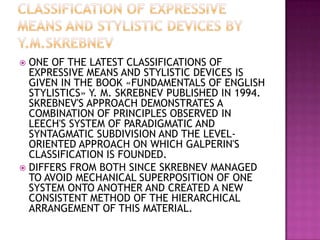
ONE OF THE LATEST CLASSIFICATIONS OF
EXPRESSIVE MEANS AND STYLISTIC DEVICES IS
GIVEN IN THE BOOK «FUNDAMENTALS OF ENGLISH
STYLISTICS» Y. M. SKREBNEV PUBLISHED IN 1994.
SKREBNEV'S APPROACH DEMONSTRATES A
COMBINATION OF PRINCIPLES OBSERVED IN
LEECH'S SYSTEM OF PARADIGMATIC AND
SYNTAGMATIC SUBDIVISION AND THE LEVELORIENTED APPROACH ON WHICH GALPERIN'S
CLASSIFICATION IS FOUNDED.
 DIFFERS FROM BOTH SINCE SKREBNEV MANAGED
TO AVOID MECHANICAL SUPERPOSITION OF ONE
SYSTEM ONTO ANOTHER AND CREATED A NEW
CONSISTENT METHOD OF THE HIERARCHICAL
ARRANGEMENT OF THIS MATERIAL.



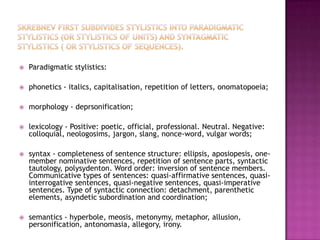
Paradigmatic stylistics:



phonetics - italics, capitalisation, repetition of letters, onomatopoeia;



morphology - deprsonification;



lexicology - Positive: poetic, official, professional. Neutral. Negative:
colloquial, neologosims, jargon, slang, nonce-word, vulgar words;



syntax - completeness of sentence structure: ellipsis, aposiopesis, onemember nominative sentences, repetition of sentence parts, syntactic
tautology, polysydenton. Word order: inversion of sentence members.
Communicative types of sentences: quasi-affirmative sentences, quasiinterrogative sentences, quasi-negative sentences, quasi-imperative
sentences. Type of syntactic connection: detachment, parenthetic
elements, asyndetic subordination and coordination;



semantics - hyperbole, meosis, metonymy, metaphor, allusion,
personification, antonomasia, allegory, irony.


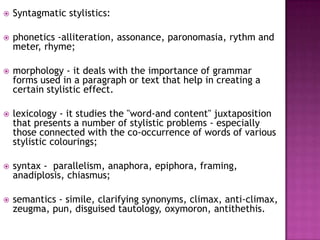
Syntagmatic stylistics:



phonetics -alliteration, assonance, paronomasia, rythm and
meter, rhyme;



morphology - it deals with the importance of grammar
forms used in a paragraph or text that help in creating a
certain stylistic effect.



lexicology - it studies the "word-and content" juxtaposition
that presents a number of stylistic problems - especially
those connected with the co-occurrence of words of various
stylistic colourings;



syntax - parallelism, anaphora, epiphora, framing,
anadiplosis, chiasmus;



semantics - simile, clarifying synonyms, climax, anti-climax,
zeugma, pun, disguised tautology, oxymoron, antithethis.
Simply organized and very detailed.
 His manual "Stylistics" published in 1971
includes following subdivision of expressive
means and stylistic devices based on the
level-oriented approach:

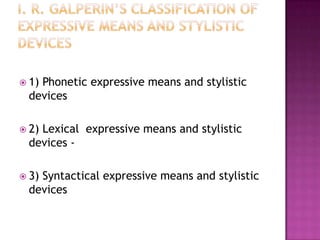
 1)

Phonetic expressive means and stylistic
devices

 2)

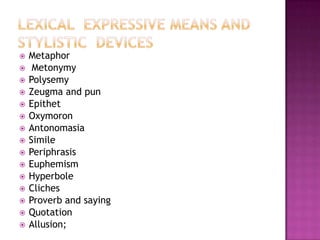
Lexical expressive means and stylistic
devices -

 3)

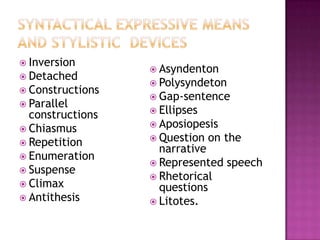
Syntactical expressive means and stylistic
devices
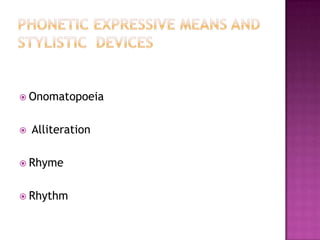
 Onomatopoeia



Alliteration

 Rhyme
 Rhythm



















Metaphor
Metonymy
Polysemy
Zeugma and pun
Epithet
Oxymoron
Antonomasia
Simile
Periphrasis
Euphemism
Hyperbole
Cliches
Proverb and saying
Quotation
Allusion;
 Inversion
 Detached
 Constructions
 Parallel

constructions
 Chiasmus
 Repetition
 Enumeration
 Suspense
 Climax
 Antithesis

 Asyndenton
 Polysyndeton
 Gap-sentence
 Ellipses
 Aposiopesis
 Question

on the

narrativе
 Represented speech
 Rhetorical
questions
 Litotes.


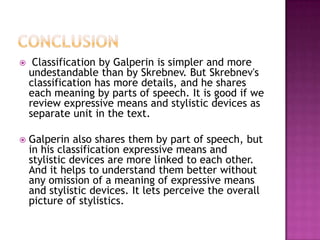
Classification by Galperin is simpler and more
undestandable than by Skrebnev. But Skrebnev's
classification has more details, and he shares
each meaning by parts of speech. It is good if we
review expressive means and stylistic devices as
separate unit in the text.



Galperin also shares them by part of speech, but
in his classification expressive means and
stylistic devices are more linked to each other.
And it helps to understand them better without
any omission of a meaning of expressive means
and stylistic devices. It lets perceive the overall
picture of stylistics.

сLassif

  • 2.
    ONE OF THELATEST CLASSIFICATIONS OF EXPRESSIVE MEANS AND STYLISTIC DEVICES IS GIVEN IN THE BOOK «FUNDAMENTALS OF ENGLISH STYLISTICS» Y. M. SKREBNEV PUBLISHED IN 1994. SKREBNEV'S APPROACH DEMONSTRATES A COMBINATION OF PRINCIPLES OBSERVED IN LEECH'S SYSTEM OF PARADIGMATIC AND SYNTAGMATIC SUBDIVISION AND THE LEVELORIENTED APPROACH ON WHICH GALPERIN'S CLASSIFICATION IS FOUNDED.  DIFFERS FROM BOTH SINCE SKREBNEV MANAGED TO AVOID MECHANICAL SUPERPOSITION OF ONE SYSTEM ONTO ANOTHER AND CREATED A NEW CONSISTENT METHOD OF THE HIERARCHICAL ARRANGEMENT OF THIS MATERIAL. 
  • 3.
     Paradigmatic stylistics:  phonetics -italics, capitalisation, repetition of letters, onomatopoeia;  morphology - deprsonification;  lexicology - Positive: poetic, official, professional. Neutral. Negative: colloquial, neologosims, jargon, slang, nonce-word, vulgar words;  syntax - completeness of sentence structure: ellipsis, aposiopesis, onemember nominative sentences, repetition of sentence parts, syntactic tautology, polysydenton. Word order: inversion of sentence members. Communicative types of sentences: quasi-affirmative sentences, quasiinterrogative sentences, quasi-negative sentences, quasi-imperative sentences. Type of syntactic connection: detachment, parenthetic elements, asyndetic subordination and coordination;  semantics - hyperbole, meosis, metonymy, metaphor, allusion, personification, antonomasia, allegory, irony.
  • 4.
     Syntagmatic stylistics:  phonetics -alliteration,assonance, paronomasia, rythm and meter, rhyme;  morphology - it deals with the importance of grammar forms used in a paragraph or text that help in creating a certain stylistic effect.  lexicology - it studies the "word-and content" juxtaposition that presents a number of stylistic problems - especially those connected with the co-occurrence of words of various stylistic colourings;  syntax - parallelism, anaphora, epiphora, framing, anadiplosis, chiasmus;  semantics - simile, clarifying synonyms, climax, anti-climax, zeugma, pun, disguised tautology, oxymoron, antithethis.
  • 5.
    Simply organized andvery detailed.  His manual "Stylistics" published in 1971 includes following subdivision of expressive means and stylistic devices based on the level-oriented approach: 
  • 6.
     1) Phonetic expressivemeans and stylistic devices  2) Lexical expressive means and stylistic devices -  3) Syntactical expressive means and stylistic devices
  • 7.
  • 8.
  • 9.
     Inversion  Detached Constructions  Parallel constructions  Chiasmus  Repetition  Enumeration  Suspense  Climax  Antithesis  Asyndenton  Polysyndeton  Gap-sentence  Ellipses  Aposiopesis  Question on the narrativе  Represented speech  Rhetorical questions  Litotes.
  • 10.
     Classification by Galperinis simpler and more undestandable than by Skrebnev. But Skrebnev's classification has more details, and he shares each meaning by parts of speech. It is good if we review expressive means and stylistic devices as separate unit in the text.  Galperin also shares them by part of speech, but in his classification expressive means and stylistic devices are more linked to each other. And it helps to understand them better without any omission of a meaning of expressive means and stylistic devices. It lets perceive the overall picture of stylistics.