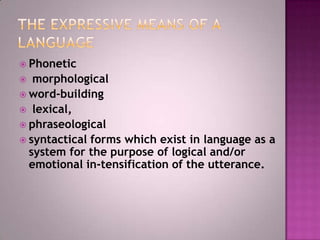
 Phonetic

morphological
 word-building
 lexical,
 phraseological
 syntactical forms which exist in language as a
system for the purpose of logical and/or
emotional in-tensification of the utterance.

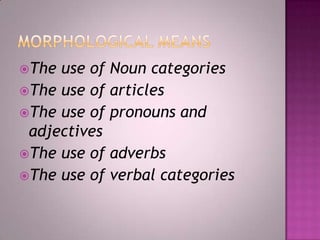
The

use of
The use of
The use of
adjectives
The use of
The use of

Noun categories
articles
pronouns and
adverbs
verbal categories
1) grammatical categories of number
2) case definiteness/ indefiniteness
It may be based on:
a) repeating the same words in a syntactical construction, e.g. women
are women, or
b) using metaphorically nouns which belong to different lexicogrammatical classes, e.g. He is a devil with the women (S.Barstow).

3) The possessive case:
inanimate and abstract nouns,
e.g. kitchen’s work, the plan’s failure.
a word group or a sentence, e.g. The blonde I had been dancing with’s name was
Bemice Crabs or Krebs (J. Salinger).


the category of definiteness /
indefiniteness

There are two ways of achieving a stylistic effect
through the usage or non-usage of articles:
 1) the violation of usual combinability of the definite
and indefinite articles with proper names and the
nouns denoting unique objects (sun, moon, sky, earth).
 2) the transposition of the meaning of an article in
context
 category

of comparison.
 e.g. the most Italian car.
 The meaning of comparison can be also expressed
lexically through equonisms,
e.g. senior – junior,
 and adjectives with the –ish suffix, e.g. mannish,
womanish, which are occasional words which
sound less categoric.
1) The usage of archaic (thee, thou, thy) or
low colloquial forms of pronouns

Pronouns can also undergo various contextual transpositions:
1) when we is used instead of I (I → we transposition):
a) Pluralis Auctoris ("editorial we”), when the author speaks on
behalf of a certain group, party, or class;
b) Pluralis Majestatis, when we is used as a symbol of royal
power;
c) Pluralis Modestial, when we is used as a means of involving the
reader or listener into the author’s thoughts. It is typical of oral or
written scientific prose;
d) when we is employed to impart to the utterance a jocular
unceremonious coloring;
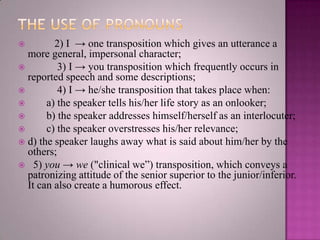
2) I → one transposition which gives an utterance a
more general, impersonal character;

3) I → you transposition which frequently occurs in
reported speech and some descriptions;

4) I → he/she transposition that takes place when:

a) the speaker tells his/her life story as an onlooker;

b) the speaker addresses himself/herself as an interlocuter;

c) the speaker overstresses his/her relevance;
 d) the speaker laughs away what is said about him/her by the
others;
 5) you → we ("clinical we”) transposition, which conveys a
patronizing attitude of the senior superior to the junior/inferior.
It can also create a humorous effect.

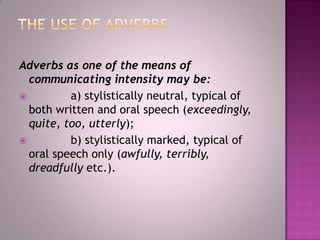
Adverbs as one of the means of
communicating intensity may be:

a) stylistically neutral, typical of
both written and oral speech (exceedingly,
quite, too, utterly);

b) stylistically marked, typical of
oral speech only (awfully, terribly,
dreadfully etc.).
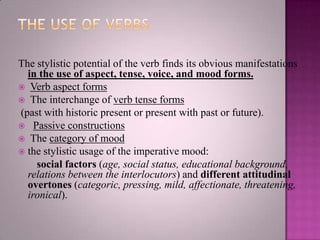
The stylistic potential of the verb finds its obvious manifestations
in the use of aspect, tense, voice, and mood forms.
 Verb aspect forms
 The interchange of verb tense forms
(past with historic present or present with past or future).
 Passive constructions
 The category of mood
 the stylistic usage of the imperative mood:
social factors (age, social status, educational background,
relations between the interlocutors) and different attitudinal
overtones (categoric, pressing, mild, affectionate, threatening,
ironical).

Morphological means

  • 2.
     Phonetic morphological  word-building lexical,  phraseological  syntactical forms which exist in language as a system for the purpose of logical and/or emotional in-tensification of the utterance. 
  • 3.
    The use of The useof The use of adjectives The use of The use of Noun categories articles pronouns and adverbs verbal categories
  • 4.
    1) grammatical categoriesof number 2) case definiteness/ indefiniteness It may be based on: a) repeating the same words in a syntactical construction, e.g. women are women, or b) using metaphorically nouns which belong to different lexicogrammatical classes, e.g. He is a devil with the women (S.Barstow). 3) The possessive case: inanimate and abstract nouns, e.g. kitchen’s work, the plan’s failure. a word group or a sentence, e.g. The blonde I had been dancing with’s name was Bemice Crabs or Krebs (J. Salinger).
  • 5.
     the category ofdefiniteness / indefiniteness There are two ways of achieving a stylistic effect through the usage or non-usage of articles:  1) the violation of usual combinability of the definite and indefinite articles with proper names and the nouns denoting unique objects (sun, moon, sky, earth).  2) the transposition of the meaning of an article in context
  • 6.
     category of comparison. e.g. the most Italian car.  The meaning of comparison can be also expressed lexically through equonisms, e.g. senior – junior,  and adjectives with the –ish suffix, e.g. mannish, womanish, which are occasional words which sound less categoric.
  • 7.
    1) The usageof archaic (thee, thou, thy) or low colloquial forms of pronouns Pronouns can also undergo various contextual transpositions: 1) when we is used instead of I (I → we transposition): a) Pluralis Auctoris ("editorial we”), when the author speaks on behalf of a certain group, party, or class; b) Pluralis Majestatis, when we is used as a symbol of royal power; c) Pluralis Modestial, when we is used as a means of involving the reader or listener into the author’s thoughts. It is typical of oral or written scientific prose; d) when we is employed to impart to the utterance a jocular unceremonious coloring;
  • 8.
    2) I →one transposition which gives an utterance a more general, impersonal character;  3) I → you transposition which frequently occurs in reported speech and some descriptions;  4) I → he/she transposition that takes place when:  a) the speaker tells his/her life story as an onlooker;  b) the speaker addresses himself/herself as an interlocuter;  c) the speaker overstresses his/her relevance;  d) the speaker laughs away what is said about him/her by the others;  5) you → we ("clinical we”) transposition, which conveys a patronizing attitude of the senior superior to the junior/inferior. It can also create a humorous effect. 
  • 9.
    Adverbs as oneof the means of communicating intensity may be:  a) stylistically neutral, typical of both written and oral speech (exceedingly, quite, too, utterly);  b) stylistically marked, typical of oral speech only (awfully, terribly, dreadfully etc.).
  • 10.
    The stylistic potentialof the verb finds its obvious manifestations in the use of aspect, tense, voice, and mood forms.  Verb aspect forms  The interchange of verb tense forms (past with historic present or present with past or future).  Passive constructions  The category of mood  the stylistic usage of the imperative mood: social factors (age, social status, educational background, relations between the interlocutors) and different attitudinal overtones (categoric, pressing, mild, affectionate, threatening, ironical).