Пединститут ЮФУ
Тема: Lexical Expressive means and stylistic
                  devices

                         Волгина Екатерина Андреевна
Кандидат филологических наук, доцент кафедры теории и
                          практики английского языка,
                 Ул.Большая Садовая,33.тел.240-82-09

           г.Ростов-на-Дону,28.09.2011.
Волгина Екатерина Андреевна
Кандидат филологических наук, доцент
кафедры теории и практики английского
                               языка,
 Ул.Большая Садовая,33.тел.240-82-09


            г.Ростов-на-Дону,28.09.2011.
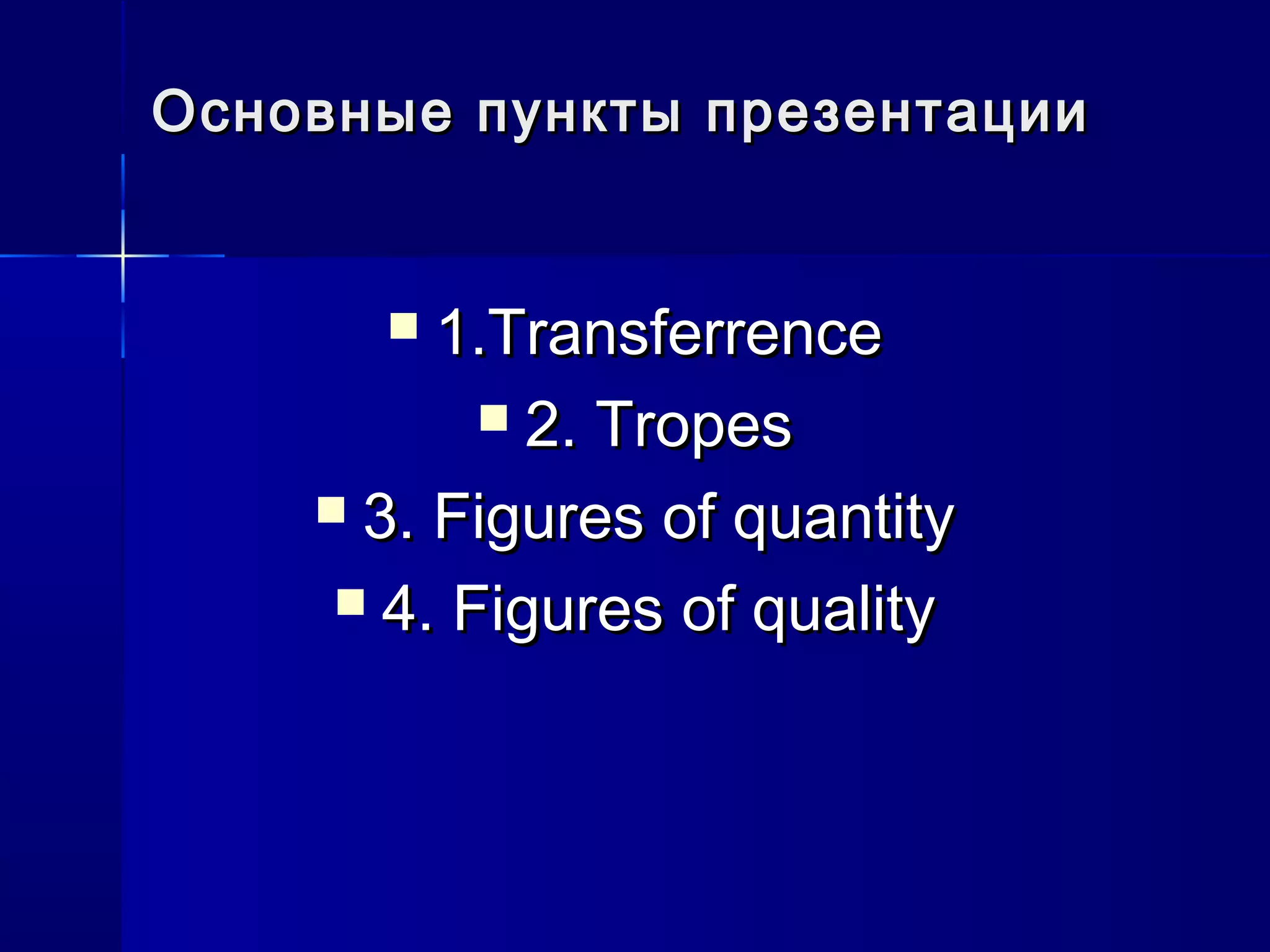
Основные пункты презентации


        1.Transferrence
            2. Tropes

     3. Figures of quantity

      4. Figures of quality
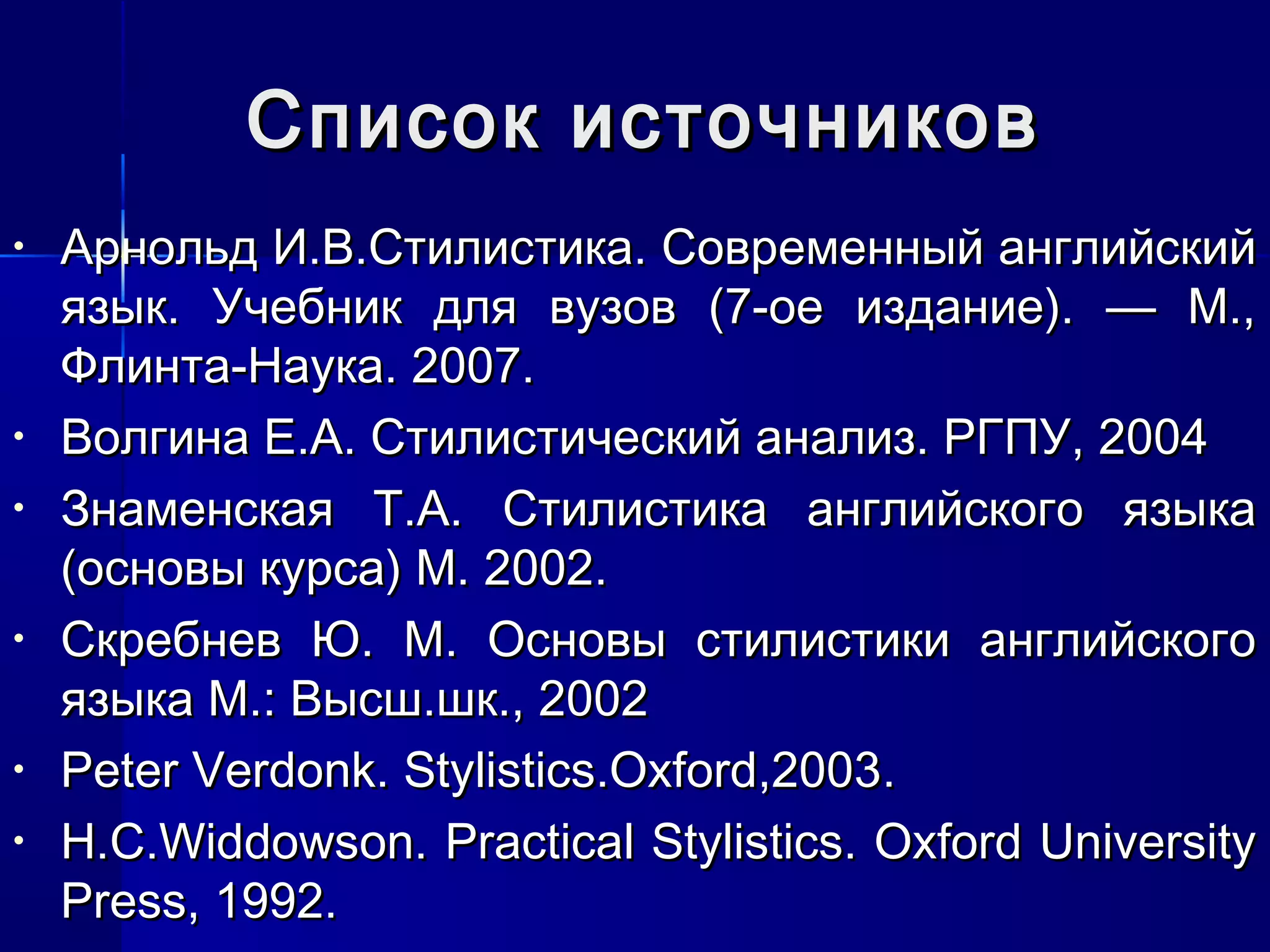
Список источников
•   Арнольд И.В.Стилистика. Современный английский
    язык. Учебник для вузов (7-ое издание). — М.,
    Флинта-Наука. 2007.
•   Волгина Е.А. Стилистический анализ. РГПУ, 2004
•   Знаменская Т.А. Стилистика английского языка
    (основы курса) М. 2002.
•   Скребнев Ю. М. Основы стилистики английского
    языка М.: Высш.шк., 2002
•   Peter Verdonk. Stylistics.Oxford,2003.
•   H.C.Widdowson. Practical Stylistics. Oxford University
    Press, 1992.
Literature on Metaphor
   1.Aristotle. Poetics and Rhetoric
   2. I.A.Richards.The Philosophy of Rhetoric, 1936
   3.Kenneth Burke. Grammar of Motives, 1945
   4.Lakoff G. & M.Johnson. Metaphors We Live By,
    1980
   5. Thornbury,S. Metaphors We Work By, 1991
   6. Cameron &Low. Metaphoric Intelligence and
    Foreign Language Learning.2001
   7. Robin Tolmach Lakoff. The Language War, 2000.
Literature on Metaphor
   Eggigton, W. The English Language
    Metaphors We Plan By., 1997.
   Gwynn R. “Captain on My Ship”:
    Metaphor and the Discourse of
    Chronic Illness” in L.Cameron &
    G.Low. 1999
LEXICAL STYLISTIC DEVICES (1)
Figures of Quantity: Hyperbole,
                  Understatement (Meiosis).

Figures of Quality:
Metonymy - based on contiguity,

Metaphor - based on similarity, likeness, affinity,

Irony – two objects are diametrically opposite.
Interaction of different
types of lexical meanings
(Galperin)(2)
   Interaction of primary & contextually
    imposed meanings=metaphor,
    metonomy, irony
   Interaction of logical & emotive
    meanings= epithet, oxymoron
   Intensification of a certain feature of a
    thing = hyperbole.
Epithet (3)-Interaction of
   logical and emotive
   meaning
 From Greek “epitheton”

   Epithet = an individual emotional
    appraisement of an object, state or
    action .

   E.g. He found himself waving a school-
    masterish finger in front of his face.
Epithet (4)
   By an adjective: a monstrous fish
   By participle I or II: crabbed age, a
    god- fearing man
   By an of-phrase: an air of indifference
   By an adverb: she glanced at him
    furtively
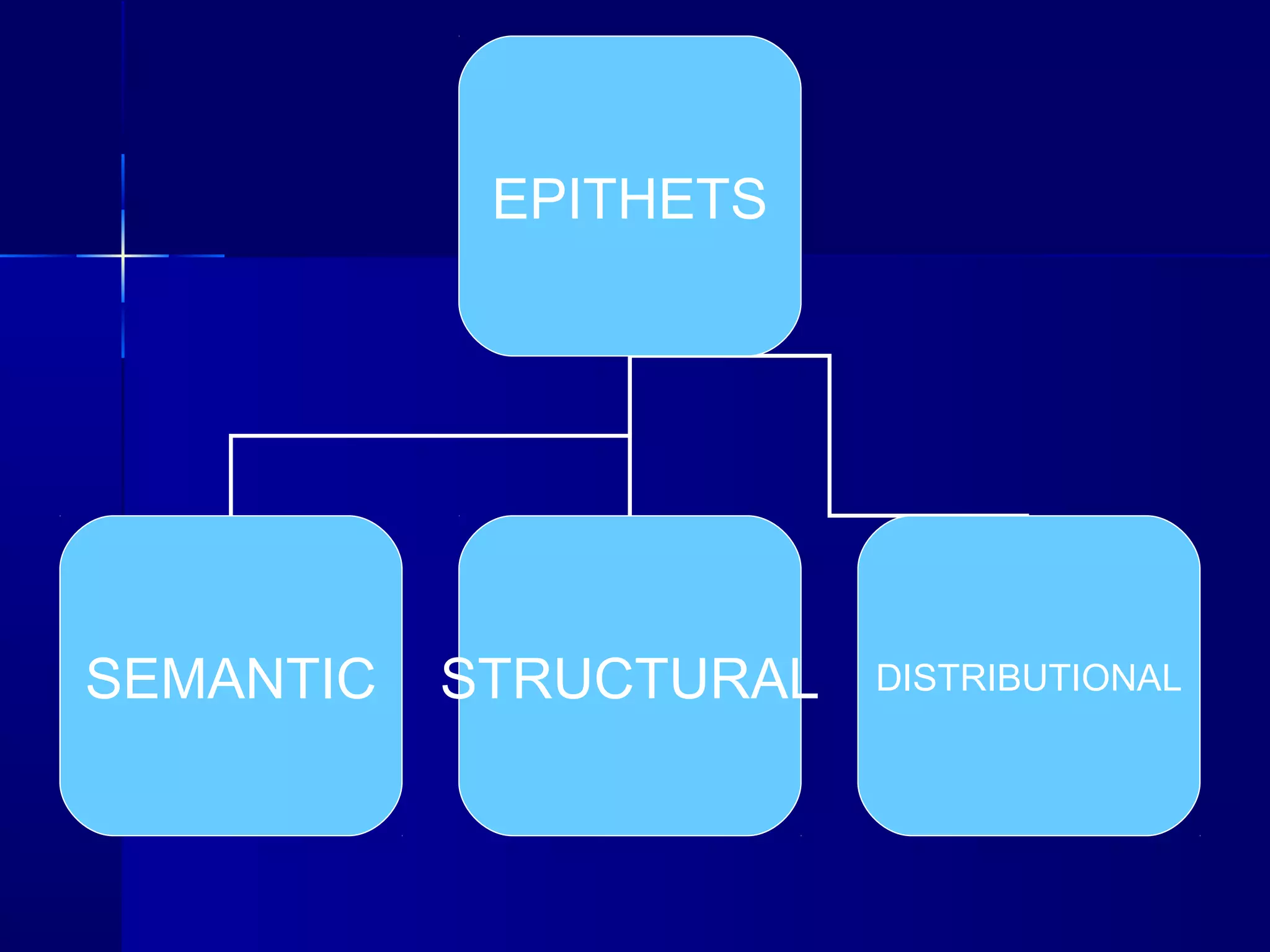
EPITHETS


SEMANTIC   STRUCTURAL   DISTRIBUTIONAL
SEMANTIC Standpoint
(6)
 Associated:   silvery fur

 Unassociated:   silvery laughter
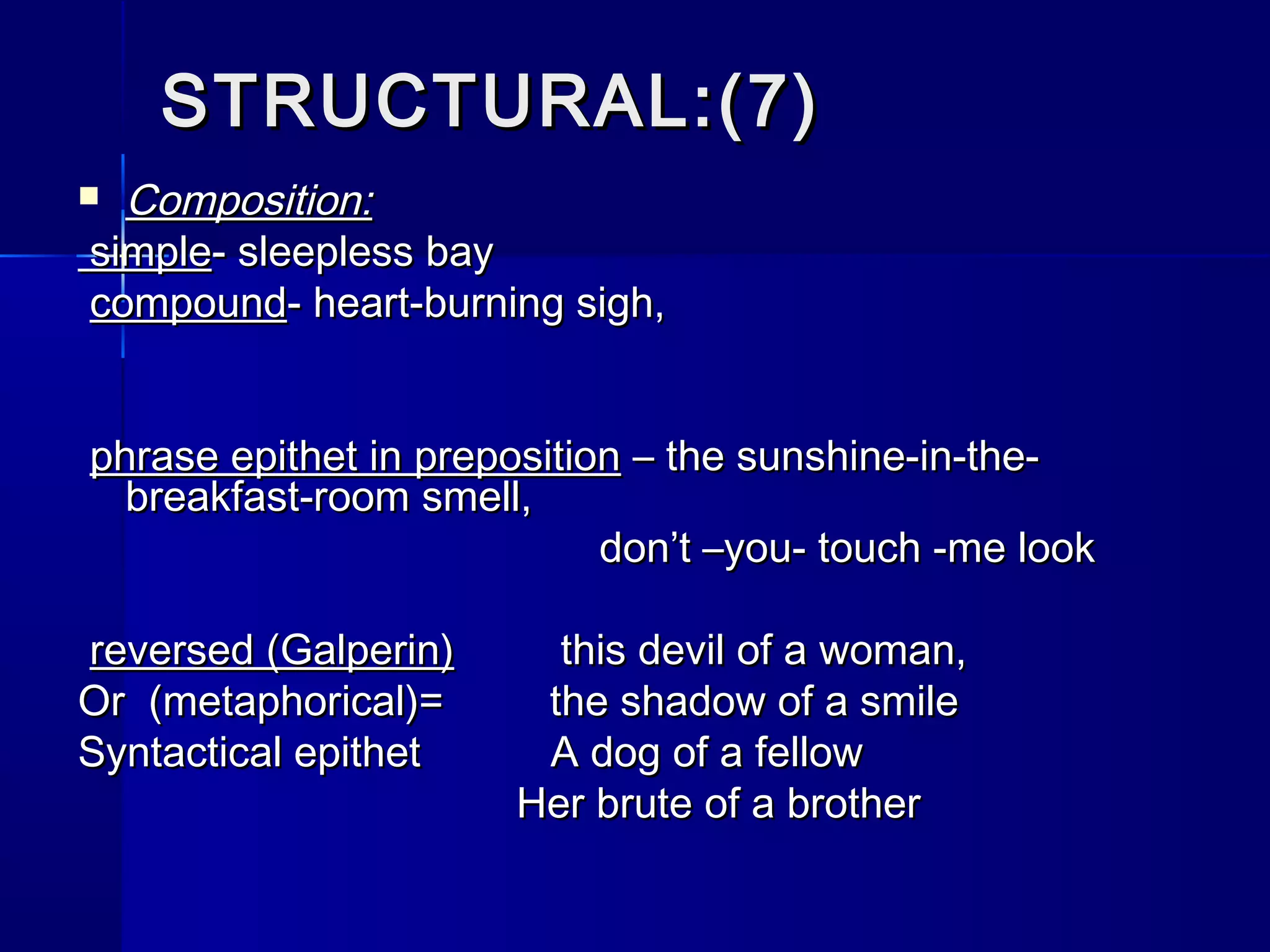
STRUCTURAL:(7)
 Composition:
simple- sleepless bay
compound- heart-burning sigh,


phrase epithet in preposition – the sunshine-in-the-
  breakfast-room smell,
                            don’t –you- touch -me look

reversed (Galperin)     this devil of a woman,
Or (metaphorical)=     the shadow of a smile
Syntactical epithet    A dog of a fellow
                      Her brute of a brother
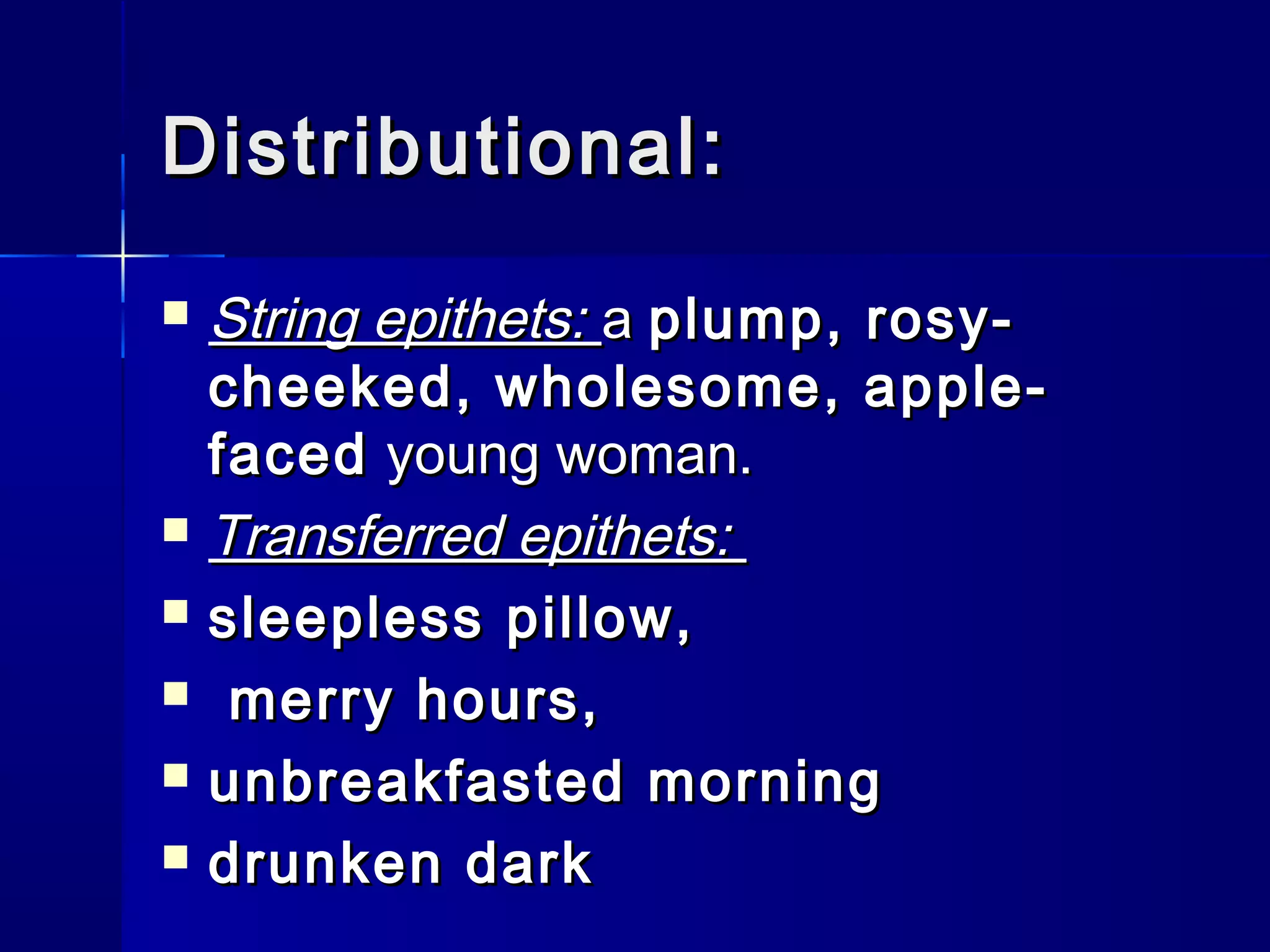
Distributional:
 String epithets: a plump, rosy-
  cheeked, wholesome, apple-
  faced young woman.
 Transferred epithets:

 sleepless pillow,

 merry hours,

 unbreakfasted morning

 drunken dark
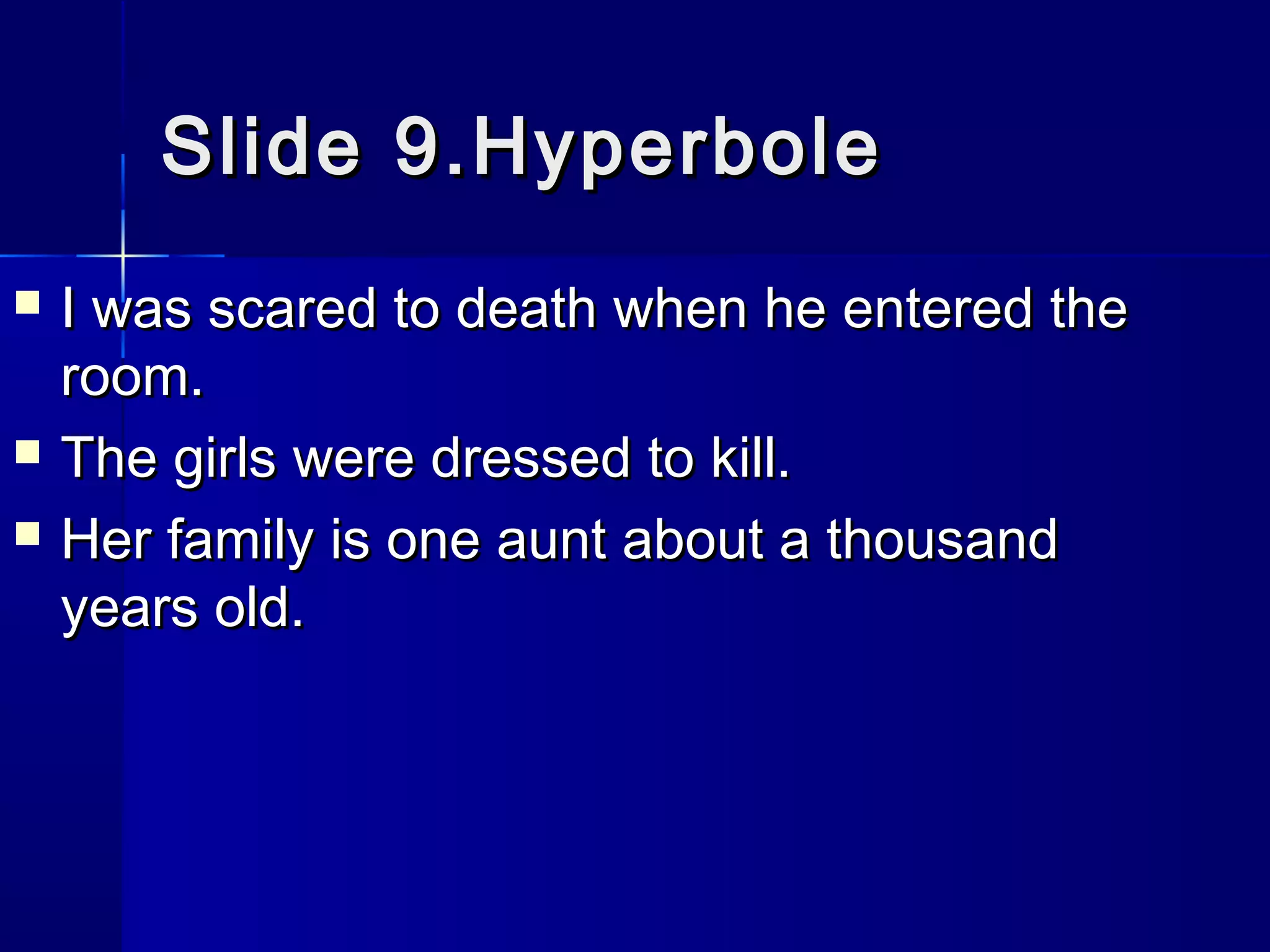
Slide 9.Hyperbole
   I was scared to death when he entered the
    room.
   The girls were dressed to kill.
   Her family is one aunt about a thousand
    years old.
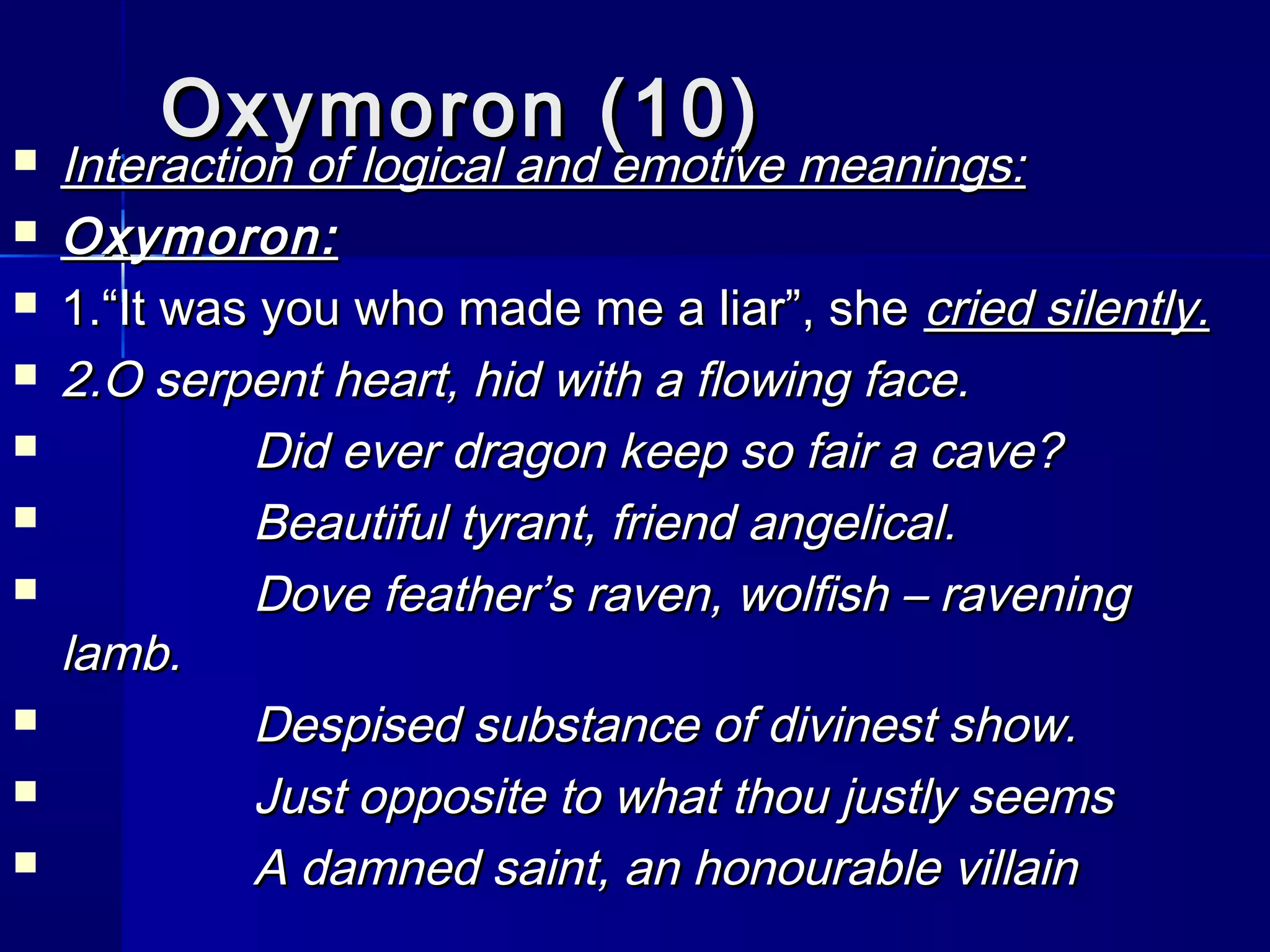
Oxymoron (10)
   Interaction of logical and emotive meanings:
   Oxymoron:
   1.“It was you who made me a liar”, she cried silently.
   2.O serpent heart, hid with a flowing face.
             Did ever dragon keep so fair a cave?
             Beautiful tyrant, friend angelical.
             Dove feather’s raven, wolfish – ravening
    lamb.
             Despised substance of divinest show.
             Just opposite to what thou justly seems
             A damned saint, an honourable villain
METONYMY(11)-interaction of
dictionary and contextual logical
meanings
 She  is coming, my life , my fate.
 He made his way through the
  perfume and conversation.
Metonymy(12)
   1. Language metonymy: the Crown – Monarchy
                      the bar –the lawyers
                      the pulpit – the priests

   2. Speech metonymy: From the cradle to the grave
TYPES of METONYMY (13)
   1. Names of tools instead of names of actions : Give
    every man thine ear and few thy voice .
    (Shakespeare)

   2. Consequence instead of cause: It (fish)
    desperately takes the death.

   3. Characteristic feature of the object: The
    moustache was standing by the window.

   Symbol instead of object symbolized:Crown for
    King, or Queen.
Synecdoche (14)
   Return to her and fifty men dismissed?
   No, rather I abjure all roofs, and
    choose
   To wage against the enmity o’ the air,
   To be a comrade with the wolf and
    owl.
   Shakespeare, King Lear).
   Hands wanted. All hands on deck.
METAPHOR (15)
   Trite: Seeds of evil, to burn with
    desire.

 Fresh: He smelled the ever-beautiful
  smell of coffee imprisoned in the can.
 They walked along, two continents of
  experience and feeling, unable to
  communicate.
Prolonged Metaphor (16)


 We need you here. It’s a dear old
 town, but it’s a rough diamond, and
 we need you for the polishing, and
 we’re ever so humble…
Catachresis (17)
   “For somewhere”, said Poirot to himself,
    indulging in an absolute riot of mixed
    metaphors, “ there is in the hay a needle,
    and among the sleeping dogs there is one
    on whom I shall put my foot, and by
    shooting the arrow into the air, one will
    come down and hit a glass-house”.
   To look for a needle in a haystack,
   To let sleeping dogs lie,
   To put one’s foot down,
   I shot an arrow into the air.
Personification (18)
   Now the bright morning-star, day’s harbinger,
   Comes dancing from the East, and leads
    with her
   The flowery May, who from her green lap
    throws
   The yellow cowslip and the pale primrose.
    (Milton, Song on May Morning)
Personification (19)
   E.g. But the privations, or rather the
    hardships, of Lowood lessened.
    Spring drew on; she had indeed
    already come, the frosts of winter had
    ceased; its snows were melted; its
    cutting winds ameliorated.
IRONY (20)- from Greek
     “eironeia’
   She turned with the sweet smile of an
    alligator
   Mr Micawber said in his usual plain
    manner.
   Verbal Irony:
   E.g. Last time it was a nice, simple,
    European-style war.
Irony (21)
   He was fond of everyone who was good
    to him – of his pony- of Lord Southdown
    who gave him the horse - of Molly, the
    cook who told him stories at night – of
    Briggs, his mother’s companion whom
    he laughed at – and of his father.
    (Thackeray, Vanity Fair).
Lexical stylistic devices
(22)
   1. Transference and transferred
    meaning.
   2. Tropes (stylistic devices) as
    figurative, image-bearing stylistic
    means.
   3. Classification of tropes in the
    English language.
   4.The structural types and functions of
    the tropes.
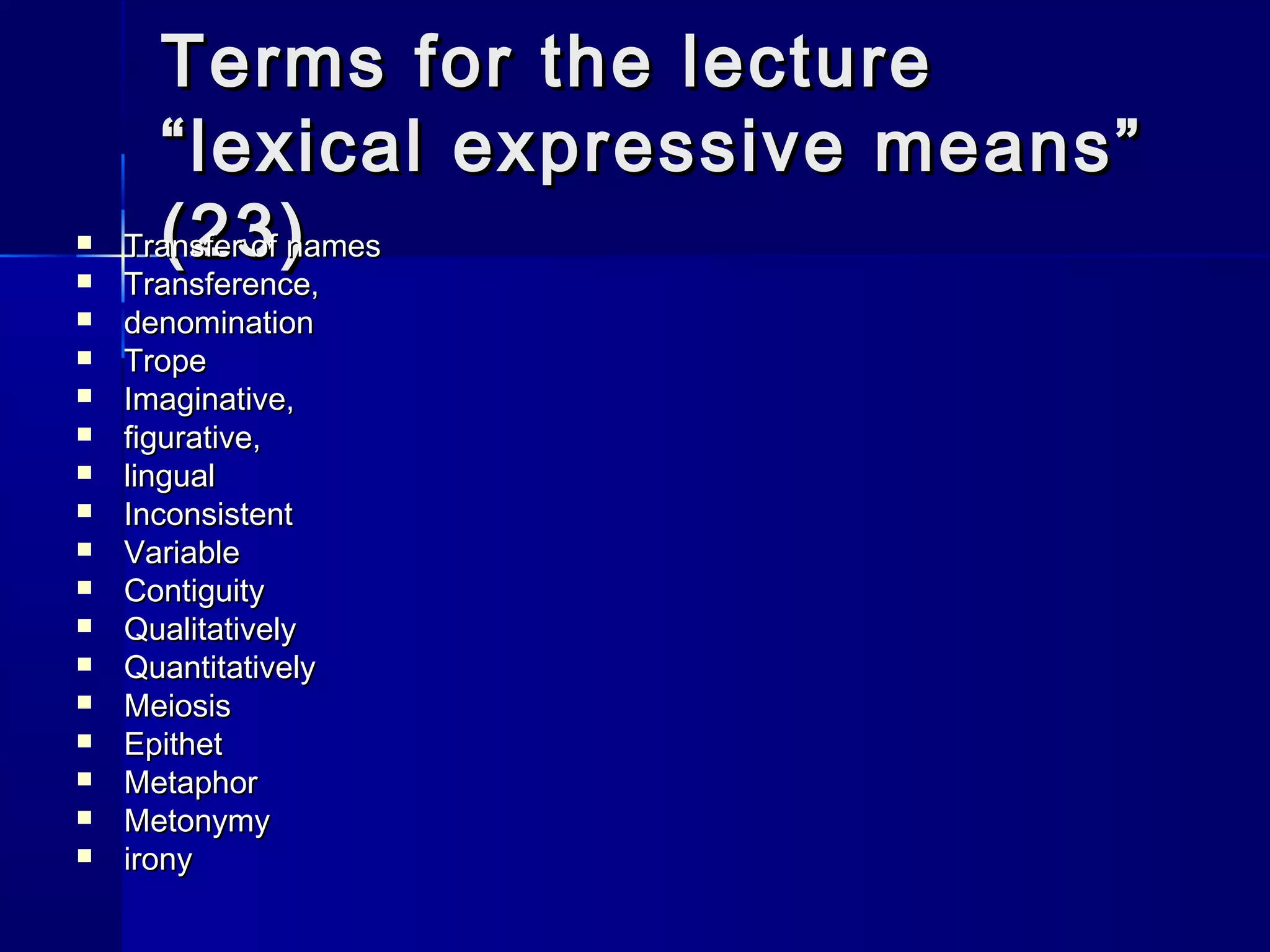
Terms for the lecture
      “lexical expressive means”
     (23)
    Transfer of names
   Transference,
   denomination
   Trope
   Imaginative,
   figurative,
   lingual
   Inconsistent
   Variable
   Contiguity
   Qualitatively
   Quantitatively
   Meiosis
   Epithet
   Metaphor
   Metonymy
   irony
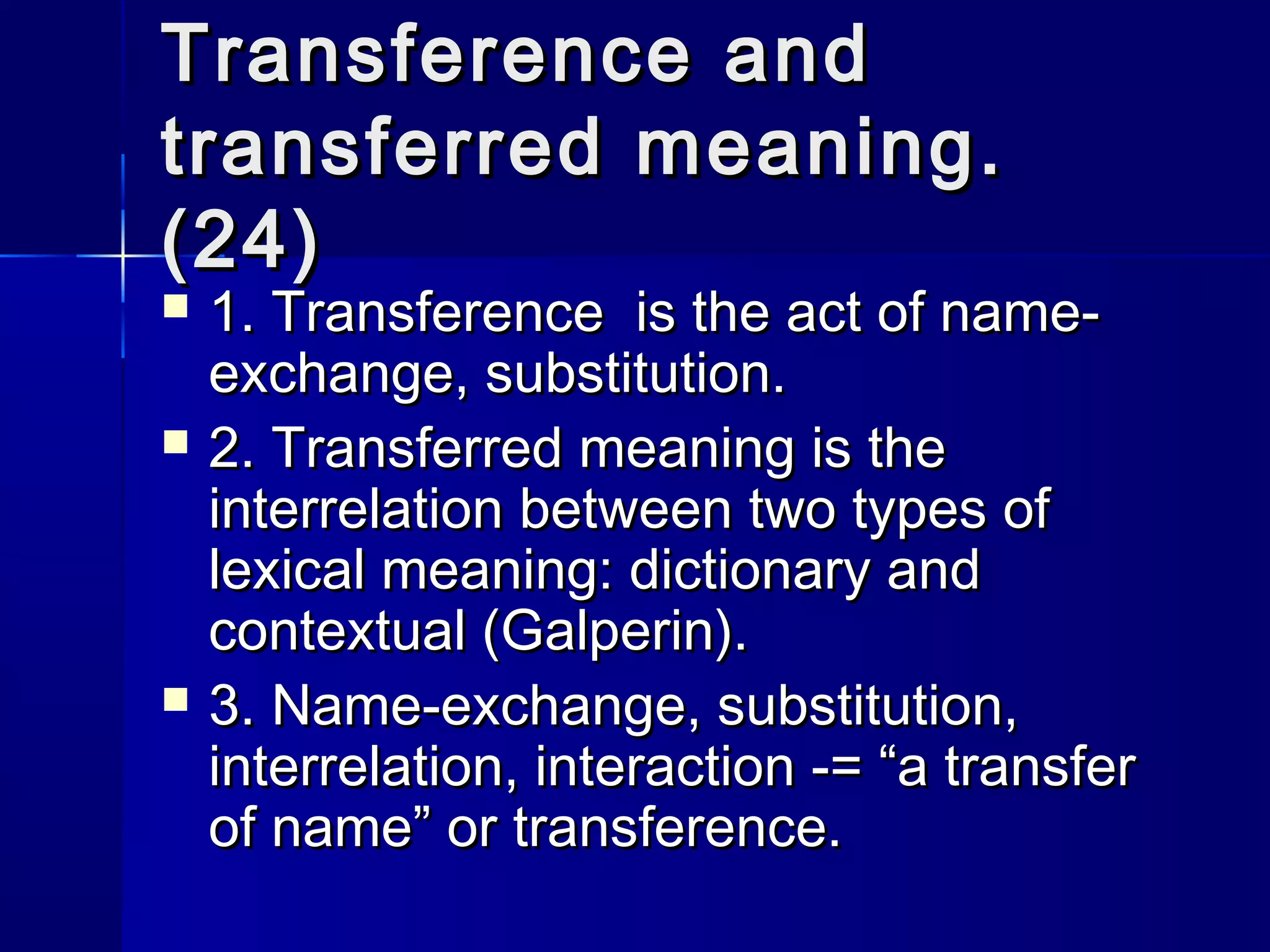
Transference and
transferred meaning.
(24)
   1. Transference is the act of name-
    exchange, substitution.
   2. Transferred meaning is the
    interrelation between two types of
    lexical meaning: dictionary and
    contextual (Galperin).
   3. Name-exchange, substitution,
    interrelation, interaction -= “a transfer
    of name” or transference.
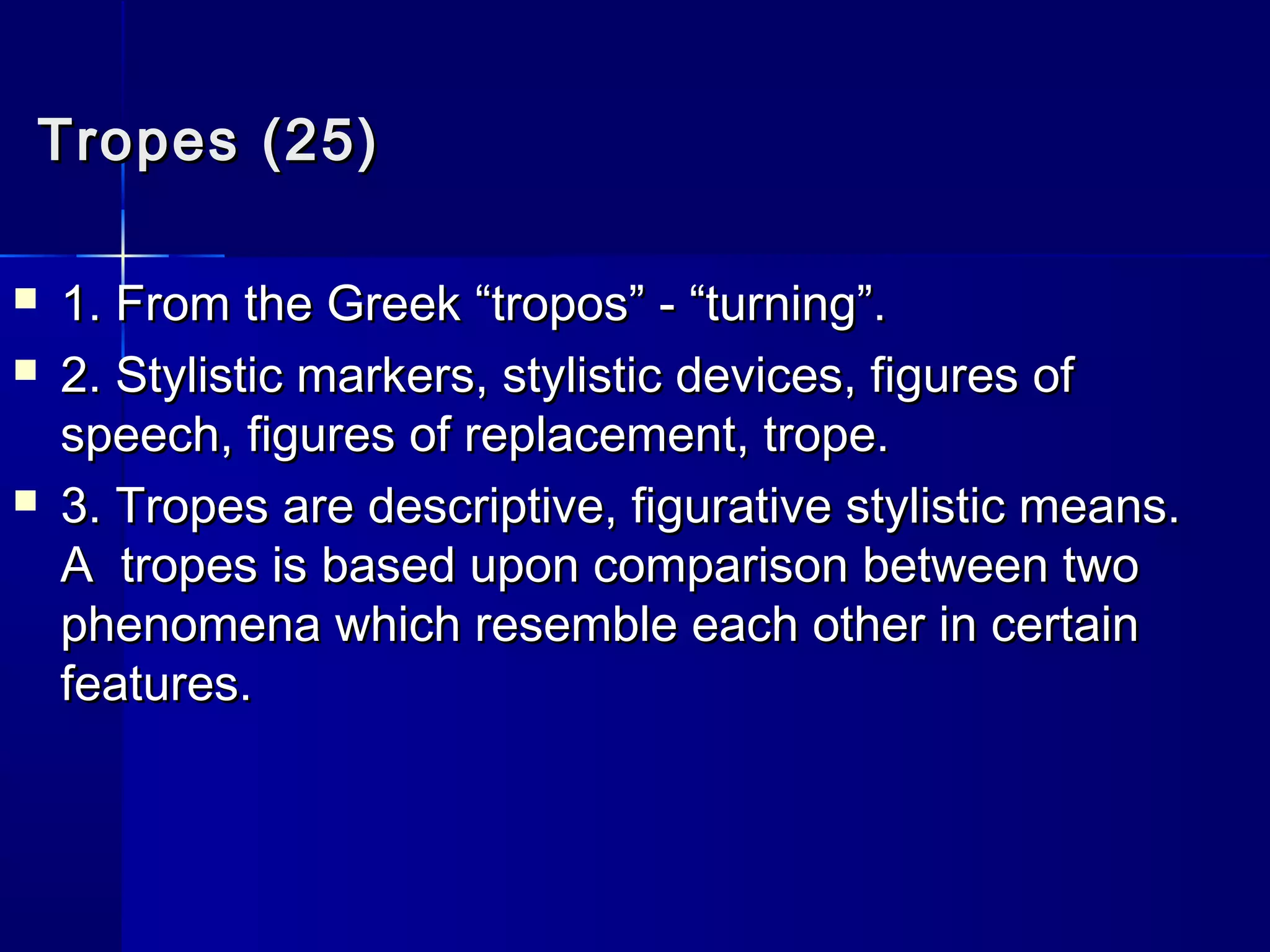
Tropes (25)

   1. From the Greek “tropos” - “turning”.
   2. Stylistic markers, stylistic devices, figures of
    speech, figures of replacement, trope.
   3. Tropes are descriptive, figurative stylistic means.
    A tropes is based upon comparison between two
    phenomena which resemble each other in certain
    features.
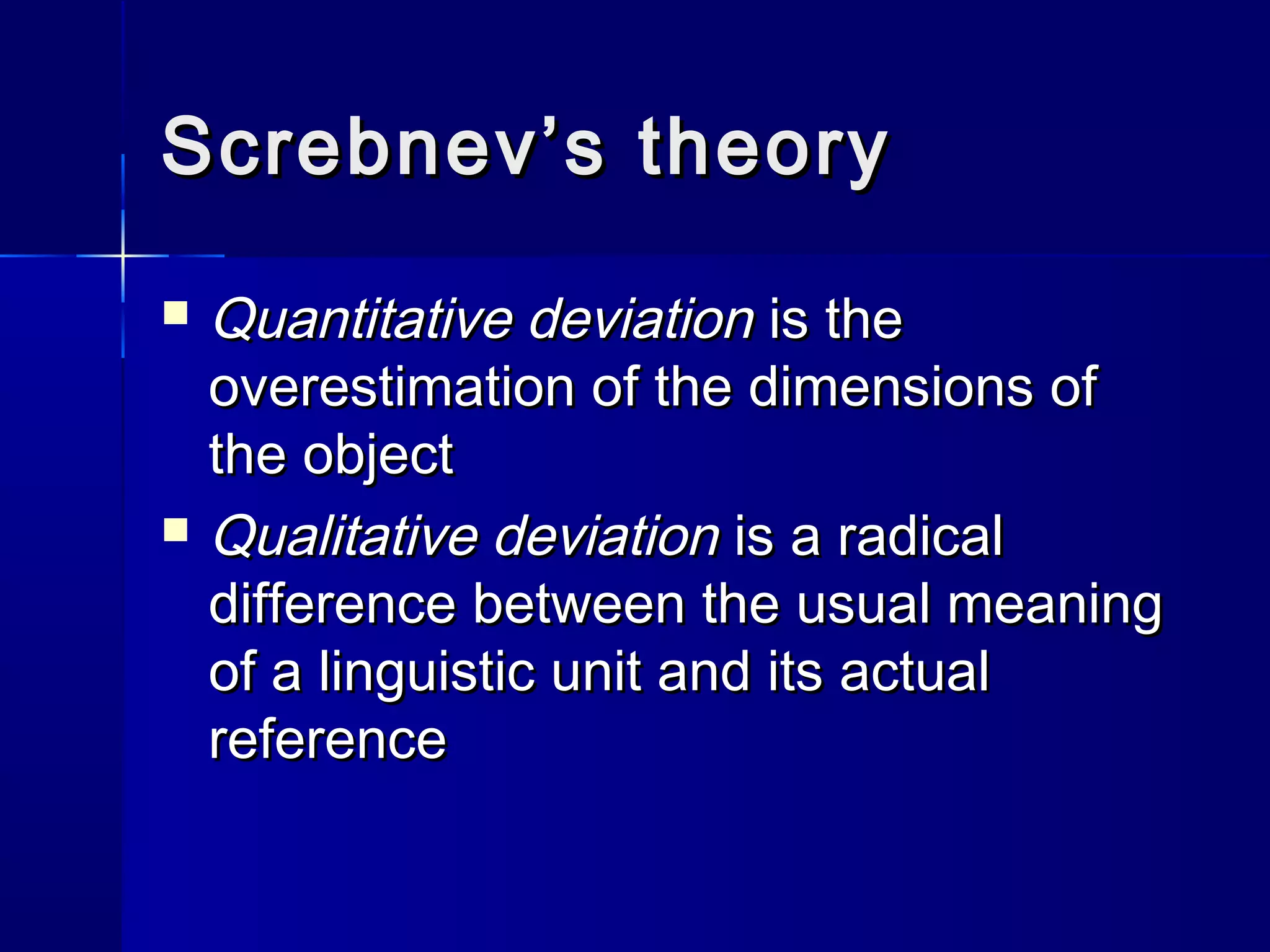
Screbnev’s theory
 Quantitative deviation is the
  overestimation of the dimensions of
  the object
 Qualitative deviation is a radical
  difference between the usual meaning
  of a linguistic unit and its actual
  reference
Thank you!

Ул.Большая Садовая,33.тел.240-82-09

Lexical stylistic devices lecture 5(slides)

  • 1.
    Пединститут ЮФУ Тема: LexicalExpressive means and stylistic devices Волгина Екатерина Андреевна Кандидат филологических наук, доцент кафедры теории и практики английского языка, Ул.Большая Садовая,33.тел.240-82-09 г.Ростов-на-Дону,28.09.2011.
  • 2.
    Волгина Екатерина Андреевна Кандидатфилологических наук, доцент кафедры теории и практики английского языка,  Ул.Большая Садовая,33.тел.240-82-09  г.Ростов-на-Дону,28.09.2011.
  • 3.
    Основные пункты презентации  1.Transferrence  2. Tropes  3. Figures of quantity  4. Figures of quality
  • 4.
    Список источников • Арнольд И.В.Стилистика. Современный английский язык. Учебник для вузов (7-ое издание). — М., Флинта-Наука. 2007. • Волгина Е.А. Стилистический анализ. РГПУ, 2004 • Знаменская Т.А. Стилистика английского языка (основы курса) М. 2002. • Скребнев Ю. М. Основы стилистики английского языка М.: Высш.шк., 2002 • Peter Verdonk. Stylistics.Oxford,2003. • H.C.Widdowson. Practical Stylistics. Oxford University Press, 1992.
  • 5.
    Literature on Metaphor  1.Aristotle. Poetics and Rhetoric  2. I.A.Richards.The Philosophy of Rhetoric, 1936  3.Kenneth Burke. Grammar of Motives, 1945  4.Lakoff G. & M.Johnson. Metaphors We Live By, 1980  5. Thornbury,S. Metaphors We Work By, 1991  6. Cameron &Low. Metaphoric Intelligence and Foreign Language Learning.2001  7. Robin Tolmach Lakoff. The Language War, 2000.
  • 6.
    Literature on Metaphor  Eggigton, W. The English Language Metaphors We Plan By., 1997.  Gwynn R. “Captain on My Ship”: Metaphor and the Discourse of Chronic Illness” in L.Cameron & G.Low. 1999
  • 7.
    LEXICAL STYLISTIC DEVICES(1) Figures of Quantity: Hyperbole, Understatement (Meiosis). Figures of Quality: Metonymy - based on contiguity, Metaphor - based on similarity, likeness, affinity, Irony – two objects are diametrically opposite.
  • 8.
    Interaction of different typesof lexical meanings (Galperin)(2)  Interaction of primary & contextually imposed meanings=metaphor, metonomy, irony  Interaction of logical & emotive meanings= epithet, oxymoron  Intensification of a certain feature of a thing = hyperbole.
  • 9.
    Epithet (3)-Interaction of logical and emotive meaning  From Greek “epitheton”  Epithet = an individual emotional appraisement of an object, state or action .  E.g. He found himself waving a school- masterish finger in front of his face.
  • 10.
    Epithet (4)  By an adjective: a monstrous fish  By participle I or II: crabbed age, a god- fearing man  By an of-phrase: an air of indifference  By an adverb: she glanced at him furtively
  • 11.
    EPITHETS SEMANTIC STRUCTURAL DISTRIBUTIONAL
  • 12.
    SEMANTIC Standpoint (6)  Associated: silvery fur  Unassociated: silvery laughter
  • 13.
    STRUCTURAL:(7)  Composition: simple- sleeplessbay compound- heart-burning sigh, phrase epithet in preposition – the sunshine-in-the- breakfast-room smell, don’t –you- touch -me look reversed (Galperin) this devil of a woman, Or (metaphorical)= the shadow of a smile Syntactical epithet A dog of a fellow Her brute of a brother
  • 14.
    Distributional:  String epithets:a plump, rosy- cheeked, wholesome, apple- faced young woman.  Transferred epithets:  sleepless pillow,  merry hours,  unbreakfasted morning  drunken dark
  • 15.
    Slide 9.Hyperbole  I was scared to death when he entered the room.  The girls were dressed to kill.  Her family is one aunt about a thousand years old.
  • 16.
    Oxymoron (10)  Interaction of logical and emotive meanings:  Oxymoron:  1.“It was you who made me a liar”, she cried silently.  2.O serpent heart, hid with a flowing face.  Did ever dragon keep so fair a cave?  Beautiful tyrant, friend angelical.  Dove feather’s raven, wolfish – ravening lamb.  Despised substance of divinest show.  Just opposite to what thou justly seems  A damned saint, an honourable villain
  • 17.
    METONYMY(11)-interaction of dictionary andcontextual logical meanings  She is coming, my life , my fate.  He made his way through the perfume and conversation.
  • 18.
    Metonymy(12)  1. Language metonymy: the Crown – Monarchy  the bar –the lawyers  the pulpit – the priests  2. Speech metonymy: From the cradle to the grave
  • 19.
    TYPES of METONYMY(13)  1. Names of tools instead of names of actions : Give every man thine ear and few thy voice . (Shakespeare)  2. Consequence instead of cause: It (fish) desperately takes the death.  3. Characteristic feature of the object: The moustache was standing by the window.  Symbol instead of object symbolized:Crown for King, or Queen.
  • 20.
    Synecdoche (14)  Return to her and fifty men dismissed?  No, rather I abjure all roofs, and choose  To wage against the enmity o’ the air,  To be a comrade with the wolf and owl.  Shakespeare, King Lear).  Hands wanted. All hands on deck.
  • 21.
    METAPHOR (15)  Trite: Seeds of evil, to burn with desire.  Fresh: He smelled the ever-beautiful smell of coffee imprisoned in the can.  They walked along, two continents of experience and feeling, unable to communicate.
  • 22.
    Prolonged Metaphor (16) We need you here. It’s a dear old town, but it’s a rough diamond, and we need you for the polishing, and we’re ever so humble…
  • 23.
    Catachresis (17)  “For somewhere”, said Poirot to himself, indulging in an absolute riot of mixed metaphors, “ there is in the hay a needle, and among the sleeping dogs there is one on whom I shall put my foot, and by shooting the arrow into the air, one will come down and hit a glass-house”.  To look for a needle in a haystack,  To let sleeping dogs lie,  To put one’s foot down,  I shot an arrow into the air.
  • 24.
    Personification (18)  Now the bright morning-star, day’s harbinger,  Comes dancing from the East, and leads with her  The flowery May, who from her green lap throws  The yellow cowslip and the pale primrose. (Milton, Song on May Morning)
  • 25.
    Personification (19)  E.g. But the privations, or rather the hardships, of Lowood lessened. Spring drew on; she had indeed already come, the frosts of winter had ceased; its snows were melted; its cutting winds ameliorated.
  • 26.
    IRONY (20)- fromGreek “eironeia’  She turned with the sweet smile of an alligator  Mr Micawber said in his usual plain manner.  Verbal Irony:  E.g. Last time it was a nice, simple, European-style war.
  • 27.
    Irony (21)  He was fond of everyone who was good to him – of his pony- of Lord Southdown who gave him the horse - of Molly, the cook who told him stories at night – of Briggs, his mother’s companion whom he laughed at – and of his father. (Thackeray, Vanity Fair).
  • 28.
    Lexical stylistic devices (22)  1. Transference and transferred meaning.  2. Tropes (stylistic devices) as figurative, image-bearing stylistic means.  3. Classification of tropes in the English language.  4.The structural types and functions of the tropes.
  • 29.
    Terms for thelecture “lexical expressive means”  (23) Transfer of names  Transference,  denomination  Trope  Imaginative,  figurative,  lingual  Inconsistent  Variable  Contiguity  Qualitatively  Quantitatively  Meiosis  Epithet  Metaphor  Metonymy  irony
  • 30.
    Transference and transferred meaning. (24)  1. Transference is the act of name- exchange, substitution.  2. Transferred meaning is the interrelation between two types of lexical meaning: dictionary and contextual (Galperin).  3. Name-exchange, substitution, interrelation, interaction -= “a transfer of name” or transference.
  • 31.
    Tropes (25)  1. From the Greek “tropos” - “turning”.  2. Stylistic markers, stylistic devices, figures of speech, figures of replacement, trope.  3. Tropes are descriptive, figurative stylistic means. A tropes is based upon comparison between two phenomena which resemble each other in certain features.
  • 32.
    Screbnev’s theory  Quantitativedeviation is the overestimation of the dimensions of the object  Qualitative deviation is a radical difference between the usual meaning of a linguistic unit and its actual reference
  • 33.