
COMPUTATIONAL STYLISTICSNurul Hanna Hussein Shah  	0710596Nurul Nadia Abdul Rahman	0710540Nor FadzilaAdenan		0718572NurNadiah Abdul Latiff		0625740
IntroductionMost traditional research in natural language processing and information retrieval has focused on analysing the topic of a text (what it says), but there is also much important and useful information carried in the style of a text (how it says it).
Computational StylisticStudy of patterns formed in particular texts, authors, genres, periods via computational methods.Through the use of computers, it should be possible to achieve more accurate detection and explanation of such linguistic patterns.
Scope of Computational StylisticCount the frequency of common words, and rare words, to detect writing style, producing distinct and unmistakable “literary fingerprint” that can be used to determine if and when there have been collaborations with other text. Detection of idiosyncratic uses of language which distinguish one author from another. An author's style is his signature. Determining the sentiment (positive or negative) of a text.Analyzing variation in rhetorical style among scientific articles.
Examples of Corpus used for Computational StylisticLiterary textsShakespeare’s works.WebsitesPersonal Blogs
CorpusA Midsummer's Nights Dreamhttp://absoluteshakespeare.com/plays/a_midsummer_nights_dream/a_midsummer_nights_dream.htmhttp://www.william-shakespeare.info/shakespeare-play-a-midsummer-nights-dream.htmRomeo and Juliethttp://www.shakespeare-literature.com/Romeo_and_Juliet/index.htmlhttp://absoluteshakespeare.com/guides/romeo_and_juliet/romeo_and_juliet.htm
Relevance to Language Learning Or Language ResearchConcept of writer/ author ‘s styleShakespeare – his own authorship.The language research; literary languageImprovise  research – in terms of methodologyLanguage used in a special way; never reflects everyday speech and may depart from the grammatical and other norms of speechLiterary language; quite unconscious, direct, sensitive, requires no reference to non-literary usage.
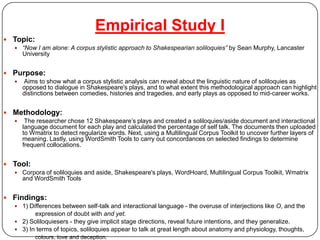
Empirical Study ITopic:“Now I am alone: A corpus stylistic approach to Shakespearian soliloquies” by Sean Murphy, Lancaster University Purpose:Aims to show what a corpus stylistic analysis can reveal about the linguistic nature of soliloquies as opposed to dialogue in Shakespeare's plays, and to what extent this methodological approach can highlight distinctions between comedies, histories and tragedies, and early plays as opposed to mid-career works. Methodology:The researcher chose 12 Shakespeare’s plays and created a soliloquies/aside document and interactional language document for each play and calculated the percentage of self talk. The documents then uploaded to Wmatrix to detect regularize words. Next, using a Multilingual Corpus Toolkit to uncover further layers of meaning. Lastly, using WordSmith Tools to carry out concordances on selected findings to determine frequent collocations. Tool: Corpora of soliloquies and aside, Shakespeare's plays, WordHoard, Multilingual Corpus Toolkit, Wmatrix  and WordSmith Tools Findings: 1) Differences between self-talk and interactional language - the overuse of interjections like O, and the   		expression of doubt with and yet.2) Soliloquiesers - they give implicit stage directions, reveal future intentions, and they generalize. 3) In terms of topics, soliloquies appear to talk at great length about anatomy and physiology, thoughts,colours, love and deception.
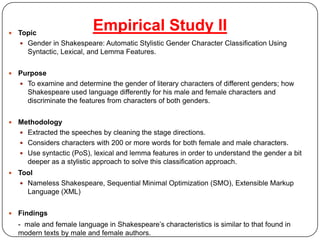
Empirical Study IITopicGender in Shakespeare: Automatic Stylistic Gender Character Classification Using Syntactic, Lexical, and Lemma Features.PurposeTo examine and determine the gender of literary characters of different genders; how Shakespeare used language differently for his male and female characters and discriminate the features from characters of both genders. MethodologyExtracted the speeches by cleaning the stage directions.Considers characters with 200 or more words for both female and male characters.Use syntactic (PoS), lexical and lemma features in order to understand the gender a bit deeper as a stylistic approach to solve this classification approach.ToolNameless Shakespeare, Sequential Minimal Optimization (SMO), Extensible Markup Language (XML)Findings	-  male and female language in Shakespeare’s characteristics is similar to that found in modern texts by male and female authors.
THE ENDTHANK YOU

Computational stylistics (2)[1]

  • 1.
    COMPUTATIONAL STYLISTICSNurul HannaHussein Shah 0710596Nurul Nadia Abdul Rahman 0710540Nor FadzilaAdenan 0718572NurNadiah Abdul Latiff 0625740
  • 2.
    IntroductionMost traditional researchin natural language processing and information retrieval has focused on analysing the topic of a text (what it says), but there is also much important and useful information carried in the style of a text (how it says it).
  • 3.
    Computational StylisticStudy ofpatterns formed in particular texts, authors, genres, periods via computational methods.Through the use of computers, it should be possible to achieve more accurate detection and explanation of such linguistic patterns.
  • 4.
    Scope of ComputationalStylisticCount the frequency of common words, and rare words, to detect writing style, producing distinct and unmistakable “literary fingerprint” that can be used to determine if and when there have been collaborations with other text. Detection of idiosyncratic uses of language which distinguish one author from another. An author's style is his signature. Determining the sentiment (positive or negative) of a text.Analyzing variation in rhetorical style among scientific articles.
  • 5.
    Examples of Corpusused for Computational StylisticLiterary textsShakespeare’s works.WebsitesPersonal Blogs
  • 6.
    CorpusA Midsummer's NightsDreamhttp://absoluteshakespeare.com/plays/a_midsummer_nights_dream/a_midsummer_nights_dream.htmhttp://www.william-shakespeare.info/shakespeare-play-a-midsummer-nights-dream.htmRomeo and Juliethttp://www.shakespeare-literature.com/Romeo_and_Juliet/index.htmlhttp://absoluteshakespeare.com/guides/romeo_and_juliet/romeo_and_juliet.htm
  • 7.
    Relevance to LanguageLearning Or Language ResearchConcept of writer/ author ‘s styleShakespeare – his own authorship.The language research; literary languageImprovise research – in terms of methodologyLanguage used in a special way; never reflects everyday speech and may depart from the grammatical and other norms of speechLiterary language; quite unconscious, direct, sensitive, requires no reference to non-literary usage.
  • 8.
    Empirical Study ITopic:“NowI am alone: A corpus stylistic approach to Shakespearian soliloquies” by Sean Murphy, Lancaster University Purpose:Aims to show what a corpus stylistic analysis can reveal about the linguistic nature of soliloquies as opposed to dialogue in Shakespeare's plays, and to what extent this methodological approach can highlight distinctions between comedies, histories and tragedies, and early plays as opposed to mid-career works. Methodology:The researcher chose 12 Shakespeare’s plays and created a soliloquies/aside document and interactional language document for each play and calculated the percentage of self talk. The documents then uploaded to Wmatrix to detect regularize words. Next, using a Multilingual Corpus Toolkit to uncover further layers of meaning. Lastly, using WordSmith Tools to carry out concordances on selected findings to determine frequent collocations. Tool: Corpora of soliloquies and aside, Shakespeare's plays, WordHoard, Multilingual Corpus Toolkit, Wmatrix and WordSmith Tools Findings: 1) Differences between self-talk and interactional language - the overuse of interjections like O, and the expression of doubt with and yet.2) Soliloquiesers - they give implicit stage directions, reveal future intentions, and they generalize. 3) In terms of topics, soliloquies appear to talk at great length about anatomy and physiology, thoughts,colours, love and deception.
  • 9.
    Empirical Study IITopicGenderin Shakespeare: Automatic Stylistic Gender Character Classification Using Syntactic, Lexical, and Lemma Features.PurposeTo examine and determine the gender of literary characters of different genders; how Shakespeare used language differently for his male and female characters and discriminate the features from characters of both genders. MethodologyExtracted the speeches by cleaning the stage directions.Considers characters with 200 or more words for both female and male characters.Use syntactic (PoS), lexical and lemma features in order to understand the gender a bit deeper as a stylistic approach to solve this classification approach.ToolNameless Shakespeare, Sequential Minimal Optimization (SMO), Extensible Markup Language (XML)Findings - male and female language in Shakespeare’s characteristics is similar to that found in modern texts by male and female authors.
  • 10.