RELATIVE CLAUSES
What are relative clauses? Subordinate clauses which allow us to add information about people or things we are talking to, without a need to repeat the name e.g. That is  the house .  The house  was built on the main road. That is  the house   which  was built on the main road.
Relative clauses are introduced just after the  antecedent  and are introduced by a  pronoun  or a  relative adverb . The most frequent ones are:  who ;  whom ;  which ;  that  (only in defining relative clauses) and relative adverbs:  where ;  when ;  why.
After preposition you write  whom  for people and  which  for things, but it is more common to place prepositions at the end of the sentence (and it is more usual in spoken English).  e.g. This is the boy about  whom  you were asking me This is the boy ( who ) you were asking me about.  Only  whom  and  which , you can’t use it with ‘ that ’
DEFINING RELATIVE CLAUSES They give essential information about their  antecedent  and without them, the meaning will be incompleted. That is why you write them  without  commas. (oracions especificatives) The computer  which  we bought is very expensive The man  who  is coming will bring us the present
Relative pronouns  can’t  be omitted if it’s the subject of the relative clauses.  The man  who  visited yesterday is an actor The house  that  was so old was rebuilt. But if it’s not the subject it  can  be omitted the man ( whom/that ) I met at the party told me  the truth The house ( which/that ) we bought is very  comfortable
If the relative pronoun is followed by a verb, then it can’t be omitted. If the relative is followed by a subject + verb, then it’s almost sure you can drop it whose  can’t be omitted, though it’s never a subject e.g. the horse  whose  leg you broke had to be killed ‘ what’  means  ‘ el que’ ‘les coses que’  and is used when the antecedent is understood e.g. I know  what  you did last summer.
NON-DEFINING RELATIVE CLAUSES If we remove this relative clause, there’s no problem to understand the main sentence, since it gives extra information. Thus, we write it between commas. e.g. The European Police Force,  which  began working in 1999, is called Europol.
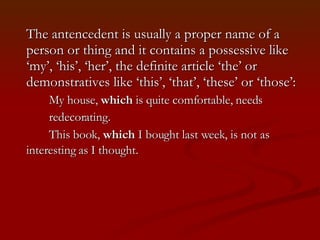
The antencedent is usually a proper name of a person or thing and it contains a possessive like ‘my’, ‘his’, ‘her’, the definite article ‘the’ or demonstratives like ‘this’, ‘that’, ‘these’ or ‘those’: My house,  which  is quite comfortable, needs  redecorating.  This book,  which  I bought last week, is not as  interesting as I thought.
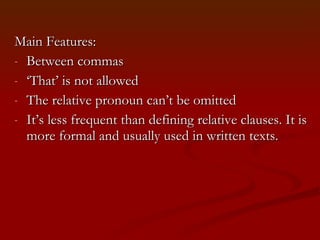
Main Features:  Between commas ‘ That’ is not allowed The relative pronoun can’t be omitted It’s less frequent than defining relative clauses. It is more formal and usually used in written texts.
fgfgfghfgh RELATIVE CLAUSES DEFINING NON-DEFINING WHO THAT WHICH THAT PRONOUNS WHERE PRONOUNS WHO WHICH WHOSE WHEN WHERE WHEN/THAT WHOM WHOSE They give us essential information The information given is not essential,it can be omitted.

RELATIVE CLAUSES

  • 1.
  • 2.
    What are relativeclauses? Subordinate clauses which allow us to add information about people or things we are talking to, without a need to repeat the name e.g. That is the house . The house was built on the main road. That is the house which was built on the main road.
  • 3.
    Relative clauses areintroduced just after the antecedent and are introduced by a pronoun or a relative adverb . The most frequent ones are: who ; whom ; which ; that (only in defining relative clauses) and relative adverbs: where ; when ; why.
  • 4.
    After preposition youwrite whom for people and which for things, but it is more common to place prepositions at the end of the sentence (and it is more usual in spoken English). e.g. This is the boy about whom you were asking me This is the boy ( who ) you were asking me about. Only whom and which , you can’t use it with ‘ that ’
  • 5.
    DEFINING RELATIVE CLAUSESThey give essential information about their antecedent and without them, the meaning will be incompleted. That is why you write them without commas. (oracions especificatives) The computer which we bought is very expensive The man who is coming will bring us the present
  • 6.
    Relative pronouns can’t be omitted if it’s the subject of the relative clauses. The man who visited yesterday is an actor The house that was so old was rebuilt. But if it’s not the subject it can be omitted the man ( whom/that ) I met at the party told me the truth The house ( which/that ) we bought is very comfortable
  • 7.
    If the relativepronoun is followed by a verb, then it can’t be omitted. If the relative is followed by a subject + verb, then it’s almost sure you can drop it whose can’t be omitted, though it’s never a subject e.g. the horse whose leg you broke had to be killed ‘ what’ means ‘ el que’ ‘les coses que’ and is used when the antecedent is understood e.g. I know what you did last summer.
  • 8.
    NON-DEFINING RELATIVE CLAUSESIf we remove this relative clause, there’s no problem to understand the main sentence, since it gives extra information. Thus, we write it between commas. e.g. The European Police Force, which began working in 1999, is called Europol.
  • 9.
    The antencedent isusually a proper name of a person or thing and it contains a possessive like ‘my’, ‘his’, ‘her’, the definite article ‘the’ or demonstratives like ‘this’, ‘that’, ‘these’ or ‘those’: My house, which is quite comfortable, needs redecorating. This book, which I bought last week, is not as interesting as I thought.
  • 10.
    Main Features: Between commas ‘ That’ is not allowed The relative pronoun can’t be omitted It’s less frequent than defining relative clauses. It is more formal and usually used in written texts.
  • 11.
    fgfgfghfgh RELATIVE CLAUSESDEFINING NON-DEFINING WHO THAT WHICH THAT PRONOUNS WHERE PRONOUNS WHO WHICH WHOSE WHEN WHERE WHEN/THAT WHOM WHOSE They give us essential information The information given is not essential,it can be omitted.