ANKITA JAGTAP
ROLL NO 4
PHYTOREMEDIATION
phyto = plant, and
remedium = restoring balance.
defined as “the efficient use of plants to remove,
detoxify or immobilise environmental contaminants in a
growth matrix (soil, water or sediments) through the
natural biological, chemical or physical activities and
processes of the plants”
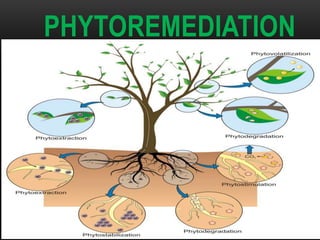
PHYTOREMEDIATION
HOW DOES PHYTOREMEDIATION WORK ?
• Phytoremediation is an in situ remediation technology that
utilises the inherent abilities of living plants.
• The mechanisms and efficiency of phytoremediation depend
on the type of contaminant,bioavailability and soil properties.
• The root system provides an enormous surface area that
absorbs and accumulates the water and nutrients essential
for growth, as well as other non-essential contaminants.
THE USE OF PHYTOREMEDIATION TO TREAT
ORGANIC CONTAMINANTS
• Phytodegradation
• Rhizodegradation
• Phytovolatilization
1 - PHYTODEGRADATION
• Also called as phytotransformation
• degradation of complex organic molecules to simple
molecules or the incorporation of these molecules into
plant tissues
• Plants contain enzymes that catalyse and accelerate
chemical reactions.
• Uptake of contaminants depend on hydrophobicity ,
solubility and polarity.
• Examples : 1.Trichloroethylene (TCE), a prevalent ground water
contaminant, transformed to less toxic metabolites by using hybrid
poplar tree.
2. Phytodegradation has been observed to remediate some
organic contaminants, such as chlorinated solvents, herbicides, and
munitions, and it can address contaminants in soil, sediment, or
groundwater .
3. Atrazine in soil was taken up by trees and then
hydrolyzed and dealkylated within the roots, stems, and leaves.
Enzymes in plant roots break down (degarde) organic contaminants. The fragments
are incorporated into new plant material.
2.RHIZODEGRADATION
• Also called phytostimulation or plant assisted
bioremediation/degradation.
• Symbiotic relationship
• Natural substances released by the plant roots – sugars,
alcohols, and acids – contain organic carbon that provides
food for soil microorganisms and the additional nutrients
enhance their activity
• Additionally, the rhizosphere substantially increases the
surface area where active microbial degradation can be
stimulated.
• Example : 1. The number of
beneficial bacteria increased in the
root zone of hybrid poplar trees and
enhanced the degradation of BTEX,
organic chemical, in soil.
2. Phytoremediation was
able to bring TPH levels and PAH levels
to below the plateau level found with
normal (non-plant-influenced)
bioremediation.
3.PHYTOVOLATILIZATION
• Uptake and transpiration of a contaminant by a plant, with
release of the contaminant or a modified form of the
contaminant from the plant to the atmosphere.
• Phytovolatilization has mainly been applied to groundwater,
but it can be applied to soil, sediments, and sludges.
• Example : Poplar trees at one particular study site have been
shown to volatilise 90% of the TCE they take up.
• Because phytovolatilization
involves the transfer of
contaminants to the
atmosphere, the impact of
this contaminant transfer on
the ecosystem and on human
health needs to be
addressed.
• Climatic factors such as
temperature, precipitation,
humidity, insolation, and wind
velocity can affect
transpiration rates.
THE USE OF PHYTOREMEDIATION TO TREAT
METAL CONTAMINANTS
• Phytoextraction
• Rhizofiltration
• Phytostabilization
1- PHYTOEXTRACTION
• Also called phytoaccumulation, refers to the uptake of metals
from soil by plant roots into above-ground portions of plants.
• Certain plants, called hyperaccumulators, absorb unusually
large amounts of metals in comparison to other plants. Eg .
Thlaspi rotundifolium
• After the plants have been allowed to grow for some time, they
are harvested and either incinerated or composted to recycle
the metals.
• Benefit is that the contaminant is permanently removed from
the soil.
• Example : 1.Detroit lead contaminated site was removed with
Sunflower and Indian Mustard.
2. Arsenic, using the Sunflower, or the Chinese Brake
fern , a hyperaccumulator. Chinese Brake fern stores arsenic in
its leaves.
3. Mercury, selenium and organic pollutants such
as polychlorinated biphenyls (PCBs) have been removed from soils
by transgenic plants .
Uptake of Metals (Nickel) by Phytoextraction
2- RHIZOFILTRATION
• Rhizo means root
• Adsorption or precipitation onto plant roots, or absorption into the
roots of contaminants that are in solution surrounding the root
zone, due to biotic or abiotic processes.
• Exploited in groundwater, surface water, or wastewater for removal
of metals or other inorganic compounds.
• Rhizofiltration first results in contaminant containment, in which the
contaminants are immobilized or accumulated on or within the
plant. Contaminants are then removed by physically removing the
plant.
• Examples : 1. Sunflower, Indian mustard, tobacco, rye, spinach, and
corn have been studied for their ability to remove lead from water, with
sunflower having the greatest ability.
2. Sunflowers were successfully used to remove radioactive
contaminants from pond water in a test at Chernobyl, Ukraine.
3. Rhizofiltration can be used for Pb, Cd, Cu, Ni, Zn, and Cr,
which are primarily retained within the roots.
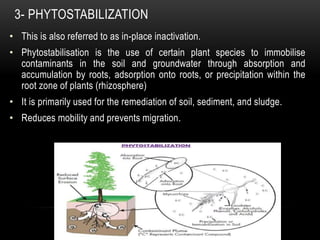
3- PHYTOSTABILIZATION
• This is also referred to as in-place inactivation.
• Phytostabilisation is the use of certain plant species to immobilise
contaminants in the soil and groundwater through absorption and
accumulation by roots, adsorption onto roots, or precipitation within the
root zone of plants (rhizosphere)
• It is primarily used for the remediation of soil, sediment, and sludge.
• Reduces mobility and prevents migration.
• Change in pH , metal solubility and mobility
• Used to re establish vegetation cover at sites where natural
vegetation fails to survive due to high metals concentrations in
surface soils or physical disturbances to surface materials.
• Advantages is that the disposal of hazardous material/biomass is
not required and very effective when rapid immobilization is
needed to preserve ground and surface waters.
• Example : Phytostabilization using metal-tolerant grasses is being
investigated for large areas of Cd- and Zn-contaminated soils at a
Superfund site in Palmerton, PA.
THE USE OF PHYTOREMEDIATION FOR
HYDRAULIC CONTROL OF CONTAMINANTS
• Also known as phytohydraulics or hydraulic plume control.
• Hydraulic control is the use of plants to remove
groundwater through uptake and consumption in order to
contain or control the migration of contaminants.
• use phreatophytic trees and plants that have the ability to
transpire large volumes of water eg . Poplar tree can
transpire between 50 and 300 gallons of water per day out
of the ground.
• Reduces infiltration of precipitation and reducing
contaminant migration
• The primary considerations for selecting hydraulic control as the method of choice
are the depth and concentration of contaminants that affect plant growth.
• Soil texture and degree of saturation are influential factors.
ADVANTAGES
• “nature” method, more aesthetically pleasing.
• The cost of the phytoremediation is lower than that of traditional
processes both in situ and ex situ
• The plants can be easily monitored
• The possibility of the recovery and re-use of valuable metals
• Minimal land disturbance.
• Reduces potential for transport of contaminants by wind, reduces soil
erosion
• Hyperaccumulaters of contaminants mean a much smaller volume of
toxic waste.
• Multiple contaminants can be removed with the same plant.
DISADVANTAGES
• Limited to the surface area and depth occupied by the roots.
• Slow growth and low biomass require a long-term commitment
• Not possible to completely prevent the leaching of contaminants
into the groundwater
• The survival of the plants is affected by the toxicity of the
contaminated land and the general condition of the soil.
• Bio-accumulation of contaminants, especially metals, into the
plants which then pass into the food chain, from primary level
consumers upwards and/or requires the safe disposal of the
affected plant material.
REFERENCES
• http://modernscientificpress.com/Journals/ViewArticle.aspx?
gkN1Z6Pb60HNQPymfPQlZIsaO1oMajYkT5i8/SIthV/i1509l
3XqlgX4XSDiXBec
• http://www.unep.or.jp/Ietc/Publications/Freshwater/FMS2/2.
asp
• http://clu-in.org/download/remed/introphyto.pdf

Phytoremediation

  • 1.
    ANKITA JAGTAP ROLL NO4 PHYTOREMEDIATION
  • 2.
    phyto = plant,and remedium = restoring balance. defined as “the efficient use of plants to remove, detoxify or immobilise environmental contaminants in a growth matrix (soil, water or sediments) through the natural biological, chemical or physical activities and processes of the plants” PHYTOREMEDIATION
  • 3.
    HOW DOES PHYTOREMEDIATIONWORK ? • Phytoremediation is an in situ remediation technology that utilises the inherent abilities of living plants. • The mechanisms and efficiency of phytoremediation depend on the type of contaminant,bioavailability and soil properties. • The root system provides an enormous surface area that absorbs and accumulates the water and nutrients essential for growth, as well as other non-essential contaminants.
  • 5.
    THE USE OFPHYTOREMEDIATION TO TREAT ORGANIC CONTAMINANTS • Phytodegradation • Rhizodegradation • Phytovolatilization
  • 6.
    1 - PHYTODEGRADATION •Also called as phytotransformation • degradation of complex organic molecules to simple molecules or the incorporation of these molecules into plant tissues • Plants contain enzymes that catalyse and accelerate chemical reactions. • Uptake of contaminants depend on hydrophobicity , solubility and polarity.
  • 7.
    • Examples :1.Trichloroethylene (TCE), a prevalent ground water contaminant, transformed to less toxic metabolites by using hybrid poplar tree. 2. Phytodegradation has been observed to remediate some organic contaminants, such as chlorinated solvents, herbicides, and munitions, and it can address contaminants in soil, sediment, or groundwater . 3. Atrazine in soil was taken up by trees and then hydrolyzed and dealkylated within the roots, stems, and leaves. Enzymes in plant roots break down (degarde) organic contaminants. The fragments are incorporated into new plant material.
  • 8.
    2.RHIZODEGRADATION • Also calledphytostimulation or plant assisted bioremediation/degradation. • Symbiotic relationship • Natural substances released by the plant roots – sugars, alcohols, and acids – contain organic carbon that provides food for soil microorganisms and the additional nutrients enhance their activity • Additionally, the rhizosphere substantially increases the surface area where active microbial degradation can be stimulated.
  • 9.
    • Example :1. The number of beneficial bacteria increased in the root zone of hybrid poplar trees and enhanced the degradation of BTEX, organic chemical, in soil. 2. Phytoremediation was able to bring TPH levels and PAH levels to below the plateau level found with normal (non-plant-influenced) bioremediation.
  • 10.
    3.PHYTOVOLATILIZATION • Uptake andtranspiration of a contaminant by a plant, with release of the contaminant or a modified form of the contaminant from the plant to the atmosphere. • Phytovolatilization has mainly been applied to groundwater, but it can be applied to soil, sediments, and sludges. • Example : Poplar trees at one particular study site have been shown to volatilise 90% of the TCE they take up.
  • 11.
    • Because phytovolatilization involvesthe transfer of contaminants to the atmosphere, the impact of this contaminant transfer on the ecosystem and on human health needs to be addressed. • Climatic factors such as temperature, precipitation, humidity, insolation, and wind velocity can affect transpiration rates.
  • 12.
    THE USE OFPHYTOREMEDIATION TO TREAT METAL CONTAMINANTS • Phytoextraction • Rhizofiltration • Phytostabilization
  • 13.
    1- PHYTOEXTRACTION • Alsocalled phytoaccumulation, refers to the uptake of metals from soil by plant roots into above-ground portions of plants. • Certain plants, called hyperaccumulators, absorb unusually large amounts of metals in comparison to other plants. Eg . Thlaspi rotundifolium • After the plants have been allowed to grow for some time, they are harvested and either incinerated or composted to recycle the metals. • Benefit is that the contaminant is permanently removed from the soil.
  • 14.
    • Example :1.Detroit lead contaminated site was removed with Sunflower and Indian Mustard. 2. Arsenic, using the Sunflower, or the Chinese Brake fern , a hyperaccumulator. Chinese Brake fern stores arsenic in its leaves. 3. Mercury, selenium and organic pollutants such as polychlorinated biphenyls (PCBs) have been removed from soils by transgenic plants . Uptake of Metals (Nickel) by Phytoextraction
  • 15.
    2- RHIZOFILTRATION • Rhizomeans root • Adsorption or precipitation onto plant roots, or absorption into the roots of contaminants that are in solution surrounding the root zone, due to biotic or abiotic processes. • Exploited in groundwater, surface water, or wastewater for removal of metals or other inorganic compounds. • Rhizofiltration first results in contaminant containment, in which the contaminants are immobilized or accumulated on or within the plant. Contaminants are then removed by physically removing the plant.
  • 16.
    • Examples :1. Sunflower, Indian mustard, tobacco, rye, spinach, and corn have been studied for their ability to remove lead from water, with sunflower having the greatest ability. 2. Sunflowers were successfully used to remove radioactive contaminants from pond water in a test at Chernobyl, Ukraine. 3. Rhizofiltration can be used for Pb, Cd, Cu, Ni, Zn, and Cr, which are primarily retained within the roots.
  • 17.
    3- PHYTOSTABILIZATION • Thisis also referred to as in-place inactivation. • Phytostabilisation is the use of certain plant species to immobilise contaminants in the soil and groundwater through absorption and accumulation by roots, adsorption onto roots, or precipitation within the root zone of plants (rhizosphere) • It is primarily used for the remediation of soil, sediment, and sludge. • Reduces mobility and prevents migration.
  • 18.
    • Change inpH , metal solubility and mobility • Used to re establish vegetation cover at sites where natural vegetation fails to survive due to high metals concentrations in surface soils or physical disturbances to surface materials. • Advantages is that the disposal of hazardous material/biomass is not required and very effective when rapid immobilization is needed to preserve ground and surface waters. • Example : Phytostabilization using metal-tolerant grasses is being investigated for large areas of Cd- and Zn-contaminated soils at a Superfund site in Palmerton, PA.
  • 19.
    THE USE OFPHYTOREMEDIATION FOR HYDRAULIC CONTROL OF CONTAMINANTS • Also known as phytohydraulics or hydraulic plume control. • Hydraulic control is the use of plants to remove groundwater through uptake and consumption in order to contain or control the migration of contaminants. • use phreatophytic trees and plants that have the ability to transpire large volumes of water eg . Poplar tree can transpire between 50 and 300 gallons of water per day out of the ground. • Reduces infiltration of precipitation and reducing contaminant migration
  • 20.
    • The primaryconsiderations for selecting hydraulic control as the method of choice are the depth and concentration of contaminants that affect plant growth. • Soil texture and degree of saturation are influential factors.
  • 21.
    ADVANTAGES • “nature” method,more aesthetically pleasing. • The cost of the phytoremediation is lower than that of traditional processes both in situ and ex situ • The plants can be easily monitored • The possibility of the recovery and re-use of valuable metals • Minimal land disturbance. • Reduces potential for transport of contaminants by wind, reduces soil erosion • Hyperaccumulaters of contaminants mean a much smaller volume of toxic waste. • Multiple contaminants can be removed with the same plant.
  • 22.
    DISADVANTAGES • Limited tothe surface area and depth occupied by the roots. • Slow growth and low biomass require a long-term commitment • Not possible to completely prevent the leaching of contaminants into the groundwater • The survival of the plants is affected by the toxicity of the contaminated land and the general condition of the soil. • Bio-accumulation of contaminants, especially metals, into the plants which then pass into the food chain, from primary level consumers upwards and/or requires the safe disposal of the affected plant material.
  • 23.