Dr. Ananta Saikia
Department of Horticulture
Assam Agricultural University
What is value addition?
Adding value to a raw product by taking it
into, at least, the next stage of production.
What creates added value?
Quality: Does the meet/exceed
customer’s expectation?
Functionality: Does it provide needed
function?
Form: Useful form?
Place: Is it in the right place?
Time: Is it in right time?
Ease of possession: Is it easy for
customers to obtain?
Creating a value-added product
Procurement of inputs
Converting inputs into products
Marketing and sales
Supply chain logistics, and
Customer service activities
Scope for value addition in NE India
Packhouses
Providing services for Cleaning,
Washing, Grading, packaging,
storage, transportation, marketing
Situated in production sites
Scope for vegetables, banana,
pineapple, oranges, local fruits
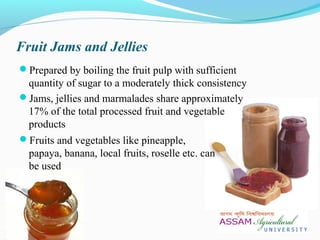
Fruit Jams and Jellies
Prepared by boiling the fruit pulp with sufficient
quantity of sugar to a moderately thick consistency
Jams, jellies and marmalades share approximately
17% of the total processed fruit and vegetable
products
Fruits and vegetables like pineapple,
papaya, banana, local fruits, roselle etc. can
be used
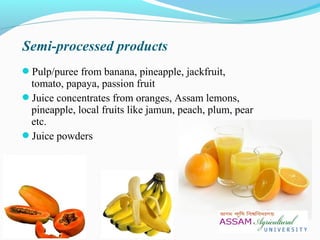
Pulp/puree from banana, pineapple, jackfruit,
tomato, papaya, passion fruit
Juice concentrates from oranges, Assam lemons,
pineapple, local fruits like jamun, peach, plum, pear
etc.
Juice powders
Semi-processed products
Dehydrated vegetables and spices
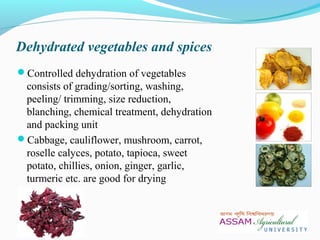
Controlled dehydration of vegetables
consists of grading/sorting, washing,
peeling/ trimming, size reduction,
blanching, chemical treatment, dehydration
and packing unit
Cabbage, cauliflower, mushroom, carrot,
roselle calyces, potato, tapioca, sweet
potato, chillies, onion, ginger, garlic,
turmeric etc. are good for drying
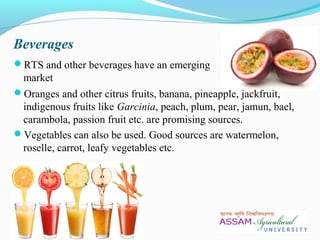
Beverages
RTS and other beverages have an emerging
market
Oranges and other citrus fruits, banana, pineapple, jackfruit,
indigenous fruits like Garcinia, peach, plum, pear, jamun, bael,
carambola, passion fruit etc. are promising sources.
Vegetables can also be used. Good sources are watermelon,
roselle, carrot, leafy vegetables etc.
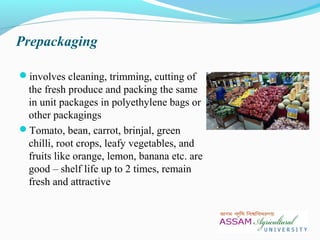
Prepackaging
involves cleaning, trimming, cutting of
the fresh produce and packing the same
in unit packages in polyethylene bags or
other packagings
Tomato, bean, carrot, brinjal, green
chilli, root crops, leafy vegetables, and
fruits like orange, lemon, banana etc. are
good – shelf life up to 2 times, remain
fresh and attractive
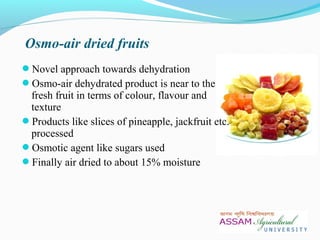
Novel approach towards dehydration
Osmo-air dehydrated product is near to the
fresh fruit in terms of colour, flavour and
texture
Products like slices of pineapple, jackfruit etc.
processed
Osmotic agent like sugars used
Finally air dried to about 15% moisture
Osmo-air dried fruits
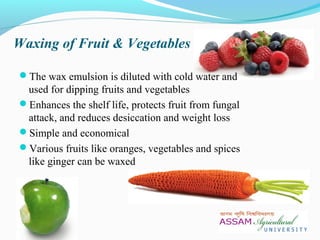
Waxing of Fruit & Vegetables
The wax emulsion is diluted with cold water and
used for dipping fruits and vegetables
Enhances the shelf life, protects fruit from fungal
attack, and reduces desiccation and weight loss
Simple and economical
Various fruits like oranges, vegetables and spices
like ginger can be waxed
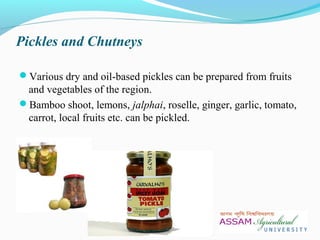
Pickles and Chutneys
Various dry and oil-based pickles can be prepared from fruits
and vegetables of the region.
Bamboo shoot, lemons, jalphai, roselle, ginger, garlic, tomato,
carrot, local fruits etc. can be pickled.
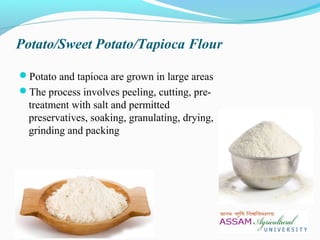
Potato/Sweet Potato/Tapioca Flour
Potato and tapioca are grown in large areas
The process involves peeling, cutting, pre-
treatment with salt and permitted
preservatives, soaking, granulating, drying,
grinding and packing
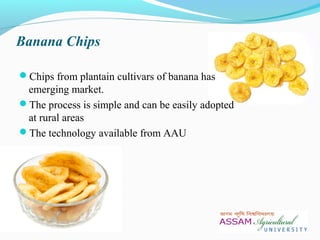
Banana Chips
Chips from plantain cultivars of banana has
emerging market.
The process is simple and can be easily adopted
at rural areas
The technology available from AAU
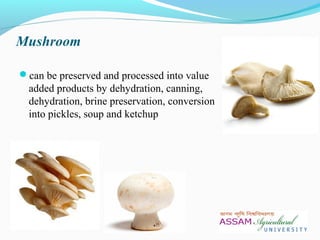
Mushroom
can be preserved and processed into value
added products by dehydration, canning,
dehydration, brine preservation, conversion
into pickles, soup and ketchup
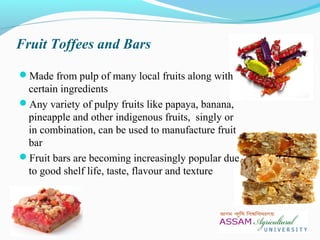
Fruit Toffees and Bars
Made from pulp of many local fruits along with
certain ingredients
Any variety of pulpy fruits like papaya, banana,
pineapple and other indigenous fruits, singly or
in combination, can be used to manufacture fruit
bar
Fruit bars are becoming increasingly popular due
to good shelf life, taste, flavour and texture
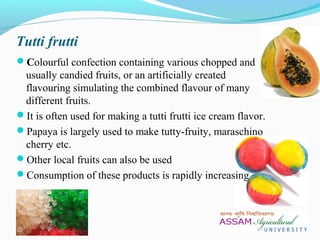
Tutti frutti
Colourful confection containing various chopped and
usually candied fruits, or an artificially created
flavouring simulating the combined flavour of many
different fruits.
It is often used for making a tutti frutti ice cream flavor.
Papaya is largely used to make tutty-fruity, maraschino
cherry etc.
Other local fruits can also be used
Consumption of these products is rapidly increasing
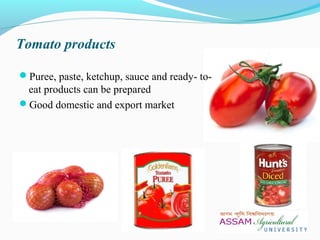
Tomato products
Puree, paste, ketchup, sauce and ready- to-
eat products can be prepared
Good domestic and export market
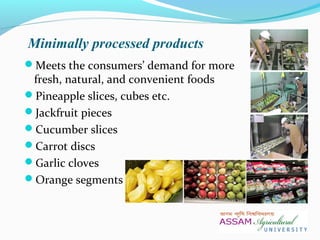
Meets the consumers’ demand for more
fresh, natural, and convenient foods
Pineapple slices, cubes etc.
Jackfruit pieces
Cucumber slices
Carrot discs
Garlic cloves
Orange segments
Minimally processed products
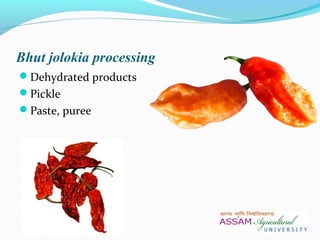
Bhut jolokia processing
Dehydrated products
Pickle
Paste, puree
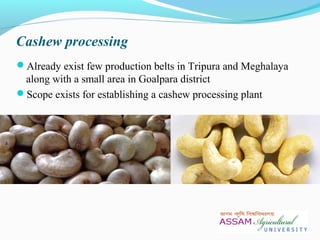
Cashew processing
Already exist few production belts in Tripura and Meghalaya
along with a small area in Goalpara district
Scope exists for establishing a cashew processing plant
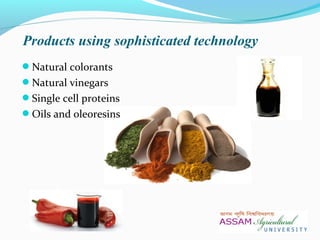
Natural colorants
Natural vinegars
Single cell proteins
Oils and oleoresins
Products using sophisticated technology
Thanks for your
attention

Value addition

  • 1.
    Dr. Ananta Saikia Departmentof Horticulture Assam Agricultural University
  • 2.
    What is valueaddition? Adding value to a raw product by taking it into, at least, the next stage of production.
  • 3.
    What creates addedvalue? Quality: Does the meet/exceed customer’s expectation? Functionality: Does it provide needed function? Form: Useful form? Place: Is it in the right place? Time: Is it in right time? Ease of possession: Is it easy for customers to obtain?
  • 4.
    Creating a value-addedproduct Procurement of inputs Converting inputs into products Marketing and sales Supply chain logistics, and Customer service activities
  • 5.
    Scope for valueaddition in NE India Packhouses Providing services for Cleaning, Washing, Grading, packaging, storage, transportation, marketing Situated in production sites Scope for vegetables, banana, pineapple, oranges, local fruits
  • 6.
    Fruit Jams andJellies Prepared by boiling the fruit pulp with sufficient quantity of sugar to a moderately thick consistency Jams, jellies and marmalades share approximately 17% of the total processed fruit and vegetable products Fruits and vegetables like pineapple, papaya, banana, local fruits, roselle etc. can be used
  • 7.
    Pulp/puree from banana,pineapple, jackfruit, tomato, papaya, passion fruit Juice concentrates from oranges, Assam lemons, pineapple, local fruits like jamun, peach, plum, pear etc. Juice powders Semi-processed products
  • 8.
    Dehydrated vegetables andspices Controlled dehydration of vegetables consists of grading/sorting, washing, peeling/ trimming, size reduction, blanching, chemical treatment, dehydration and packing unit Cabbage, cauliflower, mushroom, carrot, roselle calyces, potato, tapioca, sweet potato, chillies, onion, ginger, garlic, turmeric etc. are good for drying
  • 9.
    Beverages RTS and otherbeverages have an emerging market Oranges and other citrus fruits, banana, pineapple, jackfruit, indigenous fruits like Garcinia, peach, plum, pear, jamun, bael, carambola, passion fruit etc. are promising sources. Vegetables can also be used. Good sources are watermelon, roselle, carrot, leafy vegetables etc.
  • 10.
    Prepackaging involves cleaning, trimming,cutting of the fresh produce and packing the same in unit packages in polyethylene bags or other packagings Tomato, bean, carrot, brinjal, green chilli, root crops, leafy vegetables, and fruits like orange, lemon, banana etc. are good – shelf life up to 2 times, remain fresh and attractive
  • 11.
    Novel approach towardsdehydration Osmo-air dehydrated product is near to the fresh fruit in terms of colour, flavour and texture Products like slices of pineapple, jackfruit etc. processed Osmotic agent like sugars used Finally air dried to about 15% moisture Osmo-air dried fruits
  • 12.
    Waxing of Fruit& Vegetables The wax emulsion is diluted with cold water and used for dipping fruits and vegetables Enhances the shelf life, protects fruit from fungal attack, and reduces desiccation and weight loss Simple and economical Various fruits like oranges, vegetables and spices like ginger can be waxed
  • 13.
    Pickles and Chutneys Variousdry and oil-based pickles can be prepared from fruits and vegetables of the region. Bamboo shoot, lemons, jalphai, roselle, ginger, garlic, tomato, carrot, local fruits etc. can be pickled.
  • 14.
    Potato/Sweet Potato/Tapioca Flour Potatoand tapioca are grown in large areas The process involves peeling, cutting, pre- treatment with salt and permitted preservatives, soaking, granulating, drying, grinding and packing
  • 15.
    Banana Chips Chips fromplantain cultivars of banana has emerging market. The process is simple and can be easily adopted at rural areas The technology available from AAU
  • 16.
    Mushroom can be preservedand processed into value added products by dehydration, canning, dehydration, brine preservation, conversion into pickles, soup and ketchup
  • 17.
    Fruit Toffees andBars Made from pulp of many local fruits along with certain ingredients Any variety of pulpy fruits like papaya, banana, pineapple and other indigenous fruits, singly or in combination, can be used to manufacture fruit bar Fruit bars are becoming increasingly popular due to good shelf life, taste, flavour and texture
  • 18.
    Tutti frutti Colourful confectioncontaining various chopped and usually candied fruits, or an artificially created flavouring simulating the combined flavour of many different fruits. It is often used for making a tutti frutti ice cream flavor. Papaya is largely used to make tutty-fruity, maraschino cherry etc. Other local fruits can also be used Consumption of these products is rapidly increasing
  • 19.
    Tomato products Puree, paste,ketchup, sauce and ready- to- eat products can be prepared Good domestic and export market
  • 20.
    Meets the consumers’demand for more fresh, natural, and convenient foods Pineapple slices, cubes etc. Jackfruit pieces Cucumber slices Carrot discs Garlic cloves Orange segments Minimally processed products
  • 21.
    Bhut jolokia processing Dehydratedproducts Pickle Paste, puree
  • 22.
    Cashew processing Already existfew production belts in Tripura and Meghalaya along with a small area in Goalpara district Scope exists for establishing a cashew processing plant
  • 23.
    Natural colorants Natural vinegars Singlecell proteins Oils and oleoresins Products using sophisticated technology
  • 24.