SOIL NAILING
ANANDU ARAVIND
Dept. of Civil Engineering
Rajiv Gandhi Institute Of Technology
Kottayam
INTRODUCTION
 Soil Nailing is a technique to
reinforce and strengthen ground
adjacent to an excavation by
installing closely spaced steel bars
called “nails” ,as construction
proceeds from top down.
 It is an effective and economical
method of constructing retaining
wall for excavation support, support
of hill cuts, bridge abutments and
high ways.
 The nails are subjected to tension
compression, shear and bending
moments
HISTORY OF SOIL NAILING
 Technique came from New Austrian Tunneling
Method in 1960.
 Stabilization works in underground tunnel in
Europe in 1970.
 The first recorded use of soil nailing in its modern
form was in France in 1972.
 The United States first used soil nailing in 1976
for the support of a 13.7 m deep foundation
excavation in dense silty sands.
FAVOURABLE GROUND CONDITIONS
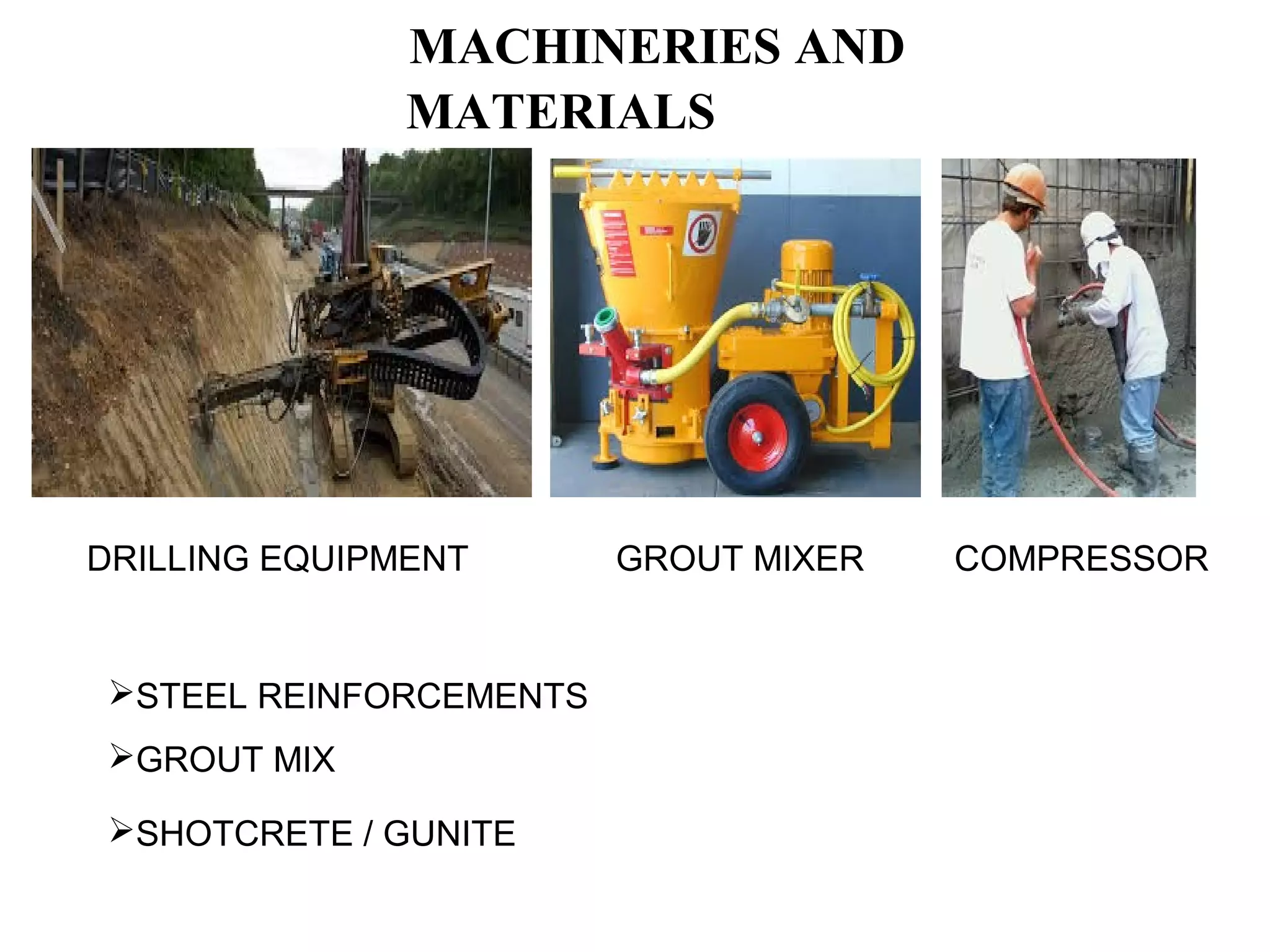
Critical excavation depth of soil is about 1-2 m high vertical
or nearly vertical cut.
All soil nails within a cross section are located above
groundwater table .
FAVOURABLE SOILS
Stiff to hard fine grained soils, dense to very dense
granular soils with some apparent cohesion, weathered rock
with no weakness planes and glacial soils etc.
UNFAVOURABLE SOILS
Dry, poorly graded cohesion less soils, soils with cobbles
and boulders , soft to very soft fine grained soils ,organic
soils.
APPLICATIONS
 Stabilization of railroad and highway cut slopes.
 Excavation retaining structures in urban areas for
high-rise building and
underground facilities.
APPLICATIONS (CONT…..)
 Existing concrete or masonry
structures such as failing retaining
walls and bridge abutments.
 Tunnel portals in steep and
unstable stratified slopes.
construction and retrofitting of
bridge abutments.
 Stabilizing steep cuttings to
maximize development space.
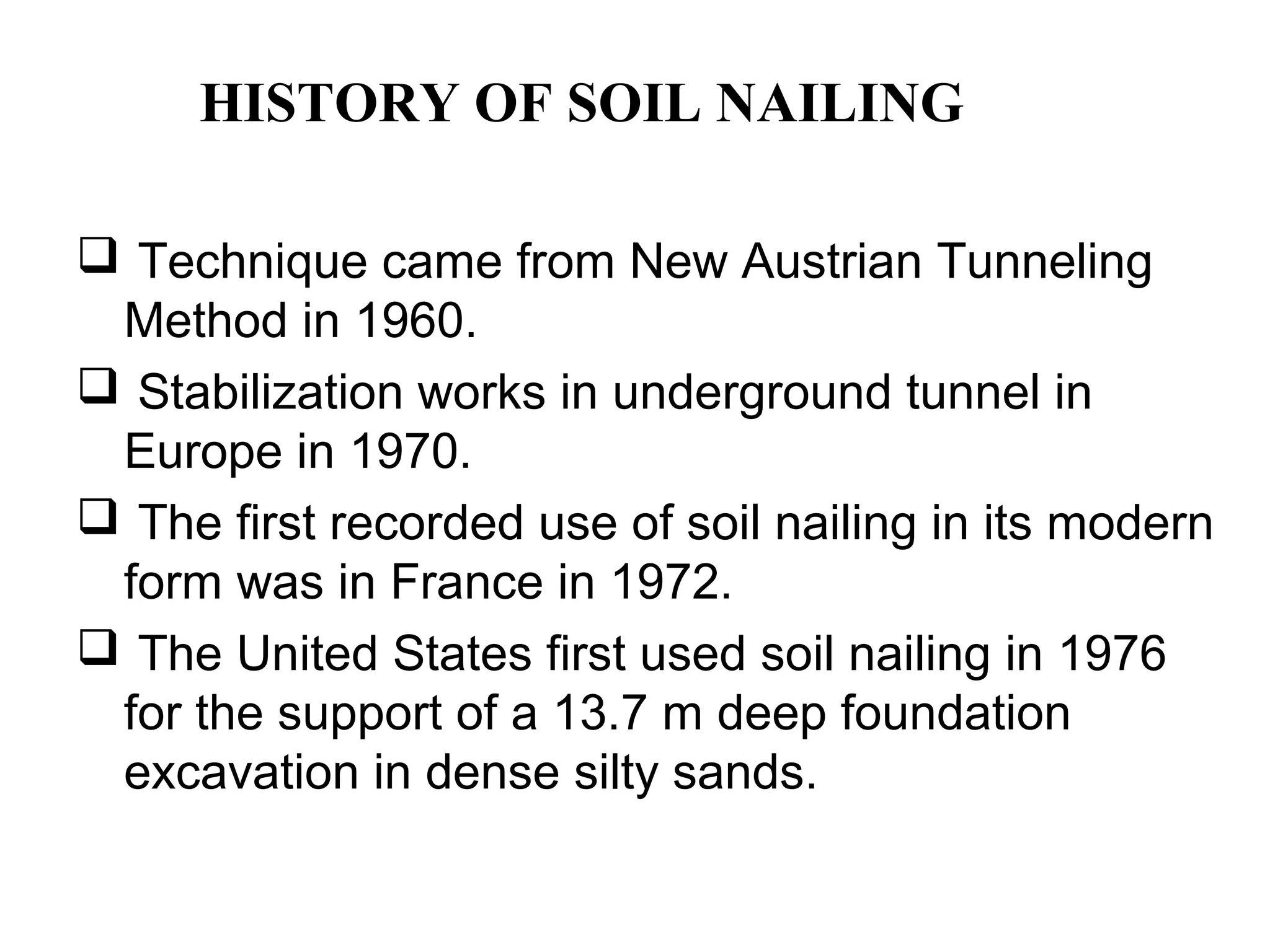
NAILS
 Driven Nails
 Grouted Nails
 Corrosion
Protected nails
 Jet grouted Nails
 Launched Nails
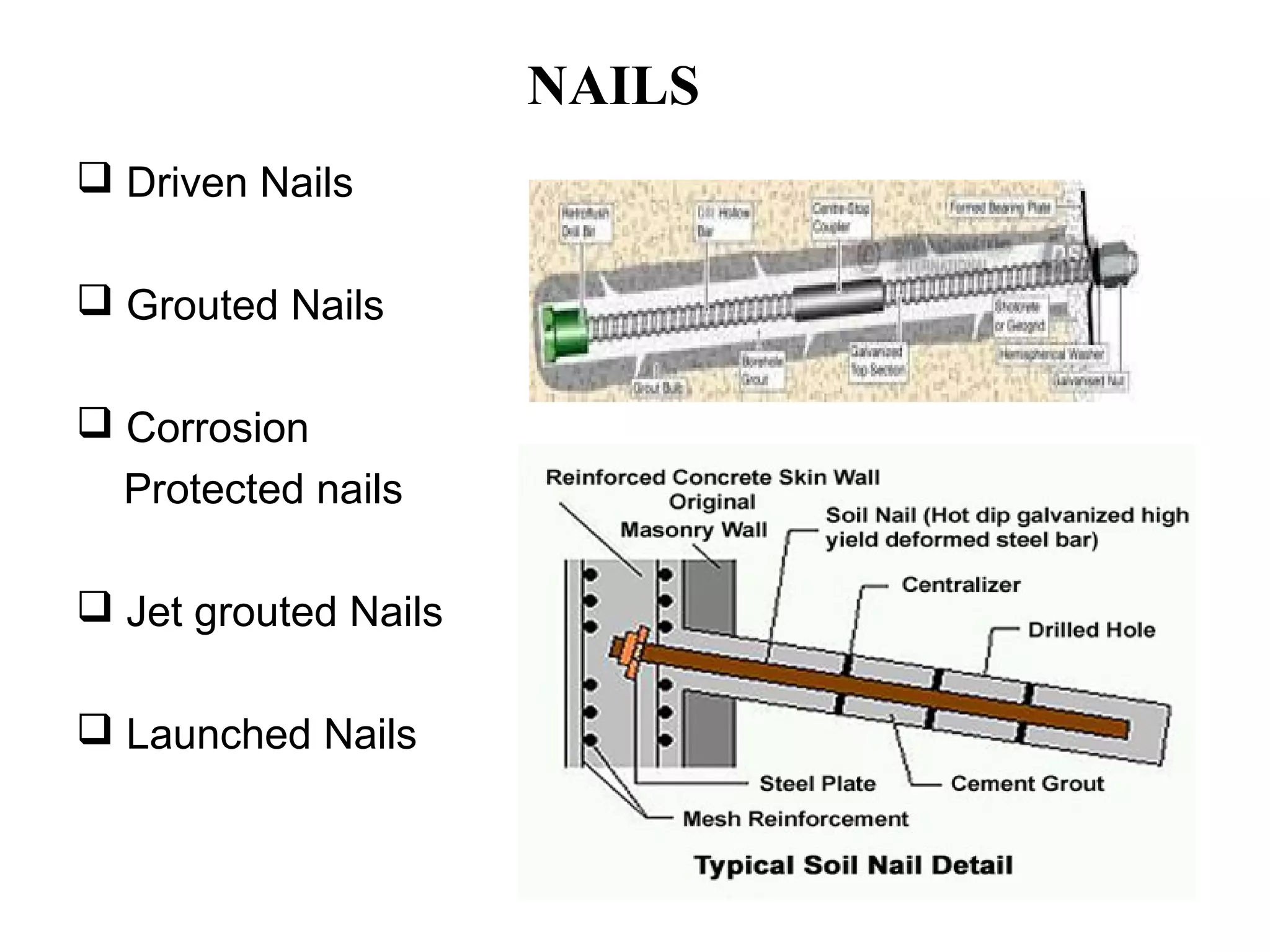
MACHINERIES AND
MATERIALS
GROUT MIX
STEEL REINFORCEMENTS
SHOTCRETE / GUNITE
DRILLING EQUIPMENT GROUT MIXER COMPRESSOR
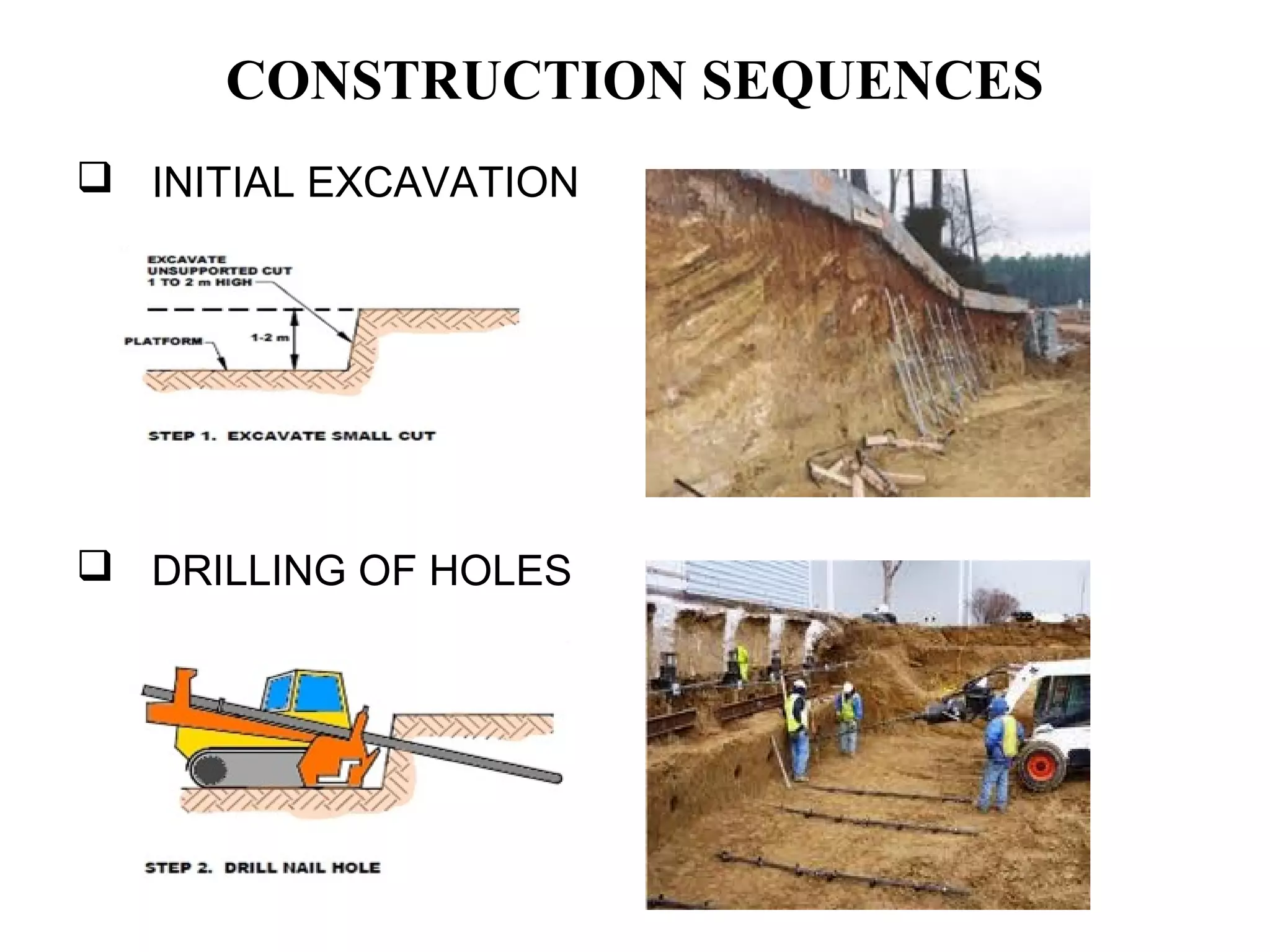
CONSTRUCTION SEQUENCES
 INITIAL EXCAVATION
 DRILLING OF HOLES
 NAIL INSTALLATION
 GROUTING
 PLACE REINFORCEMENT AND DRAINAGE
 SHOTCRETING AND INSTALLING BEARING PLATES
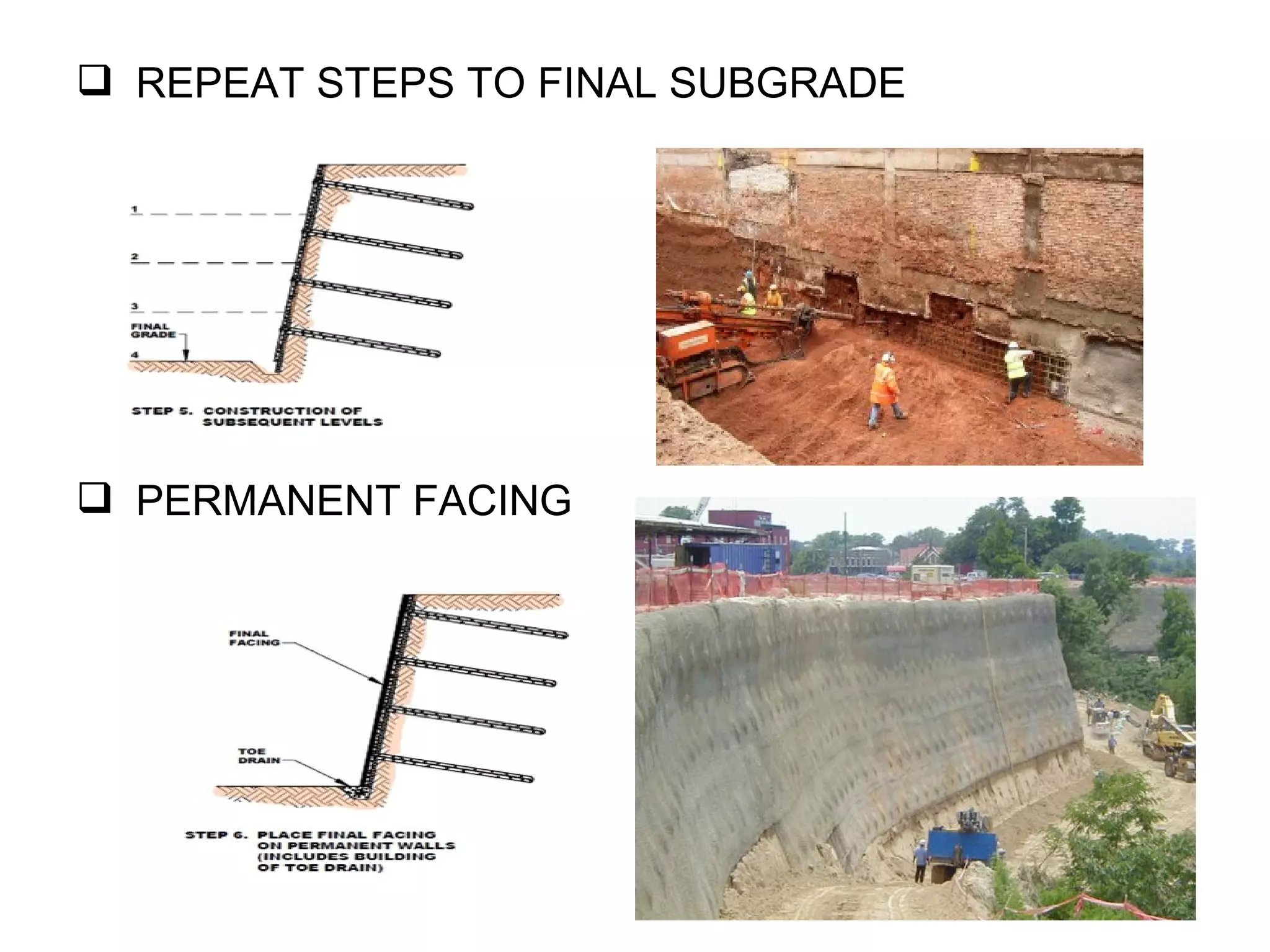
 REPEAT STEPS TO FINAL SUBGRADE
 PERMANENT FACING
ADVANTAGES
 With the right soil and site conditions, a rapid and
economical means of constructing earth retention support
systems and retaining walls.
 Shorter drill holes.
 Smaller diameter bars at shorter lengths.
 Retaining walls are secured laterally into the soil,
eliminating piles and foundation footers.
 Grouting only once is required, saving time and labor.
 The technique is flexible, easily modified.
ADVANTAGES (CONT…..)
Creates less noise and traffic obstructions.
Less impact on nearby properties
Allow in-situ strengthening on existing slope surface with
minimum excavation and backfilling, particularly very
suitable for uphill widening, thus environmental friendly,
Allow excellent working space in front of the excavation
face,
Can be used for strengthening of either natural slope,
natural or man- made cut slopes,
DISADVANTAGES
 Nail encroachment to retained ground rendering unusable
underground space,
 Generally larger lateral soil strain during removal of lateral
support and ground surface cracking may appear,
 Tendency of high ground loss due to drilling technique,
particularly at course grained soil,
 Less suitable for course grained soil and soft clayey soil,
which have short self support time, and soils prone to
creeping
 Suitable only for excavation above groundwater
CONCLUSION
 Since this process is effective in cohesive soil, broken
rock, shale, or mixed face conditions it permits flexibility
to conform to a variety of geometric shapes to meet
specific site needs.
 Due to its rather straightforward construction method
and is relatively maintenance free, the method has
gained popularity in India for highway and also hillside
development projects. Soil nailing is an economical
means of creating shoring systems and retaining walls.
REFERENCES
1. Eric W Bahner et al, Soil Nailing-A Local Perspective,
Geotechnical Applications For Transportation Infrastructure,
2005, 28-39.
2. John P Turner et al, Lanslide Stabilization Using Soil Nail and
Mechanically Stabilized Earth Walls, Journal of Geotechnical
and Geo-environmental Engineering, Vol:131, No:2, 2005,
141-150.
3. I H Wong et al, Field Performance of Nailed Soil Wall In
Residual Soil, Journal of Performance of Constructed
Facilities,Vol:11, No:3, 1997, 105-112.
4. Xinhua Xue et al, Application of Modified Gooodman Model
In Soil Nailing , International Journal of
Geomechanics,Vol:13, No:1, 2013, 41-48.
5. Eric W Bahmer et al, Soil Nailing Earth Retention In The Park
Lafayette Development In Milwaukee,Wisconsin,
Contemporary Topics In Ground Modification Problem Soils
And Geo-support,2009 , 121-128.
6. Tan et al,Slope Stabilization Using Soil Nails-Design
Assumptions And Construction Realities, 1-13.
7. Dr.Erol Guler et al, The Effect Of Upward Nail Inclination To
The Stability Of Soil Nailed Structures, Geotechnical
Engineering For Transportation Projects,2004, 2213-2220.
Soil nailing/Soil Reinforcement Technique

Soil nailing/Soil Reinforcement Technique

  • 1.
    SOIL NAILING ANANDU ARAVIND Dept.of Civil Engineering Rajiv Gandhi Institute Of Technology Kottayam
  • 2.
    INTRODUCTION  Soil Nailingis a technique to reinforce and strengthen ground adjacent to an excavation by installing closely spaced steel bars called “nails” ,as construction proceeds from top down.  It is an effective and economical method of constructing retaining wall for excavation support, support of hill cuts, bridge abutments and high ways.  The nails are subjected to tension compression, shear and bending moments
  • 3.
    HISTORY OF SOILNAILING  Technique came from New Austrian Tunneling Method in 1960.  Stabilization works in underground tunnel in Europe in 1970.  The first recorded use of soil nailing in its modern form was in France in 1972.  The United States first used soil nailing in 1976 for the support of a 13.7 m deep foundation excavation in dense silty sands.
  • 4.
    FAVOURABLE GROUND CONDITIONS Criticalexcavation depth of soil is about 1-2 m high vertical or nearly vertical cut. All soil nails within a cross section are located above groundwater table . FAVOURABLE SOILS Stiff to hard fine grained soils, dense to very dense granular soils with some apparent cohesion, weathered rock with no weakness planes and glacial soils etc. UNFAVOURABLE SOILS Dry, poorly graded cohesion less soils, soils with cobbles and boulders , soft to very soft fine grained soils ,organic soils.
  • 5.
    APPLICATIONS  Stabilization ofrailroad and highway cut slopes.  Excavation retaining structures in urban areas for high-rise building and underground facilities.
  • 6.
    APPLICATIONS (CONT…..)  Existingconcrete or masonry structures such as failing retaining walls and bridge abutments.  Tunnel portals in steep and unstable stratified slopes. construction and retrofitting of bridge abutments.  Stabilizing steep cuttings to maximize development space.
  • 7.
    NAILS  Driven Nails Grouted Nails  Corrosion Protected nails  Jet grouted Nails  Launched Nails
  • 8.
    MACHINERIES AND MATERIALS GROUT MIX STEELREINFORCEMENTS SHOTCRETE / GUNITE DRILLING EQUIPMENT GROUT MIXER COMPRESSOR
  • 9.
    CONSTRUCTION SEQUENCES  INITIALEXCAVATION  DRILLING OF HOLES
  • 10.
  • 11.
     PLACE REINFORCEMENTAND DRAINAGE  SHOTCRETING AND INSTALLING BEARING PLATES
  • 12.
     REPEAT STEPSTO FINAL SUBGRADE  PERMANENT FACING
  • 13.
    ADVANTAGES  With theright soil and site conditions, a rapid and economical means of constructing earth retention support systems and retaining walls.  Shorter drill holes.  Smaller diameter bars at shorter lengths.  Retaining walls are secured laterally into the soil, eliminating piles and foundation footers.  Grouting only once is required, saving time and labor.  The technique is flexible, easily modified.
  • 14.
    ADVANTAGES (CONT…..) Creates lessnoise and traffic obstructions. Less impact on nearby properties Allow in-situ strengthening on existing slope surface with minimum excavation and backfilling, particularly very suitable for uphill widening, thus environmental friendly, Allow excellent working space in front of the excavation face, Can be used for strengthening of either natural slope, natural or man- made cut slopes,
  • 15.
    DISADVANTAGES  Nail encroachmentto retained ground rendering unusable underground space,  Generally larger lateral soil strain during removal of lateral support and ground surface cracking may appear,  Tendency of high ground loss due to drilling technique, particularly at course grained soil,  Less suitable for course grained soil and soft clayey soil, which have short self support time, and soils prone to creeping  Suitable only for excavation above groundwater
  • 16.
    CONCLUSION  Since thisprocess is effective in cohesive soil, broken rock, shale, or mixed face conditions it permits flexibility to conform to a variety of geometric shapes to meet specific site needs.  Due to its rather straightforward construction method and is relatively maintenance free, the method has gained popularity in India for highway and also hillside development projects. Soil nailing is an economical means of creating shoring systems and retaining walls.
  • 17.
    REFERENCES 1. Eric WBahner et al, Soil Nailing-A Local Perspective, Geotechnical Applications For Transportation Infrastructure, 2005, 28-39. 2. John P Turner et al, Lanslide Stabilization Using Soil Nail and Mechanically Stabilized Earth Walls, Journal of Geotechnical and Geo-environmental Engineering, Vol:131, No:2, 2005, 141-150. 3. I H Wong et al, Field Performance of Nailed Soil Wall In Residual Soil, Journal of Performance of Constructed Facilities,Vol:11, No:3, 1997, 105-112. 4. Xinhua Xue et al, Application of Modified Gooodman Model In Soil Nailing , International Journal of Geomechanics,Vol:13, No:1, 2013, 41-48.
  • 18.
    5. Eric WBahmer et al, Soil Nailing Earth Retention In The Park Lafayette Development In Milwaukee,Wisconsin, Contemporary Topics In Ground Modification Problem Soils And Geo-support,2009 , 121-128. 6. Tan et al,Slope Stabilization Using Soil Nails-Design Assumptions And Construction Realities, 1-13. 7. Dr.Erol Guler et al, The Effect Of Upward Nail Inclination To The Stability Of Soil Nailed Structures, Geotechnical Engineering For Transportation Projects,2004, 2213-2220.