MAULANA AZAD NATIONAL INSTITUTE
OF TECHNOLOGY,BHOPAL
GEOTECTNICAL ENGINEERING
DEPARTMENT OF CIVIL ENGINEERING
2018-19
A
Presentation on
SLOPE STABILIZATION BY SOIL NAILING TECHNIQUE
Presented by
Bhanu Pratap Singh
M.Tech 1st yr
Scholar No. 182111119
CONTENTS
 INTRODUCTION
 SOIL NAIL BEHAVIOUR
 ELEMENTS OF SOIL NAIL STRUCTURE
 CONTRUCTION SEQUENCE
 TYPES OF NAIL
 FAVORABLE AND UNFAVORABLE SOIL CONDITIONS FOR SOIL NAIL
 APPLICATIONS
 DESIGN CONSIDERATION
 ADVANTAGES
 CASE STUDY
 CONCLUSION
 REFERENCES
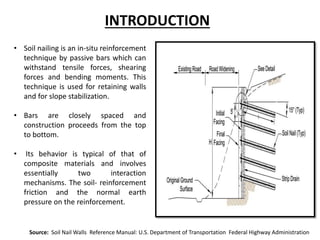
• Soil nailing is an in-situ reinforcement
technique by passive bars which can
withstand tensile forces, shearing
forces and bending moments. This
technique is used for retaining walls
and for slope stabilization.
• Bars are closely spaced and
construction proceeds from the top
to bottom.
• Its behavior is typical of that of
composite materials and involves
essentially two interaction
mechanisms. The soil- reinforcement
friction and the normal earth
pressure on the reinforcement.
INTRODUCTION
Source: Soil Nail Walls Reference Manual: U.S. Department of Transportation Federal Highway Administration
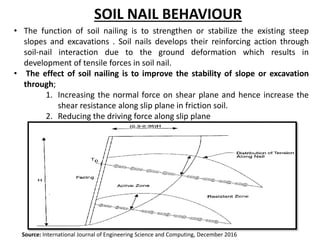
• The function of soil nailing is to strengthen or stabilize the existing steep
slopes and excavations . Soil nails develops their reinforcing action through
soil-nail interaction due to the ground deformation which results in
development of tensile forces in soil nail.
• The effect of soil nailing is to improve the stability of slope or excavation
through;
1. Increasing the normal force on shear plane and hence increase the
shear resistance along slip plane in friction soil.
2. Reducing the driving force along slip plane
SOIL NAIL BEHAVIOUR
Source: International Journal of Engineering Science and Computing, December 2016
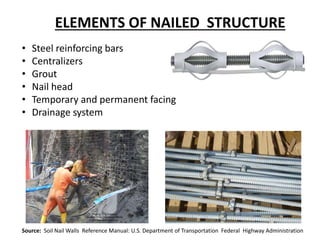
• Steel reinforcing bars
• Centralizers
• Grout
• Nail head
• Temporary and permanent facing
• Drainage system
EELEMENTS OF NAILED STRUCTURE
Source: Soil Nail Walls Reference Manual: U.S. Department of Transportation Federal Highway Administration
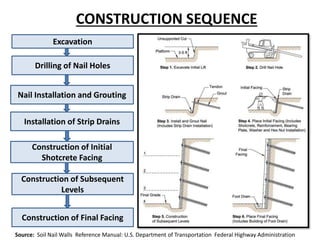
CONSTRUCTION SEQUENCE
Excavation
Drilling of Nail Holes
Nail Installation and Grouting
Installation of Strip Drains
Construction of Initial
Shotcrete Facing
Construction of Subsequent
Levels
Construction of Final Facing
Source: Soil Nail Walls Reference Manual: U.S. Department of Transportation Federal Highway Administration
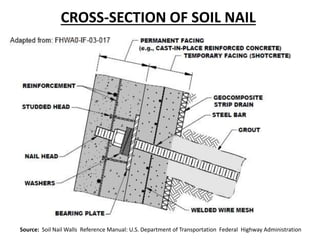
CROSS-SECTION OF SOIL NAIL
Source: Soil Nail Walls Reference Manual: U.S. Department of Transportation Federal Highway Administration
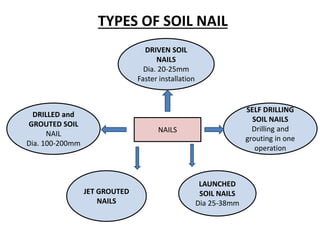
NAILS
DRILLED and
GROUTED SOIL
NAIL
Dia. 100-200mm
DRIVEN SOIL
NAILS
Dia. 20-25mm
Faster installation
SELF DRILLING
SOIL NAILS
Drilling and
grouting in one
operation
JET GROUTED
NAILS
LAUNCHED
SOIL NAILS
Dia 25-38mm
TYPES OF SOIL NAIL
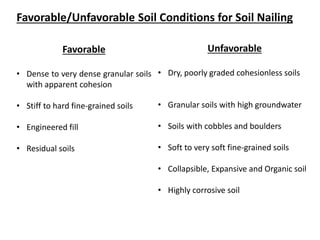
Favorable
• Dense to very dense granular soils
with apparent cohesion
• Stiff to hard fine-grained soils
• Engineered fill
• Residual soils
Unfavorable
• Dry, poorly graded cohesionless soils
• Granular soils with high groundwater
• Soils with cobbles and boulders
• Soft to very soft fine-grained soils
• Collapsible, Expansive and Organic soil
• Highly corrosive soil
Favorable/Unfavorable Soil Conditions for Soil Nailing
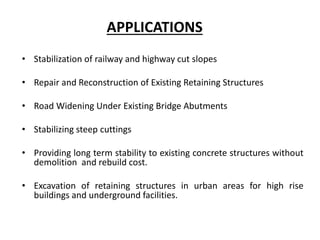
APPLICATIONS
• Stabilization of railway and highway cut slopes
• Repair and Reconstruction of Existing Retaining Structures
• Road Widening Under Existing Bridge Abutments
• Stabilizing steep cuttings
• Providing long term stability to existing concrete structures without
demolition and rebuild cost.
• Excavation of retaining structures in urban areas for high rise
buildings and underground facilities.
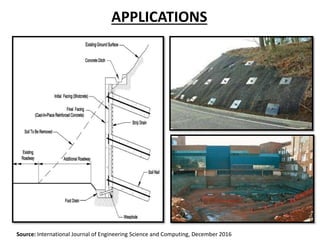
APPLICATIONS
Source: International Journal of Engineering Science and Computing, December 2016
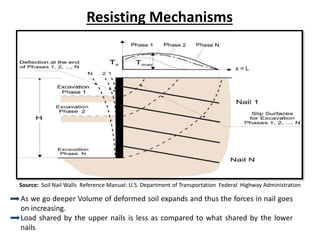
Resisting Mechanisms
As we go deeper Volume of deformed soil expands and thus the forces in nail goes
on increasing.
Load shared by the upper nails is less as compared to what shared by the lower
nails
Source: Soil Nail Walls Reference Manual: U.S. Department of Transportation Federal Highway Administration
DESIGN CONSIDERATION
1. Vertical and Horizontal Spacing of Soil Nails
• Adopt SH = SV = 5 ft.
• Check: SH × SV ≤ 36 to 42 ft2
2. Vertical Spacing at the Top and Bottom of the Wall
• The spacing between the first row and the top of the wall (SV0) is selected as:
SV0 ≤ 3.5ft.
• The spacing between the deepest row and the bottom of the wall (SVN) is:
SVN ≤ 2 to 3 ft
3. Soil Nail Inclination
• between 10 to 20 degrees
4. Soil Nail Length
• L = 0.7 H ; generally in between 0.6H to 1.2H
5. Soil Nail Pattern
• either square or staggered pattern
6.Tendon for soil nail
• Solid Bar- Dia .86in. To 1.86in. ; Length- 60ft
• Hollow Bar- Dia. Outer: 1-3in , Dia inner: .3-1in, Length- 10-20ft
Continue…….
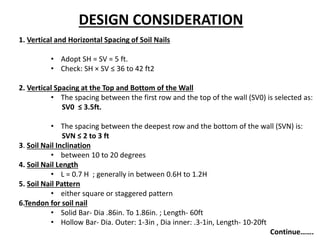
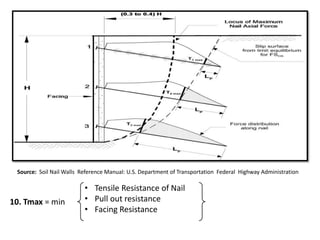
7.Maximum tensile forces
• In upper two third
• In lower one third value reduces to 50% of above.
8. Tensile force at wall facing
9. Pullout Resistance
q = nominal bond strength of the nail-grout-soil interface (force/unit area)
D= diameter of the drill hole
L= pullout development length
10.Nail Tensile Resistance
A = cross-sectional area of nail tendon
F = nominal yield resistance of nail tendon
Tmax = 0.50 Ka γs H SV SH to Tmax = 1.1 Ka γs H SV SH.
To= Tmax[0.6+.057(Smax-3)])]
Rp = πqDL
Rt = Af
10. Tmax = min
• Tensile Resistance of Nail
• Pull out resistance
• Facing Resistance
Source: Soil Nail Walls Reference Manual: U.S. Department of Transportation Federal Highway Administration
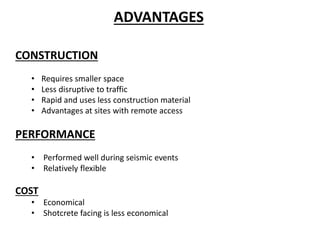
ADVANTAGES
CONSTRUCTION
• Requires smaller space
• Less disruptive to traffic
• Rapid and uses less construction material
• Advantages at sites with remote access
PERFORMANCE
• Performed well during seismic events
• Relatively flexible
COST
• Economical
• Shotcrete facing is less economical
CASE STUDY-Stabilization of Slope of Reservoir
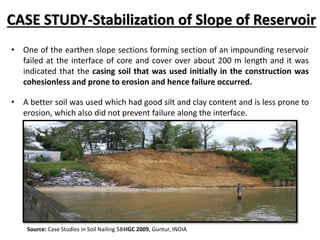
• One of the earthen slope sections forming section of an impounding reservoir
failed at the interface of core and cover over about 200 m length and it was
indicated that the casing soil that was used initially in the construction was
cohesionless and prone to erosion and hence failure occurred.
• A better soil was used which had good silt and clay content and is less prone to
erosion, which also did not prevent failure along the interface.
Source: Case Studies in Soil Nailing 584IGC 2009, Guntur, INDIA
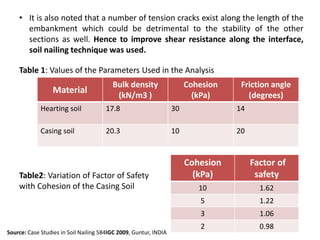
• It is also noted that a number of tension cracks exist along the length of the
embankment which could be detrimental to the stability of the other
sections as well. Hence to improve shear resistance along the interface,
soil nailing technique was used.
Table 1: Values of the Parameters Used in the Analysis
Material
Bulk density
(kN/m3 )
Cohesion
(kPa)
Friction angle
(degrees)
Hearting soil 17.8 30 14
Casing soil 20.3 10 20
Cohesion
(kPa)
Factor of
safety
10 1.62
5 1.22
3 1.06
2 0.98
Table2: Variation of Factor of Safety
with Cohesion of the Casing Soil
Source: Case Studies in Soil Nailing 584IGC 2009, Guntur, INDIA
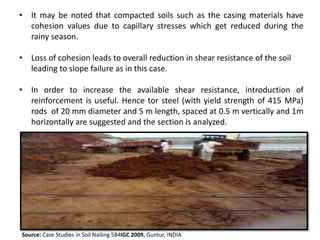
• It may be noted that compacted soils such as the casing materials have
cohesion values due to capillary stresses which get reduced during the
rainy season.
• Loss of cohesion leads to overall reduction in shear resistance of the soil
leading to slope failure as in this case.
• In order to increase the available shear resistance, introduction of
reinforcement is useful. Hence tor steel (with yield strength of 415 MPa)
rods of 20 mm diameter and 5 m length, spaced at 0.5 m vertically and 1m
horizontally are suggested and the section is analyzed.
Source: Case Studies in Soil Nailing 584IGC 2009, Guntur, INDIA
• Soil nailing has great advantages, thus there is a need to use this
technique on large scale in India in many infrastructure projects wherever
applicable to realize the technical and economic advantages associated
with the technique.
• Soil nailing is being used in many geotechnical applications to improve
stability of excavated vertical cuts and existing slopes.
• The vertical cut stability/slope stability improved due to the reinforcing
effect of nails. The study illustrates that the technique is a viable
technique to improve the stability of vertical cuts and stability of existing
slopes and its advantages need to be exploited on a large scale in
infrastructure projects.
CONCLUSION
REFERENCES
• Soil Nail Walls Reference Manual, “AASHTO LRFD Bridge Design Specifications, 7th
Edition. “ , U.S. Department of Transportation Federal Highway Administration.
• Sivakumar Babu G.L., ”Professor, Department of Civil Engineering, Indian Institute of
Science, Bangalore “ , “Case Studies in Soil Nailing”, IGC 2009, Guntur, INDIA.
• Arora R.P,Associate Professer, CE, CTAE, Udaipur, India ‘’Soil Nailing for Slope
Stabilization’’ , International Journal of Engineering Science and Computing,
December 2016 .
• Dr. Purnanand P. Savoikar, Professor2Department of Civil Engineering, Goa Engineering
College, Farmagudi, Goa, “Study of soil nailing for highway retaining wall in Goa”,
Indian Geotechnical Conference IGC2016 15-17 December 2016, IIT Madras, Chennai,
India.
• Sivakumar Babu G.L, ”Professor, Department of Civil Engineering, Indian Institute of
Science, Bangalore Ground improvement, “Ground reinforcement using soil nailing”,
NPTEL Courses.
Soil nailing

Soil nailing

  • 1.
    MAULANA AZAD NATIONALINSTITUTE OF TECHNOLOGY,BHOPAL GEOTECTNICAL ENGINEERING DEPARTMENT OF CIVIL ENGINEERING 2018-19 A Presentation on SLOPE STABILIZATION BY SOIL NAILING TECHNIQUE Presented by Bhanu Pratap Singh M.Tech 1st yr Scholar No. 182111119
  • 2.
    CONTENTS  INTRODUCTION  SOILNAIL BEHAVIOUR  ELEMENTS OF SOIL NAIL STRUCTURE  CONTRUCTION SEQUENCE  TYPES OF NAIL  FAVORABLE AND UNFAVORABLE SOIL CONDITIONS FOR SOIL NAIL  APPLICATIONS  DESIGN CONSIDERATION  ADVANTAGES  CASE STUDY  CONCLUSION  REFERENCES
  • 3.
    • Soil nailingis an in-situ reinforcement technique by passive bars which can withstand tensile forces, shearing forces and bending moments. This technique is used for retaining walls and for slope stabilization. • Bars are closely spaced and construction proceeds from the top to bottom. • Its behavior is typical of that of composite materials and involves essentially two interaction mechanisms. The soil- reinforcement friction and the normal earth pressure on the reinforcement. INTRODUCTION Source: Soil Nail Walls Reference Manual: U.S. Department of Transportation Federal Highway Administration
  • 4.
    • The functionof soil nailing is to strengthen or stabilize the existing steep slopes and excavations . Soil nails develops their reinforcing action through soil-nail interaction due to the ground deformation which results in development of tensile forces in soil nail. • The effect of soil nailing is to improve the stability of slope or excavation through; 1. Increasing the normal force on shear plane and hence increase the shear resistance along slip plane in friction soil. 2. Reducing the driving force along slip plane SOIL NAIL BEHAVIOUR Source: International Journal of Engineering Science and Computing, December 2016
  • 5.
    • Steel reinforcingbars • Centralizers • Grout • Nail head • Temporary and permanent facing • Drainage system EELEMENTS OF NAILED STRUCTURE Source: Soil Nail Walls Reference Manual: U.S. Department of Transportation Federal Highway Administration
  • 6.
    CONSTRUCTION SEQUENCE Excavation Drilling ofNail Holes Nail Installation and Grouting Installation of Strip Drains Construction of Initial Shotcrete Facing Construction of Subsequent Levels Construction of Final Facing Source: Soil Nail Walls Reference Manual: U.S. Department of Transportation Federal Highway Administration
  • 7.
    CROSS-SECTION OF SOILNAIL Source: Soil Nail Walls Reference Manual: U.S. Department of Transportation Federal Highway Administration
  • 8.
    NAILS DRILLED and GROUTED SOIL NAIL Dia.100-200mm DRIVEN SOIL NAILS Dia. 20-25mm Faster installation SELF DRILLING SOIL NAILS Drilling and grouting in one operation JET GROUTED NAILS LAUNCHED SOIL NAILS Dia 25-38mm TYPES OF SOIL NAIL
  • 9.
    Favorable • Dense tovery dense granular soils with apparent cohesion • Stiff to hard fine-grained soils • Engineered fill • Residual soils Unfavorable • Dry, poorly graded cohesionless soils • Granular soils with high groundwater • Soils with cobbles and boulders • Soft to very soft fine-grained soils • Collapsible, Expansive and Organic soil • Highly corrosive soil Favorable/Unfavorable Soil Conditions for Soil Nailing
  • 10.
    APPLICATIONS • Stabilization ofrailway and highway cut slopes • Repair and Reconstruction of Existing Retaining Structures • Road Widening Under Existing Bridge Abutments • Stabilizing steep cuttings • Providing long term stability to existing concrete structures without demolition and rebuild cost. • Excavation of retaining structures in urban areas for high rise buildings and underground facilities.
  • 11.
    APPLICATIONS Source: International Journalof Engineering Science and Computing, December 2016
  • 12.
    Resisting Mechanisms As wego deeper Volume of deformed soil expands and thus the forces in nail goes on increasing. Load shared by the upper nails is less as compared to what shared by the lower nails Source: Soil Nail Walls Reference Manual: U.S. Department of Transportation Federal Highway Administration
  • 13.
    DESIGN CONSIDERATION 1. Verticaland Horizontal Spacing of Soil Nails • Adopt SH = SV = 5 ft. • Check: SH × SV ≤ 36 to 42 ft2 2. Vertical Spacing at the Top and Bottom of the Wall • The spacing between the first row and the top of the wall (SV0) is selected as: SV0 ≤ 3.5ft. • The spacing between the deepest row and the bottom of the wall (SVN) is: SVN ≤ 2 to 3 ft 3. Soil Nail Inclination • between 10 to 20 degrees 4. Soil Nail Length • L = 0.7 H ; generally in between 0.6H to 1.2H 5. Soil Nail Pattern • either square or staggered pattern 6.Tendon for soil nail • Solid Bar- Dia .86in. To 1.86in. ; Length- 60ft • Hollow Bar- Dia. Outer: 1-3in , Dia inner: .3-1in, Length- 10-20ft Continue…….
  • 14.
    7.Maximum tensile forces •In upper two third • In lower one third value reduces to 50% of above. 8. Tensile force at wall facing 9. Pullout Resistance q = nominal bond strength of the nail-grout-soil interface (force/unit area) D= diameter of the drill hole L= pullout development length 10.Nail Tensile Resistance A = cross-sectional area of nail tendon F = nominal yield resistance of nail tendon Tmax = 0.50 Ka γs H SV SH to Tmax = 1.1 Ka γs H SV SH. To= Tmax[0.6+.057(Smax-3)])] Rp = πqDL Rt = Af
  • 15.
    10. Tmax =min • Tensile Resistance of Nail • Pull out resistance • Facing Resistance Source: Soil Nail Walls Reference Manual: U.S. Department of Transportation Federal Highway Administration
  • 16.
    ADVANTAGES CONSTRUCTION • Requires smallerspace • Less disruptive to traffic • Rapid and uses less construction material • Advantages at sites with remote access PERFORMANCE • Performed well during seismic events • Relatively flexible COST • Economical • Shotcrete facing is less economical
  • 17.
    CASE STUDY-Stabilization ofSlope of Reservoir • One of the earthen slope sections forming section of an impounding reservoir failed at the interface of core and cover over about 200 m length and it was indicated that the casing soil that was used initially in the construction was cohesionless and prone to erosion and hence failure occurred. • A better soil was used which had good silt and clay content and is less prone to erosion, which also did not prevent failure along the interface. Source: Case Studies in Soil Nailing 584IGC 2009, Guntur, INDIA
  • 18.
    • It isalso noted that a number of tension cracks exist along the length of the embankment which could be detrimental to the stability of the other sections as well. Hence to improve shear resistance along the interface, soil nailing technique was used. Table 1: Values of the Parameters Used in the Analysis Material Bulk density (kN/m3 ) Cohesion (kPa) Friction angle (degrees) Hearting soil 17.8 30 14 Casing soil 20.3 10 20 Cohesion (kPa) Factor of safety 10 1.62 5 1.22 3 1.06 2 0.98 Table2: Variation of Factor of Safety with Cohesion of the Casing Soil Source: Case Studies in Soil Nailing 584IGC 2009, Guntur, INDIA
  • 19.
    • It maybe noted that compacted soils such as the casing materials have cohesion values due to capillary stresses which get reduced during the rainy season. • Loss of cohesion leads to overall reduction in shear resistance of the soil leading to slope failure as in this case. • In order to increase the available shear resistance, introduction of reinforcement is useful. Hence tor steel (with yield strength of 415 MPa) rods of 20 mm diameter and 5 m length, spaced at 0.5 m vertically and 1m horizontally are suggested and the section is analyzed. Source: Case Studies in Soil Nailing 584IGC 2009, Guntur, INDIA
  • 20.
    • Soil nailinghas great advantages, thus there is a need to use this technique on large scale in India in many infrastructure projects wherever applicable to realize the technical and economic advantages associated with the technique. • Soil nailing is being used in many geotechnical applications to improve stability of excavated vertical cuts and existing slopes. • The vertical cut stability/slope stability improved due to the reinforcing effect of nails. The study illustrates that the technique is a viable technique to improve the stability of vertical cuts and stability of existing slopes and its advantages need to be exploited on a large scale in infrastructure projects. CONCLUSION
  • 21.
    REFERENCES • Soil NailWalls Reference Manual, “AASHTO LRFD Bridge Design Specifications, 7th Edition. “ , U.S. Department of Transportation Federal Highway Administration. • Sivakumar Babu G.L., ”Professor, Department of Civil Engineering, Indian Institute of Science, Bangalore “ , “Case Studies in Soil Nailing”, IGC 2009, Guntur, INDIA. • Arora R.P,Associate Professer, CE, CTAE, Udaipur, India ‘’Soil Nailing for Slope Stabilization’’ , International Journal of Engineering Science and Computing, December 2016 . • Dr. Purnanand P. Savoikar, Professor2Department of Civil Engineering, Goa Engineering College, Farmagudi, Goa, “Study of soil nailing for highway retaining wall in Goa”, Indian Geotechnical Conference IGC2016 15-17 December 2016, IIT Madras, Chennai, India. • Sivakumar Babu G.L, ”Professor, Department of Civil Engineering, Indian Institute of Science, Bangalore Ground improvement, “Ground reinforcement using soil nailing”, NPTEL Courses.