Downloaded 19 times
![Bacillus subtilis is one of the best understood prokaryotes, in terms of molecular and cellular
biology. Its superb genetic amenability and relatively large size have provided the powerful
tools required to investigate a bacterium from all possible aspects. Recent improvements in
fluorescence microscopy techniques have provided novel and amazing insight into the dynamic
structure of a single cell organism. Research on B. subtilis has been at the forefront of bacterial
molecular biology and cytology, and the organism is a model for differentiation, gene/protein regulation, and
cell cycle events in bacteria
Industrial significance
Many Bacillus species are able to secrete large quantities of enzymes. Bacillus
amyloliquefaciens is the source of a natural antibiotic protein barnase (a ribonuclease), alpha
amylase used in starch hydrolysis, the protease subtilisin used with detergents, and
the BamH1 restriction enzyme used in DNA research.
A portion of the Bacillus thuringiensis genome was incorporated into corn (and cotton) crops.
The resulting GMOs are therefore resistant to some insect pests.
Ecological significance:
Bacillus speciesare almostubiquitousinnature,e.g.insoil,butalsooccurinextreme environments
such as highpH (B. alcalophilus),hightemperature (B. thermophilus),or highsalt(B. halodurans). B.
thuringiensis producesa toxinthatcan kill insectsandthushas beenusedasinsecticide.
Clinical significance:
Two Bacillus species are considered medically significant: B. anthracis, which causes anthrax,
and B. cereus, which causesfood poisoning similar to that caused by Staphylococcus.[6] A third
species, B. thuringiensis, is an important insect pathogen, and is sometimes used to control
insect pests. The type species is B. subtilis, an important model organism. It is also a notable
food spoiler, causing ropiness in bread and related food. Some environmental and commercial
strains of B. coagulans may play a role in food spoilage of highly acidic, tomato-based products.
An easy way to isolate Bacillus species is by placing nonsterile soil in a test tube with water,
shaking, placing in meltedmannitol salt agar, and incubating at room temperature for at least a
day. Colonies are usually large, spreading, and irregularly shaped. Under the microscope,
the Bacillus cells appear as rods, and a substantial portion of the cells usually contain
oval endospores at one end, making it bulge.
In Vitro Assessmentof MarineBacillus for Use as Livestock Probiotics:](https://image.slidesharecdn.com/bacilluspumilus-151019123440-lva1-app6892/85/Bacillus-pumilus-5-320.jpg)
![Six antimicrobial-producingseaweed-derived Bacillus strainswere evaluated in vitro asanimal
probiotics,incomparisonto two Bacillus fromanEU-authorizedanimal probioticproduct.Antimicrobial
activitywasdemonstratedonsolidmediaagainstporcine Salmonella and E. coli. The marine isolates
were mostactive againstthe latter,hadbetteractivitythanthe commercial probioticsand Bacillus
pumilus WIT 588 also reduced E. coli countsinbroth.All of the marine Bacillus toleratedphysiological
concentrationsof bile,withsome astolerantasone of the probiotics.Spore countsforall isolates
remainedalmostconstantduringincubationinsimulatedgastricandileumjuices.
All of the marine Bacillus grewanaerobicallyandthe sporesof all exceptone isolategerminatedunder
anaerobicconditions.Allwere sensitiveto a panel of antibioticsandnon harbored Bacillus enterotoxin
genesbutall,except B. pumilus WIT588, showedsome degreeof β-hemolysis.However,trypanblue
dye exclusionandxCELLigenceassaysdemonstratedalackof toxicityincomparisontotwopathogens;
infact, the commercial probioticsappearedmore cytotoxicthanthe majorityof the marine Bacillus.
Overall,some of the marine-derived Bacillus,inparticular B. pumilus WIT588, demonstrate potential
for use as livestockprobiotics.
19/10/2015
1. Euzéby JP (2008). "Bacillus". List of Prokaryotic names with Standing in Nomenclature. Archived from the original
on 14 December 2008. Retrieved2008-11-18.
2. Jump up^ Ambrosiano N (1999-06-30). "Lab biodetector tests to be safe, public to be well informed". Press
release. Los Alamos National Labs. Retrieved2008-11-18.[dead link]
3. Jump up^ Ehrenberg CG (1835). Physikalische Abhandlungen der Koeniglichen Akademie der Wissenschaften
zu Berlin aus den Jahren 1833–1835. pp. 145–336.](https://image.slidesharecdn.com/bacilluspumilus-151019123440-lva1-app6892/85/Bacillus-pumilus-6-320.jpg)

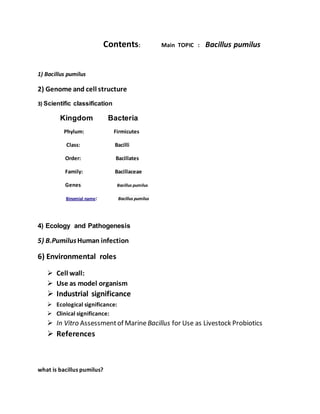
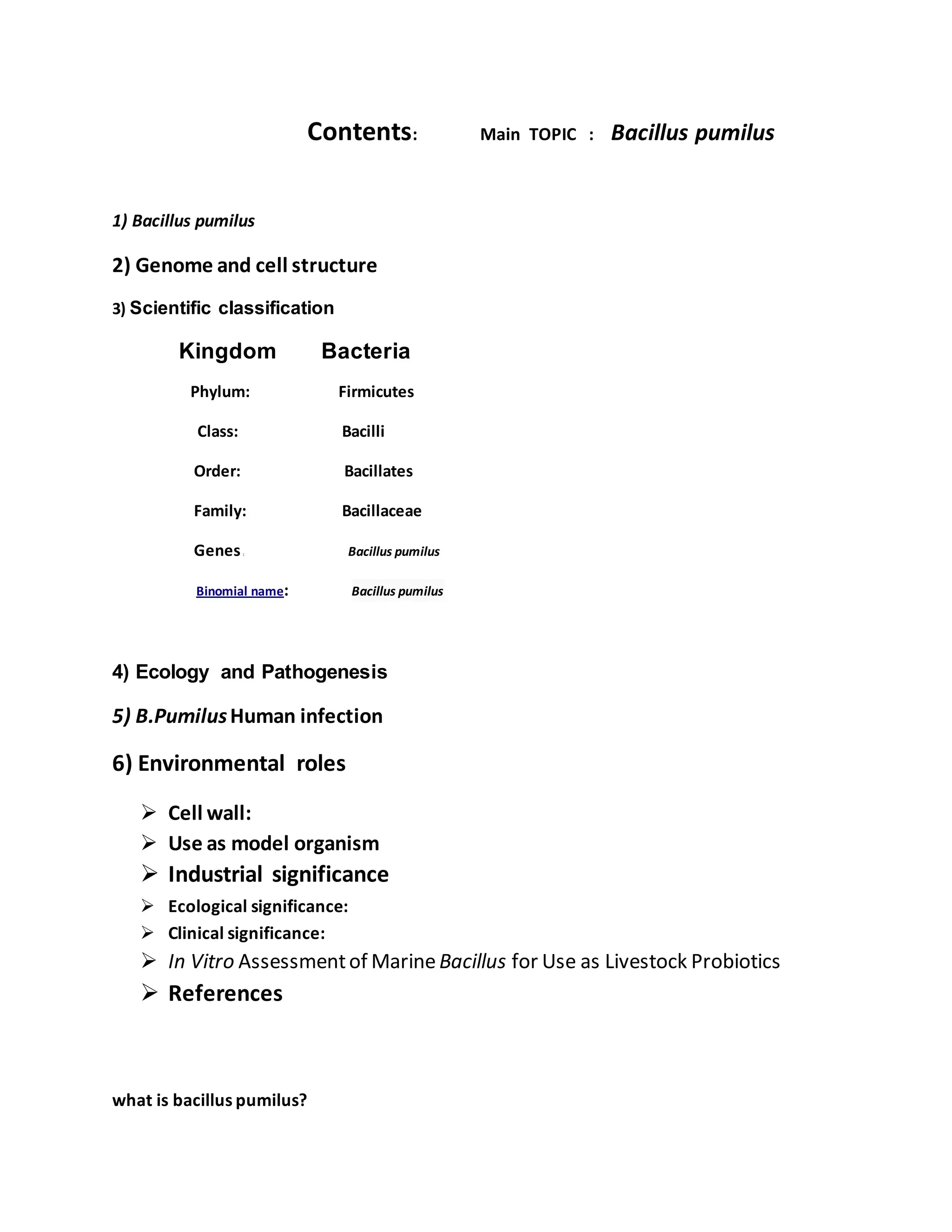
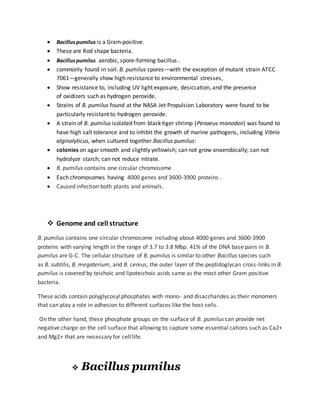
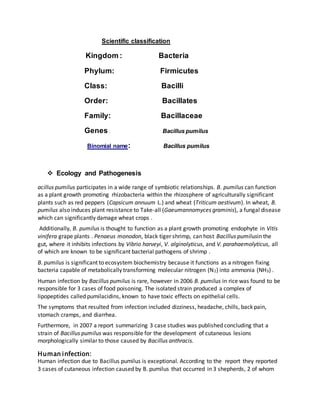
Bacillus pumilus is a rod-shaped, aerobic, spore-forming bacterium commonly found in soil. It has one circular chromosome containing around 4000 genes. While generally harmless, it has caused a few cases of food poisoning in humans. B. pumilus plays various environmental roles like promoting plant growth, fixing nitrogen, and inhabiting shrimp guts where it inhibits pathogenic bacteria. It is studied as a model organism due to its genetic amenability. Some strains also have industrial uses like producing enzymes for detergents.


