CHAPTER 7: ELECTRICITY


   7.1: Relationship
between electric current
and potential difference
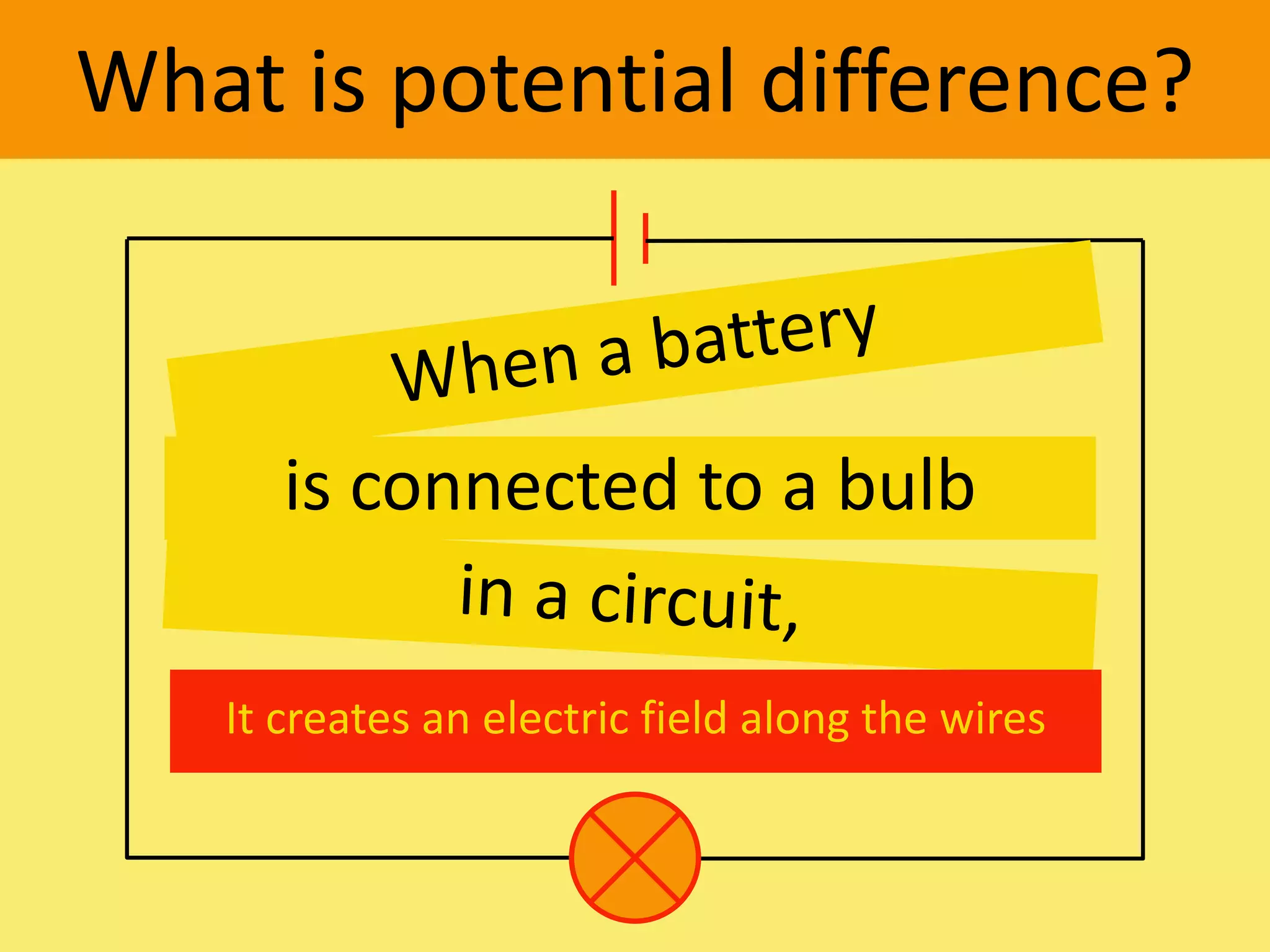
What is potential difference?


      is connected to a bulb

   It creates an electric field along the wires
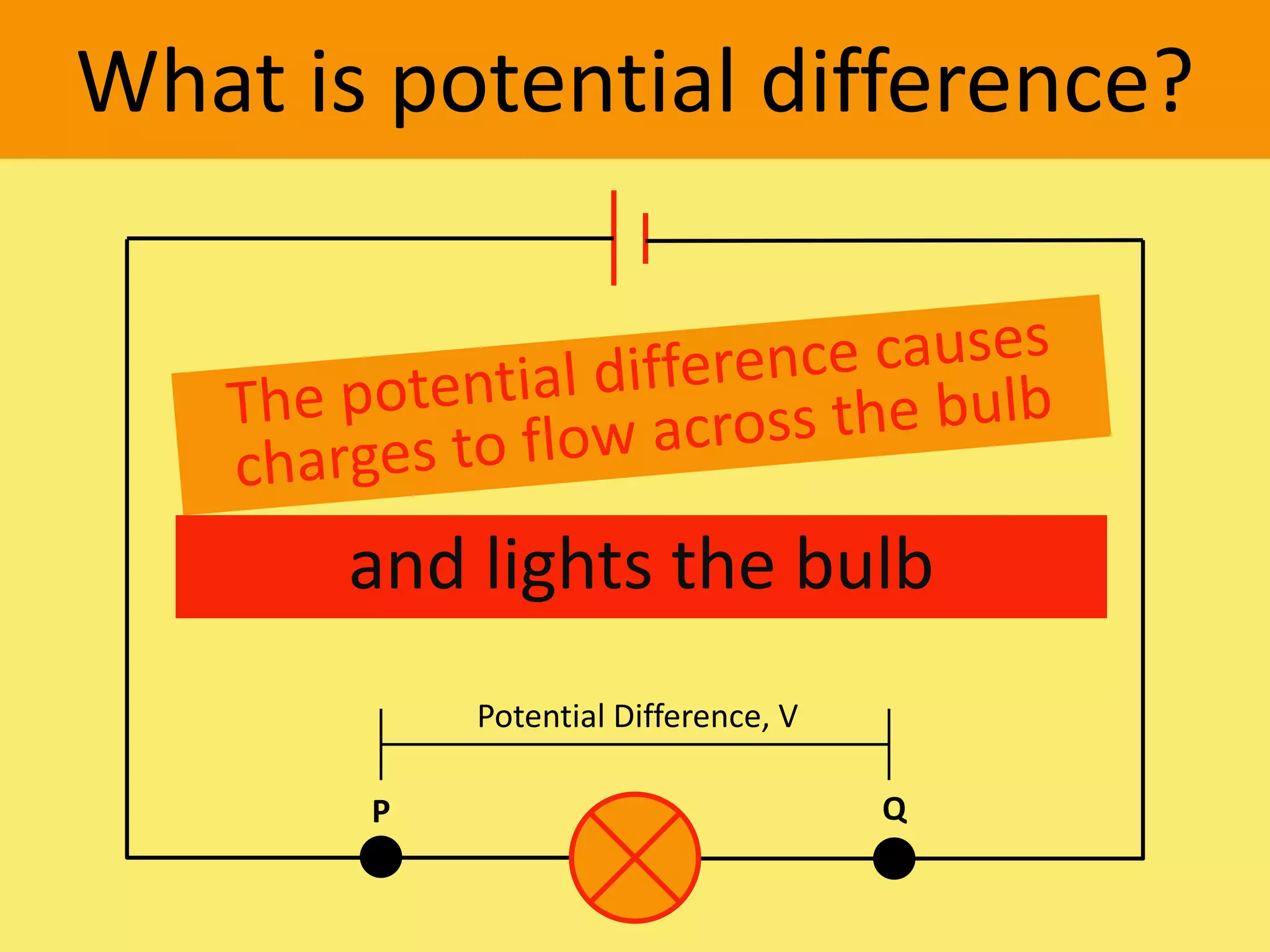
What is potential difference?

   The positive terminal at P has a higher potential


   The negative terminal at Q has a lower potential


                 Potential Difference, V

           P                               Q
What is potential difference?


       and lights the bulb
           Potential Difference, V

       P                             Q
What is potential difference?
Work is done
                   When electrical
                     energy carried
                     by the charges
                    is dissipated by
                                heat
                   and light energy
                      after crossing
                            the bulb
Potential Difference Equation
 Potential              Work Done
Difference,                 Charge

   Or                                SI Unit:
                                      Joule

               Potential               Energy
              Difference,              Charge
What is 1 Volt?

1 Volt =   1 Joule per Coulomb
What is 1 Volt?
     1 Joule of work is done


1C

A                              B
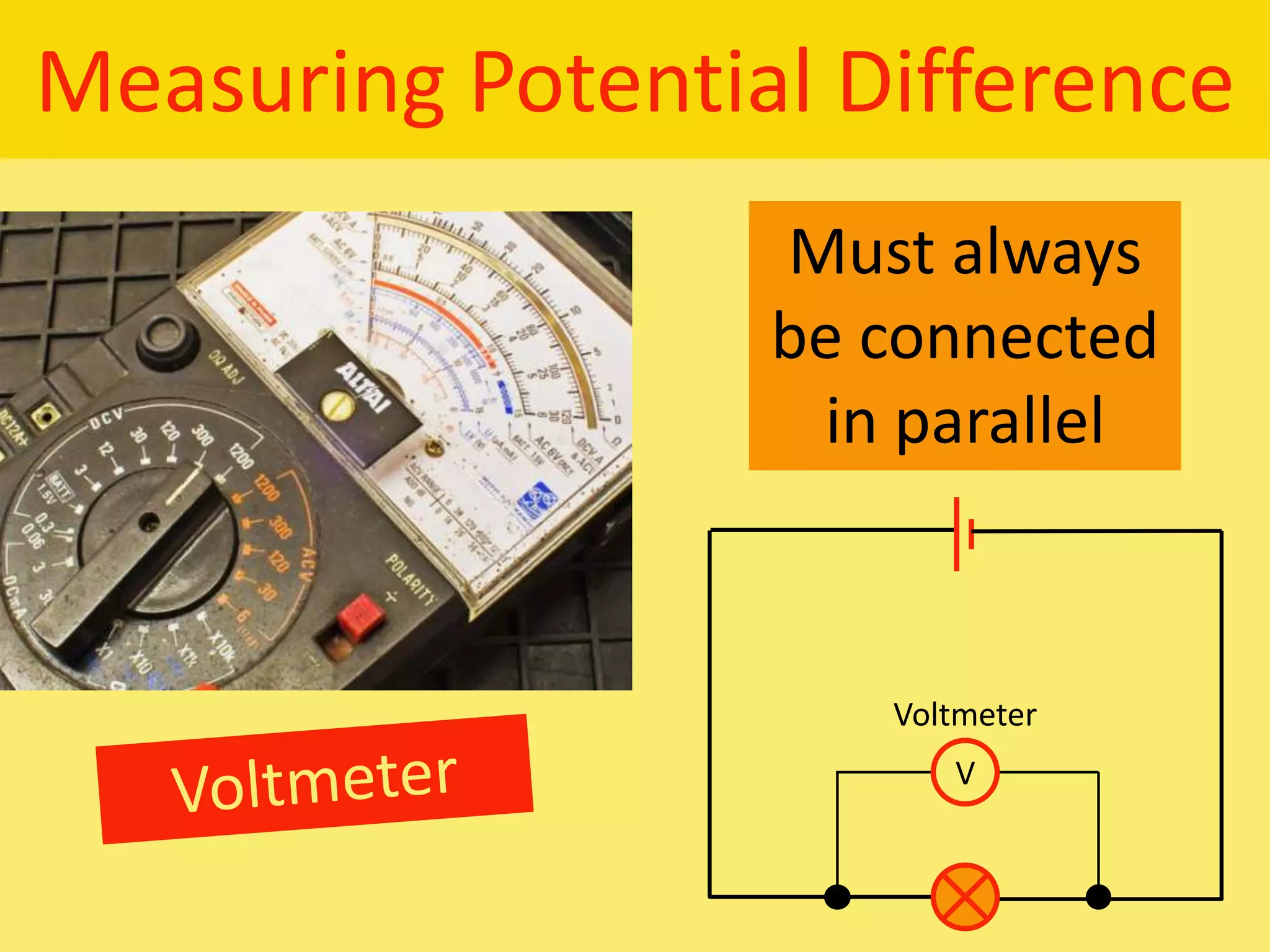
Measuring Potential Difference
                  Must always
                  be connected
                   in parallel


                     Voltmeter
                        V
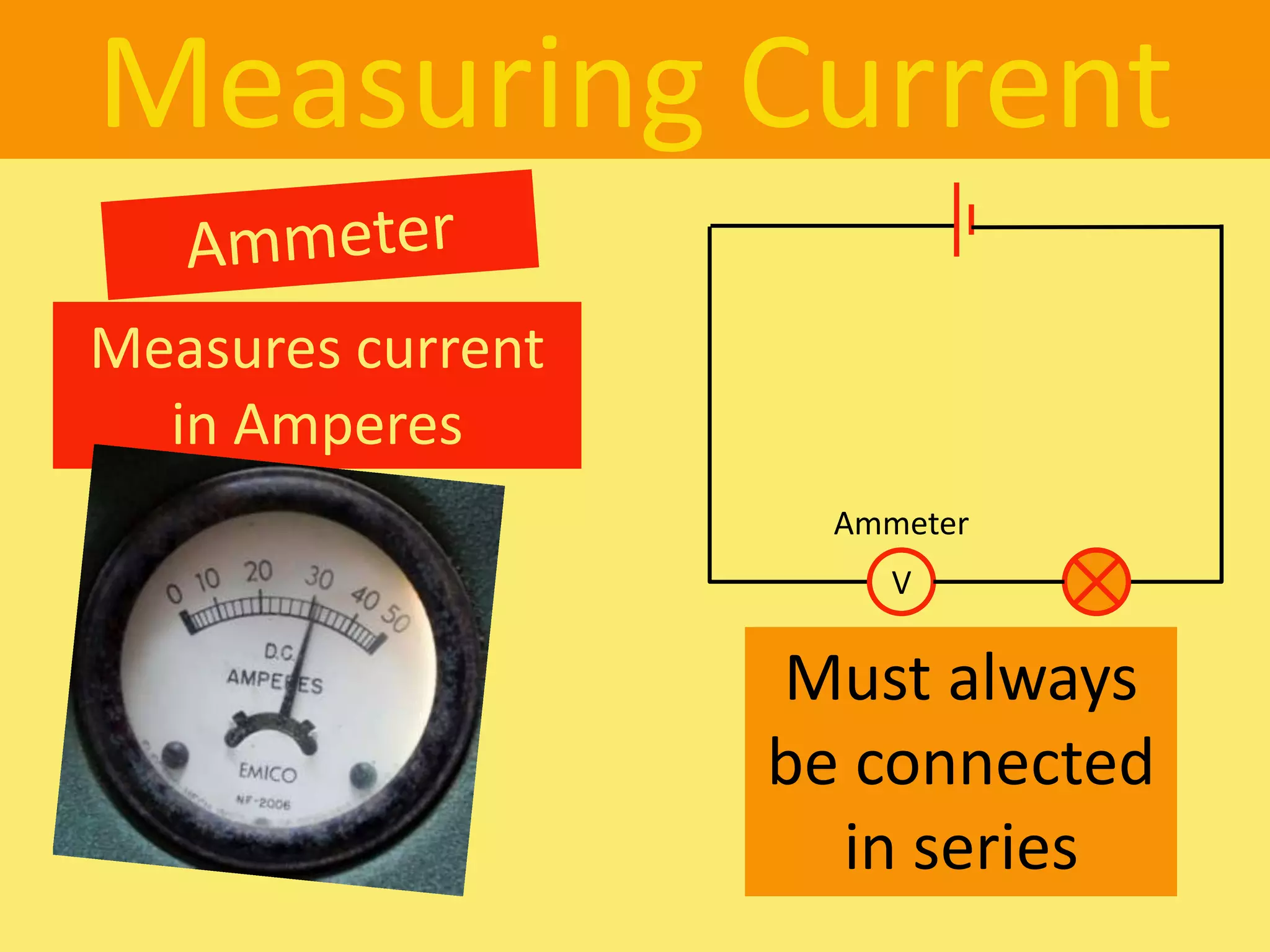
Measuring Current
Measures current
  in Amperes
                     Ammeter
                       V

                   Must always
                   be connected
                     in series
Relationship between Current and
       Potential Difference
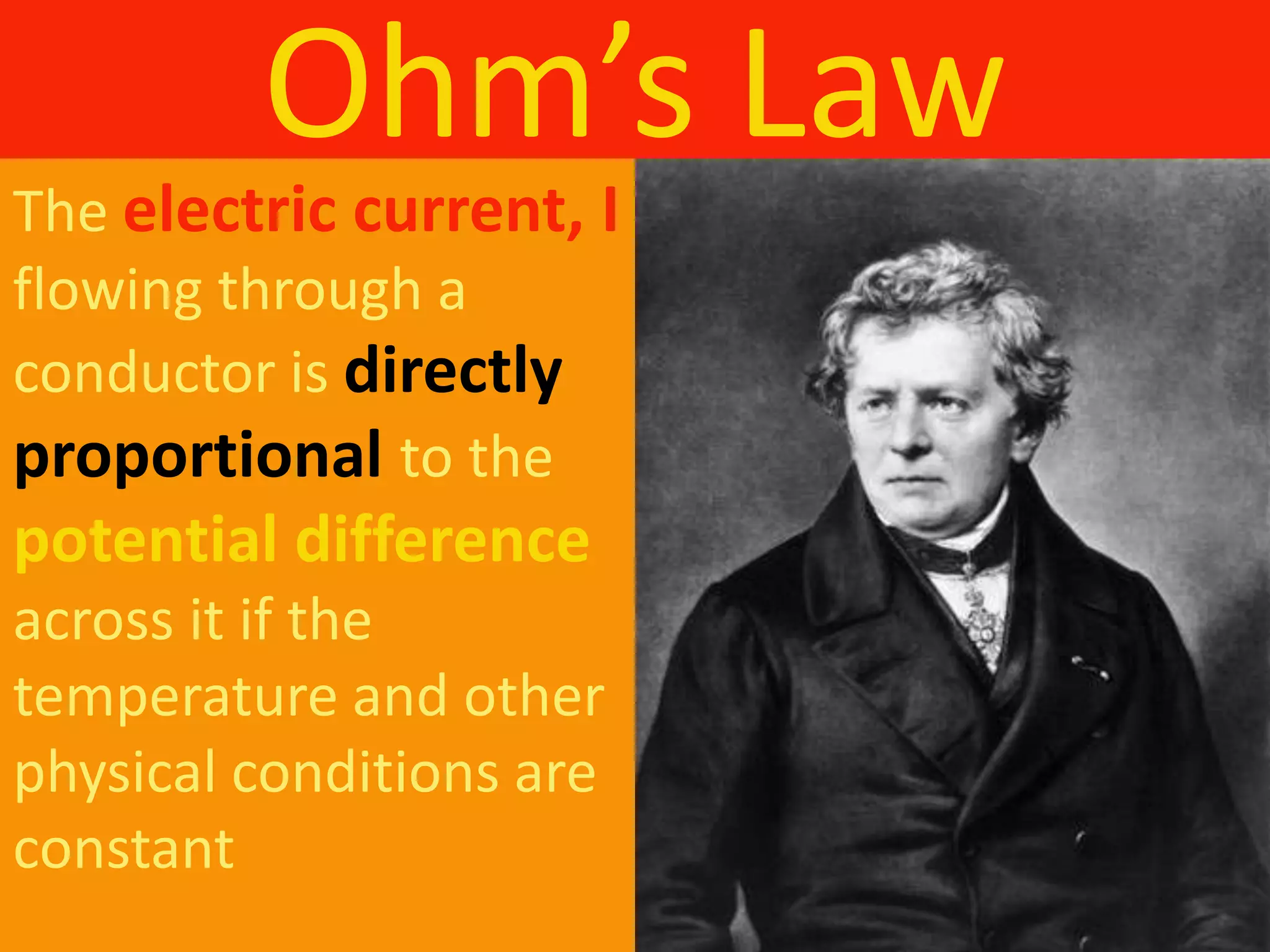
Ohm’s Law
The electric current, I
flowing through a
conductor is directly
proportional to the
potential difference
across it if the
temperature and other
physical conditions are
constant
Ohm’s Law
Ohmic Conductors and Non-ohmic
           Conductors
Conductors that obey Ohm’s Law: Ohmic


 Conductors that don’t obey   Non-
        Ohm’s Law:            Ohmic
Resistance
A measure of how much of a
conductor resists the flow of electricity
Resistance
Resistance (R) is defined as the ratio of
potential difference (V) across the
conductor the the current (I) flowing
through it.
Disadvantage of Resistance
Causes some
electrical energy to
turn into heat
So some electrical
energy is lost when
trying to transmit
across a conductor
Advantage of Resistance
Resistance allows us to use electricity
for heat and light
Heat generated from electric heaters
are due to resistance
Light we get from light bulb is due to
resistance of the wire
 - filament becomes hot and glows
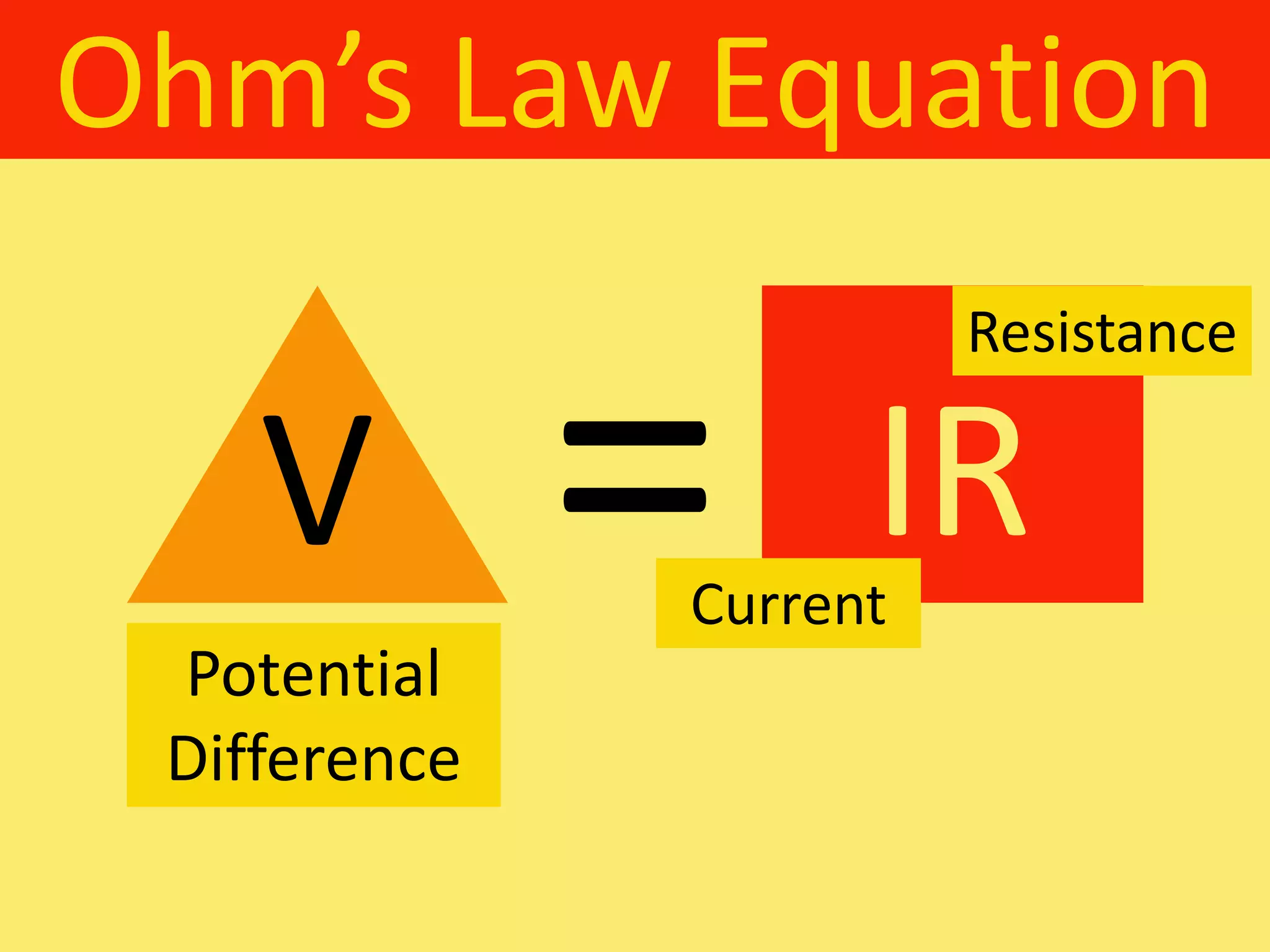
Ohm’s Law Equation


              =
                        Resistance


    V               IR
              Current
 Potential
 Difference
Super Conductor
Resistance of a metal
increases with temperature


           Resistance of a semiconductor
           decreases with temperature
Super Conductor


A material whose resistance becomes zero when its
temperature drops to a certain value called the critical
temperature
Advantages of a superconductor
           Enables superconductors
           to maintain a current
           with no applied voltage
           at that temperature
Advantages of a superconductor


  Able to sustain large currents
Advantages of a superconductor
             Enables superconductors
             to maintain a current
             with no applied voltage
             at that temperature
Advantages of a superconductor


  Able to sustain large currents
Advantages of a superconductor


Small sized motors and generators can be used
MAGLEV trains
Magnetic levitation

                        Trains can be made to
                              ‘float’ on strong
                             superconducting
                                       magnets


Eliminate friction between train and track
MRI Scanner
    Magnetic
Resonance Imaging
                          Used to determine
                           what is going on
                         inside a human body
   Body exposed to
strong superconductor
derived magnetic field
   Hydrogen atoms release energy at a
frequency that can be read by a computer
Electrical power line
     Electrical cable made of
superconductors increase efficiency


 Reduce loss of energy from heat
Photo credits
•   Flickr / kodak-moments--high-voltage / Matthias Pastwa
•   Flickr / you can do it! / Eyfi
•   Flickr / Idea / brunkfordbraun
•   Flickr / Lightning May 2010 / Lightnomad
•   Flickr / Old Altai Analogue Multimeter / Tudedude
•   Flickr / RCA Porto-Arc Ammeter / Carbon Arc
•   Flickr / resistance begins at OHM / ChrisM70
•   BerndGehrmann at de.wikipedia [Public domain]/ Wikimedia Commons
•   Flickr / Zeus Storm from ground level / dave~
•   Flickr / Resistance Is Not Futile / maury.mccown
•   Flickr / Resistance2 / steve_Iodefink
•   Flickr / Failure / ‘PixelPlacebo’
•   Flickr / img_1628 / LacerdaGonzo
•   Flickr / experiments with liquid nitrogen / peletiah
•   Flickr / Frozen – bicycle / #AlexWitt
•   Flickr / Superconductor / rx8geek
•   Flickr / afternoon tea for nerds / bionerd
•   Flickr / superconducting maglev / wwu124
•   Flickr / morning road / Todd Klassy
•   Flickr / LHC magnets awaiting test / spadger
•   Flickr / maglev / chill

7.2 relationship between electric current and potential difference

  • 1.
    CHAPTER 7: ELECTRICITY 7.1: Relationship between electric current and potential difference
  • 2.
    What is potentialdifference? is connected to a bulb It creates an electric field along the wires
  • 3.
    What is potentialdifference? The positive terminal at P has a higher potential The negative terminal at Q has a lower potential Potential Difference, V P Q
  • 4.
    What is potentialdifference? and lights the bulb Potential Difference, V P Q
  • 5.
    What is potentialdifference? Work is done When electrical energy carried by the charges is dissipated by heat and light energy after crossing the bulb
  • 6.
    Potential Difference Equation Potential Work Done Difference, Charge Or SI Unit: Joule Potential Energy Difference, Charge
  • 7.
    What is 1Volt? 1 Volt = 1 Joule per Coulomb
  • 8.
    What is 1Volt? 1 Joule of work is done 1C A B
  • 9.
    Measuring Potential Difference Must always be connected in parallel Voltmeter V
  • 10.
    Measuring Current Measures current in Amperes Ammeter V Must always be connected in series
  • 11.
    Relationship between Currentand Potential Difference
  • 12.
    Ohm’s Law The electriccurrent, I flowing through a conductor is directly proportional to the potential difference across it if the temperature and other physical conditions are constant
  • 13.
  • 14.
    Ohmic Conductors andNon-ohmic Conductors Conductors that obey Ohm’s Law: Ohmic Conductors that don’t obey Non- Ohm’s Law: Ohmic
  • 16.
    Resistance A measure ofhow much of a conductor resists the flow of electricity
  • 17.
    Resistance Resistance (R) isdefined as the ratio of potential difference (V) across the conductor the the current (I) flowing through it.
  • 18.
    Disadvantage of Resistance Causessome electrical energy to turn into heat So some electrical energy is lost when trying to transmit across a conductor
  • 19.
    Advantage of Resistance Resistanceallows us to use electricity for heat and light Heat generated from electric heaters are due to resistance Light we get from light bulb is due to resistance of the wire - filament becomes hot and glows
  • 20.
    Ohm’s Law Equation = Resistance V IR Current Potential Difference
  • 21.
    Super Conductor Resistance ofa metal increases with temperature Resistance of a semiconductor decreases with temperature
  • 22.
    Super Conductor A materialwhose resistance becomes zero when its temperature drops to a certain value called the critical temperature
  • 23.
    Advantages of asuperconductor Enables superconductors to maintain a current with no applied voltage at that temperature
  • 24.
    Advantages of asuperconductor Able to sustain large currents
  • 25.
    Advantages of asuperconductor Enables superconductors to maintain a current with no applied voltage at that temperature
  • 26.
    Advantages of asuperconductor Able to sustain large currents
  • 27.
    Advantages of asuperconductor Small sized motors and generators can be used
  • 28.
    MAGLEV trains Magnetic levitation Trains can be made to ‘float’ on strong superconducting magnets Eliminate friction between train and track
  • 29.
    MRI Scanner Magnetic Resonance Imaging Used to determine what is going on inside a human body Body exposed to strong superconductor derived magnetic field Hydrogen atoms release energy at a frequency that can be read by a computer
  • 30.
    Electrical power line Electrical cable made of superconductors increase efficiency Reduce loss of energy from heat
  • 31.
    Photo credits • Flickr / kodak-moments--high-voltage / Matthias Pastwa • Flickr / you can do it! / Eyfi • Flickr / Idea / brunkfordbraun • Flickr / Lightning May 2010 / Lightnomad • Flickr / Old Altai Analogue Multimeter / Tudedude • Flickr / RCA Porto-Arc Ammeter / Carbon Arc • Flickr / resistance begins at OHM / ChrisM70 • BerndGehrmann at de.wikipedia [Public domain]/ Wikimedia Commons • Flickr / Zeus Storm from ground level / dave~ • Flickr / Resistance Is Not Futile / maury.mccown • Flickr / Resistance2 / steve_Iodefink • Flickr / Failure / ‘PixelPlacebo’ • Flickr / img_1628 / LacerdaGonzo • Flickr / experiments with liquid nitrogen / peletiah • Flickr / Frozen – bicycle / #AlexWitt • Flickr / Superconductor / rx8geek • Flickr / afternoon tea for nerds / bionerd • Flickr / superconducting maglev / wwu124 • Flickr / morning road / Todd Klassy • Flickr / LHC magnets awaiting test / spadger • Flickr / maglev / chill

Editor's Notes

  • #3 Battery + Bulb in a circuit- Electric field along wires
  • #4 Battery + Bulb in a circuit- Electric field along wires
  • #5 Battery + Bulb in a circuit- Electric field along wires
  • #7 Potential difference, V=Work done, W / Charge, QOrEnergy, E/Charge, QSI unit Volt (V)
  • #8 1 volt = 1 Joule per Coulomb
  • #9 The potential difference between A and B in a circuit is 1 Volt if1 Joule of work is doneMoving 1 Coulomb of charge From A to B
  • #10 VoltmeterMust always be connected in parallel
  • #11 AmmeterMeasures current in AmperesConnected in series with a deviceLow resistance so little effect on the current flow
  • #12 Higher potential difference, Higher Current Flow↑ V, ↑ I↓ V, ↓ IV ∝ I
  • #15 Conductors that obey Ohm’s Law – OhmicConductors that don’t obey Ohm’s Law – Non-Ohmic
  • #17 A measure of how much a conductor resists the flow of electricityGood conductor = low resistancePoor conductor = high resistance
  • #21 V = IR V = potential differenceI = currentR = resistance
  • #22 Resistance of a semiconductor decreases with temperature
  • #23 A material whose resistance becomes zero when its temperature drops to a certain value called the critical temperature
  • #25 Able to sustain large currents
  • #26 Smaller power loss during transmission
  • #27 Less heat energy wasted
  • #28 Small sized motors and generators can be used
  • #29 Magnetic levitationTrains can be made to ‘float’ on strong superconducting magnetsEliminates friction between train and track
  • #30 Magnetic Resonance ImagingUsed to determine what is going on inside a human bodyBody exposed to strong superconductor derived magnetic fieldHydrogen atoms release energy at a frequency that can be read by a computer
  • #31 Electrical cable made of superconductors increase efficiencyReduce loss of energy from heat