


Lichen
Planus
- Aaron Sarwal (BDS 3rd
Prof.)
Lichen Planus
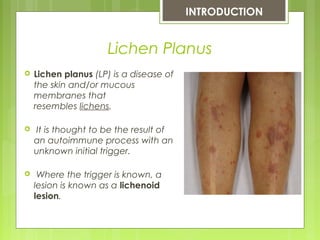
 Lichen planus (LP) is a disease of
the skin and/or mucous
membranes that
resembles lichens.
 It is thought to be the result of
an autoimmune process with an
unknown initial trigger.
 Where the trigger is known, a
lesion is known as a lichenoid
lesion.
INTRODUCTION
Epidemiology :
EPIDEMIOLOGY
 Risks for the condition include:
 Exposure to medicines, dyes, and other chemicals
(including gold, antibiotics, arsenic, iodides, chloroquine,
quinacrine, quinide, phenothiazines, and diuretics)
 Diseases such as hepatitis C
 Race: No racial predispositions.
 Sex: Lichen Planus effects women more compared to
men (3:2) ratio.
 Age: More than two thirds of lichen planus patients are
aged 30-60 years; however, lichen planus can occur at
any age
Time Period:
TIME PERIOD
 It is a chronic disease.
 It has a sub-acute presentation i.e lesions appear
usually 1-2 weeks after being exposed to stimulus.
 The condition often clears up within 18 months
but may come and go for years.
 Removal of stimulus could result in a quick
resolution, eg if lichen planus is caused by a
medicine, the rash should resolve once medicine
is stopped.
Syndrome Statement:
SYNDROME STATEMENT
 It presents with 3 types of lesions:
 Mouth Lesions
 Skin Lesions
 Other manifestations
Oral Lesions:
ORAL LESIONS
 May be tender or painful (mild cases may not
cause plain)
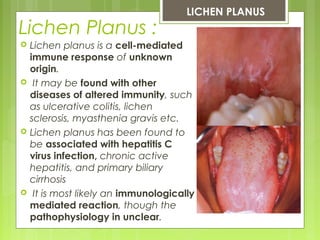
 Are located on the sides of the tongue, inside of
the cheek, or gums
 Look like blue-white spots
 Form lines in a lacy network
 Gradual increase in size of the affected area
 Sometimes form painful ulcers
Skin Lesions:
SKIN LESIONS
 Are usually found on the inner wrist, legs, torso, or
genitals
 Are itchy
 Have even sides (symmetrical) and sharp borders
 Occur in single lesion or clusters, often at the site
of skin injury
 May be covered with thin white streaks or scratch
marks (called Wickham's striae)
 Are shiny or scaly looking
 Have a dark, reddish-purple color on the skin or
are gray-white in the mouth
 May develop blisters or ulcers
Other Manifestations:
OTHER LESIONS
 Dry mouth
 Hair loss
 Metallic taste in the mouth
 Ridges in the nails (nail abnormalities)
The goal of treatment is to reduce
symptoms and speed healing.
If symptoms are mild, it may not
need treatment.
MANAGMENT
Treatment Goal
 Treatments may include:
 Antihistamines
 Medicines that calm down the immune system, such as
cyclosporine (in severe cases)
 Lidocaine mouthwashes to numb the area and make eating
more comfortable (for mouth sores)
 Topical corticosteroids (such as clobetasol) or oral
corticosteroids (such as prednisone) to reduce swelling and
lower immune responses
 Corticosteroids shots into a sore
 Vitamin A as a cream (topical retinoic acid) or taken mouth
(acitretin)
 Dressings  placed over skin medicines to protect from
scratching
 Ultraviolet light therapy for some cases
MANAGMENT
Treatments and Rationale
Detailed
Description
DESCRIPTION
Lichen Planus :
 Lichen planus is a cell-mediated
immune response of unknown
origin.
 It may be found with other
diseases of altered immunity, such
as ulcerative colitis, lichen
sclerosis, myasthenia gravis etc.
 Lichen planus has been found to
be associated with hepatitis C
virus infection, chronic active
hepatitis, and primary biliary
cirrhosis
  It is most likely an immunologically
mediated reaction, though the
pathophysiology in unclear.
LICHEN PLANUS
Signs and
Symptoms
SIGNS AND SYMPTOMS
Signs and Symptoms:
 The following may be noted in the patient history:
 Lesions initially developing on flexural surfaces of the
limbs, with a generalized eruption developing after a
week or more and maximal spreading within 2-16 weeks
 Pruritus of varying severity, depending on the type of
lesion and the extent of involvement
 Oral lesions that may be asymptomatic, burning, or even
painful
 In cutaneous disease, lesions typically resolving within 6
months (>50%) to 18 months (85%); chronic disease is
more likely oral lichen planus or with large, annular,
hypertrophic lesions and mucous membrane involvement
SYNDROME STATEMENT
Signs and Symptoms:
 In addition to the cutaneous eruption, lichen
planus can involve the following structures:
 Mucous membranes
 Genitalia
 Nails
 Scalp
SYNDROME STATEMENT
Interestingly, this disease is
seldom seen in carefree
people, the nervous, high
strung person is almost
invariably the one in which
this condition develops.
Clinical
Presentation
CLINCAL
Clinical Presentation
 The clinical presentation of lichen planus has
several variations, as follows:
 Hypertrophic lichen planus
 Atrophic lichen planus
 Erosive/ulcerative lichen planus
 Follicular lichen planus (lichen planopilaris)
 Annular lichen planus
 Linear lichen planus
 Vesicular and bullous lichen planus
 Actinic lichen planus
 Lichen planus pigmentosus
 Lichen planus pemphigoides
CLINICAL PRESENTATION
Clinical Forms: Oral Lichen Planus
 Reticular, the most common presentation of oral lichen planus,
 characterised by the net-like appearance of lacy white lines, oral
variants of Wickham's straiae. This is usually asymptomatic.
 Erosive/ulcerative, the second most common form of oral lichen
planus, characterised by oral ulcers presenting with persistent,
irregular areas of redness, ulcerations and erosions covered with a
yellow slough. This can occur in one or more areas of the mouth. In
25% of people with erosive oral lichen planus, the gums are
involved, described as desquamative gingivitis (a condition not
unique to lichen planus). It may be the initial or only sign of the
condition.
 Papular, with white papules.
 Plaque-like appearing as a white patch which may
resemble leukoplakia
 Atrophic, appearing as areas. Atrophic oral lichen planus may also
manifest as desquamative gingivitis.
 Bullous, appearing as fluid-filled vesicles which project from the
surface.
CLINICAL PRESENTATION
Diagnosis &
Histopathology
DESCRIPTION
 Direct immunofluorescence study reveals
globular deposits of immunoglobulin M (IgM)
and complement mixed with apoptotic
keratinocytes.
 No imaging studies are necessary.
 Microscopy confirms OLP.
DIAGNOSIS
Diagnosis:
Histopathology:
 Distinguishing histopathologic features of lichen planus
include the following:
 Hyperkeratotic epidermis with irregular acanthosis and focal
thickening in the granular layer
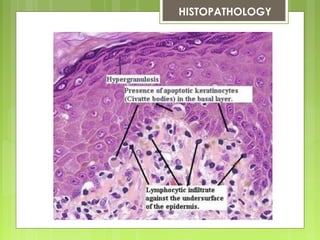
 Degenerative keratinocytes (colloid or Civatte bodies) in the
lower epidermis; in addition to apoptotic keratinocytes, colloid
bodies are composed of globular deposits of IgM (occasionally
immunoglobulin G [IgG] or immunoglobulin A [IgA]) and
complement
 Linear or shaggy deposits of fibrin and fibrinogen in the
basement membrane zone
 In the upper dermis, a bandlike infiltrate of lymphocytic
(primarily helper T) and histiocytic cells with many Langerhans
cells
 HISTOPATHOLOGY
 HISTOPATHOLOGY
Management
MANAGEMENT
 Lichen planus is a self-limited disease that usually resolves
within 8-12 months.
 Mild cases can be treated with fluorinated topical steroids.
 More severe cases, especially those with scalp, nail, and
mucous membrane involvement, may necessitate more
intensive therapy.
MANAGEMENT
Management
 Pharmacologic therapies include the following:
 Cutaneous lichen planus: Topical steroids,
particularly class I or II ointments (first-line
treatment); systemic steroids; oral metronidazole 
;
oral acitretin; other treatments of unproven
efficacy (eg, mycophenolate mofetil and
sulfasalazine)
 Lichen planus of the oral mucosa: Topical
steroids; topical calcineurin inhibitors; oral or
topical retinoids (with close monitoring of lipid
levels)
MANAGEMENT
Pharmacological Management
 Patients with widespread lichen planus may
respond to the following:
 Narrow-band or broadband UV-B therapy.
 Psoralen with UV-A (PUVA) therapy; use of topical
ointment at the time of UV-A treatment may
decrease the effectiveness of PUVA; precautions
should be taken for persons with a history of skin
cancers or hepatic insufficiency
MANAGEMENT
Pharmacological Management
Morbidity:
 In lichen planus, atrophy and scarring are seen
in hypertrophic lesions and in lesions on the
scalp.
 Cutaneous lichen planus does not carry a risk
of skin cancer, but ulcerative lesions in the
mouth, particularly in men, do have a higher
incidence of malignant transformation.
 However, the malignant transformation rate of
oral lichen planus is low (< 2% in one
report). 
Vulvar lesions in women may also be
associated with squamous cell carcinoma.
MANAGEMENT
Complications
COMPLICATIONS
Complications:
Mouth ulcers that are
present for a long time may
develop into oral cancer.
COMPLICATIONS
Summary
SUMMARY
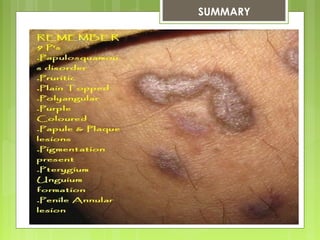
In summary:
 Lichen Planus effects women more compared
to men (3:2) ratio, etiology of Lichen Planus is
not known, it is characterised by nine P’s
 Papulosquamous disorder
 Pruritic
 Polyangular with
 Plain Topped
 Pigmented
 Purple coloured
 Papules and Plaques
 Pterygium Unguium present in nails
 Penile annular lesions
SUMMARY
SUMMARY
Thank You!
MAXILARY FIRST
MOLAR

Lichen planus

  • 1.
  • 2.
    Lichen Planus  Lichenplanus (LP) is a disease of the skin and/or mucous membranes that resembles lichens.  It is thought to be the result of an autoimmune process with an unknown initial trigger.  Where the trigger is known, a lesion is known as a lichenoid lesion. INTRODUCTION
  • 3.
    Epidemiology : EPIDEMIOLOGY  Risksfor the condition include:  Exposure to medicines, dyes, and other chemicals (including gold, antibiotics, arsenic, iodides, chloroquine, quinacrine, quinide, phenothiazines, and diuretics)  Diseases such as hepatitis C  Race: No racial predispositions.  Sex: Lichen Planus effects women more compared to men (3:2) ratio.  Age: More than two thirds of lichen planus patients are aged 30-60 years; however, lichen planus can occur at any age
  • 4.
    Time Period: TIME PERIOD It is a chronic disease.  It has a sub-acute presentation i.e lesions appear usually 1-2 weeks after being exposed to stimulus.  The condition often clears up within 18 months but may come and go for years.  Removal of stimulus could result in a quick resolution, eg if lichen planus is caused by a medicine, the rash should resolve once medicine is stopped.
  • 5.
    Syndrome Statement: SYNDROME STATEMENT It presents with 3 types of lesions:  Mouth Lesions  Skin Lesions  Other manifestations
  • 6.
    Oral Lesions: ORAL LESIONS May be tender or painful (mild cases may not cause plain)  Are located on the sides of the tongue, inside of the cheek, or gums  Look like blue-white spots  Form lines in a lacy network  Gradual increase in size of the affected area  Sometimes form painful ulcers
  • 7.
    Skin Lesions: SKIN LESIONS Are usually found on the inner wrist, legs, torso, or genitals  Are itchy  Have even sides (symmetrical) and sharp borders  Occur in single lesion or clusters, often at the site of skin injury  May be covered with thin white streaks or scratch marks (called Wickham's striae)  Are shiny or scaly looking  Have a dark, reddish-purple color on the skin or are gray-white in the mouth  May develop blisters or ulcers
  • 8.
    Other Manifestations: OTHER LESIONS Dry mouth  Hair loss  Metallic taste in the mouth  Ridges in the nails (nail abnormalities)
  • 9.
    The goal oftreatment is to reduce symptoms and speed healing. If symptoms are mild, it may not need treatment. MANAGMENT Treatment Goal
  • 10.
     Treatments mayinclude:  Antihistamines  Medicines that calm down the immune system, such as cyclosporine (in severe cases)  Lidocaine mouthwashes to numb the area and make eating more comfortable (for mouth sores)  Topical corticosteroids (such as clobetasol) or oral corticosteroids (such as prednisone) to reduce swelling and lower immune responses  Corticosteroids shots into a sore  Vitamin A as a cream (topical retinoic acid) or taken mouth (acitretin)  Dressings  placed over skin medicines to protect from scratching  Ultraviolet light therapy for some cases MANAGMENT Treatments and Rationale
  • 11.
  • 12.
    Lichen Planus : Lichen planus is a cell-mediated immune response of unknown origin.  It may be found with other diseases of altered immunity, such as ulcerative colitis, lichen sclerosis, myasthenia gravis etc.  Lichen planus has been found to be associated with hepatitis C virus infection, chronic active hepatitis, and primary biliary cirrhosis   It is most likely an immunologically mediated reaction, though the pathophysiology in unclear. LICHEN PLANUS
  • 13.
  • 14.
    Signs and Symptoms: The following may be noted in the patient history:  Lesions initially developing on flexural surfaces of the limbs, with a generalized eruption developing after a week or more and maximal spreading within 2-16 weeks  Pruritus of varying severity, depending on the type of lesion and the extent of involvement  Oral lesions that may be asymptomatic, burning, or even painful  In cutaneous disease, lesions typically resolving within 6 months (>50%) to 18 months (85%); chronic disease is more likely oral lichen planus or with large, annular, hypertrophic lesions and mucous membrane involvement SYNDROME STATEMENT
  • 15.
    Signs and Symptoms: In addition to the cutaneous eruption, lichen planus can involve the following structures:  Mucous membranes  Genitalia  Nails  Scalp SYNDROME STATEMENT Interestingly, this disease is Interestingly, this disease is seldom seen in carefree seldom seen in carefree people, the nervous, high people, the nervous, high strung person is almost strung person is almost invariably the one in which invariably the one in which this condition develops. this condition develops.
  • 16.
  • 17.
    Clinical Presentation  Theclinical presentation of lichen planus has several variations, as follows:  Hypertrophic lichen planus  Atrophic lichen planus  Erosive/ulcerative lichen planus  Follicular lichen planus (lichen planopilaris)  Annular lichen planus  Linear lichen planus  Vesicular and bullous lichen planus  Actinic lichen planus  Lichen planus pigmentosus  Lichen planus pemphigoides CLINICAL PRESENTATION
  • 18.
    Clinical Forms: OralLichen Planus  Reticular, the most common presentation of oral lichen planus,  characterised by the net-like appearance of lacy white lines, oral variants of Wickham's straiae. This is usually asymptomatic.  Erosive/ulcerative, the second most common form of oral lichen planus, characterised by oral ulcers presenting with persistent, irregular areas of redness, ulcerations and erosions covered with a yellow slough. This can occur in one or more areas of the mouth. In 25% of people with erosive oral lichen planus, the gums are involved, described as desquamative gingivitis (a condition not unique to lichen planus). It may be the initial or only sign of the condition.  Papular, with white papules.  Plaque-like appearing as a white patch which may resemble leukoplakia  Atrophic, appearing as areas. Atrophic oral lichen planus may also manifest as desquamative gingivitis.  Bullous, appearing as fluid-filled vesicles which project from the surface. CLINICAL PRESENTATION
  • 19.
  • 20.
     Direct immunofluorescencestudy reveals globular deposits of immunoglobulin M (IgM) and complement mixed with apoptotic keratinocytes.  No imaging studies are necessary.  Microscopy confirms OLP. DIAGNOSIS Diagnosis:
  • 21.
    Histopathology:  Distinguishing histopathologic featuresof lichen planus include the following:  Hyperkeratotic epidermis with irregular acanthosis and focal thickening in the granular layer  Degenerative keratinocytes (colloid or Civatte bodies) in the lower epidermis; in addition to apoptotic keratinocytes, colloid bodies are composed of globular deposits of IgM (occasionally immunoglobulin G [IgG] or immunoglobulin A [IgA]) and complement  Linear or shaggy deposits of fibrin and fibrinogen in the basement membrane zone  In the upper dermis, a bandlike infiltrate of lymphocytic (primarily helper T) and histiocytic cells with many Langerhans cells  HISTOPATHOLOGY
  • 22.
  • 23.
  • 24.
     Lichen planusis a self-limited disease that usually resolves within 8-12 months.  Mild cases can be treated with fluorinated topical steroids.  More severe cases, especially those with scalp, nail, and mucous membrane involvement, may necessitate more intensive therapy. MANAGEMENT Management
  • 25.
     Pharmacologic therapiesinclude the following:  Cutaneous lichen planus: Topical steroids, particularly class I or II ointments (first-line treatment); systemic steroids; oral metronidazole  ; oral acitretin; other treatments of unproven efficacy (eg, mycophenolate mofetil and sulfasalazine)  Lichen planus of the oral mucosa: Topical steroids; topical calcineurin inhibitors; oral or topical retinoids (with close monitoring of lipid levels) MANAGEMENT Pharmacological Management
  • 26.
     Patients withwidespread lichen planus may respond to the following:  Narrow-band or broadband UV-B therapy.  Psoralen with UV-A (PUVA) therapy; use of topical ointment at the time of UV-A treatment may decrease the effectiveness of PUVA; precautions should be taken for persons with a history of skin cancers or hepatic insufficiency MANAGEMENT Pharmacological Management
  • 27.
    Morbidity:  In lichenplanus, atrophy and scarring are seen in hypertrophic lesions and in lesions on the scalp.  Cutaneous lichen planus does not carry a risk of skin cancer, but ulcerative lesions in the mouth, particularly in men, do have a higher incidence of malignant transformation.  However, the malignant transformation rate of oral lichen planus is low (< 2% in one report).  Vulvar lesions in women may also be associated with squamous cell carcinoma. MANAGEMENT
  • 28.
  • 29.
    Complications: Mouth ulcers that are presentfor a long time may develop into oral cancer. COMPLICATIONS
  • 30.
  • 31.
    In summary:  LichenPlanus effects women more compared to men (3:2) ratio, etiology of Lichen Planus is not known, it is characterised by nine P’s  Papulosquamous disorder  Pruritic  Polyangular with  Plain Topped  Pigmented  Purple coloured  Papules and Plaques  Pterygium Unguium present in nails  Penile annular lesions SUMMARY
  • 32.
  • 33.