
Dr ZIKRULLAH
ANAESTHETIC CONSIDERATIONS IN A
CASE POSTED FOR TONSILLECTOMY
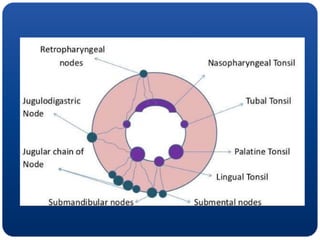
What is Waldeyer’s tonsillar ring ?
Waldeyer’s tonsillar ring
 The tonsils are areas of lymphoid tissue on
either side of the throat
 Tubal, palatine and lingual tonsils : 3 pairs
 The adenoid tissue is in the midline of the
posterior nasopharyngeal wall
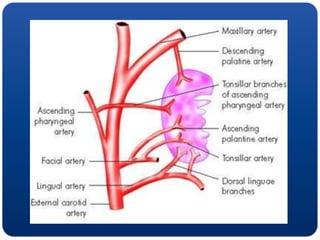
What is the Blood supply of tonsil?
 Arterial supply
Branches from external carotid artery.
Mainly tonsilllar branch of facial artery.
 Venous drainage
Plexus surrounding the tonsil drains into
paratonsillar vein which joins common
facial vein and pharyngeal plexus.
Venous haemorrhage is mostly responsible
for bleeding following tonsillectomy .
What is the Nerve supply of tonsil?
 The sensory supply is from the lesser palatine
branches of sphenopalatine ganglion and
glossopharyngeal nerve
What are the Functions of tonsils?
 The tonsils act as part of the immune system
to help protect against infection.
 Involved in helping fight off pharyngeal and
upper respiratory tract infections.
What is the Classification of Acute
Tonsillitis?
 Acute catarrhal or superficial tonsillitis
 Acute follicular tonsillitis
 Acute parenchymatous tonsillitis
 Acute membranous tonsillitis
What is the Classification of
Chronic Tonsillitis?
 Chronic follicular tonsillitis
 Chronic parenchymatous tonsillitis
 Chronic fibrotic tonsillitis
What is the Grading of tonsillar
enlargement?
 GRADE I: Congested but within fossa
 GRADE II : till the brim of tonsillar fossa
 GRADE III : beyond the pillars but doesn’t touch
each other.
 GRADE IV : kissing tonsils
What are the Clinical features of
tonsillitis?
 Pain in the throat
 Dyphagia
 Mouth breathing
 Failure to thrive/repeated infection—pain
fever, tachycardia.
 Cervical adenopathy.
 Visibly inflamed tonsil which may have
discharge.
What are the Indications of
tonsillectomy?
1. Upper airway obstruction, dysphagia and
obstructive sleep apnea.
2. Peritonsillar abscess, not responding to
adequate medical management and surgical
drainage.
3. The requirement of biopsy to confirm tissue
pathology in suspected neoplastic causes.
4. Recurrent tonsillitis that is unresponsive to
medical treatment.
 7 or more episodes in 1 year.
 5 episodes per year for 2years.
 3 episodes per year for 3 years.
 2 weeks or more of lost school or work in 1 year
5. Persistent bad-breath and taste in mouth due to
chronic tonsillitis.
 6. Persistent tonsillitis in streptococcus carrier,
which is unresponsive to antibiotics.
As a part of another operation
 Palatopharyngoplasty for sleep apnoea
 Glossopharyngeal neurectomy
 Removal of styloid process
What are the Contraindications
for tonsillectomy?
 Presence of acute infection in Upper Respiratory
Tract even acute tonsillitis
 Haemoglobin level less than 10 g%
 Children under 3 years
 Overt or sub mucous cleft palate
 Bleeding disorders ( leukemia , purpura , aplastic
anemia or haemophilia)
 At the time of epidemic polio
 Uncontrolled systemic disease
 Tonsillectomy is avoided during period of menses
What are the procedures available
for tonsillectomy?
Cold methods
 Dissection and snare (most common)
 Guillotine method
 Intra capsular tonsillectomy with debrider
 Harmonic scalpel ( ultrasound )
 Plasma mediated ablation technique
 Cryosurgical technique
Hot methods
 Bipolar Radio frequency
 Electrocautery
 LASER tonsillectomy (CO2 or KTP-512 )
 Coblation tonsillectomy
What are the relevant histories that
should be taken before tonsillectomy?
 In pediatric ; milestone development and
vaccination.
 Repeat episodes of fever, throat pain, dysphagia.
 History of any easy bruising, bleeding gums,
epistaxis, menorrhagia
 Family history of any bleeding disorders
 Recent ingestion of Aspirin, NSAIDs
 Mouth breathing
 The triad of hyponasality, snoring, and mouth
breathing normally indicates enlarged, obstructing
adenoids
 Other symptoms of adenoid disease include
rhinorrhea, postnasal drip, chronic cough and
headache
 History of possible allergies, GERD, and sinusitis.
What are the signs and symptoms of
Obstructive sleep apnoea ?
 In children, adenotonsillar hypertrophy is the most
common cause of obstructive sleep apnoea.
 The signs and symptoms :
chronic hypoxemia manifesting itself as
polycythemia and right ventricular strain.
 Snoring, apneic episodes followed by grunting and
restlessness occurring during sleep.
 The daytime symptoms include headaches,
excessive daytime somnolence and not feeling
fresh in the morning.
 Diagnosed by polysomnography
 OSA syndrome : AHI > 5 with symptoms or AHI>15
regardless of symptoms
What are the things that should be
included in examination of a case of
tonsillitis?
 Routine examination in a pediatric patient
 Loose/missing teeth:
 Patency of oral and nasal cavity
 Patients may have “adenoid facies” (long face,
flattened midface, open mouth) and hyponasal
speech
 Enlarged (> 2 cm) or tender cervical adenopathy
 Tonsillar or pharyngeal exudates.
What are the investigations needed?
 Hemoglobin and complete blood count
 Coagulation profile and platelets only if there is
history suggestive of bleeding tendencies
What are the premedications?
 An antisialogogue and a narcotic.
 Barbiturates will be of little use in short upper
airway surgery which requires quick return of
protective airway reflexes.
 Sedatives should not be used if there is history
suggestive of obstructive sleep apnoea.
What are the anaesthetic
considerations in a case of tonsillitis?
 Maintain deep general anaesthesia that prevents
reflex-induced hypertension, tachycardia or
arrhythmias.
 Muscle relaxation is required to allow placement
of the mouth gag and prevent any bucking,
coughing or straining.
 A rapid recovery of consciousness and return of
protective airway reflexes is also desired.
How should we induce the patient?
 Inhalational induction with sevoflurane is
preferred in small children especially when IV
line is not inserted and in OSA patients.
 If IV line is present Thiopentone or propofol can
be given.
What are the considerations in intubation in
a case of tonsillitis?
 Intubation under deep inhalational or muscle
relaxant assisted anesthesia is preferred.
 Regular tube/RAE tube may be passed by
orotracheal route.
 Throat should be well packed especially when
uncuffed tubes are used to prevent aspiration of
blood and secretions
 Tube can either be fixed in the midline or fixed
on one side at the angle of the mouth and the
side changed once the tonsillectomy is done and
hemostasis achieved for removal of the opposite
tonsil.
 When only tonsillectomy and no adenoidectomy
is planned one can also insert a nasotracheal
tube.
 Intubation could be difficult if the tonsils
are very large and approximating in the
midline (kissing tonsils).
How to prepare for nasal intubation?
 Nasal patency should be checked before
 Nasal decongestant drops should be instilled 15
min before procedure
 Antisialagogue like glycopyrolate can be given
10min before surgery
 One size lesser than the predicted ETT is
preferred to avoid injury
 Lignocaine jelly is applied over tube to lessen
trauma.
 Put the ETT in warm water to make it soft.
 Magill’s forceps, Laryngoscope/ fiberoptic should
be ready
What are the methods available for
nasal intubation?
 Conventional laryngoscopy with Magill’s forceps
 With help of video laryngoscopes like ‘King vision’
 Nasal fiberoptic intubation
 With help of Light wand
 Blind nasal intubation
Can LMA be used for tonsillectomy?
 Flexible LMA may be used for adenotonsilletomy
surgeries and is routinely used in some centres.
 It requires lighter plane of anaesthesia, and there
is no need for muscle relaxants; with resultant
rapid induction and smooth recovery.
 LMA is not removed until full return of reflexes.
 Disadvantage is if airway is lost during surgery, it
can be difficult to rectify the situation.
What all things should we consider
during maintenance of anaesthesia?
 inhaled anaesthetics and short-acting opioids like
fentanyl using spontaneous ventilation
 Or muscle relaxants with controlled ventilation
 Adequate depth should be maintained to prevent
any reflex-induced hypertension, tachycardia and
arrhythmias and avoid bucking , coughing or
straining during surgery
 Blood loss during tonsillectomy may be difficult to
estimate and may reach up to 5 % of the blood
volume.
 Blood transfusion may be required in some cases.
 Local anesthetic plus adrenaline applied in the
tonsillar fossa gives the advantages of bloodless
dissection, reduced operative time and reduced
postoperative pain.
 If large volumes of L.A are injected, it can give rise
to respiratory obstruction once the patient is
extubated because of bilateral glossopharyngeal
nerve block.
 As it is shared airway ,should be very vigilant
about accidental extubation or aspiration of blood
and secretion if the throat pack is displaced under
GA when uncuffed tubes are used.
 At the end of surgery, pack removal and good
pharyngeal and laryngeal suction under vision is
essential.
What is the role of anti-emetics in
tonsillectomy?
 Patients undergoing tonsillectomy are prone to
develop PONV.
 Antiemetic should be given prior to reversal.
 Ondansetron (0.1 mg/kg) or dexamethasone
(0.1–0.2 mg/kg) or a combination of both can be
considered.
How should be the extubation?
 Extubated only when awake and there is return of
protective airway reflexes.
 Extubation should be smooth thereby preventing
rise in blood pressure which can cause bleeding.
What should be the position after
extubation?
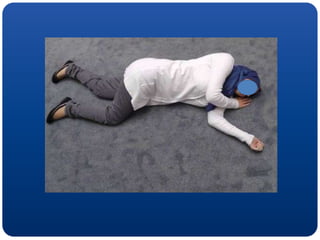
 Patient should be transported in tonsillar position
with oxygen supplementation
 Tonsillar position : left lateral position, with one
knee flexed and the hand under the face along
with a slight head low position.
 This allows the blood and secretion to drain out
rather than flow back onto the vocal cords
What is patient’s position during
surgery?
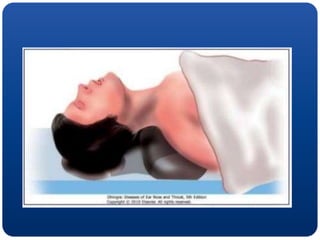
‘Rose position’
 Both the head and neck are extended.
 This is done by keeping a sand bag under the
patient's shoulder blade.
 Its contraindicated in patients with Down’s
syndrome owing to atlanto-axial instability
 The operator has a direct view of the tonsils and
there is the added advantage of the posterior part
of the pharynx forming a sump into which the
blood may drain, below the level of the glottis.
What are the complications in post
op period?
 Post-tonsillectomy bleeding
 Airway obstruction because of upper airway
edema, presence of blood and secretions and
laryngospasm
 Postoperative nausea and vomiting during first
24 hours (as high as 70%) because of pharyngeal
mucosal irritation from surgery and swallowed
blood and secretions.
 Pain and sore throat lasts for 3–4 days.
 Postoperative respiratory complications.
 Negative pressure pulmonary edema due to
sudden release of upper airway obstruction,
but very rare.
What is the classification of Post
tonsillectomy bleeding?
 Primary :
within 24 hours
Bleeding from adenoid bed is more commen in
first 4 hours.
Bleeding from tonsillar bed is more common in
first 6-8 hours
 Secondary :
24 hours to 28days
May be due to:
Sloughing of the eschar (dead tissue) overlying
the tonsillar bed
Loosened vessel ties
Infection from underlying chronic tonsillitis
What are the Risk factors for post
tonsillectomy haemorrhage?
 The risk of haemorrhage increases with age
 Higher in males.
 The surgical technique also influences the
incidence of bleeding.
Hot surgical technique (diathermy or
radiofrequency coblation) has 3 times risk
compared to cold steel tonsillectomy (traditional)
What are the Anaesthetic considerations
for re-exploration ?
 Child may loose large amounts of blood and
become hypovolemic and even progress to shock
in a short time.
 Immediate resuscitation with colloid and
crystalloid while waiting for blood to become
available.
 Intravenous boluses of fluid, 20 ml/kg stat,
repeated if necessary after reassessment of the
cardiovascular system.
 Preoperative sedation should be avoided
 Adequate preoxygenation
 IV induction agent depending on hemodynamic
stability
 Child should be considered as full stomach as
large amount of blood and secretions may be
swallowed.
 A rapid sequence intubation with cricoid pressure
and cuffed ETT using succinyl choline is
warranted.
 Two good working suctions should be ready at the
head end in case of vomiting
 Reintubation may be difficult if bleeding is
obscuring the view or due to edema from
previous airway instrumentation and surgery.
 A smaller size ETT than the previous anaesthetic
should be ready.
 Hypothermia should be avoided as it exacerbates
coagulopathy
 Decompression of stomach prior to extubation
 Extubation should be done in lateral position and
only if the child is fully awake with normal gag,
cough reflex and is stable hemodynamically
What is Quinsy?
 Quinsy is term for Peritonsillar abscess
 Situated outside tonsillar capsule
 Tonsil is pushed medially
What are the anaesthetic
considerations in Quinsy?
 Aggravation of a preexisting respiratory
obstruction
 Even with relaxation, trismus may not resolve,
making laryngoscopy and intubation difficult.
 Abscess may rupture at any time during
induction or intubation and there is a risk of
aspiration of purulent material.
 GA is induced with inhalational agent in oxygen or
intravenous induction agents like propofol along
with sevoflurane.
 Patient is kept in head low position with the head
turned toward the affected side.
 Under deep plane of anaesthesia laryngoscopy is
done extremely carefully for fear of rupturing the
abscess
What are the Preparations to be
done for LASER surgery?
 The biggest concern here is prevention of an airway
fire.
 A plan to deal effectively with such a disaster if
occurs
 O T staff must wear protective eye gear and laser
masks when working around the laser.
 Clear PVC plastic tubes seem to catch fire much
more easily than older red rubber tubes .
 Red rubber tubes seem to lead to less toxic
combustion products once ignited.
 In conventional PVC tubes safer is to guard it with
reflective tape( ‘Al’ & ‘Cu’ or FDA approved
Merocel Laser Guard.)
 Fill the cuff with an indicator dye (e.g., methylene
blue in normal saline) to detect a break early.
 The cuff should also be covered from above with
wet gauze or neurosurgical sponges to retard
heating.
 The tube diameter should be chosen 1 to 2 mm
smaller than usual.
 Wrapping should start at the distal end and be
continued up to the level of the uvula.
 The distal end of the tape should be cut at a 60-
degree angle
 The tube should then be wrapped in a spiral with
~ 30% overlap, avoiding sharp edges and leaving
no PVC exposed.
Name the special E.T tubes available
for LASER surgery?
 The Xomed Laser Shield
 Laser Shield II
 Laser Flex tube (steel spiral tube with 2 pvc cuffs)
 Bivona Fome-Cuf (Aluminium spiral tube with foam
filled cuff)
What should be done to manage
airway fire if occurs?
 Extract : ETT and other combustible materials
 Eliminate : O2 supply disconnection
 Extinguish residual fire
 Evaluate injury using direct laryngoscopy and
rigid bronchoscopy
 Continue oxygenation with mask
 If severe injury consider low tracheostomy
Tonsillectomy - anaesthetic consideration

Tonsillectomy - anaesthetic consideration

  • 1.
    Dr ZIKRULLAH ANAESTHETIC CONSIDERATIONSIN A CASE POSTED FOR TONSILLECTOMY
  • 2.
    What is Waldeyer’stonsillar ring ?
  • 3.
    Waldeyer’s tonsillar ring The tonsils are areas of lymphoid tissue on either side of the throat  Tubal, palatine and lingual tonsils : 3 pairs  The adenoid tissue is in the midline of the posterior nasopharyngeal wall
  • 5.
    What is theBlood supply of tonsil?
  • 7.
     Arterial supply Branchesfrom external carotid artery. Mainly tonsilllar branch of facial artery.
  • 8.
     Venous drainage Plexussurrounding the tonsil drains into paratonsillar vein which joins common facial vein and pharyngeal plexus. Venous haemorrhage is mostly responsible for bleeding following tonsillectomy .
  • 9.
    What is theNerve supply of tonsil?
  • 10.
     The sensorysupply is from the lesser palatine branches of sphenopalatine ganglion and glossopharyngeal nerve
  • 11.
    What are theFunctions of tonsils?
  • 12.
     The tonsilsact as part of the immune system to help protect against infection.  Involved in helping fight off pharyngeal and upper respiratory tract infections.
  • 13.
    What is theClassification of Acute Tonsillitis?
  • 14.
     Acute catarrhalor superficial tonsillitis  Acute follicular tonsillitis  Acute parenchymatous tonsillitis  Acute membranous tonsillitis
  • 15.
    What is theClassification of Chronic Tonsillitis?
  • 16.
     Chronic folliculartonsillitis  Chronic parenchymatous tonsillitis  Chronic fibrotic tonsillitis
  • 17.
    What is theGrading of tonsillar enlargement?
  • 18.
     GRADE I:Congested but within fossa  GRADE II : till the brim of tonsillar fossa  GRADE III : beyond the pillars but doesn’t touch each other.  GRADE IV : kissing tonsils
  • 19.
    What are theClinical features of tonsillitis?
  • 20.
     Pain inthe throat  Dyphagia  Mouth breathing  Failure to thrive/repeated infection—pain fever, tachycardia.  Cervical adenopathy.  Visibly inflamed tonsil which may have discharge.
  • 21.
    What are theIndications of tonsillectomy?
  • 22.
    1. Upper airwayobstruction, dysphagia and obstructive sleep apnea. 2. Peritonsillar abscess, not responding to adequate medical management and surgical drainage. 3. The requirement of biopsy to confirm tissue pathology in suspected neoplastic causes.
  • 23.
    4. Recurrent tonsillitisthat is unresponsive to medical treatment.  7 or more episodes in 1 year.  5 episodes per year for 2years.  3 episodes per year for 3 years.  2 weeks or more of lost school or work in 1 year 5. Persistent bad-breath and taste in mouth due to chronic tonsillitis.
  • 24.
     6. Persistenttonsillitis in streptococcus carrier, which is unresponsive to antibiotics.
  • 25.
    As a partof another operation  Palatopharyngoplasty for sleep apnoea  Glossopharyngeal neurectomy  Removal of styloid process
  • 26.
    What are theContraindications for tonsillectomy?
  • 27.
     Presence ofacute infection in Upper Respiratory Tract even acute tonsillitis  Haemoglobin level less than 10 g%  Children under 3 years  Overt or sub mucous cleft palate
  • 28.
     Bleeding disorders( leukemia , purpura , aplastic anemia or haemophilia)  At the time of epidemic polio  Uncontrolled systemic disease  Tonsillectomy is avoided during period of menses
  • 29.
    What are theprocedures available for tonsillectomy?
  • 30.
    Cold methods  Dissectionand snare (most common)  Guillotine method  Intra capsular tonsillectomy with debrider  Harmonic scalpel ( ultrasound )  Plasma mediated ablation technique  Cryosurgical technique
  • 31.
    Hot methods  BipolarRadio frequency  Electrocautery  LASER tonsillectomy (CO2 or KTP-512 )  Coblation tonsillectomy
  • 32.
    What are therelevant histories that should be taken before tonsillectomy?
  • 33.
     In pediatric; milestone development and vaccination.  Repeat episodes of fever, throat pain, dysphagia.  History of any easy bruising, bleeding gums, epistaxis, menorrhagia  Family history of any bleeding disorders  Recent ingestion of Aspirin, NSAIDs
  • 34.
     Mouth breathing The triad of hyponasality, snoring, and mouth breathing normally indicates enlarged, obstructing adenoids  Other symptoms of adenoid disease include rhinorrhea, postnasal drip, chronic cough and headache  History of possible allergies, GERD, and sinusitis.
  • 35.
    What are thesigns and symptoms of Obstructive sleep apnoea ?
  • 36.
     In children,adenotonsillar hypertrophy is the most common cause of obstructive sleep apnoea.  The signs and symptoms : chronic hypoxemia manifesting itself as polycythemia and right ventricular strain.  Snoring, apneic episodes followed by grunting and restlessness occurring during sleep.
  • 37.
     The daytimesymptoms include headaches, excessive daytime somnolence and not feeling fresh in the morning.  Diagnosed by polysomnography  OSA syndrome : AHI > 5 with symptoms or AHI>15 regardless of symptoms
  • 38.
    What are thethings that should be included in examination of a case of tonsillitis?
  • 39.
     Routine examinationin a pediatric patient  Loose/missing teeth:  Patency of oral and nasal cavity  Patients may have “adenoid facies” (long face, flattened midface, open mouth) and hyponasal speech  Enlarged (> 2 cm) or tender cervical adenopathy  Tonsillar or pharyngeal exudates.
  • 40.
    What are theinvestigations needed?
  • 41.
     Hemoglobin andcomplete blood count  Coagulation profile and platelets only if there is history suggestive of bleeding tendencies
  • 42.
    What are thepremedications?
  • 43.
     An antisialogogueand a narcotic.  Barbiturates will be of little use in short upper airway surgery which requires quick return of protective airway reflexes.  Sedatives should not be used if there is history suggestive of obstructive sleep apnoea.
  • 44.
    What are theanaesthetic considerations in a case of tonsillitis?
  • 45.
     Maintain deepgeneral anaesthesia that prevents reflex-induced hypertension, tachycardia or arrhythmias.  Muscle relaxation is required to allow placement of the mouth gag and prevent any bucking, coughing or straining.  A rapid recovery of consciousness and return of protective airway reflexes is also desired.
  • 46.
    How should weinduce the patient?
  • 47.
     Inhalational inductionwith sevoflurane is preferred in small children especially when IV line is not inserted and in OSA patients.  If IV line is present Thiopentone or propofol can be given.
  • 48.
    What are theconsiderations in intubation in a case of tonsillitis?
  • 49.
     Intubation underdeep inhalational or muscle relaxant assisted anesthesia is preferred.  Regular tube/RAE tube may be passed by orotracheal route.  Throat should be well packed especially when uncuffed tubes are used to prevent aspiration of blood and secretions
  • 50.
     Tube caneither be fixed in the midline or fixed on one side at the angle of the mouth and the side changed once the tonsillectomy is done and hemostasis achieved for removal of the opposite tonsil.  When only tonsillectomy and no adenoidectomy is planned one can also insert a nasotracheal tube.
  • 51.
     Intubation couldbe difficult if the tonsils are very large and approximating in the midline (kissing tonsils).
  • 52.
    How to preparefor nasal intubation?
  • 53.
     Nasal patencyshould be checked before  Nasal decongestant drops should be instilled 15 min before procedure  Antisialagogue like glycopyrolate can be given 10min before surgery  One size lesser than the predicted ETT is preferred to avoid injury
  • 54.
     Lignocaine jellyis applied over tube to lessen trauma.  Put the ETT in warm water to make it soft.  Magill’s forceps, Laryngoscope/ fiberoptic should be ready
  • 55.
    What are themethods available for nasal intubation?
  • 56.
     Conventional laryngoscopywith Magill’s forceps  With help of video laryngoscopes like ‘King vision’  Nasal fiberoptic intubation  With help of Light wand  Blind nasal intubation
  • 57.
    Can LMA beused for tonsillectomy?
  • 58.
     Flexible LMAmay be used for adenotonsilletomy surgeries and is routinely used in some centres.  It requires lighter plane of anaesthesia, and there is no need for muscle relaxants; with resultant rapid induction and smooth recovery.  LMA is not removed until full return of reflexes.
  • 59.
     Disadvantage isif airway is lost during surgery, it can be difficult to rectify the situation.
  • 60.
    What all thingsshould we consider during maintenance of anaesthesia?
  • 61.
     inhaled anaestheticsand short-acting opioids like fentanyl using spontaneous ventilation  Or muscle relaxants with controlled ventilation  Adequate depth should be maintained to prevent any reflex-induced hypertension, tachycardia and arrhythmias and avoid bucking , coughing or straining during surgery
  • 62.
     Blood lossduring tonsillectomy may be difficult to estimate and may reach up to 5 % of the blood volume.  Blood transfusion may be required in some cases.  Local anesthetic plus adrenaline applied in the tonsillar fossa gives the advantages of bloodless dissection, reduced operative time and reduced postoperative pain.
  • 63.
     If largevolumes of L.A are injected, it can give rise to respiratory obstruction once the patient is extubated because of bilateral glossopharyngeal nerve block.
  • 64.
     As itis shared airway ,should be very vigilant about accidental extubation or aspiration of blood and secretion if the throat pack is displaced under GA when uncuffed tubes are used.  At the end of surgery, pack removal and good pharyngeal and laryngeal suction under vision is essential.
  • 65.
    What is therole of anti-emetics in tonsillectomy?
  • 66.
     Patients undergoingtonsillectomy are prone to develop PONV.  Antiemetic should be given prior to reversal.  Ondansetron (0.1 mg/kg) or dexamethasone (0.1–0.2 mg/kg) or a combination of both can be considered.
  • 67.
    How should bethe extubation?
  • 68.
     Extubated onlywhen awake and there is return of protective airway reflexes.  Extubation should be smooth thereby preventing rise in blood pressure which can cause bleeding.
  • 69.
    What should bethe position after extubation?
  • 70.
     Patient shouldbe transported in tonsillar position with oxygen supplementation  Tonsillar position : left lateral position, with one knee flexed and the hand under the face along with a slight head low position.  This allows the blood and secretion to drain out rather than flow back onto the vocal cords
  • 72.
    What is patient’sposition during surgery?
  • 73.
    ‘Rose position’  Boththe head and neck are extended.  This is done by keeping a sand bag under the patient's shoulder blade.  Its contraindicated in patients with Down’s syndrome owing to atlanto-axial instability  The operator has a direct view of the tonsils and there is the added advantage of the posterior part of the pharynx forming a sump into which the blood may drain, below the level of the glottis.
  • 75.
    What are thecomplications in post op period?
  • 76.
     Post-tonsillectomy bleeding Airway obstruction because of upper airway edema, presence of blood and secretions and laryngospasm  Postoperative nausea and vomiting during first 24 hours (as high as 70%) because of pharyngeal mucosal irritation from surgery and swallowed blood and secretions.
  • 77.
     Pain andsore throat lasts for 3–4 days.  Postoperative respiratory complications.  Negative pressure pulmonary edema due to sudden release of upper airway obstruction, but very rare.
  • 78.
    What is theclassification of Post tonsillectomy bleeding?
  • 79.
     Primary : within24 hours Bleeding from adenoid bed is more commen in first 4 hours. Bleeding from tonsillar bed is more common in first 6-8 hours
  • 80.
     Secondary : 24hours to 28days May be due to: Sloughing of the eschar (dead tissue) overlying the tonsillar bed Loosened vessel ties Infection from underlying chronic tonsillitis
  • 81.
    What are theRisk factors for post tonsillectomy haemorrhage?
  • 82.
     The riskof haemorrhage increases with age  Higher in males.  The surgical technique also influences the incidence of bleeding. Hot surgical technique (diathermy or radiofrequency coblation) has 3 times risk compared to cold steel tonsillectomy (traditional)
  • 83.
    What are theAnaesthetic considerations for re-exploration ?
  • 84.
     Child mayloose large amounts of blood and become hypovolemic and even progress to shock in a short time.  Immediate resuscitation with colloid and crystalloid while waiting for blood to become available.  Intravenous boluses of fluid, 20 ml/kg stat, repeated if necessary after reassessment of the cardiovascular system.
  • 85.
     Preoperative sedationshould be avoided  Adequate preoxygenation  IV induction agent depending on hemodynamic stability  Child should be considered as full stomach as large amount of blood and secretions may be swallowed.
  • 86.
     A rapidsequence intubation with cricoid pressure and cuffed ETT using succinyl choline is warranted.  Two good working suctions should be ready at the head end in case of vomiting  Reintubation may be difficult if bleeding is obscuring the view or due to edema from previous airway instrumentation and surgery.
  • 87.
     A smallersize ETT than the previous anaesthetic should be ready.  Hypothermia should be avoided as it exacerbates coagulopathy  Decompression of stomach prior to extubation  Extubation should be done in lateral position and only if the child is fully awake with normal gag, cough reflex and is stable hemodynamically
  • 88.
  • 89.
     Quinsy isterm for Peritonsillar abscess  Situated outside tonsillar capsule  Tonsil is pushed medially
  • 90.
    What are theanaesthetic considerations in Quinsy?
  • 91.
     Aggravation ofa preexisting respiratory obstruction  Even with relaxation, trismus may not resolve, making laryngoscopy and intubation difficult.  Abscess may rupture at any time during induction or intubation and there is a risk of aspiration of purulent material.
  • 92.
     GA isinduced with inhalational agent in oxygen or intravenous induction agents like propofol along with sevoflurane.  Patient is kept in head low position with the head turned toward the affected side.  Under deep plane of anaesthesia laryngoscopy is done extremely carefully for fear of rupturing the abscess
  • 93.
    What are thePreparations to be done for LASER surgery?
  • 94.
     The biggestconcern here is prevention of an airway fire.  A plan to deal effectively with such a disaster if occurs  O T staff must wear protective eye gear and laser masks when working around the laser.
  • 95.
     Clear PVCplastic tubes seem to catch fire much more easily than older red rubber tubes .  Red rubber tubes seem to lead to less toxic combustion products once ignited.  In conventional PVC tubes safer is to guard it with reflective tape( ‘Al’ & ‘Cu’ or FDA approved Merocel Laser Guard.)
  • 96.
     Fill thecuff with an indicator dye (e.g., methylene blue in normal saline) to detect a break early.  The cuff should also be covered from above with wet gauze or neurosurgical sponges to retard heating.  The tube diameter should be chosen 1 to 2 mm smaller than usual.
  • 97.
     Wrapping shouldstart at the distal end and be continued up to the level of the uvula.  The distal end of the tape should be cut at a 60- degree angle  The tube should then be wrapped in a spiral with ~ 30% overlap, avoiding sharp edges and leaving no PVC exposed.
  • 98.
    Name the specialE.T tubes available for LASER surgery?
  • 99.
     The XomedLaser Shield  Laser Shield II  Laser Flex tube (steel spiral tube with 2 pvc cuffs)  Bivona Fome-Cuf (Aluminium spiral tube with foam filled cuff)
  • 100.
    What should bedone to manage airway fire if occurs?
  • 101.
     Extract :ETT and other combustible materials  Eliminate : O2 supply disconnection  Extinguish residual fire  Evaluate injury using direct laryngoscopy and rigid bronchoscopy  Continue oxygenation with mask  If severe injury consider low tracheostomy