SUBJECT : COMPUTER AIDED DESIGN
(2161903 )
Gandhinagar Institute of
Technology
Active Learning assignment on:-
“Digital Differential Analyzer (DDA)
Algorithm ”
Prepared by:- Patel Yash (150123119039)
Introduction
In computer graphics, a digital differential analyzer
(DDA) is hardware or software used for interpolation of
variables over an interval between start and end point.
DDAs are used for rasterization of lines, triangles and
polygons. They can be extended to non linear functions,
such as perspective correct texture mapping, quadratic
curves, and traversing voxels.
The DDA method can be implemented using floating-
point or integer arithmetic. The native floating-point
implementation requires one addition and one rounding
operation per interpolated value (e.g. coordinate x, y,
depth, color component etc.) and output result.
This process is only efficient when an FPU with fast
add and rounding operation will be available.
The fixed-point integer operation requires two additions
per output cycle, and in case of fractional part overflow,
one additional increment and subtraction. The probability
of fractional part overflows is proportional to the ratio m
of the interpolated start/end values.
DDAs are well suited for hardware implementation and
can be pipelined for maximized throughput.
Digital Differential Analyzer (DDA): Line
Drawing Algorithm
Walk through the line, starting at (x0,y0)
Constrain x, y increments to values in [0,1] range
Case a: x is incrementing faster (m < 1)
Step in x=1 increments, compute and round y
Case b: y is incrementing faster (m > 1)
Step in y=1 increments, compute and round x
(x0,y0)
(x1,y1)
dx
dy
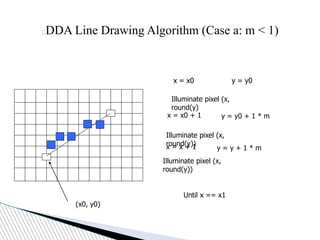
DDA Line Drawing Algorithm (Case a: m < 1)
x = x0 y = y0x = x0 y = y0
Illuminate pixel (x,
round(y)
x = x0 + 1 y = y0 + 1 * m
Illuminate pixel (x,
round(y))x = x + 1 y = y + 1 * m
Illuminate pixel (x,
round(y))
Until x == x1
(x0, y0)
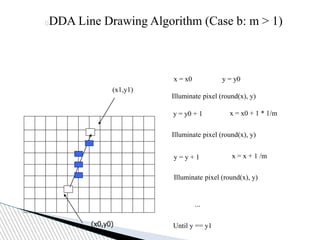
DDA Line Drawing Algorithm (Case b: m > 1)
y = y0 + 1 x = x0 + 1 * 1/m
Illuminate pixel (round(x), y)
y = y + 1 x = x + 1 /m
Illuminate pixel (round(x), y)
…
Until y == y1
x = x0 y = y0
Illuminate pixel (round(x), y)
(x1,y1)
(x0,y0)
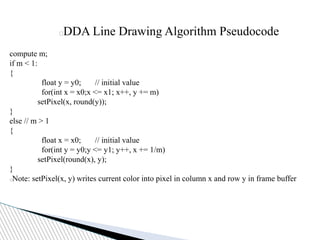
DDA Line Drawing Algorithm Pseudocode
compute m;
if m < 1:
{
float y = y0; // initial value
for(int x = x0;x <= x1; x++, y += m)
setPixel(x, round(y));
}
else // m > 1
{
float x = x0; // initial value
for(int y = y0;y <= y1; y++, x += 1/m)
setPixel(round(x), y);
}
Note: setPixel(x, y) writes current color into pixel in column x and row y in frame buffer
DDA Line Drawing Algorithm Pseudocode
compute m;
if m < 1:
{
float y = y0; // initial value
for(int x = x0;x <= x1; x++, y += m)
setPixel(x, round(y));
}
else // m > 1
{
float x = x0; // initial value
for(int y = y0;y <= y1; y++, x += 1/m)
setPixel(round(x), y);
}
Note: setPixel(x, y) writes current color into pixel in column x and row y in frame buffer
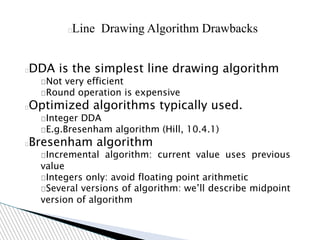
Line Drawing Algorithm Drawbacks
DDA is the simplest line drawing algorithm
Not very efficient
Round operation is expensive
Optimized algorithms typically used.
Integer DDA
E.g.Bresenham algorithm (Hill, 10.4.1)
Bresenham algorithm
Incremental algorithm: current value uses previous
value
Integers only: avoid floating point arithmetic
Several versions of algorithm: we’ll describe midpoint
version of algorithm
DDA algorithm

DDA algorithm

  • 1.
    SUBJECT : COMPUTERAIDED DESIGN (2161903 ) Gandhinagar Institute of Technology Active Learning assignment on:- “Digital Differential Analyzer (DDA) Algorithm ” Prepared by:- Patel Yash (150123119039)
  • 2.
    Introduction In computer graphics,a digital differential analyzer (DDA) is hardware or software used for interpolation of variables over an interval between start and end point. DDAs are used for rasterization of lines, triangles and polygons. They can be extended to non linear functions, such as perspective correct texture mapping, quadratic curves, and traversing voxels.
  • 3.
    The DDA methodcan be implemented using floating- point or integer arithmetic. The native floating-point implementation requires one addition and one rounding operation per interpolated value (e.g. coordinate x, y, depth, color component etc.) and output result. This process is only efficient when an FPU with fast add and rounding operation will be available.
  • 4.
    The fixed-point integeroperation requires two additions per output cycle, and in case of fractional part overflow, one additional increment and subtraction. The probability of fractional part overflows is proportional to the ratio m of the interpolated start/end values. DDAs are well suited for hardware implementation and can be pipelined for maximized throughput.
  • 5.
    Digital Differential Analyzer(DDA): Line Drawing Algorithm Walk through the line, starting at (x0,y0) Constrain x, y increments to values in [0,1] range Case a: x is incrementing faster (m < 1) Step in x=1 increments, compute and round y Case b: y is incrementing faster (m > 1) Step in y=1 increments, compute and round x (x0,y0) (x1,y1) dx dy
  • 6.
    DDA Line DrawingAlgorithm (Case a: m < 1) x = x0 y = y0x = x0 y = y0 Illuminate pixel (x, round(y) x = x0 + 1 y = y0 + 1 * m Illuminate pixel (x, round(y))x = x + 1 y = y + 1 * m Illuminate pixel (x, round(y)) Until x == x1 (x0, y0)
  • 7.
    DDA Line DrawingAlgorithm (Case b: m > 1) y = y0 + 1 x = x0 + 1 * 1/m Illuminate pixel (round(x), y) y = y + 1 x = x + 1 /m Illuminate pixel (round(x), y) … Until y == y1 x = x0 y = y0 Illuminate pixel (round(x), y) (x1,y1) (x0,y0)
  • 8.
    DDA Line DrawingAlgorithm Pseudocode compute m; if m < 1: { float y = y0; // initial value for(int x = x0;x <= x1; x++, y += m) setPixel(x, round(y)); } else // m > 1 { float x = x0; // initial value for(int y = y0;y <= y1; y++, x += 1/m) setPixel(round(x), y); } Note: setPixel(x, y) writes current color into pixel in column x and row y in frame buffer
  • 9.
    DDA Line DrawingAlgorithm Pseudocode compute m; if m < 1: { float y = y0; // initial value for(int x = x0;x <= x1; x++, y += m) setPixel(x, round(y)); } else // m > 1 { float x = x0; // initial value for(int y = y0;y <= y1; y++, x += 1/m) setPixel(round(x), y); } Note: setPixel(x, y) writes current color into pixel in column x and row y in frame buffer
  • 10.
    Line Drawing AlgorithmDrawbacks DDA is the simplest line drawing algorithm Not very efficient Round operation is expensive Optimized algorithms typically used. Integer DDA E.g.Bresenham algorithm (Hill, 10.4.1) Bresenham algorithm Incremental algorithm: current value uses previous value Integers only: avoid floating point arithmetic Several versions of algorithm: we’ll describe midpoint version of algorithm