Medical Treatment of Glaucoma 
Fritz Allen ,MD 
Visionary Ophthalmology 
September 7th 2014 
Medical Management of Glaucoma 
 Beta-adrenergic Antagonists (Beta Blockers) 
 Parasympathomimetic Agents 
 Carbonic Anhydrase Inhibitors (CAI) 
 Adrenergic Agonists 
 Prostaglandin Analogues 
 Combined Medications 
 Hyperosmotic Agents 
A 64-year-old male with POAG is taking timolol, dorzolamide, brimonidine, and latanoprost OU. He must begin phenelzine, a systemic monoamine oxidase (MAO) inhibitor. Which one of the following should
be discontinued? 
• Latanoprost 
• Brimonidine 
• Dorzolamide 
• Timolol 
Which of the following glaucoma medications is contraindicated for use in children younger than age 2? 
• Timolol 
• Levobunolol 
• Brimonidine 
• Dorzolamide 
Adrenergic Agonists 
 Indications 
 Non-selective agonists (epinephrine, dipivefrin) 
 Selective adrenergic agonists (apraclonidine, brimonidine) 
 IOP lowering 
 OAG / ocular hypertension 
 Prophylaxis against post-op pressure spikes
 Prior to and immediately after laser treatment (trabeculoplasty, laser PI, Nd:YAG capsulotomy) 
 Cataract surgery 
 Acute ACG 
 Miosis after refractive surgery (off-label use) 
Adrenergic Agonists 
 Contraindications and precautions 
 Non-selective 
 Narrow AC angles- may precipitate pupillary block 
 Blepharoptosis surgery- stimulates Müller’s muscle, inadequate correction 
 Retrobulbar anesthesia 
 Local – risk of vasospasm & occlusion of ophthalmic or central retinal artery 
 Systemic – tachyarrhythmias, death 
 Aphakia- CME risk (13-30%) 
Adrenergic Agonists 
 Selective 
 Proven sensitivity to these agents
 Concomitant use of monoamine oxidase inhibitors (MAOI) 
 Infants and children < 2 years: brimonidine is an absolute contraindication due to apnea, bradycardia, dyspnea 
 Pediatric (ages 2-7) usage reports: convulsions, cyanosis, hypoventilation, lethargy; brimonidine is relatively contraindicated 
 Precaution in patients with severe cardiovascular disease 
 Precaution in patients with depression, cerebral or coronary insufficiency, Raynaud’s phenomenon, orthostatic hypotension 
 Pregnancy: category B drug- use only if potential benefits justify risk 
Adrenergic Agonists 
 Method of action 
 Non-selective-mixed α and ß adrenergic agonist; effect varies over time, initially raising IOP slightly, followed by reduction lasting 12-24 hours 
 Selective-alpha adrenergic receptor agonist; reduction of aqueous humor production is
primary mechanism of action 
 Fluorophotometric studies suggest that Brimonidine tartrate also increases uveoscleral outflow 
 Controversial neuroprotective effect: prevent demise of retinal ganglion cells due to trauma or toxins 
Adrenergic Agonists 
 Complications of therapy 
 Non-selective 
 Local - conj injection, follicular conjunctivitis, burning, stinging, mydriasis, blurry vision, headache 
 Cardiovascular - tachycardia, arrhythmias, hypertension 
 Selective 
 Local - hyperemia, follicular conjunctivitis, conjunctival blanching 
 Systemic - dry mouth, fatigue, anxiety, respiratory depression in neonates 
Adrenergic Agonists 
 Contraindications and precautions 
 Non-selective 
 Narrow AC angles- may precipitate
pupillary block 
 Blepharoptosis surgery- stimulates Müller’s muscle, inadequate correction 
 Retrobulbar anesthesia 
 Local – risk of vasospasm & occlusion of ophthalmic or central retinal artery 
 Systemic – tachyarrhythmias, death 
 Aphakia- CME risk (13-30%) 
Adrenergic Agonists 
 Selective 
 Proven sensitivity to these agents 
 Concomitant use of monoamine oxidase inhibitors (MAOI) 
 Infants and children < 2 years: brimonidine is an absolute contraindication due to apnea, bradycardia, dyspnea 
 Pediatric (ages 2-7) usage reports: convulsions, cyanosis, hypoventilation, lethargy; brimonidine is relatively contraindicated 
 Precaution in patients with severe cardiovascular disease 
 Precaution in patients with depression, cerebral or coronary insufficiency, Raynaud’s phenomenon, orthostatic
hypotension 
 Pregnancy: category B drug- use only if potential benefits justify risk 
Adrenergic Agonists 
 Method of action 
 Non-selective-mixed α and ß adrenergic agonist; effect varies over time, initially raising IOP slightly, followed by reduction lasting 12-24 hours 
 Selective-alpha adrenergic receptor agonist; reduction of aqueous humor production is primary mechanism of action 
 Fluorophotometric studies suggest that Brimonidine tartrate also increases uveoscleral outflow 
 Controversial neuroprotective effect: prevent demise of retinal ganglion cells due to trauma or toxins 
Adrenergic Agonists 
 Complications of therapy 
 Non-selective 
 Local - conj injection, follicular conjunctivitis, burning, stinging, mydriasis, blurry vision, headache
 Cardiovascular - tachycardia, arrhythmias, hypertension 
 Selective 
 Local - hyperemia, follicular conjunctivitis, conjunctival blanching 
 Systemic - dry mouth, fatigue, anxiety, respiratory depression in neonates 
Adrenergic Agonists - Allergy 
A 64-year-old male with POAG is taking timolol, dorzolamide, brimonidine, and latanoprost OU. He must begin phenelzine, a systemic monoamine oxidase (MAO) inhibitor. Which one of the following should
be discontinued? 
• Latanoprost 
• Brimonidine 
• Dorzolamide 
• Timolol 
Which of the following glaucoma medications is contraindicated for use in children younger than age 2? 
• Timolol 
• Levobunolol 
• Brimonidine 
• Dorzolamide 
A 52-year-old woman with ocular hypertension is started on a monocular trial with a glaucoma medication. Which glaucoma medication is most likely to produce a decrease in IOP the contralateral (untreated) eye? 
• Dorzolamide 
• Latanoprost 
• Timolol
• Brimonidine 
Which class of glaucoma medications should be avoided in myasthenia gravis? 
• Miotics 
• Prostaglandin analogues 
• Beta blockers 
• Topical CAIs 
Beta-adrenergic Antagonists (Beta Blockers) 
 Agents 
 Non-selective 
 Timolol maleate (Timoptic) 
 Timolol hemihydrate (Betimol) 
 Levobunolol HCL (Betagan) 
 Carteolol HCL (Ocupress) 
 Metipranolol HCL (Optipranolol) 
 Selective 
 Betaxolol (Betoptic-S)
Beta-adrenergic Antagonists (Beta Blockers) 
 Indications 
 First line and adjunctive therapy to lower IOP 
 All types of glaucoma 
 Before or after laser surgery 
 After cataract surgery 
 Contraindications 
 Proven sensitivity to agents 
 Reactive airway disease 
 Bronchospasm 
 COPD 
 Greater than first degree heart block 
Beta-adrenergic Antagonists (Beta Blockers) 
 Relative contraindications
 Congestive heart failure 
 Bradycardia 
 Method of action 
 1- and 2- receptors are on the ciliary processes. Receptor blockade reduces aqueous humor production via direct action 
 Direct effect on non-pigmented ciliary epithelium to decrease secretion via inhibition of cyclic adenosine monophosphate 
 Decreases local capillary perfusion to reduce ultrafiltration 
Beta-adrenergic Antagonists (Beta Blockers) 
 Administration 
 Good corneal penetration 
 Peak aqueous concentration within 1-2 hours of topical dose. IOP effect peaks at 2 hours 
and lasts at least 24  Short-term escape 
 Dramatic reduction in IOP after
initial use followed by small pressure rise that plateaus within few days 
 May be due to increase in  receptors during first few days 
 Wait approximately 1 month to evaluate response 
 Long-term drift / tachyphylaxis 
 Approximately 3 months after initiating therapy, some patients have a mild decrease in IOP response 
 Some will regain responsiveness after a 
drug holiday 
Beta-adrenergic Antagonists (Beta Blockers) 
 Efficacy 
 Non-selective 1- and 2- antagonists: 20-30% IOP reduction 
 1- selective antagonist: 14-17% IOP
reduction 
 Decreased efficacy possible when used concomitantly with oral beta-blockers 
 Systemic absorption may result in IOP lowering in contralateral eye 
Beta-adrenergic Antagonists (Beta Blockers) 
 Complications 
 Ocular toxicity 
 Burning, hyperemia 
 Corneal anesthesia, punctate keratopathy, erosions, toxic keratopathy 
 Periocular contact dermatitis 
 Dry eye 
 Cardiovascular 
 1 blockade slows pulse and decreases cardiac contractility 
 May cause syncope, bradycardia, arrhythmias, heart failure, decreased exercise tolerance 
Beta-adrenergic
Antagonists (Beta Blockers) 
 Respiratory 
 2 blockade produces contraction of bronchial smooth muscle 
 May cause bronchospasm and airway obstruction, especially in asthmatics 
 May cause dyspnea and apneic spells especially in young children 
 Central nervous system 
 Depression, anxiety, confusion, hallucinations, lightheadedness, drowsiness, fatigue, weakness, disorientation 
Beta-adrenergic Antagonists (Beta Blockers) 
 Cholesterol levels 
 Alterations in plasma lipid profile have been reported with timolol when administered without punctal occlusion 
 Decreases plasma high density lipoprotein
and possibly increases risk of coronary artery disease 
 Other 
 Exacerbation of myasthenia gravis 
 May mask awareness of hypoglycemia in diabetics 
 GI distress 
 Dermatologic disorders 
 Sexual impotence 
Beta-adrenergic Antagonists (Beta Blockers) 
 Prevention of complications 
 Avoid use of beta-blockers in high-risk patients 
 Nasolacrimal occlusion 
 Use topical beta-blockers with special properties 
 Betaxolol – 1- selective antagonist 
 Decreased incidence of respiratory side effects in patients with bronchospastic disease 
 Carteolol – intrinsic sympathomimetic
activity 
 Adrenergic agonist effect that may partially protect against adverse effects of beta-blockade 
 Has less adverse affect on plasma lipid profile 
Beta-adrenergic Antagonists (Beta Blockers) 
 Management of complications 
 Discontinue drug 
 Consider switch to beta-blocker with special properties if indicated 
A 52-year-old woman with ocular hypertension is started on a monocular trial with a glaucoma medication. Which glaucoma medication is most likely to produce a decrease in IOP the contralateral (untreated) eye? 
• Dorzolamide
• Latanoprost 
• Timolol 
• Brimonidine 
Which class of glaucoma medications should be avoided in myasthenia gravis? 
• Miotics 
• Prostaglandin analogues 
• Beta blockers 
• Topical CAIs 
Carbonic Anhydrase Inhibitors 
 Agents 
 Oral 
 Acetazolamide 125 mg, 250 500 mg 
 Methazolamide 25 mg, 50 mg 
 Topical 
 Dorzolamide 2% 
 Brinzolamide 1%
Carbonic Anhydrase Inhibitors 
 Indications 
 Reduction of chronically elevated IOP in adults and children 
 Monotherapy 
 Additive therapy 
 Prophylaxis of elevated IOP after a surgical intervention 
 Reduction of acutely elevated IOP 
Carbonic Anhydrase Inhibitors 
 Contraindications 
 Sulfa allergy 
 Kidney stones 
 Aplastic anemia 
 Thrombocytopenia 
 Sickle cell disease 
 History of blood dyscrasia 
Carbonic Anhydrase
Inhibitors 
 Method of action 
 Block aqueous production by inhibition of carbonic anhydrase 
 > 90% must be blocked to decrease aqueous production 
 Possible effects on ocular blood flow 
Carbonic Anhydrase Inhibitors 
 Complications 
 Burning and stinging 
 Metallic taste 
 Cautious use of topical CAI for history sulfa allergy or kidney stones 
 Corneal toxicity 
 Paresthesias 
 Stevens-Johnson syndrome 
 Blood dyscrasias (aplastic anemia and sickle cell disease) 
 Hypokalemia (after systemic use) 
 Conjunctival injection 
 Periocular contact dermatitis
Carbonic Anhydrase Inhibitors 
 Prevention of complications 
 Monitor blood potassium, especially with systemic CAIs 
 Consider pre-treatment blood counts, especially with systemic CAIs 
 Avoid CAIs for diseased corneas with marginal endothelium 
 No CAIs for history of sulfa allergy, blood
dyscrasia or kidney stones 
Carbonic Anhydrase Inhibitors 
 Management of complications 
 Stop the medication 
 Topical toxicity 
 Change topical therapy 
 Consider brinzolamide instead of dorzolamide 
 Oral CAIs 
 Systemic toxicity 
 Decrease the dose of oral medication 
 Change to topical therapy 
 Change from acetazolamide to methazolamide 
 Medical consult for serious side effects 
 Switch to acetazolamide sequels 
Combined Medications 
 Agents 
 Dorzolamide HCL/Timolol maleate 
 Brinzolamide/Brimonidine 
 Brimonidine/Timolol 
 Latanoprost/Brimonodine/Timolol (outside
the US) 
 Indications 
 Reduction of elevated IOP in patients with OAG or ocular hypertension who are insufficiently responsive to beta-blockers 
 Patients who have difficulty taking multiple medications 
Combined Medications 
 Method of action 
 Dorzolamide hydrochloride 
 Inhibitor of human carbonic anhydrase II, which decreases aqueous humor secretion 
 Timolol maleate 
 Nonselective beta-blocker which decreases aqueous humor secretion 
Combined Medications 
 Complications 
 Most frequently reported ocular adverse events 
 Taste perversion, ocular burning/stinging, conjunctival hyperemia, blurred vision, superficial punctate keratitis, pruritis 
 Most frequently reported systemic adverse
events 
 Worsening of restrictive airway disease, fatigue, arrhythmia, syncope, heart block, palpitation, insomnia, impotence, memory loss, confusion 
 Prevention of complications 
 Discussion of potential side effects with patient 
 Nasolacrimal occlusion 
 Emphasis on correct dosing 
Combined Medications 
Glycerin is a hyperosmotic agent that should be avoided in patients with which systemic disease? 
• Hypertension 
• Diabetes mellitus 
• Hyperthyroidism 
• Anemia 
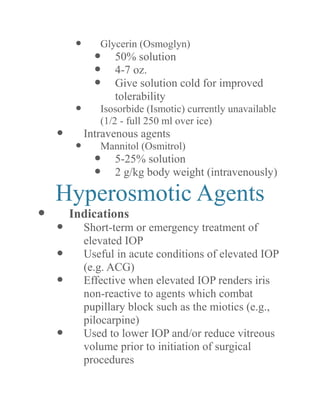
Hyperosmotic Agents 
 Dosing technique 
 Oral agents
 Glycerin (Osmoglyn) 
 50% solution 
 4-7 oz. 
 Give solution cold for improved tolerability 
 Isosorbide (Ismotic) currently unavailable (1/2 - full 250 ml over ice) 
 Intravenous agents 
 Mannitol (Osmitrol) 
 5-25% solution 
 2 g/kg body weight (intravenously) 
Hyperosmotic Agents 
 Indications 
 Short-term or emergency treatment of elevated IOP 
 Useful in acute conditions of elevated IOP (e.g. ACG) 
 Effective when elevated IOP renders iris non-reactive to agents which combat pupillary block such as the miotics (e.g., pilocarpine) 
 Used to lower IOP and/or reduce vitreous volume prior to initiation of surgical procedures
Hyperosmotic Agents 
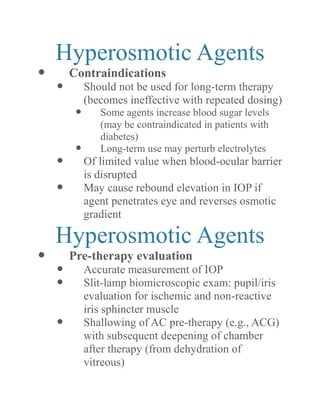
 Contraindications 
 Should not be used for long-term therapy (becomes ineffective with repeated dosing) 
 Some agents increase blood sugar levels (may be contraindicated in patients with diabetes) 
 Long-term use may perturb electrolytes 
 Of limited value when blood-ocular barrier is disrupted 
 May cause rebound elevation in IOP if agent penetrates eye and reverses osmotic gradient 
Hyperosmotic Agents 
 Pre-therapy evaluation 
 Accurate measurement of IOP 
 Slit-lamp biomicroscopic exam: pupil/iris evaluation for ischemic and non-reactive iris sphincter muscle 
 Shallowing of AC pre-therapy (e.g., ACG) with subsequent deepening of chamber after therapy (from dehydration of vitreous)
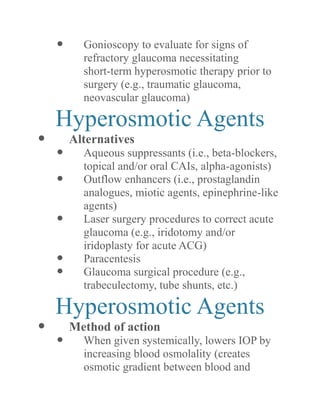
 Gonioscopy to evaluate for signs of refractory glaucoma necessitating short-term hyperosmotic therapy prior to surgery (e.g., traumatic glaucoma, neovascular glaucoma) 
Hyperosmotic Agents 
 Alternatives 
 Aqueous suppressants (i.e., beta-blockers, topical and/or oral CAIs, alpha-agonists) 
 Outflow enhancers (i.e., prostaglandin analogues, miotic agents, epinephrine-like agents) 
 Laser surgery procedures to correct acute glaucoma (e.g., iridotomy and/or iridoplasty for acute ACG) 
 Paracentesis 
 Glaucoma surgical procedure (e.g., trabeculectomy, tube shunts, etc.) 
Hyperosmotic Agents 
 Method of action 
 When given systemically, lowers IOP by increasing blood osmolality (creates osmotic gradient between blood and
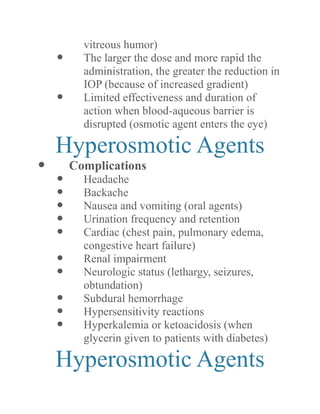
vitreous humor) 
 The larger the dose and more rapid administration, the greater reduction in IOP (because of increased gradient) 
 Limited effectiveness and duration of action when blood-aqueous barrier is disrupted (osmotic agent enters the eye) 
Hyperosmotic Agents 
 Complications 
 Headache 
 Backache 
 Nausea and vomiting (oral agents) 
 Urination frequency and retention 
 Cardiac (chest pain, pulmonary edema, congestive heart failure) 
 Renal impairment 
 Neurologic status (lethargy, seizures, obtundation) 
 Subdural hemorrhage 
 Hypersensitivity reactions 
 Hyperkalemia or ketoacidosis (when glycerin given to patients with diabetes) 
Hyperosmotic Agents
 Prevention of complications 
 Consider alternative therapies 
 Use cautiously in patients with known compromised cardiac, hepatic, or renal status 
 Avoid use of glycerin in diabetics 
 Closely observe for complications 
 Management of complications 
 Discontinue medication 
 Symptomatic relief of side effects until resolution if applicable 
 Consider urinary catheter (if intravenous mannitol is given preoperatively) 
Hyperosmotic Agents 
 Follow-up care 
 Closely monitor IOP (to determine efficacy of hyperosmotic agents) 
 Discontinue therapy as soon possible 
 Closely monitor ocular and systemic symptoms and exam 
 Patient instructions 
 Alert physician of any complications 
 Substitute IOP-lowering agents when hyperosmotic agents no longer needed
Glycerin is a hyperosmotic agent that should be avoided in patients with which systemic disease? 
• Hypertension 
• Diabetes mellitus 
• Hyperthyroidism 
• Anemia 
What is the mechanism of action for pilocarpine in reducing IOP? 
• Contraction of the ciliary muscle resulting in increased outflow of aqueous through the trabecular meshwork 
• Contraction of the ciliary muscle resulting in a reduced rate of aqueous production 
• Inhibition of the enzyme acetylcholinesterase with prolonged and enhanced action of naturally secreted acetylcholine
• Inhibition of carbonic anhydrase causing a decreased rate of aqueous production 
Echothiophate iodide (Phospholine iodide) is an example of which type of glaucoma medication? 
• Direct-acting parasympathomimetic agent 
• Indirect-acting parasympathomimetic agent 
• Beta blocker 
• CAI 
Indirect parasympathomimetics initiate their effect by: 
• Binding directly to muscarinic receptors 
• Suppressing acetylcholine release from nerve terminals 
• Suppressing enzymes that inactivate acetylcholine 
• Increasing the sensitivity of post-synaptic nerve terminals to acetylcholine 
Parasympathomimetic
Agents 
 Agents 
 Carbachol 
 Pilocarpine HCL 
 Echothiopate iodide 
 Indications 
 Increased IOP in patients with at least some open filtering angle 
 Prophylaxis for ACG prior to iridotomy 
Parasympathomimetic Agents 
 Contraindications 
 Patients with no trabecular outflow 
 Patients with peripheral retinal disease that predisposes them to retinal detachment 
 Uveitic glaucoma 
 Acute infectious conjunctivitis 
 Proven sensitivity to these agents 
 Significant lens changes with chronic use (relative contraindication)
Parasympathomimetic Agents 
 Method of action 
 Reduces IOP by causing contraction of the ciliary muscle, which pulls the scleral spur to tighten TM, increasing the outflow of aqueous humor 
 Direct-acting agents affect the motor end plates in the same way as acetylcholine, which is transmitted at postganglionic parasympathetic junctions, as well at other autonomic, somatic, and central synapses 
 Indirect-acting agents inhibit the enzyme acetylcholinesterase, thereby prolonging and enhancing the action of naturally secreted acetylcholine 
Parasympathomimetic Agents 
 Complications 
 Ocular 
 More frequent
 Induced myopia 
 Brow ache 
 Conjunctival and intraocular vascular congestion 
 Cataracts 
 Paradoxical angle closure (by inducing greater lenticular-pupillary block) 
 Posterior synechiae 
 Corneal toxicity 
 Periocular contact dermatitis 
Parasympathomimetic Agents 
 Less frequent 
 Iris pigment epithelial cysts (cholinesterase inhibitors) 
 Lacrimal stenosis 
 Pseudopemphigoid 
 Fibrinous iritis (especially in post op
period) 
 Retinal detachment 
 Complications may be minimized by titrating initial dosage and starting at lower concentrations in those with blue eyes and higher concentrations in those with darker eyes 
 Compliance probably more problematic than with other agents 
Parasympathomimetic Agents 
What is the mechanism of action for pilocarpine in reducing IOP? 
• Contraction of the ciliary muscle resulting in increased outflow of aqueous through the trabecular meshwork 
• Contraction of the ciliary muscle resulting in a reduced rate of aqueous
production 
• Inhibition of the enzyme acetylcholinesterase with prolonged and enhanced action of naturally secreted acetylcholine 
• Inhibition of carbonic anhydrase causing a decreased rate of aqueous production 
Echothiophate iodide (Phospholine iodide) is an example of which type of glaucoma medication? 
• Direct-acting parasympathomimetic agent 
• Indirect-acting parasympathomimetic agent 
• Beta blocker 
• CAI 
Indirect parasympathomimetics initiate their effect by: 
• Binding directly to muscarinic receptors 
• Suppressing acetylcholine release from nerve terminals 
• Suppressing enzymes that inactivate
acetylcholine 
• Increasing the sensitivity of post-synaptic nerve terminals to acetylcholine 
Prostaglandin Analogues 
 Contraindications 
 Uveitis/iritis (controversial) 
 Macular edema 
 Relative contraindications 
 Aphakia or pseudophakia with open posterior capsule, especially after complicated surgery 
 Recent intraocular surgery 
 History of herpetic keratitis 
 Previous CME (multiple previous surgeries/trauma) 
Prostaglandin Analogues 
 Method of action 
 Latanoprost, travoprost, bimatoprost and
Rescula increase uveoscleral and TM outflow 
 Maximal IOP reduction by 12 hours, but maximal effect may take 3-4 weeks 
Prostaglandin Analogues 
 Complications 
 Darkening of iris and periocular skin 
 Secondary to increased numbers of melanosomes within melanocytes 
 Risk of iris pigmentation greatest in light brown, blue-green, or two-toned irides; least in blue irides 
 CME 
 Uveitis suspected 
 Exacerbations of underlying herpes keratitis (pseudodendrites) 
Prostaglandin Analogues 
Prostaglandin
Analogues 
Exotic Drug 
 Canasol (extract from Cannabis Sativa) 
Thank you

Medical Treatment of Glaucoma

  • 1.
    Medical Treatment ofGlaucoma Fritz Allen ,MD Visionary Ophthalmology September 7th 2014 Medical Management of Glaucoma  Beta-adrenergic Antagonists (Beta Blockers)  Parasympathomimetic Agents  Carbonic Anhydrase Inhibitors (CAI)  Adrenergic Agonists  Prostaglandin Analogues  Combined Medications  Hyperosmotic Agents A 64-year-old male with POAG is taking timolol, dorzolamide, brimonidine, and latanoprost OU. He must begin phenelzine, a systemic monoamine oxidase (MAO) inhibitor. Which one of the following should
  • 2.
    be discontinued? •Latanoprost • Brimonidine • Dorzolamide • Timolol Which of the following glaucoma medications is contraindicated for use in children younger than age 2? • Timolol • Levobunolol • Brimonidine • Dorzolamide Adrenergic Agonists  Indications  Non-selective agonists (epinephrine, dipivefrin)  Selective adrenergic agonists (apraclonidine, brimonidine)  IOP lowering  OAG / ocular hypertension  Prophylaxis against post-op pressure spikes
  • 3.
     Prior toand immediately after laser treatment (trabeculoplasty, laser PI, Nd:YAG capsulotomy)  Cataract surgery  Acute ACG  Miosis after refractive surgery (off-label use) Adrenergic Agonists  Contraindications and precautions  Non-selective  Narrow AC angles- may precipitate pupillary block  Blepharoptosis surgery- stimulates Müller’s muscle, inadequate correction  Retrobulbar anesthesia  Local – risk of vasospasm & occlusion of ophthalmic or central retinal artery  Systemic – tachyarrhythmias, death  Aphakia- CME risk (13-30%) Adrenergic Agonists  Selective  Proven sensitivity to these agents
  • 4.
     Concomitant useof monoamine oxidase inhibitors (MAOI)  Infants and children < 2 years: brimonidine is an absolute contraindication due to apnea, bradycardia, dyspnea  Pediatric (ages 2-7) usage reports: convulsions, cyanosis, hypoventilation, lethargy; brimonidine is relatively contraindicated  Precaution in patients with severe cardiovascular disease  Precaution in patients with depression, cerebral or coronary insufficiency, Raynaud’s phenomenon, orthostatic hypotension  Pregnancy: category B drug- use only if potential benefits justify risk Adrenergic Agonists  Method of action  Non-selective-mixed α and ß adrenergic agonist; effect varies over time, initially raising IOP slightly, followed by reduction lasting 12-24 hours  Selective-alpha adrenergic receptor agonist; reduction of aqueous humor production is
  • 5.
    primary mechanism ofaction  Fluorophotometric studies suggest that Brimonidine tartrate also increases uveoscleral outflow  Controversial neuroprotective effect: prevent demise of retinal ganglion cells due to trauma or toxins Adrenergic Agonists  Complications of therapy  Non-selective  Local - conj injection, follicular conjunctivitis, burning, stinging, mydriasis, blurry vision, headache  Cardiovascular - tachycardia, arrhythmias, hypertension  Selective  Local - hyperemia, follicular conjunctivitis, conjunctival blanching  Systemic - dry mouth, fatigue, anxiety, respiratory depression in neonates Adrenergic Agonists  Contraindications and precautions  Non-selective  Narrow AC angles- may precipitate
  • 6.
    pupillary block Blepharoptosis surgery- stimulates Müller’s muscle, inadequate correction  Retrobulbar anesthesia  Local – risk of vasospasm & occlusion of ophthalmic or central retinal artery  Systemic – tachyarrhythmias, death  Aphakia- CME risk (13-30%) Adrenergic Agonists  Selective  Proven sensitivity to these agents  Concomitant use of monoamine oxidase inhibitors (MAOI)  Infants and children < 2 years: brimonidine is an absolute contraindication due to apnea, bradycardia, dyspnea  Pediatric (ages 2-7) usage reports: convulsions, cyanosis, hypoventilation, lethargy; brimonidine is relatively contraindicated  Precaution in patients with severe cardiovascular disease  Precaution in patients with depression, cerebral or coronary insufficiency, Raynaud’s phenomenon, orthostatic
  • 7.
    hypotension  Pregnancy:category B drug- use only if potential benefits justify risk Adrenergic Agonists  Method of action  Non-selective-mixed α and ß adrenergic agonist; effect varies over time, initially raising IOP slightly, followed by reduction lasting 12-24 hours  Selective-alpha adrenergic receptor agonist; reduction of aqueous humor production is primary mechanism of action  Fluorophotometric studies suggest that Brimonidine tartrate also increases uveoscleral outflow  Controversial neuroprotective effect: prevent demise of retinal ganglion cells due to trauma or toxins Adrenergic Agonists  Complications of therapy  Non-selective  Local - conj injection, follicular conjunctivitis, burning, stinging, mydriasis, blurry vision, headache
  • 8.
     Cardiovascular -tachycardia, arrhythmias, hypertension  Selective  Local - hyperemia, follicular conjunctivitis, conjunctival blanching  Systemic - dry mouth, fatigue, anxiety, respiratory depression in neonates Adrenergic Agonists - Allergy Adrenergic Agonists - Allergy Adrenergic Agonists - Allergy A 64-year-old male with POAG is taking timolol, dorzolamide, brimonidine, and latanoprost OU. He must begin phenelzine, a systemic monoamine oxidase (MAO) inhibitor. Which one of the following should
  • 9.
    be discontinued? •Latanoprost • Brimonidine • Dorzolamide • Timolol Which of the following glaucoma medications is contraindicated for use in children younger than age 2? • Timolol • Levobunolol • Brimonidine • Dorzolamide A 52-year-old woman with ocular hypertension is started on a monocular trial with a glaucoma medication. Which glaucoma medication is most likely to produce a decrease in IOP the contralateral (untreated) eye? • Dorzolamide • Latanoprost • Timolol
  • 10.
    • Brimonidine Whichclass of glaucoma medications should be avoided in myasthenia gravis? • Miotics • Prostaglandin analogues • Beta blockers • Topical CAIs Beta-adrenergic Antagonists (Beta Blockers)  Agents  Non-selective  Timolol maleate (Timoptic)  Timolol hemihydrate (Betimol)  Levobunolol HCL (Betagan)  Carteolol HCL (Ocupress)  Metipranolol HCL (Optipranolol)  Selective  Betaxolol (Betoptic-S)
  • 11.
    Beta-adrenergic Antagonists (BetaBlockers)  Indications  First line and adjunctive therapy to lower IOP  All types of glaucoma  Before or after laser surgery  After cataract surgery  Contraindications  Proven sensitivity to agents  Reactive airway disease  Bronchospasm  COPD  Greater than first degree heart block Beta-adrenergic Antagonists (Beta Blockers)  Relative contraindications
  • 12.
     Congestive heartfailure  Bradycardia  Method of action  1- and 2- receptors are on the ciliary processes. Receptor blockade reduces aqueous humor production via direct action  Direct effect on non-pigmented ciliary epithelium to decrease secretion via inhibition of cyclic adenosine monophosphate  Decreases local capillary perfusion to reduce ultrafiltration Beta-adrenergic Antagonists (Beta Blockers)  Administration  Good corneal penetration  Peak aqueous concentration within 1-2 hours of topical dose. IOP effect peaks at 2 hours and lasts at least 24  Short-term escape  Dramatic reduction in IOP after
  • 13.
    initial use followedby small pressure rise that plateaus within few days  May be due to increase in  receptors during first few days  Wait approximately 1 month to evaluate response  Long-term drift / tachyphylaxis  Approximately 3 months after initiating therapy, some patients have a mild decrease in IOP response  Some will regain responsiveness after a drug holiday Beta-adrenergic Antagonists (Beta Blockers)  Efficacy  Non-selective 1- and 2- antagonists: 20-30% IOP reduction  1- selective antagonist: 14-17% IOP
  • 14.
    reduction  Decreasedefficacy possible when used concomitantly with oral beta-blockers  Systemic absorption may result in IOP lowering in contralateral eye Beta-adrenergic Antagonists (Beta Blockers)  Complications  Ocular toxicity  Burning, hyperemia  Corneal anesthesia, punctate keratopathy, erosions, toxic keratopathy  Periocular contact dermatitis  Dry eye  Cardiovascular  1 blockade slows pulse and decreases cardiac contractility  May cause syncope, bradycardia, arrhythmias, heart failure, decreased exercise tolerance Beta-adrenergic
  • 15.
    Antagonists (Beta Blockers)  Respiratory  2 blockade produces contraction of bronchial smooth muscle  May cause bronchospasm and airway obstruction, especially in asthmatics  May cause dyspnea and apneic spells especially in young children  Central nervous system  Depression, anxiety, confusion, hallucinations, lightheadedness, drowsiness, fatigue, weakness, disorientation Beta-adrenergic Antagonists (Beta Blockers)  Cholesterol levels  Alterations in plasma lipid profile have been reported with timolol when administered without punctal occlusion  Decreases plasma high density lipoprotein
  • 16.
    and possibly increasesrisk of coronary artery disease  Other  Exacerbation of myasthenia gravis  May mask awareness of hypoglycemia in diabetics  GI distress  Dermatologic disorders  Sexual impotence Beta-adrenergic Antagonists (Beta Blockers)  Prevention of complications  Avoid use of beta-blockers in high-risk patients  Nasolacrimal occlusion  Use topical beta-blockers with special properties  Betaxolol – 1- selective antagonist  Decreased incidence of respiratory side effects in patients with bronchospastic disease  Carteolol – intrinsic sympathomimetic
  • 17.
    activity  Adrenergicagonist effect that may partially protect against adverse effects of beta-blockade  Has less adverse affect on plasma lipid profile Beta-adrenergic Antagonists (Beta Blockers)  Management of complications  Discontinue drug  Consider switch to beta-blocker with special properties if indicated A 52-year-old woman with ocular hypertension is started on a monocular trial with a glaucoma medication. Which glaucoma medication is most likely to produce a decrease in IOP the contralateral (untreated) eye? • Dorzolamide
  • 18.
    • Latanoprost •Timolol • Brimonidine Which class of glaucoma medications should be avoided in myasthenia gravis? • Miotics • Prostaglandin analogues • Beta blockers • Topical CAIs Carbonic Anhydrase Inhibitors  Agents  Oral  Acetazolamide 125 mg, 250 500 mg  Methazolamide 25 mg, 50 mg  Topical  Dorzolamide 2%  Brinzolamide 1%
  • 19.
    Carbonic Anhydrase Inhibitors  Indications  Reduction of chronically elevated IOP in adults and children  Monotherapy  Additive therapy  Prophylaxis of elevated IOP after a surgical intervention  Reduction of acutely elevated IOP Carbonic Anhydrase Inhibitors  Contraindications  Sulfa allergy  Kidney stones  Aplastic anemia  Thrombocytopenia  Sickle cell disease  History of blood dyscrasia Carbonic Anhydrase
  • 20.
    Inhibitors  Methodof action  Block aqueous production by inhibition of carbonic anhydrase  > 90% must be blocked to decrease aqueous production  Possible effects on ocular blood flow Carbonic Anhydrase Inhibitors  Complications  Burning and stinging  Metallic taste  Cautious use of topical CAI for history sulfa allergy or kidney stones  Corneal toxicity  Paresthesias  Stevens-Johnson syndrome  Blood dyscrasias (aplastic anemia and sickle cell disease)  Hypokalemia (after systemic use)  Conjunctival injection  Periocular contact dermatitis
  • 21.
    Carbonic Anhydrase Inhibitors Carbonic Anhydrase Inhibitors Carbonic Anhydrase Inhibitors Carbonic Anhydrase Inhibitors  Prevention of complications  Monitor blood potassium, especially with systemic CAIs  Consider pre-treatment blood counts, especially with systemic CAIs  Avoid CAIs for diseased corneas with marginal endothelium  No CAIs for history of sulfa allergy, blood
  • 22.
    dyscrasia or kidneystones Carbonic Anhydrase Inhibitors  Management of complications  Stop the medication  Topical toxicity  Change topical therapy  Consider brinzolamide instead of dorzolamide  Oral CAIs  Systemic toxicity  Decrease the dose of oral medication  Change to topical therapy  Change from acetazolamide to methazolamide  Medical consult for serious side effects  Switch to acetazolamide sequels Combined Medications  Agents  Dorzolamide HCL/Timolol maleate  Brinzolamide/Brimonidine  Brimonidine/Timolol  Latanoprost/Brimonodine/Timolol (outside
  • 23.
    the US) Indications  Reduction of elevated IOP in patients with OAG or ocular hypertension who are insufficiently responsive to beta-blockers  Patients who have difficulty taking multiple medications Combined Medications  Method of action  Dorzolamide hydrochloride  Inhibitor of human carbonic anhydrase II, which decreases aqueous humor secretion  Timolol maleate  Nonselective beta-blocker which decreases aqueous humor secretion Combined Medications  Complications  Most frequently reported ocular adverse events  Taste perversion, ocular burning/stinging, conjunctival hyperemia, blurred vision, superficial punctate keratitis, pruritis  Most frequently reported systemic adverse
  • 24.
    events  Worseningof restrictive airway disease, fatigue, arrhythmia, syncope, heart block, palpitation, insomnia, impotence, memory loss, confusion  Prevention of complications  Discussion of potential side effects with patient  Nasolacrimal occlusion  Emphasis on correct dosing Combined Medications Glycerin is a hyperosmotic agent that should be avoided in patients with which systemic disease? • Hypertension • Diabetes mellitus • Hyperthyroidism • Anemia Hyperosmotic Agents  Dosing technique  Oral agents
  • 25.
     Glycerin (Osmoglyn)  50% solution  4-7 oz.  Give solution cold for improved tolerability  Isosorbide (Ismotic) currently unavailable (1/2 - full 250 ml over ice)  Intravenous agents  Mannitol (Osmitrol)  5-25% solution  2 g/kg body weight (intravenously) Hyperosmotic Agents  Indications  Short-term or emergency treatment of elevated IOP  Useful in acute conditions of elevated IOP (e.g. ACG)  Effective when elevated IOP renders iris non-reactive to agents which combat pupillary block such as the miotics (e.g., pilocarpine)  Used to lower IOP and/or reduce vitreous volume prior to initiation of surgical procedures
  • 26.
    Hyperosmotic Agents Contraindications  Should not be used for long-term therapy (becomes ineffective with repeated dosing)  Some agents increase blood sugar levels (may be contraindicated in patients with diabetes)  Long-term use may perturb electrolytes  Of limited value when blood-ocular barrier is disrupted  May cause rebound elevation in IOP if agent penetrates eye and reverses osmotic gradient Hyperosmotic Agents  Pre-therapy evaluation  Accurate measurement of IOP  Slit-lamp biomicroscopic exam: pupil/iris evaluation for ischemic and non-reactive iris sphincter muscle  Shallowing of AC pre-therapy (e.g., ACG) with subsequent deepening of chamber after therapy (from dehydration of vitreous)
  • 27.
     Gonioscopy toevaluate for signs of refractory glaucoma necessitating short-term hyperosmotic therapy prior to surgery (e.g., traumatic glaucoma, neovascular glaucoma) Hyperosmotic Agents  Alternatives  Aqueous suppressants (i.e., beta-blockers, topical and/or oral CAIs, alpha-agonists)  Outflow enhancers (i.e., prostaglandin analogues, miotic agents, epinephrine-like agents)  Laser surgery procedures to correct acute glaucoma (e.g., iridotomy and/or iridoplasty for acute ACG)  Paracentesis  Glaucoma surgical procedure (e.g., trabeculectomy, tube shunts, etc.) Hyperosmotic Agents  Method of action  When given systemically, lowers IOP by increasing blood osmolality (creates osmotic gradient between blood and
  • 28.
    vitreous humor) The larger the dose and more rapid administration, the greater reduction in IOP (because of increased gradient)  Limited effectiveness and duration of action when blood-aqueous barrier is disrupted (osmotic agent enters the eye) Hyperosmotic Agents  Complications  Headache  Backache  Nausea and vomiting (oral agents)  Urination frequency and retention  Cardiac (chest pain, pulmonary edema, congestive heart failure)  Renal impairment  Neurologic status (lethargy, seizures, obtundation)  Subdural hemorrhage  Hypersensitivity reactions  Hyperkalemia or ketoacidosis (when glycerin given to patients with diabetes) Hyperosmotic Agents
  • 29.
     Prevention ofcomplications  Consider alternative therapies  Use cautiously in patients with known compromised cardiac, hepatic, or renal status  Avoid use of glycerin in diabetics  Closely observe for complications  Management of complications  Discontinue medication  Symptomatic relief of side effects until resolution if applicable  Consider urinary catheter (if intravenous mannitol is given preoperatively) Hyperosmotic Agents  Follow-up care  Closely monitor IOP (to determine efficacy of hyperosmotic agents)  Discontinue therapy as soon possible  Closely monitor ocular and systemic symptoms and exam  Patient instructions  Alert physician of any complications  Substitute IOP-lowering agents when hyperosmotic agents no longer needed
  • 30.
    Glycerin is ahyperosmotic agent that should be avoided in patients with which systemic disease? • Hypertension • Diabetes mellitus • Hyperthyroidism • Anemia What is the mechanism of action for pilocarpine in reducing IOP? • Contraction of the ciliary muscle resulting in increased outflow of aqueous through the trabecular meshwork • Contraction of the ciliary muscle resulting in a reduced rate of aqueous production • Inhibition of the enzyme acetylcholinesterase with prolonged and enhanced action of naturally secreted acetylcholine
  • 31.
    • Inhibition ofcarbonic anhydrase causing a decreased rate of aqueous production Echothiophate iodide (Phospholine iodide) is an example of which type of glaucoma medication? • Direct-acting parasympathomimetic agent • Indirect-acting parasympathomimetic agent • Beta blocker • CAI Indirect parasympathomimetics initiate their effect by: • Binding directly to muscarinic receptors • Suppressing acetylcholine release from nerve terminals • Suppressing enzymes that inactivate acetylcholine • Increasing the sensitivity of post-synaptic nerve terminals to acetylcholine Parasympathomimetic
  • 32.
    Agents  Agents  Carbachol  Pilocarpine HCL  Echothiopate iodide  Indications  Increased IOP in patients with at least some open filtering angle  Prophylaxis for ACG prior to iridotomy Parasympathomimetic Agents  Contraindications  Patients with no trabecular outflow  Patients with peripheral retinal disease that predisposes them to retinal detachment  Uveitic glaucoma  Acute infectious conjunctivitis  Proven sensitivity to these agents  Significant lens changes with chronic use (relative contraindication)
  • 33.
    Parasympathomimetic Agents Method of action  Reduces IOP by causing contraction of the ciliary muscle, which pulls the scleral spur to tighten TM, increasing the outflow of aqueous humor  Direct-acting agents affect the motor end plates in the same way as acetylcholine, which is transmitted at postganglionic parasympathetic junctions, as well at other autonomic, somatic, and central synapses  Indirect-acting agents inhibit the enzyme acetylcholinesterase, thereby prolonging and enhancing the action of naturally secreted acetylcholine Parasympathomimetic Agents  Complications  Ocular  More frequent
  • 34.
     Induced myopia  Brow ache  Conjunctival and intraocular vascular congestion  Cataracts  Paradoxical angle closure (by inducing greater lenticular-pupillary block)  Posterior synechiae  Corneal toxicity  Periocular contact dermatitis Parasympathomimetic Agents Parasympathomimetic Agents  Less frequent  Iris pigment epithelial cysts (cholinesterase inhibitors)  Lacrimal stenosis  Pseudopemphigoid  Fibrinous iritis (especially in post op
  • 35.
    period)  Retinaldetachment  Complications may be minimized by titrating initial dosage and starting at lower concentrations in those with blue eyes and higher concentrations in those with darker eyes  Compliance probably more problematic than with other agents Parasympathomimetic Agents What is the mechanism of action for pilocarpine in reducing IOP? • Contraction of the ciliary muscle resulting in increased outflow of aqueous through the trabecular meshwork • Contraction of the ciliary muscle resulting in a reduced rate of aqueous
  • 36.
    production • Inhibitionof the enzyme acetylcholinesterase with prolonged and enhanced action of naturally secreted acetylcholine • Inhibition of carbonic anhydrase causing a decreased rate of aqueous production Echothiophate iodide (Phospholine iodide) is an example of which type of glaucoma medication? • Direct-acting parasympathomimetic agent • Indirect-acting parasympathomimetic agent • Beta blocker • CAI Indirect parasympathomimetics initiate their effect by: • Binding directly to muscarinic receptors • Suppressing acetylcholine release from nerve terminals • Suppressing enzymes that inactivate
  • 37.
    acetylcholine • Increasingthe sensitivity of post-synaptic nerve terminals to acetylcholine Prostaglandin Analogues  Contraindications  Uveitis/iritis (controversial)  Macular edema  Relative contraindications  Aphakia or pseudophakia with open posterior capsule, especially after complicated surgery  Recent intraocular surgery  History of herpetic keratitis  Previous CME (multiple previous surgeries/trauma) Prostaglandin Analogues  Method of action  Latanoprost, travoprost, bimatoprost and
  • 38.
    Rescula increase uveoscleraland TM outflow  Maximal IOP reduction by 12 hours, but maximal effect may take 3-4 weeks Prostaglandin Analogues  Complications  Darkening of iris and periocular skin  Secondary to increased numbers of melanosomes within melanocytes  Risk of iris pigmentation greatest in light brown, blue-green, or two-toned irides; least in blue irides  CME  Uveitis suspected  Exacerbations of underlying herpes keratitis (pseudodendrites) Prostaglandin Analogues Prostaglandin
  • 39.
    Analogues Exotic Drug  Canasol (extract from Cannabis Sativa) Thank you