WASTE MANAGEMENT
INTRODUCTION
WASTE:
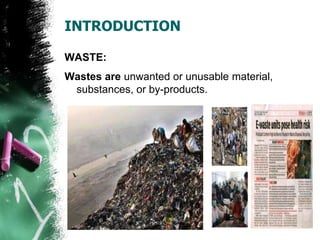
Wastes are unwanted or unusable material,
substances, or by-products.
HISTORY
• Until urban populations boomed, the garbage was not a
threat.
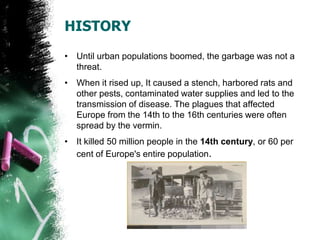
• When it rised up, It caused a stench, harbored rats and
other pests, contaminated water supplies and led to the
transmission of disease. The plagues that affected
Europe from the 14th to the 16th centuries were often
spread by the vermin.
• It killed 50 million people in the 14th century, or 60 per
cent of Europe's entire population.
Authorities are involved in the management
of waste:
• WHO (WORLD HEALTH ORGANISATION)
• BASEL CONVENTION (Basel Convention on
the Control of Transboundary Movements of
Hazardous Wastes and Their Disposal) that
was designed to reduce the movements
of hazardous waste between nations.
• MINISTRY OF ENVIRONMENT & FORESTS
(INDIA)
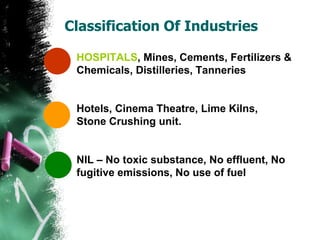
• HOSPITALS, Mines, Cements, Fertilizers &
Chemicals, Distilleries, Tanneries
• Hotels, Cinema Theatre, Lime Kilns,
Stone Crushing unit.
• NIL – No toxic substance, No effluent, No
fugitive emissions, No use of fuel
Classification Of Industries
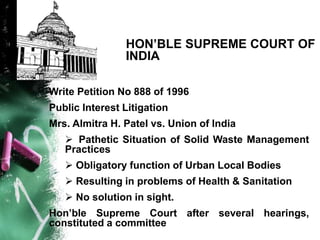
HON’BLE SUPREME COURT OF
INDIA
Write Petition No 888 of 1996
Public Interest Litigation
Mrs. Almitra H. Patel vs. Union of India
 Pathetic Situation of Solid Waste Management
Practices
 Obligatory function of Urban Local Bodies
 Resulting in problems of Health & Sanitation
 No solution in sight.
Hon’ble Supreme Court after several hearings,
constituted a committee
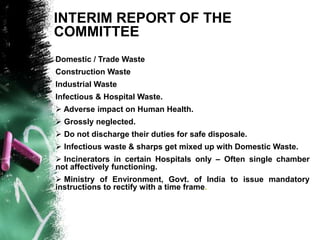
INTERIM REPORT OF THE
COMMITTEE
Domestic / Trade Waste
Construction Waste
Industrial Waste
Infectious & Hospital Waste.
 Adverse impact on Human Health.
 Grossly neglected.
 Do not discharge their duties for safe disposale.
 Infectious waste & sharps get mixed up with Domestic Waste.
 Incinerators in certain Hospitals only – Often single chamber
not affectively functioning.
 Ministry of Environment, Govt. of India to issue mandatory
instructions to rectify with a time frame.
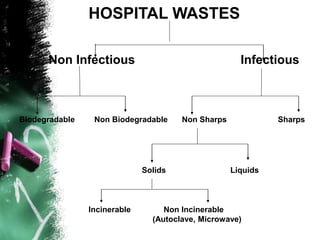
HOSPITAL WASTES
Non Infectious Infectious
Non Sharps Sharps
Solids Liquids
Incinerable Non Incinerable
(Autoclave, Microwave)
Biodegradable Non Biodegradable
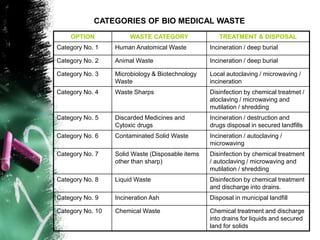
CATEGORIES OF BIO MEDICAL WASTE
OPTION WASTE CATEGORY TREATMENT & DISPOSAL
Category No. 1 Human Anatomical Waste Incineration / deep burial
Category No. 2 Animal Waste Incineration / deep burial
Category No. 3 Microbiology & Biotechnology
Waste
Local autoclaving / microwaving /
incineration
Category No. 4 Waste Sharps Disinfection by chemical treatmet /
atoclaving / microwaving and
mutilation / shredding
Category No. 5 Discarded Medicines and
Cytoxic drugs
Incineration / destruction and
drugs disposal in secured landfills
Category No. 6 Contaminated Solid Waste Incineration / autoclaving /
microwaving
Category No. 7 Solid Waste (Disposable items
other than sharp)
Disinfection by chemical treatment
/ autoclaving / microwaving and
mutilation / shredding
Category No. 8 Liquid Waste Disinfection by chemical treatment
and discharge into drains.
Category No. 9 Incineration Ash Disposal in municipal landfill
Category No. 10 Chemical Waste Chemical treatment and discharge
into drains for liquids and secured
land for solids
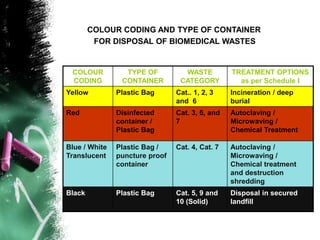
COLOUR CODING AND TYPE OF CONTAINER
FOR DISPOSAL OF BIOMEDICAL WASTES
COLOUR
CODING
TYPE OF
CONTAINER
WASTE
CATEGORY
TREATMENT OPTIONS
as per Schedule I
Yellow Plastic Bag Cat.. 1, 2, 3
and 6
Incineration / deep
burial
Red Disinfected
container /
Plastic Bag
Cat. 3, 6, and
7
Autoclaving /
Microwaving /
Chemical Treatment
Blue / White
Translucent
Plastic Bag /
puncture proof
container
Cat. 4, Cat. 7 Autoclaving /
Microwaving /
Chemical treatment
and destruction
shredding
Black Plastic Bag Cat. 5, 9 and
10 (Solid)
Disposal in secured
landfill
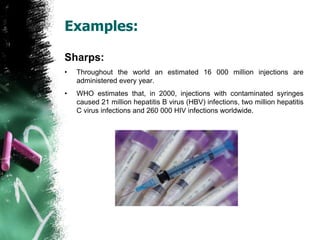
Examples:
Sharps:
• Throughout the world an estimated 16 000 million injections are
administered every year.
• WHO estimates that, in 2000, injections with contaminated syringes
caused 21 million hepatitis B virus (HBV) infections, two million hepatitis
C virus infections and 260 000 HIV infections worldwide.
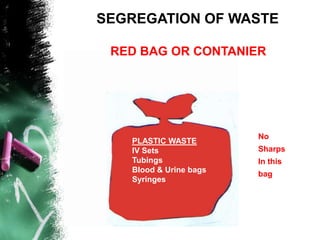
PLASTIC WASTE
IV Sets
Tubings
Blood & Urine bags
Syringes
SEGREGATION OF WASTE
No
Sharps
In this
bag
RED BAG OR CONTANIER
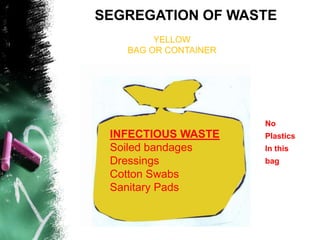
SEGREGATION OF WASTE
YELLOW
BAG OR CONTAINER
INFECTIOUS WASTE
Soiled bandages
Dressings
Cotton Swabs
Sanitary Pads
No
Plastics
In this
bag
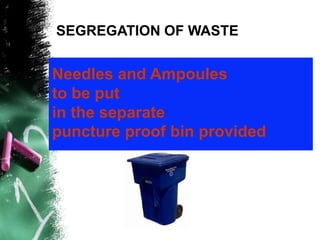
SEGREGATION OF WASTE
Needles and Ampoules
to be put
in the separate
puncture proof bin provided
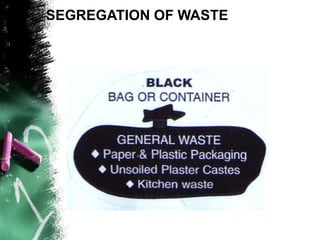
SEGREGATION OF WASTE
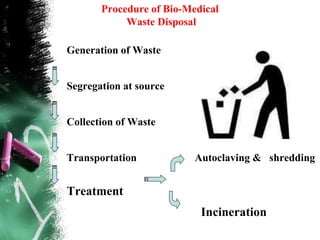
Procedure of Bio-Medical
Waste Disposal
Generation of Waste
Segregation at source
Collection of Waste
Transportation Autoclaving & shredding
Treatment
Incineration
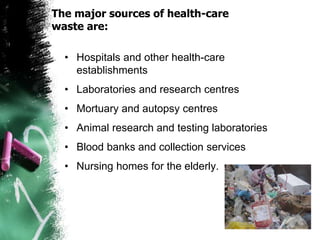
The major sources of health-care
waste are:
• Hospitals and other health-care
establishments
• Laboratories and research centres
• Mortuary and autopsy centres
• Animal research and testing laboratories
• Blood banks and collection services
• Nursing homes for the elderly.
LAB TECHNICIANS
 Use gloves during all tests.
 Reusable items to be soaked in bleach.
 Needles to be disinfected with bleach.
 Sharps to be put in needle container.
 Segregate waste as per category
 Put waste in correct bin wiz. Plastic/rubber waste
in Red, Anatomical soiled waste in Yellow, Non-
infectious general waste in Black and Sharps in Blue
Puncture Proof Container. Ensure colour bags of the
same colour as bins.
 Ensure that the plastic bag has bio-hazard symbol
and label.
 Remove plastic bags when ¾ full, tie the bags
properly. Ensure bag is properly tied / sealed to
avoid spilling.
 Wear protective gear while handling waste.
 Always keep your record book on waste activity up
to date.
DO’S
 Put the waste indiscriminately.
 Put wrong bags in bin. (Adhere to colour code.)
 Fill the bags till neck. (Waste would otherwise
spill over.)
 Handle waste without protective clothing.
 Drag the bags after removal. (Bags can burst
and the site could be repulsive.)
 Never recap the needle. (Never re-use needle
without disinfection)
 Mix non infectious waste with infectious waste.
DON’TS
Magnitude Of Problem: Indian scenario
Waste management is primarily categorized in
Municipal Waste, Industrial Waste, Bio-Medical
Waste and Electronic Waste.
Annual increase in the waste generation in approximating to 5 percent and
per capita waste generation is increasing by 1.3 percent per annum. Waste
generated in the 7 Mega cities of India is calculated as close as 19 percent
of the total waste, against 19 percent generation in Metro cities and almost
34 percent waste in all other class – I cities of India.
Only 60 percent of this volume is collected, even less is transported and
disposed off. Sanitary landfill or composting as methods of garbage
disposal is limited to very few cities. Mumbai generates about 3200 tonnes
of garbage of which about 97% is collected. In other cities, collection varies
from about 90% in Delhi and Chennai, about 75% in Calcutta and
Hyderabad, 68% in Bangalore and 70 % in Kanpur. The collection is around
50% in smaller towns.
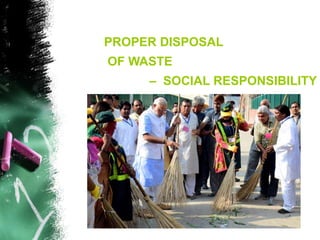
PROPER DISPOSAL
OF WASTE
– SOCIAL RESPONSIBILITY
Let us prove that we are
ECO FRIENDLY

Waste management

  • 1.
  • 2.
    INTRODUCTION WASTE: Wastes are unwantedor unusable material, substances, or by-products.
  • 3.
    HISTORY • Until urbanpopulations boomed, the garbage was not a threat. • When it rised up, It caused a stench, harbored rats and other pests, contaminated water supplies and led to the transmission of disease. The plagues that affected Europe from the 14th to the 16th centuries were often spread by the vermin. • It killed 50 million people in the 14th century, or 60 per cent of Europe's entire population.
  • 4.
    Authorities are involvedin the management of waste: • WHO (WORLD HEALTH ORGANISATION) • BASEL CONVENTION (Basel Convention on the Control of Transboundary Movements of Hazardous Wastes and Their Disposal) that was designed to reduce the movements of hazardous waste between nations. • MINISTRY OF ENVIRONMENT & FORESTS (INDIA)
  • 5.
    • HOSPITALS, Mines,Cements, Fertilizers & Chemicals, Distilleries, Tanneries • Hotels, Cinema Theatre, Lime Kilns, Stone Crushing unit. • NIL – No toxic substance, No effluent, No fugitive emissions, No use of fuel Classification Of Industries
  • 6.
    HON’BLE SUPREME COURTOF INDIA Write Petition No 888 of 1996 Public Interest Litigation Mrs. Almitra H. Patel vs. Union of India  Pathetic Situation of Solid Waste Management Practices  Obligatory function of Urban Local Bodies  Resulting in problems of Health & Sanitation  No solution in sight. Hon’ble Supreme Court after several hearings, constituted a committee
  • 7.
    INTERIM REPORT OFTHE COMMITTEE Domestic / Trade Waste Construction Waste Industrial Waste Infectious & Hospital Waste.  Adverse impact on Human Health.  Grossly neglected.  Do not discharge their duties for safe disposale.  Infectious waste & sharps get mixed up with Domestic Waste.  Incinerators in certain Hospitals only – Often single chamber not affectively functioning.  Ministry of Environment, Govt. of India to issue mandatory instructions to rectify with a time frame.
  • 8.
    HOSPITAL WASTES Non InfectiousInfectious Non Sharps Sharps Solids Liquids Incinerable Non Incinerable (Autoclave, Microwave) Biodegradable Non Biodegradable
  • 9.
    CATEGORIES OF BIOMEDICAL WASTE OPTION WASTE CATEGORY TREATMENT & DISPOSAL Category No. 1 Human Anatomical Waste Incineration / deep burial Category No. 2 Animal Waste Incineration / deep burial Category No. 3 Microbiology & Biotechnology Waste Local autoclaving / microwaving / incineration Category No. 4 Waste Sharps Disinfection by chemical treatmet / atoclaving / microwaving and mutilation / shredding Category No. 5 Discarded Medicines and Cytoxic drugs Incineration / destruction and drugs disposal in secured landfills Category No. 6 Contaminated Solid Waste Incineration / autoclaving / microwaving Category No. 7 Solid Waste (Disposable items other than sharp) Disinfection by chemical treatment / autoclaving / microwaving and mutilation / shredding Category No. 8 Liquid Waste Disinfection by chemical treatment and discharge into drains. Category No. 9 Incineration Ash Disposal in municipal landfill Category No. 10 Chemical Waste Chemical treatment and discharge into drains for liquids and secured land for solids
  • 10.
    COLOUR CODING ANDTYPE OF CONTAINER FOR DISPOSAL OF BIOMEDICAL WASTES COLOUR CODING TYPE OF CONTAINER WASTE CATEGORY TREATMENT OPTIONS as per Schedule I Yellow Plastic Bag Cat.. 1, 2, 3 and 6 Incineration / deep burial Red Disinfected container / Plastic Bag Cat. 3, 6, and 7 Autoclaving / Microwaving / Chemical Treatment Blue / White Translucent Plastic Bag / puncture proof container Cat. 4, Cat. 7 Autoclaving / Microwaving / Chemical treatment and destruction shredding Black Plastic Bag Cat. 5, 9 and 10 (Solid) Disposal in secured landfill
  • 11.
    Examples: Sharps: • Throughout theworld an estimated 16 000 million injections are administered every year. • WHO estimates that, in 2000, injections with contaminated syringes caused 21 million hepatitis B virus (HBV) infections, two million hepatitis C virus infections and 260 000 HIV infections worldwide.
  • 12.
    PLASTIC WASTE IV Sets Tubings Blood& Urine bags Syringes SEGREGATION OF WASTE No Sharps In this bag RED BAG OR CONTANIER
  • 13.
    SEGREGATION OF WASTE YELLOW BAGOR CONTAINER INFECTIOUS WASTE Soiled bandages Dressings Cotton Swabs Sanitary Pads No Plastics In this bag
  • 14.
    SEGREGATION OF WASTE Needlesand Ampoules to be put in the separate puncture proof bin provided
  • 15.
  • 16.
    Procedure of Bio-Medical WasteDisposal Generation of Waste Segregation at source Collection of Waste Transportation Autoclaving & shredding Treatment Incineration
  • 17.
    The major sourcesof health-care waste are: • Hospitals and other health-care establishments • Laboratories and research centres • Mortuary and autopsy centres • Animal research and testing laboratories • Blood banks and collection services • Nursing homes for the elderly.
  • 18.
    LAB TECHNICIANS  Usegloves during all tests.  Reusable items to be soaked in bleach.  Needles to be disinfected with bleach.  Sharps to be put in needle container.
  • 19.
     Segregate wasteas per category  Put waste in correct bin wiz. Plastic/rubber waste in Red, Anatomical soiled waste in Yellow, Non- infectious general waste in Black and Sharps in Blue Puncture Proof Container. Ensure colour bags of the same colour as bins.  Ensure that the plastic bag has bio-hazard symbol and label.  Remove plastic bags when ¾ full, tie the bags properly. Ensure bag is properly tied / sealed to avoid spilling.  Wear protective gear while handling waste.  Always keep your record book on waste activity up to date. DO’S
  • 20.
     Put thewaste indiscriminately.  Put wrong bags in bin. (Adhere to colour code.)  Fill the bags till neck. (Waste would otherwise spill over.)  Handle waste without protective clothing.  Drag the bags after removal. (Bags can burst and the site could be repulsive.)  Never recap the needle. (Never re-use needle without disinfection)  Mix non infectious waste with infectious waste. DON’TS
  • 21.
    Magnitude Of Problem:Indian scenario Waste management is primarily categorized in Municipal Waste, Industrial Waste, Bio-Medical Waste and Electronic Waste. Annual increase in the waste generation in approximating to 5 percent and per capita waste generation is increasing by 1.3 percent per annum. Waste generated in the 7 Mega cities of India is calculated as close as 19 percent of the total waste, against 19 percent generation in Metro cities and almost 34 percent waste in all other class – I cities of India. Only 60 percent of this volume is collected, even less is transported and disposed off. Sanitary landfill or composting as methods of garbage disposal is limited to very few cities. Mumbai generates about 3200 tonnes of garbage of which about 97% is collected. In other cities, collection varies from about 90% in Delhi and Chennai, about 75% in Calcutta and Hyderabad, 68% in Bangalore and 70 % in Kanpur. The collection is around 50% in smaller towns.
  • 22.
    PROPER DISPOSAL OF WASTE –SOCIAL RESPONSIBILITY
  • 23.
    Let us provethat we are ECO FRIENDLY