Centre for Library and Information Management Studies
Sir Dorabji Tata Memorial Library
TATA INSTITUTE OF SOCIAL SCIENCES
ASSIGNMENT SUBMISSION
Enrollment No : M2014MLISc013
Programme Title : Master of Library and Information Science (MLISc)
Course Title : Research Methodology
Course Code : LIS 09
Semester : Second
Assignment Title : Eximine criticaly the diffrent experimental method of data collection
Submitted On : 10th march 2015
Course Teacher : Dr. J. Shivarama
TABLE OF CONTENTS
1.0 Introduction......................................................................................................................................
1.1 Types of data.........................................................................................................................
1.2 What is Data Collection........................................................................................................
1.3 Types of Data Collection......................................................................................................
1.4 Sources of Data.....................................................................................................................
2.0 The Experimental Design Process....................................................................................................
3.0 Data Collection Methods..................................................................................................................
3.1 Questionaire Methods...........................................................................................................
3.2 Interview Methods................................................................................................................
3.3 Observation Methods............................................................................................................
4.0 Types of Research data Collection Techniques................................................................................
5.0 Conclusion........................................................................................................................................
6.0 References........................................................................................................................................
Introduction :
Data collection is one of the most important stage in conducting a research. You can have the best
research design in theworld but if you cannot collect the required data you will be not be able to
complete your project. Data collection is a very demanding job which need thorough planning ,
hard work, patience, perseverance and more to be able to complete the task successfully. Data
collection starts with determining what kind of data required followed by the selection of a sample
from a certain population. After that, you need to use a certain instrument to collect the data from
the selected sample.
Types of data :
Data can be divided into two types, namely quantitative and qualitative. Quantitative data is
numerical in nature and can be mathematically computed . Quantitative data measure uses different
scales, which can be classified as nominal scale, ordinal scale, interval scale and ratio scale.
Nominal scale is used to categorize items into different group, for example male and female,
different examination grades, different races in a country, different types of companies, different
shoe sizes and so on. The statistics that is used to analyze this type of data is mode. The second
measure for quantitative data is the ordinal scale which other than providing information as the
nominal scale does also permit ranking of the data. For example, shoe sizes can be ranked from big
to small. A typical ordinal in ranking a set of data is poor, satisfactory, good, very god, excellent. On
the other hand, an interval scale not only rank order of a set of data, it also measure the order in
units of equal intervals. However, the starting point for the measurement is arbitrary rather than
absolute.
What is data Collection?
Data collection is the process of gathering and measuring information on variables of interest, in an
established systematic fashion that enables one to answer stated research questions, test hypotheses
and evaluate outcomes. The data collection component of research is common to all fields of study
including physical and social sciences humanities, business, etc. While methods vary by discipline,
the emphasis on ensuring accurate and honest collection remains the same. The goal for all data
collection is to capture quality evidence that then translates to rich data analysis and allows the
building of a convincing and credible answer to questions that have been posed.
Generally there are three types of data collection
1.Surveys: Standardized paper-and-pencil or phone questionnaires that ask predetermined
questions.
2. Interviews: Structured or unstructured one-on-one directed conversations with key individuals or
leaders in a community
3. Focus groups: Structured interviews with small groups of like individuals using standardized
questions, follow-up questions, and exploration of other topics that arise to better understand
participants
Sources of data :
Generally we can collect data from two sources, primary sources and secondary sources. Data
collected from primary sources are known as primary data and data collected from secondary
sources are called secondary data.
Primary data are also known as raw data. Data are collected from the original source in a controlled
or an uncontrolled environment. Example of a controlled environment are experimental research
where certain variables are being controlled by the researcher. On the other hand, data collected
through observation or questionnaire survey in a natural setting are examples data obtained in an
uncontrolled environment. Secondary data are data obtained from secondary sources such as
reports, books, journals, documents, magazines, the web and more.
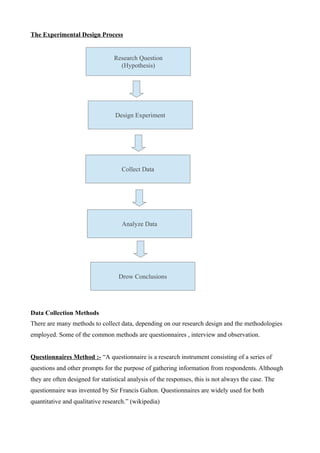
The Experimental Design Process
Data Collection Methods
There are many methods to collect data, depending on our research design and the methodologies
employed. Some of the common methods are questionnaires , interview and observation.
Questionnaires Method :- “A questionnaire is a research instrument consisting of a series of
questions and other prompts for the purpose of gathering information from respondents. Although
they are often designed for statistical analysis of the responses, this is not always the case. The
questionnaire was invented by Sir Francis Galton. Questionnaires are widely used for both
quantitative and qualitative research.” (wikipedia)
Research Question
(Hypothesis)
Design Experiment
Collect Data
Analyze Data
Drow Conclusions
“Questionnaires often use various measuring scales to obtain information from the respondents. To
obtain the bio data of the respondents, we use nominal scale as it serves as label or identification
such as gender and age, which often does not involve calculations. To gather respondents'
preferences, we use ordinal scale which is used to arrange objects or alternatives according to their
magnitude in an ordered relationship. To obtain information related to attitude, we use rating scales.
Rating asks the respondents to estimate the magnitude of a characteristic or quality regarding
certain object or thing. Questionnaire is designed both for descriptive as well as analytical surveys.
In a descriptive survey, the questionnaire will normally use nominal and ordinal scales because it
concerns primarily with the particular characteristics of a specific population of subjects. It does not
required the examination of dependent and independent variables.”
Types of Questionaire :
1) Structured Questionaire
2) Unstructured Questionaire
3) Close Questionaire
4) Open Questionaire
5) Fact/ Openion base Questionaire
Important thing's for Questionaire :
1) Follow logical relevent link for one question to another
2) Some question do not repeted avoid relevant question
3) General to specific first you ask General question and after that personal question
4) Question should follow list sensitive and most sensitive also
5) Follow from the factual and behavioural question
6) Before scraning the question you can do sample study, then frame question
Interview Method :- “Interveiw is the verbal conversation between two people with the objective
of collecting relevant information for the purpose of research.
Interview are particularly useful for getting the story behind a participant's experiences.”
( McNamara, 1999)
Interviews may be useful as follow-up to certain respondents.
Types of Interview's
1) Personal Interview
2) Telephone Interview
3) Focus group Interview
4) Depth Interview
5) Projective techniques
1) Personal Interview :- Is a face to face way communication between the interviewer and the
respondents. Generally the personal interview is carried out in a planned manner and is referred to
us.
2) Telephone Interview :- In Telephonic interview information is collected frm the respondent by
ask him question on the phone is called telephonic interview.
3) Focus group Interview :- Focus group interview ia an unstructured interview which involves a
moderator leading a discussion between a small group of respondent on a specific topic.
4) Depth Interview :- Depth interview is nondirective in nature where the respondent is given
freedom to answer within the boundaries of the topic of interest.
5) Projective Techniques :- Projective techniques involve the presentation of an ambiguous,
unstructured object, activity or person that a respondent is asked to interpert and explain. In
projective techniques, the respondent asked to interprert the behaviour of others and this way they
directly reveal their own behaviour in the same situaction.
Advantages of interview
1) Opportunity for Feedback :-“Interviewer can provide direct feedback to the respondent,
give clarifications and help alleviate any misconceptions or apprehensions over
confidentiality that the respondent may have in answering the interviewer’s questions.”
2) Length of Interview :- “If the questionnaire is very lengthy, the personal interview is the
best technique for getting respondents to cooperate, without overtaxing their patience.”
3) Complete Questionnaires :-“Personal ensures ensure that the respondent will answer all
questions asked, unlike in telephone interview where the respondent may hang up or in mail
questionnaire where some questions may go unanswered.”
4) High Participation :-“Interviewing respondents personally can increase the likelihood of
their participation, as many people prefer to communicate directly verbally and sharing
information and insights with interviewers.”
Observation Method :- Observation is a process of recording the behaviour patterns of people,
objects, and occurrences without questioning or communicating with them. Observation can take
the place in a laboratory setting or in a natural setting. Generally there are two ways to conduct
observation, namely non-participative observation and participative observation.
“Observation as the systematic description of events, behaviors, and artifacts in the social setting
chosen for study.” (Marshall and Rossman, 1989)
“Observation methods are useful to researchers in a variety of ways. They provide researchers with
ways to check for nonverbal expression of feelings, determine who interacts with whom, grasp how
participants communicate with each other, and check for how much time is spent on various
activities.” (SCHMUCK, 1997)
“The main advantage of observation as compared to questionnaire survey is you can obtain richer
and more in-depth information. You can able to catch phenomena, characteristics, activities and
other things impossible to detect by questionnaire survey.”
Observation is two Types
1) Participant observation
2) non-participant observation
“Participant observation as the primary method used by anthropologists doing fieldwork. Fieldwork
involves active looking, improving memory, informal interviewing, writing detailed field notes, and
perhaps most importantly,
patience.” (DeMunck and Sobo, 1998)
“Non-participant observation is observation with limited interaction with the people one observes.
Researchers who study how people communicate often want to examine the details of how people
talk and behave together. Non-participant observation involving the use of recording devices might
be a good choice This data collection approach results in a detailed recording of the communication
and provides the researcher with access to the contours of talk.”
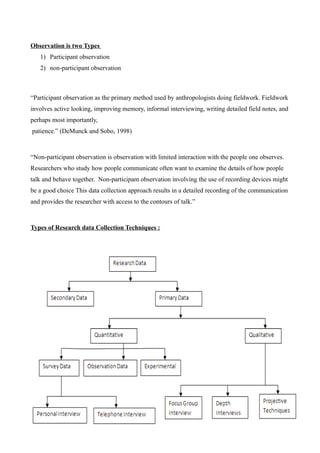
Types of Research data Collection Techniques :
Conclusion
Data Collection means putting your design for collecting information into operation. You’ve
decided how you’re going to get information – whether by direct observation, interviews, surveys,
experiments and testing, or other methods. Recording and arranging information may take
distinctive structures, contingent upon the sort of data you're gathering.
References
Data collection. (n.d.). Retrieved March 3, 2015, from http://en.wikipedia.org/wiki/Data_collection
(n.d.). Retrieved March 4, 2015, from http://www.vbtutor.net/research/research_chp7.html
Data Collection Methods. (n.d.). Retrieved March 5, 2015, from http://stattrek.com/statistics/data-
collection-methods.aspx
Shivarama, J. (2015, January 30). Personal Communication, Tata Institute of Social Science,
Mumbai-88
(n.d.). Retrieved March 7, 2015, from http://ocw.mit.edu/courses/aeronautics-and-astronautics/16-
422-human-supervisory-control-of-automated-systems-spring-2004/lecture-
notes/040604coop_decis.pdf
University of Mysore. (n.d.). Retrieved March 7, 2015, from http://www.uni-mysore.ac.in/
Participant Observation as a Data Collection Method | Kawulich | Forum Qualitative
Sozialforschung / Forum: Qualitative Social Research. (n.d.). Retrieved March 8, 2015, from
http://www.qualitative-research.net/index.php/fqs/article/view/466/996
Observation. (n.d.). Retrieved March 8, 2015, from http://www.qualres.org/HomeObse-3594.html
Section 5. Collecting and Analyzing Data. (n.d.). Retrieved March 8, 2015, from
http://ctb.ku.edu/en/table-of-contents/evaluate/evaluate-community-interventions/collect-analyze-
data/main

Data collection methods in research

  • 1.
    Centre for Libraryand Information Management Studies Sir Dorabji Tata Memorial Library TATA INSTITUTE OF SOCIAL SCIENCES ASSIGNMENT SUBMISSION Enrollment No : M2014MLISc013 Programme Title : Master of Library and Information Science (MLISc) Course Title : Research Methodology Course Code : LIS 09 Semester : Second Assignment Title : Eximine criticaly the diffrent experimental method of data collection Submitted On : 10th march 2015 Course Teacher : Dr. J. Shivarama
  • 2.
    TABLE OF CONTENTS 1.0Introduction...................................................................................................................................... 1.1 Types of data......................................................................................................................... 1.2 What is Data Collection........................................................................................................ 1.3 Types of Data Collection...................................................................................................... 1.4 Sources of Data..................................................................................................................... 2.0 The Experimental Design Process.................................................................................................... 3.0 Data Collection Methods.................................................................................................................. 3.1 Questionaire Methods........................................................................................................... 3.2 Interview Methods................................................................................................................ 3.3 Observation Methods............................................................................................................ 4.0 Types of Research data Collection Techniques................................................................................ 5.0 Conclusion........................................................................................................................................ 6.0 References........................................................................................................................................
  • 3.
    Introduction : Data collectionis one of the most important stage in conducting a research. You can have the best research design in theworld but if you cannot collect the required data you will be not be able to complete your project. Data collection is a very demanding job which need thorough planning , hard work, patience, perseverance and more to be able to complete the task successfully. Data collection starts with determining what kind of data required followed by the selection of a sample from a certain population. After that, you need to use a certain instrument to collect the data from the selected sample. Types of data : Data can be divided into two types, namely quantitative and qualitative. Quantitative data is numerical in nature and can be mathematically computed . Quantitative data measure uses different scales, which can be classified as nominal scale, ordinal scale, interval scale and ratio scale. Nominal scale is used to categorize items into different group, for example male and female, different examination grades, different races in a country, different types of companies, different shoe sizes and so on. The statistics that is used to analyze this type of data is mode. The second measure for quantitative data is the ordinal scale which other than providing information as the nominal scale does also permit ranking of the data. For example, shoe sizes can be ranked from big to small. A typical ordinal in ranking a set of data is poor, satisfactory, good, very god, excellent. On the other hand, an interval scale not only rank order of a set of data, it also measure the order in units of equal intervals. However, the starting point for the measurement is arbitrary rather than absolute. What is data Collection? Data collection is the process of gathering and measuring information on variables of interest, in an established systematic fashion that enables one to answer stated research questions, test hypotheses and evaluate outcomes. The data collection component of research is common to all fields of study including physical and social sciences humanities, business, etc. While methods vary by discipline, the emphasis on ensuring accurate and honest collection remains the same. The goal for all data collection is to capture quality evidence that then translates to rich data analysis and allows the building of a convincing and credible answer to questions that have been posed.
  • 4.
    Generally there arethree types of data collection 1.Surveys: Standardized paper-and-pencil or phone questionnaires that ask predetermined questions. 2. Interviews: Structured or unstructured one-on-one directed conversations with key individuals or leaders in a community 3. Focus groups: Structured interviews with small groups of like individuals using standardized questions, follow-up questions, and exploration of other topics that arise to better understand participants Sources of data : Generally we can collect data from two sources, primary sources and secondary sources. Data collected from primary sources are known as primary data and data collected from secondary sources are called secondary data. Primary data are also known as raw data. Data are collected from the original source in a controlled or an uncontrolled environment. Example of a controlled environment are experimental research where certain variables are being controlled by the researcher. On the other hand, data collected through observation or questionnaire survey in a natural setting are examples data obtained in an uncontrolled environment. Secondary data are data obtained from secondary sources such as reports, books, journals, documents, magazines, the web and more.
  • 5.
    The Experimental DesignProcess Data Collection Methods There are many methods to collect data, depending on our research design and the methodologies employed. Some of the common methods are questionnaires , interview and observation. Questionnaires Method :- “A questionnaire is a research instrument consisting of a series of questions and other prompts for the purpose of gathering information from respondents. Although they are often designed for statistical analysis of the responses, this is not always the case. The questionnaire was invented by Sir Francis Galton. Questionnaires are widely used for both quantitative and qualitative research.” (wikipedia) Research Question (Hypothesis) Design Experiment Collect Data Analyze Data Drow Conclusions
  • 6.
    “Questionnaires often usevarious measuring scales to obtain information from the respondents. To obtain the bio data of the respondents, we use nominal scale as it serves as label or identification such as gender and age, which often does not involve calculations. To gather respondents' preferences, we use ordinal scale which is used to arrange objects or alternatives according to their magnitude in an ordered relationship. To obtain information related to attitude, we use rating scales. Rating asks the respondents to estimate the magnitude of a characteristic or quality regarding certain object or thing. Questionnaire is designed both for descriptive as well as analytical surveys. In a descriptive survey, the questionnaire will normally use nominal and ordinal scales because it concerns primarily with the particular characteristics of a specific population of subjects. It does not required the examination of dependent and independent variables.” Types of Questionaire : 1) Structured Questionaire 2) Unstructured Questionaire 3) Close Questionaire 4) Open Questionaire 5) Fact/ Openion base Questionaire Important thing's for Questionaire : 1) Follow logical relevent link for one question to another 2) Some question do not repeted avoid relevant question 3) General to specific first you ask General question and after that personal question 4) Question should follow list sensitive and most sensitive also 5) Follow from the factual and behavioural question 6) Before scraning the question you can do sample study, then frame question
  • 7.
    Interview Method :-“Interveiw is the verbal conversation between two people with the objective of collecting relevant information for the purpose of research. Interview are particularly useful for getting the story behind a participant's experiences.” ( McNamara, 1999) Interviews may be useful as follow-up to certain respondents. Types of Interview's 1) Personal Interview 2) Telephone Interview 3) Focus group Interview 4) Depth Interview 5) Projective techniques 1) Personal Interview :- Is a face to face way communication between the interviewer and the respondents. Generally the personal interview is carried out in a planned manner and is referred to us. 2) Telephone Interview :- In Telephonic interview information is collected frm the respondent by ask him question on the phone is called telephonic interview. 3) Focus group Interview :- Focus group interview ia an unstructured interview which involves a moderator leading a discussion between a small group of respondent on a specific topic. 4) Depth Interview :- Depth interview is nondirective in nature where the respondent is given freedom to answer within the boundaries of the topic of interest. 5) Projective Techniques :- Projective techniques involve the presentation of an ambiguous, unstructured object, activity or person that a respondent is asked to interpert and explain. In projective techniques, the respondent asked to interprert the behaviour of others and this way they directly reveal their own behaviour in the same situaction.
  • 8.
    Advantages of interview 1)Opportunity for Feedback :-“Interviewer can provide direct feedback to the respondent, give clarifications and help alleviate any misconceptions or apprehensions over confidentiality that the respondent may have in answering the interviewer’s questions.” 2) Length of Interview :- “If the questionnaire is very lengthy, the personal interview is the best technique for getting respondents to cooperate, without overtaxing their patience.” 3) Complete Questionnaires :-“Personal ensures ensure that the respondent will answer all questions asked, unlike in telephone interview where the respondent may hang up or in mail questionnaire where some questions may go unanswered.” 4) High Participation :-“Interviewing respondents personally can increase the likelihood of their participation, as many people prefer to communicate directly verbally and sharing information and insights with interviewers.” Observation Method :- Observation is a process of recording the behaviour patterns of people, objects, and occurrences without questioning or communicating with them. Observation can take the place in a laboratory setting or in a natural setting. Generally there are two ways to conduct observation, namely non-participative observation and participative observation. “Observation as the systematic description of events, behaviors, and artifacts in the social setting chosen for study.” (Marshall and Rossman, 1989) “Observation methods are useful to researchers in a variety of ways. They provide researchers with ways to check for nonverbal expression of feelings, determine who interacts with whom, grasp how participants communicate with each other, and check for how much time is spent on various activities.” (SCHMUCK, 1997) “The main advantage of observation as compared to questionnaire survey is you can obtain richer and more in-depth information. You can able to catch phenomena, characteristics, activities and other things impossible to detect by questionnaire survey.”
  • 9.
    Observation is twoTypes 1) Participant observation 2) non-participant observation “Participant observation as the primary method used by anthropologists doing fieldwork. Fieldwork involves active looking, improving memory, informal interviewing, writing detailed field notes, and perhaps most importantly, patience.” (DeMunck and Sobo, 1998) “Non-participant observation is observation with limited interaction with the people one observes. Researchers who study how people communicate often want to examine the details of how people talk and behave together. Non-participant observation involving the use of recording devices might be a good choice This data collection approach results in a detailed recording of the communication and provides the researcher with access to the contours of talk.” Types of Research data Collection Techniques :
  • 10.
    Conclusion Data Collection meansputting your design for collecting information into operation. You’ve decided how you’re going to get information – whether by direct observation, interviews, surveys, experiments and testing, or other methods. Recording and arranging information may take distinctive structures, contingent upon the sort of data you're gathering.
  • 11.
    References Data collection. (n.d.).Retrieved March 3, 2015, from http://en.wikipedia.org/wiki/Data_collection (n.d.). Retrieved March 4, 2015, from http://www.vbtutor.net/research/research_chp7.html Data Collection Methods. (n.d.). Retrieved March 5, 2015, from http://stattrek.com/statistics/data- collection-methods.aspx Shivarama, J. (2015, January 30). Personal Communication, Tata Institute of Social Science, Mumbai-88 (n.d.). Retrieved March 7, 2015, from http://ocw.mit.edu/courses/aeronautics-and-astronautics/16- 422-human-supervisory-control-of-automated-systems-spring-2004/lecture- notes/040604coop_decis.pdf University of Mysore. (n.d.). Retrieved March 7, 2015, from http://www.uni-mysore.ac.in/ Participant Observation as a Data Collection Method | Kawulich | Forum Qualitative Sozialforschung / Forum: Qualitative Social Research. (n.d.). Retrieved March 8, 2015, from http://www.qualitative-research.net/index.php/fqs/article/view/466/996 Observation. (n.d.). Retrieved March 8, 2015, from http://www.qualres.org/HomeObse-3594.html Section 5. Collecting and Analyzing Data. (n.d.). Retrieved March 8, 2015, from http://ctb.ku.edu/en/table-of-contents/evaluate/evaluate-community-interventions/collect-analyze- data/main