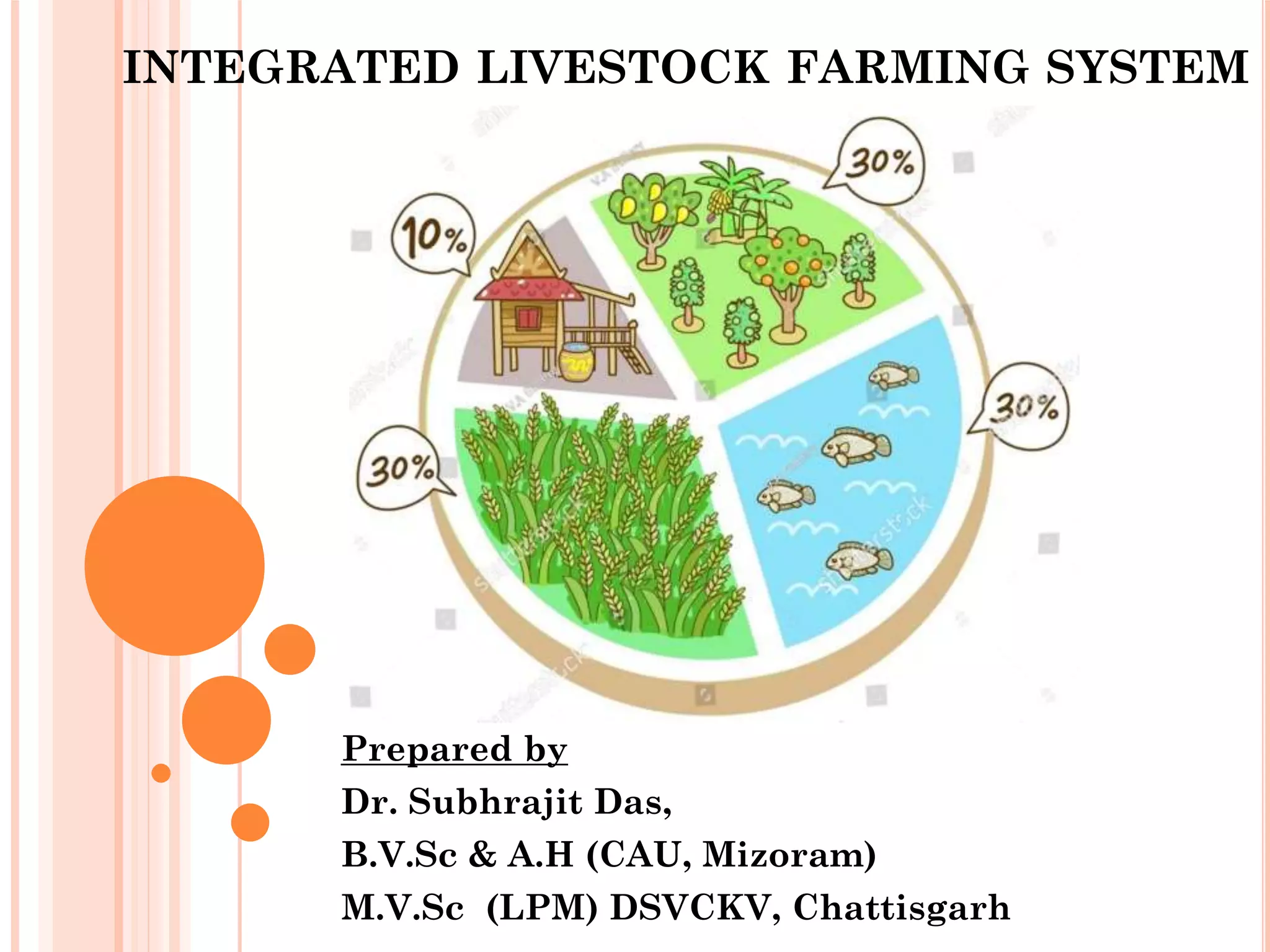
INTEGRATED LIVESTOCK FARMING SYSTEM
Prepared by
Dr. Subhrajit Das,
B.V.Sc & A.H (CAU, Mizoram)
M.V.Sc (LPM) DSVCKV, Chattisgarh
 Introduction-
 Integrated farming of fish and livestock is an old practice consisting of the
culture of fish (or shrimp) associated with the husbandry of domesticated
animals such as pigs, ducks, chicken, etc.
 The highest productions obtained so far in integrated fish farming are with
pigs, ducks and chicken.
 The raising cost of fish feed has brought interest in the utilization of animal
waste in pond culture, Livestock-fish integrated system.
 Fishes used for this purpose-Hypothalmicthys molitrix(silver
carp),Ctenopharyngodon idella(grass carp),Labeo rohita (rohu)
,(mrigal)cirrihinus mrigala ,Cyprinus caprio(common carp),Catla
catla(catla).
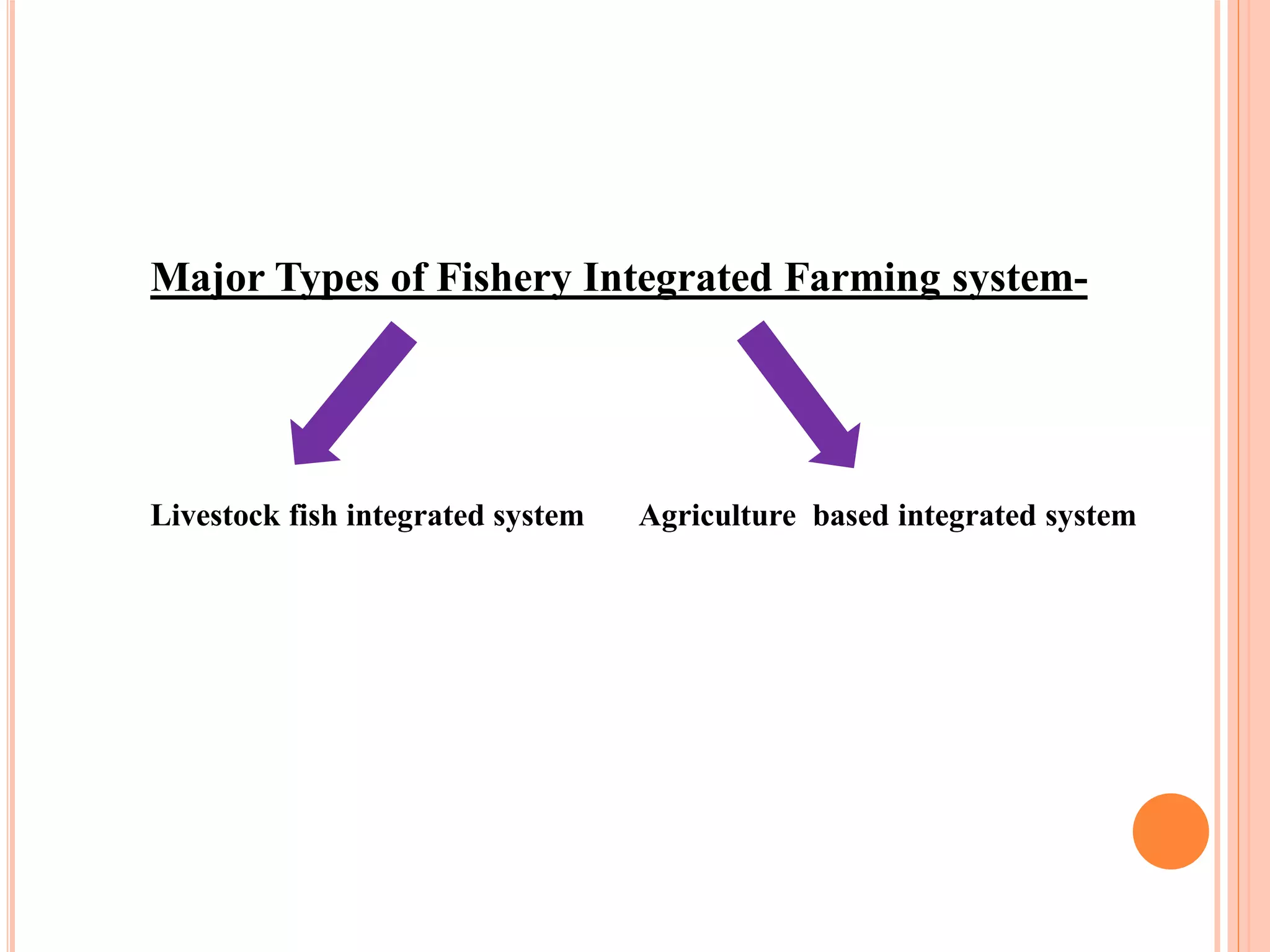
Major Types of Fishery Integrated Farming system-
Livestock fish integrated system Agriculture based integrated system
Types of Livestock-Fishery Integrated Farming system-
1.Duck-Fish Integration system.
2. Poultry-Fish Integration system.
3. Pig-Fish Integration system.
4. Sheep/Goat Fish Integration system.
5. Cattle/Buffalo-Fish Integration system.
6.Rabbit -fish Integration system.
 Duck cum fish farming-
 This system is very popular and widely practised in our country particularly
in Assam,West bengal,Bihar,Orissa,Andhra pradesh, Kerala and North-
eastern states.
 It is one of the best livestock-farming system.
 Duck droppings directly fall into the water as a direct food for fish. Duck
consumes mosquito larvae,tadpoles,dragonfly larvae and snails from pond
which are not consumed by fish also the babbling habit of ducks increase
the available oxygen in the pond as well as release nutrient from pond.
 For commercial farming Khaki Campbell, Indian Runner is preferred
instead of local breeds.
 About 200-240 eggs /duck/ year is expected and on an average 250
ducks/ha is recommended for duck cum integrated farming, with fish
production of 3000-4000 kg /ha/year.
 Poultry cum fish farming-
 Poultry excreta is an excellent feed for fish as it contain highly soluble
organic salts, more N and P compare to other livestock manure.
 Broiler, Layer in deep litter system can be raised in the integrated system.
 For one hectare fish pond 500-600birds and on an average 60 kg poultry
manure is required per day.
 Production level of 4500-5000 kg/fish/ha can be achieve.
 Sheep/Goat cum fish farming-
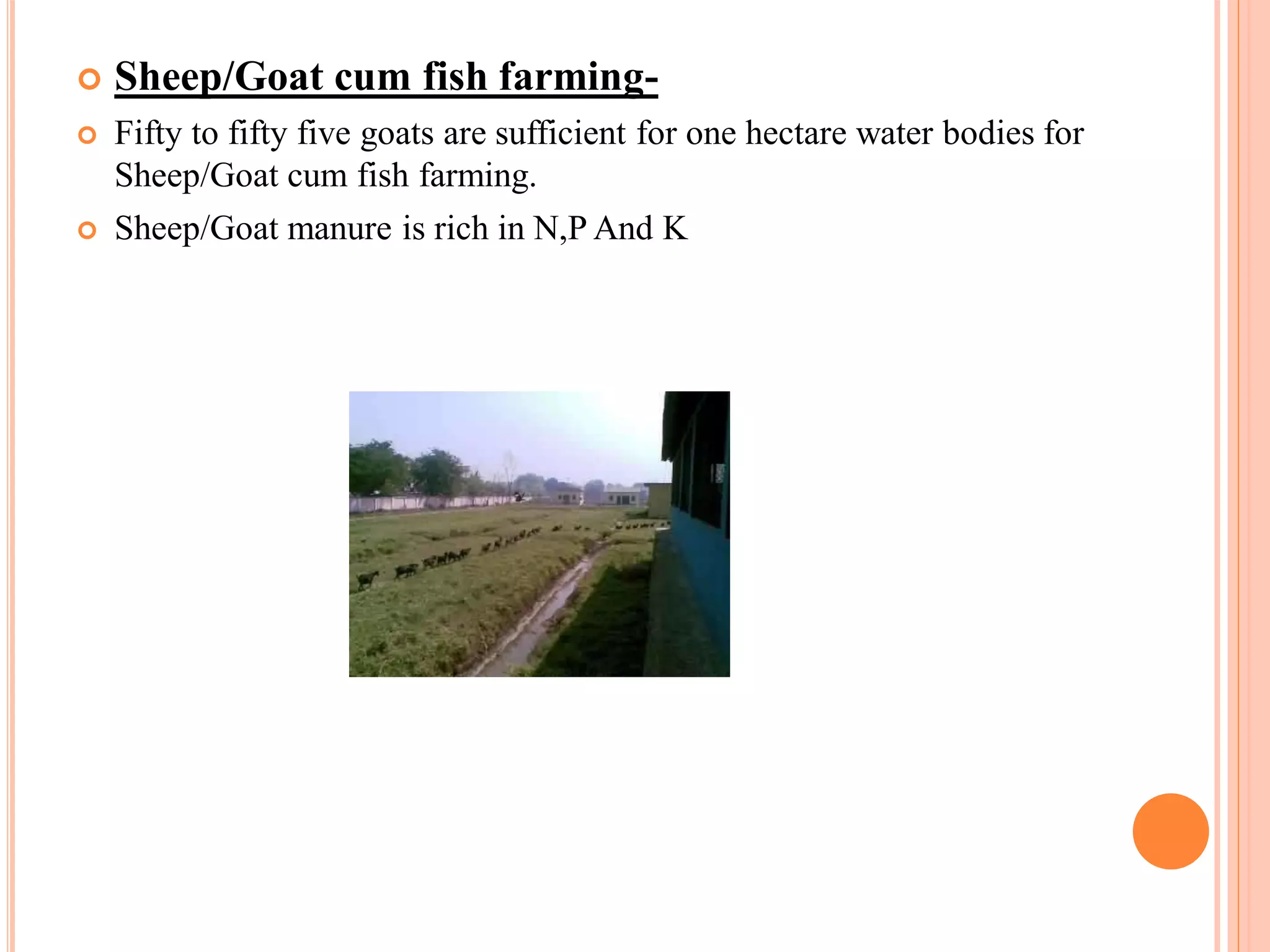
 Fifty to fifty five goats are sufficient for one hectare water bodies for
Sheep/Goat cum fish farming.
 Sheep/Goat manure is rich in N,P And K
 Cattle/Buffalo-Fish Farming-
 This system is very common in rural India. People generally mix cow dung
with paddy husk or wheat bhusa and spread over water bodies as a ready
source of fish food.
 Sometimes cow dug and cattle b buffalo sheds waste channelized directly
into the pond which serve as a excellent fish food directly or indirectly as a
source of plankton growth in plant.
 Five Cattle /buffalo are sufficient for one hectare of water bodies.
 Pig cum fish farming system-
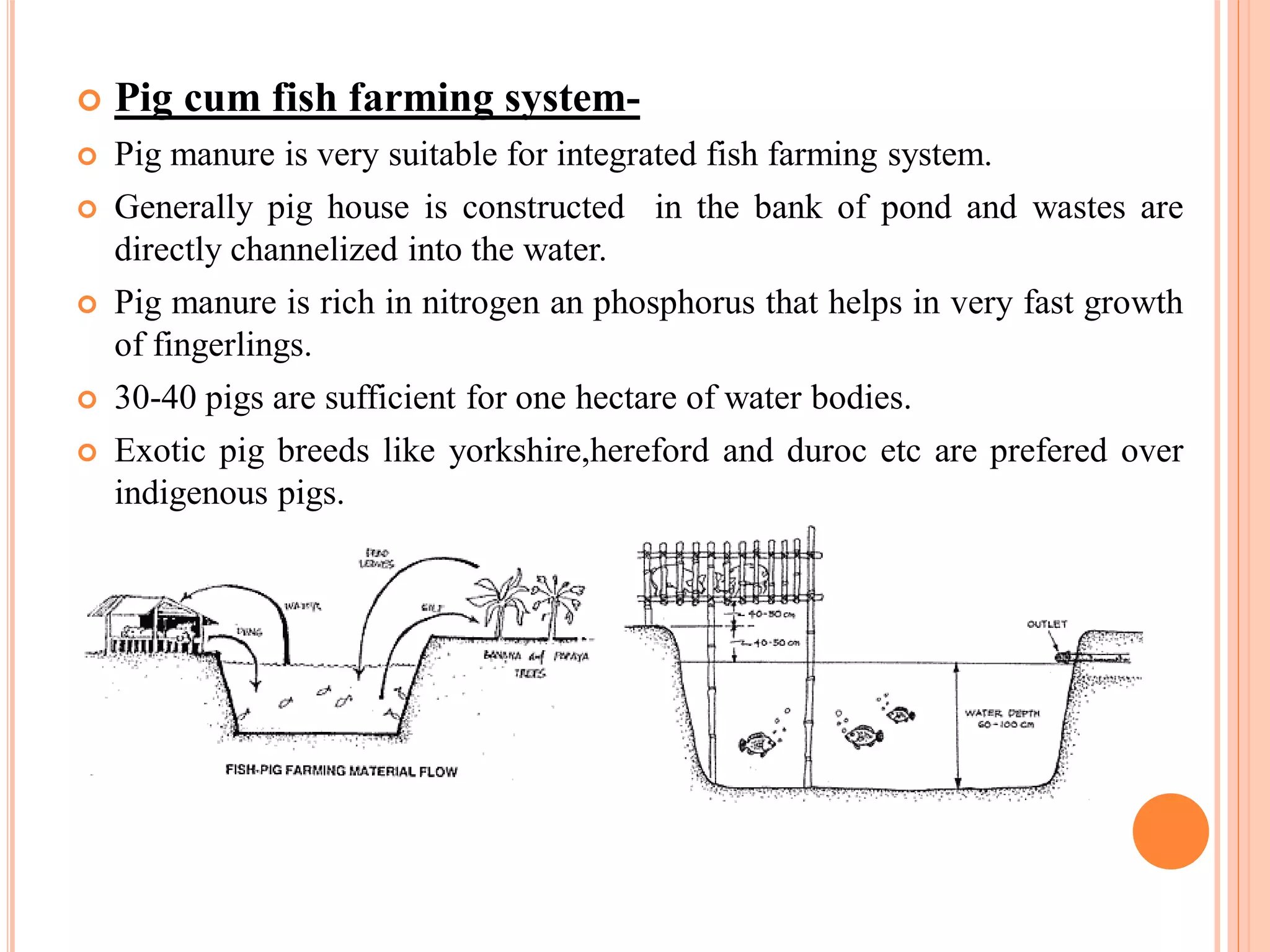
 Pig manure is very suitable for integrated fish farming system.
 Generally pig house is constructed in the bank of pond and wastes are
directly channelized into the water.
 Pig manure is rich in nitrogen an phosphorus that helps in very fast growth
of fingerlings.
 30-40 pigs are sufficient for one hectare of water bodies.
 Exotic pig breeds like yorkshire,hereford and duroc etc are prefered over
indigenous pigs.
 Rabbit cum fish farming system-
 Rabbit excreta contain-50%carbon,N-2%,P-1.33%,K-1.2%,quality
manure for sustained plankton production.
 300 rabbit is sufficient for 1 hectatre of water bodies.
 Types of Agriculture Fishery Integrated Farming system-
 1.Rice fish integration.
 2.Horticulture fish integration.
 3.Mushroom fish integration.
 4.Sericulture fish integration.
 1.Rice cum fish integration.
 It is very popular in some part of our country mainly in some part of west
Bengal.
 Advantages-
 Reduced cost of rice cultivation through removal of weeds, insects and
pests that are consumed by fish.
 1. Improves the soil fertility & soil health.
 2. Increasing economic yield per unit area.
 3. Reduction in production costs.
 4. Decreases farm input requirements.
 5. Improves the status & livelihood of the farmer.
 6. Provision of feed for fish .
 7.Increase production of fish and rice.
 2.Horticulture cum fish integration.
 Ponds bank provide suitable place which is economically useful for raising
fruit plants like banana ,papaya and vegetables(chilli,ginger,turmeric).
 Cultivation of different fodder on pond dikes like napier grass,sudan
grass,maize and alfa alfa is also useful as it provide food for livestock.
 Residues of vegetables can be recycled into the fish ponds.
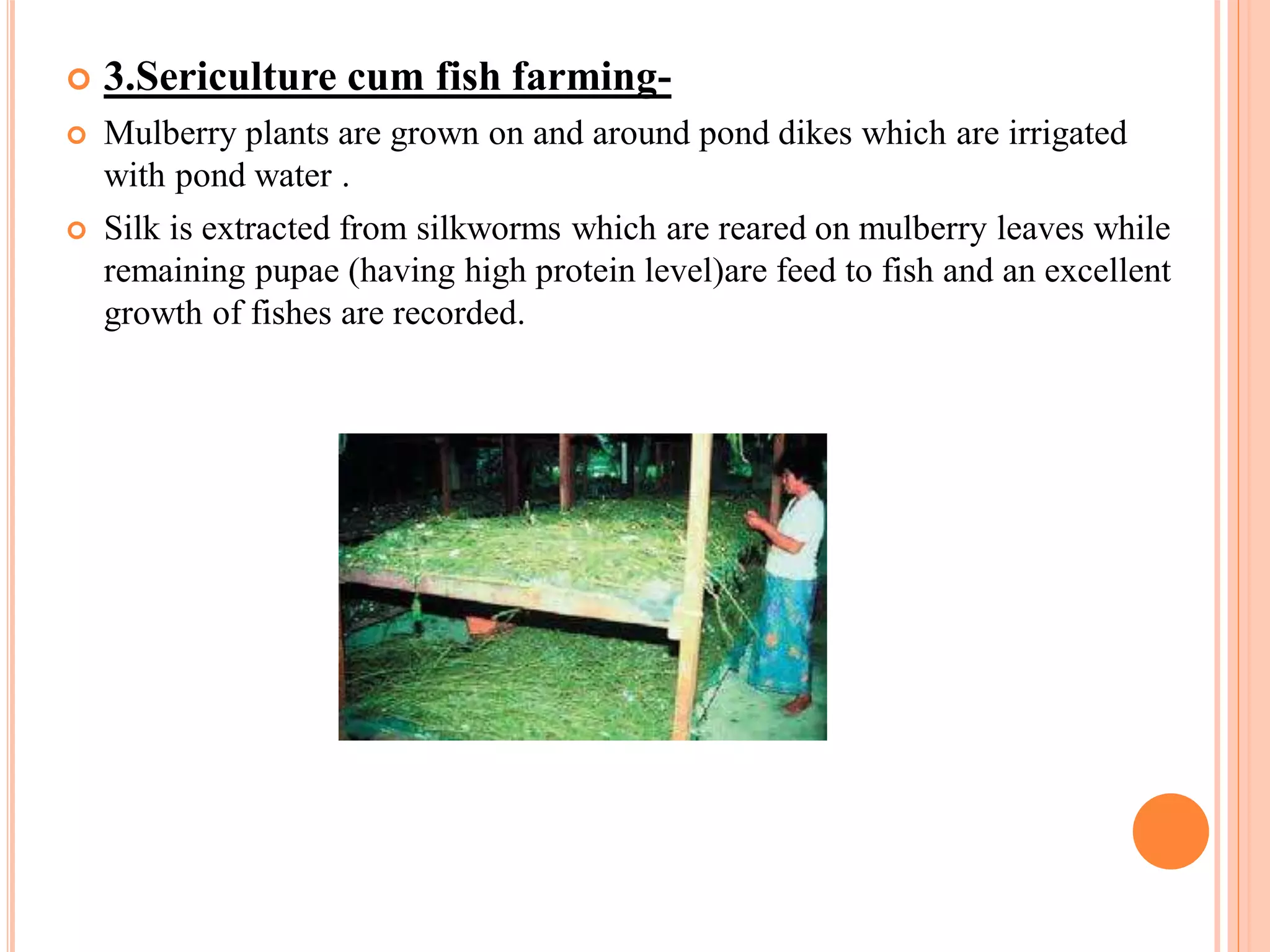
 3.Sericulture cum fish farming-
 Mulberry plants are grown on and around pond dikes which are irrigated
with pond water .
 Silk is extracted from silkworms which are reared on mulberry leaves while
remaining pupae (having high protein level)are feed to fish and an excellent
growth of fishes are recorded.
 Advantages of Integrated Farming system-
 Greater sustainability in production.
 Improve profitability due to recycling of waste.
 Solving energy crises.
 Increase economic yield per unit of area.
 Increase efficiency in the use of the existing crop and animal resources
,reduced the cost of feeding and production.
 A farmer can often integrate fish farming into the existing farm to create
additional income and improve is water management.
 Fish growth on pond can be controlled
 Effective land use and regular income.
 Improves micro climate and soil quality.
 Minimization of pollution hazards.
 Conservation of natural resources.
 Minimize the risk of failure in productivity.
 Conclusion-
 Sustainable development is the only way to promote rational utilization
of resources and environmental protection without hampering economic
growth
 The integration offish with livestock and agriculture needs to be
seriously viewed as this activity can go long way in the uplift of rural
life through manifold increase in return on investment.
 This industry may become a profitable and viable industry in a country
like India where the economy ids largely base on agriculture.
 Suitable technology has to be developed for proper treatment of waste
and all around effective utilization.
To contact- drdasacademy@gmail.com
THANK YOU

Integrated Farming System (IFC)

  • 1.
    INTEGRATED LIVESTOCK FARMINGSYSTEM Prepared by Dr. Subhrajit Das, B.V.Sc & A.H (CAU, Mizoram) M.V.Sc (LPM) DSVCKV, Chattisgarh
  • 2.
     Introduction-  Integratedfarming of fish and livestock is an old practice consisting of the culture of fish (or shrimp) associated with the husbandry of domesticated animals such as pigs, ducks, chicken, etc.  The highest productions obtained so far in integrated fish farming are with pigs, ducks and chicken.  The raising cost of fish feed has brought interest in the utilization of animal waste in pond culture, Livestock-fish integrated system.  Fishes used for this purpose-Hypothalmicthys molitrix(silver carp),Ctenopharyngodon idella(grass carp),Labeo rohita (rohu) ,(mrigal)cirrihinus mrigala ,Cyprinus caprio(common carp),Catla catla(catla).
  • 3.
    Major Types ofFishery Integrated Farming system- Livestock fish integrated system Agriculture based integrated system
  • 4.
    Types of Livestock-FisheryIntegrated Farming system- 1.Duck-Fish Integration system. 2. Poultry-Fish Integration system. 3. Pig-Fish Integration system. 4. Sheep/Goat Fish Integration system. 5. Cattle/Buffalo-Fish Integration system. 6.Rabbit -fish Integration system.
  • 5.
     Duck cumfish farming-  This system is very popular and widely practised in our country particularly in Assam,West bengal,Bihar,Orissa,Andhra pradesh, Kerala and North- eastern states.  It is one of the best livestock-farming system.  Duck droppings directly fall into the water as a direct food for fish. Duck consumes mosquito larvae,tadpoles,dragonfly larvae and snails from pond which are not consumed by fish also the babbling habit of ducks increase the available oxygen in the pond as well as release nutrient from pond.  For commercial farming Khaki Campbell, Indian Runner is preferred instead of local breeds.  About 200-240 eggs /duck/ year is expected and on an average 250 ducks/ha is recommended for duck cum integrated farming, with fish production of 3000-4000 kg /ha/year.
  • 7.
     Poultry cumfish farming-  Poultry excreta is an excellent feed for fish as it contain highly soluble organic salts, more N and P compare to other livestock manure.  Broiler, Layer in deep litter system can be raised in the integrated system.  For one hectare fish pond 500-600birds and on an average 60 kg poultry manure is required per day.  Production level of 4500-5000 kg/fish/ha can be achieve.
  • 8.
     Sheep/Goat cumfish farming-  Fifty to fifty five goats are sufficient for one hectare water bodies for Sheep/Goat cum fish farming.  Sheep/Goat manure is rich in N,P And K
  • 9.
     Cattle/Buffalo-Fish Farming- This system is very common in rural India. People generally mix cow dung with paddy husk or wheat bhusa and spread over water bodies as a ready source of fish food.  Sometimes cow dug and cattle b buffalo sheds waste channelized directly into the pond which serve as a excellent fish food directly or indirectly as a source of plankton growth in plant.  Five Cattle /buffalo are sufficient for one hectare of water bodies.
  • 10.
     Pig cumfish farming system-  Pig manure is very suitable for integrated fish farming system.  Generally pig house is constructed in the bank of pond and wastes are directly channelized into the water.  Pig manure is rich in nitrogen an phosphorus that helps in very fast growth of fingerlings.  30-40 pigs are sufficient for one hectare of water bodies.  Exotic pig breeds like yorkshire,hereford and duroc etc are prefered over indigenous pigs.
  • 11.
     Rabbit cumfish farming system-  Rabbit excreta contain-50%carbon,N-2%,P-1.33%,K-1.2%,quality manure for sustained plankton production.  300 rabbit is sufficient for 1 hectatre of water bodies.
  • 12.
     Types ofAgriculture Fishery Integrated Farming system-  1.Rice fish integration.  2.Horticulture fish integration.  3.Mushroom fish integration.  4.Sericulture fish integration.
  • 13.
     1.Rice cumfish integration.  It is very popular in some part of our country mainly in some part of west Bengal.  Advantages-  Reduced cost of rice cultivation through removal of weeds, insects and pests that are consumed by fish.  1. Improves the soil fertility & soil health.  2. Increasing economic yield per unit area.  3. Reduction in production costs.  4. Decreases farm input requirements.  5. Improves the status & livelihood of the farmer.  6. Provision of feed for fish .  7.Increase production of fish and rice.
  • 15.
     2.Horticulture cumfish integration.  Ponds bank provide suitable place which is economically useful for raising fruit plants like banana ,papaya and vegetables(chilli,ginger,turmeric).  Cultivation of different fodder on pond dikes like napier grass,sudan grass,maize and alfa alfa is also useful as it provide food for livestock.  Residues of vegetables can be recycled into the fish ponds.
  • 16.
     3.Sericulture cumfish farming-  Mulberry plants are grown on and around pond dikes which are irrigated with pond water .  Silk is extracted from silkworms which are reared on mulberry leaves while remaining pupae (having high protein level)are feed to fish and an excellent growth of fishes are recorded.
  • 17.
     Advantages ofIntegrated Farming system-  Greater sustainability in production.  Improve profitability due to recycling of waste.  Solving energy crises.  Increase economic yield per unit of area.  Increase efficiency in the use of the existing crop and animal resources ,reduced the cost of feeding and production.  A farmer can often integrate fish farming into the existing farm to create additional income and improve is water management.  Fish growth on pond can be controlled  Effective land use and regular income.  Improves micro climate and soil quality.  Minimization of pollution hazards.  Conservation of natural resources.  Minimize the risk of failure in productivity.
  • 18.
     Conclusion-  Sustainabledevelopment is the only way to promote rational utilization of resources and environmental protection without hampering economic growth  The integration offish with livestock and agriculture needs to be seriously viewed as this activity can go long way in the uplift of rural life through manifold increase in return on investment.  This industry may become a profitable and viable industry in a country like India where the economy ids largely base on agriculture.  Suitable technology has to be developed for proper treatment of waste and all around effective utilization.
  • 19.
  • 20.