COCHRANE DATABASE OF SYSTEMATIC REVIEWS
  INDEXING, CITATIONS & BIBLIOMETRICS


Adam Finch
Bibliometrics Analyst
Impact Factor: Meaning & Calculation
•
    Evaluates the impact of a journal based on a citation as a unit of quality
•
    Based on ISI’s Web of Science and released in an annual Journal Citation Report
•
    Essentially a measure of average citations per article


Impact Factor for JCR Year x =                   Citations in Year x to Papers from x-1 and x-2
                                                 Number of Source Items in x-1 and x-2

NB: Source Items are Articles, Reviews and Proceedings Papers; only these papers contribute to the
    denominator. Citations counted on the numerator, however, can be to any document type.

Cites in 2009 to articles published in: 2008 = 2592  Number of articles published in:    2008 = 526 
                                        2007 = 3982                                      2007 = 637 
                                        Sum: 6574                                        Sum: 1163 

        Calculation:                       Cites to recent articles              6574    =    5.653
                                          Number of recent articles              1163 
Impact Factor: Strengths & Weaknesses

  + Average cites-per-article makes sense

  + Comparatively easy to understand

  + Can be duplicated, predicted and simulated

  + Established and recognised metric

  + Broken down into ranked subject categories


  – Inconsistent standards for inclusion

  – Affected by ‘ citation inflation’

  – Error correction difficult

  – Subject area dependency

  – Self-citation open to manipulation
2010 Impact Factor
The Impact Factor will probably rise next year. 2010 IF looks at 2010 cites to 2009 and 2008 papers.


                                                          2008              2009              Change
       Immediacy Index                                    1.131             1.311               15.9%
       Immediacy Index for Medicine, General & Internal   1.295             1.171               -9.6%

         The Immediacy Index looks at citations in a given year to articles published in the same year.
         E.g. 2009 cites to 2009 papers ÷ # 2009 papers. A rise can indicate a strong year of papers.
Web of Science
Web of Science
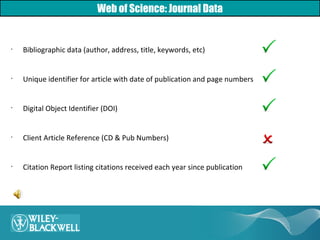
Web of Science: Journal Data


•
    Bibliographic data (author, address, title, keywords, etc)


•
    Unique identifier for article with date of publication and page numbers


•
    Digital Object Identifier (DOI)


•
    Client Article Reference (CD & Pub Numbers)


•
    Citation Report listing citations received each year since publication
Web of Science: Cochrane Database of Systematic Reviews


•
    Bibliographic data (author, address, title, keywords, etc)


•
    Unique identifier for unique article with date of publication


•
    Digital Object Identifier (DOI)


•
    Client Article Reference (CD & Pub Numbers)


•
    Citation Report listing citations received each year since publication
Web of Science: Acquiring and Repairing the Data
•
    Manually edit ISI article list of 2005—2008 papers so it matches actual content

•
    Search for and download all citations to CDSR for the past several years

•
    Match 15,000 citations to 2,431 target articles using:-
     
         Cited DOI
     
         Cited Article Reference
     
         Unique author in year

•
    Add Review Group data from Editorial Office records

•
    Download all reviews in ISI subject category and process through in-house tools
     
         Author                     
                                        Institution                
                                                                       Citation Incidence
     
         Document Type              
                                        Country                    
                                                                       Citing Characteristics
     
         Region                     
                                        Review Group               
                                                                       Top Cited Articles

•
    Analysis and reporting took days...
    Data acquisition and cleanup took weeks...
Analysis Highlights: CDSR
•
    Standard analyses less useful for CDSR.


•
    Author loyalty. Of the 863 authors publishing reviews in CDSR that contributed to the
    2009 Impact Factor, only 11 had more highly cited papers published elsewhere.

•
    Index comparison. Unfortunately, Elsevier’s Scopus does not provide a useful
    alternative data source.
     
         The Scopus citation matching algorithm finds even fewer cites than WoS, despite looking at twice the
         number of citing journals.
     
         Scopus contains a larger number of duplicate version entries due to the erroneous addition of variant
         Pubmed data to the records supplied by Wiley-Blackwell.
Analysis Highlights: CDSR
Analysis Highlights: Subject Category
Thank you

 Any questions or feedback?


E-mail: burquhart@wiley.com

Cochrane Database of Systematic Reviews: Indexing, Citations & Bibliometrics

  • 1.
    COCHRANE DATABASE OFSYSTEMATIC REVIEWS INDEXING, CITATIONS & BIBLIOMETRICS Adam Finch Bibliometrics Analyst
  • 2.
    Impact Factor: Meaning& Calculation • Evaluates the impact of a journal based on a citation as a unit of quality • Based on ISI’s Web of Science and released in an annual Journal Citation Report • Essentially a measure of average citations per article Impact Factor for JCR Year x = Citations in Year x to Papers from x-1 and x-2 Number of Source Items in x-1 and x-2 NB: Source Items are Articles, Reviews and Proceedings Papers; only these papers contribute to the denominator. Citations counted on the numerator, however, can be to any document type. Cites in 2009 to articles published in: 2008 = 2592  Number of articles published in: 2008 = 526    2007 = 3982    2007 = 637    Sum: 6574    Sum: 1163  Calculation:  Cites to recent articles  6574 =  5.653 Number of recent articles  1163 
  • 3.
    Impact Factor: Strengths& Weaknesses + Average cites-per-article makes sense + Comparatively easy to understand + Can be duplicated, predicted and simulated + Established and recognised metric + Broken down into ranked subject categories – Inconsistent standards for inclusion – Affected by ‘ citation inflation’ – Error correction difficult – Subject area dependency – Self-citation open to manipulation
  • 4.
    2010 Impact Factor TheImpact Factor will probably rise next year. 2010 IF looks at 2010 cites to 2009 and 2008 papers. 2008 2009 Change Immediacy Index 1.131 1.311 15.9% Immediacy Index for Medicine, General & Internal 1.295 1.171 -9.6% The Immediacy Index looks at citations in a given year to articles published in the same year. E.g. 2009 cites to 2009 papers ÷ # 2009 papers. A rise can indicate a strong year of papers.
  • 5.
  • 6.
  • 7.
    Web of Science:Journal Data • Bibliographic data (author, address, title, keywords, etc) • Unique identifier for article with date of publication and page numbers • Digital Object Identifier (DOI) • Client Article Reference (CD & Pub Numbers) • Citation Report listing citations received each year since publication
  • 8.
    Web of Science:Cochrane Database of Systematic Reviews • Bibliographic data (author, address, title, keywords, etc) • Unique identifier for unique article with date of publication • Digital Object Identifier (DOI) • Client Article Reference (CD & Pub Numbers) • Citation Report listing citations received each year since publication
  • 9.
    Web of Science:Acquiring and Repairing the Data • Manually edit ISI article list of 2005—2008 papers so it matches actual content • Search for and download all citations to CDSR for the past several years • Match 15,000 citations to 2,431 target articles using:-  Cited DOI  Cited Article Reference  Unique author in year • Add Review Group data from Editorial Office records • Download all reviews in ISI subject category and process through in-house tools  Author  Institution  Citation Incidence  Document Type  Country  Citing Characteristics  Region  Review Group  Top Cited Articles • Analysis and reporting took days... Data acquisition and cleanup took weeks...
  • 10.
    Analysis Highlights: CDSR • Standard analyses less useful for CDSR. • Author loyalty. Of the 863 authors publishing reviews in CDSR that contributed to the 2009 Impact Factor, only 11 had more highly cited papers published elsewhere. • Index comparison. Unfortunately, Elsevier’s Scopus does not provide a useful alternative data source.  The Scopus citation matching algorithm finds even fewer cites than WoS, despite looking at twice the number of citing journals.  Scopus contains a larger number of duplicate version entries due to the erroneous addition of variant Pubmed data to the records supplied by Wiley-Blackwell.
  • 11.
  • 12.
  • 13.
  • 14.
    Thank you Anyquestions or feedback? E-mail: burquhart@wiley.com